



Abstract
Today’s philosophy and practice of costume ageing, even in mainstream commercial Bollywood output, skews strongly towards an avowed ‘realism’. Consequently, accurate ageing and the subtle impressions of wear are valued in contrast to the ‘theatrical’ and ‘inauthentic’ ageing of most pre-1990s films (and some films still today). Designers argue that costume ageing has simply improved but this answer oversimplifies the complex narrative and organisational imperatives at stake. Older, more theatrical costume ageing, embedded within the melodramatic mode of expression, worked for its audience because of the explicit contrast it drew with costumes that were pristine. The distinction between new and aged costumes served many functions, among them the marking of vulnerable versus invulnerable bodies. Stars, dressed in new, unworn clothes, achieved their near mythic identifications in part because their costumes resisted the rigors of time and experience. In this past era, it was sufficient to pile on dirt and tear fabric to achieve effective ‘ageing’ as opposed to carefully mimicking how clothes actually age. This type of quick, crude ageing was both a consequence of—and a rationalisation for—scant time spent in costume ageing (and fabrication) in pre-production. New practices that strive for ‘realistic’ ageing thrive in expanded pre-production schedules. Alongside a resilient poetics of aged costume, ‘relaxed’ costumes lend texture to the film’s ‘lived world’. Now, the goal of ageing is to index the unseen time that characters have experienced outside the film’s temporal boundaries.
Harshaali’s character belongs to the Pakistan side of Kashmir and she hails from a poor, shepherd family … I made her a hand-woven sweater with a hoodie … We ensured that the sweater looks dirty, mucky; her clothes were aged, faded and hard-washed to create the perfect look … We had an actor called Mir (Sarwar) who plays Harshaali’s father in the film … Almost six months before we started shooting in Kashmir I told Mir to start collecting old phirans (a kind of tunic) from the locals and give them money for new ones. He helped me collect almost 100 phirans because I wanted that aged look; I didn’t want anything to look new. (Verma, 2017)
Achieving the Real
Discussions of film costume in interviews with Indian designers cycle reliably through issues such as understanding the character, perfecting the colour palette, the challenges of dressing film stars and sourcing costumes in a hurry or on a budget. More often than not, magazine articles also demonstrate an astute awareness of the reputation of Hindi film costume for overstatement and gaudiness, with the designer taking ample care to position him or herself at a distance from this particular filmi tradition. This is especially so when costume designers offer descriptions of costume ageing and distressing that propel the costume away from lavish spectacle and towards ordinariness, and even the tawdry. At these moments, costume design and costume discourse is overtly and proudly oriented towards what filmmakers refer to as ‘realism’. 1 Disparate references to the ‘real’ have been at the root of claims to distinction by costume designers for some years but only recently has this come to mean creating costumes whose primary function is to fit, almost without notice, into the character’s quotidian existence. In the twenty-first century, the Mumbai filmmaking environment has been rapidly changing, and present-day designers often speak about costume ageing as part and parcel of the achievement of greater professionalism in the industry. The quote that opens this article concerns Bajrangi Bhaijaan, one of the biggest box office hits of 2015, starring the hugely popular superstar Salman Khan. Particularly noteworthy is the equation the designer draws between the ‘perfect’ look and the production of aged, worn and even dirty costumes. Although the designer does not use the term ‘real’ in the quote, the word is implicit in the careful recounting of pseudo-ethnographic research into how people of the social status and identity of the characters actually dress in the settings to which the film alluded.
The issue of costume ageing came up right at the outset of my ethnographic research into costume production in the Mumbai film industry. In the course of one week in March 2002, two designers, in two separate interviews, told me that a particular frustration they had with commercial cinema was its persistent indifference to costume breakdown (another term for ageing). The comments of two designers by themselves were not much of an indicator but they set me wondering about what ageing did in a film, as a means to get at how a concern (or a lack of concern) for ageing might reveal something deeper about the differences between films, between designers and between the kinds of films and characters that were being shaped. For what their commentary did not explain was that aged costume does appear—and has appeared—repeatedly in the very films they criticise. Moreover, since it takes time to age a costume even crudely, its use in an industry where time is scarce alerts us to its importance. If aged costumes have had a distinct place in mainstream films throughout, then why would contemporary designers claim that ageing was given short shrift in the past? The answer lies, I argue, in how aged costume in films of the twenty-first century is judged to be more ‘real’ than aged costume that appeared in films throughout the twentieth.
I propose that the presence, absence and apparent competence of costume ageing in Hindi film have less to do with differences in skills or a gap between coarse and sophisticated aesthetics than they do with the demands of narrative form and style of characterisation, as well as the kinds of organisation and labour responsibilities that filmmaking involves. As signs, aged costumes have communicated in different ways about the film’s time and duration; as products of specialised techniques and organisational efforts, aged garments embody shifting priorities in how actual time, money, materials and labour are deployed. In other words, to simply state that certain costume treatments have developed as a result of better design intelligence and a heightened seriousness to film practice is to oversimplify the matter. In this article, I address the crucial elements that aged costume have lent to Hindi films both old and new, arguing that the choice to create ‘realistic’ looking costumes lies at the heart of a film’s claims about time, duration and the characters’ experiences. I draw on interview data with designers and dressmen (the industry’s set costumers), film analysis and ethnographic research in India and North America to delve more deeply into costume ageing and distressing as a practice and as an element in film design. 2
What is Ageing?
Costume ageing involves dyeing, painting, abrading and deconstructing a new article of clothing so that it appears old (Dryden, 1993; Parry, 2017). The techniques of costume ageing ultimately derive from theatrical precedents, and probably entered the Indian film industry in its earliest years alongside other stage practices. Until the early 2000s, costume breakdown and ageing in Hindi film was the routine and exclusive responsibility of dressmen (termed costumers in the North American and European film industries), who did the work on set under the eyes of the direction team. 3 Costume ageing of any kind has had to fit within the tight and unrelenting constraints of Hindi film production. The industry has never employed any specialists in breakdown or ageing, who can work on costumes at the same time as other costume operations are being performed, that is, in pre-production. Instead, ageing has been part of a strictly linear process of costume construction, in which costumes for each schedule come to set from a variety of designers and dresswalas (costume shops) operating independently of each other. Dressmen worked with the costume designer (previously termed the ‘dress designer’) but not officially under the costume designer’s direction. In fact, the prevailing pattern has been for dressmen to take charge of the costumes at the very moment the designer relinquishes control of them, which is once the clothes arrive on set.
From creation to eventual disposal, costume—and aged costume in particular—charts a ‘cultural biography’ (Kopytoff, 1986) that is distinctly different from clothing. Some costumes are made new specifically for the film, while others are diverted from the path of mundane use to become part of a costume ensemble. A costume’s use value then is not realised in consumption so much as in becoming a factor in yet more production (Wilkinson-Weber, 2010b). Thereafter the progress towards disuse and final disintegration is extremely rapid, unless a garment is ‘recycled’ in another film or its exchange value realised (as a star costume) in auction. 4 All costumes, even those straight from the tailor’s bench, will display the stresses of use on set and under lights. But for the aged costume, the normal processes of wear are not simply accelerated but intensified in order to impersonate a cultural biography in which a multitude of interactions and exchanges have taken place. Signs of wear must index both the day-to-day effects on the costume of the body that imaginatively occupies it (sweat, stretching and distortion of the costume’s shape), as well as the outcomes of the clothed body interacting with its environment (stains from substances like food, dirt or smoke; tears and holes from cloth being rubbed against walls, doors, trees and so on).
The difference between clothes and costume is compounded by conventions dictating that costume ageing should not simply replicate everyday processes of deterioration. Making use of artificial means not only speeds up the process of disintegration, it also allows for aged costumes to avoid the taint of contact with other human bodies. The convention that lead actors should wear new clothes that have been artificially aged, rather than used clothes whose ageing has been done by another person, living an ordinary life, is widely shared in film industries around the world. The only instances in which costumes come by their wear through the routines of life outside of the set are when actors bring their own clothes, or when used clothes are sourced from second-hand outlets. 5 There are many reasons to age costumes, from the need to control the precise degree of ageing, to prevailing filmmaking etiquette in which giving the lead actors used clothing would be an enormous insult to their prestige. It is tempting to speculate, though, that the paradoxical fusing of the abject with not simply power, but sanctioned power, is best realised if the costume also materialises this contradiction. 6
Numerous interviews with dressmen confirm that costume ageing involves the ingenious repurposing of tools and substances intended for other uses. As ager-dyers have learned outside India as well as in, tea is an excellent medium for making clothes look dingy and yellowed. The warm climate of India means that clothes that are dunked in tea (or that need to be dyed some other colour at the last minute) dry very quickly in the sun, and serendipitously contort into stiff wrinkles and creases that also contribute to the impression of a well-worn item of clothing. To make clothes look dirty, dressmen report applying ‘umber powder’ (dried pigment made from earth, differing from ordinary dirt by virtue of its fineness and controlled colour) with a brush or even with their hands to the knees, elbows and neckline of garments where dirt tends to accumulate. All these quick and effective techniques are a boon to the dressmen, who must shift costumes from a state of newness to one of dilapidation in a very short time. On the other hand, eroding the fabric to make it appear worn is particularly tricky to effect well when time is short, and dressmen have in the past resorted to using tools like pliers or even scissors to tear and break down the costume’s material. If the director (or the actor) were to demand that a costume look even dirtier, it was more than likely to get stamped into the ground as to go through a more thoughtful, measured process of ageing.
These practices alert us to two important qualifications of ageing under the regime of mainstream commercial films until relatively recently. First, that disfiguring a costume was equated with ageing, no matter that real clothes do not move straightforwardly from newness to filthiness, and they rarely if ever endure being cut up with scissors. Second, such impromptu actions inevitably subordinated continuity to the immediate needs of the shoot. Say a scene being shot required an actor to wear a dirtied shirt: that shirt was aged on the spot. The shirt, now somewhat distressed, would be preserved for reshoots or to be used for scenes later in the film that might be shot days, or even weeks, later. No one thought to make, or even had the opportunity to make, a set of duplicates, with different degrees of wear, to ensure there were no disruptions to continuity in case reshoots involved the appearance of the costume at an earlier point in the action. Needless to say, restoring an aged costume to its previous, pristine state would be out of the question.
Until the first decade of the twenty-first century, pre-production time was generally short to non-existent for the vast majority of films being made in Mumbai. This meant there was no time to age costumes in advance, with the result that the tricks and tools that skilled dressmen employed were primarily adapted to speed. As a result, the job of implanting subtle and complex signs of ageing was to all intents and purposes impossible. Yet the work the aged costume performed in the film did not suffer because of these limitations; in fact, in this respect, the ageing that could be done was typically sufficient for narrative demands.
Melodrama and the Aged Costume
Commercial Hindi films—especially those of the twentieth century—have become famous for their fantastic and showy outfits; yet it is easy enough to think of occasions in which broken down and worn costumes have been critical to a scene’s effect. Fights and accidents require heroes, heroines and villains alike to end up with torn, bloodied or dirtied clothes. Poverty-stricken, sick and abused characters also appear clad in ruined clothes that underscore the extent of their powerlessness. In other words, there has never not been some requirement for costumes to be aged, in as much as characters such as these, either permanently in the grip of conditions that forced them into aged clothes, or only temporarily overwhelmed by them, were necessary to push the plot along.
In melodrama, broken-down costumes invoke the spectre of time and its disfiguring powers. Ruined costumes acquire their significance from the direct and stark contrast they make to the pristine costumes worn by characters with wealth and power. In the majority of films belonging to the mainstream cinema of the pre- and early post-Independence decades, four functions of aged clothing can be teased out: first, the deteriorating costume as a schematic representation of time passing (e.g., the heroine’s progressively ravaged sari in Biraj Bahu [Bimal Roy, 1954]); second, a means to clarify social status in situations where cues might otherwise be ambiguous; third, the contrast of aged and pristine costume as metonyms of vulnerable and invulnerable bodies; and fourth, broken-down clothing as a means to locate characters and relationships within the film’s moral universe. In this last instance, the melodramatic mode of the twentieth-century Hindi cinema, which demanded the highly affective enactment of moral force and conflict, is very much at work (Thomas, 1995; Vasudevan, 1989). The ordinary characters that populate melodramas are not intended to be apprehended as complex, imaginary persons so much as embodiments of moral and ethical positions that are evident in their words, gestures, acts and of course their costume (see Gledhill, 1991). As a result, costume ageing is most obvious within film narratives where disrepair and novelty interact dramatically to underscore melodramatic themes.
Perfection counterposed with disarray encapsulates the contrast of the rich versus the poor, or the fortunate versus the ill-fated. In fact, Hindi film’s obsession with fashionable clothing since the silent era conforms very well to this pattern of oppositions. Fashion distinction, after all, comes from the mastery of endless reinvention, perpetually discarding what one has in favour of what is new. From pre-World War II to the immediate post-Independence period, the mere appearance of stars in beautiful clothes designed just for them, and just for those roles, effortlessly evoked affluence and an easy familiarity with the rewards of modernity (Wilkinson-Weber, 2005, 2014). Wearing one new costume after another, as each scene gave way to the next, and as a song sequence played out, underscored the extraordinary power of the hero and heroine to renew themselves through the display of eye-catching, immaculate clothing.
Throughout this period, an alternative way to demonstrate the link between power, charisma and the perfect costume was the spectacular period or ‘historical’ film. The sheer scale of set and costume production for Mughal e Azam (K. Asif, 1960) made it a landmark film to which subsequent, lavish recreations of royal life and courtesan culture have repeatedly referred. The magnificence of aristocratic life, particularly as it reproduced itself prior to—or in spite of—British colonial domination, is even now embodied in breath-taking costumes that never get spoiled or even wrinkled (see, e.g., Amrapali [Lekh Tandon, 1966], Asoka [Santosh Sivan, 2001], Jodhaa Akbar [Ashutosh Gowariker, 2008] and Bajirao Mastani [Sanjay Leela Bhansali, 2015]).
Female stars from the 1960s onwards employed personal designers to ensure that their costumes were as spectacular and contemporary as possible. By the 1960s, however, the appearance of fashionable clothing was in itself insufficient to communicate modernity and luxury. By stages, the use of multiple costume changes in song sequences, and even in the dramatic scenes, was substituted to intensify the impact of a fashionable item. In the 1990s, the arrival of professional fashion designers along with India’s pivot to commodity capitalism generated film costume as, in Mazumdar’s (2007, p. 99) words, ₹fashion show’, global in its reference points, and aimed squarely at a new, moneyed middle class. In fact, the aged costume did not need to appear at all for the comparative point to be made: the replacement of one new garment by another, seemingly without limit, was effortlessly understood as the antithesis of the single dirty, ragged costume of the villager, the prisoner or the beggar.
In sum, the rule that countless films of the 1960s to 1990s followed was that as long as ageing’s overriding objective was achieved—to unequivocally illustrate the predations of time upon a character that was either temporarily or irrevocably vulnerable to it—then the question of whether the distressing approximated to or deviated from the natural wear of a garment never came up. It is no accident, therefore, that most of the ageing in these films seems overwrought to contemporary eyes, the kind of ageing that contemporary ager-dyers and costume designers today call ‘theatrical’. Theatrical ageing means that garments are given holes where holes would be unlikely to form, and the material is so distressed as to appear almost pulverised. It is a kind of ageing that is appropriate in stage productions where effects need to be amplified to be visible, but the magnification of the screen invites a completely different and more nuanced visual experience.
One example of the narrative contrast between new and aged clothing comes from Waqt (Time, Yash Chopra, 1965). The film is justly celebrated for its depiction of the fashionable leisure class of contemporary Bombay, complete with circular beds, American cars and, from a costume perspective, leather jackets, bolo ties, svelte saris, body-hugging kameez (blouses)and churidars (tight-fitting trousers to go under long shirts and blouses). Less often noted is the continuous counterpoint between these fashionable, desirable items and the aged and unremarkable clothing of characters that through misfortune or plain malice have fallen upon desperate times (Figure 1). In the aftermath of an earthquake that separates them, the mother, father and three young sons of a once-affluent family chart different courses until fate brings them back together. The various signs and substance of material deprivation are only eradicated at the point that the unraveled family is unified, with a final, brief scene of conventional prosperity played out at the scene of the initial disaster.
Time, which is necessary for the various threads to be rewoven, varies in how it treats some members of the family compared to others. Grown-up middle son Ravi, now a barrister, is in a romance with Meena, the pampered daughter of family friends. Along with his step-sister (Meena’s best friend), they make up a fortunate trio, all grown to gorgeous adulthood in harmony with time, and now relatively unaffected by it. In scene after scene, their clothes are impeccable, fashionable and enviable. Father Kedarnath and mother Lakshmi, in contrast, are destroyed by time as it saps them of youth and energy, the former unjustly imprisoned, the latter reduced to poverty. Time leaves inerasable evidence of its effects in their pitiful costumes. Meanwhile eldest son Raju and youngest Vijay are at the margins of the costume exegesis. Raju, as a rakish thief, wears an array of sharp suits, colourful leisure wear and even a cat burglar outfit, to suggest a kind of slipperiness that evades time’s consequences. Vijay, on the other hand, must make do with the ambiguous implications of a uniform (he works as a chauffeur) that can be repeatedly cleaned and pressed, but which lacks the power of the ever-changing costume to avoid entirely the effects of wear and tear. Little of the ageing that we see possesses any subtlety; it is enough that it is done, or partially done, for the crucial aim is for the audience to register these differences as embodiments of different timescapes and moral positionings within the film. At the film’s conclusion, the patrifamily (the idealised Indian family centred on a father and his sons) is lined up dressed in fine clothing: suits for the sons, kurta pajama for the father, a vivid and colourful sari for the mother and, most striking of all, demure saris in pastel shades for the new, markedly less modish daughters-in-law. The family’s fragments have now been integrated into the rediscovered whole.
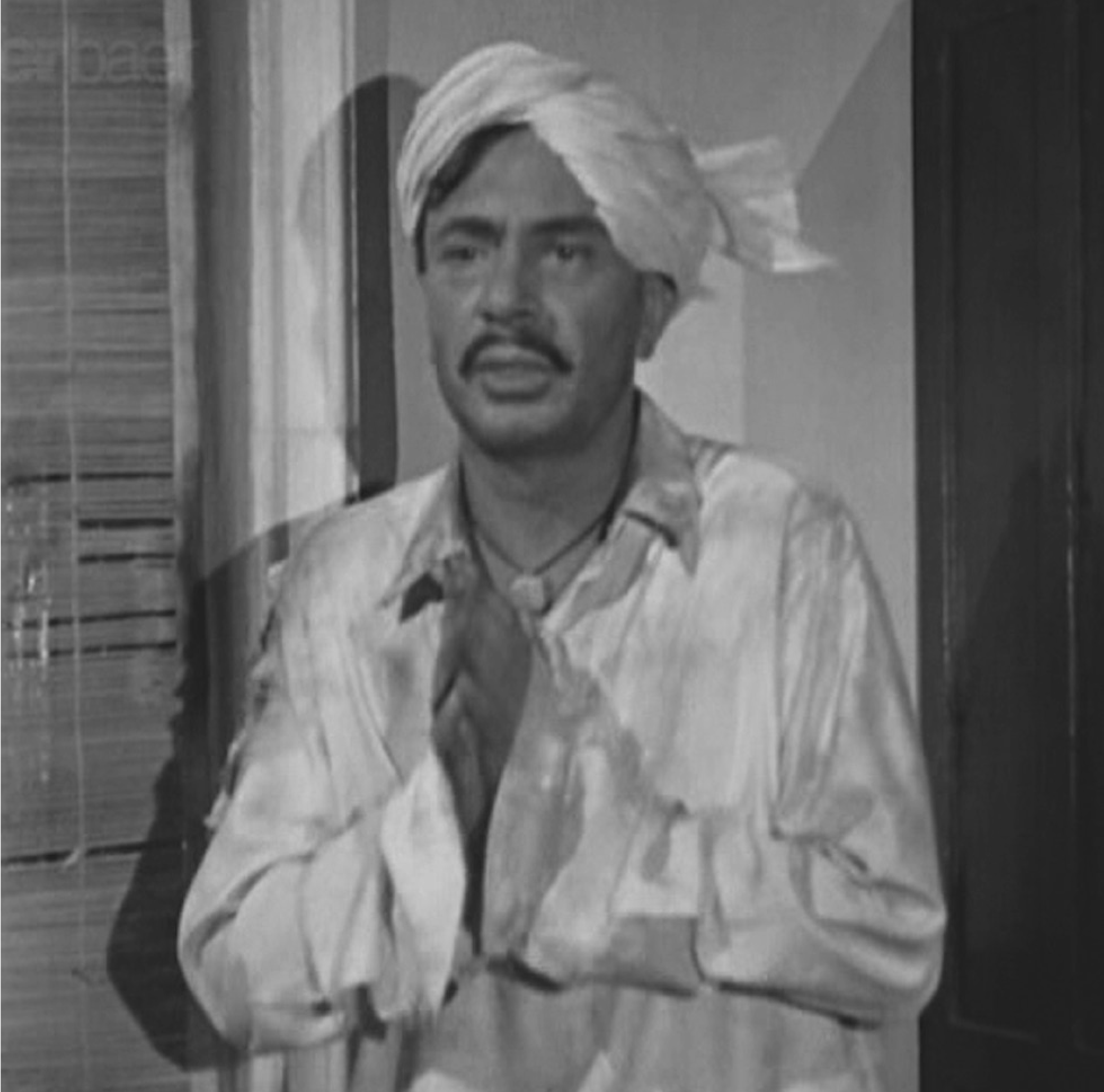
An appeal to the ‘common sense’ realisation that time takes its toll on materials can also be used to push and pull the audience into complex moral realisations. Soiled and ragged clothing, in its betrayal of social norms of public deportment, is a source of shame for the wearer, to which the proper response is aversion, and possibly pity. A similar film to Waqt in its recounting of a family’s separation and triumphant reunion, Amar Akbar Anthony (Manmohan Desai, 1977), gives us Nirupa Roy as the long-suffering, blind mother (and apparently widow) Bharati arriving disheveled and dirtied into the midst of a crowd of worshippers of Sai Baba. Having narrowly escaped the clutches of two of the film’s villains, she crawls into the temple enclosure in a crumpled and torn sari and a stained blouse. In a matter of moments, however, Sai Baba restores her sight, in acknowledgement of her virtue and the unjust suffering to which she has been subjected. While the costume continues to testify to her ordeals as this scene and the next continue, the saint has effected a bodily regeneration that very quickly her costume reflects (within a few scenes she appears in a clean, neat sari and even applies sindoor on learning that her husband is still alive). Counter to a normative reading that would reflect shamefully upon Bharati’s condition, the dirtied costume here casts the wearer in a meritorious position (Figure 2).
In an equally famous example from the film Mother India (Mehboob Khan, 1957), the long-suffering Radha (played by Nargis), having survived a devastating flood, rejects a devious moneylender’s sexual advances, then proceeds to chastise his household goddesses while her face, her arms and her sari are caked in mud. The script and Nargis’s acting make plain her shift from piteousness to confidence (and anger). Arguably, however, in both this case and the example from Amar Akbar Anthony, the emotional power of the scene derives from the momentary identification of abjection (and distressed clothing) with unassailable moral integrity (Figure 3).
A final variation on the moral complications of aged versus new clothing comes from Raj Kapoor’s Shree 420 (Raj Kapoor, 1955). In this film, the new and artfully renewed clothes of the wealthy fail to measure up to the unpretentious, aged dress of the poor. Arriving in the big city in ill-fitting clothes and shoes that are falling apart, the hero Raj transforms himself into a polished and dishonest man about town, wearing the smart suits that he purloins from the laundry where he works. His eventual redemption through the rejection of the city’s deceitful allure is sealed with his re-adoption of his old costume. In showing us the place where dirty clothes are made to seem new, the film uncovers the power of the affluent to erase time and achieve invulnerability through deceptive regeneration (Figure 4).


New Costumes: New Practices
In sharp contrast to the prevailing narrative logic and practical constraints of costume ageing in most twentieth-century films, today’s practices strive towards a naturalism 7 that mimics how clothes actually wear out. Since the late 1980s and early 1990s, coinciding with a sea change in India’s integration into the global economy, films have shown a marked shift in subject matter, aesthetics and production practices. The effects of an increasing familiarity with international media and the arrival of a neoliberal, consumerist economy are most apparent among the upper middle classes, or the very people who make films. Among the changes that have been introduced to filmmaking has been an altered approach to the fabrication and uses of aged costume across the spectrum of Hindi cinema, as described in the introduction. Resources for film sets, props and costumes have expanded just as the multiplex audiences, with visual sensibilities shaped by expanded access to television and global media, have arrived to appreciate them.
When I began fieldwork on costume production in Hindi cinema in 2002, these adjustments were still very much in progress. The chief points of contention were sartorial taste and fashion appreciation, and the only designers who brought up the topic of costume ageing had acquired most of their experience in the parallel cinema, Merchant-Ivory productions, or foreign co-productions. Films in the parallel cinema always tended to serve as an ‘other’ to the commercial industry in terms of stories and mise en scène, zeroing in on the dilemmas of ordinary life in the nation, including struggles of gender, caste and class. Scripts, sets, location and costumes, meanwhile, were designed to follow a naturalist aesthetic so as to impress upon the audience the authenticity of the world shown on the screen. Merchant-Ivory films drew strongly on British filmmaking influences, and Cosprop, the London-based period costume maker, was involved in substantial collaboration with Indian craftspeople and designers. Other co-productions with foreign teams generally involved the imposition of costume department conventions at all levels except for on-set costumers: dressmen were at the centre of set costume as they were in commercial film.
Ten years later, in 2012, designers who had worked on major star vehicles as well as hatkē (off-beat) films brought up to me the need to age costumes without my prompting them to do so. Each one stressed the importance of verisimilitude. Indeed, just as the forms and conventions of popular, commercial film found their way into smaller budget, independent filmmaking (pastiches of song sequences; melodrama played for laughs), so the dedication to naturalism of films that showed ‘actuality’ crept into mainstream features (Dwyer, 2011). With greater access to better film technology and techniques, naturalistic visual conventions became one of the most overt contemporary measures of quality for a broader swathe of cinematic output.
In stark contrast to NRI films, ‘feudal family romances’ of the 1990s and all the earlier films in which wealthy (and impeccably dressed) characters predominated, films that took on tougher subjects revolving around fallible, vulnerable protagonists demanded closer attention to details like costume ageing. In the vanguard of these developments were director Mani Ratnam, production houses like Ram Gopal Varma’s Factory and, later, Anurag Kashyap’s Phantom Films. A ‘pervasive desolation’, in Biswas’s terms (2017, p. 21), came to pervade films about contemporary Mumbai, and a gritty aesthetic dominated films that depicted the city’s seedy underbelly, or down-at-heel provincial towns and villages (Sinha, 2013). 8 Now that making costumes (and settings) ‘real’ had become a sought-after component of contemporary commercial films (instead of or in addition to the exotic and the fantastical), worn and broken-down costumes took their place within the eroded fabric of cityscapes or the grim vistas of rural life recognisable to many viewers. In these contexts, aged costume assisted in the construction of characters whose actions and interactions, while still melodramatic by the minimalist standards of American acting, were coming to draw more on emotional and sensory naturalism.
Even films about young urbanites and cosmopolitan middle classes have subscribed more and more to the naturalistic aesthetic. Farhan Akhtar’s Excel Entertainment productions exemplified this trend, starting with Dil Chahta Hai (Farhan Akhtar, 2001) (discussed later). By the 2010s, a variety of production houses, sometimes co-producing with a conglomerate like Viacom, were making films that situated characters very obviously in a real, and often dirty, world—Kahaani (Sujoy Ghosh, 2012), Queen (Vikas Bahl, 2014) and Airlift (Raja Krishna Menon, 2016), to cite just a few.
Because costumes, to a greater extent than before, must be subordinated to the demands of naturalistically conceived characters and story, designers now strive to take account of real world conditions and experiences in more ethnographic ways. Underlying ageing processes is a new approach to ‘sampling’ the logic of material life. Invoking the example of the ‘real’ as the model for their practices, designers and dressmen use examples of clothing actually aged through wear to guide their efforts. The position of a bended knee within a trouser leg serves to focus the dressman or designer’s attention on where stains and dirt might appear; the thinning of the fabric around a shirt collar; the pilling of fabric where it is constantly rubbed—all these are factored into the decisions as to how a costume should be processed before it is ready to wear on set. The work of ageing, in these cases, is intended to be invisible, since it is there to affirm and consolidate the film’s naturalism by producing costumes that escape the notice of the viewer altogether. In such a philosophy of ageing, the results are so continuous with everyday experience that they literally vanish into scenarios that are immediately and unquestionably persuasive.
The stress upon research and location scouting in several recent films that straddle the boundary between the hatkē and the commercial hints at the larger aesthetic and philosophical shift going on. For Highway (Imtiaz Ali, 2014), Aki Narula reports that he was told he had to keep the costumes ‘as real as possible’ (2014). Sachin Lovelekar (costume designer along with Namrata Jani for Madaari [Nishikant Kamat, 2016]) remarks that ‘creating a real world has become my style of specialisation’ (Upadhyay, 2016). Aki Narula’s work for Highway involved sourcing used clothing in the location that would provide an instantly aged and ‘authentic’ look for the characters.
9
And Shaahid Amir and Neetu Singh say of their work on Sarbjit (Omung Kumar, 2016) that ‘[t]he accessories were totally realistic keeping in mind the economic condition of the family. All the costumes were tailored to suit the look of the film. We used handwoven fabrics and aged them ourselves’ (Lakhi, 2016). Finally, Rick Roy, designer for Begum Jaan (Srijit Mukherji, 2017), credited star Vidya Balan with agreeing to allow her clothes to appear less than perfect:
None of the clothes she wore were ironed. It was her idea to dip wash the clothes and skip the ironing part. This ensured her clothes looked worn and added to the authenticity. Nobody’s clothes were ironed in the film. (Indo-Asian News Service, 2017)
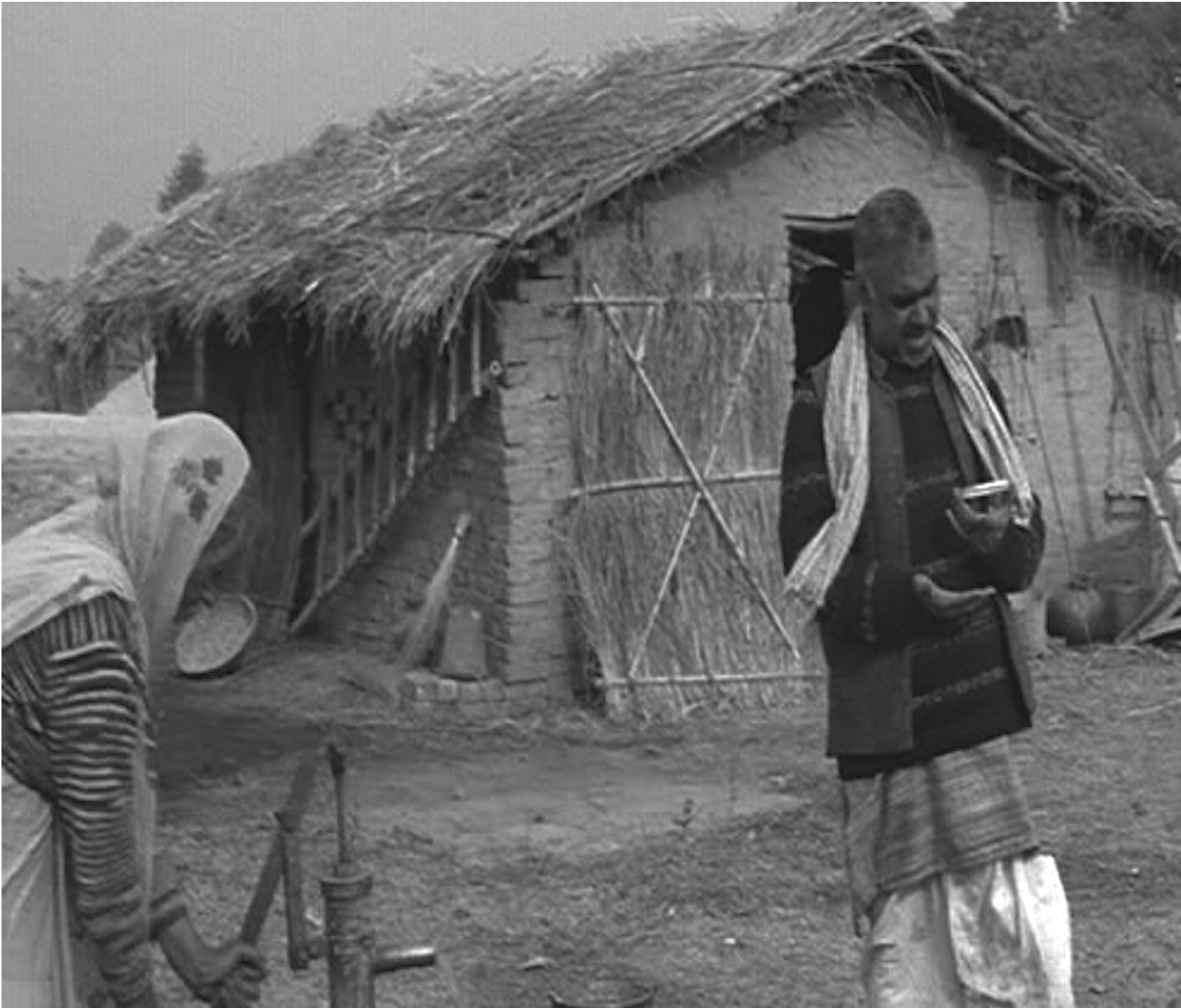
The films of Vishal Bhardwaj are particularly telling, drawing heavily upon an art film sensibility but reaching out to a commercial audience with well-known stars and highly anticipated soundtracks. A dressman on the second film in Bhardwaj’s Shakespeare trilogy, Omkara (Vishal Bhardwaj, 2006), described to me the meticulous ageing that he and his team did on costumes for characters living and working in the parched badlands of Uttar Pradesh: ‘… even [on] the belts and the shoes. We know how much ageing of the dress should be if the character is wearing the same dress for a month, how to give the perspiration mark on the arm hole’ (Figure 5) (personal interview, May 13, 2012).
Omkara’s costumes, designed and with ageing overseen by Dolly Ahluwalia, harmonise perfectly with the late Samir Chandra’s evocative production design: clothes look dusty amid ramshackle structures in an arid landscape, or unpressed and slack in the apartments of an ancient, extended family compound. In one scene the lead character ‘Omi’ (Omkara), in his capacity as political ‘fixer’, dispenses with a rival of his mentor Bhaisaab for the upcoming elections. Inside a darkened and sparsely furnished room, with the light seeping in through its broken thatch and walls, Omi and his lieutenants stand about in creased shirts and worn, rumpled trousers. After an incriminating video is played on a smartphone, the outflanked operative leaves the room and walks to the courtyard. We now see that in addition to his untucked, wrinkled kurta, well-worn vest and scarf, his dhoti (draped and tied lower garment worn by men) is stained where it is draped around his feet, as though it has brushed the dirt or picked up moisture from a stray puddle. As the scene proceeds, we see an elderly woman drawing water from a pump. Dressed in an old sweater and a paper-thin sari, she and Omi are pictured in front of a dwelling where gaps in the thatch and erosion of the brick-built wall are unmistakable. Shortly afterwards, a fight breaks out among the men and, when the dust literally settles, a substantial amount is caked on Omi’s trousers. Here the outcome of a fight in the film’s ‘real’ world is joined to a poetic purpose—to emphasise (and anticipate) the messiness of unrestrained violence. Designer Ahluwalia has alluded to her concern for realism in numerous press interviews, tracing it to her theatrical training at the National School of Drama (Dhiman, 2014). It is not surprising then to realise how the aged costume adds both visual and narrative layers to the scene (Figure 6).

Yet this kind of ageing, as skilful as it is, is not the most interesting for my argument. That would be the subtlest kind of ageing, what may be termed costume ‘relaxing’, or a kind of ageing that is guided by the simple imperative that a costume should not look as though it is new. This may mean little more than, to quote an article describing costume designer Subarna Ray Chaudhuri’s approach in the period film Lootera (Vikramaditya Motwane, 2013), sending the clothes ‘to the dhobi ghat (the launderer) for a thorough wash. Also, I did not iron any of the clothes, since they had to look naturally crumpled’, (Pereira, 2013). There is not even much need to break down and discolour the costume in these instances; in fact, the opposite—the idea is to make a costume look as though it belongs to the collection of clothes already in use by the character, to which both pristine and severely aged costumes are unsuited.
Subtle ageing reflects an approach to costume design in which deviation from perfection is an indispensable component of the recreation of a lived world. A textbook example is Dil Chahta Hai, directed by Farhan Akhtar. During my first visit to Mumbai, I came across many designers who talked enthusiastically about this highly influential film, and in 2018 it is still regarded as a landmark film in its willingness to break with some of the conventions of storytelling and characterisation in mainstream, commercial film. The freshness of Dil Chahta Hai came less from its striving towards naturalism in itself, so much as a striving towards naturalism amongst characters that in older mainstream films were typically shielded from it—in other words, the heroes and heroines wearing glamorous and filmi clothing, with little to no ageing whatsoever. Arjun Bhasin, the costume designer, told me that capturing this version of ‘a contemporary scene in India’ meant reconceiving costumes as ‘clothes, their real clothes’, including casual wear, jackets and accessories that had some wear to them already (personal interview, August 8, 2016). Bhasin’s views on what he wanted to capture in a costume are well illustrated in a longer quote from the interview:
I love to buy things used because they already have a life to them, [a life that] doesn’t fit in the film’s time, but belongs to an earlier time. The costume feels like it has a history like the character, the different time and place of a character, like the way older people gravitate towards the clothing they are still wearing because it comes from a time when they looked their best. It makes them feel what they felt at that time.
Bhasin continued:
Sometimes you are afraid to approach the stars with these things, but when you do, they are open to it, if you make a point of it, ‘I do not want the first day of this person’s life to be the first day of the movie.’ Then it has been established this person has a history before the film begins.
Bhasin here pinpoints exactly the ethos that has crept into films both hatkē and mainstream, that characters need to have imagined lives that extend back into the film’s speculative past as well as its future. They have histories and personalities, and the clothes they wear are presumed to belong to a larger, albeit unseen (and unmade), collection of outfits that fills their wardrobes and drawers. Characters are imagined as having chosen to wear one particular outfit as opposed to another, when in fact there was only one costume for the actor to wear (Figure 7).
In addition, the significance of the lightly aged costume goes far beyond what is considered appropriate for any given scene. A filmmaker’s commitment to realism means very little if only one costume, or one character’s costumes, are treated in this way. Rather, we see that the purposeful production of the lightly aged costume within a system of costumes, almost all of them aged to some degree as well, yields the impression of effortlessly recreated ‘lived-experience’.
Deciphering the Aged Costume
Aged costumes are an important component of a film’s visual economy. Used as factors of production, as commodities whose use value is realised in production itself (Wilkinson-Weber, 2010b), any and all become part of the actor’s body and the actor’s performance. In the finished film, they serve quite literally as ‘deep surfaces’ (Cavallaro & Warwick, 1998, p. xii), screen images in which clues to the character are embedded. In the case of aged costumes, their appearance implies events and durations endured that need not be shown to be apprehended. Is it possible to come up with a model of film costume ageing that contains all of its possibilities, across genres and representational practices?
Aged costumes would merit very little attention if it were not for film viewers’ familiarity with the conventions required to make sense of images of distressed clothing (see especially Parry, 2017 on this phenomenon). In order to tease these out, it is helpful to refer to Peirce’s 1894 analysis of the different forms of the sign (Peirce, 1992, pp. 4–10). First, familiarity with indexicality—the documentary capabilities of photography such that ‘an object the photograph represents must have existed in the first place’, (Doane, 2007, p. 133)—allows the viewer to understand the broken down or lightly aged costume as the material outcome of previous events. A presumed, physical connection to acts and traumas of an otherwise unseen past suggests that the aged costume (alongside aged props, sets and locations) bears a particular burden in the filmic construction of its world. The costume does this by alluding not just to a past event but rather a past series of events, perhaps experienced over days, or even years, which we never see in the film itself but which we can read out from the clothing’s visible traces. In both kinds of ageing—the traumatic and the subtle—breakdown has the effect of inserting time, compressed into the accumulation of its effects on a garment, into the narrative. The more distressed the costume, the more it indexes the erosive impact of irresistible duration.

But the aged costume overflows the visual to resonate with viewers at other sensory levels, inviting them to contribute memories of their material interactions with such clothing (see especially Parry, 2017 on this phenomenon). The lightly aged garment carries the vague scent of the wearer, while the sight of old and dirty costumes both recalls to mind and viscerally recreates familiar and often unpleasant smells and textures, underscoring Gunning’s point that ‘film spectators are embodied beings rather than simply eyes and minds somehow suspended before the screen’ (2007, p. 39). Writing about costume in theatre, Monks writes that ‘clothing adds an empathic response, part of the experience of watching performance comes from imagining how it must feel to dress as a gorilla, or to wear high heels’ (2010, p. 24). Even granting the conventional and performative distinctions between stage and screen acting (and spectatorship), this seems to serve as a valid description of the cinema viewer’s engagement with film costume. In this respect, aged costume, in its resemblance (along the sensory spectrum) to old and distressed clothing that audiences have experienced before, is an icon as well as an index.
The iconicity of the aged costume is not only embedded in the cinematic image; it is also inherent in its material precursor, which is not actually old clothing but rather a facsimile—a fake, in short. Unlike most fakes, the artificially aged costume is a socially approved and mandated counterfeit that embodies a set of cultural inversions. It is simultaneously new and old—‘raw’ like any unworn garment, but rapidly and artificially ‘cooked’ into the world of culture (Lévi-Strauss, 1969). Moreover, its use value increases rather than decreases with physical dilapidation. Yet a fake, no matter how much work goes into it and how cleverly it invokes the objects it mimics, can only be effective to the extent that it correctly anticipates what the audience will find authentic. It is for this reason that, as Mark Jones wrote in reference to a British Museum exhibit on historical fakes, successful counterfeits provide us with ‘unrivalled evidence of the values and perceptions of those who made them, and of those for whom they were made’ (1990, p. 11). Simply put, the fake starts from the expectations of the viewer, pinpointing the exact features and characteristics that are most likely to be convincing, even to the point that contradictory evidence is overlooked.
Undoubtedly the current enthusiastic endorsement of naturalism among industry personnel arises out of an awareness of—and a sense of belonging to—a global mediascape in which sensory verisimilitude accompanies films of many genres. At the same time, the tendency for filmmakers to read themselves into audiences from the same middle- and upper-class strata as themselves is much more problematic in a dramatically differentiated society like India than in the US or Europe. There is, at present, no way to know if Indian filmmakers are correct in their ideas about audience demands, except to note that naturalistic visual conventions have had no adverse impact on the box office success of unabashedly popular films starring mainstream superstars. However, it is perhaps more significant that filmmakers believe that they are correct. As I have written elsewhere, ‘the real’ functions as much as a flexible signifier of filmmakers’ sensibilities that they claim are better attuned to the audience, as it does as an impartial, and presumably objective key to distinguishing superior industry content (Wilkinson, 2016). It is probably safe to assume that many film viewers respond to and are enchanted by the aged costume’s visual and sensory potential, such as touch and smell. Equally significant are the ways in which the work that goes into ageing affirms something about one’s accomplishments to industry peers inside and outside the country. In this respect, doing ageing ‘right’ is a key component of ‘boundary-work’. Transposing Gieryn’s (1983) concept of boundary-work to the Hindi film context, Ganti (2012, p. 9) argues that the unceasing work of lending distinction to one’s own practices while disdaining others is crucial for ‘assert[ing] exceptionalism within the filmmaking community’ and ‘allows us to see the ideal type of filmmaker that members of the Hindi film industry strive to be—innovative, autonomous, sincere, rational, professional, and cosmopolitan—as representative of a modern, globally competitive media industry, indexing India’s “arrival” on the world stage’ (2012, p. 35). My own work on costume confirms Ganti’s findings, with the qualification that contrary affirmations from sidelined designers and crew attempt to undermine those of ascendant personnel by emphasising the ingenuity and sincerity of filmmakers in the pre-1990s period (Wilkinson-Weber, 201; Wilkinson, 2016). Costume ageing, though, is an important exception to this latter pattern, first, because ageing processes have less to do with what the costume is than how it is treated; and second because dressmen continue to be called upon to do costume ageing, even as they are debarred from much of the decision-making over the choice of costuming itself.
There is also a third possibility, relating to the meanings of aged costume that persist in spite of dominant naturalist conventions. In addition to being index and icon, the aged costume can function as a symbol. When deployed to contrastive effect with new, unblemished clothes, aged costumes in the pre-1990s era, as discussed earlier, performed moral as well as visual and narrative tasks. For the criminal, a dirty, sweaty costume underscored his falling outside normal social conventions (take, e.g., Jagga, the violent gang leader in Awaara [Raj Kapoor, 1951]); for the poor and destitute, distressed clothes, like those worn by the urban underclasses of Deewaar’s (Yash Chopra, 1975) Mumbai, spoke of personal and domestic ruin; for the injured and the beaten, like gang boss Bhujang after a drubbing from the eponymous three heroes of Tridev (Rajiv Rai, 1989), their abasement and humiliation was exhibited openly for all to see.
As a symbol, the aged costume has both aesthetic and philosophical ramifications. A useful comparative is historical geographer David Lowenthal’s (2015) inquiry into notions of ‘heritage’, or how the past has been imagined in European and North American artistic and popular culture. To engage with the past, given that there is no unmediated access to it, there are two stark cultural alternatives from which to choose: either to erase the passage of time in the reproduction of ‘things as they were’ when new (a ruin before it collapsed; a dress before it became threadbare); or to take pleasure in the curation of ruins and objects thick with patina. Biological metaphors flourish in the second scenario, underscoring how the fallibility of human bodies is projected into the built environment. Objects seem biologically aged owing to erosion or accretion:
Ageing is a worn chair, a wrinkled face, a corroded tin, an ivy-covered or mildewed wall; it is a house with sagging eaves, flaking paint, furnishings faded by time and use … Such signs of decay … betoken imminent extinction. No product of man or nature endures forever. (Lowenthal, 2015, p. 206)
Into this binary, we can project the pristine and the broken down costume, one defying time and the other submitting to it. No stain or wear intrudes upon the image of a timeless perfection, enhancing and emphasising the allure of the equally infallible star both inside the costume and continuous with it. The impeccable costume speaks to a transcendence of time’s effects that expands the character’s existence beyond the mortal into the mythic.
In fact, one could argue that the mainstream Hindi masala film of the 1960s, 1970s and 1980s holds out the possibility of the denial of decay, even of death, via the determined use of new clothes in scene after scene: new, perfect, and re-arranged and fitted between shots. The song sequence is the highpoint of this kind of effect, where the abrupt costume changes, and the fantastical scenarios into which the song transports the actors (combined with outstanding vocal and instrumental performances), suggest duration without deterioration. Implicit in the song is the helplessness before time and circumstances of those not empowered to renew and recreate themselves (to all intents and purposes, those without access to such prodigious wardrobes). 10 With the delivery of the immaculate costume as the mark of service due to the star (in keeping with his or her status and power), the new costume has long been an intrinsic component of the Indian film celebrity, whose persona incorporates distinct elements of divinity (Dwyer, 2006; Lutgendorf, 2006; Vasudevan, 2011). The emphatic ageing of costumes, alongside the use of newly made ones, ‘worked’ in as much as it enabled the confrontation of old and new, of vulnerability and power, that animated the scenarios that the films were intended to explore.
So powerful is this symbolic capacity of the aged versus the pristine (a contrast that can be extended into other elements of the film besides costume) that it remains useful even within an ethos and aesthetic of naturalism. One of the most striking instances of this was described to me by the costume designer for Shyam Benegal’s film Samar (Shyam Benegal, 2005), a film that revolves around social inequalities both actual and enacted (in a ‘film’ within the film) among villagers in Madhya Pradesh. Had the film transposed the sartorial ‘reality’ of the village location on to the film, I was told, it would have been very difficult for the audience to determine which of the characters was among the village élite, and which was among the downtrodden, since rural dress—all of it showing signs of age and wear—contained few signs of social distinction. The decision was made to age the costumes of the victimised villagers, leaving those of the upper castes and upper classes comparatively pristine.
The Time to Make Time
Costume ageing’s semiosis is directed towards introducing time into the narrative, but this works differently today from how it did in an earlier era. Consistent both with what costume designers observe in the world, and the internal logic of contemporary films, the goal of verisimilitude is to ensure that the time that is interpolated produces the sensations and recognitions of a ‘real’ world. 11 That said, aesthetic tastes, stylistic preferences and narrative conventions cannot and do not produce aged costumes (or weathered and worn props, and sets and so on) all by themselves. Rather, the aptitudes and working habits of the film crew, and the resources at their disposal, dictate what is possible. If films, big and small, in the Mumbai industry now aim at a level of naturalism in their costumes, then what has happened to make this not just desirable, but achievable?
With respect to making the aged costume, the resource that is urgently needed (yet is almost always in short supply) is time. The more assiduously time is inserted into the film through the painstaking recreation of the effects of age and wear, the more time that has to be dedicated to ageing and breakdown processes either before, or as, the film is shot. Until the 2000s, costume production was done on a schedule to schedule basis (Wilkinson-Weber, 2014), contributing significantly both to lapses in continuity and to the use of fresh costumes from one schedule to the next (and by extension, the appearance of new clothes from scene to scene in the finished film). There was time enough for theatrical ageing of the destructive kind but not for ageing that aims at a greater degree of naturalism. In industries such as Hollywood with full-time, professional ager-dyers, costume breakdown absorbs a significant chunk of the film’s budget, and the key (chief) ager/dyer is among the best paid of the workers in the costume department. 12 In order for the breakdown artist to do their best work, time as a resource cannot be reduced below a certain level. Time is needed for the chemical processes of ageing to become complete, for fabric to reshape itself after being wetted or dried and for multiples of a costume to be made, all with small, incremental changes to the amount of ageing on each.
Over the period that I have been studying costume production in India, there has been an unmistakable trend towards acknowledging the necessity of planning and preparing costumes before shooting begins. By 2012 my interviewees, all of them currently active in the industry, agreed that building some pre-production time into the costume design process, no matter what kind of film they were working on, was now more common than not. I have yet to talk to any personnel in the art or costume department who felt they had been given sufficient time in advance of shooting to do all they wanted and needed to do; at the same time, every single designer (all of them opting to be called ‘costume’ and not ‘dress’ designers, to accentuate their distinction from fashion designers and personal stylists) could describe a rationale and a plan for preparing costume schemes that encompassed the entire film. The modal figure given was two months of preparation, with four months as the upper limit. These numbers should not be taken as being normative, only suggestive as to the general trends in operation from the 1990s onwards. With longer pre-production times, a deliberative process of costume design becomes possible, as opposed to the crisis-to-crisis designing that went on in a majority of films through the 1980s (and in some cases, still occurs). Such a process includes the elaborate construction of a ‘look’; planning costume changes by scene and by anticipated shooting schedule; figuring how many duplicate costumes are needed; and crucially for my purposes here, preparing for and executing any costume ageing.
Indirect evidence of there being more time at the designer’s disposal comes from press interviews on the making of costumes. The costume designer for NH10 (Navdeep Singh, 2015), a revenge movie that pits two middle class urbanites against a powerful village family involved in an honour killing, is quoted further on the subject of costume ageing. Notice how she talks about the stages of ageing required, all done ‘step-by-step’.
… none of the costumes were fresh. Navdeep [the director] is very particular about it. He will pick up the shirt and check the collar and disapprove, if it isn’t worn out enough. So I would use sand paper to give the worn out effect. We put clothes through ageing processes like potassium dips etc. And we did that step by step. We didn’t want it to look ragged and poor but at the same time didn’t want it to look like they have been bought fresh from the market. (Parekh, 2015) Quote from Eka Lakhani, Costume Designer for NH10.
Certainly the effort to make costumes not look like they had been ‘bought fresh from the market’, was not just to wrench costumes away from the pristine ‘other’ of earlier Hindi films; it was also intended to stress the imagined, continuous experience of the characters that is assumed but not necessarily shown (Figure 8).
Lakhani’s reference to the steps involved in the ageing, and the consultation with the director as to the exact effect he wanted, underscores the care and attention that now goes into the breakdown process. A multi-staged process to create what one might call ‘precision’ ageing entails not just the accretion of effects but also allows for their layering and the chance to examine and evaluate results as the process goes on. In the following description of ageing (from an interview I conducted in 2008) given by a dressman on a different, unnamed film—he was unsure as to the film, but he was certain of what he did—a sense emerges not just of layered ageing but also the thought that goes into it:
I had put the clothes in tea water to give the village look but I also had to make it look poor, for that I had used red color brick. The brick is put on a cloth and the cloth is crumpled under it and then I hit it lightly with the small hammer to give an effect of old torn clothes. The way we make chatni [chutney] in our kitchen, the same way we use to get the effect of clothes which are worn out, [or] just about to tear …. The tea effect really comes out natural. Do you know how bandhani is made in Gujarat where some part gets colored and some parts don’t? Tie-dyeing, right? Same way we get the effect of tea water. We don’t have to iron it because we want that same look.

It appears, therefore, that in another conundrum of the contrast between clothing and costume, the type of discreet ageing that underscores the normality of clothing—of its imperfections and unavoidable tendency to experience wear—only succeeds to the extent that it is actually meticulously designed, and not something that emerges solely out of contingency and improvisation.
As noted, the drive towards higher standards of naturalism is also, in the Indian context, a means of establishing distinction and difference between past and present filmmakers. Another look at Ela Lakhani’s remarks about her work on NH10 reveals something of this striving for distinction. She says, ‘[w]e didn’t want it [the costume] to look ragged and poor but at the same time didn’t want it to look like they have been bought fresh from the market’ [Emphasis mine]. Lakhani here alludes to the convention that ageing had hitherto been associated with, that is, the distressing of garments to the point of disintegration, synecdoches of the broken and desperate character who wears them. She contrasts that form of ageing with the kind she is attempting to achieve, to bring the costume to the point that it would no longer seem ‘fresh from the market’. Interestingly enough, this is not a point upon which designers distinguish themselves from dressmen, although there are several on which they do (fashion tastes, for example). Instead, dressmen use the same language of materials, strategies and objectives as designers, and set present-day efforts against the habits of the past. A dressman describing changes in ageing practice explained it to me in terms of the rise of a preference for what is ‘natural’ over what is now deemed ‘artificial’.
Now the patchwork which was done in earlier movies has become out-dated and looks very artificial. To do a patchwork of red color patch in on a blue color sari is out-dated.
It is by now abundantly clear that laying claim to ‘real’ or ‘natural’ costumes in contrast to ‘artificial’ ones is a means of shoring-up claims to prestige in an industry that is currently much concerned with the persuasive recreation of naturalistic settings. Yet it seems to me that changes in costume ageing in Hindi film do not stem primarily from differentials in skill or the contrast between coarse and refined aesthetics. It is true that production values (and budgets) have gone up, and a cursory glance at the major commercial releases since, say, 2005, undoubtedly rewards the viewer with plentiful evidence of extremely competent costume breakdown. But to condemn designers and dressmen of the past (or of the low-brow productions that are still made today), only serves to conceal the adjustments in cinematic conventions and the organisational regimes of filmmaking that make complex ageing both sought-after and possible. And this concealment also functions to draw an invidious and inaccurate contrast between the supposedly crude and ill-informed practices of the earlier commercial Indian industry and the professional, refined procedures associated with the American and European productions.
An Indian costume designer recently described to me her experience of re-watching the Richard Attenborough film Gandhi (1982), a British and Indian co-production that employed large numbers of Indian actors and technicians. Given the allocation of key creative roles to British personnel (British director, British art director) as well as to esteemed Indian professionals (the Oscar-winning costumes were credited equally to John Mollo and Bhanu Athaiya), it surprised her to discover that there was much less costume ageing in the film than she had expected. There was no question of attributing this lack to the filmmakers, and so the question landed in more difficult and confusing territory. In a high quality, impeccably made period film, why was costume ageing not considered necessary? In jarring unacceptably with today’s sensibilities, was the film inevitably compromised with respect to its authenticity and persuasiveness? Was the inattention to ageing in the older Hindi industry simply symptomatic of more widely shared ideas of acceptable practice in global cinema? There is currently no scholarship on ageing in older Hollywood productions, meaning that answers are elusive. If, though, the naturalistic, ‘authentic’ forms of ageing of the past few decades are universally novel, it would be harder to look at the un-aged costumes of older Indian films as merely embarrassing indicators of ineptitude and carelessness. On the contrary, probing the uses and appearances of aged costumes may have a broader applicability to the analysis of form, genre and production processes in the history of global filmmaking.