




Abstract
The term ‘item numbers’ emerged in film journalism sometime in the late 1990s as an industry slang. It later evolved into a heterogeneous cinematic language with its investment in production design, choreography, special effects and specialised editing. Using interviews with industry professionals, this article will unpack the production ecology of the hypersexualised and hybrid song and dance spectacle.
Introduction
The item number of Bombay cinema is a hybrid musical form marked by hypersexualised aesthetics. While it is known to have its lineage in the B circuits of cinema owing to its production economy, the item number of the contemporary caters to a multiplex audience. Lavishly mounted sets, intricate camera work, deliberate investment in gaudy costume and makeup, measured use of CGI and sophisticated choreography lend it its unique nature as a special kind of song and dance sequence. This article deals with the infrastructural world that produces the item number. I engage with its microprocesses involving industry professionals, investors, global trade, local cultural practices and the politics of the city. Relying on interviews with industry professionals such as production designers, art directors, special effects supervisors, light suppliers, and technicians who are also involved with different cine workers unions, the article maps a contemporary archaeology of item numbers in which new technologies are deeply embedded within existing social, politico-legal and economic infrastructures. The individual processes of functioning of the different professionals might replicate the industry standards for other kinds of dance numbers. But I engage with the multiple processes as they congeal around the machinery of the item number. Item numbers run counter to narrative cinema’s diegetic absorption, drawing attention to techniques and the politics of production style. There is an assembling of effect in the item number and a measured investment in the trash aesthetics that it draws from the memory and materiality of B circuit films. The spectacle generated by the item draws on a pattern of design, special effects, and choreography identified with low genres. It is an assemblage of designs which relies on non-human agents in equal parts. The role played by technology and the medium itself in simultaneously encouraging and constraining human creativity is noticeable. The human vision of fantasy falls short of the prowess of contemporary technology, the fantasy being that of control, auteurship and design. The threat of being halted looms large at the volatile borders of the industry because of the political ecology around it. This article also engages with these networks of design to stage a debate around power relations in the industry. The article posits the item number as offering a distinct cinematic language via its investment in the aforementioned production styles, networks of power and cultural processes.
The Visualisation of the Number
A key thematic in the discussion of the item is the aesthetic category of disgust that the design of the dance tinkers with. This is a deliberate investment in the gaudy, the excessive and the loud. Item numbers borrow extensively from something which serious scholarship treats disdainfully—an animated taxidermy of the decorative as the deceptive, cosmetic, less politically valuable and far too pleasurable to be high art. I refer to Rosalind Galt’s defence of the pretty image to posit the production of item numbers as a measured step towards the mounting of the spectacle. Galt (2011, pp. 4, 11) notes,
[T]he problematic association of the image with the overly aesthetic and therefore with the inferior is complexly and persistently intertwined with the history of cinema. Denigration slides from the image as such to specific kinds of images (too colourful, too seductive, too cosmetic), in each case modelling the image that is too imagistic for its own good…pretty qualities include deep colours, arabesque camera movement, detailed mise-en-scène, and an emphasis on cinematographic surface. The pretty is self-evidently designed; refusing notions of cinematic chance, but it is also measured, stopping short of transgressive excess. By the standards of realism, the pretty image is ‘too much’, but it is also not enough to be redeemed as radical excess. Not quite beautiful or sublime, it is also not camp or countercultural.
Production designer, Suresh Selvarajan says about ‘Mera Naam Mary’, an integrated item number in Brothers (Malhotra, 2015):
The story demanded celebration in a poor locality, we deliberated if we can shoot in some run down factory instead of a regular party in a pub or a restaurant. But production value had to be very high. After a lot of recce, I chose a coconut farm in Madh Island … to make the entry of the star a grand affair. I designed a shack out of a two-tiered 50,000 feet high half-cut fibre boat, coconut trees of fibre and sand. Instead of bricks, 15,000 beer bottles and 20,000 bulbs were used (the stage on the upper tier had 15,000 red bulbs) for the walls. Mary (Kareena Kapoor) was supposed to crawl on the sand, so a two feet trench was dug on the ground which was filled with red LED lights and covered with transparent acrylic sheets topped with loose sand … so that is why Mary’s movements on the ground level could create red patterns on the sand.
1


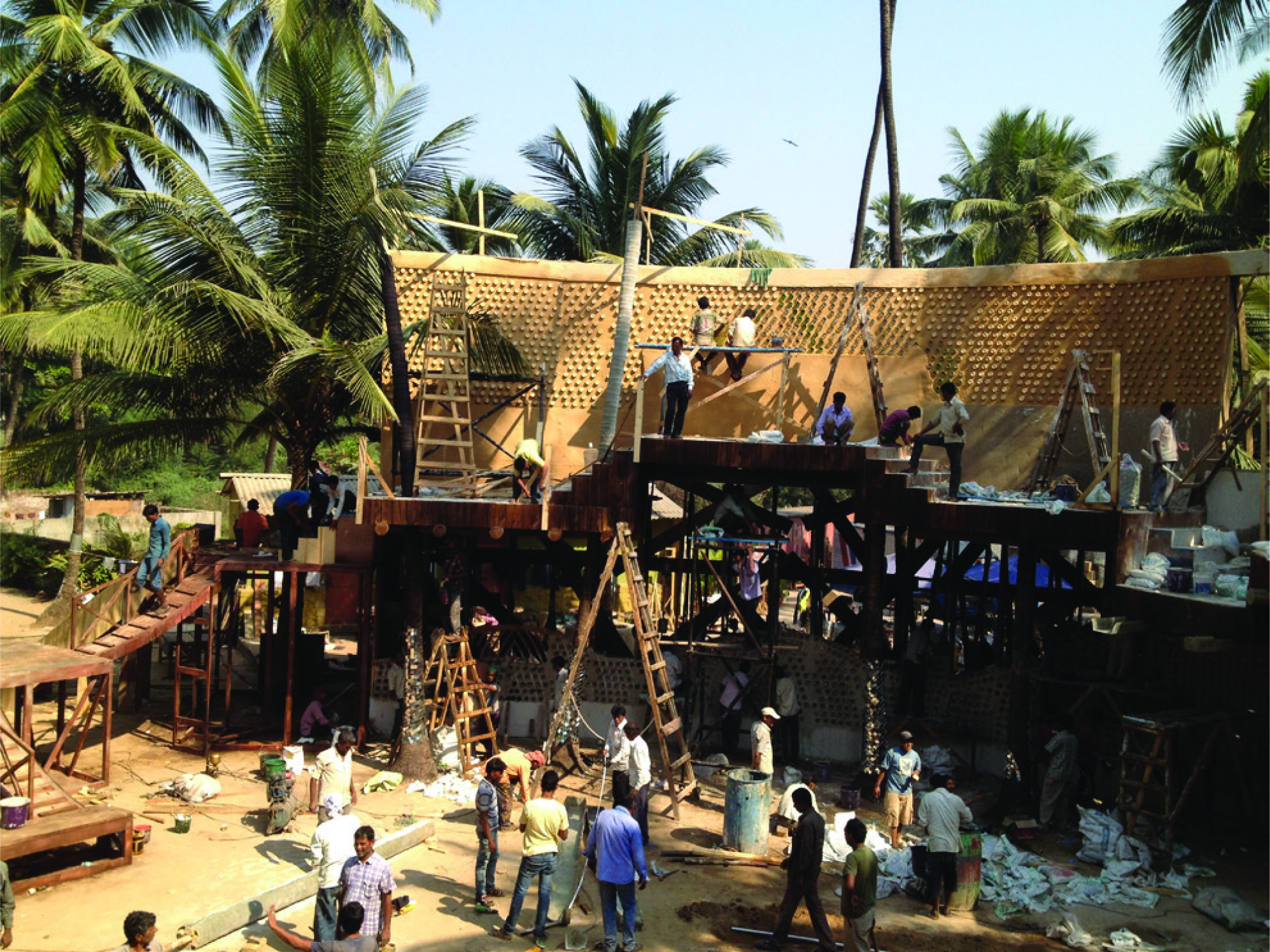


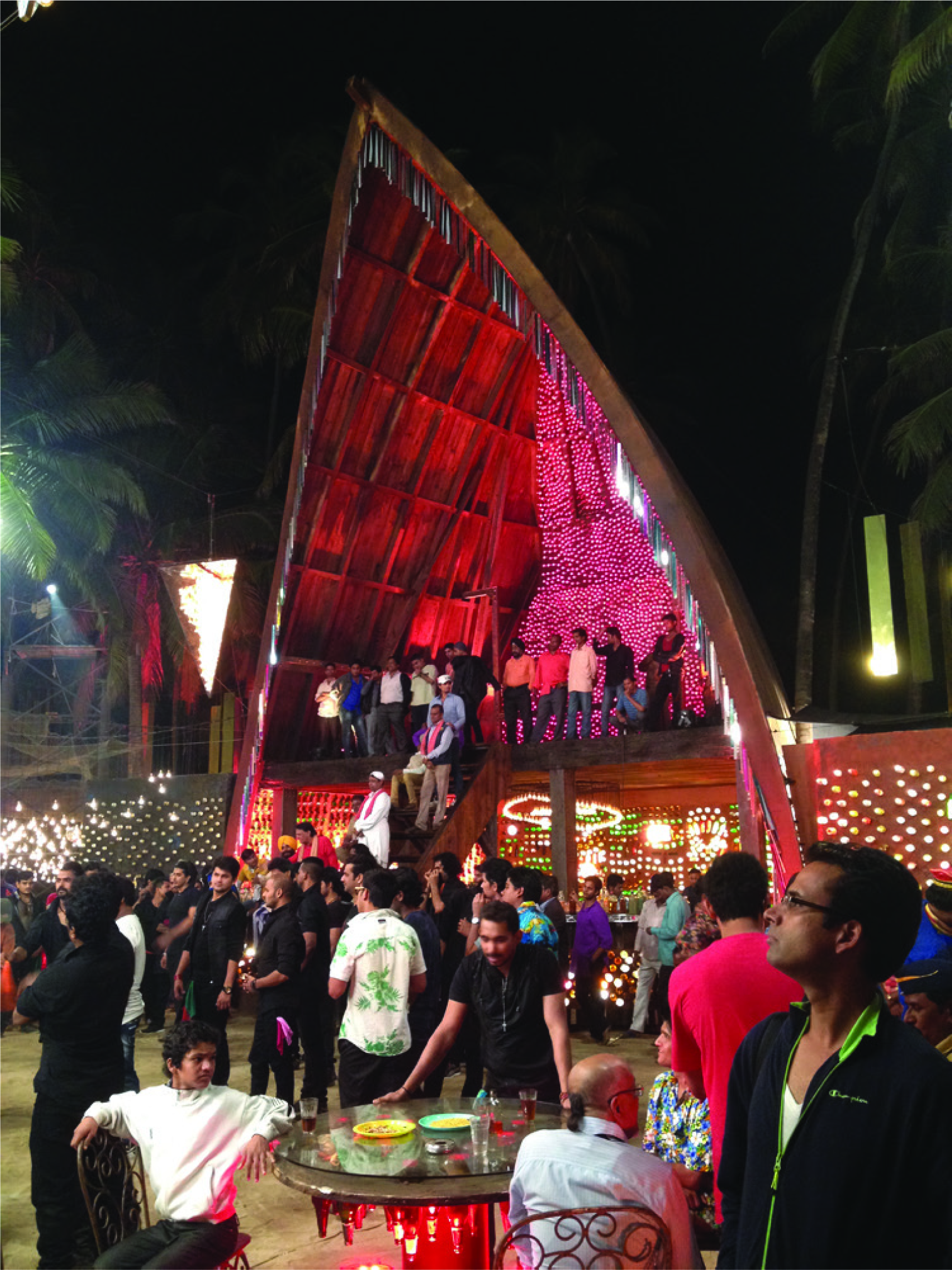
Within the narrative of the film, ‘Mera Naam Mary’ is positioned at the cusp of the two brothers’ journey to the final ring, one who has won a local fight (Siddharth Malhotra) and another (Akshay Kumar), an old champion who returns to the ring to earn the prize money that might save his daughter’s life. Kumar is challenged by his old trainer and fight arranger/tout Pasha to prove his old competence in a fight with a new fighter. The item number staged to celebrate Malhotra’s victory is intercut with shots of Kumar who has not fought in the ring for many years, sweating it out with the opponent. The tempo of the song builds to the winning steps of Kumar. The grandeur of the song (its set design) stands out of the narrative’s lower middle class setting but is excessive: the lights, the mirror work on the coconut tree trunks and the beer bottles give it a distinctly lowbrow aesthetic. It was important to, therefore, understand how these sets were created.
Art direction and production design are interchangeable roles in the Bombay film industry.
2
In my initial days of fieldwork on the sets, I kept wondering if at all there existed any clear distinction. Nitin Wable responds to this issue:
Production designers and art directors are dummy architects, and good visualisers. An art director after good knowledge and experience can be a production designer. Production designers work with a team, a location manager, art directors, costume and effects designer … all those who can deliver what he visualises.
3
The production designer’s job in an item number that I inferred was to create a quick spectacle, sometimes out of the bare minimum. When I asked Wable about the bare-opulent look of ‘Mayya Mayya’ in Guru (Mani Ratnam, 2007), he guffawed aloud beating the coffee table at the Starbucks, Khar, saying,
That item was the biggest luck by chance that ever happened. We were shooting in Turkey for more than a month; there was no money and just a day to shoot the song. I came across an old abandoned Byzantine church! It had frescoes on the ceiling but unfortunately, it also had a huge tomb-like structure on the floor. I got it covered with a reflecting surface so that when Mallika Sherawat crawled and writhed on the floor, the fresco would be seen. I immediately notified the team; got some cheap satin and organdie for a little wall lining, low watt bulbs along the dance floor, some coloured beads for a curtain, laid out a few tables with local lamps on them … and the Turkish bar was ready!
4
‘Dard-e-Disco’, a highly self-reflexive item number performed by Shahrukh Khan in Om shanti Om (Farah Khan, 2007), not only punctures the narrative of the film but also demystifies the gimmicks of the star machine and the elaborate nature of the sets used for such numbers. Santosh Kotkar, one of the art directors for the film, says about the design strategy
5
:
By the time we came to designing ‘Dard-e-Disco’ we were sure of director Farah Khan’s requirements. In keeping with the entire look of the film which ranges from art deco to art neo and taking advantage of the fact that the song comes right after the interval (the rebirth of the hero and cut to the contemporary) we created a fantasy look for it. I referred to Boris Vallejo’s fantasy paintings. Sabu Cyril, the production designer for the film wanted four different looks for the song, presenting the four elements: earth, wind, water, and fire as the last element (Shahrukh Khan’s link with his previous life, his phobia of fire). For the rest of the film, we visited at least 80–100 abandoned studios in South Bombay, Marine Lines and Nariman Point and hunted for props and furniture from antique shops in Chor Bazaar, but in this song we took the cinematic liberty and created sets in Yash Raj (earth and wind sequences) and Film City studios (water and fire sequences).
The mounting of item numbers thus points to the deliberate ‘prettification’ of gritty real spaces both on and off screen. Designed often in abandoned sites, item numbers transform not only the location where they are shot but also add glamour to mundane narrative space. A poor locality begins to look glamorous momentarily, the affective charge of the sudden break from the narrative that causes an immersive amnesia for the spectator.
A circular bed revolves in a haze of fog, with every drumbeat, a series of flames blast up. In the next sequence, the fire is replaced by smoke that shoots upward. The third sequence shows pale green coloured smoke. Katrina Kaif swings across the stage in a complex trapeze movement. The fourth and final stanza is marked by water splashes on her and ends again with the flames shooting up at equal intervals.
‘Sheila Ki Jawani’, an item number in Tees Maar Khan (Farah Khan, 2010), self- referential like ‘Dard-e-Disco’, demystifies the apparatus behind the item by revealing the storm fan blowing Katrina Kaif’s straightened hair, the jimmy jib and the reflectors. At the same time, it creates a spectacle for the off-screen spectator. This resonates with Jane Feuer’s (1995, p. 443) argument about the Hollywood musical oscillating between demystification and remythicisation to constitute the myth of entertainment. Santosh Kotkar, the art director for the film says,
The bed was made out of a giant turntable. Farah Khan wanted it to look like ‘Jumma Chumma De De’, but had to be much grander. It is a shooting sequence within the film. But we did take the liberty to trick the audience. While the fan and the carabiners were positioned deliberately in the frame, we had extra layers of curtains around the stage to hide the multiple gas lines we had ordered for the smoke and the fire.
6
Kotkar checked his watch. He asked if we could continue the conversation at the spot. We went to a Hard Rock Café next to the Gate 3 of Yash Raj studio, a ready location for shooting party songs. But the place was done-up with special disco light beams, bulbs housed in glass jars, a bar counter behind which the camera was placed and a makeshift bandstand. Checking with the choreographer, Vaibhavi Merchant, if the arrangements met her requirements, Kotkar showed me how he had shut out daylight using a black cloth on the glass walls of the pub and a series of yellow rice lights against the cloth. Sensing that the star would not arrive any time sooner, we proceeded to have lunch. I uncovered an informal production memo for ‘Chikni Chameli’, integrated in Karan Malhotra’s Agneepath (2012):
While the Kancha haveli (in Mandwa in the film) in the rest of the film was an abandoned Portuguese fort in the island of Diu, the song particularly was shot in General Studio in Film City. We searched all along the coastlines of Maharashtra and Goa for the perfect Mandwa and eventually settled for a hamlet in Diu…couldn’t afford food and transport for all the 100–150 dancers to and from Diu. Ganesh master wanted a rugged look for the song, no LED lighting, only bulbs, hanging chandeliers and fire effects. The song’s opening demanded a red satin canopy which had to be manually pulled up using pulleys to reveal Katrina Kaif’s body from her thighs up to her face. Apart from the four smaller flame bursts, the real challenge was the culmination of the song; the top-angled shot of the concentric rings on the floor, slowly catching fire from the match that Katrina casually flicks on it.
7
A mosquito coil-like structure was made which was then sprayed with a flammable solution. 8 A battery of special effects (both mechanical and digital) heightened the spectacle of the numbers. Their extensive use points out a mode of (re)presentation where visual attractions and spectacular moments dominate, creating an opposition between narrative and attraction. The item number thus resonates with what Tom Gunning (1986) notes about the cinema of attraction: ‘[P]resenting discontinuous visual attractions, moments of spectacle rather than narrative’. Despite internal critique within the industry against the use of mechanical special effects whose screen impact is obvious to the spectators and a push towards the sophistication and seamlessness of digital visual effects, fire and water effects in most item numbers are constructed using analogue gears. The affinity for the imperfect and the obviousness of special effects underline the choice of trash as a measured style of production. The recent critiques against it are akin to Rosalind Galt’s argument against anti-pretty writings, against the cosmetic and the overly visual. Galt notes that writings on film strongly monitor line and colour or narrative and mise-en-scène as avatars of either reason and meaning, or deception and spectacle (2011, p. 106).
The search for Rajendra Yadav, the water effects equipment vendor’s location in the lower-middle class residential area in Coral Park, Goregaon (east), was no trouble at all. The first people I asked for his address ushered me to his office saying, Filum wale na? Aaiye! (Looking for the film personnel? Follow us!). The man himself was kind enough to not only show videos recorded on his iPhone of equipment used in dance shoots but also demonstrated a rotating fountain on the dirty street outside. He found himself a large audience along with me; I realised this was a regular spectacle for his mohalla whenever he invests in some new machine. Yadav started his career as an assistant for art director, Prakash Shetty and recalled with a sense of nostalgia how he was the person behind the crocodile in Khoon Bhari Maang (Rakesh Roshan, 1988). The man has bifurcated his business from only supplying ‘fog machine, dry ice fog machine, rain machine, waterfall machine, storm fan, blower fan’ for films to ‘hydraulic systems, walkie-talkies, fork lift and other fabrication infrastructure’ for live shows. The demand for water effects in films has reduced with the burgeoning use of CGI. 9
Stars do not want to wet themselves, Salman Khan complains of thinning hair due to repeated water splashes, heroines demand extra tubs of warm water, it becomes very expensive for the production team. Sometimes the director feigns rebuking my men when a heroine complains of cold water…it is a hell lot of trouble for us to create a 1.5 metre high tank which will hold approximately 500 lt of water, insulate an extra electric coil in it to heat the water and also create two pipelines for two showers, warm water for the main dancer, regular water for the background dancers …. 10
A range of fire effects are used in dance sequences: quick flashes, thicker and slower flames, fire that spreads on the floor and cold sparks that pour down (known in the industry as Niagara Falls). Along with these, a fire effects supervisor is also skilled to create colour blasts and glitter-paper bursts. There is a single standard technique to execute most of these effects: a tank is filled with pressurised carbon dioxide with cylinders atop it carrying LPG, coloured gas and/or a mixture of finely cut coloured paper and glitter depending on whether the blast requires fire, smoke and/or paper, respectively. The desired blast is achieved with the electronic console that adjusts the analogue lever which in turn controls the arrangement of the tank and cylinders. Rajendar Tyagi, action effects equipment supplier, notes that depending on the shooting location and height of the camera, he suggests to the choreographer the types of blasts possible; whether a pyrotechnic aerial bomb blast is possible inside a studio or a drone is required to shoot a parachute colour blast or if the height of the blast needs to be controlled.
11
He further notes,
Although there is live direction by the dance master, I attend one trial with the choreographer’s team to check for the desired effects and mark out the spots spatially and also note the dance steps as cues for the different kinds of effects for every sequence ….
12
The ring of fire that Priyanka Chopra uses as a prop in ‘Asalam-e-Ishqum’ from Gunday (Ali Abbas Zafar, 2014) is made of a cold fire coil. However, it is fine-tuned at the editing stage.
Post-production alteration or ‘prettification’ of the image is however less dubious than mechanically produced special effects at the production stage because it aims at achieving perceptual realism, a seamless spectacle rather than positioning the item as an ‘attraction’ assembled out of microprocesses. In her book on the special effects blockbusters of the 1970s, Julie A. Turncock (2015, pp. 11, 14) yields the success of this new genre to the ‘vividly, somatic technologised experience’ that it offered ‘to rouse and provoke the sensorium’. She suggests:
[F]ilmmakers sought to stimulate the senses. This was not to numb the viewer but to activate him or her—not unlike the notion of drug-induced mind expansion. Intensified colour schemes, beams of light, fast-moving objects, and quick editing first penetrate the body and then engage the mind with the films’ ideas about technology, kineticism, power structures, liberty, etc. (Turncock, 2015, p. 15)
The pretty image with its archaeology of detail also generates the frisson of contradictory forces: seamlessness of the VFX spectacle and yet the visceral shock of sensation.
Apart from stitching the shots (with cut, dissolve and speed changes) approved by the director with the assistance of the continuity Ad, not much is done at the offline editing table today; everything goes to the online editing VFX team for refinement and effects. 13 The VFX supervisor who is present on the set can potentially morph the footage either through live switching (or what is known as the literal ‘online editing’) or through ‘creative expressions’ (at a later stage using a combination of software such as 3D MAX, Maya, Smoke, Bling and Nuke). VFX can multiply bodies to create a large crowd, grade skin complexion, introduce advanced level colour correction, play with lens flares, and change tonality, lighting, and even the backdrops. 14 In editing film dances today, the use of ‘creative expression’ makes the production process economical; a sequence shot in a closed studio can be replicated on a beach or anywhere else by morphing the background, the dance movements remaining unchanged. Except for big budget productions like Sanjay Leela Bhansali’s, most choreographers shoot with a single line of dancers, the rest of the lines are multiplied digitally (in a dance where there is uniformity in clothing, crowd multiplication is a cakewalk for any rookie). 15 Stephen Prince (2012, p. 8) notes that digitally produced effects are more sensually immersive than their analogue counterparts, blending live action and synthetic image elements convincingly into scenes. A higher degree of perceptual realism is possible through digital compositing methods in which every layer can be tweaked or changed unlike optical printers where segments of images are joined but themselves remain unchanged; thus, live action footage can be infinitely adjusted with computer manufactured elements such as crowd multiplication and background morphs (Prince, 2012, p. 5).
Part of the success of ‘Lovely’, a big budget party item number, from the film Happy New Year (Farah Khan, 2014) comes from it is use of variegated lighting–both digital and manual fire effects illuminating the extremely complex set with a stage, pole dancing merry-go-round, multi-tiered onscreen audience balcony and trapeze equipment for the dancers to sling across the dancing platforms. The song opens with shots of the stage lined with bulbs, shifting spotlights on the dancers, a series of lights around the balcony of the audience and a merry-go-round, along with suitable background lighting for every shot. At the refrain, flames rise upwards with low but distinct blasts. As the song progresses, LED beams (matching Deepika Padukone’s costume) flash behind the dancers. This is followed by yellow disco beams flashing diagonally behind Padukone wearing a golden costume. We then see blue disco lights criss-cross beams to contrast with her red costume and the spotlight tracks her leaps around the merry-go-round poles and the trapeze towards the end of the song. White light introduces Shahrukh Khan in the audience, and red light marks out Abhishek Bachhan dancing in one of the balconies with a bottle in his hand containing some red liquid.
Effect lighting in song sequences has undergone many changes over the past decade. Arjun Singh, owner of Light Kraft recalls,
‘Kaisi Paheli Zindagani’, picturised on Rekha in Parineeta (Pradeep Sarkar, 2005), was one of the first songs (you might call it an item number) in the industry for which we invested in a digital console. We could thus create and move three spotlights and also manage the multiple levels of lighting (we used rows of normal bulbs in circles all across the two tiered stage and on each stair leading to the levels, and the coloured bulbs on the rotating windmill as the backdrop to the film’s Moulin Rouge) from a single console. This allowed continuity shots and quicker takes as lights could be shifted by simply pressing a few buttons … Now we use LED beams, disco lights (in our business we call them intelligent lighting), I also have software to create LED dance floors. I prefer a DMX controller with multi-bulb structures which can revolve 360 degrees, pan and tilt. Motorised lighting helps high speed shots. This is very different from the 1980s when gelatine paper was used to cover up 100 W bulbs for dance sequences or manually rotate normal shooting lights to create effects. I call that cheating. Now we use real technology, real lighting. Earlier curtains were needed by gaffers to dim the lights, now we can fade it from the console. So much manpower is saved!
16
Arjun Singh’s disparaging of analogue effects resonates with a history of opinion within film studies about cinema’s indexical ability to accurately reproduce content captured by the camera. Dan R. North (2008, p. 6) has convincingly argued against this narrative to state that visual effects are ‘a misunderstood and mistreated field in film studies …a condescending presumption of a correct function for cinema, and a miscalculation of the viewer’s ability to discriminate’. The disdain for special effects runs parallel with distaste for anything that crosses the line of sobriety, poor aesthetics, the paracinematic low brow or the non-narrative spectacle.
While Arjun hints at the B grade quality of cheap lighting techniques used in the 1990s, I asked him for details about the glamorous light deployed for contemporary party item numbers. Some of them were evidently coming from borrowed ideas about light used in music videos that feature international singing stars such as Jennifer Lopez, Pittbull, Enrique Iglesias, Chris Brown and will.i.am. Arjun asked if I wanted another cuppa and went to the counter to order more food. He returns after a good ten minutes, smiles and says,
The DOP for ‘Babydoll’, Ragini MMS 2 (Bhushan Patel, 2014), Hari Vedantam referred to the lighting in Jennifer Lopez–Pitbull music video, ‘Dance Again’, to shoot the song on Sunny Leone (digitally simulated golden studio lighting effect that bounces off the mirrors to the reflector coated walls to the skin of the dancer at a syncopated rhythm) … We all travel global now, I regularly visit lighting exhibitions in Denmark, Frankfurt, China, attend live concerts in London. We definitely borrow ideas from live performances abroad. The entire business of live feed lights came from international pop artists … Recently I invested seven crores on special effect lighting for ABCD 2 (dir. Remo D’Souza, 2015). The cinematographer Vijay Arora wanted something similar to Step Up Revolution’s (dir. Scott Speer, 2012) finale dance number ….
17
The mainstream glamour of the item number quickly appropriates the prettiness of the low brow and shrugs off the grittiness of its production process. It presents an image that is highly stylised, global in its aesthetics and ready to cater to tastes across classes, creating a new regime of the cosmetic, and colourful image that extends into the infrastructure supported by an informal economy of dancers, choreographers and suppliers.
Item Dance and Its (Dis)contents
Dance in the item number as I have pointed out at the outset, cannot be treated in isolation; it works within an assemblage of sensations. Choreography works within the aesthetic of prettification, where affect is interconnected with a battery of events and activities: global travel, fashion and modelling industries, music videos, television music channels and music streaming on the web, and physical training and grooming exercises. The essential choreographic ingredients in the spectacle involves an ever mutating dance vocabulary that is borrowed from an ensemble of influences; remediating at every step the new ‘sexy’, the new ‘hip’ and the acutely cinematic nature of the ‘sexy’ in dance moves; the technological construction of the ‘sexiness’ of the moving body.
The item number first emerged after a decade of liberalisation in the midst of media images saturated with fashion photography, music video, the VH1 and YouTube experienced in the comfort of the urban home space. 18 Alongside, the evolution of filming technique and the demand for new cinema (bolstered by multiplex exhibition), dancing stars of the earlier decades had exited the industry. The industry’s production ecology at this point was the most conducive for the birth of the item number. This is when we see elements associated with dances in B grade films of the 1990s transformed into fashionable music video like dances within A circuit films. Squatting on haunches, gyrating torsos, vigorous pelvic thrusts, and heaving breasts—these iconic markers of item numbers are mostly borrowed from B films. 19 At the same time, the item girl’s frontal look at the camera can be associated with a certain kind of fashion photography. Sarah Berry’s work on cinematic fashion shows of the 1930s suggests that the gestures of the performing star tended to interrupt narrative flow with alternating long and medium shots. The performing star’s gaze and movements were structured by anti-realist acting; ‘When playing a fashion model, the star presents herself in a semi-frontal stance, usually to an on-screen audience aligned with the camera’s point of view. She is thus looking, almost directly, at and playing to the viewer—a vaudeville tradition’ (Berry, 2000, p. 51). The firmness of the model’s choreographed gait down the ramp and an exhibitionist attitude at the head of the ramp gets translated into the item girl’s confident, and yet sensual gestures.
The early item numbers set in rural locations or the urban hinterland involved raunchy dance movement and were reminiscent of regional dance—theatrical traditions such as nautanki and Lavani where the dancer brazenly meets the audience’s gaze. Usha Iyer has positioned the item number as another new layer of performance (where dance is mechanically constructed through cinematography, editing and special effects) beyond the production numbers creating a stand-alone attraction in the film (2014).
20
She suggests,
[T]he moral binaries that defined the vamp–heroine dyad do not apply to the item girl and the heroine. The item number, focused not as much on the dancing skills of the item girl as on her ‘sex appeal,’ engenders a movement vocabulary defined by the striking of sensuous poses, and a central focus on the gyrating torso. (2014)
Yana Gupta, the Czech model appeared in ‘Babuji Zara Dhire Chalo’, an item number in a 2003 Bombay crime film, Dum (E. Niwas) which became an instant hit and still rocks the dance floors across the globe. The number interestingly begins with a high angle POV tracking shot of somebody sitting atop a buffalo (shot taken from between the two horns). After exactly twenty seconds, there is a cut to a low angle shot revealing the full frame of Yana Gupta gallantly astride the animal. In the subsequent shots (close frontal shots of Yana’s face and low angle shots of her powerful athletic footwork), her monopoly position among the group of male chorus line gangsters dancing with rifles, liquor bottles in their hands is established. Not only does the song begin with her point of view, but she also leads the dance. She comes to the forefront of the male chorus line dancers and appropriates the recognisable ‘male’ dance steps, peeks between men jigging their dhoti-clad hips to the audience and laughingly tugs down the boxers of a scrawny man. Ganesh Hegde, the choreographer for the song recalls,
Yana was uncomfortable doing film numbers. She was new in the industry and was still sticking to the pattern that models should do music videos first and then try their luck with film dancing. When I showed her some of the songs that I had shot earlier, she was convinced. I wanted a rugged, North Indian setting for the song, so we settled for Film City (it has a cow shed nearby, that is where we procured the buffalo from!). It was a unique concept; no mainstream actress could even imagine making an entry on a buffalo. But Yana was amused by the idea. She was like the female Yam Raj descending from the sky!
21
The choreographer often emerges as the key assembling figure of the production process, wielding control over the camera along with supervising the works of the production designer, costume managers, and editors.
22
In an interview, Caesar Gonsalvez reflects on his role as the choreographer in an item number:
I understand the needs of the song the best, from camera angles to arrangement of props in front of the camera, the angle at which the disco lights need to be fixed, costume to what effects and enhancements to be added with CGI, and of course, choreography … before doing films, Bosco and I did ad films for Prahlad Kakkar and a whole host of music videos. You must have been a child back then … do you remember ‘Kaanta Laga’–Remix’ by DJ Doll? That was a helluva music video! The DJ Doll character, Radhika, ran away after the first day of shooting but if you look at the video today, it was edited so well you would not know that DJ Doll is not one person throughout. The main challenge was not choreographing Shefali Zariwala (a horrible dancer who would not do anything beyond two steps that she managed to pick up) but editing it in a way that not only her bad dancing would not be seen but also looked edgy for its time! That is how we learnt all about camera angles and editing, all on the job. In India, we do not have micro-specialised departments like Hollywood like a DOP or a designer who specifically shoots dance, and songs are shot on tight budgets in just 2–3 days. Hence, we are the self-trained master directors of these 5 minute music videos within the films. (smiles)
23
I received a further confirmation from Ganesh Hegde who defines the item number with respect to the choreographer in these terms:
They are numbers directed by me, not just choreographed. The producer sources them out like that … I will contribute that five-minute film to the film. The sole purpose is marketing; creating a big sound for the film. I get a free hand from the director (except the bare necessities) to execute a flashy looking song, making them as distinct as possible, as theatre breakers, something that would stand out. I shot the opening credit item number for Company suited for MTV promotion with 85 cuts, a music video kind of execution … the colour palette and Urmila Matondkar’s attitude in the song made the mark. With the rolling titles, I just could not give her latkas and thumkas (dance movements) like any regular item number … In most cases people hit the theatres only for the item number … I handle cameras in the songs; it is not just the film’s DOP. I prefer shooting on RED cameras and work between aspect ratios of 5:3 or 4:5 giving it a music video look. A multi-cam set up saves a lot of time when working on a tighter margin, also gives me the exact match cut, choreographing for me is definitely not just about putting in steps! In film production, there is a lot of faith on the choreographer of an item number, shots are planned in a certain way … There is absolutely no scope of tussle with anyone on set.
24
Given that item numbers are often promotional tracks for films, in certain cases (the big budget item numbers), the producer has considerable control over the dance. The choreographer ceases to be the sole master of the number in exceptional cases (when the producer’s fund is at stake because the film’s promotion depends solely on the success of the item number) when the producer feels the need to invest in someone who has more discretion and more expertise in the overall mounting of the spectacle. In the case of ‘Dhoom Machale’ (Dhoom 3, Vijay Krishna Acharya, 2014), Aditya Chopra, the producer of the film was the key figure behind the construction of the spectacle. As the signature of the Dhoom franchise, Chopra had to ensure the absolute success of the number. The choreographer, Vaibhavi Merchant, was still the main designer of the dance, but she had to work around the design of other specialists. Merchant notes,
Aditya said, ‘[C]an we get an ad film maker to visualise this and direct it?’, and I thought that was a great idea because we needed a different mind for it to look different from the earlier two Dhooms, so Karina Taira from Paris … was brought in … her aesthetic sense was brilliant…! I had to design the entire choreography looking at how she (Katrina Kaif) looks, the clothes that she is wearing … so nothing that is too loud, or too garish, so that it takes the attention away from the way she is looking.
25
The assemblage of costume, design, choreography and music is a constellation of affects. This process has become apparent in recent years when the choreography of item dances has moved from eulogising the eroticism of the body to fetishising the fit body. The extra filmic narrative of the intensive rehearsal schedules, injuries during practice, exercise regimen for a certain kind of look (fetishising the labouring body rather than the sensual body) add to the mounting of the spectacle. Laurent Guido in her work on dance as attraction in early cinema points to a similar attempt to rationalise corporeality at the end of World War I. Following examples of athletic manuals and physical education methods, especially Demenÿ’s harmonious gymnastics, fashion and cinema magazines ascribed to a beauty criterion that depended on ideal proportions defined by both the study of antique sculptures and a golden rule theory (Guido, 2006). 26 Guido traces a link between media production of serialised representations of fashion models and showgirls with a procession of soldiers. The stylistic and packaging of item dance movement emphasises a similar need to rationally explicate sexualisation. The constant accentuation of the fitness narrative is a deliberate attempt to glamorise item numbers, keeping the sleaze element of the B circuit at bay.
Choreographers elucidate the new trends in the movement vocabulary of item dances by citing a range of issues. These include changes in the media landscape, change in television programming with the middle class getting access to dance reality shows of the West. The cult of DIY hip hop in contemporary Indian urban areas that allow digital savvy mohalla boys to learn and participate in hip hop contests, also sponsor marginalised figures from across the world, creating a new imagination of the hip and the sexy dance for the middle class.
27
Caesar Golsalvez says,
[T]hat kind of 1990s bad dancing will not work any longer. We all travel abroad, interact with artists there, see street performances in European plazas and also random kids dancing on the streets … although we do have a signature, Bosco–Caesar style (which is why some stars like to work with us, some producers sign us) but we keep experimenting with choreography in every song. ‘Mit Jaaye Gham’ (Dum Maaro Dum, Rohan Sippy, 2011), shot in Mehboob studio was influenced by underground pub scene in Amsterdam, ‘Asalam-e-Ishqum’ was inspired by burlesque performances in some of the Chicago cabarets that we visited, although the choreography had to be indigenous; Bollywood audience will not like watching extremely Westernised moves such as krumping, tutting and other street hip hop styles … the late 1990s/early 2000s idea of choreography as vigorous dancing which would tire you out in two minutes is thrown out of the box. With just three to four days of shooting an item number and a lot of hopes pinned onto the success of that one song, we cannot do a sloppy formula. Even if it is a slow track with choreography like the vamp’s crawling on the floor (like ‘Zara Zara Touch Me’ number from Race [Abbas–Mustan, 2008]) has to be done with a whole lot of new attitude, highly fashionable design and subtle lighting and dynamic shots; essentially simple looking, so that everyone can appreciate but involving international styles such as jive and swing which create the hitherto unseen attraction in film dance.
28
Change in the nature of choreography is imbricated in the events of the period. The second half of the 2000s saw a rediscovery of Indian cinema in the West. Bollywoodisation took a different turn, capitalising on global media networks, appropriating global space and in turn borrowing heavily from it. A new branding of popular Hindi filmic dance was seen when Farah Khan was invited to choreograph Shakira’s performance for her chartbuster number ‘Hips Don’t Lie’ (2005) at the MTV Music Awards, New York, 2006. 29
While I mention this changing media culture in the mohalla, it is crucial to recognise the mohalla of the industry, the economy of the background dancers who form an integral part of the production culture. Utilising little breaks during shooting, Parvez gave me a long interview and made me a part of his exciting world. I realised his importance as one of the office bearers of the Cine Dancers Association when the bouncers at the gate of Nair Bungalow, Madh Island let me enter as soon as I mentioned the name, Parvez Sheikh. Having worked with Farah Khan since the dance performance at the Miss World contest hosted in Bangalore in 1996 to several award shows until 1998 and in all the major item numbers choreographed by Khan’s team, Parvez had a lot to share:
When male background dancers are cast in an item number, their selection is done on the basis of their appearance as characters rather than their dancing skills; mostly they are rugged looking guys, who would have to behave as if they have never seen anyone like the item, with eager expressions on their faces they would want to want impress her or grab at her … you will notice that there will not be much synchronisation between the movements of the item girl and the male dancers surrounding her, only a few special movements—bending and grooving towards her hips.
30
He took a break from the interview, called for chai and pointed to the testing of the helicam (a tiny remote controlled helicopter that can pan, rotate, tilt to obtain motion videos with a GPS sensor and wireless video transmitter, requiring two humans to control it, the camera operator and the pilot who steers the helicam; a quirky mutation of a technological assemblage) for the outdoor dance shoot. Pervez recalls,
The drone works better in these outdoor shoots; giving a bird’s eye view to formations… This reminds me of the Akela Crane that was used in shooting ‘Chhaiya Chhaiya’ (Dil Se, Mani Ratnam, 1998). This crane is much higher than the Boom Crane or Jimmy Jib. We rehearsed for three days in Bombay by marking three tiles on the floor. Dancing within those tiles in ten rows of three boys, each gave us a trial for dancing on top of the moving train. We got single wires as harnesses, but we were so scared … although an extremely slow moving train (not more than 20 km/hr), it took us six days to get the perfect shots. We would go up in a bus, and dance down on the train. Multiple cameras were used, two cameras on the two wagons of the train behind us and ahead of us, another one fixed on the tunnel, apart from the Akela Crane following us.
31
Neha Sharma, a female background dancer who I met a year ago in Bombay, had gained quick stardom in the industry. Although an outsider to the city and its film industry, Neha had worked with all the star choreographers. To me she said,
I grew up in Delhi. I trained with Ashley Lobo and Terence Lewis in Delhi. I also did a residency at Gati. Later, I went to New York Dance Academy … But trust me, none of that training is of any use in Bollywood. Any decent looking girl with some attitude and basic skill in dancing can procure jobs here. I was noticed when I performed at the Taj Express Bollywood Musical Tour in France in 2013 ….
32

When I asked her if she learnt anything new about dance from the industry, she said,
Not much, although now I will think twice before saying something like film dancing is easier than live shows … a lot of last minute adjustments are to be made. Sometimes we are forced to change the entire blocking because some prop or set would not allow what we had planned and rehearsed. If an actor can not do certain steps, again we need to adjust to his/her comfort … Not much of a deal though, we are professionals. If we are booked for a week’s rehearsal, the choreographer trains us for two days, the rest of the days we chill … 5–7 days are needed by the star, exclusively to learn the steps.
33
Hemant showed me a standard advertisement in KS Productions’ Facebook page. Hemant is the CEO of KS Productions, a private agency that hires and ‘supplies’ foreign dancers for film, television, advertisement, music video shoots, IPL and weddings and other big budget parties.
I started hunting for the elusive yet ubiquitously visible group of foreign dancers in December 2015. They come in large numbers with work permits for India, lured by the charm of Bollywood style dancing. White skinned bodies are still the fetish object for industry producers. This is despite the Cine Dancers Association’s protocol of employing only authorised cardholders. These dancers have different kinds of work permits, which allow them to seal different kinds of contracts with producers. 34 The industry lingo for them is gori item. In 2010, a propaganda ran by Raj Thackeray of Mumbai, Maharashtra Navnirman Sena (MNS) demanded the ousting of all foreign dancers from Bollywood (who pollute Indian culture and reduce opportunities for Indian dancers in the industry) to win votes of local women who were losing out on jobs in the industry. It was at this time that issues faced by many foreign dancers working illegally in the industry under tourist visas, came into limelight (Nelson, 2010). The propaganda sparked off a debate where film-makers argued that since a number of films feature global travel and foreign locations production costs can be economised if an attractive backpacker is hired to shoot a song in a local studio in Bombay instead of shooting elaborate song sequences with foreign dancers abroad. In my conversation with Reshma, an ‘arranger’ for these dancers who works with major production houses like YRF (name slightly altered on request), I realised that most of these women come from London, Poland and Russia with a background in American dance reality shows like So You Think You Can Dance series (Matthew Diamond, Nigel Lythgoe, 2005–). They often work on tourist visas and earn loose cash because of which they operate under a regime of secrecy. Although Reshma was hesitant with her comments and even more in letting me talk to the dancers, I sensed that most of them double up as escorts for private parties. 35 Not only do they fuel the white skin fetish of average Indian spectators, they also provide an international style to the item numbers, consumed as music videos on YouTube and performed by live shows across the world. Most of these dancers have mastery over belly dancing, rumba, mambo and salsa that only a few Indian dancers receive training in. The choreographers I interviewed said they are forced to look for exotic dancers to add to the glamour quotient of big budget stylised item numbers. These films require a certain kind of look, skill and height that Indian dancers lack. ‘Spectators who are used to streaming videos of Justin Timberlake and MO will definitely look for that level of stylisation in our item numbers … Indian dancers lack that somehow!’, says Caesar Gonsalvez. 36 Sabbas Joseph, director of Wizcraft, calls it the ‘uniqueness’ package and ‘[t]his includes costumes and dance routines, apart from their skin and hair colour.… Their energy levels are higher than their Indian counterparts and they are a lot more uninhibited because they are not conscious about their bodies’ (Khatri & Dangor, 2007).
This is the geopolitical infrastructure of the item number’s pretty image which is intricately connected to and shaped by production cultures engendered by local politics, neighbourhood practices, transnational influences, global trade and vice versa.
Complaints, If Any
The production of item numbers points to a larger grid involving labour unions, markets, networks of trade and economic associations, urban governance and political links. The proliferation and symbiotic relations that the industry shares with the production culture around it involves embeddedness in the circuits connecting cine worker’s unions, small-time hustlers, local politics, neighbourhood religious festivals and trade.
The geography, cultural connotations and spatial coordinates of Bombay play an important role in the ecology of the film neighbourhood. Let me put down a few of my observations regarding the nature of the film neighbourhood. Thomas Blom Hansen has suggested that global flows of capital turn vast cityscapes into zones of indeterminacy with different kinds of economics, law, forms of community and solidarity. Hansen argues that ‘caste groups or religious communities are not “out there” but are created as collective identities when they are named in public rituals, organised, and reproduced through performative practices as groups and categories for themselves’. The Shiv Sena in Bombay during its three elections since 2009 has revamped itself as a linguistic group rather than as a Muslim abhorring right-wing political party (Jog, 2011; Kulkarni, 2014; Rangnekar, 2009). Islamic mitra mandals (friends association) (e.g., Muslim Mahasangha) have started working closely with Shiv Sena participating in leisure activities. At the same time, the erstwhile mitra mandal ethos ‘to nurture a masculine culture of self- assertion, ideals of brotherhood, loyalty and honour’ (Hansen, 2001) are upheld. The performative charge of this new syncretic mitra mandal public culture has its own impact on the functioning and shaping of new identities of the film industry. My own immersive encounter with the Shiv Sena-led film neighbourhood signposts the functioning of cine workers unions as imperative for the mounting of the item numbers.

‘To do it entirely on CGI is difficult …. For example, for the number ‘Kamli’ in Dhoom 3 (Vijay Krishna Acharya, 2013), we had offered two ropes to Katrina Kaif to swing from. With CGI, the two ropes could be erased. Like a good finish’, says Babu Sistla, a setting dada sitting sheepishly inside the Film Studios Setting and Allied Majdoor Union office opposite the Shiv Sena Shakha in Caesar Road, Andheri (West). While I speak to the chairman about dwindling jobs for cine mazdoors (cine workers) and the steps taken by the union to ameliorate the situation, I find a complaint register peeking from a pile of papers lying on the table. Mr Abdul Ghani Hajoo describes the titles under which mazdoors are permitted to work: electrician, light man, crane operator, crane assistant, production boy (incharge), carpenter and assistant carpenter. All these people work in different shifts and have fixed scales of monthly salaries. Listening to him speak about the two per cent fee that the union charges from every mazdoor against the service that is provided (the union has the prerogative of halting all shoots for indefinite periods if a mazdoor is ever denied his legitimate payment by the producer), I flip through the pages of the complaint book. Complains have been lodged against several well-known names in the industry, some of the cases are reported in detail (specifically mentioning the details of the mishap, studio, shift and film/serial title), others are cryptic (only a docket number with the name of the complainant and the accused). One such case that I found under number 165, registered on 13 January 2016, was against art director, Wasiq Khan for non-payment of salary. The complaint was lodged by a Satyadev Vishwakarma. Some of the pages had been struck out and sealed by the Federation of Western India Cine Employees (FWICE) which means these had been resolved, explains Mr Davalkar, another office bearer present in the room.
On a hot Sunday afternoon I was invited (read invisibly threatened) to attend the Republic Day cultural programme of the union at Filmalaya Studio, Andheri (located in the lane next to the union office and Shiv Sena Shakha). The experience was beyond overwhelming, not just to see the sheer discomfort that the all-male/mafia space had in seeing my presence (until then I had not concretely imagined that all the cinemazdoors would be men!) but also the open presence of hierarchy and thinly veiled hyper-masculine aggression. The mazdoors were barked at for the slightest slip in behaviour. This ranged from a softer clap after a rather dull performance by a female copy artist (who was openly showered currency notes on) to leaving the auditorium even for a pee break before the arrival of the guest, Haji Arafat Shaikh, a Shiv Sena politician from Bombay and the president of Maharashtra Shiv Vahatuk Sena (the Islamic face of the party). Sartorially, a union leader’s religion cannot be distinguished from another; all of them wear an elongated straight vermilion mark on their forehead and carry the Shiv Sena scarf around their necks. To me, they were archetypal characters from a Mahesh Manjrekar or Ram Gopal Varma gangster film. Their attitude oscillates between bhaigiri (constant threat of violence) and bhaichaara (generous benevolence), underlining the continuing importance of the dada figure in working-class neighbourhoods of Bombay—a mafia fraternity run by the don, addressed as the bhai/dada or elder brother who has the potential of being Robin Hood and ruthless gangster at the same time (Hansen, 2001).
Rajendra Yadav, the water effects expert laments,
The compulsory membership fee to Movie Action Dummy Effects Association has risen to 1 lakh! No jobs, so existing members do not want new people in the trade. About 2.5 per cent of our earnings go into our PFs and 2.5 per cent as fee towards the union’s functioning. We do not have a pension, but 3–7 lakhs are paid to members for family’s needs ranging from education, daughters’ weddings, and medical emergencies. Accidents are rarely ever covered for unless it is the producer who is kind enough to donate some money to the victim. One of the major accidents we suffered was on the sets of Devdas (Sanjay Leela Bhansali, 2002). One of my men succumbed to the blows of a storm fan’s blades which fell on him while he was standing on a high ladder attempting to mask the electric wires over the boulevard that was created between Paro and Dev’s havelis. The crew on the set that day gave up their earnings for the day. Bhansaliji also donated some money. The total compensation was three lakhs.
37
A similar concern about the ever escalating and enormous membership fee is shared by dancers Imran and Shafiq. Imran has a Shiv Sena card for which he paid close to ₹400,000 to acquire and renew it against an annual fee of ₹10,000. Imran says,
I think it is the only legitimate way to cut down on an ever-increasing market of surplus dancers. Although there is a trial with a panel of choreographers such as Saroj Khan and Bosco–Caesar, money has to be paid. That is how the party safeguards our benefits. Of course, women are exempted of making immediate payments—they are allowed to pay in instalments after they get work. They also pay lesser because there is no dearth of work in the industry for female dancers, despite the competition from gori items.
38
Shafiq Khatib who is now a costume designer grieves that he could never be a film dancer because he could not bring himself to take a loan of ₹325,000 from his father in 2010. Although a passionate dancer, Khatib, who was trained in Shiamak Davar’s school and performed in several award shows, says,
I would rather be a freelance costume assistant than pay such a lot of money to be a background dancer. Of course, there is a lot of money there, and it does not matter whether I dance on the third row or the front, I get the same … but if I am caught dancing without a card, my career will be jeopardised.
39
Zahid Sheikh, who is both the president of the Cine Dancer’s Association and a member of the three-member body of the FWICE Vigilance team, could never spare any time for a full-length interview. I met him briefly when he entered a shooting location (where I had the chance to be) to inspect cards and working conditions of the members. He informed me about a massive strike the dancer’s union had called on 3 November 2015 which ended in a meeting with the producers. A memorandum containing three major demands was prepared but the MOU has not been signed yet. The first clause of the memorandum aims at making membership to the dancer’s union compulsory; producers often illegally employ freelancers who work for extra hours at a lower pay. A corollary clause intends to fix the working hours strictly to 8-hour shifts; if stretching the shift to 12 hours is necessary, the dancer is paid for one and a half shifts. The second agenda is to ensure accident benefits for the dancers in case of injury during work. The third and most pressing demand of the union is the elimination of touts and middlemen by ensuring that the producers pay the dancers through the union. To handle issues related to non-payment of salaries, the union has dedicated two hours every day (4–6
The union members, extremely confident of their actions, pose themselves as benevolent dadas of the industry. They take questions of ethics, extralegal methods and the satisfaction of their members for granted. Glaring gender inequalities and open misconduct towards women are swept under the carpet. Women at the lower end of the different sectors of the industry have internalised this unwritten gender-biased protocol. I entered the Cine Costume Make-up Artists and Hair Dressers Association office in Kartik Complex, Andheri (West) in the midst of absolute chaos; one of the office bearers was yelling over the phone (it sounded almost irrational to me), two others rushed out hurriedly. The word that caught my ears was vasooli (a Bombaiya slang which means extortion of money). Later, the General Secretary, Mr Stanley D’Souza explained that how the makeup artists for Sanam Re (Divya Khosla Kumar, 2016) had not been paid and the film was slated to release in the following two days. The union ensures that all its card holding members receive payments on time. D’Souza says,
They owe the man 7 lakhs! Once a film releases, it is easy to evade payments even more, the producer often says, ‘My movie flopped. I’ve no money now!’ It is the production team’s discretion if the payment is made directly to the artist or if it reaches him via the association … but payment has to be made within a stipulated time.
41
Vasooli, has other connotations in the film industry. Sometimes even the act of claiming money that one has legitimately earned is referred to as vasooli. When the production team refuses to pay a cine worker, organised action against the producer turns into vasooli.
The recent resurgence of the Shiv Sena and its active mitra mandal culture has infiltrated the film workers’ unions with the promise of a local linguistic fraternity (it is interesting to note that most of the office bearers of the unions are Muslims or OBC Hindus or Konkani Christians who bond with upper caste Hindus only at the level of a common language, Marathi), steeped in patriarchy and an all-male but ‘cool’ plebeian association. The ‘cool quotient’ is supplied by the plebeian association’s hobnobbing with celebrities, the rich and the powerful, and the nature of the city itself as a centre for global flows of media capital and fashion. Thus, the unions operate in ways similar to the functioning of the mitra mandals (who distinguish themselves from right-wing groups in North India such as Rashtriya Swayam Sevak Sangh or Bajrang Dal on the basis of their interventions in leisure spaces to help rebuild local communities). The geographical and cultural proximity between the Shiv Sena shakhas (Squad) and the union offices is striking. Cultural practices involving masculinity, physical agility and prowess, and a certain kind of plebeian music (dhol, taasha (percussion instrument) and banjo, also used in spectacular Islamic street processions in Bombay) associated with festivals such as Dahi Handi and Ganesh Chaturthi which are mitra mandal’s activities, are highly contiguous and have infiltrated the film industry. The unions are the active local rulers of the industry. The design execution and music recording of item numbers are dependent on the activities of the mitra mandal, most of which is either directly funded by the Shiv Sena or by others who are not opposed to them (Eckert, 2003).
I closely examined the centrality of the relationship between the choreographer, production designer, and the special effects supervisor (as well as the omnipresence of the cine worker’s unions) in the mounting of these dances. In highlighting this combined role in shaping the dancer’s relationship to the audience, I have tried to draw attention to the infrastructure and cultural economies through which the item has acquired a set of stylistic features. The film industry here emerges as a site for the production of culture, and the creation of local subjectivities involved in microprocesses, which together create the assemblage of the item number (Mayer, 2007). The broader theoretical framework followed by the article opens a dialogue between the ostentatiousness of the image and the erotic/affective qualities generated by it. Through the article, I have mobilised elements of the mise-en-scène (sets, props, choreography, camera movements, special effects and lighting) that are legible in terms of the ‘pretty image’. The item number as the pretty media object enables the articulation of a discourse that is hypersexualised in tone and affect. The assemblage of the pretty in item numbers is the surface that reflects ‘the congealed facts and fantasies of a culture’, the way value is created in social formations and lodged in specific material forms, and how objects organise affects (Brown, 2003, p. 4). The overwhelming accumulation of colour, light, pyrotechnics, props and lavish sets are thus deeply entangled with local politics, cultural practices and global media economies. The article also aims to make an intervention in the existing academic discourse on cinematic ‘trash’ and ‘sleaze’ by underlining the obvious but understated edge of technology mediating the sensation of ‘sleaze’ and bringing it in close connection with mainstream production economy in the case of the item number.
Declaration of Conflicting Interests
The author declared no potential conflicts of interest with respect to the research, authorship and/or publication of this article.
Funding
The author received no financial support for the research, authorship and/or publication of this article.