




Abstract
This essay focuses on a fragment of the Bengali superstar Uttam Kumar’s star text, the dada figure, to analyse the contours of melodramatic enunciations and masculinity that appear in the 1970s’ popular films. This decade is identified with the radical politics associated with the Naxal movement that erupted in varied expressions of rage and anger at institutional and systemic failures. Since Uttam typified a bhadralok masculine subjectivity, his evolution in domestic melodramas especially in male weepies from the period enables me to read the specifics of regional cinema and its response to social and political contexts of the times.
Introduction
In this essay I examine a fragment of the star text of the well-known Bengali matinee idol Uttam Kumar (1926–1980). He occupies a near-mythic status as the mahanayak, superstar, in the annals of popular Bengali cinema with 202 released films. According to a survey Uttam delivered 75 silver jubilees, 10 golden jubilees, and 3 films had platinum runs (Bhowmick, 2001, p. 15). The mahanayak is generally identified with the ‘golden 50s’, widely popular for his romantic pairing with Suchitra Sen (1931–2014). However in this essay I turn my lens on a later period of his filmic career, the 1960s–1970s, when he became virtually a ‘one-man industry’. During these decades, along with romantic roles, he experimented with and delivered hits in films where he appeared as a ‘character actor’, the industry shorthand for him not being the hero in these films. I focus on a relatively under-researched aspect of his star text, the dada, the elder brother, or the putative elder brother figure (Biswas, 2007, p. 4). My reading of the mahanayak’s star text provides an insight that has not been addressed adequately by existing scholarship either on the 1970s Bengali cinema or on Uttam Kumar. Existing scholarship on Bengali cinema of the 1960s–1970s mostly focuses on the auteurs, Satyajit Ray, Mrinal Sen and Tapan Sinha. Ray’s trilogy Pratidwandi (1970), Seemabaddha (1971) and Jana Aranya (1975); Sen’s Interview (1970), Calcutta71 (1972) and Padatik (1973); and Sinha’s Apan Jan (1968) and Teen Bhuvoner Paare (1969) are commonly cited to speak of this decade (Biswas, 2006, 2007; Chaudhuri, 2006; Ghosh, 2012; Gooptu, 2010).
Scholars of popular Indian cinema have concurred that popular films narrate social and political concerns (Bhaskar, 2012; Biswas, 2003; Mazumdar, 2007; Vasudevan, 2012), despite the fact that they are not made with any definite and well-defined political or social agenda generally (Virdi, 2003). However, they are synchronous with the psyche of the nation in curious ways and become manifestations of social history (Virdi, 2003). Bhaskar (2012) has commented on the conjunction of melodrama, gender and historical moments to show the power of melodramatic formations that capture the crisis of subjectivities caught in moments of acute historical transitions. Others have drawn attention to the significance of the melodramatic form and constellations of star personas that can be read as discursive formations that become significant for specific historical periods (Biswas, 2003; Mazumdar, 2007; Vasudevan, 2012). So Biswas has argued that the popular films of the 1950s were able to articulate the Nehruvian agenda of social transformation more forcefully than the realist cinema of Ray. Drawing on his intervention Vasudevan has analysed the tramp fragment of Raj Kapur’s star persona as articulating the concerns of abducted women’s rehabilitation after partition in Chalia (1960). Similarly Mazumdar has studied the star persona of Amitabh Bachchan as the angry young man who captures the volatile history of that time via the mobilisation of the melodramatic form for the 1970s. Biswas (2007) has suggested that the Bengali popular films of the late 1960s–1970s configure a particular relationship of history with the political and social via enunciations that become apparent after the moment has passed. The question that Biswas poses of the relationship between film and history is interesting in this context. Following Deleuze, he suggests that we move away from the dualism of reality/history and its truth claims to the
…conjunction itself, to the ‘and’ in film and history. Then the cinematic event will join the flow with the present, and deflected from its truth claims can be placed in a field of writing. No absolute claims about the past, but an attempt at projecting itself into another space and time. Its durations and movements, its specific modes of joining acts into sequence, rather than the sequence itself, can reveal the possible connections of history that we are yet to explore. (Biswas, 2007, pp. 2–4)
This focus on the conjunction allows a move away from the contentious issue of ‘reality’ of history to the possibility of narrating social history through cinematic representations.
I see my intervention in this essay as an extension of the scholarship on popular cinema, melodrama, and the star persona cited above that can enable us to consider how popular Bengali cinema was responding to crucial questions of socio-political history. Mobilising the star persona of Uttam these films signpost the social upheavals, rage, and the violence of the late 1960s–1970s through the figuration of the dada persona of the superstar. Biswas points out that in popular melodrama it is important to follow the star persona rather than filmic enunciation directly. Following the star figure’s circulation can signpost a cluster of subjectivities that enables a productive engagement with the particular melodramatic formations that speak for/to the times.
In some 1970s films we see Uttam in roles that stage the conflicts experienced by the beleaguered husband and father. Films such as Shesh Anka (1963), Jotugriho (1964), Jibon Jigyasa (1971), Bikele Bhorer Phul (1974), Baghbondir Khela (1975), Hotel Snow Fox (1976), and so on saw him essaying roles that foregrounded deep-seated anxieties that can be taken as constitutive features of the domestic melodrama, as examined in the context of American cinema. A domestic melodrama narrates the vicissitudes of a middle-class family engulfed by a crisis, very often brought about by intergenerational conflict, psychological trauma, and implying covert social and political critique (Elsaesser, 1987; Gledhill, 1987; Schatz, 1981). Further as Rodowick remarks, ‘The domestic melodrama is attentive only to problems which concern the family’s internal security and economy and therefore considers its authority to be restricted to issues of private power and patriarchal right’ (Rodowick, 1987, p. 270). Therefore, the family in crisis and patriarchal rights under threat are significant melodramatic tropes that have become resonant of the historical period.
In the films mentioned above the Uttam characters experience similar familial crisis and delimitation of authority which bring about personal trauma that signpost other failures besieging the socio-political climate. However what interests me in this essay is to analyse the manner in which the intergenerational schism and interface with the young is mounted via Uttam, the dada, putative elder brother figure in Ekhane Pinjar (1971), Jadu Bangsha (1974), and the real elder brother figure in Nagar Darpane (1975). All the three films that I discuss can be read as domestic melodramas and deploy certain features of ‘male weepies’, a sub-genre of the standard family melodrama used by Schatz in his discussion of the 1950s Hollywood melodrama, as a productive trope to borrow for my analysis. A male weepy is characterised by the lonely male protagonist, very often a social rebel, facing adversities, driven by emotional strife, looking for affective, emotional fulfilment that is very often denied to him, and who is also termed ‘male tear-jerker’ (Mercer & Shingler, 2004, pp. 8–10).
In these films, Uttam undergoes a significant transformation; he becomes old and seems unable to cope with the varied shifts of values confronting the young, a brooding, and melancholic presence, often in confrontation with the younger generation (Biswas, 2007). I argue that it is this confrontation that lets us glimpse the changing dynamics of the bhadralok and the transformations within its ranks where the elder dada figure is confronted by generational differences and seems unable to come to terms with his space and the increasingly antagonistic familial/social situations. As the dada he is held responsible for the whole predicament facing the younger generation, and he fails to have any dialogue or conversation that he so desperately seeks, or he remains silent not least because he has begun to recognise his own hand in the destruction of the youth. These antagonistic narrative situations are accentuated by the star’s performance, his ageing body, and sartorial elements as I show in my discussion later in the essay. The narrative foci of intergenerational schism, enactment of violence on the beleaguered elder brother, and his suicide and madness form the focus of my textual analysis. I see the genre of male weepies starring Uttam, becoming the ‘political unconscious’ to borrow Jameson’s (1982) idea, where the narrative is imagined as a socially symbolic act that maps the contemporary political and social history of the region. Lastly I argue that examining the contour of stardom and masculinity that emerge via this dada figure enables us to frame important questions about the importance of melodrama in the Indian context. Before I address these issues it is important to make some comments about Uttam’s star status within the context of Bengali film history.
Uttam and the Popular Film: Bhadralok Mahanayak
For popular Bengali cinema, Uttam’s star persona becomes its primary locus of star-centric specificity. This corroborates Neepa Majumdar’s observation that in the Indian context stars and their stardom stand in for genre, that is, they are the primary markers of product differentiation, ‘Dominating the cinema at all levels, from the economic structuring of the film industry to the formulaic nuances of textual strategies, stardom…came to take over almost exclusively, the function of product identification that genres have had in Hollywood cinema’ (2009, p. 11). Unlike Hollywood, in the Indian context, it is the star who becomes the mode of generic identification and in the process lends him/herself to narrative, product and symbolic value, and as Majumdar points out ‘the rise of [the] star system also led to a greater emphasis on the star as genre than on genre per se’ (2009, p. 131). Uttam’s star text too demonstrates these characteristics. His career graph can be divided into three phases: the 1950s, his romantic phase with Suchitra; the 1960s, his Supriya (1933–2018) phase; and the last phase in the 1970s–1980s till his death. Bhowmick has argued that the particular social conditions in Bengal after independence helped create the Uttam text; cinematically it was a composite text of varied persons including Suchitra and his directors (2001, pp. 16–18). The 1950s has been identified with his romantic iconicity and has received scholarly attention (Biswas, 2002; Chatterjee, 2007; Gooptu, 2010). 1 In the 1960s, Uttam’s casting in Satyajit Ray’s Nayak (1966) and Chiriakhana (1967) and his experiments in ‘character roles’ added to his star status. Out of the various character roles, that of the elder brother figure became an important part of his star iconicity. I suggest that it in the 1960s and 1970s Uttam’s personal status as the eldest son got coalesced with his status as the figurehead of the entire industry. By the 1960s he was well established as a popular box office star, and his serialised life story foregrounding his middle-class origins and his familial commitments to his joint family as well as his responsibilities to the industry had appeared in the film magazine NabaKallol. 2
In the popular imaginary, Uttam’s dada persona, his elder brother image, was perceived as a locus of authority that had to provide a sense of direction to steer the industry to a better position. As the only superstar, virtually a ‘one-man industry’, he was responsible for delivering hits. He was also expected to look after the interests of junior artists and technicians. Most of his star biographies document his patronage of the technicians, his charity work, his fund raising, and philanthropic endeavours. His charity work has acquired the status of public folklore. He established the Shilpi Sangha in 1968 after he broke with Abhinetri Sangha. If in the studio period, at least in Bengal, the new theatres were run as a ‘family’ (Gooptu, 2010, pp. 65–114), then, in the next decade of the star system, it was Uttam who emerged as the figurehead of authority and ‘head of the industry/family’. This image was in keeping with the nurturing and paternalistic role expected of him. His junior actors such as Shubhendu Chattopadhyay (1936–2007) have publicly acknowledged his dada-like stature and his contribution towards their filmic careers (Chattopadhyaya, 2001). Soumitra Chatterjee (1935) too has attested to Uttam’s enduring appeal in his elder brother roles (Chatterjee, 2001). In his film career, he enacted this role 30 times, almost the same number of times that he has acted in romantic idol roles opposite Suchitra, Sabitri Chatterjee (1937), or Supriya, three heroines with whom he had co-starred from the 1950s to the 1980s. This dada persona is quite important as a marker of his screen persona. 3 The consolidation of his stardom therefore equally rests on this persona which allowed him to capitalise on acceptance by large sections of family audiences and not limit his repertoire to romantic leads. This essay focuses on the bhadralok 4 dada persona that he typified.
Before I extend my argument it is important to explain the constituent characteristic of Uttam’s star persona, his bhadralok identity. One of the reasons given for Uttam’s rise in the 1950s is credited to his appeal to the educated middle-class audiences. It remained so for the rest of his career as well. The values of education, hard work, and decency made his persona acceptable to the bhadralok imaginary (Dasgupta, 2010). However, we need to keep in mind that the ideal of this identity is not limited to a particular class; rather, it rests on a certain idea, ‘an ethic or a sentiment’ and ‘appears as a subjective social code of comportment, style, morals’ (Bhattacharya, 2005, pp. 7, 52–53), a belief in a code of conduct which rests on ‘a broad spectrum of ideas: nationalism, and liberalism and humanism of sorts’ (Ghosh, 2004, p. 251). The notion of bhadrata or what it means to be bhadralok is understood as being characterised by the following: genteelness, humaneness, refinement and unselfishness (Ghosh, 2004). The heterogeneity of those who comprised the category of the bhadralok made it possible for varied kinds of groups to lay claim to being part of this category (Ghosh, 2004, p. 248). Uttam’s huge fan base and popularity was seen to rest on this ideal code of cultured Bengaliness. As mentioned above, his romantic iconicity in the 1950s was able to articulate a particular inflection of the modern Bengali male self, located in the euphoric dreams associated with the independence. In the late 1960s–1970s, the changing historical conditions posed a threat to this ideal of the bhadralok subjectivity typified by the star.
The Turbulent 1970s: Disenchanted Selves
The entire decades of the 1960s–1970s were witness to a deepening sense of disquiet as contemporary political and social events made the euphoria of independence seem like a distant dream (Brass, 2001; Chakrabarty, 2014; Franda, 1968, 1971; Manor, 2017; Nossiter, 1988; Tomlinson, 1993). At the all-India level, the wars with China (1962) and Pakistan (1965 and 1971) resulted in the diversion of public investment into unproductive uses and led to a slowdown of industrial growth and successive draughts in 1965–1966, 1966–1967, and later in 1971–1972 and 1973 reduced agricultural production. The 1973 oil crisis resulted in industrial dislocation. The 1960s–1970s saw social, political, and economic turmoil in West Bengal as well. The disenchantment with the political and social saw the rise of the Naxalbari movement, 5 which sought to bring about social change through revolution. The divisions in the Communist Party and the Congress 6 led to political strife. The effects of the industrial and agricultural recession seen in the entire country were more severe and long drawn for West Bengal. The delicensing of industries in 1966 and recessionary trends in tea production and railway equipment resulted in shutdowns of major industries. The decline in cereal production led to food riots and political agitation from 1966 to 1970. The state was battling a sharp fall in industrial employment, lockouts, strikes, and falling rates of employment as are evident from the statistics of the National Employment Services (Shodhganga, n.d.). For instance, according to the employment registration figures, in 1970, only 20,000 were placed in jobs out of the 300,000 applications, effectively a mere 5 per cent employment. From a figure of 822,000, the industrial employment had gone down to 746,000 in 1968; in 1977, there were 397 strikes and lockouts involving more than 200,000 people. These factors destroyed the Nehruvian developmental vision, resulting in an explosion of rage, violence, and turmoil in the state. Many among the educated youth turned to the Naxalite movement, others embraced a life of petty crime and illegal activities, and the state used extreme force and violence to control the anti-establishment activities, while the schisms in the political parties made governance difficult.
This turbulent socio-political situation made the Bengali bhadralok imaginary fraught, disaffected, and disgruntled (Chatterjee, 1990, pp. 27–33; Thoraval, 2000, p. 255). I suggest that the youthful anger, rage, and the violent turn against the establishment that saw its culmination in the Naxalite movement can be read via a certain discursive formation of the bhadralok and its confrontation with the changdas, that is, the mostly middle-class street youth and their demotic youth culture in popular 1970s Bengali cinema, who eschewed the turn to radical Naxalite politics. The displays of disregard for elders who they saw only pontificate about the past, derision, and anger at institutional authority/elders are manifestations of the youth in this cinema. These youth feel no particular need to be bhadra, because this ethic or sentiment has become redundant and passé in the context of their present time. This displacing of bhadrata and its interface with the bhadralok is one particular figuration that this essay marks via Uttam and his dada persona.
I now turn to a summation of arguments about the changing contours of the 1960s–1970s popular Bengali cinema that contextualises the dada figure historically. Gooptu argues that ‘the distinctiveness of a cinema which constructed an exclusionist ideology: one that was based on the Bengali bhadralok’s worldview, and whose essence was “Bengaliness” and “Bengali culture” gives way to its “other” (in the 60s)’ (2010, p. 14). Tapan Sinha’s Apan Jan (1968) started this trend closely followed by Teen Bhuvoner Paare (1969), starring Soumitra Chatterjee as the leader of disillusioned street youth (Biswas, 2007; Gooptu, 2010, pp. 254–261). 7 Demonstrating a ‘generic shift’ in the popular discourse where the ‘lone romantic hero gives way to groups of drifting, despairing, angry youth, the street protagonists’ (Biswas, 2007, p. 4), the young in these films come from educated middle classes and lower middle classes but have no jobs and have either drifted into or chosen to be part of neighbourhood mastaan groups or petty gangs indulging in railway-wagon breaking and smuggling activities. These figures are not similar to the tapori figure of Hindi cinema (Mazumdar, 2007); they are mostly educated with college degrees. There is a certain ‘lumpenisation of the self’ (Biswas, 2007) that becomes the preferred mode of self-fashioning of these young people who do not see middle-class values as worth emulating; their rage is directed at everything that the previous generation stood for.
However, it needs to be noted that popular Bengali cinema was not able to replicate the angry young man figure of Bombay epitomised by Bachchan, as neither Uttam nor Soumitra Chatterjee enacted similar characters. Analysing the 1970s, Shiv Visvanathan comments that this decade saw ‘violence’ becoming the
modern Indian grammar… The Bachchan phenomenon was its most visible cinematic staging… the perfect foil to the gentleness of Rajesh Khanna. He was the first hero who had no roots in the village and saw himself at home in the slum… portrayed the true equality of all urban occupations by playing coolie, paanwallah, cop, criminal, and smuggler. His was a faith in urban mobility and he had little hope in ordinary goodness. (Vishwanathan, 2012, p. 10)
Bachchan represented the poetry of urban violence, ‘the urban warrior’ (Nandy, 1998) as also ‘the cathartic power of violence as it battled evil’ (Mazumdar, 2007, pp. 8–28; Raghavendra, 2008, pp. 173–206). Though Uttam did act in some hit Robin Hood kinds of films, Rajdrohi (1966) and Amanush (1974), he still never assayed the Bachchan kind of ‘angry young man’ roles. Bengali cinema’s proletariat vigilante justice-seeker fighting heroes such as Chiranjeet (1955–), Prosenjit (1962–) and Ranjit Mullick’s (1944–) later films appear in the 1980s. The template of youth that we see in the 1970s films is still largely the urban bhadralok, educated but unemployed, or the drifting despairing rudderless street youth groups who often become mastaans and engage in asocial activities. They too do not display the contours of the angry epic Bachchan persona. The extent of their rage or frustration at the failure to secure a job can only end in venting their anger at the tearing of the interview papers, as we see in Mrinal Sen’s Interview (1971), getting co-opted into becoming middlemen as in Satyajit Ray’s Seemabaddha (1971), or Surya’s smashing of streetlamps in his dream in Jadu Bangsha. These youths display derision for bhadrata, were street smart, and debunked middle-class social mores; they were variously described as changdas, chotolok, itar and asabhya. 8 Gooptu suggests that they can be categorised as ‘bhadralok loafer and the shikhitabekaar (educated unemployed)’ (2010, p. 257). She further states that the late 1960s–1970s popular cinema ‘has given way to its other and therefore cinema itself changes its contours to cater to other dominant audiences’ (2010, p. 14), that is, the bhadralok, bourgeoisie, gives way to its other, the chotolok, proletariat, as the dominant social group. However, as I have mentioned above the bhadralok was a heterogeneous category with different constituents. Therefore, I argue that this interface between the bhadra and abhadra is not a confrontation between the bhadralok and its ‘other’, the chotolok, but the strife between the bhadralok and the changdas is a conflict of values and intergenerational schism.
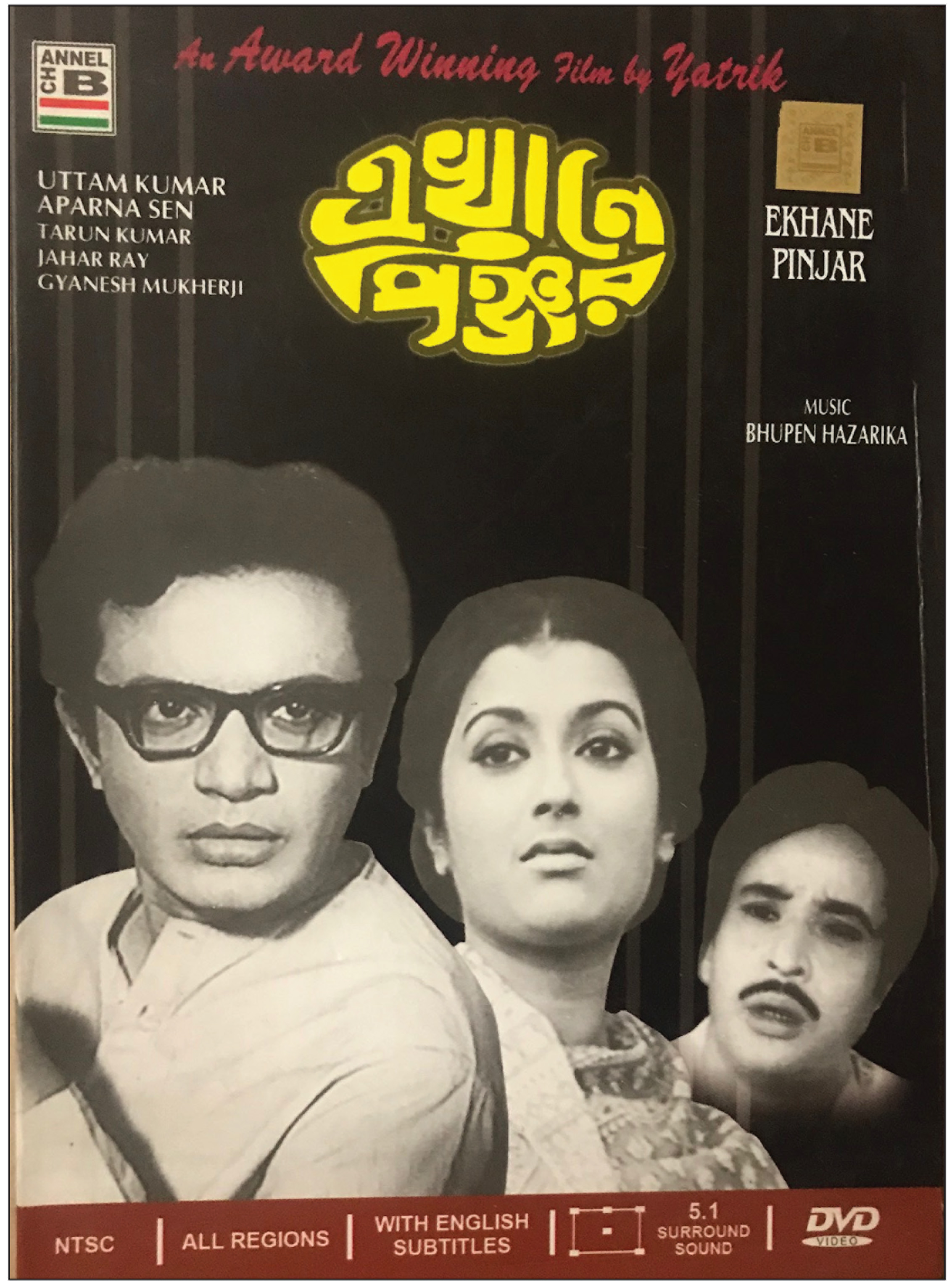
Ekhane Pinjar is a story of a middle-class family whose eldest son Nabendu/Dileep Chowdhury is a shikhitabekaar, the educated unemployed (Gooptu, 2010), who drifts into a life of criminality and dies in a police encounter (Figure 1). Amal/Uttam is a successful writer who encounters Nabendu in the police lock-up and gets drawn to this educated young man who is a criminal but still dreams of realising his bhadralok identity in the future. After Nabendu’s death, Amal visits his small-town home to inform the family of this unfortunate death but is unable to disclose the real reason for his visit as the family ekes out an impoverished living of genteel poverty with an ill, bed-ridden father. Nabendu’s older sister Nila and youngest brother Subho are also petty criminals. Amal soon ‘takes’ the place of the dead son and enables the family regeneration as his bhadralok persona steers them towards moral and economic stability.
In Jadu Bangsha, we encounter Uttam as the ‘brooding, melancholic decrepit failure Ganada’ (Biswas, 2007) (Figure 2). He is not the protagonist in this film, but his overarching presence as the neighbourhood elder brother figure haunts Surya and his friends’ imaginary. The film narrates the story of Surya/Dhritiman Chatterjee and his three friends, Buli, Abhay and Kripamoy, a group of drifters, jobless bhadralok young men who spend their days in fogs of drunken stupor. This despairing youth group uses violence and intimidation to mark their presence. Ganada becomes the most potent victim of their aggression and is forced to commit suicide as he is unable to live with the insult and humiliation of his confrontation with Surya’s gang.

Nagar Darpane stages the apogee of the ‘actual elder brother figure’ (Biswas, 2007, p. 4) (Figure 3). The film narrates the story of Anupam Chakravarty, a popular writer and advertising professional and his family of two younger brothers and widowed mother. The first half of the film focuses on Anupam’s work life and his increasing isolation due the amoral dealings of his manager, his refusal to collude with him in siphoning off money, and Anupam’s forced resignation. From being the karta [head], of this ekannavarty [joint family], he becomes dependent on his younger brother, Aju, who rises to become the Calcutta police commissioner. Anupam is increasingly isolated in his familial space. He is eventually besieged by madness and ultimately incarcerated in mental asylum.

Bhadralok Dada and Intergenerational Schisms
In the three films the Uttam dada figure is confronted with the degeneration of the younger bhadralok exemplified by the use of uncultured language and violence deployed by the disaffected youth. One of the defining features of bhadralok identity is that of cultured selfhood discussed above, where language is a crucial marker. The peppering of everyday language with slangs and expletives is a marker of the ‘other’, the chotolokor and the changdas. Bhattacharya’s work has demonstrated how in the nineteenth-century language discourse the form of Bengali language was a deeply contested issue. The debate among the sadhu, chalit and moukhik bhashas was resolved unequivocally in favor of the ‘spoken voice’, the ‘cultured and educated voices of the Chaudhuries and Tagores’ and not the ‘unrefined parole of the peasant’ (2005, p. 218). The use of slangs, expletives, and the open display of abusive language that we encounter in these films demonstrates the chasm between the ‘cultured language’ of the bhadralok and its disavowal by the changdas. The sense of disenchantment with this defining linguistic characteristic of the bhadralok that the young feel cannot be more pronounced and disturbing.
In Ekhane Pinjar, the conversations of Amal with the shikhitabekar, educated unemployed youth, are used to reveal the shifts in the self-perception of the older successful writer and the young bhadraloks who have no aspirations to become bhadra, especially seen in Amal’s interaction with Subho, Nabendu’s younger brother. Subho’s sarcastic observation to Amal that he is no Vidyasagar, 9 and he has no desire to be one, is reflective of this disavowal of polished language and the merits of education. But ultimately Amal is able to ‘speak’ to him and Subho promises that he will refine his language. Amal’s first encounter with Nabendu stages the conversation between the successful, feted, and popular writer and the educated criminal who ‘looks’ like a bhadralok but is not one of them. As I have said above, this othering of the self is not enacted as a class confrontation but as an intergenerational schism. The younger generation has internalised the chotolok attributes and hence is in constant collision with the demands and desires of respectability. The film narrative positions various conversations that revolve around the futility of being bhadralok in the given social circumstances. Amal’s encounters with Nila and Subho are used to present the growing chasm of ideas and ideals that is inflicting the younger bhadralok and why they are drifting away from their social and familial ethical responsibilities to the criminal world and petty smuggling activities. In these encounters with the elder, more successful figure, the young do not accept his views. In Jadu Bangsha too Surya and his friends cannot be bothered with the polished niceties of speech and language. They question, critique and are unapologetic about the errant and deviant ways that they have chosen. The dominant tropes in these films play on the disintegration of the dreams, the ennui, the dejection and the constant confrontation between bhadralok and the abhadra youth.
The clash in Nagar Darpane is staged between Anupam and his brothers Aju, and Amu, as well as Shukla, Aju’s wife, as an intergenerational strife, and a clash of bhadrata versus abhadrata. The values that Anupam believes in are not the normative ones that the younger family members choose to imbibe, and this leads to the narrative collision that culminates in the horrifying psychoses that Anupam experiences. In the film the favoured cosmopolitan life of the younger generation is equated to socialising, drunken parties and dancing. In fact ‘partying and dancing to western music’ is one of the recurrent tropes that makes a moral statement in many of the 1970s films: in Chowringee (1968), Fariyaad (1971), Hotel Snow Fox (1976) and Ritwik Ghatak’s Subarnarekha (1965); frenzied drunken partying scenes and cabarets are used to signpost the aspirationally Westernised urban life which is regarded with moral opprobrium. In Nagar Darpane we see the ‘foreign-returned’ Amu and his sister-in-law, Shukla, embark on a spree of socialising which bodes ill for the family. Aju’s job makes it impossible to provide Shukla with his company and time; Amu steps in to fill that gap. Confronted with their developing sexual intimacy, we see a bewildered Anupam defining the ‘bhadralook’, aghast at the unfolding events, witnessing the affair with alarm and a censorious gaze. Significantly this ‘look’ is denied to the others in the family. Further in both Jadu Bangsha and Nagar Darpane, the interface of dada with the youth takes on darker tones resulting in the dada’s suicide and madness. I shall analyse the physical intimidation and violent encounter of the gang with Ganada in Jadu Bangsha and Anupam’s experience of familial disintegration resulting in his psychotic breakdown in Nagar Darpane to further illustrate the intergenerational schism and violence that are central to the world of the domestic melodrama as has been described in another context (Schatz, 1981) and the waning of the dada’s influence as the locus of authority, both moral and familial.
The waning influence of dada and the intergenerational schism is demonstrated in two sequences where the gang comes to confront Ganada in his shop and at Naina’s house. The sequences also work as a reminder of the crisis of the older bhadralok as it confronts the younger generation. They subject him to horrible humiliation, making snide remarks, casting aspersions on his relationship with Naina, and making fun of his adopted family, ‘home’. The gang’s childhood idol has been transformed into a ‘pathetic loser’, ‘the owner of a rundown business’ (Biswas, 2007, p. 6), sitting with his face behind the typewriter, amidst the pile of ‘worthless commodities’ (Biswas, 2007, p. 6). As the group approaches him, the camera slowly zooms in to him, closing in after we see the overflowing shelves of goods that he has not been able to sell. He appears before us, an unshaven, unkempt, devalued self, the ‘bhadralok of yesteryears’ (Ghosh, 2004, p. 250), one whose time has started waning, with a cigarette dangling on his lips, writing to some ayurvedic agency to sell their products. Surya and others continue to pressure him to give money that is due for pawning the antique lamp. Their body language and gestures are extremely contemptuous, exhibiting derision, while Ganada remains silent.
His silence signifies the consciousness of his culpability and responsibility in how the younger generation has turned out. Biswas observes that
Conversation, face to face exchange, takes on a new vividness and intensity… The star adopts a new speech, brings a new timber into his voice, and accentuates his age as he faces a generation that has come to question every legacy of its fore bearers. (Biswas, 2007, p. 6)
The gang leaves after bullying him and snatching the paltry ₹5 he had. The next shot frames them on their cycles, feeling victorious at their ability to inflict abject humiliation on their childhood hero. This display of sadistic pride and aggressive masculinity is enacted again in the second sequence when the gang confronts Ganada at Naina’s house and ends in his suicide.
This sequence on the first day of Durga Puja 10 opens with a sound of horse hoofs and a marching martial music connoting soldiers going to battle, while in the visual field we see the four friends riding cycles, framed from the back, and in the foreground a cemetery with graves, with one big grave and its cross visible prominently. The shot cuts to slipper-clad feet climbing stairs while the marching tune and the beat of horse hooves continue on the aural register. The unfolding scene stages a battle, between the childhood hero who is seen by the gang as a relic of the past, accused of being a thief and a liar, and the young men drunk on spirits as well as their physical prowess that thrives on the display of naked aggression and virility. At the beginning of the sequence, we see Ganada sitting on his bed with the four friends led by Surya standing facing him. The conversation begins innocuously though the tense expression on Ganada’s face, his jerky movements as he smokes his beedi, tobacco cigarette, and his attempts at making polite conversation are juxtaposed against the supercilious body language of the gang. As the conversation starts acquiring dangerous overtones with blatant display of derision and aggression, we see Ganada becoming agitated and he starts to raise his voice. The mounting tension and dread is captured in a brisk-shot reverse shot between Ganada and the youths. Surya repeatedly calls him a liar and a cheat, who pretends to be Yudhistara, 11 but actually has pawned the gold lamp.
Visually Ganada dominates the frame foreground, standing taller than Surya, who is only seen as a close-up reflection in the small square mirror on the rear wall. This composition with Ganada appearing larger and taller than the four youths signifying his stature, which places him above the callow youths, is repeated through the sequence till we get to the culminating segment. Ganada frantically searches his suitcase to return the lamp but is unable to find it. From a previous scene we know he had cleaned the lamp and kept it back. Ganada is puzzled, and we see Surya charging into the room to demand an explanation for its disappearance. As Ganada tries to convince them that he has not sold it, they remain unconvinced and suddenly start beating him. In a series of intercuts we see their faces in close-ups, sweating, panting, and raising their fists as they keep bashing the prone figure on the bed. Through this beating, the soundtrack resounds with the rising beats of the dhaak, drum and cymbals, the traditional Durga Puja music. The shocked scared reaction inserts of Naina and her youngest sister cue us to the bloody beating that Ganada is receiving. The gang leaves soon, and the ensuing shot of their feet climbing down the stairs as the dhaak music changes to the sound of horse hoofs and the marching tune with which the sequence had begun takes us back to the same composition of the four figures cycling and the grave with the cross seen in the foreground. The ‘victorious’ warriors have achieved their victory and leave behind their vanquished adversary, the bhadralok dada who was their neighbourhood hero. The poignancy of the sequence is accentuated as we see an older Uttam being derided and beaten by the younger actors, despite the shot composition where we see Ganada almost towering over the younger actors. The suave and elegant romantic matinee idol is now reduced to being bullied and negated as a failure, his heroic stature and status notwithstanding.
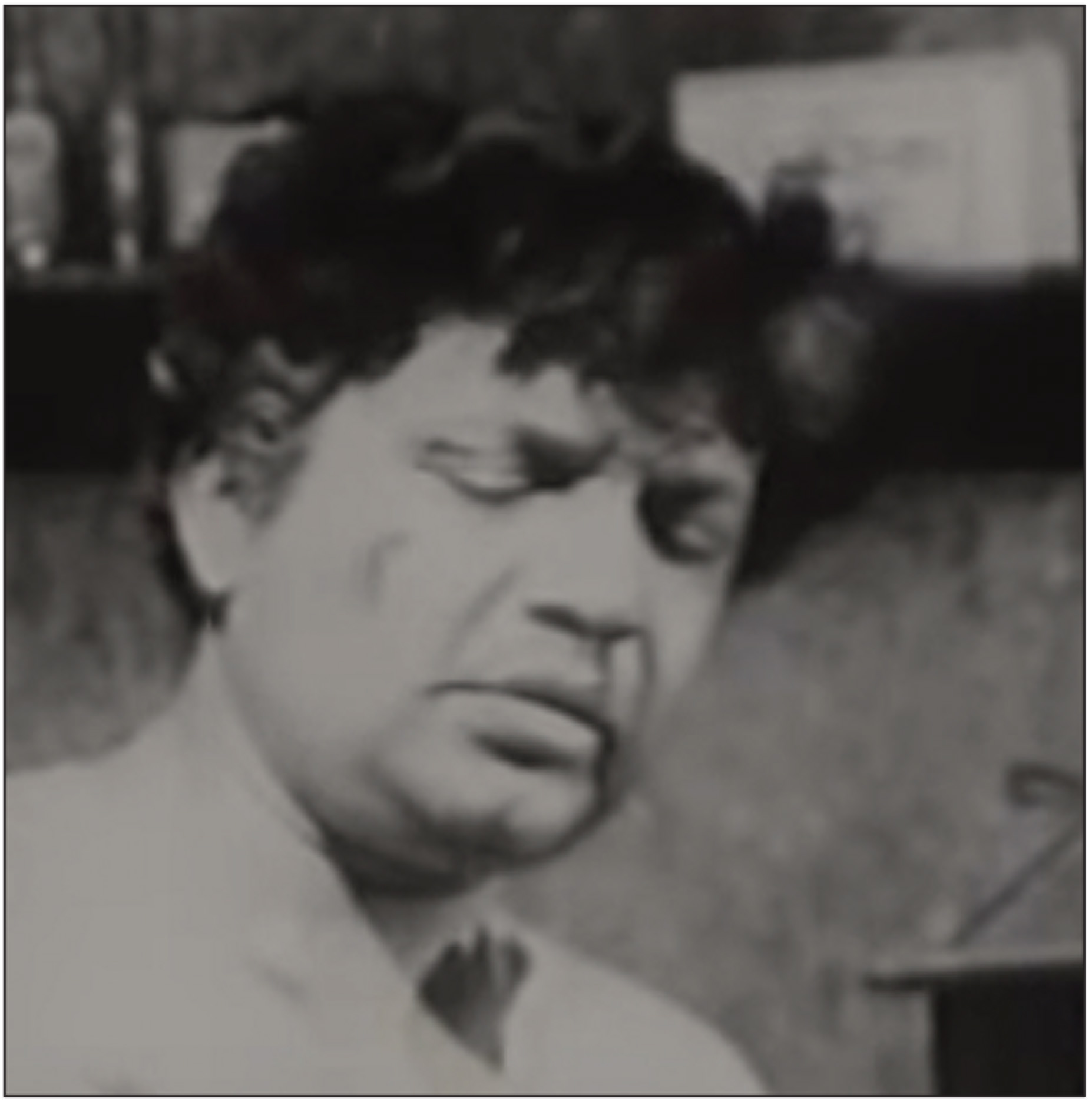
The shocking consequence of this violent aggression is visible in the close-up of Ganada’s face, blood-smeared, with a bleeding nose and gashes on his cheeks (Figure 4). His torn kurta and broken spectacles is a sad reminder of the violent overtones of the interface of bhadra and abhadra that the film explores. This terrifying interface is further intensified via an insert of Ganada picking up and throwing the plate of sweets served to the guests as a mark of respect and in a spirit of joy to mark the auspicious beginning of Puja. But the entire episode has shattered the veneer of bhadrata that the sweet connoted. Significantly Ganada throws it, and the import of his gesture is made clear by his observation to Naina, ‘I probably deserved this; I had tried to make them understand…’ We see Ganada smile, 12 and the camera slowly zooms in to his close-up and fills the frame with a freeze shot of his bruised and bloodied face. His culpability and dejection coupled with his abject humiliation result in the overdose of opium that takes his life. The bhadra dada can no longer bear the guilt or the responsibility of the crisis engulfing the young, and since he himself is a failure, he can only signal his protest by killing himself.
In Nagar Darpane the intergenerational chasm that Anupam experiences morphs into a psychological nightmare, a portent of his imminent psychotic insanity within the diegetic world. The camera frames him as a solitary figure lying down on his easy chair or walking up and down his verandah, disconnected from both his home and his writing. Anupam becomes a caricature of his former self as he withdraws into himself almost becoming mute. The use of his ‘embodied voice over’ (Silverman, 1988)
13
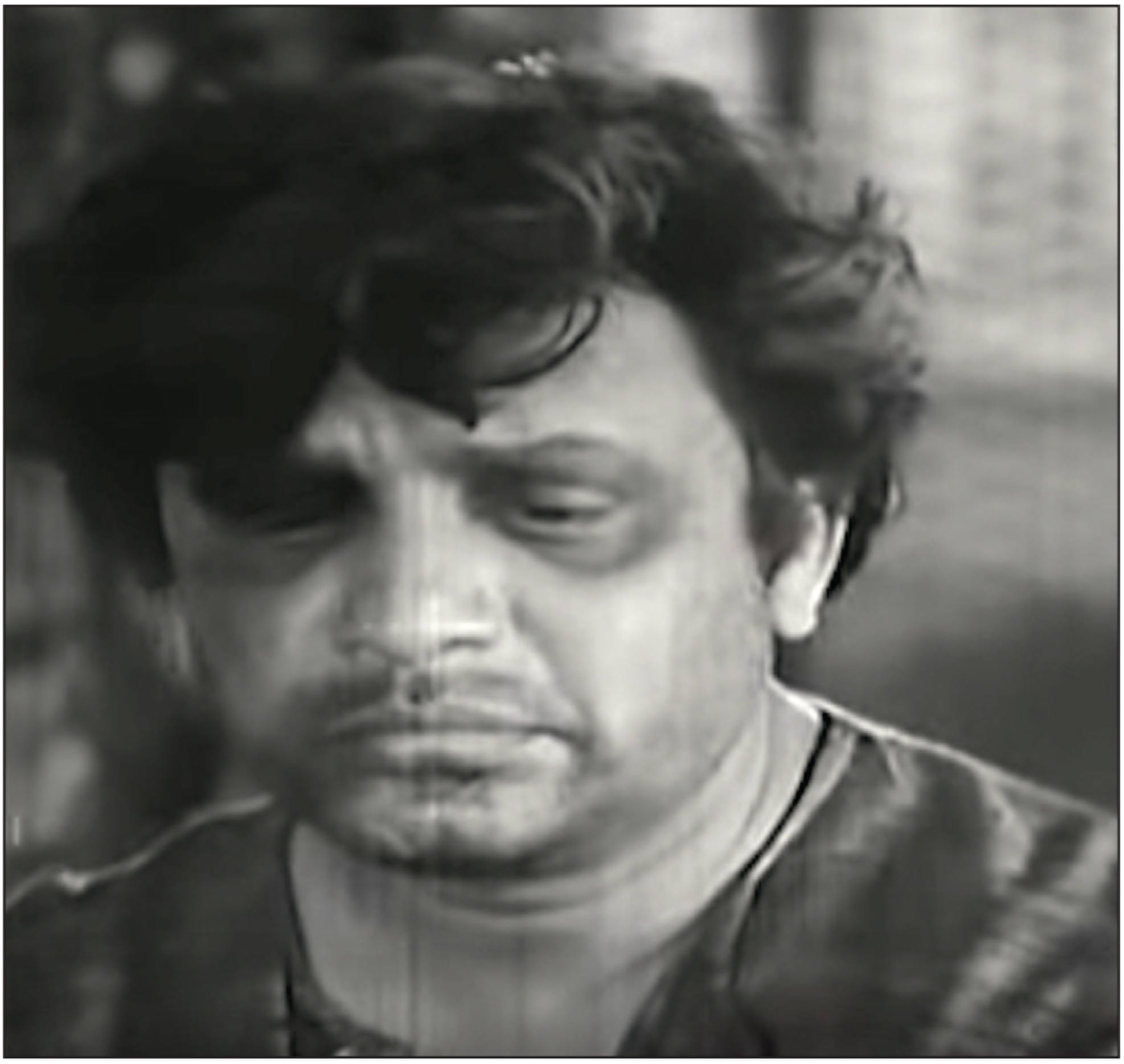
increases as well. We see the physical deterioration of the once suave and elegant figure. Anupam looks unkempt, with stubble, dark circles under his eyes, and a jowly face that appears a grotesque version of what he once was. His conversations are marked by a sense of puzzling inadequacy to grapple with the situation or become snarling confrontations where he becomes an object of fearsome loathing and terror, becoming hysterically violent, attacking his sister in law, Shukla, or raging at his wife, Srilekha, and his brother. He also starts peering at himself in the mirror, scrutinising the lines on his face, desolate and lonely. This physical deterioration of the ineffectual male is expressed as an inward violence, a characteristic of the melodramatic form that struggles to articulate individual or social disintegration. It would be productive to use Rodowick’s analysis from a different context to understand Anupam’s irrational incoherency directed at his family and its outward expression. Rodowick has eloquently pointed out that
Melodrama is better characterized as a centripetal form which directs these forces inward. Or more precisely, the expression of violence can only be regulated by an economy of masochism which often gives the narrative a suicidal thrust, channeling the expression of sexuality as violence against the text in a manner which maximizes the potential for disruption and incoherency. In this manner the melodramatic text is balanced on the edge of two extremes, one of which is inertia (the paralysis of the system, its resistance to change or any form of external development) and the other which is entropic (where action is expressed only as an irrational and undirected surplus energy. (Rodowick, 1987, p. 273)
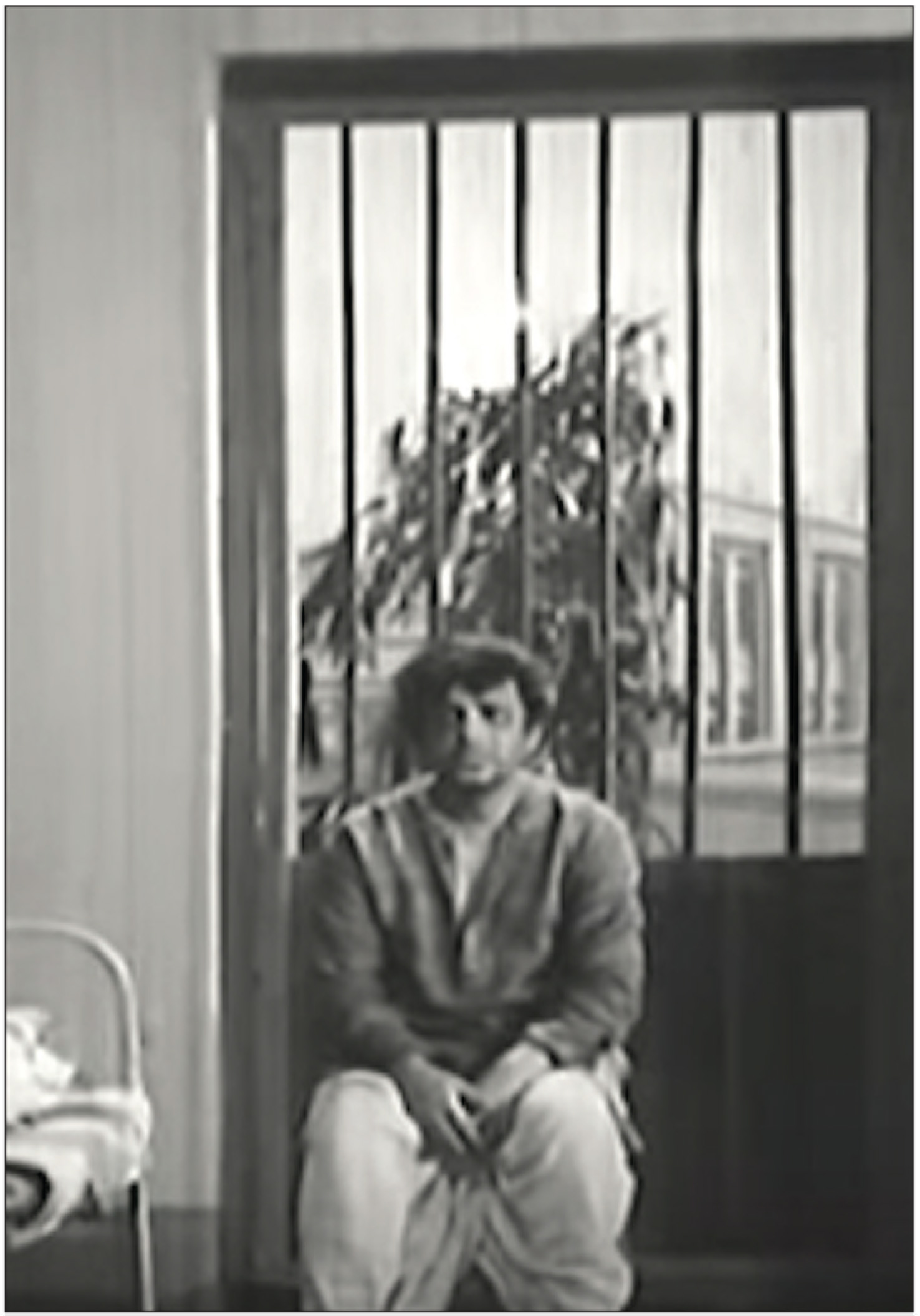
Anupam’s inertia and entropy described above is a portent of his slide into madness. This is juxtaposed with the incidents in the city, thus equating his insanity with the madness unfolding outside, a sign of the insane violence which engulfed the Bengal polity resulting from the Naxalite movement and its fallout in this decade. As I have remarked in the introductory section, the domestic melodrama makes covert political and social comments through the trope of the family in crisis and the ineffectual male figure. Anupam’s psychosis alerts us to the manner in which this film is signposting the larger historical condition of the 1970s via the star body. The use of radio commentary, the sounds of police sirens, and newspapers inserts are intercut with Anupam sitting or pacing as he hears about violent incidents engulfing the city. These sequences resort to pure gestural performance as we see him holding and pressing his stomach as if he is in unbearable pain. His insomnia and still posture make him appear as the mute witness who cannot stop or even protest at the horrific nature of the urban dystopia that is unraveling. The violent counter-aggression to contain Naxalism unleashed on the city is led by his younger brother Aju, the City Police Commissioner. Anupam too is subjected to Aju’s beating and violence as his ‘madness’ spirals out of control and he is dragged away to a mental asylum. We see Anupam again in the penultimate sequence of the film inside a cage in the asylum (Figures 5 & 6). As the scene unfolds the camera cuts to his close up. We see vacant eyes with huge dark circles, the face bruised, hair uncombed, unshaven, unblinking and unfocused stare, and the body drooping even in the sitting posture. As Anupam slowly raises his head inside the room, the camera tracks back, we see him sitting still, looking the decrepit human being he has become. The long journey of the emotionally and physically violated dada/star ends thus in the empty look, the stare that fixes us with its unblinking horror. The epitome of the romantic hero is now a battered body, displaying the bruises of the times on his face and self.
The star text/body conjoins the on and off screen (Dyer, 1979). For the spectators and fans of Uttam this scarred body is a reminder of the many turbulences that star would have experienced in his long career as the ‘one-man industry’ burdened with the responsibility of being the dada yet recognising his own limits. For his audiences these traumatic and terrifying cinematic encounters would have resonated with the information about the troubled personal life, and the schisms within the industry where the star was pitted against his contemporaries, underscoring the links we know exist between the diegetic and the extra-diegetic that creates the star text. Writing in Amar Ami, his autobiography about the turbulent late 1960s–1970s, Uttam has mentioned the sense of acute crisis that he was facing as the industry was reeling under infrastructural shortcomings, crippling electricity shortages which led to significant financial losses, as well as his films flopping, and his personal financial loss due to the box office debacle of his home production of Choti si Mulaquat (1967). Further the schism between two groups, Shilpi Sangha and Abhinetri Sangha, one led by Uttam, the other by Satyajit Ray, had divided the industry and the star writes of the emotional hurt and sense of betrayal that he felt as many co-actors chose to support Ray’s camp. The dada/star thus embodied the many personal and the professional battles that engulfed Uttam during this period.
Performing Masculinity: Ineffectual Male/Bhadra Star
Cinematically the figure of the vulnerable dada, the ineffective male of these two films, gives voice to the loss and suffering of the region eloquently via these male weepies. In these weepies, Uttam’s genteel sensitivity is the sign of the failed male protagonist who despite being the normative bhadralok figure cannot provide the required protection or direction to his adopted and real family. Ganada is not able to save Naina’s family from disintegrating in Jadu Bangsha, while in Nagar Darpane it is Anupam’s younger brother Aju who steps in to take over the reins of his family. Uttam’s sensitive masculinity was seen as a valued characteristic in his romantic couple films with Suchitra. In those films he was primarily configured as the gentle lover, the compassionate companion for the strong independent woman; his feminised masculinity was not coded as a sign of failure. However, the ineffectual dada can be read as the sign that denotes the passing of the bhadralok subjectivity that Uttam, the star, typified. For the 1970s films this waning of the bhadralok subjectivity is located in the intergenerational schism, a central trope of the family melodrama, displacing the questions plaguing the social on to the personal as I have demonstrated in my reading. The morphing of the superstar into the ineffectual dada figure whose inabilities force him to yield space to the younger generation and their aspirations is brought out with remarkable resonance in the three films discussed here.
This dystopic narration is accentuated with performance, changes in speech patterns, and sartorial elements adopted by the star in these films. The melodic and elegant speech favoured by Amal changes to a hurried tense cadence as Ganada and a frenzied snarl of Anupam as Uttam tries to give body to the beleaguered sense of subjectivity that he is enacting. This change in the timbre of his voice to high pitch, stutter, snarling dialogue delivery and visually his bearded unkempt harassed looks add to the sense of despair that the films articulate. It is also important to signpost the sartorial elements that add to the performance of the bhadralok dada in these films. In all three films discussed here, he is dressed in dhuti panjabi (dhoti kurta), the traditional attire of the Bengali male. This attire is important as it is a significant visual marker of the Bengali bhadralok. Uttam’s image was constructed along the axis of attire and fashion as is true for star texts. Biswas argues that Uttam’s acceptability for the diverse audience base rested on the fact that he could carry off traditional and Western attire with equal ease (2010, p. 40). Uttam was an acknowledged style icon and film magazines regularly carried photo features of the star wearing the traditional Bengali male attire. In the 1970s, couture house Anandas had used him as a model for designer dhutis designed by the artist Gostho Pal. 14 Accounts of Uttam’s style of wearing the dhuti and its mastery that the star demonstrated showcase his style quotient, the unbuttoned kurta with its peeping gold chain around his white neck, the ‘correct’ manner of managing the front pleats, the measure of ankle and feet soles that would be visible and the choice of appropriate make of dhuti befitting social occasions such as denoting festivity or condolence events provide us with the cartography of self that clothes denoted for the mahanayak. This map coded him as the epitome of the cultured bhadralok (Bandopadhyaya, 2010, pp. 171–172; Mukhopadhyaya, 2010, p. 32), the quintessential masculine idol.
In Ekhane Pinjar Amal’s cultured bhadralok identity is cued via his culturally coded dress as the dhuti-clad Amal dominates the visual field striding the frame with easy grace and felicity. This figuration marks out his subjectivity that is able to vanquish the local villain Avinash Mitra. As he negotiates with him, one glimpses the mettle of a strong will that can deal with the local henchman and come away victorious without resorting to fisticuffs. In this film, he is still in control of the changing situations of the varied expressions of modern city life that he encounters including that of deteriorating social conditions. 15 In the other two films, we encounter the beleaguered male, the failed dada wearing unkempt clothes in Jadu Bangsha, and his crumpled kurta and dirty clothes stage the detritus that Ganada has become, far removed from the elegant suave Amal of Ekhane Pinjar and ultimately seen in a torn kurta as he gets beaten up by a mob and descends into insanity in Nagar Darpane. The shocking sequence of familial violence where Anupam is slapped by Aju is made more poignant as we see the star dressed in a dirty dhuti-kurta, shabby shawl, and being dragged bare foot by the asylum orderlies. The performance of beleaguered masculinity as it crumbles under pressure is given form and substance by the sartorial choices which were in sharp contrast to Uttam’s otherwise charismatic and fashionable star persona. During this period his failing health had become visible in the receding hairline, weight gain, and puffed cheeks, poignantly expressing Ganada and Anupam’s physical vulnerabilities.
Uttam’s masculinity, his genteel bhadralok identity, can be coded as both pretty and manly at the same time (Kelly, 2016), 16 the quintessential Bengali male. His masculinity cannot be compared to the Hollywood heroes’ physicality or the Hindi film heroes’ body, sculpted to muscular perfection. His heroic attributes were seen to reside in his superior mental faculties and his bhadralok persona which did not resort to hard physical labour or settled scores by resorting to violence. He was not the ‘macho’ hero; his suave, well-groomed persona could only play the piano or the extent of his physical training was limited to playing tennis, given his middle-class origins (Bosu Roy, 2001, pp. 21–22). The genteel and bhadra male subjectivity typified by Uttam brings the star’s almost androgynous masculinity into sharp focus. Bandopadhyaya provides an interesting analysis of the lack of Uttam’s physical attractiveness which can be coded as normatively handsome. His thick lips, pudgy hands, and slack jaw line (as compared to a more rugged-looking Soumitra Chatterjee) still made him the heartthrob of his huge female fan base. Uttam’s delicate demeanour and feminine looks attracted women to regard him as an ideal and safe romantic partner. Across his fan base the oft-repeated phrase about him was that he was ‘good’, he would never harm anyone, or be a villain (2010, pp. 75–188). Uttam’s idealised bhalochele, good-boy image, was carried along the bhadralok axis. This image accreted despite his negative portrayals of a wife murderer in Bicharak (1959) of a drunkard lustful husband in Shankhabela (1966), or in films that deployed the trope of sexual aggression such as a kidnapper and potential rapist in Alo Amar Alo (1972). If most of Uttam’s romantic screen personas are that of the sensitive ideal male, then the ‘normative’ male stereotype of the sexually virile man was also an important constituent of his image. In the extra-filmic domain of gossip, visible in the biographies and fan letters in film magazines, various rumored affairs, his marriage, and the long live-in relationship with Supriya Chaudhuri all create a tension that feeds into his masculine image.
In conclusion it can be said that in his long career Uttam lent himself to the changing contours of Bengaliness that exemplified the varied times successfully. From being a romantic matinee idol to a failed ineffectual figure his personas of a hero and dada provided the popular industry a locus that captured the aspirations and disenchantments of the three decades that defined not only the contours and generic segmentation of the industry but also ideas of Bengali masculinity. As I have attempted to demonstrate via my focus on the 1970s genre of male weepies starring Uttam, the popular melodramas captured a significant moment of social and political upheaval in West Bengal via these films. The power of star persona and the ability of melodrama to capture experiences of crises are given full expression in these films. The tremendous draw and charge of these films could not have been possible without Uttam—for his spectators the sight of the beleaguered dada would have had specific resonances as they would have insider knowledge about his ill health and various familial and professional crisis that the star was undergoing at this time. More importantly we need to remember that as the dada he embodied the persona of the pater familias, personally as well as for the industry. The industry was engulfed in a series of crisis as it embattled the threat of Hindi cinema, infrastructural shortcomings, and divisions within the industry, which, as I have mentioned above, saw two opposing camps, one led by Uttam, the other helmed by Ray. Therefore the intergenerational schism and the socially turbulent times that are eloquently expressed in the films were also visible in the troubled times that the industry itself was facing. As Uttam the dada/star provided the popular with its most obvious locus, his cinematic tragedies and the professional and personal struggles are placed on the same interpretative plane in this excavation of the evolution of his star persona in the 1970s. The conjunction of melodrama, the star persona, and masculinity thus become a significant template for understanding the power and charge of melodrama and its varied configurations for South Asian film cultures.
Footnotes
Acknowledgements
The author would like to thank Ira Bhaskar for her comments and suggestions for this article. Thanks are also due to Sumangala Damodaran, Hephzibah Israel and Geetha Venkataraman for their suggestions on early versions of this article.
Declaration of Conflicting Interests
The author declared no potential conflicts of interest with respect to the research, authorship, and/or publication of this article.
Funding
The author received no financial support for the research, authorship, and/or publication of this article.