



Abstract
Binaca Geetmala was a weekly countdown or hit parade radio programme that ranked Hindi film songs by order of popularity, first based on listeners’ requests and later on record sales. The programme aired from 1952 until 1994 and is arguably one of the longest lasting and most influential radio programmes in the world. Drawing on a variety of sources, including listeners’ diaries, correspondence from listener radio clubs and interviews with broadcasters and devoted listeners, I trace Geetmala’s four-decade ‘melodious journey’, charting the programme’s central role in making Hindi film songs – the leading popular music in the Indian subcontinent. I make two interrelated arguments. First, I argue that through its popularity charts, Geetmala cultivated an understanding of Hindi film songs as ‘the music of the common people’ and made partaking in film song’s so-called ‘commonness’ the very attraction of the programme. Here, I consider how this fascination with ‘commonness’, with measuring popularity, and with individuals’ participation in the process, relates to the larger political culture of independent India’s first decades, including the experience of universal suffrage. Second, I argue that by encouraging alertness to ever-changing popularity lists and by developing specific terminology, Geetmala effectively transformed ordinary radio listeners into discerning Hindi film-song experts.
‘Behno aur bhaiyo, aap ki khidmat me Ameen Sayani ka adaab (sisters and brothers, at your service, Ameen Sayani greets you).’ For four decades, Ameen Sayani greeted Binaca Geetmala’s listeners with a version of this phrase recited in his characteristic upbeat style. Binaca Geetmala was a weekly countdown or hit parade radio programme that ranked Hindi film songs by order of popularity, first based on listeners’ requests and subsequently according to record sales. The programme aired mostly uninterrupted from 1952 until 1994 and is arguably one of the longest running and most influential radio programmes in the world. Similarly, the programme’s legendary host, Ameen Sayani, who anchored Geetmala during its four-decade run, is one of the subcontinent’s most influential voices; his enigmatic voice and speaking style are still evoked by broadcasters and ordinary people alike today.
Binaca is a consumer brand owned by the multinational pharmaceutical company CIBA-Geigy Limited, and ‘geetmala’ or ‘geet mala’ means a garland of songs in several South Asian languages. Geetmala aired on Radio Ceylon, an immensely successful commercial radio station that in the decades following India’s independence from British rule developed a symbiotic relationship with the Hindi film industry in Bombay (present-day Mumbai). As the station’s name suggests, Radio Ceylon was located in the nearby island nation of Ceylon (now called Sri Lanka). To reach listeners in the former British India, the station relied on a powerful shortwave transmitter that had been originally set up by the British War Office during the Second World War to bring music and news to British soldiers in the South Asia and Southeast Asia Commands. Louis Mountbatten, who before becoming India’s last viceroy served as the Southeast Asia Command’s Supreme Commander, played an important role in bringing the transmitter to the island and setting up a military radio station. Mountbatten and his team could not have foreseen that the military station would become a successful commercial radio station in the decades following the British departure from the subcontinent.
Radio Ceylon’s Geetmala, which aired on Wednesday nights at 8
Scholars of music and film acknowledge Geetmala’s centrality to cinematic cultures of the subcontinent (Arnold, 1991; Beaster-Jones, 2015; Jhingan, 2011, 2013; Manuel, 1993; Morcom, 2007, 2011). Yet, there is little scholarly research on this influential radio programme itself, even as research on the history of radio broadcasting in India has begun to expand significantly (Duggal, 2015, 2018; Huacuja Alonso, 2019, in press; Lelyveld, 1994, 2002; Punathambekar, 2008, 2010a, 2010b; Ravikant, 2013, 2016). Drawing on a variety of sources, including listeners’ personal diaries, correspondence from listener radio clubs and interviews with broadcasters and devoted listeners, I trace Geetmala’s four-decade ‘melodious journey’ and chart the programme’s central role in making Hindi film songs the leading popular music of the Indian subcontinent. I make two interrelated arguments. First, I argue that, through its popularity charts, Geetmala cultivated an understanding of Hindi film songs as ‘the music of the common people’ and made partaking in film song’s so-called ‘commonness’ the very attraction of the programme. Here, I consider how the programme’s fascination with ‘commonness’, measuring popularity and with individuals’ participation in this process relates to the larger political culture of independent India’s first decades, including the experience of universal suffrage. Second, I argue that by encouraging alertness to ever-changing popularity lists and by developing specific terminology that enabled listeners to measure a song’s success or otherwise, Geetmala effectively transformed ordinary radio listeners into opinionated and discerning Hindi film-song experts. Put differently, the programme ensured that every listener had an opinion about Hindi film songs’ overall merit and that expertise in Hindi film songs became a popular pastime.
An analysis of Geetmala also helps us unravel the important, if still largely unstudied, symbiotic relationship between radio and Hindi cinema that developed in the Indian subcontinent in the decades following India’s independence. As such, one of the underlying aims of this article is to move beyond the notion that in India, and South Asia for that matter, Hindi film songs are inherently ubiquitous. Rather, I seek to begin to understand the contingent process by which that ubiquity developed through a close analysis of a single radio programme. The article opens with a discussion of Geetmala’s early years, followed by an in-depth exploration of the countdown system and the ways it both reflected and contributed to contemporary political culture. Along the way, I trace Sayani’s astonishing career and the Binaca brand’s important role. I close with a brief exploration of the programme’s afterlife and various attempts at reviving it.
B. V. Keskar, All India Radio and Radio Ceylon
The story of Geetmala begins with a watershed event in the sonic history of the subcontinent. In November of 1952, B. V. Keskar, Prime Minister Jawaharlal Nehru’s new appointment to the Ministry of Information and Broadcasting, spearheaded ambitious reforms to the musical and linguistic programming of the national radio network, All India Radio (AIR). The goal of these reforms was to ‘transform the auditory experiences of the citizens of the newly independent nation through the medium of radio’ (Huacuja Alonso, 2019, pp. 117–118). Keskar, who was a Hindustani classical music connoisseur, filled airtime hours with Hindustani and Carnatic classical music. In his most divisive move, Keskar ordered that AIR stations stop broadcasting Hindi film songs because he believed that these songs’ growing popularity posed a threat to Indian classical music traditions (Keskar, 1952, p. 8). In the months to come, listeners dissatisfied with the national network’s transmission began to search for other stations that better suited their musical tastes (Huacuja Alonso, 2019; Ravikant 2016).
In the neighbouring country, Radio Ceylon administrators quickly realised that AIR’s restrictions on Hindi film songs posed an exceptional opportunity for their newly founded commercial station to develop a broadcasting service that specifically catered to the needs of disgruntled listeners in India. The shortwave transmitter the British had brought to Ceylon during Second World War had outstanding reception throughout most of India. In the months following Keskar’s tirade against film songs, Radio Ceylon executives forged connections to broadcasters and entrepreneurs in Bombay, who helped the station recruit sponsors, produce sponsored radio programmes and connect Radio Ceylon to the film industry. Radio Ceylon administrators also developed their own in-house programming in Colombo itself: they employed Hindi-speaking broadcasters from India and built up an impressive Hindi film-song gramophone library. By the mid-1950s, a famous saying circulated in India that noted that 9 of 10 radio sets were tuned to Radio Ceylon and the 10th was out of service (Awasthy, 1965, p. 54). In addition to India, Radio Ceylon also garnered a robust following in neighbouring Pakistan, fostering a shared aural culture across the newly formed borders.
Keskar’s controversial reforms, however, had other consequences, which ultimately set the stage for what Radio Ceylon and, more specifically, Geetmala would accomplish in later years. AIR reforms unleashed a heated debate about film songs. While some radio listeners publicly supported the minister’s reforms, many more passionately criticised what they felt was a prejudiced onslaught on music they loved. One place where film-song fans took to defend their music was the opinion pages of film magazines. Of course, film magazines are not neutral space; film fans are more likely to read these magazines and to write in their opinion pages. Yet, what we see developing is a new interpretation of the value of film songs framed unambiguously in response to Keskar’s critique (Huacuja Alonso, 2019, p. 136).
One music lover writing from Bombay to the Movie Times explained that ‘a large section of the masses’ purchases radios only because they want to hear film music. Moreover, ‘shopkeepers who possess radio sets mostly like to get more film music to attract the public’. Another listener also from Bombay explained in Filmfare, ‘The films brought music to the common man, simplified so that he could enjoy and appreciate it.’ Music directors too began to relate their compositions rather consciously to the ‘common people’ in the wake of Keskar’s diatribe. For example, Naushad Ali, by then an already prominent and respected film music director explained:
the main reason why those who favour classical music detest film music is that its makers smashed the age-old taboo. Film music brought a great art out [of] the musty halls of the Nawabs, out of the possession of [a] few to the millions who were denied the privilege of enjoying it for centuries. (Naushad, 1955, p. 19, as cited in Jhingan, 2011, p. 161)
Both the Bombay writer and Naushad’s notes show the ways many, in great part in response to AIR’s reforms and the controversial ban, began to describe film songs as ‘the music of the common man’. The radio listener addressing Filmfare readers put it best when he wrote, ‘the versatility of film music and its appeal to all segments of society explains its continuing popularity and establishes its significance as a mass-art’.
Here, I wish to stress two points. First, while Keskar’s critiques of film songs stand out for their severity, the notion that Hindi film songs cater to ‘cheap’ or ‘unsophisticated’ tastes of film has been a remarkably resilient and prevalent idea. As Anna Morcom notes, explanations as to why Hindi films (or Indian films, more generally) feature song numbers have often centred on the perceived deficiency of spectators (2007, pp. 3–4). For example, the film critic Soma Das Gupta maintains that Hindi cinema’s song numbers counter the ‘built-in naturalism of the cinema’ and bring Hindi cinema in line with a ‘pre-industrial, mythical style of discourse’ prevalent in India (Das Gupta, 1998, p. 59 as cited in Morcom, 2007, p. 3). Second, the idea of Hindi film songs as a ‘mass-art’ or the ‘common man’s music’ pushed by defenders of film songs was not necessarily at odds with Keskar’s own criticism. After all, the minister too believed that film songs were representative of the common man’s tastes. Yet, while defenders of film music celebrated film songs’ appeal to the ‘common man’, Keskar looked down upon ordinary Indians’ music tastes, insisting that it was the government’s responsibility to lift the ‘sound standards’ of the country (Huacuja Alonso, 2019). Indeed, as Rook-Koepsel has shown, Keskar tried to redefine the idea of radio as ‘a common good’ so as to mean not that radio should suit ‘common’ people’s tastes but should contribute to the ‘common good’ by uplifting the masses via ‘educational and nationalizing policies.’ (2010, pp. 61, 64). In the decades to come, Geetmala transformed Keskar’s criticisms of Hindi film songs as cheap and ‘common’ into the programme’s main appeal. Geetmala not only celebrated Hindi film songs as ‘mass-art’, but also, as I further elaborate in this essay, made partaking in Hindi film songs’ ‘commonness’ the programme’s central attraction.
Geetmala’s Early Years
Geetmala’s inaugurating programme aired on 3 December 1952, a mere two months after B. V. Keskar had expelled film songs from the national airwaves (Bhargava, 2007, p. 28). Ameen Sayani was then working for Radio Enterprising Service (RES), a private content production company in Bombay that, in the wake of Keskar’s reforms, helped Radio Ceylon produce sponsored programmes (Bhatt, 2007; Chaudhuri, 2007, pp. 227–235). Hamid Sayani, Ameen Sayani’s older brother, was among the company’s founders and introduced then a still-teenage Sayani to broadcasting. RES personnel used to record sponsored radio programmes in Bombay and sent magnetic tape copies via airplane to Radio Ceylon’s studios in Colombo. Geetmala was among several radio programmes that made the weekly trip to Colombo and were broadcast back to India via Radio Ceylon’s powerful former military transmitter. RES’s Bombay-produced sponsored programmes complemented Radio Ceylon’s sustenance programmes, produced and aired live from the station’s studios in Colombo (Sayani, interview by author, June 2011 and 25 July 2016).
At the time, countdown programmes that ranked songs in order of popularity had become common in many regions but were still fairly new in the subcontinent (Dunning, 1998, p. 279). RES personnel, in conversation with CIBA, decided to try out a Hindi film-song countdown programme. The young Sayani, eager to prove himself as a broadcaster, agreed to produce and anchor the experimental Hindi film-song hit parade programme for a modest salary (Bhatt, 2007; Sayani, interview with author, June 2011 and 25 July 2016). Geetmala’s initial format was the following: Sayani played an assortment of popular film songs and asked listeners to rank them and to mail in their lists. After assembling listeners’ rankings, Sayani made a final hit parade list and announced it in the succeeding programme. Listeners whose own ranking lists matched the final hit parade shared a prize.
CIBA was a chemical company with headquarters in Switzerland and offices in India. For the most part, CIBA manufactured pharmaceutical goods but had a small consumer product section as well. Most listeners remember Binaca as a toothpaste brand, but in reality, Binaca was an umbrella name for several hygiene consumer products (Vishnu Prakash, CIBA Director of Communications, interview by author, 29 July 2016). CIBA had its own publicity team, which would produce short radio advertisements. Sayani would air these ads in his programme and would add references throughout the show, whenever possible connecting songs and their ranking to the advertised products. He would, for example, say ‘give me a Binaca Top smile’, while remarking on a particular song’s rise or would encourage listeners to ‘freshen up’ with Binaca talc powder (Vishnu Prakash, CIBA Director of Communications, interview by author, 29 July 2016; Sayani, interview by author, June 2011 and 25 July 2016). In 1989, CIBA changed their consumer product brand name to Cibaca and the programme’s name changed to Cibaca Geetmala. Listeners, however, continued to call the programme by its original name, Binaca Geetmala.
In many ways, Geetmala was a conventional Radio Ceylon programme. Like other inaugurating Radio Ceylon programmes, Geetmala first and foremost made film songs available on the airwaves and celebrated their artistic contributions while the Indian government toiled to restrict and condemn them. It is telling, for example, that the RES team selected the fun tune from the song ‘Pon Pon Pon Baja Bole, Dholak Dhin Dhin’, featured in the film Aasmaan (1952), as a signature tune (Bhargava, 2007, pp. 26–27). After all, one of Keskar’s most pointed critiques of film songs was that their lyrics were ‘concocted and irrational’ (Keskar, 1952, p. 59). In choosing this song as Geetmala’s signature tune, the RES producers and Sayani were directly challenging AIR’s policies.
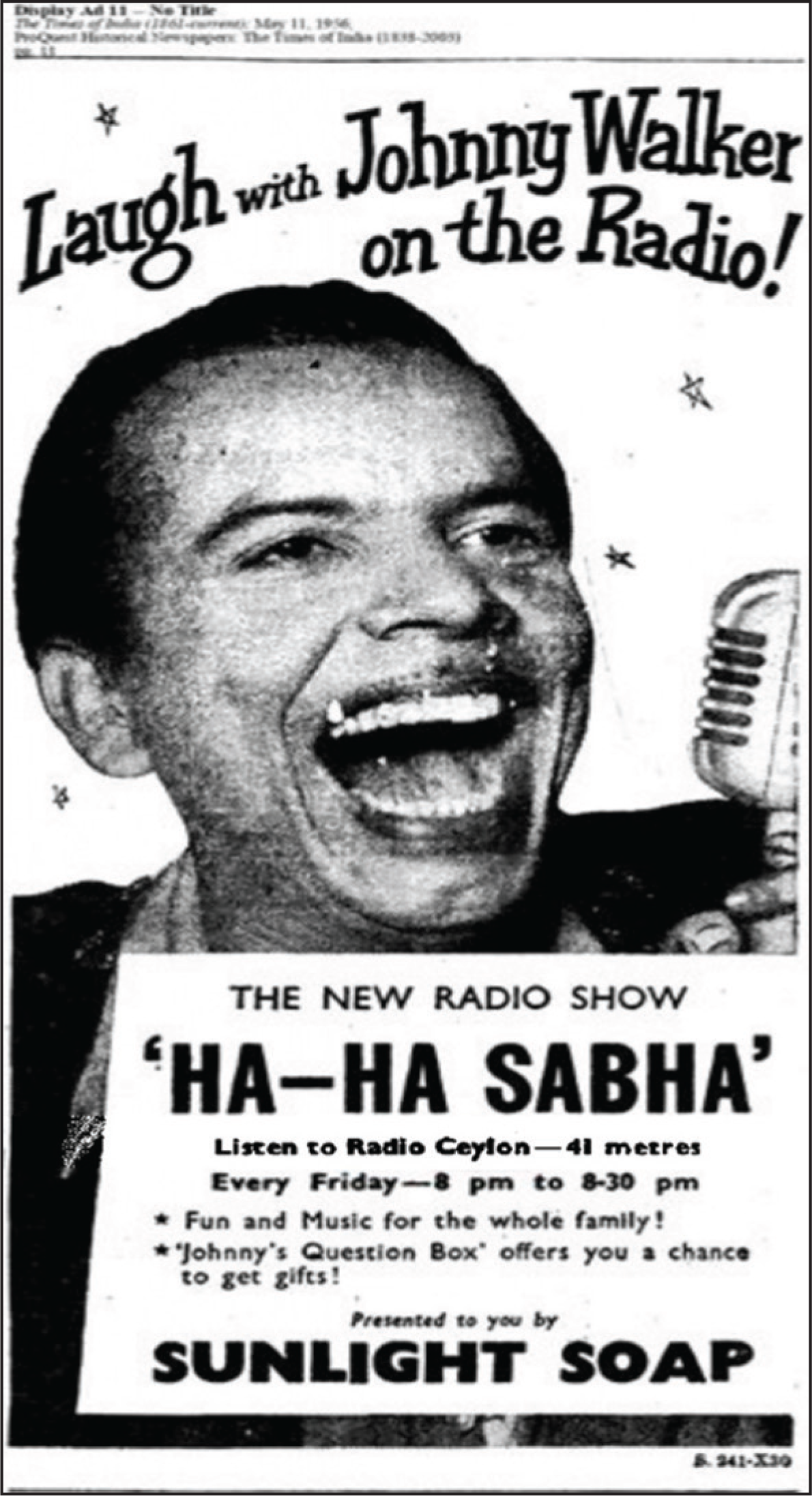
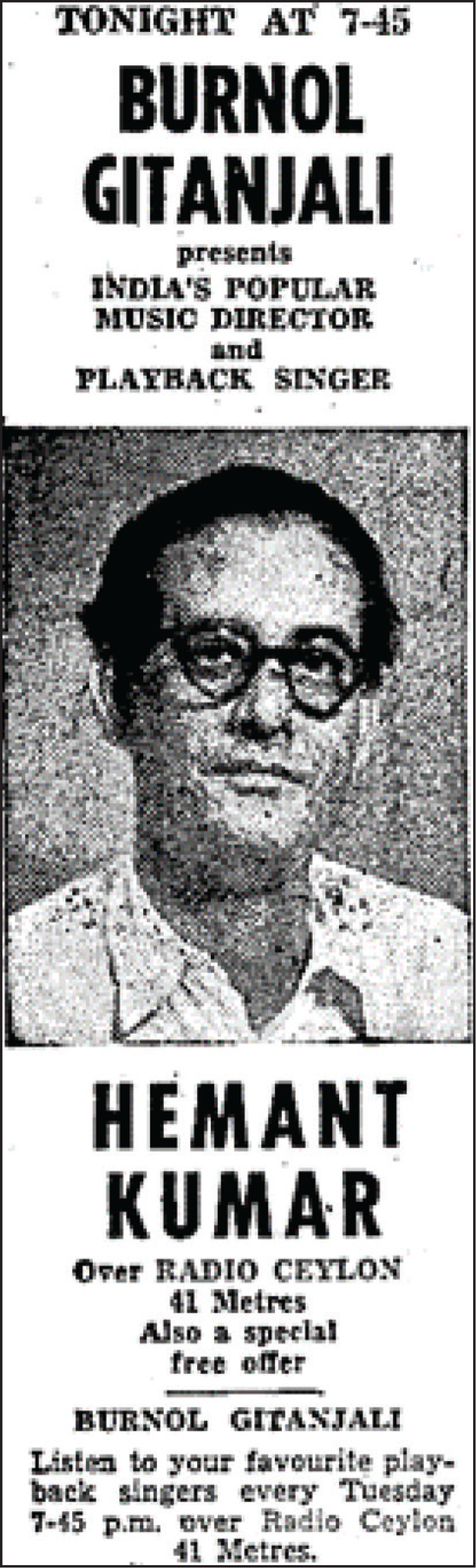
Geetmala was also part of a wide-spread ‘aural filmi culture’ that Radio Ceylon programmes fostered and that featured not only Hindi film songs but also encouraged listeners to experience films aurally. The voices of actors and playback singers became a regular presence in many of RES-sponsored programmes. For example, the renowned actor Johnny Walker appeared in a Radio Ceylon production called ‘Ha Ha Sabha’ (Ha Ha Gathering) (see Figure 1). Similarly, other RES programmes would feature interviews with playback singers, composers, actors and film directors. The programme Burnol Gitanjali highlighted the works of a different music director or playback singer every week and featured interviews with film personalities (see Figure 2).
Finally, language had been an important aspect of Radio Ceylon’s success. In this, Geetmala was no different. AIR, in the years following independence, promoted a Sanskritised form of Hindi devoid of Arabic/Persian loan words as the national language (Lelyveld, 1993, 2002; Rook-Koepsel, 2010). In contrast, Sayani, like other Radio Ceylon broadcasters, adhered to what I have elsewhere referred to as the ‘ideology of Hindustani’ (Huacuja Alonso, in press). ‘They sought to speak a language that was free of religious affiliations (not marked as “Hindu Hindi” or “Muslim Urdu”) and that could connect speakers of other regional languages, without threatening regional ideologies.’ In this way, Sayani and other Radio Ceylon broadcasters directly challenged AIR’s linguistic and musical reforms. What set Geetmala apart was its countdown competition format and the constant alertness and emotional involvement this format fostered.
Geetmala’s Countdown System
Sayani’s own retelling of Geetmala’s early years centres on the important role of audience participation. For that first programme, Sayani recalls, ‘I worked on the script, put in a lot of josh […] did a lot of linking of the songs, put in some jokes, couplets and what not and then just waited anxiously for listeners’ mail’ (Bhatt, 2007). That first week, Sayani recalls, Geetmala received around 9,000 letters. Broadcasters then used fan letters to gauge their shows’ current and potential success. At the time, a programme was considered a successful production if it received a couple of hundred letters a week. Radio Ceylon staff in India and Colombo were stunned. Sayani was the happiest of all, until ‘it finally hit’ that his responsibilities included managing the programme’s mail and the competition format required that he consult every single letter (Bhatt, 2007).
The second week, Sayani remembers, listeners sent more than 16,000 letters, and the third week, somewhere around 25,000. For those first hectic months, Sayani managed to convince school friends to help him read and organise piles and piles of letters, but before long the mail became simply unmanageable. As is the case with most radio correspondence, Geetmala’s earlier mail did not survive, and it is not possible to verify the accuracy of Sayani’s estimates. Yet, his focus on letters and his insistence on their overwhelming number are themselves revealing. It points to a desire to highlight listeners’ participation and to present listeners as active and informed contributors. ‘There were letters everywhere and no place to sit in the office’, Sayani concludes his retelling (Punathambekar, 2010, p. 195).
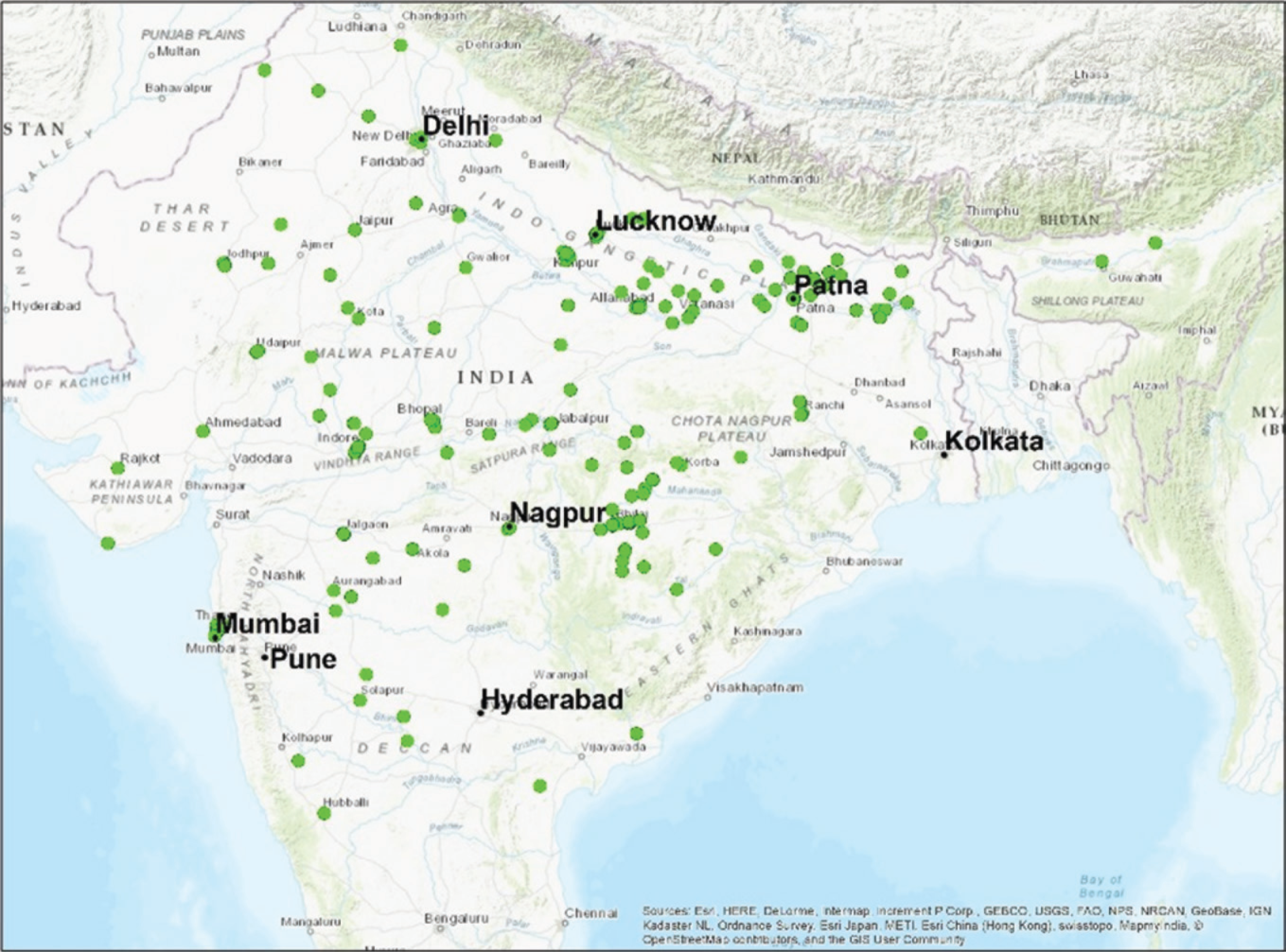
As the mail became unmanageable, CIBA and RES decided to stop basing Geetmala’s hit parade on correspondence and instead collected record sales. In addition to changing the countdown format, CIBA and RES personnel expanded Geetmala’s airtime. Starting in 1954 the programme aired for a full hour every Wednesday, and Sayani played 16 songs in ascendant order of popularity in each programme. During the first years, the company collected statistics from a handful of record shops in Bombay, but it gradually expanded and, by the 1960s, incorporated sales data from more than 40 shops in Bombay, Calcutta (present Kolkata), Delhi, Hyderabad, Pune, Nagpur, Lucknow and Patna.
Shortly after the programme’s inauguration, RES and CIBA decided to create formal radio shrota sangh, or radio clubs, which consisted of groups of people who would get together every week, listen to music in private homes or public spaces, vote for their favourite songs and mail their choices to the company’s studios in Bombay. Initially, Geetmala had 10–15 listening clubs, but during the peak of the programme’s popularity, it had about 400 radio clubs.
How exactly CIBA incorporated statistics from radio clubs into the final countdown lists remains unclear. In various interviews, Sayani notes that radio club statistics were used to double-check and catch inconsistencies in record sales statistics (Bhatt, 2007; interview with author, 25 July 2016; Punathambekar, 2010, p. 196). CIBA executives, however, explained that the company had a specific ‘formula’ that combined both sales lists and radio club statistics but gave preference to record sales as these were more accurate (Vishnu Prakash, interview by author, 29 July 2016). Despite extensive research, however, I was unable to confirm what that formula exactly entailed. Similarly, I was unable to find any documents stating the names of the shops and/or cities from which CIBA based record sale statistics that I could cross-reference with the information I gathered from interviews.
In the end, however, the method used to develop Geetmala’s lists might actually not be that important. That is because popularity lists that relied on record sales in any significant way could not possibly be representative of the larger public’s tastes. While exhibiting some growth, the record market always remained small. In the 1950s, sales in the upwards of a 1,000 records were rare (Joshi, 1988; Kinnear, 1994; Manuel, 1993). Until the 1970s, HMV held an almost complete monopoly of the market. The record market expanded significantly when a new record company called Polydor began producing records for Indian audiences in the 1970s, but sales remained limited. Moreover, there were other logistical problems that made record sales an unreliable measure of an individual song’s popularity. Seventy-eight rpm records, which were available until the 1970s, held two songs, one on each side. Forty-five rpm records, which became available in the mid-1960s, held four to five songs, and LP records, which became available in the 1970s, held the entire film’s song selection. Sayani’s team noted that CIBA would consult shopkeepers and would ask which tracks had motivated buyers to make their purchase. But, of course, those decisions would have been difficult to determine with any kind of certitude.
The reality is that even after the record industry’s expansion, only a minuscule percentage of the population could afford to purchase records every week. It was not until the boom of the cassette industry in the 1980s that people began to build their own personal libraries of film songs. Unlike gramophone records, cassettes, particularly pirated ones, were affordable. But as I explore later in this essay, by then the importance of Geetmala had decreased significantly (Manuel, 1993). The reality is that record sales, which were the backbone of Geetmala’s popularity lists during its peak years, could not have been fully representative of film-song lovers’ tastes.
Sayani himself admitted in various interviews that there were problems with the countdown system, even as he strayed away from the primary problem that record sales could not be representative of the tastes of Hindi film-song audiences. First, he notes, that there was an important time delay. Magnetic copies of recordings travelled from Bombay to Colombo every week. This meant that Sayani had to record the programme a week before it was actually aired, and in an ardently competitive field, such a delay could be significant. Sayani also points to other practical problems. Often records shops would run out of popular records, and this would inevitably alter the results. Sayani notes that some listeners as well as music and film directors, therefore, were not incorrect in noting that Geetmala’s ‘popularity polls’ did not always reflect the ‘current mood’ (Bhatt, 2007; Sayani, interview by author, June 2011 and 25 July 2016).
The unfairness of the countdown system at one point threatened to close the programme. Towards the end of 1956, a group of music directors approached CIBA and demanded that it should stop sponsoring the show altogether because it was hurtful to the film music industry. Staff from CIBA did not cancel the programme, but to cool down the controversy they asked Sayani to stop announcing song ratings. Sayani continued to play the winning songs in their rating order, but he did not announce the actual rating of each song. In an effort to bring the rating system back, Sayani suggested that CIBA appoint an ombudsman from the film industry to check the countdown list and ensure the fairness of the rating process. Individuals such as Baldev Raj Chopra and G. P. Sippy, both established film directors and producers, took on this role and reviewed song lists. ‘We developed a pretty strong system’, Sayani claims, but in actuality complaints about the programme never ceased, and were as constant as praise for Sayani’s enigmatic voice (Punathambekar, 2010, p. 197).
Complaints never ceased because Geetmala’s tribulations were not ones that any ombudsman could solve. Regardless of how statistics were collected, the fact of the matter was that Geetmala’s popularity lists were not so much representative of mass tastes as much as they helped create them. This, however, is an issue inherent not just in Geetmala but also in the very idea of a hit parade/countdown music programme. Scholars of popular music have long shown that regardless of how statistics are gathered, popularity charts ‘amplify success’ because ‘more media exposure’ leads to ‘more sales’ creating a ‘circular process’. Any successful countdown programme does more than merely present popularity results; it creates them (Parker, 1991, pp. 207–208). In some ways, this is also an issue inherent in the very notion of commercial music. Referring specifically to Hindi film songs, Peter Manuel poignantly argues that the ‘homogenous style of film music’ cannot ‘be attributed to popular demand, but rather to the creation of film music as a common-denominator mass-music style, produced in corporate, urban studios and superimposed on a heterogeneous audience’ (Manuel, 1993, p. 8).
Manuel draws from Theodor W. Adorno’s famous critique of mass media and music. Undeniably, Geetmala was part of the ruthless commercial system from which a fortunate few musicians benefited, but many others were crowded out. Yet, I am wary of a purely top-down critique for two main reasons. First, I worry that uneasiness with the idea that culture and art can be created in the marketplace can too easily lead us to romanticise non-commercial arts. Second, and most important for our purposes here, these types of critiques can too easily overlook listeners’ own active participation and fail to fully account for how media shapes individual lives and societies.
To understand the changes that Geetmala enabled, I want to briefly return to the watershed event that spurred Radio Ceylon’s growth in the first place. To justify his controversial reforms, Keskar continuously underscored the importance of ‘the listener’ to Indian classical musical traditions. ‘The knowledgeable listener who fully understands the beauty and fine points of the art […] makes for musical progress and builds up the sound tradition’ (Keskar, 1967, pp. 26–28). On several occasions, Keskar explained that a rich classical tradition needed ‘discernible listeners’ (by which he meant discerning listeners) whose knowledge of music would motivate musicians to deliver top-notch performances. Radio Ceylon, specifically Geetmala, through its countdown system, certainly helped mould ordinary radio listeners into ‘discerning’ music listeners, but not of the classical traditions Keskar admired, rather of the ‘concocted and irrational’ tunes the minister loathed (Keskar, 1952, p. 59).
Interestingly, even as Geetmala overtly challenged Keskar’s policies, the programme’s participatory culture indirectly supported other government initiatives. If Keskar’s radio campaign sought to ‘train the ears of radio audiences’ and mould obedient Indian ‘citizen-listeners’, Geetmala’s participatory ethos, while directly challenging AIR’s patronising social uplift project and challenging its anti-Hindi film-song diatribe, aligned with some aspects of the Nehruvian project of making ‘citizens’ out of the ‘masses’ (Huacuja Alonso, 2019, p. 118). Within five years of independence and against many odds, India held its first elections, becoming the world’s largest democracy. As Rohit De explains, ‘the institutionalization of universal franchise’ was a ‘revolutionary act’, particularly in ‘a deeply hierarchical society’ and ‘especially when franchise had only recently been extended to women, people of colour, and working-class men’ in most so-called ‘mature democracies’ (De, 2018, p. 249). But if India’s democracy was a revolutionary act, it was also an enormous bureaucratic task that required mass mobilisation and publicity. Ornit Shani credits the Constituent Assembly Secretariat (CAS), the political body who oversaw the preparation of India’s first draft electoral roll based on universal suffrage, with doing the necessary bureaucratic grind that helped forge India’s democratic constitution. In addition to drafting electoral rolls, Indian officials had to communicate to millions of citizens the complicated logistics of how to exercise their right to vote, where and how to vote. Key to the success, Shani argues, was the ways in which the CAS managed to distribute information about new voter rolls through announcements in the press and by opening up a larger discussion about the democratic process (Shani, 2017, pp. 85–122). Moreover, the Films Division also made short documentaries about the voting process, which screened in thousands of cinemas throughout India before the main film show. The film, Democracy in Action (1951), for example, introduced citizens to the procedures of voting and elections, in anticipation of the first election in 1952 (Roy, 2007, p. 190). Similarly, AIR, the national broadcasting network and Radio Ceylon’s main competitor also aired a number of programmes introducing listeners to the electoral process, contributing to the larger conversation and ethos that made India’s first elections a remarkable logistical success.
To my knowledge, Sayani did not address elections in Geetmala as Radio Ceylon’s policy avoided any kind of direct political commentary. Yet, it is no coincidence that India held its first elections in 1952, the very year that Geetmala became a national sensation and conquered the airwaves. Even if Geetmala’s own voting process was not fully democratic, Sayani encouraged listeners to become ‘discerning critics’ of film songs and to judge the quality and merit of songs for themselves. As such, he indirectly participated in a larger dialogue about the importance of evaluation and choice, crucial dimensions in the exercise of the vote. I make this point with great caution, aware of its limits. Sceptics might point out that Geetmala enjoyed immense popularity until the 1970s and remained on the air until 1994. By then, Indians would have been well accustomed to the process of democracy.
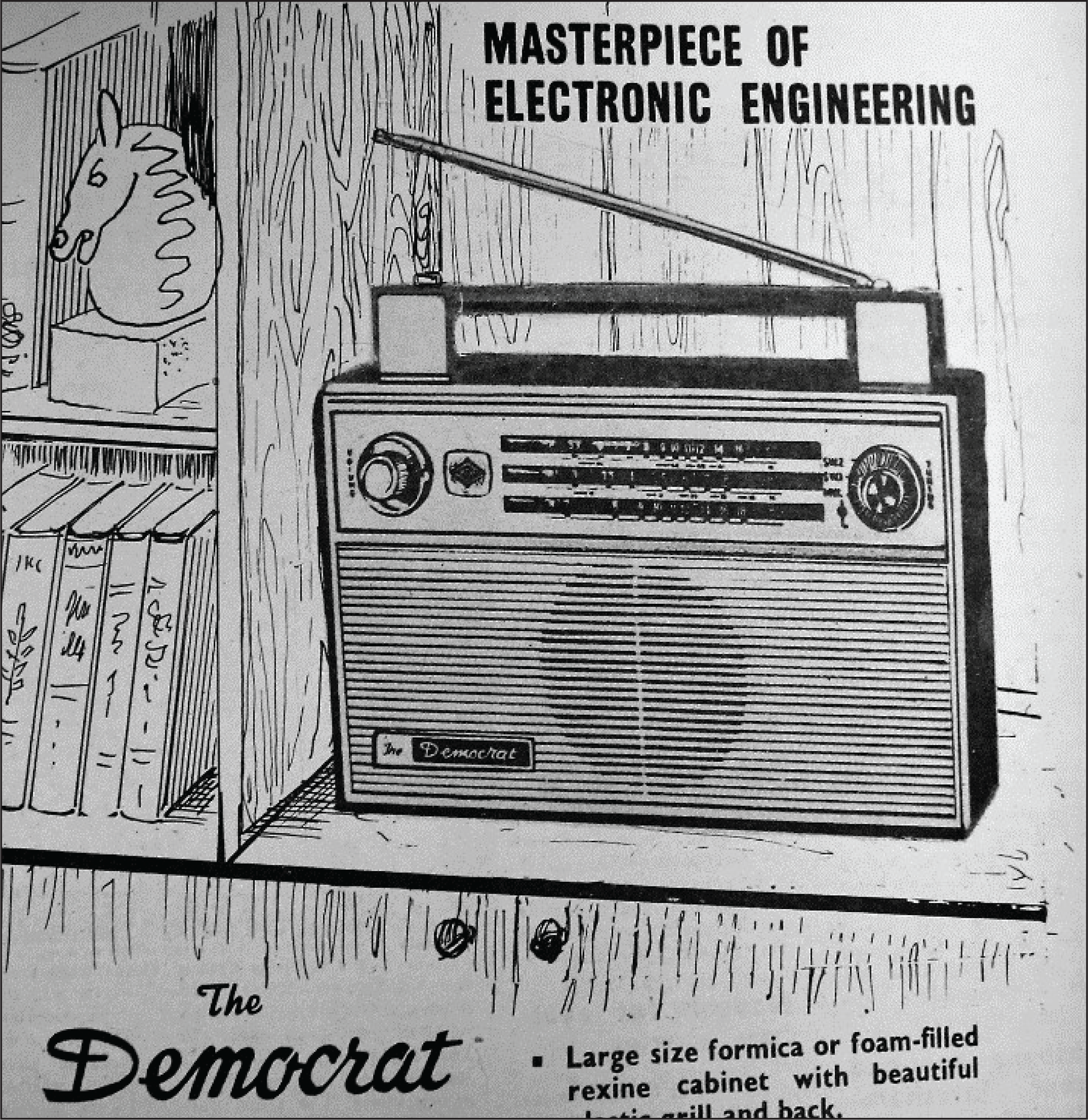
Moreover, Geetmala enjoyed immense popularity in neighbouring Pakistan, where the state failed to implement universal franchise until the 1960s, and the first presidential elections did not take place until 1965. My answer to these valid critiques is that the programme’s sustained popularity in India banked on its unprecedented early success, which was at least partially related to the way Geetmala engaged the language of democracy and civic participation. In regard to Pakistan, the programme’s popularity there too built on its initial massive success in neighbouring India. Geetmala’s participatory format might also have been attractive for listeners in Pakistan, despite – even perhaps because of – the difficulties of establishing universal franchise in that country. While more research is needed, at least one radio-making company based in Pakistan embraced the idea of radio as ‘democratic’ by naming a transistor model, ‘The democrat’ (see Figure 3).
Sangeet Sirhi/Musical Ladder
As the new citizens of India learned the logistics and vocabulary of elections, Sayani too introduced the vocabulary of Geetmala’s hit parade system. To encourage listeners to take the competition seriously, Sayani developed a very specific vocabulary of popularity. He came up with the concept of ‘sangeet sirhi’ (musical ladder), and every week he described how songs moved up and down this musical ladder. Sayani called the particular ranking of songs ‘paidan’, literally footrest in Hindi and Urdu. Throughout his various programmes, he invited listeners to anticipate the ranking of songs and to root for their favourite songs. Before revealing the winning song of the week, Sayani played a concert of trumpets. In this way, he ‘created an adrenaline pumping moment over the birth of a new winner’ (Jiang, 2018, p. 1247). When discussing a song’s paidan, he would tell listeners of the song’s prior ranking history, how many ‘paidan’ it had gone up or down, and make guesses about the future. Sayani would also talk about the film in which the song appeared, mention how other songs in the film fared and would comment on the music director who composed the songs and the playback singers who performed it (Bhargava, 2007, p. 141).
As the programme evolved, Sayani developed specific terms that helped increase listeners’ awareness of the competition. Songs that re-entered the programme after a long period of absence were called punpraveshi (pun = re, praveshi = entered). Starting in 1965, when a song played more than 18 times in the programme, it became a sartaj geet (crowned song) and was informally ‘retired’ from the programme. What this meant was that Sayani would no longer play the entire song and would instead simply play a jhalki (glimpse) or a short excerpt of the song lasting 10–15 seconds. The first song to become sartaj was the song ‘chhu lene do nazuk hoton ko’ from the film Kaajal (1965), which had topped Geetmala’s charts for many weeks (Bhargava, 2007, pp. 88–89).
Some listeners did not like the sartaj system because it meant that they could no longer hear their favourite songs. Following complaints, in 1978, Sayani waited until a song was played 25 times before making it a sartaj (Bhargava, 2007, p. 93). Despite some listeners’ dislike for the sartaj system, the practice persisted, and the term endured in the listener discourse. Till this day, many music fans remember which songs had been crowned ‘sartaj geet’. In this way, Geetmala’s terminology – sartaj, punpraveshi, paidan – not only encouraged listeners to keep up with the countdown lists but also provided a new way to conceptualise Hindi film songs’ changing popularity and ultimately helped mould listeners into discerning listeners and informed participants.
Annual Programmes
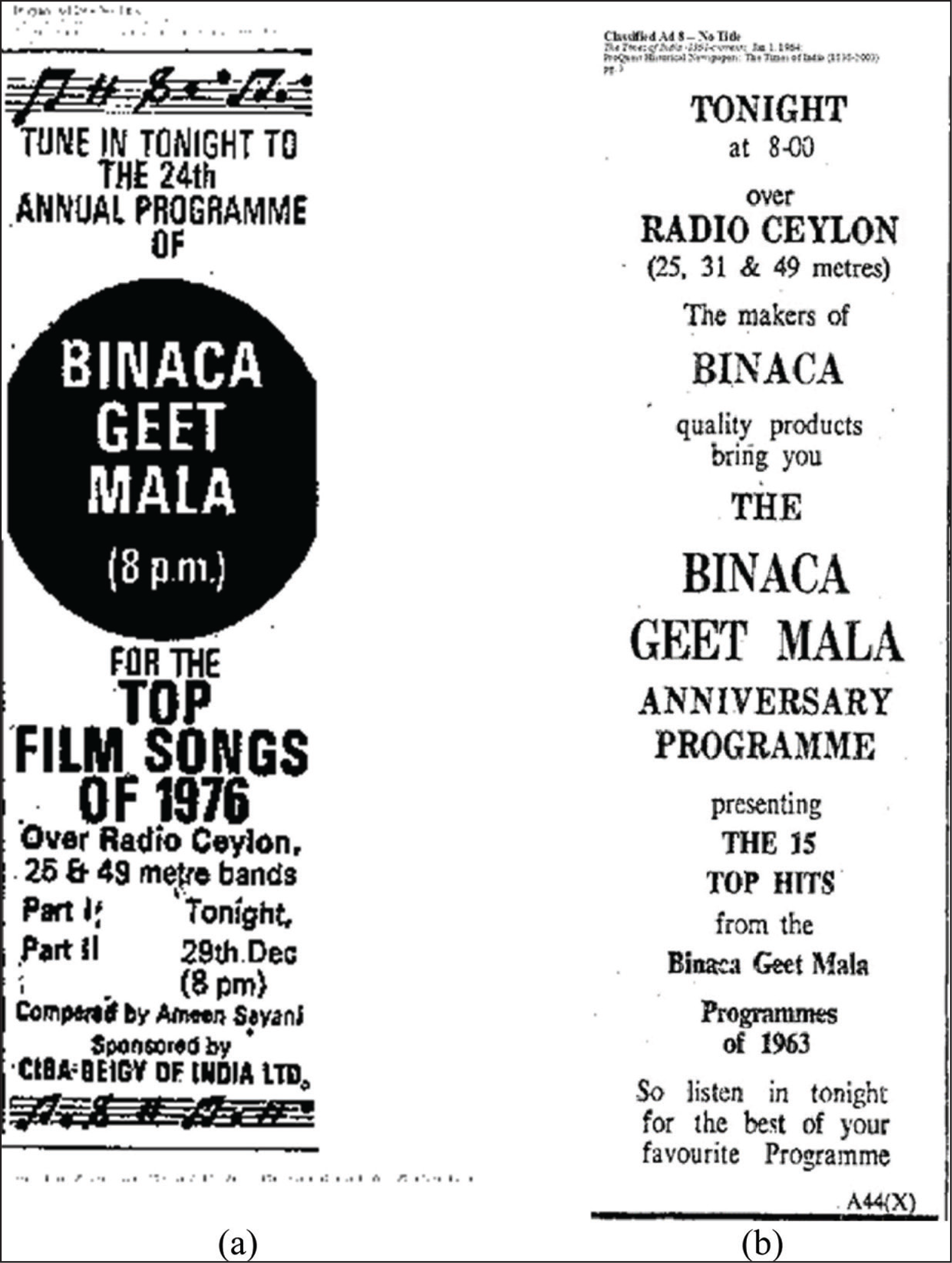
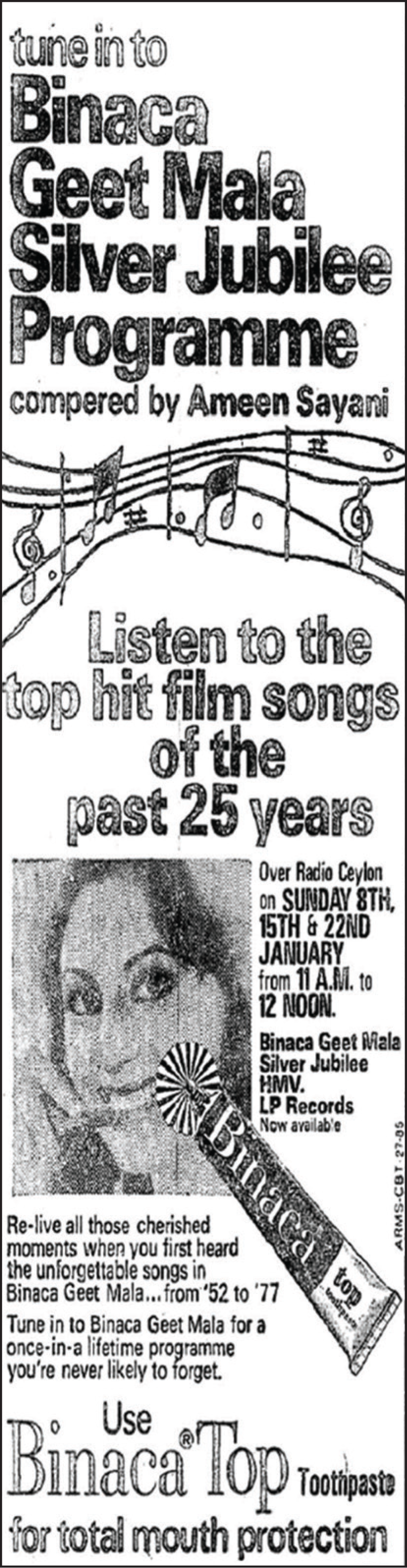
Every year, CIBA compiled statistics from the weekly programmes and assembled a list of the year’s top songs. For Geetmala’s devout listeners, the annual programme was the most exciting and awaited radio programme of the year. Many who did not regularly tune in to Geetmala would tune in to the annual programme. Anil Bhargava remembers that on the days leading up to the annual programme, people would rush to purchase radios from shops, which often sold out (Bhargava, 2007, p. 48). Newspapers announced the yearly programme, reminding listeners to tune in, increasing anticipation for the results (see Figure 4). People made guesses as to which song would win the year’s competition, leading to an intense competition between friends, college students and even relatives. Siraj Syed, for example, remembers that as a teenager, he gained the respect of elders for his ability to predict Geetmala’s yearly programme rankings (Siraj Syed, interview by author, 30 August 2017). Moreover, the annual programme engaged in the language of elections more than any other weekly programme, with Sayani celebrating the triumphant songs as the democratically elected songs of the year.
The first annual programme aired in 1953 and celebrated the top six songs based on listeners’ letters. By 1954, the programme had been expanded to a full hour and included 16 songs. In 1957, Sayani expanded the yearly programme to include two one-hour episodes. In this way, the annual programme could feature at least twice as many songs (Bhargava, 2007, pp. 42, 72). Also, in addition to announcing the winning songs, starting in 1957, Sayani would also announce the names of the top three directors and playback singers of the year. To be named one of the top three singers or music directors of the year in Geetmala was the equivalent of receiving a major film award. This is important because Geetmala, like many other Radio Ceylon programmes, contributed to making playback singers and music directors into celebrities.
Despite its importance, the yearly programme proved difficult to manage, and the programme’s format and rules changed frequently. The exact number of songs included in the final programme varied, so did the criteria for selecting winning songs. One problem was that the timing of the release of films and songs affected songs’ annual rankings. Songs that were released later in the year were less likely to accumulate points. For example, this happened with the song, ‘mera salam le ja, dil ka payam le ja’ from the film Uran Khatola (1954), which had topped the programme for several months in 1954 and 1955, but did not fare as well as expected in the yearly countdown programmes because its points were divided across the two years (Bhargava, 2007, pp. 33–36). To address this problem, the RES team developed a new system. If a song earned more points in the second year, then the points of both years would be added, but if the song earned more points in the first year, then the points of both years would not be added. What is significant here is not so much the content of these technical debates, but rather that these technicalities became such ardently discussed public knowledge, further solidifying the idea of the listener as a music expert and active participant in a democratic system.
Diarists as ‘Discerning’ Listeners
Perhaps nothing shows the importance of individual participation more than the practice of keeping weekly Geetmala diaries. Listeners took film-song competition so seriously that many kept detailed records of each week’s listings. For decades, Anil Bhargava meticulously recorded the song-competition results as well as any changes that the programme underwent. Bhargava, whose passion for radio and music began in his early teens, continued the work of his father, who recorded Geetmala’s earliest rankings. On the basis of these handwritten diaries, he published, Binaca Geetmala ka surila safar (Binaca’s melodious journey). This book is one of the finest resources about Geetmala available. When I visited Bhargava in 2017, he showed me the handwritten notebooks in which he had recorded Geetmala’s results (see Figure 5). Written in incredibly neat handwriting and wrapped in decorative paper, his notebooks are a testament to the ways Geetmala’s format as well as the music it featured entered the everyday lives of listeners.
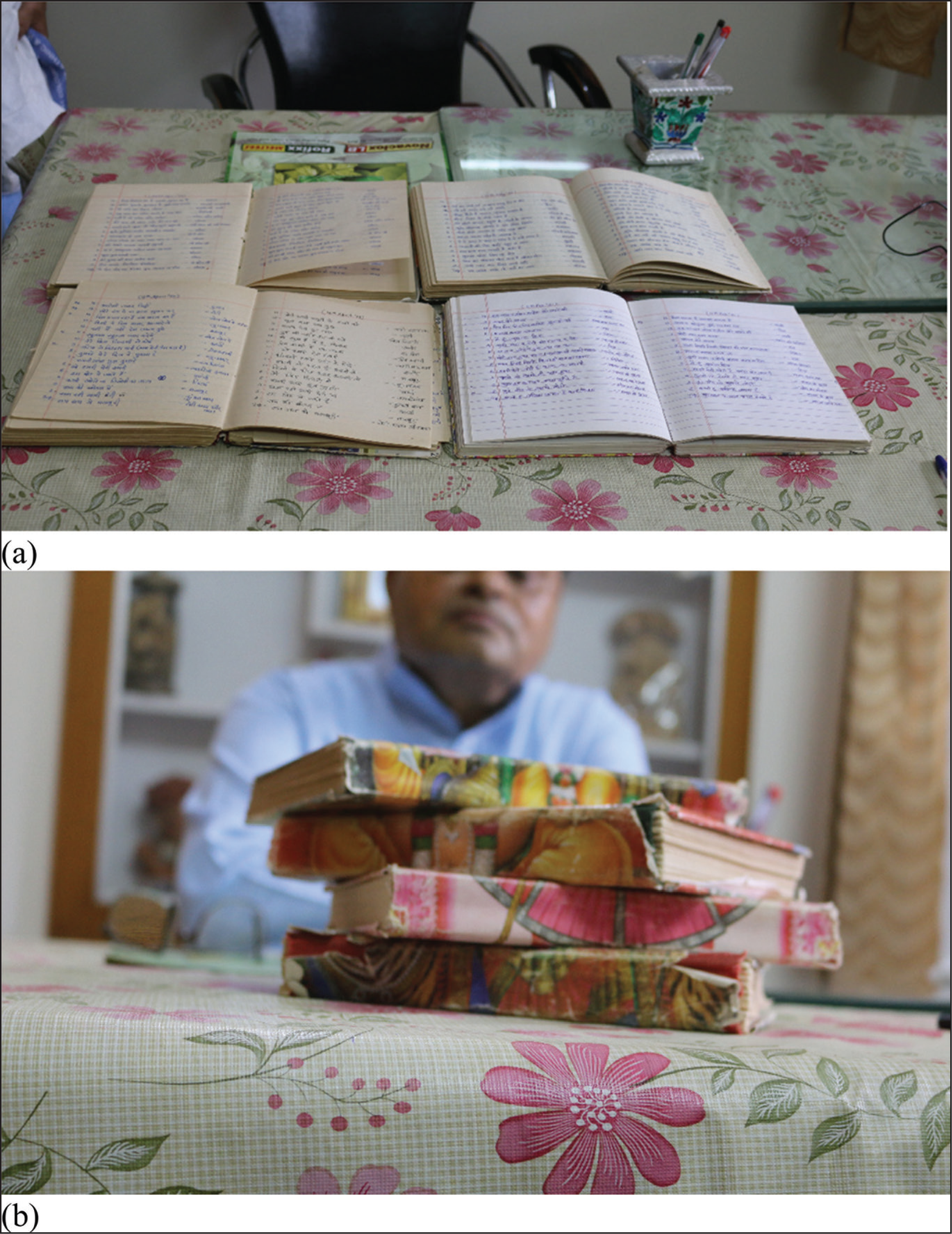
While Bhargava is unique in his diligence, it was quite common for followers of the programme to record results. As Bhargava observes:
What song would move up and what song would move down in the count down. This was a crucial aspect of people’s lives. People would argue. Some people took notes of every programme, others only took notes of the yearly programme. (2007, p. 136)
Geetmala was not the only programme that shaped listener experience. As Vebhuti Duggal points out, most radio film-song programmes ‘were serially broadcast (fixed days and times, even if sometimes the frequency to be tuned into would fluctuate)’ (Duggal, 2018, p. 4). In this way ‘they helped produced a regularity and frequency in listeners’ expectations’ and that regularity was part of the process of ‘becoming a [radio] listener’ (Duggal, 2018, pp. 4, 27). Geetmala, however, stands out from other film-song programmes in that the countdown system encouraged what Martin Parker calls ‘continual watchfulness’ (1991). The charts changed constantly, and listeners had to regularly update their knowledge (Parker, 1991, p. 213).
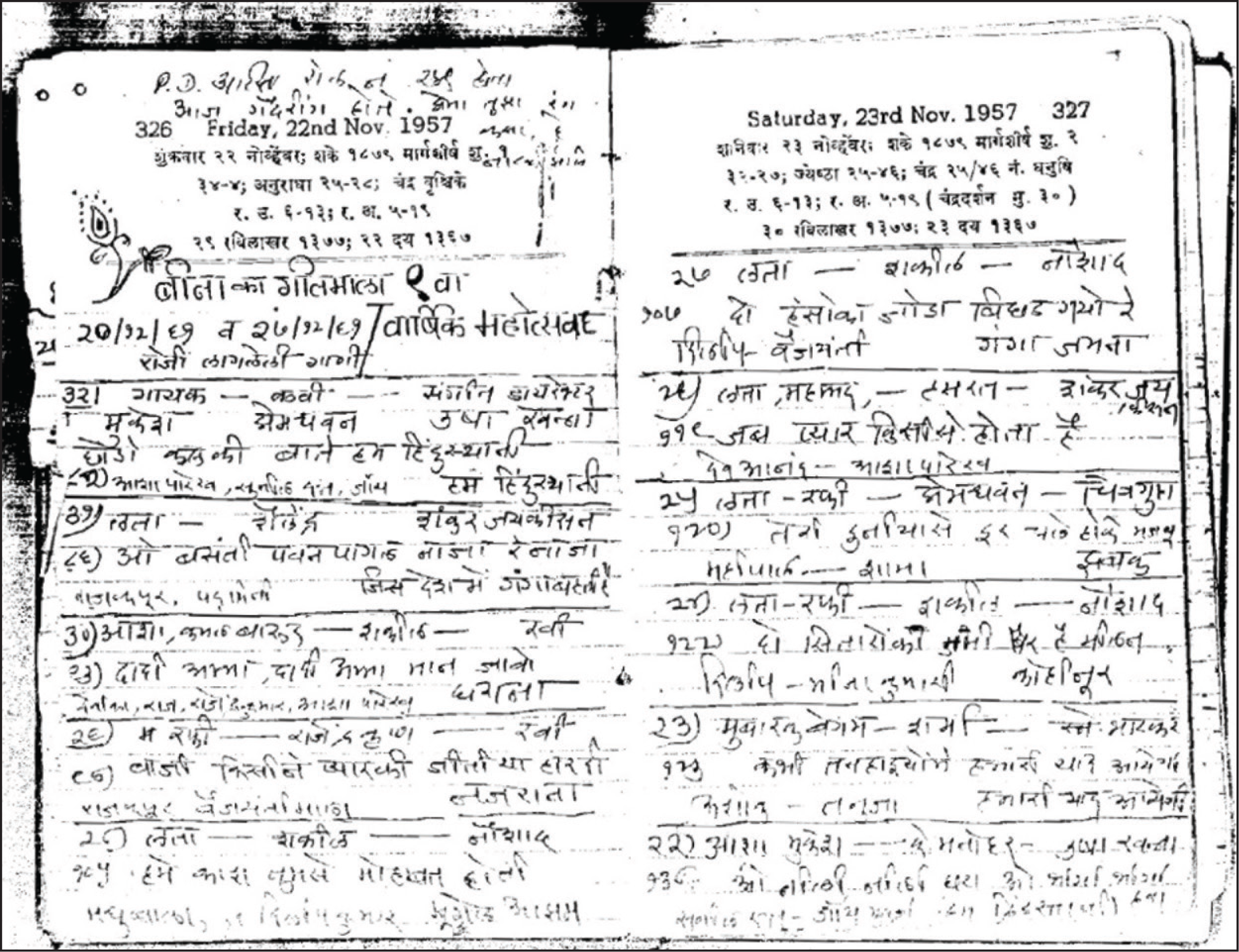
Like Bhargava, J. J. Kulkarni from Sholapur, Maharashtra, also kept a diary every week from 1957 until 1962 in which he listed the songs played in Geetmala’s weekly programmes along with their rankings. He later mailed copies of his diary to a Radio Ceylon broadcaster as evidence of his dedication and love for the radio station (see Figure 6). In his letter, Kulkarni explains: ‘In my student days I had the habit of writing in my diary the weekly Binaca Geetmala programme’. We might ask why people wrote down the results? In the age before the instant availability of information, diaries served as a written record that fans could later consult and possibly share with friends and family. These written notes helped listeners remember song lyrics and recall the context in which they had heard these songs. Most importantly, people wrote down the results of Geetmala because they considered it important information about their favourite music. Ultimately, the diarist was a prime example of a discerning listener as an active participant in a larger popular culture.
Radio Listeners’ Clubs
In addition to diarists, radio club members are also prime examples of discerning listeners. Sayani remembers that, in the early years, Geetmala had 10–15 registered listening clubs, but by the 1960s, Radio Ceylon received mails from about 400 radio clubs (Bhatt, 2007; Sayani, interview by author, June 2011 and 25 July 2016). Members assigned great importance to these clubs. They held weekly gatherings, listened to the programme and voted for their favourite songs, and mailed results to RES’s offices. As Duggal demonstrates, by the 1970s, some radio clubs even printed their own publications, and these included short essays on radio, film songs and cinema, as well as short stories, poems and jokes (Duggal, 2015, pp. 28–30). Moreover, in later years, radio clubs were also not exclusive to Geetmala or Radio Ceylon as listeners gathered to tune in to a variety of radio programmes, including AIR’s Vividh Bharti programmes. Regrettably, we have less information about Geetmala’s earlier radio clubs as both CIBA and RES regularly discarded listeners’ correspondence. Fortunately, Sayani’s team kept documents from when he briefly revived the programme in 2001, including an extensive and detailed list of more than 400 clubs. The list is a compilation of radio clubs that were in existence before the programme shut down in 1994. Sayani’s team used this list to reach out to club presidents to encourage them to revive their old radio clubs. Unfortunately, this list does not include the dates when the clubs originally opened or closed or information about the number of club members and their demographics, crucial information that would have allowed us to better understand their influence. It does offer, however, other important clues.
The list reveals that most of these registered radio clubs were located in smaller towns and cities with less than a million inhabitants. This is very significant, because the music shops from which CIBA collected sales statistics were located in major metropolitan centres in North India, with the exception of Hyderabad (see Figure 7). This suggests radio clubs were most active in the places that radio listeners were less likely to influence Geetmala’s rankings through their purchase of records. We could posit that this is because radio clubs served as a ‘counterweight’, to record sales statistics. As mentioned earlier, gramophone owners for the most part were wealthy and urban. Yet, without any specific evidence of how radio club votes were incorporated into the final countdown lists, it is hard to know how much exactly these clubs influenced rankings. What is undeniable is that regardless of radio clubs’ actual role in the countdown system, these clubs played a crucial role in involving listeners from small towns and in encouraging their members to become involved in radio’s participatory culture.
Other scholars of radio in India have pointed out the importance of listeners from small towns. For example, Duggal, in her study of farmaish or film-song request programmes, explains that most requests did not come from large metropolitan areas but ‘from towns and tehsils that the metropolitan India has never cared about’ and argues that the radio provided a sense of recognition and participation in the larger national political body (Duggal, 2018, pp. 9–11). Documents kept by Sayani’s team provide further evidence of this phenomenon.
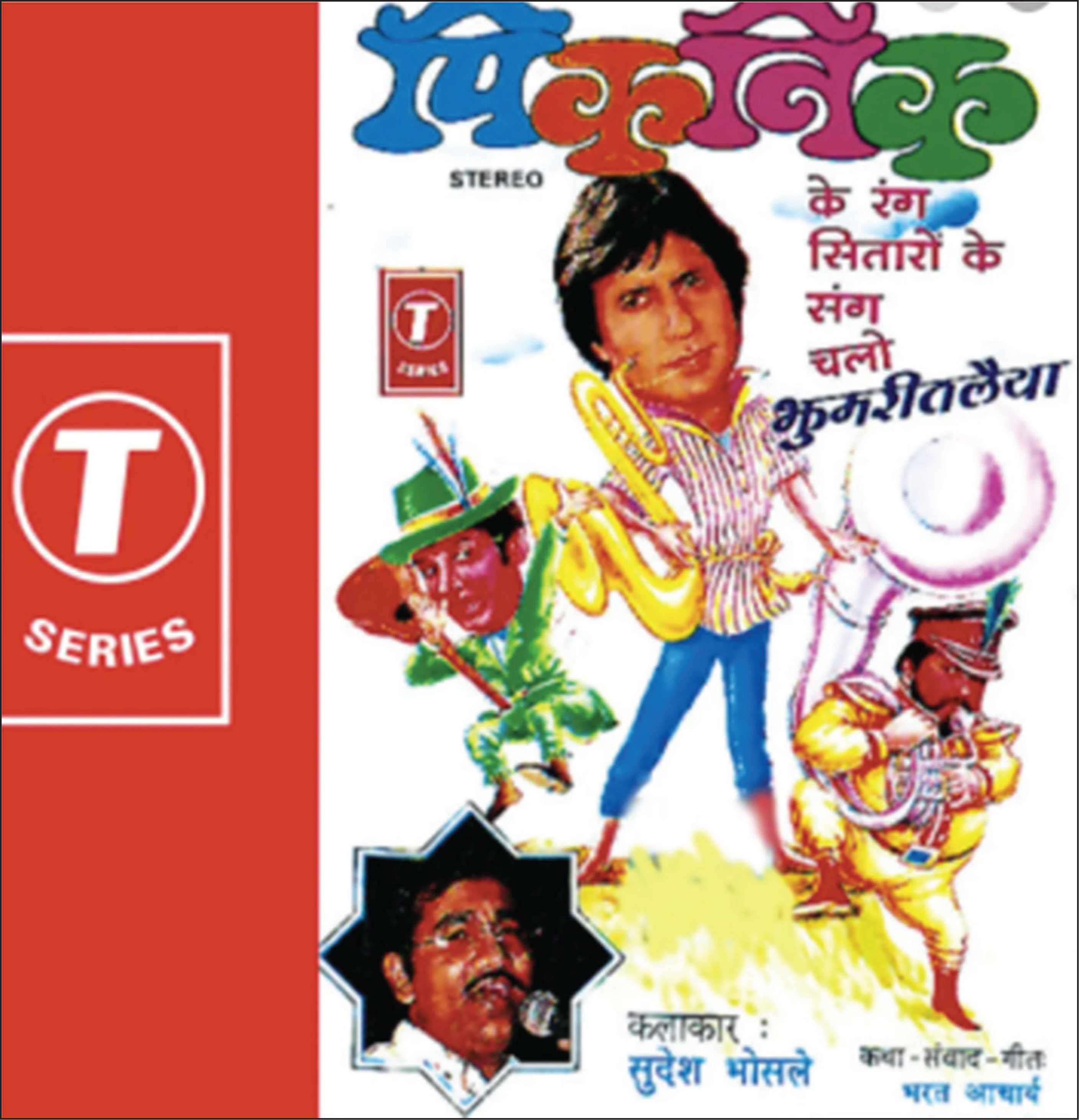
Perhaps nothing shows the importance of the involvement of listeners from small towns more than the story of Jhumri Talaiya, a small mining town in the northern state of Bihar (now in the state of Jharkhand). Listeners from Jhumri Talaiya mailed hundreds of postcards and letters every month to Geetmala (Duggal, 2018, p. 11; Ravikant, 2016, p. xxxiv). Sayani mentioned Jhumri Talaiya so often that this formerly unknown town became famous throughout the Indian subcontinent. Jhumri Talaiya became a crucial part of the earlier-mentioned aural filmi culture often referenced as a kind of fabled place. For example, the comedian Sudesh Bhosle put together an audiocassette series called, Picnic 1 and Picnic 2, where he imitates the voices of several Hindi film actors who gather for a picnic in the town Jhumri Talaiya (see Figure 8). Here, I wish to suggest two ways of thinking about Jhumri Talaiya that directly relate to this article’s leading arguments. First, listeners from Jhumri Talaiya were the enthusiastic and discerning music lovers and ‘citizen-listeners’ that Keskar had dreamed AIR’s reforms would help create. Second, this ordinary town’s now celebrated status nicely demonstrates how Geetmala made belonging to the ordinary and everyday – celebrating commonness and participatory culture – the very attraction of the programme.
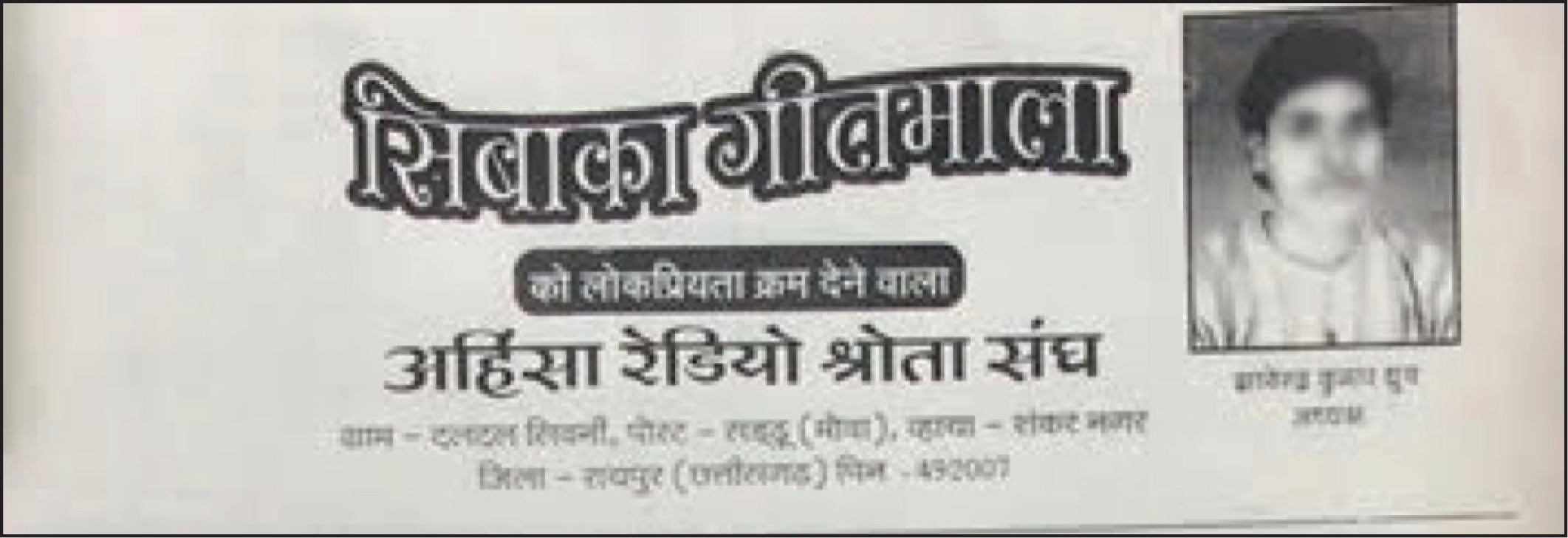
In addition to the list of radio clubs, Sayani’s team also kept correspondence from listeners’ clubs, including postcards and letters. These documents are from the early 2000s, when Sayani temporarily revived the programme under a new format. They do, offer, however, some important clues about radio-listening clubs and about the experience of listening to Geetmala. First, these documents demonstrate how seriously listeners took their own role as film-song critics. Some radio club members, for example, made personalised letterheads and personalised seals. For instance, the ‘Ahinsa radio club’ president included his picture in the club’s letterhead, and the ‘Red Rose radio club’ had its own personalised seal, as did the president of the Manihari club (see Figures 9 and 10). Sayani and other broadcasters assured me that this practice was also common during Geetmala’s earlier years. While I am wary of using this later correspondence to make any concrete conclusions about the demographics of earlier radio clubs, it also appears that many of the radio clubs’ members were non-elite, even if they were literate and well off enough to purchase seals and personalised letterheads. One writer, for example, was an electrician who signed letters as Jawwad Bijli Mistri.
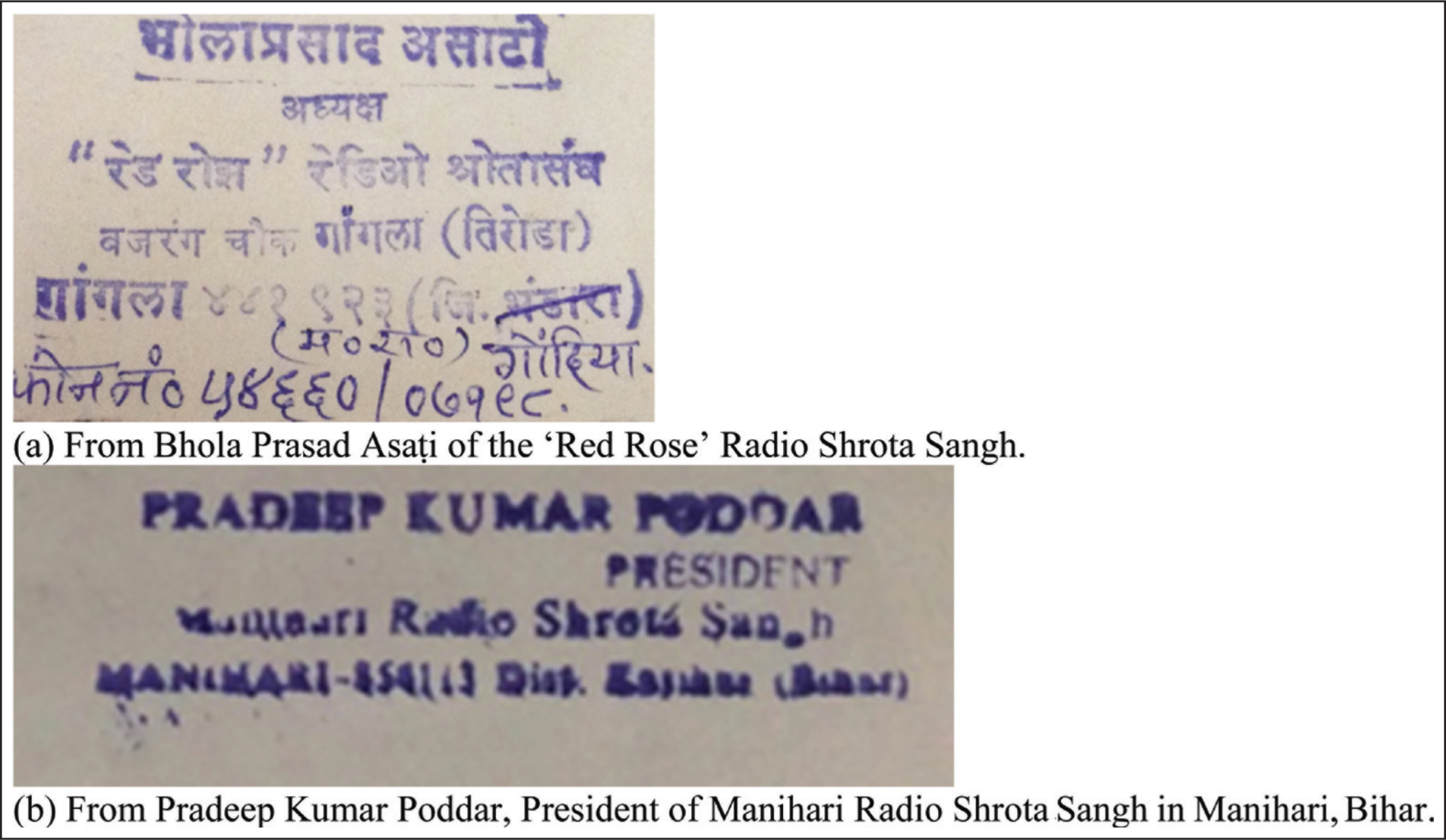
In addition to demonstrating the importance that listeners assigned to clubs, this correspondence also shows Sayani’s central role in the programme and in listeners’ lives. Listeners congratulated Sayani on his birthday, on Eid and mourned the passing of his wife. Again and again, they commented on Sayani’s voice and its effect on them. Jawed Bijli Mistri from Bhagalpur, Bihar, noted: ‘I am an old listener. I listen to the programme because I love your voice.’ Madhab Chandra Sagour from Naihati in West Bengal called Ameen Sayani an ‘awaaz ke jadugar’ (voice magician) and noted that Sayani’s voice ignited a kind of magic that had uplifted his sprit.
Ameen Sayani, ‘Awaaz ke Jadugar’
Listeners’ notes make it clear that Sayani’s own role deserves further attention. While I cannot possibly summarise the career of this incredible broadcaster in this short essay, I wish to address two points that are crucial to understanding Geetmala’s role in the making of Hindi film songs into a popular music and to fostering the kind of expertise earlier described: (a) Sayani’s approach to language and (b) Sayani’s particular approach to commercial broadcasting.
Unlike most Hindi broadcasters, Sayani had no formal training in Hindi–Urdu when he began his work with RES. He grew up in a Gujarati-speaking household and had attended an English-medium boarding school. ‘It took me seven years to really feel comfortable speaking Hindustani on the air’, Sayani explains. In the end, however, the fact that Sayani was not a native speaker of Hindi, Urdu or Hindustani seems to have ultimately worked in his favour. On the air, Sayani very consciously adopted a simple manner of speech that non-native speakers could easily understand and appreciate (Bhatt, 2007) (see Figure 11).
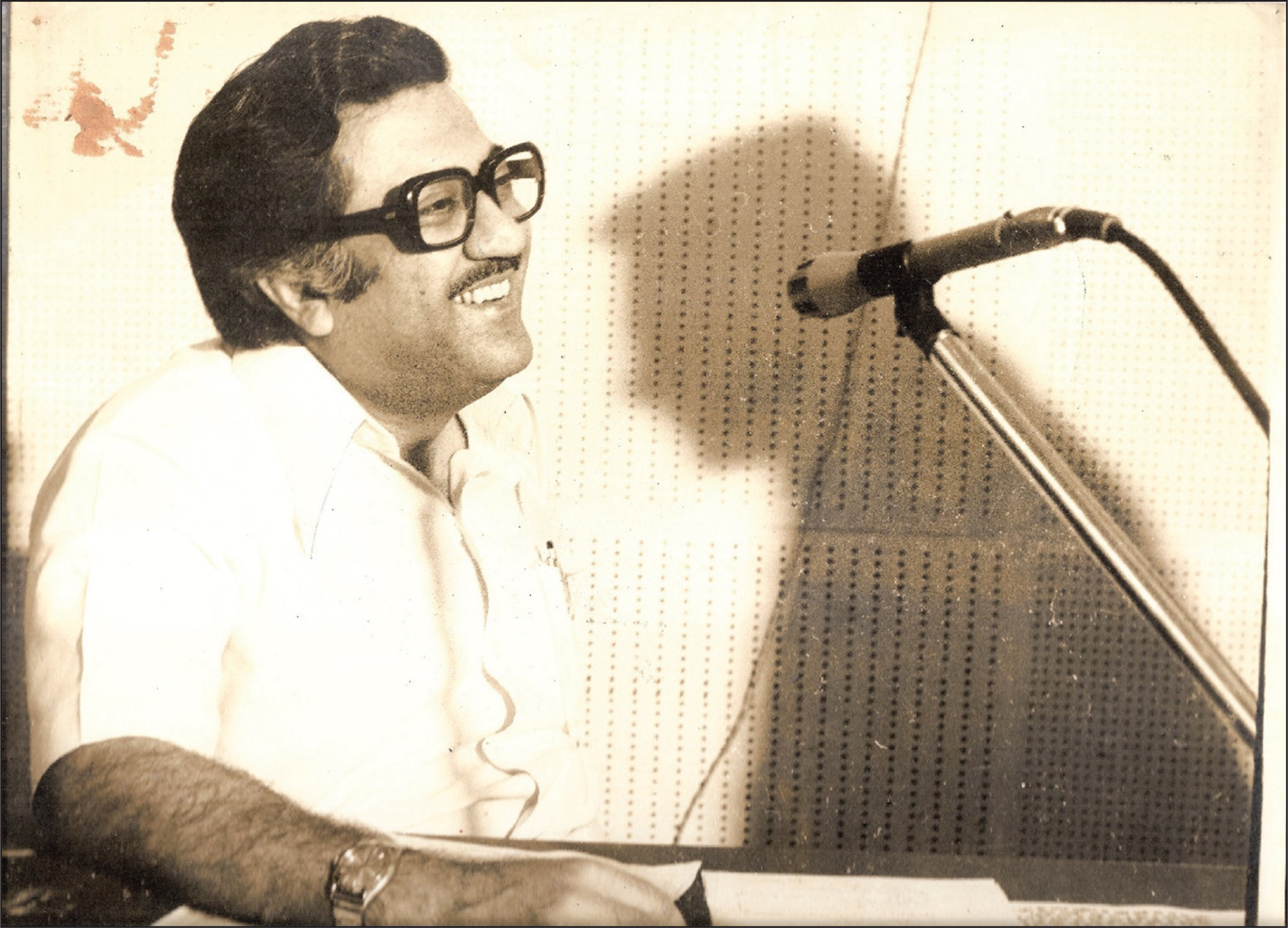
Sayani’s commitment to speaking an inclusive language also deserves further attention. Sayani’s iconic ‘behno aur bhayio’ (sisters and brothers) is best known, but his fans too remember how he ended the programme: agle saptah phir milenge, tab tak ke liye apne dost Ameen Sayani ko ijazat dijiye, namaskar, shubh ratri, shab-ba-khair (We should meet next week, until then allow your friend Ameen Sayani to leave you. Greetings. Good night) (Bhargava, 2007, p. 17). The greeting Namaskar leans towards Hindi, while Shab-ba-khair towards the Urdu spectrum. Even as other broadcasters, some rather unconsciously, began to lean closer towards the Hindi spectrum by the 1970s, Sayani remained steadfast in his commitment to the ‘ideology of Hindustani’, which was an essential part of his radio persona.
Second, while most Radio Ceylon broadcasters are somewhat hesitant to describe the economic inclinations of their work, and stress instead their close-knit relationship with listeners or their love of music, Sayani unapologetically describes himself as a businessman. In one interview, Sayani joked that he was the person who kept you wired to the radio and gave you a headache by talking endlessly and then later convinced you to buy a painkiller for that headache (Bhatt, 2007).
As Ameen Sayani’s career blossomed following Geetmala’s unexpected success, Sayani continued to work with RES, which had an agreement with Radio Ceylon, but managed his own office. During the peak of his career in the 1960s and 1970s, Sayani had more than a dozen copywriters and sound engineers working for him. Sayani produced many sponsored programmes, selling toothpaste, incense and headache pills, but in reality, the products that he most successfully advertised and sold were film songs and films. Most of his programmes played film songs and celebrated them as major artistic and cultural contributions. Moreover, a leading source of income and work for his office were film publicity programmes. These were approximately 15-minute programmes that served as a sort of aural trailer and were meant to introduce audiences to newly released films and to convince radio listeners to watch the film in the theatres. Film publicity programmes included brief summaries of the film’s plot, excerpts of the film’s songs and short dialogue clips. Publicity programmes aired on Radio Ceylon and, starting in 1967, on AIR, when sponsored programmes were allowed on Vividh Bharti. Sayani, perhaps more than any Radio Ceylon broadcaster, saw himself as a film and film-song publicist, and this vision is certainly behind Geetmala’s success. After all, making and celebrating Hindi film songs as ‘common’ was part and parcel of Sayani’s larger publicity campaign.
CIBA’s Binaca Brand
It seems fitting that we briefly consider CIBA’s role in shaping Geetmala since the company financed the programme and managed the hit parade lists for nearly four decades. CIBA had been among the pioneering companies that had turned to radio advertising in the 1950s. While it is not clear why CIBA decided to advertise its consumer products on Radio Ceylon, a few factors might have contributed. As an international company, CIBA had access to more resources than most Indian businesses, particularly during the years following the carnage of Partition. Moreover, as a European company, CIBA’s personnel would likely to have been familiar with radio advertising. Most importantly, CIBA’s foreign status allowed the company to circumvent the Indian government’s restrictions on foreign exchange.
Throughout the programme’s life, Sayani and his team worked closely with CIBA’s publicity team. As mentioned earlier, CIBA’s publicity team produced the short sonic advertisements that Sayani aired on Geetmala, and the famed broadcaster made sure to mention Binaca products. What is interesting here and directly related to this essay’s argument is that like Geetmala itself, which celebrated film songs as ‘common’ or as a ‘mass-art’, Sayani in his aural advertisements celebrated these various Binaca brand toiletries – toothpaste, talc powder, moisturisers, etc. – as ‘common’ and therefore desirable. Sayani presented Binaca products as ‘everybody’s’ toiletries in the same way he celebrated film music as everybody’s music.
One may ask: How did Geetmala influence Binaca product sales? Prakash explained that CIBA used a multi-media advertising system that made it difficult for his publicity team to determine the exact effect of Geetmala’s advertising. In addition to radio, CIBA advertised in print media and later TV as well. Yet, the company’s continued sponsorship as well as the sheer amount of effort CIBA’s publicity team dedicated to the programme certainly suggests that CIBA executives, at the very least, believed it was a worthwhile investment.
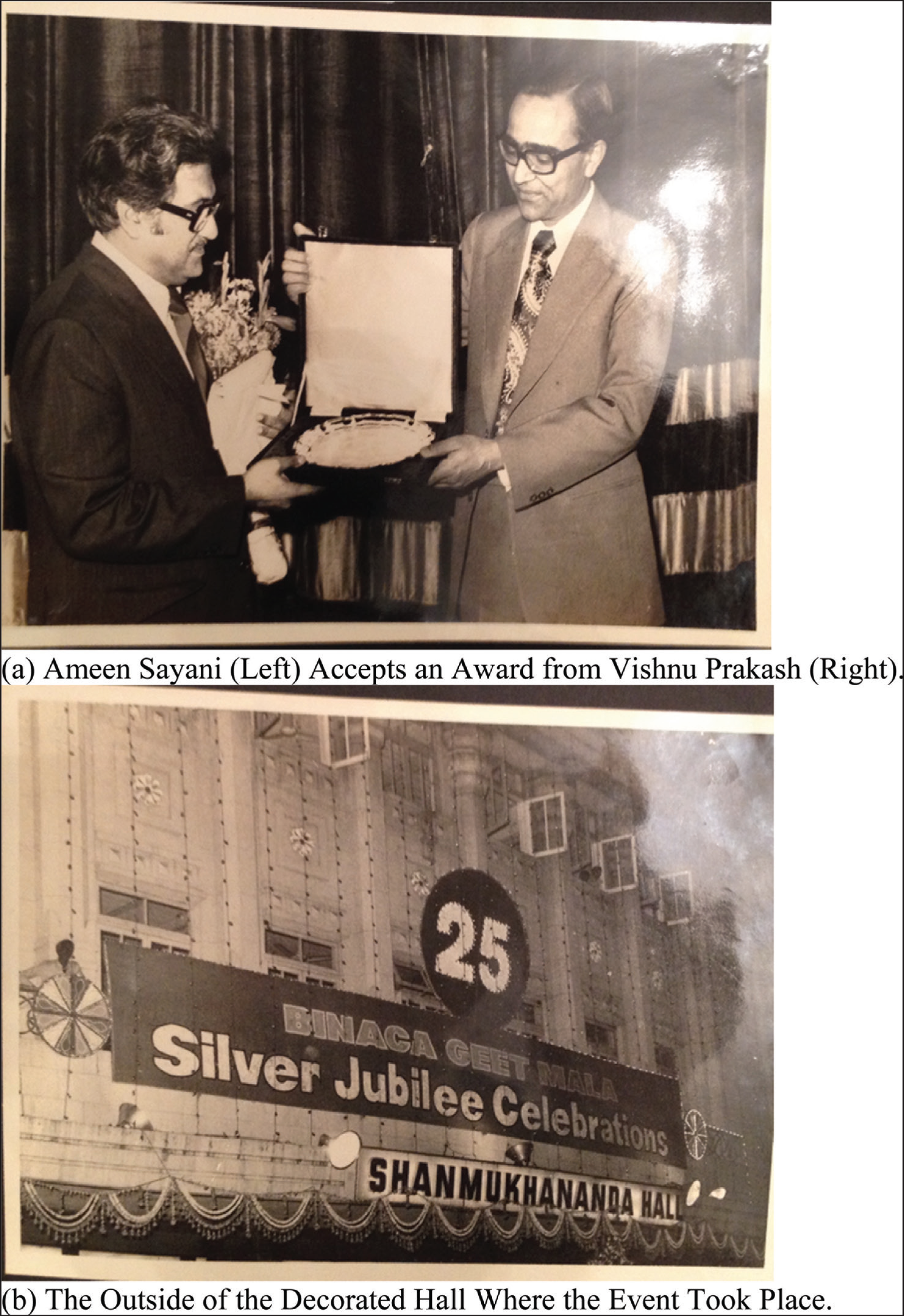
One event nicely demonstrates how the value of the Geetmala’s publicity campaign exceeded the quantifiable. When celebrating Geetmala’s 25th anniversary, CIBA organised a large reception in Bombay’s Shanmukhananda Hall and honoured all leading playback singers and music composers whose songs had topped Geetmala’s charts. Sayani, as expected, served as the programme’s host. The event was widely publicised, and an edited recording of the programme later aired on Radio Ceylon itself (see Figures 12 and 13). As I sat in Prakash’s living room, looking through the photo album that he kept of this event, it became clear to me that his company’s long association with Geetmala offered an aura of excitement and success for an otherwise everyday product. But ironically Sayani created that aura by celebrating the ‘commonness’ of both Binaca products and film songs.
Geetmala across the Years
Geetmala enjoyed almost unprecedented popularity in the 1960s and the early 1970s. In the mid-1970s, however, Geetmala’s audience began to decline and in the 1980s, the programme witnessed its steepest decline. There were several reasons for this. To begin with, Radio Ceylon’s transmitter reception began to deteriorate in the 1970s, pushing listeners to other stations, including AIR’s Vividh Bharti and Urdu Service. Changing music technologies and cultures seem to have played a particularly an important role as well. The rapid growth of the cassette industry in the 1980s ensured that film songs no longer had a monopoly on the popular music in the subcontinent and led to a boom of locally and regionally produced non-film music (Manuel, 1993). Moreover, the ‘cassette revolution’ of the 1980s also decreased radio’s importance. Cassettes were much more affordable than records (particularly pirated cassettes), and fans of film music could now build their collection of old and new music (Jhingan, 2013; Manuel, 1993). Perhaps, most importantly, the rise of television in the 1980s proved a huge blow to Geetmala and to radio as a whole. Television not only robbed entertainment hours from radio but also provided new ways of experiencing songs and films outside of the theatre. Programmes like Chitrahar (literally ‘garland/necklace of pictures’), which exclusively aired film songs and their corresponding film scenes, offered listeners an audiovisual experience that the radio could not (Bhargava, 2007, p. 179; Morcom, 2007).
When seen in this context, the fact that Geetmala survived until 1994 is remarkable. The more interesting question is not why Geetmala’s importance declined, but how the programme was able to continue. It appears that the programme survived because in seeking and celebrating the ‘common’ Sayani always showed willingness to adapt. For example, when the ‘cassette revolution’ boosted local and regional non-film music, Sayani began to incorporate non-film songs into the hit parade (Manuel, 1993). ‘Disco diwaane aha aha, nashili hai raat’ by Nazia and Zoheb Hassan from neighbouring Pakistan, which had become a huge hit throughout the subcontinent, was the first non-film song played on Geetmala. Disco Diwaane was also the first non-film song to become a major success across the region, and it ultimately paved the way for the emergence of independent pop music in India and Pakistan. The inclusion of non-film songs at this crucial transition in the media soundscape allowed Geetmala to tap into other popular music genres and to adapt to a changing media scenario where Hindi film songs no longer completely dominated.
Sayani’s relationship to AIR’s Vividh Bharti also nicely demonstrates the importance of the famed broadcaster’s willingness to adapt. In 1957, five years after Keskar instituted his infamous blockade against film songs, the minister finally yielded. AIR inaugurated Vividh Bharti, a variety music programming station that broadcast film-song programmes, in 1957. A decade later, in 1967, Vividh Bharti began to air sponsored programmes. Ameen Sayani was also among the group of broadcasters who toiled to convince AIR executives to allow commercials on Vividh Bharti. His programme Saridon ke Sathi was Vividh Bharti’s first sponsored programme (Siraj Syed, interview by author, 30 August 2017).
As Vividh Bharti grew in the decades to come, its broadcasters imitated Radio Ceylon’s programmes and styles and promoted a filmi aural culture alongside Radio Ceylon. By the 1980s, Ameen Sayani had become a common presence in Vividh Bharti and on various occasions approached AIR administrators to try to convince them to air Geetmala on Vividh Bharti. To his dismay, AIR administrators refused to host Geetmala noting that listeners associated this legendary programme with Radio Ceylon. Eventually, after much cajoling in 1989, Vividh Bharti agreed to air the programme but under a different name, Sangeetmala. Starting on the 6 November 1989, Sangeetmala aired on Mondays from 9
Geetmala’s Afterlife
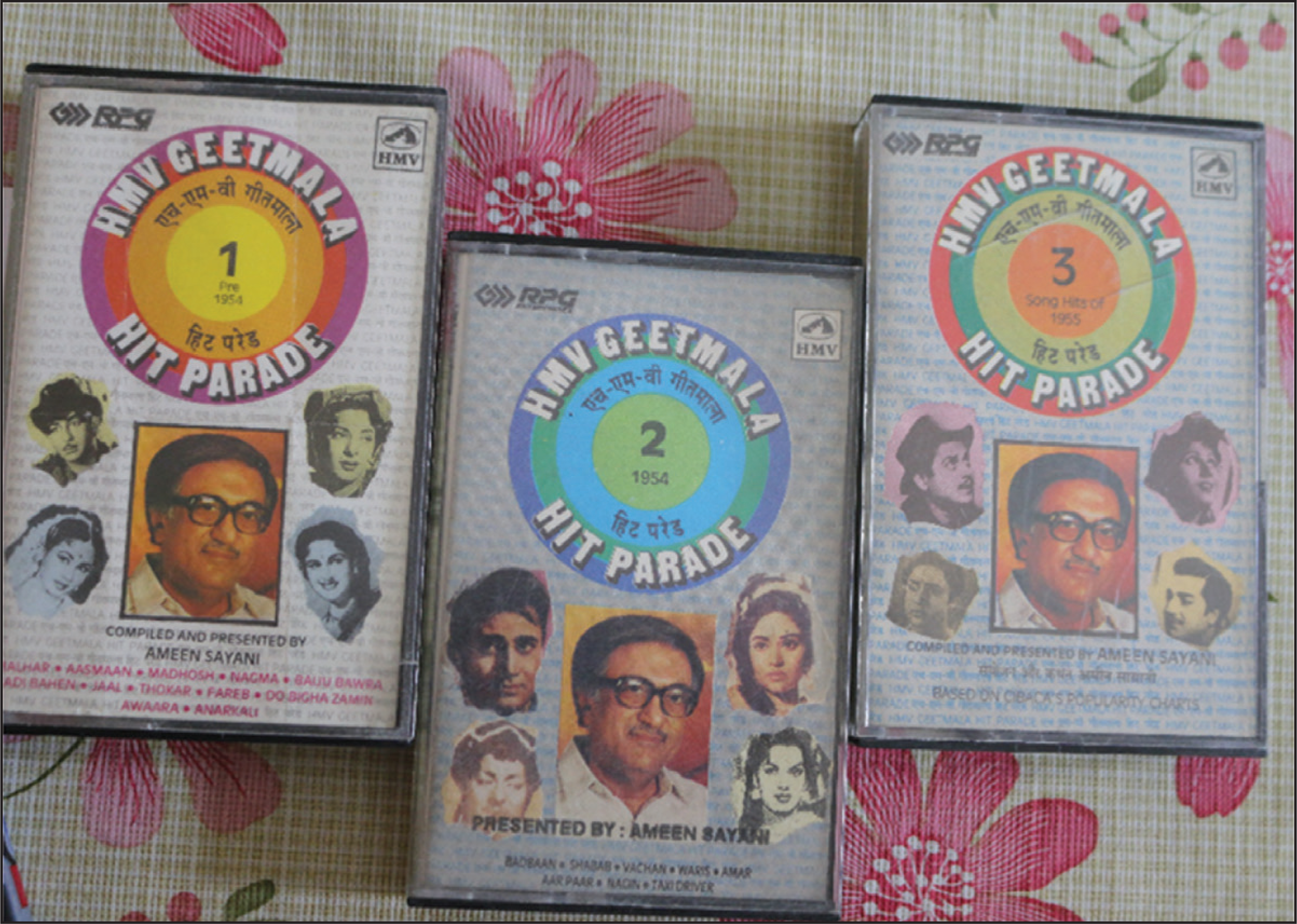
The radio programme shut down permanently on both Radio Ceylon and Vividh Bharti in 1994, but the story of Geetmala hardly ends here. The same year, HMV announced a Binaca Geetmala Hit Parade series that would feature all the songs that made it to annual programmes in a series of cassettes (see Figure 14). Sayani also attempted to capitalise on the memory of Geetmala on television shortly after the radio programme permanently closed down. Doordarshan, the national network, inaugurated a TV programme called Cibaca Geetmala. Both projects, however, faltered. After making 10–12 cassettes, HMV cancelled the project, and the TV programme closed down after being unable to gather a large enough following. While a number of factors contributed to the projects’ failure, it seems that the biggest problem was that neither the tapes nor the TV programme, which focused on evoking nostalgia for old-time music, accurately replicated the competition format that required continual watchfulness and had been so successful at luring listeners in.
One of the last and perhaps most interesting attempts to revive Geetmala took place in 2001. Several Vividh Bharti stations began airing a programme under the name Colgate–Cibaca Sangeetmala. (By this time, Colgate had bought out CIBA’s dental hygiene products and hence officially sponsored the programme.) Sayani’s team developed a format that sought to both replicate the original competition format and tap into the nostalgia for older music that the programme evoked. The weekly hit parade included five old songs and five newly released songs. Sayani called this mixture Ganga–Jamuna, a term often used to refer to the mixture of Muslim and Hindu traditions in India.
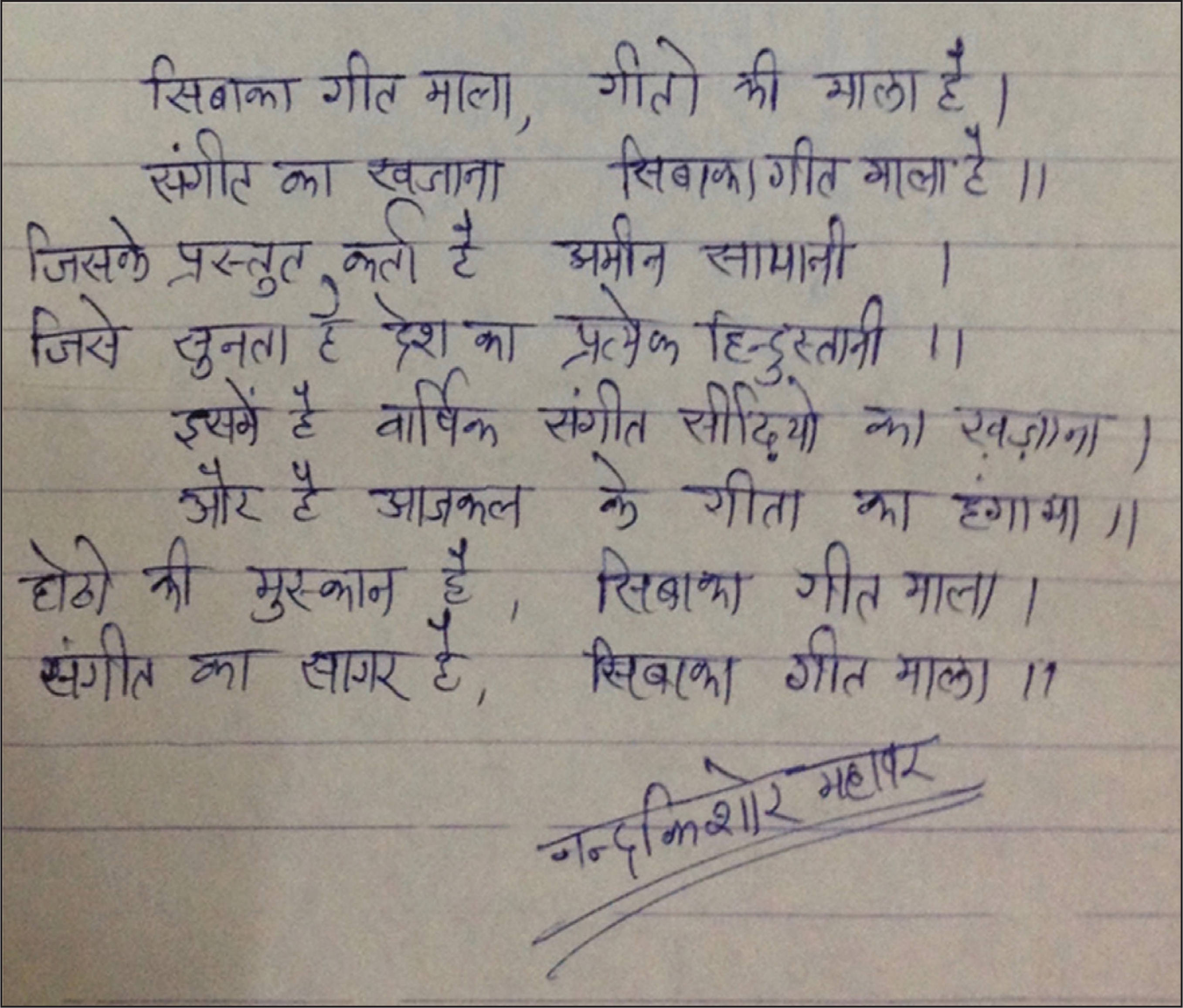
While in the past CIBA had overseen gathering statistics, during this revival period, Sayani’s team took charge. In addition to contacting music shops, Sayani’s team also contacted radio club presidents, encouraging them to revive their old radio clubs. (This is the list I used earlier.) Many club members followed suit and revived old radio clubs. Listeners wrote in Hindi primarily, but also in Urdu, Gujarati and Punjabi. The president of the ‘Sangeet Premi’ radio club from Jaipur, for example, wrote: ‘I have become young again hearing your voice.’ Another listener excited about the programme’s revival penned a poem to the programme that deserves quoting in full (see Figure 15).
Cibaca Geetmala, geeton ki mala hai
Sangeet ka khazana, Cibaca Geetmala hai
Jiske prastut karta hain Ameen Sayani
Jise sunta hai desh ka pratiek hindustani
is me hai varshik sangeet sirhiyon ka khazana
aur hai ajkal ke geeton ka hangama
hothon ki muskan hai Cibaca Geetmala
sangeet ka sagar hai Cibaca Geetmala
Cibaca Geetmala, garland of songs.
treasure of music is Cibaca Geetmala
presented by Ameen Sayani
heard by every Hindustani.
It has the yearly music ladder treasure
and today’s music party
what makes our lips smile, Cibaca Geetmala,
an ocean of music, Cibaca Geetmala.
This programme, with its Ganga-Jamuna formula, succesfully gathered a group of loyal fans united by the memory of Geetmala, for more than two years, but shut down on August 2003. The difficulties Sayani faced tapping into the nostalgia and the various experiments he attempted nicely show the importance of the competition format and the idea of the listener as an active participant in making and celebrating this ‘mass-art.’
Conclusion
This essay outlined two interrelated arguments. First, it argued that Geetmala, through its popularity lists, cultivated an understanding of Hindi film songs as the music of the ‘common people’ or a ‘mass-art’, as one listener put it. Even if Geetmala’s own voting process could not be fully democratic, Sayani indirectly evoked the language of franchise and participated in a larger dialogue about political participation. Second, the essay argued that by encouraging alertness to ever-changing popularity lists and by developing specific terminology, Geetmala effectively transformed ordinary radio listeners into opinionated and discerning Hindi film-song experts, making expertise in Hindi film songs a popular pastime. In closing, I wish to point out the ways in which these two arguments are connected. The ‘discerning’ Hindi film-song critic, whether a diarist, radio club member, or ordinary listener, was the ideal political participant, the learned constituent in Geetmala’s popularity lists. The process of making radio listeners into ‘discerning’ critics was crucial to making Hindi film songs into the leading popular music genre of the subcontinent and to ensuring their much celebrated and discussed ubiquity in India and beyond.
In keeping with the spirit of Geetmala, I wish to close with Sayani’s legendary words: agle saptah phir milenge, tab tak ke liye apne dost Ameen Sayani ko ijazat dijiye, namaskar, shubh ratri shab-ba-khair (We should meet next week, until then allow your friend Ameen Sayani to leave you. Greetings. Good night.)
Footnotes
Acknowledgements
A special thanks to the broadcasters and listeners who shared material with me and who generously gave their time to speak with me about their passion for radio. I would also like to thank Andrew Amstutz, Salma Siddique, Asiya Alam, Peter Knapczyk, Fernando Sanchez, Waseem Ahmed and Jacqueline Anton for their assistance in the completion of this piece. Lastly, I am grateful to the two anonymous reviewers for the comments on drafts of this article and to Bioscope editors, Lotte Hoek and Ravi Vasudevan.
Declaration of Conflicting Interests
The author declared no potential conflicts of interest with respect to the research, authorship and/or publication of this article.
Funding
The author disclosed receipt of the following financial support for the research, authorship, and/or publication of this article: The author received funding from American Council of Learned Societies and the American Institute of Indian Studies when conducting research and writing this article.