



Abstract
When the COVID-19 pandemic broke out in 2020, countries around the world began enacting lockdown measures and enforcing social distancing rules. Almost at the same time, the use of drones also began to see a spike, especially in the hands of civilian users. This article examines the phenomenon of the drone video as a genre of the pandemic. While drone imagery is not endemic to the COVID-19 crisis, in the face of mass deaths and lockdowns, drone users globally began to turn to the drone as a mobile archive machine. Drawing on recent scholarship on drones, I examine how the drone’s vertical vision afforded a form of pandemic witnessed by proxy. Despite the increasing use of drones for policing, surveillance and warfare, in the case of India, drone imagery also played an important role in countering government narratives about the pandemic and its body counts. Examining the drone images captured by the late photographer Danish Siddiqui, I demonstrate how the drone’s ‘vertical play’ facilitated the emergence of a counter-archive of the pandemic.
Introduction
The outbreak of the COVID-19 pandemic in mid-2020 was accompanied by several striking changes in urban management, emergency disease control measures and technological realignments. Amidst an increasing death toll, governments and individual citizens globally attempted to rethink the meanings of work (and entertainment) in a veritable state of exception. Cities around the world went into lockdown, with ensuing changes in rhythms of work and leisure. The normalisation of platforms such as Zoom, Microsoft Teams and Google Meet for work and teaching, the closure of film theatres (among other public spaces), the release of big-budget films over OTT platforms and the conduct of online film festivals are prominent examples of such dramatic realignments. Amidst such changes, the pandemic also saw the increasing use of drones, with a World Economic Forum report from July 2020 predicting an increase in the use of drones for creating and maintaining ‘resilient supply chains and socially distanced delivery services’ (Wolf, 2020). Indeed, in the months that followed, drones were in the news for reasons ranging from surveillance and enforcement of social distancing (Tripathi, 2020) to the exploration of potentials for remote delivery and sanitisation (Chengappa, 2021). Yet, the most visible and spectacular use of drones during the pandemic has by far been seen in the hands of individual users rather than government services and corporate supply chains. Drones, of course, emerged in the context of the military–industrial complex with their use enabling remote surveillance and warfare – often with devastating effects (Benjamin, 2012; Chamayou, 2015; Parks & Kaplan, 2017). But despite this intimate connection to violence, the use of drones as consumer objects (Hildebrand, 2021) and as a form of elemental media (Fish, 2020) has also seen an increase in the last few years. Drone use during the pandemic is not a product of the crisis, but, like the video-conferencing platforms mentioned above, has been accelerated by the crisis. The drone’s remote imaging and sensing capabilities thus align perfectly with the cardinal motto of the pandemic – ‘social distancing.’ In this essay, I consider the kinds of media practices that the drone engenders and what specifically drones mean as a media of the pandemic.
Strike-I: Aesthetic Mapping and Melancholia
Drone imagery emerged almost simultaneously with the global outbreak. Patricia Zimmerman and Caren Kaplan have proposed that the simultaneous outpouring of similar drone footage across the world suggests the emergence of a ‘specific genre’ (Zimmerman & Kaplan, 2020). In their discussion, Zimmerman and Kaplan note several aspects of the genre which are of particular interest to film and media theorists – among them the eliciting of affect, the focus on urban space, the use of sound, and the evocation of melancholia, nostalgia and devastation. Indeed, even a cursory look at drone flight imagery ranging from New York, to Boston, to Oakland, to Mumbai, to Chennai and Guwahati showcases these elements starkly. On the other hand, as they note, such footage is not endemic to the pandemic, but like the virus itself is born of the ‘material conditions of neoliberalism and globalization’ (Zimmerman & Kaplan, 2020).
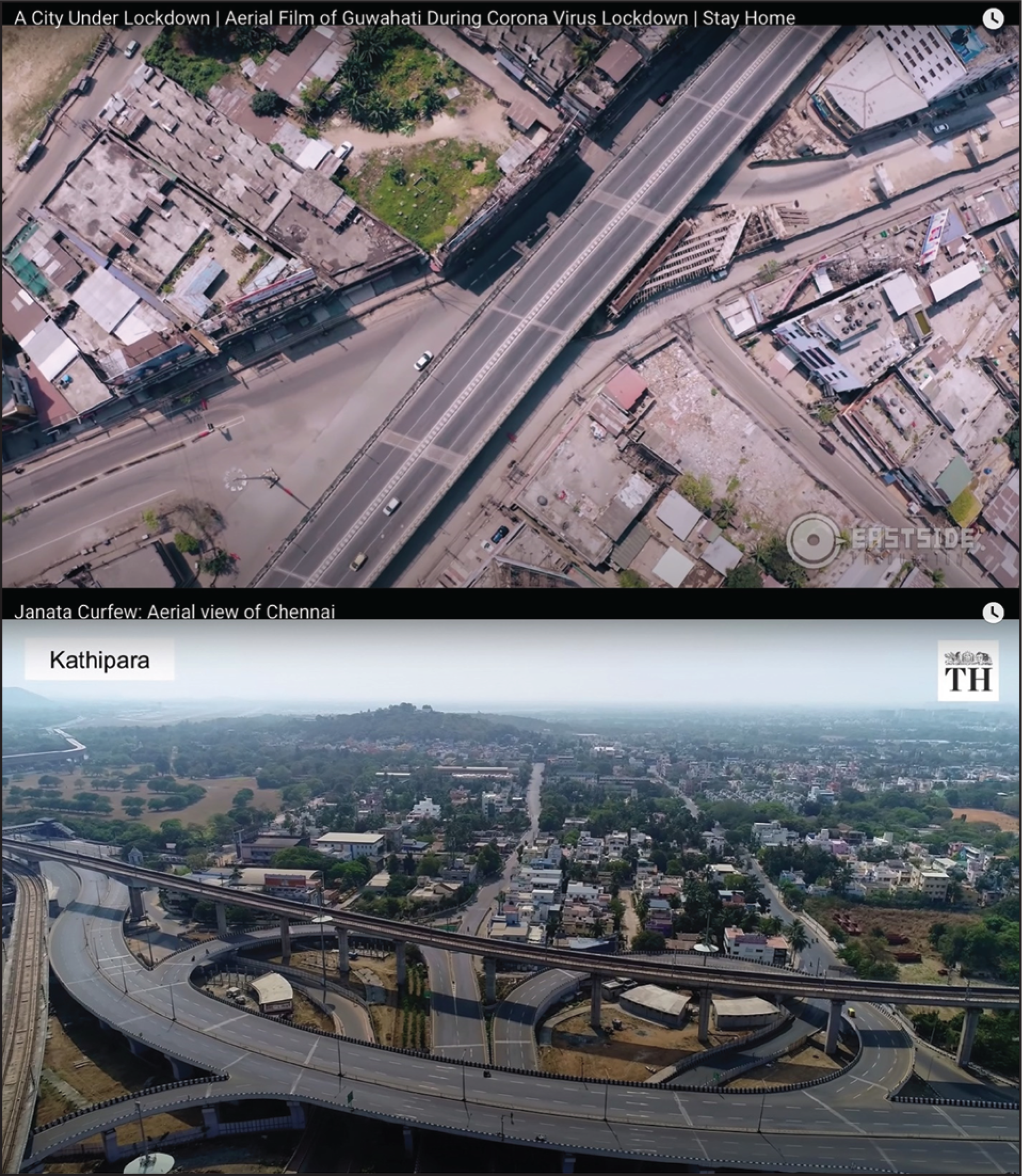
From the Indian experience, consider, for instance, two videos: one from the city of Chennai and the other originating in Guwahati. Both are metropolitan cities (albeit varying in scale). In the video from Chennai, published by The Hindu in March 2020, we see aerial shots of the city. The camera glides over the city’s airspace, showcasing prominent urban landmarks and areas – a bus terminus (Chennai Mofussil Bus Terminal), a bridge in Kathipara and buildings in the Anna Salai area. A melancholic piano score accompanies the flight of the drone, with the images edited together with textual signage telling us the location of the shots. A Mumbai video uploaded by Mumbai Live is very similar in construction and style, with a slight difference in music and a couple of ground-level shots (Mumbai Live, 2020). The footage from Guwahati is a little more elaborate in its sonic and visual construction. Created by the cinematographer Prayash Sharma Tamuly, the video begins with a black screen and the din of traffic (Sharma Tamuly, 2020). On-screen text asks us to imagine the ‘largest metropolitan city in Northeast India’ without its usual chaos. Almost immediately after we are told that Guwahati entered lockdown a day before the rest of the country – the camera glides over the city’s expanse showing us aerial views of the city scape, with textual anchors again locating its landmarks. The melancholic music that is otherwise continuous throughout is disrupted at only two points: first when we hear the sound of azaan (call to prayers) over loudspeakers as the drone glides over a mosque, and immediately after, the sound of bells as it traverses the airspace over the Kamakhya Temple. Sound design plays an important anchoring role here, and like text, localises the space we see from the air. But why localise with text and sound in such videos?
In most instances, these videos tell us very little about on-ground space. Except for a few recognizable landmarks, one city could easily replace another. Aligning with Stephen Graham’s postulation of the drone’s ‘myth of total vision,’ such images display an ‘absence of knowledge about the people targeted below’ (Graham, 2016, p. 77) Rather, the drone camera’s vertical vision lends itself to the ‘flat perspectives seen from the “God’s eye” view of the cartographer’ (Graham, p. 6) that cannot encapsulate the volumetrics of urban space or its life worlds. In their discussion, Zimmerman and Kaplan (2020) trace the genealogy of pandemic drone videos to two traditions. First, ‘the advent of aerial photography’ starting with Nadar’s balloon-flight-enabled pictures of Paris, and then coalescing in the floating camera’s capacities for ‘reconnaissance and targeting’ during World War I. In fact, as scholars such as Martin Stollery have shown, the imperial impulse in aerial photography can be seen even in the documentary tradition – an impulse that undergirds the use of drones for conquest today and harks back to the close relationship between film technology and ‘developments in the communication, transport, arms-manufacturing and surveillance industries [which] in turn are related to histories of modern warfare and imperialism’ (Stollery, 2000, pp. 163–164). The other tradition that Zimmerman and Kaplan mention is that of city symphony films such as A Propos de Nice (Vigo, 1930), Berlin: Symphony of a Great City (Ruttman, 1927) and Man with a Movie Camera (Vertov, 1929). However, although focused on city space, there is a crucial difference between pandemic drone videos and the earlier city symphony films. The latter are primarily a symphony of the street, while the drone’s vision is born of a digitalised two-dimensional, panoptic cartography engendered through technologies such as Google Maps. As Zimmerman and Kaplan themselves note, such drone imagery ‘masks the continuities of late capitalism’s inequalities’ (2020). By flattening perspective, such technology ‘establishes a new visual normality [for] an imaginary floating observer and an imaginary stable ground’ (Steyerl, 2011). Thus, as Teresa Castro points out, pandemic drone footage belongs to the register of the urban uncanny, where in the face of potential human extinction, such images capture the ‘post-apocalyptic’ lingering of human life’s non-human substrates. Castro frames this as an ‘aestheticization of politics’ where the affective evocation of nostalgia and mourning ‘primarily speaks to the world’s privileged’ (Castro, 2020, p. 84). While consumer drone use is definitely an ‘assemblage of human and nonhuman agencies’ (Hildebrand, 2021, p. 67), in this specific genre, the human agent controlling the machine from the ground is rendered invisible.
What we are left with is a becoming cinema of the pandemic, resonating with what Robert Cambell has called ‘kinocentrism (or cinematic thinking)’ (Campbell, 2018, p. 53). In this arrangement that naturalises the cinematic imagination within the practice of everyday life, Campbell argues, the temporality of the media stands in for the reality of place or event. Thus, sonic, textual and editing choices in these videos not only localise the footage in the absence or recession of volumetric comprehension (Elden, 2013, p. 49) but also render the crisis itself as a spectacle of empty space and empty time. These images emerge from the time of the pandemic, but left alone without manipulation, occupy what can be characterised as a ‘drone-time’ insulated from the granularities of the ground by the spectacle of flight. It is safe then to say that the first wave of pandemic drone footage is rooted in the representation of the urban uncanny – that is, the representation of urban space as man-made, yet unhomely. Ultimately, these representations are the product of aesthetic choices – the slow gliding camera, the use of melancholic music and the evocation of affect through montage. Such images emerge during the pandemic yet are strangely also devoid of it. The images encountered in these videos of urban spaces are a form of pandemic witnessing by proxy – that is, a witnessing stripped of its human agents. The camera goes where the human eye cannot, both because of its vertical limitations and the on-ground arrest of the body’s mobilities under lockdown. And while the images emerge from the time of the pandemic, they also produce an ‘any-time-wherever’ (see Figure 1).
Strike-II: Reterritorialising the Ground of the Pandemic
But is this the only kind of vision the drone enables? Recent work in drone theory has also conceptualised its capacities for dismantling the god-like view from above. As Rasmus Gahrn-Andersen has argued, ‘the drone’s practical significance should not be considered as ontologically reducible to the drone […] as an object in-itself’ (Gahrn-Andersen, 2020, p. 278). The drone affords vertical regimes of power and control (as in the case of remote warfare and surveillance) but is not necessarily defined by them. Austin Choi-Fitzpatrick, for instance, notes the potential of the drone for ‘nonviolent digital disruption’ in the hands of civilian users and activists resisting state control (Choi-Fitzpatrick, 2020, p. 145). And while the videos mentioned above do not resist state power, they also do not directly emerge from it. Rather, as aesthetic objects they belong to the register of what Julia Hildebrand has called ‘vertical play’ that affords the same kinds of pleasures as gaming (Hildebrand, pp. 139–141). The images’ auratic power derives both from their cinematic framing and the possibilities for ordinary citizens to capture the familiar in unfamiliar light.
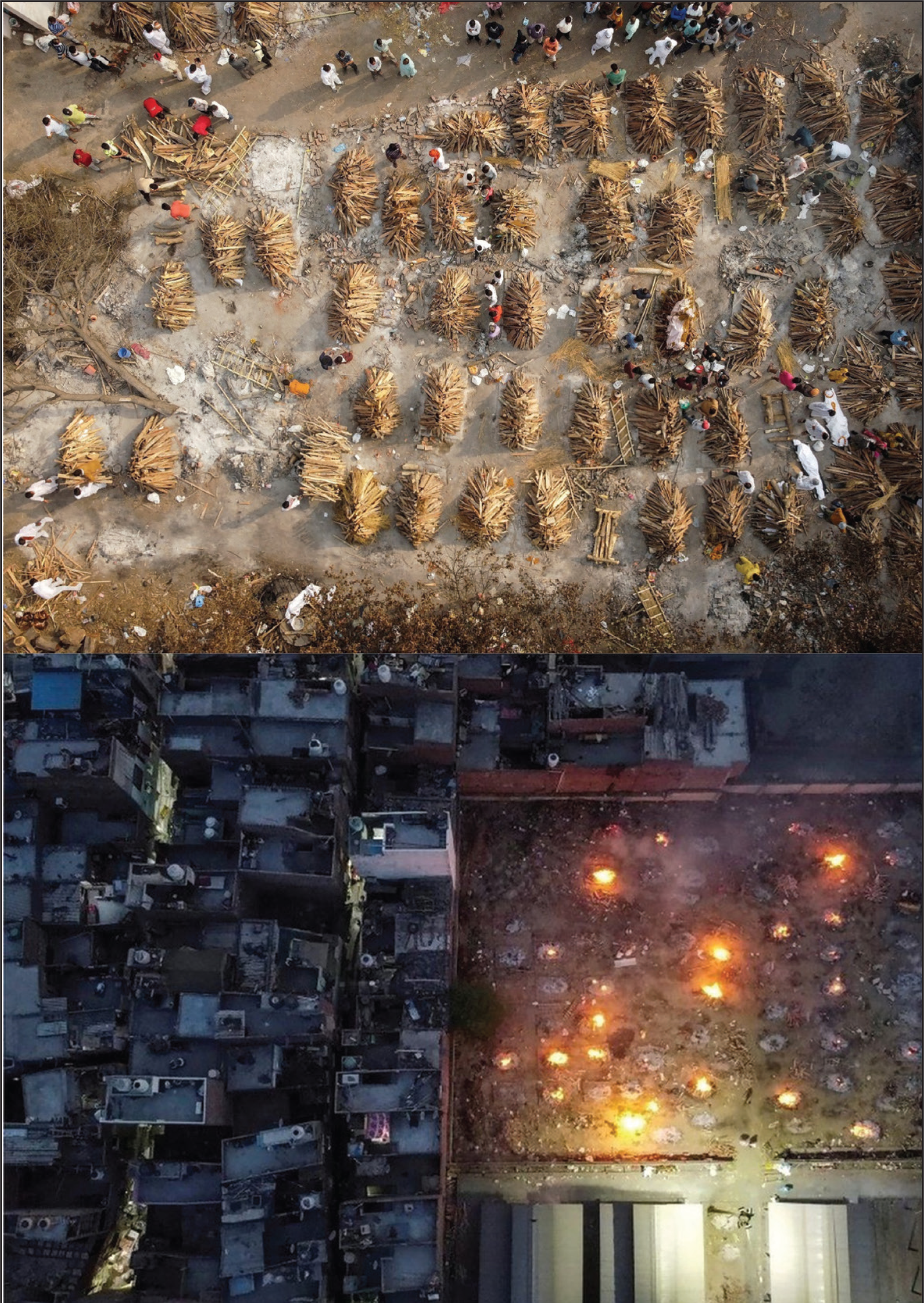
Yet in 2021, as news of a second, devastating COVID-19 surge in India began to emerge, the vertical play of the drone found renewed purpose. The Indian government continued to downplay the scale of the surge as thousands died from infections, and a medical infrastructure struggled to keep up with the inflow of patients. A May 2021 video by ABP News reported that bodies were being buried en masse on the banks of the Ganges in Uttar Pradesh – the images were captured by a drone camera (ABP News, 2021). More famously, photographs taken by the late photographer Danish Siddiqui via drone strongly countered the official narrative. Siddiqui, of course, did not take only images using drones, but the drone images played an important role in displaying the scale of the surge.
Four of these images taken for Reuters in Delhi’s Seemapuri neighbourhood stand out. In one image, we see people at the edges of the frame and interspersed throughout, around unlit funeral pyres (Reuters, 2021). In another similar shot, we see people carrying a dead man to the grave (danishpix, 2021). A third image shows us a mass cremation in daylight – smoke, ashes and flames dot the plane of the image – while in another image, possibly from the same flight but at higher altitude, we see the cremation site next to a block of buildings (Siddiqui, 2021). In this slightly darker image, the flames stand out more strongly confronting our gaze and drawing us into the tragedy unfolding below. Like other aerial images, these too flatten perspective. The landscape becomes a map, people become dots and pyres look like piles of matches. Writing about drone warfare, Grégoire Chamayou asserts that such bodies are ‘not so much a figurative representation as an operative function’ for military targeting and death (Chamayou, 2015, p. 114). Yet, the sight of the drone in Siddiqui’s pandemic images suggests a different kind of vision than both the soon-to-be-victim pixel of militarised verticality and the melancholic flight of the drone over empty cityscapes. Instead, vertical play here enables a wide view that exposes the scale of the tragedy (see Figure 2). In a paradoxical way, the distance of the drone rehumanises the tragedy – bodies and figures may not be individualised, but in their collective dotting of the plane of the image, they become subjects rather than objects/targets. Here, the drone reterritorialises the pandemic map via its ‘foregrounded “dislocation” and aerial motility’ (McCosker, 2016) and facilitates a form of witnessing in flight.
Conclusion
Drones themselves are still emerging technology in India, and their remote imaging capabilities are of particular interest to the State for surveillance and policing. As R. Swaminathan notes, alongside ‘CCTVs, web monitoring programmes and real-time satellite imagery, drones complete the picture of 360 degree surveillance’ (Swaminathan, 2015, p. 20). Crucially, drones had been used by the Delhi Police in 2019 to surveil the anti-Citizenship Amendment Act protests, leading to widespread concern about targeting and harassment of activists and protestors (Gill, 2019). While such concerns persist and need to be resisted, the normalisation of drone use has also led new visual imaginaries in the hands of vloggers, activists and filmmakers. In their hands, camera-enabled drones become means of entertainment, pleasure, activism and even social capital.
As discussed above, civilian drone use during the pandemic afforded two visions of the crisis. In the first wave, drone vision helped produce melancholic evocations of space filtered through an aesthetic, cinematic perspective of urban space. In the other, the same vertical play engendered a counter-archive of the pandemic in contrast to the official story. While drone media are not pandemic born, between these two ends of the spectrum, they helped create a sense of the pandemic in an event that was unfolding at literally, an epidemiological rate. In that sense, drone media in the time of COVID-19 can be thought of as a form of witnessing. John Durham Peters writes, ‘to bear witness is to put one’s body on the line’ (Peters, 2011, p. 30). Yet perhaps the drone’s triangulation of the operating body, the recording camera and the image/subject also entail a form of witnessing without risk. Drone media after all afford the vicarious experience of the event from afar. Thus, if drone media allow us to consume the pandemic as a media event, it is certainly from a distance … remotely.
Footnotes
Declaration of Conflicting Interests
The author declared no potential conflicts of interest with respect to the research, authorship and/or publication of this article.
Funding
The author received no financial support for the research, authorship and/or publication of this article.