




Abstract
Through a series of reflections on the film Jole Dobe Na (Those Who Do Not Drown, 64 minutes, 2020), directed by Naeem Mohaiemen, this essay explores the relations between archives, dust and memory. It argues that memory is constantly struggling against the proliferation of detritus that clutters the material archive as we attempt to recover or reconstitute the past. Mohaiemen’s Jole Dobe Na, a film about loss and mourning, places its protagonists in an abandoned hospital filled with disused furniture, equipment, and records, through which we pursue the thread of memory like searchers in an archive. But while Mohaiemen’s earlier, research-driven films have excavated archives for documents, photographs and film footage in order to comment on history or release unexplored historical possibilities, Jole Dobe Na appears to view the archive itself as debris, always threatening to collapse into dust as memory confronts the past as wreckage. Mohaiemen’s Tripoli Cancelled (2017) and Jole Dobe Na (2020), films set in liminal, derelict spaces (an airport and a hospital) both speak to the questions of site and space that preoccupy cinema today, especially artists’ films meant for gallery viewing. They also reflect on the archive as a ruin rather than a repository.
Many years ago, accompanied by the film historian Moinak Biswas and the photographer Dayanita Singh, I visited the abandoned and derelict premises of National Instruments Ltd, once a public sector industrial unit manufacturing high-quality optical equipment, which had become ‘sick’ and was forced into lockdown in 2003. Singh, then working on her project File Room (first exhibited in 2011), was interested in the stacks of yellowing, dust-covered paper files that lined the walls of the huge, empty office-rooms in the disused building, its dereliction already recorded by two young photographers, Madhuban Mitra and Manas Bhattacharya (2012). 1 File Room, described as an ‘archive of archives’, sought to capture the last days, or even the afterlives, of official paper files. It confronted not only the ‘chaos, mortality and disorder in the labyrinths of working bureaucratic archives’, but also the inevitable decay and disintegration of paper itself (Singh, 2013a, 2013b). 2 The deserted, echoing spaces that we walked through held other memories as well: abandoned chairs with scratched initials and numbers; stopped clocks; desks on which the office-workers’ paraphernalia of thermos flasks, tea-cups, letters, calendars, photographs of deities, film-stars or family still stood; and disused machines and work-benches, some with a shirt still hanging on a rod nearby. Mortality and disorder were everywhere. And indeed, apart from an extensive bank of still photographs and some 60 hours of video recordings preserved by the Media Lab of the Department of Film Studies, Jadavpur University, nothing now remains of these objects or settings, physically consigned to oblivion after the site was redeveloped by the university for other purposes (Hutnyk, 2009). 3 All that could be saved, through the initiative of some students and faculty, were the books in the workers’ library; the files, cameras, and machines that might certainly have found place in an industrial archive or museum have not survived.
Industrial sickness or the mortality of objects are not the same as those afflictions of the flesh by which we were beset over the past three pandemic years. Yet when I first watched Naeem Mohaiemen’s film Jole Dobe Na in July 2020, sitting at my computer in a locked-down house, I was powerfully reminded of the desolation and detritus I had witnessed at the National Instruments factory, all those years ago. When the coronavirus disease-2019 (COVID-19) struck, whole economies shut down, precipitating an unimaginable crisis for the labouring poor, for migrant workers and their families, and for the sick and dying, often isolated and unable to access treatment or care. Their suffering and abandonment were the backdrop against which profound disruptions of everyday life played out: fear of contagion, distancing protocols, infection and confinement, empty streets, the sound of ambulance sirens, and the tragic recurrence of death and loss. For me, Jole Dobe Na (Mohaiemen, 2020) became a testament to that alien, solitary time, though it had nothing to do with the pandemic. Co-commissioned by the Yokohama Triennale 2020 and the Bildmuseet Umeå, Sweden, the film was made in response to a prompt from the Raqs Media Collective, India, for a film on care and the afterlife of caregivers. Its title recalled a line from a Bengali folk-song, ‘premer mora jole dobe na’, meaning that those who die in love do not drown (Shedde, 2021). 4 Over the months of devastation that followed the film’s completion, as death took firm hold on the subcontinent, the phrase ‘those who do not drown’ acquired another association, that of the unburied, half-burnt bodies of the COVID-dead, floating downstream on the sacred river Ganga near Allahabad (Pandey, 2021). 5 The shock of that transference, an image of indestructible love becoming the river-borne burden of daily bereavement, was one of many catastrophic alterations wrought by the virus. At the time of first viewing, the fragment of melody attached to the half-line jole dobe na (literally, they do not drown) resonated in memory, hovering over, but never quite settling on the married couple in the film.
Mohaiemen’s film is a record of loss, linking memory and affect with physical detritus and the dissolution of the archive. This runs counter to some of his earlier, more political and research-driven films, such as The Young Man Was, Parts I and II (Mohaiemen, 2011, 2014) and Two Meetings and a Funeral (Mohaiemen, 2017) which present themselves for analysis in terms of what Catherine Russell, invoking Walter Benjamin, has called archiveology. They excavate and collect documents, photographs, found footage or footage retrieved from archives, combining them with new narrative threads in order to release or awaken unexpressed historical potentialities (Russell, 2018, pp. 27–28). Instead of returning to the past in terms of a linear chronology, these films evoke a future buried within the past. They are documentary, but are not really documentaries. Their archival practice re-politicises and makes new ideological investments in past images, drawing, as video installations often do, upon an aesthetics of contingency. But in the feature films Tripoli Cancelled (2017) and Jole Dobe Na (2020) Mohaiemen’s relation with the archive appears more complex and contradictory. As Carolyn Steedman observed in Dust, reflecting on Jacques Derrida’s Archive Fever (1995), physical archives are not just accidental collocations of documents or other fragments of the past; they are also repositories of dust and bacteria. Inviting the fevered curiosity of the archivist-historian, they contain germs as well as data; historically, they are linked to actual fevers and illnesses (Steedman, 2002, pp. 17–37). If there is dust in the archive, archives are also on the brink of collapsing into dust, reduced to the heaps of rubbish that the Angel of History sees accumulating at its feet, in Walter Benjamin’s classic vision of ‘the storm that blows from Paradise’, propelling us backwards into the future (Benjamin, 1969, pp. 257–258). An archive is usable if it ‘functions as a memory’, as Neeraja D. and Ahmed Ozsever remind us in their installation An Unusable Archive: ‘It becomes a system of complex relationships if one is able to locate, understand, and interpret the material as part of a larger framework’ (2020). 6 What, their installation asks, can one do with material that appears to be whole and evidentiary, yet does not escape the randomness of its discovery?
Tripoli Cancelled and Jole Dobe Na ask a different question as they stitch together reflections on the archive as dust, debris that can neither be preserved nor salvaged, while memory struggles to sift through the proliferation of useless objects, ranged like the obstacle course of broken furniture that the husband in Jole Dobe Na, Jyoti, climbs over in order to reach the operation theatre (Figure 1). Both films show physical documents, file-rooms, and disused equipment, abandoned or left to decay in airports and hospitals, institutions that traditionally fetishize record-keeping, as memorialised in Dayanita Singh’s File Room. In our customary interactions we submit to processes of labelling, docketing, and physical verification of items such as boarding passes, patient records and laboratory samples (like the vial containing Sufiya’s blood, which she checks for the spelling of her name). Yet when the flight is cancelled, when the patient dies, all these papers, so carefully stored, dated, ordered, filed, are worth nothing at all; they are fit only for the scrap-heap. Nothing, we know from experience, matches the sadness of throwing away all the medical reports that we had so scrupulously docketed and carried to every hospital appointment, after the beloved patient herself has left us. Like dead leaves in autumn, these documents feel at once heavy and light – heavy with the weight of a past that cannot be recovered; light, as their connection to life withers away. History is just such a record of forgetting, of losing photographs and documents, of throwing away what we cannot keep.
Jyoti climbs over broken hospital furniture. Still from Jole Dobe Na (Mohaiemen, 2020), by kind permission of the director.

The visual text in Jole Dobe Na is evacuated by loss. Deliberately composed in shades of brown and green against the dusty yellow and ivory of hospital waiting areas, the film’s fading afternoon or evening light bathes everything in an autumnal, sepia tint (Figure 2). Jyoti and Sufiya (played by Sagnik Mukherjee and Kheya Chattopadhyay) are an estranged couple, brought together by Sufiya’s unnamed illness. The film records the husband’s memories of his wife’s last days on a loop that throws up snatches of ‘hesitant intimacy’: sharing a bottle of water, reading aloud from the Bengali author Syed Mujtaba Ali’s stories, pushing a wheelchair, learning ‘the protocols of blood’. Over these last few months, they inhabit a dream-world of companionship, under the sign of impending death. Jyoti, the husband, assumes the role of primary care-giver in a setting eerily emptied of doctors, nurses or other patients. In fact, the same actor appears briefly in other roles, like that of the white-coated phlebotomist. For those who know Mohaiemen’s work, the film may seem to extend his concern, carried over from Tripoli Cancelled, with isolation, tenderness, abandoned buildings, and the banality of everyday actions. No one could have anticipated the irony of its release during the pandemic, when we were forced to acknowledge that, as Freud said: ‘we are all ill’ (Freud, 1961, p. 358).
Jyoti on hospital verandah in afternoon light. Still from Jole Dobe Na (Mohaiemen, 2020), by kind permission of the director.
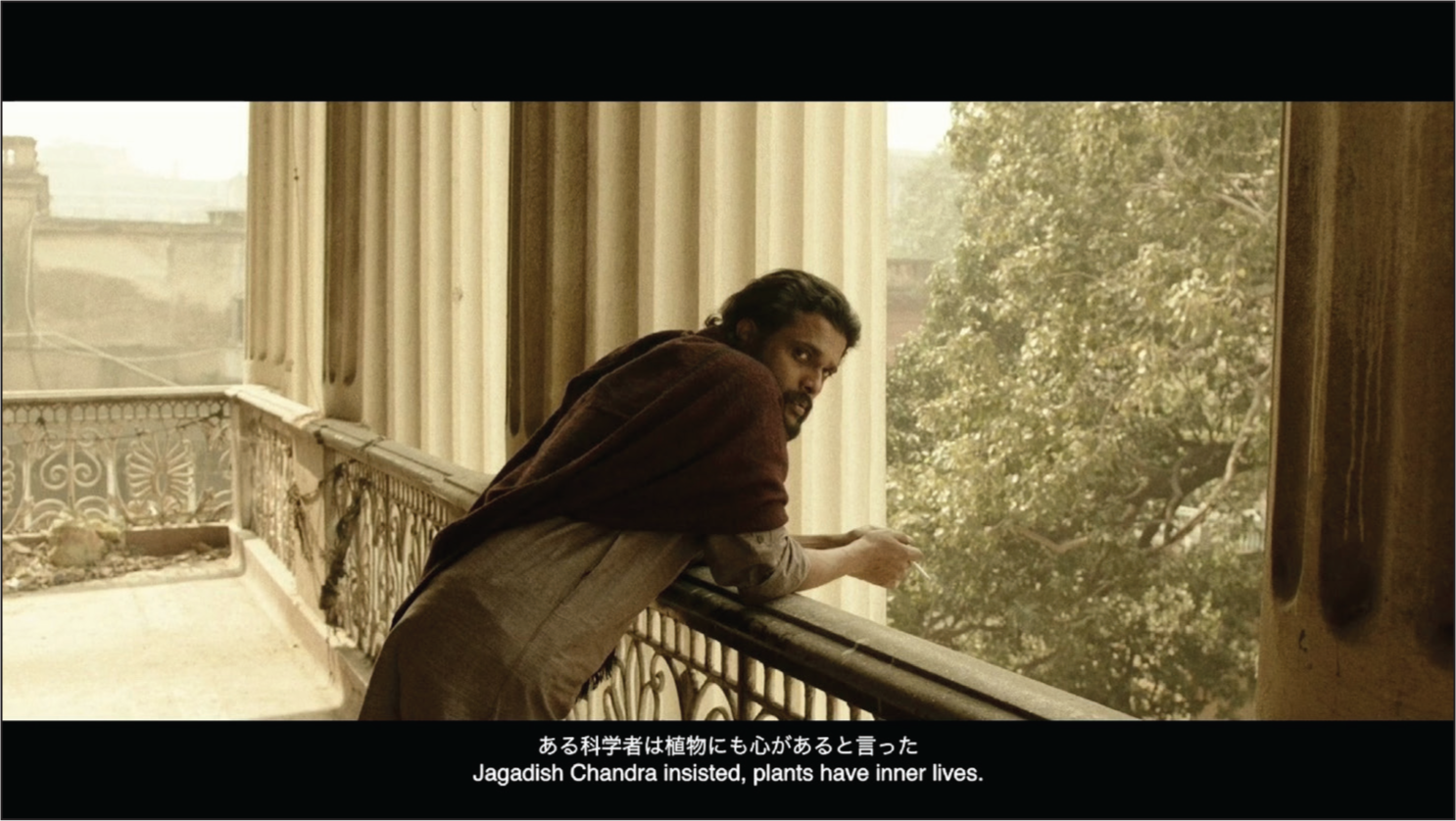
In some ways, the film’s ‘memory loop’ (Mohaiemen & Pierre, 2021) appears oddly depersonalised. If the surreal dereliction of the scene, the deserted hospital with its broken furniture, scattered files and empty operation theatre are retrospectively produced by a traumatic evacuation of the husband’s memory, this remains implicit. As we watch the two characters perform the most familiar and expected of hospital routines – registering at a desk, waiting, being examined – in a building that is not just abandoned but cluttered with debris, we do not immediately ask for a naturalistic explanation of this state of disuse. Rather, we enter the film’s spaces of abandonment (like those of the defunct Ellinikon airport in Tripoli Cancelled) like searchers in an archive, piecing together fragments in a history of loss. Speech and movement are frugally used within Sukanta Majumdar’s sound design and Qasim Naqvi’s music. When Sufiya corrects the receptionist who ‘westernises’ her name into ‘Sophia’, or holds her own with a phlebotomist obsessed by prohibitions of blood; when Jyoti speaks of his refugee family and his attachment to this shabby, crowded city, to which Sufiya has returned from abroad, a longer history of decolonisation is hinted at, but that history is never fleshed out.
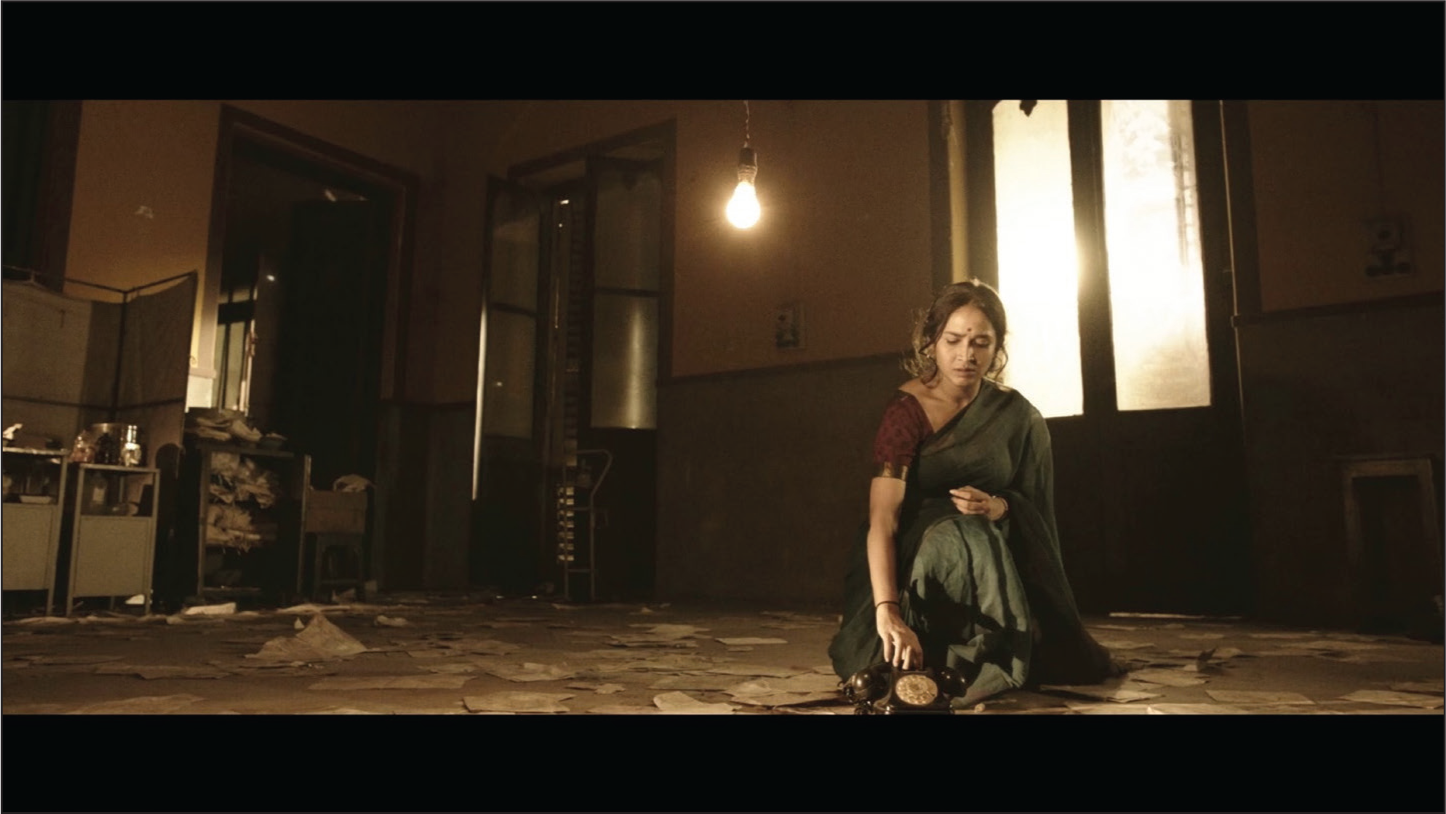
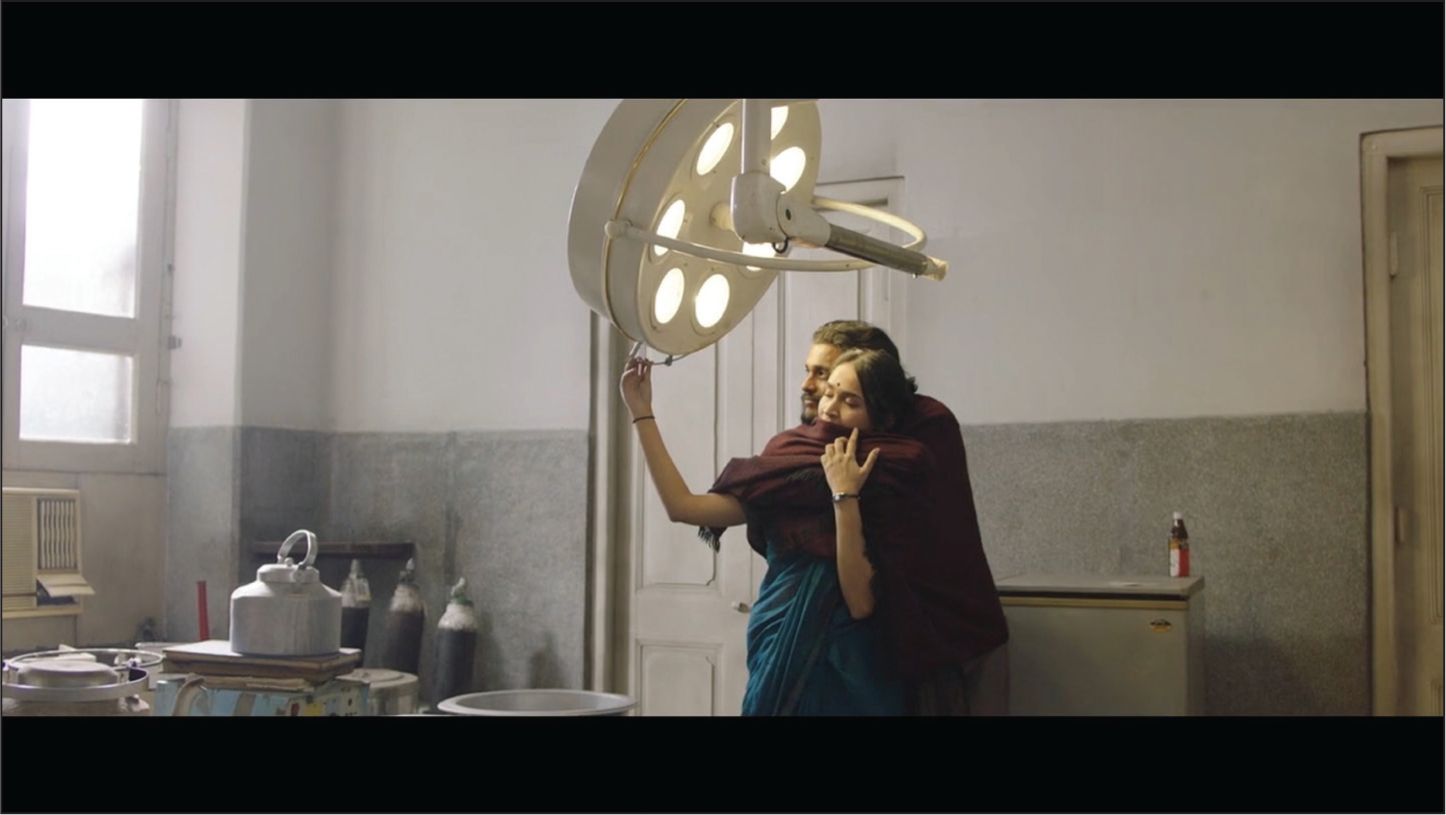
In the opening sequence of Jole Dobe Na Sufiya runs into a long, empty room, strewn with papers that have escaped from bundles of files in the background. As she kneels to answer the phone (an obsolete black dial-up model), our attention is drawn to the profusion of dusty paper, like fallen leaves, around her (Figure 3). Later (44 m), Jyoti walks across the same expanse of documents, speaking of a prayer rug and beads that he found on a shelf in a hospital waiting room, left behind for the next user. Shortly afterwards (47 m), a running close-up of these discarded records, together with hospital equipment such as syringes, glass phials and scissors, is followed by shots of Jyoti leaning over the balcony parapet, reading through old letters. The bunch of papers hangs suspended over the parapet, but Jyoti does not let them go, and this moment is followed by two more scenes of ‘hesitant intimacy’, first when Jyoti speaks of his aunt’s long-drawn-out passing and his inability to learn the kalema prayer that should accompany the departing soul; and next when the two perform a slow dance with the overhead lights in the disused operation theatre (Figure 4). When we next see Sufiya, she is strapped into an oxygen mask, and behind her, briefly glimpsed, is the paper-strewn floor and the bundles of discarded files, an abandoned archive.
Sufiya answers the telephone. Still from Jole Dobe Na (Mohaiemen, 2020), by kind permission of the director.
Jyoti and Sufiya dance in the OT. Still from Jole Dobe Na (Mohaiemen, 2020), by kind permission of the director.
The recurrence of these images – to which we might add clips from old films featuring white actors made for Western viewers, and slides with baffling pathological images – is surely not accidental. They do not, by a Barthesian reality effect, establish the dereliction of the hospital premises. Rather, this profusion of scattered paper, of unusable instruments and medical records, reminds us that physical archives, the spaces and objects in which we try to locate narratives of personal loss, are themselves no more than dust, like the material bodies of those whom we have lost. Memory’s struggle against oblivion is carried on despite the archive, rather than through it. The archive is, or will become, dust: In memory, the materiality of the past remains as pure detritus, something that is abandoned, unaccommodated, and in constant decay. Though the hospital’s surreal emptiness is non-naturalistic, the props of the real are nevertheless present. The black telephone and paper documents place the film in a past era of written hospital entry records, no computers, and no mobile phones. Mohaiemen has himself spoken of the fortuitous discovery of the Lohia Matrisevasadan hospital in Kolkata where the film was shot. Abandoned a decade ago, it had already taken on the ‘skin’ of much longer disuse. The film crew’s sense of being ‘in the remnants of what was’ was intensified by the building’s architecture – not designed as a hospital, it bore its own structural memories (Mohaiemen & Pierre, 2021). For myself, a viewer familiar with the decaying colonial buildings housing government hospitals, the setting evoked eternities of waiting with one shared bottle of water, memories of surly admissions staff, the dreaded pathological report, the doctor’s condescension, and faces of long-dead relatives rising up in memory like ghosts. Such scenes, however evacuated of content, are never other than recognisable.
Basab Mullik’s brilliant camerawork (he also uses a drone and, for one sequence, a jimmy-jib) focuses on the faded grandeur and dereliction of the setting, the desolation and wreckage that are steadily transformed into an obstacle-course in their relationship. Jyoti and Sufiya inhabit a space of intimacy as they sit or stand side by side, as Jyoti reads to his wife, but increasingly they are pushed apart. When Sufiya sits in a wheelchair, wearing an oxygen mask, she directs a steady, unflinching gaze at the camera even as she sheds a single tear and shuts her eyes. In the thoughtful absorption of that gaze is the contemplation of her own death. The backward and forward sequence of these filmed moments does not constitute a narrative. But Sufiya’s absorption, her intentness, grows as she focuses on an end from which her husband, increasingly desperate in his search for answers, is excluded. The conversation between the two remains unfinished, as Sufiya withdraws into herself and into the protective carapace of hospital confinement, allowing only a ‘narrow aperture’ through which she might be viewed. In the last scene, as Jyoti performs one of the most intimate acts of physical care-giving, combing his wife’s hair, we realise that Sufiya is dead.
The film’s time, while speeding internally towards Sufiya’s death, is also curiously stalled, not really assignable to a historical date as such, though the characters’ cross- border identities and inter-faith marriage take their temporal and spatial co-ordinates from historical events such as India’s Partition in 1947 and the Bangladesh Liberation War of 1971. Jyoti’s Hindu family migrated to India from East Bengal (now Bangladesh); Sufiya, an Indian Muslim, has chosen to return to India from abroad. The two are a cosmopolitan pair, their religious affiliations deliberately blurred (as in the kalema scene). Sufiya is sophisticated and self-aware in her shabby setting, while the radical Jyoti reads to her from Syed Mujtaba Ali’s stories of migrants, exiles and transnational travellers. Their conversation, alternately intimate and edgy, suggests an unseen border between them like the ones that divide the subcontinent. Yet they share moments of excitement and gaiety, as when Sufiya asks to be pushed faster in her wheelchair (40 m), or lyrical interludes like the slow dance with the OT lights. The film uses space and motion frugally, allowing a narrative to develop, but only in snatches retrieved from oblivion, as memory struggles against the accumulation of debris that is the past. Equally, it allows certain images (Sufiya’s head framed between two light cones (Figure 5), Sufiya’s eyes looking out over the oxygen mask) to acquire a painful iconicity, to become what we might call memory stills.
Sufiya’s head between two light cones. Still from Jole Dobe Na (Mohaiemen, 2020), by kind permission of the director.

I saw Tripoli Cancelled at the Experimenter gallery when it was first released, and again at the Tate Britain in 2018 when Mohaiemen was in contention for the Turner Prize. In some ways, Jole Dobe Na is its perfect counterpart, a Bengali film full of literary and cinematic echoes, located at home rather than abroad. The shot of Jyoti and Sufiya on the terrace in the evening (Figure 6) where Jyoti speaks of the kalema (51 m; the scene is recalled in the film’s last moments), is reminiscent of the brother and sister at the close of Ritwik Ghatak’s modernist masterpiece, Meghe Dhaka Tara (Cloud-Capped Star, 1960). But Tripoli Cancelled and Jole Dobe Na are not so much contrasted as complementary. Both are set in spaces of liminality, in Foucaultian heterotopias (airport, hospital), between border and border, between life and death, which are also spaces of loss and abandonment. They inhabit a kind of stalled, lost, unmeasured time. While Tripoli Cancelled, with its stranded protagonist in a disused airport, is ‘international’ in the very act of demonstrating – through the borders and blocks that control global travel – the impossibility of internationalism, Jole Dobe Na evacuates the local, a ‘home’ to which one returns or cannot leave behind, though its characters, uprooted by history, are also migrants. In Tripoli Cancelled the protagonist’s reading matter is Watership Down, a political fable of migratory rabbits in search of utopian community; in Jole Dobe Na, Mujtaba Ali’s stories present the ironic cosmopolitanism of the Bengali traveller, carrying the joint burden of colonial past and politically divided, decolonised present.
Jyoti and Sufiya on the terrace. Still from Jole Dobe Na (Mohaiemen, 2020), by kind permission of the director.

Arguably, cinema today inhabits a time of transition, a period of uncertainty between the linear time of narrative and the recycled time of the loop. ‘Film’s uncertain status’, in terms of site, space and viewership has long exercised commentators (Rodowick, 2007, p. 12). In this age of new media and digital access, no sharp distinction can be drawn between black box and white cube, between artists’ films in exhibition sites, multiscreen video installations, and films made for projection in cinema theatres (Balsom, 2013; Uroskie, 2014). Artists’ films and video installations, on endless loop in gallery spaces, unmoor narrative through the mechanics of repetition, and may indeed choose repetition as an expressive mode, like the memory loop in Jole Dobe Na. In the gallery, the ‘emancipated spectator’, to use Jacques Rancière’s phrase (2007, p. 17) can choose her mode of looking, whether stationary before the screen or wandering away at will, to take in other scenes or objects. Instead of the static viewer and moving image of classic cinema, we have the moving viewer and bounded screen of video, and a potentially ‘interrupted’ viewing time. Nevertheless, even artists working in gallery spaces are reluctant to surrender the claim that the screen – or the art object – has upon the viewer’s attention, a claim that was traditionally affirmed by the closed space of the cinema theatre. One of Mohaiemen’s most ambitious recent works, the feature-length (85 minutes), three-channel film installation Two Meetings and a Funeral (Mohaiemen, 2017), shown on three adjacent screens with 5.1-surround sound, certainly draws the viewer into an immersive historical journey. Narrative, cinematic affect and image-content resist the dispersal or fragmentation of audience attention, even when viewing conditions are sub-optimal, like a computer screen or Experimenter Gallery’s tiny ‘white cube’.
In closing, therefore, Jole Dobe Na may also speak to larger concerns about cinema, art and viewing spaces. Two Meetings, charting the failure of the Non-Aligned Movement, is also, like Tripoli Cancelled and Jole Dobe Na, ‘a project partially obsessed with buildings as the remains of that day’ (Mohaiemen & Lookofsky, 2018). In conditions of historical abandonment, derelict buildings and architectural nostalgia bind Mohaiemen’s recent work to the very questions of site, space and memory that are raised by cinema’s relation to its multiple, mutable settings. This is all the more relevant because of the progressive abandonment of single-screen theatres and the loss of the proscenium viewing experience in cinema. Jole Dobe Na, a deeply personal film about mourning, projects mourning as an effect of space, as an evacuation of film’s past and a reflection on its future. In effect, the film is a documentary about its own making, just as it comments on the archive as ruin rather than repository. Despite its scattering or dispersal of the material archive in order to replace it by the memory-loop, it allows us to engage with film’s present, past and future within a single cinematic vehicle.
Footnotes
Declaration of Conflicting Interests
The author declared no potential conflicts of interest with respect to the research, authorship and/or publication of this article.
Funding
The author received no financial support for the research, authorship and/or publication of this article.