



Abstract
This article attempts to answer two questions: (a) what led to the psychological fissure of the East Pakistanis? And (b) how did the psychological fissure culminate into their physical separation? To answer the first question, the study examines six variables of perpetual antagonism between East and West Pakistan, that is, geographical absurdity, constitutional confusions and military takeover, economic disparity, language issues, political factionalism and military dynamics, and establishes that the conjuncture of all these factors (rather than the role of India or outside actors which have often been exaggerated ignoring the internal dynamics) constituted the dynamics of Pakistan’s disintegration in 1971. Then it discusses West Pakistan’s genocide against the East Pakistanis and the Indian intervention as immediate factors for Pakistan’s physical separation. The study finds that the Indian action reinforced the existing variables, accelerated the creation of Bangladesh and ended civil strife. Paradoxically, outside actors such as the United States, Soviet Union and China had only a limited impact on the sources and escalation of the East–West divide. The lessons of 1971 are relevant for the inner workings of federalism, especially with disconnected geographical boundaries.
India is squarely accused in Pakistan for its role in the 1971 Indo–Pakistan war that led to the division of Pakistan and the birth of Bangladesh. Zulfikar Ali Bhutto, the Pakistan People’s Party leader who became the President of the divided country on December 20, 1971, writes that the 1971 war was ‘the climax of a long series of hostile and aggressive acts by India against Pakistan since the establishment of the two as sovereign and independent states’ (Bhutto, 1973, p. 541). Since then, Pakistan, mostly under military rule, has been determined to avenge India for allegedly fomenting separatism in what was once East Pakistan 1 and promoting terrorism to create instability in Indian states.
A cursory look at the country’s tumultuous history since independence in 1947 reveals that Pakistan was created in haste without a basic territorial design. The internal and inherent contradictions—in terms of its geography and its language and culture—were instrumental in the bifurcation of the Muslim state. Equally significant was the economic exploitation of the East by the West Pakistan and the country’s Punjabi dominated army always looked at the Bengalis as less than the Pakistani citizens. The politics of the two wings were polarised on different agendas which even led to the personal animosity between leaders of the Eastern and the Western Wings. These factors eventually fuelled the demands of provincial autonomy in East Pakistan, then into a secessionist movement and finally, an independent and sovereign state. A deep rooted internal dissension and conflict between the East and the West Pakistan played a crucial role. And for India, the politico-military-strategic situations of 1971 that emerged from the obdurate Pakistani civil–military establishments were just a fait accompli. A Pakistani journalist writes that over the years, the media in his country has taken to ‘mixing the message’ and now ‘balances the short-term culpability of India with the long term culpability of Pakistan’ (Ahmed, 2013, p. 10). Many liberal voices in Pakistan, in retrospect, agree that ‘the process of Pakistan’s breakup had started much earlier than 1971 and was largely a function of domestic politics’ (Haqqani, 2013, p. 126).
This study basically attempts to answer two questions: (a) what led to the psychological fissure of the East Pakistanis? And (b) how did the psychological fissure culminate into their physical separation? In order to answer these questions, the study takes into account six variables which are essential to understand the emergence and growth of Bengali nationalism that led to the 1971 war and put forth a circumscribed narrative of the perpetual antagonism between East and West Pakistan. The study is distinct in the sense that it elucidates geographical absurdity, constitutional confusions and military takeover, economic disparity, language issues, political factionalism and military dynamics to establish that the conjuncture and inter-play of all these factors led to the psychological fissure of the East Pakistanis. It shows that the December 1970 election results were the expression of a long suppressed Bengali sentiment. Then the study examines how the psychological fissure culminated into physical separation with the Pakistani military action and the unfolding genocide. Then it examines India’s eventual intervention which reinforced the existing variables, accelerated the creation of Bangladesh and ended civil strife. The study substantiates that the outside actors such as the United States, Soviet Union and China had only a limited impact on the sources and escalation of the East–West divide and their actions were confined to the external dimensions of the conflict. The study concludes that the creation of Bangladesh was inevitable and it occurred because of Pakistan’s internal dynamics of disintegration.
The study is significant in view of the fact that whereas regionalisms that confront most states arise from minority differences, Pakistan’s was, instead a majority problem: more people lived in East Pakistan than in its Western counterpart. And secondly, it is pertinent because in a sense the country lacks sound political leadership as it was ruled by the military for more than half of its existence. Moreover, the East Pakistan experience could be a lesson for the inner workings of federalism, especially with disconnected geographical boundaries.
Psychological Fissure
The following six variables can easily be described as dynamics of Pakistan’s disintegration as they kept both wings psychologically alienated to each other.
Geographical Absurdity
The geographical separation of the East and West Pakistan by over 1000 miles of Indian territory had a great impact on the centrifugal forces at work in both wings since the very origin of the Pakistani state till its bifurcation in 1971. For West Pakistan, this split-up of the two wings appeared at that time to be of less consequence than the common bond of Islam. They argued that ‘Muslim nationalism would triumph over any separatism created by the physical division of the state’ (Stephenson, 1968, p. 197). But even then, there was a high degree of ‘scepticism’ among foreign observers about the viability of its Eastern Province on account of its geographical detachment. One such keen observer remarked, ‘the greater the weight we attach to these geographical factors … the more difficult does it become to accept the racial and ideological aspects of the Two Nations Theory’ (Stephenson, 1968, p. 198). Thus, from the very beginning, the survival and sustenance of the Pakistani state with such absence of geographical contiguity looked impractical.
This geographical disconnection was perhaps the reason why Bengal was not envisaged as part of a separate Muslim state by the Punjabi poet-politician Mohammad Iqbal when he first advocated the establishment of such a state in his presidential address at the annual Muslim League session at Allahabad in 1930. Even Chaudhary Rehmat Ali, an Indian Muslim living in Cambridge, England, who originally conceived the idea of a ‘Muslim homeland’ in his Cambridge University monograph ‘Now or Never’ in 1933, only talked of ‘Pakistan’ or ‘land of the pure and faithful’, which would comprise Afghania (Khyber Pakhtunkawa, previously known as the North West Frontier Province), Punjab, Jammu and Kashmir, Sindh and Baluchistan. There was no thought of including Muslim East Bengal in this imaginary state, so naturally Bengalis had no role in the name of their state after independence in 1947 when they were made a part of it. Even the Lahore Resolution of 1940—which eventually led to the adoption of Pakistan as the objective of the Muslim League
2
—does not convey the concept of a single Muslim state. The Resolution mentions ‘Independent States’ in areas where Muslims are numerically in a majority
3
. Even when the Resolution was slightly modified in the following year, it still emphasised the establishment of more than one ‘sovereign’ and ‘independent’ state as it had stated:
The establishment of completely Independent States formed by demarcating geographically contiguous units into regions which shall be so constituted, with such territorial adjustments as may be necessary, that the areas in which the Mussalmans are numerically in a majority, as in the North-Western and Eastern zones of India, shall be grouped together to constitute independent states as Muslim Free National Homelands in which the constituent units shall be autonomous and sovereign…. (Pirzada, 1970, p. 372)
The connectivity between East and West Pakistan once depended upon train lines, mostly from Karachi to Dacca through Jodhpur (Rajasthan, India), where a gap of seven miles had to be traversed by camel. But this train service was dependent upon India–Pakistan relations, which have been hostile since partition. Sea and air are therefore the normal links between Western and Eastern Pakistan. But again, air routes are disrupted when there is a war between the two neighbours, as it happened during the 1965 and 1971 wars. Such an exigency would add some 2,400 miles to the length of the air route between the West and East Pakistan via Ceylon (as Sri Lanka was known) leading to large-scale logistic problems for the two disconnected landmass. And the sea voyage from Karachi to Chittagong (East Pakistan, now Bangladesh) would take nearly two weeks.
This geographical discontiguity also reinforced the East Pakistani concern about their defensive capability. Given that the East Pakistan was almost surrounded by Indian landmass (except for a short land border with Myanmar and of course the Bay of Bengal) and ‘it’s generally level terrain, and its lack of depth to maneuver troops,’ it would be extremely difficult for the West Pakistani army to defend even with a large force (Stephenson, 1968, p. 211). It was also natural that splitting the army into two forces separated by great distances would further weaken the security of both regions.
The facts of geography made West Pakistan a part of the Near East and Southwest Asia, whereas East Pakistan was irrevocably part of Southeast Asia. 4 In a sense, at the time of the partition, unfamiliar frontiers were drawn on the familiar Indian subcontinent. Thus geography played a significant role in reinforcing the differences in mentality and political culture between the two wings. Jawaharlal Nehru, the first Prime Minister of India wrote as early as 1936: ‘The Muslim nation in India—a nation within a nation, and not even compact, but vague, spread out, indeterminate … And even if many people believed in it, it would still vanish at the touch of reality’ (Nehru, 1936, p. 469).
Constitutional Confusions and Military Takeover
Greater than the spatial distance, however, were the differences in political leadership regarding their vision and perception about the future of the Pakistani nation as it took nine years of chaotic political brinkmanship to enact a workable constitution for the country. East Pakistan was always a contentious issue. This particular difficulty and incapacity of Pakistani leadership exposed the lack of any bond of solidarity capable of maintaining a sense of nationhood with common identity between the two wings of Pakistan. From the very outset there were huge differences of opinion about the powers of the Central Legislature vis-à-vis East Pakistan. Looking at the West Pakistani domination and arrogance, the Bengalis perceived that the Central Government would be more powerful and ‘they will be made a colony of Pakistan’ (Zaheer, 1994, p. 30). The East Pakistani leadership demanded constitutional provisions for the Eastern Wing which would bring it to par with the West. The political leaders talked of a ‘confederation between the East and West Pakistan’ and a ‘unicameral legislature on the basis of population, leaving only defence, foreign affairs and currency with the center’ (Zaheer, 1994, pp. 30–32). However, after considerable wrangling and contentious deliberations among different factions of political leaders over the years, good sense finally prevailed and a compromise was reached on the structure of East–West relationships. Pakistan got a constitution in 1956.
One great merit of the new constitution was that it represented a consensus between the political leaders of East and West Pakistan. East Pakistan surrendered its numerical advantage as a majority province by agreeing to the principle of parity with West Pakistan at the national level. More significantly, provisions were made for equal status of the East and the West Pakistan in government jobs, both in armed forces and administration. One of the articles of the new constitution stated:
(1) Endeavour shall be made by the state to enable people from all parts of Pakistan to participate in the defence services of the country. (2) Steps shall be taken to achieve parity in the representation of East Pakistan and West Pakistan in all other spheres of federal administration. (Misra 1972, p. 30)
But elections were never permitted under the new Constitution. In October 1958, the Pakistan military, under the leadership of Commander-in-Chief of the Army General Ayub Khan deposed President Iskander Mirza, abrogated the Constitution and imposed martial law which, in retrospect, is seen as a watershed moment in the history of Pakistan, particularly in the context of the relationship between the two wings of the country. Ayub had to craft a new system because the 1956 constitution had no place for the Punjabi dominance of the army, thus creating an avenue for the military rule and military culture in the country for a long time to come.
The political leadership of the two wings, which at least used to meet and bargain over their differences, came to an abrupt standstill. From then onwards, the country’s future was dictated by the military leadership and that ‘The East Wing would thus be confronted with the formidable combination of the Punjabi dominated army and the Punjabi politicians, both having, by and large, the same views about East–West relations’ (Zaheer 1994, pp. 58–59). The West Pakistani bureaucrats, who dominated East Pakistan’s administration, were no less a source of disillusionment for the Bengalis. Many political leaders of East Pakistan—as they continued to oppose the West’s oppressive rule—were intermittently arrested and taken into ‘judicial custody’, ‘detention’, and jail for their ‘conspiracy’ or ‘anti-state activities’. As a result, East Pakistan remained enflamed with political unrest, student riots, mass protests, etc. However, East Pakistan continued to oppose the military rule and its atrocities against the Bengali people. Thus the absence of constitutional propriety substantially widened the gap between the East and the West Pakistan.
Ayub Khan’s martial law had upset the entire scheme of things and set the country on a new and uncharted course altogether as the feeling of alienation in East Pakistan continued to deepen during his regime. Ostensibly, the absence of Bengalis from the two important decision-making bodies— civilian bureaucracy and military—heightened the Bengali apprehensions. The establishment of such a highly centralised regime and banning of political parties effectively cut them out of the national scene with no voice at the centre. In fact, ‘the imposition of martial law in 1958 and the abrogation of representative democracy … sealed the political hopes of the Bengalis and turned them toward independence’ (Raghavan, 2013, p. 8).
Economic Disparity
Before independence, East Pakistan was in no way connected with West Pakistan so far as the trade and commercial ties were concerned. Instead, for centuries, economic interdependence between the Hindus and the Bengali Muslims was a normal feature in addition to their cultural and social relationships. Accordingly, the main product of the East Bengal, ‘jute’, was being consumed by India and in turn, India was supplying essential goods to the Bengalis. In the process, East Bengal maintained a stable economy. Therefore, at the time of partition, the Gross Domestic Product (GDP) of East Bengal exceeded the GDP of the West Pakistan. However, due to the economic exploitation and colonization of East Bengal by the West Pakistani rulers, the Bengali economy ebbed. In 1949–50, when the East Pakistani GDP was 13,130 million rupees, the West’s GDP was 11,830, whereas by 1968–69, the East Pakistani economy was stumbling with 20,670 million rupees and the West Pakistan’s was at an uprising trend of 27,744 million rupees (Ahmed, 1998, pp. 15–17).
Except for the establishment of a few Universities, the West Pakistani rulers were not very keen on developmental enterprises in East Pakistan. Even projects like Kaptai Dam and Karnaphuli Paper Mills remained a source of discontent against the government as the Dam submerged homes and farmlands of more than 40,000 Chakma tribals who were never compensated and the price of Karnaphuli paper was fixed in such a manner that its East Pakistani users had to compensate for the cost of the transportation of the paper to West Pakistan.
Economic exploitation by the West Pakistani rulers was, in fact, an unforgivable reason for the Bengali discontent. Uneven distribution of revenue and foreign exchange between East and West Pakistan embittered the relationship of the two wings from the very beginning. Criticizing the centre’s policies of import licensing and foreign exchange allocation, the Bengali leadership claimed that ‘what was earned in East Pakistan was spent here in West Pakistan’ (Zaheer, 1994, p. 51).
5
For years, cash crops—jute and tea being the foremost—were exported and the revenue generated was almost entirely consumed by West Pakistan while East Pakistan received a much smaller share of federal investments. By 1950, jute contributed 45 percent of the total export earnings of Pakistan. As late as 1960, approximately 70 percent of Pakistan’s export earnings originated in the Eastern Wing (Stephenson, 1968, p. 203), but their standard of living remained at an abysmally low level. In 1959, the per capita income in West Pakistan was 32 percent higher than in the East; by 1970, it increased to 61 percent (Jackson, 1975, p. 20). Similarly, in 1948 there were 11 textile mills in the East and only 9 in the West, whereas by 1971 there were 26 in the East, as opposed to 150 in the West. Bengalis were also upset that West Pakistan, as the seat of governmental power, was the major beneficiary of the government jobs and foreign aid. For example, in 1966, only 27,648 government officials out of a total of 114,302 belonged to East Pakistan (Mazari, 1999, p. 136). Similarly, East Pakistan’s share of government and foreign-aid investment had only risen from 20 percent in 1950–55 to 36 percent in 1965–70. The Bengalis pointed out that the powers of economic management in Islamabad ‘had been used to divert East Pakistan’s foreign trade earnings to finance imports into West Pakistan, and to compel East Pakistan to purchase goods and services from the West Wing which might be more cheaply obtained elsewhere’ (Jackson, 1975, p. 20). A very insightful description is seen in the Foreign Affairs of the time:
The East was also the main market for the West’s products, including the sleazy cotton fabrics, sold at inflated government-fixed prices, which have no market anywhere else in the world. Bengali nationalists complained that the colonial exploitation of their land under the West Pakistanis was worse than under the British a generation before. (Schanberg, 1971, p. 127)
Although economic disparities between East and West Pakistan were the subject of political agitation for years in the Bengali heartland, the leadership in East Pakistan did not want separation and an independent status for the Bengalis. All that they wanted was ‘a form of confederation in which the people of Bangladesh would get their just and rightful share of foreign aid, and not a mere twenty percent’ (Haqqani, 2013, p. 148). Finally, Awami League, the largest political party in East Pakistan under the leadership of Shaikh Mujibur Rahman, adopted a six point manifesto in 1966 which aimed at obtaining economic and political autonomy for the Bengali people. Under these arrangements, defence and foreign affairs would be the responsibility of the central government, whereas the Eastern Wing would be regulating taxation, trade and aid. Mujib also demanded that separate foreign exchange accounts be kept and that separate trade offices be opened overseas so that the East Pakistanis would be effectively controlling their own economy (Jackson, 1975, p. 21). However, Mujib had told Yahya Khan, the military general who succeeded Ayub in 1970, that his six points were not the ‘Koran or Bible’ and were negotiable (Mazari, 1999, p. 157). Explaining before the media, the Bengali leader had emphasised: ‘I can assure you, Pakistan will remain strong and united … our programme is not directed against the people of West Pakistan … [and] it has never been … [The] six point programme is as much theirs’. Later he affirmed that ‘the six points will be realised and Pakistan shall also stay’ (as quoted in Raghavan, 2013, p. 32). Moreover, one leading scholar views that ‘Mujib’s “six point” programme was a return to the original platform of the Muslim League in British India, demanding maximum autonomy for East Pakistan and reducing Pakistan into a loose federation’ (Lievan, 2011, p. 59). As always, the central leadership denounced the East Pakistani demands as a conspiracy to destroy Pakistan.
With the intensification of economic exploitation, the Bengali nationalism also grew more virulent, leading toward a generalised hatred of West Pakistanis. The Bengalis had come to see the government in West Pakistan as alien and another version of colonial exploitation called ‘internal colonialism’ (Mazari, 1999, p. 9). There was widespread Bengali resentment over being treated as second-class citizens in a country where they constituted the majority of the population.
Language Issues
Language played a very decisive role in alienating the Bengalis, who were more numerous than the combined ethnicity of Western Pakistan. More Pakistani people spoke Bangla than Urdu. 6 Bangla is a standardised Sanskrit-influenced language which is completely different from Arabic–Persian infused, mixed languages spoken in different parts of West Pakistan. It gave the people of East Pakistan a cultural solidarity that was lacking in the culturally more heterogeneous West. 7 And yet, the West Pakistani politicians attempted to make Urdu the official language of an undivided Pakistan, partly because it was spoken in the urban centres of West Pakistan (Stephenson, 1968, pp. 201–202).
The differences over the language controversy started as early as the Lucknow session of the All India Muslim League in 1937, when a resolution proposing Urdu as the language of Muslim India was moved, but strongly opposed by the Bengali delegates (Zaheer, 1994, p. 23). The same controversy erupted again barely three months after independence when the Bengali Minister of Education wanted to reform the educational system on the lines of ‘Islamic ideology’. This time also the East Pakistani delegates opposed Urdu as the only official language of Pakistan (Zaheer, 1994, p. 21). In February 1948, when a member of Constituent Assembly moved an amendment to allow Bengali to be used in the House along with Urdu, Prime Minister Liaquat Ali Khan opposed the motion on the ground that ‘Pakistan has been created because of the demand of a hundred million Muslims in this sub-continent and the language of the hundred million is Urdu… It is necessary for a nation to have one language and that language can only be Urdu and no other language’ (as quoted in Zaheer, 1994, p. 21). This led to the demand for Bengali as an official language and people from all walks of life across the political spectrum in East Pakistan supported the move. In the meantime, Sheikh Mujibur Rahman founded the East Pakistan Student League which subsequently spearheaded the agitation. Soon the agitation had spilled over on to the streets and on 11 March 1948 a student demonstration was baton-charged and a large number of students were arrested. The situation unravelled from bad to worse in the days that followed. However, the West Pakistani leadership could not comprehend the East Pakistani Bengali sentiment and Mohammed Ali Jinnah during his East Pakistan visit in March 1948 declared that ‘State language of Pakistan was going to be Urdu and no other language. Anyone who tries to mislead you is really an enemy of Pakistan’ (as quoted in Zaheer, 1994, p. 22). Hasan Zaheer, a Pakistani civil servant, who had also served in East Pakistan, writes:
The protagonists of Urdu proceeded with the task of Islamizing the Bengali language with evangelical fervor… In 1952, twenty-one centers of the Central Ministry of Education were teaching Bengali in Arabic script in East Pakistan, about which the Chief Minister pleaded ignorance, although education was a provincial subject. Such was the insensitivity of the ruling party to popular issues that the East Pakistan Muslim League Council also recommended Arabic as the state language. This was not acceptable even to the West Pakistan intelligentsia. (Zaheer, 1994, p. 24)
Jinnah’s announcement, as well as the West Pakistani undue intrusion into their language, was not acceptable to the Bengali majority, whose proficiency in Urdu was virtually non-existent. In fact, it generated profound concern about cultural, linguistic and ethnic identity among Bengali Muslims. Ironically, Urdu was not even native to any area that comprised undivided Pakistan. And the East Pakistani constituted more than half of the population who spoke only Bengalis. Much to the anger and disappointment of the Bengalis, this majority was being denied recognition of their language as one of the national languages. This resentment culminated into a five-year-long Bangla Language Movement, which took an ugly turn on 21 February 1952 when a bloody battle between the police and students led to the loss of many innocent lives. The incident turned out to be so sensitive that later a monument called Shaheed Minar (Martyr’s Monument) was built at the site of the shooting to commemorate martyrdom of those who were killed and February 21, the day police fired on the demonstrators, was regularly observed as Bengali Language Day in East Pakistan with great fervour. 8
However, little was known or understood in West Pakistan about the incident and the bitterness it created against the police and army. The West Pakistanis also failed to understand that there was much more at stake than only the language or the cultural pride of the Bengalis. (a) A minority region was imposing its will on the majority region. (b) Bengalis would be handicapped in civil service examinations for years and hence the West Pakistani domination in administration would continue. (c) As the literacy rates of East Pakistan were higher than that of the West, there was reasonable expectation that many Easterners would rise in the government, but the trend would reverse if Urdu were to be accepted as the official language (Stephenson, 1968, p. 202).
The language riots are now considered a milestone in the history of Bangladesh’s liberation movement. Initially, the language issue symbolised Bengali separatism, but ultimately it accentuated into Bengali nationalism (Ziring, 2010, p. 179). The adamant stand of the West Pakistani leadership created such an adverse reaction among the Bengalis that even those who could read and speak Urdu refused to acknowledge it. In fact, it changed the course of East–West Pakistan permanently. Bengali was ultimately—though grudgingly—accepted as one of the state languages in 1954, but the Language Movement and the firing on students in 1952 sowed the seeds of the eventual separation of East Pakistan in 1971. It ‘marked a sharp psychological rupture. For many in the Bengal delta it signified the shattering of the dream of Pakistan’ (Schendel, 2009, p. 114). Henceforth, Bengali politics took such a regionalist turn that it could not be brought back and amalgamated with the country’s national mainstream again.
Political Factionalism
The factionalism among the political parties also divided Pakistani politics along regional lines. Even before independence, the Central Pakistani leadership started a policy of suppression of popular forces in East Pakistan. Bengali Muslim nationalism emerged as a powerful force under the leadership of H.S. Suhrawardy, the Urdu-speaking barrister, who led Bengal into Pakistan in the elections of 1946. But he was not allowed to assume the Parliamentary leadership of East Pakistan Assembly in August 1947, to the great disappointment of the Bengali people. Victimization of opponents in East Pakistan became a part of the intolerant political culture of the Western Wing from an early formative period.
While the Awami League concentrated its efforts in East Pakistan, the Muslim League dominated the politics in the Western Wing of the country. Bengali resentment and dissatisfaction against their West Pakistani rulers were clearly visible in the 1954 East Pakistan Legislative Assembly elections, where the Muslim League was swept from power. The Muslim League captured only nine seats in the Assembly of 309 whereas the United Front of the opposition parties won more than an overwhelming majority. 9 The main planks of the United Front manifesto were the recognition of Bengali as an official language and complete autonomy for East Pakistan in all matters except defence, foreign policy and currency.
The language issue was somehow resolved with Urdu and Bengali jointly earning the status as official languages, but the political supremacy of the West Pakistani rulers continued. The veteran leader of East Pakistan, Fazlul Haq, 10 who moved the ‘Pakistan Resolution’ at the Lahore session of the Muslim League in 1940, became the Chief Minister and formed the first non-Muslim League government of Pakistan. However, within two months, he was dismissed on grounds of treason and complicity with India and secessionism (Ziring, 2003, pp. 6–64; Sisson and Rose 1990, p. 13). To the utter dismay of the Bengalis, Governor’s rule was imposed in the province and Major General Iskander Mirza was appointed as Governor and authorised to assume dictatorial powers. This action greatly embittered the already disappointed Bengali population. When various divisive measures were adopted by the West Pakistani leadership to shatter the United Front, the militant nationalist forces united under the banner of the Awami League. When Pakistan deployed troops to suppress the riotous street demonstrations, the soldiers soon came to see the Bengalis as anti-Pakistani and anti-Islam. In the same vein, the Bengalis began to see Pakistan’s army as a foreign presence in their homeland. The Muslim League, which had won the battle for Pakistan, soon lost its stature in East Pakistan because it failed to protect the interests of the East Pakistani people.
By 1970, political factionalism between the Western Wing and the Eastern Wing widened to such an extent that it was almost impossible to fill the gap. These apart, the political forces in the Eastern Wing looked ripe for the end game and separation. The election was just a means, which finally ended the East–West conflict for good with the culmination of an independent Bangladesh. Shaikh Mujib’s Awami League was not the only political force in East Pakistan that the West would reckon with. Communist forces were also well organised with many of them having committed to a militant course (Zaheer, 1994, p. 128). The 1970 elections also imbued nationalist fervour in all classes of the Bengalis. East Pakistan reached such a climax that even ‘the academic and bureaucratic leadership was as much committed to the achievement of complete autonomy as the political leaders’ (Zaheer, 1994, p. 128). The election results were seen not only as a success of Shaikh Mujib’s Awami League but also as a victory of Bengali nationalism.
In reality, the East Pakistan had already been politically disconnected from the West for a long time. Former Pakistani ambassador to the United States Hussain Haqqani in his book Magnificent Delusions reveals thus:
East Pakistan had been seething with anger long before Mujib and the Awami League translated that rage into votes. But West Pakistani officers were unable to feel the depth of this sentiment in what can only be described as a colonial hubris. The West Pakistani elite seemed willing to risk the division of the country rather than allow the Bengali majority to have a leading role in the country’s governance. (Haqqani, 2013, p. 149)
The 1970 elections marked a classic example of political factionalism between the two wings of Pakistan. Two major political parties—the Awami League of Shaikh Mujibur Rahman and the Pakistan People’s Party (PPP) of Z.A. Bhutto—clearly polarised the country’s politics on drastically different political agendas. While the Awami League stood for provincial autonomy, moderate socialism and normalisation of relations with India, the PPP had run for extensive socialization, a harsh anti-India policy and a stronger central government. The country had already been polarised on factional politics to such an extent that neither party won any seats in the other wing of the country (Barnds, 1971, p. 321). It also hardened the political stance of two leaders in the country’s two wings. Political factionalism even led to personal rivalry. Bhutto hated Mujib so much that once he advised Yahya Khan to get rid of the Bengali leader. He told Yahya to have Mujib quickly tried for treason in a military court and then summarily executed. 11 This kind of animosity did not leave any room for accommodation of the political aspirations of East Pakistani leaders in an undivided Pakistan.
Military Dynamics
Nominal representation in the country’s armed forces, unbridled military expenditure to fight with a neighbour which had century-old cultural and economic ties with the Bengalis, apathetic attitude of the military leadership towards the East Pakistani grievances and, above all, merciless killings and atrocities of the Bengalis by the Pakistan army severed the ties between the East and the West.
With the exception of religion, the West Pakistanis shared almost nothing with their countrymen in the far eastern region of the subcontinent cut off by the vast ‘unfriendly’ Indian landmass. That is why the army cast itself as a so called ‘essential unifier and bridge’ between the two wings from the very beginning. But at the same time, the army was predominantly comprised of non-Bengalis who failed to acknowledge the Bengali culture and aspirations. Pakistan’s military recruitment policy followed the lines established during the colonial era, when the British judged Bengalis among the ‘non-martial racesand denied the East Pakistanis their legitimate representation in the country’s armed forces. As a result, Bengalis constituted only 1 percent of the Pakistan army in 1947 and their number went up to only 7 percent by the late 1960s (Matinuddin, 1994, pp. 75–76).
Most of the officer’s cadre belonged to the West Pakistani provinces of Punjab and Khaibar Pakhtunkawa. The following table (see Table 1) shows the number of East and West Pakistani officers serving in Pakistan Army in 1955, that is, after eight years of its independence.
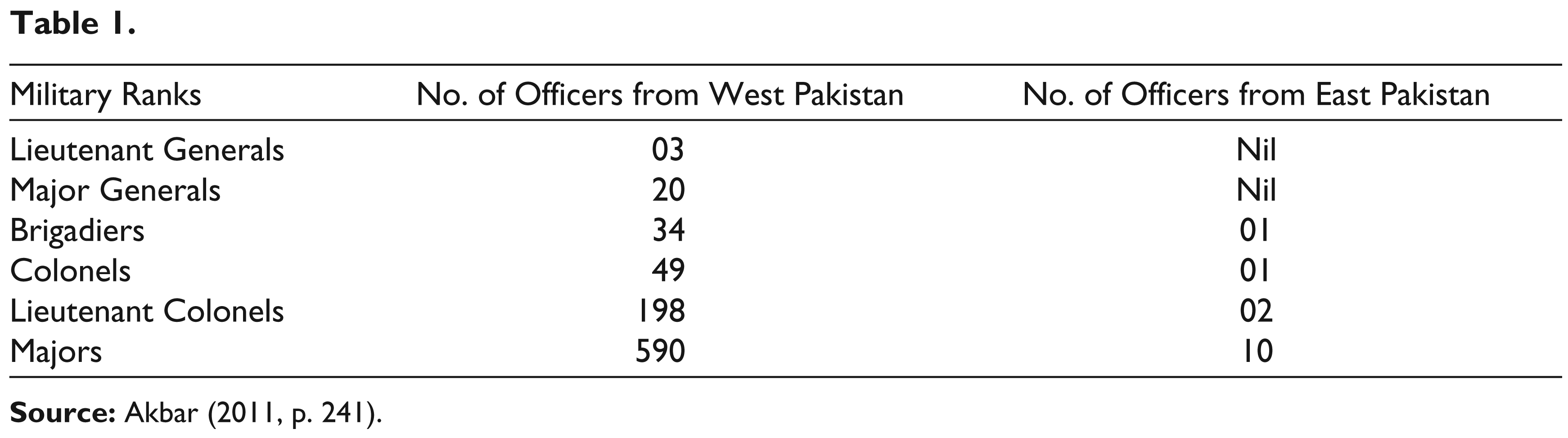
East Pakistani representation of the officer corps in the Navy and Air Force was no better. There were only 7 officers in the Navy from the East against 593 from the West and 40 officers in the Air Force, against 640 from West Pakistan (Akbar, 2011, p. 241). The popular perception that the country was safe only in the hands of the West Pakistani military officers naturally alienated the Bengali majority. This overwhelming Punjabi–Pathan officer corps dominated the armed forces and treated the Bengalis—who constituted 56 percent of Pakistan’s population—as militarily inferior also implied ‘over half of the country comprised lesser Pakistanis’ (Cohen, 2004, pp. 73–74). The idea of Bengali majority was indeed an ‘anathema’ to the military rulers. Consequently, the West Pakistani power structure became the national power structure and as the military rule continued in Pakistan the army looked like a colonial force and became a key instrument in the alienation of the Bengali people (Ziring, 2010, p. 179).
The Military’s role in the 1965 India–Pakistan war was another turning point in the history of the relationship between East and West Pakistan. During the war—which took place on the borders of West Pakistan—East Pakistan was totally cut off and the Bengalis were left undefended. Ayub Khan’s theory that ‘the battle of East Pakistan be fought in West Pakistan’ only added to the feeling of isolation and alienation in the Eastern Wing of the country. The war exposed East Pakistan’s vulnerability and the impossibility of defending it by the military efforts based in the West. One most significant aspect of East–West Pakistani relationship during and after the war was also that many Bengalis saw the cause of the war—the Kashmir question—as an exclusively West Pakistani concern (Jackson, 1975, p. 21). They thought it indefensible that ‘while the bulk of the nation’s army was used in West Pakistan to fight for the rights of five million Kashmiris, 55 million Bengalis, all but surrounded by India and defended by only one division of government troops, were left to fend for themselves’ (The New York Times, 24 April 1966). This strategic dissonance between the two parts of the same country increasingly aggravated their differences. Hence, the 1965 war, instead of acting as a unifying force,—as national wars often do—dealt a grievous blow to the incipient process of national integration. Shortly after the war, signs of political unrest had begun to surface in both wings of the country. The sentiment of Amar Sonar Bangla (our golden Bengal) was an all-pervading slogan in the East, rejecting union with the West.
The Bengalis were also disappointed by the way Yahya Khan’s military regime treated East Pakistan when two natural disasters struck it in July and November of 1970. One a devastating flood and the other a killer cyclone and a tidal bore of twenty to thirty five feet high, in which hundreds of thousands of Bengalis perished and about three million were marooned. International aid poured in, but the attitude of West Pakistani military rulers was one of negligence. Adding to the anguish of the East Pakistanis, not a single political or military leader of any standing visited the Eastern Wing (Raghavan, 2013, p. 32 and Ziring 2003, p. 118) except Yahya Khan—who visited East Pakistan on his way back home from China. Yahya had an aerial view, ‘casting an alcoholic eye’ (as he was inebriated) ‘on the barely visible destruction beneath’ He did not announce any relief for the victims and only instructed the governor to take charge, and left for Rawalpindi (Raghavan, 2013, pp. 32–33). The military leadership clearly failed to address the East Pakistani tragedy and further alienated the people at the time of their distress. One American diplomat serving in Dacca at the time viewed: ‘The cyclone was the real reason for the final break’ (Bass, 2013, p. 23). It became such a sensitive issue for the Bengalis that even before the election one leading political party demanded independence for East Pakistan and boycotted the elections which were held in next few months (Ahmed, 1998, pp. 31–32). This Bengali passion also added to the vote tally of the Awami League in the December 1970 elections—the first and only direct countrywide elections in undivided Pakistan’s history. The military’s apathetic attitude to the East Pakistani problems further intensified their conviction that only through autonomy could they control their own destiny.
Physical Separation
The tension between the two wings reached a climax when the Awami League, led by Sheikh Mujibur Rahman, won a landslide victory in the national election. This gave the Awami League the constitutional right to form government at the centre. But the country’s military establishment refused to accept a popularly elected Prime Ministerial candidate from the East Pakistan on the ground of ethnicity and declared martial law annulling the results of a free and fair election. 12 They also arrested Mujib and placed him in Rawalpindi jail. The news spread like wild fire and the struggle for complete independence began in East Pakistan. The West Pakistani rulers resorted to a military solution to their own political problems and Lieutenant-General Tikka Khan, 13 who afterwards gained the epithet as ‘Butcher of Bengal’ (Schendel, 2009, p. 162), led the massive atrocity and massacre campaigns.
Military Action: Genocide
The West Pakistani military rulers’ arrogance, high-handedness and cruelty against their Eastern wing are clearly depicted through the timeline between the December 1970 national election and the December 1971 division of the country. Soon after the election, a general visiting Dhaka told his military colleagues: ‘Don’t worry. We will not allow these black bastards to rule over us’. After a few days, when a ‘short and harsh action’ against the Bengalis was decided by the Yahya’s military cronies, the generals concluded that ‘killing of a few thousand would not be a high price for keeping the country together’(Haqqani, 2013, pp. 150–151). This followed the infamous ‘Operation Searchlight’ on 25 March 1971, a ferocious military action aimed to ‘reduce the number of Bengalis so they were no longer the majority in Pakistan’ (Bass, 2013, p. 121). Hundreds of thousands of people were shot, bombed, or burned to death. Untold atrocities were committed against the unarmed civilians, including the women and children. The United States Central Intelligence Agency (CIA) estimated that ‘some 200,000 or more residents of the area have been killed’ (Bass, 2013, p. 236). About a million people fled the country. One commanding officer of the Eastern wing assured his fellow officers: ‘I will muster all I can—tanks, artillery and machine guns—to kill all the traitors and, if necessary raze Dhaka to the ground. There will be no one to rule; there will be nothing to rule’(Haqqani, 2013, p. 151).
The level of brutality and the slaughter of Muslims (and Hindus) by Muslims revealed the hollowness of the so called Pakistani concern of ‘Islam in danger’. Islam being part of the state ideology failed to bridge the gap. The 1971 genocide of Bengalis by the Pakistan army speaks volumes about the arrogance of the Pakistani rulers and the failed nature of the Pakistani state and can only be explained in terms of the ‘colonial relations between the East and West Pakistan and the semi-fascist character of the West Pakistani military’ (Ahmed, 1998, p. 32). Yahya’s decision of military action against the Bengalis was clearly a tragic miscalculation and showed a lack of foresightedness in term of its political, economic and diplomatic consequences on the part of the military leadership. The army failed to understand that the Bengali nationalist movement was not a counterinsurgency; it was a political problem and needed painstaking efforts to solve it.
India’s Role
An unparalleled refugee crisis, the security of India’s north-eastern states and the killing of thousands of Hindus in East Pakistan were, apparently, the most prominent factors which could not hold New Delhi back from military intervention. But the Indian involvement ultimately brought an end to the civil strife in the hapless country.
The unspeakable atrocities committed by the Pakistan army and the unfolding genocide in East Pakistan
14
led to an unparalleled refugee crisis in India which forced New Delhi to intervene. In fact, notwithstanding the military situations inside East Pakistan, New Delhi’s involvement came only after five million refugees fled to India across the international border as the cost of feeding the refugees and the epidemics from disease resulting from this tragedy was enormous.
15
It meant that India was now paying a heavy price for Pakistan’s internal turbulence. On 24 May, Prime Minister Gandhi narrated the Indian stand:
What was claimed to be an internal problem of Pakistan has also become an internal problem for India. We are, therefore, entitled to ask Pakistan to desist immediately from all actions which it is taking in the name of domestic jurisdiction, and which vitally affect peace and well-being of our own citizens. Pakistan cannot be allowed to seek a solution of its political and other problems at the expense of India and on Indian soil. (Gandhi, 1972, p. 17)
One alarming issue for the Indian officials was the security problem in West Bengal and the north-eastern states of India where New Delhi was already experiencing Marxist guerrilla violence. The civil administrators of the affected districts were especially concerned that the guerrillas would try to recruit their cadres from amongst the Bangladeshi refugees and cause further political turmoil in the region (Ganguly, 1994, pp. 99–100). That is why, initially, India’s military support to the ‘liberation forces’ was to prevent them from their direct involvement in these states in search for arms. Accordingly, when a large flow of enraged East Pakistani youth rushed into the Indian borders, begging for arms and training so that they could go back to fight, India was left with hardly any option but to support them. India supplied them with ‘limited and largely obsolete’ arms to keep them ‘involved in East Pakistan regardless of their military effectiveness’. New Delhi considered it ‘prudent’ to provide some training and weapons for limited guerrilla activities to continue in East Pakistan (Sisson & Rose, 1990, p. 185). The intension was to arm them less as a guerrilla force to fight the Pakistan army and more to try and stop, and then reverse, the never ending flow of refugees.
But the most compelling internal factor for India to intervene in East Pakistan was perhaps the genocide of the Hindu population as the Pakistani military treated both Indian and Pakistani Hindus as enemies (Bass, 2013, pp. 71–72). Hindus, who numbered about 10 million, that is, about 13 percent of East Pakistan’s population, were deliberately targeted and killed. About 90 percent of the refugees who fled to India were Hindus. In fact, Pakistan was systematically ‘driving out Hindus in the millions’. While the government of India was aware of it, New Delhi deliberately tried to play it down and instead referred to it as genocide against the Bengali community in Bangladesh so as to avoid an outcry from the opposition political parties. Mrs Gandhi’s government also feared that ‘the plain truth would splinter its own country between Hindus and Muslims’(Bass, 2013, pp. 121–122).
India raised the issue with the United Nations and, by October, reinforced the efforts of the Mukti Bahini and other liberation forces in terms of military and humanitarian assistance. Indian leadership finally decided that the only way to stop the tide of refugees was to stop the killing across the border. That, in turn, prompted West Pakistan to lunch the full-fledged air attacks in India’s western sector on 3 December. The following morning, India unleashed the full weight of its military against Pakistan’s eastern wing that ultimately led to its dismemberment from the west. India’s role was important to the extent that it reinforced the existing variables and accelerated the creation of Bangladesh. But the dynamics of East Pakistan’s separation were already there very deeply entrenched with the Bengali sentiments.
Role of Outside Actors
Inevitably, like any other international conflict, the hostilities between East and West Pakistan were part of a wider international picture in which the United States, the Soviet Union and the Chinese played some important role. But their actions were somewhat limited to the external dimensions of the conflict. Before they could significantly maneuver the fragile geo-strategic situation, the military/strategic dynamics had already crossed the Rubicon in favour of the Bengali independence. The more India went closure to take a decision to intervene, the more the Indian leadership was assured that outside interference would have no impact on the outcome of the war. An authoritative account on the issue affirms that ‘the policies (India) adopted toward China and the United States in December clearly demonstrated India’s confidence that both countries could safely be ignored’ (Sisson & Rose, 1990, p. 216). Moreover, India had already signed a treaty of Peace, Friendship and Cooperation with the Soviet Union under the provisions of which Moscow would not support Islamabad or any country that would be obliging to the Pakistani policy.
The United States President Richard Nixon and his National Security Advisor Henry Kissinger tried their best to prevent their cold war ally Pakistan’s disintegration. They supported Yahya Khan’s policies including the military action in East Pakistan and the killing of at least two hundred thousand Bengalis. Gary J. Bass, in his The Blood Telegram writes:
[The]United States was allied with the killers. The White House was actively and knowingly supporting a murderous regime at many of the most crucial moments. There was no question about whether the United States should intervene; it was already intervening on behalf of a military dictatorship decimating its own people. (Bass, 2013, p. xiii)
It means that the United States actually chose inaction on a ‘genocide’; the crime committed by the troop columns led by US-made M-24 tanks, jet fighters, armoured carriers, guns and ammunition (Bass, 2013, p. 68 and 148). The Nixon administration also dispatched the aircraft carrier Enterprise to intimidate India from the Bay of Bengal, although later it was claimed that the purpose was merely to ‘scare’ the Indians and was ‘not going to intervene’ (Bass, 2013, pp. 291, 293–302 and pp. 314–316) and urged Iran and Jordan to transfer US-supplied combat aircraft to Pakistan.
By supporting Yahya’s military regime, the United States wanted to show to the newly ‘reproached’ communist China ‘how faithfully Washington backed its ally’ (Saunders, 2014, 39). President Nixon’s personal relationship with the South Asian leaders also seemed to have played a role in his decision, as he personally liked Yahya and ‘hated’ Indira Gandhi as is evident from the foul language he often used against the woman Prime Minister of the world’s largest democracy (Raghavan, 2013, p. 228; Bass 2013, p. 319). Both Nixon and Kissinger gave the impression to the Pakistanis that they could get away from their crime in East Pakistan. But with the war clearly tilting in favour of an independent Bangladesh, they had to accept the inevitable. However, both of them later claimed that they prevented India from complete subjugation and domination of Pakistan (Nixon, 1978, p. 530; Kissinger, 1979, p. 913). Nevertheless, Nixon expressed the State Department’s stance in his memoir:
The State Department felt that independence for East Pakistan was inevitable and desirable, and that India had limited aims in East Pakistan and no designs on West Pakistan. The risk of Soviet or Chinese intervention … was small …therefore …we should keep calm, sit back, and let the inevitable happen. (Nixon 1978, p. 526)
Thus, whatever role Washington played was confined to the external dimensions of the conflict and it certainly could not stop the bifurcation of Pakistan.
Indian policy makers did not pay much attention to the alleged threat of Chinese interference. In fact, India moved several divisions of troops from the Chinese borders to different Pakistani war fronts which were ‘clear evidence of New Delhi’s confidence that China would sit this one out—as it had during the 1965 Indo–Pakistani war’ (Sisson & Rose, 1990, p. 216). From the Chinese perspective, the developments in East Pakistan, including the 25 March 1971 military action, were ‘unenthusiastic,’ as Beijing ‘had nothing to gain, but much to lose’. The Pakistani military crackdown against pro-Chinese political factions in East Pakistan also did not go unnoticed in the Chinese capital (Sisson & Rose, 1990, p. 250). There was neither any commitment of military support to its ‘ally’ Pakistan in the event of war with India nor any expression of threat to India in case New Delhi decided to intervene in East Pakistan. Thus, China, ‘vigorously denounced India in public statements, but carefully avoided any involvement’ in the East Pakistan crisis.
So far as the other superpower, the Soviet Union was concerned, New Delhi signed a treaty of Peace, Friendship and Cooperation with Moscow and was rest assured that if China started to ‘use aggression, the USSR would not hesitate to use its strength and force in repelling it’. From the Indian point of view, ‘such an agreement will … act as a deterrent to China and Pakistan against embarking on any military adventure’ (Raghavan, 2013, pp. 122–125). Further, Article IX of the treaty stated that ‘In the event of either Party being subjected to an attack or a threat thereof, the High Contracting Parties shall immediately enter into mutual consultations in order to remove threat and to take appropriate effective measures to ensure peace and the security of their countries.’ Nevertheless, the treaty was neither the ‘product of a strategic consensus between India and Soviet Union’, nor did the two countries have the same objectives in concluding it (Raghavan, 2013, p. 109).
Conclusion
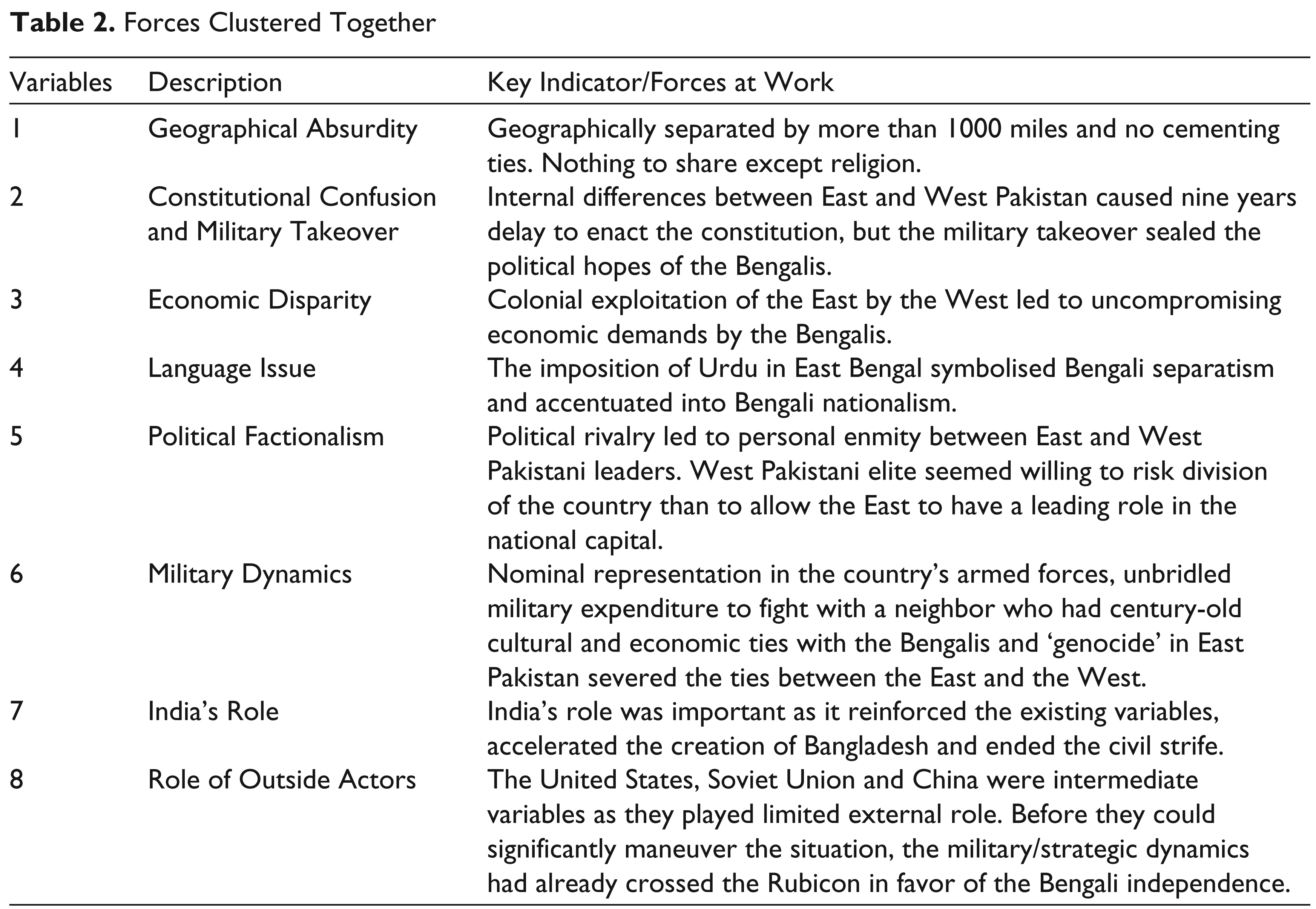
The analysis shows that the origins of Pakistan’s disintegration lay deep in her history. 1971 was only the logical outcome of the dynamics that were operational since 1947. The six variables discussed above jointly compose a multidimensional attribute space where they clustered together for complete independence of East Pakistan into Bangladesh. They were mutually reinforcing and each one of them was adding into the contested dynamics of the country’s disintegration. The East Pakistani’s demand for greater rights and autonomy drew its strength from their widespread resentment over being treated as second-class citizens and the decades of suppression and exploitation kept the Bengali mind ignited which was finally expressed in the 1970 elections and blew up after the military action. It is difficult to ignore the facts that the first nation-wide protests began in defence of Bengali language and it soon turned into demands for greater autonomy which gradually intensified into an agenda of separation. The experience with West Pakistani rule convinced the Bengalis that they had simply exchanged one alien exploiter (the British) for another and that this perception eroded the psychological unity of the country. In the opinion of a western scholar: ‘The creation of Bangladesh was Bengali-led and an inevitable working through of the inherent contradictions of East and West Pakistan’ (The Times of India, 21 November 2010, p. 12).
Forces Clustered Together
‘There was a general feeling of hatred against Bengalis amongst the (West Pakistani) soldiers and the officers including generals. There were verbal instructions to eliminate Hindus’ (Bass, 2013, p. 83). Bengalis also hated the army on the same footing. Sydney H. Schanberg of The New York Times gave a vivid picture about how the Pakistani soldiers had to stumble upon their own fellow citizens as ‘alien’
16
during the war:
Pakistani is a fish in a hostile sea. As he retreats, there is always a Bengali guerrilla somewhere who may jump him and cut off his fingers to watch him die slowly. Many Pakistani soldiers are trying to escape the Indian advance by getting into civilian clothes and trying to slip through the countryside. But it will be futile. The Pakistani soldier cannot hide in a land of Bengalis. He is taller and broader and lighter-skinned than they. Even if he has learned the Bengali language, they will detect the accent. And if he can speak only his own Urdu or Pushtu, then surrender is his only hope. (The New York Times, 12 December 1971)
Bangladesh is ethnically more homogenous than either India or Pakistan. Its people speak one language and they have a common culture and a shared history that united the Bengalis. Islam is the religion of the country’s majority, but it has never been the basis of its nationhood. Bengalis had shown that a common adherence to Islam was insufficient to keep them with Pakistan, especially at a time when their linguistic and economic interests were under threat. The Bangladeshis were also prickly that their West Pakistanis counterparts regarded their religion as tainted by Hinduism and thus in need of purification. 17 Hence, the state of relationship between East and West Pakistan, to quote scholar Sumit Ganguly, ‘was not only tenuous but also asymmetric. The West Pakistani leadership did not view their Eastern counterparts as equals and in fact dealt with them paternalistically at best, and exploitatively at worst’ (Ganguly, 1994, p. 87). This sort of racial prejudice had reached its zenith in 1971. The psychological rupture of the Bengalis exploded with their blood and tears, leading to their permanent separation from the Western wing.
Since 1971, Pakistan’s army promoted the hatred of ‘Hindu India’ and implanted the seeds of Islamism, extremism and state sponsored terrorism against India to avenge the humiliation of Bangladesh (Rashid, 2012, pp. 47–48). As a result, Pakistan, the ‘land of the pure’ has become the epicentre of global terrorism. The Pakistan army has failed to accept that the separation of its Eastern Wing was the inevitable result of the very internal and inherent contradiction rather than any ‘climax’ of Indian hostility. Perhaps the time has come for introspection: the present Pakistan has survived considerably longer after division (forty-four years) than the East and West Pakistan managed to live together (twenty-four years). Certainly, the Muslim nation deserves better than the military’s obsessive policy towards its neighbours. It is time that the military juntas in Pakistan allow the civilian leadership to flourish—democracy to truly restore. The lessons of 1971 should be their cardinal principles while dealing with the other states.
Footnotes
Acknowledgements
The author thanks the United States-India Educational Foundation (USIEF), New Delhi, for the award of Fulbright-Nehru Senior Research Fellowship (2013-14) to pursue research at the Indiana University, Bloomington, USA, during which this article was written. However, the views expressed in this essay are personal.