




Abstract
This article is an attempt to relook at the treaties of 1949 and 2007 between India and Bhutan and argues that the 2007 Treaty is the outcome of the evolution and maturity of Bhutan as an independent and sovereign state, that it is imperative for India to make constant adjustments in its foreign policy towards Bhutan to secure its influence in the tiny but important country and maintain the strength of India–Bhutan bilateral relations. From the side of Bhutan, it is also important to have an ‘alliance shelter’, and India is best suited to meeting Bhutan’s needs for political, economic, societal and strategic shelter. 1 By using a historical approach, this article shows why it was necessary for the two countries to renew the 1949 Treaty in the first decade of the twenty-first century. The article uses historical methodology, in combination with interdisciplinary methods such as comparative analysis, generalisation, and expert interviews. Major sources for the paper include the texts of the Treaties, speeches by political leaders and published articles and books by international writers, including writers from India, Bhutan and Vietnam.
Introduction
The kingdom of Bhutan has long been considered a steadfast and trust-worthy alliance of India in South Asia. In 2018, India and Bhutan celebrated the 50th anniversary of the establishment of formal diplomatic relations between the two countries. It is noteceable that though the two countries had signed the Treaty of Friendship in 1949, the formal diplomatic relations were established only in 1968. This is in part due to the limited interaction between the two countries before 1968. India was quite secure of Bhutan’s loyalty and perhaps did not really find the need to set up formal diplomatic relation before 1968. Scholars have divided the development cooperation between India and Bhutan into three significant waves. The first wave between the 1960s and 1970s focussed on building social and physical infrastructure. The second wave between the 1980s and 1990s focussed on democratisation and decentralisation. The third wave was from the 2000s focussed on developing hydel projects, which has expanded into other areas such as information technology, disaster risk management, education and research cooperation (Bisht, 2010). The formal establishment of diplomatic relations in 1968 showed the upward growth of bilateral relations. In early 2018, Bhutan opened a consulate in Guwahati city in northeastern India. A series of commemorative activities, including cultural activities, exhibitions and scientific conferences were held in India and Bhutan since early 2018. The current friendly relationship between India and Bhutan has had a strong foundation since the days of the Indian Prime Minister Jawaharlal Nehru and Bhutanese King Jigme Dorji Wangchuck in the mid-1940s. In 1947, Prime Minister Nehru invited a Bhutanese delegation to attend the Asian Relations Conference in New Delhi. Later, India and Bhutan started negotiations which led to the birth of the Treaty of Perpetual Peace and Friendship in 1949, replacing the Punakha Treaty signed in 1910 between the British Indian Government and Bhutan. In 2007, a new treaty of friendship between India and Bhutan was signed, replacing the 1949 Treaty as the framework for the cooperation and contacts between the two countries since then until today. Therefore, both 1949 and 2007 are also important landmarks in the history of bilateral relations between India and Bhutan.
Literature Review
In recent years, India’s relations with neighbouring countries in South Asia have received special attention by both Indian and international scholars. However, this topic has not been studied much by Vietnamese authors. In India’s foreign policy, neighbouring countries occupy a key position in its ‘neighbourhood first policy’. Studies about India–Bhutan relations have also been done substantially in comparison with studies about India and other South Asian countries such as Nepal, Pakistan and Sri Lanka. A quick search on Google Scholar at 6:40 a.m. on 25 December 2018 by the author shows that, by typing the key words ‘India-Bhutan relations’, there are 54,700 results, while by typing the key words ‘India-Nepal relations’, there are 22,800 results, 20,800 results for ‘India-Sri Lanka relations’ and 503,000 results for ‘India-Bangladesh relations’. Regarding the India–Bhutan Treaties of 1949 and 2007, by typing the keyword ‘India-Bhutan Treaty 1949’, there are 529 results and for ‘India–Bhutan Treaty 2007’, there are 11,600 results. This metric is employed merely to show how this particular bilateral relationship of India’s stands against other Indian relationships with smaller neighbours and the attention that India–Bhutan ties have received perhaps, also as a result of the Doklam issue in 2017.
Regarding India–Bhutan relations, Shubham (2014) is of the view that India–Bhutan relation is an important relation not to be ignored. It did not evolve after 1947 when India achieved its independence from the British rule but had begun much before that. The relationship between India and Bhutan after the British had left the subcontinent was a continuity of the past. The Treaty of 1949 marked a continuation of the Anglo-Bhutanese treaty of 1910 and continued with the British legacy of treating the Himalayas as the sentinel of India’s security. Penjore (2004) studied about the security of Bhutan in the difficult context of walking between the two giants in Asia, that is, India and China. Penjore is of the view that ‘vulnerability’ is the word that best sums up the plight of small states in any discourse on security. And Penjore argues that Bhutan is the most vulnerable sector in the Indian security system, as it ‘stood out as a wide vacuum on a frontier of vital strategic importance’ (Penjore, 2004). Malik and Sheikh (2016) looked at the changing dynamics of Indo-Bhutan relations and its implication for India. The paper pointed out that in the cicumstances of the late 1940s, the signing of the 1949 Treaty suits the national interests of both India and Bhutan. Bhutan was not under any kind of diplomatic or political pressures from the side of India. Bhutan’s main concern was the restoration of its sovereign status, recognition of its independence and restoration of the Dewangiri hill strip. For India, the objective was to protect her strategic interests (Malik & Sheikh, 2016).
Despite Bhutan triumphantly took the stage as the world’s youngest democracy in 2008 and is becoming more prominent in international scenario, few writings in English by Bhutanese scholars have been published. Publications of several prominent Bhutanese scholars have helped us understand more about Bhutanese perspective on Bhutan’s history, culture, society and politics. Karma Ura in his book titled Bhutan: Between Heaven and Earth (2011) traces the beautiful stories of Bhutan with its amazing past and much hope for the future. Bhutan in its inception was a Buddhist monarchy, with a dynamic oral tradition and no written language and large expanses of unexplored and uninhabited land. Kama Phuntsho in his book titled The History of Bhutan (2013) offers a comprehensive history of Bhutan, along with a detailed social and political analysis. It offers substantive discussions of Bhutan’s geography and culture. In addition, Tenzing Lamsang, Editor of The Bhutanese, has expressed his views on various issues in his private newspaper as well as other newspapers such as Indian Express. His articles include ‘Giving Bhutan its due’ and ‘More than the Doklam issue, Bhutan worried about hydropower deficit’. According to Lamsang, India is not a challenge but an opportunity—both as the largest potential source of investment for Bhutan’s economic diversification programmes and also the largest market for the products and services that come out of this diversification. He is also of the view that Bhutan is India’s closest and most reliable friend and will remain so. In Vietnam, in recent years, as India is rising, there has been increasing interests in Indian affairs. The number of published works on India’s various issues and especially India–Vietnam relations have increased dramatically. To name a few, the book 45 Years of Vietnam–India Relations: A Retrospect and Prospects edited by Prof. Nguyen Xuan Trung (2017) includes papers on Vietnam–India relations in various fields including economy, politics, defence and security, sciences and technology, culture and education and bilateral cooperation in other areas. Other works include India – the country, society and culture edited by Le Van Toan and Nguyen Thi Mai Lien (2017); the conference proceedings on ‘India’s Rise and its impact on regional security structure’ by the Institute for Indian and Southwest Asian Studies, Vietnam Academy of Social Sciences (September 2018); conference proceedings on ‘Vietnam–India Development Cooperation in Economy, Defence, Security in the Context of Free and Open Indo-Pacific Region’ (August 2018) by the Ho Chi Minh National Academy of Politics and ‘Indo-US Relations’ (1947–1991) by Le Thi Hang Nga (2018). However, there are very few works dealing with India’s relations with its immediate neighbours in South Asia. For example, the book Vietnam–India Cultural Relations by Le Van Toan (2017) deals with various aspects of Vietnam–India cultural relations; Pakistan’s Foreign Policy Adjustments since the Beginning of the 21st Century and Trends by Ngo Xuan Binh (2018) has a small portion dealing with Pakistan’s policy and relations with India. In terms of India–Bhutan relations, no work has been done in Vietnam so far. There is, however, a recent doctoral thesis on Bhutan’s Model of Development and Its International Impact by Nguyen Tat Lan (2018) at the Hanoi National University. Bhutan studies and Bhutan–India relations may be considered a serious gap in academic activity in Vietnam that needs to be covered as India–Bhutan relations can provide Vietnam, itself as a smaller neighbour to a giant neighbour, that is, China, with useful lessons.
Historical Background of India–Bhutan Relations
The history of the relationship between India and Bhutan can be traced back to 747, when the Great Master Padmasambhava introduced Buddhism from India to Bhutan. 2 Since then, Buddhism has influenced and spread in every aspect of life in Bhutan. According to P. Stobdan, the key factor which is the major driving force in the promotion of India–Bhutan relations is Bhutan’s deep devotion to gyagar (the sacred land of India) (Stobdan, 2014).
In addition to the sharing of cultural and religious heritage, India and Bhutan extended its contact in other areas during the period of British colonial rule. The relations between British India and Bhutan began in 1774, when Warren Hastings, the then British Governor-General in India, established a friendly relationship with the Bhutanese rulers and Bhutan allowed Bengal (East India) to trade with Tibet through its territory.
However, the relationship between British India and Bhutan was not always smooth. The relationship between the Governments of British India and Bhutan became strained after 1815 when the British began to eye a narrow strip of land, about 1,000 square miles in size, in the hilly areas of Bhutan. This area would have given British India a well-defined and protected border area as well as useful tea grounds for British plantation owners. In 1841, the Governor-General Auckland annexed the Assam duars or paths towards Bhutan. The relations between British India and Bhutan became increasingly tense due to the continuous attacks and loot by the Bhutiyas tribal group on the Bengal side of the border of the two countries.
Tensions between British India and Bhutan eventually led to the Duars War (1864–1865). Duars are the gateway to Bhutan and is the most important part of Bhutan in terms of the economy. It is a narrow strip of fertile land of about 30 km in width and about 350 km in length in the middle of the foothills south of the Himalayas and north of the Brahmaputra River. The Duars War ended with the Treaty of Sinchula in November 1865 which was detrimental to Bhutan’s interests, and by which the British annexed all of Assam Duars, Bengal Duars and 83 square km of Dewangiri territory in southeastern Bhutan, in return to an annual allowance worth ₹50,000 (Bharatiya Gorkhali Welfare Association, Treaty of Sinchula, 1865). The British took control of Sikkim and Cooch Behar in exchange for not interfering in Bhutan’s internal affairs (Penjore, 2004). The terms of the Sinchula Treaty prevented Bhutan from expanding towards the southwest—the area under British control. The Treaty of Sinchula for the first time institutionalised the relationship between British India and Bhutan and was the basis for the relations between the two countries thereafter. With this treaty, Bhutan became the protectorate of the British Indian government and under the British hegemony since 1865.
Forty-five years after the Treaty of Sinchula, Bhutan signed the Treaty of Punakha with British India in 1910 after China entered Tibet and made territorial claims to Bhutan (1910–1912). The British were concerned about China’s forward policy in Tibet and other Himalayan states. The British wanted to prevent the Chinese expansion by keeping Tibet, Bhutan, Nepal and Sikkim as buffer zone states. The Treaty of Punakha in 1910 increased the annual compensation of the British for the occupation of Bhutanese territory. This treaty also guaranteed the non-interference into the internal affairs of Bhutan in exchange for the British guidance in its foreign affairs. This was considered a relatively balanced treaty, although there was a growing role of the British in Bhutan, from the role of an arbitrator to that of an advisor in foreign affairs (Penjore, 2004). The Treaty of Punakha replaced the Treaty of Sinchula as the basis for the relations between India and Bhutan until the British left the subcontinent. During this period, the relations between India and Bhutan were governed by a Political officer based in Sikkim.
After India gained independence in 1947, treaties signed between the British Indian and Bhutanese governments continued to guide the relationship between the two sides. In 1947, Prime Minister J. Nehru invited the Bhutanese delegation to attend the Asian Relations Conference in Delhi. In 1948, a Bhutan delegation visited India and expressed desire to review the existing treaties between the two countries. Subsequently, in the summer of 1949, India and Bhutan began negotiations for a new treaty.
The need to negotiate a new treaty between India and Bhutan is set in the context of geopolitics in the entire Himalayan region, and the Indian subcontinent was undergoing major changes after the People’s Republic of China came into being in 1949 and the occupation of Tibet by the Chinese People’s Liberation Army in 1950. These events, coupled with the presence of Chinese troops near the Bhutanese border, the annexation of Bhutanese colonies in Tibet and China’s claims forced Bhutan to reconsider its traditional isolation policy. Strengthening its relations with India became an urgent need. For the security of India, the stability of the Himalayan states is strategically significant.
Based on this foundation, India–Bhutan relations were shaped in a more concrete manner after the official visits to India by the Bhutan King Jigme Dorji Wangchuk and Prime Minister Jawaharlal Nehru to Bhutan during the period from 1954 to 1961. However, in the initial periods after independence of India, the bilateral cooperation between India and Bhutan was limited. India was quite secure of Bhutan’s loyalty and might not have found the need to set up formal diplomatic relations. The formal diplomatic relations between the two countries were established only in January 1968 when the Indian government appointed a special position in Bhutan. The Indian House in Bhutan was inaugurated on 14 May 1968. Bilateral relations were elevated to ambassadorial level in 1978. These developments showed the upward evolution of India–Bhutan political relations.
Treaty of 1949
In late 1948, the King Jigme Wangchuk sent a delegation to New Delhi to discuss the relationship between Bhutan and India. The Indian government assured Bhutan that India would respect Bhutan’s autonomy if Bhutan maintained its relationship with independent India as it had been during the British period. Negotiations between India and Bhutan continued in the years 1948–1949, leading to the birth of the ‘Treaty of Perpetual Peace and Friendship’ between India and Bhutan (Malik & Sheikh, 2016). Since then, the 1949 Treaty has become the basis of bilateral relations between India and Bhutan.
The Treaty of Perpetual Peace and Friendship, signed in Darjeeling on 8 August 1949 contained 10 major articles, designed ‘to regulate in a friendly manner, and upon a solid and durable basis, the state of affairs caused by the termination of British Government authority in India, and to promote and foster the relations of friendship and neighborliness’ (Malik & Sheikh, 2016). The first seven articles of the Treaty contained important contents and were the basis for the relationship between India and Bhutan. The articles of the Treaty included the following major contents (National Legislative Bodies/National Authorities, 1949).
In the main, the Treaty affirmed ‘perpetual peace and friendship’ between the two countries (Article 1), and non-interference in each other’s internal affairs while Bhutan, however, agreed ‘to be guided by the advice of the Government of India in regard to its external relations’ (Article 2). Article 6 also crucially restricted the right of the Bhutanese government to import and export military equippment.
India would also pay a subsidy to the Government of Bhutan (Article 3) and agreed to return to Bhutan some 32 square miles of territory in the area known as Dewangiri within the year (Article 4). The promotion of free trade and commerce between the two countries was a major aspect of the Treaty which also allowed Bhutan ‘every facility for the carriage, by land and water, of its produce throughout the territory of the Government of India’ (Article 5). Article 7 affirmed that the subjects of the two countries would be treated equally in law by both governments.
The Treaty of 1949 during the time of Prime Minister Jawaharlal Nehru and King Jigme Dorji Wangchuck had been instrumental in the India–Bhutan relationship since then, until being renewed in 2007. By returning to Bhutan 32 square km in Dewangiri (now Dewathang) under Article 4, India recognised Bhutan’s independence and thus helped remove Bhutan’s fear of any Indian imperialist intentions and prevent Bhutan from looking towards the north. This shows that India has been sensitive and responsive to Bhutan’s fears of a big neighbour.
Article 2 of the Treaty of 1949 is of particular importance, giving India the right to guide Bhutan in its foreign policy and operations. However, this was also the root cause of disagreement between India and Bhutan. There was inconsistency between the English and Bhutanese versions (Dzongkha) of the Treaty, and the Treaty does not specify which documents are competent. New Delhi insisted that Bhutan was forced to follow India’s instructions, while Bhutan said it was only to seek and consider India’s advice (Penjore, 2004). A new interpretation of Article 2 appeared in 1974 after the Foreign Minister of Bhutan commented that India’s advice and guidance to Bhutan’s foreign affairs was optional (Penjore, 2004). Decades of disagreement led to New Delhi’s acceptance of Bhutan’s interpretation of the Treaty in the mid-1980s.
However, the difference in the interpretation of Article 2 of the Treaty did not actually impede the performance of Bhutan’s foreign affairs to a large extent for most of the periods. Leaders of both India and Bhutan believe that the continuity and sacredness of the 1949 Treaty ultimately depends on mutual trust and confidence. Half a century passed, the Treaty (renewed in 2007) remained dynamic because the two countries continued to cooperate for mutual benefit. Bhutan is on India’s sides in important issues/affairs, because ‘a strong India means a strong friend of Bhutan’ (Penjore, 2004). The incumbent Prime Minister of India chose Bhutan to be the destination of his first foreign trip. The India–Bhutan Friendship Agreement remains a good example of the bilateral relationship between a big country and a small country in South Asia (Pattanaik, 2014).
In addition, the treaty dealt with free trade between India and Bhutan. India agreed to provide Bhutan with ‘every facility for the carriage, by land and water, of its produce throughout the territory of the Government of India, including the right to use such forest roads’ (Kohli, 1993, p. 40). The Treaty allowed Bhutan to import weapons, ammunition, machinery, military equipment, and so on through the assistance and approval of Indian Government, if such imports did not adversely affect India’s security interests. Bhutan agrees not to export arms through its territories, by the government or private individuals. The Treaty also ensured that the subjects of India and Bhutan residing in each other country were treated equally and are extradited when it was necessary (Appadorai & Rajan, 1988, p. 172).
Through the 1949 Treaty, Bhutan entered into a special relation with India. The Chinese annexation of Tibet in 1950 strengthened this relation further as both India and Bhutan began to see a common threat in Beijing (Shubham, 2014). The Treaty of 1949 contained values of trust and equality in bilateral relations between the two countries. That is the spirit that helps develop bilateral relations. Beautiful words have been used to describe the deepening relationship between India and Bhutan, such as ‘special relationship’, ‘privileged relationship’ and ‘strategic alliance’.
The Need for Amendments to the Treaty of 1949
There are broadly two sets of opinions regarding the necessity for the renewal of the 1949 Treaty. According to one set of opinions, there was, in fact, no urgent necessity for the renewal of the treaty, as ‘the treaty has never been a constraint in conducting Bhutan’s foreign relations’, as expressed by Bhutan’s Foreign Minister Jigmi Y Thinley (Penjore, 2004). According to the former Indian Foreign Secretary J. N. Dixit, ‘the letters of the treaty do not really prevail in terms of determining the relations between Bhutan and India, but rather it is more of spirit of goodwill and understanding and friendship that prevails in conducting their separate relations with other countries’, and India–Bhutan relations demonstrate ‘how the tremendous goodwill and friendships between the two countries can transcend legal instruments and the words printed on paper’ (quoted in Penjore, 2004).
However, according to another set of opinions, the 1949 Treaty was in real need of being renewed. Some people said that the Treaty affected the status of Bhutan from the day it was signed. Article 2 of the Treaty was a tool to undermine Bhutan’s sovereignty and, therefore, an unequal treaty (Malik & Sheikh, 2016). In 1960, the King Druk Gyalpo Jigme Dorji Wangchuck affirmed, ‘We are not one hundred percent independent because of the 1949 Treaty’ (Malik & Sheikh, 2016). Thus, although in 1949, India recognised Bhutan’s sovereignty and the 1949 Treaty was negotiated by both sides in an open air, over time, the need to revise the Treaty was frequently put forward. According to this view, the nature of the issue was that the Treaty did not allow Bhutan to have absolute autonomy in dealing with its external relations.
According to Shubham, the signs of gap between India and Bhutan began to show since the late 1950s (Shubham, 2014). In 1959, India turned down Bhutan’s request to take part in negotiations with the Chinese for resolving the Sino-Bhutanese border disputes in the wake of the Chinese repression in Tibet. In May 1960, India released a map that created misunderstanding between the two countries. Bhutan said that the map had not shown the border between the two countries as an international one. Later, boundary strip maps between the two countries were signed but Bhutan began to show its stronger assertion and independence in its diplomatic relations which challenged Article 2 of the 1949 Treaty. During the 1960s, Bhutan began to have direct negotiation with a Swedish company for establishing a paper factory in its own soil and invited French nuns to develop medicinal services (Shubham, 2014). During the 1962 Sino-Indian war, Bhutan complained when some of the Indian troops crossed into Bhutanese territory.
Bhutan continued to try to establish an independent identity by joining the Colombo Plan in 1962 and receiving an international status for the first time, though it was done with India’s assistance. In 1968, Bhutan attended the UNCTAD (United Nations Conference for Trade and Development) session in New Delhi. In 1969, Bhutan started its own currency. In 1970, it formed its own foreign affairs department. In 1971, it was admitted in the United Nations (again with India’s help). In 1978, the Bhutan Mission in India was renamed as the Royal Bhutanese Embassy, which was seen by many Indians as a key diversion from the 1949 Treaty (Shubham, 2014).
Re-looking at history, it can be seen that, Bhutan fully supported India until the mid-1960s, before China’s affirmation of its authority over Tibet. Bhutan was on the side of India in the border conflict between India and China. Prime Minister Nehru stated in the Parliament of India in November 1959 that, ‘any invasion against Bhutan… shall be considered an invasion against India’ (Shubham, 2014; Trivedi, 2008). However, this sentiment was reduced later when a series of analysis indicated that, Bhutan had, in fact, begun to doubt India’s ability to protect Bhutan against China, especially after the India–China border war in 1962 and India–Pakistan war in 1971. The incorporation of Sikkim into India may have also added to Bhutan’s insecurity. India supported Bhutan to become a member of the United Nations in 1971. The formal reason for joining the United Nations was to be eligible for development projects, including technical assistance and finances from multilateral institutions and agencies. However, this showed that the sacredness of Article 2 of the 1949 Treaty was fundamentally weakened. At the same time, Bhutan strengthened its independent position by establishing diplomatic relations with Dhaka (Bangladesh) in 1971.
Since 1979, the King Jigme Singye Wangchuck expressed his desire to ‘renew the India–Bhutan Treaty of 1949’ (Malik & Sheikh, 2016). Bhutan began to show its independent position in the international arena. For example, Bhutan supported China and other countries on the Khmer Rouge issue in Cambodia at the Non-Aligned Movement (NAM) Summit in Havana in 1979. In 1980, Bhutan’s foreign minister was elected as the chairman of the Economic and Social Council for Asia and Pacific which was seen as another big leap by the Himalayan state in the international arena. Bhutan also failed to take into account the Indian stance on the status of landlocked countries at the United Nations, signed the NPT (Non-proliferation Treaty) in 1985 and supported Pakistan’s proposal for a Nuclear Free Zone in South Asia. In April 1984, Bhutan began formal boundary talks with the Chinese. Bhutan also reduced India’s assistance in its fifth five-year plan by 43 per cent and found new sources of aid from various Western countries. All these activities clearly showed that Bhutan was eager to move beyond the 1949 Treaty (Shubham, 2014).
In the 1990s, India–Bhutan relations was characterised by a more give-and-take nature. In 1993, Bhutan reinstated its support for India and expected reciprocity from the latter. India also assured Bhutan protection from all anti-national activities, particularly on the issue of Nepalese regufees (Shubham, 2014). In 2000s, Bhutan proved to be India’s trusted friend when it launched Operation All Clear and Operation Flush Out against Indian insurgents taking shelter in its territory.
Entering the twenty-first century, India–Bhutan relations faced new challenges. Article 2 of the 1949 Treaty began to work more against India’s interests. Both India and Bhutan engaged more with China and pro-Chinese elements in Bhutan criticised Article 2 of 1949 Treaty, accusing India of forcing its smaller neighbours into submission (Shubham, 2014). Bhutan shifted its constitutional monarchy to constitutional democracy after the first general election in 2008 to elect the Constitutional Council. Therefore, the form of the Government was to be changed to be consistent with its democratic character and to respect the mandate of the people. At the same time, the relationship between India and Bhutan also needed to change and adjust to the new situation. King Jigme Khesar Namgyal Wangchuk took note of this during his visit to India in February 2007.
Thus, in the context of the changing geopolitics of the Himalayan region and within Bhutan, Article 2 of the Treaty of 1949 became a burden. The unfriendly forces towards India used it to accuse India of ‘ambitious expansion and hegemony’ in the region. Therefore, the revision of the 1949 Treaty benefitted both India and Bhutan.
Treaty of 2007
A new India–Bhutan Friendship Treaty was signed on 8 February 2007 between the then Indian Foreign Minister Pranab Mukherjee and Bhutanese Crown Prince Jigme Khesar Namgyal Wangchuck. The Treaty of 2007 once again reaffirms ‘the perpetual peace and friendship between India and Bhutan’ (Article 1) (Ministry of External Affairs, Government of India, 2007). The Treaty of 2007 also contains 10 articles inherited and developed from the Treaty of 1949. The Treaty of 2007 affirmed the close cooperation between India and Bhutan in the fields of political and security, diplomacy, economy, trade and cultural exchanges, expanding to the fields of education, health, sports, science and technology. The Treaty of 2007 retains the provisions of Articles 1, 3, 5, 6 and 7 of the Treaty of 1949 but contains two significant changes compared to the 1949 Treaty.
First, Article 2 of the Treaty of 2007 states that ‘In keeping with the abiding ties of close friendship and cooperation between Bhutan and India, the Government of the Kingdom of Bhutan and the Government of the Republic of India shall cooperate closely with each other on issues relating to their national interest. Neither Government shall allow the use of its territories harmful to the national security and interests of the other’ (Ministry of Foreign Affairs, Government of India, 2007). The amendment of Article 2 of the India–Bhutan Friendship Treaty in 2007 provides sufficient space for Bhutan to carry out its external relations without depending on the guidance of India. Since then, in terms of procedure, Bhutan does not need to secure the permission of India to establish diplomatic relations with a third country. Thus, the revised Treaty between India and Bhutan in 2007 recognised the elements of Bhutan’s ‘territorial sovereignty and integrity’ that the 1949 Treaty did not have.
Second, the Treaty of 2007 added the content of promotion of cultural exchanges between the two countries and expanded to other areas such as education, health care, sport, science and technology (Article 7).
In addition, the Treaty of 2007 also addresses the further promotion and expansion of bilateral cooperation in economic and commercial sectors for the long-term benefits of the two countries. Besides, the Treaty of 2007 agrees about the settlements of disagreements and differences relating to the interpretation and implementation of the Treaty on a bilateral basis and through negotiation in a ‘spirit of trust and understanding, in consonance with the historical close ties of friendship and mutually beneficial cooperation that form the bedrock of Bhutan–India relations’ (Ministry of Foreign Affairs, Government of India, 2007). In order to avoid differences and disagreements in the interpretation of the Treaty which happened to the 1949 Treaty, Article of the Treaty of 2007 affirms that the texts in Hindi, Dzongkha and English are equally authentic but in case of difference, the English text shall prevail (Ministry of Foreign Affairs, Government of India, 2007).
The new treaty of 2007 aims to raise bilateral ties to reflect contemporary realites. According to the Indian External Affairs Ministry Spokesperson, the new treaty aimed to consolidate Bhutan–India mutually cooperative friendship in a manner that was responsive to and served the two countries’ national interests through close cooperation and reflected the contemporary nature of the relationship while laying the foundation for future development of bilateral ties (quoted in Chaudhury, 2007). The new treaty also showed the recognition of the changing face of Bhutan’s politics and its move towards democracy. The Indian spokesperson futher said, ‘the finalisation of the India-Bhutan Friendship Treaty coincides with Bhutan’s transition to a Constitutional democracy and reflects the desire of both governments to put in place the framework for the future growth of our relationship’ (quoted in Chaudhury, 2007).
Thus, the Treaty of 1949 between India and Bhutan was renewed in 2007, becoming the new framework for bilateral relations today. The Treaty of 2007 is both a continuity and change compared to the 1949 Treaty. The 2007 Treaty continues to affirm the ‘perpetual peace and friendship’ between India and Bhutan. It does not envisage a change in the treatment of nationals of both countries, or in the free trade regime of both countries towards each other. However, Article 2 of the 1949 has been substituted by ‘a language that speaks of cooperation’ (Hindustan Times, 2007b). The 2007 Treaty included ‘fresh provisions for consolidating and expanding economic cooperation for mutual and long-term benefits, and cooperation in the fields of culture, education, health, sports and science and technology’ (Hindustan Times, 2007b) bringing India–Bhutan relations to a new stage, and at the same time reaffirming the friendship and trust between the two countries. The amendments and renewal of the Treaty in 2007 proves the maturity of India–Bhutan relations to meet the new demands of the twenty-first century political context. The Treaty of 2007 provided Bhutan with greater autonomy in external relations, independent of India’s guidance, and lays the framework for a relationship which serves the national interests of the two countries, a relationship which is based on mutual consultations and ensures mutually beneficial cooperation.
Implications for India and Vietnam
The revision of the 1949 Treaty in 2007 shows that the so-called ‘Treaty of Perpetual Peace and Friendship’ between India and Bhutan in 1949 is not something which is unchanged or permanent. The change in 2007 may have important implications for both India and Vietnam. For India, it shows that though India continues to have Bhutan’s loyalty and friendship, this should never be taken for granted. The new regional and international context is changing so fast and unpredictably that India needs to be constantly vigilant and cautious.
For Vietnam, Bhutan’s relations with India can be an example of the cordial relationship between a small country and a big neighbour. Vietnam, like Bhutan, is a ‘small’ country and used to having historical tensions and conflict with its big neighbour, China. Vietnam and Bhutan have relatively cultural homogeneity and strong national identity which can give the two countries’ institutional advantages. This can not only help promote their long-term socio-economic performance but also give them a better position in coping with the vulnerabilities stemming from the global political economy. As pointed out by Campbell and Hall (2009), culturally homogeneous countries tend more easily than culturally heterogeneous ones to develop strong national identities and in turn an ideology of social partnership, which augments the possibilities for cooperation, sacrifice, flexibility and concerted state action in the national interest. Vietnam and Bhutan share other similarities such as both had limited roles to play in international organisations during the Cold War and more recently, both depend economically on their bigger neighbours, Bhutan on India and Vietnam on China. Like Bhutan–India relations, Vietnam–China relations are disproportionate or asymmetric in many ways. This is illustrated in Table 1.
Some Comparative Indices Between Bhutan vs. India and Vietnam vs. China
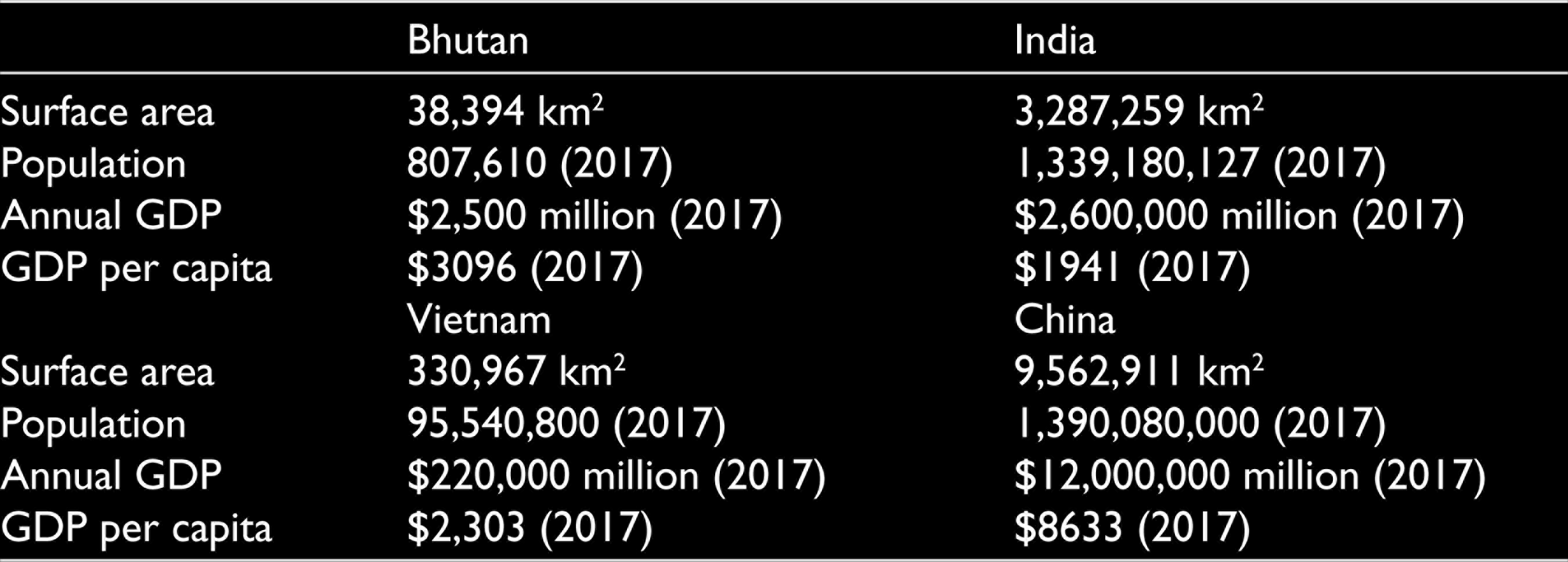
Table 1 shows a comparison of some key variables between Bhutan and Vietnam. In terms of population, territory and annual GDP, Vietnam is much larger than Bhutan. However, in terms of GDP per capita, Vietnam is smaller than Bhutan. 3 In comparision with India, both Bhutan and Vietnam are ‘small’. This has several implications. Being ‘small’, both Bhutan and Vietnam are likely to have relatively less natural resources, which makes the two countries more dependent on the external world. Moreover, small size means a small domestic market, which makes openness to international trade and its vicissitiudes mandatory. In terms of political behaviour in world polity, small states normally have to manoeuvre within the rules of international political-economic order (Campbell & Hall, 2009). In other words, they are the ‘norm-takers’ rather that the ‘norm-makers’. So, for both Bhutan and Vietnam, small size, limited resource base and general power asymmetry are similar constraints. However, both Bhutan and Vietnam can turn their relative weakness into an advantage, for they are not viewed as threatening rivals by the great powers, and therefore might have greater freedom of action when launching policy initiatives, bulding coalitions with like-minded states and acting as mediators.
Vietnam can learn from Bhutan’s relations with India in managing its relations with the giant power in the north. While Bhutan is located in a strategic and sensitive area for India, Vietnam is located in a strategically important area for China. What Vietnam might need to note from Bhutan–India relations is that, to ensure the strategic trust of big countries, there is a need to show its loyalty and similarity in values. Another implication in this context for Vietnam is that it should also promote its relations with India more strongly as the latter has been a trustworthy security provider in the region. India can also help reduce Vietnam’s economic dependence on China, though it might be noted that the same aspect might also true in the case of Bhutan, which could reduce its economic dependence on India by turning to China.
For India–Vietnam relations, it is important to appreciate the importance of bilateral collaboration. India–Bhutan relationship can also be a role model for India–Vietnam relationship. While Bhutan is considered India’s best friend in South Asia, Vietnam can become India’s best partner in Southeast Asia, by helping India actualise its ‘Act East’ policy. India–Vietnam relationship has been upgraded to Comprehensive Strategic Partnership in September 2016. Vietnam–India can be another example of cordial and trust-worthy small–big power relations that the two countries should constantly promote.
Another implication for Vietnam from understanding Bhutan–India traditional relations is that Vietnam can promote trilateral relations among India, Bhutan and Vietnam. As both India–Bhutan and India–Vietnam relations are good, there is no reason why the three countries can not develop trilateral cooperation which can be beneficial for three countries.
Conclusion
In a nutshell, it can be said that both 1949 and 2007 are ‘historic moments’ in the history of the relationship between India and Bhutan. After India’s independence, the Treaty of Perpetual Peace and Friendship of 1949 was the foundation for the friendly and mutually trust-based relationship between the two countries. Entering the twenty-first century, the new situation created the need to amend and revise the 1949 Treaty, which led to the signing of the India–Bhutan Friendship Treaty in 2007. The renewal of the Treaty in 2007 aimed to open ‘a new era in the further deepening and strengthening of this unique and special relationship’ (Hindustan Times, 2007b). The Treaty of 2007 has brought the two countries to a new stage and direction and could serve as a framework for contacts between the two countries today and in the future. The Treaty of 2007 emphasises partnership rather than a relationship based on financial dependence, assuring a mutually beneficial relationship (Malik & Sheikh, 2016). The revision of the 1949 Treaty in 2007 confirmed the maturity of Bhutan and the continued credibility of India–Bhutan relations. It also affirmed that the so-called ‘alliance’ between India and Bhutan is not something that is permanent and unchanged. India needs to constantly make appropriate adjustments in its foreign policy towards its neighbour to secure its strong influence in the region as well as in its bilateral relations with Bhutan. The revision of the 1949 Treaty in 2007 has important implications for both India and Vietnam and encourages both sides to make more efforts in strengthening bilateral relations.
Footnotes
Declaration of Conflicting Interests
The authors declared no potential conflicts of interest with respect to the research, authorship, and/or publication of this article.
Funding
The authors disclosed receipt of the following financial support for the research, authorship, and/or publication of this article: This research was funded by the Vietnam National Foundation for Science and Technology Development (NAFOSTED) under grant number 601.02 – 2018.300.