




Abstract
The cAja-’ib al-Hind (Marvels of India) is a collection of sea stories allegedly compiled by Captain Buzurg Ibn Shahriya-r (d. 399/1009) which belongs to an Arabo-Islamic literary genre called the caja-’ib, containing themes of entertainment—things that are marvellous and strange. But these stories are not merely entertaining, they are an additional resource for the modern researcher because they also reflect the realities of daily life in seafaring communities of the Indian Ocean in the ninth and tenth centuries. Among the tales of the fantastic and the marvel, we find the simple humanity of the seafarers, something lacking in the purely factual, medieval, geographical and historical texts. A complementary model to the understanding of the maritime landscape of a group or community is proposed in this article. The stories model in this article demonstrates the relationship of an occupational group with other seafarers in a trans-regional Indian Ocean trade.
Introduction
The stories of the sea captain were collated in Sῑrᾱf on the coast of the Persian Gulf among a society of religious, ethnic and linguistic varieties. They are stories of marvel and wonder in a maritime landscape of the Indian Ocean where facts and history meet fiction, based on the reality that provided entertainment and moments for religious reflection by the audience. They are mainly narrated by captains, shipowners and merchants, but it is Buzurg who introduced the stories.
Information on the everyday life of groups or communities in Medieval Arabic historical and geographical texts are generally wanting, and even when that information is offered we are many a time left with no real knowledge of their thinking and awareness of the environment they lived in. Complementary to the Arabic texts, a stories model is proposed here: to explore how stories can be utilised in an examination of the construction and shaping of the life of a community or group in a maritime landscape.
Story-telling is uniquely human and our brains are receptive to the taking in of information through stories (Cole, 2020, 1). Many a story, oral or written, has the purpose of communicating information as well as entertainment, such as the c Ajā’ib al-Hind. The stories are of adventures and surprises, and wonders and mystery, and also of facts and history. They are set in the Indian Ocean, recounted by mariners and merchants, often or not whimsical but also instructional on diverse matters such as geography, seamanship, people and cultural practices. They may draw on myths and legends which were known at the time. The book contains 136 tales, of these 29 are dated between 900 and 953 CE, or they provide the names of the ruling caliphs which allows us to place them in a recognisable reality (Ibn Shahriyᾱr, 1981, xviii). 1
The stories of the Marvels of India belong to the cajā’ib genre of Arabic literature. The word cajā’ib stands for anyone who has a curious mind, a craving for unusual things or a lust for stories which go beyond mundane life. However, cajā’ib also refers to God’s creation, as Buzurg declared, ‘His miracles … have spread everywhere, his marvellous works on land and sea, the marvels of his perfect works in every direction and every country’ (Ibn Shahriyᾱr, 1981, 1). Witnessing the wonders of God’s creation is, therefore, the theme of the Marvels of India: ‘[He] has created different kinds of people and nations. He, by his creative genius, has made them differ in character and appearance’ (Ibn Shahriyᾱr, 1981, 1). Thus, the marvels of creation and the marvels of the far-away countries existing in the geographies of the time are manifested in the cajā’ib literature, showing ‘an admixture of real observations’ (Dubler, 1960, 203) interacting sometimes with an imaginary world as facts collide with fiction.
There are compelling stories related to occupational groups of captains/shipowners and mariners, and their life and their relation with other seafarers on land and sea. Other stories on coastal and island communities have less substance pertaining to the identity of the inhabitants. A striking feature is that eyewitnesses are identified, as Buzurg addressed the audience with introductory words such as ‘I was told’ or ‘they say’. He invoked real people, sailors of the time, such as the story told by Ismᾱcῑlawayh, an esteemed shipowner, which gives an authority and veracity to the tale being told (Ibn Shahriyᾱr, 1981, 5, 31; Shafiq, 2013, 63). The question of what is true or not in the stories is directed to the person narrating the story to Buzurg, as in the story of Captain Zarᾱbakht’s A Giant Lobster: ‘Do you guarantee the truth of this story?’, said Buzurg, and Zarᾱbakht replied, ‘I heard it myself’ (Ibn Shahriyᾱr, 1981, 5). Buzurg seemed to be talking to his fellow mariners and an audience familiar with maritime life, addressing them with conversational gambits such as ‘we were talking’, indicating that this is ‘clearly a group talk’ (Shafiq, 2013, 63).
Framework for Study: The Community Identity in the Stories Model
The stories of the Marvels were collated at a time when works of physical and human geography were describing the regions and the maritime landscapes, the shipping routes, the global Indian Ocean trade and the coastal peoples around this vast ocean. Worthy of note is the Akhbār al-Ṣīn wa l-Hind (Accounts of China and India), re-edited by a merchant, Abū Zayd al-Sīrāfī (fl. fourth/tenth century) (Abū Zayd al-Sῑrᾱfῑ, 2017). Other contemporaneous works of geography are those of Ibn Khurradᾱdhbih (d. c. 300/911), Kitᾱb al-masᾱlik wa l-mamᾱlik (Book of Routes and Provinces) (Ibn Khurradᾱdhbih, 1889), al-Iṣṭakhrῑ (fl. c. 340/951-2), Kitᾱb masᾱlik al-mamᾱlik (Book of the Routes of Provinces) (Al-Iṣṭakhrῑ, 1870, 1927), Ibn Ḥawqal (fl. 367/977-8), Kitᾱb ṣūrat al-arḍ (The Book of the Configuration of the Earth) (Ibn Ḥawqal, 1992) and al-Muqaddasῑ (fl. fourth/tenth century), Aḥsan al-taqᾱsῑm fi macrifat al-aqᾱlῑm (The Best Divisions for Knowledge of the Regions) (Al-Muqaddasῑ, 1906) and for history there are al-Mascūdῑ (d. 282-3/896), Murūj al-dhahab (The Golden Meadows) (al-Mas’’ūdῑ, 1983) and al-Ṭabarῑ (d. 310/922-3), Kitᾱb Ta’rῑkh al-rusul wa l-mulūk (The Book of the History of the Prophets and Kings) (al-Ṭabarī, 1965). These works, though briefly touched upon in this article, corroborate the time and place of events in the stories.
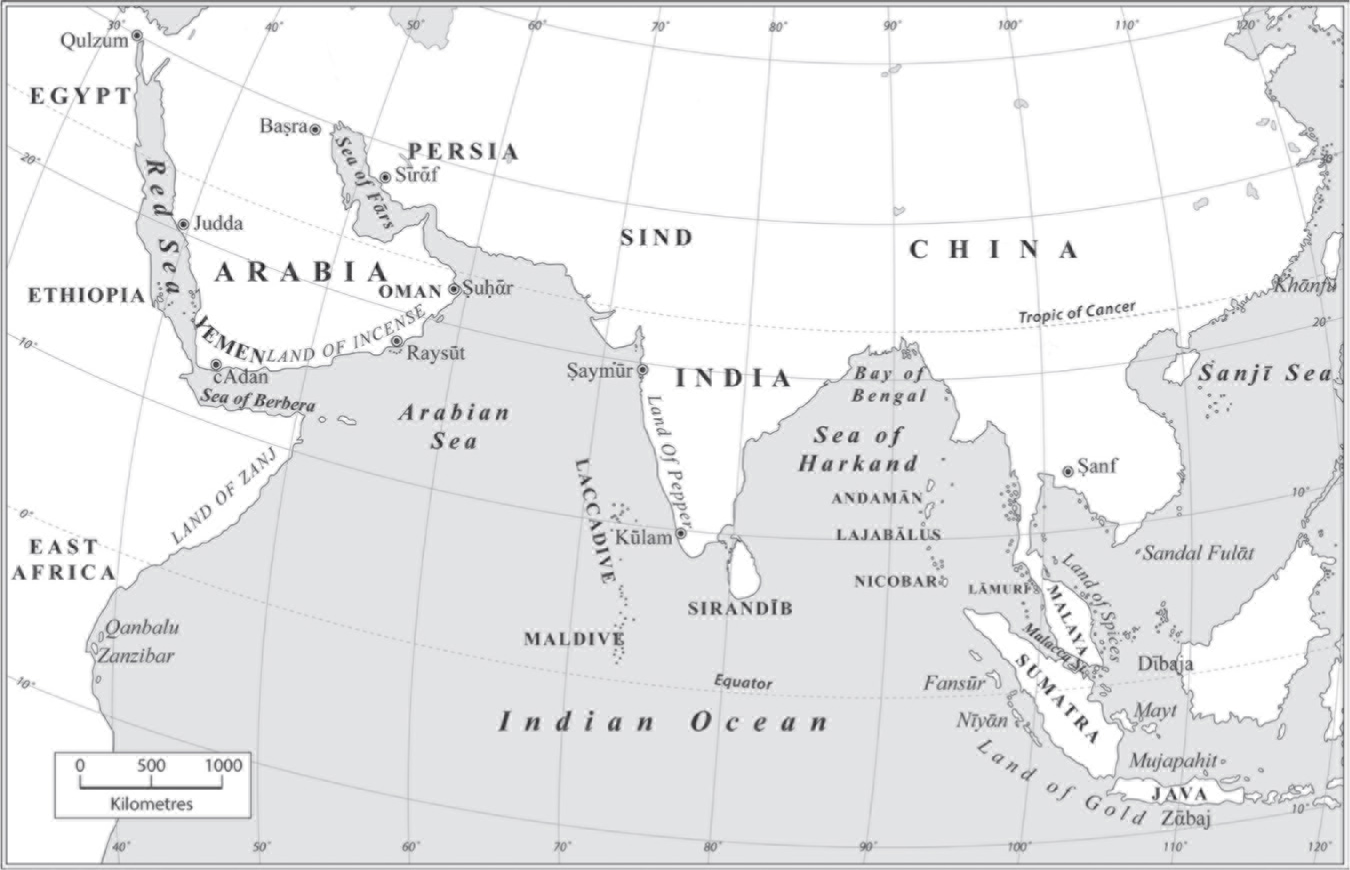
In this borderless world of a globalised Indian Ocean, the sea captures the imagination of an audience through stories of seafarers often caught in the fury of a storm in sometimes uncharted waters, a timeless theme. Although these stories may be sensational, it is a fact that for the seafarers the sea was a risky venture. But sea transport had great rewards as trade was carried out trans-regionally to India, the Land of Pepper, Sumatra and Java, the Lands of Gold and the Moluccas, the Lands of Spices (Abū Zayd al-Sῑrᾱfῑ, 2017, 4–5, 24–25, 42–43, 63–64; Ibn Shahriyᾱr, 1883–1886, 231–264, map). Indian Ocean trade between Mesopotamia, India and China was at its peak during the caliphate of al-Manṣūr (r. 136–158/754–775) who declared to his courtiers that ‘There is no obstacle between us and China, everything on the sea can come to us [in Baghdᾱd] on it’ (al-Ṭabarῑ, 1965, X (iii): 272).
Within this trans-regional world of trade, the sea stories hold much truth about historical place-names of ports and islands, names of caliphs and names of the occupational groups – the maritime and mercantile communities of the time. The sea is central to the stories and integral to the time and space of a cosmopolitan Indian Ocean society, bound together by trade from coast to coast and island to island. They tell us of a homogeneous mercantile system led by shipowners and captains exposed to the monsoon winds, as reported by both the Marvels stories and the Accounts of China and India (Abū Zayd al-Sῑrᾱfῑ, 2017, 5–8, 41–44; Ibn Shahriyᾱr, 1981, 13, 49, 66, 94, 97, 111), during which time travel was made in many stops at ports for disembarking and embarking of merchants and passengers, loading and unloading cargo, replenishing the ship with water and waiting for fair weather. Their voyages were long and often perilous; their ship could be struck by gales or rocks; they could perish in the sea or, if marooned, they could be confronted by strange creatures or communities.
These stories reveal a sense of ‘belongingness’ among groups or communities of ethnic, religious and cultural diversities. The model here is to go beyond the fixed notion of identifying people and their movements with particular boundaries, but one exemplifying cross-cultural exchange in a trans-regional Indian Ocean. The larger picture could be attained through Medieval Arabic texts but these are often incomplete as context is not always present and we are left to wonder how a community of people lived or what they did. An alternative model here is to explore how stories like the Marvels of India can provide details, not of a wider community as this is absent, but rather to examine a smaller occupational group (captains, shipowners, mariners and merchants), part of a community and their thinking and awareness of the environment in which they live. The question being asked here is what can be extracted from these stories about individuals and occupational groups and their interaction with the communities in the ninth and tenth centuries?
Centrality of India
In the introduction to the c Ajā’ib al-Hind, it is said that, of the marvels God created, China and India are designated 8 of 10 parts (Ibn Shahriyᾱr, 1981, 1), marking the significant importance of travel to these lands by sea to reveal ‘a legendary, rich and mysterious world’ (Marzolph & Van Leeuwen, 2004, II: 708). Indeed, both India and China are central to the vast Indian Ocean. When labelling the Indian Ocean, the Greek and Roman geographers called the western zone as the Erythraean Sea while the Muslim geographers of the tenth century identified it as the Sea of Fᾱrs (Persia); thus, in the map of al-Iṣṭakhrῑ it includes both halves of the Indian Ocean, showing India and China as one territory and Arabia lies opposite (1927, 28–29). Ibn Ḥawqal, also mapping the whole ocean as the Sea of Fᾱrs, extended it to include the Red Sea (1992, 50). However, their contemporary, al-Muqaddasῑ, rejected this concept of the Sea of Fᾱrs and considered the whole Indian Ocean as the Sea of China (1906, 9–11). As this conceptualisation was important in Antiquity and Early Medieval Islam, India stood in the middle of this extensive ocean and was, therefore, a vital commercial hub in all directions.
The name al-Hind in the book title c Ajā’ib al-Hind translates as India. For Islam, however, the continent was divided politically into two halves—the Sind province in the north and all the west coast was Muslim while al-Hind, the eastern half, was non-Muslim (An Eleventh-Century Egyptian Guide, 2014, 500, fn. 9). The c Ajā’ib al-Hind embraced both halves, a country steeped in marvels, magic and mystery. But irrespective of the geographical division, the Arabians and Persians were generally fascinated by Indian stories and tales that went back to pre-Islamic times. As Houari Touati argued, ‘Indian wisdom possessed an aura rivalled only by the Greek scientific and philosophical corpus and the Persian and literary traditions’ (Touati, 2010, 6).
But there is something else which Van Der Lith considered culturally and geographically important. He said that al-Hind included the South-East Asian Islands—Sumatra, Java and Malaya (Abū Zayd al-Sῑrᾱfῑ, 2017, xxii, 5, 9, 11, 42, 44; Ibn Shahriyᾱr, 1883–1886, 231), otherwise called the East Indies by the Europeans. This is a plausible proposition as the islands were ‘Hinduised’ at the time the Marvels were collected, and therefore part of that mysterious world that the Muslim mariners and merchants were exploring. They were strategically connected with China and were renowned for their products of gold, ivory, ebony, tin, scented woods, spices, aloes and camphor (Ibn Shahriyᾱr, 1981, 26, 29, 38, 42–44, 60, 67–68, 73).
As a neighbour to Persia and close to Arabia, India (the whole country) would have been familiar to Muslim historians and geographers even though they may not have travelled there, such as the Persian al-Bῑrūnῑ (d. 442/1050), a polymath who knew India closely but did not visit the continent; he relied on what he read and was reported to him. In contrast, the encyclopaedist and merchant, al-Mascūdῑ travelled to all parts of India and reported about Indian communities in fair detail.
Some historical sources highlight the sea trade route from Sῑrᾱf or Ṣuḥᾱr on the Persian and Arabian Gulf, respectively, to Khᾱnfū, China, and point to a well-established link that goes back centuries earlier (Abū Zayd al-Sῑrᾱfῑ, 2017, 5, 6, 8, 10, 52). India was at the centre of this global Indian Ocean trade, and records of sea links from the Mediterranean to the west coast of India are well attested in historical and geographical Arabic texts as previously discussed. This is reflected in the Marvels of India that documents a busy sea traffic to China in many of its stories (Ibn Shahriyᾱr, 1981, 13–18, 27–29, 49–52, 58–59, 62–64, 84, 99, 103, 111).
India was ‘the greatest of all countries’ claimed Strabo (d. 23 CE) (Bk 2.5.32), and it was, according to Herodotus (d. 426 BCE), known for its gold (Bk III. 98). A mercantile record, the Periplus of the Erythraean Sea in around 60 CE, shows the trade network of the Greeks and Romans, from the Red Sea to the west coast of India (The Periplus Maris Erythraei 1989, 283). Also, using the West Indian ports as a base for long-distance trade with the islands of South-East Asia, the Sᾱsᾱnians (c. 224–651 CE) commanded the sea route to China for many centuries before Islam, a fact well established by the Muslim geographers al-Iṣṭakhrῑ (1870, 133) and al-Muqaddasῑ (1906, 629–630). Additionally, Chinese chronicles, such as those of Chau Ju-Kua (d. 1228) reporting about the period of fourth- to the seventh-century CE, mention transporting of goods from Persia to India, East Africa and Arabia (1911, 7–8).
It is evident from the Marvels of India that for many stories Sῑrᾱf was the starting point for sea traffic in the Indian Ocean. It was an ancient Sᾱsᾱnian port, and a great commercial entrepôt (Ibn Shahriyᾱr, 1981, 118), wealthy and prosperous, according to al-Iṣṭakhrῑ (1870, 131–132, 170) and al-Muqaddasῑ (1906, 426). Its trading partner, Ṣuḥᾱr, also included in the Marvels stories and often referred to as Oman (Ibn Shahriyᾱr, 1981, Index 118–119), was well positioned against the monsoon winds; it was ‘the gateway to China’ receiving goods for Mesopotamia and Yemen (al-Muqaddasῑ, 1906, 92), while al-Iṣṭakhrῑ described it as a wealthy, populous sea town (1927, 25). Indeed, the West coast of India was a meeting point of routes where Arabian and Persian shipowners and merchants settled in Gujarat, Goa, Mangalore and Calicut on the Malabar Coast (Agius, 2008, 86–89). Malabar’s merchants on its coast set up store houses at Calicut, Cochin and Quilon, for the distribution of spice, aromatic woods and timber, in particular, teak.
Looking, therefore, at Chinese and Arabic texts together with the information in the Marvels of India, the long distance trade from the Persian Gulf via India was deep-rooted in the ninth and tenth centuries. The route to China, recorded by the Tang annals (c. 620–650 CE), speak of the merchant voyages taken from Khᾱnfū (Canton) via Malacca and India. It is understood that Chinese ships sailed as far as Ṣuḥᾱr and Sῑrᾱf, and that Chinese merchants throughout the Song and Yuan dynasties (960–1368), would have settled there. Meanwhile, the Arabic texts report of Chinese ships putting in at Ṣuḥᾱr, Sῑrᾱf and Baṣra (Abū Zayd al-Sῑrᾱfῑ, 2017, 7, 8, 10, 30–33, 36, 40–42, 52; Ibn Rusta, 1892, 94; al-Ṭabarῑ, 1965, IV (i), 2023), and reaching cAdan (Abū Zayd al-Sῑrᾱfῑ, 2017, 63, 64; see Kindermann, 1934, 21).
One story, of a hero sailing to China, retold in the Marvels, is of Master Captain cAbhara who told Buzurg that he ‘went to China seven times’. Buzurg told us that no one was expected to reach China without any mishap. This seems plausible, given the length of the journey; the voyage from and to Sῑrᾱf could have taken up to 12 months because of the number of stops needed to repair the sewn-planked ships, other maintenance and waiting for fair weather. He goes on to say: ‘If a man reached China without dying on the way, it was already a miracle. Returning safe and sound was unheard of’’ (Ibn Shahriyᾱr, 1981, 50). This is clearly an exaggeration but it underlines the dangers of the voyage, something that would have been only too well known to his audience and an acknowledged reality. The story goes on to give a vivid account of Captain cAbhara’s competence as he instructed the crew of a becalmed ship to continue their voyage to China. The details of how cAbhara directed the ship give us a clear insight into the seamanship of the time. Because of the length and danger of the journey, some captains or shipowners who operated as merchants would have stayed for some time in China, possibly even settling there, as in the case of Isḥᾱq b. Yahūda, an Omani Jew, who made a voyage on his own ship in 300/912 from China to Oman after 32 years (Ibn Shahriyᾱr, 1981, 62).
Taking these accounts together with those of geography and history, we have Mesopotamia, India and China, three great trading powers at a time when Sῑrᾱfῑ and Ṣuḥᾱrῑ mariners and merchants were two groups who were among the leading occupational communities, transporting people and goods to and from the Indian Ocean ports. Sῑrᾱf appeared to have been totally cosmopolitan as the Arabic texts and the Marvels confirm. So were other port cities in the ninth and tenth centuries, and though both sources are perhaps less informative, we could draw a general picture of the migratory movements in the Indian Ocean. Those that settled in a new port could have formed a new colony or joined one of the Arabian or Persian settlers, thus, conducting business with the new settlers and/or fellow merchants who passed by on their way to China. Khᾱnfū, on coastal South China, was inhabited by mercantile colonies of Persians and Arabians (Abū Zayd al-Sῑrᾱfῑ, 2017, 48, 52).
It is necessary to state that the existing bonds between Arabians, Persians and Indians were in place long before Islam, though with the coming of Islam, trade was accelerated as it became sanctioned by the Qur’ᾱn: ‘(But) let there be amongst you traffic and trade by mutual good-will’ (Sūrat al-Nisᾱ’ [The Women] IV: 29). Through facilitating trade, mercantile communities were carrying on missionary work, converting hundreds of people at every port their ships put in. South of Sind, the Gujaratis settled in Cambay, a cosmopolitan city with a community as ambitious as the Arabian and Persian merchants. Consider the regular trade with the Hindu merchants of Gujarat and Hormuz (Digby, 1982, I: 100), and the Gujarati merchants on the Malabar Coast and the rest of the Western Indian Ocean. Together with the Gujaratis, there were the merchants and craftsmen of the Parsee community who had settled from Gujarat to Sind. There is a general lack of the Gujarati presence in the Marvels tales but India is frequently referenced (Ibn Shahriyᾱr, 1981, 1–3, 8, 20, 25, 27, 30, 37, 60–71, 75, 95). This trans-regional global trade was for the most part of this early medieval period, cosmopolitan, but in many instances Islamic in nature. However, although the Persian and Arabian merchants were fired by a missionary zeal to reach many ports in the Indian Ocean, the Indians led the way in the sea trade to Burma and Malaya, Bengal, Hormuz, Aden and East Africa (Chaudhuri, 1985, 100).
Given this migratory movement of people on the west coast of India and the South-East Asian Islands, it should be stated that the Marvels contain little specific or direct mention of colonies or communities be they Arabian, Persian or Indian, and that is where Muslim historical and geographical texts are important sources such as Abū Zayd al-Sῑrᾱfῑ’s Accounts of China and India and al-Mascūdῑ’s Murūj al-dhahab, which enhance our understanding of the maritime cultural and economic landscapes.
Historically, these medieval Muslim sources, including the Marvels, convey information on port towns from which we can work out, albeit sometimes in a limited way, the communities that lived there, with some idea of how wealthy or poor they were, the language they spoke and the religion they practised. The Sῑrᾱfῑ society was a composite of different ethno-cultural-religious coastal communities. Alongside the Persian and Persianised community, there was the Arabian community who had settled in Sῑrᾱf while a dominant Persian community was found in Ṣuḥᾱr in Oman. Within the larger society there was an organised occupational community of mariners and merchants highlighted in the Marvels, while craftsmen, spoken of in the other medieval texts, are hardly noted in the stories. It is difficult to classify sea captains and merchants as two clear-cut groups; often a skipper was a merchant and/or shipowner and this is never made clear either in the Arabic texts or the Marvels stories, a dual occupational group that persists currently as I recorded in the Arabian Gulf (Agius, 2009, 128).
The language in contact with the groups or communities in and around the ports and landing places is of particular note. Wherever the communities were united under the Islamic umma (see later), Arabic was the lingua franca. While a Standard Arabic operated as a religious language for prayer and legal practices, this should not exclude the fact that in the ninth and tenth centuries, Persian was still an active maritime repertoire. That a Persian nautical language was applied by the maritime communities is evidenced in the nomenclature of technical terms currently exercised by the mariner groups (Agius, 2008, 361–366, 370–372). Persian continued to survive as a maritime trading language from Sᾱsᾱnian times. Consider its continuance as one of the lingua francae in a trilingual tablet in the fifteenth century erected by the Chinese Muslim Admiral Zheng He (d. 1433) in Sri Lanka in 1411 (Levathes, 1994, 113; Sheriff, 2010, 83), with ‘inscriptions in Chinese, Tamil and Persian prais[ing] Buddha, Shiva and Allᾱh in equal measure’. 2
Conceptualising Group or Community Identity
In this study, group is defined as a company of people sharing ideas and an occupation, and/or working together while community is a class of people, living together in the same place and engaged in some work or another. By this easily understood definition, there is no intention to follow a psychological approach on a group identity concept (see Spears, 2011, 201–224) though some attempts at analysis are made with inferences to the self and relation to others (see Pietromonaco & Barrett, 2000, 155–175), and Stets and Burke’s views on social identity and roles are worth noting (Stets & Burke, 2000, 224–237).
Community in Medieval Islam was perceived through the umma concept which in a general sense envelops ‘the people community’, a term shared with Semitic cultural thought (Denny, 2000, 859–862). It is ‘a fundamental concept in Islam, expressing the essential unity and theoretical equality of Muslims from diverse cultural and geographical settings’ 3 (Pearson, 2003, 76–77). Thus we read in the Qur’ᾱn: ‘We made of you an umma justly balanced that ye might be witnesses over the peoples’ (Al-Qur’ᾱn, Sūrat al-Baqara [The Heifer], II: 143). 4 The intended meaning of ‘peoples’ is a reference to all communities, Muslims and others. In such a way, the Marvels of India brings together in its stories, people of ethnic-religious and cultural diversity; though the leading character is a Muslim by birth or a convert to Islam. On conversion, the characteristic spirit of an egalitarian society and the universality of Islam attracted members of other beliefs in that they did not need to desert their old customs and practices (Khalilieh, 2019, 79): ‘This georeligious and geopolitical unity’, expounded Houari Touati, ‘become a space that dogmatically guaranteed the truth of a “living together” willed by God’ (2010, 3). That said, community identity in the umma concept incorporates the ‘People of the Book’, not just the Jews and Christians, but also the Sabians and Magians (i.e. Zoroastrians) 5 who receive Allᾱh’s protection too (Al-Qur’ᾱn, Sūrat al-Ḥajj [The Pilgrimage] XXII: 17). Even polytheism is not excluded from the Qur’ᾱnic verse. In Yusuf Ali’s view, ‘All forms of faith that are sincere (and not merely contumacious) are matters in which we as men cannot interfere’ (The Holy Quran 1946, II, 854, fn. 2788). Hinduism is represented 14 times in the Marvels (Ibn Shahriyᾱr, 1981, 2, 62, 67–69, 71–72, 84, 86, 89, 91–95).
But a true definition of identity becomes more complex as we start categorising an individual’s or group’s religion, race or type of occupation involved. On this basis, regardless of race and religion, the focus of group identity, as pointed out earlier, is the sharing of a common interest or a common profession such as, in the case of the Marvels, the shipowners, captains and merchants, the protagonists of a number of its stories. The interesting part of the stories model concept in this study is that there is a common characteristic in the occupational groups, Sῑrᾱfῑs in particular, in that they are all story-tellers, notables of a sea town, knowledgeable on nautical matters, and with a message to proclaim (Ibn Shahriyᾱr, 1981, xviii, 118). Their stories disclose the thinking and awareness of maritime communities through their life on land and at sea at a time when Islam was in its golden period.
Community Identity
With respect to communities in the Marvels, the information is not always directly obtainable; many a time it is guess work through inferencing the context of events and activities. At the time the Marvels of India stories were brought together, the two port cities, Sῑrᾱf and Ṣuḥᾱr, attracted, though not exclusively, seafarers from South-East Asian islands, mixing with the local communities and sharing common attitudes and interests. In the case of Persian communities, they were dotted all around the Arabian Peninsula coast, according to historians al-Balᾱdhurῑ (d. 279/ 892-3) (1866, 78, 431–432) and al-Ṭabarῑ (1965, IV (i), 2021–2023, V (i), 2545–2548, 2560–2564). A dominant Persian community, mainly mercantile families, was living in Ṣuḥᾱr long before Islam, to the point that, al-Muqaddasῑ reported, Persian was the main language of the sea town. Moreover, he said that the Persian population in cAdan and Judda outnumbered the inhabitants of the cities (1906, 92, 96), and the Persian presence on the west coast of India and East Africa is also noted, stretching as far as Khᾱnfū in China (Abū Zayd al-Sῑrᾱfῑ, 2017, 52). In fact, Persian navigation in the Indian Ocean lasted for centuries (Sheriff, 2010, 156–163), and the numerous nautical nomenclatures of Persian origin in Arabic testify to this even in modern times as I have shown above (Agius, 2008, 370–372).
It may be speculated from the Marvels stories that Hindu mercantile communities, mentioned earlier, were spread in different coastal towns of the Western Indian Ocean. Some activities, reported in the Marvels by Sῑrᾱfῑs living on the West Indian coast, reflect an understanding of their manners and customs and their tales on subjects from ravens, snakes and bewitched crocodiles to thieves, Hindu ablutions and Hindu holy men (Ibn Shahriyᾱr, 1981, 6, 7, 8, 62, 69, 84, 86, 88–89, 91–94). Other communities, such as the Zoroastrian groupings, are not unusual. One particular story told by Abū al-Zahr al-Barkhatῑ, a sea captain, speaks of fire worshippers on an island where Zoroastrians, rulers and people, gather to worship the fire that burns all night (Ibn Shahriyᾱr, 1981, 13, 17). It describes an activity which the story-teller knows very well as he himself was once a Zoroastrian before he converted to Islam. An indication by the same story-teller of varied communities living in Sῑrᾱf tells of a captain who sailed from Sῑrᾱf to China with a large number of merchants from different countries. A gale that rose in the middle of the sea gave them no hope of rescue, so ‘the passengers said farewell to one another, and each prayed according to his religion’ (Ibn Shahriyᾱr, 1981, 13–14) because there was on board a mixed group of merchants from Persia, India, South-East Asia and China (Ibn Shahriyᾱr, 1981, 14), which echoes the cosmopolitan mix of Sῑrᾱf. Here we have something which is not usually found in the writings of medieval historians and geographers: an empathy, an ability to comprehend and depict the sufferings of communities from different ethnic-religious groups. Further, the dramatic story-telling enhances our ability to relate to these people, and thus understand the scenario of the event. Also of note is the fact that the captain sees it as his moral duty to calm and reassure the passengers (Ibn Shahriyᾱr, 1981, 14).
The population community mix in Sῑrᾱf is further illustrated with a story told by a merchant about three ships that set off in convoy in 306/918 from Sῑrᾱf to Ṣaymūr on the West Indian coast, carrying 1,200 passengers. On board, there were shipowners, merchants, traders, sailors and other passengers (Ibn Shahriyᾱr, 1981, 97). There is no mention of their country of origin but it may be surmised from the large number mentioned that there was a diverse mix of ethnic-religious groups on board ship. The story ends with a tragedy as the three ships were wrecked, and all passengers, except for a small number who escaped in a lifeboat, lost their lives. There was, however, a caveat to the story as the narrator announces that this large-scale and violent event marked ‘the decline of Sῑrᾱf and Ṣaymūr’ (Ibn Shahriyᾱr, 1981, 97–98). Historically, a decline in Sῑrᾱf was reported by the geographer al-Muqaddasῑ (1906, 426) in the tenth century, saying that Sῑrᾱf was being abandoned by the communities to establish themselves in Ṣuḥᾱr (see Aubin, 1959, 297; Williamson, 1973, 22; Wilson, 1954, 94). The information is vague but he did speak of an earthquake that ‘shook [Sῑrᾱf] violently for seven days’ (al-Muqaddasῑ, 1906, 426). While the events may differ, this is an example of how the information in the Marvels and that of the Muslim geography and history support each other.
Stories are neither always specific about the name of a community nor where it is located. Consider Al-Ḥasan b. cAmr, possibly a merchant, who gathered stories from India and Zᾱbaj (i.e. Java) among other places; neither the place names are given, nor the names for rulers, because in this instance the story-teller was more preoccupied with things of the fantastic (Ibn Shahriyᾱr, 1981, 37). And information, when provided, could be peripheral: a Sῑrᾱfῑ merchant spoke of a Maharaja, the King of Zᾱbaj, but nothing about the people. The story line, nonetheless, is about 800 money changers operating on the island (Ibn Shahriyᾱr, 1981, 80) which is probably an exaggeration but not too far from reality when one realises that the island was known for its gold and was an important commercial hub for rich merchants among whom were Sῑrᾱfῑs.
Several stories are about islands with communities serving passing ships, frequently set around the South-East Asian Islands, also recorded in the Accounts of China and India (Abū Zayd al-Sῑrᾱfῑ, 2017, 8–10). Many an inhabited island was visited by the seafaring communities: the Lajabᾱlus-Nicobar Islands, north of Sumatra; Mayt Island near Ṣanf and Sarῑra, south-east off Sumatra and Zᾱbaj Island, that is Java (Abū Zayd al-Sῑrᾱfῑ, 2017, 9–10; Ibn Shahriyᾱr, 1883–1886, 231–247; 1981, 59, 74, 80). Yet there is a lacuna of information as to what communities do on these islands except for sensational and gruesome stories of a cannibal society on Fansūr and Nῑyᾱn Islands (Abū Zayd al-Sῑrᾱfῑ, 2017, 5; Ibn Shahriyᾱr, 1883–1886, 233, 245; 1981, 73–74).
The larger islands of Sumatra, Java and Malaya were of strategic importance for the global Indian Ocean economy. But even so, the Marvels are vague on sea trade, and a fuller picture of this lucrative commerce can only be sought in the geographies of Medieval Islam as pointed out in the Accounts of China and India, examples of which are numerous (Abū Zayd al-Sῑrᾱfῑ, 2017, 3–6, 5, 8–9, 13–15, 41–43, 44–45, 47, 63–65). Most of the stories of the Marvels, therefore, only reveal a partial picture of life on the islands as, in general, the intention is to entertain an audience with tales of geographically confined and sometimes imaginary communities such as those on the Island of Women and the Wᾱqwᾱq Islands (Ibn Shahriyᾱr, 1981, 6–8, 13–18). Both stories are examples of geographical myth, meant to be humorous, but this must be stressed, not lacking in nautical facts. Examining these legendary myths, the seas that surround the islands are, as Marzolph and Van Leeuwen marvellously described them, ‘boundaries between different realms, gates to strange and miraculous worlds, and territories in which man is subject to the arbitrariness of fate’ (Marzolph & Van Leeuwen, 2004, II: 697). They were referring to the tales of Sindbᾱd the Sailor of the Arabian Nights but their interpretation of the seas surrounding the islands equally applies to the Marvels of India. Fate, a power that controls events, cannot be managed or changed. In the story of The Island of Women, Captain Abū al-Zahr al-Barkhatῑ spoke of one of his captain companions who went out sailing to the Sea of Malaya. Surviving a ferocious sea, the crew and passengers landed safely on an island. The story is straightforward and believable up to now, with facts about seamanship that a maritime historian and geographer would find of benefit. The second part of the story, however, moves into the realm of fantasy. It is about the men’s survival in an island community of thousands of women. The sailors and merchants die after having sex with the women except for one who does not join in the orgy—an old man (Ibn Shahriyᾱr, 1981, 13–18). What is interesting in the story is that how the narrator is playing on the male fear of female dominance. The island community has been created by a society in which females greatly outnumber males, and the surplus women have been shipped to this island. It appears that the community they come from are sun-worshippers.
In the story of the Wᾱqwᾱq Islands, Captain Buzurg spoke of fellow merchants who reported there were 12,000 inhabited islands. The Islands are, according to the story, located off Zᾱbaj, that is Java, the Land of Gold. A ship owned by Abū Muḥammad al-Ḥasan ibn cAmr was blown close to the islands. The islanders fled away as they saw the ship because they thought that they were going to be attacked, and after a few attempts to disembark the captain sent one sailor who spoke Wᾱqwᾱqῑ. The narrator spoke of two communities, each had a king and they fought against each other, until a crew member scared them off by performing magic. Then the story takes a new turn—the slaves’ flight to freedom. It happened that the shipowner tricked the king of one community by capturing 100 slaves and chaining them on board ship. The slaves cut themselves free, tying up the sailors who were guarding them and set off, leaving the rest of the crew stranded in the village (Ibn Shahriyᾱr, 1981, 6–8), a victory for the slaves and punishment to those who enslaved them. The Islands of Wᾱqwᾱq appear to be real to the audience; they have an organised government of communities who may or may not get along with each other. They are islands of marvels as can be seen in other stories about them: according to Captain Muḥammad b. Bᾱbishᾱd, one tells of ‘scorpions that fly like birds’. He also recounted that a huge tree bears fruit as large as human beings which speak as the wind blows; he heard from men who visited the island that a sailor picked one of its fruits and it burst and there was nothing left but a dead crow (Ibn Shahriyᾱr, 1981, 30, 39). But features of the marvellous and mystery do not always surround the Wᾱqwᾱq Islands: One story is of a sailor sailing between Lᾱmurῑ Island north east of Sumatra and China when he was caught by a gale lasting many days. He and his crew got water from the island and continued their voyage to Ṣanf, Vietnam (Ibn Shahriyᾱr, 1981, 30, 39, 95, 111). The story is rich in nautical matters that are still relevant today. Fetching water from islands is a subject often mentioned by my informants in the Red Sea (Agius, 2019, 119, 145–146, 225).
Although Master Captain Buzurg recounted tales of marvels such as cannibal communities, dog-headed people and human-headed trees, of grim tragedy and humour such as the story of the Island of Women and A Slaving Adventure, yet there are a number of accounts based on a recognisable reality that the mariners and merchants of Sῑrᾱf would have experienced in India, Sumatra and Java Islands and China (Ibn Shahriyᾱr, 1981, 120–122; Shafiq, 2013, 64–65).
Occupational Groups
Identity is a concept that has had many different interpretations of its social categories. Here, the group, as a category, accepts the individual’s personal identity and interaction with other groups in the context of the stories. Some interesting theories on individual identity are around but there is no intention here to cover any of them (see Deschamps & Devos, 1998, 1–12; Worchel & Coutant, 2004, 182–202). However, in the Marvels of India, within the larger communities I discussed earlier, we come across groups as dynamic units, and examining their attitudes will help us to understand individual identity. Our focus is on the occupational groups—the Sῑrᾱfῑ shipowners, captains and merchants, and here the information is much more forthcoming. We have short biographies of the story-tellers, the captains/shipowners and merchants with their nautical skills and knowledge.
Although several occupational groups in the Marvels were from the Sῑrᾱfῑ community, a number, not often mentioned by name, were Omanis, possibly from the Ṣuḥᾱr community. Interestingly, the tenth-century historian and merchant al-Mascūdῑ claimed to have met some Omanis on his voyages to West India, East Africa and China. He might have been suggesting that there were in these regions Sῑrᾱfῑ settlers at different ports. Others with seafaring skills were the Yemenis (Ibn Shahriyᾱr, 1981, 150; al-Iṣṭakhrῑ, 1870, 138; al-Mascūdῑ, 1983, I: 123).
The captain grouping held a prominent position among the Sῑrᾱfῑ communities for their exceptional knowledge and skills in navigation and management of the ship from start to its final destination. They were considered professional in their mastery of the sea as they sailed from Sῑrᾱf to India and China: for instance, Captain Buzurg eulogised Abū cAbdallᾱh Muḥammad ibn Bᾱbishᾱd b. Ḥarᾱm b. Ḥammawayh who was, ‘one of the principal shipmasters … one of the best informed of God’s creatures in nautical matters, and one of the best and most respected sailors’ (Ibn Shahriyᾱr, 1981, 4), a powerful compliment to a captain of the sea from a fellow captain (Buzurg). Then there was Ismᾱcῑl b. Ibrᾱhῑm b. Mirdᾱs, known as Ismᾱcῑlawayh who knew the Island of Java very well, significant as it was for the mercantile communities, being the Land of Gold (Ibn Shahriyᾱr, 1981, 5). The famous Abū al-Zahr al-Barkhatῑ, a notable captain and a righteous man, as noted earlier, reassured the crew and passengers that he would not abandon ship, saying, ‘All us captains, when we board a ship, stake our lives and destiny on it. If it is lost, we die with it’ (Ibn Shahriyᾱr, 1981, 14). This is interesting as it is an example of one of the 12 principles of navigation (siyᾱsᾱt) recorded centuries later by the navigator, Aḥmad Ibn Mᾱjid (d. after 966/1500) (Tibbetts, 1981, 387–391). It also gives an insight into the relationship between a captain and the seafarers for whom he makes an oath that he will not abandon them, something I have not come across in Medieval Arabic geographical or historical texts.
The ability of Master Captain cAllᾱma, sailing from India to China, is celebrated when he foretells the coming of a gale by looking at the formation of the sea. Among the mariner grouping, there was Mardawayh b. Zᾱrabakht, ‘one of the captains on the China and Land of Gold [route]’, and another was Jacfar Ibn Rashῑd Ibn Lᾱkis, well known on this route (Ibn Shahriyᾱr, 1981, 5, 28, 102–103, 105). They were all real people who would have been known to the audience, and this gave authority to their stories.
In explaining the identity of occupational groups, it is essential to look at the individuals’ status, their place in the social and professional structure of their occupation and their contribution to the society to which they belonged. The people and the vessel they sailed on, their relation to the sea and their use of celestial navigation are all clearly exemplified in the Marvels as true seamanship. Admittedly, not in much detail but they could be at times more informative than Medieval Arabic texts, thus, complementing rather than competing. An essential point is the skippers’ individual identity as a professional in his relationship to the crew and the passengers.
Celestial navigation was crucial, a practice still found in the Red Sea (Agius, 2019, 146–147, 175–176): Captain Abū al-Zahr al-Barkhatῑ told us how sailing in the Malay region, their ship ran into strong winds which took them under the Canopus star, claiming that ‘at its zenith [man] must abandon all hope of return’ (Ibn Shahriyᾱr, 1981, 13). He displayed an emotional connection as he recounted a gripping tale of the travellers’ endurance as the ship survived the onslaught of the ferocious storm. Experience is, of course, crucial to these stories and valuable to the understanding of the individual identity within the maritime society. The same captain relates a story he heard from his maternal uncle, Ibn Anshartū who set off on a large ship to Fansūr, off Sumatra Island. On their way he and the sailors studied the stars all night to determine the route either way (Ibn Shahriyᾱr, 1981, 19), a detail that reinforces the group identity of professional sailors out at sea, again a feature I did not find in Medieval Arabic sources. Nonetheless, it must be said that both Arabic texts and the Marvels stories are short of information on such things as describing a craft’s hull design, types of sails, rigging configuration, steering, pilotage and so forth. Interestingly, the Accounts of China and India does document boatbuilding on some Indian Ocean islands (Abū Zayd al-Sῑrᾱfῑ, 2017, 4, 41, 61), an early medieval glimpse into construction techniques. Although not much is known through Medieval Arabic sources of ship types of the Western Indian Ocean, here we can turn to archaeological evidence that confirms the fact that the Arabian–Persian–Indian ships were constructed of sewn planks and shared a common hull design (Flecker, 2000, 101–119; Vosmer, 2010, 121–135), unlike the nailed planks of a Javanese, Sumatran or Chinese junk. We do not know how seaworthy were the Persian–Arabian–Indian ships but we do know that the junks had a large draught and a good floating capacity (Agius, 2008, 166, 225–226; Levathes, 1994, 43, 78).
In the stories, the professional community conveys information on anchoring or when to jettison the cargo to save the ship and passengers. Captain cAllᾱma, an extraordinary sailor, sailing from India to China, on seeing the force of a storm ordered the merchants to throw the cargo overboard. When the winds abated and they went to collect their cargo at a nearby island, not only did they recover their cargo but they gathered cargoes of shipwrecks that had been deposited there. This is a story that is void of lore and marvels. It is believable with a happy ending that ‘the merchandise they had recovered brought them wealth and happiness’ (Ibn Shahriyᾱr, 1981, 28); an ordinary story of a captain whose identity was portrayed to be exemplary to the audience, demonstrating the merchants’ trust in their captain. Then we have a story related by Captain Bᾱbishᾱd returning from Fanṣūr near Sumatra to Raysūt on the Southern Arabian coast of Oman. He knew exactly when they were approaching land by observing the seascape at sunset: ‘At that time, if you are opposite a mountain or an island, you will see it distinctly’. No nautical instruments were used, just reliance on the naked eye. The merchants on board had made a bet of 20 dinars that the captain would be right. When the look-out man cried out that Raysūt was close, ‘they congratulated one another, and wept with joy and happiness’ (Ibn Shahriyᾱr, 1981, 53–54). Knowledge of the sea and experience is a recurrent theme in the stories but one thing that makes these stories unique is the humour and humanity as shown in this story of the engagement of the captain with the seafarers and their trust in the captain. At the end, we are told that the money went ‘for distribution in alms to the poor.’
We have copious evidence in the Marvels of the nautical skills the mariners displayed on hazardous voyages such as when approaching a landing place or an island; navigators had to show expertise in steering their way through coral reefs and submerged rocks. There is mention of voyaging from one island to another and it is a fact that, in the days of sail, island hopping was a necessary strategy because islands gave a safer anchorage, something my informants of the Red Sea corroborated (Agius, 2019, 145–146).
Reflections and Conclusion
Sharing a cultural landscape, the stories of fact and fiction in the Marvels highlight the way individuals and communities lived, their social identity and the roles they played. This is particularly true of the occupational groups who have ideas and technology in common, in this instance, a class of captains/shipowners and merchants who share their lives at work or rest. The examples we have seen in the Marvels are of 31 members of an occupational group, underlining their status in the community, their family background, travel and achievements. Their adventures are supported by the nautical data they impart, details of which are sometimes found in Medieval Arabic historical and geographical texts, but by engaging with the coastal and island communities and seafarers, the Marvels tales go further; they contain a self-other understanding.
The stories model as epitomised by the Marvels is a valuable adjunct to understanding the maritime landscape of the ninth and tenth centuries. As has been shown, several of these stories are told from the viewpoint of eyewitnesses who would have been recognisable to the audience as eminent captains, shipowners and merchants, suggesting that the facts they contain on seamanship are true. The stories may be mainly fictional and often sensational in content, but whatever the veracity of events in the Marvels tales their accounts furnish us with a glimpse of what these prominent people knew at the time and how they thought. While the geographical texts may be knowledgeable on the physical nature of the seas and oceans, they present, as far as I am aware, few particulars about the occupational groups of a port town.
Much of the geography in the Marvels tales is corroborated by Medieval Arabic texts and strengthens our knowledge of, for instance, the islands of the East Indies. There is no imaginary geography except for such oddities as the Island of Women which has echoes of Homer’s Greek tales (Hall, 2008, 1) and the Wᾱqwᾱq Islands that have proved to be unidentifiable so far, first mentioned by the geographer, Ibn Khurradᾱdhbeh (Maqbul, 1995, Appendix). 6 Eventful as these stories are, they also offer the ninth–tenth-century audience some opportunity for moral and religious reflection that gives us a window into the cultural thinking of the times in the twenty-first century. They are usually based on a recognisable reality and it is this rich maritime landscape that we are able to access. Like Sindbᾱd’s Seven Voyages in the Arabian Nights, the Marvels may also be described as ‘the archetypes of human imagination, where history and geography mingle with literary and legendary images’ (Marzolph & Van Leeuwen, 2004, II: 605).
As we have seen, Arabic was the lingua franca and would have been shared with Persian, the native language in Sirᾱf where the stories were collected. If bilingualism were the case, would the stories of the Marvels have been communicated in Arabic or Persian?—an intriguing question. The Arabic of the stories contains a lot of dialectal usages, as some other works of the cajᾱ’ib do, such as, in the Arabian Nights, which suggests they were recounted in Arabic; but there is a second and, to my mind, a more likely possibility, that they were recounted in Persian, the language of Sῑrᾱf, and then translated by Captain Buzurg, the alleged collator, in (dialectal) Arabic.
The stories model takes away from the belief that history, geography and archaeology are the only sources to rely on for recreating the medieval maritime past of the Indian Ocean. Looking at the maritime landscape of the ninth and tenth centuries, the Marvels stories with their mixture of fantasy and reality, fact and fiction, enable us to better reconstruct the realities of the lives of the occupational groups of the vibrant sea ports and their voyages across the Indian Ocean. Since, unlike medieval texts of geography and history, the Marvels tell a story, a sequence of events, set in a recognisable context, this enables the audience through time to identify and relate to the protagonists of the story and to better understand the maritime landscape they inhabited. The lively interaction between these captains/shipowners, merchants, seamen and passengers enables us to empathise with them just as the audience who gathered to listen to the tales was gripped by their adventures. There are psychological insights embedded in the stories such as the relationship between the self and the community whether that be a captain interacting with his passengers or members of different faith groups coming together in the face of tragedy. Their humanity speaks to us across the centuries, giving a voice to long forgotten communities. As Tim Mackintosh-Smith has so rightly said, ‘the yarning sailors are finally given their say’ (Abū Zayd al-Sῑrᾱfῑ, 2017, xxviii).
Footnotes
Declaration of Conflicting Interests
The author declared no potential conflicts of interest with respect to the research, authorship and/or publication of this article.
Funding
The author received no financial support for the research, authorship and/or publication of this article.