




Abstract
Recent developments in climate change-related negotiations indicate that there are emerging conflicts of interest between Small Island Developing States (SIDS) and emerging powers like India and China. Emerging powers have to address their developmental concerns while pursuing aspirations related to leadership in global governance. To take a leadership role in global governance structures relating to climate change, emerging powers need to pursue their interests while accommodating the concerns of their potential followers, which include SIDS. Increased conflict of interests between emerging powers and other sets of vulnerable countries could lead to adverse implications for the North–South divide in international environmental relations, which in turn will impact their leadership aspirations. Using the example of leadership in international relations and the statements made by the SIDS at COP26, this article concludes that the existing situation presents a challenge as well as an opportunity for emerging powers like India to take a leadership role in a reformed new world order.
Keywords
Introduction
To comprehend the emerging dynamics between emerging powers and Small Island Developing States (SIDS), it is important to revisit the major developments that took place at the 26th Conference of Parties to the United Nations Framework Convention on Climate Change (COP26) in Glasgow, Scotland. During the conference, that is, COP26, several issues were discussed, including mitigation-related efforts, transfer of technology and finance, funding for adaptation, loss and damage and collaboration-related issues (Glasgow Climate Pact, 2021, para. 20). This article is specifically concerned with the evolution of the relationship between rapidly growing developing countries, often labelled as emerging powers—as they intend to change the existing distribution of power and have an ascendant role in global affairs (Schirm, 2010, p. 198)—and SIDS.
The first part of this article will provide a brief overview of the existing dynamics between developed and developing countries in international law relating to combating climate change. Subsequently, the article will focus on the submissions/statements made by different countries, specifically the SIDS, during COP26. At the outset, it is important to point out that relying on statements or language used by politicians has its limitations. For instance, in the discussion relating to the Climate Change Bill in the UK Parliament, the language used by politicians narrowed the debate as it was mostly scientific and economic in nature (Wills, 2017). However, despite many limitations, statements made by leaders indicate the collective or dominant interest in the society, or at the very least reflect the perception of the concerned government in terms of what is legitimate and acceptable (Schirm, 2010, p. 201). Accordingly, statements made by SIDS at COP26 are important as they provide insights into the collective interests of their societies. Using the unique situations and vulnerabilities of SIDS as a background, the article will rely on their statements made during COP26 to highlight important areas of conflict of interest between emerging powers and SIDS.
The second part of the article will focus on the implications of the above-mentioned trends for emerging powers. In this context, emerging powers are identified as those countries that fulfil two criteria. First, they have experienced significant growth in terms of their economic and political clout. Second, they aspire to change the existing status quo of the international economic and political governance structures, as they believe that they are entitled to ‘a more influential role in world affairs’ (Hurrell, 2006, p. 02). This can be done either through a complete reformation of the existing framework or through co-option in the existing decision-making forums (Anghie, 2015). Either way, the result involves some change in the status quo.
Focusing on the emerging conflicts of interest between SIDS and emerging powers is important on account of the following reasons. First, emerging powers aspire to take on a leadership role in international political and economic decision-making bodies (Hurrell, 2006, p. 02; Schirm, 2010, p. 198). This cannot happen without the support of other developing countries, especially those that are vulnerable and poor, like the SIDS and least developed countries (LDCs). Therefore, acceptance among potential followers is an essential trait of leadership (Schirm, 2010, p. 214). Second, conflicts of interest between SIDS and emerging powers will have serious implications for the traditional North–South divide, which has characterised international legal regimes, for example, those relating to trade and the environment. Accordingly, an unravelling of the North–South divide in international law-making forums does not bode well for the leadership aspirations of emerging powers. Further, it could also lead to competition between various sub-groups of developing countries for preferential treatment (Weinhardt & Schöfer, 2022).
Using the example of studies on leadership in international relations, the last part of the article will focus on why it is important for emerging powers to identify and work on areas of mutual concern as well as accommodate the interests of a vulnerable group of countries like the SIDS.
The Old Paradigm: The Developed–Developing Countries Dichotomy
The existing framework of the legal response to climate change is based on the principle of ‘common but differentiated responsibilities and respective capabilities’ (CBDR-RC). Since its articulation in the Rio Declaration of 1992 (see Principle 07), CBDR-RC has been reiterated time and again in legal texts relating to climate change (e.g., Article 3 [1] of the United Nations Framework Convention on Climate Change [UNFCCC] and Article 2 [2] of the Paris Agreement). A lot has already been written about the evolution of CBDR-RC (Rajamani, 2006; Thakur, 2021). It was incorporated in its most extreme form in the Kyoto Protocol of 1997, where developing countries were given complete exemption from the binding emission reduction targets. In the Paris Agreement of 2015, CBDR-RC has been considerably watered down through the requirements of ‘Nationally Determined Contributions (NDCs) in light of different national circumstances’, which in turn signals a shift towards individual differentiation (Pauwelyn, 2013; Rajamani, 2016; Thakur, 2021).
While the principle of CBDR-RC has been a cornerstone of the law relating to climate change and is a general principle of international environmental law (Cullet, 1999, p. 578), contestations around its interpretation have emerged as the fault line between developed and developing countries and represent the old dynamics of the international environmental law-making process.
Over the years, some developing countries have experienced rapid economic growth, and their carbon footprint is growing at an enormous pace. They include India, China, Brazil, Indonesia and South Africa, to name a few. At present, India and China are among the largest greenhouse gas emitters (The World Bank, n.d.; Union of Concerned Scientists, 2022). The UNFCCC system divides responsibilities between annex and non-annex states, which represent developed and developing countries, respectively (Deng & Chen, 2016; Rajamani, 2008; Stone, 2004). This division of responsibilities between developed and developing countries (through their division into annex and non-annex parties), adopted in the UNFCCC itself, has become contested (United Nations Climate Change, 2008a, p. 05). Advanced economies like Australia have reiterated their aversion to granting any special treatment to large emitters of greenhouse gases from developing countries (United Nations Climate Change, 2008a). Further, on some occasions, questions have been raised about the categorisation of certain countries as annex or non-annex parties (United Nations Climate Change, 1997).
The fact that the UNFCCC does not contain any objective criteria for differentiating states as developed or developing has further added to the problem. The core problem relates to the interpretation of CBDR-RC. While developed countries insist that CBDR-RC should be interpreted dynamically, thus taking into account the increasing emissions from some developing countries, the principle is also linked with concepts that inform the working of the international legal system, for example, equity and solidarity (Cullet, 2008; Batruch, 1998; MacDonald, 1996), and is therefore linked with designation as a developing country.
The old framework was evident in COP26 as well. Several statements made during the conference highlighted the continuing relevance of old dynamics, for example, by calling upon developed countries to increase their assistance and take on a leading role in combating climate change. For instance, in the COP26, the necessity of developed countries leading the effort against climate change has been stressed by the joint submission of Pacific SIDS (COP26, 2021a), vulnerable LDCs like Gambia (COP26, 2021b), as well as the Secretary-General of the United Nations, Antonio Gutteres (COP26, 2021c).
The Specific Concerns of SIDS and the Emergence of New Dynamics
An overview of statements made at COP26 indicates the emergence of a new trend in international environmental law. However, first, it is important to provide a brief background on varied interests in international forums. International environmental law has had to reconcile the interests of the various groupings of states from the very beginning. These groupings/interests include developed countries, developing countries, LDCs, SIDS, economies that are particularly dependent on fossil fuel production (e.g., Organization of the Petroleum Exporting Countries i.e., OPEC), countries with low-lying coastal, arid and semi-arid areas or areas liable to floods, drought and desertification and developing countries with fragile mountainous ecosystems (Rajamani, 2008). States do highlight their specific interests and concerns in international forums. The COP26 submissions from Iran and the OPEC countries highlighted their specific concerns. For instance, Iran’s submission contextualised its obligations against the background of sanctions imposed on it (COP26, 2021d). On the other hand, the statement by OPEC countries focused on ensuring energy security (COP26, 2021e).
Moreover, there are differences within various groups that collectively negotiate for making global climate policy. Thus, the developed countries have had to reconcile conflicting interests (e.g., between the USA and the EU); emerging powers, which include the BASIC countries i.e., Brazil, South Africa, India and China, have different approaches relating to the role and concept of equity and CBDR-RC; and members within the group of developing countries have many conflicting interests among them (Das, 2013). Further, it has long been recognised that certain sub-groups of states have specific concerns. These include the LDCs and SIDS. Having specific vulnerabilities can cause tensions between a group of states and other developing countries, especially emerging powers. For instance, on one occasion in the recent past, Bangladesh had submitted that CBDR-RC should apply not just to developed and developing countries but between developing countries and LDCs as well (United Nations Climate Change, 2008b, p. 10).
SIDS and Climate Change
SIDS have specific environmental concerns. Their unique situation and vulnerabilities have been recognised in other international forums as well (UNCTAD, n.d.). As they are non-annex states, they can also be included within the developing country group (United Nations Climate Change, n.d.-a). For SIDS, response to climate change is not just about ensuring equity in international legal relations; rather, it is a matter of survival (Das, 2013, p. 224).
Although they have always been treated as a distinct and vulnerable group, their increased vulnerability and survival-related threat from climate change make their presence as a special and distinct category of states more prevalent. This is because a report by the Intergovernmental Panel on Climate Change (IPCC) paints a very grim picture of the global warming scenario. The report states that global surface temperatures will continue to rise under all possible scenarios, and preventing the temperature rise to cross even the 2 °C target will require deep reductions in the emission of greenhouse gases (Intergovernmental Panel on Climate Change, 2021). Thus, for SIDS, the threat from climate change is much more imminent and touches upon their very survival. In their statements during the COP26 process, climate change has been labelled as a ‘single greatest threat to our livelihood, security and wellbeing’ (COP26, 2021a, p. 01) and a matter of ‘life and death’ (COP26, 2021f, p. 04).
One of the major issues in climate change-related negotiations, especially from the perspective of SIDS, is that of loss and damage. At a general level, the UNFCCC defines loss and damage as ‘the actual and/or potential manifestation of impacts associated with climate change in developing countries that negatively affect human and natural systems’ (United Nations Climate Change, 2012, p. 03). However, in a more specific context, loss and damage can be understood as the adverse effects of climate change that will inadvertently occur even after measures relating to mitigation and adaptation have been utilised (Thomas et al., 2020). It will also include migration that is induced because of the adverse effects of climate change despite taking measures relating to adaptation and mitigation (Thomas et al., 2020).
Although initially the UNFCCC process mainly focussed on mitigation and then adaptation, over the years loss and damage has become an important part of the UNFCCC negotiation process. A mechanism, that is, the Warsaw International Mechanism (WIM) for loss and damage associated with climate change impacts has been established within the UNFCCC process to facilitate and promote the ‘implementation of approaches to address loss and damage associated with the adverse effects of climate change’ (United Nations Climate Change, n.d.-b). However, there are different perspectives and approaches towards loss and damage ranging from the mitigation and adaptation perspective to the existential perspective (Boyd et al., 2017).
At COP26, loss and damage was given special emphasis by SIDS. Further, as the international community approaches COP27, loss and damage has emerged as one of the central concerns, especially for vulnerable countries. The issue was on the agenda item of the recently concluded COP27 as well (COP27, 2022). Earlier, over 400 organisations had demanded that loss and damage should be included as a formal agenda item at COP27, demonstrating the widespread awareness of its significance for vulnerable sections of society (Climate Action Network International, 2022). India had declared that it would try to ensure issues relating to loss and damage are at the centre stage at COP27 (Kumar, 2022). Eventually, loss and damage emerged as a central issue at COP27 (United Nations Climate Change, 2022). Such developments indicate that loss and damage has gradually gained global acceptance and will be an important aspect of future climate change-related negotiations.
Negotiating Power of SIDS
In the context of climate change, SIDS have specific concerns based on vulnerability and exposure to climate-related hazards (Thomas et al., 2020). Factors like narrow resource base, high dependence on the natural environment, limited industrialisation and geographical remoteness contribute to increased exposure and vulnerability to climate-related hazards (de Águeda Corneloup & Mol, 2014; Thomas et al., 2020).
While SIDS are extremely vulnerable to hazards emanating from climate change, they also suffer from structural power limitations (de Águeda Corneloup & Mol, 2014). This adversely impacts the bargaining and negotiation capacity of individual SIDS member countries. To overcome individual limitations, SIDS organised into a negotiating group, that is, the Alliance of Small Island Developing States (AOSIS), in 1990. The AOSIS consists of 39 small-island and low-lying coastal states and represents their interests in negotiating forums related to climate change and sustainable development (Alliance of Small Island States, n.d.).
It is interesting to note that despite lacking structural power, SIDS have been able to ‘punch above their weight’ (Alliance of Small Island States, n.d.) and have been successful in the initiation of certain initiatives and substantive decisions like pursuing efforts to limit temperature rise to 1.5 °C above pre-industrial levels (Klein, 2016). The disproportionate success of SIDS in UNFCCC negotiating forums (when seen from the perspective of their structural and bargaining power) can be attributed to the efficient use of leadership skills. Such leadership skills relate to entrepreneurial leadership, intellectual leadership and environmental leadership (de Águeda Corneloup & Mol, 2014). As an example of the last form of leadership, it is important to mention that while the contribution of SIDS towards emissions of GHGs is less than 1% they have submitted ambitious NDCs (Thomas et al., 2020).
A specific mention of moral leadership is extremely significant in this context. The moral leadership that SIDS have undertaken in climate change negotiating forums has been instrumental in enabling their voices to get heard (de Águeda Corneloup & Mol, 2014; UN Departmental of Economic and Social Affairs, 2014, p. 15). As mentioned above, this moral leadership partly emanates from the fact that SIDS have a high vulnerability to the hazards of climate change despite not contributing to the emission of greenhouse gases. Further, a formal organisation like the AOSIS has been instrumental in getting the voices of SIDS heard in negotiating forums right from its inception (Shibuya, 1996).
However, it is important to highlight that the countries that are considered part of SIDS also have differences in terms of needs and interests. AOSIS is heterogeneous, as some members of the group, like Singapore, are relatively wealthy countries (Ourbak & Magnan, 2018). Moreover, there has been a discernible trend towards an increase in individual submissions by countries included in the AOSIS group at the expense of group submissions through AOSIS (Betzold et al., 2012). However, the differences are mostly in issues relating to forestry, while in key areas like mitigation and adaptation, there is no evidence of fragmentation (Betzold et al., 2012, p. 604). Thus, SIDS has been able to keep their negotiating group intact, and there is not strong evidence of fragmentation.
SIDS and Emerging Powers: Divergence of Interests
Developing countries, in general, consist of countries that have many dissimilarities amongst them but are united on account of their common interests that emerge from a shared historical experience, for example, being subject to colonialism (Chimni, 2006, p. 05). Therefore, it is not uncommon for a group of countries that have varied interests to come together as a single entity to effectively articulate their joint or common interests. This is because if there can be a universal international law that prescribes uniform standards that override differences among countries, there is no reason why developing countries, despite the differences among them, should not articulate their common interests jointly (Chimni, 2006, p. 05). In the specific case of climate change, developing countries have common interests like the transfer of technology and funding for mitigation as well as adaptation-related projects (Das, 2013, p. 223). Further, the number of issues up for negotiation has increased significantly, which in turn could also lead to more cohesion within a group as it could lead to an increase in opportunities for making compromises within the group (Betzold et al., 2012).
However, as mentioned above, the increased vulnerability of SIDS to climate change necessitates a specific focus on their unique situation. Their urgency to address climate change has effectively resulted in the emergence of conflicting interests between the SIDS and developing countries, especially the emerging powers. An indication of conflicting interests between SIDS and emerging powers is evident in the negotiating history within the UNFCCC. For instance, during the Copenhagen meeting, the demand of SIDS for limiting temperature rise to 1.5 °C above pre-industrial levels and adopting a legally binding document was met with resistance not just from developed countries but also from China and large emerging economies, respectively (de Águeda Corneloup & Mol, 2014). Thus, the entrepreneurial leadership strategies of SIDS were forcefully overruled by the structural power of the large Annex-1 states and the ‘emerging economies’ (de Águeda Corneloup & Mol, 2014, p. 290).
SIDS and emerging powers differ in the intensity of demands for climate finance. On account of the inevitability of being exposed to adverse effects of climate change, one constant factor across the statements made by SIDS is the need for increased attention to funding for adaptation. Up until now, most of the funding relating to climate change has been directed towards mitigation, that is, reduction of the concentration of greenhouse gases in the atmosphere (COP26, 2021g). Now that it is evident that, notwithstanding the progress made in the mitigation of the emission of greenhouse gases, many countries (especially SIDS) will encounter adverse effects of climate change, even if the temperature increase is limited to 1.5 °C (COP26, 2021g) and increased attention is being given to adaptation-related funding. While developing countries, in general, have been advocating for an adaptation-focused approach to climate change (Das, 2013, p. 218), the SIDS are more vocal about such funding.
However, keeping the specific case of submissions made at COP26 in consideration, the following further differences of interests between SIDS and emerging powers can be identified.
First, for SIDS, restricting the increase in global temperatures to 1.5 °C above pre-industrial levels is extremely important, and has been designated as non-negotiable (COP26, 2021a). The Paris Agreement obligates states to limit global warming to well below 2 °C above pre-industrial levels and then goes on to state that efforts to limit the rise of temperatures to 1.5 °C above pre-industrial levels should continue (Article 2.1.a). The latter part was inserted at the specific insistence of SIDS (Klein, 2016). An overview of submissions from SIDS also highlights that they have vehemently emphasised the importance of meeting the 1.5 °C target. For instance, the statement from Samoa highlighted the emission gaps in meeting the 1.5 °C target (COP26, 2021g), Jamaica labelled meeting the 1.5 °C target as a ‘matter of life and death’ (COP26, 2021f, p. 04), the Marshall Islands stated that meeting the 1.5 °C target is essential for survival (COP26, 2021h), the joint statement from Pacific Small Island States designates the 1.5 °C target as ‘non-negotiable’ (COP26, 2021a, p. 01), while the statement by the Chair of the Alliance of Small Island States strongly emphasised on keeping the temperatures below the 1.5 °C target (COP26, 2021i, p. 01).
Second, the issue of subsidies for fossil fuels, especially coal, has emerged as a key differentiating interest between SIDS and emerging powers. The Glasgow Declaration states that the use of ‘unabated coal power’ should be ‘phased down’ (Glasgow Climate Pact, 2021, para 20). It is reported that in the initial text, the term that was used was ‘phased out’. However, it was replaced with the term ‘phased down’ at the insistence of some developing countries, which also included emerging powers, specifically India and China (Volcovici et al., 2021). This was done at the last minute, and while it helped to achieve a consensus, the language change was heavily criticised by some European countries and was met with disappointment from SIDS, like the Marshall Islands (Volcovici et al., 2021). The COP26 President from Britain even went to the extent of stating that emerging powers like India and China will have to explain themselves to poor countries and those that are vulnerable to climate change (Harvey & Mason, 2021). These would obviously include SIDS. The BBC covered the story as a question titled ‘COP26: Did India betray vulnerable nations?’ (Khadka, 2021).
However, it is important to contextualise the change in the wording of the text against the backdrop of certain facts. First, India, as well as China, have made it clear that their position is in accordance with the principle of CBDR-RC and individual national circumstances. It means their reliance on fossil fuels like coal for development cannot be compared with that of developed countries, which at present rely on other fuels like gas and oil (Sinha, 2021). Second, India also made it clear that it has a strong objection to singling out coal as it is against the principle of achieving net-zero emissions as per the national circumstances of emerging economies (Volcovici et al., 2021). Finally, India had to clarify that the change in wording was a result of consensus and that India alone was not responsible for introducing the change (Mohan, 2021).
Irrespective of the intricacies mentioned above, it is certain that the issue of coal subsidies will potentially emerge as a major issue of disagreement among some developing countries, which other than China and India also reportedly include Cuba, Venezuela, Iran (Sinha, 2021) and SIDS. This is because coal subsidies are an issue that resonates strongly among SIDS. For instance, the joint statement by the Pacific SIDS insists against fossil fuel subsidies and emphasises that ‘coal use must end’ (COP26, 2021a, p. 02); the Marshall Islands also strongly argued against the use of coal and other ‘super-pollutants’ and likened the use of fossil fuel subsidies to paying ‘for our own destruction’ (COP26, 2021h, p. 02); while the joint statement from the Alliance of Small Island States also called for phasing out of fossil fuel subsidies (COP26, 2021i, p. 01).
The New Dynamics as Leadership Challenges and Opportunities
The overview provided above highlights that, in addition to the old dynamics that revolve around the developed–developing country dichotomy, the imminent threat of climate change has resulted in the emergence of SIDS as a distinct and prominent category of states whose interests differ from other developing countries (especially emerging powers) on key issues like coal subsidies. This puts the emerging powers in a unique position that will test their leadership capabilities. On the one hand, they have to cater to their interests (as is demonstrated by the issue of coal subsidies for China and India), while at the same time they also have to accommodate the interests of the rest of the developing as well as vulnerable countries, which includes the LDCs and SIDS.
In the specific case of India, one study highlights that it has had to reconcile the dilemma of moral leadership that is based on its deep suspicion of the West (which stems from its history of colonial past) with its desire for material growth (Pathak & Parris, 2021). Further, another study states:
India’s institutional architecture is the result of a persistent tension between seeking international legitimacy and the domestic constraints of poverty and sensitivity to energy prices. Climate institutions developed at key moments of international pressure but resulted in a flexible and non-binding institutional structure designed to give the executive latitude to pursue developmental priorities unimpeded. (Pillai & Dubash, 2021, p. S111)
Although in some situations catering to developmental concerns while pursuing efforts to take on a leadership role in global affairs may seem irreconcilable, managing diversity and finding ways to accommodate the interests of others is an essential requirement of acceptance of leadership (Schirm, 2010, p. 199).
At the risk of being repetitive, it is extremely important to mention that the fact that SIDS are facing unique and peculiar problems should not be interpreted as the redundancy of the old framework where legal relations are characterised on the basis of developed and developing country distinctions. In other words, the conflict of interest between SIDS and emerging powers does not necessarily mean that the category of developing countries and the old North–South divide have become redundant. As Chimni states:
the process of aggregating in international law a diverse set of countries with differences in the patterns of their economies also validates the category ‘third world’. That is to say, because legal imagination and technology tend to transcend differences in order to impose uniform global legal regimes, the use of the category “third world” is particularly appropriate in the world of international law. (Chimni 2006, p. 05)
More importantly, the relevance of the old framework, which is based on the distinction of responsibilities between developed and developing countries, is evident in the statements made by various countries in COP26 as well, where developing countries across the spectrum have called on the developed states to take a leading role in combating climate change and fulfil their promise of climate finance (COP26, 2021h, 2021i, 2021j; Glasgow Climate Pact, 2021, para 20). However, the increased vulnerability of SIDS provides a unique opportunity for emerging powers like India to take on a leadership role by carefully finding a balanced position that caters to its interests and also takes into account the interests of its potential followers, which include the SIDS.
Opportunities for Cooperation
Despite evidence of conflict of interest between SIDS and emerging powers at COP 26, there are several areas where the two can cooperate, which in turn could lead to more cohesiveness within the Global South and also act as an opportunity for emerging powers to take on leadership roles on issues that are of specific relevance to the Global South. They are briefly summarised below.
Loss and damage is of specific relevance to SIDS, but emerging powers like India have also publicly endorsed the concept. For instance, India is also concerned with loss and damage, and its Ministry of Environment, Forest and Climate Change has stated that it will be seeking payments for climate-related disasters at COP26 (The Economic Times, 2021). Further, India has declared that it will pursue efforts to ensure that loss and damage is a central issue at COP27 (Kumar, 2022). Such developments provide an opportunity for the two to work together.
Similarly, climate finance could be identified as another area where the interests of the two merge, although differences may exist as far as specific details are concerned. It was decided at COP16 in Cancun that developed countries would mobilise USD 100 billion for assisting developing countries by the year 2020, which was later extended to the year 2025 (UN Department of Economic and Social Affairs, n.d., paras 2 and 6). Other international actors have also stepped up contributions towards climate finance, with the World Bank reporting that it has donated USD 31.7 billion to climate finance in the fiscal year 2022 (The World Bank, 2022).
While it is now recognised that climate finance could help in boosting other sectors of the economy (United Nations, n.d.) and international organisations are assisting private entities in financing low-carbon projects in emerging economies (IMF Blog, 2022), it is important to note that a number of significant challenges need to be addressed for ensuring effective flows of climate finance. For instance, an Oxfam report highlights that the true value of climate finance is very low than what is officially reported, and most of the climate finance is provided in the form of loans that create debt crises for recipient countries (Oxfam International, 2022). Further, emerging powers like India have also highlighted the inadequacy of the current state of affairs relating to climate finance (Jai, 2021).
Climate-induced migration presents another opportunity, as it is an important issue for SIDS. However, climate-induced migration is a matter of serious concern for emerging powers like India as well. While Bangladesh, which is extremely vulnerable to the hazards of climate change (The Climate Reality Project, 2021), is suffering from climate-induced migration, one study states that because of the interdependence of India and Bangladesh, all vulnerabilities and effects of climate change like migration are ‘interrelated and interconnected’ (Panda, 2015, p. 207).
Moreover, India is also vulnerable to several adverse effects of climate change (The World Bank, 2013), including climate-induced migration. Because of climate change-related disasters like droughts, floods, cyclones and severe heatwaves, India is experiencing climate-related migration, with the poor being the most affected (Al Jazeera, 2021). Another study concludes that in the context of internal migration within India, social protection programmes aimed at easing the hardships of the rural poor in India will not work unless they are designed to take into account climate-related stress (Bhardwaj et al., 2021). Therefore, climate-induced migration can affect SIDS as well as emerging powers on account of regional interdependence as well as country-specific factors.
In addition to the opportunities mentioned above, several maritime issues provide an opportunity for cooperation between SIDS and emerging powers. For instance, in the case of China, there is a discernible scholarly interest in strengthening cooperation in areas like the management of fisheries and the use of mineral resources in the deep seabed (see, e.g., Xinxin & Peng, 2022). For the specific case of India, using its advanced technology to address increasing water scarcity in SIDS could provide an excellent opportunity to gain leadership within the Indo-Pacific region (Guduru et al., 2020).
Thus, there are several areas where the interests of emerging powers and SIDS merge (although there may be differences in terms of specific details). Such areas present an excellent opportunity for emerging powers to take back a leadership role within the Global South in international forums. Nonetheless, keeping the diversity of countries into consideration, it is not unusual to find many issues where the interests of emerging powers clash with those of SIDS. This is in sync with the very nature of international negotiations and does not necessarily lead to fragmentation. A strategy of identifying mutual issues of concern and toning down and accommodating aspirations in areas of conflict could not only prevent fragmentation but also provide an opportunity for emerging powers to assume a leadership role.
Proposed Roadmap for Leadership
The complexity of diverse interests at play in negotiating forums like the Conference of Parties and the continuing relevance of the developed–developing country dichotomy present a challenge as well as a unique opportunity for emerging powers like India to take on a leadership role, at least among developing countries. Emerging powers are in an atypical situation on account of two facts. First, they have experienced rapid development of their economic and political clout, and accordingly, they aspire to take a leadership role in global governance (Schirm, 2010, p. 198; Stephen, 2017). This is evident in international institutions, where a tussle for leadership on account of the rise of emerging powers could result in outcomes like increased deadlocks, contestations and fragmentation (Stephen, 2017, p. 496). Second, they continue to face challenges on the developmental front, especially on key human development indicators (UNDP, n.d.). In the specific case of global warming, Cullet labels India as ‘two countries’ (Cullet, 2008, p. 112).
For illustration, Figures 1 and 2 contextualise cumulative CO2 emissions (from fossil fuels and cement) and per capita CO2 emissions against the Human Development Index of major emitters. Notice how, in the case of India, the inverse relationship between the two is prominent.
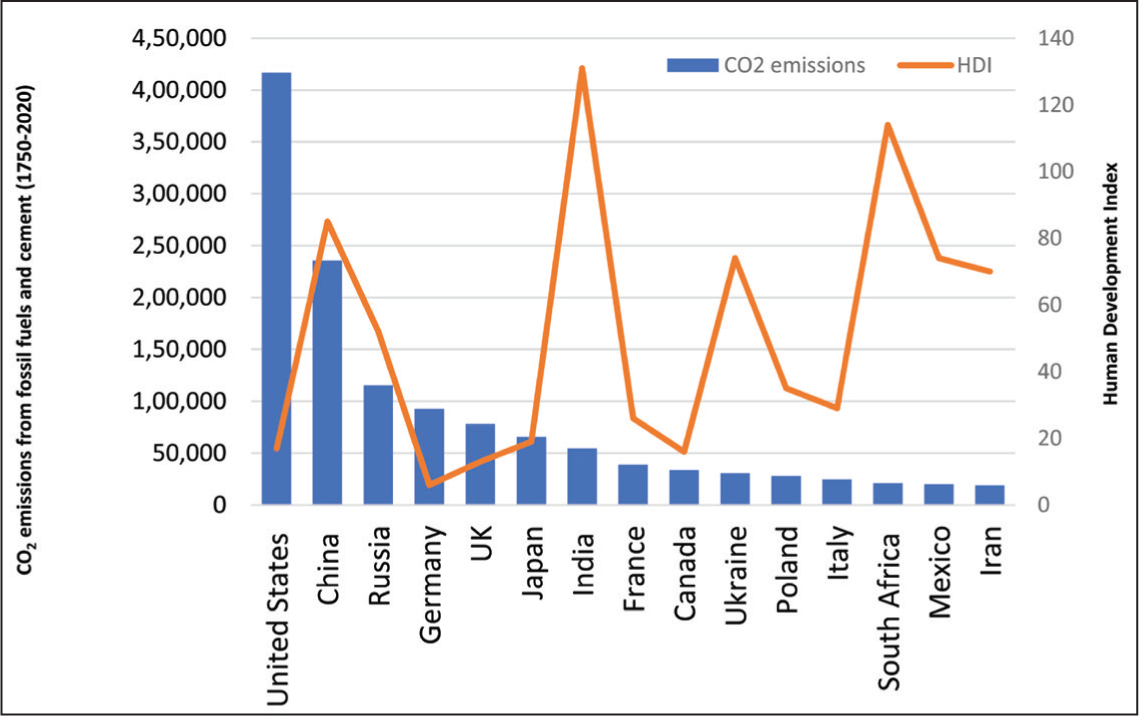
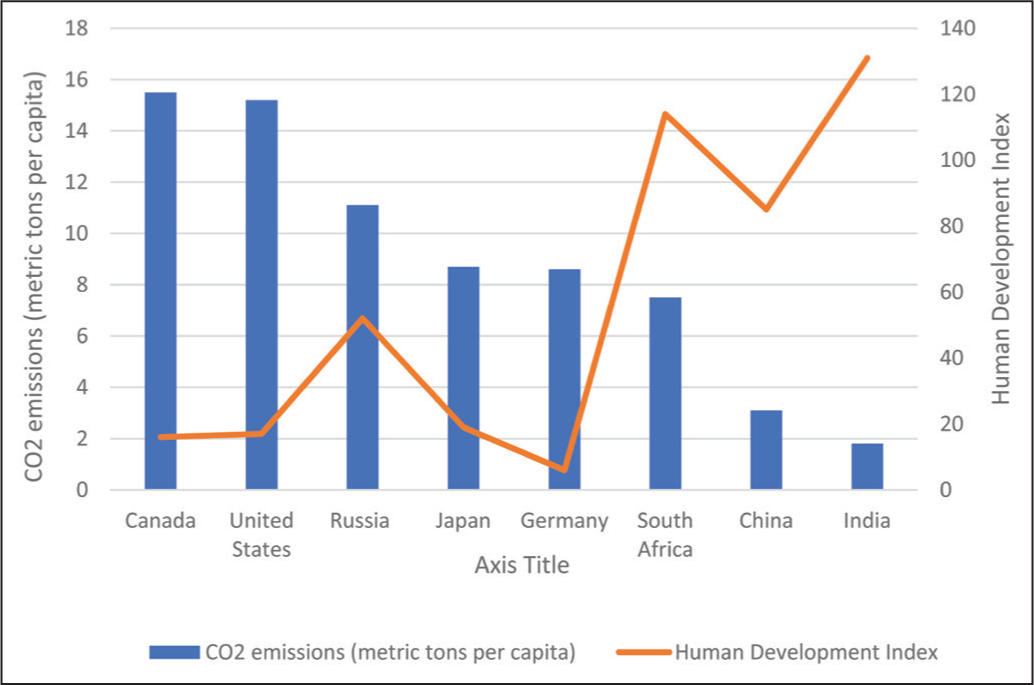
Therefore, emerging powers have to craft a strategy that addresses their developmental concerns while at the same time catering to their leadership aspirations. For this to happen, the focus should be given to two important responsibilities.
First, although their cumulative emissions as well as emissions per capita are significantly less than the developed countries (Singh et al., 2009; Union of Concerned Scientists, 2022), tackling climate change is not possible without the cooperation of emerging powers. Differential treatment should not be stretched to such limits that it defeats the very purpose of the treaty itself (Rajamani, 2006, p. 107). Thus, while developed countries still have to take a leading role in combating climate change, emerging powers have to shoulder additional responsibilities as well. This has been stressed by the Secretary-General of the United Nations as well, and his statement called on developed countries and emerging powers to take additional responsibilities for tackling climate change (COP26, 2021c). In this context, emerging powers have already started to take some required steps, and with the introduction of NDCs in the Paris Agreement, they are contributing towards combating climate change as per their national circumstances. It is the second task discussed below that is challenging.
Second, emerging powers have to find a way to accommodate the diverse interest groups that exist within developing countries, especially vulnerable groups like the SIDS. This is extremely important for taking a leadership role. In this particular context, it is important to refer to a study by Schirm (2010) relating to the leadership role of emerging powers. The said study highlights that an important aspect of leadership is its acceptance by potential followers, which is contingent upon accommodating the interests of potential followers, even to the extent of toning down one’s interests or aspirations (Schirm, 2010, p. 216). Using the leadership efforts by emerging powers like Brazil and Germany and the response from their potential followers across different forums like the UN Security Council, the World Trade Organization (WTO) and the International Monetary Fund (IMF) as a case study, it concludes:
[T]he evidence shows that leadership by emerging powers gains followership only if it is credibly framed as a project also representing the goals of others even to the point of changing one’s own goals and thus blurring the distinction between the goals of the emerging power and those of followers. (Schirm, 2010, p. 216)
Further, the above-mentioned conclusion is applicable not just in the case of potential followers from neighbouring countries but to distant followers as well (Schirm, 2010, p. 214).
In other words, if emerging powers want to emerge as leaders of a new world order, as opposed to being co-opted in the existing order (Anghie, 2015, p. 155), they have to accommodate the interests of vulnerable sections of the Global South, which includes the LDCs and SIDS. A mere increase in power or capabilities will not catapult a state to a leadership position; acceptance among potential followers is equally important (Schirm, 2010). This does not mean that they should relegate their specific concerns to the background. Rather, they have to find a way to pursue their interests while at the same time accommodating the interests of other vulnerable developing countries like LDCs and SIDS. In this context, working together on areas that are of mutual concern to SIDS and emerging powers (e.g., the issue of loss and damage, climate finance and climate-induced migration) should be explored. This is not an easy task, but gaining acceptance as a leader is not easy either.
It is important to mention here that the traditional North–South divide in international law, while relevant, is also being challenged. For instance, in the context of international climate change and trade laws, Pauwelyn (2013) concludes that the trend has shifted to individualisation of differential treatment, that is, differential treatment is based on individual circumstances. Weinhardt and Schöfer (2022) contradict the findings of Pauwelyn. They conclude that in the specific case of the WTO, law the traditional North–South division is being replaced by fragmentation among developing countries (Weinhardt & Schöfer, 2022). In this case, multiple vulnerable groups like the LDCs, small island vulnerable economies, low-income countries in transition, etc., compete with developing countries for getting special and differential treatment within the WTO (Weinhardt & Schöfer, 2022, p. 86). This has resulted in the phasing out of Special and Differential Treatment (SDT) for emerging powers as well as a significant number of other developing countries (Weinhardt & Schöfer, 2022, p. 88).
Failure to accommodate the interests of vulnerable groups could lead to individualisation of differential treatment or fragmentation of the same. In both cases, the traditional North–South divide becomes redundant and does not bode well for the leadership aspirations of emerging powers. Fragmentation could be a matter of serious concern in an international legal regime like that of climate change, which has been characterised as a ‘polycentric climate regime complex’ (Lövbrand et al., 2017, p. 596), where apart from states, other actors are playing an important role in mitigation as well as adaptation (Thakur, 2021). Using the example, of climate technology initiatives, emissions trading system and unilateral trade measures, Van Asselt and Zelli (2014) conclude that climate governance has moved from an era of the centrality of the UNFCCC to fragmentation. They further argue that fragmentation is a given and focus on achieving coordination and coherence through the UNFCCC (Van Asselt & Zelli, 2014, p. 138, 151). This aspect is specifically relevant for emerging powers like India, which have traditionally based their foreign policy within the traditional North–South framework (Hurrell, 2006, p. 19), and its climate policy is based on ‘equity concerns and limited historical responsibility for warming’ (Pillai & Dubash, 2021, p. S111).
Conclusion
The existing framework for differentiating between developed and developing countries in international environmental law continues to hold relevance. For instance, at COP26, various categories of developing countries, that is, oil-producing countries, SIDS, LDCs or emerging powers, reiterated the significance of common but differentiated responsibilities. This call holds specific significance in the context of climate finance.
However, at the same time, the traditional North–South divide is being challenged, and, in some cases, the special situation of SIDS has put their interests in direct conflict with those of emerging powers. This is because, in addition to the imminent and survival-related threat from climate change, their interests differ from those of other developing countries in some key areas. The reservations and objections by SIDS relating to fossil fuel subsidies (especially coal) are a case in point.
However, the divergence of interests among SIDS and other developing countries does not necessarily lead to individual differentiation, as CBDR-RC can coexist with different national circumstances. The existing situation presents a challenge as well as an opportunity for emerging powers like India. Naturally, countries like India would seek to protect their interests in international negotiating forums. Moreover, emerging powers continue to face many challenges on the developmental front. However, the criteria for taking on a leadership role demand that they must find a way to accommodate the interests of vulnerable developing countries like LDCs and SIDS.
The emergence of issues like climate finance and loss and damage in climate change-related negotiations provides an opportunity for emerging powers to forge deeper bonds between themselves and SIDS. Failure to do so would result in the rejection of their leadership among their potential followers. Further, it could make the existing framework of differentiating between Global North and South redundant, which in turn will adversely affect the leadership aspirations of emerging powers like India.
Footnotes
Declaration of Conflicting Interests
The author declared no potential conflicts of interest with respect to the research, authorship and/or publication of this article.
Funding
The author received no financial support for the research, authorship and/or publication of this article.