



Abstract
Less than one-fourth of women in the working-age group are in India’s workforce. This article draws from multiple studies of a 5-year-long programme that intervened to connect a million underprivileged women to employment opportunities across five Indian states. The article’s objective is twofold. One, identification of the barriers that keep women from joining and continuing in the workforce. Two, documentation of the enablers that the programme devised for women to overcome these barriers. The studies employ qualitative research methodologies to service these objectives, deriving their sampling typologies from the programme’s quantitative monitoring data. We find that severe impediments keep women from the workforce, especially so in the case of underprivileged women. These include curtailed mobility; mismatch in aspirations, education, training and work; first-generation-employee disadvantage; and traditionally gendered work division reinforced by male preference in the new urban economy’s emerging jobs. We schematise the programme’s services as a continual provision of information, counselling and mentorship to enable women to surmount these barriers—from girlhood to their adult lives. The programme design could provide insights for policymaking towards improving women’s participation in India’s workforce.
Keywords
Introduction
Statistics on women’s participation in India’s workforce make for a disturbing narrative. A World Bank report (2019) ranks India at 121 among 131 countries in female labour force participation (EconomicTimes, 2018, January). Perhaps even worse is that of the only 24% women in the working-age group who are in the country’s workforce, 94% are part of the unorganised sector (Central Statistics Office, 2018 and Manju, 2017). They are women who work as unskilled workers in insecure, often multiple, part time jobs, at lower wages than men, without unionisation. Low on literacy and skill levels, they are maids, petty vendors, casual farm and construction labourers. Worst still, even this manual and meagre female labour force participation at its current rate has fallen to a historical low (Rukmini, 2019).
Now for the possibilities. If all women in the working-age group in India were to work as often as men, the country would have over 200 million extra workers, estimates the Social Statistics Division (World Bank Group, 2019, September). This shift, the International Monetary Fund (IMF) calculates, would grow the economy by 27%, making India a developed country.1
But connecting with income opportunities remains impossible for the bulk of Indian women. There is a dearth of formal salaried jobs for women as workers in offices and factories, states the National Commission on Self-Employed Women and Women in the Informal Sector (Ela, et.al., 1989). Young women rarely find the white-collar jobs they desire. Which, in turn, pushes women into the informal sector, the Commission analyses. Mehrotra (2019) argues that with poor levels of education, most women get absorbed into agriculture, traditional services, construction or unorganised manufacturing sectors that have no social insurance (Social Statistics Division, 2019). Unsurprisingly, therefore, much of the female employment in India is either self-employment or being unpaid in family-owned enterprises (Sharma, 2012). The sixth economic census (2014), in fact, reveals that only 14% of the total number of entrepreneurs in India are women. Just 21% of proprietary establishments in India are owned by women. Thus, unable to find acceptable jobs or not being able to set up independent businesses or generate income from self-employment, and unenthusiastic about doing menial work, many women withdraw entirely from the workforce (National Survey Sample Office and All India Survey on Higher Education. (2017–2018)).
Literature Review
Extant literature on factors that impede women’s employment and entrepreneurship are given to being grouped into two broad categories: internal and external barriers.
Individual and Societal Conditioning are Deemed Internal Barriers
These include personality shortcomings, deficiencies in education and skilling competence, and attitude-related drawbacks. Giacomin et al. (2011), Ekanem (2015) and Ramadani (2015) investigate the limitations in working women’s personality and attitude, like lack of confidence. Studies show that these inadequacies are most often the consequence of societal perceptions that see women’s primary role as bearers of family obligations and caregiving responsibilities. Women are restricted in their careers, especially in business, because they are expected to prioritise family over career (Akhalwaya & Havenga, 2012). Sharma (2018) corroborates the above statement by suggesting that women are double-burdened with caregiving roles and community expectations. Johns (2013) observes that women receive little support to execute caregiving roles and have to extract time out of their careers to fulfil these. Meanwhile, Goyal and Parkash (2011) review media reports and assess that Indian women lack family and societal support for entrepreneurial growth.
Structural and Institutional Hierarchies Constitute External Barriers
Less-than-adequate sociopolitical, economic and infrastructural support to further women’s participation in the workforce add to their disadvantages. Empirical studies from different cultures and geographies record women’s voices with regard to their roles as workers and careerists being undermined. Gender bias and stereotyping at workplaces are common, according to Woldie and Adersua (2004) and Movahedi and Yaghoubi-Farani (2012). Research provides evidence for the numerous more problems women entrepreneurs face as compared to their male counterparts. These include lack of social acceptance for women’s entrepreneurial ventures (Jiang et al., 2012); lack of access to capital to run establishments (Gundry & Ben-Yoseph, 1998; Roomi & Parrot, 2008); and limited access to banks, credit and investors (Movahedi & Yaghoubi-Farani, 2012). Jennings and Brush (2013), in their study based on secondary literature, find that pursuing entrepreneurial activities such as launching a business, owning and managing a business, and commercialisation are less likely to be undertaken by women in comparison to men. Also, women-owned businesses are smaller in size, sales growth and number of employees when compared to businesses owned by men, say Morris et al. (2006). This is because women have limited access to entrepreneurial networks and, in turn, to learning business skills informally, explains Jayachandran (2020). Modarresi et al. (2017) are categorical that women do not have access to networks needed to forward their businesses and careers in male-dominated hierarchies. McElwee and Al-Ryami (2003) say that women’s upward mobility in businesses is stunted because they cannot ‘exchange information, discuss issues and seek advice’ since most business networks are male-dominated.
The Study Programme: Disha
The programme under study, titled Disha, was launched to address the aforementioned challenging context.
2
Initiated in 2015, the 5-year-long programme has been running across five states of India to connect a million underprivileged women to income opportunities by:
providing career guidance and counselling to young women to facilitate smooth transitions from education to work in schools, colleges and vocational institutes; creating collaborative platforms to match the needs of women job seekers with employers, especially local employers; constituting mentor networks to train, provide information and psycho-social support to women towards setting up microenterprises; and linking women to value chains by creating and strengthening collectives at the chains’ lower end.
A total of 1,015,341 women participated in 102 interventions (called pilots) under the Disha programme in Delhi National Capital Region (NCR), Haryana, Maharashtra, Karnataka and Telangana. 3 To implement these interventions, the programme engaged with 64 implementing partners, including civil society organisations and social enterprises, 79 training agencies, and five central and nine state government departments. The programme onboarded 244 employers.
Study Objectives
Identification of the barriers that keep women from joining and continuing in the workforce.
Documentation of the enablers that the study programme devised for women to overcome these barriers.
Research Design
To service the aforementioned objectives, this article draws from studies of nine interventions conducted between 2017 and 2019. 4 The studies employ qualitative methodologies. The sampling for qualitative research is based on the analysis of quantitative monitoring data pertaining to the intervention under study. Figure 1 illustrates the research design for the studies.

Source: Conceptualised by authors.
Secondary data are sourced from each intervention’s monitoring data and documents, online and offline—as collected by the Disha Management Information System (MIS), and provided by implementers and partners. Before the field research, information and insights are gathered on the activities of the intervention under study. For specific understanding of the intervention’s context, a study of literature, census data and media reports on gender, counselling, employment, entrepreneurship and market linkage in India is undertaken. To comprehend the intervention’s more immediate setting, its processes and progress, key informants (KIs) who can provide relevant facts and perspectives are identified.
Primary data collection comes from fieldwork, through semi-structured and structured in-depth interviews (IDIs) and focus group discussions (FGDs), verbal reports and observations.
The data collection centres are offices of implementers and other agencies involved, production and training units, and educational institutes and residences of programme participants. Themes that service the information needs of the study objectives are identified. Primary and secondary data are coded according to these themes. The coded material is analysed for the findings.
Sampling
Of the over one million programme participants, 71% and 29% belong to urban and rural India, respectively. A total of 42% are between 18 years and 25 years of age, and 27% are under 18 years. 5 In keeping with the programme’s mandate to target young women from underprivileged backgrounds, 64% of the participants belong to below poverty line (BPL) card-holding households. 6
An analysis of the programme-monitoring data provides for this article’s sampling typology. In that, the programme’s participants are of three types: (a) student—in educational institutions such as higher secondary schools, vocational institutes and colleges; (b) job seeker in educational institutions or in job market; and (c) neither student nor job seeker—mostly married women who are not in educational institutions nor actively seeking jobs. Further, the choice of specific interviewees for each ‘type’ of participant to be studied is guided by the purposive sampling technique. This technique is defined as selecting units (e.g., individuals, groups of individuals and institutions) based on specific purposes associated with answering a research study’s questions (Teddlie & Yu, 2007).
Findings
The 134 programme participants who are the primary subjects of the nine study interventions comprise all three participant types described earlier. Their demographic characteristics are as follows: the mean age is 31 years, the highest numbers at 33% are the group that has passed Class 12, 17% are graduates and 62% are married. The 94 KIs, include principals of schools, vocational institutes and colleges; training and placement officers (TPOs) in vocational institutes; onboarded employers; human resource (HR) professionals and recruitment consultants; agri and non-agri product aggregators; small-and-large-scale buyers; cooperative society members; village sarpanchs; and parents, siblings and spouses of the programme participants. The following findings are an aggregate of the analyses of the data collected from:
programme participants and KIs through IDIs and FGDs; field observations; programme documentation and monitoring data; secondary data and documentation, including media reports; and review of literature.
The following findings presented are in two parts:
All the programme participants confront obstructions that keep them from starting and continuing with work. Some barriers are common to all three participant types, across ages, education and geographies, while some others are more acute and overwhelming for particular types of women. The barriers are as follows:
Social prejudices prevent women from leaving home. Women going out to study and work are associated with uncontainable independence. Also with the the failure of male family members to provide for and protect women. Girl students in a Delhi-based Industrial Training Institute (ITI) said ‘responsible girls’ from ‘respectable families’ are expected to make education and career choices based on the proximity of these opportunities to their homes. 8 Additionally, the fear of physical safety already felt by women and their families is aggravated by rising reports of violent assaults on women. Parental panic levels have zoomed due to sensational media coverage on crimes against women, observed Deputy Director of the Delhi government’s Directorate of Training and Technical Education. Parents, now, impose stricter bans on the movements of their daughters, he regretted.
Women travelling to distant and unfamiliar spaces, including colleges, offices, factories and markets, is met with disapproval and discouragement. Women farmers in Maharashtra’s Yavatmal district said they had never been to a market to sell their produce. Though they are involved right from the process of sowing to harvesting, the women observed that only male farmers engage with marketing activities. The owner of a local private dal (pulse) mill explained why: markets are ‘male spaces’, involving travelling unsafe and uncomfortable distances, in trucks, with produce and cash, and waiting overnight in queues at wholesale markets, and interactions with male drivers, brokers, traders and labourers. A similar dread of difficult and dangerous commutes keeps urban women indoors, often prompting self-imposed bans on mobility. It is usual for women to quit not just due to the distances to their workspaces, but because of the poor and unsafe quality of these distances. A young woman recruited by a steel factory in Haryana under the study programme resigned within 3 months. Her reasons for quitting were a complex amalgam of personal and external compulsions. But the immediate reason articulated by her was commute. Her brother had seen bikers harass a woman at the neighbourhood bus station. He was already opposed to her working. Then, blinded by winter fog, the woman fell and hurt herself while returning from office. These incidents led to her family forbidding her from working.
Mobility Constraints.

Source: Focus group discussions and in-depth interviews conducted by the authors.
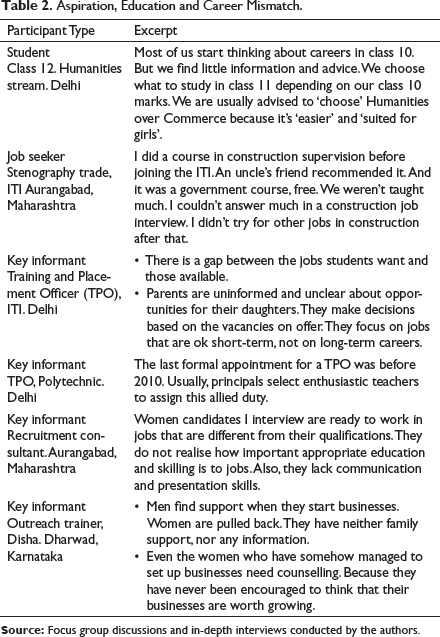
Career planning for girls (like for boys) is a dynamic process that is influenced by evolving interests, new information and academic scores obtained. The process begins as early as in classes 9 and 10 because a study stream has to be chosen in Class 11. And it continues through college, vocational training and even later when job-related choices are shaping larger career goals. For the most part, however, and unlike most boys and men, girls and women have inadequate exposure, counsel and guidance to inform the decisions required to plan their careers. Almost all the programme participants admitted to taking up courses and jobs because they were the only ones available, or someone or some website had recommended these.
There is inadequate, or no, career counselling in schools. Girl students of Class 12 said it is common for families and teachers to advise them to select the Humanities stream because it is ‘easier’ and ‘more suited’ for women. At vocational training institutes, shared a TPO in a Delhi-based polytechnic, counselling duties are assigned to ‘enthusiastic faculty’ as ‘allied responsibilities’. Consequently, counselling is mostly informal and cursory. Most ‘counsellors’ are unconnected to current trends and demands in the job market, the TPO pointed out, especially so with regard to employment for women in these job-squeezed times.
Given their underprivileged backgrounds, the families of the programme participants lack the levels of education and exposure needed to guide choices related to higher studies and careers. They are uninformed and unclear themselves about job and entrepreneurial opportunities. Additionally, unlike men who find support from family not only on employment but also entrepreneurship, women who want to start businesses need permission from family, which is usually hard to come by. An entrepreneurship trainer in Karnataka’s Dharwad district observed that even the rare women who manage to launch their own businesses against odds need advice and information. Because they are never encouraged to think that these are worth growing.
Aspiration, Education and Career Mismatch.
Source: Focus group discussions and in-depth interviews conducted by the authors.
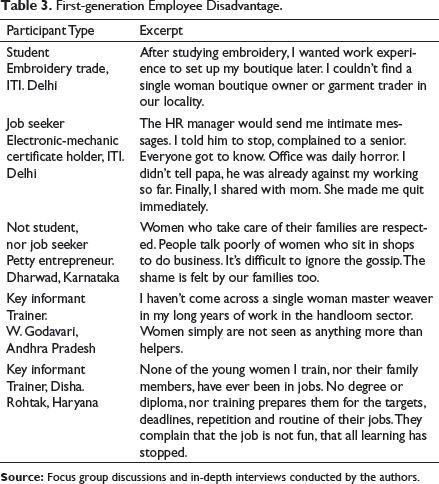
As first-generation women employees, these young women are underprepared, even unprepared, to deal with their employment experiences. Explaining which predicament, a trainer in an intervention to facilitate placements said that neither their degrees and diplomas nor his training compensate for his trainees’ lack of observed references and role models. As they grapple with unprecedented targets, deadlines and interpersonal dynamics at their workplace, only a few manage to cope. It is common for girls to slide into depression and quit, the trainer added.
There is no one to seek advice and learn from. Not in the immediate circle of family and friends, oftentimes, not even in the neighbourhood. An ITI student of embroidery, resident of a slum in West Delhi, shared her inability to find a woman boutique owner or garment trader to intern within or around her locality. Consequently, she accepted a tele-calling job closer home. The struggle continues even after managing to get jobs. Unaware of workspace etiquettes and entitlements, and unable to source information on these, young women strive to survive workplace dynamics. Working in an information technology (IT) firm, a polytechnic diploma holder said she felt constant humiliation at the hands of her colleagues who have B. Tech degrees, unsophisticated as she believes she is compared to them.
The families of first-generation women employees are also ill-prepared to deal with their daughters, sisters and wives going out to work. Most have never even had male members work in regular jobs. The fathers, uncles and brothers of the programme participants are farmers, petty shopkeepers, vegetable sellers, freelance technicians and repairmen, daily- wage workers and labourers. Expectedly, they are wary and protective of their women being part of unfamiliar and male-dominant workplaces.
First-generation Employee Disadvantage.
Source: Focus group discussions and in-depth interviews conducted by the authors.
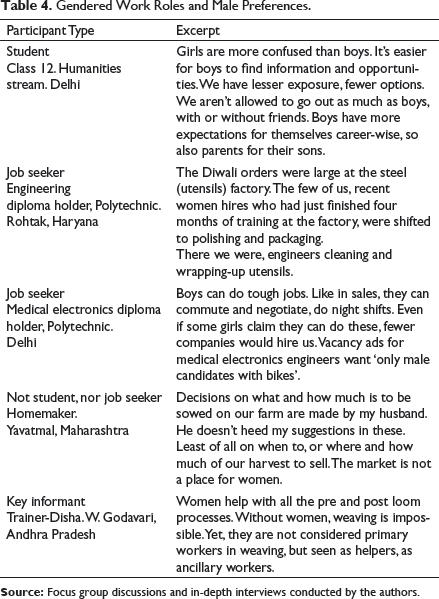
Entrepreneurial drive, while appreciated in men, is perceived as a dereliction of household duties in women by their families and communities. It is common to be shamed for ‘sitting in shops and interacting with strange men’, said some of the aspirant women entrepreneurs in Karnataka’s Dharwad district. This included sneering at families of such women, they added. The rare few women who are ‘allowed’ to start businesses must restrict themselves to tailoring, roti-making and running grocery stores from within the confines of their homes.
Gender bias is apparent in employment too, even in professional occupations. Programme participants observed that the work women were assigned in offices and factories were not the ‘mainstream jobs that men are seen as more capable of doing’. A group of women polytechnic diploma holders in engineering recruited in a steel utensils factory shared their frustration at being allocated only low-skilled manual work like polishing and packaging. The factory supervisor said that the assignments were strategic because women were better at ‘finer work’.
Gendered Work Roles and Male Preferences.
Source: Focus group discussions and in-depth interviews conducted by the authors.
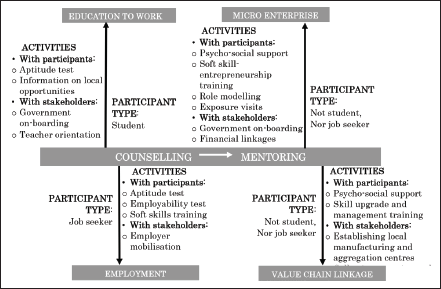
In response to the barriers identified earlier, the study programme devised enabling services for all three types of its participants—namely student, job seeker and not student, nor job seeker. The services aimed at enabling women to overcome barriers from connecting to, and continuing with, income opportunities by facilitating:
transition from education to work; job readiness and connections with the employment marketplace; wherewithal to set up, regularise and expand micro-enterprises; and linkages to value chain.
The provision of information and psycho-social support through continual counselling and mentorship is at the core of the enabling services. Figure 2 presents a schematic of the programme’s enabling services:
Source: Conceptualised by authors.
Mobilising stakeholder commitment was imperative to these counselling interventions. These entailed activities to ensure buy-in from government education departments, as also from principals and teachers in schools, colleges and vocational institutes. It also included procuring formal approvals from concerned authorities, as also orientation and training of institutions and faculty in career counselling skills.
The career counselling interventions affected impact both at the student and at the ecosystem levels. Students said that the sessions had motivated and guided them to better define their career goals. Special inspiration, said many, was derived from exposure to women professionals and entrepreneurs facilitated by the interventions. Students felt that the programme had begun streamlining and standardising career counselling, which is otherwise a largely perfunctory activity in schools and vocational institutes. TPOs in vocational institutes said they noticed new-found confidence in students who underwent counselling. At the system level, various state education departments introduced career counselling in their schools, colleges and vocational institutes. Parent engagement meetings were introduced in ITIs and polytechnics. Though not part of mainstream schedules in these institutes, they marked the beginning of interactions between parents and faculty towards shaping the careers of young women. Principals across schools and institutes recommended that such counselling should begin as early as Class 10, be mandatory and technology-enabled.
The interventions administered aptitude and employability tests to women candidates. The results of these assessments were then used to career counsel candidates and link them with suitable employers. Or, if candidates tested low on the employability quotient, they were enrolled into training agencies for soft and hard skilling to enhance their job worthiness. Simultaneously, the interventions mobilised employers, with focused efforts to onboard local firms and services. HR demands were mapped. Importantly, partnerships were forged to collaborate across employment portals, placement drives and job fairs.
An achievement of these interventions was the design and setting up of one-stop spaces—both physical and online—for women to assess their aptitude and employability, and access information, counselling and guidance on jobs and careers. Women job seekers said that the employment centres and job portals made the search for employment safe, and infused it with dignity. Job hunts for women, otherwise mean relying on small headhunting shops, agents and touts who promise jobs for a fee and most often turn out to be scamsters. Many women spoke of being reduced to physical job hunts, scouting around for workshop-to-shop, office-to-office and factory-to-factory to be met with rejections and rudeness. Onboarded employers, meanwhile, appreciated the interventions for making hiring easier, by facilitating connects with candidates already filtered to suit their requirements. This meant reduction in recruitment costs by doing away with the need to advertise vacancies and appoint recruiters. Employers recommended that the interventions should be consolidated as a social enterprise, and they should begin charging recruiting fee.
An innovation of these interventions was a multi-layer mentorship structure to provide information, guidance and psycho-social support to women keen on starting and growing existing businesses. At the village level, women with leadership qualities were identified and taught to provide training and support to women in their localities. They were designated Biz Sakhis, Women Sourcing Managers (WSM) and Coordinators. At the district level, the programme appointed managers, outreach trainers and counsellors to operate help desks for aspiring and existing women entrepreneurs. The help desks were set up in government departments that collaborated with the programme to promote entrepreneurship among women.
Women who participated in all three levels of training said these had motivated and equipped them with information and skills to develop and consolidate their business ideas. Also, that the training had facilitated them with an understanding of the value of demand and supply assessments before launching enterprises in already-limited rural and small-town markets. The guest lectures provided women with never-before-experienced access to insights and practical tips from entrepreneurs, investors and banking professionals. Bureaucrats from the Karnataka government’s Department of Skill Development, Entrepreneurship and Livelihood confirmed that the state budget had provided a substantial grant for the financial year 2018–2019 to promote skill development training among youth on the lines of these interventions.
The interventions offered services to increase the income of women who were neither students nor in the job market, particularly women farmers and artisans. These included technical and capacity-building training for skill upgrade. Local aggregation centres and manufacturing units were set up to facilitate convenient access to workspaces and markets. Also, the constitution of women’s collectives, like producer companies and mutually aided cooperative societies (MACS), was facilitated. Websites for these collectives were created to enable online promotion and marketing of their products. Participants were trained in digital marketing skills. Participation in exhibitions across the country was facilitated to add to women’s market exposure and opportunities.
A crucial and consistent part of these interventions were training in mentorship imparted to women managers of the collectives who were identified and appointed locally. Even after the interventions make their exit, these managers will remain repositories of knowledge for their communities and will continue to guide women into maximising income opportunities.
The interventions took the necessary first steps towards institutionalising value chain linkages for women, especially women farmers and artisans. They facilitated the formation of collectives, and developed a standard operating procedure (SOP) to aid the functioning of these. They also trained local women to manage the collectives based on the SOP. Also, small-and large-scale buyers were onboarded to be part of the value chains. Women said they found benefit in the training. Lessons in upscaling traditional skills and learning allied ones taught them how to stabilise and enhance income. Being part of collectives, running e-commerce websites, visits to markets and exhibitions opened up new marketing and sales avenues. Many women admitted to having been unfamiliar even with the market rates of their own produce till the interventions had taught them how crucial it was to be informed. Trainers said the novel market-facing experiences provided by the interventions made women confident and assertive with regard to their work lives.
Conclusion
Severe impediments keep women from the workforce, especially so in the case of underprivileged women. Concerns around mobility curb possibilities and pathways to higher education for girls and women. And these continue to restrict, often even bring to an end, their work lives. Local work is preferred by both men and women, especially so at low salaries. But for women, it is often the only socially permissible option. Most young women from underprivileged backgrounds are first-generation employees. They lack working women as role models in their nuclear and extended families, and neighbourhoods. Their families too are without references and ill-equipped to cope with women members working. In fact, support and resources needed to match aptitude and the choice of education and career are in limited supply for women. Career guidance in schools and colleges is inadequate, if not absent. Workspaces rarely have gender-sensitive counsellors. Additionally, traditionally, gendered work division assigns women ‘non-technical’ ‘softer’ jobs in ‘helper’ roles, and lower incomes in comparison to men. Women are discouraged, even shamed, for aspiring to do business. And emerging jobs in the new urban economy prefer male candidates, at least at the lower end. Already deficient in technical and soft skills, women are further disadvantaged as competitors in the gendered, job-squeezed market.
At the core of the study programme’s design is the recognition that impediments that keep women from the workforce cannot be overcome at the sites of work alone. The programme’s services are, thus, a continual provision of information, counselling and mentorship to facilitate women to surmount these barriers—from girlhood to their adult lives. These begin with career counselling and guidance interventions in schools, vocational institutes and colleges. The aim is to enable women to achieve a synthesis between their aptitude, interests, education, training and careers. Similar ambitions at actualising women’s aspirations drive the creation of mentorship networks to inform and advise women on business ideas and schemes. Mentors provide women with psycho-social support to become entrepreneurs. Meanwhile, issues of mobility are addressed by creating online and offline collaborative platforms to connect job-seeking women with local employers. As also by setting up local manufacturing and aggregation centres to link women to value chains. Training in technical and soft skills are provided towards upscaling, diversifying and being employment ready. The design of the study programme could provide insights for policymaking towards improving women’s participation in India’s workforce.
Footnotes
Acknowledgement
We thank the IKEA Foundation and the United Nation Development Programme (UNDP), the sponsors and primary implementer of Disha respectively, for providing us with research freedom. We also thank the India Development Foundation (IDF) for support and guidance. Our gratitude to the UNDP and other local teams that assisted us with field research. And to all those who engaged with our studies to enrich them: Disha’s women participants, their families, their communities, employers, government officials and other key informants.
Declaration of Conflicting Interests
Funding
The authors received no financial support for the research, authorship and/or publication of this article.