




Abstract
The micro, small and medium enterprises (MSMEs) are the backbone of the community development in the developing world. In the fragile and backward regions, it is the micro enterprise that is considered to be the engine of growth and development. Being labour-intensive and requiring lesser capital input, the micro unit start-ups demand lesser investment in plant and machinery, attracting more and more potential entrepreneurs. Over the time, such units gain experience and knowledge becoming more efficient. This article studies the firms located in the fragile and geographically remote region of Jammu and Kashmir. The article uses a panel of 15 years from 2002 to 2016 based on the Annual Survey of Industries data. Using the Stochastic Frontier Analysis, the article studies the MSMEs and the micro units. From the post-estimation, technical efficiency scores are attained for both MSMEs and the micro units. The results reveal that the micro units are more efficient than the MSMEs in general. Tobit regression is used to estimate the technical inefficiency model to determine the factors that contribute to the inefficiency present in the micro units. The results show that there is a negative relationship between the efficiency of the micro unit firms and the asset-liability ratio and the loan-liability ratio, while there is a positive relationship between the private ownership of the firm and the efficiency level. Age of the firm is considered separately to validate the ‘learning theory’ by Jovanovic. The article concludes by suggesting that the government must provide adequate boost and a big-push to the micro units in order to eradicate the widespread unemployment and fragility in the region.
Introduction
The micro, small and medium enterprises (MSMEs) development model has been a tested and successful model in the context of developing nations. For the last five decades, the MSMEs sector has been growing by leaps and bounds in the case of the Indian subcontinent. From being more labour intensive to using simpler capital, this sector has all the features needed to develop the poor nations (Shihabudheen, 2013). It is the MSMEs sector that produces most of the industrial output, provides maximum employment in the secondary sector and has the best innovating and coping strategies developed in the most cost-efficient ways. The sector doesn’t require high and complex skills, which anyways is scanty in the developing world. The MSMEs are located across the lengths and breadths of the nation and help in decreasing the regional imbalances. At the same time, MSMEs utilise the local resources and undertake the process of value addition by bearing the least costs. The growth and development of MSMEs contributes to the socio-economic development of the whole region.
There has been a constant change in the scope and definition of the firms in India. From investment criteria, through the employment criteria to the current turnover criteria both the definitions and the nature of the secondary sector have changed drastically. The Micro, Small and Medium Enterprises Development Act, 2006, classifies the micro, medium and small enterprises into two classes, namely the manufacturing enterprises and the services enterprises. The manufacturing enterprises are classified into micro, small and medium enterprises on the basis of investment in plant and machinery, while the services enterprises are classified on the basis of investment in equipment. The said investment of less than 25 lakh rupees for manufacturing and 10 lakh for the services enterprises is classified as the micro unit. This is followed by the investment bracket of 25 lakh to 5 crore in manufacturing and 10 lakh to 2 crore in the services sector composing the small units. When the investment goes above 5 crore and stays below 10 crore in the case of manufacturing and 2–5 crore bracket in the services sector the enterprises are classified as the medium ones. This definition is followed by the new definition that was presented by the current finance minister of India, Nirmala Sitharaman, ahead of announcing the Government of India’s rejuvenation package in the wake of COVID-19 crisis for the MSMEs. The new definition classifies the MSMEs on the basis of investment in capital and machinery and subsequently on the basis of turnover of the units (Jha, 2020). However, for the purpose of this study, we will be using the old definition as the time period under study falls under that limit.
Of the three types of units that come under the MSMEs head, the micro units have received little attention. It is the micro enterprise that requires the least complex knowledge of skills and knowhow. In a country where the levels of poverty are still high, an industrialisation that is highly mechanised can’t be dreamt of immediately. Simple machinery combined with simple labour using the locally available resources makes the micro units the most desirable ones in the under-developed and developing part of the world. The micro units do not require the complex and expensive prerequisites demanded by the large enterprises. Such units instead contribute to employment generation and poverty reduction. At the same time, micro units can flourish in rural as well as urban areas. This way poverty reduction can be aimed at the very grassroots level without having to deal problems like migration, etc.
The micro units are defined as tiny business units employing only a few employees. In most of the cases, these employees can be family members. The range of output and the inputs used both are simple (Gosen & Sameer, 2009). Micro units are known to use the minimum technology and thus have a special importance for the poor countries and the backward regions. Micro units contribute to poverty alleviation in a diverse way targeting the poor at the very grassroots level, thus decreasing the number of global poor sustainably. Almas in his 2001 paper emphasises on the importance of the micro units in ushering a growth process that is welfare oriented and leads to the convergence of incomes across a nation. From generating new ideas to developing the coping strategies, micro units push entrepreneurship and self-employment very high.
Globally empirical research has been conducted that supports the fact that the micro units have the maximum potential to eradicate poverty and provide sustainably gainful employment to the poor people. Evidences from poor as well as developed countries such as Ethiopia (Gebreeyesus, 2007), South Africa (McPherson, 1996), Sweden (Heshmati, 2001) and India (Ramarao, 2012; Srinavas, 2013) testify the importance and positive contribution of the micro and tiny units. Each research highlights an important contribution validated through empirical analysis made by the micro units. In the context of India, S.P. Kashyap in his 1988 paper explains how right from the Second Five-Year Plan a strategy was carved out to develop the small scale and household level industries. The industrial policy resolution of 1956 explained how the tiny and household units were supposed to grow under appropriate government protection and integrate in the mainstream industrialisation process overtime (Kashyap, 1988). From preventing the unplanned urbanisation to spreading the minute secondary sector across the country, the best solution to mitigate poverty was seen in this development. At the same time it was expected that this sector will utilise the labour and skill that would otherwise remain unutilised and will go waste.
The (then) state of Jammu and Kashmir is the most backward industrial state of India. From being geographically remote to being a bordering state, a number of problems are endogenously associated with the region. While the Ladakh region is a hilly state and has the least favourable conditions for industrial development, the Chenab Valley is cut from the main areas of Jammu and Kashmir. The persistent low intensity conflict in the region makes the situation worse. Uncertainty and fragility discourage the industrialisation of a region (Widmalm, 1997). As such the industrial environment in the whole state of Jammu and Kashmir has been unfavourable. The vicious circle of underdevelopment and backwardness is self-perpetuated in the region with unfavourable industrial climate setting the trigger of perpetual un- and underemployment, consumerism and lack of opportunities to carry productive activities. In such circumstances, it is the growth and development of the micro units that has the scope to break this vicious circle.
In the light of these facts and figures, the current study is a novel contribution towards the understanding of the micro units in the underdeveloped regions in general and fragile regions of such nations in particular. The present study highlights the importance of the micro units in spreading the process of industrialisation in backward regions. The article also points to the benefit of using locally available factors of production and its association with the micro unit enterprises. The article concludes by giving relevant policy interventions in order to provide a big push towards the growth and development of the micro unit enterprises in fragile and backward situations.
Data and Methodology
The data is taken from the Annual Survey of Industries (ASI) collected by the Ministry of Statistics and Programme Implementation of India. The data is now freely available for research use in the Indian Council of Social Science Research data repository. A panel of 4,347 firms is made for the time period of 15 years from 2002 to 2016. From the panel, the firms are classified into the micro, small and medium units. Of the total firms 53% units are the micro units. The firms both MSMEs and the micro units are studied for a period of 15 years from 2002 to 2015. There is no study that we could find, studying the MSMEs in the Jammu and Kashmir region using the ASI data. Eventually no literature review can be summed up in the context of past studies. The only studies that could be found were theoretical considerations published callously. And as such, no mention of the said papers/studies is made here. The variables used in this panel are deflated by using the wholesale price index at the aggregate level.
Specification of the Model
To study the MSME and the micro firms in Jammu and Kashmir, the basic Cobb–Douglas production function is taken. The two inputs of labour and capital are considered since these two inputs are the universal inputs and used in all sorts of production. The ex-factory value of output is taken as the single output produced by the firms in the panel. This value of output is used by almost all the studies using ASI data at various levels (Kashyap, 1988; Khan & Abdulla, 2019; Singh et al., 2019). The Battese and Coelli (1988) model is used to determine the frontier:

where ln represents the natural logarithm, which is log to the base of e.
Technical Inefficiency Model
The post-estimation of the frontier model gives the scores of the technical efficiency of the firm. Technical inefficiency model is based on the same results. In the case of this panel, we use the Tobit model to explain the factors affecting the efficiency of the micro firm in Jammu and Kashmir are used because the regression is censored. The value of efficiency which is the dependent variable ranges between 0 and 1 and thus the regression becomes censored.
The technical inefficiency model used for this study is

where
As per the ASI schedule, there are six types of ownerships of the firm. For the simplicity of this analysis we have clustered the firm ownerships into three categories, namely government owned, privately owned and jointly owned. However, the environment of joint sector is not much visible in case of Jammu and Kashmir region, and hence very few samples are surveyed in ASI data. As such including them is not feasible for analysis here. The dummy variable
The age of the firm is an important variable in determining the technical efficiency. To consider the age of the firm separately, the technical efficiencies of the micro firms corresponding each time period are presented and explained.
MSMEs in J&K over the Last 15 Years
MSMEs in J&K.
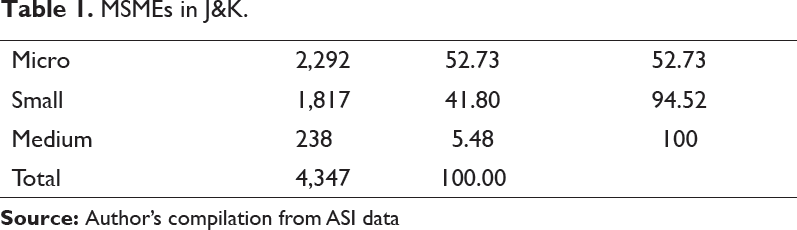
Given the geographic, climatic and conflict-ridden nature of Jammu and Kashmir region, investment is always risky. The financial and other institutions, within and outside India, accordingly are always sceptic to invest in the places of high uncertainty. For instance, 25 foreign envoys from different countries of the world, after observing politico-economic conditions of Kashmir, made a statement that Kashmir is not ‘conducive for foreign investment’ (Ganai, 2020). At the same time the risks involved in the case of Jammu and Kashmir are many. The harsh winter especially in the Kashmir and Ladakh region breaks the road connectivity and often communication and the said regions can go without land connectivity for months. This puts a threat to the demand and supply chains. As a result, the lack of reasonable financial availability has been dim. At the same time, the MNCs and other national and international business giants considering thorough cost-benefit analysis fail to open up their units in this part of the world. Being not only a bordering state but at the same time a conflict-ridden area increases the fragility and uncertainty in the region (Pradhan, 2004). Durable peace has long been absent in the said region (Bose, 1999). Combining all these factors, the scope of medium and large enterprises in the region of Jammu and Kashmir hasn’t been workable and sustainable. As such, the scope of the growth and development of large units in J&K has not been feasible.
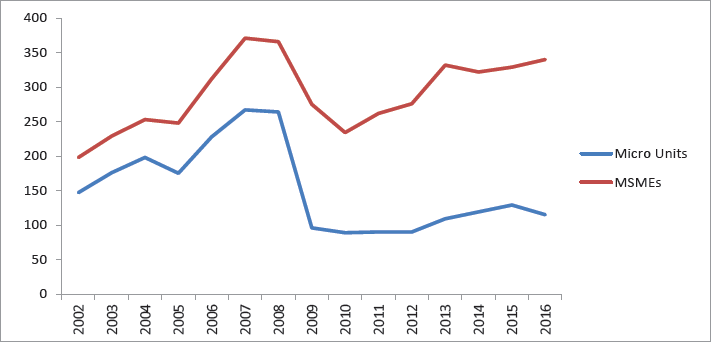
An absence of total industrialisation in any area of the world goes against the axioms of the modern-day notions of decentralised growth and development. It falls both upon the policy makers and the local population to derive and find the most feasible ways to undertake the process of industrialisation. It is a known fact that the region of Jammu and Kashmir has always had a weak institutional structure (Widmalm, 1997). As such, it falls upon the existing and potential entrepreneurs of the region to undertake the process of development in their own hands. From generating ventures of self-employment to being the job providers and making the region a little less of a consumer state, entrepreneurs in the underdeveloped parts of the world are supposed to create a productive business environment (Li & Rama, 2015).
Growth of MSMEs over Time.

Results and discussions
Stochastic Frontier Analysis
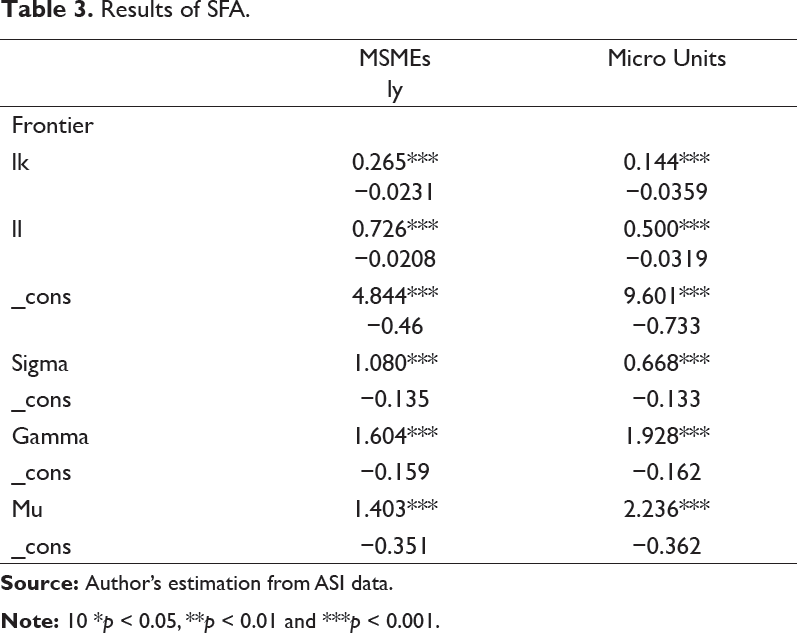
We first conduct the stochastic frontier analysis (SFA). The results of SFA are summed up in Table 3 for the MSMEs sector in Jammu and Kashmir as well as the micro sector separately. The production function used in this case is a basic Cobb–Douglas production function. It uses two inputs to produce one output. Capital and labour is used to produce the output. The output value is the gross factory value of output produced by a firm as specified in the ASI data.
Holding the labour input constant for the MSMEs, a one percentage increase in the capital input leads to a 26% increase in the total output produced by the firm. The relationship between capital and output in the MSMEs sector is positive and highly significant. On the other hand, while holding capital constant; a 1% increase in the labour input increases the output by 72%. The results are again highly significant and the relation positive in nature. For the time period under study there accrue constant returns to scale for the MSMEs sector in Jammu and Kashmir. The overall nature of industrialisation in J&K tends to be labour intensive.
For the micro sector the relationship between inputs and output is both positive and significant. Holding the labour constant, with a percentage change, that is, to say a percentage increase in the capital input there is a 14% change in the output. At the same time holding the capital input constant, a percentage increase in the labour input leads to a 50% increase in the output. The results are in line with the basic nature of the micro units that use simple and less capital tools and are mostly labour oriented. It can be deciphered from the labour coefficient that the firms in Jammu and Kashmir region are highly labour intensive and need least capital to increase the output.
Efficiency Scores
Results of SFA.
Efficiency Scores.

The micro units are the margin firms, by the very nature of their existence and operation; they do not have the capacity to bear shocks and high-level inefficiencies. Consequently, Nelson in his 1981 paper considers the firms to be entities making the production bets based on their resource and technology availability. These considerations determine the differences in the efficiency levels of the firms (Nelson & Nelson, 1981). The stakes are high for the micro units especially in the backward and fragile zones. It becomes essential that these units play a calculated game and undertake the production in the most feasible way with least mistakes and wastage of limited resources. Micro units are more prone to churning. Though the process of constructive destruction may be viable in the developed world, poor and backward regions like Jammu and Kashmir can’t afford high churn rates (Kane, 2012).
There is a vast array of empirical research showing that the micro units being limited capital firms are able to derive higher returns on the capital. The average return to the capital for these units is higher than their respective rate of interests. The same has been tested by Lerner et al. (2013) on Sri Lanka, Grimm et al. (2011) in the sub-Saharan Africa among others. It can be analogously concluded that the micro firms in Jammu and Kashmir like other poor, backward and fragile regions tend to be more efficient compared to the units of larger scale in the same region given their strict conditions of existence. As a result, the micro units have a necessity to work as their best and enhance the overall productivity of their units.
Tobit Estimation
Tobit Results.
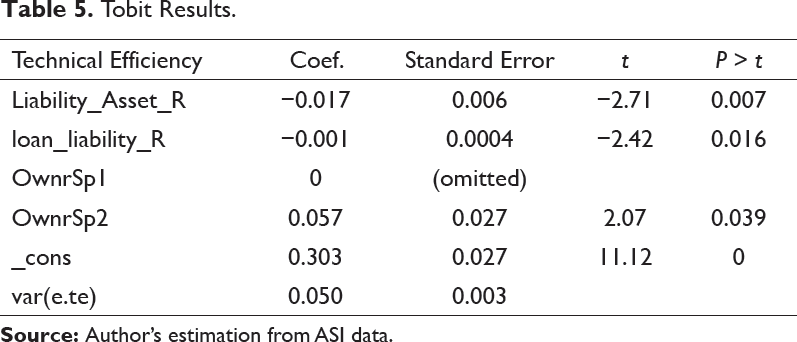
The ratio of total loans to liabilities of the firms shows the relationship between the indebtedness of the micro units with their efficiency level. There is a again of a negative relationship between the two in case of the micro units in Jammu and Kashmir. The results confirm that the inefficiency in the firms is caused by a higher loans and liabilities. Micro units usually produce simple and homogeneous products thus make normal profits. Given the level of investment and turnover of such units, these units are also faced by the lack of collateral while seeking financial help from formal and dedicated sources (Bigsten et al., 2003). This pushes the firms to take loans from the sources that charge higher interest rates and thus dim the prospectus of firm efficiency and growth. Therefore, such units have to be vigil while taking any sort of loan because their chance of paying it back is not much higher like in the case of medium or small-scale units that are both technologically advanced and have access to more formal sources of credit (Cressy & Olofsson, 1997).
As already pointed out, we have included only two types of ownership excluding joint sector: (a) government owned (Ownrsp1) and (b) privately owned (Ownrsp2). In the Tobit regression Table 5, benchmarking Ownrsp1, there is a positive and significant relationship between the private ownership of a firm and its technical efficiency. The said point is highlighted by literature where, privately owned micro units tend to be more efficient because most of the times, the owner is the manager. Most often the owner himself works in the firm, the ‘learners theory’ applies and the owner finds ways to innovate and make the production process more efficient (Jovanovic, 2016).
One of the important factors explaining the positive relationship between the private ownership of the micro unit and the overall technical efficiency is the social networking effect. A lot of empirical literature focuses on the importance of the social networks in the process of firm growth and increased level of efficiency. Geertz in his 1978 paper empirically establishes the positive relationship between the efficiency of a firm and the relationship between individuals over the value chain. From obtaining access to information to getting credit access, social networks in case of micro units can boost the firm’s overall functioning (Geertz, 1978). Social networking enhances efficiency of the micro unit by helping the entrepreneur in a number of ways along the value chain. From getting the inputs at a cheaper price to selling the output in a better market for a higher price without having many intermediaries in between the social network enhances the efficiency (Barr, 1998). But for the social network to work the firm must be individual centric as it requires a lot of negotiation and grape-wine type of contacts building. If the micro unit is owned by the government or any of its agencies everything has to work in the formal manners and through proper papers. There remains no scope of social networks in an enterprise owned/managed by the government. Therefore, the micro units owned/managed by the government are inefficient, while the units owned and run by the private individuals are more efficient, as reflected by the Tobit coefficients for the ownership dummy.
Age of the Firm
The age of the firm is an important variable in determining the efficiency of the firms, in the case of Jammu and Kashmir it can be seen that the old firms show very high levels of technical efficiency. This is in line with ‘learning theory’ given by Jovanovic (2016). As per him, after expanding the business operations in the initial years of production and reaching an optimal size, with age the firm’s productivity and efficiency expands. The results drawn above and presented in Figure 2 follow the Jovanovic theory and the age of the firm is taken as an important variable determining the efficiency growth over time.
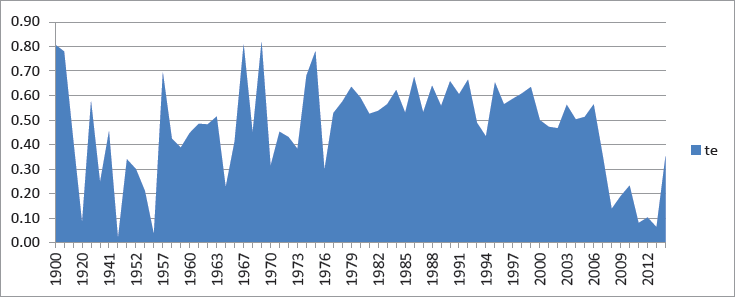
There is ample evidence that in the poor and developing world, the micro unit holders often learn by doing their job repetitively. Nichter and Goldmark (2009) elaborate on how firms in the developing regions slowly gain skill and knowledge over time. While indirectly expanding the contacts and entrepreneurial networks get a better hold of information and market conditions. Such ideas specifically hold in the Jammu and Kashmir region given the backwardness of the region coupled with the low intensity conflict. In the case of conflict, there is a lot of hidden information and indirect supply chains and business paths that are not known or understood directly. Therefore, the older firms have an edge in this case.
Given the small size constraint that prevents the firms from investing in research and development, firms are left to be innovative with all the little they have. Thus, efficiency comes with time and experience rather than with technology and R&D. The lack of credit facilities again limits the firm’s targets of gaining high technical efficiency. As a coping strategy, firms have to take a longer time path. They have to accumulate the retained profits and in a future time period invest the same and increase their efficiencies.
Conclusion
The article studies the micro, small and medium enterprises in Indian administered region of Jammu and Kashmir. There is a serious paucity of research on enterprises in the region. To our best of knowledge, this is first study that exploits the pooled panel data from 2002 and 2016 from the ASI, conducted by Ministry of Statistics and Programme Implementation, Government of India. Under this study we conduct three-tier analysis on MSMEs surveyed over the period of 15 years. First, we employ SFA to understand the relationship between inputs and outputs on the lines of Cobb–Douglas production function. The result suggests that MSMEs in the region are labour intensive, and require least capital for manufacturing and production. Only 1% change input of capital and labour increases the output by 26% and 72%, respectively. We also conduct SFA on micro enterprises separately with the rationale that features of the region of Jammu and Kashmir having non-conducive climatic, geographical and conflict-ridden area might be more suitable for micro enterprises. The results are also similar, with 1% change in capital and labour changes output by 14% and 50%, respectively. Second, from post estimation, technical efficiency is calculated both for micro enterprises and MSMEs in general. The results uphold our rational that micro enterprises are more efficient than other small and medium enterprises. Approximately 50% of the micro enterprises are efficient as compared to only 37% overall MSMEs. Finally, we attempt to explore the factors that cause (in)efficiency in these enterprises using Tobit model. The results suggest that firms with higher asset-liability and the loan-liability ratio tend to have higher inefficiency while as the enterprises that are wholly private/individual owned as compared to government owned have higher efficiency levels. Individual ownership is a successful way of enhancing the efficiency of the micro units. But care should be taken by the government in investing directly in such units. It can fund a big amount and use it as seed-capital and subsidy for the people falling in the ‘youth-bulk’ demographic cohort. Furthermore, age of the firm is considered separately; age is positively associated with efficiency levels. The result is supported by enormous literature under the name of learning theory. The article concludes by suggesting that the government must provide adequate boost and a big push to the micro units. The micro sector can be further developed by appropriate policy intervention. The financial constraint is the greatest problem faced by this sector. However, it is not the direct loan or private debt this sector needs to grow but instead proper protection. The micro sector needs a big push in the form of seed capital, subsidies, tax wavers and market share quotas. Since the financial constraint in this sector does not allow for an explicit unit based R&D, it falls upon the government and its agencies to enhance efficiency and productivity based R&D for this sector using its own resources. It is an established fact that peace is the basic pre-condition for smooth (industrial) development. The efficiency of the micro units can be increased by making the durable peace sustainable and long lasting in the region. Also, a considerable amount must be spent to carry out research and development to improve the micro sector and enhance its efficiency. However, it can also be concluded that unless the politically fragile environment in the region has improved, inefficiency in economic institution both at the micro as well as well macro level may continue to elude desired outcome. Peace and security are important parameters which have to be dealt with for the long-term economic development.
Footnotes
Acknowledgements
We would highly like to thank Dr Abdulla for his valuable help and comments on the initial draft of this manuscript.
Declaration of Conflicting Interests
Funding
The authors received no financial support for the research, authorship and/or publication of this article.
