



Abstract
Spatial differences in the level of economic activity have several sources and conditioning factors. The most obvious among them is the character of naturally available material endowments including climatic and terrain conditions. The connectivity with adjacent or distant trading centres is yet another dimension that plays a critical role in propagating multiplier effects of ‘backward and forward linkages’ and gravity forces among the regions. What is attempted here is to create a template of a strategic framework for approaching the issues of regional disparities as they arise in varied forms and magnitude.
Keywords
Introduction
For some time now, it has been said that the story of India is the story of her States including the disparities within them (Bakshi et al., 2015). Of late, intra-state regional disparities have come to the fore. Many state governments have set up committees to look into intra-regional disparities in their states. Here, we attempt to abstract the core approach that Dr Vijay Kelkar Committee followed in its analysis and proffering its recommendations. Generally, region, as well as disparities, has several connotations. These could be geographically demarcated with administrative jurisdictions at varied levels of government. Thus, regions could be the whole of continents nation-states or erstwhile provinces or could be states and one could move on to sub-state levels. Sometimes, moving away from the standard understanding of regions in the spatial sense alone, we may want to imagine regions based on attributes that render a collective of people particularly vulnerable and call for special attention. Similarly, disparities could mean socio-cultural political or indeed economic (which is of primary importance for us) again, measured severally. On the matter of unit of analysis, after due consideration, we have concluded that on balance, it is best to stick with the district as the unit of the regional analysis. After all, it is the primary construct of administration in India and optimally suited to be a relevant and meaningful unit of the regional analysis. Data are also typically available with some reliability at this level. Below this level, especially in rural India, the data on several variables of economic consequence are simply not available. At a higher level, aggregation is possible.
Since our interest is not purely academic or epistemic, a question like ‘Why do disparities arise?’ is of interest to us only to the extent that on the one hand, it establishes our position that at least beyond a point disparities are not desirable for various reasons, and an answer provides us clues about how one could go about reducing such disparities. We will only state here that disparities arise and are perpetrated over time due to historically induced path dependency, differences in human endowed capital, physical infrastructure, natural endowments, geographical features, and perhaps the rather nebulous, yet largely important for outcomes: social capital.
In studying and working out strategies of development processes related to human systems, it is well worth adopting the twin lenses of liveability and livelihoods in discerning the issues involved. These, to anticipate what comes a little later, provide the basis for the two tracks/pronged approach.
Prologue
We will recommend the adoption of a two-track multi-dimensional approach to tackle the issues here. From the start, we emphasize our argument that resources alone, while important in the outcomes we want to achieve, will not get us there. To prepare the ground, we will step back a bit and briefly deal with the overarching background. This overarching framework is provided by a good governance system. This is not something grandiose but rather is made of brick and mortar stuff and maybe simply be conceptualized as being made up of four basic components.
The governance system deals with incentive induced interactions by and between agents and agencies and comprises four components: (a) policy framework/design (not individual policies by themselves alone) which set the incentives for agents and agencies involved; (b) processes and protocols which could be modified to reduce transactions costs; (c) capacity building (data and skills to analyse and implement) which determine if and how decisions by the agents and agencies via the induced incentives lead to actions which in turn lead to outcomes and (d) independent evaluation office (IEO) which helps to monitor the entire process above and help to tweak and redesign/reform the above components.
The basic mantra is the policy framework creates incentives that prompt action plans that based on capacity lead to actual implementation and further outcomes. So, if one is not satisfied with outcomes, it is well to take a look at the policy design or capacity.
Given that all economic institutions primarily are driven by the objective to reduce transaction costs, one important way to do it is through leveraging ICT. Smart Governance which is in vogue is all of the above with the proviso that it should be inclusive in the sense that it should lead to the creation of an ecosystem where the Government, Academia, Private Sector and the Civil Society agencies are in continuous dialogue and data/information sharing mode in the process of taking any decision.
The policy framework provides a macro-parametric environment but the fleshing out of the capacity remains an important task in the attainment of optimal outcomes. For example, where individuals need to voluntarily join to form a group the principle of imputation which incentivizes coalition formation comes into play. Thus, we need to go a little farther than the matter at hand to create such a microenvironment that will enable the individual agents to develop a stake in coalition formation (the imputation problem in Microeconomics 101). This requires taking a top-down as well as a bottom-up approach. Thus, it requires organizational as well as institutional building to flesh out the action elements by absorbing policy/estimating resources and moving towards meaningful implementation. In the tunnel-like, we must drill from both sides and achieve alignment as the two sides meet creating a clear pathway.
Core
Apart from being analytical, participatory, knowledgeable-based and realistic, it is an approach informed by basic principles. It may be good to begin to flag some of the core beliefs or principles which we believe ought to be satisfied.
Incentives matter: In the matter of policy design, it is important to keep this in mind. This recognition allows for a policy design that has a self-enforcing character and does not require supervisors to oversee by the way opening up the possibility of nepotism and corruption (side payments). This implicitly means that we are arguing for incentive-compatible mechanisms to be intrinsic to all optimal system/design efforts. Decentralization read with the subsidiarity principle is not just a good organizing principle but also an effective management principle. It requires the ability and willingness to let go of power (including resources) and repose faith in lower echelons. In true letter and spirit, this involves not just delegation and decongestion, but also and most importantly the concept of devolution of resources and power in an untied manner. It thus centrally requires belief in the characteristic of autonomy. One size does not fit all. Although self-evident this is often ignored and prudence is sacrificed at the altar of convenience and simplicity of formulation, application and monitoring of policy implementation. It also works as a safeguard against the possible allegation of corruption. So, while some discretion may creep in, it needs to be minimized in the application of the principle. Principle of comparative advantage: This is a principle known to us at least since Ricardo’s time. It is important since there is a tendency to identify certain specific interventions in the leading regions and demand replication in terms of the same intervention for the lagging ones. The role of socio-economic-cultural ethos as well as the given natural endowments are often ignored in making the aforesaid demand. This turns out to be an unproductive strategy for bringing about growth and development in lagging regions. As an aside, we may say that while we mention advantage here, there is an implicit, the comparative disadvantage also presents which constrains the kind of grafting or mindless replication that is flagged above. (Micro) design policy/schemes, to avoid elite capture: This especially applies to the detailing of the scheme and applies when common resources are involved. In this case, it is possible to exert political and social power and extract benefits inequitably, consequently keeping some of the vulnerable beneficiaries away from their due. Specific checks and balances need to be put in place to avoid such possibilities. Transparency: This is served best when the awards/allocations are formulaic. Here too, given the fungible nature of resources allocated for a region (at whatever level of aggregation), elite capture by a particular sector becomes a possibility. This may then be thwarted by broad-based guidelines for sector-wise ceilings and more important floors. Tinbergen principle: Roughly put this implies that you require as many instruments as there are objectives to attain a certain number of distinct objectives. Using one instrument for pursuing multiple objectives is foolhardy and would often lead to garbled outcomes. Do not ignore market forces/solutions: When optimally functioning, markets tend to aggregate information and provide information and signals useful for decision making. The argument is not to allow them to always function in an unbridled manner but rather to conceptualize them and learn from them even when one wants to deviate. Also, judgement about the level of state capacity at one’s disposal is important from the point of view of feasible and hence meaningful policy design.
Having the above as backdrop and as points of reference, let us dive straight into the matter at hand. We start with the twin lens of livelihoods and liveability again. These give us the basic two tracks underlying our approach. Given the two tracks, we need two things, one, indicators that are easily measurable for which region-level data will be available and two, they are minimalist in number but cover the essential basic requirements of decent civic living as well as provide the basis for productive activities to be encouraged. Every element/component indicator variable doubles up with twin facets. Of course, the specific indicator that proxies it and hence will be measured will be different. Then, a combination of these indicators that are reasonably few but sufficient to capture the underlying dimension will have to be identified. This then forms the necessary elements of the formula which will prescribe the essential regional allocations.
Alternatively, and perhaps more correctly following the Tinbergen principle, we need two different formulae reflecting two objectives of liveability and livelihoods further calling for, minimally, two sets of instruments. These would best be designed and implemented by two different organizations and perhaps with different institutional structures.
In any case, the formulaic allocations are only the beginning: the larger and perchance the more difficult part yet remains. This involves issues of overall and specific vision with a sense of prioritization in a cross-sectional as well as temporal sense. Then, with this as the backdrop, we will need to design appropriate policy with an eye on extant capacity and hence the capacity-building efforts. More importantly with the contemporary sensibilities, we need to evolve pathways for meaningful private sector participation. All of this will require special and specific efforts in the realm of good governance (in particular decentralisation) in a multidimensional sense.
On to the basic strategy now. We strategise in a multi-dimensional two-track mode.
The first track related to liveability has to do with the axiom of equality that every citizen is entitled to a certain amount of benchmarked public goods and services. The list of such goods and services will have to be identified and the quantum-related benchmarks decided. This will lead to a vector of basic goods and services that must minimally be provided by the appropriate level of government. This vector will have to be indexed which becomes a basic development entitlement norm. It is empirically possible to work out the deficit or distance from this norm in any given region and appropriately used for allocating resources. The underlying cost structure of supplying such public goods and services then provides some clues about the requisite resource requirements in total. Given a realistic assessment of the currently available resource envelope allows us to assess the realism of our recommendations as also set priorities for attainment. Two caveats need to be entered. One, although simply stated neither the indexation nor the latter calculation is as simple as we have put it. Two, the first one suffers generically from some arbitrariness, and the second calls for granular level data that are reliable and consistent. We merely recognise this without apology and move on.
Moving to the second track. This is guided by the principle of equity. Now, by definition, the backward regions relatively lack directly productive infrastructure. So, we need to provide/facilitate it through public as well private efforts. Now, generally, infrastructure is an umbrella term that is contingent on the specificities of a region. Thus, a thoughtful empirical study identifying the strengths (comparative advantage) will have to be carried out keeping an eye on path dependencies and the other on current and future possibilities. The actual estimation of infrastructure deficit and the allocative prescriptions will follow as explained in track one mutatis mutandis and need not detain us here. We need to underline here that given the current macroeconomic ethos, the design of incentive-compatible policy design is extremely crucial for attracting private capital. The role of the public sector investment will be largely confined to providing such components that will help crowding-in by the private sector. Infusion of relevant investment will lead to growth acceleration in the lagging regions leading to convergence and rectification of regional imbalance. The equity aspect needs to be reflected in the sense that since one size does not fit all, we need to avoid mimicking and grafting ‘what has worked elsewhere’ blindly. It also implies that given the initial conditions there is a limit to the absorptive capacity of a region in a given time. This latter especially requires that the political leadership in managing optics and credibility come to the fore.
Apart from the obvious geographically determined regional disparities, there are some other significant disparities which arise simply from being a member of the society with a particular identity say a woman, child or a tribal. On the other hand, particularly harsh geographies or endowments thereof could also present severe cases of vulnerability. Such cases (which may include water-stressed regions or hilly tracks) could be of concern while at the issue of tackling regional disparities. These create pockets of vulnerabilities that, while they are crucial to the overall development and social cohesion, may not be amenable to the general treatment outlined above. They call for a customised mission mode response with not inconsiderable understanding and ingenuity.
Divergences in economic prosperity often perpetuate for too long a period and breed a perception of deliberate political neglect, maligning and hindering any political attempt to ameliorate the disparity.
On the other hand, pre-existing distinct political identities emphasise disparity (potential or extant) and resent prospects of any regional integration. Similar chasms due to political legacy or history can as well be portrayed in terms of alleged economic discrimination.
Indian experience in this regard has been sufficiently diverse. These range from region-specific constitutional provisions (e.g., Article 371) to constituting new states consisting of contagious regarding districts. Several states continue to grapple with the question of intra-state regional imbalances (e.g., Saurashtra Kutch within Gujarat, Vidarbha and Marathwada in Maharashtra, Seemandhra in newly constituted Andhra Pradesh).
In 2005, planning commission published ‘Report of Inter-ministry task group on Readdressing Growing regional imbalances’. This report identified 170 backward districts including 55 extremely affected backward districts.
Many of the studies including the inter-ministry task group report have used districts as a unit for measuring backwardness. The choice of the district as a unit of analysis is partly dictated due to the nature of the database ordinarily operative together with administrative viability and partly due to usual sensible statistical considerations of ‘optimal’ stratification. There are certain facets of natural resource endowments in which political-cum-administrative units such as ‘district’ does not make much economic sense (e.g., access to water is more well defined by river-basin) and may need to be separately addressed as far as possible. In some cases, the role played by the third tier of the federal arrangements needs to be dealt with specific conditions related to the case in point (e.g., villages not well connected to urban economic centres as against those which are more cohesively linked with urban economic centres).
A very large number of studies based on available data rely on the extant district unit-based data and usually get confined to measuring extant economic distances through some type of indicators (Dholakia, 1985; Bhattacharya & Sakthivel, 2004; Das & Mishra, 2009). Their preliminary descriptive usefulness notwithstanding such portrayals based on such diverse indicators need to be aggregated and weights used in such aggregation continue to be a statistically unending exercise. Moreover, very few reports have dealt with reshaping long-/medium-term economic strategy for the acceleration of region-specific growth as a panacea for breaking the vicious circle of backwardness.
The state of Maharashtra was formed in the converse of reorganisation of erstwhile based on linguistic homogeneity. The Marathi speaking districts from CP and Berar and Nizam ruled Hyderabad state where they joined Marathi speaking districts of Bombay province. Many of the leaders and political organisations from Vidarbha (Berar) had resented this reorganization. After prolonged debate and negotiation districts of Berar were merged into the new state. The incorporation of these districts was facilitated by the constitutional provision namely 371 ‘Special provision concerning the States of Maharashtra and Gujarat’.
Apart from relative economic under-development, there were some other political factors as well. The cast and community composition of Vidarbha are different from the Marathi speaking districts of Bombay province. This aspect is reflected in the inaugural speech of first chief minister Yashwantrao Chavan. He emphatically said, ‘the new state will be a “Marathi speaking” state and not “Maratha state”’. This is also reflected in the choice of a non-Maratha Vidarbha leader as a chief minister of newly formed Maharashtra (1962–1974).
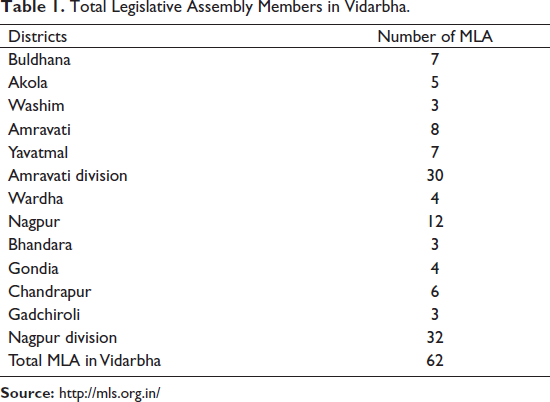
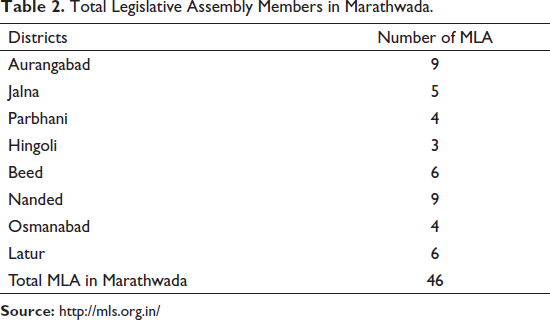
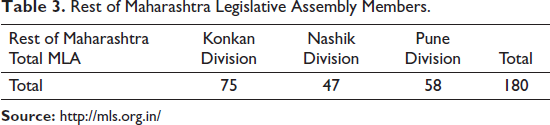
Let us now turn to the political representation within Maharashtra, followed by noting the peculiar characteristics of Vidarbha as well as the backwardness of Marathwada. This will be followed by a reflection on the two committee reports that were appointed by the Government of Maharashtra to look into the regional balance/backwardness within the State. As in the case of our emphasis on the Kelkar committee in laying down the abstract/theoretical framework for conceptualizing the problem, here too, we shall pay greater attention to the Kelkar committee report which is the latest attempt to have a go at the issue.
Total Legislative Assembly Members in Vidarbha.
Total Legislative Assembly Members in Marathwada.
Rest of Maharashtra Legislative Assembly Members.
Mumbai Region Legislative Assembly Members.

Rest of Maharashtra Division-wise Legislative Assembly Members.

Disparity Clusters.
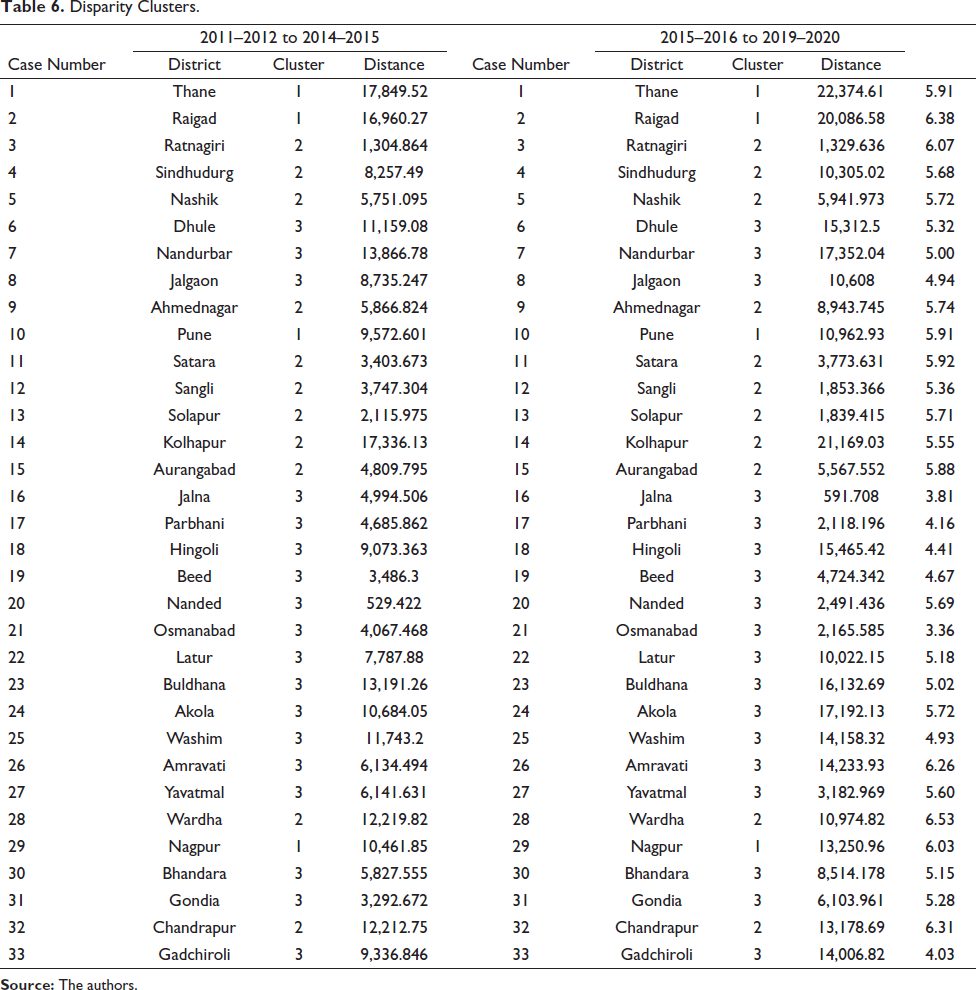
Cluster Analysis Cluster 1.

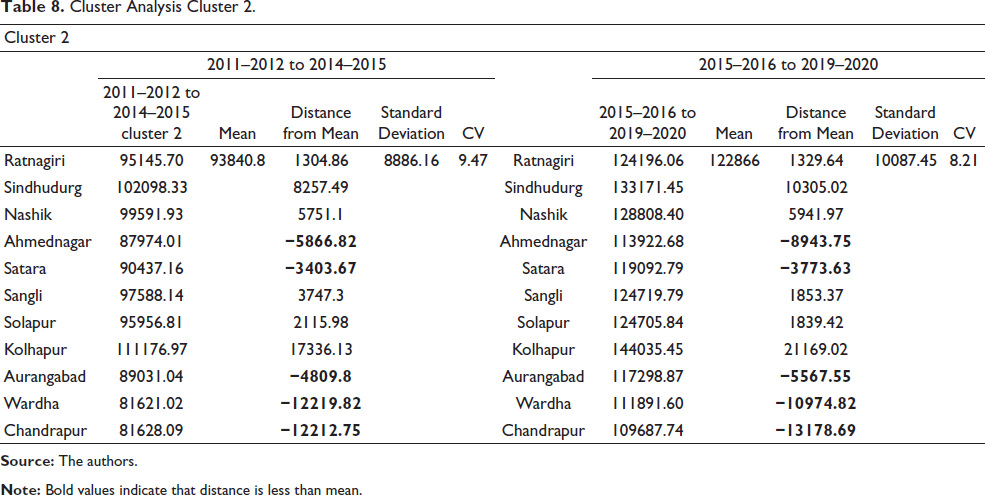
Cluster Analysis Cluster 2.
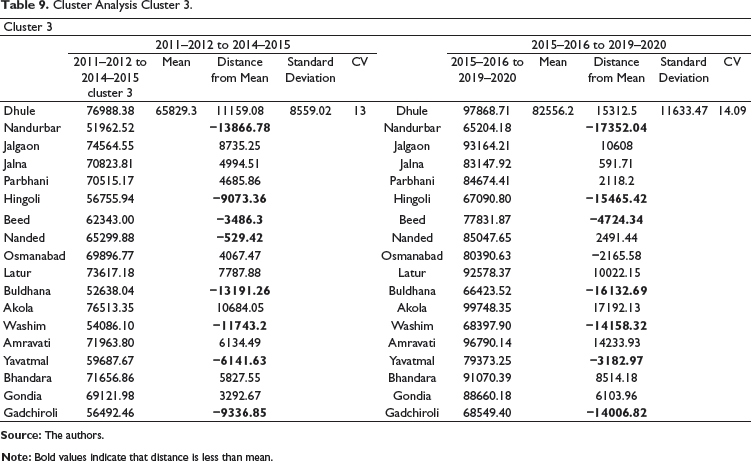
Cluster Analysis Cluster 3.
District Growth Rate.

Epilogue
What is attempted here is to create a template of a strategic framework for approaching the issues of regional disparities as they arise in varied forms and magnitude. To that extent, it falls short of a neat step-by-step prescription as expected in a tool kit in a cut and dried form. It only prescribes the things to consider in determining the allocative formula along the two tracks and hints at several commensurate measures that are needed to accompany them. It never suggests that addressing regional disparities is easily done. We began by stressing that the matter is far more than mere concern related to deficient resources. The fleshing out will require huge effort toward efficient public financial management so that allocations get translated into actual expenditures in relevant areas. Furthermore, the other elephant in the room has to do with the huge effort that will be required towards capacity building. This includes the creation of both a reliable database and, more importantly, the human capital endowment at an appropriate level to understand the final outputs and outcomes aimed at as well as to undertake the action plan comprising relevant steps. And then, there is the political economy filter. Given that the path may be messy, we have vested a great deal in the values of participatory democracy of a particular form. The political masters will and must have the final say in decisions (of course they also take the risks involved). In creating formulae for allocative rules, enough room must be left for political play. This is something that is to be importantly kept in mind in our expert formulations and prescriptions. After all, political players as policymakers not unlike nature are guided by the tenet: Natura non facit saltus!
Footnotes
Declaration of Conflicting Interests
The authors declared no potential conflicts of interest with respect to the research, authorship and/or publication of this article.
Funding
The authors received no financial support for the research, authorship and/or publication of this article.
