




Abstract
The desired higher growth in the agricultural sector can be achieved only when there is proper application of information and communication technology (ICT) with adequate investments from both public and private sectors. There is a great scope to implement ICT in order to communicate and integrate the entire agri-food supply chain. The beneficiaries of ICT in agriculture are not only confined to farmers but also encompass food processing companies and suppliers within the agri-food sector. The tools of ICT applications have the potential to provide networking of agriculture sector within the country and globally. It is against this backdrop that the present study not only addresses issues relating to the applications of ICT for economic change in the agricultural sector of India but also identifies the past and present major ICT initiatives in agriculture, the factors responsible for the success of ICT services and the elements of an appropriate framework for assessing the impact of ICT on agricultural development. It is observed that the application of ICT solutions for the development of rural India have been opening a vast range of possibilities to a majority of the population living in rural settings to cross the digital divide. The e-governance strategy for the agriculture sector is capable of exhibiting strategic flexibility to simultaneously integrate the opposing forces.
Introduction
In an era of rapid technological change, a country’s competitiveness and relevance in the global economy is increasingly determined by its capacity to effectively use information for design, production and marketing (Dzidonu, 2002). A growing mode of delivery in this environment is by information and communication technologies (ICTs) that can provide vital access to information and to markets by connecting the rural poor and marginalised sections to the world’s information resources and opportunities. Although the use of ICTs remains concentrated largely in the developed world, a rapid growth in information technologies has now been taking place in developing countries since the old ways of delivering important services are becoming obsolete at the time when traditional societies stand transformed into knowledge societies (Shaik et al., 2004). The necessity of developing the capacity to generate and disseminate knowledge and exploit it as a powerful tool to derive societal transformation has been emphasised in the report of the Task Force on India as Knowledge Superpower that also visualises ICT 1 as an important means of achieving such transformation (Government of India [GOI], 2001). The last three decades have witnessed the rapid development of information technology all over the world. Studies from the developed world have shown that ICT can positively contribute to economic growth and development, and it has the potential to reduce poverty and improve livelihood by empowering users with timely knowledge, reducing transaction costs and enhancing appropriate skills for increasing productivity (Hamelink, 1997; Kenny, 2002).
In the agricultural sector, ICT has already taken root and is now recognised as an essential mechanism for delivering knowledge and advice as an input for modern farming (Jones, 1997). It can give a new impetus to the productive activity, which could become transformational factors. The advancements in ICT can be utilised for providing accurate, timely, and relevant information and services to the farmers, thereby facilitating an environment for more remunerative agriculture. Although the Indian agricultural sector is now witnessing the evolution of ICT, there has been lot of catching up to do due to the differentiated nature of demand of the farmers in different areas. However, ICT has many potential applications and, if nurtured effectively, it not only can bring new information services to user farmers but may also act as a catalyst for the sustainable development of farming system. It is against this background that the present study not only addresses issues relating to the applications of ICT for economic change in the agricultural sector of India but also identifies the past and present major ICT initiatives in agriculture, the factors responsible for the success of ICT services and the elements of an appropriate framework for assessing the impact of ICT on agricultural development.
Scope of the Study
The government of India of late has been emphasising upon the implementation of the Digital India programme, which empowers citizens with e-access to government services and livelihood-related services. The recent Union Budget 2022 categorically focuses upon digital connectivity of villages as the need of the day, with the chief objective of providing facilities in the villages through broadband connectivity. Apart from this recent initiative, a number of initiatives were undertaken earlier to truly transform rural India into well informed section of the society. Therefore, the present study focuses not only on the use of ICTs to access information but also on the use of ICTs as access and utilisation tools with a view to diffuse information to farmers in general and the agriculture sector in particular since benefits of such initiatives achieve twin objectives.
Review of Recent Literature
There are spate of studies that have focused on the importance of ICT and the role of ICT in rural development. One of the recent studies found mobile phones as the widely accessed tool among the farmers for communication and also for accessing agriculture-related information, particularly for the marketing of produce (Chhachar et al., 2014). On the other hand, the study conducted by Taragona and Gelb (2005) pointed out that awareness, time, cost of technology and system integration are the main constraints of ICT adoption in horticulture. Another study conducted by Gelb and Voet (2009) aimed at analysing ICT adoption trends in agriculture and found lack of customised ICT applications, harmonisation with production, market and ongoing end-user extension training as the key challenges to ICT implementation. The study conducted by Kale et al. (2015) revealed high cost of hardware and software, and inadequate and unstable power supply as the hurdles to access to information for average rural dwellers.
Although the course of time has witnessed concerted efforts to develop the agricultural sector of India through various ICT initiatives, frameworks and services, the constraints faced by farmers many a times defeat the objectives for which ICT tools have been constructed and implemented. For instance, the study carried out by Rajoria et al. (2017) showed lack of training and practical exposure towards ICTs and low ICT literacy as the ‘most serious constraints’, whereas lack of awareness of benefits of ICTs, lack of skills in handling ICTs, poor finance and erratic power supply are considered as ‘serious constraints’ in the adoption of ICT initiatives. There are several issues that need to be addressed, and they chiefly revolve around inadequate accessibility of ICT services to rural farmers, lack of basic skills of using ICT facilities in agriculture and inability of government to deliver adequate ICT knowledge to farmers (Singh et al., 2015). A study conducted by Agu (2013) specifically focused on the problems faced by women in agriculture such as access to land, access to/weak extension services, access to credit, lack of supportive policies and access to/no adoption of new agricultural technologies.
There are several challenges as well as problems in developing and implementing communication technologies in the rural settings. Hanson and Narula (2012) explored the current scenario of developing countries, infrastructure development policy, acceptance of technologies in lifestyle and social system, need of the society and models of information technologies for the society. One of the studies has come out with typical problem in terms of extension services to farming community in particular. It has been observed that the public extension personnel spend just 40 minutes per year for a farmer (Dileepkumar, 2012). Obviously, such sub-optimal contact intensity is a matter of concern. However, Aker (2011) observes that the use of ICTs in agricultural sector, especially mobile phone services, has provided information on market, weather, transport and agricultural techniques trough contact with concerned agencies and departments.
The ICT initiatives so far are helpful in providing accurate, timely, and relevant information and advice to the farmer community, thereby facilitating favourable platform for more remunerative agriculture. However, it is to be noted that the ICT movement is still evolving and that except for few ICT based projects like the Kisan Call Centre (KCC), there has been a significant gap in the ICT movement since most of ICT project for farming community are implemented in a very limited geographical area, covering few thousand of the population (Manjeet et. al., 2019). This calls for the drawing up of national strategy for spearheading IT penetration in rural India. It is noticed that since ICT tools developed so far do not have bearing on landholding size of farmers, there is need to focus on smallholder agriculture, especially to provide market information to this segment of farming community (Lokeswari, 2016). The effective information delivery also necessitates supplementation of traditional extension methods with new ICT tools, with significant involvement of research institutions, government agencies and also private sector participation.
ICT Initiatives for Agricultural Development
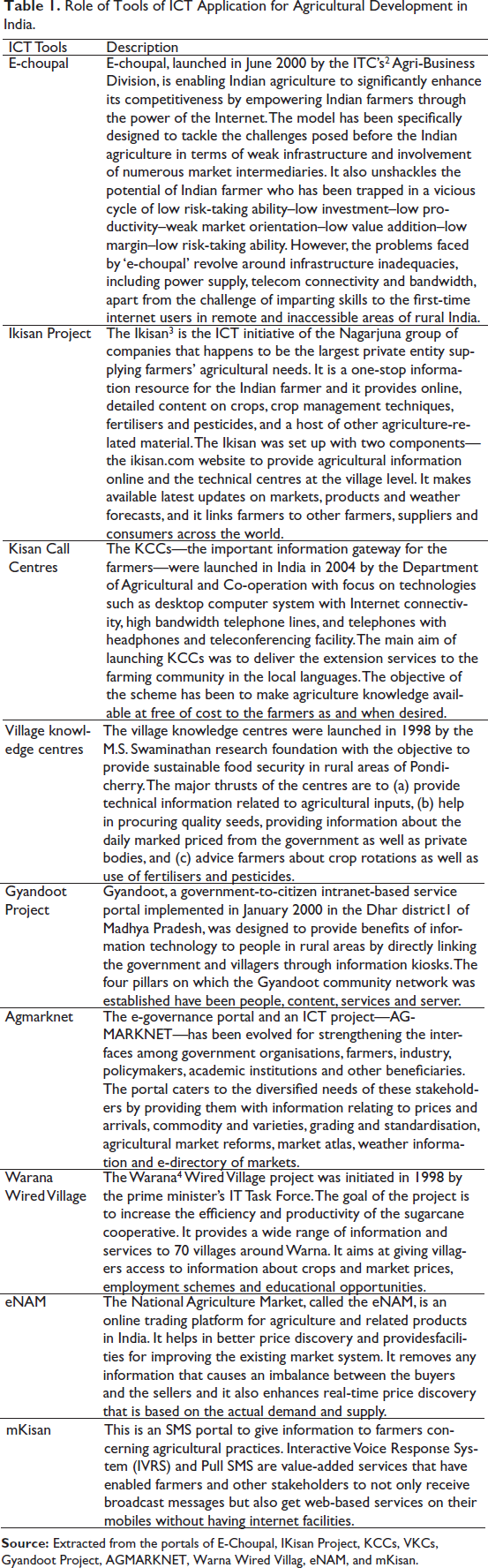
Although ICT in agriculture is an emerging field focusing on the enhancement of agricultural and rural development in India and it involves application of innovative ways to reach the rural domain, the actual usage of ICTs and their ability to bring significant impact on the farm productivity and socio-economic development of the intended beneficiaries is yet to be understood. The common problems in adoption of ICT in rural segments are lack of awareness and willingness for adoption of new technologies among the rural peoples. There are some other hindrances in the adoption of ICT that include illiteracy of farmers, non-availability of relevant and localised contents in their own languages, and lack of easy and affordable accessibility. However, some initiatives have been undertaken in India using ICT for agricultural development, and they mainly encompass Gyandoot Project (Madhya Pradesh), Warana Wired Village project (Maharashtra), Information Village Project of the M.S. Swaminathan Research Foundation (MSSRF, Pondicherry), Ikisan Project of the Nagarjuna group of companies (Andhra Pradesh), automated milk collection centres of Amul Dairy cooperatives (Gujarat), land record computerisation (Bhoomi, Karnataka), Computer-aided Online Registration Department (Andhra Pradesh), online marketing and CAD in Northern Karnataka (Karnataka), Knowledge Network for Grass Root Innovations–Society for Research and Initiatives (SRISTI, Gujarat) and application of Satellite Communication for Training Field Extension Workers in Rural Areas (Indian Space Research Organisation). All these projects have very small component of agriculture. There are also some exclusive agricultural portals, namely. Haritgyan.com, Krishiworld.net, TOEHOLDINDIA.com, Agriwatch.com, ITC’s Soyachoupal.com, Acquachoupal.com and Plantersnet.com, and they actually cater to the ICT requirements of farming community with emphasis on agricultural sector.
Inspite of the fact that ICT applications have huge potential for agricultural development, very few projects are initiated in India, with the majority of them initiated by NGOs, private organisations, cooperative bodies and governmental organisations other than agricultural departments. This shows the apathy of agricultural development departments towards incorporating ICT into their main steam activities. The areas where ICT can play a key role are enhancing agricultural extension activities, creating farming system with location-specific modules of research and extension, promoting market extension, sustainable agricultural development, participatory research, etc. (Shaik et al., 2004).
Application of ICT in Agriculture
Application of ICT in agriculture has become increasingly important, and the phases where ICT can play a leading role include crop cultivation, water management, fertiliser application, fertigation, pest management, harvesting, post-harvest handling, transportation of produce, packaging, food preservation, processing, food quality management, food safety, storage and marketing. For instance, ICT extends information on the market trends and prices, which helps the farmers to not only negotiate prices but also protect their food security and livelihood. Similarly, agricultural advisory extended through ICT such as weather forecasting, crop-specific advisory and price information empowers farmers and helps them to optimise returns (Shrestha & Sathvik, 2021).
The activities where use of ICT in the agricultural sector acquires relevance encompass the following: (a) dissemination of market price information, (b) creation of land registries, (c) agro-meteorological information communication, (d) facilitating networks of agricultural researchers and farmers, and (e) using internet for learning about agricultural techniques used in developed countries. One of the better ways of trading is through the internet and, therefore, e-trading assumes significant importance. Due to the fragmented structure of agriculture, relatively dispersed trading community and consequently inefficient supply chains, there is ample scope to reduce costs and improve service levels. In the present milieu, Geographic Information Systems (GIS), precision farming and mapping obviously bring ICT into picture. The application and mapping of ICT in agriculture are shown in Figure 1, which provides an insight into the approach of the services extended by ICT.
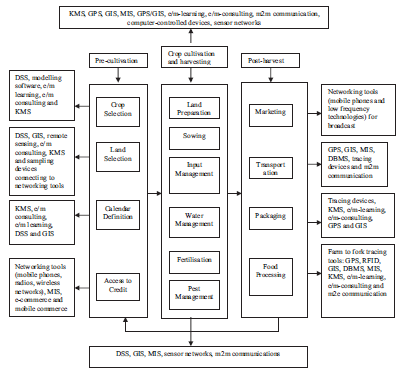
The application of ICT is needed not only during pre-cultivation and in crop cultivation and harvesting operations but also during the post-harvest operations. While the use of Decision Support Systems (DSS), Knowledge Management Systems (KMS), GIS, modelling software, e/m-learning and consulting, remote sensing and networking tools are needed during pre-cultivation operations, crop cultivation and harvesting as well as post-harvesting operations will require other information services, namely. Global Positioning System (GPS), Management Information System (MIS), Database Management System (DBMS), Radio Frequency Identification (RFID), machine-to-machine communication (m2m), mobile and electronic learning (e/m learning), sensor networks, e/m-learning and consulting, computer control devices and tracing devices. These ICT services are essential for achieving the desired growth in the agricultural sector and for its sustainable development.
Role of Tools of ICT Application for Agricultural Development in India.
E-governance Initiatives in Agriculture
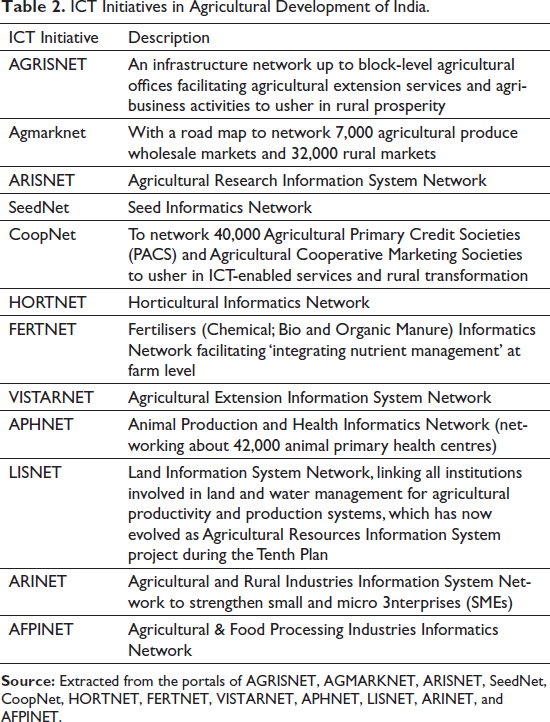
Recognising the integrative and service delivery potential of the ICT, the Government of India is implementing a National e-Governance Plan in Agriculture (NeGPA) through its Department of Information Technology. It was initially launched in 2010–2011 in seven pilot states, which aimed at achieving rapid development in agriculture through ICT. In 2014–2015, the scheme was extended to cover the remaining states and two union territories (UTs), with further extension given to it up to 31 March 2021. The strategic objective of NeGPA is to enable the government services to reach the common man. The necessary content backbone, for creating digital opportunities at grassroots, is being built under the ambitious AGRISNET and Agmarknet mission mode projects by the Ministry of Agriculture. These initiatives—together with reforms in agricultural marketing that include amendment of the APMC Act to permit e-marketing, promotion of direct marketing, National Warehousing Receipt System, grading and standardisation facilities, setting up of rural godowns and strengthening of marketing infrastructure—are paving the way for the ICT-enabled direct marketing of agricultural produce. The major initiatives with respect to e-governance in agriculture are shown in Table 2.
ICT Initiatives in Agricultural Development of India.
This ambitious goal cannot be achieved solely with the limited government resources. The National Agriculture Policy as well as NeGPA have laid emphasis on the use of ICT for rapid growth of agriculture and generating value at the grassroots level. Considering the government as a large enterprise, it is observed that there are high continuity and change forces operating in the agriculture sector. The e-governance strategy for the agriculture sector should be capable of exhibiting strategic flexibility to simultaneously integrate the opposing forces. It is required to leverage the momentum generated by continuity forces and opportunities created by change forces to meet the challenge of implementing effective and efficient e-governance in the agriculture sector as illustrated through examples based on the principles of flowing stream strategy (Suri & Sushil, 2006).
Nexus Between ICT and Agricultural Development
The ICT initiatives and applications can help in strengthening the farming community through a wide range of networking with exposure of farmers to the global market, aside from their collaborations with private sector players, NGOs, and government institutions and agencies. The benefits of ICTs in terms of their contribution to improve agricultural productivity was well recognised (Armstrong et al., 2010, Armstrong et al., 2011). The public and private sectors have long been on the search of effective solutions to address long- and short-term challenges in agriculture, and also the abundant information needs of farmers. ICT is noticed to have an increasing impact on the agricultural sector and on the processes associated with food production (Blurton, 2010). It has been reported by Casaburi et al. (2014) that sending SMS messages with agricultural advice to smallholder farmers increased yields by 11.5% in extension area as against control group with no messages. Further, the large adoption and integration of ICTs has reduced information and transaction costs, improved service delivery, created job opportunities, and generated new revenue streams and saved resources (Anonymous, 2017). It has been reported by Syiem and Raj (2015) that the most frequently used mode of communication is the mobile phones, which are used by the farmers for social communication, contacting traders for the marketing of produce and contacting experts for getting agricultural advisories.
Case Studies on Effectiveness of ICT in Agricultural Development.

It is to be noted that while ATIC acts as a single window for information delivery, Digital Green uses video as tool for disseminating agricultural technologies information. The role of EasyKrishi is to aggregate all the farmer producer organisations digitally, whereas e-SAP addresses solutions for the issues related to pest management, and IKSL deals with call centre solutions for all the farmer’s queries. Here, Krishi community radio station serves the cause of the local community. The mKisan’s use of messaging empowers the farming community. It has been categorically mentioned that these seven case studies have successfully empowered the farming community. Further, a perception analysis of e-SAP revealed that 70% of beneficiaries extended positive response regarding e-SAP since the concept helped them to overcome the major difficulty in terms of crop pest problems (Nagesh & Raj, 2019). There are number of benefits of EasyKrishi application, and these benefits not only go to farmers but also to agricultural financing institutions, policymakers and advisory bodies. 5
The recommendations derived from the case studies have much wider implications. One of the recommendations suggests the popularisation of ICT initiatives to meet the large sections of the community since they are meeting the requirement of the selected portions of the population. Another recommendation is to expand limited use of mobile application. The establishment of an alternative mode of communication in places where power and internet connectivity turns out to be barriers is also one of the recommendations. It has also been emphasised upon undertaking periodical studies to evaluate ICT initiatives for their expansion. The real boost for agricultural development will also depend upon how best the youths engaged in ICT disseminations are properly trained. In this context, development of infrastructure is crucial for the widespread dissemination of ICT benefits to reposition agricultural sector of India and make it globally more competitive and developed.
Conclusion
The introduction, implementation, application and adoption of ICT services are essential for the sustainable growth and development of the agricultural sector of India. The desired higher growth in the agricultural sector can be achieved only when there is proper application of ICT with adequate investments from both public and private sectors. Since ICT helps in information dissemination in less time with effective ways of communication, its implementation cannot be ignored. There is a great scope to implement ICT in order to communicate and integrate the entire agri-food supply chain. The beneficiaries of ICT in agriculture are not only confined to farmers but also encompass food processing companies and suppliers within the agri-food sector. The tools of ICT applications have the potential to provide networking of agriculture sector within the country and globally, aside from bringing farmers, researchers, scientists and administrators under one umbrella. Although providing access to the new technology to the majority would impose a large financial burden, the more difficult task is to prepare the disconnected to develop the competence to participate in the emerging digital economy. The new technologies developed through ICT initiatives can help surmount barriers prevailing at present in providing access to information resources at a low cost and it will make its applications feasible as well as profitable. The application of ICT solutions for the development of rural India will surely open up a vast range of possibilities to the majority of the population living in rural settings to cross the digital divide to obtain access to information resources and services provided by ICT.
Footnotes
Declaration of Conflicting Interests
The author declared no potential conflicts of interest with respect to the research, authorship and/or publication of this article.
Funding
The author received no financial support for the research, authorship and/or publication of this article.
