




Abstract
The global construction sector accounts for 13.2% of the world’s gross domestic product (GDP). It not only contributes to the economic growth engine of the world but also climate changes due to its high energy footprint. Sustainable buildings have the potential to reduce the adverse impacts of the construction industry, but their adoption is slow due to hindrances. The aim of this paper is to study literature on barriers to green building adoption to date and highlight the overlapping and unique barriers specific to India in comparison to a few prominent countries, and provide solutions and recommendations for future research. The methodology has been an extensive literature review of the barriers to green building (GB) adoption. The key findings, namely barriers, were classified under economic, governmental, organizational and social perception, information, technology and material categories. Barriers unique to India and a few other developing countries are an extension of project schedules, lack of research and developmental works, lack of public motivation, poor building code enforcement, high payback period, uncertain supply of green materials, improper implementation of policy framework and performance of green building technologies (GBT’s). The GB construction sector is fragmented around the world. Even the GB definition is not the same across the globe although the environmental aspect is the same. Similarly, there are unique and overlapping challenges in GB adoption globally. Buildings in usage perspectives can be classified into residential and non-residential. This study looks only at non-residential GBs due to their homogenous nature. There is a dearth of specific studies related to the adoption of GBs in India. This study aims to fulfil the gap of India’s standing in the barriers to GB adoption with respect to the developed and developing countries.
AC: Air conditioning AP: Accredited professional BEPAC: Canada’s Building Environmental Performance Assessment Criteria BREEAM: Building Research Establishment Environmental Assessment Method CASBEE: Japan’s The Comprehensive Assessment System for Building Environmental Efficiency CFC: Chlorofluorocarbon, gases that are used in things such as aerosols and refrigerators and can cause damage to the ozone layer EPBD: European Union’s Energy Performance of Buildings Directive GB: Green building GBT: Green Building Technology GDP: Gross domestic product (GDP) is the standard measure of the value added created through the production of goods and services in a country during a certain period GHG: Greenhouse gases GOI: Government of India HAM: Hybrid Annuity Model HCFC: Hydrochlorofluorocarbons IAQ: Indoor Air Quality IEQ: Indoor environmental quality (IEQ) IGBC: Indian Green Building Council LCCR: Low carbon climate resilient LEED: Leadership in Energy and Environmental Design MSGI: Maritime Singapore Green Initiative PPP: Public Private Partnership ROI: Return on Investment TERI: The Energy Research Institute UKGBC: UK Green Building Council UNEP: United Nations Environment Programme USGBC: U.S. Green Building Council WLC: Whole life costing
AUS: Australia BR: Brazil CN: China CO: Columbia GH: Ghana HK: Hong Kong IND: India KU: Kuwait MY: Malaysia SA: Saudi Arabia SG: Singapore SP: Spain UAE: United Arab Emirates UK: United Kingdom US: United States of America VT: Vietnam
Introduction
With the global economy rapidly developing, environmental problems and climate change issues are becoming more pronounced day by day. More than 40% of global energy usage and 30% of global greenhouse gas emissions come from buildings both in the developed and developing nations as per UNEP. Apart from greenhouse gas (GHG) emissions, the construction and building sector also contributes to non-CO2 GHG emissions such as halocarbons, chlorofluorocarbons (CFC’s) and Hydrochlorofluorocarbons (HCFC’s). As a result, in order to minimise the adverse impacts, the concept of a circular economy has been emphasised in the construction sector. A circular economy is aimed to reduce the consumption and production pattern by closing loops using reusable waste and resources also decelerating the material loop by developing durable reusable products (Bocken et al. 2016). For example, Leising, Quist, and Bocken (2018) explored a circular economy in the building sector through three case studies that were Building Research Establishment Environmental Assessment Method (BREEAM) certified. As per Nazirah, Yusof, and Othman (2013) sustainable buildings decrease energy demands, costs and better the health and productivity of employees (Eichholtz, Kok, and Quigley 2010), and reduce risk (Ministry of New and Renewable Energy & TERI 2010). Plus it is advantageous for developers, occupants and owners (World Green Building Council 2013). By the works of Darko et al. (2013), sustainable measures can decrease GHG emissions by 142 Megatons per annum by 2020 and 296 Megatons per annum by 2030. According to Barriuso and Urbano in (2021), green roofs and walls help in fighting the climate change issue. They help in the reduction of GHG’s, reduce noise and manage stormwater runoff. The GB definition is varied across the world according to its history, culture, traditions, weather conditions, different building types and ages, environmental, and social and economic factors. The World Green Building Council defines GB as the means to balance the negative impacts during the building lifecycle on the environment and climate by creating positive impacts on the same. There are several evaluation systems to certify GB across the world which includes BREEAM, the European Union’s Energy Performance of Buildings Directive (EPBD), Canada’s Building Environmental Performance Assessment Criteria (BEPAC), Green Building Tool (GBTool), Leadership in Energy and Environmental Design (LEED) and Japan’s Comprehensive Assessment System for Building Environmental Efficiency (CASBEE). India has two major green building certification agencies: LEED, by the Indian Green Building Council (IGBC) and Green Rating for Integrated Habitat Assessment (GRIHA), formulated by The Energy Research Institute (TERI). The IGBC, part of the Confederation of Indian Industry (CII) was shaped in the year 2001. The vision of the chamber is, ‘To empower a reasonable assembled climate for all and work with India to be one of the worldwide innovators in the maintainable constructed climate by 2025’.
There are various policy supports and incentives across the world to facilitate the GB movement. GB policies in the US employ a rewards-based and mandate system which is a vital role in the implementation of the same (Choi and Miller 2011). To promote effective GB in the UK, implementation of building energy efficiency labels are undertaken (Building Research Establishment n.d.). Japan being naturally challenged in terms of energy and resources, the government undertook unrelenting efforts to preserve energy security by promoting GB and energy conservation through various laws, incentives and policies. China experienced rapid green building growth after the construction boom and fast-paced urbanisation. Using both mandates and incentives, China stressed the development of GB (Zhang, Wu, and Liu 2018). In India, the central and many state governments are working closely with IGBC to promote the green building movement by doling out incentives (Manna and Banerjee 2019).
Adoption of GB is gaining momentum due to the rise in global sustainability awareness along with various problems such as climate change, fast urbanisation and population explosion (Butera 2010; Gou and Xie 2016). Green buildings also impact Indoor Air Quality (IAQ) as per Wu et al. in (2021) when ordinary buildings and one- to three-star green buildings were chosen for the comparison of air quality measurements, three-star green buildings reported to have enhanced air quality. By undertaking a comparative study of conventional mall buildings versus green mall buildings in Beijing in terms of IEQ and customer satisfaction, Du, Zhang, and Lv (2020) finds that green mall buildings are superior to conventional ones. Wang and Zheng in (2020) propose that there is a multivariate linear relationship between daily energy consumption and environmental parameters in green star green building from Shanghai.
However, there are problems that hinder the adoption of GB. Lack of awareness, high capital costs, rules and regulations across geographies has reduced the adoption of GB. One of the biggest roadblocks is asymmetric awareness of the various stakeholders and the absence of a comprehensive policy mechanism. According to Li et al. (2014), China does not have a complete technology system for the construction of GB. China’s GB market is not mature as the people’s concepts towards GB are not clear (Liu and Hu 2019). In the US, people remain doubtful that GB has not achieved what it had promised in terms of energy savings (Scofield 2009) plus there are issues in convincing people to buy GB with added expenses such as certification and technology expenditure. The condition in the UK is better with increased awareness among the public, but there are poorly designed GB projects because of bad architecture which results in much more energy usage than buildings that are not certified (Zhang et al. 2018). In Japan, the mandatory requirement of Comprehensive Assessment System for Built Environment Efficiency Accredited Professional (CASBEE-AP) to hold a first-class license in architecture limits the reach. This barrier is enhanced by limited GB understandings such as India faces a serious problem of inadequate understanding of GB accompanied by lack of compulsory laws regarding mandatory enforcement. The majority of the GB in India either belongs to private companies or the government. The residential demand is low (Darko et al. 2013) due to higher green premium and tedious certification rules. Sabbagh et al. in (2019) analyse that multiple social, environmental and economic factors are important for the transformation of the building industry from conventional to green in the Arabic region. Thus we see the GB market is unique and has its own barriers, it is important to understand India’s barriers to GB adoption standings with respect to the world and improvise solutions accordingly.
What Is Meant by Green Buildings in India?
According to the GRIHA Manual (Ministry of New and Renewable Energy and TERI 2010), India is witnessing a construction boom with the sector growing at 9% and contributing around 6.5% to the GDP. Although sustainable construction is still a big question but with 60% of the construction yet to happen, India can make great strides towards sustainable development. According to the World Green Building Trends 2018 (World Green Building Council 2018) report, survey participants expect rapid green activity growth in the coming three years mostly powered by the drive for healthier and greener buildings accompanied by environmental rules and regulations. India is at par with the global average to undertake new green building construction (51%) while significantly below the global average for existing retrofits (World Green Building Council 2018). India’s GB market is still an emerging one and needs enough public awareness along with professionals who are green educated. With systematic identification of unique and overlapping barriers to GB adoption in India versus other countries, identifying solutions can bridge the existing gap. This would be a useful resource for the academia as well as for the industry to bolster GB movement.
Recent Green Policy Developments
Policies play an important role in the adoption of sustainable measures and GB across the world. For example, the aviation sector is energy-intensive and contributes to GHG emissions. In India, the domestic aviation market is one of the fastest-growing domestic markets globally and is forecast to have continuous positive growth. Hence, in order to achieve sustainable and inclusive growth in the sector, the GOI has proposed a ‘Green Aviation Policy’ to develop a regulatory framework to rectify the environmental hazards created by the civil aviation industry by recognising key policy areas that require guiding principles and regulations. This policy will try to make prices of bio-jet fuels economical and expedite the process for securing clearance for aviation projects in India. The UK government has plans for relaunching a ‘Green Investment Bank’ to help finance the climate ambitions of the country. This plan comes amidst the growing concern to invest in green infrastructure to meet UK’s climate goals and help in reviving the economy. In March 2019, the UK Green Building Council (UKGBC) drafted the definition of ‘Net Zero Carbon’ buildings to provide information on ways to achieve net-zero carbon in construction and operations. Over time, this would help to formulate policy and regulation. LEED Zero, a new certification program launched by US Green Building Council (USGBC) addressed net zero operations and resources in buildings in 2018. The UK launched Aviation 2050 to counterbalance the negative impacts of the aviation sector by ensuring sustainable growth, Bergqvist and Monios (2019) studied the prospects of a ‘Green Port’ in theory as well as in practice which can help reduce emissions. For example, the Maritime Singapore Green Initiative (MSGI) launched by the Maritime and Port Authority of Singapore (MPA) was one of the first environment-friendly initiatives launched in this port and shipping sector. In 2019, their prime agenda was the decarbonisation of shipping. The main focus areas of the policy are the Green Port Programme, the Green Ship Programme, the Green Energy and Technology Programme and the Green Awareness Programme. Thus, it is seen that a number of policies have evolved over the years and those are in their initial stages of implementation. It is also seen that effective policies in the field of aviation, ports, shipping and transportation not only augments the adoption of GB but sustainable measures as a whole.
Review Aim
This paper is directed to undertake an extensive literature review of research papers mentioning the barriers to adoption of GB till 2019. Identification of barriers and removal of them is the key to conventional sustainable development in the construction sector. The review consists of underscoring various barriers to GB adoption, methodological approaches, and identifying the overlapping and unique barriers to GB adoption for India. Furthermore, trying to identify the existing gap and solutions to overcome them as a cue for future research. To delve into the area of green building research, this study addresses the question ‘What are the various barriers to GB adoption till 2019 and how can India overcome them by taking global inspiration?’
The objectives of this extensive review are:
To identify the various barriers to GB adoption. To identify overlapping and unique barriers specific to India and recommend solutions taking global inspiration.
Research Methodology
This is an extensive literature review of barriers to GB adoption. To form a definite understanding of a topic it is necessary to undertake a pertinent literature review on the subject (Webster and Watson 2002). It also helps in the building of theory which is helpful for both industry and academia. This paper is a combination of peer-reviewed academic papers, conference journals and related materials from official websites of green building associations across the globe. Relevant papers from the past two decades are chosen and synthesised to come up with meaningful insights on barriers to GB adoption specific to India, and solutions to overcome them taking global inspiration.
To gather pertinent peer-reviewed journals, papers, review articles and reports a systematic search was conducted on databases such as Scopus and Web of Science for their access to reputable publications. Scopus is already used for GB review research purposes (Darko, Zhang, and Chan 2017) along with Web of Science. To include every relevant paper other databases were included: Elsevier, Emerald, JSTOR, Wiley Online Library Journals (Wiley & Sons), EBSCO, Journal of Green Building, International Journal of Sustainable Building Technology and Urban Development and Journal of Sustainable Development. An exhaustive search was conducted based on the ‘keywords/abstract/title’ cell present in the databases for document type ‘article’ or ‘review’ published in the past two decades. The keywords which were used to search included mainly ‘green buildings’ which in its design, construction or operation reduces or eliminates negative impacts and can create positive impacts; ‘sustainable buildings’ was used like green buildings; ‘barriers’, ‘challenges’, ‘hindrances’ and ‘obstacles’ all referring to the obstructions to GB adoption; ‘drivers’ signifying the push factors which will drive the adoption of GB; ‘built environment’ meaning man-made surroundings that provide the setting for various human activity; ‘construction’ and ‘zero carbon’ referring to net-zero carbon emission to the environment; ‘LEED’, ‘energy efficient’ and ‘high performance’.
At first the range of countries were selected which were divided into developed (US, UK, CN, AUS, SP, SG, JP and the UAE) and developing countries (BR, IND, VT, GH, CN and KU). Then the countries which are the frontrunners in the adoption of GB were identified from and inspiration was drawn for India.
The initial search included papers that were relevant/irrelevant to the topic. After a primary search, a second round of filtration which consisted of brief abstract reading, content and discussion was done. In this round, relevant papers related to the topic were selected which were deemed valid for further analysis.
As the papers were selected from the past two decades starting from 2000, there is an evolution in the adoption of GB literature, from understanding what GB is, the realisation of the importance of GB in standalone pilot GB projects in the improvement of an occupants life expectancy, IEQ, IAQ followed by drivers of GB adoption. There is a general observation that green building development research papers are more from countries like China. Although we find there is a dearth of barriers to the adoption of GB specifically from India’s perspective.
Figure 1 summarises the logical sequence of the research flow. It begins with the selection of a suitable database which is then followed by a preliminary search of articles related to GB barriers. The articles are selected on the basis of countries that are frontrunners in the GB development space from both developed and developing nations. The selected articles, around 75 of them, were then critically reviewed and analysed, followed by the identification of overlapping and unique barriers in India in comparison with a few countries across the world. Finally arriving at solutions and recommendations for further research in the barriers to GB adoption space.

Coding of GB Barriers Country-wise.

Coding of GB Barriers Country-wise.
Notes: List of abbreviations: AP: Accredited Professional; AC: Air conditioning; GB: Green building; GBT: Green Building Technology; WLC: Whole life costing.
Country abbreviations: IND: India; US: United States of America; UK: United Kingdom; CN: China; SG: Singapore; MY: Malaysia; GH: Ghana; AUS: Australia; BR: Brazil; CO: Columbia; SP: Spain; VT: Vietnam; HK: Hong Kong; KU: Kuwait; SA: Saudi Arabia; UAE: United Arab Emirates.
The barriers have been coded from B1 to B15. Whereas B1 gives the most common barrier to adoption which is most prevalent, B15 gives the least prominent factor which is present in India. It is observed from Figure 1 that there are pertinent factors that hinder the development of GB. But among all high capital costs, lack of stakeholder’s awareness, organisational and psychological, inefficient policy implementation, lack of GB incentives, lack of GB expertise and lack of client demand are factors that hinder the development of GB in many countries. There are barriers specific to India as well, for example, poor regulation on building code enforcement, unavailability of green building products and services, lack of pre-existing research and development work, and lack of financing mechanisms. Some of them are also present in a few other countries but strongly in India. Further, the paper discusses individual barriers in detail.
Cost effectiveness is one of the most important parameters regarding the implementation of GB. Even with the various added benefits, the high initial expenditure along with added GBT costs plus the high price of procurement hinders GB adoption as it is difficult to convince various stakeholders. In China, according to Liu, Low, and He (2012), the high initial cost is a major barrier to GB implementation. High green building premiums along with GBT costs is still rated as the biggest factor in the US (Dwaikat and Ali 2016; Zhang, Platten, and Shen 2011). GB requires an integrated design approach using GBT’s which cost more than their non-GB counterparts. The leadership faces the utmost challenge while deciding for the GB adoption due to the increased capital costs in the UK (Hakkinen and Belloni 2011; Opoku and Ahmed 2014). In India, high capital costs is a major pull factor as it draws the investor back from investing in GB (Abraham and Gundimeda 2018; Luthra et al. 2015). GB markets in Singapore, Ghana, Australia, Malaysia, and Vietnam too witnesses high capital costs as a chief impediment towards GB adoption (Bin Esa et al. 2011; Chan, Qian, and Lam 2009; Nguyen et al. 2017; Samari et al. 2013; Zhang et al. 2011). Thus it can be seen that cost is the foremost factor which is focussed on while deciding on a construction project (Shi et al. 2013). Ergo, it is pertinent to attribute high capital cost as a significant barrier to the adoption of GB and formulate strategies to win over this barrier.
Lack or Misplacement of Government Incentives
Policy incentives for GB from the government is an important factor for promoting GB adoption. Chen et al. in (2021) state that government incentives and subsidies are necessary for promoting GBT, while punishment measures cannot alter the final state and can only urge more participants to implement positive strategies. Incentives can be described as instruments that influence people’s behaviour in a certain way. They can be often classified into financial and non-financial incentives. Financial incentives are mainly monetary such a tax benefits, financial subsidies, discounts, etc., while non-financial incentives include technical guidance, expedited permits, and building area permits. Non-financial subsidies are flexible and can be implemented depending on local conditions. According to Hendricks and Calkins (2006), willingness to install more green roofs will increase for residents of Chicago and Indianapolis with the announcement of government subsidies. There are various government powered incentives to drive GB adoption by stakeholders in the US, Canada, and UK (Qian and Chan 2010). Plus Singapore also has non-financial benefits, for example, owners with a high level of GB are entitled to receive an extra 2% of the building area award (Choi 2009). As per World Green Building Council (2018) countries such as Brazil, Columbia and Spain struggle with the absence of incentives as a barrier to GB adoption. Lack of government incentives is one of the main obstacles in implementing GB in Australia (Love et al. 2012). Samari et al. (2013) point out that the Malaysian government only introduced two incentives, that is, tax exemption and stamp duty which are not sufficient enough to enhance GB adoption. Also, in countries such as India, Kuwait and Hong Kong, the lack of incentives is a major hindrance towards GB adoption (Abraham and Gundimeda 2018; AlSanad 2015; Zhang et al. 2012). Along with this inadequate institutional and financial mechanism to reward GB those who achieved higher scores for energy efficiency (Zheng et al. 2012) in China. There are cases in the US where institutional structures did not award buildings with low energy consumption (Richardson and Lynes 2007). Therefore, lack of incentives acts as a great hindrance to GB adoption. While it is seen that there is positive co-relation with proper incentives and adoption of GB seen in countries such as the US, Canada and the UK. Hsieh, Claresta, and Bui in (2020) claim that corporate governance policies implemented to align shareholders’ and managers’ interests, such as higher institutional holdings positively impact company’s resource allocation for green initiatives. Kongab and He in (2021) found out that supply side government policies can boost development of GBT. Hence it is prudent that not acknowledging energy efficient buildings can deter GB adoption.
Lack of Stakeholder’s Awareness
As mentioned earlier ‘human challenge’ is again the biggest impediment which includes educating or generating awareness among the various stakeholder’s as they play an important role. Just like there are exclusive environmental needs for different countries, similarly different stakeholder’s play varied roles in different countries for GB policy implementation according to the building structure (Falkenbach, Lindholm, and Schleich 2010). The various stakeholders involved in a GB project on a global level by and large can be classified as: the government, developers, buyers, tenants, private bodies, corporates and clients. Each of them plays a pivotal part in the GB movement, hence a lack of information results in insufficient knowledge and hence awareness regarding GB diminishes. In Ghana, stakeholder’s claimed of not being aware of sustainable measures and alternatives (Hakkinen and Belloni 2011). As per Winston (2010), professionals in the UK claimed that a limited knowledge about GB methods is detrimental towards GB adoption. Darko et al. (2017) and Rodriguez-Nikl et al. (2015) claim that in the US, a lack of information on the structural engineer’s part is a major roadblock. According to China Environmental Awareness Program 2007 (CEAP), the citizens thought the onus for protection of the environment lies with the local governments, authorities, and companies. In Australia as per Bin Esa et al. (2011), consumers lack the basic information about utilities and savings from implementing energy efficient devices. Malaysia also faces tremendous challenges from a lack of awareness. Most architects, consultants and clients quoted lack of information, awareness and education on potential benefits of GB construction. In India, the information asymmetry and lack of awareness among stakeholders lowers GB demand (Luthra et al. 2015). Similarly in Vietnam, the absence of public awareness is a critical barrier (Nguyen et al. 2017). Therefore, it is prudent to assume that the lack of awareness is a serious impediment towards GB adoption. Hence strategies should be devised to overcome this barrier. The project owners are at the centre of sustainability decisions to drive the implementation of sustainable building features in the construction industry. Despite this, the existing studies on the successful delivery of green buildings have only focused on the views of other construction project participants such as architects and contractors, while project owners are left out.
Lack of Client Demand
The construction sector being client driven hence the decision of clients play a major role in the adoption of green construction. According to Pitt et al. (2009), the shortage of awareness from the client side and low demand for sustainable buildings severely impacts GB adoption. Zhang et al. (2011) report that the absence of motivated demand from the customers is a challenge which needs to be overcome. As per Ahn et al. (2013), in Ghana most clients are self-convinced about the fact that there is no need for sustainable buildings. In India as per Abraham and Gundimeda (2018), more of added infrastructure and essential trainings are needed to create proficiency in GB. A dearth of proper information and the unavailability of green professionals having experience in this particular field becomes an issue. India, Saudi Arabia, Mexico, China (mainland), and Colombia have the lowest percentage of client demand in comparison to the global average of 34% as per World Green Building Council (2018). There is a lack of client demand which is a major challenge in Asia (Shafii and Othman 2005). Therefore it is obvious that lack of client demand is a major barrier to adoption of GB and this needs to be removed.
Organisational and Psychological Barriers
A number of organisational and psychological barriers do exist in the adoption to GB. Motivation to build sustainable buildings becomes the main criteria to further enhance the construction of GB. There is a common perception that sustainable costs more than the conventional non GB. In the UK the perception that sustainable methods costs more (Opoku and Ahmed 2014) is again one of the critical impediments to GB adoption. As per Hoffman and Henn (2008) and Gauthrie and Wooldridge (2012), barriers to adoption of GB are psychological. With low levels of innovation among architects, engineers, and contractors it is difficult to enhance the growth of sustainable buildings (Richardson and Lynes 2007). There is a mental makeup to continue with the existing practices and resist change in the construction industry. In the US, because of exogenous or endogenous risks firms have resisted innovation and it is difficult to convince stakeholders who are accustomed with traditional methods (Darko et al. 2017). Coming to the organisational segment, the ultimate motive of every business is to reap profits and to balance that goal alongside sustainability agenda is a real challenge. Therefore, to manage competing and conflicting targets along with business agenda keeping in mind the huge company size and diverse business activities in a construction company, adoption of sustainable buildings are difficult. According to Opoku and Ahmed (2014), in the UK organisational leaders are faced with the dilemma of the real or perceived cost associated with sustainability. In Malaysia and Ghana, there is a common perception that green building options cost higher than conventional options (Algburi and Faieza 2016; Hakkinen and Belloni 2011). Even in China, where there is a perceived reluctance to choose green, the perception of sustainability premium is a major challenge. Mostly the clients look at the initial capital outlay rather than considering the WLC of the built asset. WLC benefits should be underscored by clients in order to make an informed decision while adopting sustainability. Thus we see psychological and organisational barriers are significantly present hence proper strategies should be devised to overcome them.
Inefficient Policy Implementation
Formulation of policies and regulations in line with GB development is a crucial function of the government to ensure wide acceptance of GB in the market (Qian and Chan 2010). In many cases the government initiatives fall short due to improper implementation. As per Luthra et al. (2015), the absence of comprehensive policies by the facilitating body is a major obstacle to GB adoption in India. Real estate construction managers in China claim that inadequate policy implementation is one of the greatest barriers to GB adoption for residential projects (Zhang, Platten, and Shen 2011). This is reiterated by Wu et al. (2019) where they claim concerns over industry policy to be a significant challenge. Supervision of GB in China includes a host of different entities. For example, government, housing and development, environment department, etc., and the current policies do not include all the entities; hence resulting in overlapping of responsibilities among them. Also in Kuwait, the absence of GB codes and regulations is a hindrance towards GB adoption (AlSanad 2015). B15 ‘poor building code enforcement’ is a real challenge faced in India, hence it is specifically mentioned. According to Abraham and Gundimeda (2018), poor building code regulation is the second most important barrier in India. The National Building Code (NBC) and the Energy Conservation and Building Code (ECBC) are the two main building codes in India. Minimum energy efficiency ranging from 27% to 40% could be achieved in an ECBC complaint building as per the analysis done during development of ECBC. NBC also provides specifications to optimise spaces and the promotion of integration among stakeholders. Nguyen et al. (2017), Hakkinen and Belloni (2011) and Samari et al. (2013) highlight that ineffective strategies along with weak administrative policy and legislation enforcement is a critical barrier in Vietnam, Ghana, and Malaysia. Code enforcement should be a mandate with evaluation techniques and enforcement mechanisms along with penalisation of non-compliance. The non-mandatory nature of ECBC and weak enforcement of codes prevent adoption of GB.
A poorly planned process for the fulfilment of the various GB features of the project could impact the project timeline and the budget (Orsi et al., 2020). On the other hand, an abysmally managed project could also negatively impact its GB features. It is also highlighted that there is a positive correlation between process integration and GB design development. On the basis of the literature review and of the results obtained, this research also establishes that the design–build approach is a more suitable procedure for GB developments than design–bid–build due to its higher level of integration.
It can be seen that the presence of comprehensive public policies can be a push factor and help allay the perception that sustainable methods cost more. According to Konotokosta (2011), in the US the early GB adopters have allowed sustainable cities to utilise the advantage of new building policies from federal and state levels more frequently. The same cities reported lesser carbon emissions per capita, hinting at the presence of a positive correlation between public policy implementation, sustainable buildings, and carbon emissions. Thus it is clear that more robust and comprehensive government policies are needed to remove this barrier.
Lack of GB Expertise
Lack of expertise resulting from absence of GB education and proper training in the construction industry is a major roadblock. In the US the number of stakeholder’s having expertise in GBT’s is limited (Darko et al. 2017). Also, given the complicated nature of GBT’s lack of technical knowledge and experience will greatly reduce successful GB implementation and adoption efforts. According to Alkhaddar et al. (2012), construction workers acknowledge green methods and are interested on sustainability issues but limited workers have the desired knowledge to perform the work and hence they are only able to perform the bare minimum required in regards to sustainability methods. The construction industry lacks human resource capacity in terms of both number and skills of construction professionals for example contractors, sub-contractors, labourers, architects and structural engineers. In India, there is a need for added infrastructure and training to develop expertise in GB. The absence of information and lack of professionals having experience in GB is an obstacle (Abraham and Gundimeda 2018). Lack of professional training and technical know-how of market players along with legislation issues in developing countries such as India, South East Asia, Malaysia and Ghana have been mentioned in several studies (Hakkinen and Belloni 2011; Isa et al. 2013; Shafii and Othman 2005). Hence, the lack of GB expertise is a serious barrier too, which needs to be overcome.
Lack of Financing Mechanisms
Financing is one of the main aspects of any construction project. Hence in the case of GB, the lack of proper financing mechanisms is a serious barrier towards implementation. In China, the procedure of application for subsidies, grants, and loans consumes a lot of time and takes extra effort owing to the lack of information about related financial support and arduous application process. Plus, building energy consumption data is difficult to obtain for most cities. Hence providing financial support becomes difficult sans evaluation of buildings energy performance (Hou et al. 2016; Liang et al. 2019). Also, there is a lack of multi-channel financing and several other financial support, for example, low-interest loans, special funds, rewards and subsidies (Bao, Zhao, and Zhu 2012; Zhang and Wang 2013).
India’s GB movement too is stunted due to the lack of proper financing mechanisms. There is enough challenge in accessing financial capital for green investments which includes no relaxation in interest rates from funding sources for new ventures with high upfront costs (Abraham and Gundimeda 2018; Luthra et al. 2015). In Malaysia, there is the absence of credit sources to balance the upfront cost, investment risks, poor demand along with high final price (Samari et al. 2013). Saudi Arabia also faces financial barriers to GB adoption (Mosly 2015) Therefore it is seen that a proper financing mechanism is required for large-scale adoption of GB. PPP models can be adopted in greening infrastructure developments. According to Koppenjan in (2015), by pursuing PPPs, governments may attract private investment in LCCR-infrastructure when public funds fall short. However, experiences with PPP are diverse. Besides successes, failures are reported. The performance of PPPs is contested. For PPP to flourish, governments must make sure that success factors are in place, like the presence of a sound LCCR policy, potentials for ROI, and necessary skills to act as professional client and competent contract and stakeholder manager. There are other sophisticated models like HAM that also can be used in financing of GB.
High Payback Period
This is an important impediment to adoption of GB in India as people tend to focus only on the short-term perspective. According to Abraham and Gundimeda (2018), a popular notion is the payback duration of these investments is high while returns are low. Also they cannot fetch attractive premiums or charge extra rent despite the benefits they offer. As per Ahn et al. (2013), ‘requirement for long payback periods from implementing sustainable technologies and practices’ is a significant barrier in the US. Nguyen et al. (2017) highlight that developers in Vietnam are price receptive and value short-term profits more rather than focussing on long-term perspectives.
Extension of Project Schedules
Time is a critical barrier to the adoption of GB as most GBTs are yet to be perfected and implementation of the same causes issues that delays in the project timeline (Hwang and Ng 2013). Unavailability of GB raw materials and uncertain supply of green products are the physical factors which can be one of the potential causes for project schedule extension. As the demand for GB is skewed, the supply chain of GBT and GB raw materials face uncertainty. Due to the unavailability of raw materials in the nearby localities, this adds up to the cost and hence causes cost overruns. Due to additional delays, there are cost overruns which goes against the motive of the stakeholders. As per Hoffman and Henn (2008), in China there are incremental delays as green construction needs integration of suitable technologies and connection with other building components which makes this a barrier to GB adoption. Project managers from Singapore claimed that more time needed during the pre-construction process is a topmost challenge to GB implementation (Hwang and Ng 2013). Abraham and Gundimeda (2018) point out that commissioning time lag is a barrier in India too. But interestingly in the US as per Darko et al. (2017), the barrier ‘implementation of GBTs is time consuming and causes project delays’ has much lesser significance than perceived earlier. The reason behind this can be the adoption of an integrated design process which allocates enough time for receiving feedback and revisions. Therefore, integrated design processes can be a solution for extension of project schedules.
Lack of Research and Development Work
Solid foundation of an existing research and development work helps to build on the present research works plus provide inspiration for future works which are needed to bridge the gap between industry and academia. But in India according to (Luthra et al. 2015) there is a sheer dearth of research and development in the field of GB which hinders its development. Similarly in Singapore, construction professionals and managers claimed that lack of genuine research regarding benefits of GB is an important obstacle in their path to pursue GB projects. Lack of GB research studies in Vietnam is a lacuna (Nguyen et al. 2017).
Lack of Public Motivation
Public motivation is amplified by awareness of GB along with government incentives and policies. The GB market is still an emerging one in the developing countries and more of public motivation is required. There is a need to foster a sense of accountability for development of sustainable buildings. Lack of public motivation is supposed to have great impact on the Chinese construction industry regarding the adoption of GB as per Zhang, Platten, and Shen (2011). According to Wu et al. (2019), China’s GB market is nascent furthering this idea. Wang et al. (2018) claim that the GB markets in the developing countries are sluggish. According to Sharma (2018), India’s ‘green buying motive of buyers’ is the weakest construct. This can also be the reason behind low penetration of GB in India’s residential sector. Nguyen et al. (2017) point out that investor’s lack of motivation is a challenge in Vietnam. Xie et al. in (2020) state that there is a significant difference in the occupant’s pro-environment behaviour residing in green and non-green buildings. Green building residents showed more frequent pro-environment behaviours. Training and promotion can have an exponential effect on the GB market and public motivation.
Unpredictable Performances of GBT’s
GB adopter’s must have confidence on GBT’s but reliance on the same is hard to find and this poses a threat to the adoption of GB. Green methods, for example, the implementation of renewable energy has variable performance as it is dependent on weather and seasonal changes which is out of our control (Jaafar et al. 2003). Lack of technical knowledge as discussed earlier with the barrier ‘Lack of expertise’ is a major hindrance. This is further explained with ‘Uncertain supply of green products’. The unpredictability of GBT’s also adds on to the cost implication and contributes to B1 High Capital costs.
Uncertain Supply of Green Products
Supply of green products is difficult to procure as compared to conventional building materials counterparts as there is a lack of promotion and marketing campaigns in the country. In several countries where GB development is still in a nascent stage, GBT’s and green product markets are yet to mature (Landman 1999). Malaysia’s government has advanced in the sustainable building space but still certain GBT’s and green materials are not from Malaysia, for example, ‘technology used to accumulate low-stream water structure and greywater reusing structure is all obtained from abroad’ (Alias, Sin, and Aziz 2010). The materials used are foreign made and has been procured from remote locations. This barrier can add on to the sustainability premium which is a major challenge to GB adoption. According to World Green Building Council (2018), unavailability of green products in the Indian markets is a major challenge. Yas and Jaafer (2019) highlight that one of the main challenges in the UAE market is the unavailability of GB materials and GBT’s in the nearby market
Discussion
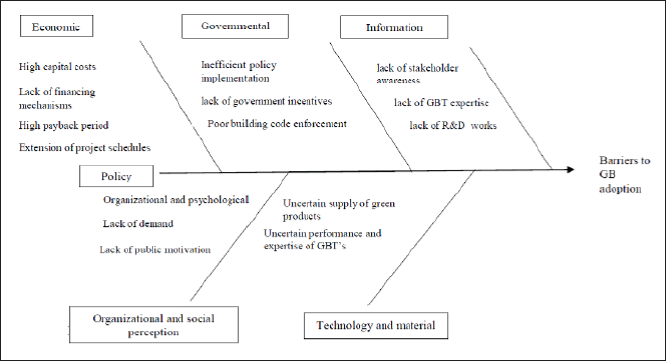
A variety of barriers were identified out of which overlapping barriers are high capital costs, lack of stakeholder’s awareness, organisational and psychological, lack or misplacement of government incentives, lack of GBT expertise, lack of financing mechanisms and lack of demand. The unique barriers to India and few other countries are lack of public motivation, unpredictable performance of GBT’s, poor building code enforcement, high payback period and uncertain supply of green products. The fifteen barriers identified are classified under five main categories, namely, economic, governmental, organisational and social perception, information, technology and material.
Economic barriers include the factors which increase cost. They include B1, that is, ‘High capital costs’ is prevalent in most of the countries. The remaining factors exist partially specifically in India. It is also seen that in the US extension of schedules is a weak barrier due to adoption of an integrated design mechanism which allocates enough time for feedback and revision. Xiao, Bie, and Bai in (2021) propose an enhanced buffer management method to dynamically control the delay of schedule risk in GB projects.
The governmental barrier consists of the challenges from the facilitator’s end. As per Samari et al. (2013), the government holds a significant position in finalising regulations, incentives for the implementations of GB. This category includes inefficient government policy implementation, lack of government incentives, and poor building code enforcement. The former two are prevalent in most countries while the latter is specific to India. According to Fan and Wu in (2020), how an incentive scheme works before implementation of any adjustment is an important factor for policymakers. This study reveals how incentive mechanism design affects stakeholders’ choices of GB levels in both tangible and intangible ways. Construction of green buildings cannot be excluded from government supervision as per Feng et al. in (2020).
Organisational and social perception barrier includes the various pre-existing mindsets that hinder the adoption of GB. It includes psychological barriers, that is, resistance to change, and the perception that sustainability costs more. Also, lack of client demand and public motivation are classified under this. The GB market is comparatively inert and extrapolatory in the developing countries which is due to the low public motivation and awareness. Anna Dell’ and Bottero in (2021) in (2021) find out that consumers in Singapore are aware of the benefits of Green Mark rated buildings.
The information barrier arises from the lack or asymmetry of information. This includes lack of stakeholder awareness, lack of GBT expertise and lack of research and development works. The latter two are spread unevenly, that is, contain some of the developed countries too. Wu et al. (2019) highlight that advanced GB technological support is not a main barrier in China as they already have them in place. They need a strong cash flow support and policy support along with increased training and education of GB.
The last barrier, that is, technology and material, includes the uncertain performance of GBT’s and uncertainty in the green material supply chain is mainly seen in emerging markets such as India and China. World Green Building Council (2018) highlights that in India 21% of the respondents feel there is a lack of availability of green products. Spreading awareness about innovative green building materials and implementing the same will help attract public attention towards use of greener alternatives. According to Wang et al. in (2021) technology and science input is one of the fundamental influencing factors while green financial incentives and size of the industry are the main influencers for development of green buildings in China. Apart from these, the sustainable innovation barrier is a significant one which hinders the adoption of sustainable methods into the mainstream.
GB adoption has still a long way to go in the Asian markets in comparison to the developed countries. India in comparison to the US, UK, Japan, Singapore, China, Malaysia and Hong Kong still has a long road to cover in terms of GB adoption. There is a need for proper implementation of policies. The study also explores how the government is one of the most important stakeholders in GB adoption and takes the role of an ‘initiator, controller and moderator’. Sharma (2018) highlights how barriers and challenges are positively related to the government. Hence the government should take the responsibility of formulating effective policies taking into consideration the different entities involved. The policies should be enforced plus there must be a mechanism to track the same. There must be rules for defaulters, which can attract penalties if found to be defaulted. Both corporates and the government should collaborate and work together towards GB implementation. An integrated design approach should be adopted in GB implementation so that the probability of extension of project schedules, and hence added costs, can be ruled out. Coming to the information barrier which arises from a lack of research works on GB, promotion and publicity, GB awareness, and GB education and trainings must be increased. Proper training and GB education along with GB demonstration projects should be undertaken to increase stakeholder awareness. Measures like information distribution using the medium of television, print media, and radio plus dedicated websites to serve as a one-stop database for all standardised GB data can be helpful. Forming partnerships with industry agencies, governments can organise workshops and launch campaigns. With more government funds allocated to research and developmental works on GB, India can have a solid base of GB literature helping the industry and academia. India also faces the barrier of inconsistent supply of green products which can be eradicated by proper government incentive programs along with an active GB market.
Figure 2 represents ‘fishbone diagram of all the barriers’ to GB adoption under the main categories.
The GB movement is definitely gaining importance across the globe and by utilising the potential of GB, the negative impacts of the construction sector can be offset. Although India’s GB adoption has been sluggish, GB in the residential market is booming in the US. Factors attributed to the growth are occupants’ improved quality of life and improved construction quality. By identification of unique and overlapping barriers, this research empowers various institutions and government bodies in India to formulate necessary GB approaches by recognising the loopholes.
One of the main barriers is high capital cost, the solution to which is an integrated design approach. Recently in Jordan, an integrated design approach was taken to augment water and energy efficiency of midrise residential buildings by using eQUEST which is an energy simulation tool. The results portray a reduction of 77.9% in the annual electricity need, 65.0% in the requirements of diesel oil and 19.5% in the indoor water consumption.
The research concludes that unique barriers specific to India and developing nations apart from the overlapping one’s are: lack of financing mechanisms, lack of public motivation, unpredictable performance and expertise of GBT’s, poor building code enforcement, high payback period, and uncertain supply of green products. It is reaffirmed that the government plays an important role in mitigating them by doling out tax incentives, rebates, funding R&D work, technology support and proper policy implementation. Effective promotion of GB along with proper training regarding GBT’s, GB demonstration projects can help increase public awareness along with proper implementation of policies. Focusing on various sustainable innovation techniques and implementing them will not only create an example for the world also will help India to become a flagbearer of the GB movement.
Further research studies may include more detailed analysis of each of the barrier and remediation from India’s perspective. Additionally, a survey instrument can be generated to check the perspective of different GB projects barriers in India in non-residential spaces, for example, SEZs, ports, health care centres, data centres and the mass rapid transit system. Different projects and owner types should be taken into consideration.
Footnotes
Acknowledgements
The authors wish to acknowledge Symbiosis Centre for Management and Human Resource Development for providing the opportunity.
Conflict of Interest:
Funding:
Self-funded
Ethical approval:
Not applicable