



Abstract
Fossil energy consumption is considered a source of environmental degradation. While the demand for fossil energy increases during the process of urbanization, different nations rely upon different sources of fossil energy. As such, a one-size-fits-all approach in reducing the consumption of fossil fuels to improve the quality of the environment is neither logical, nor practical. This study investigates the short-term and long-term effects of urbanization in relation to fossil energy consumption from coal, gas and oil. The auto-regressive distributed lag (ARDL) is employed on the sample of five emerging ASEAN nations in the 1985–2018 period. The findings reveal that that urbanization in Indonesia, Malaysia and Thailand appears to be associated with an increase in coal consumption in the short run. In Vietnam, gas consumption will increase with urbanization. However, in the long run, urbanization in Thailand and Vietnam is linked to an increase in oil consumption. Urbanization in Indonesia, Malaysia and the Philippines leads to the reduction of coal consumption in the long run. Policy implications have emerged based on the findings of this study.
Introduction
The growth-energy nexus has been examined in previous studies. During the third industrialization (1960–1990), researchers mainly focused on the impact of financial development on energy consumption and environmental degradation. More recent literature investigates the relationship between energy, economic growth (and/or financial development) and urbanization (Duan et al., 2008; Li et al., 2018; Mrabet et al., 2019; Poumanyvong & Kaneko, 2010). These scholars argue that an increase in urban population enhances the demand for energy and, in turn, puts more pressure on the environment.
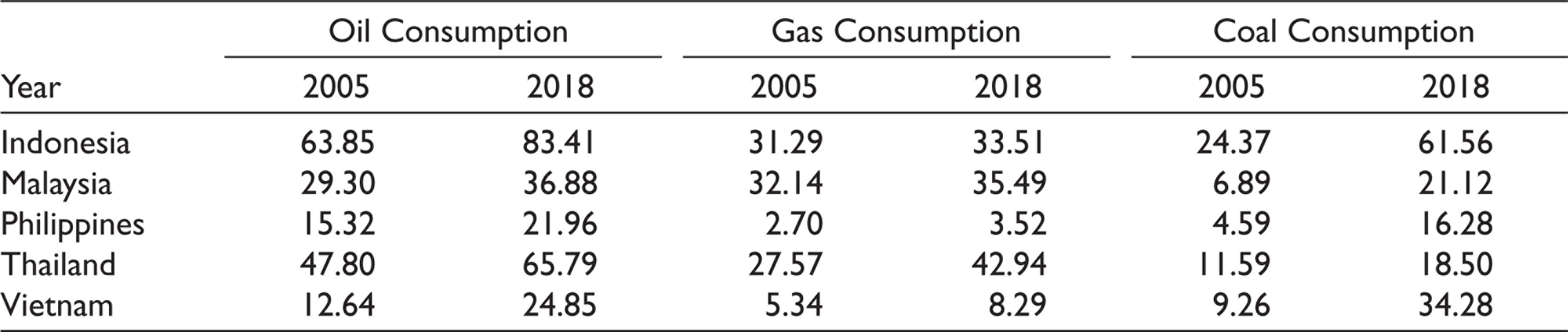
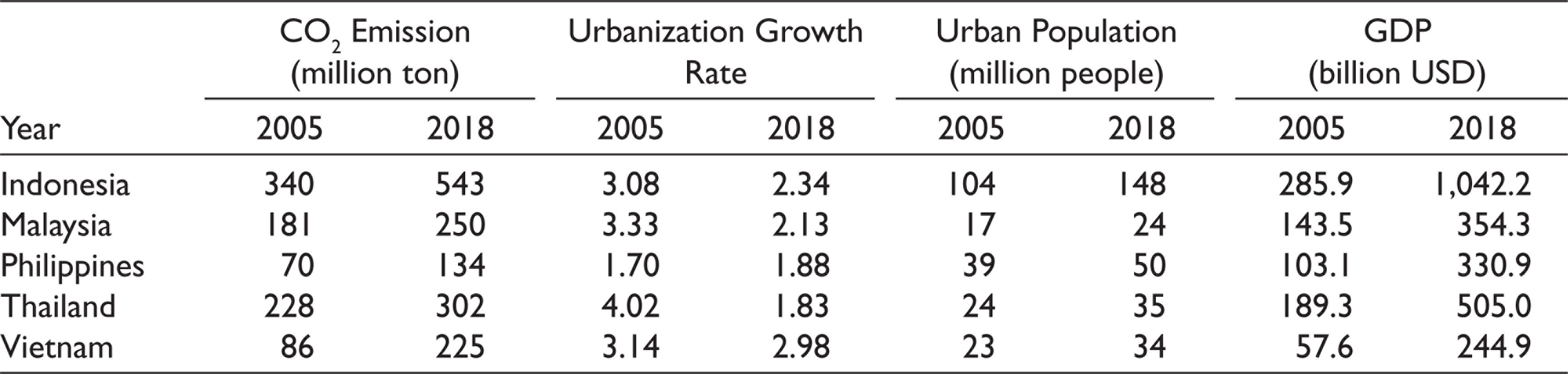
As per the International Energy Agency (IEA, 2019), the amount of energy used per unit of economic activity in 2018 was recorded at a 1.2% improvement. However, the index had been nearly double in 2010. The report also notes that the energy supply for the world has been under the pressure of rising demands for cooling, heating, mobility and many other services and productions. In addition, British Petro Statistics (2019) recorded that coal consumption increased more than six times in Vietnam and around three to four times in other Southeast Asian (ASEAN) nations from 2005 to 2018 (Table 1). However, total GDP only increased by four times in Vietnam and two to three times in other ASEAN nations during the same period (Table 2). Viewed together, statistics from Tables 1 and 2 reflect the inefficiency of energy usage in the ASEAN nations.
On the other hand, the urban population expanded by 44 million people in Indonesia, 7 million in Malaysia, around 11 million people in the Philippines, Thailand and Vietnam from 2005 to 2018 (Table 2). The overall increase of urban population in these ASEAN nations was around 30–50%. Table 2 indicates that CO2 emissions increased from 40% to 60% in Indonesia, Malaysia, the Philippines and Thailand, and 2.6 times in Vietnam between 2005 and 2018. These observations raise concerns about the relationship between urbanization and energy consumption. With energy consumption in ASEAN countries being considered as inefficient, we argue that urbanization in this context is a direct consequence of industrialization and processes of modernization in which a permanent process is carried out through reform and innovation. The process of modernization means a transition to a post-industrial society.
Energy Consumption in Selected ASEAN Countries (equivalent to million tons of oil)
CO2 Emission, Urbanization and GDP in Selected ASEAN Countries
The ASEAN is generally perceived as one of the most active economic zones in the world. However, during the process of industrialization and modernization in which countries in the region have achieved high economic growth rates and the living standard has consistently increased, the region has faced severe sustainability challenges owing to environmental degradation. Several researchers have investigated the relationship between urbanization and energy consumption (Al-mulali et al., 2012; Al-mulali et al., 2013; Al-mulali & Ozturk, 2015; Li & Lin, 2015; Poumanyvong & Kaneko, 2010; Zhang & Lin, 2012). The causality between urbanization and energy consumption, or CO2 emissions, in the nexus of energy and economic development, has also attracted many scholars. Empirical studies on urbanization and energy consumption focus on large emerging countries such as China and India (Li et al., 2018; Shahbaz et al., 2017; Zhang & Lin, 2012; Wang et al., 2014). Other studies were conducted using a sample of developed nations such as the OECD and the EU countries (Kasman & Duman, 2015; Chontanawat et al., 2008). However, the link between urbanization and energy consumption has largely been ignored in emerging markets in the ASEAN region. The time series aspect of this link has also been neglected.
The contributions of this study to current literature on urbanization and energy consumption can be summarized as follows. First, other studies appear to use total energy consumption while this paper focuses on each of the fossil fuels sources, including coal, gas and oil. Second, unlike other studies in which panel data analysis is used, this paper utilizes a time-series analysis to examine a co-integration (a long-run relationship) between energy and urbanization for each of the Southeast Asian countries. Third, we focus on developing countries only in the Southeast Asian region including Indonesia, Malaysia, the Philippines, Thailand and Vietnam to provide specific insights for policies. Fourth, a relationship between urbanization and energy consumption in each of these Southeast Asian countries is estimated and then compared with each other for policy implications.
Following this introduction, the remainder of the paper is structured as follows. The Literature Review section presents a literature review on urbanization and energy consumption. Data and research methodology are then discussed in the section Data and Research Methodology. Results section presents the empirical findings, followed by the conclusion in the section Conclusion and Policy Implications of the paper.
Literature Review
Extensive literature exists on the relationship between energy consumption and economic development (Aslan et al., 2014; Bartleet & Gounder, 2010; Belke et al., 2011; Chontanawat et al., 2008; Kasman & Duman, 2015; Narayan et al., 2010; Ouedraogo, 2013; Ozturk & Acaravci, 2010). Among these studies, Ouedraogo (2013) and Aslan et al. (2014) argue that energy consumption affects economic growth, while Bartleet and Gounder (2010), Narayan et al. (2010) and Kasman and Duman (2015) argue the inverse; that economic growth affects energy consumption. Chontanawat et al. (2008) confirm the influence of economic growth on energy consumption in the OECD countries, while the opposite effect is found in non-OECD economies. The bidirectional causal relationship between economic growth and energy consumption is also found in the work of Belke et al. (2011) and Ozturk and Acaravci (2010). Li and Lin (2015) and Poumanyvong and Kaneko (2010) present two opposing impacts of economic growth on energy consumption, depending on the respective stage of development. While economic growth leads to lower energy usage in low-income countries, a positive relationship between economic growth and energy consumption is found in middle- and high-income nations.
On the ground of endogenous relationship between economic growth and financial development, Islam et al. (2013), Karanfil (2009), Lee and Chang (2008) and Sadorsky (2010) consider financial development as a relevant factor affecting energy consumption. Karanfil (2009) argues that financial factors such as exchange rates and interest rates can potentially affect energy consumption via energy price. Sadorsky (2010) and Islam et al. (2013) find a positive relationship between financial development and energy consumption. Empirically, Lee and Chang (2008) reconfirm a significant relationship between energy consumption and economic growth when capital is added into the panel regression model.
Later research has shifted its attention to the more specific relationship between particular socio-economic issues and energy consumption in specific regions or at different stages of economic development. Within this, we consider that the relationship between urbanization and energy consumption is particularly interesting and important area of research. There are two strands of empirical studies that emerge in this respect. In the first strand, urbanization and industrialization are understood to encourage energy consumption (Burney, 1995; Dahl & Erdogan, 1994; Lenzen et al., 2006), while in the second, urbanization reduces per capita energy consumption (Lariviere & Lafrance, 1999; Pachauri & Jiang, 2008; Poumanyvong & Kaneko, 2010). For example, Liu (2009) focuses on the household perspective to explore the relationship between urbanization and energy consumption. Applying ARDL regression and Granger causality test, Liu (2009) suggests co-integrated movements between energy consumption, GDP, population and urbanization in China. The findings confirm the unidirectional Granger causality from urbanization to energy consumption in the short run and the long run. This suggests that a higher level of economic development or a higher level of urbanity leads to more efficient energy usage, as reflected through a decreased growth rate of total energy consumption or energy consumption per capita. Similarly, Lariviere and Lafrance (1999) have demonstrated that a higher density of urban inhabitants decreases electricity usage in Canada.
Moreover, the causality between urbanization and energy consumption has attracted a lot of research attention recently, with time-series analysis being widely employed. Al-mulali et al. (2012), for instance, conduct an analysis comparing the different effects of urbanization across countries in different regions. However, Al-mulali et al. (2012) do not separate developed countries from developing nations in their analysis. Furthermore, their empirical model is a bivariate model which has been criticized by many scholars due to the issue of omitted variables. Wang et al. (2018), on the other hand, employ study the relationship between urbanization, energy consumption, CO2 emission and economic growth in 170 countries in the period of 1980–2011. The authors confirm the co-integration between all these variables. In another study, Bakirtas and Akpolat (2018) conduct a panel analysis for six emerging countries that are located in different continents from 1971 to 2014. The authors find the Granger causal relationship between economic growth, urbanization and energy consumption.
Data and Research Methodology
This paper aims to examine the effect of urbanization on energy consumption in selected Southeast Asian countries. Unlike previous studies in which panel regressions were used, a time-series analysis is utilized in this paper. As such, the effects for each nation are observed and then compared among these nations.
Furthermore, in our time-series analysis, the analysis has been conducted for each of the five nations, separately. As such, differences in the measurements of variables, if any, across nations are not an issue. In our model, a share of industry in GDP is used as a proxy for industrialization. Moreover, we also utilize a share of the manufacture in GDP in the model. We consider that urbanization, industrialization and manufacture are three indicators representing modernization. Data for GDP, urbanization, manufacture and industrial contributions are collected from the World Development Indicators from the World Bank Database. Data on fossil energy consumption has been taken from the British Petro Statistics (2019). All of these data for five ASEAN nations are available from 1985 to 2018. The log-log model can be illustrated as follows:

where EN represents for coal consumption, gas consumption and oil consumption; GDP represents the nominal GDP; URB represents urbanization growth rate; IND and MAN are shares of industry and manufacture in total GDP, respectively. Subscript t represents for time; superscript j represents each of the countries.
A time-series analysis typically employs VAR (vector autoregressive) or ARDL model for estimations. While VAR model has several advantages, VAR exhibits its weaknesses while estimating with small sample size or when all variables are not stationary at the same order I(0) or I(1) (Shrestha & Bhatta, 2018).
As such, the ARDL model becomes a reasonable alternative for the VAR model. ARDL model can perform well with small sample. The ARDL model is independent with stationary level at either I(0) or I(1) (Danish et al., 2018; Odhiambo, 2009; Sari et al., 2008; Shrestha & Bhatta, 2018). Furthermore, ARDL bound test can also identify co-integration in the model. In the case of endogenous problem, ARDL can report unbiased long-run estimates and valid test statistics (Harris & Sollis, 2003). As such, we propose to utilize the ARDL model for our time-series analysis. Empirical models using the ARDL are expressed as follows:



where αi represent short-term coefficient; bj represent long-term effects; the upper subscript j represents for five ASEAN nations (Indonesia, Malaysia, the Philippines, Thailand and Vietnam). As such, each of these three models above will be conducted five times for five emerging markets in the ASEAN nations.
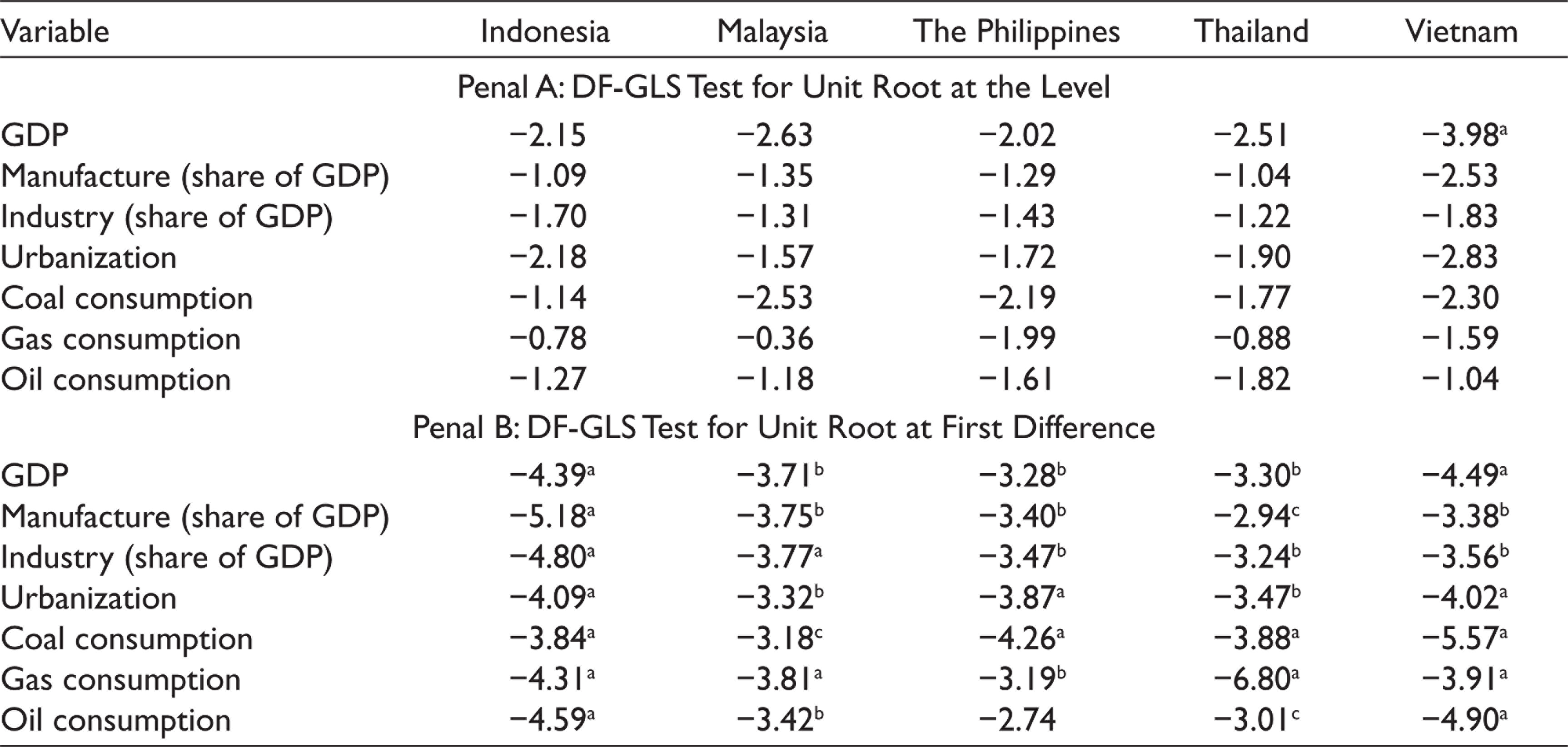
In the ARDL model, all variables are required to be stationary at level (I(0)) or at their first difference (I(1)). We employ the modified Dickey–Fuller test based on generalized least squares (DF-GLS) for general unit-root test and Zivot and Andrews (ZA) test for the unit-root test with a structural break. DF-GLS test results are presented in Table 3. It is noted that the DF-GLS test does not take into account structural breaks in time-series data. As such, the DF-GLS results may be inefficient if the structural break is present in the data. The ZA test facilitates a unit-root test with a structural break in a time-series analysis.
In the next step, a co-integration test is conducted using two different tests: (a) the Gregory–Hansen test and (b) the ARDL bound test. First, the Gregory–Hansen test produces co-integration analysis with the presence of the structural breaks. Second, the ARDL bound test can be conducted with and without structural break identified by the Gregory–Hansen test. From these analyses, we can compare results that have not been considered in previous studies. In relation to the ARDL bound test procedure, we need to identify optimal lag length for each variable in the model first. We propose to employ the Bayesian information criterion (BIC) to decide optimal lags.
Results
Unit-Root Test
Results from Table 3 indicate that the majority of the variables are not stationary in their level using the modified Dickey–Fuller test based on GLS. However, most variables are integrated at their first difference, I(1), except for the urban population, which is stationary at I(0). These results mean that our variables are integrated at both I(0) or I(1). As such, the use of the ARDL model is more appropriate than the VAR. However, the only exception is that oil consumption in the Philippines is not integrated at both I(0) or I(1). As such, the ARDL results from a model of oil consumption in the Philippines are invalid.
As an alternative to the DF-GLS test, we conduct the ZA test to ensure the robustness of the findings. 1 Findings from the ZA tests indicate that oil consumption in the Philippines is stationary with the presence of structural break. Therefore, a regression model developed for oil consumption in the Philippines is valid using the ARDL model with the presence of a structural break.
Unit Root Test by Modified Dickey-Fuller Test Based on Generalized Least Squares (DF-GLS)
Co-integration Test
Table 4 presents the results from Gregory–Hansen test for co-integration with a structural break. The results confirm the long-run relationship among variables included in a regression model with the dependent variable as (a) coal consumption (for Indonesia, Malaysia, and the Philippines), (b) gas consumption (for Malaysia and the Philippines) and (c) oil consumption in (Indonesia and Malaysia). No long-run relationship among variables were included in a regression model using each of the energy sources (including coal, gas and oil consumption) as the dependent variable in Vietnam and Thailand.
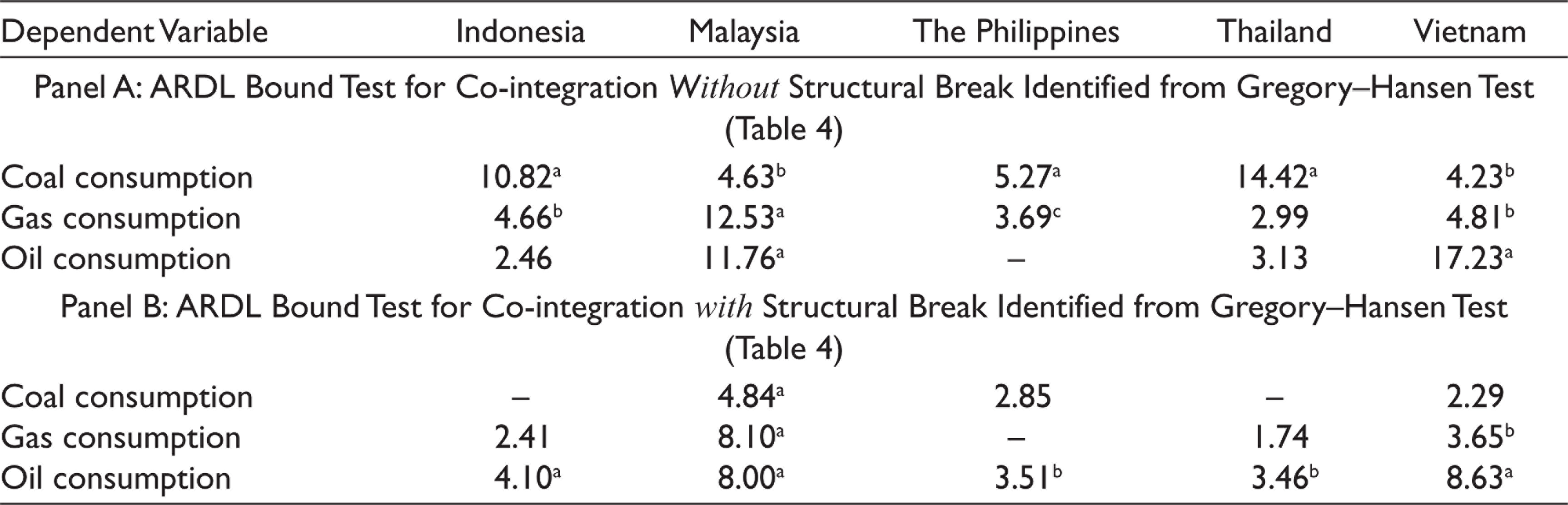
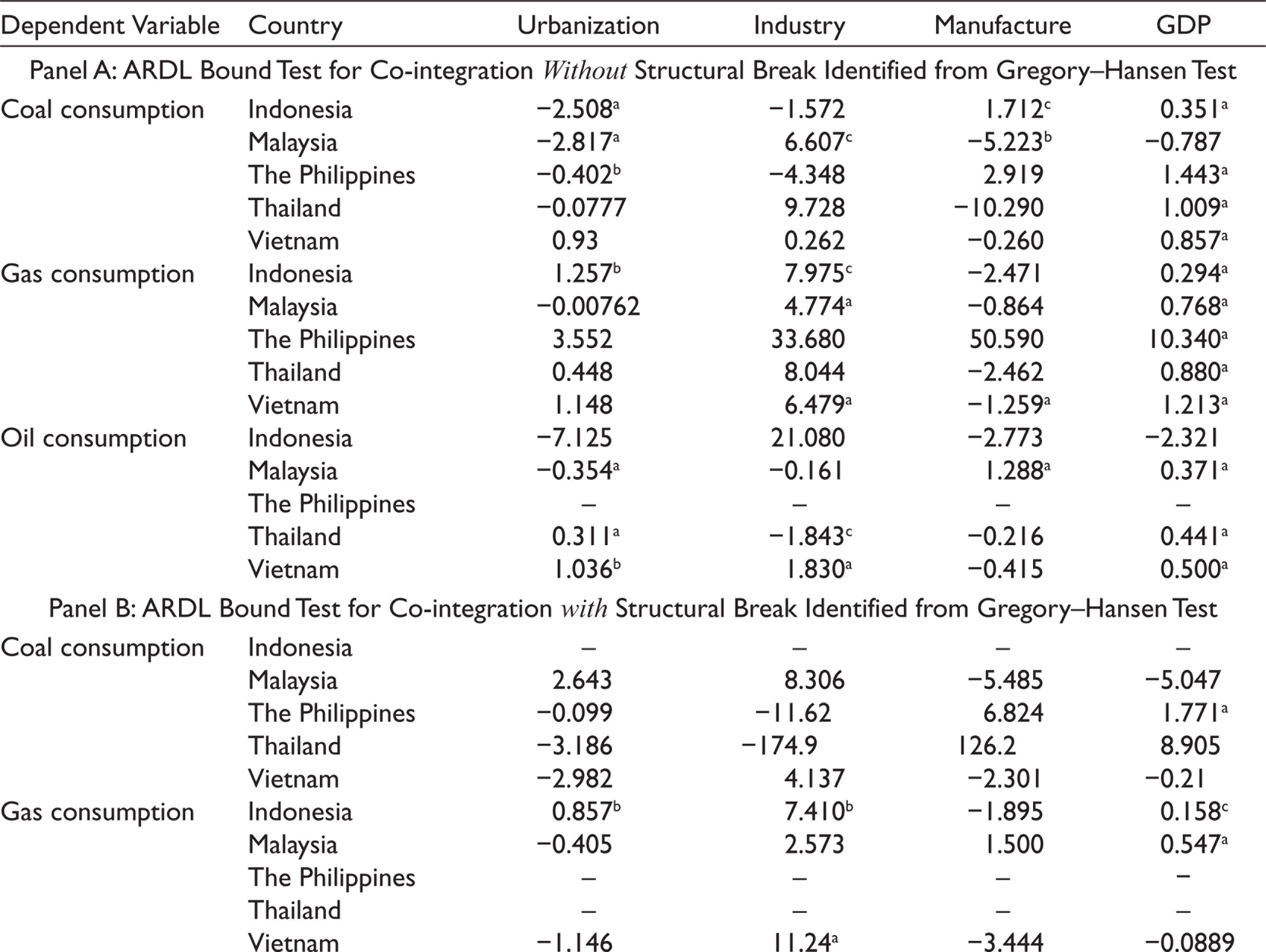
Based on the breakpoints identified by the Gregory–Hansen tests, as presented in Table 4, we conduct the ARDL bound tests without and with these breaks, which are presented in Panel A (without a structural break) and Panel B (with structural break) of Table 5, respectively. As presented in Table 5, due to the presence of a structural break, the serial correlation has been found in several models (e.g., a model with coal consumption as a dependent variable in Indonesia, gas consumption in the Philippines, coal consumption in Thailand). In addition, the model using oil consumption as a dependent variable in the Philippines without the structural break is not valid due to its failure of the DF-GLS test (Table 3). As such, it is noted that the results from these four models are not available in Table 5. In Table 5, empirical findings from the ARDL bound test confirm the co-integration relationship between consumption of each fossil energy source and other variables (urbanization, industry, manufacture and GDP) in all five ASEAN nations. An exception is found for the model using gas consumption as a dependent variable in Thailand.
ARDL Regression Results
Table 6 presents the long-run effect of urbanization on the consumption of each of fossil fuel source, using the ARDL regression technique. It is noted that for each country, a regression model is run three times in which each of the fossil energy sources (coal consumption, gas consumption and oil consumption) is used as the dependent variable. In addition, Table 7 presents the short-term effect of urbanization on energy consumption for each source in five selected ASEAN nations.
From Table 6, we find a negative long-term relationship between urbanization and coal consumption in Indonesia, Malaysia and the Philippines. On the other hand, urbanization significantly reduces gas consumption in Indonesia in the long term. A positive long-term effect of urbanization on oil consumption is found in Thailand and Vietnam, while a negative effect is found in Malaysia. Economic growth appears to have mainly had a significant and positive impact on the consumption of fossil energy (coal, gas and oil) in all five emerging markets in the ASEAN nations.
Gregory–Hansen Test for Co-integration with a Structural Break

ARDL Bound Test for Co-integration with a Structural Break from Gregory–Hansen Test
Coal, gas and oil are three main fossil energy resources in the world. Each of the five ASEAN countries appears to have adopted a specific energy strategy for the modernization of the economy. Table 6 presents a common trend of decreasing coal usage across Indonesia, Malaysia and the Philippines. On the other hand, a positive relationship between urbanization, the emergence of manufacturing industries and gas consumption is observed in Indonesia. Meanwhile, Thailand and Vietnam use more oil resources in the process of modernization of the national economy. An increase in urbanization growth rate is also observed in these two countries. In addition, a change in energy infrastructures is also observed in Malaysia and Thailand. While urbanization in Malaysia reduces the use of coal, the country appears to encourage the use of coal and gas in the industrial sector. Also, the manufacturing sector in Malaysia displays a transition, toward reliance on oil instead of coal. Although Thailand uses more oil resources within the urban area, the industrial sector in Thailand appears to have reduced its use of oil resources.
Long-term Effect of Urbanization on Energy Consumption ARDL Long-term Results

ARDL Short-term Results of Urbanization Only

Table 7 presents the short-term effects of urbanization on the consumption of each fossil energy source. The time-lagged effects presented in Table 7 are conducted using the ARDL model, based on the BIC criteria. In general, urbanization provides a mixed effect on the consumption of fossil energy in these five ASEAN nations in the short-term. In Indonesia, Malaysia and Thailand urbanization is positively correlated with coal consumption. While it helps reduce gas consumption in Indonesia, it increases gas consumption in Vietnam. Urbanization also has a negative effect on oil consumption in Indonesia, the Philippines and Vietnam, while a positive relationship between urbanization and oil consumption is found in Malaysia. For each particular country, urbanization is therefore found to have different time-lagged effects on fossil energy usage. The Philippines and Malaysia appear to have adopted fossil energy sources in urban areas. Owing to urbanization, fossil energy consumption in these two countries has been affected with a 1-year lag. In contrast, findings from our paper indicate that energy consumption in urban areas is relatively conservative in Indonesia and Thailand. Urbanization has up to 3-year lagged effects on coal and oil consumption in Indonesia. In Thailand, the effect of urbanization on oil consumption also lasts for 3 years. Among the five countries in the ASEAN, Vietnam is the only country where urbanization has a 2-year lagged effect on gas consumption. We note that the lagged effects of urbanization on oil and gas consumption in Indonesia, Thailand and Vietnam may potentially be caused by the geographical and natural characteristics of these countries. These three nations own a large number of oilfields and a significant petroleum capacity in comparison with the other two countries in the region, the Philippines and Malaysia.
Table 8 summarizes the empirical relationship between urbanization and fossil energy consumption in both the long and the short run for five ASEAN nations. In particular, Indonesia, Malaysia and the Philippines indicate a negative correlation between urbanization and coal consumption in the long run. However, in the short run, urbanization has a positive effect on coal consumption in Indonesia, Malaysia and Thailand. An inverse effect of urbanization on gas consumption between the long term and the short term is found in Indonesia. Another inverse result between the long term and the short term is found between urbanization and oil consumption for Vietnam. Thailand has experienced positive effects of urbanization on oil consumption in both the short run and the long run. The difference between the short-term and long-term effects of urbanization on fossil energy consumption is useful to policymakers and the governments of these five ASEAN countries.
A Summary of the Relationship Between Urbanization and Sources of Fossil Energy Consumption in Five ASEAN Nations

Conclusion and Policy Implications
The energy-growth nexus has attracted the attention of policymakers, academics and practitioners since the third industrialization (1960–1990). However, in previous studies, the focus has largely remained on industrialized countries (the OECD countries) or large manufacturing nations such as China and India. Over the existing period of urbanization, studies on the energy-growth interrelationship for the ASEAN, which is now one of the most active economic regions in the world, have largely been ignored. In this paper, the relationship between urbanization and energy consumption in the emerging markets in the ASEAN nations has been investigated. We employ a time-series analysis to examine the co-integration relationship between consumption for different energy sources of fossil fuels and urbanization. Unlike other papers in which panel data analyses are utilized, a time-series analysis allows us to compare the effects of urbanization on energy consumption across five selected ASEAN nations.
The overall findings from our study confirm the long-run relationship between urbanization and fossil fuel consumption in Malaysia, the Philippines, Thailand and Vietnam. In addition, unlike other papers, our findings are distinct because different types of energy sources have been considered. In particular, our results indicate that urbanization has had different effects on energy consumption across the selected nations, depending on the source of fossil energy in question (i.e., coal, gas or oil). For example, while urbanization provides a long-term negative effect on coal consumption in Malaysia and the Philippines, in Thailand and Vietnam, it encourages greater consumption of oil.
A difference between the long-term and short-term effects of urbanization on the energy consumption of fossil fuels is thus apparent. In Malaysia, urbanization significantly increases coal and oil consumption in the short run. However, the effect is the opposite in the long run. Inversely, in Vietnam, a negative effect from urbanization on oil consumption is observable in the short term, while there is a positive effect in the long term. Our findings also confirm the positive effect of urbanization on oil consumption in Thailand in both the short run and long run.
The findings of our paper raise several policy implications.
For Malaysia, the Government should limit urbanization growth rate because it evidently helps reduce consumption of coal, and oil in the short run.
The Philippines currently maintains an appropriate strategy for modernization which appears irrelevant to fossil energy consumption in the long run.
The Government of Thailand should pay close attention to the impacts of urbanization on energy security. We note that growing demand for fossil energy consumption in Thailand due to modernization and economic development can potentially lead to problems of energy security and environmental degradation.
Increases in urban population encourage the consumption of gas but reduce the demand for oil in Vietnam. However, in the long run, the Vietnamese government should note that urbanization tends to increase oil consumption. These results imply that the urbanization process in Vietnam is strongly associated with fossil energy consumption, leading to more severe environmental degradation.
For Indonesia, coal and gas appear to be alternative resources in both the long term and short term. These results imply that the Indonesian government should note a negative effect of urbanization on oil consumption.
In summary, findings from our paper provide empirical evidence to support the view that the governments of countries in the Southeast Asian region should encourage the use of renewable energy sources to minimize a negative effect on the environment. We argue that countries in the region should encourage the use of renewable energy such as hydropower, in order to increase economic growth while limiting environmental degradation. We consider that balancing economic development with sustainable energy consumption is crucial and can be initiated through shifting the demand for fossil fuels to renewable energy sources.
Footnotes
Declaration of Conflicting Interests
The authors declared no potential conflicts of interest with respect to the research, authorship and/or publication of this article.
Funding
This research is funded by Ho Chi Minh City Open University under the grant number E2020.13.1.