




Abstract
Introduction:
Worldwide, the age-adjusted incidence of cervical cancer is approximately 18 cases per 100,000 women. In our country, the majority of women are diagnosed at an advanced stage, where the disease is often incurable and associated with a poor outcome.
Objectives:
The study aimed to explore perceptions and behaviours related to cervical cancer screening and HPV vaccination in a tertiary care setting. This was achieved through a survey conducted among patients attending outpatient services at our hospital.
Methodology:
This cross-sectional study, conducted in a hospital setting, employed a pre-validated, self-administered questionnaire distributed to the participants. The questionnaire collected data on sociodemographic and reproductive profiles, knowledge regarding cervical cancer and its risk factors, awareness of preventive strategies and attitudes and practices related to Pap smear screening and HPV vaccination. Participants completed the survey after giving informed consent. Upon completion, each participant was provided with an educational pamphlet on cervical cancer screening and HPV vaccination to enhance public awareness.
Results:
Out of 324 participants, 140 (43.2%) had heard of cervical cancer, and 225 (69.7%) demonstrated a favourable attitude towards cervical cancer vaccination. However, only 84 women (25.7%) were aware of its risk factors. Notably, a mere 15 individuals (0.04%) reported having received the cervical cancer vaccine.
Conclusion:
The findings reveal a considerable gap in awareness regarding cervical cancer and the screening of precancerous lesions among women, underscoring the pressing need for targeted strategies and programmes to strengthen cervical cancer prevention, particularly in low-resource settings. Bridging knowledge gaps and fostering educational initiatives are critical to combating cervical cancer in such contexts. The distribution of pamphlets aims to contribute to public awareness and prevention efforts.
Introduction
Cervical cancer is the fourth most prevalent cancer affecting women globally. As per GLOBOCAN 2020 estimates, 604,000 women were diagnosed with cervical cancer, and 342,000 succumbed to the disease.[1] The global age-standardised incidence rate is approximately 13.1 per 100,000 women.[2] In India, around 60% of women diagnosed with cervical cancer die each year, contributing to nearly one-third of the global cervical cancer mortality.[3] The primary causative agent is high-risk human papillomavirus (HPV) infection, with types 16 and 18 accounting for nearly 75%-80% of all cases.[4] Early detection methods include Pap smear, colposcopy, visual inspection with acetic acid (VIA), and HPV testing.[5] Several factors influence the stage at which cancer patients seek medical assistance, including literacy, financial status, location and the availability of healthcare facilities. However, a common underlying factor in all these aspects is the level of awareness and attitudes patients hold towards these diseases.[6] Recognition of HPV’s role in the development of cervical cancer has led to two key strategies for prevention and early detection: HPV vaccination and screening for precancerous lesions. The Centers for Disease Control and Prevention (CDC) recommends the following HPV vaccination schedule: two doses administered 6–12 months apart for individuals aged 9–14 years, and a three-dose regimen for those aged 15–26 years, with the second dose given 1–2 months after the first, and the third dose administered six months after the second.[7]
The World Health Organization (WHO) has launched a global initiative to eliminate cervical cancer as a public health problem by 2030, based on a three-pronged strategy: achieving 90% HPV vaccination coverage among girls by age 15, screening 70% of women at ages 35 and 45 with high-performance tests, and ensuring that 90% of women diagnosed with cervical lesions receive appropriate treatment and care.[7] In countries with a high cervical cancer burden, coordinated efforts between healthcare organisations and policymakers are critical to the success of these goals.
This study was undertaken to assess the perceptions and practices related to cervical cancer screening and HPV vaccination among patients visiting the Obstetrics and Gynecology outpatient department at our institution.
Materials and Method
An institutional based cross-sectional study design was conducted at the Department of Obstetrics and Gynecology, AIIMS, Mangalagiri, after IEC approval was obtained. 324 female patients were included in this study. All Women aged 18 years and above visiting the Obstetrics and Gynecology outpatient department and who had consented to participate in this research study were included. Exclusion criteria were women who were mentally and critically ill, and Women diagnosed with cervical cancer.
A pre-validated questionnaire, which participants completed on their own, was distributed. The questionnaire encompassed multiple domains, including demographic and reproductive details, awareness of cervical cancer and its associated risk factors, understanding of preventive measures, and attitudes and practices concerning Pap test screening and HPV vaccination. The participants were asked to fill the questionnaire after obtaining an informed consent. After completing the answers, each patient was provided with a pamphlet related to knowledge of screening for carcinoma cervix and HPV vaccination to create public awareness.
Statistical Analysis
All the questionnaire data was entered into a Microsoft Excel sheet, and statistical analysis was done through Epi Info software.
Knowledge Assessment
The knowledge of the screening for cancer cervix and HPV vaccination was assessed by 10 questions. A score of 10 was assigned to each correct response, while a score of 0 was given to each incorrect response. Those who scored more than 50%, were labelled to have good knowledge score.
Attitude Assessment
Attitude was assessed by their willingness to get themselves and their daughters vaccinated against HPV.
Practice Assessment
The practice was assessed by looking at the respondent’s action towards screening for Ca cervix. Participants who had undergone screening within the past three years were considered to have regular screening practices, while those who had never been screened were classified as having no screening practice.
Results
Socio-demographic Profile of Participants
A total of 324 individuals completed the questionnaire, resulting in a 100% response rate. Most participants were under the age of 30, with a majority residing in urban areas.
Participants’ Knowledge on Cervical Cancer
Regarding overall knowledge, 74 participants (22%) demonstrated a good understanding of cervical cancer. An analysis revealed that 104 participants (43.6%) had heard of cervical cancer, while 87 (26%) were aware of the Pap smear test. Only 49 participants (15%) knew the recommended frequency for undergoing a Pap smear. Additionally, 84 respondents (25%) identified foul-smelling vaginal discharge and bleeding during sexual intercourse as symptoms of cervical cancer. A total of 110 (33%) knew that HPV infection is transmitted through sexual contact.
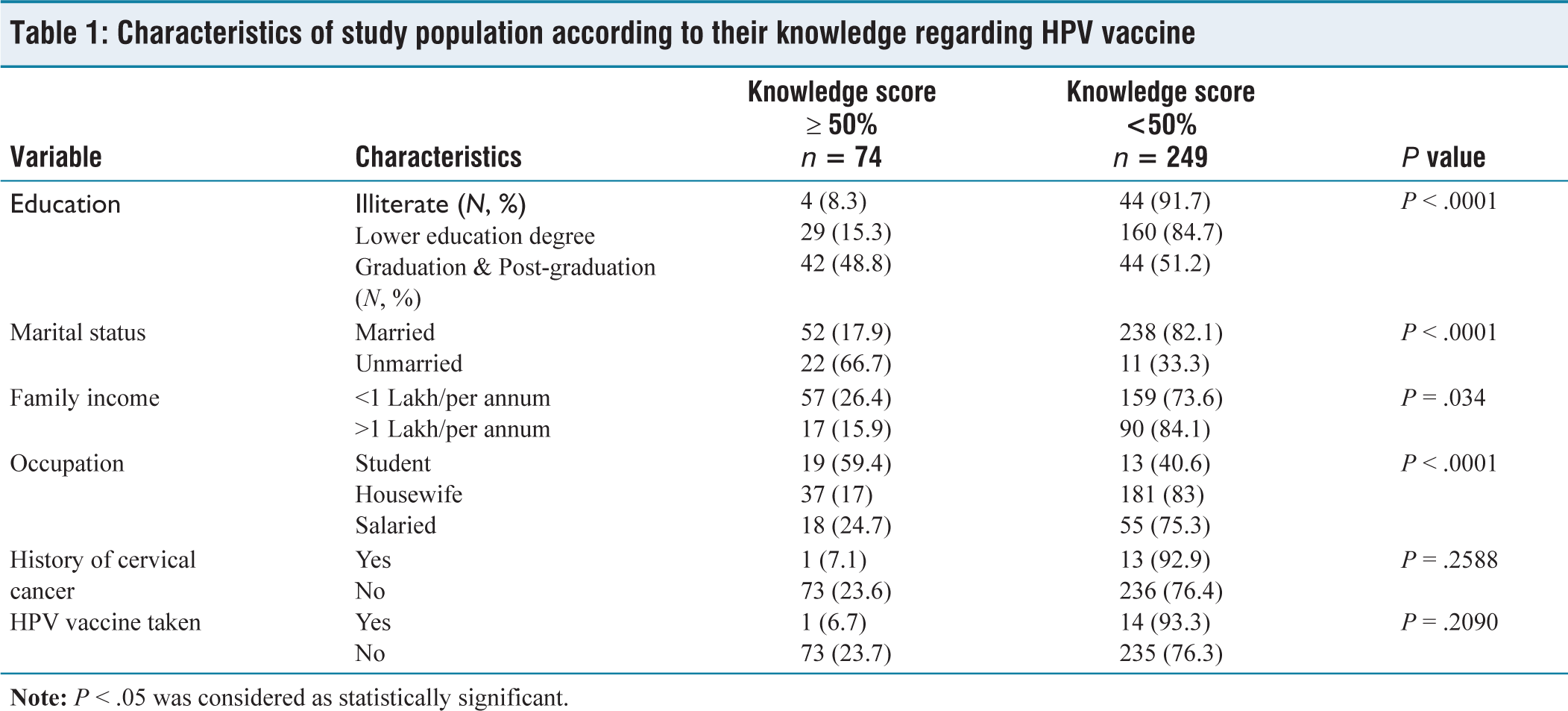
Study population were grouped based on their knowledge score, and the same was assessed based on their education, marital status, income level, occupation, history of cancer cervix and status of HPV vaccination. The knowledge score based on educational status, marital status and occupation was found to be statistically significant (P value < .05) [Table 1].
Characteristics of study population according to their knowledge regarding HPV vaccine
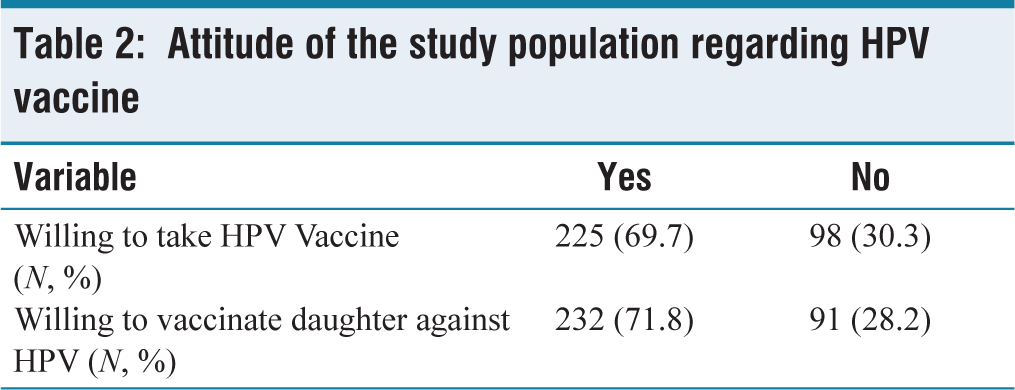
Their attitude towards vaccination was overall positive; 69.7% believed that it was necessary for them to receive the vaccine and 232 (71.8%) were willing to vaccinate their daughter against HPV [Table 2].
Attitude of the study population regarding HPV vaccine
Discussion
This study assessed the knowledge, attitudes and practices related to cervical cancer screening and HPV vaccination. Among the participants, 104 (43.6%) had heard of cervical cancer. This awareness level is lower than that reported in studies from Spain (2014)[8] and Nigeria (2014),[9] but higher than findings from Zimbabwe, where 90% of respondents had no awareness of cervical cancer.[10] The respondents in our study had an overall knowledge score of 22%, indicating inadequate knowledge regarding cervical cancer screening and HPV vaccination. This result highlights the need for community-based efforts to establish prevention and screening initiatives. Similar low knowledge scores were reported in a 2013 study conducted in Nigeria,[11] and even lower scores were found in studies conducted in Nepal and Yemen.[12,13] Graduates and post graduates had higher knowledge score (48.8%) when compared to illiterates (8.3%) and participants with lower education degree (15.3%). The married had higher knowledge score when compared to the unmarried.
Regarding cervical cancer prevention, about one-third of the participants in our study recognised that it can be prevented by limiting the number of sexual partners, delaying the initiation of sexual activity, and avoiding smoking. In comparison, a study from Spain reported that 67% of respondents were aware that early screening and HPV vaccination could help prevent cervical cancer.[8] This disparity in awareness may be due to better access to preventive services such as screening and vaccination in developed countries, where these interventions are more affordable and readily available through the healthcare system.
In our study, the rate of cervical cancer screening practice among participants was extremely low, with only 4% of participants reporting having undergone screening. This proportion is notably lower when compared to findings from studies conducted in Spain (71.5%),[8] Hong Kong (7%),[14] Nepal (10.5%),[12] Yemen (7%),[13] Nigeria (6%),[15] Uganda (19%)[16] and Addis Ababa (6.5%).[17] The most commonly reported reasons for not undergoing screening included lack of awareness about cervical cancer symptoms, limited knowledge about the availability of screening services, the high cost of the test and personal choice to avoid screening.
Furthermore, the study found that participants with higher education levels demonstrated greater knowledge about HPV infection and HPV vaccines. Although overall knowledge levels were low, participants showed a generally positive attitude towards vaccination once they were informed about it. Most participants (69.7%) felt that receiving the vaccine was important for themselves, and a substantial proportion (232 participants, or 71.8%) indicated their willingness to have their daughters vaccinated against HPV. This high acceptance rate could be attributed to the information provided through pamphlets about cervical cancer and HPV vaccination. CharaKorn C. et al and Basuand Mittal[18,19] conducted studies that revealed a similar trend. Despite having limited knowledge, the participants displayed a high level of acceptance towards the HPV vaccine. These studies identified obstacles to achieving widespread HPV vaccination, such as the absence of a service platform to administer the vaccine in certain countries and the high cost associated with it.
Conclusion
The study participants demonstrated insufficient knowledge regarding cervical cancer screening and HPV vaccination. The low uptake of cervical cancer screening can be attributed to a lack of information and limited accessibility to screening services. To address these challenges, it is crucial to establish robust social communication channels and initiatives that promote acceptance and compliance with screening practices. The findings of this study are expected to inform the development of future strategies and the implementation of effective programmes for cervical cancer prevention, particularly in resource-constrained settings. Additionally, the distribution of pamphlets is anticipated to play a significant role in raising public awareness about the prevention of cervical carcinoma.
Footnotes
Declaration of conflicting interests
The authors declared no potential conflicts of interest with respect to the research, authorship and/or publication of this article.
Ethics approval and consent to participate
The study was conducted according to the Declaration of Helsinki principles.
Funding
The authors received no financial support for the research, authorship and/or publication of this article.
Institutional ethical committee approval number
Approval of Institute ethical committee obtained (AIIMS/MG/IEC/ 2022-23/191).
Informed consent
Signed informed consent obtained from patient.
Credit author statement
VS, SSK and VK were involved in conception, literature search, analysis of data and drafting the manuscript.
Data availability
The datasets generated and/or analyzed during the current study are not publicly available and are available from the corresponding author on reasonable request.
Use of artificial intelligence
No AI application was used in the preparation of this manuscript.