



Abstract
Dependency on aged care homes is unusually becoming a viable option for elderly couples these days, which is unconventional to the Asian way of life. The perception of the aged care home, perceived as an institution, has gradually shifted over the years and continued to evolve as elderly couples have become more open to this option to ascertain their independence. Though scholarly researchers have conducted studies on elderly life in aged care homes, there is no evidence of research on elderly couples’ mundane life in aged care homes specifically addressing the complexities of institutional interference in the togetherness, end of life, privacy, sexuality and intimacy of their physical and emotional necessities. Therefore, this article addresses this research gap. It employs an in-depth systematic literature review to address the issue and unveils important insights on the body of knowledge. The findings reveal the complexity of elderly couples’ challenges in dealing with institutional interference, as well as the importance of autonomy and privacy.
Keywords
Introduction
Population ageing remains a global phenomenon, and it is increasing rapidly, especially in developing countries (Ambigga et al., 2011; Beard & Bloom, 2015). The rate of increment remains unprecedented in human history and is projected to continue rising (Davies et al., 2016). This major change in demographics happening globally is caused by the decrease in mortality and fertility, improved public health policies, advancement in the health system and longer life expectancy (Ambigga et al., 2011; Onunkwor et al., 2016). The segment termed ‘older adults’ is commonly divided into ‘young old’ (aged 65–74), ‘old old’ (aged 75–84) and ‘oldest old’ (aged 85+) (Suzman & Riley, 1985; Zizza et al., 2009). With respect to Malaysia, the estimated population of the country in 2019 was 32.6 million, with a total of 2.4 million older adults aged 65 years and above, which made up 6.5 per cent of the total population (Department of Statistics Malaysia, 2019). Malaysia is anticipated to reach the status of an ageing nation in the year 2030 (Tobi et al., 2017) when its elderly population reaches 15 per cent (Nations, 2015, 2017). Statistics obtained from the Department of Statistics Malaysia (2019) showed that a woman aged 65 in 2019 was expected to live for another 17.2 years, whereas a man of the same age was expected to live for 15 years more.
Ageing is a dynamic and regressive process that leads to the decline of older adults’ functional abilities to perform with autonomy (Cruz & Ramos, 2015) and restricts their freedom to live a healthy, independent life (Rolph et al., 2009). Ageing leads to changes in self-concept and identity and, the psychology of the aged, focuses on older people and later life adaptation (Schroots, 1996) that set certain life principles of elderly couples in aged care homes. In tandem with the forthcoming ageing nation status, Malaysia is moving towards a transformation in healthcare nationwide, from public health facilities to aged care institutions (Majumder et al., 2017). Aged care homes are sprouting at an alarming rate, especially in urban areas, with 1,473 approved registered care centres supported by non-profit organizations and 1,019 private establishments (Hoe et al., 2018). Due to physiological changes and longer life expectancy, there will be changes in the way future older adults will live, and some may consider relocating to aged care homes as a viable option.
Earlier studies have established the influence of cultural factors on aged care systems (Choo et al., 2003; Tey et al., 2016). As a multi-ethnic country with an integrated national identity, Malaysia is composed of three major ethnicities, including the Malay, Chinese and Indians, with its own sociocultural values in relation to language, religion, food and dressing (Tey et al., 2016). Malaysia is influenced by Asian cultural traditions of family members providing care to and looking after their parents, but the highly competitive economy has made it challenging for the children of elderly people to cope (Alavi et al., 2011; Ambigga et al., 2011; Hoe et al., 2018). Some adult children may face financial hardships to pay for the exorbitant medical costs of their parents due to the lack of a universal insurance system (Tey et al., 2016). The traditional image of a family is still highly regarded, with expectations for family members to be held responsible for their parents’ social and financial issues (United Nations, 2017). The increasing size of the ageing population, changing pattern of families from the extended to the nuclear type and the younger generation being flooded with responsibilities towards their jobs to provide for the next generation have greatly affected this cultural tradition (Wagiman et al., 2016; Yusoff & Buja, 2013). In certain cases, some may not have the luxury of time to spare to ensure that the needs of their ageing parents are met (Akil & Abdullah, 2014).
Within this line of thought, preventing elderly couples from becoming victims of the situation requires a joint effort from family members and the government to take necessary measures to provide better aged care facilities, programmes and benefits for them. As the need for care is more prevalent in later life, older adults who wish to remain close to their spouse may prefer to relocate together. Fortunately, the perception of aged care homes as a place to abandon older adults is slowly changing. Some elderly couples have become more open to the idea of relocating together to aged care homes (Brownie et al., 2014; Gilbert et al., 2015; Lotvonen et al., 2018). They no longer perceive the change in living environment as an act of abandonment by their family members and instead see it as a declaration of their independence (Alavi et al., 2011; Hoe et al., 2018).
This study explores the challenges in adapting to growing old together in an aged care facility and coping with institutional interferences. It looks into the needs of elderly couples and the challenges they face in maintaining their primary relationship in their aged care home, with the main aim of examining their experience while relocating into aged care homes. With this focus, this article also reflects on their challenges, specifically addressing the day-to-day issues and examining these issues in the light of theoretical and practical perspectives.
In order to contribute to existing knowledge in the field of study, the complexities of later life in an aged care home through the lenses of existing literature is conducted in the introduction and key themes have identified to optimize the study. The next section contains a systematic, in-depth review of literature based on the identified themes: ‘aged care homes’, ‘elderly couple’, ‘end-of-life’, ‘institutionalization’, ‘later life’, ‘privacy’ and ‘relocation’. The third section examines the results of the study, which elaborates on six key areas: the traditional ‘home’ as a public setting, relationships and togetherness, end of life, institutionalization and its impact on privacy and dignity, bed as the ‘last resort’ and ‘barriers to intimacy and sexuality in later life’. The discussion section elaborates on the institutional interference in the lives of elderly couples relocating together to aged care homes, which justifies the decision to expand the knowledge in this area. The last section, the conclusion, describes the emerging research issues and sums up the article, indicating to the space for future research.
This study establishes the gap in research and develops themes that aim to explore the challenges faced by elderly couples who relocate to an aged care home to grow old together. Although conceptually there are cultural differences between countries and homes, a generalization of literature is taken into account to unveil the issues. This study employed an in-depth review of literatures that spanned over the last two decades, which is delimiting because it excludes other periods where previous aged care studies have been investigated based on the previous generation. The literature review examines theories to explicate and understand the experiences of elderly couples relocating to aged care homes. Research, till date, has not yet determined the impact of the relocating process on elderly couples who move in together and how the experience may vary from moving in without the spouse.
The overall structure of this review takes the form of six themes. This study supports the notion that the experience of growing old together as an elderly couple in an aged care home is different from that in their ‘home’. The research process involves searching for relevant literature on Google Scholar, from academic papers, journal articles and book chapters. Together these studies provide important insights through key journals via Scopus, Web of Science, and several others through the snowball method. The following keywords were used to help develop themes according to the research objectives of the present study: ‘aged care homes’, ‘elderly couple’, ‘end-of-life’, ‘institutionalization’, ‘later life’, ‘privacy’ and ‘relocation’.
Major Themes in the Literature
The Traditional ‘Home’ as a Public Setting
The traditional ‘home’ provides a sense of familiarity and is a living environment filled with meaning. The traditional home is the space shared by elderly couples that mirrors their relationship with objects, habits implied and emotions inured, created while they live together (Kane, 2001). Relocating to an aged care home introduces uncertainty into every aspect of the life of older adults, which requires them to get used to their new environment. Their housing needs gradually become intertwined with their personal care needs and overall well-being (Martin et al., 2015). They form a new life pattern within the aged care home, which is also widely accepted as their new second home with similar qualities as their former home but without their family (Lee et al., 2002).
Undoubtedly, most older adults prefer to continue living in their own homes till the end of life. However, this desire is often hindered by the lack of proper infrastructure within the traditional ‘home’ environment to support their needs and health deterioration (Tobi et al., 2017). Within an aged care setting, the traditional ‘home’ is regarded as a public space where the frailty of an older adult is often exposed and an individual’s power diminished (Willcocks et al., 2005). Studies have suggested that for some older adults, home is a negative space that they may bear unpleasant memories of (Castle, 2001). When elderly couples move from their home into an aged care facility, this creates an opportunity for them to develop new profound experiences without feeling detached from their former living environment, as the two environments share similar functions and qualities.
Inhabiting a familiar place promotes a sense of attachment that allows elderly couples to adapt to the change in environment (Domènech, 2016), living in a ‘home’ shared with other residents and staff members (Hughes, 2004). In a similar vein, for older adults with diseases such as Alzheimer’s or dementia, living as part of a small group of people could potentially contribute to a variety of positive outcomes, including a higher level of communal support, lowered decline rate in daily activity, sustained interest in the environment and reduced anxiety, aggressiveness and depression (Fleming et al., 2008; Sjögren et al., 2017). Additionally, interactive care-giving and supportive group activities could include intergenerational interactions involving both the old and young, to enable the sharing of knowledge, feelings or experiences (Tey et al., 2016). This integration of intergenerational interactions combined with appropriate philosophies of good aged care practices could contribute towards establishing a united Malaysian identity that transcends ethnic differences (Hoffman et al., 2020; Tey et al., 2016).
The fundamental impression of an aged care home is commonly as a site with dynamic settings of social, physical, cultural, psychological and emotional security for older adults (Andrews et al., 2007; Wiles, 2003). However, staff members accessing their rooms on a regular basis to provide care makes it difficult for elderly couples to maintain a sense of normalcy, often resulting in the loss of privacy (Domènech, 2016; Eyers et al., 2012). Their rooms become their sole private space, usually equipped with personal and familiar possessions such as photo albums (Rubinstein, 1989). Likewise, elderly couples who share a room get to spend quality time together in a new living environment manifested as a place to be filled with new memories and still are reminded of their past identities and the relationship (Domènech, 2016). Elderly couples endow the home with personal meaning that reinforces a sense of individuality and ownership (Kane, 2015; Willcocks et al., 2005).
Relationships and Togetherness
One of the biggest fears about relocating to an aged care home for an older adult is leaving their spouse behind, or being removed from their own home (Castle, 2001; Granbom et al., 2016; Nay, 1995). The fear of being separated, if they were to move into aged care homes, lingers in the minds of most elderly couples (Rahn et al., 2017). The theme of ‘togetherness’ emerged suggests that it is essential that elderly couples continue sharing their lives to ensure their well-being (Rahn et al., 2017). Previous studies suggest that there is an increase in the number of older adults who prefers ageing in place and provide care for their spouses till the end-of-life despite being burdened by their illnesses and disabilities (Eyers et al., 2012; Turner et al., 2016).
After relocating to an aged care home, an older adult goes through the process of renegotiating meanings, identities and relationships (Cook et al., 2015). In addition, as already mentioned, the relocation to an unfamiliar living environment may pose a threat to their ontological security, disrupting their identity and affecting their ability to be themselves around new people (Castle, 2001; Wiles et al., 2009). In what may be the most apparent need to deal with unfamiliarity, social support in the form of both emotional and practical support can help them cope with the diminishing family support when they move into an aged care home. There is growing evidence that ageing affects different people differently (de Hond et al., 2019; Steptoe et al., 2013; Zaid et al., 2019). According to Peace and Holland (2001, p. 404), ‘some residents build stronger relationships with caregivers compared to their bond with other residents’.
The thought of living within a controlled environment and adjusting to rigid routines can be daunting for older adults (Kane, 2001). Previous studies on elderly couples relocating to an aged care home together have documented that some institutions actively separated partners (Bauer et al., 2013; Rahn et al., 2017), a common practice, and imposed regulations on residents to keep their doors open, with staff entering the room without knocking (Bauer, 1999; Hughes, 2004). The present study points to the possibility that the restrictions and environment in aged care homes make it challenging for elderly couples to maintain their relationship and fulfil their desire to live a normal life with their spouse till the end of life (Castle, 2001). The ability to continue spending quality time together, physical affection, laughter, feelings of love, shared experiences, friendship and playfulness were deemed important essentials for elderly couples (Mahieu & Gastmans, 2015), whereby consistent and positive interaction has a direct correlation to relationship satisfaction (Mahieu et al., 2017).
Towards the End of Life
Despite spending a lifetime together before relocating to aged care homes, some older adults found it challenging to express their thoughts about end-of-life care and refrained from discussing it with their spouse (Cook et al., 2015; Kane, 2015; Turner et al., 2016). Providing care in old age is understood as a necessity among older adults, as part of their responsibility to look after their spouse as a form of commitment to their marriage (Turner et al., 2016). Most people aim to provide care for their spouse while dealing with physical and emotional stress and fatigue (Turcotte et al., 2015; Turner et al., 2016). Willingness to care is tempered by an older adult’s ability to care, as studies suggest that older adults nearing the end of life may suffer from at least three or more chronic conditions, which increases as they head towards later life (Barnett et al., 2012).
Elderly couples in aged care homes will want to provide care for their spouse and retain a sense of normalcy in their everyday lives (Seamark et al., 2014; Turner et al., 2016). In a study, Adamek (2003) described how a group of aged care residents responded to a standard question to rate their mental health, with the answers reflecting dismal outcomes for life. Caregiving is pervasive in later life where the duration of care provided is unpredictable and filled with unforeseen circumstances (Morris et al., 2015; Payne et al., 2012). Older adults who wish to care for their spouse till the end of life will have to empower themselves with resilience to deal with crises, due to the limited support available (Payne et al., 2012; Poirier et al., 2017).
Institutionalization and Its Impact on Privacy and Dignity
Before elderly couples relocate to aged care homes, they share a life with each other and form a cultural association with home, including several aspects such as autonomy, familiarity, history, relationships, privacy and dignity. Older adults may have a different set of expectations and perception of the quality of and what constitutes an excellent aged care home environment (Castle, 2001; Lotvonen et al., 2017). The types of activities carried out in Malaysian aged care systems are usually managed under a single authority. One of the central characteristics of aged care homes is that older adults are at risk of losing their identity and autonomy, which may result in their feeling like a liability in old age (Soares, 2014). One of the most common problems associated with institutionalization is the need for person-centred infrastructure and services that older adults may require to meet their individual needs. The most obvious response to this problem is to employ interactive care-giving methods to support the physical, mental, social and emotional well-being of older adults (Al-Shaqi et al., 2016).
It has conclusively been shown that the restriction of aged care residents’ privacy is also commonly perceived as a trait of institutionalization (Domènech, 2016; Evangelista et al., 2014; Hoe et al., 2018; Hughes, 2004). Privacy in aged care refers to the valued respect for an older adult’s individuality, which is also an indicator of one’s quality of life (Kane, 2015), while dignity refers to older adults’ need to perceive that their dignity is preserved and respected (Degenholtz et al., 2008). Physical privacy in aged care centres refers to the extent to which the body is physically accessible, denoting personal space and the marking of territory (Leino-Kilpi et al., 2001). The role of the body in understanding privacy in gerontology could be taken for granted when caretakers who touch the private parts of older adults’ bodies that may cause uneasiness for their spouses and themselves (Twigg, 2002; Hughes, 2004).
Caretakers are permitted access to older adults’ room and negotiate access to their private space shared with their spouse in order to provide care (Bauer, 1999; Rahn et al., 2017). To facilitate privacy effectively, aged care home staff members need to comprehend their role as a caretaker and ensure that elderly couples can maintain a sense of identity and dignity to prevent any unwanted emotion of being threatened (Domènech, 2016; Willcocks et al., 2005). In order to maximize older adults’ privacy and instil dignity (Hughes, 2004), aged-care providers must look into developing spaces of care that progressively adapt to older adults’ growing demands and be open to alter the traditional approach to the delivery of personal care and territory. This view is supported by Domènech (2016), who writes that the change in approach towards institutionalized boundaries of care spaces will help older adults develop new skills and a new way of experiencing life in aged care together with their spouse.
Bed as the ‘Last Resort’
Expressions of physical affection can influence the quality of a relationship and partner satisfaction, which in turn may affect the health and well-being of either partner (Rahn et al., 2017). Bedrooms in aged care homes are intimate spaces manifested from the objects within the place, with wardrobes, mirrors and photo frames contributing to remind older adults about themselves and their lives before relocating to the aged care facility (Gosling et al., 2002; Nettleton et al., 2018; Villar et al., 2015). Research has indicated that the arrangement of beds and adjustment made to beds affect the choice of actions of older adults and activities conducted within the space (Jacobs & Merriman, 2011; Nettleton et al., 2018). The bed is a material object constituted for therapeutic purposes (Nettleton et al., 2018) that becomes a place of ‘last resort’ for older adults in aged care homes (Townsend, 1981).
Elderly couples in aged care homes who share a bed recognize it as a comforting experience, which contributes significantly to their desire to maintain the relationship (Bauer et al., 2013). Armstrong (1998, p. 447) stated that ‘a building of bricks and mortar, wards, kitchens, laundries, halls and corridors, but at the very core of its physical presence is the bed’. The bed can never be wholly private space, but it serves a ‘hub of the therapeutic, investigative, administrative and financial network’ (Prior, 1992, p. 68). For elderly couples who are separated and placed in different rooms, time together remains important for them to express love and physical affection, for example, through holding hands, kissing, massaging, cuddling and affectionately squeezing (Mahieu & Gastmans, 2015). Nevertheless, elderly couples are aware that although bed curtains allow visual privacy, they do not prevent overhearing of private conversations (Kane, 2015; Zwi, 2017). Some couples may prefer to sleep separately on different beds, but some may be involuntarily asked to sleep in different rooms due to health circumstances (Simpson et al., 2017; Zeiss & Kasl-Godley, 2001).
Barriers to Intimacy and Sexuality in Later Life
Old age and relocation to an aged care facility do not deter elderly couples from yearning for intimacy (Gott, 2004). Older adults’ needs related to sexuality and intimacy have been absent from ageing and care policy (Garrett, 2014; Hafford-Letchfield, 2008). Consequently, this leads to an elderly couple having inadequate privacy and reduces their likelihood to remain intimate with each other (Bauer et al., 2014; Villar et al., 2015). Physical intimacy needs a high degree of privacy to be maintained in their relationships (Merryn et al., 2003). The need for both intimacy and sexuality is vital and is part of human existence (Mahieu et al., 2017). Sexual activity for older adults often get dismissed as being extremely reserved or fully inactive due to the misconception that sexual activity is only limited to youths (Mahieu et al., 2017).
Previous research findings suggested that older adults’ needs relating to intimacy and sexuality were overshadowed by the concern to prolong physical independence (Simpson et al., 2017). Although there are elderly couples who choose to remain sexually active, caretakers and family members often perpetuate ageist notions to dismiss an older adult’s sexual desires and presume them to be asexual (Bauer et al., 2014). Provision for intimacy is often viewed as falling outside the jurisdiction of primary caretakers, because intimacy is considered too private or personal (Bauer, 1999; Bauer et al., 2014). Physical contact has been proven to help elderly couples regulate emotions, reduce stress hormones, promote health and well-being and foster long-term survival and quality of life in the amount of time left and spent with their spouse (Rahn et al., 2017; Rancourt et al., 2017). Health problems may have a direct correlation with the redefinition of sex (Mahieu & Gastmans, 2015), but the perseverance of intimacy among elderly couples in aged care homes remains important until the end of life.
Implication for practice
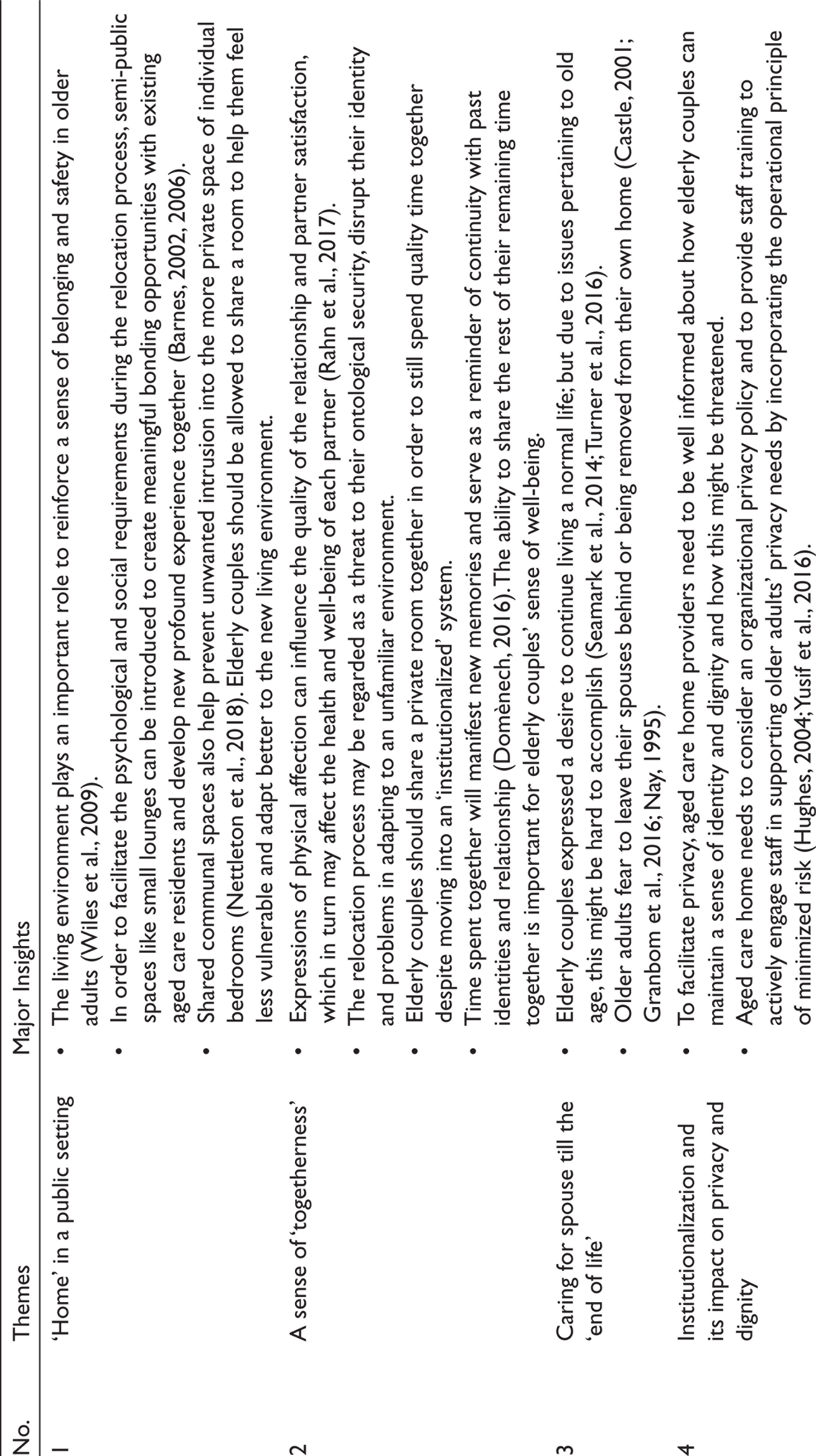

Implication for practice
As shown in the literature review, there are a number of studies on issues related to older adults in aged care homes, but studies related to elderly couples relocating to aged care homes and their mundane life in a highly structured living environment are neglected in scholarly researches. Several issues around the process of relocation and the challenges it brings to elderly couples—as a couple and as an individual—are yet to be examined, specifically on the complexities of institutional interference in their emotional intimacy in the living environment. Although previous studies (Bauer et al., 2013; Dröes et al., 2012; Hughes, 2004; Rahn et al., 2017; Turner et al., 2016) have measured this construct, there is very little knowledge on the institutional interference in elderly couples relocating together to an aged care home, which justifies the decision to expand the knowledge in this area. Table 1 describes the implication for practice based on the themes studied.
The article implicates that the integration of design interventions, autonomy and privacy in aged care homes has the potential to make them a moral haven, a private retreat for elderly couples to spend the rest of their lives together in. Aged care homes are subject to reorganization, and the attempt to reconcile multiple tensions gives rise to ‘prescribed personalization’ (Nettleton et al., 2018) of an ideal environment for elderly couples in aged care facilities. This article offers insights to aged-care providers and policy designers and recommends changes in policies to improve the services and programmes relating to the elderly. Consequently, through prescribed personalization, future aged care homes can strive to practise a person-centred care approach, in ways that could alleviate phenomenological and unexpected issues in the quality of life of elderly couples who decide to move together to an aged care facility. This study widens the understanding of aged care service providers and helps them prepare for new older adults who relocate into aged care homes along with their spouse. In addition to this, the descriptions of the key themes in this study also provide valuable guidance to enable elderly couples and their families to make informed decisions when choosing an aged care home, potentially improving the experiences of both the residents and the staff. To this end, an area of future research is to track the emotional aspect of complexities, contextualizing the research in different cultural settings, physical conditions and other emotional aspects in the aged care home environment.