



Abstract
This study was conducted to know Indonesia sustainable tourism resilience in the COVID-19 era. The research was done through a qualitative approach then analyzed based on the sentiment analysis and tourism resilience theory. The data used on this study are review data related to five super-priority tourism destinations in Indonesia, which are Borobudur Temple, Lake Toba, Labuan Bajo, Mandalika and Likupang since January 2020 to March 2021 from TripAdvisor. The result of this study shows that Indonesia sustainable tourism resilience during the pandemic COVID-19 era does not have strong enough resilience in facing the unstable recessions conditions and following new tourism trends that have emerged in the pandemic era or after the pandemic ends. This study provides two recommendations to overcome those problems: (a) Indonesia needs to develop local tourism activities based on the e-tourism concept and (b) the tourism activity must integrate with digitalization and local wisdom to create local common branding in the destination.
Introduction
COVID-19 or ‘Coronavirus disease’ is an infectious disease caused by a new type of virus called coronavirus which originating from Wuhan, China (Wibowo, 2020; World Health Organization, 2020). The virus was quickly spread among the wider community and causes shocks in various world sectors and causes a fairly high mortality rate for its patients (Hidayat et al., 2020). In case to prevent COVID-19 transmissions, all governments implement related policies such as self-quarantine, social distancing and health protocols to be applied by the community in every activity they carry out. COVID-19 policies have indirectly created a global economic recession due to shocks in related sectors such as socio-cultural and political (Baldwin & Weder, 2020; Bhattarai & Subedi, 2021; Wassler & Fan, 2021). It will create a crisis in related sectors that are vulnerable to disasters, such as the tourism and economic sectors (Filimonau & De Coteau, 2020).
The tourism sector crisis occurred due to the implementation of various policies set by governments on a global and regional scale to reduce the spread of COVID-19 worldwide. UNWTO (2021) even stated that 2020 was the ‘worst’ year of the world tourism history due to the travel activities decreasing by 74% (<1 billion trips) or equivalent to USD 1.3 billion. It causes many loss all over the worls such as in Madrid, Spain, it caused 100–120 million jobs in related tourism sectors (UNWTO, 2021). In South Korea, it caused over 1.5 billion students needs to learn from home and have experienced depression called Corona blues (Bae & Chang, 2021). In 12 countries at ASEAN, it caused significant negative effect that generates the spiral of market uncertainty, which weakens investors sentiments and causes market volatility (Mishra & Mishra, 2020).
On the other hand, COVID-19 creates positive impacts and new opportunities for related sectors, especially in the tourism sector with sustainable concepts such as ecotourism, water tourism or heritage tourism. Dewi (2020) stated that COVID-19 is an opportunity for biodiversity in tourism areas to recover, develop and reorganize tourism destinations. However, the changes in tourism destination management will affect and change the global tourism trends. Euronews & Globetrender (2020) stated that ecotourism, nomad tourism and wellness tourism would be more attractive for tourists after COVID-19. It is because most of them need to spend their free time in areas, which are far from urban areas and technology. Based on these facts, it can be concluded that the tourism sector still has high opportunities in the COVID-19 pandemic era, especially for tourism with a sustainable concept. These conditions beneficially to the countries with natural and social-based tourism destinations such as Indonesia, Japan and France (The Economist, 2017).
One of the countries that was experiencing rapid growth in the tourism sector before the COVID-19 pandemic is Indonesia. In 2019, Indonesia world rank in tourism industry was 40 and has an advantage in supporting policy and enabling condition (rank five worldwide); and natural and cultural resources (rank 18 worldwide) (World Health Organization, 2019). This research chose Indonesia as a research object because Indonesia is a perfect example of a sustainable tourism destination in resilience research. By using COVID-19 condition, and also natural and cultural resources surrounding them, the Indonesia government is developing a countermeasure policy by increasing tourism destination resilience in new normal era. Based on Presidential Regulation No. 18 of 2020, this policy called Indonesia five super-priority tourism destinations that consist Lake Toba (North Sumatra), Borobudur Temple (Central Java), Mandalika (West Nusa Tenggara), Labuan Bajo (East Nusa Tenggara) and Likupang (North Sulawesi) (Ministry of Tourism and Creative Economy, 2021). This policy was also expected to be able to provide a sustainable positive multiplier effect on the creative economy sector, such as MSMEs through the development and introduction of local products in each tourist destination area (Ministry of Tourism and Creative Economy, 2021). In case, it can create positive economic activities to support Indonesia economic recovery after COVID-19.
Based on the review result of the similar literature of Figure 1, it shows that research related to Indonesia five super-priority tourism has not been widely carried out. The figure above shows that research related to sustainable tourism resilience in the COVID-19 era is divided into two research clusters. They are the whole of Indonesia resilience in the COVID-19 era, and the development of the Indonesian tourism sectors. Most of the research is carried out separately based on its tourism. An example is research related to the development of the Mandalika tourism destination that is planned as an area for the MotoGP event in October 2021 (Chotijah, 2021). Other examples are research related to brand perceptions equity in Borobudur Temple destinations in the XYZ generation (Pranatasari & Diva, 2020) and research related to developing tourist ports in the Lake Toba area (Azwar et al., 2020). It can be concluded that there has been no scientific research yet that discusses the resilience of Indonesia super-priority tourism destination in advance.
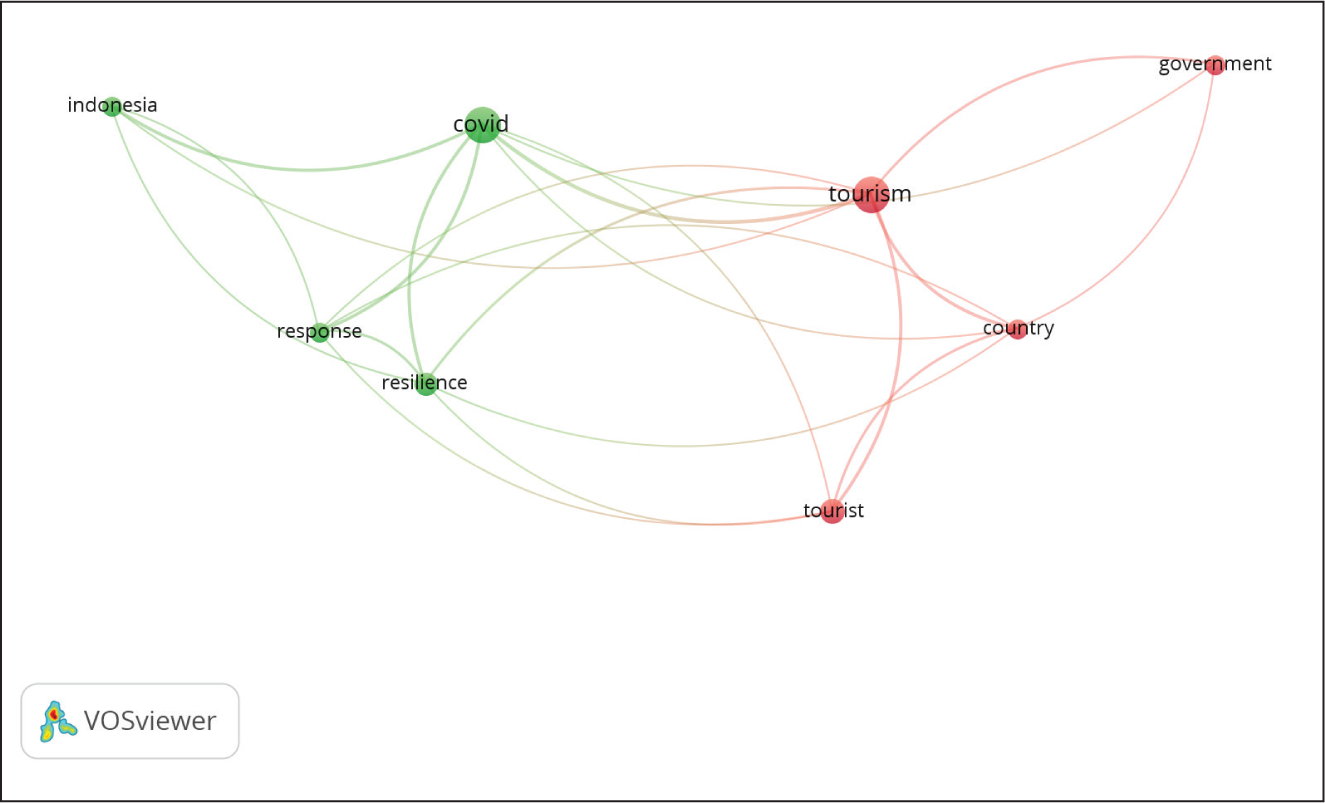
Based on the backgrounds above, this study was conducted to determine the resilience of Indonesia sustainable tourism in the COVID-19 era. The five super-priority tourism destinations were chosen to reflect the overall conditions of Indonesia tourism during the COVID-19 era. Therefore this study was conducted with the title ‘SUSTAINABLE TOURISM RESILIENCE IN THE COVID-19 ERA (CASE STUDY OF FIVE INDONESIAN SUPER PRIORITY TOURISM DESTINATIONS)’. This study is organized into five sections. The first section explained the COVID-19 impact on Indonesia, especially in tourism sectors, and how Indonesia tries to overcome this situation through five super-priority tourism destination policy. The second section provides theoretical support and past studies related to sustainable tourism and tourism sector resilience in Indonesia and worldwide. The third section provides information about research analysis, tools, and the analytical frameworks of the Five Indonesia super-priority policy to increase Indonesia tourism resilience during the COVID-19. The fourth section discussed Indonesia tourism profile, resilience, and recommendation to improve them. The final section presents the concluding remarks.
Sustainable Tourism
Tourism is a moving activity from the temporary residence of individuals or groups out of their permanent residences for certain reasons other than to generate wages or salaries (Ningrum & Kuswardani, 2017). Broadly, Republic Indonesia Constitution No. 10 in 2019 about Tourism defines tourism as all tourism-related and multidimensional activities that arise due to demands from tourists, investors, local communities and the government (Sunaryo, 2013, p. 2). The development of tourism destinations in certain areas is often influenced by tangible aspects such as the potential attraction possessed by tourist areas (Satria & Erlando, 2018). To maximize the development of potential tourist attractions, tourism managers usually group the tourism areas based on attractiveness, such as natural capital and existing social capital. Examples of natural capital are ecotourism and marine tourism, which are tourism areas whose appeal comes from the potential of natural capital. While festivals are a form of tourism destination whose appeal comes from the social diversity of local communities (Chin et al., 2014; Kong et al., 2015; Sunaryo, 2013, pp. 25–26).
Sustainable tourism is a concept that integrates tourism activities with the natural potential and social capital that exists in the local community (Falatoonitoosi et al., 2021). Tsaur et al. (2006) stated that sustainable tourism not only has high competitiveness but also should develop and integrate the three sectors to support one each other, such as the environmental, economic and social sectors. In case the sustainable tourism development must be carried out based on a commitment to maintaining all existing resources around the tourist area by environmental aesthetics as well as economic and social needs (Hassan, 2000). It is reflected in the behavior of related parties such as management, tourist and the government to maintain the essential culture, ecological cycles and processes, biodiversity and other life support systems. Regularly, the development of tourism destinations with a sustainable concept is often used by the government, investors or other stakeholders as an application of sustainable development policies in a particular region or country.
Sustainable tourism destinations are expected not only to be able to maintain the biodiversity and social capital of the area but also to have other economic and social impacts on local communities. The intended economic and social impacts are increasing income, poverty alleviation and unemployment reduction. Nestoroska (2012) and Sharpley (2021) stated that the positive economic and social impact created by tourism activities is a long-term guarantee for the sustainability of tourism destinations to maintain the level of visit and tourist satisfaction in the future. Positive economic and social impacts on the tourism sector can be created when relevant stakeholders are willing to actively participate to maintain tourist satisfaction levels. It is by creating tourism activities that provide positive experiences and increase tourist awareness of the sustainable tourism concept (Sharpley, 2021; Wibowo et al., 2019).
Tourism Sector Resilience
Resilience is a term that describes the concept in the form of a process or results in certain phenomena. Thus far, academics and other stakeholders have not agreed on a definition that can explain resilience as a whole. In case resilience has many definitions according to a particular field of study or science (Carada, 2019; Sobaih et al., 2021). Resilience in the tourism sector is often associated with tourism destinations when struck by disruptive natural disasters, harm the tourism area and its surroundings and limit the ability of tourist destinations to receive tourists (Filimonau & De Coteau, 2020). Sharma et al. (2021) define tourism resilience as the ability of tourism destinations and related management to adapt to all types of risk when natural disasters or emergencies occur. Meanwhile, Dewi (2020) defines tourism resilience as the ability of destinations to overcome natural disasters, social conflicts, policies, climate change and ecosystems around tourist areas.
Liu-Lastres et al. (2020) stated that the tourism sector resilience has an important role in the tourism destinations recovery. It means the development of tourism destinations based on the sustainable development concept and empowerment of local communities around tourism areas or more commonly referred to as sustainable tourism (Carada, 2019; Dewi, 2020; Liu-Lastres et al., 2020; Sharma et al., 2021). Sharma et al. (2021) stated that COVID-19 is a challenge for the tourism sector, in case every tourism area must have the resilience to survive during the COVID-19 era. Hereafter, every tourism area is required to transform and adapt to new global tourism trends after COVID-19. It is sustainable tourism activity that concerns environmental conditions and has a positive impact on local communities.
When the relevant stakeholders well understand the potential tourism areas to be developed, the transformation and adaptation is possible to reach. In case we need an appropriate measuring tool to determine the resilience of a tourism area. Sharma et al. (2021) stated that resilience in the tourism sector can be measured through four categories as listed in Table 1. The information obtained by measuring tourism destinations resilience can be used as a reference or considerations for relevant stakeholders to strengthen resilience and develop tourism destination recovery strategies after COVID-19.
Tourism Destination Resilience Measurement
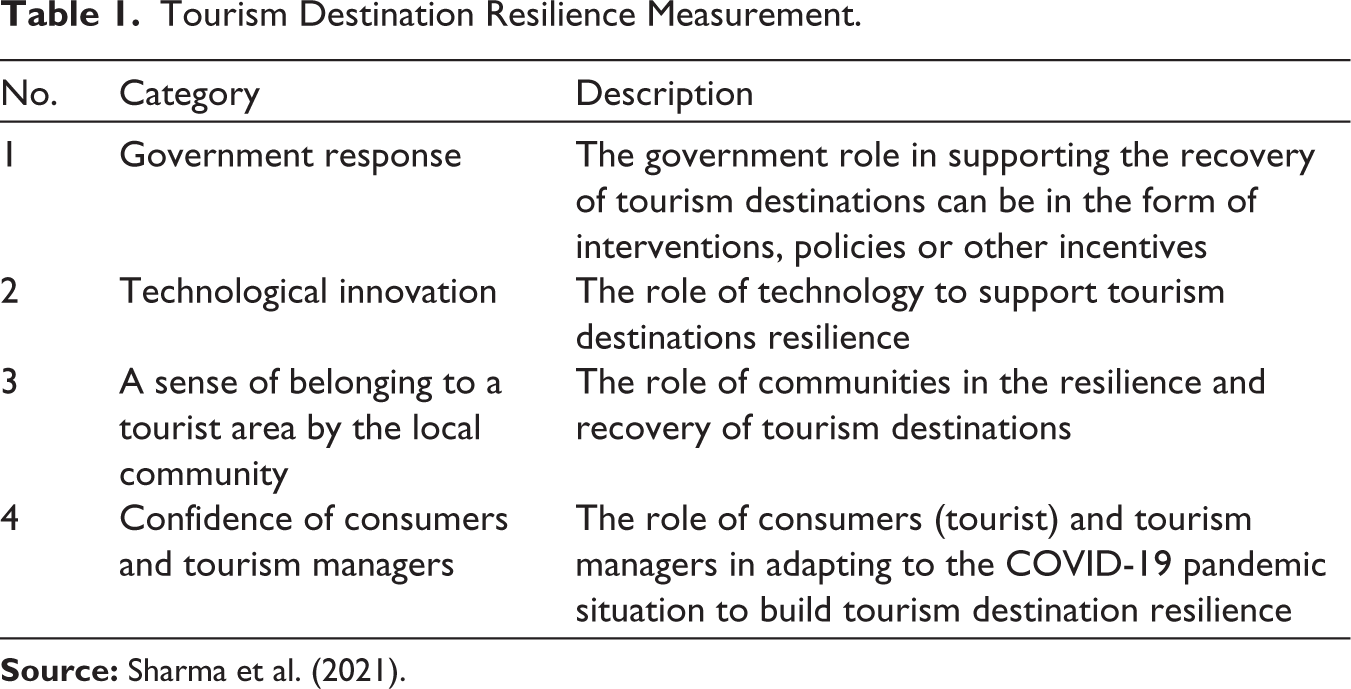
Tourism Destination Resilience Measurement
This study uses a descriptive qualitative approach since this study tries to understand the existing phenomena directly without manipulating the observed phenomena (Leedy & Ormrod, 2005; Patton, 2001; Saunders et al., 2007 in Sarosa, 2012, p. 7). In addition, it is also because the expected research data could not be achieved using a quantitative approach or similar statistical procedures (Basrowi & Suwandi, 2008, p. 1). While the descriptive analysis referred to this study assigned to the data used in the forms of numbers, words and pictures (Moleong, 2010). Through a descriptive qualitative approach, the data and problems in this study can be collected using the right method and well explored. In case a logical relationship will be created between data, analysis and concluded by research needs (Jackson et al., 2007).
This study will be carried out based on the research framework listed in Figure 2. The initial stage is data collection using the web scrapping method, which is a data retrieval technique through the process of making computer programs for downloading, parsing, and organizing data from the web automatically (Han & Anderson, 2021). This type of data obtained through the web scrapping method is categorized as big data, which is large, heterogeneous, and it will continue to be encroached every day (Sowmya & Suneetha, 2017). This method is conducted by the instrument of Web Harvy. The data are conducted from the tripadvisor.com website content that contains reviews of five super-priority destinations, such as Borobudur Temple, Lake Toba, Komodo Island (Labuan Bajo), Kuta Beach (Mandalika) and marine tourism areas located in Likupang (Likupang Beach, Paal Beach and Pulisan Beach) started from January 2020–March 2021. The website (Tripadvisor) was chosen since it is the largest online platform that reviews travel or trips made by individuals or certain communities. Thus, it has the data needed for the study.
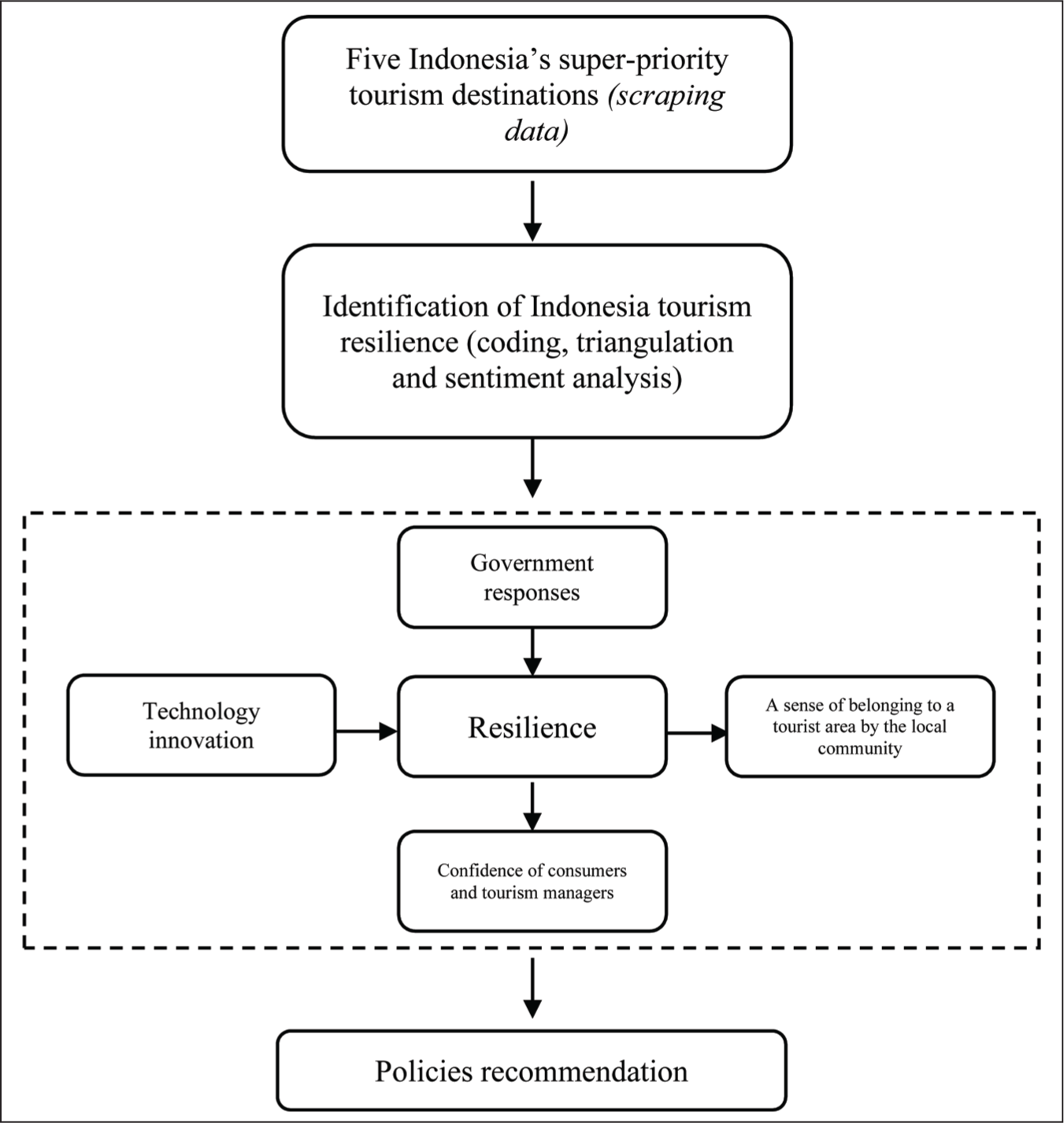
Furthermore, the data will be coded into four categories according to the concept of tourism resilience expressed by Sharma et al., 2021. Then, it will be analyzed based on the sentiment analysis concept. It is an analysis to identify opinions or messages contained in data based on learning or categories that are applied to the analysis engine on the specified model, such as positive, negative and neutral (Saura et al., 2018; Xiang et al., 2017; Ye et al., 2009). The data labelling process based on four categories of tourism destination resilience measurement and three categories of sentiment analysis which is positive, negative and neutral categories. The sentiment analysis method was chosen because tourists usually observe some destination based on that three categories through online review before visiting (Sari et al., 2021). The sentiment analysis will be carried out through machine learning methods. It is a labelling process using tools or technology to classify data (Ye et al., 2009). The instrument used for the labelling process is RapidMiner. The data from the sentiment analysis will be reprocessed and presented in the form of tables, images or word clouds according to research needs to facilitate the process of concluding the research result (Bandur, 2016).
The reliability and validity in this research was done through source triangulation activity as the credibility test of this research. Because the triangulation activity was done using secondary data from various sources (Sugiyono, 2020). The purpose of triangulation in qualitative research was to increase one’s understanding of research data and findings, while minimizing the weakness of data credibility by providing evidence in the form of similar or supporting data (Sugiyono, 2020). The data used in this manuscript will have a high degree of credibility and can be trusted as valid research data through this activity.
Indonesian Tourism Profile in the COVID-19 Era
Based on the data from tripadvisor, there were 61 reviews related to Indonesia super-priority tourism destinations in 2020 (Table 2). This number decreased dramatically than in 2019, which means there are only a few tourists who visit five Indonesia Super-Priority Destinations and represent as evidence of the weakening of Indonesia tourism activities due to the spread of the COVID-19 virus. This result was similar to Neirotti et al. (2016) research, which states, nowdays online reviews from tourists in some destinations create market value of that destination to increase the market power that influences customers. The higher number of reviews in some destination means the market power of those destinations increased, and vice versa.
The Five Indonesia Super-priority Destinations Review in 2020
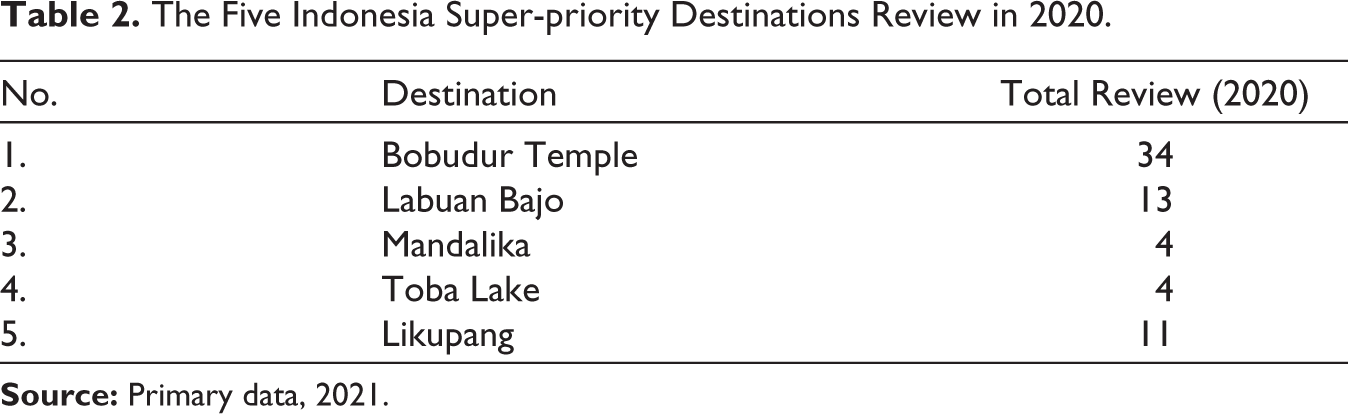
The Five Indonesia Super-priority Destinations Review in 2020
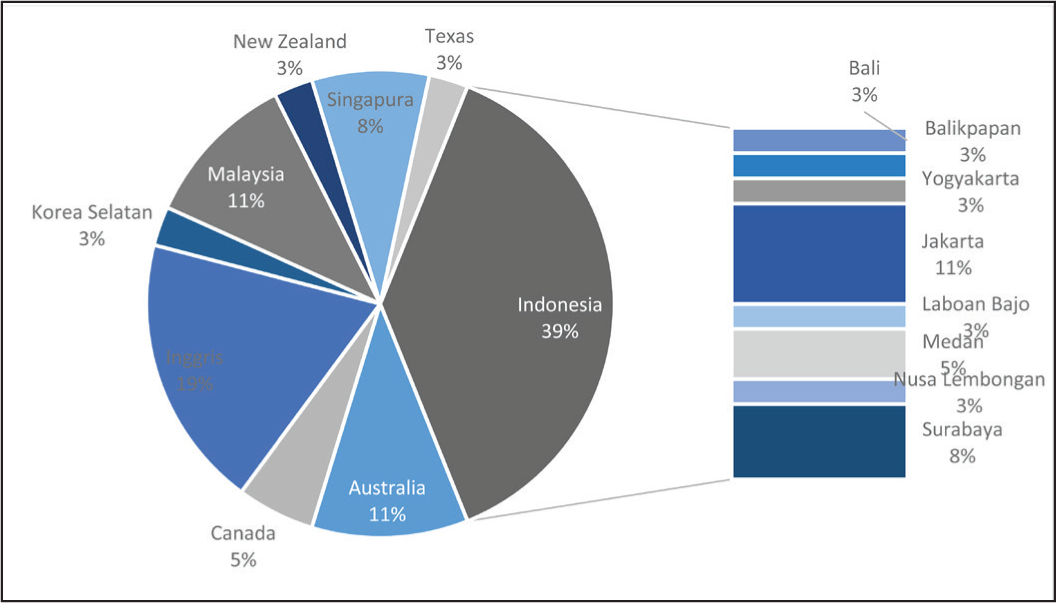
Figure 3 shows most of Indonesia tourist destinations are visited by domestic tourists, especially from Surabaya, Jakarta and Medan. Meanwhile, the foreign tourists who come to visit Indonesia are dominantly from England, Malaysia and Australia. In 2020, few countries were unavailable for international flights, including Indonesia. The decreased number of foreign tourists who visit Indonesia was due to the tightened regulations such as vaccine regulations, PCR, self-quarantine for at least 14 days, policies related to health protocols, the new normal, etc. To overcome that problem, the Indonesian government is trying to develop a tourism site based on the Ministry of Tourism and Creative Economics Indonesia in 2020–2024, focusing on domestic tourist visits to increase the resilience of tourism and the other related sectors in Indonesia, especially for Lake Toba and Mandalika as the destinations with few reviews. This condition also showed local people low interest in visiting those two destinations in 2020.
Indonesian Tourism Resilience
Tourist review data processed through the coding process allow one review to have more than one label based on tourism resilience parameters (government response, technological innovation, sense of belonging to tourist areas by local communities and confidence of tourists and tourism managers). It often happens for various reasons, such as the review is impossible to be categorized in one category only, and it cannot be separated into one or two sentences because it can change the review meaning by reviewers. In case the results of the data that have been processed through the coding will be more than the actual number of reviews (66 reviews) (Table 2) (Rachmat & Lukito, 2016). While in the sentiment analysis process, each review that has gone through the coding process only has one label, such as positive, negative or neutral (Bandur, 2016).
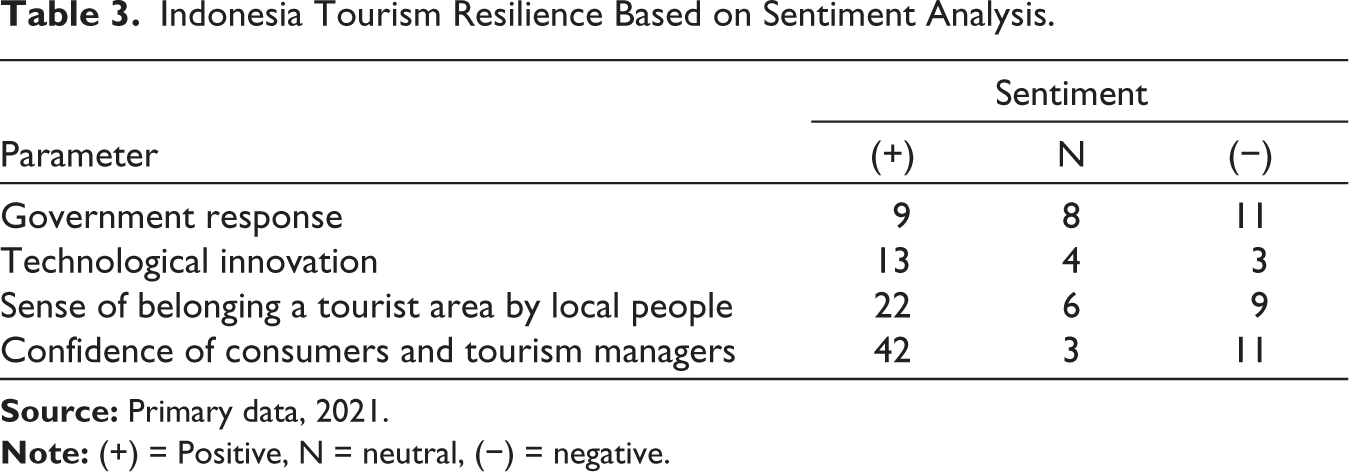
The result of processed tourist review data based on sentiment analysis is shown in Table 3. Based on the sentiment analysis, it is known that ‘Consumer Confidence and Tourism Management’ is the category that most influences Indonesia tourism resilience in the COVID-19 era. It is shown from the total data that has been processed through the coding process and sentiment analysis. The increasing number of reviews that have gone through the coding process are related to certain categories. It shows that these categories have a high influence on Indonesia tourism resilience. On the other hand, the category with a few reviews indicates that it has a low effect on Indonesian tourism resilience.
Indonesia Tourism Resilience Based on Sentiment Analysis
The following is an analysis of each category that affects Indonesia tourism resilience based on traveler reviews contained in TripAdvisor:
The government response is a category related to the role or intervention of the government to overcome the negative impact of the COVID-19 disaster on the tourism sector (Higgins-Desbiolles, 2020). Based on the sentiment analysis result on Indonesia five super-priority tourism destinations, most of the reviews related to the government’s response are negative (11 data or 39.28%), which means that the government’s response to tourism activities in Indonesia is mostly negative. It is explained through the results of the analysis in Figure 4.
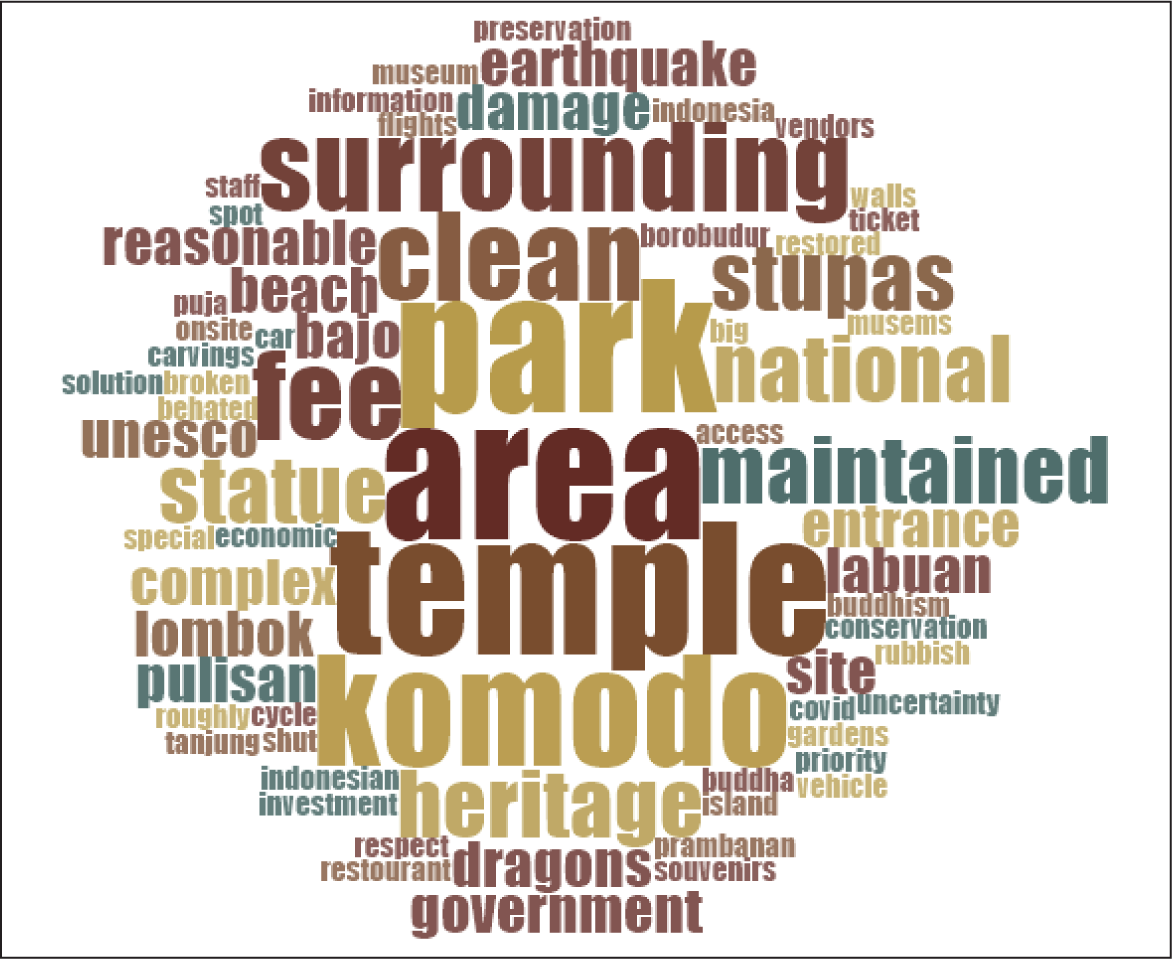
The data analysis result related to government response categories shows that there is an imbalance in the government’s response to Indonesian tourism. It is shown in Figure 3, where Borobudur Temple [statue (2%), temple (5%) and heritage (2%)], and Komodo National Park [park (5%), dragons (4%) and Komodo dragons(2%)] compared to three other tourism areas such as Lake Toba, Mandalika and Likupang. Many reviewers give negative reviews in tourism destinations other than Borobudur Temple and Komodo Island. It is because some tourism destinations are managed by the government, such as Likupang and Pulisan Beach, where the new normal rules are not carried out properly. In addition, since 2020, many tourism destinations have become poorly maintained [maintained (2%), clean (3%), damaged (2%) and surrounding (4%)], it is because their operational schedule is following government regulations related to COVID-19 prevention in Indonesia. The instability of tourism activity in 2020 caused many tourism-related businesses to temporarily or even permanently close. This condition not only happens in five Indonesian super priority tourism, but also occurs equally in tourism site throughout Indonesia (Purba et al., 2021; Putu et al., 2021). Even though the role of the government to prevent this situation is intensively needed by tourism developers and owners, especially destination in rural areas such as Kuta Lombok Beach, Likupang Beach, Paal Beach and Pulisan Beach. Most of the local people in that area worked in the tourism sector because of the instability of tourism activities and the economic downturn in 2020 which caused local people to lose their jobs and find it hard to find new jobs (Purba et al., 2021; Spenceley et al., 2021).
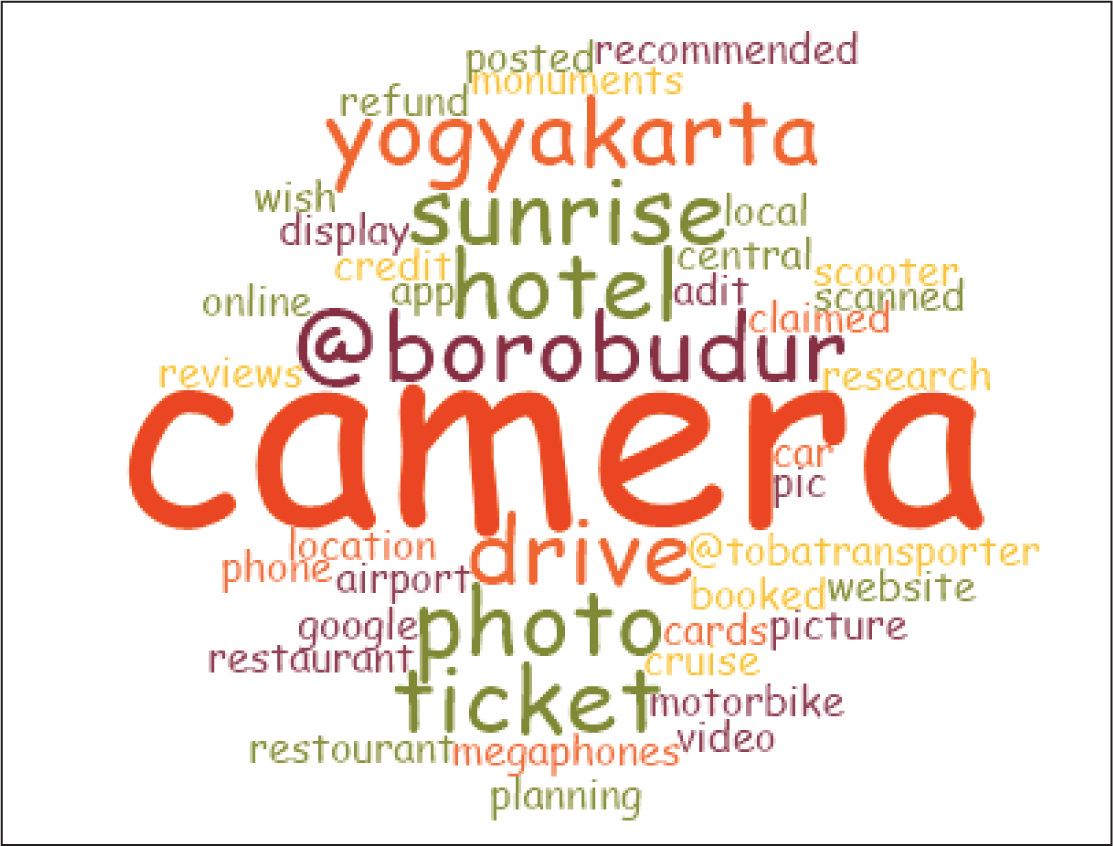
Technological innovation is a category related to the use of technology and information to create tourism resilience in the COVID-19 era. This pandemic provides an opportunity for relevant stakeholders to accelerate technological change in tourism destinations (Sharma et al., 2021). Technology utilization in the tourism sector is not only beneficially for providing information related to tourism activities in the COVID-19 era but also for helping health protocols implementation in the new normal era, such as limiting the number of tourists and so on (Assaf & Scuderi, 2020; Stankov et al., 2020). The sentiment analysis result related to technological innovation shows a fairly high positive sentiment (13 data or 65%). It means that most of Indonesia tourism destinations are beginning to integrate with technology. Most of the reviews related to technology in five of Indonesia super-priority tourism destinations discuss technological instruments owned or brought by tourists, especially cameras to take pictures [camera (8%), photo (3%) and picture (4%)]. Based on Figure 5, it is known that among the five super-priority tourism destinations in Indonesia, Borobudur Temple is the most integrated tourist destination with technology [Borobudur (3%), and Yogyakarta (3%)] compared to other tourist destinations.
Although the technological innovation sentiment in Indonesian tourism destinations is particularly positive, yet there are some negative sentiments since there is a lot of information related to tourism activities that are difficult to obtain via internet. For example:
Drove all the way from Jogja on a scooter at 3am to experience the sunrise. Looked up e temple online the night before to make sure there were no closures. When I got there they said temple was closed, but zone one was open you just couldn’t go to the inner temple. This was false and barely got within 200 meters of the temple before they had it all blocked off. They should of posted this on their website or made it extremely clear at the gate. They then claimed since my ticket had been scanned I couldn’t get a refund…. I was there for all of 10 mins. Such a disappointment! The staff were not helpful! Tourism activities during the COVID-19 era fluctuated following the pandemic conditions. In case online access regarding tourism activities such as the operational schedule of tourist areas, restrictions on the number of visitors, restriction on tourist area zones, information related to transportation, and accommodation is needed by tourists. However, down to 2021, Borobudur Temple, Komodo National Park and Lake Toba are the destinations that can easily find information related to their tourism activities online through social media. Most of their social media activities began in mid-2020. The lack of easy access to official information related to tourism destinations can reduce the resilience of destinations during the COVID-19 pandemic and vice versa (Spenceley et al., 2021).
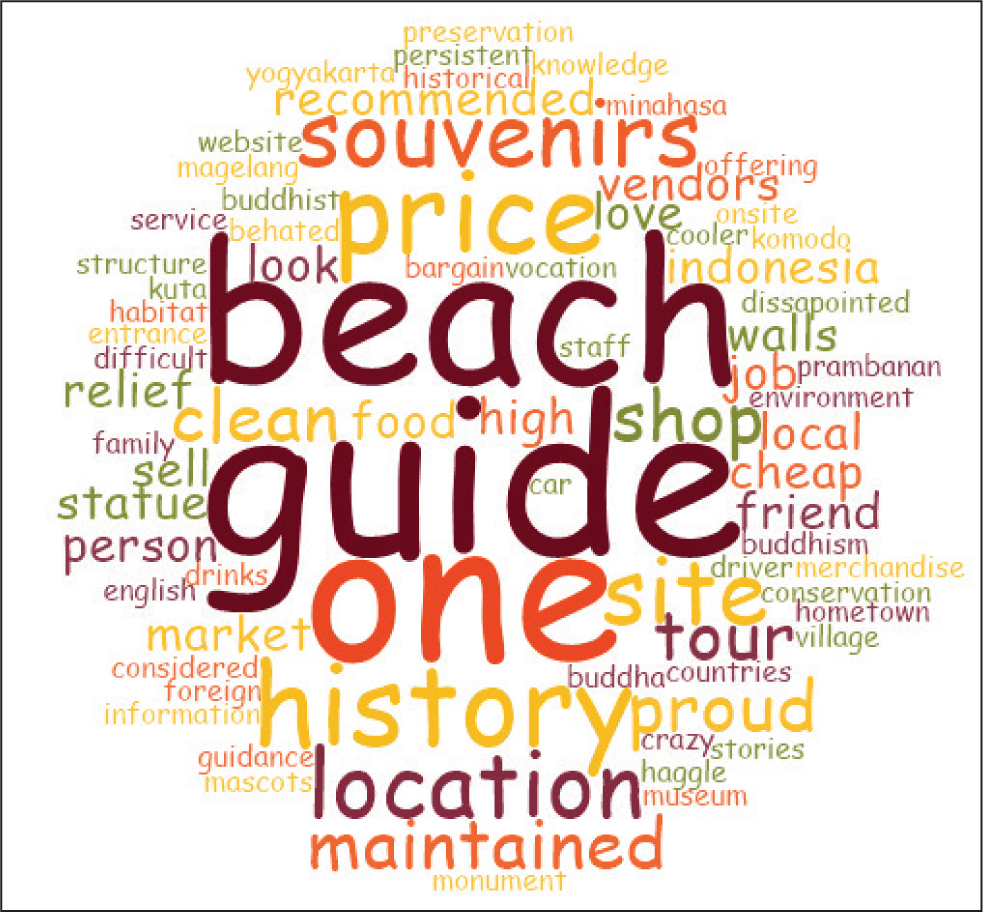
The sense of belonging to a tourist area by local communities is a category related to the role of local communities in tourism resilience. They have an important role in local tourism resilience, it is because people globally get difficulties in long-distance travel activities during the pandemic (Sharma et al., 2021). In 2020, almost all countries will impose international travel restrictions (travel bans and travel restrictions) both from outside and from within to reduce the spread of the COVID-19 pandemic (Chinazzi et al., 2020; Iacus et al., 2020; Ma et al., 2020; Tsoukas, 2020). In case, nowadays, Indonesian tourism activity depends on the domestic community to visit local tourist destinations around their residence (Kusuma, 2020). But this activity cannot be done efficiently because local people are still not feeling well to start doing tourism activity in a new normal era. Many local people still have travel anxiety, especially individuals or communities infected with COVID-19 previously, which makes it difficult to remobilize tourism activity by relying only on local people as tourists (Abbas et al., 2021; Yamin et al., 2021). The sentiment analysis results related to local communities sense of belonging to a tourist area are mostly positive (22 data or 59.46%). It shows that the majority of local communities have greatly benefited from tourism activities in Indonesia. In case local people voluntarily try to maintain the tourists, area and make visitors comfortable while in the tourist area. Generally, they are fluent in English, friendly and always try to promote other tourist destinations around the Magelang and Yogyakarta areas, such as Prambanan Temple. The sense of belonging is also owned by the surrounding community in a tourist site, especially in Borobudur Temple. In Figure 6, it can be seen that tour guides have an important role in this category, it showed by a word like a guide (6%), history (3%), site (3%) and statue (1%). Most of them are consist from local people that good at telling the history and stories of the reliefs found on the walls of Borobudur Temple to tourists. But since COVID-19 hit Indonesia, many of them lost their jobs and became unemployed or changed their jobs to survive.
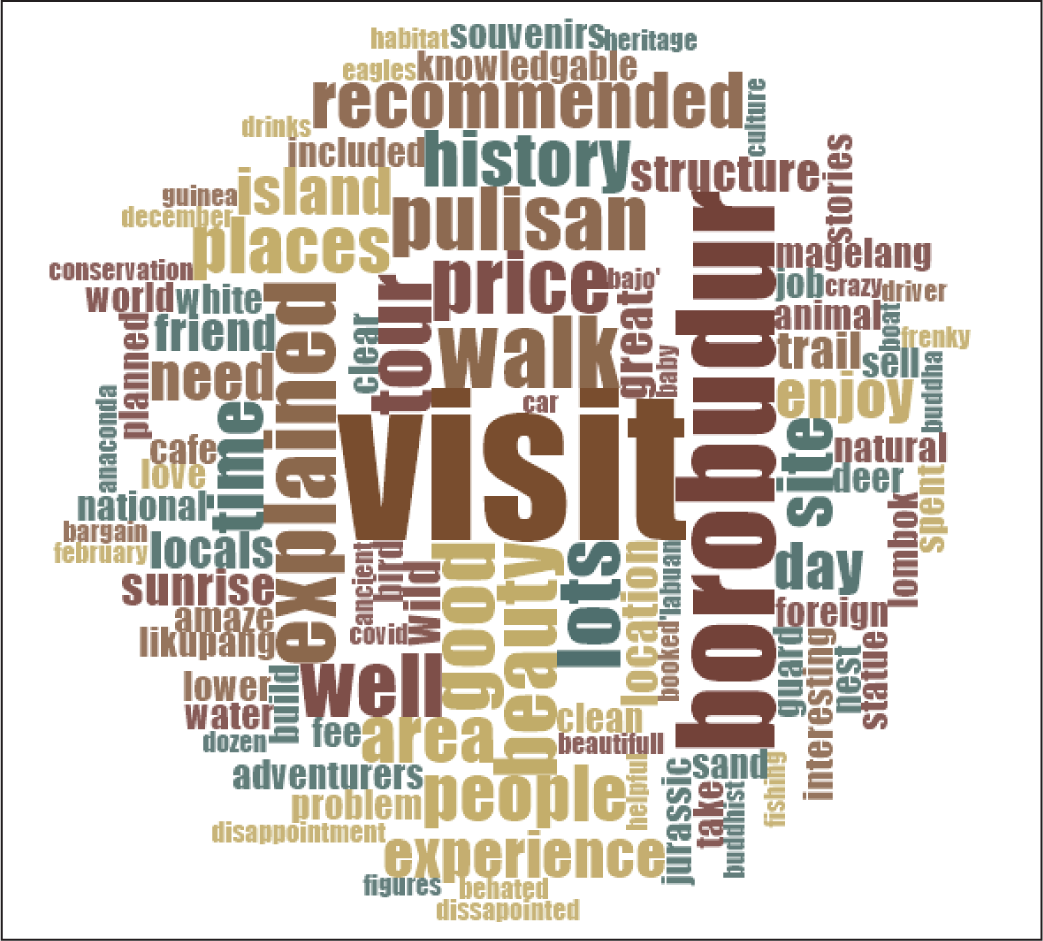
This category is related to tourism managers’ confidence to restart tourism activities according to health protocol rules and the new normal in tourist areas (Sharma et al., 2021). Based on the sentiment analysis result, it has a fairly high positive sentiment value (42 data or 75% data). It shows that tourism managers and consumers believe that tourism activities are needed to support the Indonesian economy during COVID-19. The result of data analysis related to the category of consumer confidence and tourism managers shows that tourists are still trying to carry out tourism activities during the COVID-19 era. On the other hand, tourism managers are also trying to open tourist areas by health protocols and new normal rules. In can be seen in Figure 7, especially on the keywords visit (5%), explain (2%) and walk (2%). The word ‘visit’ refers to tourists who keep trying to carry out tourist activities by visiting local tourism destinations. While ‘explain’ refers to the role of tourism managers in explaining the importance of complying with health protocol rules and the new normal to reduce the spread of the COVID-19 pandemic when carrying out tourist activities. It matters that positively support Indonesia tourism resilience in the COVID-19 era.
Indonesia tourism activity during the COVID-19 has a pro and cons related to the environment sustainability in tourism sites, especially in natural capital-based tourism such as Labuan Bajo, Likupang and Toba Lake. In high maintenance areas like Labuan Bajo, tourism managers have an important role in maintaining the sustainability of the environment and biodiversity surrounding them, especially the sacred animal ‘Komodo Dragon’. Previously, this activity could be done efficiently because there is an income from tourists and no risk of illness and death when carrying out the tourism activities. Since April 2020, when the government enforced total lockdown and closed all tourism sites, this activity cannot be done well because of various reasons, even if the new normal era in 2021 (Spenceley et al., 2021). Contrarily, in low-maintenance natural capital-based tourism such as Likupang and Toba Lake, the absence of consumers and tourism managers during the COVID-19 reduces environmental and congestion (Hartono et al., 2021; Ihsan et al., 2022; Spenceley et al., 2021). COVID-19 gives the environment and biodiversity surrounding them to rest and recover after being exploited through tourism activity (Dewi, 2020). It also gives the time to related stakeholders to think and develop more sustainable tourism activities to support the reduction of climate change and biodiversity loss in the near future (Spenceley et al., 2021).
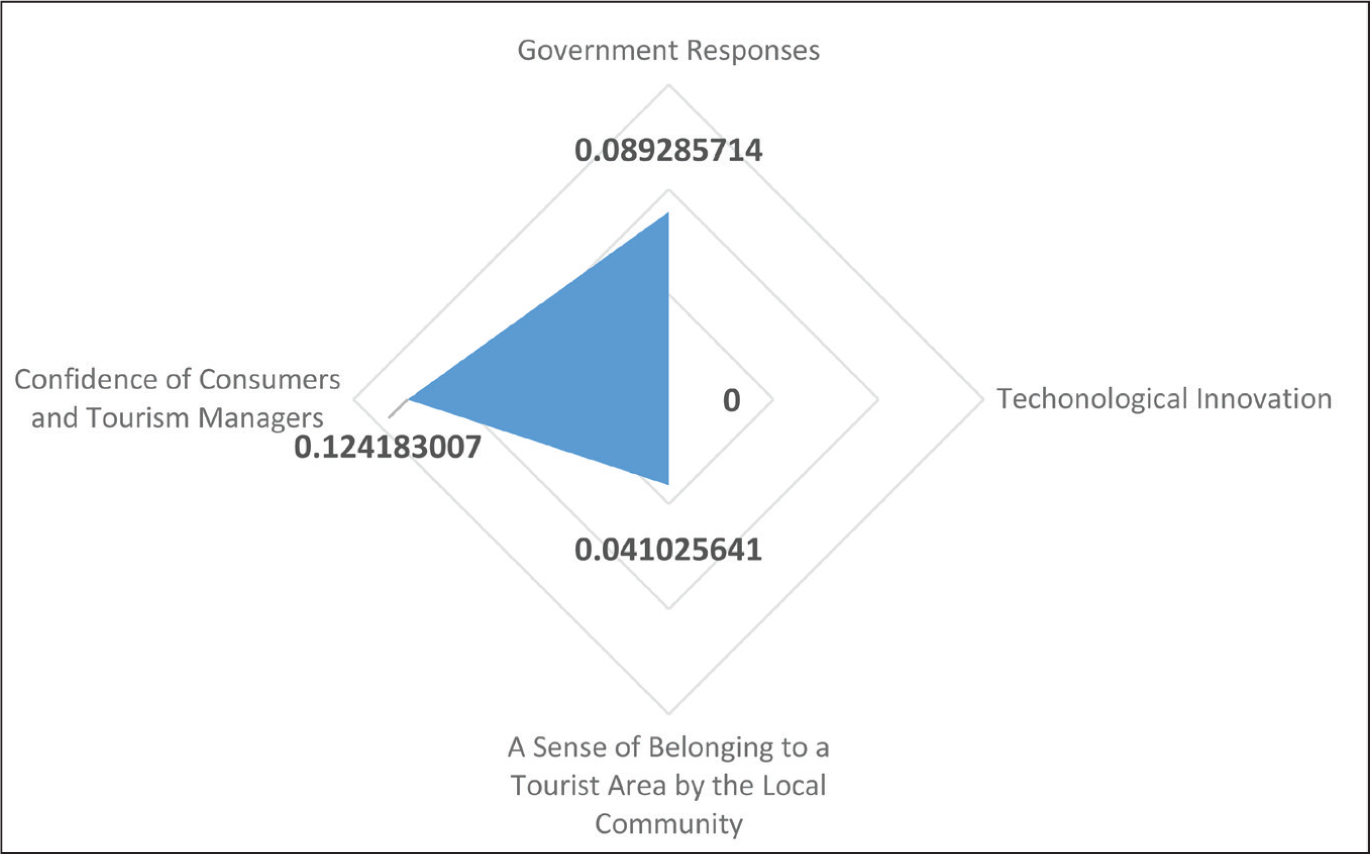
Based on the analysis result, it shows that not all categories affect the Indonesian tourism resilience in the COVID-19 era. Based on Figure 8, the consumer confidence and tourism management (0.12) is the category that most influences Indonesian tourism resilience, followed by the government response category (0.09) and the sense of belonging to the tourist area (0.04). Meanwhile, technological innovation does not affect Indonesian tourism resilience (0.00). The category of consumer confidence and tourism managers shows the pros and cons for tourism activities during the COVID-19 era. It is shown by the public interest in continuing to carry out tourism activities in the COVID-19 era even though they only visit local destinations closest to their residence. This condition set up pros and cons in Indonesia, especially during the peak season, such as December–January and May–June (Wibowo et al., 2019). The pros consist of the people who like to do ‘revenge tourism’ activity. They believe the public deserves doing trip as a gift for enduring the COVID-19 prevention activity (Oktaviani & Sutisna, 2021). The cons consist of the people experiencing travel and tourism anciety, especially during the peak season. They believe tourism sites will create a new pandemic cluster and they will get infected during travel activity or cannot go home because of the following regulations such as a local lockdown or public transportation lockdown (Wachyuni & Kusumaningrum, 2020). In the ecological perspective, tourism managers confidence also has an impact on Indonesia tourism activity. The COVID-19 pandemic makes people aware of the importance of environmental conservation and healthcare. This causes a change in the trend of tourism activity more into sustainable tourism and wellness tourism (Putu et al., 2021; Yamin et al., 2021). These changes force the tourism managers to adjust their activity to become resilient during the new normal era. The government response category has a considerable influence on Indonesia tourism resilience in the COVID-19 era. It relates to consumer confidence and the tourism managers category. The Indonesia tourism activities implementation during the COVID-19 era depends on the government decisions. It is the application of health protocol rules and the new normal, as well as the readiness of tourism managers to stop or close tourist areas at any time during the pandemic when the number of cases is getting high or endangering the community (Mutiarin et al., 2021). The third influenced category on Indonesia tourism resilience is the community sense of belonging to a tourist area. Local communities have an important influence on tourism activities in the COVID-19 era, it is because most tourists who visit tourist areas are local people. The travel restrictions rules that some countries have implemented since 2020 make it difficult for foreigners to come to Indonesia for tourism purposes and vice versa (Chinazzi et al., 2020; Iacus et al., 2020; Ma et al., 2020; Tsoukas, 2020). On the contrary, local people still do not feel like starting tourism activity in a normal new era. Many local people still have travel anxiety, especially individuals or communities infected with COVID-19 previously. This condition hurts the local community sense of belonging. Currently, many people from local community starting to lose their sense of belonging in tourism sites because many of them losing their job in tourism activity since COVID-19 hit Indonesia. This problem can be resolved by creating innovative ways of supporting tourist-dependent communities by utilizing local potential (Spenceley et al., 2021). For example, by creating digital content on the theme of history or folklore of a particular site to attract tourists and increase tourism value during COVID-19. This activity will increase Indonesia tourism resilience and create a more diverse income stream for local people and the local economy in the long term. The last is the category related to technological innovation, which surprisingly does not impact Indonesia tourism resilience either positively or negatively. Based on the analysis result in Figure 8, the technological innovation category has a value of 0.00, which means that most tourism activities in Indonesia are not integrated with technology. It is unfortunate since technology plays an important role in increasing tourism resilience in Indonesia. Since the COVID-19 pandemic, many countries have used technology to implement an e-tourism strategy, such as a strategy for creating digital content related to tourism, in case tourists can do tourism activities digitally before actually visiting the destination (trying before buying) (Gretzel et al., 2020). This activity will increase the value of tourist sites, attract domestic tourists to visit local destinations and inform the application of health protocol rules and the new normal to tourist areas (Spenceley et al., 2021). It was also created to attract the interest of international tourists towards international travel after the COVID-19 pandemic.
The low integration of Indonesian tourism with technological innovation will weaken Indonesia tourism resilience during and after the COVID-19 era. It is because technological innovation in the COVID-19 era will affect the decision-making of prospective tourists in choosing tourism destinations after COVID-19 (Gegung, 2021). The more information related to certain tourism destinations spreading online, the higher probability of domestic and international tourists visiting the destinations in Indonesia. Based on analysis of Indonesia tourism resilience, generally Indonesia tourism site does not have strong enough resilience to deal with the unstable conditions of COVID-19 as well as new tourism trends that have emerged during and after the COVID-19 era. The weak resilience of Indonesian tourism in the COVID-19 era occurs because of the difficulties of applying a new tourism activity based on trends and regulations like sustainability and new normal protocols on site. There is also an imbalance in the use of technology for tourism needs in Indonesia. Thus, it is necessary to formulate a strategy to strengthen Indonesian tourism resilience to be applied during the COVID-19 era, in case Indonesian tourism is better prepared to compete in the domestic and global tourism markets after COVID-19 ends.
Policy Recommendations to Improve Indonesia Tourism Resilience
Based on data analysis in Section IV, there are two specific recommendations to create Indonesian tourism resilience in the COVID-19 era. First, related to tourism activities development based on the e-tourism concept. To develop tourism activities based on the e-tourism concept through the digital content creation related to tourism. This activity aimed to attract domestic tourists in the COVID-19 era and attract foreign tourists to spend their leisure time in Indonesia through digital tourism content. Second, by integrating and digitizing local wisdom and environment to create sustainable local common activity and branding in destination. The development of Indonesia tourism brands can be done by exploring the potential art and culture owned by the local tourism destinations. When it can be explored and utilized properly based on the sustainable tourism concept, a tourism brand will be created with positive characteristics and can integrate local potential with tourism activities in the COVID-19 era. The brand itself then translated into several online and offline intellectual properties, such as souvenirs, packaging designs, billboards, leaflets and other promotional products. Intellectual property-based products will create a multiplier effect in the form of inclusive and sustainable economic activities for local communities. One of them is the integration of local businesses that have been digitized in each tourist destination to maximize the potential of the resource owned by tourism destinations.
This research proposed big data and sentiment analysis to determine the resilience of Indonesia tourism sector in COVID-19 area. Based on the analysis results of Indonesia sustainable tourism resilience in the COVID-19 era, there are four important things related of Indonesia resilience. First, technology utilization in the tourism sector is important because it helps to provide information related to tourism activities in the COVID-19 era, help implement health protocols surrounding area and limit the number of tourists. Second, the government response to Indonesia tourism sectors and activities was late. Because of that, many tourism site was damaged and poorly maintained. Third, the sense of belonging by local people was low because most of the local people lost their job in tourism and other related sectors. Nowadays, many of them become unemployed or change their jobs to survive. Last, related to the confidence of consumers and tourism managers. Many of them, especially tourism managers lose their confidence in reviving the tourism site, particularly nature-based tourism such as Labuan Bajo, Likupang and Toba Lake.
This study also runs into difficulties, and it becomes the limitation of the research. The data used on the research were big data obtained from Tripadvisor, because it is difficult to obtain primary data and validate the results directly on-site due to the COVID-19 condition. We suggest future research to obtain primary data and validate research directly (based on the field study).
Footnotes
Declaration of Conflicting Interests
The authors declared no potential conflicts of interest with respect to the research, authorship and/or publication of this article.
Funding
The authors received no financial support for the research, authorship and/or publication of this article.