



Abstract
This article addresses sport as a vehicle of social mobility for athletes of all racial backgrounds. Utilizing two waves of the National Longitudinal Study of Adolescent Health, we test two sociological models. The zero-sum model argues that any time spent on sports takes away from time that could be spent on academics, hindering performance in school and ultimately mobility. The developmental model suggests that participation in sport contributes in a variety of ways to the performance of student-athletes in school and in the labor market. We operationalize social mobility by years of education and educational attainment. We find limited support for the developmental model. The results indicate white men and African American men who participate at low and high-levels benefit. Sport participation has no statistically significant influence upon years of education and educational attainment for Hispanic men. We use a Heckman selection model and find that self-selection occurs among (American) football players. We conclude by suggesting future research.
Whether or not, or to what extent, participation in sport affects social mobility has been the subject of debate among sports fans, journalists, and social scientists for many years. While popular discussions of participation in sport and social mobility generally take a sanguine view (Coleman, 1961), scholars have been divided on the question (Fejgin, 1994). Since more than half of all high school students participate in high school sports (Rees and Sabia, 2010), assessing the impact of participation in sport on the social mobility of student-athletes is of interest to the student-athletes themselves, parents, teachers, school administrators, and policy-makers. While there is a vast literature on the subject few of these studies are based on nationally representative longitudinal data, which Marsh (1993) suggests as the best way to estimate the effects of sport participation on social mobility.
This article builds on previous research by testing two sociological models on the effect of participation in sport on social mobility: the zero-sum model and the developmental model. We operationalize social mobility by years of education and educational attainment analyzing a multi-wave longitudinal study of a large nationally representative sample of adolescents collected between 1994 and 2008. We find white men and African American men who participate in sport at high- and low-levels, increase their time spent in school. African American, Hispanic, and white men increase the probability of earning a college degree if they have participated in sport, but high school sport participation does not increase the probability of earning a high school diploma or attending college or receiving vocational training. Sport participation has no statistical influence upon years of education for Hispanic men.
Our results suggest limited support for the developmental model. We contribute to the literature in three key ways. First, we find that not only white but also African American athletes, regardless of level of sport participation, stay in school longer than white and African American students who do not participate in sport. Second, we find mixed support for sport participation in high school increasing the likelihood of African American, Hispanic, and white men earning a college degree. Third, we demonstrate that results vary by level of participation.
Sport and social mobility: A review of the quantitative literature
Does sport participation affect social mobility? And if it does, do all student-athletes benefit equally? Two sociological models dominate the research on the effect of participation in sport on social mobility: the zero-sum model and the developmental model. The zero-sum model argues that any time spent on sports takes away from time that could be spent on academics, hindering performance in school and ultimately mobility (Coleman, 1961; Hanks and Eckland, 1976; Hauser and Lueptow, 1978; Howell et al., 1984).
In contrast, the developmental model suggests that participation in sport contributes in a variety of ways to the performance of student-athletes in school and in the labor market. For example, scholars have demonstrated that participation in sport contributes to the student-athletes’ character development (Frey, 1986; Rees et al., 1990; Spady, 1970; Spreitzer, 1994). Others have analyzed how sport enhances ones’ self-concept (Spady, 1970) or self-esteem (Spreitzer, 1994), and ability to work in teams (Spreitzer, 1994). Another group, largely economists, have estimated the effect of participation in sport on the acquisition of human capital (Corneliben and Pfeifer, 2007; Eide and Ronan, 2001; Rees and Sabia, 2010). And in recent years scholars have argued sport participation increases social capital among athletes and between athletes and teachers or other members of the community (Broh, 2002; Spaaij, 2009).
While there is a considerable literature on the question of sport participation’s effect on social mobility, as Fejgin notes, ‘Most studies testing the predictions of developmental versus zero-sum theories are inconclusive, leaving room for researchers who hold opposing views of school sports to draw different conclusions about their outcomes . . .’ (1994: 212). The recent work on the differential effects of sport participation by race is a good example of this.
For many years scholarly work did not examine the effect of participation in sport on students of color. This was clearly an oversight given the over-representation of African Americans among professional athletes (see Eitzen and Sage, 2008; Sailes, 1988; Smith, 2009) and the importance accorded to sport by many African Americans (Edwards, 1973; Eitle and Eitle, 2002; Smith, 2009; Spreitzer and Snyder, 1990). In general, the results from this literature are mixed, providing evidence for both developmental and zero-sum models: white students benefit from participation in various ways but other racial groups were either not included in the analysis, or, if they were, usually did not accrue the same benefit from sport participation. For example, in a longitudinal study Purdy et al. (1982) examined the records of more than 2000 students at one university over a ten-year period and ‘. . . found that athletes were less prepared for college and achieved less academically in college than the general student population. Scholarship holders, blacks, and participants in the major revenue-producing sports of (American) football and basketball had the poorest academic potential and performance’ (Purdy et al., 1982: 439). Other scholars (Kiger and Lorentzen, 1986; Picou et al., 1985; Sellers et al., 1991; Upthegrove et al., 1999) found similar results.
Longitudinal research on the effects of sport participation in high school on years of education and educational attainment has offered, in general, weak support for the developmental model with benefits usually restricted to white males. The zero-sum model found no support. Two regional studies, one from the upper-Midwest (Eccles et al., 2003) and the other from the ‘Deep South’ (Picou et al., 1985: 73) report participation in high school sport has a positive effect on attending and graduating from college for white males. The study by Eccles et al. (2003) analyzed data which consists primarily of working-class and middle-class white families from southeastern Michigan, found that student-athletes who play team sports in high school are more likely to attend college at 21 and to have graduated by 25–26 years of age. Data were collected at 6th grade and periodically thereafter with a final wave completed at six years after high school. Both the number of waves and the overall length of the project are clear strengths. However, the study is limited by its regional character, lack of racial diversity, and the use of a general measure of sport participation which does not distinguish by level.
The other regional study (Picou et al., 1985), examined data from the Southern Youth Study, collected over a 13-year period and composed of white and black, male and female students. In addition, educational attainment was coded into seven ordinal categories from ‘less than high school . . . to PhD’. This kind of precision in educational outcomes is rare in the literature. Consistent with a modified version of the developmental model, the authors found that among those students who participated in varsity athletics, only white males demonstrated significant positive effects.
Two studies (Sabo et al., 1993; Spreitzer, 1994) analyzing High School and Beyond (HSB) data, a large, nationally representative, longitudinal study with multiple waves, found results similar to the regional studies discussed above (Eccles et al., 2003; Picou et al., 1985). The HSB baseline data was collected in 1980 among two cohorts: high school sophomores and seniors, with the final wave collected six years later. Sabo et al. (1993) were one of the first to examine the effects of sport participation in high school on social mobility by race and gender, including blacks, whites, and Hispanic males and females. Measures of social mobility included educational outcomes (college attendance and years of education) and career expectations. In addition, the authors offer one of the most refined measures of sport participation which takes into account whether the student-athlete played varsity and whether they were a team leader. Sabo et al. (1993) found significant variation by race and gender: white males and suburban white females (and rural Hispanic females) saw participation in sport affect postsecondary status attainment. Participation in high school sport had almost no effect on status attainment of black males and females.
Spreitzer (1994) also found evidence to support the developmental model, suggesting that athletes were more likely than non-athletes to be in an educational institution after two years and earn a baccalaureate degree after six years, however, he notes ‘. . . the association between sport participation and educational attainment is strongest among White males’ (Spreitzer, 1994: 379). Two limitations of these studies should be noted. First, the data analyzed are old, with the most recent wave collected 25 years ago. 1 A new cohort of students have entered and played sport in that timeframe. Second, the research subjects may be too early in the life cycle to determine the long-term impact of sport participation on social mobility (Howell et al., 1984).
In summary, the literature on the relationship between sport participation and social mobility suggests clear though limited support for the developmental model. In general, white athletes benefit while other groups usually do not. There is little research in support of the zero-sum model. We argue the results of the literature are in part due to: 1) the variety of ways social mobility is operationalized; 2) whether cross-sectional or longitudinal studies are conducted; 3) whether samples are regional or nationally representative; and 4) whether results are disaggregated by race, class, and/or gender or other characteristics. While a nationally-representative longitudinal study is clearly the preferred way to assess the effect of participation in sport on social mobility (Marsh, 1993), few studies are conducted in this way.
The analysis offered here hopes to bring some clarity to the current debates. The analysis is important because it utilizes a national study, with data collected in four waves over a 14-year period permitting an assessment of the effects of participation in high school sports on years of education completed as well as the probability of earning a degree. Recent reports suggest that most students complete their four-year college degree in under six years (Glenn, 2010). The data are drawn from a nationally representative sample and it is recent data, with the latest wave having been collected in 2008. Additionally, during the first wave of data collection the respondents were asked questions about sport participation over the past week thus eliminating recall problems.
This article is concerned with understanding the relationship between sport participation, social mobility, and race. To assess the effect of level of sport participation on social mobility we measure low- (one to two days per week) and high-level (three or more days per week) of sport participation. Drawing on the zero-sum and developmental models, we test the following hypotheses:
2
H1: Low and high sport participation will decrease men’s years of education. H2: Low and high sport participation will increase the men’s years of education. H3: Low and high sport participation will decrease the likelihood of earning a (high school, college) degree. H4: Low and high sport participation will increase the likelihood of earning a (high school, college) degree.
The following section of the article presents the data and methods.
Data and methods
We drew our data from the National Longitudinal Study of Adolescent Health (Add Health). Add Health is a school-based, nationally representative study of American adolescents in grades 7 to 12 (Harris, 2009; Harris et al., 2009). From a list of all high schools in the United States, Add Health researchers selected a stratified sample of 80 schools with probabilities proportional to size. Schools were stratified by region, urbanicity, school type, ethnic mix, and size. Additionally, for those high schools not covering grades 7 to 12, the sample included the middle school that contributed the most students to the high school’s incoming cohorts. The result is a sample of 145 schools of varying sizes, affiliations, and community contexts. Another reason we utilize Add Health to study the effect of sport participation by race is that it oversamples for African American students, although the sample sizes in some instances are still small.
From 1994 to 2008, the study collected four waves of data from students, parents, and school administrators both at students’ home and at school. For this analysis, we use public data from the Wave 1 (in-school and in-home) and Wave 4 (in-home) questionnaires. The in-school survey was administered to all available students in each of the sampled schools. In each school, surveys were administered in a single day during one 45- to 60-minute class period. At Wave I, the men in this study were in 7th to 12th grade. At Wave IV, the men range in age from 25 to 34.
The questionnaire included basic demographic characteristics, school-related activities (including sport and organizational participation), and parent demographics. The Wave I in-home survey took place in the year following the in-school survey and consisted of a random sample of approximately 200 students from each of the originally sampled schools (N = 20,745; both male and female students). The 90-minute interviews were administered in individuals’ homes and to ensure confidentiality, questions were completed using laptop computers. Nested within 120 schools, 14,396 students completed both the in-school and in-home questionnaires. As our hypotheses are primarily concerned with discerning the relationship between sport participation and social mobility among men and we are using the public dataset rather than the more robust, but private dataset, we restricted our analyses to more than 2000 males who had completed both Wave I and Wave IV. We properly weighted the men in the Add Health dataset to represent a national sample.
Variable measures
We limited this study to only include men for four reasons. First, men are more likely to participate in athletics than women (Hall et al., 2002; Lipscomb, 2007). Second, men perform more physical activity than women and view physical activity as part of their self-schema (Hall et al., 2002; Harrison et al., 1999). Third, men are more likely to be socialized to play sports because of ideas about masculinity (Connell, 2001; Messner, 2009). Fourth, sport participation among women has a different impact upon social mobility than men (Hanson and Kraus, 1998; Videon, 2002).
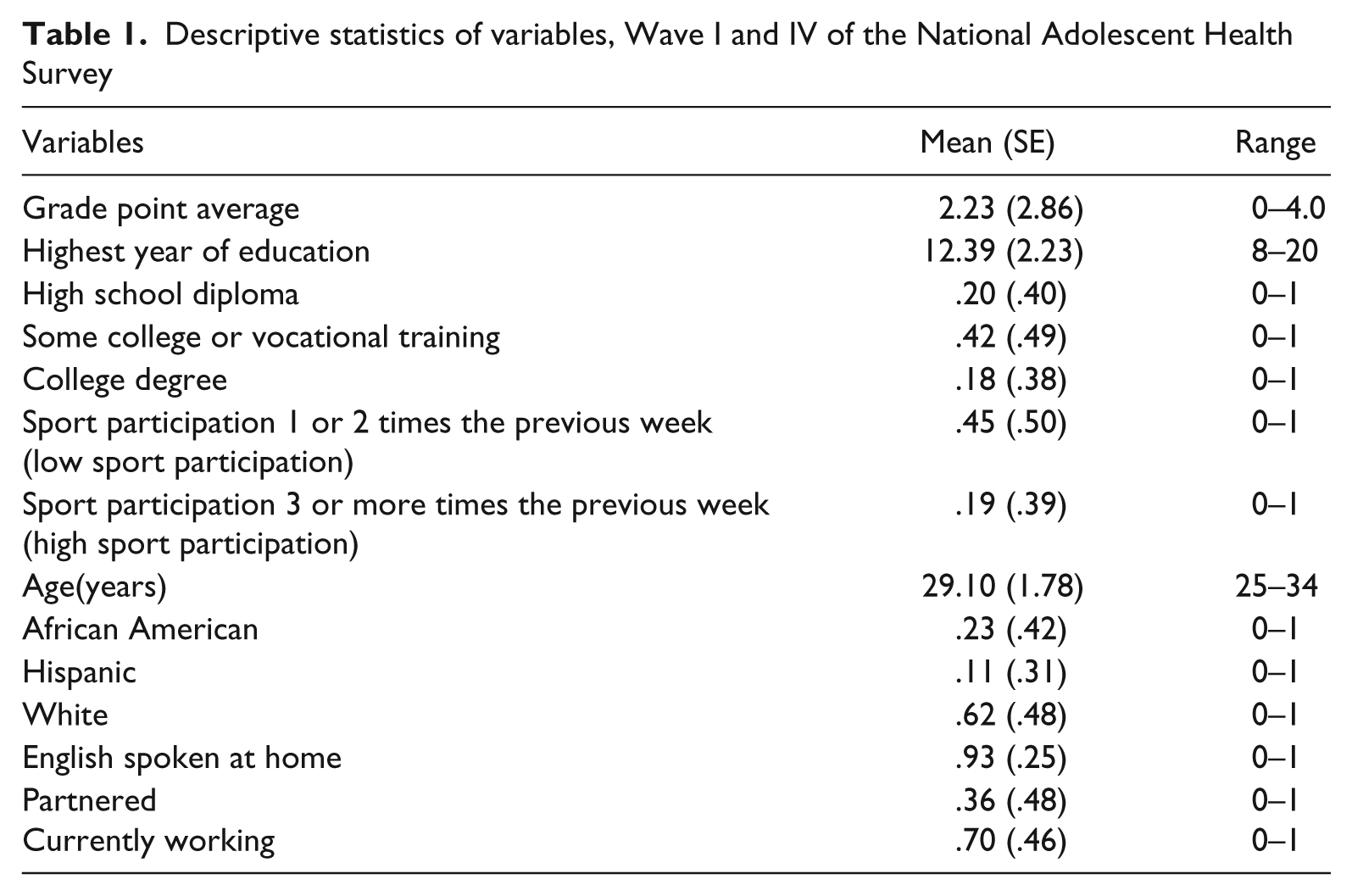
We examine a number of sociodemographic characteristics. The demographic controls that we analyzed were age, partnership, employment, and speaking English. All descriptive statistics are reported in Table 1. The men of this study range from 25 years of age to 34 years old. Most of the men in this dataset will have completed their education. Because a few of the men in this study have married (less than 8%), but many lived with a partner, we coded cohabitation and marriage as 1 and single as 0. Thirty-six percent of the men are partnered. We also examine men who are currently employed and working at least ten hours a week. Seventy percent of the men were currently employed and working at least ten hours a week. Another demographic characteristic utilized was speaking English at home. We coded language spoken at home as English as one and all other languages as zero. Over 90 percent of men spoke English at home.
Descriptive statistics of variables, Wave I and IV of the National Adolescent Health Survey
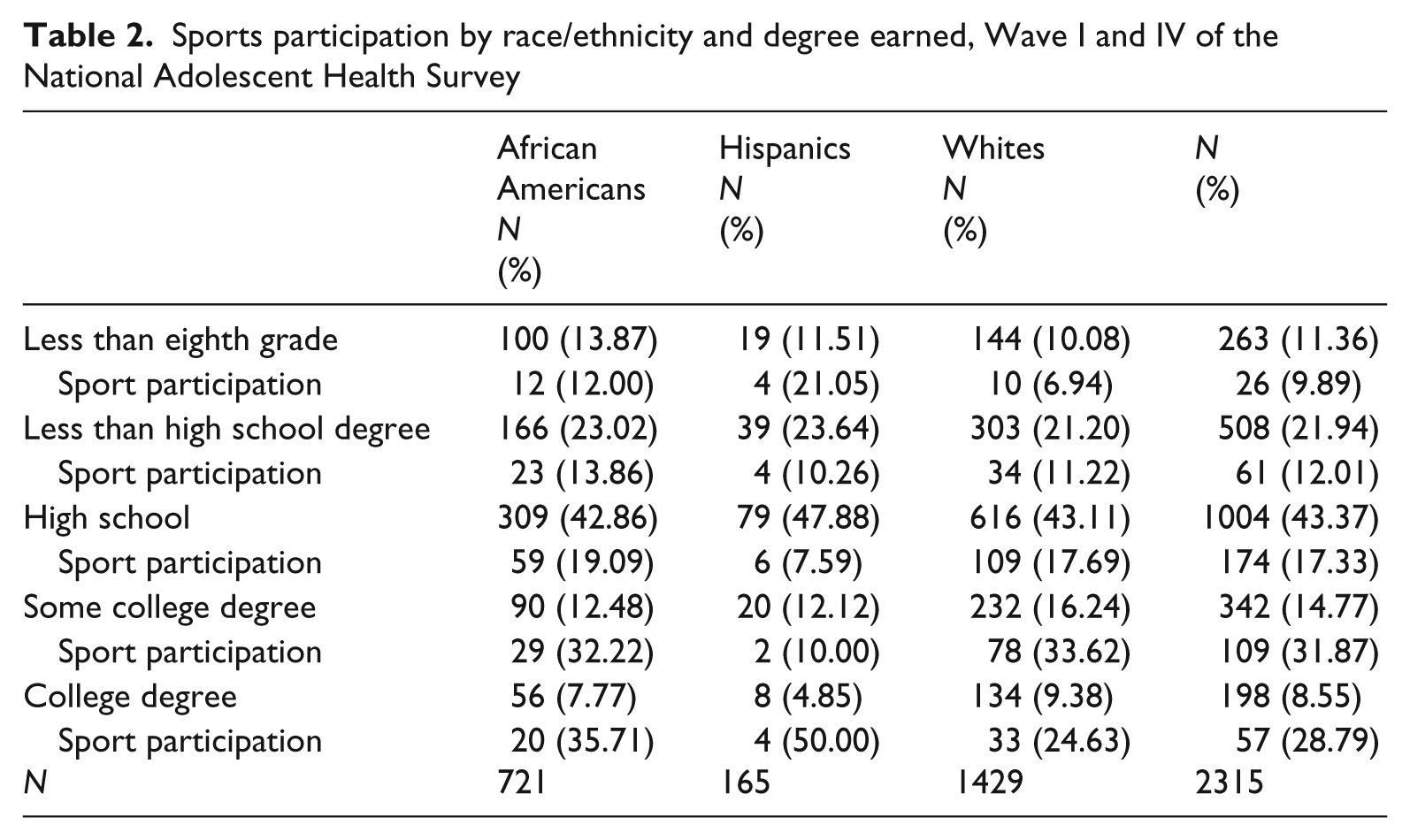
Sports participation by race/ethnicity and degree earned, Wave I and IV of the National Adolescent Health Survey
Grade point average (GPA)
We use a comprehensive measure of GPA similar to that used by Rees and Sabia (2010). The grade point average from Wave I was calculated by combining letter grades from English, science, history, and math courses. A letter grade of an A was scored as a 4, a letter grade of B was scored as a 3, a letter grade of C was scored as 2, a letter grade of D was scored as 1, and a letter grade of F was scored as 0. Therefore, if a student had earned four As, he would have a grade point average of 4.0. The average grade point average was 2.23.
Educational attainment
We construct two dependent variables to measure social mobility. Our first dependent variable is education measured in years at Wave IV. The average year of education was 12.39 with the minimum number of years of education as seven (less than an eighth grade education) and the maximum number of years of 20 (post-graduate degree). Our second dependent variable is a dichotomous variable that is coded as zero having no degree and one for having a high school degree, some college or vocational training, or a college degree.
Men’s years of education and percent who earned degrees vary by race. White men who have less than an eighth grade education are at the lowest percentage of 10.08 percent, while African American and Hispanic men who have less than an eighth grade education have higher percentages of 13.87 percent and 11.51 percent, respectively. The majority of the sample (approximately 50% for white, African American and Hispanic men) earned a high school diploma while almost 10 percent of white men have earned a college degree. A little more than seven percent of African American men earned a college degree and only a little more than four percent of Hispanic men earned a college degree.
Furthermore, we compared educational degrees earned with sport participation. Sport participation included any man who had participated in at least one sport. Among men with less than an eighth grade education, 12 percent of African American, 21.05 percent of Hispanics and 6.94 percent of white men participated in sport. For men who earn a high school degree, white and African American men participate in sport at a higher percentage than Hispanic men. Almost 25 percent of white and 50 percent of Hispanic men who participated in at least one sport earned a college degree. Additionally, 36 percent of African American men who participated in sport earned a college degree.
Sport participation
Sport is a contested concept. Our understanding of sport has been informed by the work of scholars such as D. Stanley Eitzen and George Sage. In their recent book, Eitzen and Sage (2009: 16) define sport as ‘. . . any competitive physical activity that is guided by established rules’. The definition has three key components: 1) competition involving ‘. . . the attempt to defeat an opponent . . .’, where the opponent is broadly construed; 2) physical activity, requiring ‘strength, speed, stamina, and accuracy’; 3) rules, distinguishing ‘. . . it from more playful and spontaneous activities’.
Eitzen and Sage (2009) acknowledge this definition is too broad. The heterogeneity among practices included in this definition would make it hard to distinguish sport from non-sport activities. A pick-up basketball game and an NBA game would both be identified as a type of sport. As a result of this imprecision, Eitzen and Sage (2009) suggest disaggregating sport into three categories: informal sport which is characterized by ‘playful activity for the enjoyment of the participants’ (2009: 16). A pick-up game at a sandlot baseball field or community basketball court would be examples of informal sport. Organized sport is distinguished by the presence of rudimentary organization, with ‘. . . formal teams, leagues, codified rules, and related organizations’ (Eitzen and Sage, 2009: 16). Organized sport includes, city leagues, Little League programs, interscholastic teams and leagues. The final category, corporate sport, has elements of informal sport and organized sport, but it has become ‘. . . a corrupted, institutionalized version of sport’ (Gilbert, in Eitzen and Sage, 2009: 17). This level includes ‘. . . sport as big business and sport as an extension of power politics. The pleasure in the activity for the participants has been lost in favor of extrinsic rewards for them and pleasure for fans, owners, alumni, and other powerful groups’ (Eitzen and Sage, 2009: 17).
Building upon Eitzen and Sage’s (2009) conceptualization of sport, we restrict our study to organized sport and examine how low- and high-levels of participation among adolescents affects social mobility. Much of the literature on sport participation and mobility has a categorical measure of sport participation that does not distinguish by level (Barber et al., 2001; Corneliben and Pfeifer, 2007; Eccles et al., 2003; Fredricks and Eccles, 2006; Lipscomb, 2007). Those that do acknowledge variation in level of participation usually focus on high-level participation. For example, Purdy et al. (1982) study the effect of participation in college athletics at a division one school on academic performance. Eide and Ronan (2001) examine how participation in high school varsity athletics affects long-term educational attainment and earnings. Our study, in contrast, includes measures of low- and high-level sport participation in organized sport.
Our measure of level of sport participation draws from the work of Rees and Sabia (2010) who use Add Health data to explore the effect of sport participation on academic performance in high school. Rees and Sabia (2010) have three levels of sport participation: low (one to two times per week), moderate (three or four times per week), and high (more than five times per week). We use a dichotomous sport participation variable (low- and high-levels) because only 3 percent of the sample in our dataset correspond to the high-level identified by Rees and Sabia (2010). It is hard to disaggregate sport participation at the highest level by social mobility and race when only 3 percent of the sample participate in sport at such a high level.
Rees and Sabia (2010) examine level of activity related to sport participation and its effect upon comprehensive grade point average, aspirations to attend college, difficulty of paying attention in class, and difficulty of completing homework. They find that sport participation has limited positive academic spillover. These positive academic spillovers, they note, are due to the influence of unobservables that have not been accounted for in the literature. One of the limitations of Rees and Sabia’s (2010) study is that their four endogamous variables examine academic performance rather than educational attainment. One important contribution of this study is that we examine the impact of sport participation upon actual educational attainment in years of education and degrees earned. For years social scientific research has demonstrated that credentials (educational degrees) are more important than educational performance in the attainment of employment (Dornbusch et al., 1996; Rosenbaum et al., 1990). Furthermore, research has also demonstrated that employers rarely consider grades when making hiring decisions (Rosenbaum et al., 1990: 269). Thus, for a study such as ours which is concerned with social mobility, focusing on educational attainment seems more fruitful than a focus on grades.
The measure of sport participation employed in this study is consistent with recent research (Broh, 2002; Eide and Ronan, 2001; Feyjin, 1994; Rees and Sabia, 2010) which uses refined measures of sports participation. Broh (2002) notes that varsity interscholastic participation leads to positive educational outcomes while intramural participation has a negative effect. Feyjin (1994) found similar results. In contrast, other research uses a measure of sport participation that is categorical, self-reported, and does not distinguish by level (Barber et al., 2001; Corneliben and Pfeifer, 2007; Eccles et al., 2003; Fredricks and Eccles, 2006; Lipscomb, 2007). We feel our more refined measure of sport participation permits us to better assess its impact on social mobility.
First, we assess the effect of sport participation by race. Figure 1 shows sport participation by sport and racial identity. Basketball and (American) football are played the most often by all men. A little over 27 percent of African American men and 24 percent of Hispanic men play football, while 19 percent of white men play football. Additionally, more African American men play basketball (26.47%) than white men (19.12%). Football has the greatest total participation by 19.6 percent followed by basketball at 19.1 percent. A higher percentage of Hispanic men played soccer and wrestled than white or African American men. White men played baseball, tennis, swam, and other sport at higher percentages than African American and Hispanic men. Eide and Ronan (2001) also find differences in sport participation among different racial and ethnic groups.
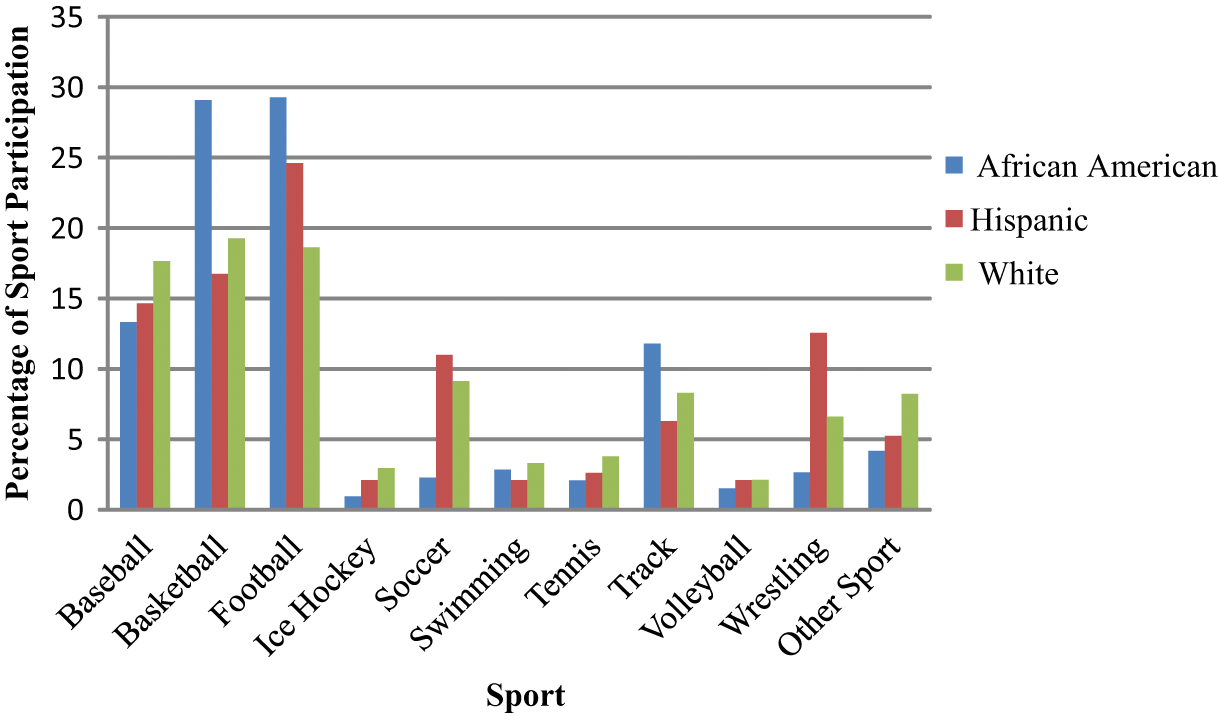
Percentage of sport participation by racial identity, Wave I of the National Adolescent Health Survey.
The number of men per sport participation category (high and low) is shown in Figure 2. Those men who had not participated in sport in the previous week were 42.73 percent. Among those who did participate in sport during the previous week, most men (38.27%) had a low level of participation. Nineteen percent of men participated in sport at the high level in the previous week. Among men who participate at low- and high-levels, most are African American. African American men participate in low-levels of sport at 49 percent and high-levels of sport at almost 19 percent. Hispanic and white men participate in sport at lower percentages.
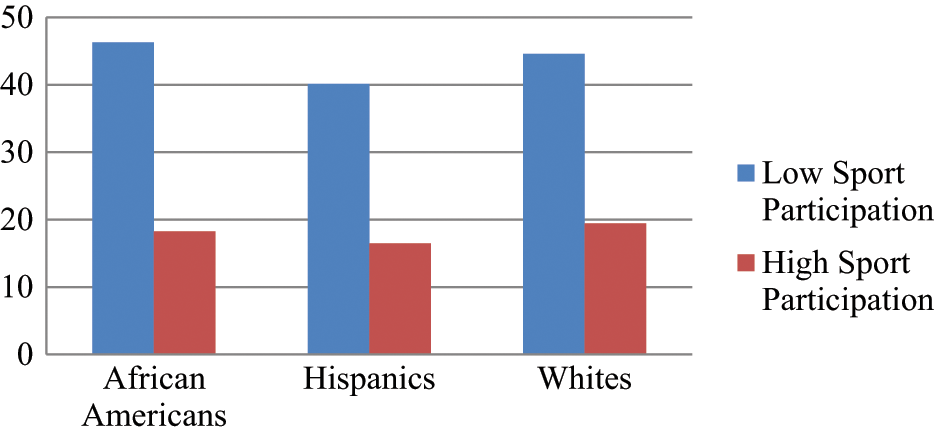
Sport participation by activity level, Wave I of the National Adolescent Health Survey.
Limitations of data
There are some limitations to our current study. Future research should seek even more refined measures of athletic participation. While Wave I asks what specific sport the young men participate in, this follow-up question is not asked in Wave IV. As a result, we cannot determine if the men are still participating in these specific sports. However, we feel this is not a flaw since our objective is to assess the effect of sport participation – in general – on social mobility. Additionally, in Wave I, the men were not asked at the kind of sport they played, such as YMCA or travel team. Sack and Thiel (1979) examine the long-term consequences of participation on the Notre Dame football team and they find differential results for starters and non-starters. This is a refinement our data-set did not allow.
Data analysis
To compare and contrast the zero-sum model and the developmental model, we utilize two different analyses for the social mobility exogamous variables: multiple regression for years of education; and a logistic regression for various degrees earned. All analyses were conducted using the Stata statistics/data analysis package (Stata Corp., 2001). Descriptive statistics were calculated to compare sport participation and social mobility.
Participation in sport is associated with several factors that may also be related to social mobility. In order to control for some of these potentially confounding factors, we carried out race-specific OLS regression and logistic regressions (controlling for age, partnership, English language, and employment). The slope coefficients of the OLS regression may be interpreted in the following way: a one unit increase in the slope coefficient (b) of the independent variable is an increase or decrease in social mobility, controlling for all other independent variables. A logistic regression is used for model estimation because the dependent variable is a dichotomous response, scored one for earning a high school diploma and zero for all other degrees. The odds ratios reported here estimate the sport participant’s odds of an event, such as an increase or decrease in earning a degree, relative to the men who do not participate in sport. An odds ratio (OR) of 1.00 is not statistically significant. An OR greater than 1.00 means that the men who participate in sport increase the odds of earning a degree while compared to men who do not participate in sport, while an OR less than 1.00 means that the men who participate in sport decreases the odds of earning a degree when compared to men who do not participate in sport (Agresti and Finlay, 1997).
Results
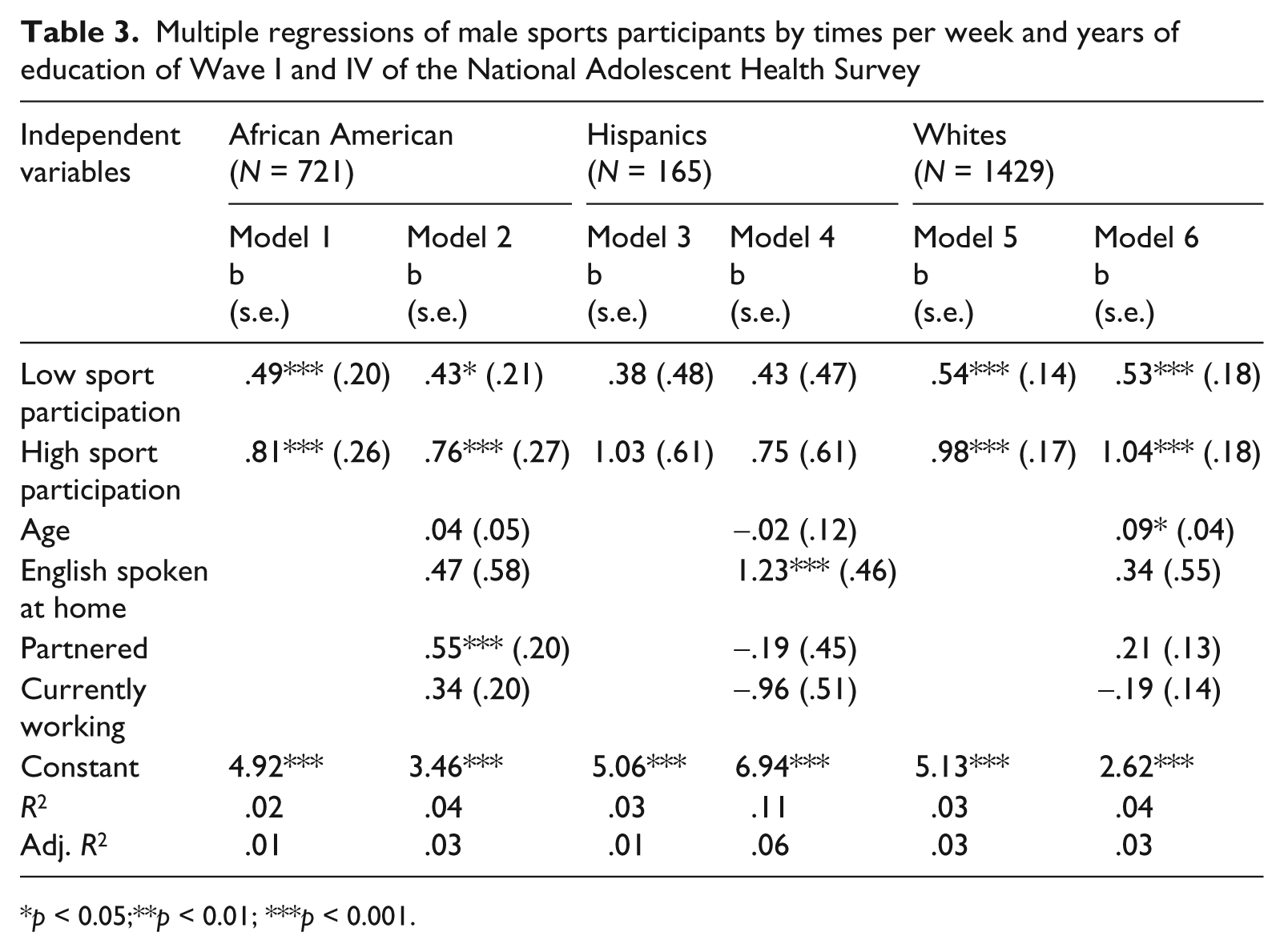
We focus upon statistically significant findings. Tables 3 and 4 examine sport participation at various activity levels among African American, Hispanic, and white men. One of the advantages of our study is that we measure years of education and degrees earned, while Rees and Sabia’s (2010) outcome variables were related to academic success such as grade point average, problems paying attention in the classroom, and problems completing homework. In Table 3 in Model 1, low sport participation increases African American men’s years of education by .49 years (almost one semester). Additionally, high sport participation among African American increases their years of education by three quarters of a semester. Model 2 in Table 3 includes all the control variables for the full model. Low sport participation increases years of education by .43 years (almost one semester) for African American men. Additionally, high sport participation among African American men increases their years of education by .76 years (three-fourths of year) when the full model with the control variables is examined. For instance, if a 25-year-old African American man did not participate in sport, he would have 12.79 years of education according to our modeling. However, if the same 25-year-old African American man had low sport participation (once or twice in the previous week), he would increase his years of education by 13.22 years. Furthermore, if a 25-year-old African American man had high-level of sport participation, he would increase his years of education by 13.55 years, almost a full year more than the African American man who did not participate in sport.
Multiple regressions of male sports participants by times per week and years of education of Wave I and IV of the National Adolescent Health Survey
p < 0.05;**p < 0.01; ***p < 0.001.
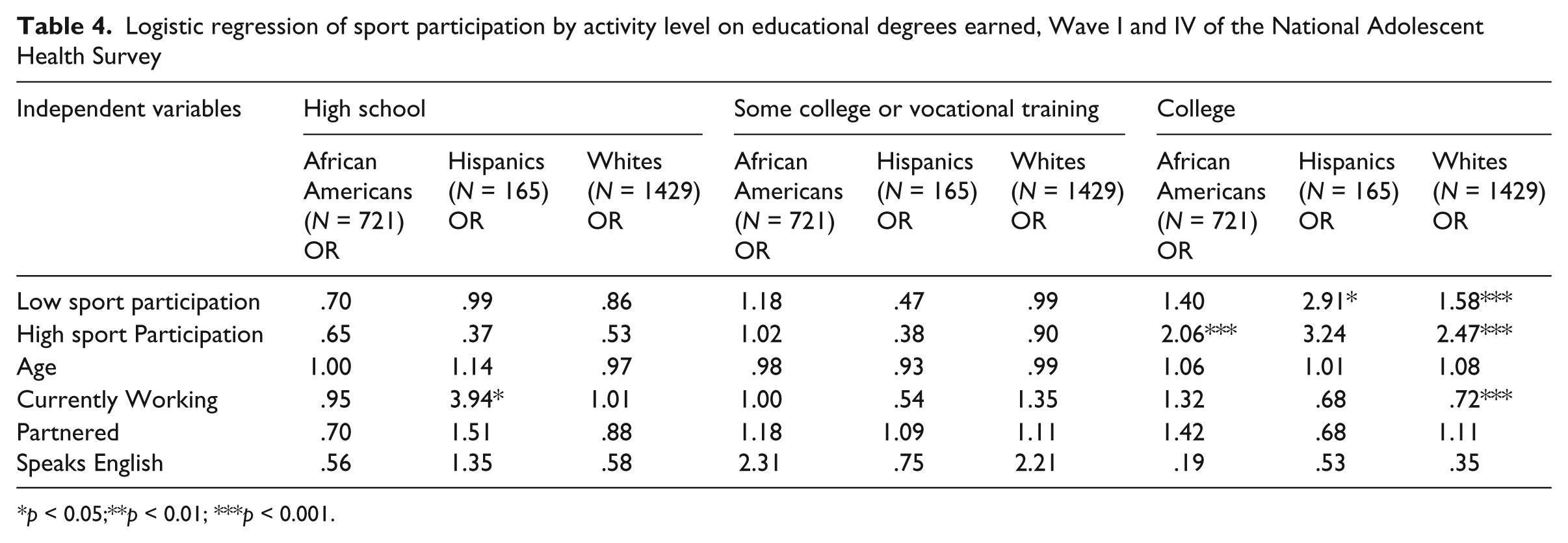
Logistic regression of sport participation by activity level on educational degrees earned, Wave I and IV of the National Adolescent Health Survey
p < 0.05;**p < 0.01; ***p < 0.001.
Models 3 and 4 in Table 3 examine Hispanic men, sport participation by activity level and years of education. While sport participation by activity level is positively signed, none of the sport participation by activity levels variables are statistically significant for Hispanic men. Sport participation by activity level has no statistical impact upon years of education for Hispanic men.
Similar to the finding for African American men, low and high levels of sport participation increase years of education for white men. Model 5 in Table 3 demonstrates that white men who participate in sport once or twice per week increase their years of education by .54 years (one semester). Furthermore, those white men who participate in sport three or more times per week increase their years of education by .98 years (almost a full year).
Model 6 in Table 3 includes the full model indicating low and high levels of sport participation increases years of education for white men. Participating in sport once or twice a week increases years of education by .53 years for white men and participating in sport three or more times per week increases years of education by 1.04 years (two semesters). Therefore, if you have a 25-year-old white man who does not participate in sport, then he would have 12.19 years of education according to our modeling. If the same 25-year-old white man had low sport participation, he would increases his years of education by 12.71 years. Furthermore, if the same 25-year-old white man had high sport participation, he would increase his years of education to 13.23, a full year more than a 25-year-old white man who did not participate in sport.
In summary, low and high sport participation for African American and white men increases years of education. Hispanic men are not influenced by sport participation by level of activity.
In Table 4, we examine sport participation by activity level of African American, Hispanic, and white men using a dichotomous outcome variable of degree earned by high school diploma, college or vocational training, and earning a college degree. The effect of sport participation on earning a high school degree is not statistically significant.
Among men the effect of sport participation on attending some college or receiving vocational training, is not statistically significant. Hence, we find little support for the zero-sum or the developmental model at these levels of educational attainment.
Among men who earned a college degree, we see that some level of sport participation increases the likelihood of men earning a college degree. Of particular importance are the findings that sport participation has a positive effect for African American and Hispanic men, though in different ways. For African American men who participate in high levels of sport, the probability of earning a degree increases by 67 percent (OR = 2.06; p < 0.001) when compared to other African American men who do not participate in sport. Yet, for Hispanic men, it is low levels of sport participation that increases their probability of earning a degree by 74% (OR = 2.91; p < 0.05) when compared to Hispanic men who do not participate in sport.
Similar to other studies, we find that low- and high-levels of sport participation increases the likelihood of white men earning a college degree. White men who participate in sport once or twice per week are more likely to earn a college degree by 61 percent (OR = 1.58; p < 0.001) when compared to white men who do not participate in sport. Furthermore, white men who participate in sport three or more times per week are more likely to earn a college degree by 71 percent (OR = 2.47; p < 0.001) when compared to white men who do not participate in sport. At first glance, this suggests that sport benefits all men, but white men especially. However, the literature on educational attainment has documented that white men are much more likely to earn a college degree than African American and Hispanic men. Thus the positive effect of sport participation on earning a college degree for African American and Hispanic men is likely greater than it is for white men. These findings are novel and support the developmental model.
Discussion
Does sport participation increase social mobility? In his ethnographic examination of a Georgia high school basketball team over many seasons, May (2009) concludes that sport participation may direct many young black men towards earning a high school diploma and not participating in deviant activities. A high school degree in turn can lead to more educational attainment in the form of trade school, military, or college. We tested four hypotheses on the relationship between sport participation and social mobility. The first hypothesis, derived from the zero-sum model, stated that low- and high-levels of sport participation will decrease the number of years of education. There was no support for the zero-sum model. The trends for all groups were positive; however, only the results for African American and white men were statistically significant.
Our second hypothesis, derived from the developmental model, stated that sport participation will increase men’s years of education. We find limited support for the developmental model. As the developmental model predicts, some sport participation increases the number of years of education the athlete will complete. For African American and white men, low and high sport participation increases the years of education. These findings are consistent with the developmental model. Yet for Hispanic men, sport participation had no statistical significant influence upon years of education. The results for Hispanic men, however, were similar (positive) to those of African American and white men and with a larger sample size may be statistically significant. Scholars have argued that sport participation will increase the time student-athletes spend in school as a means to remain eligible to play sports while in high school (Otto, 1982). Moreover, having a higher status as an athlete may encourage men to remain in school and earn a high school diploma (Spady, 1970). Other scholars have noted that student-athletes may benefit from lenient teachers and grade-inflation (Hanks and Eckland, 1976). These factors – in addition to the positive effects developmental scholars postulate benefit student-athletes – may be contributing to the additional time that African American and white student-athletes spend in school.
Our third hypothesis, derived from the zero-sum model, theorized that low- and high-levels of sport participation would decrease the probability of earning a high school or college degree. The effect of sport participation on earning a high school degree or attending some college or a vocational school was inconclusive for all three groups: African Americans, Hispanics and whites. None of the results were statistically significant.
Our fourth hypothesis, again derived from the developmental model, postulated that sport participation would increase the likelihood of earning a high school or college degree. When we examine activity level of sport participation, we find that high-level of sport participation increases the likelihood of African American men earning a college degree. Additionally, Hispanic men who participate in low-levels of sport increase their probability of earning a college degree. Furthermore, we find that low- and high-levels of sport participation increases the likelihood of white men earning a college degree. This result is consistent with the developmental model. In summary, we find limited support for the developmental model and no support for the zero-sum model. Our results are similar to other recent research which has suggested that sport participation has a small, non-negative impact on social mobility (Barron et al., 2000).
However, our analysis diverges from preceding research in an important way. Most research suggests that sport participation increases social mobility for white men but not for racial minority men (for exceptions, see Braddock, 1981; Eide and Ronan, 2001). An important contribution of our study is to demonstrate that African American and Hispanic men also benefit from sport participation. Both white and African American men who participate in sport stay in school longer than men of similar racial backgrounds who do not play sport. Furthermore, African American, Hispanic and white men who played sport in school are more likely to graduate from college. Our findings are consistent with those authors (e.g. Braddock, 1981; Marsh, 1993) who argue that sport participation positively impacts educational outcomes; however, our results suggest the benefits from sport participation affect only college graduates. We suggest that we would find more robust results for African American and Hispanic men and sport participation if we had had access to a larger sample size.
In recent years scholars have assessed the impact of level of sport participation on educational outcomes (Broh, 2002; Rees and Sabia, 2010). Similar to Broh (2002), we found a positive correlation between level of participation and years of education and probability of earning a college degree. However, our longitudinal results on the effect of sport participation on earning a high school degree and attending college were inconclusive. This points to another key contribution of our study: by using longitudinal data, conducted over multiple waves and over a substantial number of years, we are able to assess the long-term impact of sport participation on mobility, calling into question studies which suggest uniform support for the developmental model.
While our results provide fine-grained analysis of the long-term impact of sport participation on social mobility, we also acknowledge limitations. We agree with Broh (2002) on the need for investigations into the effect of individual sports on educational outcomes and social mobility. Some researchers have examined the effect of revenue-generating versus non-revenue generating sports on educational outcomes and social mobility (Upthegrove et al., 2002); however, with a larger sample size it might be possible to analyze the effect of individual sports on social mobility.
Another possible limitation of our current study is the impact of selection bias on our results. Selection bias in this case refers to the fact that high school students who elect to play inter-scholastic sports may be different from non-athletes in important ways. By Wave IV, many of the respondents had completed their college educations and were entering into full-time employment.
In recent years, scholars have been considering the impact of self-selection on analyses of participation in sport and social mobility. Marsh (1993) suggested that his results should be interpreted cautiously due to the possible impact of self-selection on the analysis. Though most high school students participate in at least one sport (Rees and Sabia, 2010), scholars have recently noted how contextual factors are related to the differential participation in sport of men and women, blacks and whites, more affluent versus less affluent, and students from urban versus rural backgrounds (Videon, 2002).
In an important study, Eitle and Eitle (2002) found important differences by race, socio-economic status, cultural capital and household educational resources (also see Eitle, 2005). In addition, Eitle and Eitle (2002) disaggregated their results by sport, finding that students with lower cultural capital and from households with lower educational resources were more likely to play football and basketball. Participation in other sports, like hockey and tennis, was associated with higher levels of cultural capital and household educational resources. Importantly, the authors found confirmation of the previously hypothesized preference of African American families for their male children to play basketball and football as a means of social mobility. Similarly Upthegrove et al. (2002) demonstrate how selection biases interact with the institutional pressures imposed on student athletes in revenue generating sports (football and basketball). The negative consequences of these dual processes are exacerbated for African American student athletes who are over-represented in revenue-generating sports. Guest and Schneider (2003) found similar results, noting that the meaning students attribute to playing high school sports varies by the social context. Participation in sport is most strongly associated with achievement in schools with low educational expectations and schools in poor communities (Guest and Schneider, 2003). For students in schools with high educational expectations the authors found the converse is true, that is, achievement is associated with participation in non-sport extracurricular activities.
Research into the impact of selection bias into specific sports on social mobility have found that the effect of participation in sport is less than previously expected. Barron et al. (2000) argue that when ability and preference for leisure are controlled, the effect of participation in sport on social mobility is reduced. However, they emphasize there seems to be an independent non-negative effect from participation in sport on social mobility. Fredricks and Eccles (2006), Lipscomb (2007) and Rees and Sabia (2010) found similar results. 3 To assess the effect of selection bias on our sample, we performed a Heckman selection model, which is a two-step process of utilizing a multiple regression and then examining the Chi-Squares of the variables (Beck, 1983; Cuddeback, 2004; Winship and Mare, 1992). We first ran a multiple regression and then examined each independent variable for possible selection bias of sport participation. When we inspected all of the independent variables used in the models in Table 3, we find no sample selection bias (Chi2 = 0.22; p = 0.636). We also analyzed individual sport participation (i.e. tennis; swimming, etc.) and we found no sample selection bias (Chi2 = 1.37; p = 0.242). Furthermore, team sport participation (i.e. football; basketball; baseball, etc.) presented no sample selection bias (Chi2 = 0.77; p = 0.379). There was also no selection bias in the level of sport participation by race. The only selection bias occurred for football players and grade point average (Chi2 = 37.740; p = 0.003). We do not use grade point average as an independent variable, because as previously stated, it is not a very good indicator of social mobility. This may suggest lower academic performing males are self-selecting football as a sport. If this is the case, this self-selection may overestimate the coefficients for years of education and educational attainment. However, because football players were the only selection bias that we found, we feel that this may only be a small limitation of our study. Thus our conclusions are similar to those of other recent scholars: sport participation positively affects mobility though less than previously expected.
Future research
This study has demonstrated the benefit of using longitudinal data in studying the effect of sport participation on social mobility. Future research can improve on this by disaggregating their results by sport, especially whether the athlete is playing revenue generating sports (basketball and football) or non-revenue generating sports (everything else) given the racial and class effects found by Upthegrove et al. (1999). In addition, further research should examine the effects of participation in sport by the number of years played and at what level (varsity, intramural, etc.). More measures of social mobility, such as income or socioeconomic status, could also enhance this line of inquiry. Future research can build on the work of Broh (2002) and Guest and Schneider (2003) who assess the effect of participation in sport vis-a-vis other types of extra-curricular activities. Other research should build upon Rees and Sabia’s (2010) work examining educational outcomes such as grade point average. Lastly, quantitative studies such as this should be complemented by qualitative ones which shed light on the social processes through which race, class, and gender affect social mobility both directly and indirectly (e.g. Jamieson, 2005; May, 2009; Spaaij, 2009).
Footnotes
Acknowledgements
The authors wish to thank the following people for their assistance: Mark Fossett, Nancy Plankey-Videla, Holly Foster, Zulema Valdez, Jeff Ackerman, and Michael Ezell. Previous versions of the article were presented at the Race and Ethnic Studies Institute (RESI) colloquium at Texas A&M University and at the American Sociological Association annual meetings in Atlanta, Georgia in 2010.
Funding
The authors acknowledge financial support provided by the Race and Ethnic Studies Institute (RESI) at Texas A&M University.