




Abstract
The 2010 FIFA World Cup in South Africa generated extensive controversy over spectators’ use of the African vuvuzela trumpet. We asked 123 White American participants about their opinions of vuvuzelas as well as their attitudes towards a variety of racial/ethnic minority groups including immigrants, African Americans, and Latinos. We found that the less participants liked vuvuzelas, the less positively they also tended to feel toward minority groups. Furthermore, respondents who liked vuvuzelas the least were also less generally open to change. These findings suggest that the vuvuzela controversy was about more than just a plastic trumpet – it was also an episode of differential ingroup/outgroup perceptions and a lack of openness to new things.
I think it is great that soccer fans use them [vuvuzelas] during games. It makes the South African World Cup experience unique. (Survey respondent)
Vuvuzelas make me dislike stadium-based soccer. [Their use] is infantile, extremely annoying, and seems designed to keep more refined personalities from enjoying the game. (Survey respondent)
The 2010 FIFA World Cup in South Africa – the first time that the African continent was selected as host – generated a memorable sports-related controversy revolving around spectators’ use of the plastic vuvuzela trumpet. Countless North American and European news reports focused on complaints about the horns. Dismissing the sound as an annoying ‘buzzing’, some even argued that the vuvuzela could cause health problems (Hear the World, 2010; Swanepoel et al., 2010). In fact, Western-based television stations including ESPN and BBC spent a lot of money trying to dampen the sound. As summed up by the New York Times:
Just five days into the World Cup, and the No. 1 topic of conversation around the world isn’t about results or tactics, but rather the vuvuzela – the $2.50 plastic horn that, blown nonstop by the thousands, has provided a bleating soundtrack to every match. (Klein, 2010)
Historically vuvuzelas were used to call meetings across different African villages (Swanepoel et al., 2010). Originally made from a kudu (antelope) horn, the modernized version has since become a symbol of South African hope since its revived use after the first democratic elections marking the end of apartheid (Swanepoel et al., 2010). South Africans report that these horns bring them happiness and unity (FIFA, 2009; Longman, 2010):
When we started the vuvuzela, there was so much sadness in our country in those years and it brought so much joy . . . For a few hours, they would forget about the reality in our society and enjoy the sound. (FIFA, 2009)
Despite the cultural significance of the vuvuzela to South Africans, however, the World Cup controversy led to orchestrations to ban the instruments (de Haan, 2010; Klein, 2010; Longman, 2010), a move that would have been considered by many to be legislating against a part of the host continent’s culture. FIFA president Sepp Blatter explained, ‘We should not try to Europeanize an African World Cup’ (Jenkins, 2010) and indeed, the majority of anti-vuvuzela sentiment emerged from the United States and European nations. Both The Los Angeles Times and a news poll in the United Kingdom reported that 70 percent of people wanted vuvuzelas banned (Daily Mail, 2010; The Los Angeles Times, 2010). The BBC received 545 complaints about the vuvuzelas after just four days of World Cup play which caused them (as well as ESPN) to mute the sound (BBC, 2010; ESPN, 2010). Furthermore, American and European based sports organizations such as Yankee Stadium, Wimbledon, the Southeastern Conference of US College Sports, and eight English Premier League teams all banned the use of vuvuzelas after the World Cup Games (CNN, 2010; Swartz, 2010; Weiner, 2010).
We suggest that there was more to the pervasive anti-vuvuzela sentiment than simple auditory irritation. Foer (2004) traveled before the 2006 World Cup to study the culture of soccer as a means to explain various political, economic, and social controversies throughout the world and found that through soccer globalization is not depicted by cultural uniformity, but instead by the social construction of cultural identities and practices, highlighting differences between groups. Furthermore, Kinder and Sears (1981) argued that symbolic racism (or anti-Black sentiment) has replaced ‘old fashioned racism’ in that prejudice is now more often expressed in more subtle forms and acts. Looking at these examples, we propose that the vuvuzela controversy represented a symbolic representation of intergroup perceptions born in the audiences of soccer, fueled at least in part by spectators’ general openness to change. To explore this possibility, we examined whether opposition toward vuvuzelas predicted negative impressions of minorities and a more general resistance to societal change. Investigating this question in this manner allows us to examine the intersections of a person’s negative attitudes toward vuvuzelas with other intergroup perceptions, the focus of this article.
Them vs us: Intergroup perceptions within sports
Two sociological concepts relevant to our present analysis are intergroup perceptions and stereotyping.
Intergroup perceptions
Sociologist William Sumner coined the term ‘ethnocentrism’ in 1959, which is the tendency to believe that one’s ingroup is centrally important and should be used as comparison for other outgroups. Many sociologists view this as the stepping stone for the social construction of social exclusion since it causes sentiments of loyalty and superiority to form between group members, often leading toward outgroup derogation (e.g. Billiet et al., 1996; Coenders, 2001; de Venanzi, 2004, 2005; Sumner, 1954). Additionally, social identity theory states that people often define themselves using traits of their ingroup, and strive to maintain a positive identity by comparing their own groups with others (Tajfel, 1982; Tajfel and Turner, 1979). During intergroup interactions, people tend to classify others by amplifying the differences they see through exaggerating the negative attributes about an outgroup to maintain a positive impression of themselves (Aberson et al., 2000; Jenkins, 2000; Tajfel, 1982; Tajfel and Turner, 1979). This inclination to view one’s own group more positively is known as ingroup bias (Aberson and Romero, 2000; Tajfel, 1982; Tajfel and Turner, 1979).
This formation of ingroup biases is particularly likely in the sporting world, as spectators readily categorize others using ingroup/outgroup terms based on team affiliations, directly affecting the behavior of players and fans (Ateyo, 1979; Branscombe and Wann, 1992). Ingroup bias plays a large role in sports – both players and audience members are driven to see their team win, making social categorization a pathway toward team hostility (e.g. Brown, 2000; Foer, 2004). A classic psychological study demonstrated that the conflict between two rival Ivy League schools’ football fans was owed in large part to the two groups’ opposite perceptions of the game – each convinced that the majority of the penalties and dirty plays were from the opposing team (Hastorf and Cantril, 1954). This study is one of many which demonstrates that both sides of a sporting event use ingroup/outgroup perceptions to bolster their own ingroup (i.e. Crisp et al., 2007; Wann and Branscombe, 1990).
These same intergroup perceptions seen within sporting arenas are also seen between racial groups, and since perceptions of recreational social identities have been shown to be associated with racial outgroup perceptions (Brewer and Pierce, 2005), during international sporting events these ingroup/outgroup perceptions are then magnified. The pervasive nature of competition between ethnic groups only further amplifies these between-group differences seen on and off the soccer field (Blumer, 1958; Bobo and Hutchings, 1996; Quillian, 1995).
Stereotyping
Studies have also demonstrated that membership with a specific group or team can lead to negative stereotypes of opposing group members, which reinforces the inclination to categorize individuals as ingroup or outgroup (McArthur, 1981). Such biases carry into team favoritism, since fans often view their team as a part of themselves (Branscombe and Wann, 1992). Furthermore, other studies have highlighted that such ingroup biases increase violent and aggressive activity from players and fans in comparison to baseline measures taken before a game (Ateyo, 1979; Celozzi et al., 1981). Other studies have found that fans apply more positive traits to other fans from their ingroup in comparison to fans from the outgroup. Importantly, this result was only significant for individuals who highly identified with their team (Wann, 1991; Wann and Branscombe, 1993).
Sports studies have long attempted to study the intersection of race and stereotypes as it pertains to the cultural constructions linked to sports perceptions (e.g. Curtis and Loy, 1979; Hartman, 2000; King, 2005; King et al., 2007; Loy and McElvogue, 1970). Therefore, we propose that during the 2010 World Cup, such ingroup/outgroup distinctions forged in the heat of an arousing competition were present in fans’ views of the vuvuzelas. Through acknowledging the existence of a dominant culture, that perspective can create a sense of social authority over other socially subordinate groups (e.g. Hebdige, 1979). One study reported that the use of ‘them vs us’ vocabulary increases after a loss (Miendl and Lerner, 1984), and many people in the United States and parts of Europe blamed vuvuzelas for their team’s poor performance (e.g. Pesca, 2010; Scrivener, 2010). For example, after a desultory 0–0 draw with Uruguay, Patrice Evra, France’s captain, blamed his team’s subpar performance on vuvuzelas: ‘We can’t sleep at night because of the vuvuzelas. People start playing them from 6am. We can’t hear one another out on the pitch [field] because of them’ (Longman, 2010).
Summary
Local fanaticism can morph into extreme nationalism through international sporting events, creating a sense of ingroup loyalty which often accompanies animosity toward outgroups. The World Cup, therefore, is ripe for the emergence of intergroup bias, a proposition that we assessed empirically in the following study. Specifically, our research assessed whether – despite denials to the contrary – ideology and social attitudes amplified the 2010 vuvuzela debate. In other words, we argue that race-neutral controversies, such as the vuvuzela debate, often do have a racial component underlying them. It is race-related biases that have been shown to influence people’s social perceptions of others, which we argue in turn also predict the negative social attitudes seen within controversies such as this. Such a pattern of results would further demonstrate that intergroup biases predict attitudes in ostensibly race-neutral societal controversies more often than is normally acknowledged.
Method
Participants
To study vuvuzela attitudes within a majority-race population outside of Africa, a sample of 123 White American participants (68 female, M age = 33.84, SD = 12.95) was recruited from Amazon’s ‘Mechanical Turk’, a web-based recruitment site that allows anyone over the age of 18 to complete short studies for small amounts of money (see Buhrmester et al., 2011). Our focus on White American respondents does not suggest that the comparable perceptions of other individuals are unimportant, but rather reflects our desire to focus our investigation on the Western demographic majority-group among which anti-vuvuzela sentiment was pervasive during the World Cup.
Measures and procedure
World Cup attitudes and openness to change
Participants first answered four questions about their opinion and exposure to vuvuzelas and the World Cup. The questions asked: ‘How much have you watched the World Cup?’; ‘What team are you rooting for in the World Cup?’; ‘Did you know what a vuvuzela was before the World Cup?’; and ‘What is your honest opinion about the vuvuzelas?’ Next, participants were asked how much they agreed with a series of statements relating to their feelings about vuvuzelas and being open to new things using a seven-point scale (1 (Not at All) to 7 (Very Much)). Some of the statements were: ‘I like the vuvuzela’; ‘I think that vuvuzelas should be banned from the stadium’; ‘I am bothered by the buzzing sound during games’; ‘If I were at the World Cup I would use a vuvuzela in the stands’; ‘I think athletes should be able to adapt to their environment’; and ‘I am open to change.’ All of these items were treated as single-item measures.
Racial outgroup perceptions
Next, using the same seven-point scale, participants were asked ‘How intelligent and trustworthy do you find the following groups’ (e.g. immigrants, African Americans, and Latinos, Whites). Non-race-specific groups such as working mothers, disabled people, and single parents were also included in order to obtain comparison groups for analyses. Participants responded with two separate ratings for each group (one rating for intelligence and one for trustworthiness).
Results
First, we examined whether how much a participant watched the World Cup predicted their attitudes toward vuvuzelas and found no significant relationship. There were also no significant gender differences. Next, we computed composite scores for each target social group by combining ratings of intelligence and trustworthiness. This composite was highly reliable: immigrants (α = .84), Latinos (α = .89), African Americans (α = .91), Whites (α = .85), working mothers (α = .70), disabled people (α = .83), and single parents (α = .84). Linear regressions revealed that vuvuzela liking (M = 2.89, SD = 1.94) predicted composite trait ratings for three of these groups: immigrants (β = .23, t(121) = 2.57, p = .012); Latinos (β = .25, t(121) = 2.83, p = .005); and African-Americans (β = .20, t(121) = 2.26, p = .026). In other words, the less people liked vuvuzelas, the less positively they also felt toward these minority groups. Vuvuzela liking did not predict ratings of Whites (β = .09, t(121) = 0.95, p = .345) or any of the other social groups examined (see Table 1 for other results).
Social group attitudes
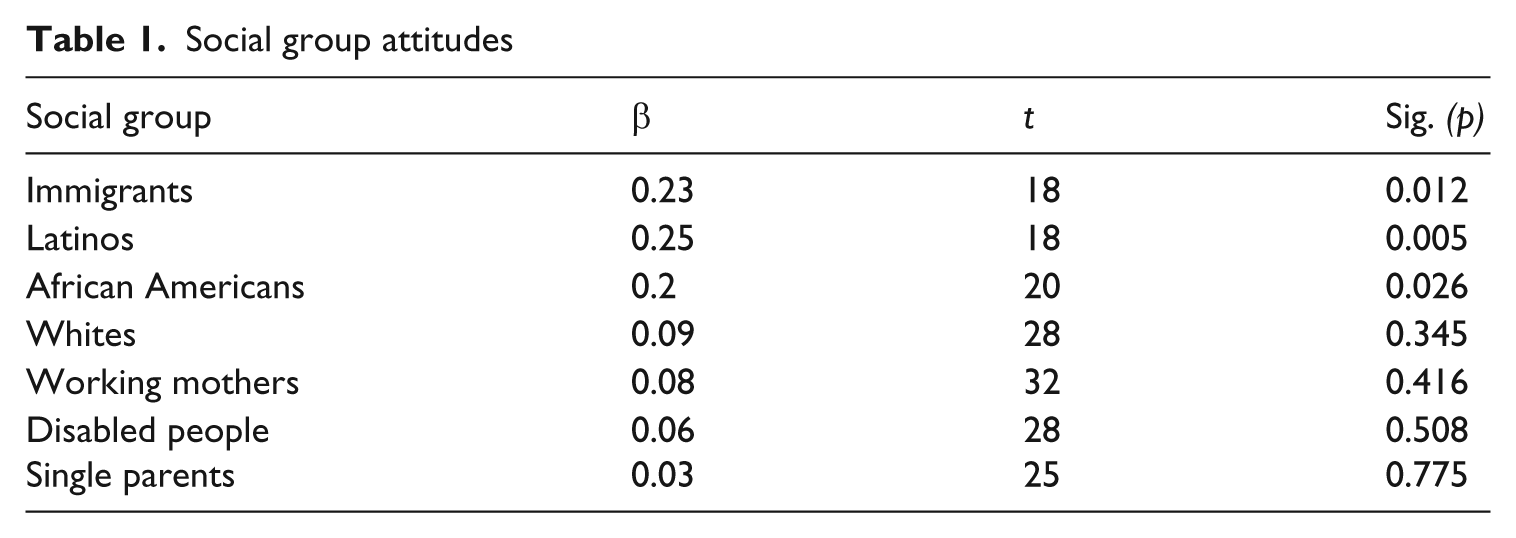
Regarding ingroup preferences, participants also rated their racial ingroup (White) significantly more positively (M = 4.88) than immigrants (M = 4.33; t(119) = 4.76, p < .001, r = .20), Latinos (M = 4.41; t(119) = 4.21, p < .001, r = .19) and African Americans (M = 4.50; t(119) = 3.52, p = .001, r = .17). A difference score was then calculated by subtracting the composite score created from the ratings of these minority groups (α = .89) from their ratings regarding their White racial ingroup. The ingroup preference score significantly predicted participants’ liking of vuvuzelas (β = -.35, t(119) = 2.21, p = .029) in that those Whites with higher ingroup preferences liked vuvuzelas less.
Next, using the mediational strategy outlined by Baron and Kenny (1986), we examined the possibility that respondents’ openness to change mediated the relationship between vuvuzela liking and attitudes toward minority outgroups. First, we regressed ratings of how much participants liked vuvuzelas on ratings of openness to change, yielding a positive relationship, β = .17, t(119) = 1.91, p = .05: the more respondents liked vuvuzelas, the more open to change they were.
Next, we computed a minority perceptions composite score consisting of six items (α = .93): ratings of intelligence and trustworthiness for immigrants, Latinos, and African Americans. A linear regression illustrated that openness to change significantly predicted attitudes towards racial minorities, β = .20, t(119) = 2.16, p < .033. Furthermore, how much respondents liked vuvuzelas positively predicted this minority perceptions composite score, β = .25, t(119) = 2.81, p < .006.
Finally, we entered both our predictor variable (liking of vuvuzelas) and our prospective mediator (openness to change) into a regression model predicting attitudes toward minority groups. As depicted in Figure 1, openness to change partially, but significantly mediated overall perceptions of minority groups (i.e. immigrants, Latinos and African Americans): Sobel test = 1.82, p < .03 (one-tailed). These findings indicated that respondents’ openness to change accounted in part for the relationship between vuvuzela attitudes and attitudes toward minorities.

Mediational analyses of liking of vuvuzelas, openness toward change, and attitudes toward minority groups.
We also tested the reverse of this model (i.e. minority attitudes predicting vuvuzela liking). First, a linear regression illustrated that attitudes toward racial minorities significantly predicted one’s openness to change, β = .27, t(116) = 2.16, p < .033 and that one’s openness to change also significantly predicted how much respondents like vuvuzelas, β = .21, t(121) = 1.91, p = .05. Participants’ attitudes toward racial minorities also positively predicted their liking of vuvuzelas, β = .41, t(116) = 2.81, p < .007. Then we entered both our predictor variable (attitudes toward minorities) and our prospective mediator (openness to change) into a regression model predicting vuvuzela liking, and found that it only marginally mediated the overall perceptions of vuvuzelas: Sobel test = 1.43, p < .07 (one-tailed), indicating that our original model fits the data better. Overall, this illustrates that participants’ openness to change does account at least partially for the relationship between vuvuzela liking and outlooks toward racial minorities.
Discussion
As hypothesized, we found that participants’ attitudes toward vuvuzelas significantly predicted how they felt toward minorities. Additionally, those who disliked vuvuzelas the most were also significantly less open to change, a more general attitude that also predicted one’s outlook toward immigrants, Latinos and African Americans. Furthermore, participants showed a positive racial ingroup bias in comparison to immigrants, Latinos and African Americans, and that ingroup preference also predicted their attitudes toward vuvuzelas. This demonstrates that participants clearly had a positive racial and country ingroup bias or preference, highlighting that intergroup perceptions pertaining to both race and nationality were clearly at play during the vuvuzela debate.
Based on these findings, it is apparent that there is significant overlap of anti-vuvuzela sentiment, negative attitudes toward minority groups, and opinions toward change. In short, this investigation provides empirical evidence that nationalism-related, ingroup/outgroup perceptions were implicated in the controversy over vuvuzelas. It is important to note, however, that these results only represent people who watched the World Cup on television, since the experience of a vuvuzela varies drastically in person versus through television. Past research has shown that being in a mediated social environment (such as through television) is not equivalent to being in the actual environment (e.g. Goodman et al., 1990; Kim and Biocca, 1997). But research has also shown that experiences through media can in some contexts significantly affect one’s social outlooks and perceptions (e.g. Ford, 1997; Brown Givens and Monahan, 2005; Shrum et al., 1998). Therefore these results do not necessarily generalize to individuals who watched the World Cup in person. Since how much participants watched the World Cup was not associated with their attitudes toward vuvuzelas, however, our findings at least generalize across the World Cup television audiences.
The vuvuzela is not the first physical object to take on broader meaning as a cultural symbol relevant to intergroup perceptions. Cultural groups often utilize symbols – whether religious or national – to unite people within and across groups. But those symbols can divide groups too, most likely due to the emotional associations linked between group membership and emblems such as flags and religious images (Billig, 1995; Butz, 2009; Carlston and Mae, 2007; Weisbuch-Remington et al., 2005). In fact, some studies demonstrated that symbols lead to greater group identification, much like what transpired with vuvuzelas.
It is important to note that our findings do not support a blanket statement that everyone who disparaged the vuvuzelas also harbored negative attitudes toward minorities. Certainly there are legitimate race-neutral reasons for anti-vuvuzela sentiment. But our findings do suggest that it is inaccurate – and perhaps a bit disingenuous – to dismiss the vuvuzela controversy as a trivial matter in which race and national identity played no role. One recent study with dependent variables used in our study (i.e. how intelligent and trustworthy do you find these groups?) found that White Americans who endorsed the principles of the Tea Party movement were also significantly less tolerant of minorities such as immigrants and homosexuals, even though Tea Party members were simultaneously seeking to refute allegations of such bias (Schaller, 2010).
Our data also are not the first to indicate the presence of racial bias in sports-related judgments. A recent analysis of National Basketball Association games indicated that referees called more personal fouls against players of a different race than their own – a finding that emerged in spite of the fact that referees and the league vehemently deny that race plays any role in officiating (Price and Wolfers, 2007). Another study in major league baseball found that although racial differences were not observed for first-base coaches – a somewhat less prestigious position – they did emerge among third-base coaches, a disparity that may reflect decades-old racial stereotypes regarding intelligence and leadership (Schmidt, 2010).
Throughout the vuvuzela controversy, it became clear that some people would continue to dislike vuvuzelas no matter what any governing agency said, further fueling the cultural division seen worldwide. But vuvuzelas were only partially responsible for igniting this division. The controversy erupted amidst pre-existing stereotypes regarding the ability of an African nation to effectively host the event (Mwirigi, 2010) and concerns that visiting teams should be heavily protected while visiting this African nation (de Haan, 2010). Similar themes were observed in previous media coverage of African soccer such as the common use of phrases such as ‘Out of Africa’, ‘Just happy to be here’ and ‘developing country’ in describing the Cameroon national team during its 1990 World Cup match with England (Tudor, 1992). More recently, the Washington Post compared the lack of education in Africa with their lack of youth soccer programs and ended their article by saying ‘Africa wasn’t just the world’s poorest continent – they could compete’ (Olopade, 2010), highlighting that Africa is still viewed as a poor, developing continent today and that it was shocking for them to have lasted as long as they did, almost mimicking the ‘Just happy to be here’ sentiment seen 20 years earlier. Moreover, once African soccer players began increasing in numbers in countries like England and Scotland, verbal and physical abuse toward those players increased, with some fans throwing banana peels at Africans to equate them with monkeys (Jones, 2002). Furthermore, organizations such as the National Front were formed to keep Africans from playing in their countries (Centre for Contemporary Studies, 1981; Horne, 1996). In short, the 2010 vuvuzela controversy emerged in the context of a sport with a long history of ingroup/outgroup conflict, particularly when it comes to Africans.
Overall, the debate surrounding the vuvuzela trumpets during the World Cup was an example of cultures and teams clashing, demonstrating that when international sporting controversies arise, simply denying that perceptions of race and ingroup/outgroup perceptions are involved does not preclude the possibility that such issues are, indeed, implicated. Our findings suggest that the vuvuzela controversy was about more than just a trumpet – it was also an episode of international ingroup/outgroup processes and a more general resistance to accept change. Whether you enjoy or despise vuvuzelas, they constitute a central aspect of how spectators from the host nation celebrate soccer. As FIFA President Blatter articulated:
It is African culture, we are in Africa and we have to allow them to practice their culture . . . It is part of their celebration, it is part of their culture, so let them blow the vuvuzelas. (FIFA, 2009)
Footnotes
Acknowledgements
The authors would like to thank Laura Babbitt, Keith Maddox, Tracy Nishida, Tepring Piquado, and Negin Toosi for their comments on a previous draft of this article.
Funding
This study was supported in part by a grant from the Russell Sage Foundation and by a National Science Foundation Graduate Research Fellowship awarded to Sarah Gaither.