




Abstract
Understanding gender differences in fantasy sport consumption involves in-depth assessment of personal attributes, consumption, sport fandom, and motivations to participate. The study addresses the area of gender and fantasy sport, examining motivation and consumption behaviors of men and women concerning this activity. In this research, a total of 530 men and women fantasy sport users were surveyed about their media consumption and overall motivations for participating. Results indicated men consuming nearly 10 hours more of sports media content each week than women. Regarding motivations, men and women yielded consistent motivations for play on five of the seven measures, with the two remaining measures, enjoyment and passing time, being significantly higher for men. Implications and directions for future research in this relatively new scholarly realm are offered.
Introduction
It is of little surprise that the combination of women and sports has frequently resulted in discussion of marginalization, (dis)empowerment, and gender stereotyping (Hardin, 2005; Meân, 2001; Wenner and Gantz, 1998). From the inception of organized sport, the activities have almost exclusively privileged men playing games, with women relegated to the sidelines – if they are allowed to be present at all (Hargreaves, 1994). Once sport was produced in mass media, men were again privileged, as sport became an enactment of male athletes being watched by predominantly male audiences (Raney and Bryant, 2006). The inception of Title IX, in 1972, significantly aided women in terms of participation, yet sports media largely remained a male domain. For instance, only the Olympics and the Kentucky Derby consistently yield television audiences that are more female than male (see Billings et al., 2012).
Because of this consumption-oriented imbalance for the vast majority of sports offerings, women have found few offerings geared toward them; leagues such as the Women’s Tennis Association and Ladies Professional Golf Association find their events banished to secondary cable channels, if aired at all. When women’s sports are shown, scholarly focus has been on gender-oriented content (e.g., Adams and Tuggle, 2004; Blinde et al., 1991; Urquhart and Crossman, 1999) and production (e.g., Greer et al., 2009; Hallmark and Armstrong, 1999). Little attention has been paid to consumption habits and the related motivations for women to participate in sports media, with the result being that obstacles to women’s sports media consumption are still largely unidentified. Researchers such as Bernstein (2002), Creedon (1994), and Markula (2009) have noted generally positive changes for women in sports media while also recognizing the systemic entrenchment that continues to marginalize not just women athletes, but women sports fans in general.
Increasingly, the enactment of fandom has taken place not just in stadiums, sports bars, and living rooms but also online, via the activity of fantasy sport, with an estimated 35 million Americans playing each year (Fantasy Sport Trade Association, 2012). For the uninitiated, fantasy sport offers ties to gaming studies (see Crawford, 2008; Leonard, 2006) in that people largely participate in sport-related activities online. However, fantasy sports are quite different from game studies in that they are all based on games happening in real-time. For instance, fantasy baseball consists of selecting professional baseball players from a given league and forming one’s own team. A fantasy team’s future successes are then based on how individual players perform in real games across many teams in a given league (see Einolf, 2005 and Ruihley and Hardin, 2011b for more detail on the tie between fantasy and mediated/performed sport). Even more than most sports, the participants are overwhelmingly male (Farquhar and Meeds, 2007; Lomax, 2006), yet millions of women have found a locale for their sports fandom by participating in fantasy sport.
This study surveys 530 men and women respondents who have participated in fantasy sport play in the previous 12 months. Through this form of survey research, gender-based similarities and differences are illuminated to offer profiles of the motivations for why men play and why women play, and – perhaps most critically – the extent to which these motivations are similar or different from each other.
Related literature
Notions of fanship and connection are often foundationally linked to the desire for social belonging (see Billings, 2008) as fans seek a common bond or kinship in the consumption of mediated sport. However, research regarding the intersection of gender, sport consumption, and use of leisure time illuminates different reasons for being sports media consumers. Women in heterosexual relationships are significantly less likely to have leisure time to spend (see Lee and Bhargava, 2004), and when they do find leisure time in their lives, they are less likely than men to enjoy those moments (Mattingly and Bianchi, 2003). As such, leisure time becomes less about release and more about ensuring that everyone else is enjoying and participating in relational and/or familial functions. Whiteside and Hardin (2011: 136) recently explored why women do or do not opt to watch sport on television, finding that “they watched traditional, mainstream sports because they offered the women a way to connect with the men in their lives; it was not the content driving the consumption, but the opportunity for relationship maintenance and quality time.” Thus, Gantz and Wenner’s earlier (1991) discovery that men and women seek out sport for mostly similar reasons, such as emotional release and entertainment, is still true. However, women are less likely to find these end goals. Put simply, men are more likely to create bonds within a more closely knit sports culture, but women are seeking bonds as well – not within sports culture, but within their own romantic relationships and larger family units.
This desire to create a social grouping in which one belongs (and an ancillary nebulous “other” group that do not belong) is explained theoretically in the work of Tajfel (1972) and his articulation of social identity theory – a theory that, in essence, attempts to explain why people often do not wish to function at the individual level as much as to work within a cognitive schema of social groups. Sports fanship often takes theoretical root in the social identity of a group, more commonly referenced as self-categorization theory (Turner et al., 1987). The theory postulates that groups often define themselves in terms of in-group and out-group membership status. Sport fanship contains many of these dichotomous distinctions beyond just us vs. them (see Giulianotti, 2002), including notions of home vs. away, skilled vs. unskilled, and “real” fan vs. lesser fan. Fantasy sport blurs these distinctions, creating new layers of division including, for instance, “real” fans with ancillary sport interests and low-involvement traditional fans who become highly interested in sporting outcomes because of fantasy sport interests. However, one of the greatest schisms that occurs within the in-group/out-group performance and consumption of sport is gender-based, with men being inherently included and women typically being implicitly (and sometimes even explicitly) excluded (see Messner, 2002; O’Reilly and Cahn, 2007).
Scholars know very little about how and why women are motivated to play fantasy sport other than that the traditional gender-based hegemony persists (Davis and Duncan, 2006), but a great deal of information has accumulated related to the role of fantasy sport within the larger sport marketplace. For instance, we know fantasy sport is big business economically ($1.5 billion as of Klassen, 2006) and the people who play often become consumed by it (see St. Amant, 2005; Walker, 2006). Nesbit and King (2010) established a direct link between fantasy sport play and TV viewership and a larger report from ESPN Integrated Media Research (2010) revealed that fantasy sport participants consume an average of 22 hours and 40 minutes of ESPN media each week – over three times that of the typical non-fantasy sport playing fan. Thus, fantasy sport yields a form of super or deep fan (see Billings and Ruihley, in press; Real and Mechikoff, 1992) that significantly impacts the amount of sport consumption (see Drayer et al., 2010). Moreover, this time is spent in a different type of fandom than the traditional sports media consumer; Sandomir (2002) notes that having fantasy players on over a dozen teams may result in people who “root, root, root for no team.”
Thus, relational and identity-oriented differences result in clear divisions in the ways men and women consume sports media. However, the first research question is postulated with a specific aim of determining whether such divides hold true in the ancillary but related field of fantasy sport play:
RQ1: Does fantasy sport consumption differ between men and women?
The potential divisions arising from RQ1 could best be seen as forming a nexus for understanding gender differences in the related world of fantasy sport play. Fantasy sport fuses consumption of traditional media (television, radio) with the Internet, seemingly by necessity (see Real, 2006). The majority of sports telecasts are still consumed via television while virtually all fantasy sport play is negotiated and operated online (Felps, 2000). While fantasy games have been “mainstream” for decades (see Fine, 1983), the tie between sport consumption and the Internet really has come into being over the past decade, resulting in an increasing number of fans that multi-task their sports fandom – an activity that frequently includes fantasy sport (Hur et al., 2007; Seo and Green, 2008; Serazio, 2008).
Indeed, for men who think mainstream sport has become less deviant and neutered, fantasy sport offers a new frontier in which hegemony is reinforced and boorish behavior is more likely to be tolerated. Poulton (2007) references the often deviant nature of fantasy games; a year later, the same author highlights the cultural sociology embedded within play, noting that players “vicariously enjoy representations of aggressive masculinity” (Poulton, 2008: 346). Davis and Duncan (2006) state that “[f]antasy sports reinforce hegemonic ideologies in sport spectatorship, emphasizing authority, sports knowledge, male-bonding, and traditional gender roles” (Davis and Duncan, 2006: 262). Noting how a considerable amount of time is typically dedicated to searching the Internet for statistics and injury reports, they write that “individuals who are less well informed are often openly ridiculed for poor draft, trade, and roster structuring decisions” (Davis and Duncan, 2006: 253); this creates a potentially hostile environment for women to participate in if less initiated/immersed in sport lore. From a theoretical perspective, ridicule (either as the author or the recipient of it) could explain part of the appeal of fantasy sport, as this type of mocking tends to separate people into groups – whether that is winners vs. losers, intelligent vs. ignorant, etc. The desire to be a part of a perceived “in” group that is “in the know” offers a psychological explanation for why someone (male or female) would seek out an activity like fantasy sport. Still, studies like the one offered by Davis and Duncan (2006) find that fantasy sport groups are less welcoming for women than even traditional, enacted sport, leading one to question why women would seek out a type of environment that is more likely to be hostile than even mainstream sport.
To ascertain an answer to this question, one must incorporate measurement work for overarching fan consumption, starting with the contributions from Wann (1995) and continuing with Trail, Fink, and Anderson’s (2003) understanding of spectator behavior. These foundational studies then form a nexus for understanding consumption modes for fantasy sport (Dwyer and Drayer, 2010), influences for fantasy sport consumption (Roy and Goss, 2007) and specific motives for fantasy sport play (Ruihley and Hardin, 2011a; Spinda and Haridakis, 2008). Regarding the latter of these three modern topics, Spinda and Haridakis (2008) defined these types of needs as motives for play, uncovering six main factors: ownership, achievement/self-esteem, escape/pass time, socialization, bragging rights, and amusement. Such motivations need to be examined through a gendered lens to determine whether trends such as these (and the motivations inherent in holistic sport consumption research) differ between men and women fantasy sport players. Such contemporary understandings of the growing field of fantasy sport play can ultimately lead not only to a better understanding of why women play, but also to the perhaps more pertinent notion of why other women choose not to do so. Once barriers can be identified, greater understanding of necessary solutions could be incorporated to make this area of sports media more inclusive for women.
In addition, one area in which fantasy sport has found a niche within overall sport fandom is in regard to Mavenism (Feick and Price, 1987) and Schwabism (Ruihley and Hardin, 2011a; Ruihley and Runyan, 2010), both of which deal with establishing and advancing sports knowledge and expertise to others. Each concept was measured using three items. Mavenism identifies whether a participant gathers information about an activity or product and enjoys sharing that knowledge with others, while Schwabism measures how much a participant identifies as a “know-it-all” when it comes to a sporting activity. The terms are related, but not interchangeable. Mavenism is the degree to which one enjoys sharing sports knowledge, but Schwabism is the degree to which people enjoy having others know that they have a lot of sports knowledge to share. This includes statistics and other information about the activity.
Understanding the gender differences in fantasy sport consumption involves an in-depth examination of personal attributes, consumption, sport fandom, and motivations to participate. Previous research provides valuable insight in terms of motivations for both sport fandom (Gantz and Wenner, 1991; Real and Mechikoff, 1992) and its ancillary, fantasy sport fandom (Dwyer and Drayer, 2010; Farquhar and Meeds, 2007; Roy and Goss, 2007; Ruihley and Hardin, 2011a; Spinda and Haridakis, 2008). However, this latter category has not been investigated within a gendered lens by which one could explore the similarities and differences between the way men and women desire to play fantasy sport. With this academic need in mind, the remaining research questions aid the understanding of these gendered understandings:
RQ2a: Does sport fanship differ between men and women that participate in fantasy sport?
RQ2b: Are there differences in how men and women view their sport fantasy sport knowledge?
RQ3: In what ways do fantasy sport motivation factors differ between men and women?
Methods
To comprehend the ways in which fantasy sport consumption differs between men and women, a quantitative survey was developed to address the research questions. A detailed discussion of the sample, instrument, procedure, and analyses is included in the following section.
Sample
Fantasy players were operationalized as adult men and women who have played a fantasy sport in the past 12 months. Then a purposive sample was utilized for this research. Given that approximately 90% of fantasy sport players are male (see FSTA.org, 2012), the purposive sample was the best way to reach a generalizable number of women fantasy sport players. A total of 85 trained student recruiters targeted and invited both male and female fantasy sport participants to participate in this research. Each was asked to secure the following demographics: (a) one male fantasy player, aged 18–34; (b) one female fantasy player, aged 18–34; (c) one male fantasy player, aged 35 or older; (d) one female fantasy player, aged 35 or older; and (e) one additional fantasy player of any gender, aged 18 or older. Recruiters solicited people predominantly but not exclusively via email. If the target person agreed, they were electronically mailed a hyperlink connecting them directly to the online survey instrument. While the use of a purposive sample limits overall generalizability of results for the fantasy sport community as a whole, as an option it was considerably better than seeking a representative sample that was weighted very heavily toward male players.
Instrument
An online questionnaire was developed to address the research questions. Google Documents was used to create, host, and store the data for this research. The survey consisted of questions focusing on demographic information (gender, age, and relationship status), sport consumption (hours consuming sport-related content), fantasy sport consumption (number of leagues per season, hours devoted to fantasy sport per week, types of fantasy sport, years participating in fantasy sport), fanship, and motivation to participate in fantasy sport. For fanship and motivation areas, participants were instructed to identify their level of agreement or disagreement on a seven-point Likert scale, anchored by 1=Strongly Disagree and 7=Strongly Agree.
As part of the scale development, correlation and reliability testing were conducted on all the motivating factors. A test for unidimensionality was conducted by testing the correlation coefficient and items not correlating above 0.30 were dropped from the analysis (De Vaus, 2002). Additionally, examining the Cronbach’s alpha coefficient tested reliability. If the alpha level measured below 0.70, the unreliable items were dropped from the analysis (De Vaus, 2002). For the motivational scale items, all correlated and were reliable (greater than 0.70) with other factor items, with one exception. The scale items representing social interaction had poor correlation (r < 0.250 for all three items) and low reliability (α= 0.438) and were therefore excluded from the analyses. In addition to the previous two tests, an exploratory factor analysis (EFA) was conducted to reduce factor items that were newly created or combined from multiple research studies. The EFA was chosen as a result of these constructs not having been tested in prior research, and as a way to “discover the nature of the constructs influencing a set of responses” (DeCoster, 1998: 2). Three factor items (i.e., escape, enjoyment, and surveillance) still remaining in the analysis and meeting these qualifications were tested. When requesting three factors, these items separated with the appropriate factor items to create three distinct factors with strong factor loadings (>.749) within each set. Subsequent to the correlation, reliability, and data reduction, remaining scale items were averaged and converted into factor scores.
Examinations in the areas of Mavenism (Feick and Price, 1987) and Schwabism (Ruihley and Runyan, 2010 and Ruihley and Hardin, 2011a) were conducted to identify levels of sport knowledge. Each concept was measured using three previously tested items. Mavenism identifies whether a participant gathers information about an activity or product and enjoys sharing that knowledge with others while Schwabism measures how much a participant identifies as a “know-it-all” when it comes to a sporting activity. These terms are related, but not interchangeable. Mavenism is the degree in which one enjoys sharing sports knowledge, but Schwabism is the degree in which people enjoy having others know they have a lot of sports knowledge to share. This includes statistics and other information about the activity. The items for Mavenism correlated well (r = 0.503-0.752) and were reliable (α=0.829). Similarly, the items for Schwabism correlated well (r = 0.685-0.807) and were reliable (α=0.901). Fanship was measured with previously constructed constructs based on the work of Seo and Green (2008) in their research focusing on online sport consumption. Three scale items were used inquiring about how “one considers oneself a huge fan of particular sports and teams” (Seo and Green, 2008: 86). The following list describes the variables used to measure the motivational aspects of fantasy sport consumption. All items were measured utilizing three scale items per motivating factor. Table 1 relays the complete list of scale items incorporated.
Statements and sources of analyzed factors.
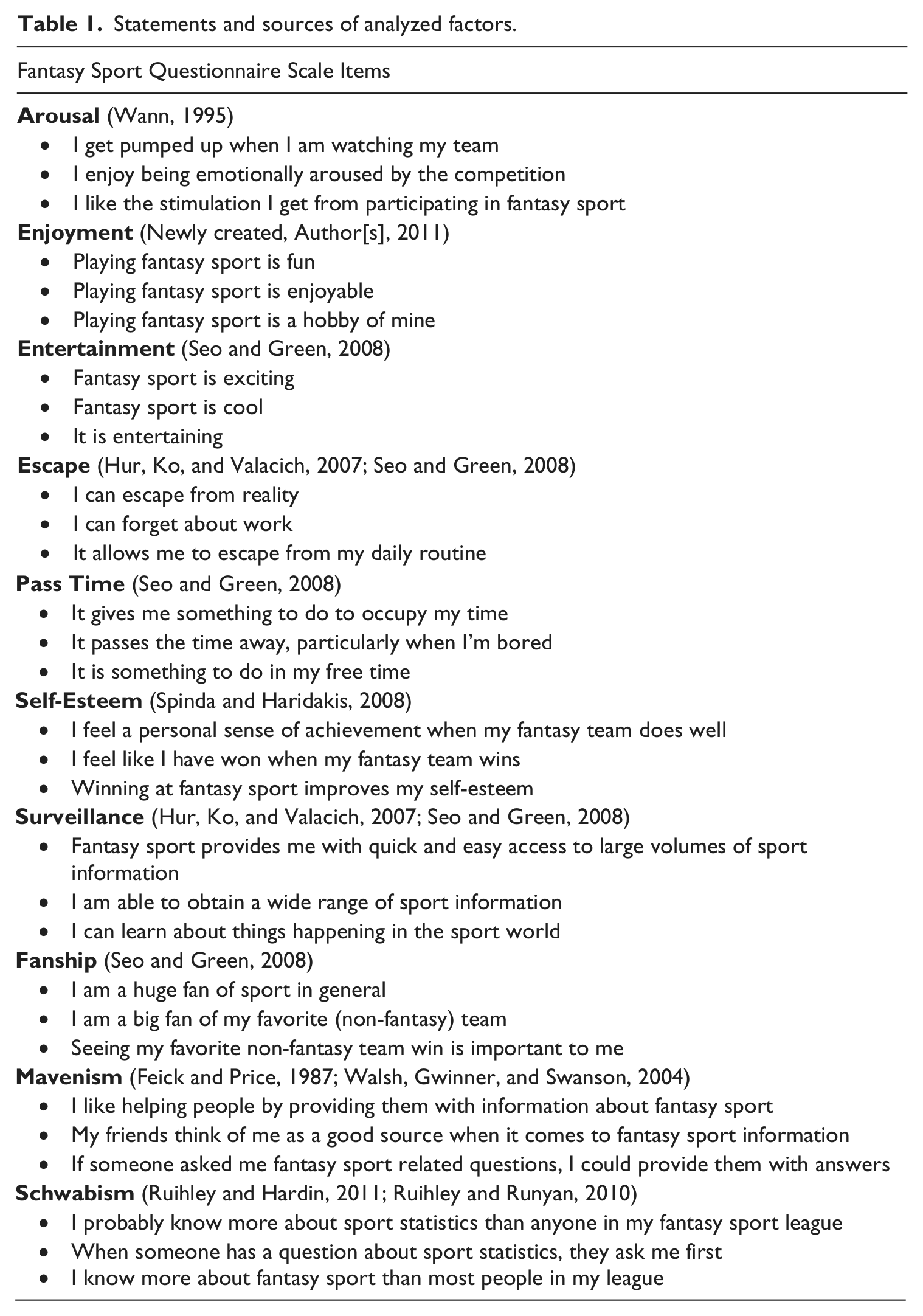
Arousal concerns the emotional stimulation received as a result of participating or consuming a sport activity (Wann, 1995).
Enjoyment is a factor determining whether the participant takes pleasure in the activity (Billings and Ruihley, in press).
Entertainment examines excitement and amusement in the activity (Seo and Green, 2008).
Escape is a factor measuring how much a participant uses an activity to forget about the daily grind and/or life’s struggles (Hur et al., 2007; Seo and Green, 2008).
Pass Time refers to participants using a sport activity to literally pass the time of day (Seo and Green, 2008).
The Self-Esteem motive examines how a person feels about himself or herself in relation to a team’s performance (Spinda and Haridakis, 2008).
Surveillance measures how fantasy sport consumers search for information related to their activity. This involves gathering information in relation to schedule, players, statistics, injuries, matchups, etc. (Hur et al., 2007; Seo and Green, 2008).
While factor analysis indicates that enjoyment and entertainment are closely related, these items were measured individually because of previous media studies work indicating that they are not synonymous (see Vorderer, 2003). The two factors of enjoyment and entertainment are closely tied, yet measure different functions; for instance, watching one’s favorite team play a game may cause excitement (entertainment) while a losing outcome may not result in the viewer regarding this consumption as pleasurable (enjoyment).
Analyses
SPSS Statistics software (19.0) assisted in the analysis of this data. As previously mentioned, correlation tests were used to determine scale item cohesiveness while reliability tests were administered to examine consistency of the scale items. To address the research questions, T-tests were used to examine consumption (RQ1) and fanship differences (RQ2a) between men and women. Multivariate Analysis of Variance (MANOVA) procedures were administered to examine the sport knowledge (RQ2b) and motivational (RQ3) differences between men and women fantasy sport groups. Bonferroni’s correction was administered for the appropriate analyses. In addition, linear regression was utilized to determine which variables make significant contributions to the prediction. Each sport knowledge construct and each motivation variable was tested with the factors of (a) gender, (b) age, (c) relationship status [single or in a relationship], (d) fandom – fantasy sport hours of consumption [per week], (e) fantasy sport number of leagues [per season], and (f) hours of sport consumption [per week].
Results
Sample
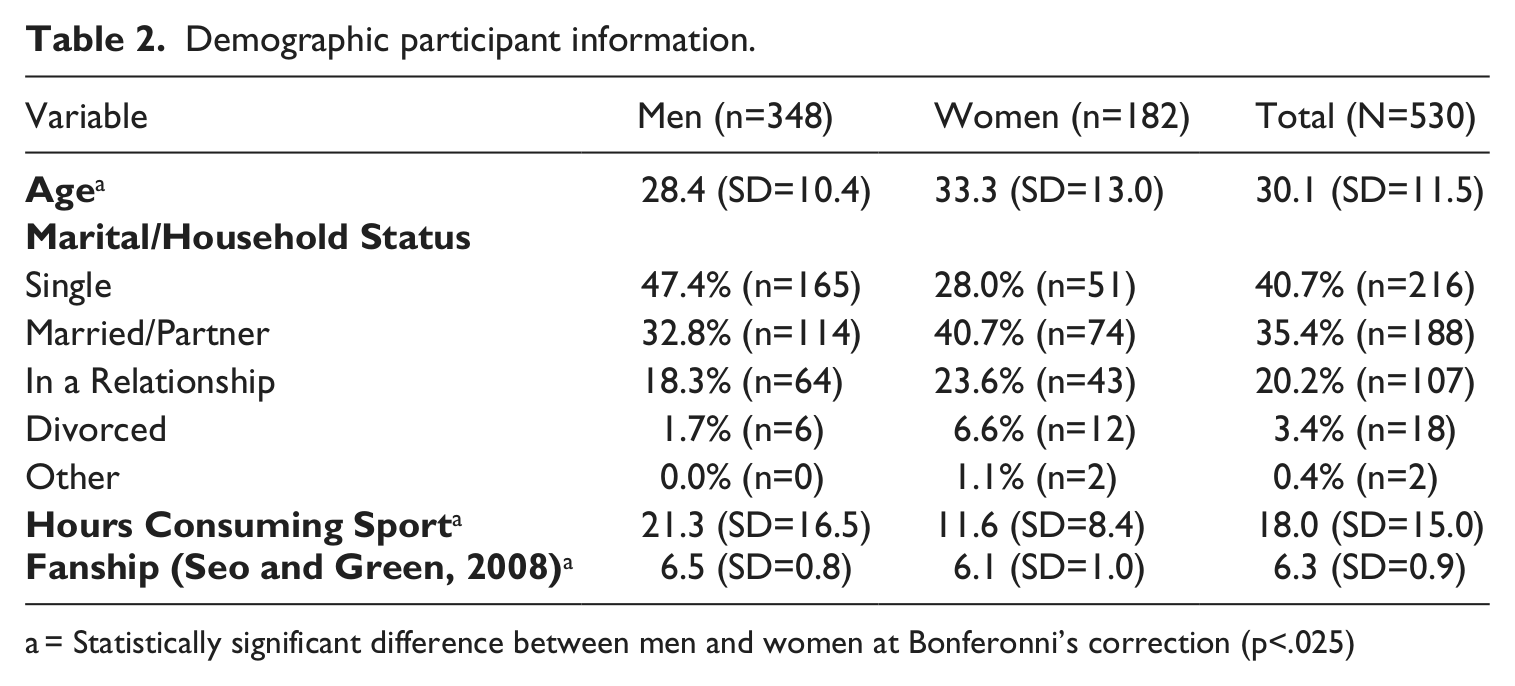
The sample in this study totaled 530 adult fantasy sport participants. This sample is composed of both men (n= 348) and women (n=182), with the mean age of the sample at 30.1 years. The average age of men was measured at 28.4 years (SD=10.4); for women it was 33.3 years (SD=13.0). The men identified as being predominantly single (n=165, 47.4%) followed by being married (n=114, 32.8%) while the majority of women identified as being married (n=74, 40.7%) followed by being single (n=51, 28.0%). Finally, men self-reported consuming 21.3 hours (SD = 16.5) of sport related content while women reported consuming 11.6 hours (SD=8.4). For a complete list, please see Table 2.
Demographic participant information.
= Statistically significant difference between men and women at Bonferonni’s correction (p<.025)
General analysis
In this research, it is important to understand not only the answers to the research questions, but also the data behind the answers. In this case, a backwards regression analysis was conducted to determine what, if any, factors are contributing to the areas of sport knowledge and the fantasy sport motives. As mentioned, the factors of age, fandom, fantasy sport hours of consumption (per week), fantasy sport number of leagues (per season), gender, hours of sport consumption (per week), and relationship status (single or in a relationship) were tested against sport knowledge and motives.
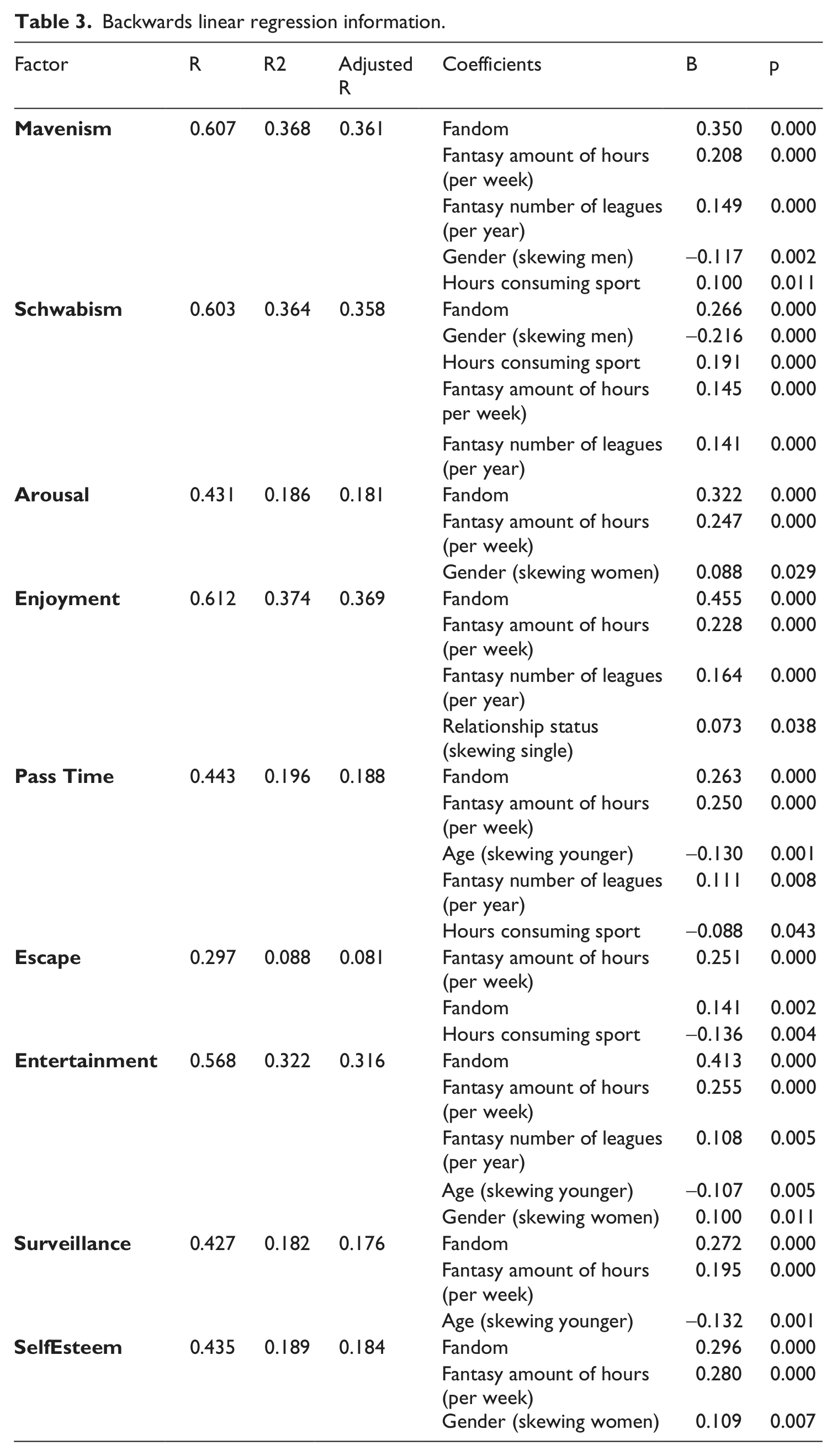
The analysis revealed a wide range of variance (8.1% to 36.9%) and many significant beta weights (.073 to .455). The top factors, present in each of the measurements, were fandom and amount of hours devoted to fantasy sport. Fandom weighed most heavily on Enjoyment (β=.455, p=.000), Entertainment (β=.413, p=.000), Mavenism (β=.350, p=.000), and Arousal (β=.322, p=.000). Fantasy sport hours contributed most to Self Esteem (β=.280, p=.000), Entertainment (β=.255, p=.000), Escape (β=.251, p=.000), and Pass Time (β=.250, p=.000). For the purposes of this study, it is important to note that Gender had a significant contribution for the factors of Schwabism (β=.-.216, p=.000; skewing men), Mavenism (β=.-.117, p=.000; skewing men), Self Esteem (β=.109, p=.000; skewing women), Entertainment (β=.100, p=.000; skewing women), and Arousal (β=.088, p=.000; skewing women). Table 3 lists all regression analyses.
Backwards linear regression information.
Addressing research questions
Research question 1 focused on fantasy sport consumption differences between men and women. Significant differences were found between men and women in their fantasy sport consumption. These differences included number of years participating, number of leagues participated in per year, and number of hours per week devoted to fantasy sport. Men averaged 5.8 years (SD=4.7) of fantasy sport participation while women averaged 3.2 years (SD=3.3). Men reported participating in 3.1 (SD=2.9) fantasy leagues per season with women participating in 1.5 (SD=1.0). In a self-report of the amount of time devoted to fantasy sport per week, men reported an average of 4.7 hours (SD=6.4) and women reported an average of 3.5 (SD=3.5). A MANOVA analysis examined the statistical differences of the aforementioned results in research question 1. All results were significant at the Bonferroni’s corrected significance level (p<.016).
Research question 2a addresses the differences in sport fanship between men and women participating in fantasy sport. The results reveal that sport fanship does differ between men and women participating in fantasy sport. This concept was examined using Seo and Green’s (2008) scale items measuring the concept. The sample’s average factor score was 6.3 (SD=0.9). Men averaged a 6.5 (SD=0.8) factor score and women averaged a 6.1 (SD= 1.0) factor score. Differences were significantly different (p=. 000) between men and women. Table 2 provides further detail.
Research question 2b examines if any differences exist between how these two groups perceive their fantasy sport knowledge. The concepts of Mavenism and Schwabism were used to measure perception of sport knowledge. Addressing Mavenism, men had a factor score of 4.8 (SD=1.4) and women had factor scores of 3.9 (SD=1.6). For Schwabism, men had a factor score of 4.3 (SD= 1.6) and women had a factor score of 2.9 (SD=1.6).
Addressing Mavenism, a stepwise backwards regression indicated five variables accounting for 36.1% of total variance (R=.607, R2=.368, Adjusted R2=.361). Standard coefficient data show overall fandom as having a higher beta weight (β=.350, p=.000) than fantasy sport amount of hours (β=.208, p=.000), number of fantasy sport leagues (β=.149, p=.000), gender (β= -.117, p=.011; skewing men), and hours consuming sport (β=.100, p=.002).
Addressing Schwabism, a stepwise backwards regression indicated five variables accounting for 35.8% of total variance (R=.603, R2=.364, Adjusted R2=.358). Standard coefficient data show overall fandom as having a higher beta weight (β=.266, p=.000) than gender (β= -.216, p=.000; skewing men), hours consuming sport (β=.191, p=.000), fantasy sport amount of hours (β=.145, p=.000), and number of fantasy sport leagues (β=.141, p=.000).
Taken collectively, the results indicate that differences do exist between how each gender perceives their fantasy sport knowledge. A MANOVA was used to analyze the differences in these factors and found those differences to be statistically significant (p=.000), while accounting for Bonferroni’s correction (p <.025), providing ample evidence for answering research question 2b.
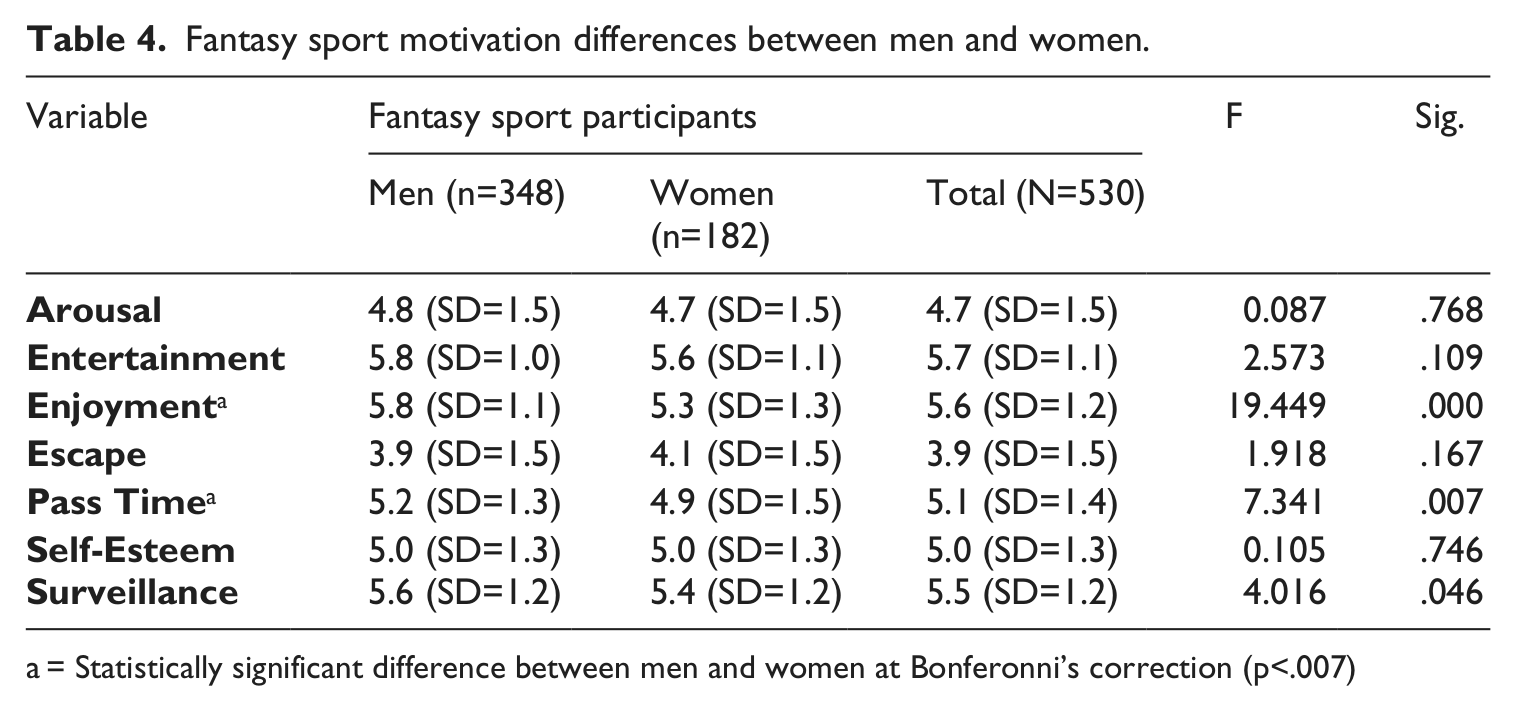
Research question 3 focused on what ways fantasy sport motivation factors differ between men and women. Table 4 reports these factors by gender of respondent.
Fantasy sport motivation differences between men and women.
= Statistically significant difference between men and women at Bonferonni’s correction (p<.007)
A MANOVA was used to analyze the differences of motivational factors. Utilizing Bonferroni’s correction (p<.007), two fantasy sport motivational factors were found to be significantly different between men and women. Those factors were (a) Enjoyment and (b) Pass Time. All other factor averages were nearly identical between the genders. A complete list of motivational factor scores is provided in Table 4. As Table 3 indicates, regression analysis did not include gender as a significant coefficient when examining the motivation factors of Enjoyment and Pass Time.
Discussion
This study reveals a great deal about not only fantasy sport fandom, but also its relationship to the larger umbrella concept of sports fandom, in general. One begins to get a sense of different profiles based on gender, along with a keen sense of where men and women merge and diverge within their interests.
From a theoretical perspective, fantasy sport seems to offer some of the most overt opportunities for groups to subdivide along the lines of Turner et al.’s (1987) notion of self-categorization theory, particularly within the realm of gender. However, this study reveals that while the levels at which motivations for men’s and women’s fantasy sport play are different (as they tend to be heightened for men), the priorities and primary aims that men and women exhibit when deciding to play are remarkably similar. The manner in which they arise at some of these similarities may be a subject for useful further examination. For instance, there was no significant difference in regard to the escape motivation, but prior research informs us that traditional fandom offers differences in this regard, making fantasy sport play a leveling of the field. As Whiteside and Hardin (2011: 136) noted, for women “sports programming [is] not associated with escape, but instead with family obligations and relationship-building—emotion work.” Consequently, one must note from a theoretical perspective that these gendered social identities are already influenced by past sport consumption differences and fantasy play can either widen or diminish these gaps.
Overall, the majority of motivation scales yielded similar responses for both men and women participants. When factoring in the reality that men had, on average, almost double the number of years involved in fantasy sport play, it is noteworthy that so many motivations were the same for both men and women. Indeed, the top three motivations for men were, in order: (a) Enjoyment, (b) Entertainment, and (c) Surveillance. The top three for women were the same, just in a slightly different order: (a) Entertainment, (b) Surveillance, and (c) Enjoyment. Much of this paper focuses on the gender differences (which were both noteworthy and statistically measurable), but there is much revealed in this survey that lends credence to the potential argument that men and women are quite similar when it comes to consuming and participating in fantasy sport.
When one makes the transition to the differences, the most prominent finding is in regard to the two motivational factors in which men’s scores are significantly higher: enjoyment and passing time. Both findings are likely related to the fact that men spend more time consuming sports (consider the 10-hour weekly gap found in the study), as well as the fact that men rank sports far more highly in their leisure time activities. Women, meanwhile, find enjoyment in a variety of outlets – sport is one, but it is not an overwhelming facet of their lives in the manner it is for men (Gantz and Wenner, 1991). Future research would benefit from exploring these established differences to determine, for instance, if there is a relationship between (a) number of years’ participation and perceived enjoyment or (b) the difference in enjoyment levels between female-only fantasy leagues and mixed-gender fantasy leagues. One could presume that such differences may be illuminated, but subsequent research should seek to confirm or reject these inferences.
Another finding worthy of elaboration and future investigation concerns sports media consumption levels, as men self-reported nearly 10 hours more consumption each week than did women. Within a theoretical vein, future research related to media cultivation theory (see Gerbner et al., 1986) appears to be warranted, as this theory argues that media can help to set the terms of social debates and understandings, and it appears that such a gap in media exposure could result in different social realities for men and women as they relate to understanding sport and subsequent participation in fantasy sport play.
The finding that men represent the majority of sports media users and viewers is not at all novel; however, the degree of this difference is, when taking into account the sports-oriented nature of the women participants (they were all at least fantasy sport players), as well as the fact that they ultimately played these sports for very similar reasons (with no significant differences on the majority of the scales). The average age of the women participants was five years higher than that of the men respondents; however, sports media use tends to increase with age (see ESPN Integrated Media Report, 2010), meaning that one would expect the gender gap to be even smaller in terms of consumption.
As mentioned previously, the closest related study to this work that combines the notion of fantasy sport participation and gender comes from Davis and Duncan (2006). Within the broader notion of masculine privilege, they found that men participating in fantasy sport were more likely to emphasize the importance of having sport knowledge. In this research, this kind of activity is manifest under the motivation of surveillance. While the results indicate a non-significant difference between men and women on the surveillance measure, one must note that this factor was non-significant because both genders scored quite high in the area. Given the established relationship between surveillance and consumption, one is seemingly presented with a paradox, as the former yields little gender difference and the latter yields dramatic gender difference (the aforementioned 10-hour gap). The paradox seemingly is more cemented as men also indicated more time devoted to specifically fantasy sport per week (men μ= 4.7 hours and women μ= 3.5 hours). However, hours alone do not necessarily emphasize the importance of having sport knowledge – the most appropriate measure could be comparing consumption of non-fantasy playing sports fans with their fantasy-participant counterparts. Billings and Ruihley (in press) did just that, finding that participating in fantasy sport resulted in a near-identical increase in consumption for each gender: 63% for men and 61% for women when compared to their non-fantasy playing sports fan counterparts. When taking into account that this gap occurs in sports fandom in general, one sees that fantasy sport increases consumption by the same percentage, yet men and women sports fans are starting from different base points.
Market mavens are the types of consumers willing to share their thoughts and opinions about an experience with others (Higie et al., 1987; Stokburger-Sauer and Hoyer, 2009). Market mavens have been described as being highly attentive, involved, and interested consumers within a marketplace (Chelminski and Coulter, 2007; Clark et al., 2008; Feick and Price, 1987). Market mavens are important not only for their loyalty to marketplace knowledge and information-seeking attitude but also because of their willingness to inform others. The market maven is an influential consumer, but with their word-of-mouth potential also represents a possible ally or enemy for an organization.
In the context of this study, results indicate that men score higher on Mavenism scales than women. This is important because mavens are the frontline of a word-of-mouth campaign; they are more likely to share, inform, and recruit. In essence, they are unpaid representatives of the brand, product, or organization. If fantasy sport men are scoring higher on these scales, it is abundantly likely that men are spreading information about this activity more than women are, creating a gendered snowball effect in which more men join the activity because men are more likely to exhibit maven-like behavior.
When extending this finding theoretically, it is important to document close origins and understandings between self-categorization theory (Turner et al., 1987) and social identity theory (Tajfel, 1972). The latter often concerns how we respond to individuals who behave in a manner that causes group connotations. There were differences between men and women, but there appears to be an insular nature to fantasy sport that makes the greatest in-group/out-group distinction one of fantasy player vs. non-fantasy player much more than of men vs. women. Still, the stark contrast on the Enjoyment scale does provide the impetus for future work in the area to ascertain whether women players experience barriers to their play enjoyment that men do not experience (at least to the same degree). One also witnesses the consumption gap and notes that even if men and women are playing fantasy sport for largely the same reasons, their love of this ancillary game format does not readily translate to an equal love for sports media offerings. Men still represent the overwhelming majority of sports television viewers, sports radio listeners, and consumers of sports Internet offerings. These findings only cement the cavernous differences found in previous research.
Conclusion
Sport has been referred to as a “boys’ club” for quite some time now (Adams and Tuggle, 2004) and there are aspects of this study that reinforce these notions. However, much as greater participation opportunities for women resulted in near-equal interest in playing at the youth sport level (see Billings et al., 2012), fantasy sport seems to be filling a specific need for women participants. Millions of women are finding a home in fantasy sport and are choosing to continue playing in subsequent years. All of this activity occurs in spite of the ridicule and perceived “second class” status that women sports fans continue to experience. Motivational research indicates that there are many reasons they are drawn to it – if only they just enjoyed it to the degree that the men do.