



Abstract
Politicians and sports organizations have often relied on economic benefits to justify their decisions in hosting major sports events in their countries. Consequently, there are comparatively few studies on the non-economic benefits of hosting major sports events. The purpose of this research is to determine whether there is any change in the level of national pride in the hosting of the Youth Olympics Games held recently in Singapore in 2010. Two separate surveys were conducted among students from a tertiary education institution in Singapore two months prior to, and after, the event. Results showed a significant increase in the level of national pride. Specifically, the increases in the level of national pride were more pronounced among males and those who were more involved in sports. The results concur with previous studies that have reported an increase in national pride following the hosting of a major sports event. As this is a case study focusing on the Youth Olympic Games, which arguably is on a distinctly smaller scale compared to the Olympics or the FIFA World Cup, future research needs to be conducted on other major sports events to determine the generalizability of the findings.
Introduction
Sport is an important and conspicuous vehicle of national expression. Many nations have turned to sports to tell stories about themselves. Through sports, narratives of shared meaning and values for the nation are created for the citizens. In addition, international sports competitions encourage nationalistic displays and provide the platform for a nation to be recognized by other nations. As such, sports can help a nation to enhance its national identity and pride (Jaksa, 2011; Morgan, 1997).
The ability of sports to build national identity is not limited to elite sport performances. Sports at less competitive levels can also contribute to narratives of shared meaning and values for the nation. However, it is at elite international sports events that the ability of sports to build a sense of national identity and pride becomes more prominent (Dóczi, 2011; Jaksa, 2011). Taiwan, for example, has been using international sports events and its success in such events to build on its national identity and pride amongst its citizens. More importantly, it has also sought to use sports as a vehicle for the country to be recognized in the international community (Bairner and Dong-Jhy, 2011).
In particular, many nations have used the hosting of major sports events to bolster their national identities, despite the high financial costs. This has been documented extensively in the literature but most recently in the South African FIFA World Cup 2010 (Alegi, 2010; Dowse, 2012). The ability of the FIFA World Cup to transcend racial divides and promote community cohesion was seen when South Africans of all races donned their country’s national team shirts and flew the South African national flags (Battersby, 2010; Dowse, 2012). This phenomenon of using major sports events to enhance national identity is not limited to global sports events, but is also apparent in regional sports events. An example of this can be seen in Indonesia’s hosting of the fourth Asian Games in 1962 (Lutan, 2005).
The decision to bid for and host a major sports event is political in nature. Only the political executive has the authority to make decisions concerning both public expenditure allocation and the national legislation required to secure hosting rights (Dowse, 2012). To justify the high financial cost in hosting major sports events, politicians and sports organizations have relied on research documenting the economic benefits of hosting major sports events to convince decision makers in the government and, more importantly, the general public (Wood, 2006). The public’s perception of the financial viability has the potential to undermine public confidence in the sports event (Waitt, 2003). The public expects that hosting a major sports event is a decision that should only be taken when there is net economic gain for the host nation (Hogan, 2003). Consequently, extensive studies have been done on the economic benefits of hosting major sports events, such as the Olympic Games and the FIFA World Cup. These studies have focused on various economic impacts for the host country, including changes in tax revenues, employment of residents, publicity for the host country and investment in new infrastructure and facilities.
In comparison, there are fewer studies on the non-economic benefits of hosting major sports events, as they are external to the economic evaluation in the decision to host the event (Guala and Turco, 2009; Kim and Petrick, 2005; Ritchie et al., 2009; Waitt, 2003). Social impacts of major sports events are less tangible, making them more difficult to measure and quantify. In addition, social impacts are often associated with negative factors, such as security concerns, alcoholism, prostitution and congestion (Kim and Petrick, 2005). Studies conducted have generally concluded that non-economic benefits do exist. They include an increase in community pride, an increase in sports participation rate in the community and an increase in the level of awareness of traditions, culture and environmental concerns (Kim and Petrick, 2005; Ritchie et al., 2009; Waitt, 2003; Wood, 2006).
In 2010, Singapore hosted the inaugural Youth Olympic Games (YOG) from 14 to 26 August. As part of the International Olympic Committee’s strategy in inspiring young people to participate in sport and to adopt and live by the Olympic values, the focus of the YOG is on adapted sports targeting at young people between the ages of 14 and 18. As such, a unique feature of the YOG is the inclusion of a culture and education programme to introduce young people to the Olympic values. In addition, the sports included in the YOG are adapted to appeal to the youth, including alternative and creative events such as street basketball (Wong, 2011).
Similar to the experiences in other countries, the Singapore government had reported extensively on the economic benefits of the event, including the amount of tourism receipts and the positive profiling of the country for future investments, as justification for using S$387 million in hosting the YOG. The non-economic benefits of hosting the event, including community involvement, were reported less extensively (Lee, 2010; Teo, 2010). The purpose of this research is to examine the non-economic impacts of hosting the YOG and, in particular, on whether there is any increase in the level of national pride felt by Singaporeans. As the target group of the YOG is young people, the study will thus be limited to examining the change in national pride felt by young Singaporeans.
Literature review
While national identity can be defined simply as how nations see and think about themselves, it is in reality an elusive and complex concept (Morgan, 1997). The social glue that holds members of a nation together and makes them distinct are based on imagined relations. As such, nations are nothing more than ‘imagined communities’ (Anderson, 1983). For this paper, national identity is defined as the sense of belonging to, and identification with, the nation; it is an embodiment of expressions and feelings to differentiate from others who do not belong to the nation (Edensor, 2002).
The process of national identity formation is dynamic, and can occur in everyday life and in ‘more spectacular collective gatherings, in the enaction of practical knowledge as much as in the overt assertion or celebration of communal values and characteristics, which are equally part of a larger social dimension of experience, thought and action’ (Edensor, 2002). Sports can contribute to a nation’s identity much like its politics, economy and geography (Jaksa, 2011). In many countries, national sports serve to unify their citizens together and encourage the formation of a shared identity. For instance, American football is highly revered in the United States, while cricket is the national obsession of India.
Related to the concept of national identity are the concepts of nationalism and national pride. Nationalism is an ideology that ‘the nation, ethnicity or national identity is a fundamental unit of human social life, and makes certain political claims based on that belief, above all the claim that the nation is the only legitimate basis for the state, and that each nation is entitled to its own state’ (Chatturvedi, 2005). Nationalists work towards creating or sustaining a nation on the basis of political legitimacy. In contrast, national pride is the positive affect that the public feels towards their country as a result of their national identity. It is both the pride or sense of esteem that a person has for one’s nation and the pride or self-esteem that a person derives from one’s national identity (Smith and Jarkko, 1998).
Sport can help a nation to enhance its national identity and pride (Jaksa, 2011; Morgan, 1997). For example, the Asian Games (and its predecessor, the Far Eastern Championship Games, FECG) was a sporting battle between China and Japan extended from the political arena. The Chinese saw the games as an excellent platform to display their wounded nationalistic sentiments and to unite and triumph over their greatest political foe (Hong, 2007). This exhibition of nationalism was observed in other Asian Games hosts and participant countries, such as India, Thailand and Korea, where they were able to display pride in their culture and national identity through activities such as the opening and closing ceremonies, and beating other countries/nations at the games (Karnjanakit and Samahito, 2007; Koh, 2007; Sisodia, 2007).
In Singapore, sport has similarly been used to encourage the formation of the national identity. The development of sport in Singapore has been linked to the country’s political process of nation building and national development (Peh, 2012). When Singapore gained its independence in 1965, the country was beset with a range of economic and social problems. The government leveraged on sport and physical education for the masses as a social and political tool to address national health for productivity reasons (McNeill et al., 2003; Peh, 2012). In addition to this utilitarian function of sports, the Singapore government also recognized that sports can be a useful tool for nation building. From the 1960s to the 1980s, the Singapore government actively promoted inter-constituency games to build a sense of shared national identity. During the early history of Singapore, the role of sport was a pragmatic response to the problems faced by a young country. Sport was used not only to inculcate strong exercise habits to ensure a healthy and productive workforce, but also to build a sense of national identity.
There was a significant shift though in the 1990s, when the government started to realize the political and economic significance to the nation of doing well at the elite level in sport (Murali, 1998; Peh, 2012). Singapore had attained economic affluence by the 1990s and this allowed the nation to embark on a bolder plan of sporting ambition. This was signalled through a dramatic increase in funding for top athletes, as well as an admission on the ‘unrivalled sense of national pride that is felt when Singaporeans win in international competitions’ (Ministry of Community Development and Sports, 2001; Ministry of Community Development, Youth and Sports, 2008). One of the recommendations from the 2008 Sporting Culture Committee Report was to host one marquee sports event every month with the belief that hosting such major sports events will have beneficial long-term impacts on the economic front, and also allow Singaporeans to unite ‘around a common passion’. Hosting marquee sports events is but a small part of the government’s master plan to position Singapore as a vibrant city to attract more foreign investments and stay on top of the global economic competition.
The gradual shift in emphasis on the role of sports has paid off in recent years. In 2010, Singapore won two awards in recognition of its capabilities in hosting a diverse range of major sporting events, such as the inaugural Singapore 2010 YOG and the Formula 1 SingTel Singapore Grand Prix, the first night race in the F1 calendar. The accolades were being the number two Ultimate Sports City at the biennial Sport Accord Convention in Dubai and winning the Gold for the Sport City Award at the International Sports Event Management (ISEM) Awards 2010 (Singapore Sports Council, 2010).
Since 2012, the Singapore government has embarked on a project called Vision 2030, which seeks to develop desirable values in its citizens through sports, such as a winning spirit and respect for teamwork, in order to compete in the globalized world and to cope with changes in its aging population and increasingly diverse cultural and racial profile. From the Report of the Committee on Sporting Singapore 2001, to the Sporting Culture Committee Report of 2008, to Vision 2030, the Singapore government has signalled the escalating importance of sports in its social, political and economic toolkit. Therefore assessing social impacts of the hosting of international sporting events such as the YOG are of strategic significance.
In this paper, the focus is on national pride. Measuring an intangible impact such as national pride in a systematic and quantifiable way requires the impact to be recognized as an attitudinal construct (Wood, 2006). To measure national pride, the National Opinion Research Centre in the University of Chicago developed the General National Pride scale. This scale measures the extent to which a citizen is proud of his nation, its achievements and what it stands for. The General National Pride scale consists of five agree–disagree items, with the second item being reverse-coded, on a five-point Likert scale. Hence, the General National Pride scale runs from 5 (lowest general national pride) to 25 (highest general national pride). These items are as follows:
I would rather be a citizen of (country) than of any other country in the world;
there are some things about (country) today that make me ashamed of (country);
the world would be a better place if people from other countries were more like the (country’s nationality);
generally speaking, (country) is a better country than most other countries;
people should support their country even if the country is in the wrong.
The scale had been used extensively in many previous studies conducted in different countries. For example, the International Social Survey Program used the scale in at least two separate studies. The first study was conducted in 24 countries in 1995. In this study, it was found that the countries had scores ranging from 13.5 to 17.6. The second study was conducted in 33 countries in 2003. The scores in this study ranged from 13.4 to 18.4 (Smith and Jarkko, 1998; Smith and Kim, 2006).
Studies using the scale also revealed differences in the level of national pride between different demographic groups. The younger segment of the population generally has a lower level of national pride as compared to the older segment of the population. It was suggested that as the older segment of the population had been exposed to extreme nationalistic sentiments during World Wars I and II and other major politically divisive events, it is more likely to be nationalistic than the younger segment. The younger segment of the population, on the other hand, has been more exposed and impacted by the effects of globalization, and as such, has a lower level of national pride when compared to the older demographic group (Dóczi, 2011; Kersting, 2007; Smith and Kim, 2006).
Results were mixed as to whether there is a difference between the genders in the level of national pride. Where a difference in the national pride scores was observed between the genders, it was usually men who scored higher on the national pride scale. This difference between the genders has been suggested to be due to the higher level of acceptance of violence among men and their involvement as soldiers in wars (Smith and Jarkko, 1998; Smith and Kim, 2006).
In Singapore, at least two separate studies had been conducted to study the level of national pride in the country using the General National Pride scale. The first study conducted in 1999 involved 1451 Singaporeans aged 15–64 years of age; the second was in 2009 with 2016 Singaporeans aged between 21 and 64 years of age. The score was 17.2 in both studies. This was considered a high score, as Singapore would have been ranked fifth among 33 countries, putting it above countries such as Canada (mean score of 17.0) and France (mean score of 14.4), if it was included in the International Social Survey Program conducted in 2003. It would also have been ranked higher than some Asian countries, including Japan (mean score of 15.9) and Taiwan (mean score of 15.6). The studies indicated that Singaporeans were very proud of their country (Tan and Koh, 2010; Tan and Ooi, 2000).
Concurring with other studies, the two Singaporean studies also found differences in the level of national pride between different demographic groups (Tan and Koh, 2010; Tan and Ooi, 2000). Younger Singaporeans were generally less proud of their country. In addition, there were also gender differences, with female Singaporeans indicating a higher level of national pride (mean score of 17.4) compared to male Singaporeans (mean score of 17.0).
The above discussion suggests that the level of national pride in a country is not consistent across the different demographic groups, as they may have different life experiences. In addition, the difference in the level of national pride across groups may be attributed to differing access to nationalistic sentiments, including attendance at international sports events (Sasada, 2006).
International sports events are opportunities for the spectators to be exposed to nationalistic sentiment and increased antagonism towards rival sporting nations (Morgan, 1997; Sasada, 2006). In particular, a small number of studies have generally concluded that following the hosting of a major sports event, there is an increase in national pride in the host country. A longitudinal study of the Sydney 2000 Olympic Games revealed a significant increase in Sydney residents’ pride in Sydney and Australia from 1998 to 2000 (Waitt, 2003). More recently, it was also found that recent host countries of the FIFA World Cup, South Korea (2002) and Germany (2006), enjoyed a temporary surge in national pride (Kersting, 2007; Kim and Petrick, 2005). Although the increase in national pride is usually short-lived, the sports event becomes a part of the national narrative and history. As such, hosting large-scale sports events can present unique occasions to strengthen bonds among citizens through a common narrative and history (Kersting, 2007; Kim and Petrick, 2005; Waitt, 2003).
The increase in national pride from hosting major sports events has been attributed to the grand opening ceremonies in these events. These ceremonies generally seek to demonstrate the host country’s capabilities and its unique culture to the world. Hence, they tend to enhance feelings of national identity and pride amongst the population of the host country (Hogan, 2003; Lutan, 2005; Traganou, 2010). For example, while the opening ceremonies of the Olympic Games present universal ideals of humanism and peaceful internationalism, they also seek to reaffirm and celebrate the host country’s identity. The opening ceremonies are thus regarded as a site for the construction of national identity and narratives of a nation (Hogan, 2003; Traganou, 2010).
In addition, the hosting of major sports events is usually accompanied by the building of new facilities and grand stadiums. Stadiums, as the site of the main ceremonies and major sporting events, can demonstrate the technological and economic capabilities of the nation (Lutan, 2005). With their mammoth size and grandeur, they also play an important role in propagating national pride (Traganou, 2010).
The above review has suggested that differences exist in the level of national pride between different segments of the population, as they have access to different experiences. In addition, the hosting of major sports events has a temporary effect in raising the national pride among the population of the host nation. This suggests that the change in national pride following the hosting of a major sports event may differ across segments of the population. However, research in this area remains limited.
One such study suggests that females are more likely to view the hosting of major sports events as having positive impacts on the host country, and hence females are more likely to indicate a feeling of patriotism and unity as compared to males (Kim and Petrick, 2005). This is interesting, as females neither follow sports as closely nor become as personally involved in sports as males do (Denham, 2010). In addition, the media tends to emphasize sports as a masculine activity. Coverage of women athletes in the media is less frequent than the coverage of male athletes. When the media does cover female athletes, it tends to trivialize the athletic achievements of women athletes by focusing on the physical appearances, personal lives and clothing choices of women athletes rather than their physical or sporting abilities (Cooky et al., 2010; Hardin and Greer, 2009; Wanta, 2006). Even the opening ceremonies of the Olympics are often gendered and position sports as a masculine activity (Hogan, 2003). As such, it is expected that the hosting of a major sports event should interest males more than females and consequently affect the level of national pride felt by males to a greater extent.
It also follows from the above that the hosting of major sports events is likely to generate greater interest among those who are interested or involved in sports, as opposed to those who are uninterested in sports. A person who is involved in sports or finds sports personally relevant and important will identify himself as a member of a group interested in sports. Identification with a group allows for an individual to feel connected and exhibit behaviours that are congruent with members of a group interested in sports, including attendance at sports events, purchasing sports merchandise and consuming sports information (Fisher and Wakefield, 1998; Gwinner and Swanson, 2003). In a recent study, it was found that sports consumers rated success in international competitions as more important than non-sports consumers (Dóczi, 2011). As such, it suggests that the hosting of major sports events may have differing effects on the level of national pride on groups with different levels of sports involvement.
In the review of the literature, the hosting of major sports events has been found to generate an increase in the level of national pride. While the literature suggests that there are differences in the change in levels of national pride as experienced by different demographic groups, the number of studies remains small and results are thus inconclusive. The research question for this study is to examine if there is an increase in the level of national pride in Singapore following its hosting of the YOG. If there is a change in the level of national pride, this study will also examine whether the change is consistent across different genders and levels of sports involvement.
Methodology
A convenience sample was drawn from a tertiary education institution in Singapore. Two months prior to the YOG, an email was sent to all students enrolled in the institution to solicit their participation in a survey. The survey was administered electronically and participants were asked to respond to the General National Pride scale. As this scale had been used earlier in various countries including Singapore, using it to measure national pride in this study allows for comparisons to be made across studies. Information on demographic variables was also collected in this survey carried out from 22 June to 2 July 2010. A total of 1653 (12.7%) Singaporean students between the ages of 17 and 25 years old responded.
Confirmatory factor analysis was conducted to validate the General National Pride scale. Although each scale item showed no departure from normality, the data was found to violate the requirement of multivariate normality (z = 12.14, >5). However, the sample size of 1653 responses allowed the asymptotic distribution-free estimation method to be used in the analysis. The goodness-of-fit indices indicated that the data fitted the proposed one-factor model well. The normed chi-square (χ2/ df = 16.33/5) was 3.266, showing a reasonable fit. The root mean square error of approximation (RMSEA) value of 0.04 was below 0.05 for a close fit. The comparative fit index (CFI) and goodness-of-fit index (GFI) were 0.96 and 1.00, respectively. Both indices, above the benchmark of 0.9, signified a good fit. Lastly, the weighted construct reliability for the scale was 0.69, which is higher than 0.6, indicating that the scale is reliable. The above validity and reliability indicators supported the use of the General National Pride scale in this study without any modification or refinement.
Two months after the YOG, another email invitation was sent to the 1653 respondents of the initial survey to participate in a follow-up survey. Conducting the survey with the same respondents two months before and after the event provides an opportunity to examine how the level of national pride has changed.
The majority of research on resident perceptions of major sports events has employed cross-sectional research methods. Cross-sectional research establishes the level of national pride at a single point in time. In comparison, longitudinal research allows the examination of change in national pride over time, particularly since residents’ perceptions change as the hosting of the sports event gets underway. However, such research usually poses many challenges for researchers. Longitudinal research requires higher levels of co-ordination and resources, including both time and cost. As such, there are fewer of such longitudinal studies (Dowse, 2012; Guala and Turco, 2009; Ritchie et al., 2009).
A total of 679 (41.1%) respondents completed the second survey, which was also administered electronically during the period from 19 to 30 October 2010. This response rate is comparable to the response rate of 39.0% from an earlier study employing the longitudinal method (Waitt, 2003). All responses were usable for further analysis.
In addition to the General National Pride scale, this second survey included a sports involvement scale. For the purpose of this study, the sports involvement scale was adapted from the three-item domain involvement scale used in earlier studies (Fisher and Wakefield, 1998; Gwinner and Swanson, 2003). The scale measures the individual’s involvement with sports and refers to the field of sports as a domain rather than an interest in specific sports or groups. It is designed to reflect the degree to which sports as a domain is personally relevant to the individual. The items used in the sports involvement scale are as follows:
Sports is very important to me;
I think about sports all the time; and
I watch sports whenever I can.
Data analysis was conducted using PASW Statistics 18.0 software. The reliability of each scale was analysed using Cronbach’s alpha. Descriptive statistics were compiled for the demographics of the participants and mean scores of national pride. A paired samples t-test was employed to examine the impact of the YOG on national pride.
It is worth noting that the large sample size used in the testing will make a small difference between groups become statistically significant, even when the effect has no practical or theoretical meaning (Field, 2009; Pallant, 2010). Reporting effect size will allow for a judgment to be made on the magnitude of the differences present between groups, comparison of research results across studies and a judgment on the practical significance of the results (Kotrlik and Williams, 2003). Hence, effect sizes were also calculated to measure the magnitude, practicality and/or meaningfulness of the change in national pride scores. In this study, Cohen’s d was used as the measure of effect size. Cohen’s d calculates the differences between groups in terms of standard deviation units. An effect size is small if d is smaller than 0.2 (Cohen, 1988). Details of the analysis are described in the next section.
Findings and discussion
The sample consisted of 679 respondents, of which 35.6% were male and 64.4% were female. The respondents had an average age of 18.52 years (SD = 1.57). The respondents’ involvement in sports was neutral, with a mean of 3.07 and standard deviation of 0.92.
The Cronbach’s alpha coefficient of the General National Pride scale was 0.49. Although the reliability of General National Pride scale dropped from 0.69 in the first survey to 0.49 in the second survey, it was still within the Cronbach’s alpha range of 0.33–0.70 reported in past research (Smith and Jarkko, 1998). The Cronbach’s alpha coefficient of the sports involvement scale was 0.81, which was comparable to earlier studies (Fisher and Wakefield, 1998; Gwinner and Swanson, 2003). Hence, both scales were deemed to be reliable for this study.
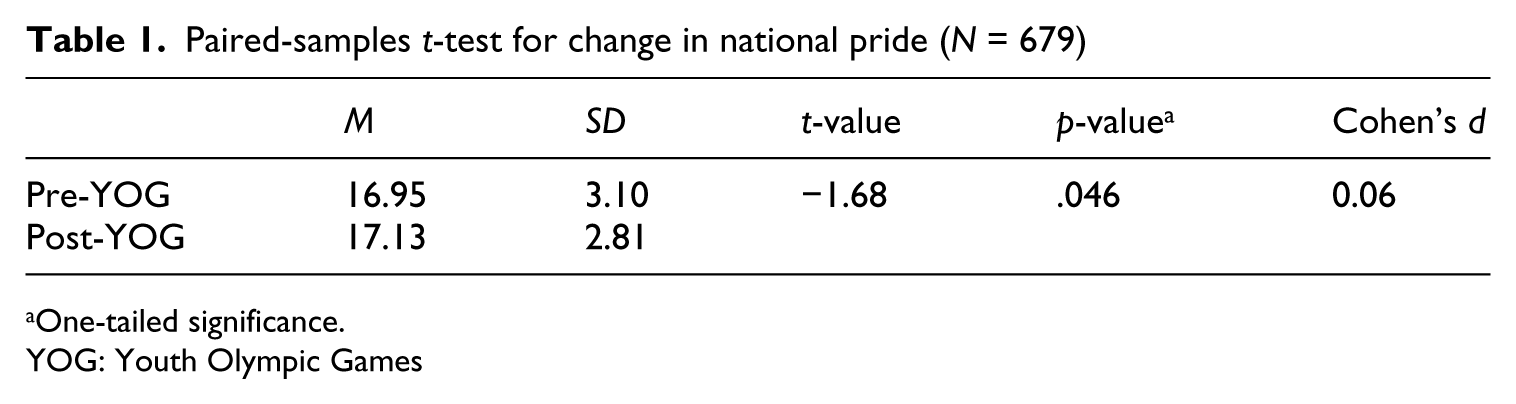
A paired t-test was conducted to evaluate if there was an increase in national pride following the hosting of the YOG. There was a statistically significant increase in national pride from the survey prior to the YOG (M = 16.95, SD = 3.10) to the survey conducted after the YOG (M = 17.13, SD = 2.81; t = −1.68, p < .05). This result concurs with the findings from earlier studies that hosting a major sports event has a positive effect on increasing the level of national pride among the residents of the host country. The effect size, however, was small (d = .06), which suggests that the magnitude of the change was not large. This is detailed in Table 1.
Paired-samples t-test for change in national pride (N = 679)
One-tailed significance.
YOG: Youth Olympic Games
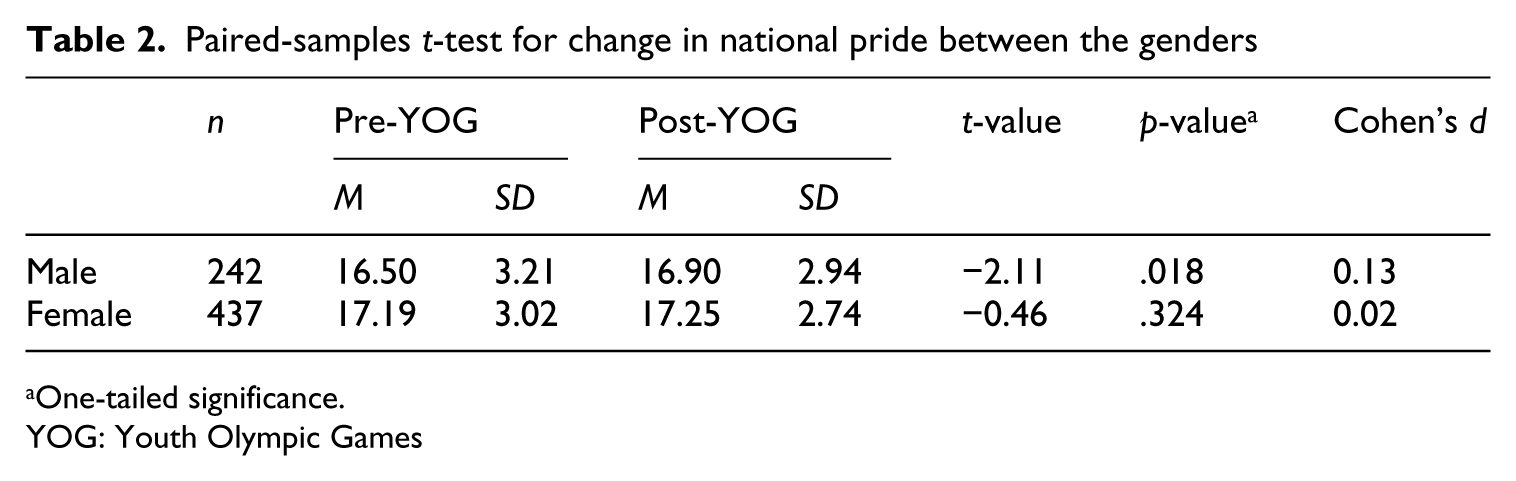
Paired t-tests were conducted to determine if gender was a factor for the change in national pride following the hosting of the YOG. This is detailed in Table 2.
Paired-samples t-test for change in national pride between the genders
One-tailed significance.
YOG: Youth Olympic Games
There was a statistically significant increase in national pride for male respondents from the survey prior to the YOG (M = 16.50, SD = 3.21) to the survey conducted after the YOG (M = 16.90, SD = 2.94; t = −2.11, p < .05). The effect size, while larger than the effect size for both genders, was still considered small (d = .13). While female respondents had an increase in national pride from 17.19 to 17.25, the increase was not significant. In other words, the effect of the YOG on national pride was more pronounced in males.
This finding is not unexpected. The literature review has suggested that males are more likely to be involved in sports. Hence, it is expected that males will be affected to a greater extent by a sports-related event like the YOG and exhibit a greater increase in national pride. However, this result is contrary to an earlier study in which females reported higher levels of national pride following the successful hosting of an international sporting event (Kim and Petrick, 2005). While the respondents in this study are slightly younger as compared to the earlier study, it is not clear if this difference has an effect on the national pride between the genders. This suggests that the mixed results will need to be examined further.
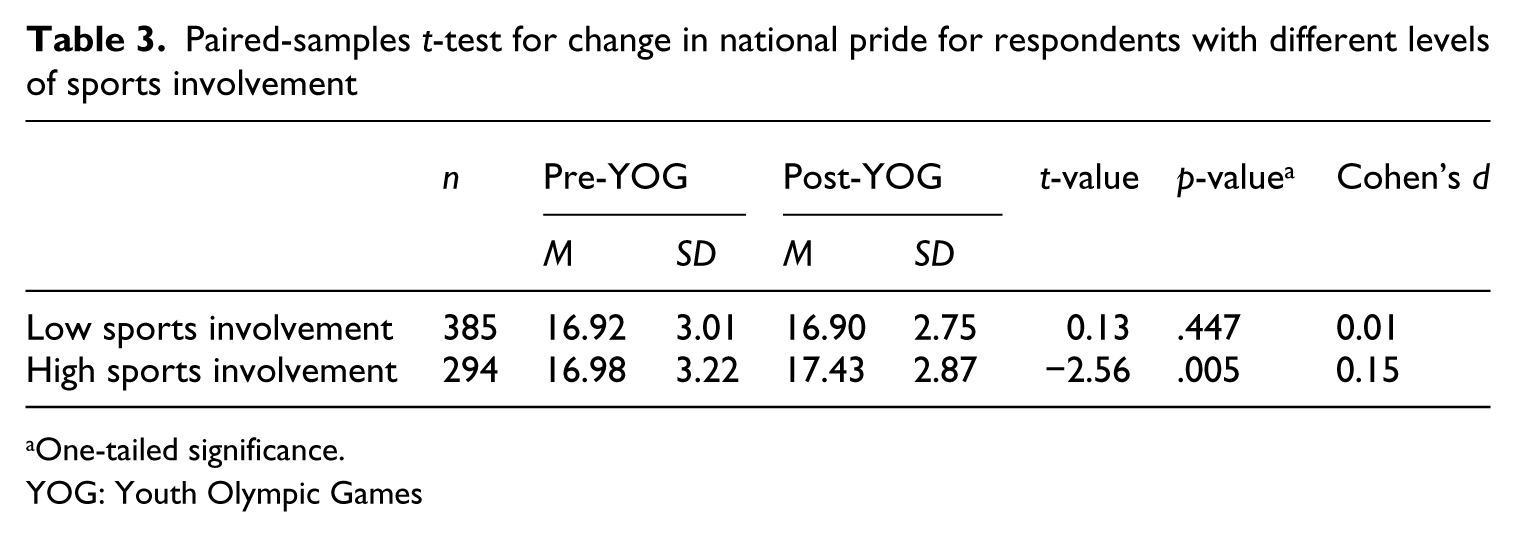
The next part of the analysis was to determine if the level of sports involvement would affect the increase in national pride following the hosting of the YOG. Respondents were split into two groups, with those scoring higher than the mean of 3.07 on the sport involvement scale categorized as high involvement in sport, and those lower than the mean of 3.07 categorized as low involvement in sport. Paired t-tests were used to examine if there was an increase in national pride for both groups. This is detailed in Table 3.
Paired-samples t-test for change in national pride for respondents with different levels of sports involvement
One-tailed significance.
YOG: Youth Olympic Games
Respondents who were highly involved in sports reported an increase in their level of national pride from the survey conducted prior to the YOG (M = 16.98, SD = 3.22) to the survey conducted after the YOG (M = 17.43, SD = 2.87; t = −2.56, p < .01). The magnitude of the increase was small (d = 0.15). This demonstrates that the hosting of the YOG had a small but significant positive effect on the level of national pride among respondents highly involved in sport.
This finding concurred with the literature that respondents who are more involved in sports are more likely to be interested in the hosting of a major sports event. Consequently, they are more likely to report an increase in national pride from the hosting of the YOG. In contrast, respondents who were not highly involved in sports reported almost no change in their level of national pride.
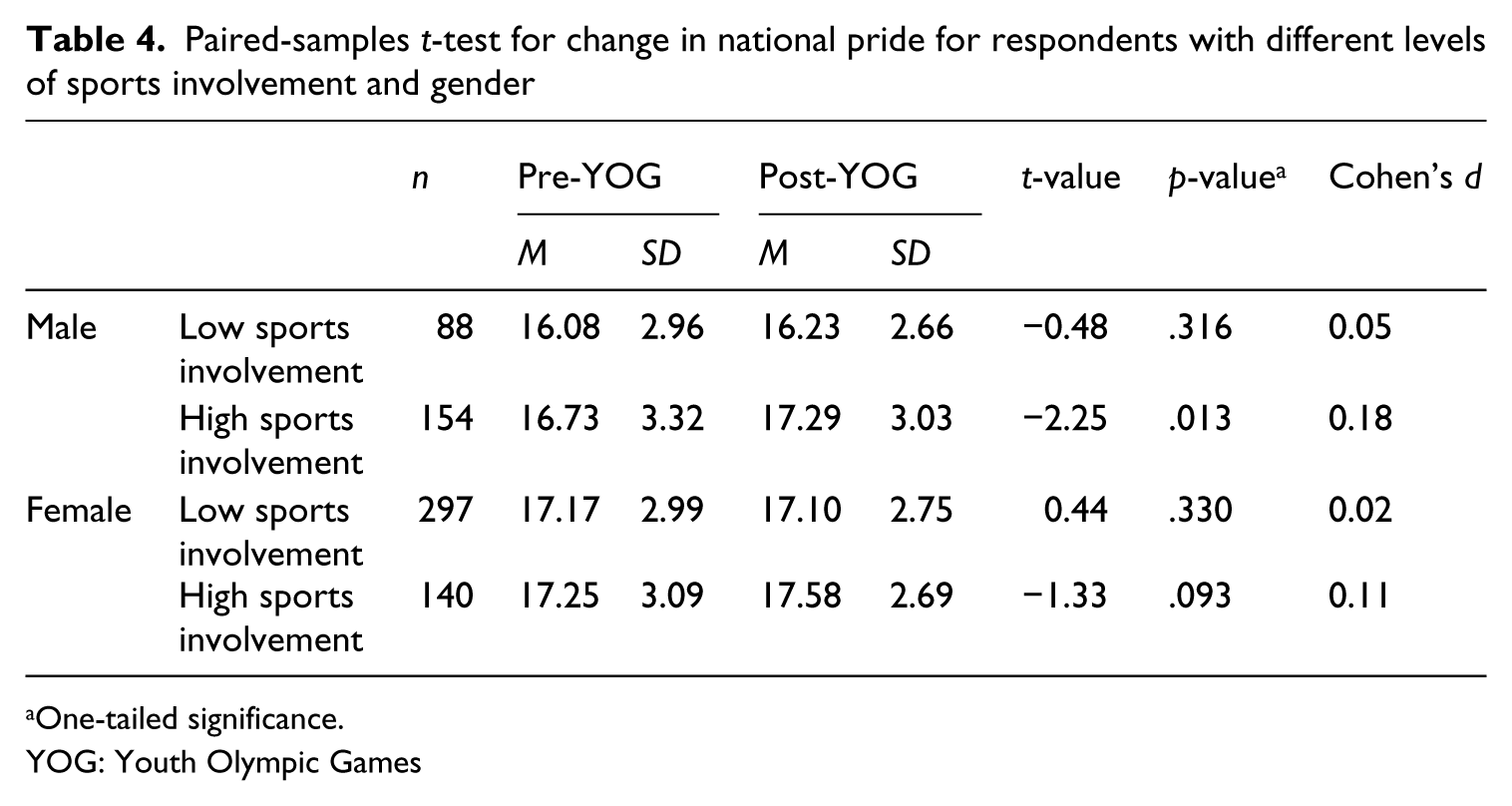
The literature review suggests that males are more involved in sports when compared to females. An independent-samples t-test was conducted to compare the sports involvement scores in this study for males and females. The results concurred with the literature and showed that male respondents (M = 3.50, SD = 0.94) were significantly more involved in sports than female respondents (M = 2.83, SD = 0.82; t = −9.33, p < .001). To examine whether there is a difference in the increase in national pride for groups with differing levels of sports involvement across the genders, paired t-tests were conducted for groups with different levels of sports involvement separated by genders. This is detailed in Table 4.
Paired-samples t-test for change in national pride for respondents with different levels of sports involvement and gender
One-tailed significance.
YOG: Youth Olympic Games
For both genders, only the group with high sports involvement showed an increase in national pride. For male respondents, the increase in the level of national pride was from 16.73 to 17.29 (t = −2.25, p < .05). For female respondents, the increase in the level of national pride was from 17.25 to 17.58 (t = −1.33, p < .10). The effect sizes for both males and females were small, although the effect size among males (d = 0.18) was larger than that for females (d = 0.11). This suggests that the change in national pride in hosting an international sports event is different for groups with different genders and levels of sport involvement. The effect is the largest among male respondents who are highly involved in sports; there is no effect among respondents who are not involved in sports.
Conclusion
In sum, hosting a major sports event, such as the YOG, can lead to an increase in national pride among young adults. This effect, however, is not large. Analysing the segments shows that young people who are of the male gender and who are highly involved in sports are more likely to exhibit an increase in national pride following the hosting of a major sports event. The effect is the largest when the person is both male and highly involved in sports.
In particular, it concurs with existing literature that the hosting of a major sports event has different effects on sub-segments of the population. The findings from this study have found that young adults have a higher level of national pride following the hosting of a major sports event. In addition, they also suggest that the effect differs between the genders. Evidence from this study suggests that it is also important to look beyond demographic variables for deeper insights, for example, the sports involvement level of the respondents.
From an application standpoint, this research suggests that while government bodies and sports associations have often focused on the economic arguments for hosting major sports events, there is increasing evidence that there are non-economic benefits as well. Hosting a major sports event can raise the level of national pride among young citizens, especially among the sub-group of males and those who are highly involved in sports. While the effect is not large and according to the literature tends to be temporary in nature, the event can become part of the nation’s narrative and history. Hence, this can serve to strengthen the bonds among the citizens of the host country.
Particular to the Singapore context, the government had put forward economic and social reasons for its decision to host the YOG. This is consistent with the government’s strategy since the country’s independence in 1965. The role of sport was envisaged to be both an economic and social tool. While the emphasis has shifted with the times and changes in the leadership, sport is seen as a regulating mechanism that helps integrate society and foster national development. Hence, the role of sport in this context can best be interpreted from the functional perspective. Through sport, cohesion and effective functioning of a society can be achieved. This is essential given that Singapore is a multi-racial country and social order cannot be taken for granted (Peh, 2012).
While the findings from this study have shown that there is an increase in national pride in hosting the YOG, future research should determine the reasons for this increase in national pride. For instance, the successful hosting of a major sports event can restore the faith of the citizens in the ability of the government to manage a complex project and supports the legitimacy of political institutions (Dowse, 2012). In effect, this can increase the level of popular support for the government and national pride in having an able government. Another possible reason for the increase in national pride as suggested in the literature review is the shared narrative of the population, which can lead to greater unity amongst the host population and their sense of belonging to the nation. As it is not within the scope of this research to determine the reasons for the increase in national pride, future studies should consider further research in this area.
From an academic perspective, this research adds to the small number of longitudinal studies examining the change in national pride arising from the hosting of a major sports event. One limitation of this study is that while the longitudinal method allows for examining changes over time, the level of national pride might have been affected by other uncontrollable factors not related to the hosting of the YOG. If an event that may affect the level of national pride occurs during the period between the surveys, for example, triumphing at international sporting events, then the increase in national pride may be due to this event rather than the hosting of the YOG.
Moreover, deciding when to hold the pre- and post-event surveys is always a contentious issue. When the pre-event survey is held too close to the event, respondents may be affected by the pre-event celebrations and promotional campaigns. In this case, Singapore was awarded the opportunity to host the YOG in February 2008. Celebrations and planning for the event started soon after, with the Asian Youth Games, a major regional sports event that is a precursor to the YOG, being held here in 2009. It is reasonable to assume that the respondents may have been affected by some of these communications campaigns prior to the pre-survey. However, to hold the pre-survey much earlier may cause the window between the two surveys to be too wide and reduce the validity of the results, as events that might have confounding effects on national pride are more likely to occur.
The YOG is a new international sports event and, consequently, there have been relatively few studies on the event (Wong, 2012). This study adds to the literature on the YOG; however, more research will still need to be conducted to understand this relatively new event better. Specifically, as this study is on the YOG, it may be difficult to generalize the findings to other major sports events. This is because the YOG does not have the same appeal as other major sports events. It has attracted less attention among both the media and the participants when compared to other major sports events (Wong, 2011). As such, the spectators are necessarily of a different profile than other major sports events. This remains a limitation of this study.
Footnotes
Funding
This research received no specific grant from any funding agency in the public, commercial or not-for-profit sectors.