



Abstract
On the 50th anniversary of the ISSA and IRSS, key foundational scholar in the sociology of sport John Loy assesses the development of the field by focusing on larger questions of theory and methodological tactics. Loy characterizes key stages of development in reflecting on the trajectory of the field. He considers the “universals and particulars” in considering the sociology of sport’s station within the social sciences and humanities. In assessing the challenges of the field, Loy focuses on the fundamental features of sport in a societal context and draws on Raymond Williams to articulate the “long residuals” that undergird inquiry in the sociology of sport. In looking to the future of the field, Loy, drawing on Berger and Mills, encourages scholars to engage sociology of sport as a “form of consciousness” in ways that debunk myth and reveal power relations.
Preface: 50–50–50
This special issue has personal significance for me. For as well as celebrating the 50th anniversary of both the International Sociology of Sport Association (ISSA) and the International Review for the Sociology of Sport (IRSS), it signifies my 50th anniversary as a sport sociologist. While a graduate student at the University of Wisconsin 50 years ago I coauthored my first published paper, “Toward a Sociology of Sport” (Kenyon and Loy, 1965); published my first single authored paper, “A Paradigm of Technological Change in Sport Situations”, in Volume 1 of the International Review of Sport Sociology (1966); and presented a paper coauthored with Gerald Kenyon at the first international symposium on the sociology of sport in Koln, Germany, in 1966.
Reflections on the trajectory of the sociology of sport
Over the past five decades I have utilized more theoretical perspectives and have employed a greater variety of research methods than perhaps any other sport sociologist. More significantly, I have experienced first-hand the trajectory of the sociology of sport as it has developed through what George Sage and I have characterized as the Missionary Stage (1960s), Educational Stage (1970s), Specialty Stage (1980s), and International Stage (1990s to present) (Loy and Sage, in press). Having personally coped with the ever-changing challenges and controversies within the sociology of sport, I can only say that I hold out the hope, expressed by Sokal and Bricmont (1998: 211) for science in general, that within the sociology of sport there will be “the emergence of an intellectual culture that would be rationalist but not dogmatic, scientifically minded but not scientistic, open-minded but not frivolous, and politically progressive but not sectarian”. And like them, I conclude: “But this, of course, is only a hope, and perhaps only a dream” (Sokal and Bricmont, 1998: 211).
Universals and particulars
While I am not prepared to argue that sociology is a science, I do hold firm in my belief that the primary aim of the sociology of sport is (should be, could be) to pursue the scientific ideal of discovering generalizations regarding relations between sport and society that are supported and sustained by creditable research findings. The acceptance of this ideal by fellow sport sociologists is a moot matter, but I believe that the goal of generating sociological generalizations informed by empirical evidence provides a much needed emphasis on “universals” rather than “particulars” within the sociology of sport.
Immanuel Wallerstein observed over 30 years ago that “The social sciences of the nineteenth and twentieth century have been the locus of a debate between the universalizers and the particularizers, between those who sought to discover the general rules of social behavior, and those who sought to delineate the particular and peculiar ways in which each unit developed” (1976: xi). At the time of his observation Wallerstein proffered that most economists, political scientists, and sociologists were universalizers, whereas most historians and ethnographers were particularizers. Today, in the 21st century, I would categorize the majority of contemporary sport sociologists as particularizers.
Since the so-called hermeneutic and historic turns in the 1980s and the variety of post-modernist perspectives that have evolved since the 1990s, in combination with the rapid and expansive development of cultural studies, media and film studies, and the study of race, ethnicity, gender, and sexualities, the research and writings of sport sociologists have increasingly reflected a focus on identity politics, personal meanings, and the unique, specific, and particular of social situations and social interactions. Such a focus is not be disavowed but it has taken the spotlight away from a sociological focus on macro social structures, political economy, and engagement in research representing comparative sociology, historical sociology, and cross-cultural analysis, as well as theory testing and replicating empirical investigations.
Assessing the challenges of the sociology of sport
Generalizations
Given my prologue on my perception of the trajectory of the sociology of sport, it logically follows that the major challenges confronting the sub-discipline are to generate substantive generalizations about the relations between sport and society, and to develop effective ways and means of confirming these generalizations. When I refer to sociological generalizations I am not limiting my terms of reference to empirical laws or causal propositions. Rather I include theoretical statements, models, and paradigms about all basic forms of social interaction and social structure that are characteristic of any given level or type of social system irrespective of time and place. With respect to the nature of sport per se I refer to the identification of fundamental features and dimensions of sport, and to broad categories of behavior and meaning of sport involvement that transcend temporal and/or spatial boundaries.
Society
To date, the most effective strategy for discovering substantive generalizations in the behavioral and social sciences has been the detailed review and in-depth analysis of classical and contemporary theorists who both provide data and serve as thought-provoking vicarious sociological colleagues (Loy and Booth, 2002; Smelser and Warner, 1976). Exemplars of the use of this strategy and related tactics are Randall Collins and Alan Page Fiske.
In his work Conflict Sociology: Toward an Explanatory Science, Collins (1975), with an explicit focus on social stratification, social organization, and social psychology, sets forth literally dozens of causal propositions in an effort to fulfill four objectives: (1) develop a general explanatory theory for sociology; (2) provide a non-ideological synthesis of the theoretical writings of Goffman, Marx, and Weber; (3) propose a unification of micro and macro perspectives; and (4) give an overview of the current status of sociology. I suggest that many of his stated causal principles are useful for the study of the relations between sport and society.
Similarly, Fiske (1991) draws upon the work of Durkheim, Marx, and Weber, but more broadly than Collins he integrates comparative, experimental, and ethnographic research with classical social theory in constructing a unified framework of the fundamental structures of social life. Specifically, Fiske identifies four elementary forms of human relations that he labels: communal sharing, authority ranking, equality matching, and market pricing. Further, he clearly illustrates how these four forms of human relations are manifested in a wide variety of domains, including reciprocal exchange, distributive justice, social contribution, work, meaning of things, orientations to land, significance of time, decision making, social influence, constitution of groups, social identity, and motivation (see in particular Table 1: 42–49). I suggest that a reading of his work makes it self-evident as to how his generalized models of human relations are highly applicable to the study of sport and society.
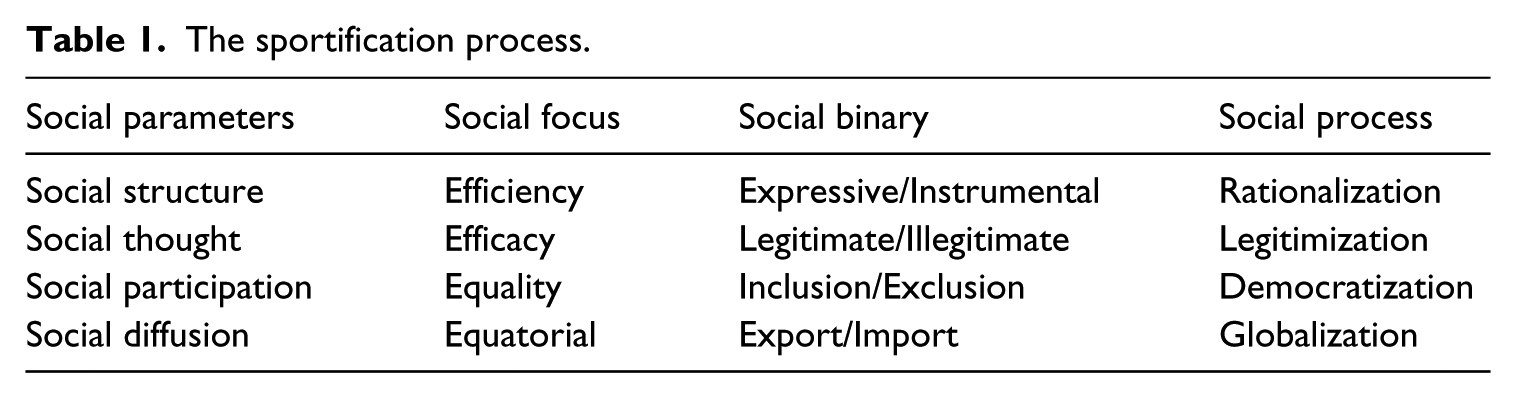
The sportification process.
Sport
Given the several hundred distinct athletic games and sports throughout the world, it goes without saying that every sport is unique in some form or fashion. Nonetheless, fundamental features of sport can be generalized. For example, a key sociological process related to the development of modern sport is what has been termed “sportification,” denoting “a universal hegemonic trend of standardization and globalization of sport practices” (Renson, 1998: 53). Jay Coakley and I have specified the main social parameters and social processes underlying the generalized sportification process, as schematically shown in Table 1 (Loy and Coakley, 2007: 4650).
Perhaps more significantly for purposes of social analysis, Stephen Hardy et al. (2009) drew upon Fernand Braudel’s concept of “longue duree” and Raymond Williams’ concept of “residual” and identified six systems of belief and practice in the Western world of sport that we designated as “long residuals”:
We note that these long residuals “have extended through time and space by means of endless repetitions and performance” (Hardy et al., 2009: 132).
Future directions for the sociology of sport
I may be overstating the case, but I contend that, like past and present directions, the future directions for the sociology of sport are largely dependent upon the personal choices sport sociologists make in terms of vocation and method.
Vocation
Vocation in a religious sense refers to a “calling” to a profession, while in a philosophical sense it “refers to an ethically self-conscious reflection about one’s work” (Berger and Kellner, 1981: vii). I think that I implicitly made my choice of vocation upon reading the first two sociological books that I purchased as a graduate student. Taking a sociology class for the first time in 1963 I bought a copy (only 95 cents new!) of the just released Invitation to Sociology: A Humanistic Perspective by Peter L Berger; and enrolling in a second class taught by Hans Gerth I bought a copy of The Sociological Imagination by C Wright Mills (1959), whose graduate mentor had been Hans Gerth at the University of Wisconsin.
Both Berger and Mills write about sociology as a form of consciousness. Peter Berger outlines the dimensions of sociological consciousness in terms of four motifs that he calls the (1) debunking motif; (2) unrespectable society motif; (3) relativizing motif; and (4) cosmopolitan motif (Berger, 1963: 25–53). As an aspiring sociologist I readily identified with these motifs and continue to do so. For I believe that sport sociologists should be engaged in (1) debunking the myths and stereotypes surrounding sport; (2) exploring the unrespectable, scandalous side of sport involving bribery, cheating, corruption, gambling, sexual violence, and substance abuse; (3) highlighting the relativizing issues in sport such as the perennial debates of amateurism versus professionalism; and (4) exemplifying the cosmopolitan motif in their study of the globalization of sport.
Like Berger, C Wright Mills also views sociology as a form of consciousness, as for example, a sociological awareness of “the personal troubles of milieu” and “the public issues of social structure” (1959: 8). More explicitly, Mills, in depicting the nature of the sociological imagination, argues that …the first fruit of this imagination – and the first lesson of the social science that embodies it – is the idea that the individual can understand his own experience and gauge his own fate only by locating himself within his period, [and] that he can know his own chances of life only by becoming aware of those of all individuals in his circumstances. (1959: 5)
In a broader sense, Mills’ conception of sociological consciousness is comprised of five sensibilities: historical, cultural, structural, critical, and corporeal (Loy and Booth, 2004a).
Method
For Mills, the major import of what he calls the sociological imagination is that it “enables us to grasp history and biography and the relations between the two in society” (Mills, 1959: 6). The perennial problem in sociology is selecting a method that will best capture the core of the sociological imagination. Here, like Berger and Kellner, I use the term “method” to refer “not to the techniques of research employed by sociologists, but to the logic of their scientific investigations” (1981: vii).
Given my affinity for play, games, and sport, I have for a long time held the view that a game theoretic model of social life would provide the best method to use in generating sociological generalizations, in that games model cooperation and conflict, agency and structure, micro and macro, types of social power, strategy and tactics, as well as embodied social practices. Norbert Elias (Giulianotti, 2004) and Pierre Bourdieu (Booth and Loy, 1999) make the most cogent and germane analyses of sport and society with a focus on embodied social practices. However, the utilization of game theoretic models by Elias (1978) and Bourdieu (1984, 1998) more often than not borders more upon analogy or metaphor rather than sophisticated sociological analysis. An outstanding exception is the articulation of social games by Nicos Mouzelis (1995), whose work uniquely addresses the central problems of sociology in a grand and creative synthesis of the theorizing of Bourdieu, Elias, Giddens, Goffman, Marx, and Parsons.
Mouzelis makes a convincing case that every social game has three dimensions and each of these dimensions has its own logic and dynamic. Specifically, he argues that all social games are comprised of (1) a positional dimension focused on social roles and institutional structures (à la Giddens, Parsons, and Marx); (2) a dispositional dimension focused on habitus (à la Bourdieu) and configurational structures (ala Elias); and (3) an interactive-situational structure dimension focused on a vocabulary of motives (à la Mills) and interactive-situational structures (à la Goffman and Mead). A full understanding of any given social game requires consideration of all three dimensions, but a particular dimension and its logic may be of greater primary importance in one game than in another.
Interestingly, Robert K Merton appears to be the only celebrated sociologist to have considered each of Mouzelis’ three dimensions of social games at some point in his work (Loy and Booth, 2004b). To encourage others to utilize Mouzelis’ social games paradigm in their pursuit of the sociology of sport, I echo Sherlock Holmes’ call to his partner- in-crime: “Come, Watson, Come, the game is afoot!”
Footnotes
Funding
This research received no specific grant from any funding agency in the public, commercial, or not-for-profit sectors.