




Abstract
While scholars working in the sociology of the gender, body, health, sport and media have begun to address the paucity of research into media representations of men and masculinities, the literature to date has failed consistently to address the racialised aspects of media dwelling male athletic bodies. The same critique can be applied to recent explorations of popular men’s magazine, Men’s Health. Current research has thus systematically underplayed the significance of “race” as a defining feature of idealised, mediated masculinities. During this paper then, I use Critical Race Theory to guide a semiotic analysis of a year’s worth of Men’s Health magazine. Firstly, I argue that white male athletic bodies are represented as idealised masculine types, possessing both the virtues of body and mind, while their black male counterparts, to varying degrees, are depicted as spectacular, violent and hyper-masculine. Secondly, I go on to argue further that this idealisation of the white male athletic body is a reaction to broader social and cultural transformations, indicative of late-modern societies. That is, I suggest Men’s Health’s mantra of self-regulation is better understood as a call to white men to exercise greater embodied control in order to reaffirm jurisdiction and supremacy, during an epoch of uncertainty. Thirdly, following this line of argument, the paper contends that future readings of Men’s Health, and men’s magazines more broadly, must seek to understand better how racialised discourses inform dominant media representations of masculinities.
Introduction
Traditionally, one of the most popular ways gender identities have been understood is as fixed and polarised, meaning masculinity and femininity are often treated as “natural” expressions of a sexed body (Butler, 1990; Haywood and Mac an Ghaill, 2003; Mac an Ghaill, 1996). More recently, however, those working within gender studies have encouraged a rethink of the binaries of sex and gender, which has led to a more complex debate about the nature of masculine and feminine identities, patriarchal systems of domination and individual subjectivities (Butler, 1990, 1993; Connell, 1995, 2005; Jackson, 1998; Kimmel, 1987, 2003). Thus, much recent work in the sociology of gender, which has been heavily influenced by the works of Butler (1990, 1993) and Connell (1987, 1995, 2005), has recognised increasingly the role of human agency in performances of gender, historical and cultural shifts in the ideals of gender and the intersections between gendered identities and other performances of self (Haywood and Mac an Ghaill, 2003). In short, contemporary masculinities and femininities are understood better as historically and culturally contingent projections of self that are “more contradictory, fragmented, shifting and ambivalent than dominant public definitions of these categories suggest” (Mac an Ghaill and Haywood, 2007: 5).
This epistemological shift, which advocates a greater recognition of plurality (Aboim, 2012), is especially relevant for contemporary, sociological explorations of men and masculinities in sport and leisure. That is, recent empirical studies, across a number of disciplines, have expressed notable concern about the tendency for male bodies in mainstream media to appear rarely as anything other than muscular, lean, youthful and/or toned (Hobza et al., 2007; Michaels et al., 2013; Ward et al., 2011). In turn, a growing body of critical literature has documented the instrumentalism of the mediated, eroticised (athletic) male body, as well as its role in encouraging men to use muscularity and leanness as nominal markers of masculine embodiment (Connell, 2005; Elliot and Elliot, 2005; Grogan and Richards, 2002; Leit et al., 2001; White and Gillett, 1994).
While researchers in a number of sociological fields, such as the body, health, media and gender, have begun to address the paucity of research into media representations of men and masculinity, the literature that has amassed to date has consistently failed to address the racialised aspects of idealised male bodies (Azzarito, 2009). Bonilla-Silva and Baiocchi (2008) cite this failure to be emblematic of a broader trend in sociology. They contend that “mainstream sociology has observed racial matters with an inadequate racial theorization, and, hence, has not ‘seen’ the significance of racial stratification” (Bonilla-Silva and Baiocchi, 2008: 137). Current research, especially within the sociology of sport and leisure (Carrington, 2008: 428), has thus underplayed systematically, both methodologically and conceptually, the divisive process that is racialisation and the customariness of Eurocentric epistemological strategies (Hylton, 2012). So, although previous scholarship concerning idealised masculinities contributes much to our understanding of mediated athletic bodies, and their impact on a masculine identity politic, they have often failed to consider meaningfully the racialised aspects of representation and/or how discourses of “race” inflect differently readings of masculinities. I undertake this task during this paper.
Situating Men’s Health
According to Mintel (2010) the men’s magazine industry has experienced a decline in recent years. The previously popular so-called “lads mags”, such as FHM, Zoo and Nuts, have witnessed their market share decrease in recent times. However, despite the industry as a whole reporting a decline in circulation figures, titles such as Men’s Health, Healthy for Men and Men’s Fitness have boasted increasing monthly distributions (Mintel, 2010). Indeed, all of these magazines may be buoyed by the growth of their market share; however, Men’s Health in particular is an interesting case in point given that in 2009 it became the best-selling, paid-for, monthly men’s magazine in the UK, overtaking FHM for the first time (Audit Bureau of Circulations (ABC), 2012).
While statisticians have documented the popularity of Men’s Health with readers of men’s magazines, those scholars interested in the nature of the title’s content have preferred to address its social and cultural implications. Whannel (2002: 36), for instance, asserts that Men’s Health has played a particularly significant role in popularising “a more middle-class aspirational discourse of body maintenance” amongst men. This is especially noteworthy insofar as the content of FHM, the previous market leader, which is aligned closer to New Laddist interpretations of masculinities and their brash, care-free and excess-seeking ideals (see Benwell, 2003), is in stark contrast to Men’s Health’s celebration of control, discipline and self-health management. In addition, the pictorial focus of Men’s Health is, too, distinct from FHM: while the former centralises semi-naked (mostly white) men the latter foregrounds semi-naked (ideally beautiful, white) female bodies). Contrary to traditional homosocial behaviours, which encourage men to deny the pleasure obtained by interaction with all-male environments (Pronger, 1990), the magazine actively urges men to desire the often inactive, muscular (but not necessarily literally) athletic bodies of other men. Thus, considering the magazine’s popularity, not in spite of its homoerotic content but because of it, Men’s Health arises as a relevant late-modern cultural artefact (Gill et al., 2005: 38), emblematic of popular and emerging idealised masculinities.
Men’s Health magazine has drawn notable scholarly attention from sociologists of sport, leisure and physical culture, amongst others. These commentaries have criticised the magazine for commodifying masculinity (Alexander, 2003); perpetuating normative, capitalist conceptions of manhood (Lawrence, 2013); advocating neo-liberal discourses of self-health management (Crawshaw, 2007); being anti-feminist (Bloom, 1997); glorifying hegemonic forms of masculinity (Ricciardelli et al., 2010; Stibbe, 2004); disseminating contradictory self-health advice (Kennedy and Hills, 2009); and exacerbating body dissatisfaction amongst men (Arbour and Martin Ginis, 2006; Labre, 2005a, 2005b). However, while these studies have been particularly helpful for understanding the gendered nature of embodiment, and the uniformity of mainstream media representations of masculinities and male bodies, they have not recognised sufficiently that discourses of sport, health, belonging and masculine identity are inflected differently through “differential racialisation” (Brah, 1996: 15). In this sense, explorations of processes of racialisation in Men’s Health, and sport and leisure media more broadly, are largely absent from otherwise detailed and useful analyses of representational practices.
Critical Race Theory and intersectionality
Sociologists of sport and physical activity have been more and more willing to explore the intersections between “race” and gender in recent times (Anderson and McCormack, 2010). However, these analyses have most often focused on oppressed peoples and their disadvantages, such as women (Abney and Richey, 1992; Birrell, 1990; Carroll et al., 2002; Oglesby, 1981; Ratna, 2007; Scraton et al., 2005) and Black men (Burdsey, 2004, 2007a, 2007b; Carrington, 1998, 2002a, 2002b; Majors, 2001; Sabo and Jansen, 1994), meaning less is known about the points of collision between “race”, whiteness, masculinity, sport, health and/or media. In order to develop further the sociological literature on intersectionality, sport and leisure, during this paper I explore the discursive constructions of racialised male athletic bodies, especially the white male athletic body, given its socio-historical relevance is frequently ignored.
More specifically, I employ a Critical Race Theory (CRT) approach to intersectionality (see Lawrence, 2013), since it is grounded in an anti-essentialism that recognises the political pragmatism of certain social categories (see Bonilla-Silva, 1999; Crenshaw, 1995) as well as the multiple oppressions that exist for differently racialised groups and peoples (Anderson and McCormack, 2010; Crenshaw, 1995; Delgado, 2011; Hylton, 2012). A CRT approach to intersectionality (Burdsey, 2011; Crenshaw, 1995; Crenshaw et al., 1995; Delgado and Stefancic, 2012; Hylton, 2005, 2009; Yosso, 2002; Zamudio, 2011) is an especially useful framework for a study of this nature, insomuch as it requires scholars to confront, specifically, processes of racialisation. Furthermore, a CRT approach to intersectionality, which, like the concept of intersectionality more broadly, owes much to poststructuralist and black feminist theorising (Azzarito and Solomon, 2005; Hill-Collins, 1989, 1991; hooks, 1982, 1991, 1992), recognises how “race” and racism work with and through a myriad of other social categories, in unique ways, to produce multiple and varied outcomes (Carbado, 2000; Crenshaw, 1995; Hylton, 2012; Williams, 1991). However, as opposed to more hard-line poststructural interpretations of anti-essentialism then, which “are more associated with anticategorical intersectionality theorizing” (Anderson and McCormack, 2010: 952), CRT scholars embrace a “race” conscious approach within their work (Hylton, 2010).
Importantly, this political, as well as epistemological, stance should not be misconstrued as essentialism (Hylton, 2012). That is, maintaining certain identities (i.e. male/female and white/black/British Asian) have greater macro social significance than others (i.e. sportsperson/musician), is certainly not akin to a denial of the complex late-modern subject, the interconnectedness of social identities or the socially constructed nature of categories in the first instance. In simple terms, all differences matter; however, for CRT scholars, some differences matter (politically, structurally and culturally) more than others (Crenshaw, 2012). So, while “race” and racism are major focuses of this study – insomuch as it begins and ends by considering the importance of “race” for the politics of representation – their centrality fluctuates, along the research journey, allowing for a detailed exploration of their relationship with other forms of oppression (Burdsey, 2007a; Hylton, 2010, 2012). In turn, “race” is not adhered to, dogmatically, as the defining aspect of the discussion but at the very same moment, neither is it ever inconsequential.
Method
Having identified Men’s Health as an especially appropriate magazine, a year’s worth of the title (11 issues), from January/February 2010 to January/February 2011, was collected to form this study’s sample. The small sample size was not deemed problematic given the aim of the paper was to explore “meaning”, “processes” and “perceptions” (Inu, 1996: 770), as opposed to matters of “rate”, “incidence” or “prevalence” (Marshall, 1996: 522). Identifying “the most productive sample to answer the research question” (Marshall, 1996: 664) then was of paramount importance for this paper and involved ensuring the quality of the data was suitable, rich and specific as opposed to numerically dense (Long, 2007). During this primary phase, all of the magazines were read, cover to cover, and substantial entries, which documented observations and feelings about each individual magazine, and its images and articles, were made into a research diary. The following analysis sections include both observations drawn from the entire sample of magazines, as documented in the research diary, as well as specific images and articles.
It was during this preliminary phase of the research that suitable articles and images were identified. A purposive sampling method (Marshall, 1996) was used to select the most productive and/or significant images and articles for exploring the racialised aspects of male athletic bodies. Most significantly, however, this method was especially suitable given it owned the capacity to counter notions of colour-blindness “where Eurocentric epistemologies consistently fail” (Hylton, 2012: 25). Hall (1997), Carrington (2002a, 2002b) and Hylton (2009) provide further support for utilising this method given their work, to varying degrees, draws on purposively selected images. The semiotic analysis that follows then draws explicitly, but not exclusively, from two Men’s Health front covers (October 2010 and November 2010) and three images from two separate articles, published in Men’s Health’s October 2010 and January/February 2011 editions.
In order to examine selected images and articles, I amend and apply Yosso’s (2002: 53) approach to Critical Race media literacy (see Lawrence, 2013: 96) to Kress and Van Leeuwen’s (1996) framework for approaching visual semiotics. The frames for analysis were as follows: (1) the representational dimension, which is divided into the representation of narrative processes (i.e. “what’s happening”) and conceptual processes (or racialised “ideas”) within the frame of the image/article; (2) the metafunction, or in other words, the interaction between the viewer and the image/article (i.e. what sort of engagement does the sign require); and (3) the layout or composition of the image/article (i.e. the position of bodies and their features, movements, muscularity (of particular muscle groups, for instance), body positioning in relation to camera and/or props, dimensions of eye contact (if any), clothing styles, style of accompanying narratives and types of adornment (Kolbe and Albanese, 1996).
Given a CRT approach values experiential knowledge, which in turn recognises any decoding of imagery is dependent upon the subject positions of the semiotician, it is relevant to note that as a white, heterosexual, able-bodied, British-born, man, I interpret the images and articles from a position of privilege and power. Therefore, as is all too often the case with semiological works, I do not hide behind a language of objectivity and invite a critique of my work from scholars who have greater connections to marginalised groups, peoples and subjectivities than do I. While I contend that my scholarship is guided by a philosophically rigorous methodological approach, this reflexivity prevents my research from merely (re)centring dominant discourses and epistemologies (Blaisdell, 2006: 166).
(Il)Legible black masculinities: David Haye and Senegalese wrestling
Increasingly, the inclusion of black male athletic bodies in mainstream media has become ever more ordinary, even central. Nonetheless, critical sociologists, active in various Western social democracies, have long contended that too often they have been racialised in a manner that emphasises physicality and athleticism (Carrington, 2002a, 2002b, 2010; Entman, 1994; Hall, 1997; Hylton, 2009; Orbe, 1998; Sabo and Jansen, 1994; Van Sterkenburg et al., 2010). In turn, representations of black men in sport media have been criticised for perpetuating an essentialist and stereotypical discourse of black manhood as inherently angry, violent, physical, stupid, sexually aggressive and animal-like (Orbe, 1998). So pervasive is this stereotype, we might say that this type of black male body has become the most “legible” of black bodies (see Neal, 2013: 4).
Central for much of Carrington’s (2002b: 21) theorising about black athletic bodies then is the notion that the torsos of these men “as object of visual desire is everywhere” [emphasis in original]. However, it is especially noticeable that, within this study’s sample of Men’s Health magazines, the bodies of black men are only seldom visible; South Asian men, incidentally, are almost omitted entirely from the magazine. 1 Conversely, images and articles celebrating ideally beautiful white women, chiselled white male bodies, as well as white men striving to be chiselled white male bodies, saturate the pages of Men’s Health. Hence, while black sporting bodies do have an obvious presence in Britian’s best-selling men’s magazine, implying homoerotic pleasure can be gleamed from these bodies, their inclusion is peripheral.
November 2010’s cover of Men’s Health features “mixed” (white mother of English ancestry, black farther of Jamaican ancestry) British boxer, David Haye, as its centrepiece (Figure 1). The cover, which is the only one in the sample of magazines to feature a man who is racialised as black, is certainly an atypical Men’s Health front cover: the signature white background, red lettering and black–white effect, usually applied to a placid, shirtless white man wearing low cut jeans – seen on every other cover in the sample – has been noticeably transformed. In stark contrast, Haye appears in full boxing attire, brightly coloured, as are his surroundings. The boxer’s eyes stare purposefully towards the floor, his right arm swings around towards his opposite shoulder (imitating a punch) and his mouth falls open emulating a victorious roar. This carefully staged depiction of a black man doing an aggressive and violent sport differs greatly to Men’s Health’s conventional assertive and confident, but neutral, white male cover models. To this end, Haye is employed as the “spice, [the] seasoning that can liven up the dull dish that is mainstream white culture” (hooks, 1992: 21).
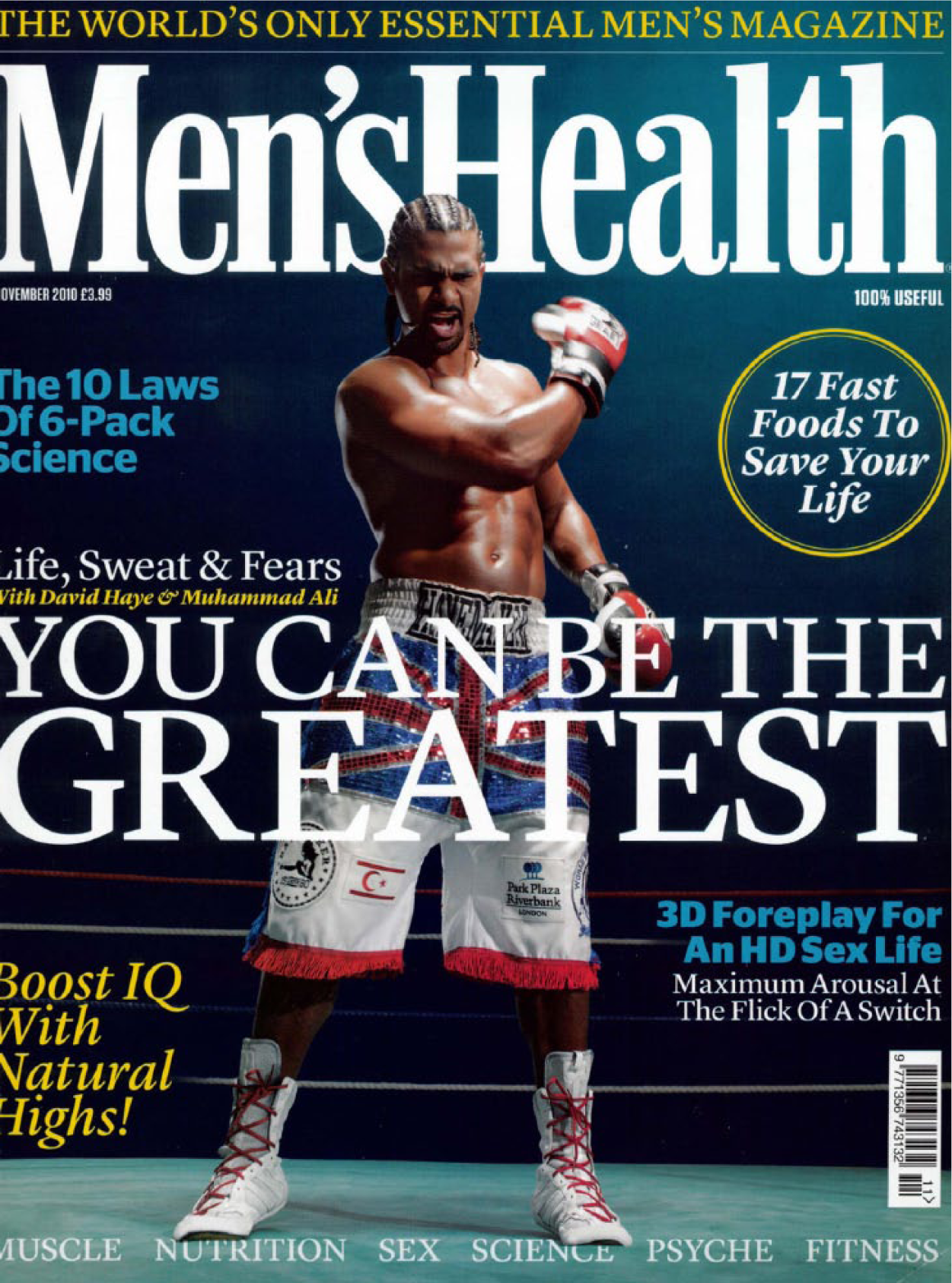
David Haye poses on the front cover of Men’s Health, November 2010.
The colourful vibrancy injected into what is usually an unremarkable monotone and minimalist template thus invites a special appreciation of the main event: the muscular, black male athletic body. As he poses in shorts adorned with the flag of Great Britain, which marks his blackness as somewhat less threatening (less legible), Men’s Health’s representation of Haye (quite literally) contests the notion that “there ain’t no black in the Union Jack”, and in so doing “expands the range of racial representations and the complexity of what it means to ‘be black’” (Hall, 1997: 272–273) and British. Some colour-blind frameworks may misinterpret this as an unequivocal elevation of Haye above the other more mundane and placid white male cover models; however, while those keen to welcome in a gloriously post-racial epoch might consider this special treatment as favourable, CRT contends such liberal conclusions be approached with caution (Delgado and Stefancic, 2012). That is, while, on the one hand, the visibility of Haye positions him as a celebrated standard of male health and virility, on the other, infusing markers of flamboyancy and theatricality within a template previously devoid of such sentiment perpetuates the notion of spectacular black athleticism. Sensationalising black male physicality, in this sense, trivialises the more progressive and inclusive signs and codes contained within the image, thus denying the likes of Haye his ordinariness and his “unspectacular humanity” (Carrington, 2002b: 35). As Critical Race theorists warn (see Chang, 1993; Delgado and Stefancic, 2012; Ladson-Billings and Tate, 2006), typically, any gains in racial equality in liberal Western democracies, are often, at best, incremental.
Of further note is a feature piece within Men’s Health January/February 2011. The article, entitled “BATTLE STARS OF AFRICA” (Morton and Gudin, 2011), is complimented by a black and white picture, in which two black Senegalese wrestlers (see Figure 2), their modesty covered only by a piece of cloth, are captured just at the moment one fighter buries his shoulder into the other’s mid-torso. As opposed to Haye, whose participation in a more familiar sport to British audiences, and embrace of the Union flag, acts to normalise the black British body, the Senegalese wrestlers – who are marked as distinctly “African” bodies – are pictured alfresco, exposed to the elements, grimacing and scowling. These black male bodies are decidedly more “legible”: they “bring welcome relief, a comforting knowingness” (Neal, 2013: 5) to mainstream (largely white) media audiences, through a reinforcement of essentialist ethno-cultural tropes regarding black African physicality and primitivity. The associated article, too, ensconces this mythology. The supplementary text, for instance, employing a fantastical tone, informs the reader that each wrestler’s pre-match routine is guided by the mysticism of “ancient folklore” (Morton and Gudin: 140), “amid a cacophony of frenzied cheering” [emphasis added] (Morton and Gudin: 134). These men, who purportedly “butt” 2 to discover “the better, stronger, faster more powerful man” [emphasis added] (Morton and Gudin: 140), are represented in a manner that reaffirms and reiterates regressive stereotypes.
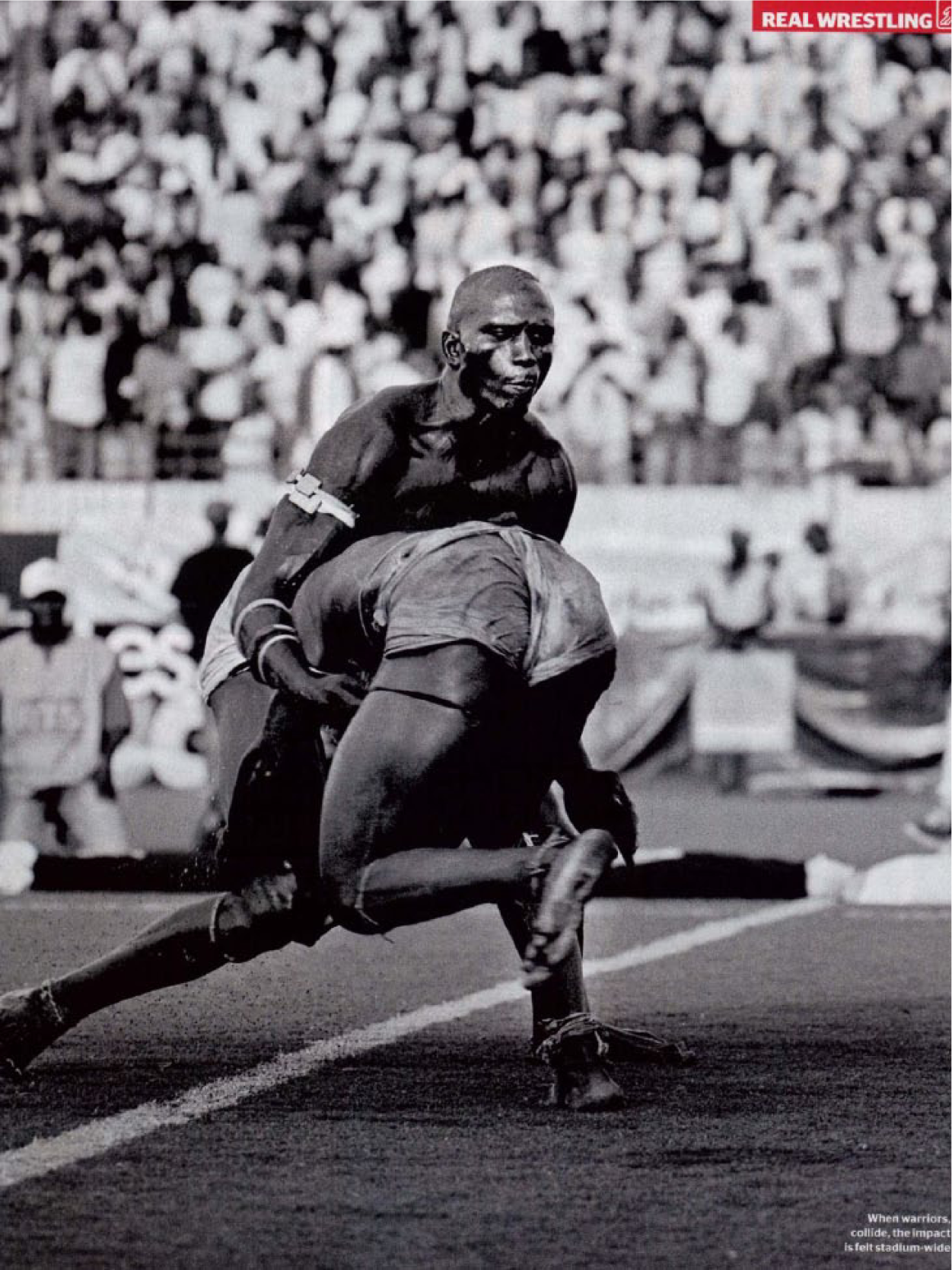
Two Senegalese wrestlers in the midst of “battle”.
Following this crude racialised narrative, a cluster of images focus upon professional Senegalese wrestler, Yakini (see Figure 3). In the first image, two black men, whose faces are not visible, are pictured in an unsanitary, unhealthy position, covered in dirt and sand, fighting over what could be construed as a small, trivial object. In the second photo, Yakini is photographed hanging from a pull-up bar, much like a gorilla would hang from a tree: his face is gormless and his head appears to retreat into his body, inviting further an interpretation of him as being ape-like. The third image depicts Yakini in a gym, under the bar of a Smith machine, 3 which is loaded fully with what appears to be an extraordinary amount of weight. As he stands erect, the bar at capacity, resting across his shoulders, Yakini is captured screaming – his mouth fully open, his teeth exposed – perceivably having just completed a full squat. The final image sees Yakini posing topless, covered in sand with his fists clenched in the on-guard position. The Senegalese gazes sternly into the camera, just as a boxer would observe his opponent. His torso is much more square-on than traditional boxing stances would teach, allowing for a greater appreciate of his size. His body, its mass and readiness for conflict, is evidently the most significant aspect of the image.
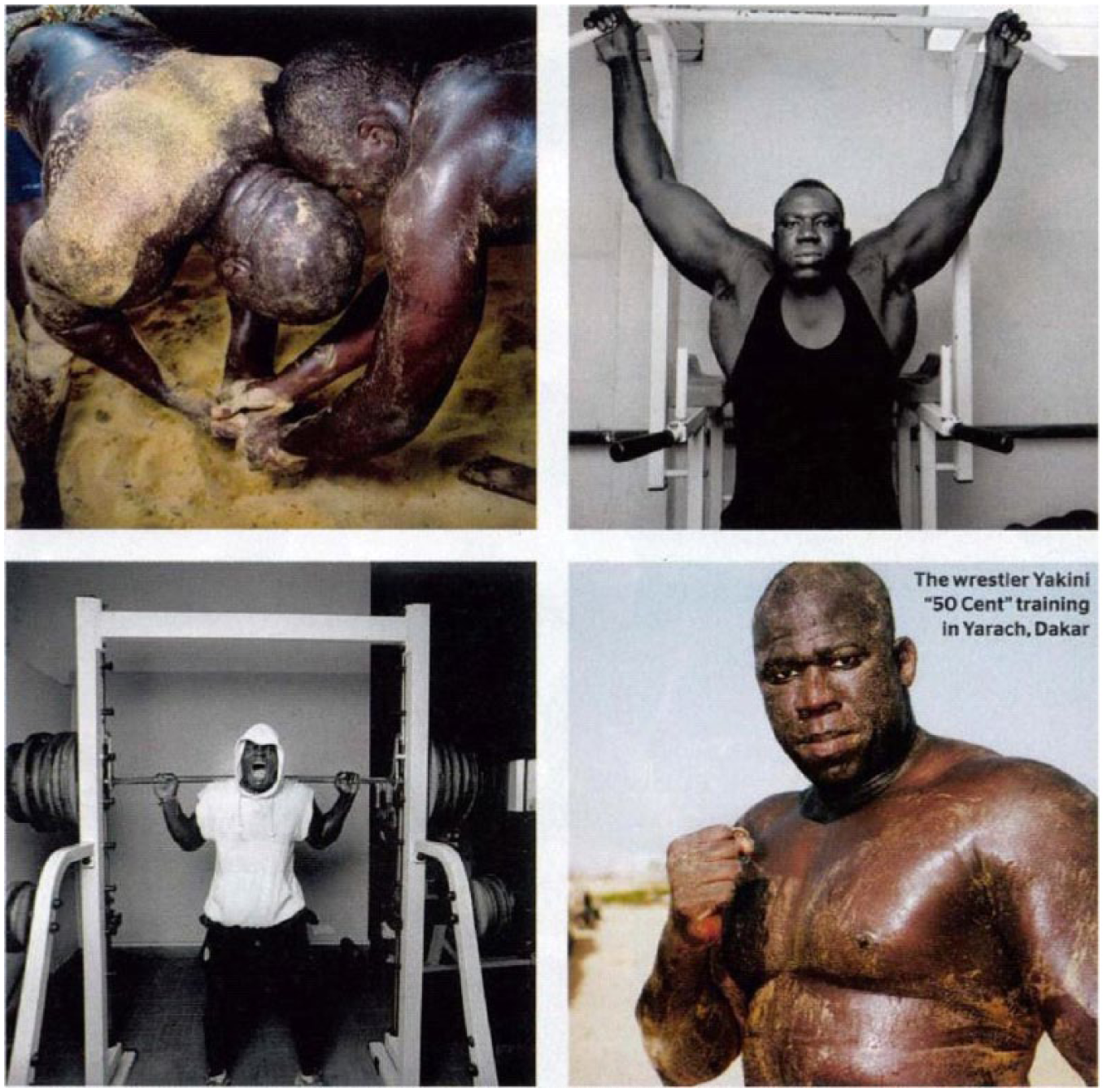
A quartet of images of wrestler Yakini.
Collectively, these images encourage the reader to interpret Yakini’s body as primitive, aggressive, unrefined, hyper-masculine and unsophisticated. Framing images and articles within a fantastical and ingenuous imagination of black African physicality, the images of Yakini propagate a cankerous folklore of Otherness, which frames black African male bodies as primordial and poverty-stricken machines, built to withstand eternal tribal warfare (Aspaas, 1998). Evoking such essentialist racialised mythologies then positions Yakini as a, fascinating yet, distinctly “unhealthy” body, propagating the classical literary narrative that “darkness conveys evil and terror” (Delgado and Stefancic, 2012: 84).
Such rudimentary representation then serves to police acceptable incarnations of black masculinity as well as to inscribe racialised boundaries. To be exact, after the page is turned, and the “BATTLE STARS” are left behind, a more familiar “reality” – served by articles discussing the virtues of well-equipped, sanitised gyms, and (white) men in suits (metonyms of civility and rationality) – is quickly restored to the fore of the reader’s mind. This juxtaposition (which I outline in further detail in the following sections) then reminds Men’s Health’s target demographic (white British, modestly salaried, young to middle-aged professionals (Mintel, 2010)) that those fleeting interactions with the “bizarre”, the “unhealthy” and unfamiliar world of the black African male Other was only for a brief moment. Yakini and his peers thus function in the realm of spectacle: through Men’s Health they offer momentary, illusory access to a world that British-based Men’s Health readers, and David Haye, do not belong.
Embodying perfection: establishing “the right message”
On the cover of October 2010’s Men’s Health, white male, Kirk Miller (see Figure 5) poses proudly after being crowned the winner of the annual cover model competition. Referring to Miller, Men’s Health editor, Morgan Rees (2010: 146), describes how cover models, especially the winner of the reader’s competition, are central to communicating the magazine’s philosophy and purpose: Kirk has got himself into unbelievable shape … He also has a brilliant, easygoing attitude and the sort of well-balanced lifestyle that sends the right message to our readers [emphasis added].
Miller, a white, well-muscled, short dark-haired, man, in the most unequivocal of terms, is marked as the “right” man readers should aspire to emulate. Given Miller is singled-out for praise then, he is an especially interesting body on and through which Men’s Health’s archetype of contemporary maleness can be explored. Before an analysis of Miller is conducted, however, which I detail later, firstly, a closer inspection of the article accompanying him and the competition’s other finalists aids a better understanding of what it is Men’s Health considers “the right message” for its readers.
Figure 4 displays the 11 bodies that comprise the list of 2010 finalists. The seven men who are pictured span an age range of 23 to 41, and all pose for the camera, uniformly. Their bodies show off heavily muscled upper-bodies, their torsos are hairless, their heads boast full crops of short dark hair, their cheekbones and jaw lines are pronounced (or are accentuated by carefully trimmed short stubble) and their mouths are shut tightly. Importantly, as the editor declares, the bodies on show do not merely represent themselves: these men embody the moralities, virtues and principles of Men’s Health and are thus commended for their “[dedication] to the perfection of not just a physique, but a lifestyle” (Harris, 2010: 144). The reader is left in little doubt: the “physique[s]” on display, for the delectation of the consumer, symbolise the most ideal of masculine bodies.
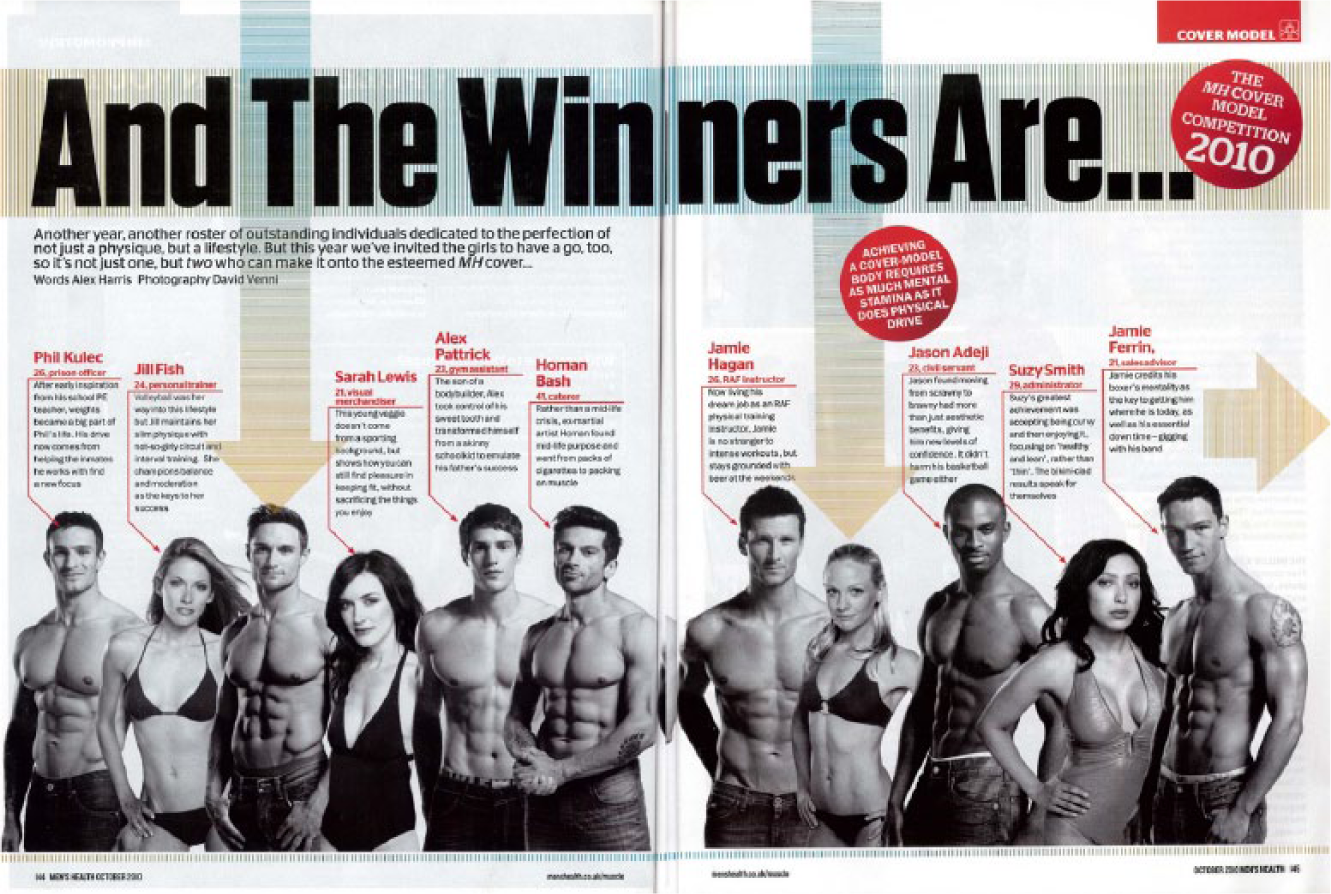
A double-page spread in Men’s Health exhibitions the 11 cover model competition finalists.
Heraclitus infamously once remarked: “[y]ou could not step twice into the same river; for other waters are ever flowing on to you”. The same can be said of the Men’s Health cover model finalists. That is, all of the bodies on show, each one transformed into a stone-like sculpture, by a corollary of digitised effects and carefully deployed artificial light sources, are entirely unattainable. Simply, this is not because the models’ bodies will continue to evolve and change, but because it is beyond anyone to live as a motionless figure, frozen in time, manipulated continually by a number of professional-standard photographic lighting aids, digital technologies and beauticians. Hence, so distorted are the images of Men’s Health’s cover model finalists, it is beyond any person, including the finalists themselves, to ever resemble in the realm of the everyday a digitally manipulated cover model.
The artificialness of a portrait photo-shoot and techniques of digital manipulation in magazines are indeed common and well documented (Wheeler, 2002). However, far from warning consumers of the dangers unrealistic comparisons can have for men, Men’s Health readers are often directed actively, by short and assertive commands (Kennedy and Hills, 2009), to “be like” the hyper-real bodies in Men’s Health: “LOSE YOUR GUT!” and “GET BACK INTO SHAPE!”. To make the momentous task of achieving a cover model physique less daunting then, and thus seemingly more attainable, the magazine offers comforting reassurance to readers that the finalists are “normal” men: Jamie H’s tag line, 4 for instance, describes him as being “no stranger to intense work outs but stays grounded with beer at the weekends” (Harris, 2010: 145) [emphasis added]; while Jamie F’s headline emphasises his “essential down time – gigging with his band” (Harris, 2010: 145) [emphasis added]. Winner, Miller, too, despite his especially unique competition-winning physique, is also sold as an exemplar of normalcy and ordinariness: in the most explicit of terms, Miller is heralded as a “normal, down-to-earth guy” (Harris, 2010: 146). Thus, if we are to believe the cues left by the magazine, we should be in no doubt that all men can own a body like a Men’s Health cover model.
Once a “you too” narrative is established readers are also offered direction as to how they might perform and/or train their bodies to be more like the models: “ACHIEVING A COVER-MODEL BODY REQUIRES AS MUCH MENTAL STRENGTH AS IT DOES PHYSICAL DRIVE” (Harris, 2010: 145). This emphasis on mind as well as body is particularly significant and runs throughout the article: Alex, a 23-year-old white male, is described as having “took control of his sweet tooth and transformed himself from a skinny school kid” (Harris, 2010: 144) [emphasis added]; Homan, a 41-year-old white male, is reported as having avoided “a mid-life crisis … [and] found mid-life purpose and went from packs of cigarettes to packing on muscle” (Harris, 2010: 144) [emphasis added]; Phil’s (a 26-year-old white male) “drive” is supposed to come “from helping inmates he works with find a new focus” (Harris, 2010: 144) [emphasis added]; while Jamie F “credits his boxing mentality as the key to getting him to where he is today” (Harris, 2010: 144) [emphasis added]. Furthermore, Miller, once again, as the most esteemed body in the competition, is used also to advance further the notion that mental capacities are key to achieving muscular physiques: “[Miller] read, a lot, and [he] made sure it was reliable stuff” (Harris, 2010: 148). Even more crudely, however, so as to dispel categorically any suggestion that Miller’s muscular torso might owe to an innate predisposition for muscle growth, the article states quite clearly that he “wasn’t born this way” (Harris, 2010: 148). To this end, the subtle linguistic cues, which add context to these muscular male bodies, who have become “physically complete” (Harris, 2010: 146), ask the reader to accept that they are the results of superior cognition, discipline, control, aspiration and shrewd intellect. Not genetics.
Notably, a “race” conscious reading of the image observes that, with the exception of Jason Adeji, a conspicuous feature of the article is the prominence of (muscular, dark-haired, tanned) white bodies. Adeji then, considering how white bodies dominate the list of finalists, Men’s Health’s broader context and its “esteemed” (Harris, 2010: 144) front covers, appears as a body out of place (Ahmed, 2000). Adeji is not Othered simply by his blackness. That is, set against the other finalists, the tag line accompanying Adeji is uniquely devoid of any consideration of his philosophical mantra, motivation, hard work or normality. What is rehearsed, however, is a narrow typecast of a muscular, self-assured, basketball-playing black man: “moving from scrawny to brawny … [gave] him new levels of confidence. It didn’t harm his basketball game either” (Harris, 2010: 145). These observations are significant for two reasons: firstly, the failure to mention how Adeji’s mental capacities contribute to the building of his physique – especially given the virtues of the mind are pivotal aspects of idealised representations of masculinity in Men’s Health – supports implicitly bio-racist assumptions about black intellectual immaturity and natural physicality; secondly, locating Adeji within an essentialist discourse of black maleness, which implies that “confidence” is a consequence of the body, not vice versa, infers he should be read as a “legible” black male athletic body. In this way, Adeji is represented as emanating from a different racial paradigm to his white male counterparts, meaning his physical achievements, while admirable and desirable, are supposed to be read differently to those of his peers.
Self-discipline and the right to control: the philosophy of the disenfranchised
The front cover of Men’s Health October 2010 (see Figure 5) depicts male cover model winner, Kirk Miller, and white, blonde-haired female, Laura Muirhead, the victor of the equivalent female competition, in particularly close quarters. Miller stands proudly erect at the fore of the photograph, his physical size emphasised further by Muirhead’s hunched posture and needful bodily gestures. As opposed to Miller, Muirhead, who grasps timidly at her male counterpart’s waist, stunting her height, is less self-assured. At the level of connotation, while the nature and purpose of Miller’s stance is to persuade readers he is the more prominent of the two white bodies, Muirhead’s pose is deeply symbolic of the physical and emotional dependence women “ought” to place on men. To establish further a discourse of white heterofemininity as reliant, docile and submissive Muirhead is complemented by a small piece of text entitled, “Behind every great man…” (Harris, 2010: 149) – and quite literally, as if to complete the well-known maxim figuratively, Muirhead stands behind Miller – Men’s Health’s “great man”. Should we be convinced by the subtle (non)linguistic cues then, in the wake of every muscular male is a dependent, unthreatening, supportive, ideally beautiful and, hence, “great”, women.
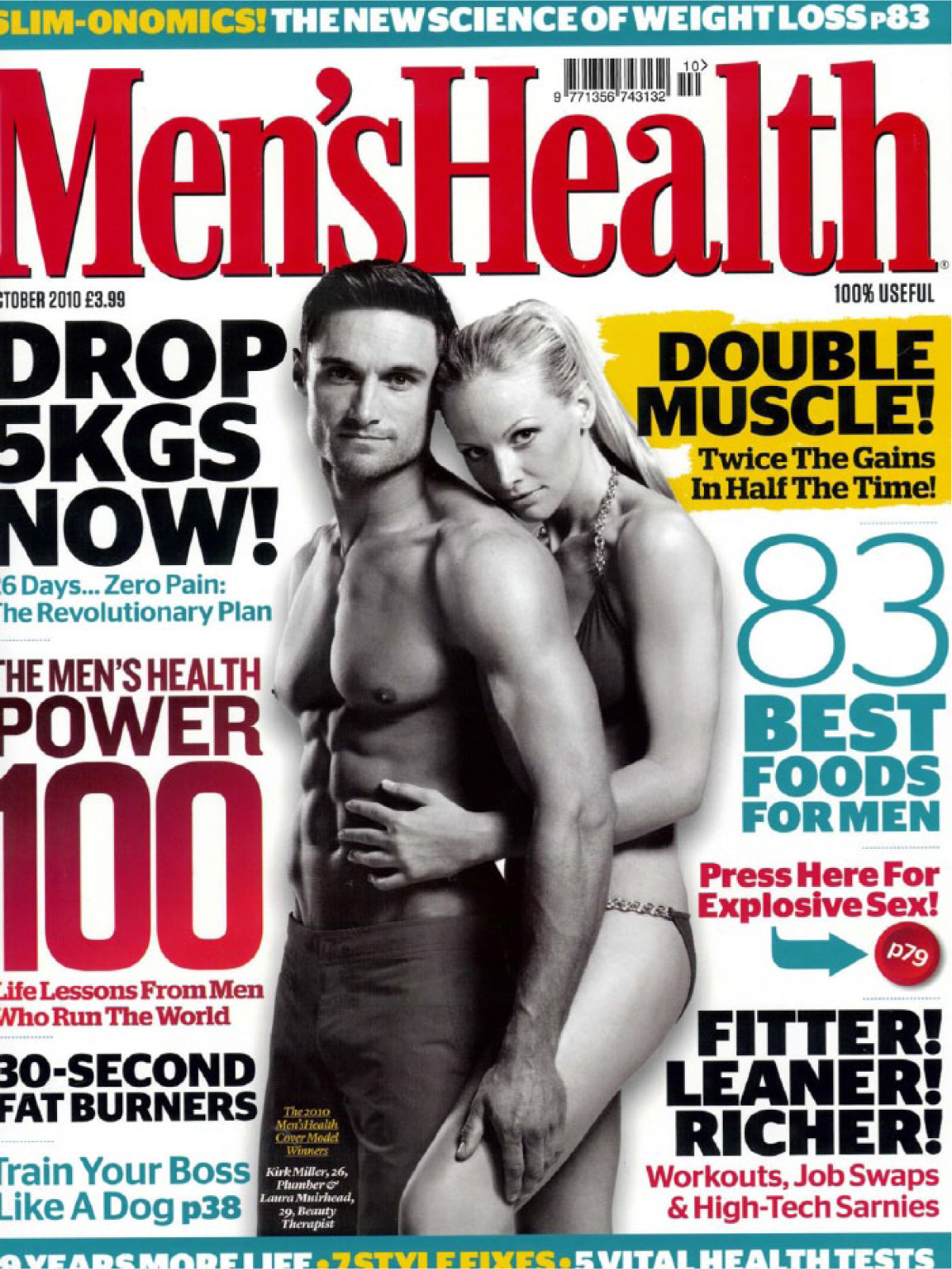
Kirk Miller and Laura Muirhead stand united on the cover of Men’s Health, October 2010.
Not only is Muirhead’s representation important in defining contemporary idealised heteronormative male–female relations, but it is equally as important for the discursive construction of idealised white masculinities. To be exact, given Muirhead’s implied subordination, Miller’s shielding of her from full view of the camera, reaffirms ancient assumptions about male superiority. This representation of a white man, as “lovingly” controlling draws significant parallels with Hoch’s (2004) assertions made about the classic white knight, a white man in inherently good standing, as the protector of “vulnerable” white women. As both ideally white bodies stand unified in their supposed “greatness”, “innocence and goodness” (Delgado and Stefancic, 2012: 83), reinforcing what Critical Race feminists have long argued about the differential representation of women on racialised grounds (see Brooks and Hébert, 2006), Miller’s symbolic purpose is clear: not only does he infer that the pursuit of in perfecto corpore is a physical mission, but his protective stance advises it is a moral one, too.
White athletic masculinity as a discourse of control and supremacy, however, does not confine itself to a regulation of white women. Men’s Health also represents Miller and the other finalists as devote self-regulators: “[t]heir commitment is not only evident in these photos, but in the way they live their lives every single day” (Harris, 2010: 146). Miller, for instance, is praised for his “commitment” to neo-liberal mantras of self-health management and his quantification of self: meticulously recorded gym routines and a thorough analysis of food consumption are behaviours deemed worthy of commendation. However, given Miller is represented as an exemplar of normality, and such punctilious planning may be considered distinctly abnormal – even obsessive or narcissistic – Men’s Health is keen for readers to be aware of his “big drink [on Saturday’s]” and “cheat days” 5 (Harris, 2010: 148). This information is especially important because it asks the reader to understand that self-regulation is a choice not a chore. A stand-alone bright red text box, too, alleges this even more forcefully: “[Miller] MAKES THE GYM WORK FOR HIM RATHER THAN BECOMING IMPRISONED BY IT” (Harris, 2010: 146). Thus, while not wishing to overlook the health implications of promoting excessive alcohol and fatty-food consumption, which are represented erroneously as aspects of a “well-balanced lifestyle” (Rees, 2010: 146), idealised white athletic bodies in Men’s Health are sentimentalised because of their commitment to a surveillance of self, as well as others.
Self-regulatory practices are not only represented as admirable; they are said also to reward men with a sense of stability and superiority, in the midst of uncertainty. Miller, for example, after adopting a “lifestyle” commandeered by scrupulous regulation of the self, is quoted in the article as having “ditched insecurities. Even in job interviews I feel more in control” (Miller quoted in Harris, 2010: 148). Miller’s physique then, a product of “a strict regime” (Harris, 2010: 147), consisting of dedication, control and self-quantification, offers apposite reassurance to those men who harbour “insecurities”. That is, he is presented as evidence that a strong body is an effective vehicle through and in which the unpredictable labour markets of late capitalism can be better managed. Thus, given “[m]ost bodies’ continued existence in capitalist society depends upon their availability as resources” (Pronger, 1995: 435), conditioning the body – both physically and mentally – is purported to empower men to cope better with otherwise fragile, aggressive and individualistic neoliberal economies.
Men’s Health’s enthusiastic glorification of those white men invested desperately in physical and mental self-surveillance can indeed be read as a subtle call to confront a perpetual and impending sense of vertigo. However, an analysis guided by a CRT framework recognises that – in light of black athletic and sporting successes, some of which Men’s Health help to document – such a celebration has racialised significance. In other terms, given black masculinities have long been perceived as a “threat” to white male supremacy (Fanon, 2008 [1952]; Hoch, 2004), especially in physical cultures (Carrington, 1998, 2000, 2002b, 2002a, 2010), Men’s Health actively contests the premise upon which this “threat” is conceived: the bio-racist belief in black hyper-physicality and white muscular atrophy. While in popular media muscular black male bodies are increasingly more visible, and frequently framed as cool, “fashionable and aspirational” (Gilligan, 2012: 171), Men’s Health’s target audience is able to find solace in the likes of Miller, and the other white finalists. Put simply, these men provide visual assurance that white men, too, can, in the words of Men’s Health, own “a torso like a Greek god” (Harris, 2010: 148).
Superhuman status has often been the preserve of black male sportsmen (Carrington, 2002b, 2002a; Lawrence, 2011). However, Men’s Health promises that if “normal” white men do as Men’s Health cover model finalists do, and invest their money and time in health and fitness cultures – in addition to, or outside of, sport – they too may develop a most healthy, celestial physique. Men’s Health’s glorification of Miller and the other finalists then might be understood better as an attempt to (re)establish the symbolic supremacy of white masculinities. Such a conclusion then supports the claims made by Critical Race theorists regarding the complex and multifaceted nature of white supremacy (see Gillborn, 2005). In other terms, an exploration of racialised representational practices demonstrates further that white supremacy is not mobilised most frequently as a vicious, bigoted ideology, exclusive to far-right groups (Bonilla-Silva, 2002; Gillborn, 2005, 2006; Hughey, 2011); rather, it functions in plain sight, reinforcing covertly “conscious and unconscious ideas of white superiority and entitlement” (Ansley, 1997: 592), in seemingly “race” neutral arenas.
Summary
Writing over two decades ago, Graham (1997 [1993]: 3) prophesised: …the great white male’s day has passed, along with his unlimited power and influence … From now on, the great white male will be one of many.
In spite of such an assured divination, within this study’s sample of magazines, white male bodies remain very much at the ideological centre of embodied discourses of idealised masculinities and/or imaginations of “great men”. In Men’s Health, white men are not simply some of many. Moreover, not only do white men dominate visually, the dominant discourses of whiteness that surround them promote a reading of idealised white male bodies as having earned such strong and healthy physiques, in the most noble of fashions – by utilising cognitive abilities. Indeed, Delgado and Stefancic (2012) and I (Lawrence, 2011) have noted that dominant Western media cultures often racialise whiteness as intelligent, spiritual, dedicated and selfless; however, what is especially noteworthy about Men’s Health’s representation of idealised white athletic bodies is that they are depicted as possessing the virtues of both mind and body. So, while Yakini and Haye are depicted, to varying degrees, as “having bodies but not minds” (Mercer, 1994: 138), white bodies are surrounded by a more holistic discourse of embodiment.
Miller and the other (white) finalists indeed come to represent the most masculine of male bodies, according to Men’s Health, and are honoured with god-like status. However, while at the same time as they are elevated to heights often preserved exclusively for black sportsmen, they are without hesitation framed as “down to earth” and “normal”. Simultaneously, Miller and his ideally white male counterparts are thus privileged to exist both as miraculous-ordinary and average-exceptional. In this sense, idealised white male athletic bodies function as perfect embodiments of postmodern paradox: while at the same time as they are normal, they are unachievable; where masculinity is racialised, whiteness is an invisible aspect; where physicality is innate, it is also psychological; where whiteness is disembodied, it is also embodied. This, what might be called hyper-white (mediated) masculinity, thus reminds, if there was ever any doubt about the fictitiousness of the “great man”, that mediated representations of masculinities are merely discursive constructs – not real bodies – that can never be executed to perfection outside of Men’s Health because of their incongruous nature. It is an unreachable, and thus eternally profitable, ideal.
While Graham’s prophecy regarding the decline of the white man may not be realised in the context of Men’s Health, it does nonetheless point to a broader cultural imperative, which dictates that social structures are gradually eroding and the power and authority previously signified by whiteness and maleness is less assured. Men’s Health, its glorification of a particular kind of white muscular man and its failure to break absolutely with regressive stereotypes of black men, thus can be read as a reaction to the “crisis of white masculinity”. In other terms, as fragmentary and unpredictable economic, social and cultural conditions effect and distort traditional notions of masculine behaviour; as Western agendas of liberalism grant more people and groups access (which does not necessarily translate to entry) to previously inaccessible institutions; and as the fallibility of global and local capitalist economies become increasingly evident, Men’s Health sells its largely white male readership a comforting resistive strategy, embodied by Kirk Miller. In light of capitalism’s promise, that “everyone owns at least one unit of power, themselves” (Wright, 2002: 15), the magazine offers suitable assurance: if white men retreat from labouring with a racialised body and convert to working on an aesthetic, culturally inscribed body (Mac an Ghaill and Haywood, 2007) – through a self-imposed regime of self-regulation – they may be better conditioned to grapple with the grand social and cultural transformations indicative of late-modern societies.
Throughout this paper, I have sought to argue that the “great man”, and other representations of idealised masculinities in Men’s Health, and therefore other men’s magazines, cannot be read in isolation from processes of racialisation. That is because far from male athletic bodies in Men’s Health existing as neutral, objective, colour-blind, and/or meritocratic representations of the human form, they are admitted, manipulated and celebrated in a manner that serves the interests of white male supremacist discourses. To this end, a reading of Men’s Health, guided by a CRT approach to intersectionality and semiotics, has been able to illustrate that male athletic bodies are differently racialised through representation and that racialised aspects of idealised masculinities are invested relationally in discourses of power. Therefore, I conclude by arguing that future sociological explorations of Men’s Health, and men’s magazines more broadly, must confront racialised processes of representation and examine more thoroughly how dominant discourses of white masculinities inform idealised media representations of male bodies.
Footnotes
Funding
This research received no specific grant from any funding agency in the public, commercial or not-for-profit sectors.