




Abstract
The CBC’s and NBC’s primetime broadcasts of the 2014 Winter Olympics were analyzed to determine differences between the media treatment of home nation and foreign athletes. The CBC results showed that Canadian athletes represented 48.5% of total athlete mentions and constituted all of the top 20 most-mentioned athletes. NBC results showed that American athletes represented 43.9% of their total mentions and 65% of the top 20 most-mentioned athletes. The CBC was more likely to attribute Canadian athletic successes to commitment and intelligence, and non-Canadian successes to strength. The CBC was more likely to discuss the emotions and background of non-Canadians and make neutral/other comments about Canadians. NBC was more likely to attribute American failures to experience. Comparisons between the networks revealed 30 significant differences in the manner of depicting home athletes compared to athletes from other nations.
Introduction
The 2014 Sochi Winter Games established, once again, that the primetime Olympic broadcast remains the crown jewel of all broadcast television products. United States-based NBC averaged 21.4 million viewers per night while leading the ratings for all 18 consecutive nights by considerable margins (Kissell, 2014). Though smaller in population, Canada’s interest in the Olympics was also permeating, averaging approximately 1.3 million viewers each night (Brioux, 2014) with 96% of the population sampling some portion of the CBC’s round the clock coverage (International Olympic Committee, 2014a). Despite increased audience shifts to web and mobile-based formats, the worldwide television audience exceeded two billion viewers (International Olympic Committee, 2014b), establishing that even if the Winter Games has less widespread appeal than the Summer Games, every Olympiad leaves a major media imprint.
The mere fact that so many nations watched the 2014 Winter Olympics does not mean they watched the Games in the same way, with the same descriptions and same focus. The desire to view proportionately more of one’s home athletes competing is a major influence for any Olympic programmer. As NBC Olympic veteran anchor Jim Lampley once noted, [Focusing on one’s home nation is] “just intelligent programming” (in Billings, 2008: 65). International analyses reveal that not only are home nations given increased focus, but they are also depicted in demonstrably different manners. Whether commercial or government run, the desire to bolster national pride and interest is at the fore of how the Olympics are shaped for mass consumption.
Ho and Bairner (2013) claimed the Games are often seen “as an appropriate tool with which to teach national identity” (351). Thus, with requisite respect to the notion of Olympic ideals and principles, audience interest is often influenced by whether a home nation succeeds or fails at a given event or contest. This disconnect can be quite prominent, with scholars writing that “though the Olympic Charter maintains that Games are not contested between nations, national representation hinders this idea” (Lau et al., 2012: 1281). Empirical analyses of more than one nation’s broadcast representation of a single Olympiad have been relatively meager. Billings et al. (2011) analyzed the 2008 Summer Olympic telecasts of the United States and China, finding considerable differences ranging from event focus to the amount of commentary to even the use of personal pronouns to describe one’s home athletes (China broadcasters used “we” and “us” to describe their athletes while NBC forbade it). Thus, this study will analyze the salience and description of home nation vs. non-home nation athletes through the contrasted lenses of the two most prominent (and, thus, presumed to be complementary) North American media products: US-based NBC (National Broadcasting Company) and Canadian-based CBC (Canadian Broadcasting Corporation). The need for cross-nation comparisons is underscored by the potential impact for bolstering nationalized feelings as a by-product of consumption (see Billings et al., 2013b).
Related literature
Theoretical conceptions
An offshoot of social identity theory (Tajfel and Turner, 1986), self-categorization theory (Turner et al., 1987) can be considered as social identity of the group. Encompassing a multitude of group associations, the theory incorporates aspects of identification ranging from demographics to social beliefs to loose associations that change from moment to moment. Individuals simultaneously classify themselves as being members of a plethora of groups at any given time, often having group definition activated by stimuli or circumstance. Each cognition regarding group membership constitutes either belonging (within an in-group) or estrangement (within an out-group). Specifically, when consuming an international sportscast, identity issues are activated, yet are routinely viewed as secondary to national citizenship, as “the flag often trumps many other considerations” (Angelini et al., 2014: 126).
Self-categorization theory has been expanded to explain occurrences within both in-group and out-group designations, with both upward contacts and downward comparisons (Taylor and Lobel, 1989) cementing the cognitive circles in which people believe they do or do not belong. Thus, within many viewers’ conceptions of Olympic media, one’s home nation becomes the in-group with all other nations jointly constituting the out-group. Despite the grandiosity and scope of any Olympic Games, self-categorization could be viewed as limiting media consumption to a simple formula in which one’s home athlete or team is attempting to win a medal while a nebulous collective of antagonist out-group members are depicted largely as possibilities for thwarting a home athlete’s potential successes.
Nationalized Olympic exposure
Previous research of sport and nationalism has inevitably focused on the Olympics, primarily because of the seemingly uncontested belief that the Olympics have consistently “been as much a forum for fervent nationalism as they have been about peaceful competition” (Butterworth, 2007: 187). Seemingly all media have been found to have some sort of bias favoring a home nation, whether such differences are unpacked as a tinge, tilt, or complete loss of objectivity (see Chen and Colapinto, 2010; Mason, 2012; Min and Zhen, 2010). This not only takes the form of increased media focus on home nation athletes and events in which the home nation is likely to perform well whether in Canada (see Mason et al., 2010) or the United States (see Billings, 2008), but also how success is defined. The 2008 Beijing Summer Olympics featured Chinese media focusing on gold medal counts with American media focusing on overall medal counts in an attempt for each nation to claim overall Olympic victory (Dyreson, 2012). Jiang (2013) noted that within Olympic newspaper coverage, the desire to promote the home athlete overrode other group affiliations, such as the political ideology of the media source.
The Canadian Olympic broadcast on the CBC has been subject to investigation from both a production (MacNeill et al., 2001) and content-oriented (Mason, 2012) standpoint, which, when used jointly with past studies of US Olympic coverage on NBC, aid in developing expectations for the amount of media exposure dedicated to home nation athletes and teams. NBC’s primetime Summer Olympic broadcast tends to feature more name mentions of American athletes than all other nations combined (Billings, 2008; Billings et al., 2014) while the Winter Olympics is a bit more inclusive of non-American athletes—presumably because there are fewer events NBC can opt to air. Nationalized analyses of the past three primetime Winter Olympic broadcasts found that American athletes received 39.3% of all athlete mentions in 2002, 40.2% of all athlete mentions in 2006, and 42.3% of all athlete mentions in 2010 (Angelini et al., 2012; Billings, 2008).
Within these past studies, heightened salience of athletes was operationalized through the construction of a top 20 most-mentioned athletes table. In the past three Winter Olympics, 68.3% of all athletes on these tables were American, with 17 Americans in 2002, and 12 Americans for both 2006 and 2010 (Angelini et al., 2012; Billings, 2008). Success was frequently superseded by national citizenship as Angelini et al. (2012) noted that while Norway’s Marit Bjørgen led all Olympic athletes with five medals at the Vancouver Games, she finished 491st on NBC’s most-mentioned athletes list.
Based on these two related measures of salience through the concept of athlete mentions, two hypotheses (bifurcated by nation) are postulated with three additional research questions posed related to the new inclusion of the comparison between the US and Canadian Olympic carriage networks:
H1a: Americans will represent more than 40% of total athlete mentions in NBC’s primetime broadcast of the 2014 Sochi Winter Games.
H1b: Canadians will represent more than 40% of total athlete mentions in the CBC’s primetime broadcast of the 2014 Sochi Winter Games.
H2a: The majority of the 20 most-mentioned athletes in NBC’s primetime broadcast of the 2014 Sochi Winter Games will be American.
H2b: The majority of the 20 most-mentioned athletes in the CBC’s primetime broadcast of the 2014 Sochi Winter Games will be Canadian.
RQ1: Will US and Canadian Olympic prime time broadcasts be proportionally different in the amount of mentions dedicated to home nation athletes?
RQ2a: What percentage of mentions will Canadian athletes receive on NBC’s primetime broadcast of the 2014 Sochi Winter Games?
RQ2b: What percentage of mentions will American athletes receive on the CBC’s primetime broadcast of the 2014 Sochi Winter Games?
Nationalized Olympic commentary
The manner in which the Olympics are conveyed is seemingly always shaped by home nation interests (Du, 2014). Even the staging of the Games is seen as an opportunity for international persuasion. Parks (2013) noted that “Under Stalin’s regime, winning was absolutely necessary in order to justify participation in international competitions, because poor performances were seen as damaging to the Soviet image vis-à-vis the West in the emerging Cold War” (1558). In a similar vein, the 2008 Beijing Summer Games were characterized as a chance for the Chinese government to use public events “wherein national pride was established on the basis of interaction between China and the outside world” (Han, 2011: 276).
Tastes, media styles, and formats change from nation to nation, but the seemingly common thread is that Olympic competitions are about far more than sport. Politics are at play (see Du, 2014) while “characteristics of sport stars are often interpreted not as their own individual identity but as being representative of their nationality” (Watanabe et al., 2013: 296). Some audiences have denounced this “one-eyed, all-consuming nationalism” (Rowe, 2013: 133), yet others have seemingly embraced the range of patriotism and hyper-competition often embodied in Olympic media content (Billings et al., 2013a).
Studies of international events have uncovered how commentators become vehicles for shaping nationalized stories. For instance, within rugby, scholars found that sportscasters manipulated scenes “of ambiguous situations where visual evidence could be read in several ways” to promote existing national stereotypes (Desmarais and Bruce, 2010: 349). MacNeill (1996) noted how Canadian announcers used the 1988 Olympic ice hockey tournament to cement the sport as part of Canadian national identity. Analysis of cross-nation Summer Olympic coverage (see Billings et al., 2011) found that even among the same Olympic events, stories could easily be shifted to create protagonists and antagonists consistent with national interests. Similarly, an examination of four telecasts (USA, China, Canada, and Slovenia) of the 2008 USA vs. China Olympic basketball game revealed different narratives between both home and third party nations, with China’s CCTV engaging in false propaganda to help preserve the image of the losing Chinese team (Billings et al., 2009).
Prior studies of the Winter Games focused on how home nation athletes are sometimes described in different manners than foreign athletes in the areas of: (a) attributions of success; (b) attributions of failure; and (c) characterizations of personality/physicality (Angelini et al., 2012; Billings, 2008). Regarding reasons for athletic success, during the 2002, 2006, and 2010 Winter Games, NBC was more likely to credit American success to subjective variables such as commitment (2006, 2010), concentration (2006), consonance (2010), courage (2002, 2006), intelligence (2010), and composure (2002, 2006). Non-Americans were more likely to have their success credited to more objective notions of experience (2002) and skill (2006).
Regarding athletic failures, analyses from 2002 and 2006 (see Billings, 2008) revealed no differences in this area, yet the 2010 Vancouver analysis (see Angelini et al., 2012) revealed that American failures were more likely to be attributed to a lack of consonance (luck), while commentators were more likely to attribute non-American athletic failures to a lack of athletic strength and athletic ability.
Regarding depictions of personality and physicality, previous studies (Angelini et al., 2012; Billings, 2008) found that American athletes were more frequently described as extroverted (2010) while foreign athletes received more comments about the size and parts of their bodies (2006, 2010). Thus, even though the majority of tested categories revealed no significant differences, the remaining differences provided ample proof that divergent dialogues were created relating to home vs. foreign athletes. Thus, three hypotheses (bifurcated by nation) are offered regarding characterization differences while an additional research question pertains to whether taxonomical differences, that is there will be significant differences between compared variables in each of the categories within our coding taxonomy, will exist between the two national broadcasts from the United States and Canada:
H3a: NBC employee depictions of American and non-American athletic successes will be taxonomically different.
H3b: CBC employee depictions of Canadian and non-Canadian athletic successes will be taxonomically different.
H4a: NBC employee depictions of American and non-American athletic failures will contain significant differences.
H4b: CBC employee depictions of Canadian and non-Canadian athletic failures will contain significant differences.
H5a: NBC employee depictions of American and non-American physicality and personality characterizations will be taxonomically different.
H5b: CBC employee depictions of Canadian and non-Canadian physicality and personality characterizations will be taxonomically different.
RQ3: Will US and Canadian Olympic broadcasts be significantly different in the manner in which they depict home athletes compared to the manner in which they depict athletes from other nations?
Method
To answer all hypotheses and research questions, all 63 hours of NBC’s scheduled primetime coverage and 72 hours of the CBC’s primetime coverage of the Sochi Winter Olympic telecast, broadcast over 18 nights (6–23 February 2014), were analyzed. Only those descriptors, comments, and athlete mentions spoken by individuals employed by NBC or the CBC were analyzed because such dialogue can be scripted and directed by each network’s producers (see Eastman et al., 1996). NBC and CBC employees during the Sochi Winter Olympic broadcast included host commentators, on-site reporters, special assignment reporters, color commentators, and all play-by-play announcers for both team and individual sports (from ice hockey to curling to figure skating to freestyle skiing).
Two methods of coding were applied to each hour of Olympic coding on both networks. The first type of coding looked at the commentator’s actual use of athlete names. Twenty coders watched each evening’s primetime broadcast, logged, and counted every mention of every Olympic athlete by any employee of both the NBC and CBC networks.
The unit of analysis for the second method was the descriptor (defined as any adjective, adjectival phrase, adverb, or adverbial phrase) spoken by a network employee. All descriptors were coded for: (a) the sex of the athlete (man or woman); (b) the ethnicity of the athlete (Asian, Black, Hispanic, Middle Eastern, White, or other); (c) the nationality of the athlete (American, Canadian, or other nationality); (d) the sex of the announcer who spoke the descriptor (man or woman); (e) the word-for-word descriptive phrase; and (f) the athlete’s sport. All descriptors were then classified using the Billings and Eastman (2003) taxonomy, later advanced by Billings et al. (2008). This taxonomy divides commentary into three categories: (a) attributions of success or failure (i.e. descriptions of the athletic performance); (b) depictions of an athlete’s personality or physicality (i.e. descriptions of external variables not attributable to the athletic performance); and (c) neutral comments (i.e. comments that do not describe the athletic performance or depict the athlete’s personality and/or physicality—often factual play-by-play dialogue, including background information about the athlete).
In all, descriptors were classified into one of 16 categories for this analysis, encompassing comments pertaining to: (a) concentration (i.e. “such a focused skier”); (b) strength-based athletic skill (i.e. “riding strong”); (c) talent/ability based athletic skills (i.e. “mistimed jumps”); (d) composure (i.e. “panicked”); (e) commitment (i.e. “rebuilt himself”); (f) courage (i.e. “resilient athlete”); (g) experience (i.e. “double gold medalist at the X-Games”); (h) intelligence (i.e. “skated smart”); (i) athletic consonance (i.e. “unlucky break”); (j) outgoing/extroverted (i.e. “shows swagger”); (k) modest/introverted (i.e. “humble on and off the ice”); (l) emotional (i.e. “heartbroken”); (m) attractiveness (i.e. “makes it easy to take good pictures”); (n) size/parts of the body (“he’s almost six feet tall”); (o) background (“from Quebec”); and (p) other. Using Cohen’s (1960) formula, a second researcher coded over 10% of the database and reliabilities were determined for the following variables: (a) the gender of the athlete [K = 1.00]; (b) the ethnicity of the athlete [K = 0.99]; (c) the nationality of the athlete [K = 1.00]; (d) the gender of the announcer [K= 1.00]; (e) the word-for-word descriptor or descriptive phrase [K = 0.87]; and (f) the name of the sport being discussed [K = 1.00]. Overall intercoder reliability using Cohen’s kappa exceeded 97%.
Once all data were analyzed and tables were created, chi-square analysis was employed to determine significant differences between groups by using the percentage of overall comments as expected frequencies. For example, because 84.9% of all attributions for success and failure on NBC were about American athletes, it was expected that roughly the same proportion (84.9%) of comments about concentration, skill, composure, commitment, and so on should be established as expected frequencies for American athletes, and that significant deviations would be substantially more meaningful than employing 0.50 as an expected frequency for each individual category (see Billings and Eastman, 2003). Expected frequencies were also determined in this way for descriptors about athletes on the CBC.
Odds ratios (OR) were utilized as measures of effect sizes as they determine the degree of association between two binary variables (Howell, 2010). An OR represents the odds that an outcome will occur based upon a given phenomenon occurring, by comparing it to the odds of the outcome not happening (Szumilas, 2010), with values ranging between 0 and ∞.
Results
Content analysis of NBC’s 2014 primetime Sochi Olympic broadcast resulted in 39 hours, 26 minutes and 41 seconds of coverage. Content analysis of the CBC’s 2014 Sochi Olympic broadcast resulted in 41 hours, 59 minutes and 55 seconds of coverage. Hypothesis 1a predicted that Americans would represent more than 40% of total athlete mentions in NBC’s primetime broadcast of the 2014 Sochi Winter Games. Table 1 reports how this coverage was divided by nationality in the primetime coverage.
Total athlete mentions by nationality in the primetime coverage of the 2014 Winter Olympics on NBC and the CBC.
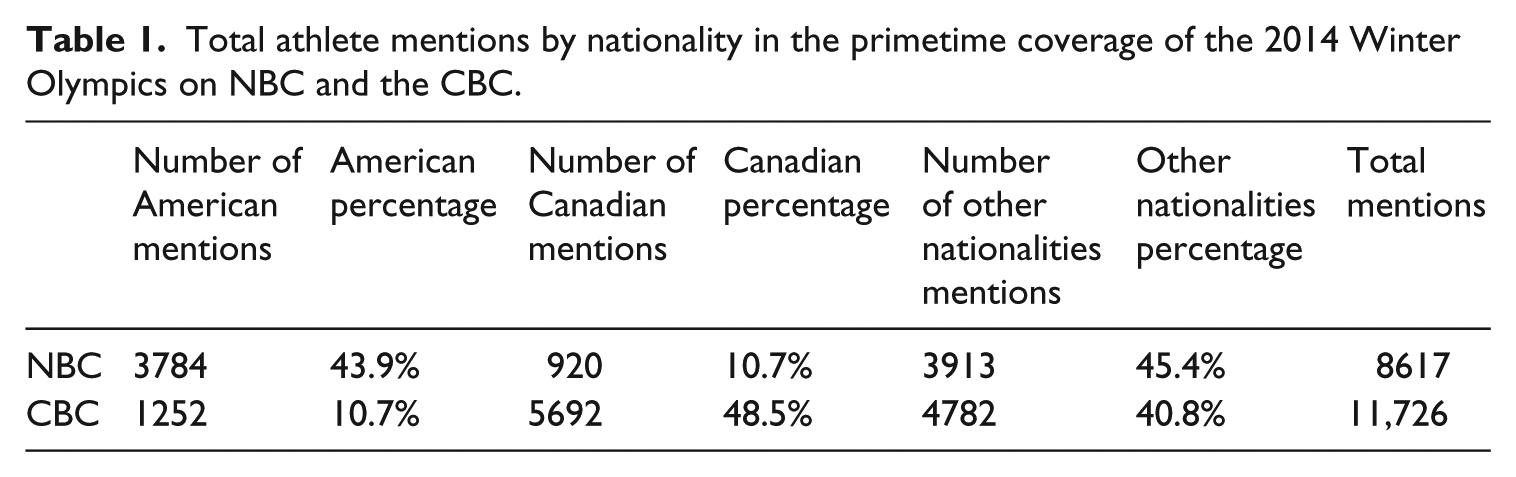
As outlined in Table 1, mentions of American athletes totaled 43.9% of the total mentions. Thus, Hypothesis 1a is supported.
Hypothesis 1b predicted Canadians would represent more than 40% of total athlete mentions in the CBC’s primetime broadcast of the 2014 Sochi Winter Games. Again referencing Table 1, Canadian athletes on the CBC represented 48.5% of the total athlete mentions, supporting this hypothesis.
Hypothesis 2a predicted the majority of the 20 most-mentioned athletes in NBC’s primetime broadcast of the 2014 Sochi Winter Games would be American. Table 2 identifies the top athletes mentioned within NBC’s broadcast.
Top 20 most mentioned athletes in the 2014 Winter Olympics primetime coverage on NBC.
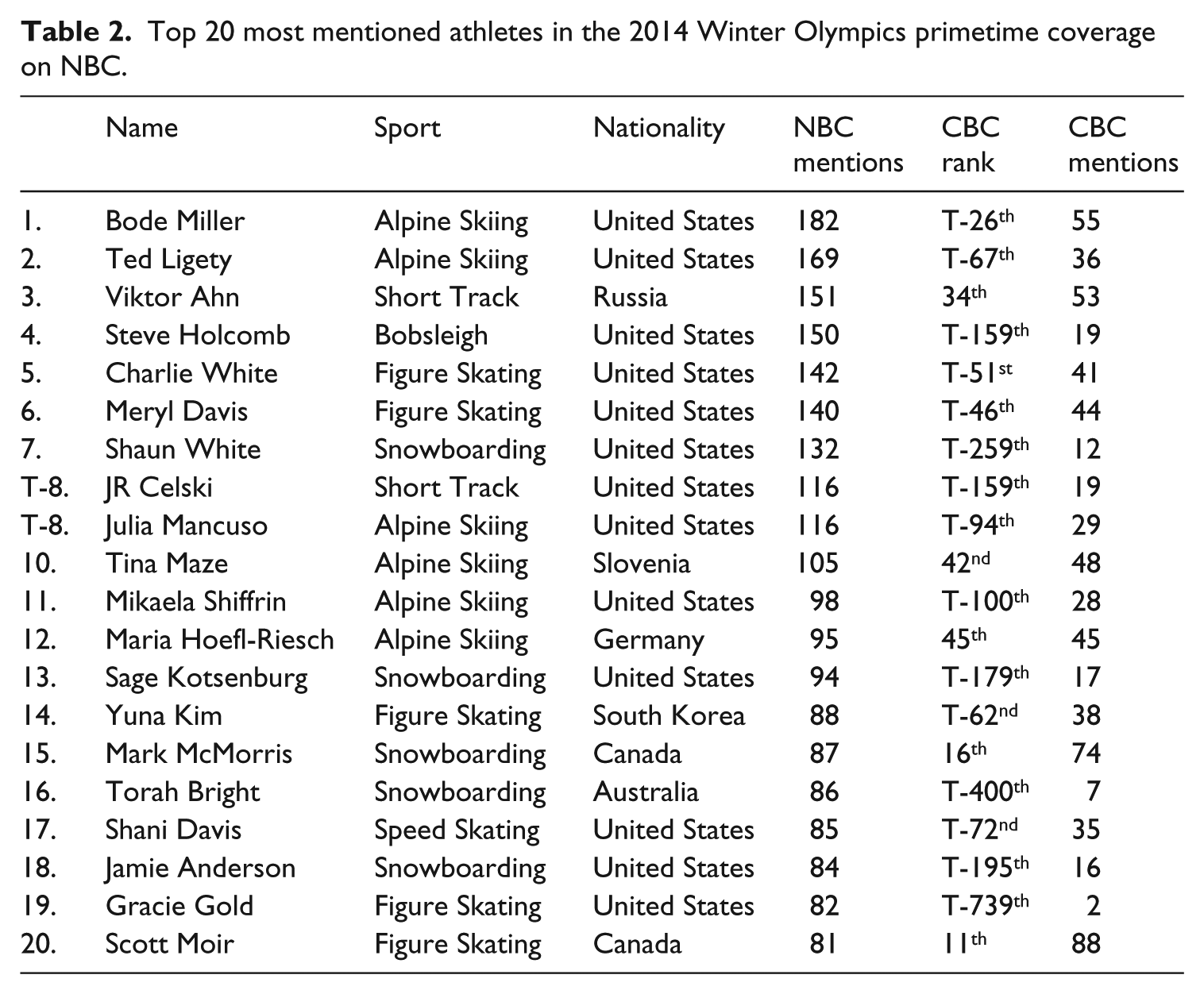
As Table 2 outlines, 13 of the 20 (65%) most-mentioned athletes were American, supporting Hypothesis 2a.
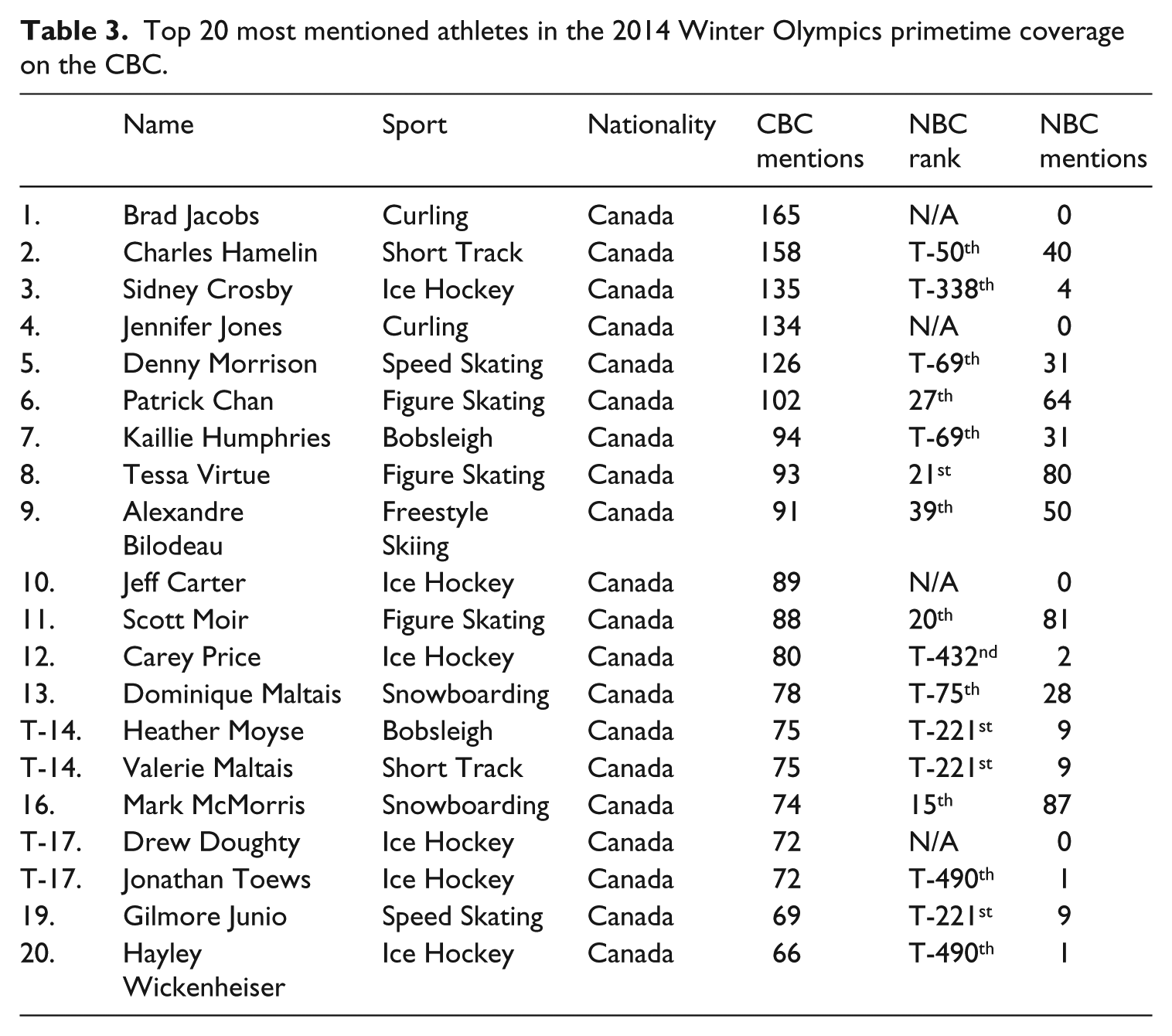
Hypothesis 2b predicted the majority of the 20 most-mentioned athletes in the CBC’s primetime broadcast of the 2014 Sochi Winter Games would be Canadian.
As shown in Table 3, all of the top 20 most-mentioned athletes were Canadian (100%), supporting Hypothesis 2b.
Top 20 most mentioned athletes in the 2014 Winter Olympics primetime coverage on the CBC.
The first three research questions attempted to determine the amount of coverage American and Canadian athletes received on the primetime broadcasts of the opposing nation. Research Question 1 asked if US and Canadian Olympic primetime broadcasts would be proportionally different in the amount of mentions dedicated to home nation athletes. Significant differences between groups were determined by using percentage of overall mentions as expected frequencies. Overall, the CBC mentioned Canadian athletes 5692 times (57% of the total mentions), and NBC mentioned American athletes 3784 times (43% of total mentions), a significant difference (χ2 = 22.84, df = 1, p < 0.001). RQ1 is answered in that the Canadian broadcast featured home athletes significantly more than the American broadcast.
Research Questions 2a and 2b queried the specific percentage of mentions Canadian athletes received on NBC’s primetime broadcast and, conversely, that American athletes received on the CBC’s primetime broadcast. Referencing Table 1, the NBC broadcast featured Canadians 10.7% of the time, with the CBC broadcast featuring Americans by the exact same proportion, answering both RQ2a and RQ2b.
Hypothesis 3a predicted NBC employee depictions of American and non-American athletic successes would be taxonomically different. Table 4 highlights these categories.
Descriptive analysis of success/failure by nationality on NBC.

χ2 = 10.08, df = 1, p = 0.005, OR = 3.47, 95% CI = 1.33, 9.05.
As outlined in Table 4, no significant differences for success were found; H3a is not supported.
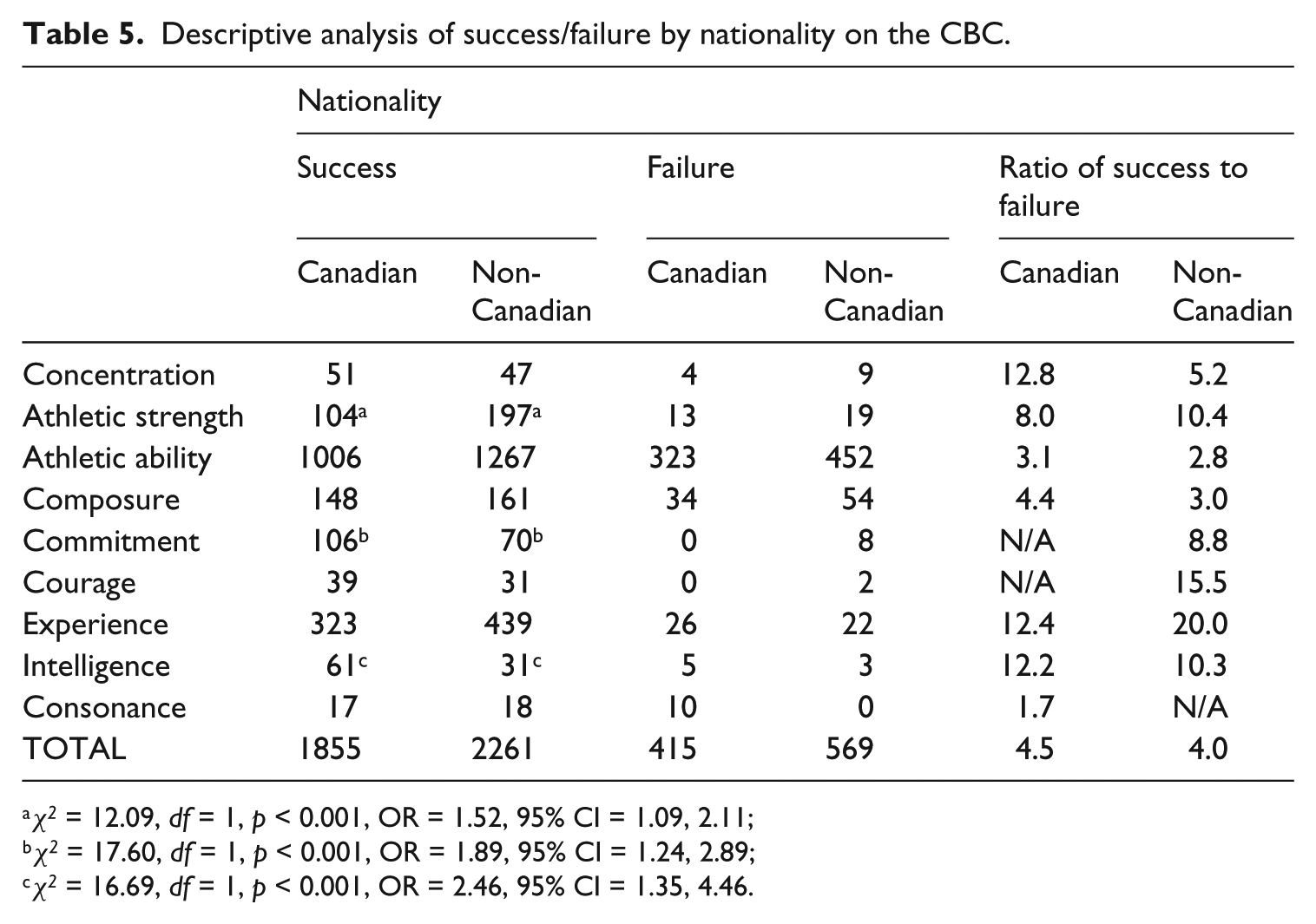
Hypothesis 3b predicted CBC employee depictions of Canadian and non-Canadian athletic successes would be taxonomically different. Table 5 highlights the frequencies in each taxonomical category, with significant differences noted.
Descriptive analysis of success/failure by nationality on the CBC.
χ2 = 12.09, df = 1, p < 0.001, OR = 1.52, 95% CI = 1.09, 2.11;
χ2 = 17.60, df = 1, p < 0.001, OR = 1.89, 95% CI = 1.24, 2.89;
χ2 = 16.69, df = 1, p < 0.001, OR = 2.46, 95% CI = 1.35, 4.46.
Significant differences were found in three of the categories: (a) athletic strength (χ2 = 12.09, df = 1, p < 0.001) disproportionately focused on non-Canadians; (b) commitment (χ2 = 17.60, df = 1, p < 0.001) disproportionately focused on Canadians; and (c) intelligence (χ2 = 16.69, df = 1, p < 0.001) also disproportionately focused on Canadians. Hypothesis 3b is partially supported.
Hypothesis 4a and Hypothesis 4b predicted depictions of athletic failure would contain significant differences on both broadcasts. As illuminated in Table 4, NBC employee depictions of athletic failures were taxonomically different in just one of the categories: experience (χ2= 10.08, df = 1, p = 0.005) disproportionately focused on Americans. Hypothesis 4a is partially supported. When examining the differences in taxonomies within the CBC broadcast, no differences were discovered. Hypothesis 4b is not supported.
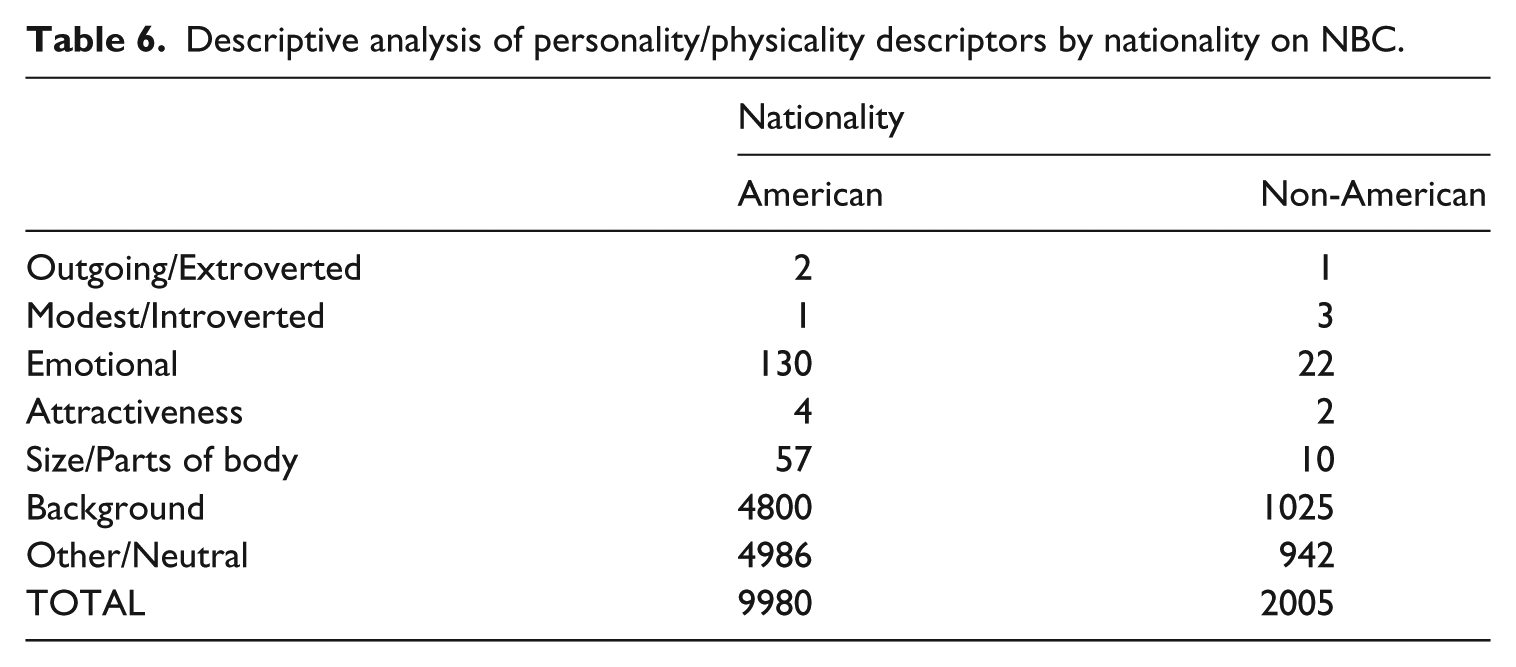
The final two hypotheses examined differences in athlete physicality/personality characterizations. Hypothesis 5a predicted NBC’s employee depictions of American and non-American physicality/personality characterizations would be taxonomically different. Table 6 highlights the frequencies in each category for NBC. There were no significant differences found. Hypothesis 5a is unsupported.
Descriptive analysis of personality/physicality descriptors by nationality on NBC.
Hypothesis 5b predicted that CBC employee depictions of Canadian and non-Canadian physicality and personality characterizations would be taxonomically different. Table 7 highlights the frequencies in each category for the CBC, with significant differences noted.
Descriptive analysis of personality/physicality descriptors by nationality on the CBC.

χ2 = 5.37, df = 1, p < 0.025, OR = 1.78, 95% CI = 0.91, 3.51;
χ2 = 14.47, df = 1, p < 0.001, OR = 1.18, 95% CI = 1.05, 1.33;
χ2 = 9.00, df = 1, p < 0.005, OR = 1.13, 95% CI = 1.01, 1.26.
Three categories had significant differences. The first two categories: (a) extroverted/outgoing (χ2 = 5.37, df = 1, p < 0.025); and (b) background (χ2 = 14.47, df = 1, p < 0.001), contained disproportionately more comments attributed to non-Canadian athletes. Additionally, the category of (c) other (χ2= 9.00, df = 1, p < 0.005) had disproportional focus upon Canadian athletes. Hypothesis 5b is partially supported.
The final research question (RQ3) asked if US and Canadian Olympic broadcasts would be significantly different in the manner in which they depict home athletes compared to the manner in which they depict athletes from other nations. Tables 8 and 9 highlight frequencies in each category for home nation and non-home nation athletes, with significant differences noted.
Descriptive analysis of successes/failures of home nation athletes on NBC and the CBC.

χ2 = 79.11, df = 1, p < 0.001, OR = 6.85, 95% CI = 3.32, 14.11;
χ2 = 165.66, df = 1, p < 0.001, OR = 7.12, 95% CI = 4.27, 11.88;
χ2 = 39.70, df = 1, p < 0.001, OR = 1.25, 95% CI = 1.14, 1.37;
χ2 = 255.16, df = 1, p < 0.001, OR = 8.16, 95% CI = 5.24, 12.71;
χ2 = 207.46, df = 1, p < 0.001, OR = 10.56, 95% CI = 6.04, 18.47;
χ2 = 27.51, df = 1, p < 0.001, OR = 3.08, 95% CI = 1.56, 6.09;
χ2 = 100.45, df = 1, p < 0.001, OR = 7.55, 95% CI = 3.84, 14.87;
χ2 = 10.30, df = 1, p < 0.005, OR = 2.25, 95% CI = 1.18, 4.27;
χ2 = 80.63, df = 1, p < 0.001, OR = 1.71, 95% CI = 1.47, 2.00;
χ2 = 35.10, df = 1, p < 0.001, OR = 4.21, 95% CI = 1.92, 9.25;
χ2 = 7.74, df = 1, p < 0.01, OR = 1.77, 95% CI = 1.04, 3.03.
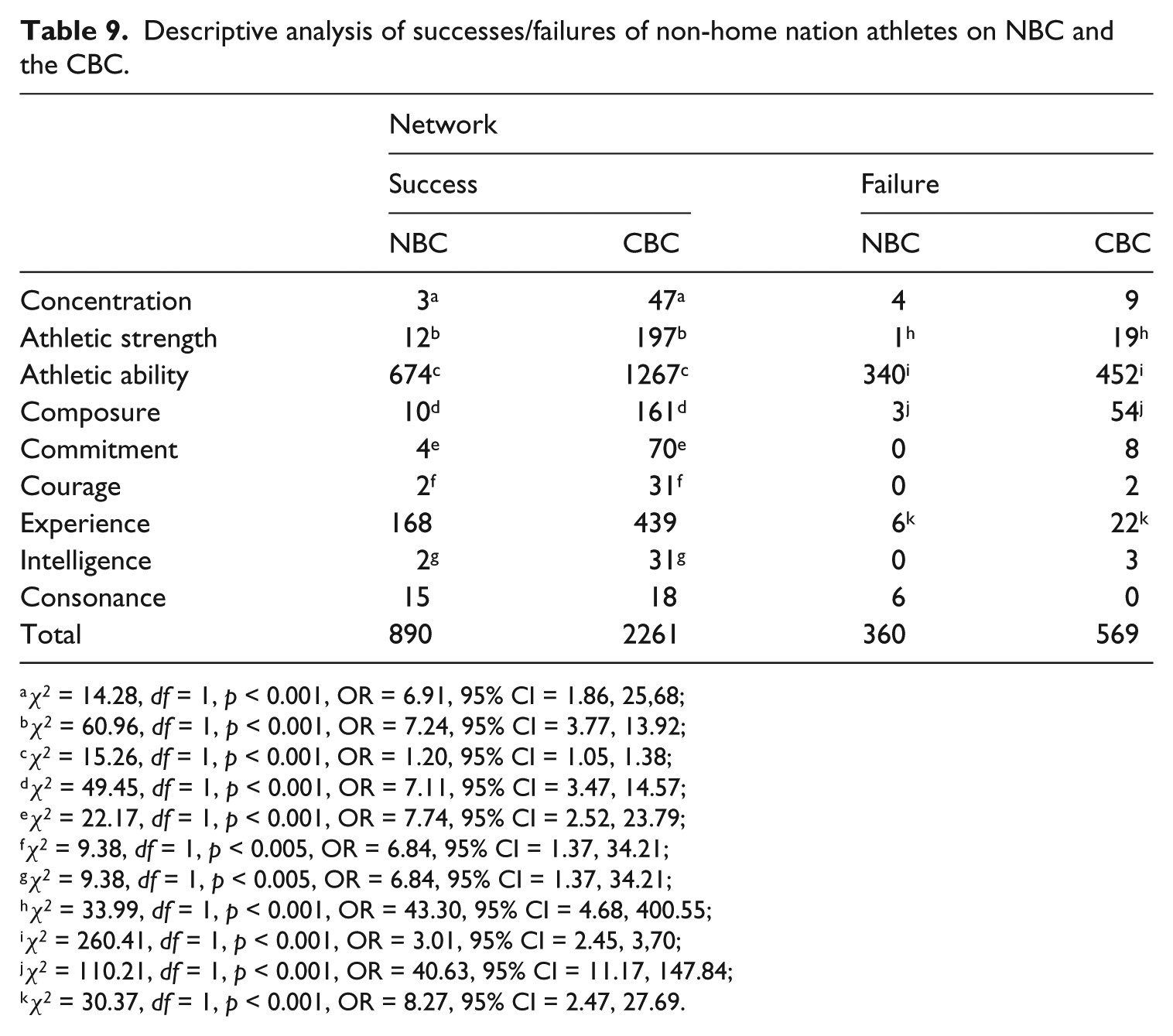
Descriptive analysis of successes/failures of non-home nation athletes on NBC and the CBC.
χ2 = 14.28, df = 1, p < 0.001, OR = 6.91, 95% CI = 1.86, 25,68;
χ2 = 60.96, df = 1, p < 0.001, OR = 7.24, 95% CI = 3.77, 13.92;
χ2 = 15.26, df = 1, p < 0.001, OR = 1.20, 95% CI = 1.05, 1.38;
χ2 = 49.45, df = 1, p < 0.001, OR = 7.11, 95% CI = 3.47, 14.57;
χ2 = 22.17, df = 1, p < 0.001, OR = 7.74, 95% CI = 2.52, 23.79;
χ2 = 9.38, df = 1, p < 0.005, OR = 6.84, 95% CI = 1.37, 34.21;
χ2 = 9.38, df = 1, p < 0.005, OR = 6.84, 95% CI = 1.37, 34.21;
χ2 = 33.99, df = 1, p < 0.001, OR = 43.30, 95% CI = 4.68, 400.55;
χ2 = 260.41, df = 1, p < 0.001, OR = 3.01, 95% CI = 2.45, 3,70;
χ2 = 110.21, df = 1, p < 0.001, OR = 40.63, 95% CI = 11.17, 147.84;
χ2 = 30.37, df = 1, p < 0.001, OR = 8.27, 95% CI = 2.47, 27.69.
For the home nation athletes, significant differences were found in 11 of the 18 (61.1%) success and failure categories. In a category-by-category analysis, disproportionately more comments focused on the success of home nation athletes on the CBC in terms of: (a) concentration (χ2 = 79.11, df = 1, p < 0.001); (b) strength (χ2 = 165.66, df = 1, p < 0.001); (c) composure (χ2 = 255.16, df = 1, p < 0.001); (d) commitment (χ2 = 207.46, df = 1, p < 0.001); (e) courage (χ2 = 27.51, df = 1, p < 0.001); and (f) intelligence (χ2 = 100.45, df = 1, p < 0.001). Conversely, NBC was more likely than the CBC to offer comments regarding athletic success for home nation athletes in the following categories: (a) athletic ability (χ2 = 39.70, df = 1, p < 0.001); and (b) consonance (χ2 = 10.30, df = 1, p < 0.005).
With respect to athletic failure, the CBC was more likely than NBC to depict failure for home nation athletes because of composure (χ2 = 35.10, df = 1, p < 0.001). Conversely, NBC was more likely than the CBC to depict failure for home nation athletes because of: (a) athletic ability (χ2 = 80.63, df = 1, p < 0.001); and (b) consonance (χ2 = 7.74, df = 1, p < 0.01).
As shown in Table 9, for non-home nation athletes, significance was also found in 11 of the 18 (61.1%) success and failure categories. For mentions of athlete successes, disproportionately more comments focused on the success of non-home nation athletes on the CBC in terms of: (a) concentration (χ2 = 14.28, df = 1, p < 0.001); (b) strength (χ2 = 60.96, df = 1, p < 0.001); (c) composure (χ2 = 49.45, df = 1, p < 0.001); (d) commitment (χ2 = 22.17, df = 1, p < 0.001); (e) courage (χ2 = 9.38, df = 1, p < 0.005); and (f) intelligence (χ2 = 9.38, df = 1, p < 0.005). Disproportionately more comments focused on the success of non-home nation athletes on NBC in one category: athletic ability (χ2 = 15.26, df = 1, p < 0.001).
For depictions of athletic failures for non-home nation athletes, NBC was more likely than the CBC to focus on: (a) strength (χ2 = 33.99, df = 1, p < 0.001); (b) athletic ability (χ2 = 260.41, df = 1, p < 0.001); (c) composure (χ2 = 110.21, df = 1, p < 0.001); and (d) experience (χ2 = 30.37, df = 1, p < 0.001). For the CBC, no categories had disproportionally more comments focused on athletic failures for non-home nation athletes.
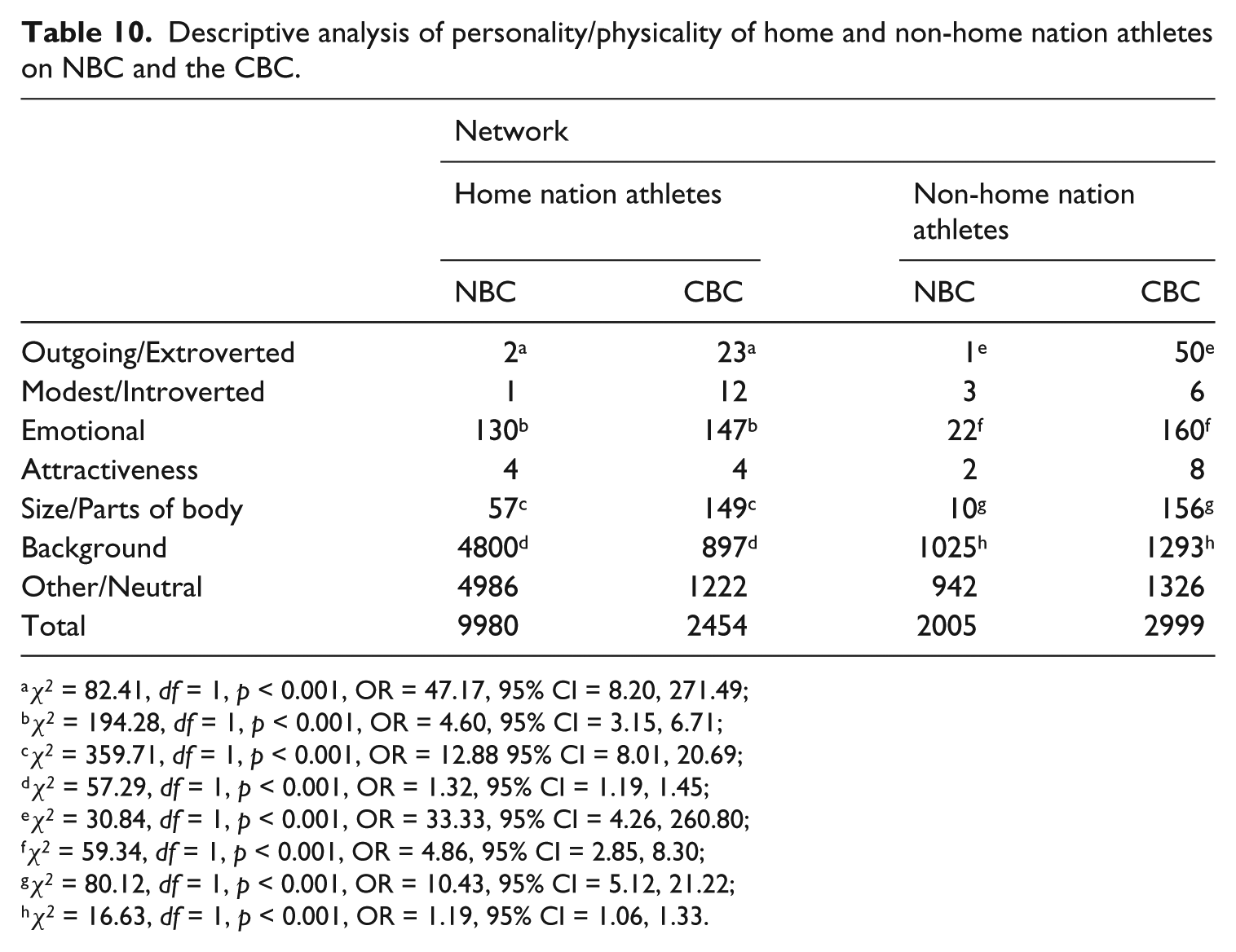
With respect to personality descriptors, Table 10 highlights the frequencies in each category for home nation and non-home nation athletes, with significant differences noted.
Descriptive analysis of personality/physicality of home and non-home nation athletes on NBC and the CBC.
χ2 = 82.41, df = 1, p < 0.001, OR = 47.17, 95% CI = 8.20, 271.49;
χ2 = 194.28, df = 1, p < 0.001, OR = 4.60, 95% CI = 3.15, 6.71;
χ2 = 359.71, df = 1, p < 0.001, OR = 12.88 95% CI = 8.01, 20.69;
χ2 = 57.29, df = 1, p < 0.001, OR = 1.32, 95% CI = 1.19, 1.45;
χ2 = 30.84, df = 1, p < 0.001, OR = 33.33, 95% CI = 4.26, 260.80;
χ2 = 59.34, df = 1, p < 0.001, OR = 4.86, 95% CI = 2.85, 8.30;
χ2 = 80.12, df = 1, p < 0.001, OR = 10.43, 95% CI = 5.12, 21.22;
χ2 = 16.63, df = 1, p < 0.001, OR = 1.19, 95% CI = 1.06, 1.33.
For home nation athletes, significant differences were found in four different categories, with the CBC disproportionately more likely than NBC to focus on home nation athletes in terms of being: (a) outgoing/extroverted (χ2 = 82.41, df = 1, p < 0.001); (b) emotional (χ2 = 194.28, df = 1, p < 0.001); and (c) size (χ2 = 359.71, df = 1, p < 0.001); NBC had disproportionately more comments than the CBC regarding background (χ2 = 57.29, df = 1, p < 0.001). For non-home nation athletes, the CBC was disproportionately more likely than NBC to focus on the following categories: (a) outgoing/extroverted (χ2 = 30.84, df = 1, p < 0.001); (b) emotional (χ2 = 59.34, df = 1, p < 0.001); and (c) size (χ2 = 80.12, df = 1, p < 0.001). For non-home nation athletes, NBC was disproportionately more likely to focus on background (χ2 = 16.63, df = 1, p < 0.001). Research Question 3 is answered forcefully, as the majority of categories yielded significant differences.
Discussion
Observing how US and Brazilian broadcasters employed different narratives when covering the 2002 World Cup soccer championships, Billings and Tambosi (2004) claimed that, “the game being played is not always the [same] game that is described on network television” (164). In Sochi, the CBC and NBC presented exceptionally different narratives of the 2014 Olympiad. Both whittled thousands of hours of competition and ceremonies into 18 nights of programming consisting of enacted sport along with features, interviews, promos and commercials. This framing (Goffman, 1974) involved the selection, emphasis, and exclusion (see Gitlin, 1980) of content designed to appeal to two different audiences that, while sharing a 5525 mile border, have different cultures and national loyalties.
Using cultural proximity as a core programming value within the primetime Olympic broadcasts, the CBC and NBC employed forms of Canadian and American nationalism respectively. In the process, both partook in “us vs. them” dialogues, potentially reinforcing in-group/out-group identifications based upon national identity. Nation-centric narratives are not surprising—they have been part and parcel of Olympic media since the modern Games began in 1896 (see Dyreson, 2008a)—but the differences in the manner and degree in which the two networks engaged in this practice provide insight into the respective networks, audiences, and national sporting cultures.
From the standpoint of athlete success, both networks emphasized home athletes at a greater rate than their medal success. American athletes won 10.1% of all medals and 9.1% of gold medals, yet received 43.9% of all mentions on the NBC broadcast, suggesting Americans were mentioned at a rate of 4.6–4.8 times their medal success. Canadian athletes won 8.5% of all medals and 9.5% of the gold medals, but received 48.5% of all mentions on the CBC, suggesting Canadian athletes were mentioned at a rate of 4.8–5.7 times their medal success. Thus, when medal success is the barometer, both broadcasts placed a heightened emphasis on in-group (home) athletes at the expense of out-group (foreign) athletes, with the CBC’s home athlete emphasis at a greater ratio than NBC’s.
Contrasts between the two broadcasts become more evident when composite home nation mentions are compared and unpacked to account for celebrity (i.e. the most-mentioned athletes). For instance, the United States sent 230 athletes to the Winter Games and 198 different American Olympians received mentions on NBC, including Winter and Summer Olympians from the past. Canada sent 222 athletes to the Winter Games and 412 different current and former Canadian Olympians received mentions on the CBC. Additionally, as noted in RQ1, when contrasting both broadcasts in terms of overall mentions for home nation and foreign athletes, the CBC placed significantly more emphasis on home nation athletes than NBC.
If the aforementioned significant difference provides evidence that the CBC had a heightened focus on its home nation athletes, the network’s list of the top 20 most-mentioned athletes crystallizes this contrast. 65% of NBC’s top 20 most-mentioned athletes were American, a finding relatively consistent with other US Olympic broadcasts (Billings, 2008), with seven athletes from six other countries rounding out the list. The CBC, however, contained no national diversity in its top 20 list, as all of the athletes were Canadian. The highest ranked non-Canadian on the CBC’s broadcast was Bode Miller (NBC’s most mentioned athlete), tied for 26th place with five other Canadians. When compared to previous US Olympic broadcast studies, this CBC finding has no parallel. Americans have never accounted for more than 75% of the most-mentioned list in any US Olympic primetime broadcast studied from 1994–2014 1 (Angelini et al., 2012; Billings, 2008; Billings et al., 2014; Eastman and Billings, 1999). From the standpoint of media framing, the CBC’s emphasis function was heavily tilted towards Canadian athletes, as non-Canadians were not the central focus of major CBC primetime Olympic stories.
An example of this heightened difference between the two broadcasts is the treatment of Viktor Ahn. The Russian (formerly South Korean) short track speed skater earned more medals than any other male Olympian at the 2014 Games, and was the second most decorated athlete in Sochi. Ahn, who was NBC’s third most-mentioned athlete, ranked 34th on the CBC’s broadcast. His celebrity on the NBC broadcast was partially influenced by his rivalry with American JR Celski, yet Ahn also had aduels with Canadian Charles Hamelin, the second most-mentioned athlete on the CBC broadcast, who won only one medal. As such, Ahn’s achievements were portrayed as secondary to a Canadian who was not as successful in the same discipline.
There are multiple instances where both broadcasts downplayed significant accomplishments of foreign athletes. Dutch speed skater Irene Wüst was Sochi’s most successful Olympian with five medals, yet she was relegated to footnote status on both NBC (101st place) and the CBC (67th place). Wüst’s lack of attention was likely influenced by the fact that neither the US nor Canada fielded a medaling female speed skater in Sochi. Likewise, Norwegian biathlete Ole Einar Bjørndalen became the most decorated Winter Olympian in history, but fared worse than Wüst on both NBC (220th place) and the CBC (339th place) broadcasts. Canada and the US historically perform poorly in biathlon, yet the networks’ lack of attention to this historic accomplishment indicates the degree to which the emphasis function favors home athletes and sports at the expense of others. Another example is Norwegian cross country skier Marit Bjørgen, whose three medals in Sochi brought her lifetime total to 10, tying her for first place as the most decorated female Winter Olympian in history. Her treatment from NBC was more meager in 2014 than in 2010, as she was not mentioned once in primetime. The CBC covered Bjørgen enough to place her as the 75th most-mentioned athlete, though arguably the attention was not in line with her accomplishments. Bjørgen’s exclusion from NBC’s primetime broadcast and her diminishment on the CBC broadcast indicate the extent to which nationalistic tendencies and pride—both countries are non-entities in cross country—influence network Olympic frames.
Athlete mentions also provide insight into each nation’s sense of sporting identity. Canadian curling captains Brad Jacobs and Jennifer Jones ranked first and fourth respectively on the CBC broadcast, but received zero mentions on NBC. A popular sport in Canada (the team won gold for both men’s and women’s teams), curling is an afterthought in the US, warranting virtually no attention from NBC in primetime. Likewise, hockey has a strong role in Canadian culture and national identity (see Blake, 2010; MacGregor, 2004; Whitson and Gruneau, 2006) and six of the CBC’s top 20 most-mentioned athletes were hockey players, compared to none for NBC.
The differential treatment in snowboarding could also be seen as mirroring national performance and sporting culture. Shaun White was ranked 259th on the CBC, compared to 7th for NBC. Though he failed to medal in Sochi, his story had significant salience. For more than a decade, White has been snowboarding’s biggest star and most dominant figure. His withdrawal from the slopestyle event, as well as his attempt (and subsequent failure) to win a record-setting third gold medal in halfpipe, were significant stories that received proportionally less coverage from the CBC. Snowboarders accounted for 25% of the NBC most-mentioned list, likely the result of US dominance in the event—26.7% of the medals since its 1998 Olympic debut—and the sport’s perceived homegrown roots as its modern origins are largely US based (see MacArthur, 2009).
How the networks rendered athletes from across the border is also telling. Though both networks devoted 10.7% of mentions to their neighboring athletes, the broadcasters often used them as supporting players to their hometown heroes. For example, the ice dancing rivalry between Canadians Tessa Virtue/Scott Moir (silver) and Americans Charlie White/Meryl Davis (gold) was portrayed differently, with the CBC emphasizing the Canadian team and NBC the US team. Likewise, in snowboard slopestyle, American Sage Kotsenburg’s upset victory over Canadian Mark McMorris resulted in two different narratives. McMorris entered the Games the bigger international star, but when Kotsenburg scored gold, NBC catapulted him to celebrity status, while the CBC kept the story firmly focused on McMorris, with Kotsenburg mentioned just 17 times.
Differences in the broadcasts persisted not only within home athlete salience, but also in how home nation and “other” athletes were described. In contrast to previous studies, NBC’s rendering of American and non-American athletes contained minimal divergences, with only one category yielding significant differences. The CBC’s picture of Canadian and non-Canadian athletes contained more contrasts, yet the combination of these differences did not create a singular “us vs. them” narrative. For instance, non-Canadian athletes were more likely to receive both objective (background) and non-objective (extroverted) descriptors. The subjective notions of commitment and intelligence were used to describe Canadian success. This certainly could be perceived as a pro-Canadian rendering appealing to national pride, but one Olympiad is not enough to declare a trend. Crediting non-Canadian successes to strength, while crediting Canadian success to commitment and intelligence, would allow for a stronger view of Canadian athletes as it suggests they overcame difficult odds, but again, there is insufficient information to formally indicate a trend.
When the CBC and NBC are compared, the US and Canadian Olympic broadcasts contained 30 significant differences in the manner in which they depicted home athletes compared to athletes from other nations. Such a high volume indicates that a starkly different duality of narratives unfolded on both networks, yet in different taxonomical areas. For example, NBC was more likely to focus on athletic ability and consonance as reasons for American success and failure, whereas the CBC was more likely to focus on composure as the reason for Canadian success and failure. Athletic ability was seemingly more of a narrative on NBC as the network was more likely to credit it as a reason for non-American athlete success and failure. Within the areas of personality/physicality, NBC was more likely to focus the backgrounds of both American and non-American athletes, while the CBC focused more on the size, extroversion, and emotions of Canadian and non-Canadian athletes. It is also worth noting that the total number of descriptors heard on NBC and the CBC was starkly different, with audience members hearing nearly twice as many descriptors throughout the primetime broadcast on NBC compared to what would have been heard on the CBC. It was observed during NBC’s primetime coverage that much time was spent at competition venues, while the CBC appeared to focus more on in-studio commentary and interviews, which led to more discussion of the Olympic events and not specific athletes, as well as more discussions by individuals not employed by the CBC (such as coaches, athletes, and athletes’ family members). This is consistent with similar decreases found in Chinese commentary during the 2008 Summer Olympics when compared to NBC (Billings et al., 2011). Such differences show that American and Canadian audiences received different narratives based on which athletes were selected, emphasized, and excluded, and how these selected athletes were described.
The differences in how the CBC and NBC render home and foreign athletes are noteworthy. The exclusion or diminishment of “other” athletes can lead to symbolic annihilation (see Gerbner and Gross, 1976; Tuchman, 1978) for certain athletes, their sports, and their nations, when networks focus on the successes of home athletes at the expense of both foreign athletes and sports where other nations dominate. By concentrating on Olympic sports that are popular in a particular country—typically sports in which that home nation excels—and creating narratives centering around home nation athletes, the networks generate a distorted image of the Olympic Games that could lead to audiences having an inaccurate view of a nation’s relevance in global sport.
Billings et al. (2015) observed a relationship between the level of patriotism, nationalism, internationalism, and smugness, and the amount of Olympic media consumption. Billings et al. (2013a) found, for instance, that US smugness peaked at the end of the 2012 London Games, after the US secured the top place on the medals table. Thus, exposure to nationalized Olympic media could transcend the theoretical, predicting one’s nationalistic attitudes. Such connections cannot be understated. If the Olympics are a truly global event, the stories Olympic media create have the potential to shape how viewers perceive global sport, global culture, and the nebulous “other” embodied within all other nations.
Conclusion
Reflecting on his brief term as the president of the American Olympic Committee, General Douglas MacArthur remarked that while trying to motivate his 1928 Summer Olympians, “I told them we represented the greatest nation in the world, that we had not come 3000 miles just to lose gracefully, that we were there to win, and win decisively” (MacArthur, 1964: 86). Such competitive zeal is certainly not just an American trait. Indeed, the nation vs. nation nature of the Olympics creates senses of both patriotism and competitiveness, merged with a craving to see one’s home nation athletes not only perform well, but be victorious.
Yet, even if one’s home nation athletes perform poorly, there is often a greater desire to see them compete than watch athletes from “other” nations perform in sports that are relatively “foreign” to a certain nation. Smith (2012) remarked “it may be fine if a United States team is not consistently shown winning every event in the Olympics, so long as the commentators focus on the positive attributes of the team or player” (188). Indeed, the CBC and NBC stories of the Sochi Olympiad appear to not only be about American or Canadian successes, but also about Americans or Canadians as central figures in sporting narratives, regardless if the home athletes were completely successful in their efforts. These stories, whether about the thrill of victory or the agony of defeat, were carefully crafted to celebrate home athletes.
Though Dyreson (2008b) argues that, with the possible exception of Greece, “the United States has been crafting patriotism for longer and with greater vigor than any other polity” (136), this study suggests that the CBC has equaled, if not surpassed its North American cousin in terms of creating a primetime Olympic broadcast narrative that appeals to nationalistic leanings. As such, the results do lend some credence to a claim made by former NBC executive Dick Ebersol about the content of his network’s Olympic broadcasts: I’ve had this conversation many times with broadcasters from other parts of the world. They’re always amazed that media in the United States criticizes us for being too nationalistic. They feel just the opposite. They think we have the most diversity (Billings, 2009: 14).
Yet, if the CBC’s primetime broadcast leans more towards its home nation, both primetime broadcasts of the Sochi Olympiad demonstrate how the two broadcasters emphasized athletes from their home countries to tell Olympic stories designed to appeal to the widest possible national audiences. By centering their narratives mostly on the triumph and the struggle of home nation athletes, the CBC and NBC gave more credence to Pierre de Coubertin’s long ago voiced concern that “The Olympic Games [are] becoming an affair of state” (Senn, 1999: 30).
Footnotes
Funding
This research received no specific grant from any funding agency in the public, commercial or not-for-profit sector.