




Abstract
Equestrian sport is one of the largest sports among young girls in Sweden. A majority of these girls get their riding education at riding schools that provide horses and instructors. Previous research has pointed out that the Swedish riding school is characterised by a traditional stable culture that originated in army practices. Presently Swedish children and youth sport at large are undergoing a change driven by increased commercialisation and individualisation. The aim of this article is therefore to explore and analyse how Swedish riding instructors perceive and experience their professional role in regards to these changes. Interviews with 10 riding instructors have been analysed using a constructivist approach of Grounded theory, as well as institutional theory and institutional economic theory. It was discovered that the riding instructors, due to an economic recession, feel that the institutional arrangements of the riding schools have become governed by the economy. The riding instructors thus feel impelled to change and adapt to new teaching styles – from instruction characterised by giving orders to teaching characterised by dialogue. This study illustrates how economic challenges require continuous development of the riding instructors’ pedagogical ability, and have made them more aware of their profession, its historical heritage and norms.
Introduction
Equestrianism is one of the largest sports among young girls in Sweden. Previous research has indicated that the Swedish riding school is characterised by a traditional stable culture that originated in army practices (Forsberg and Tebelius, 2011; Hedenborg, 2009a; Lundesjö-Kvart, 2013; Thorell and Hedenborg, 2015). Horse riding is a complex activity that involves interspecies communication and a human–horse relationship (Birke and Brandt, 2009; Birke et al., 2004; Dashper, 2016). The riding instructor has a crucial role in teaching communication between humans and horses. Presently, Swedish children and youth sport in general are undergoing a change driven by increased commercialisation and individualisation. Previous research has yet to address whether these changes have influenced riding school instructors and, if so, how. The aim of this article is therefore to explore and analyse how Swedish riding instructors perceive and experience their professional role.
The Swedish riding instructor and equestrian trainer
In order to discuss and analyse the role of the Swedish riding instructor, it is important to define this function. The title Riding Instructor is internationally recognised by the International Group for Equestrian Qualifications (IGEQ), although several countries use the term Riding Teacher. The title is derived from military vocabulary (Auty, 2008; Dashper, 2016; Lundesjö-Kvart, 2013; Maw, 2012; Thorell and Hedenborg, 2015). In equestrian sports, instructors are divided into four levels. The fourth and highest level, called ‘Swedish Fellow’, is awarded by the Swedish Equestrian Federation (SvRF) (SvRF, 2015b).
The Swedish Sports Confederation offers no uniform coaching courses. Instead, each sports federation (such as SvRF) is free to design its own courses in terms of content and structure (Hedberg, 2015). The educational programme through which one becomes qualified as a riding instructor is offered in different formats and at different places in Sweden; however, the Swedish National Equestrian Centre at Strömsholm (SNECS) constitutes the main centre and is also the educational centre of the SvRF (Thorell and Hedenborg, 2015). The educational formats offered span from one semester of distance learning in a vocational school, to a three-year university programme, and also includes a Bachelor’s degree in Equine Studies.
Unlike many other leaders and coaches for Swedish children and youth sport, riding instructors are employed by, or self-employed at, riding schools,. As part of this professional role, they conduct teaching and are also usually responsible for tasks related to the daily care of horses, the operation of the facilities and administrative work. This makes the role of the riding instructor complex on several levels.
Riding instructors have a different role and function from Equestrian trainers. The education that equestrian trainers receive is geared towards their professional role, which principally entails training riders with their own horses, who do not usually take part in lessons at a riding school, for sport and competition. In order to become a licensed trainer, it is necessary to pass several courses at different levels. Basic education for trainers includes a 12-day distance-learning course (SvRF, 2015c). This article will focus on the role of the riding instructor at the riding school.
Swedish children and youth sport
In Sweden, as in the other Scandinavian countries, sports activities are clearly shaped by a social democratic welfare regime under the slogan ‘sports for all’ (Larsson and Bäck, 2008). Sports and recreational activities for children and young people are subsidised by the government, based on the idea that participation in sports activities teaches children and young people social interaction, democratic processes and sound values (Norberg and Bergsgard, 2010).
Swedish children and youth sport have undergone several changes in the past decades. In recent years, children and youth sport clubs have lost young practitioners to other activities (Hedenborg and Glaser, 2013; Norberg, 2014; Thedin Jakobsson, 2015; Toftegaard Stöckel et al., 2013). In equestrian sports, this is evinced by a decrease in the number of members at riding schools. Another change is the increasing commercialisation of physical activities for children and youth organised by sports clubs (Coakely and Pike, 2014; Toftegaard Stöckel et al., 2013; Wagnsson and Augustsson, 2015), as well as in physical education in schools (Walseth et al., 2015). Furthermore, an additional development that is likely to have influenced the sports movement is the neo-liberalisation of the school system in the past two decades, leading to a growing focus on market adaptation and educational development characterised by individualisation (Carlgren et al., 2006; Lundahl et al., 2013). Individualisation is reflected in sports as well, and previous research has indicated that it is important for coaches to understand and adapt to these changes (Höigaard et al., 2008; Jowett, 2008). Whether this development has influenced the professional role of the riding instructor will be discussed below.
The direction and content of pedagogical leadership have been problematised in research on children and youth sport and, as a consequence of this, new demands are put on sports leaders (Hertting, 2010). The leadership role in sports is complex, and requires flexibility and didactic adaptation. In addition, it requires expertise in several different fields such as didactics, physiology, psychology and sociology (Armour, 2011; Gilbert and Trudel, 2001). Knowledge about aspects of children’s learning development is also necessary in order to educate children and young people (Walsh, 2011).
The Swedish Sports Confederation has designed a concept paper (SvRF, 2012) that is fundamentally based on the Convention on the Rights of the Child (United Nations, 1989). This document provides guidelines for how sports for children and young people should be conducted. This means that sports leaders are expected to lead activities, competitions and regulations appropriate for young practitioners (Eliasson, 2015; Toftegaard Stöckel et al., 2013; Redelius, 2012). Previous research has shown that leaders in children and youth sport have limited power to influence the design of children’s sports activities in general, despite their important educational role (Redelius, 2002). In recent years, Swedish sports coaches have been criticised for a lack of adequate skills. However, it is problematic to impose higher requirements on the leaders when most of them are volunteers (Hedberg, 2015).
Overall, it seems reasonable to assume that the role of riding instructor is facing considerable challenges. It is therefore interesting to study how this professional role is perceived and experienced by active riding instructors.
The Swedish riding school
As of 2016, there are 450 riding schools in Sweden that are linked to the Swedish Equestrian Federation (SvRF), and 90 percent of active riders are female (SvRF, 2015a). Swedish riding schools are organised in a number of different ways: while many are operated by sports clubs, some are privately owned, either by an individual or a cooperative. In the case of sports club-operated riding schools, members elect a board that works on a voluntary basis to represent the members’ interests (Smith, 2009). Municipal governments play an important role in the riding schools operated by sports clubs, especially through the subsidisation of riding school activities. Municipalities do not actively partake in the management of riding schools. Regardless of organisational form, however, it is important to have a balanced economy (Smith, 2009).
Swedish riding schools offer basic group training in horse handling and riding for both children and adults. The primary objective of this training is riding for leisure and pleasure and, to a lesser degree, competition. It is common that girls and young women engaged in horse riding at the riding school ride for one hour per week and then spend many hours in the stable taking care of the riding school horses (see e.g. Forsberg, 2007; Forsberg and Tebelius, 2011; Hedenborg, 2009a, 2013; Nikku, 2005). Unlike in many other countries, riding at riding schools in Sweden is not only a pastime of wealthy families, as riding is subsidised, just like other child and youth sport activities (Forsberg and Tebelius, 2011). Previous research on riding school activities has emphasised that young girls develop leadership skills, initiative and a sense of responsibility by being active in the stable environment and taking care of horses (Forsberg, 2007; Forsberg and Tebelius, 2011; Gilbert, 2014a, 2014b; Nikku, 2005; Ojanen, 2012; Thorell and Hedenborg, 2015). Research on the role of the Swedish instructor is lacking.
Teaching riding is central at Swedish riding schools, and involves many aspects, not least when it comes to managing the riders (pupils at the riding school) and the horses, their temperament and behaviour (Hassler-Scoop and Kelly, 2002; Wolframm, 2014). This separates equestrian sports from many other sports; in addition to being knowledgeable about how children and young people learn to ride, the riding instructors must also have knowledge about how to train and care for horses (Wolframm, 2014). Therefore, horse riding can be seen as a complex activity based on interspecies communication (Birke and Brandt, 2009; Birke et al., 2004; Dashper, 2016; Gilbert and Gillet, 2011). The goal of riding is to create a relationship with the horse based on contact and collaboration.
Safety is an important part of the training provided at riding schools, as injuries can be sustained while handling or riding horses. The risk of injury may also be higher among people lacking knowledge of horse ethology and behaviour (Thompson et al., 2015). Thus, one of the primary tasks for Swedish riding schools is to educate riders in such a way that they are less likely to injure themselves at the riding school or while handling horses in other environments (SvRF, 2013). Instructors at riding schools must always be safety conscious, and riding lessons are structured so as to avoid accidents and near misses.
Besides teaching riding, the instructors play a strong role in the reproduction and maintenance of what may be called stable culture, by formulating rules and procedures for horse care and riding. Since the 1950s, equestrianism has undergone major changes, from being closely connected to the army to becoming a part of the sports movement and providing activities for children and young people (Hedenborg, 2006, 2009a, 2009b, 2013). Despite other changes that have taken place within the sport, however, it has been demonstrated in a previous study that military traditions are still apparent in the education of riding instructors today (Thorell and Hedenborg, 2015). Thorell and Hedenborg (2015) used institutional economic theory to explain this continuity in the stable culture, underlining that transaction costs were simply too high to alter the dominant framework. Neither those in charge of the instructors’ education nor those who attended the courses had anything to gain from an educational change of direction. Practical skills such as efficiency, orderliness and responsibility still had great value in stable culture (Thorell and Hedenborg, 2015), and continued to be highly valued even after riding instructor education ceased to be managed by the military. Although the new riding instructors were educated in a civil environment, they appropriated military traditions. The system of riding instruction in Sweden has, in recent years, been criticised for being archaic (Lundesjö-Kvart, 2013). Lundesjö-Kvart (2013) writes that the lack of development is due to riding instructors clinging to traditional patterns out of convenience or, as formulated by Thorell and Hedenborg (2015), high transaction costs. According to previous research by Lundesjö-Kvart (2013), the traditional model of riding instruction where the instructor only gives orders is no longer suited to Swedish riding schools.
Previous research has indicated that the international equine industry has become more compartmentalised and entrepreneurial, with a strong focus on competitions (c.f. Dashper, 2016; Gilbert, 2014a; Gilbert and Gillet, 2011; Maw, 2012). Gilbert (2014a) has analysed Pony Clubs in Canada, concluding that they have become increasingly commodified over time. Rather than relying on volunteer labour, equestrian coaching has become professionalised. Dashper (2016) claims that there is a need for riding lessons to develop and be adapted to the new generation of modern equestrian sport. Teaching riding involves a complex interplay of different sensorial stimuli, and the instructor’s role is to help the rider to communicate with the horse in such a way as to achieve harmony and partnership (Dashper, 2016). Thus, riding lessons can expand the dyadic relationship between horse and rider. In England, the equestrian teaching system at the British Horse Society has progressed (Maw, 2012). As riding for leisure and competition has created a demand to suit individual riders’ goals, riding lessons have become more individualised. It is necessary for riding instructors to have a knowledge of teaching methods, the pedagogical theories behind teaching, and an understanding of the history of their practice (Maw, 2012). Riding instructors are usually reliant on their own riding skills rather than on their pedagogical and theoretical understanding (Maw, 2012). The instructor must be an experienced rider with kinaesthetic knowledge and competence in the sport in order to be able to teach riding to others (Dashper, 2016). However, a good rider is not automatically a good teacher. Including pedagogical theory into the education that riding instructors receive would improve the quality of teaching at riding schools, leading to better riding skills and greater horse welfare (Maw, 2012). Auty (2008) also argues that teaching riding today requires more of a coaching approach, entailing dialogue with the rider rather than one-way instruction. Learning to ride is an ongoing, never-ending process that constantly challenges the rider to adapt and improve new skills (Dashper, 2016). Whether the Swedish riding school is undergoing similar changes will be discussed below.
Methodology and theoretical perspective
The aim of this article is to explore and analyse how Swedish riding instructors perceive and experience their professional role. Due to the lack of previous research on the riding instructor’s role, an exploratory approach was necessary. This study is therefore based on two steps of method and theory.
As a first step, we decided to explore the field from the riding instructors’ perspective. Grounded theory (GT) is particularly suited for exploring novel areas of research, and gives the opportunity to discover new fields (Charmaz, 2006; Glaser and Strauss, 1967; Strauss and Corbin, 1998). Grounded theory is also especially useful for explaining different processes of meaning (Holt and Tamminen, 2010). In this study, we have chosen to be inspired by Charmaz’s (2006) perspective on GT based on a social constructivist approach. Unlike the classic positivist approach, which is represented by Glaser (2001), the social constructivist approach in GT takes a less strict and normative approach and instead focuses on understanding through interpretation (O’Connor et al., 2008). The constructivist focus of GT is based on the notion that researchers produce knowledge through their interpretations of the informants’ actions and behaviour (Charmaz, 2009). The ambition is to enter the informant’s world and be part of the meaning of the world that is studied through the empirical data collected. Therefore, the result can be seen as an interpreted portrait of the studied world, rather than a precise image of it (Charmaz, 2006).
At the first stage, we have attempted to understand the role of the riding instructors, and the context they operate in, by constructing a theoretical explanation grounded in empirical data. The explanation generates a picture of reality as it appears to the informants. This picture is useful in seeking to understand and explain their reality (Corbin and Strauss, 2008). We have simultaneously been processing the literature, and continued to do so after compiling our results, as it is only after designing adequate categories that one can relate to the relevant literature.
The next step was to analyse the results with the help of institutional theory (e.g. Berger and Luckmann, 1991; Eriksson-Zetterquist, 2009; Meyer and Rowan, 1977) and institutional economic theory (e.g. North and Thomas, 1973). Riding instructors engage, operate and participate in a specific social context: the riding school. Based on previous research, the riding school can be seen as an established institution in which people are influenced and governed by a historically contingent social order: the stable culture, in which military norms and arrangements are paradigmatic (Thorell and Hedenborg, 2015). In order to gain insight into the riding school as an institution, it is necessary to understand its origins and structure (c.f. Eriksson-Zetterquist, 2009). The institutional arrangement of the riding school is the product of generations of people performing similar acts, which form a pattern (c.f. Berger and Luckmann, 1991). In addition, people are guided and influenced by these patterns (Eriksson-Zetterquist, 2009). One important insight is that altering institutional arrangements, both formal and informal, can be expensive, not least as the formulation of new institutional solutions takes time and energy (c.f. North and Thomas, 1973). The study also utilises the anthropological notion of culture. The notion of stable culture has been central in our analysis of the informants’ statements, and is used to understand rules and norms affecting the environment for riding instructors at the riding schools.
Selection and approach
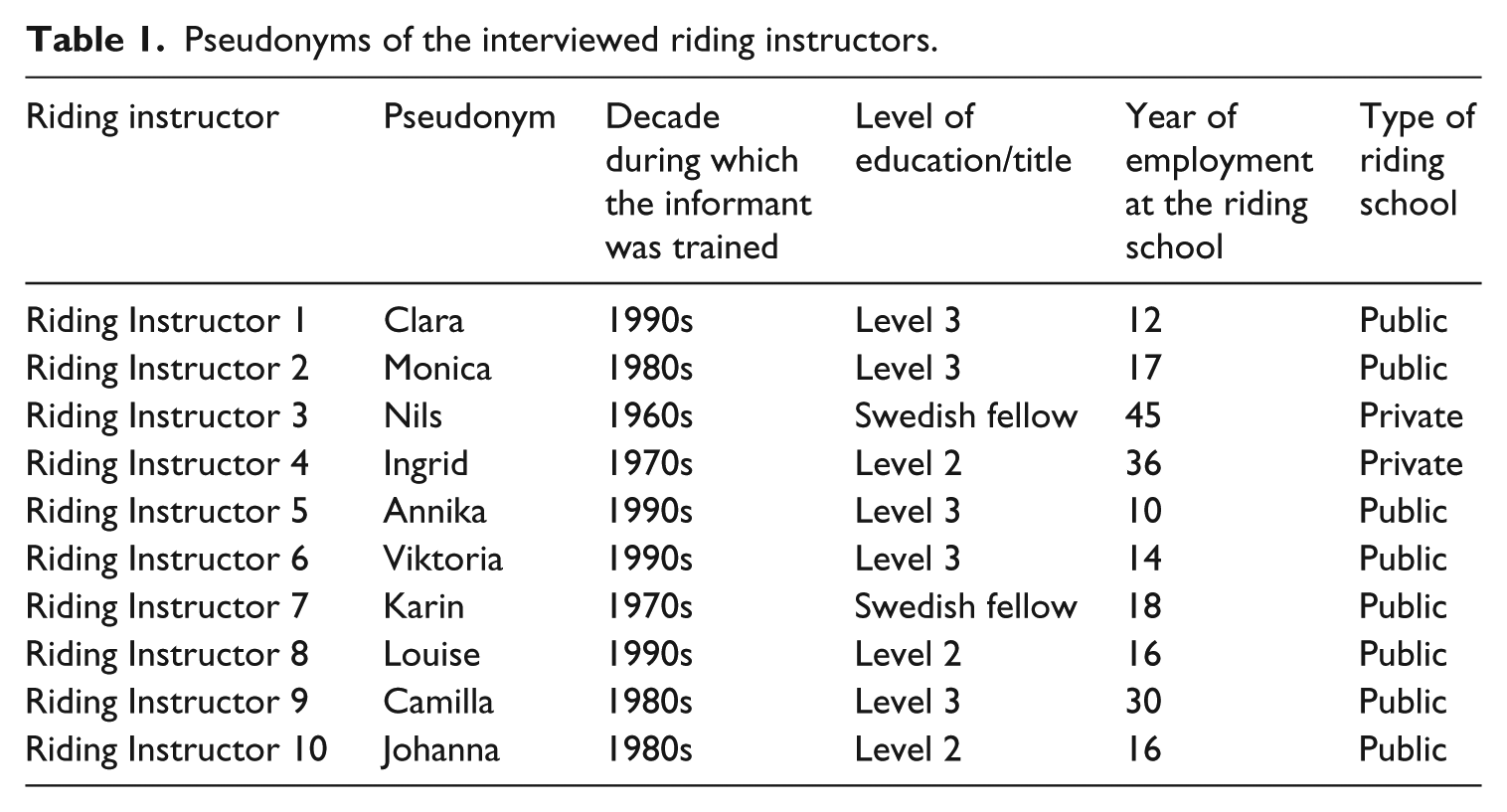
Ten riding instructors were interviewed as part of this study (see Table 1). A list of authorised riding instructors and established riding schools was supplied by the office staff at the Swedish Equestrian Federation, and seven riding schools in Sweden were chosen on the basis of membership figures, and the educational level of the riding instructors and the riding school establishment. All of the informants have undergone the first to third levels of riding instructor training. They have attended the former Riding instructor courses (1 to 3 and the so-called ‘long course’), or the Equine Science Program at the Swedish University of Agricultural Sciences, located at the Swedish National Equestrian Centre at Strömsholm (SNECS). The riding instructors interviewed in this study are employed at riding schools of different sizes. Some of the riding schools are located in rural areas, while others are located near major cities. The riding instructors’ level of education was important in relation to their actual work. In order for the interviewed instructors to be able to reflect on changes affecting the riding school, only instructors who had been employed for at least 10 years at their riding schools were chosen for the study. Seven of the interviewees work as managers of their respective schools, and are responsible for activities, finances and staff. Eight of the riding instructors are employed by sports club-operated riding schools, and two at private riding schools.
Pseudonyms of the interviewed riding instructors.
We contacted the riding instructors by telephone, asking whether they were willing to be interviewed. A time for the interview was subsequently decided upon. All of the contacted instructors agreed to participate in the study. The interviews were conducted either at the riding schools (in an office or in the riding school cafeteria) or in the respondents’ homes. On three occasions, two riding instructors were interviewed together, so that one was free to take care of any work-related situation that might have arisen during the interview. An open-ended questionnaire that centred on four different areas was used as an interview guide. These areas were: 1) riding school activities; 2) education; 3) teaching philosophy; and 4) the future of the riding school. More specific questions were used to structure the discussions of these areas, in order to attempt to interpret the instructors’ perceptions and experiences of their duties at their respective riding schools. The questions focused on how the interviewees viewed activities, children and youth, horses, their mission as instructors and the future. All of the interviews were recorded, each interview lasting approximately 1 to 1½ hours. Impressions from the interviews were documented and a summary of each interview was made directly after the interviews. Existing questions were adjusted and new questions added as needed during the data collection process, in order to achieve a theoretical saturation in the assembled material (c.f. Charmaz, 2006).
The analysis process
During the first stage we use Charmaz’s (2006) interpretation of GT with a focus on meaning, action and the social context (c.f. Charmaz, 2006; Hallberg, 2006). This implies that the analysis reveals a story about people, situations and social processes. The interviews were transcribed and printed, one at a time, and the analysis focused on finding similarities and differences between the instructors’ statements. By encoding the data, a structure was established that made it easier to interpret work processes in the riding schools. The encoding also functioned as a link between the collection of data and the development of a theoretical standpoint used to explain the interview material (c.f. Charmaz, 2006).
The material was encoded in two stages. The first stage constituted the initial coding, in which pathways were sought by studying fragments of the interview material (word by word, sentence by sentence) (c.f. Charmaz, 2006). The codes were short, describing the action and indicating how dilemmas could arise in the riding school. The second stage constituted the so-called focused coding, which emphasised and developed the most salient codes. Here all of the interviews were compared with each other (constant comparisons) based on the informants’ experiences, in order to generate questions and discover new dimensions (in accordance with Hallberg, 2006; O’Connor et al., 2007).
Memos were recorded during each interview. According to Charmaz, these serve an important function in providing guidelines for further data acquisition (2006). They were of great value to the analytical process by acting as a support and framework for the results that emerged. Through the coding, ideas about concepts were generated. Based on the analysis of the empirical material, four categories appeared that could be linked to each other.
The analysis is grounded in a constructivist perspective, and the concept of reflexivity is a vital part of the process (c.f. Bryant and Charmaz, 2010). The aim of providing a detailed description of the analytical process is to show the rigour and clarity of the study, so as to lend greater credibility to the interpretations made (see e.g. Corbin and Strauss, 2008).
It is relevant that one of the authors of this study is employed as a teacher in pedagogy and leadership, which has likely influenced the analysis. The author’s background created a prior understanding of the area, but also allowed the author to ask informed questions. The collected empirical data was processed and analysed by the authors together.
Results
In the analysis of the interviews, a pattern consisting of four categories appeared, the most central of which has been designated Governed by economy. The other categories are: Adapting a new way of teaching; Affected by strong traditions; and Importance of the collegial consensus. All categories can be linked to each other as well as the bridging core category.
Governed by economy
The riding instructors felt themselves to be governed by the economy, and underlined that they are driven by economic conditions. They emphasised that there have been major changes in their assignments in the last 10 years, and that these changes are mainly related to the economy and market control. In 2008, Sweden experienced an economic recession, which was seen as a contributing factor to changed conditions for the riding schools. Moreover, the riding instructors felt that other sports activities for children and youth had negatively impacted the previously steady influx of interested children to riding schools. The instructors stated that they had to engage in and accept the changed conditions, contending that the new economic situation has forced them to rethink and alter riding schools activities.
The riding instructors described their work in terms of ‘working with [one’s] interest’. One of the instructors, Johanna, talked about the tough life and work in the riding school. In order to cope with the new financial situation, she analysed the situation for her riding school as well as the situation for nearby riding schools. Johanna subsequently adapted to the situation, and she and her colleagues chose to invest out of the crisis: When I had worked here for three years and we still struggled financially, we had a lot of debt and did not really manage so instead of cancelling activities, we increased the activities and made sure to raise quality even if it cost more to see if this was the solution, and it was. In addition we asked ourselves: what do people want and what is our riding school like? What is our niche? And it was especially bringing in younger children and also to broaden our activities.
Clara, another riding instructor, worked at a riding school that opted for a different strategy. She describes how the school was forced to lay off members of staff in order to optimise its economy: ‘When the recession began, we lost some riders, there were many who could not afford this and we had to lay off some staff, but thanks to that, we today have a stable economy’.
The riding instructors felt the need to find a new approach, managing the riding schools in a way more akin to a business, although the majority of the riding schools were operated by non-profit associations or clubs. The instructors stressed that continual monitoring of societal development and financial awareness became very important. Camilla, who worked at a sports club-operated riding school, explained: These are the times we live in, and you cannot lean back and think that, ‘what we do is perfect and we should not change ourselves’, we must constantly be aware of changes in the business we run. If all our activities were subsidised maybe we could sit back and enjoy but we have to survive despite [the] new conditions.
The riding instructors underlined the importance of making the riding school activities more attractive to riders as well as to other participants in order to attract and keep them as members. The change occurred gradually, and riding instructors were also aware that the trend influenced other sports clubs and associations. The previously steady influx of children had waned, and this forced the riding instructors to adapt to new conditions. All certified that a riding instructor must be service-oriented and focused on finding solutions. Monika exemplified: Now we’re really a service club: ‘Well Lisa wants to ride Wednesday at 18.00…’, ‘Well, we fix it…’ so it is today and it is due to a lesser number of riders. Before it was more ‘this is the schedule we have, is it something that suits you?’ So you have become very service minded.
One of the shifts in approach was marketing, which was perceived as a way to recruit new riders. In her interview, Clara recounted how she and her colleagues visited all of the schools in the region to provide information on the riding school’s activities and to invite pupils to try riding lessons. Monika, Ingrid and Louise mentioned the ‘ripple effect’, noting that new people may be drawn to the riding school after receiving recommendations from existing riders.
According to the riding instructors, these changes in riding school activities have occurred in the last decade. They felt they had no other choice but to meet the new conditions, and stressed the necessity of being responsive and open to changes. Yet, the importance of maintaining tradition was also underlined. Clara described it as follows: ‘You must update yourself all the time. It is becoming more and more important for people in our sector to leave “business as usual”, we must think about our tradition, but be open-minded to new things too’.
It has not always been simple to create riding school activities based on demand; sometimes, instructors were impelled to adopt new strategies despite personal scepticism. For instance, the instructors explained that riding schools have long had a lower age limit of seven years to begin attending riding lessons. At the age of seven, children were considered to be receptive to instructions pertaining to riding and safety. Today, it is not uncommon for children’s activities to be offered from the age of three, and many of the instructors noted that parents often requested an early start. During such lessons for younger children, the child has a person leading the horse, and playfulness is emphasised. Furthermore, not all activities were centred on the horse. Many of the riding instructors expressed reluctance towards offering activities for children under the age of seven, as small children usually have trouble learning and understanding safety instructions. Monika stated: ‘I do not think the children are ready for this… they have to start school first, but when we faced a decline in the number of riders I had to think a little and it is clear there can be a ripple effect’.
Camilla was hesitant towards offering activities for children who were not ready for riding education, but the riding school had no choice but to recruit younger pupils: ‘You have to pick them when they’re five or six, because if you don’t they leave for some other sport, which is completely idiotic’.
Adapting a new way of teaching
Economic change has resulted in a new way of relating to pupils and parents, according to the instructors. They are now being called customers. Furthermore, riding instructors have changed their pedagogical approach to teaching. In this study, this category in the responses has been labelled ‘Adapting a new way of teaching’, which indicates that instructors develop a more receptive behaviour towards the riders. The instructors underlined the need to focus on dialogue, and to listen to what is being asked by the riders. Karin explained this change in attitude: Yes, it has changed. It used to be: ‘(if it doesn’t suit you) there is the door’. Today I am, as a riding teacher, happy if the riders ask (questions), this is a prerequisite for learning. If the rider does not understand what I say, I have to say it with other words and in another way.
Educational challenges are made visible when the riding instructors are compelled to reflect on learning processes and communication with their riders. The riding instructors observed the benefits of experience in this regard, as learning processes and communication were not part of the training they received at SNECS. Instead, they have developed pedagogical and social skills, which have become increasingly important, over time. Johanna, who underwent her training in the 1980s, contends that she was initially shaped by her military-style education, but that today she functions more like a coach, being more flexible and expressive in her teaching approach. Louise similarly notes that her teaching methods have changed over time. Nowadays, she tends to spend more time explaining the reason for her instructions, rather than simply giving orders: ‘Clearly, (I have started to) explain why much more, to make children understand, not “now, we do this”, that happened 10 to 15 years ago, but that kind of instruction does not work today’.
The instructors emphasised the importance of encouraging young people’s involvement and interest in horses. Johanna highlighted the benefits of allowing young people to be more involved in the riding school’s activities. This results in them staying longer at the riding school, she observed, which is good for the school’s finances. Another challenge that has emerged recently, according to the instructors, is frustrated parents, who feel that their children are not developing their skills quickly enough. The riding instructors stated that parents increasingly seek to ‘get their money’s worth’, demanding more noticeable progress in exchange for the lesson fees they pay for their children. These parents’ demands for their children’s development sometimes contrasted with the instructors’ aims; the instructors underlining that riding lessons are based on long-term training, and should focus on balance, control and security in relation to each child’s individual level of development.
Several of the riding instructors stressed the importance of social skills, and contended that a military approach towards riders, characterised by shouting instructions during lessons, is no longer suitable. Today, the riding instructor has become a social profession that requires insight into pedagogy and learning development, in addition to knowledge of the horse. Nils clarified: ‘Yes, and I have been critical for many years to the use of instructions during the military period. That kind of teaching is no longer accepted’.
Over time, creative and responsive communication has become an ideal for the riding instructors, who described and exemplified how activities have evolved as a result. As mentioned above, the Swedish government has been providing financial support to developing Swedish sport for children and young people for several years. Consequently, a number of the riding instructors have been able to try out ‘new’ activities with riders in an initial stage. Such new activities include focusing specifically on show jumping or dressage, with fewer riders in each group, and increasing opportunities to compete with the horses from the riding school. This allows riders to develop more individually, as they have the opportunity to receive more individualised assistance. The instructors view this to be an adaption to the problematic economic situation, and Ingrid compared this development to the situation when she was young: It was terrible at that time [laughs]! It was completely different; the riders followed the instruction, predicted circles. Now you educate them more in detail. So I think it has changed. Earlier the riders were considered as a group, everyone would go into circles, everyone would turn around, now you concentrate more on each rider, I think each rider needs individual feedback. Now I think you see the riders more.
The instructors underlined that riding school pupils today want more time for personal contact with their riding instructor, and appreciate the opportunity to discuss their personal development with him or her. Monika described how such requests appear in the evaluations of the riding lessons, but are difficult to accommodate due to lack of time: ‘We always conduct evaluations and the riders appreciate very much just to sit down and talk with us about everything and about the riding, but it’s hard to find the time’.
Affected by strong tradition
The instructors emphasised the importance of creativity and developing new activities in accordance with the riders’ desires, but also stressed that basic training in riding and horse knowledge should not be sacrificed. Karin expressed: The security [is of high importance] and it has been so all the way from the beginning and the discipline, get there in time, having the right equipment, you are at the right place. These military parts [of the education] are good to learn. The structure and taking good care of the horse.
The instructors felt that their own education had greatly influenced their mission. Victoria states: ‘It is in your spine’. The instructors highlighted parts of the military heritage of horse riding as significant. Punctuality, responsibility and discipline were seen as prerequisite for being able to manage and take care of the horses. Orderliness was also frequently stressed as an important skill, and something the instructors claimed to have learnt themselves during their training at SNECS. In this way, the instructors’ statements indicated that they were ‘affected by strong traditions’. Camilla described how she is influenced by the military discipline that characterised her riding instructor education, but she also sees it as being important to convey: Of course one is influenced by the importance of discipline, not for the sake of discipline as such, but it has a purpose, the horses have to be taken care of, no accidents should happen, there must be regulations and that goes for humans, too.
The riding instructors also dwelt on their mission to educate young people in practical leadership, noting that the stable environment requires one to know the rules and procedures for handling horses. Louise talked about how she teaches young people responsibility by allowing them to be more involved and help out in the stables at the weekends: For the young ones, you need to coach them a lot, when they grow up to be older you can say ‘do this!’, and then leave to them a little space and gradually give them more and more responsibility.
The instructors stated that children and young people are given the opportunity to take on more responsibility and lead other people at the riding school. However, Louise also notes that children today are seemingly less independent: It differs only in the last 15 years, a big difference… earlier, riders came to the stables themselves! There are not many who do this today, they are driven there by their parents… it’s crazy! How will these children be able to cope in life? The most important thing for us is to teach them to be independent and responsible. Yes, but they must take responsibility, and grow up and be adults as well.
Camilla describes the riding school as a place where riders acquire and develop their leadership skills by learning to handle horses safely. Leadership comes ‘naturally’ when the riders are taught safety, and when they are allowed to take on more responsibility by assisting other riders.
Importance of the collegial consensus
The instructors emphasised some important traits for a riding instructor, including the ‘right attitude’, responsiveness and the ability to develop new ways of teaching that should be applied by the entire staff in the riding school. The instructors frequently used the word ‘we’ when describing the development of their work. Cooperation is considered to be an important part of everyday activities, and a prerequisite for maintaining good quality in the riding school. All riding instructors emphasised the ‘importance of the collegial consensus’. Even if they did not meet their colleagues every day, they met regularly to discuss important topics. Group cohesion and mutual support among staff members in the face of challenges was stressed as important. Annika talks about the importance of camaraderie among instructors at her riding school: We have supported each other when someone feels down and encouraged each other when necessary, in a place like this where we have riders with their own horses and because of that there are a lot of opinions. That is why we bring ourselves together, as a united front, because that is necessary.
Consensus is necessary for activities to function optimally, according to the instructors. Camilla believed that it was essential for the quality of the activities provided by the riding school, and that newly employed riding instructors should adapt to the existing system: ‘We have had a few instructors who were temporarily employed and sometimes it did not work out because some of them did not think consensus was important and therefore they could not work here, you have to adapt to our system’.
This system can be characterised as an operational educational plan to be followed by all, a plan that internalises the culture of the riding school. This approach is possibly connected to the informants’ time at SNECS, and is further developed at their own riding schools. Clara exemplified: I and Nina [a colleague], we’ve been educated at SNECS, so we think about teaching riding quite similarly, one becomes very much a product of SNECS [laughter]. Now it is a very long time since I was a student there but it is still of value to me. So when we teach youths to become instructors here at our riding school, we keep training them in the same way, for good and for bad.
In connection with the new economic challenges, a different kind of riding lessons were seen as being necessary. To ensure a future for the riding school it is important to provide riders with good quality lessons, and to be aware of ‘what was going on outside of the riding school’, the instructors said. A changed attitude towards the riders was central, and Karin confirmed this by stating: ‘Last year, we had a project called We are here, a project that greatly emphasised how to interact with people in various situations’. It was an example of how the instructors are to be aware of welcoming people to the riding school.
Concluding discussion
The aim of this study has been to explore and analyse how Swedish riding instructors perceive and experience their professional role. The initial stage of the analysis generated four partly interlinked categories in the empirical material. An inductive methodology inspired by a constructivist perspective on Grounded theory was utilised (Charmaz, 2006).
The study showed that riding instructors feel that they are part of an institution in which military ideals are prevalent. However, Swedish riding schools, as well as other sports clubs, struggle to retain the interest of children and youth, as commercial sport entities challenge their way of organising sport.
Governed by economy constituted the core category, which also linked the other categories together. This core category highlighted how the riding instructors struggle with economic challenges in order to accomplish the tasks of the riding school. The riding instructors underlined that economic challenges had influenced their role and changed their attitude towards the riders. They perceived this change as a positive development, as they felt the quality of their work had increased. In other words, the instructors asserted that the patterns and normative systems in the riding schools have changed as a result of economic challenges. To use a concept borrowed from Douglas North, transaction costs that previously hindered instructors from altering their behaviour now worked in favour of a change (c.f. North and Thomas, 1973). This development can be compared to what Meyer and Rowan (1977) describe as ‘…Institution’s adaption to the outside world, legitimacy in relation to its own members and surrounding institutions, and development of formal structures, [which] is the key to survival’. Broader societal demands for and expectations of greater individualisation impacted riding schools’ treatment of riders (c.f. Höigaard et al., 2008; Jowett, 2008). However, it is worth noting that a similar development can be seen in the Scandinavian school system (Carlgren et al., 2006), and may have influenced riding instructors as well. In addition, increasing commercialisation in Swedish children and youth sport at large may partly have caused this change (Coakely and Pike, 2014; Toftegaard Stöckel et al., 2013; Wagnsson and Augustsson, 2015).
The riding instructors did not feel a need to design riding lessons differently, as long as they provided sound basic training in riding and safety measures. Nonetheless, they felt their way of teaching had evolved, becoming more analytical and individually focused. This category was called Adapt a new way of teaching. In contrast to previous research (Fahlström et al., 2013; Hedberg, 2014), in which it has been asserted that Swedish sports coaches lack a capacity for reflection and critical thinking, the present study indicates that riding instructors reflect on perceived changes in their working conditions. The interviewees highlighted reflection as important and necessary in order to be able to develop as a teacher (c.f. Gilbert and Trudel, 2001). A two-way dialogue with the riders was also emphasised as essential to learning (c.f. Armour, 2011; Walsh, 2011). This change can be seen as beneficial for the learning environment at the riding schools, and is also congruent with how Auty (2008) explains the core of education in riding. Riding lessons (at riding schools) are important for helping riders to learn to ride, and handle and communicate with horses in a variety of situations and at different stages of development (Dashper, 2016). It is also consistent with the skills and characteristics that other researchers have highlighted as being important for riding instructors (c.f. Lundesjö-Kvart, 2013; Wolframm, 2014). This change can already be seen in the English equestrian system, as shown by Maw (2012), who argues that this model of teaching provides the opportunity for a mutual interchange and encourages the rider continually to reflect over the lessons. Maw (2012) explains this change in terms of the increasing competitive focus of many equestrians today. As a result, teaching has shifted from an instructional approach to a coaching model. It is important to stress that our analysis is only based on the interviewees’ experiences, and that we have not conducted any observation of riding lessons. Nevertheless, it is interesting that our interviewees attested to a similar change, despite the fact that riding schools are aimed primarily at leisure and pleasure rather than competition. Although the informants’ training took place at different times and educational centres, there was a strong continuity in their responses.
The interviewees’ statements show that riding instructors have changed perspective on their practices, not least evinced by the reference to riders as customers. This change is linked to neo-liberalisation and the market, despite the fact that many riding schools are not profit-driven (Smith, 2009). Although only two of the riding instructors interviewed are employed at a private riding school, all interviewees referred to children and youth (and their parents) as customers. They underlined that they had become more service-oriented, and more responsive to the wishes of their customers. Some of the informants also highlighted that it is no longer acceptable for the riding instructor to bark instructions to the riders as per the military tradition. (Maw (2012) attests to the same change, explaining it in terms of the diverse backgrounds of today’s riders, who expect a more pedagogical approach.) In addition, parents especially underline that they want their children to develop more quickly as riders. The riding instructors emphasised the difficulty of meeting such demands, as learning to ride takes time and practice, and riding lessons should not jeopardise the safety or well-being of the horses. Safety awareness is well integrated into the educational system at Swedish riding schools (SvRF, 2013), and the use of commands and the structure of riding lessons and horse care is based on the military heritage and a concern with safety (Thorell and Hedenborg, 2015). Equestrian sport has come to place a strong emphasis on safety and the use of personal protective equipment (Thompson et al., 2015). Horses can be unpredictable and are easily startled, and horse-related accidents and near misses have recently attracted more attention in research (e.g. Thompson et al., 2015; Thompson and Mattews, 2015). The riding instructors interviewed as part of this study stressed the importance of safety, and their statements indicate how this value was conveyed to them through their education.
Previous research has shown that Swedish stable culture is strongly governed by traditional military norms (Forsberg, 2007; Forsberg and Tebelius, 2011; Nikku, 2005; Thorell and Hedenborg, 2015), and that riding lessons are characterised by a one-way model of instruction (Lundesjö-Kvart, 2013). During the interviews, the riding instructors appraised the traditional stable culture taught to them as part of their training (c.f. Thorell and Hedenborg, 2015). They underlined the importance of orderliness, looking smart and being punctual, thus indicating the continuing prevalence of this traditional stable culture. The instructors were also aware that these norms existed and that they themselves preserved, maintained and were affected by them. In the analysis, this category was called Affected by strong traditions. The interviewees also stressed that the riding school provides a learning environment in which they as teachers and masters can serve as role models and conveyors of knowledge, and in which children and young people learn leadership by managing and handling horses. Children and youth also practise leadership by assisting younger or more inexperienced children and parents, according to the riding instructors (c.f. Forsberg, 2007: Forsberg and Tebelius, 2011; Ojanen, 2012). The instructors underlined the importance of sharing knowledge about horse management with their pupils, and stated that children and youth are given responsibility and influence so that they will continue to be active at the riding school.
Riding instructors hold together the social environment of Swedish riding schools, and in the analysis this category was labelled Importance of the collegial consensus. The collegial consensus is a social construction controlled and regulated by the existing educational system established by the Swedish Equestrian Federation, and communicated to the riding instructors through their training at SNECS. This system is reproduced at riding schools, where it also provides security and guiding principles (c.f. Thorell and Hedenborg, 2015). The riding instructors underlined that they and their colleagues are constantly invested in maintaining and improving the quality of the riding lessons. Thus, stable culture is an example of an established institution in which people are influenced and governed by a historically generated social order (c.f. Berger and Luckmann, 1991). This culture is shaped by a military paradigm that also affects the instructors.
In conclusion, this study has explored and analysed the challenging of military norms at Swedish riding schools. Understanding these changes is of importance for the development of riding instructor education. The riding school can be characterised as an educational institution, in which interspecies communication and relationships are taught. Embossed and governed by the stable culture, older forms of teaching practised at riding schools are becoming outdated in contemporary society. The riding school’s survival and success will depend on its ability to adapt to society (c.f. Meyer and Rowan, 1977).
This study illustrates how riding instructors, due to an economic recession, feel that the institutional arrangement of the riding schools has become governed by the economy. The riding instructors thus feel impelled to change and adapt to new teaching styles. The economic challenges require continuous development of the riding instructors’ pedagogical ability, and have made them more aware of their profession, its historical heritage and norms.
Footnotes
Acknowledgements
Our gratitude is extended to all interviewees for sharing their experiences with us. We would also like to thank Manon Hedenborg White for helping with the language, and the anonymous reviewers for their thorough assessment and valuable comments.
Funding
The author(s) disclosed receipt of the following financial support for the research, authorship, and/or publication of this article: This work was supported by The Swedish-Norwegian Foundation for Equine Research (grant number: H1047024 ).