




Abstract
Governing state-funded sport is tenuous because of the need to maintain legitimacy and support from political authorisers, stakeholders and network partners/members. The purpose of this paper is to compare/contrast how central sport agencies in Norway and New Zealand create, build or sustain legitimacy through their accountability regimes. More particularly, this comparison distinguishes between input and output sources of legitimacy, where the former is associated with democratic processes (e.g., electoral procedures and public consultation), and the latter is linked with results and demonstrable benefits. While the Norwegian Olympic and Paralympic Committee and Confederation of Sports (NIF) draws legitimacy from its representative membership structures and status as a social movement, Sport New Zealand claims legitimacy on the basis of achieving targets and outputs. In both cases there are emerging pressures to recast input–output legitimating narratives, suggesting their ‘depleteability’ over time. These shifts are discussed in relation to their influence on policy reforms within environments of accountability that are fluid and incomplete.
Over the past three decades, sport’s legitimacy as an area of public policy has become entrenched in the governments of many western liberal democracies. Secured via links with health, the economy and education and through its ideological ties with social welfare and national identity (Chalip, 1996; Houlihan, 1997), sport is now enshrined in national/federal legislation spanning domains of physical activity, major events and international development. However to suggest sport’s legitimacy is institutionalised, does not mean it is insulated from resistance, challenge and revision (Green and Houlihan, 2005; Houlihan, 2002; Piggin et ;al., 2009). Indeed maintaining legitimacy and support (i.e., from stakeholders and network partners/members) is integral to state sport, owing to a number of persistent challenges.
The first (and most frequently discussed) relates to the enduring cleavage between elite and mass participation sport. Keeping the two together has required both the coordination of programmes and policies, and the advancement of various ‘joined-up’ approaches and paradigms (e.g., seamless systems, whole-of-sport planning, long-term athlete development models, etc.). Where central agencies have created institutes, centres or academies for elite sport, these structures have been legitimised on the basis of providing pathways for regional athletes, while claiming also that links with community sport persist. However even in a country like Australia, where federal sport has long cultivated significant public and political support, the legitimacy of these links has been called into question (Crawford and Independent Sports Panel, 2009).
Addressing diverse goals and the demands of various interests (along lines of professional/amateur, disability, ethnicity/race, language and gender) represents a similar challenge to central agency legitimacy. This is not only because being effective in these areas is pragmatically ‘wicked’ (Sam, 2009) but also because policies and programmes may be cynically perceived as mere ‘window dressing’. Indeed advancing equity goals can be a double-edged sword for central agencies – while policies (such as those aimed at raising the number of women in governance positions) serve an important aspirational function, they can variously cast the agency as rigid or unreflexive (Shaw and Penney, 2003), or overcommitted (Sam, 2011).
If demonstrating results or ‘outputs’ in these areas calls the legitimacy of agency activities into question, another challenge relates to the ‘inputs’ underpinning policies and programmes. The manner in which policies and programmes are created and how they are evaluated is of increasing salience in the post-New Public Management (NPM) environment, with its emphasis on consultation, deliberation and citizen engagement (O’Flynn, 2007). Policy advice now comes from many sources including private consultants, academic experts, as well as organisational movements and quasi think-tanks (e.g. Sport Matters Group in Canada; Sport and Citizenship in the European Union; and Sports Think Tank in the United Kingdom). Taken together, the nature of ‘expertise’ is as contentious as the corporatist ways in which networks are structured, and the legitimacy of central sport agencies is thus contingent on co-opting the ‘appropriate input’ in the ‘right’ circumstances.
While the above challenges are important in themselves, they also highlight the impetus for central sport agencies to legitimise their decisions, policies, and authority (Strittmatter, 2016). Alongside both state and societal pressures for transparency and greater accountability, public agencies are increasingly concerned with stakeholder relations and public image (Moore, 1995). As Houlihan and White (2002) point out in the UK context, sport is particularly vulnerable to the whim of governments, and thus the impacts of programmes have to be defended often. In states where governments support sport, they do in the context of ‘evidence-based policy-making’, with many of the activities of central sport agencies resembling advocacy or case-building (Sam, 2011). That sport development professionals and their agencies should be involved in promotion and advocacy points to one of the largest challenges to their work – that is, the need to continually justify their existence.
Against the background of the above challenges, two questions emerge. First, how do central agencies 1 build credibility and acceptance for their policies and programmes? What are their sources of legitimacy and how do they ensure their policies are ‘solidly backed’? In political environments, legitimacy is broadly defined as the acceptance by relevant stakeholders of an agency’s right to govern and in this view, legitimacy is a type of resource that agencies seek to create, maintain and defend (Ashforth, 1990; Suchman, 1995). As the section below highlights, the principal means through which agencies build legitimacy is by demonstrating how accountable they are (Bovens, 2007a: 464). Hence the central purpose of the study is to compare/contrast how central sport agencies create, build or sustain legitimacy through their accountability regimes.
To enable comparison, we adopt Scharpf’s (1997, 1999) ‘almost canonical’ distinction between input and output legitimacy (Steffek, 2015: 266), where the former is associated with processes (e.g., electoral procedures and public consultation), and the latter is linked with performance, results and ‘demonstrable’ benefits. In this perspective, legitimacy is linked with accountability – both in the sense of being democratically ‘responsive’ to the public and in the sense of providing assurances regarding the effective use of public funds (Aucoin and Heintzman, 2000).
A second set of questions relates to the implications for central sport agencies that have a predilection for advancing one type of legitimacy over another. To what extent, for example, can central agencies be accused of overstating their democratic responsiveness or alternately, of overpromising results? How might an emphasis on input or output legitimacy preclude or screen out future activities and actions? The modalities of legitimacy-building may thus be indicative of changing relations and interactions between sport and the state. It is our contention that the ways in which they sustain, maintain or attempt to build legitimacy may be indicative of their potential sources of strain and future accountability challenges. Indeed, these transformations are arguably indicative of the recasting and redrawing of boundaries around the authority and responsibility for sport. Following Cashore (2002), input–output legitimacy is applied as a framework for understanding central governance in sport. This study compares and contrasts the central sport agencies of two countries (Norway and New Zealand) and focuses on each sport agency’s mechanisms for advancing input- and output-oriented sources of legitimacy.
The remainder of this article is divided into three sections. The first section delineates the concept of legitimacy, as well as the broad analytical approaches used to unpack it. This section also describes the distinctions between input and output legitimacy and how these are located within the context of accountability structures. The second section describes the methods of this study and provides a theoretically-informed rationale for the selection of cases, as well as details of their comparability in terms of population, geography, levels of employment and corruption, etc. The case analyses are then presented along three dimensions: (1) central agency structures and goals; (2) sources of legitimacy and orientation towards accountability; and (3) tensions and strains on legitimacy. In the third section, the tenuousness of legitimacy is discussed in relation to emerging accountability pressures.
Legitimacy and accountability
As one of the fundamental concepts in the social sciences, legitimacy is too ‘unwieldly’ to engage with on a full-frontal assault (Weatherford, 1992). It is a contested concept (Hurrelman et ;al., 2007) and yet it remains central in the social sciences in part because of state-societal changes around who can, or should be allowed to control, regulate, or steer organisations and citizens.
A dominant perspective around legitimacy in studies of state-sponsored sport is thus normative, where the main questions surround whether an organisation is ‘legitimate’ in its mandate to govern. The evaluative criteria for such judgements are often linked to the nature of democratic representation or the degree to which state goals align with public values (Kidd, 1988; Sam, 2003; Skille, 2008). Critiques of central sport agencies implicitly question the state’s ‘right to rule’ an area predominantly run by volunteer autonomous organisations (Sam and Jackson, 2004). What these accounts tend to overlook are theoretically-backed explanations for why sport agencies make such bold claims in the first place, or why their defence of existing policies should appear at times unreflective and contradictory. Understanding legitimacy can thus enable a better contextualisation of the activities and narratives of central sport agencies.
Accordingly, Suchman (1995) outlines two principal approaches to the study of legitimacy. The first attempts to answer why organisational forms come to be accepted as legitimate; the explanatory basis for ‘why’ has been a core focus in organisational sociology, where uncertain environments are said to induce firms to pursue legitimate practices. This perspective is important because it alerts us that organisations conduct themselves not only in line with some means–ends efficiency (logic of consequence) but equally in line with a logic of appropriateness (DiMaggio and Powell, 1991; March and Olsen, 2006). It also explains why organisations in the same field may begin to resemble one another – the quest for legitimacy in this view causes ‘isomorphism’ because organisations modify themselves in line with existing institutional norms and values (Ingram and Clay, 2000; Suchman, 1995).
A second approach to legitimacy is concerned with intentional behaviour, or how legitimacy can be created, maintained or regained (Suchman, 1995). This approach directs our attention to the observable strategies, techniques and activities within public agencies that must seek endorsement of their policies by a network of ‘stakeholders’, constituting any combination of politicians, corporate partners, member organisations and government Ministries (Black, 2008). In political environments, governments wishing to extend the legitimacy of their actions and policies deploy various strategies such as consultation, partnerships with civil society organisations or research to demonstrate economic value.
For Moore (1995: 275) the way to build credibility and support in this environment is to ‘embrace accountability’. Beetham (2001) likewise observes that accountability mechanisms are an important dimension to legitimacy building because they are the tangible structures that central agencies use to engineer common frameworks of belief. Stakeholders can thus be assured of appropriate action through concrete means such as the dissemination of information, the setting of performance targets, and the establishment of public forums and complaints processes. To provide accountability is to inform, explain and justify one’s actions (Bovens, 2007b) and in this way, legitimacy building is a form of advocacy or ‘convening’ (Latour, 2009). In sum, the legitimacy of the agency (or its right to govern) is closely vested in its accountability relationships with others (Aucoin and Heintzman, 2000; Black, 2008; Gains and Stoker, 2009).
Building public support, consent or consensus can be interpreted as buttressing one of two sources of legitimacy (Scharpf, 1999; Skogstad, 2003). Input legitimacy, refers to the support of policies and programmes as based upon their processes of formulation and development. A central agency can thus acquire or advance its legitimacy by consulting stakeholders, endorsing ‘checks and balances’ on authority, and demonstrating congruence with public values (see Table 1). In sport, the country-wide consultation processes preceding national policy reforms point to the recognition that deliberation and stakeholder engagement are important means for securing ‘buy-in’ (Sam, 2005; Thibault and Babiak, 2005). Likewise in Sweden, showing congruence with democratic ideals is fundamental for maintaining the Swedish Confederation of Sport’s standing as a legitimate social movement in relation to the wider society (Fahlén and Stenling, 2016).
Legitimacy sources, orientations and mechanisms.
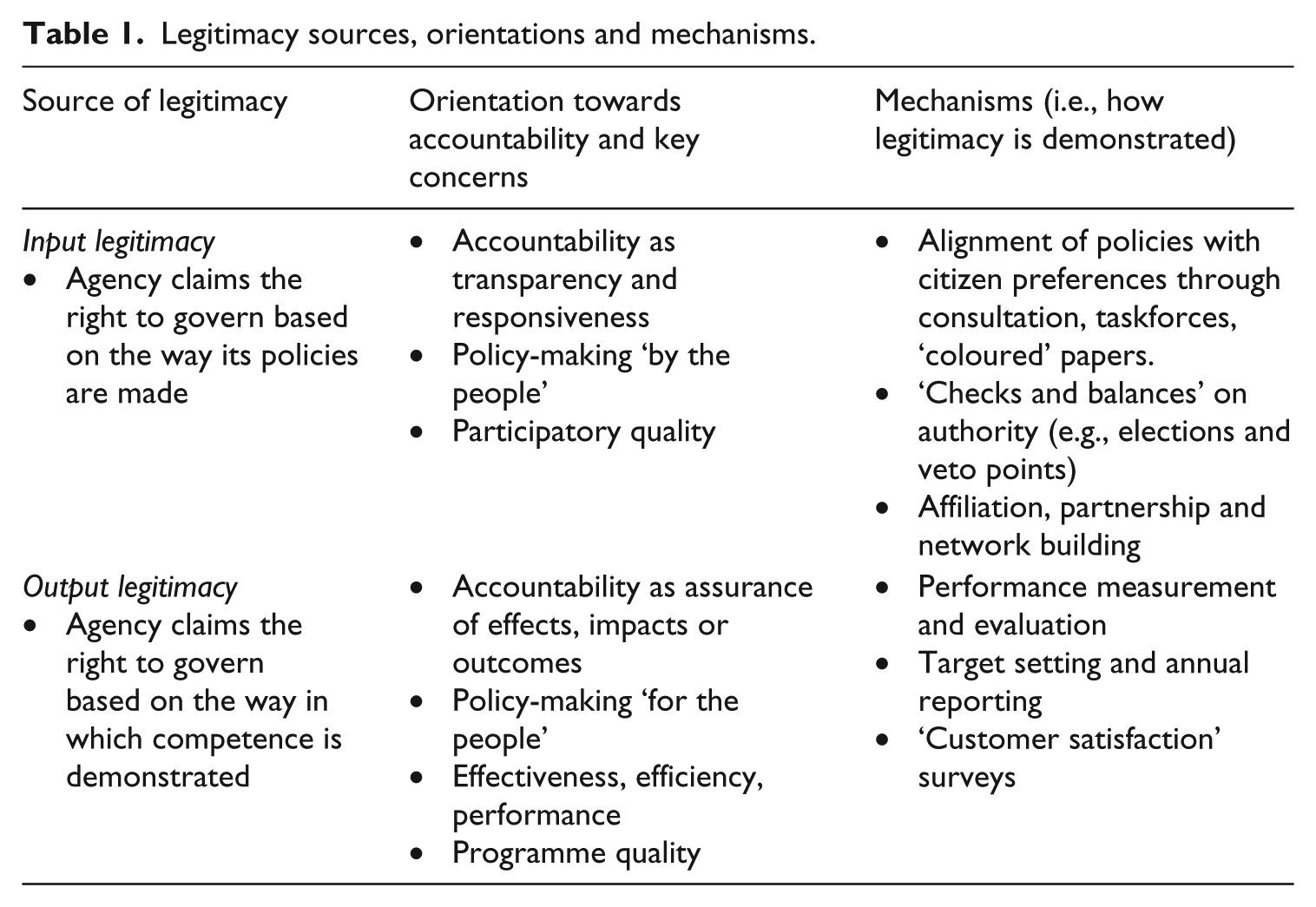
Once policy frameworks are established however, the agencies responsible for delivering and implementing programmes may be held accountable for demonstrating their influence and effects. Hence output legitimacy, is derived from the demonstrable benefits and outcomes that policies and programmes produce (Scharpf, 1999; Schmidt, 2013). As a reflection of NPM principles (emphasising performance measurement), building legitimacy thus comes from demonstrating ‘what works’ (see Learmonth and Harding, 2006). In Anglo-Saxon countries like the UK and Australia, the legitimacy of state agencies has come to be tied with business practices and tools (such as benchmarking or management-by-objectives), that promise more efficient delivery of services and more ‘bang for the buck’. According to Boston et al. the differentiation between input and output sources of legitimacy is located in the broad neoliberal state reforms of the 1980s and 1990s underpinned by what the authors describe as: a ‘move away from input controls and bureaucratic procedures. . . to a greater reliance on quantifiable output (or outcome) measures and performance targets’ (Boston et ;al., 1996: 26).
Indeed, the term ‘investment’ now features strongly in sport policy documents as does its corollaries ‘return on investment’ and ‘value for money’. As part of the wider suite of modernising reforms, central sport agencies have adopted regimes such as the sport funding accountability framework in Canada, partly as a means of determining funding allocations to national sport organisations (NSOs) but also as a means of legitimating their commitment to providing a return on investment (Sam, 2011). Likewise in France, Honta and Julhe (2015: 183) note that the state invoked contracts and a ‘results culture’ to ‘reactivate and reinforce’ its leadership and legitimacy into the elite sport sector. Central agencies consequently expend resources for evaluations as well as towards various monitoring tools and research initiatives measuring sport ‘outputs’ in relation to employment or its contribution to gross domestic product.
Case analyses
By comparing systems, it is possible to acquire greater understanding of each. Pivotal to this analysis, Norwegian and New Zealand public sector organisations have been compared due to their differing uptakes of NPM (Allison, 2005; Christensen and Lægreid, 2001, 2007). NPM in this context refers to the general doctrine that governments should be more business-like and that public services will benefit from private sector techniques, mechanisms and values (Pollitt and Bouckaert, 2011). While Norway has been widely considered a reluctant reformer, New Zealand has been labelled as an eager adopter of NPM doctrines and techniques (Christensen and Lægreid, 2007). Insofar as NPM is fundamentally linked with accountability (particularly as it relates to performance outputs, the use of contracts and a customer focus), the cases are analytically viable because of their propensity for theoretical replication – that is, where one can expect contrasting results but for predictable reasons (Yin, 2013).
Both New Zealand and Norway are Organisation for Economic Co-operation and Development countries, and comparable because they have similar economic and social structures (Casey et ;al., 2011). They are both western democracies though of course differing in language, history and climate. Only New Zealand, the Scandinavian nations of Norway, Finland and Denmark and Ireland are of comparable size, with New Zealand and Norway having similar population densities of 14 inhabitants per square kilometre. They also have identical employment rates (Statistics NZ, 2005). Culturally, both countries are at the extreme ‘clean’ end of the corruption spectrum, with New Zealand ranked 4th and Norway ranked 5th out of 168 countries (Transparency International, 2016).
The development of each state’s sport system has occurred independently of one another. Norway and New Zealand are not in direct competition with each other in professional sports (e.g., team handball or rugby), nor in terms of their respective foci on winter and summer Olympic sports. Since they are not linked on grounds of geography (proximity) or colonial pasts (i.e., New Zealand and England, Norway and Sweden), there is little evidence of isomorphism (as with New Zealand’s relationship with Sport England) or policy convergence (as with the Scandinavian countries). In both cases, the central agencies have a quasi-monopoly on state-directed sport. We suggest the caveat ‘quasi’ because in both cases: (1) there are elements of sport spanning Ministries in health and education; and (2) sport is heavily supported by local municipalities (cf. Sam, 2011; Skille, 2011b). In both countries, ‘vote’ contributions towards sport (i.e., direct tax dollars within the Government budgetary process) were negligible until 2000.
Based on Sabatier and Jenkins-Smith’s (1993) framework for policy analysis, comparative sport policy researchers have focused on developments over a period of at least a decade (Green and Houlihan, 2005), hence this study synthesised research works and public documents from the early 2000s to the present. Public documents from both the central agencies under examination were collected and analysed, paying special attention to documents aimed at regulators (Ministries) and stakeholders (e.g., NSOs) such as annual reports, strategic plans, ‘coloured papers’ and media releases. The authors acquired research works in both English and Norwegian; journal articles, books and book chapters focusing on sport, government and public policy in both countries were reviewed. Works were drawn from the related fields of sport management, sport sociology and sport politics, and were critically evaluated using the framework set out above, focusing on how each respective central agency worked towards accruing public support (i.e., legitimacy).
Before proceeding with our analysis, it should be noted that the input–output dichotomy is used here as a heuristic to understand the ways in which central agencies sustain public support. The concept of legitimacy is notoriously contested and while many others have used the dichotomy (e.g., Boedeltje and Cornips, 2004; Falleth et ;al., 2010), it has its limitations. The first is the interpretive nature of defining which mechanisms qualify as input versus output forms of legitimacy. We clarify the distinction in Table 1, but acknowledge that conceptual classifications of this kind are rarely mutually exclusive. Following Deephouse and Suchman (2008: 67), our aim is not to be ‘fixated on defending the purity and independence of the different dimensions of legitimacy’. As suggested above, the assertion that a legitimate organisation must offer an ‘acceptable theory’ of itself (Meyer and Scott, 1983: 202) is broad enough to encompass a variety of such legitimating accounts.
A second limitation of the input–output distinction is that it gives the impression that central agencies are in control of their own legitimacy and as such this tends to under-emphasise the societal values and norms dimension of legitimacy in institutional works. There are grey areas, hence why contextualisation is important here. For example, programme evaluations that look at impacts and outputs are mechanisms for demonstrating performance but we must leave aside the question as to whether those evaluations are indeed held to be legitimate by others; indeed this question points to the nested nature of legitimacy where the legitimacy of the mechanisms themselves can be brought into question.
The Norwegian and New Zealand cases are analysed below with reference to three dimensions: (1) structures and goals; (2) sources of legitimacy and orientation towards accountability; and (3) sources of strain.
Norway
Structures and goals
Norway is a unitary state with a population scattered across a large territory. It is distinctive by virtue of its egalitarian values, its relatively homogeneous population and its trust in state institutions (Christensen and Lægreid, 2001). The organisation and governance of sport in Norway reflects the ‘Scandinavian sports policy model’ (Bergsgard and Norberg, 2010), marked by large national voluntary organisations with a near monopoly on competitive sports, underpinned by significant government investment. The model is hierarchical in that all levels of sport in Norway – children and youth sport, mass sport and elite sport – are organised and driven within the same structure.
The Norwegian Olympic and Paralympic Committee and Confederation of Sport (NIF) is Norway’s umbrella organisation, comprising 54 specialised sport federations, 11,400 sport clubs and just over 2.2 million memberships (NIF, 2015). Electoral procedures to governing bodies in the federations and the NIF are based on principles of representative democracy, seeking to take into account the variety of interests embedded in the movement. Public authorities take responsibility for sports facilities and provide funding to the associations but keep otherwise at an arm’s length distance. Since the 1990s, the elite sport body Olympiatoppen (OLT) has operated as a department of the NIF, accountable to the general secretary and the NIF elected board. Over the years there have been proposals to detach OLT from the NIF administration and give the elite sport director a direct line to the board. Such initiatives have so far been voted down, not least because, in the general secretary’s words: ‘it would make a clearer distinction between mass and elite sport and disturb a rooted value system of the organization’ (Dagbladet, 2006).
Compared to most other countries, sport participation is high (Ibsen and Seippel, 2010) and sport-for-all remains the main goal of public sport policy. A recent white paper entitled ‘the Norwegian Sport model’ highlights the usual benefits tied to sport (health, social inclusion, and local community integration) as a foundation for funding the associations (Ministry of Cultural Affairs, 2012). It also suggests a rise in lottery funding earmarked for sport, strengthening the NIF as the umbrella organisation. Although sport-for-all is the main aim of public sport policy, elite sport maintains a prominent space in the white paper. It states that one of four aims of public sports policy is to ‘strengthen elite sport based on its role as an identity creator and its contribution to a positive performance culture in the Norwegian society’, and signals a gradual increase in public funding towards these aims (emphasis added, Ministry of Cultural Affairs, 2012: 13).
Sources of legitimacy and orientation towards accountability
The voluntary sport movement maintains a high degree of autonomy, yet ;also enjoys extensive government support, based on the belief that it is a significant contributor to the welfare state (Ronglan, 2015). In public debates, the NIF promotes its position as the dominant voluntary movement. Voluntarism is a positive term in the Norwegian self-understanding (dugnad or local voluntary work has been chosen as Norway’s ‘national word’), and sport is thus claimed to be a central contributor when it comes to social integration, community and trust (Ministry of Cultural Affairs, 2012). Leaders regularly issue news releases focusing on sport as an open and inclusive arena, pointing at the fact that the NIF is the largest voluntary organisation in the country and emphasising initiatives such as ‘sport against racism’, ‘no homophobia’, and ‘welcome girls’. Likewise, the reform processes backed by representative structures of the NIF are an exemplar of input legitimacy – where decisions are judged heavily by the involvement of the wider sport movement (Augestad et ;al., 2006). In this way, the NIF maintains input legitimacy by aligning its policies with citizen preferences, while also demonstrating its centrality in the network. As Eichberg and Loland (2010) observe, such initiatives are intended to legitimise the NIF as a genuine ‘popular movement’ and a cornerstone of an egalitarian welfare society.
This proclivity towards input legitimacy (via alignment with public values) has reduced the need for the NIF to document outputs explicitly. While NIF spokespersons highlight the societal and economic value of ‘700,000 volunteers producing more than 27,000 FTE’s [full-time equivalent jobs] per year’ (NIF, 2013), the agency stops short of claiming its effectiveness in generating these and other outcomes. Thus while the NIF builds legitimacy by way of its discursive association with valued ends (e.g., health), it refrains from explicitly demonstrating performance or competence in achieving these ends. Instead, the NIF’s output legitimacy is derived from its competence in discourse construction. The primary outputs claimed by the NIF are thus linked with lobbying and advocacy directed towards Government (on aspects of lottery distributions and facility construction) and the International Olympic Committee (IOC) (in relation to human rights and the environment) (see NIF, 2014, 2015).
Tensions, strains on legitimacy
Two issues illustrate the continued importance of input legitimacy in the form of organisational representation, democracy, and transparency (Enjolras and Waldahl, 2010). The first concerns the credibility of the NIF as a democratic grass-root movement, in light of criticism that it is becoming increasingly ‘business-like’. As early as 2004, the Minister of Cultural Affairs emphasised that ‘voluntary engagement is an ideological basis for state support’ and thus warned against paid local experts (Hompland and Lorentzen, 2011; Tøyen, 2013). A similar aversion towards professionalisation is evident from the NIF’s recent disclosure that it made extensive use of a commercial communication agency for corporate advice. Rather than contributing to strengthen the NIF’s reputation as a modern organisation, its top-management was accused of lacking transparency and wasting public funds (VG, 2014). The second issue is in relation to the NIF’s failure to secure popular support for a proposed bid to host the 2022 Olympic Winter Games in Oslo. While based on a unanimous resolution among its federations, the NIF concentrated its lobbying towards the IOC and political parties. Public criticism subsequently centred on finances as well as the contrast between the ‘IOC-culture’ (represented by their ‘arrogance’) and the basic values of Norwegian sport (Berglund, 2015). When politicians heeded widespread resistance in the autumn of 2014 and eventually declined to guarantee the necessary state funding, it appeared they were more responsive to public opinion than the elected sport leaders (Berglund, 2014). The underestimated resistance to the bid led to self-examination in the NIF and showed that the unity of the sport movement can be tenuous, further illustrating that alignment with public values remains very important for maintaining the NIF’s (input) legitimacy.
However, output legitimacy appears to be increasingly salient in the Norwegian context. The term ‘performance culture’ has over the last years been heavily promoted by OLT, both internally and through advertising campaigns and public conferences in collaboration with other societal sectors (art, economy, and science). A positive performance culture is thus linked with discourses around ‘high professional standards’, ‘role models’, ‘inspiration’, being ‘ethically sound’, and ‘healthy’. While this can be seen as a way to substantiate the societal value of elite sport beyond pure medals (raising input legitimacy), the credibility of a performance culture inevitably rests upon the results achieved, and OLT is aware of the necessity to maintain good results. Following a disappointing Olympics in 2012, a broad-based external evaluation of the Norwegian elite sport model documented that a large proportion of the resources available at OLT were concentrated on a limited number of medal candidates (NIF, 2013). Further, the report recommended that strengthening transparency, organisational structures and goal clarity was needed to maintain good results as well as OLT’s reputation.
With regards to sport-for-all, the white paper also signals the need for more output-oriented reporting. While explicitly stating that the significance and legitimacy of the sport movement is justified by the extensive activity in clubs, the white paper also notes that: ‘it is decisive that the NIF can substantiate and document how efforts and measures taken at the central and regional level contribute to develop the activities in the clubs’ (Ministry of Cultural Affairs, 2012: 94). The Ministry accordingly suggested increased information gathering to ‘take the initiative to an even more systematic and research-based evaluation of NIF’s goal achievement’ (Ministry of Cultural Affairs, 2012: 94). Such signals indicate an increasing emphasis on ‘outputs’ that extends beyond the NIF’s more typical annual reporting.
Because a unitary sport movement in size and scope represents a powerful societal actor, the image of a united front maintains political influence and justifies substantial public support at an arm’s length distance. A challenge of the model stems from the dual aim of the NIF, leading to debates between groups promoting efficiency and performance and groups promoting democracy and participation (Steen-Johnsen and Hanstad, 2008). In public discourse, these dilemmas have been under-communicated (Helle-Valle, 2008); however, recent research citing a democratic deficit (Enjolras and Waldahl, 2010) and the growing tensions between mass and elite sport (Ronglan, 2015; Skille, 2011b), points to the tenuousness of maintaining both unity and legitimacy.
New Zealand
Structures and goals
New Zealand is a small nation (population 4.2 million) located in the South Pacific. Like Norway it is a unitary state, with some elements of decentralised authority to local authorities and regional bodies. New Zealand is known internationally for its rapid political and economic reforms in the mid-1980s. In an environment marked by high inflation, a newly-elected Labour Government embraced the neoliberal doctrines of the UK’s Thatcher and USA’s Reagan. It de-regulated markets, privatised public utilities and instituted government-wide reforms aimed at marketising public services (Boston et ;al., 1996). New Zealand’s central sport system was established in this era of NPM and consequently evolved to mirror the reform agenda of its political principals (Sam, 2012, 2015).
Structurally, the central agency Sport New Zealand (Sport NZ) is a crown entity, an arm’s length non-departmental body operating on behalf of the Ministry of Culture and Heritage. Sport NZ is governed by a board of directors responsible for strategic direction and leadership, and consisting of 8–10 members appointed by the Minister of Sport and Recreation – there are no elections for these positions and no limits on terms. Board members are independent paid professionals. As these board members are neither representatives of regions, nor of particular sports or levels of the sector (i.e., national/local), they are not directly accountable to partner organisations or clubs, but rather held accountable vertically by the Minister for Sport and the Ministry of Culture and Heritage. Sport NZ’s strategy, programmes and activities are therefore a reflection of the ruling coalition government; the agency’s policy-making process operates accordingly.
The Government requires that Sport NZ submit a statement of intent and annual report to the Minister. In line with the Government as ‘purchaser’ of outputs and outcomes, the annual report provides an account of Sport NZ’s return on investment. This purchasing principle is also evident in Sport NZ’s establishment of High Performance Sport New Zealand (HPSNZ) in 2012, a subsidiary operated by a separate board of governors. As with Sport NZ, board members of HPSNZ are appointed by the Minister rather than elected and paid remuneration between NZD $10 k and $14 k (Sport NZ, 2013a). In terms of its mandate, the Sport NZ Group’s current mandate is to increase public participation in sport and active recreation while supporting elite sport success. Prior to 2008, Sport and Recreation New Zealand (or SPARC as it was then called) maintained health and physical activity within its mandate but following a change in Government in 2008, the agency shifted its priorities to refocus on ‘core business’, a change embodied in the Government’s disestablishment of informational campaigns and programmes designed to induce physical activity and healthy lifestyles.
National sport organisations have historically been one of the main partners and contractors of Sport NZ programmes. Typically governed via a mix of regional representatives and independent board members, these organisations are autonomous, that is, they are not members of Sport NZ (as is the case in Norway). However, to say they are autonomous is not to say they are not heavily influenced by the central agency. Sport NZ exerts a substantive influence in these organisations through its conditional and targeted funding schemes (Sam and Macris, 2014).
Sources of legitimacy and orientation towards accountability
In the absence of electoral accountability structures on its board, NZ’s central sport agency has recognised the importance of input legitimacy by demonstrating congruence with public values. In 2002, SPARC established an advisory committee, Te Rōpū Manaaki to bring its operations in line with principles of the Treaty of Waitangi (New Zealand’s founding document). The committee was intended to operate as a source of strategic policy advice and as an advocacy group, having as one of its objectives ‘to evaluate the benefits of utilising a “by Māori, for Māori” approach’ to sport delivery (Te Rōpū Manaaki, 2005). 2 A more recent initiative focuses on gender equity in the governance of sport. In partnership with the New Zealand Olympic and Commonwealth Games Committee, Sport NZ aims to bring more women into the boardrooms of national organisations. In recent years, the gender ratio on the Sport NZ board has become more even, comprising 4 women and 6 men. Taken together, these initiatives can be interpreted as attempts to advance legitimacy by demonstrating a commitment to democratic input along both lines of race and gender.
Another way in which Sport NZ tries to advance its legitimacy is through its various communication strategies. The agency’s ‘rebranding’ in 2012 (from SPARC to Sport NZ) was justified on the basis that it would be more easily recognised alongside its international counterparts such as UK Sport. While reassuring stakeholders that the rebranding did not bring any substantive change, Sport NZ’s chief executive suggested it would bring more recognition and by extension, more legitimacy. Sport NZ also spends considerable time fostering support among its sector partners. The chief executive conducts an annual ‘road show’ and visits the regions to explain Sport NZ’s current plans. While the visits and presentations are open to the public, they are not consultatory except in the most tokenistic sense (Arnstein, 1969). Rather they are intended to inform regional stakeholders about the agency’s strategies, its latest statistics and outputs in relation to sport-for-all and elite objectives.
Sport NZ’s most explicit strategy in building legitimacy is in relation to its commitment to performance targets. Through its annual reporting of ‘returns on investment’, the agency’s goals of ‘more kids, more adults and more winners’ feature prominently as do the statistics to demonstrate these outcomes. Sport NZ thus focuses its support on capable organisations, targeting those that ‘can effectively and efficiently deliver on Sport NZ’s priorities’ and those best able to demonstrate outputs (Sport New Zealand, 2012b, 2013b: 15). The agency reports on a number of different performance measures such as: (1) the number of sport participants; (2) the number of participant opportunities; (3) the number of joint community sport projects; (4) the number of coaching plans developed in NSOs; and (5) the number of volunteers within the sector and so forth (Sport New Zealand, 2013a). In regards to elite sport, HPSNZ explicitly uses results to legitimise its strategy of performance-based budgeting. For example, it recently noted that ‘These [2013] results once again demonstrate that our strategy of targeting sports with the potential to win on the world stage is a successful formula’ (High Performance Sport New Zealand, 2013).
Tensions, strains on legitimacy
For Sport NZ, the reliance on outputs to justify its policies and programmes presents a continuous strain. Indeed HPSNZ’s targeted sports strategy comes under annual criticism when the ‘winners’ and ‘losers’ of funding are announced each December (Geenty, 2015; Wilson and Wall, 2016). Another source of tension comes from the tendency for output measures to ‘ratchet’ upwards, where last year’s thresholds are increased each year (Bevan and Hood, 2006). Sport participation statistics are particularly susceptible to this phenomenon, with agencies running the risk of ‘failing’ to meet output targets. In one report, Sport NZ suggested it was too ambitious in its earlier sport participation targets (set in 2009) and consequently began using time spent ‘mucking around’ as evidence (Sport New Zealand, 2012a: 4–14). Speculatively, sport, physical activity and recreation are conflated so as not to report a decline in participation levels. The strains of this type of output reporting are also evident in the frequently changing units of measurement and baselines appearing in Sport NZ documents (cf. Sport New Zealand, 2013a, 2014).
Discussion
The cases above illustrate the different means through which sport agencies advance their legitimacy – that is, how they sustain the support of political authorisers, network partners and member organisations. Undoubtedly, the way in which sport agencies maintain legitimacy is linked with their respective societal cultures and governing traditions. Where Norway has a tradition of social inclusion and corporatist state organisation, it is unsurprising that the NIF should seek legitimacy based on these norms. Likewise, the New Zealand state reforms that transformed it into a ‘performance system’ (Kettl, 2000) have undoubtedly normalised Sport NZ’s predilection for justifying its policies in terms of outputs. Beyond these links however, the cases suggest that both input and output sources of legitimacy are tenuous. Reflecting the dictum that ‘we can never do merely one thing’ (Hardin, 1963: 81), it is suggested that legitimacy claims may deplete over time and that the widening imperative to build legitimacy is linked to changing accountability environments.
The NIF is clearly more concerned with input-side legitimacy oriented policies than Sport NZ as evidenced by its continual efforts to align its policies with public values and by its appeals to represent a wider civil society social movement. Yet as the case analysis demonstrates, there are indications that this basis for support may no longer be sufficient on its own. One possible threat to the NIF’s input legitimacy stems from the growth of differentiated self-organised and commercial sport activities that fall outside the traditional organisational structure (Seippel et ;al., 2016). If this growth continues and is accompanied by fragmented structures and a decrease in memberships and organised sport activities, either a narrowing of NIF’s mandate or a change of institutional arrangements are possible scenarios.
Another source of tension within input-based legitimacy more generally is that it relies heavily on the narratives of participation and democratic process (Skogstad, 2003). In this view, NIF’s democratic structures are not guarantees of legitimacy, since their underlying principles are elastic and may rely on the perception that one’s input will make a difference. Reflecting this difficulty, Enjolras and Waldahl (2010) observed that NIF members were not indifferent to the issues of the organisation but rather felt that their opinions would be useless to enact change. Such perceptions raise questions as to whether the central agency might be ‘drift[ing] away from its members’, as has been observed with the Netherlands Olympic Committee and Netherlands Sports Federation (NOC*NSF). Germane to the Norwegian case is that the NOC*NSF is coming to see its activities as externally focused and servicing the needs of Government instead of internally-focused and servicing its membership (Waardenburg and Van Bottenburg, 2013: 8). Hence while the NIF’s goal – to focus on ‘political lobby work’ using its ‘political clout’ (NIF, 2011) – signals a continuing corporatist arrangement with the government, it is unclear if such closed-door discussions will be based on consultations with the membership (Hunold, 2001). Indeed with any lobbying effort, comes the possibility for ‘capture’ and given that one main aim of this advocacy is to raise sport’s share of lottery revenue, it is possible that the government would demand some form of oversight in return.
This need for oversight appears in other Norwegian sectors, however the state’s adoption of NPM principles has been sector-specific compared with the permeation of performance-based systems in New Zealand. The Norwegian education sector for example, has experienced reforms towards greater accountability and the use of performance measurement with a shift towards more output-oriented means of governing (Møller and Skedsmo, 2013). These tendencies reflect a similar (but less evident) trend in the sport sector. Skille characterised a recent white paper as ‘a quasi-neo-liberal turn, keeping the liberal idea of staying at arm’s length from the state and at the same time fulfilling state aims (in order to be allocated state resources)’ (Skille, 2015: 511). Though performance measurement in line with the school sector is unlikely, more external and explicit evaluation of goal achievement will probably eventuate. Indeed the importance of output legitimacy is manifest in Norwegian state executives using performance measures ‘to manage the image of their organisations’ (Lægreid et ;al., 2013), with the implication that such practices may be institutionalised across state–society boundaries.
In comparison with the NIF’s long-standing concern for sport’s democratic value, New Zealand’s central agency attempts at democratising have been more sporadic and ad hoc. Given Sport NZ’s lack of representational structure, its strategies to mobilise (input-side) affirmative commitments rely on symbolic policy changes such as re-branding/re-naming itself so as to show congruence with ‘best practice’. It has at various times created advisory boards to inform policy on indigenous sport, but Te Rōpū Manaaki no longer appears in official documents. The agency has recently promised a review of Māori engagement by 2017/2018, signalling the importance that it remains ‘culturally responsive to Māori’ (Sport NZ, 2015). Sport NZ’s recent promotion of gender equality on NSO boards is also an example of its concern with the democratic inputs into governance. Importantly however, there is a distinction between promoting equity values in the sector and legislating action in this regard. Unlike the NIF, Sport NZ has neither the legitimacy of a united social movement nor the structural links to coerce change on a wide-scale. Yet despite this, Sport NZ has set performance targets for women on sector boards: from 27% in 2012, improved to 34% in 2015 and a minimum of 40% by 2020 (Sport NZ, 2016).
Taken together, the cases suggest that the ways in which agencies try to shore up legitimacy are in flux. One explanation may be simply that sustaining support using one broad narrative depletes over time. Houlihan (2002: 148) for example, raises the dangers of basing anti-doping policy solely on its capacity to generate support within a community, observing that the thresholds for what is ‘moral’ may well slip towards ‘arbitrary populism’. However, an equally plausible explanation is that changing legitimations may be indicative of emerging views on accountability and the links between civil society and state actors.
Legitimacy building as precursor to reforms
Where legitimacy is a key dimension of governance and authority, an important consideration is not only whether legitimacy strategies ‘work’ but also what effects these may have under changing circumstances. Thus responding to legitimacy deficits can itself have the effect of transforming an organisation (Suchman, 1995). In the context of Canadian federal sport policy, it was found that continuous legitimations of sport’s benefits effectively reduced the capacity for agency bureaucrats to advise on improvements (Sam, 2011). Thus one of the risks of persistently legitimating sport’s positive impacts, is the propensity to overcommit – to ostensibly ‘over promise and under deliver’ (Sam, 2011: 771).
In this light, we note that Sport NZ sought to narrow its mandate as a means of gaining credibility. Under a new Government in 2008, it abandoned ‘health’ and ‘physical activity’, with agency executives claiming that ‘we cannot be all things to all people’ and that narrowing funding can make a greater impact. In Norway, the NIF maintains a wide mandate that includes health and yet here too, there are signs that member organisations remain committed to sport provision as their core purpose. Skille (2011a) for example suggests that because competitiveness is the main convention of Norwegian sport clubs, there are limited possibilities for the realisation of social goods such as health. More particularly, adolescents perceive sport clubs as more elitist and exclusive compared to schools (Säfvenbom et ;al., 2014), bringing into question the former’s capacity to bring about social integration. In spite of such findings, and in contrast to Sport NZ’s narrowing mandate, the NIF maintains its broad agenda combining competition, inclusion and health aims. This suggests that health and social inclusion legitimations remain not because the capacities of Norwegian network organisations are any greater (or that they are more committed to these goals) but rather because they help buttress the narrative of sport as a social movement. Thus despite the incommensurabilty of various goals, their apparent alignment is necessary for maintaining legitimacy vis-à-vis Government as well as within the network itself.
In New Zealand by contrast, the way in which competitiveness and health are reconciled is through structural reforms. Thus we see evidence of an apparent ‘policy cycling’ (Thatcher and Rein, 2004), where health and physical activity have re-appeared once again within Sport NZ documents after an absence of seven years (Sport New Zealand, 2015). Likewise, to sustain the legitimacy of pursuing contradictory goals, Sport NZ has established separate institutions to effectively insulate elite sport from community-based sport (Sam, 2015). In Norway a similar tension exists; the NIF still has an integrated elite sport body, but the characteristics of a voluntary movement and the requirements needed to succeed in elite sport make the interweaved structure harder to legitimise (Ronglan, 2015). The need for legitimacy thus explains why, internationally, elite sport administrative structures frequently appear separate from the wider sport mandate.
One final noteworthy distinction between Norway and New Zealand is to do with the legitimising narratives about the role of sport officials (as public servants) in relation to their counterparts in the private sector. In New Zealand a key source of state legitimacy has long centred around adopting business-like practices, hence the widespread use of contracts and performance metrics (Keat and Sam, 2012). This has reinforced the idea that Sport NZ is in the ‘sport entertainment industry’ (Miskimmin, 2012), that it should create markets, advance market mechanisms for delivery and hold others to account for performance. Such a corporate orientation is therefore paradoxical in light of its main concern – the threat to New Zealand’s sporting heritage and the need for collective efforts to protect it (Sport New Zealand, 2015). In contrast, the NIF must maintain the image of being less corporately influenced and autonomous, even though the sports themselves are increasingly commercialised (Enjolras, 2002). The corresponding importance of service quality at this level (an output-oriented demand) is almost certainly in tension with the citizens’ expectations of the central agency. Thus to the extent that different accountability structures are grounded in different legitimacy claims (Black, 2008), it is important to consider both the conditions under which agencies have gained authority to make policy but also how they attempt to maintain and sustain support.
Conclusion
Though it is rarely operationalised, legitimacy is a significant concept in social science and sport studies. In sectors like sport that are characterised by activities cutting across multiple levels of organisations and dense patterns of reciprocal interdependence, the concept’s relevance may be particularly evident (cf. Scharpf, 1999). As the lines between state and civil society organisations evolve and change, it is not surprising that the legitimacy of those arrangements should be called into question. In a more fundamental way, the concept of legitimacy helps to critically analyse how and why state agencies do what they do. Before we can unpack the content of legitimating rhetoric (around health or national identity for example) or critique the appropriateness of public programmes, it is important that we understand the imperatives that officials face, the way in which their political authorisers wish to be communicated, their channels of accountability or expectations around innovation/change. Indeed while funding remains an important lever in exercising central leadership around sport, an agency’s ‘reach’ is nevertheless contingent on the perception that it is doing the right things (and doing them right) – that it is legitimate in its scope, actions and decisions.
What our contrasting cases demonstrate is that sport agencies rely on different bases of legitimacy, and seek to buttress those accordingly. Yet while the means through which agencies advance their legitimacy may appear stable, they are certainly not static. Rather they point to the need to reconcile the tensions of legitimate authority such as whether to govern through appointed experts or elected officials, or whether to privilege state–society traditions against a neoliberal environment that demands measures of ‘quality’ and ‘performance’. In this way, generating support and legitimacy has consequences for future policies and capacities. To the extent sport agencies justify their policies in terms of outputs, outcomes or legacies, such ‘case-building’ can alter the balance between advocacy and policy evaluation, and between showing solidarity with the sector and identifying problems within it. Where reforms equally emphasise the input sides of legitimacy such as public deliberation, consultation and stakeholder ‘engagement’, the interplay of co-existing legitimacy schemas is an important dimension for understanding the contours of future reforms.
Footnotes
Funding
The authors received no financial support for the research, authorship, and/or publication of this article.