



Abstract
Using data collected by means of an online questionnaire of German football-club volunteers, we studied whether match quality helps to predict philanthropy as measured in terms of donations. Match quality is defined as the congruence of a volunteer’s motives for volunteering with his or her utility experiences and can thus be expected to foster the production of volunteer satisfaction and eventually social capital. Social capital has a bonding and a bridging component. The former should predict donations to a volunteer’s own football club, while the latter should predict donations to other charitable and non-profit organizations. Our empirical results lend some support to the hypothesis that a high match quality makes it more likely for a volunteer to donate to his or her own football club. The propensity of donations to other organizations decreases when match quality increases. We use social identity theory and the economics of identity to sketch elements of a theory that links match quality, social identity, social capital, and donations.
Introduction
A major feature of today’s civil society is the existence of a large voluntary sector, of which sports clubs form a quantitatively non-negligible subfield. As a part of the voluntary sector, sports clubs are often supposed to help producing social capital. Social capital, in turn, may be an important determinant of donations. In fact, in recent research Brown and Ferris (2007) find that social capital is a significant predictor of donations that may even moderate the influence of other widely studied determinants like, for example, measures of human capital and religiosity. They differentiate between charitable giving to religious and secular causes, and volunteering (giving time). Brown and Ferris find that social capital influences all three dimensions of donations, where network-based social capital particularly affects religious giving, norm-based social capital (i.e. an individual’s general trust in the system and other human beings) affects volunteering, and both forms of social capital influence secular giving.
Studying donations is interesting for several reasons. First, from the perspective of a practitioner, donations of money are a source of income for sports clubs, in addition to membership fees, subsidies, and donations of time by volunteers. Second, a large body of literature has studied the determinants of donations (see, e.g., Bryant et al., 2003; Clotfelter, 1997; Havens et al., 2006; Vesterlund, 2006) and studying whether social capital moderates the influence of some of the predictor variables discussed in this literature is important in its own right. Third, donations are an action-oriented product of social capital. A financial transaction in the form of a donation will only be executed if a donor feels obliged to give to the fundraising organization due to more or less balanced reciprocity norms, and if a donor trusts that the fundraising organization will use the donations along its proper purposes.
Stukas et al. (2005) argue that volunteering is likely to contribute to the creation of social capital only if volunteers are satisfied with their volunteer work.
Simply put, those volunteers who find their activities satisfying may be more likely to see society as a place where people are responsible, trustworthy, and ready to help those in need, just as they themselves do. Those volunteers who find their activities unsatisfying may feel that others similarly might prefer not to volunteer and that society therefore cannot count on people to help those in need. (Stukas et al., 2005: 7)
Volunteer satisfaction, in turn, is likely to be positively associated with match quality, defined as the congruence of volunteers’ motives for doing volunteer work and their utility experiences. In other words, a volunteer needs to find a position that enables him or her to match his or her motives for doing volunteer work with his or her utility experiences from doing volunteer work. A mismatch can be expected to lead to dissatisfaction, reduced work effort, weak organizational bonds, and, eventually, a higher turnover rate (Emrich and Pierdzioch, 2016; for a characterization of volunteering as a process of search, see Schiff, 1980). Given that researchers have found that social capital predicts donations (Brown and Ferris, 2007; on social capital and giving, see also Brooks, 2005), and taking into account that match quality may help producing social capital, it is interesting to test directly whether donations are associated with match quality.
We build on the research by Stukas et al. (2005) and Brown and Ferris (2007) and add four extensions. First, we study data from an online questionnaire study of volunteers of German football clubs. The data that we study render it possible to examine the potential nexus between match quality and donations in a sports-specific context. Second, we focus on match quality rather than other widely studied measures of social capital like individuals’ networks and their general trust in others. If match quality is high, a volunteering club member should be satisfied with his or her situation and the bonding component of social capital should be high as well, as commitment to the club increases. At the same time, the bridging component of social capital should increase if satisfaction with volunteer work strengthens a volunteer’s belief in the responsibility and trustworthiness of other citizens (Stukas et al., 2005). Third, we differentiate between donations volunteers make to their own football club, which may depend on what has been called in earlier research the bonding component of social capital, and donations volunteers make to other charitable and non-profit organizations, which may depend on the bridging component of social capital (on bonding and bridging, see Putnam, 2000: 22–24). The bonding component of social capital refers to the relations and connections and their use within groups, whereas the bridging component addresses an opening up towards outside social relations. As we shall argue in our review of the literature on sports clubs and social capital, an open question is whether sports clubs are bridging organizations, whether they belong to the bonding type, or whether they simultaneously produce both components of social capital. Our empirical findings show that match quality fosters donations to a volunteer’s own football club, although this effect is not significant once we turn from a bivariate analysis to the analysis of a multivariate regression model. Our empirical findings further show that donations to other charitable and non-profit organizations than a volunteer’s own football club are negatively linked to match quality. Match quality, thus, has a moderate positive effect on the bonding component of social capital and a negative effect on the bridging component. Fourth, we lay out elements of a theory that sheds light on how match quality affects the production of social capital and, eventually, donations. To this end, we draw on both the large and significant research in social psychology on social identity theory (e.g. Tajfel and Turner, 1979, 1986) and recent research on the economics of identity (Akerlof and Kranton, 2000) to interpret our empirical findings and to link match quality, social identity, the bonding and bridging element of social capital, and donations in a unified theoretical framework.
We organize the remainder of this research as follows. We first review the literature on sports and social capital. We then describe our method and sampling, followed by a description of our data and our empirical results. Next, we discuss our results drawing on social identity theory and the economics of identity. We conclude with a summary and a discussion of the limitations of our research.
Literature review: sports and social capital
Social capital reflects trust and cooperation, the establishment and enforcement of reciprocity norms, and the exchange of information among club members with non-club members (on social capital and the role of sports, see Putnam, 1993: 173 ff., 1995: 67, 2000: 109 ff.). Following Coleman (1990: 305), social capital arises in relations between individuals in social networks, which, in principle, can assume a position on a continuum between an extremely closed and a very open social network (using social capital in a social network should increase the stock of social capital; see Ostrom, 2000: 179). Social networks consist of actors, social relations between these actors, and properties of actors (see Wassermann and Faust, 1994: 89) and, in a wider sense, every type of organization, including voluntary organizations and sports clubs, is a specific form of a network. A voluntary organization as a specific type of organization can be anything between a formal organization and a family. The specific relations between individuals in a voluntary organization, the extensive use of such relations in face-to-face communication, and also the attitudes and values of individuals who become members should foster the production of social capital in voluntary organizations.
Given the prominence of sports clubs in the voluntary sector, and given their potential role as producers of social capital, it is not surprising that the promotion of sports clubs has become an important part of public policy in many countries, and that researchers have studied various facets of the potential link between sports clubs and social capital. Researchers have studied, for example, the role of sports clubs as a means to support disadvantaged communities and the integration of minorities (Mutz, 2012; Skinner et al., 2008; Walseth, 2008) as well as the link between involvement in sport and non-sport community activities and perceived social support (Nicholson et al., 2014), where mere membership and activity in sports clubs seem to have different implications (Seippel, 2005). Yet, while the subject of social capital and volunteering in general has widely been studied (see, e.g., Stolle, 1998; Stolle and Hooghe, 2004; Stolle and Rochon, 1998; Stukas et al., 2005; Torpe, 2003; Wollebæk and Selle, 2002; Wollebæk and Strømsnes, 2008), research in the field of sport and social capital has grown only recently (Brown et al., 2014; Clopton and Finch, 2010; Darcy et al., 2014; Frost et al., 2013; Nicholson et al., 2013; Okayasu et al., 2010; Palmer and Thompson, 2007; Tacon, 2016; Vermeulen and Verweel, 2009; Wang et al., 2012).
Social capital is a very broad term that encompasses different elements that can be measured along various dimensions. One of the major elements is ‘trust’. Concerning sports, Brown et al. (2014) conclude that membership in a community sport organization is a strong and significant predictor of trust. Another measure of social capital is social connectedness as proposed by Hoye et al. (2015). Their measure seeks to quantify an individual’s degree of interpersonal closeness with his or her social world. Their findings indicate that even low levels of involvement in sport organizations are associated with higher levels of social connectedness, but they also stress that it remains an open question whether social connectedness leads to sport involvement in the first place.
Several authors find only little or no support for the claim that active involvement in a voluntary organization contributes to the production of social capital (Guillen et al., 2011; Wollebæk and Selle, 2002; Wollebæk and Strømsnes, 2008). Similarly, while several authors find positive effects of volunteering on social capital, which are often attributed to sports clubs (Skinner et al., 2008; Zakus et al., 2009), results reported by several other authors shed a more nuanced view on the link between sports and social capital. Jarvie (2003), for example, studies data on Scottish sports club and their role in community life and finds that sports clubs only play a supporting role in the development of a community and the creation of social capital. Smith and Ingham (2003) add to this finding by focusing on professional sports clubs and their effect on community development and social capital in Cincinnati. They conclude that there seems to be no support that professional sport can foster the development of social capital in a community. Some aspects, such as building a new stadium, are even able to divide certain groups in a community, especially in the presence of other dividing issues.
The results reported by Smith and Ingham (2003) point to a fundamental aspect. On the one hand, membership in a sports club has the potential to increase social involvement and trust in other members of society in general – bridging. On the other hand, membership in a sports club may strengthen the bonds to the club and its other members, which can lead to a sole focus on the club and a turning-off from the outside world – bonding. Voluntary organizations with high bridging social capital are supposedly efficient in building social trust, a key element of Putnam’s concept of social capital. In contrast, an organization with high bonding social capital primarily builds trust among its members (Putnam, 2000; for empirical evidence showing that connected, i.e. bridging, associations have a positive effect on democracy while isolated, i.e. bonding, associations have a negative effect, see Paxton, 2002; Van der Meer and Van Ingen, 2009; for empirical evidence contrary to often articulated fears that social capital has universally declined, see Paxton, 1999).
Much of the research conducted on sports and social capital remains qualitative. Hoye and Nicholson (2011), for example, interview members of Victorian country race clubs in Australia. They conclude that these clubs create and sustain significant amounts of social capital. Wang et al. (2012) analyze the presence of social capital within sport participation structures around the world on the basis of an online questionnaire. While the manifestation of social capital varies across nations, results suggest that members of sport participation systems use their sport activities as a tool to bond, rather than to bridge.
The bonding process is even seen to sometimes hinder the potential for the creation of bridging social capital. Nicholson et al. (2013) analyze the relationship between social capital and social provisions associated with sport involvement. They find that sport involvement has a significant effect on the social provision scale, yet the effect is small. In another study, Nicholson et al. (2014) measure social capital in terms of perceived social support. They find that sport communities have a small but significant predictive effect on overall social support, but membership in sport organizations does not produce higher levels of social capital relative to other types of voluntary organizations.
Several authors have focused on the community effects of sport, including questions of local identity and integration (Atherly, 2006; Jarvie, 2003, among others). Frost et al. (2013), for example, find that Australian football clubs provide social benefits for their local communities, and that community-building strategies have made the clubs more socially inclusive over the years. Zakus et al. (2009) claim that sport in Australia plays an important role in generating both bonding and bridging social capital because it helps communities to build networks of trust, safety and mutuality. Using Canadian survey data, Perks (2007) studies the effects of youth sport on the community involvement of adults throughout the lifecycle. He finds that youth sport involvement has a small but positive effect on adult community involvement, reflecting that the formation of social capital as an adolescent pays off in higher levels of community involvement as an adult.
Coalter (2007) analyzes the contribution of sports volunteering and sports clubs to the development of social capital. He reviews the ongoing debate about the inclusion abilities of sport and criticizes the lack of empirical evidence on this issue. The role of sport in the social capital debate remains unclear, especially when differentiating between bonding and bridging social capital. On the one hand, sports clubs consist of like-minded people coming together to promote a common interest, which can foster the production of bonding social capital. On the other hand, membership in sporting organizations can stimulate higher levels of generalized trust though acquaintances with other people. This might have a positive effect on bridging social capital.
Okayasu et al. (2010) highlight that it is important to distinguish between the types of clubs as well. Presenting examples of different types of community sports clubs, they show that the bonding and bridging potential of a club depends on its type. Darcy et al. (2014) emphasize the importance of bonding social capital as a foundation for bridging social capital at the club level in this context. While individuals gain a sense of belonging and common social values as a result of a club membership, this sort of social capital can provide a foundation for the development of links to other community organizations. Nevertheless, bonding and bridging are also bound to subjective perceptions that vary across individuals and organizations (Nichols et al., 2012). In this regard, Krouwel et al. (2006) focus on the social-capital effects of football club membership on different ethnic groups (for an overview, see Pettigrew and Tropp, 2006). On the basis of two studies conducted in Rotterdam, they analyze the potential of football clubs to integrate minorities and find that sports clubs tend to reinforce ethnic identities (for a study conducted in Germany, see Mutz, 2012). In other words, so-called ‘mono-ethnic clubs’ arise, which foster bonding social capital. If these clubs compete, inter-ethnic differences can be intensified, thereby decreasing the bridging social capital of the clubs.
As for volunteerism in sports clubs and its effect on social capital, Tonts (2005) uses data from a qualitative survey among representatives of sports clubs in rural Australia and other voluntary organizations, as well as data from a questionnaire sent to households. He finds positive effects of sports club membership and volunteerism on social capital, but he also sheds light on the negative aspect of bonding social capital, which he calls the ‘darker side’ of social capital. Tonts claims that the bonding effect within sports clubs can lead to the social exclusion of citizens based on race, class, gender, and status, countering the effect of sports-club membership on the bridging component of social capital. This ‘darker’ effect has already been mentioned by Putnam (2000) and can be observed in several of the studies mentioned above. Vermeulen and Verweel (2009), therefore, suggest that sport is a divider and an integrator at the same time. Both bonding and bridging are complicated processes, which could be regarded as identity work, an important argument that we shall come back to when we discuss our results.
Harvey et al. (2007) analyze yet another aspect of the link between volunteering in a sports club and individual social capital. Based on a survey among volunteers in sports clubs in different Canadian regions, they emphasize the role of long-term as opposed to short-term involvement in a club for the accumulation of social capital. Harvey et al. (2007) also mention a general problem that beleaguers studies of the interdependence of volunteering and social capital, namely the question of causality (see also Paxton, 2002, who finds evidence of a bidirectional causality between social capital and democracy, and Van der Meer and Van Ingen, 2009). One hypothesis is that people who volunteer are more trusting in other people. Another hypothesis stipulates that trusting people become volunteers more often than less trusting people do (selection effect). Several studies address this question and deliver mixed results. One group of studies confirms the former hypothesis (Keele, 2005; Shah, 1998), whereas other researchers support the latter hypothesis. Sønderskov (2011), for instance, analyzes a worldwide survey on membership in voluntary organizations and general trust. He finds evidence that a high degree of general trust has a positive effect on membership in a voluntary organization. According to Sønderskov, when analyzing membership effects, treating membership as exogenous to general trust is invalid and models that do not take this form of ‘reversed’ causality into account are most likely biased. The problem of reversed causality does not bias our empirical results because donation behavior is neither a cause of volunteers’ social capital nor of match quality. Donations also do not impinge back on other explanatory variables like volunteers’ general humanitarian values and their satisfaction with their volunteer work.
Method and sampling
In September 2011, we used an online instrument to survey volunteers in football clubs in south-west Germany (Südwestdeutscher Fußballregionalverband). The online instrument consisted of a standardized questionnaire, which we developed based on earlier results reported by Emrich et al. (2014). We sent the link to the questionnaire via email to the heads of the executive councils of football clubs, and asked them to either fill in the questionnaire and/or send the questionnaire to the volunteers in their football club. The anonymity of volunteers was ensured. In total, N = 682 volunteers participated in our online survey. Not all volunteers, however, answered all questions of the questionnaire, so that we shall always report the number of observations that we could use in our empirical analysis.
Description of the data
Donations
We asked the volunteers whether they had donated to their football club or to another charitable/non-profit organization within the last 12 months before the questionnaire was undertaken. Table 1 summarizes the answers.
Summary statistics of donations.

With a total of N = 423 observations available, 217 volunteers answered that they had donated to their football club (51.30%) and 206 (48.70%) answered that they had not donated to their football club. As for donations to other organizations, 175 (41.37%) answered that they had donated during the 12 months preceding the questionnaire, while 248 (58.63%) had not given any money to other organizations.
Construction of a match-quality index
In order to measure match quality, we built on research by Stukas et al. (2009) and constructed a match-quality index (MQI) by combining data on motives and utility experiences of volunteers, both measured along several dimensions, to capture the multidimensionality and interpersonal variability of motives and utility experiences. The MQI captures the congruence of motives for doing volunteer work and the corresponding utility experiences. Based on earlier research by Emrich et al. (2014) and Flatau et al. (2014), we compiled data for motives and utility experiences along 13 dimensions (for another categorization based on the popular Volunteer Functions Inventory, see Clary et al., 1998; Stukas et al., 2005). Accordingly, we compiled data on altruistic motives and utility experiences like ‘to help others’, egoistic motives and utility experiences like ‘to have fun’, and extrinsic motives and utility experiences related to job-market performance and social networking like ‘to acquire job-market skills’. Table 2 summarizes the dimensions along which we measured motive and utility experiences in combination with some descriptive statistics. We measured every motive and utility experience on a 5-point scale from ‘do not agree’ to ‘totally agree’.
Summary statistics of motives and utility experiences.
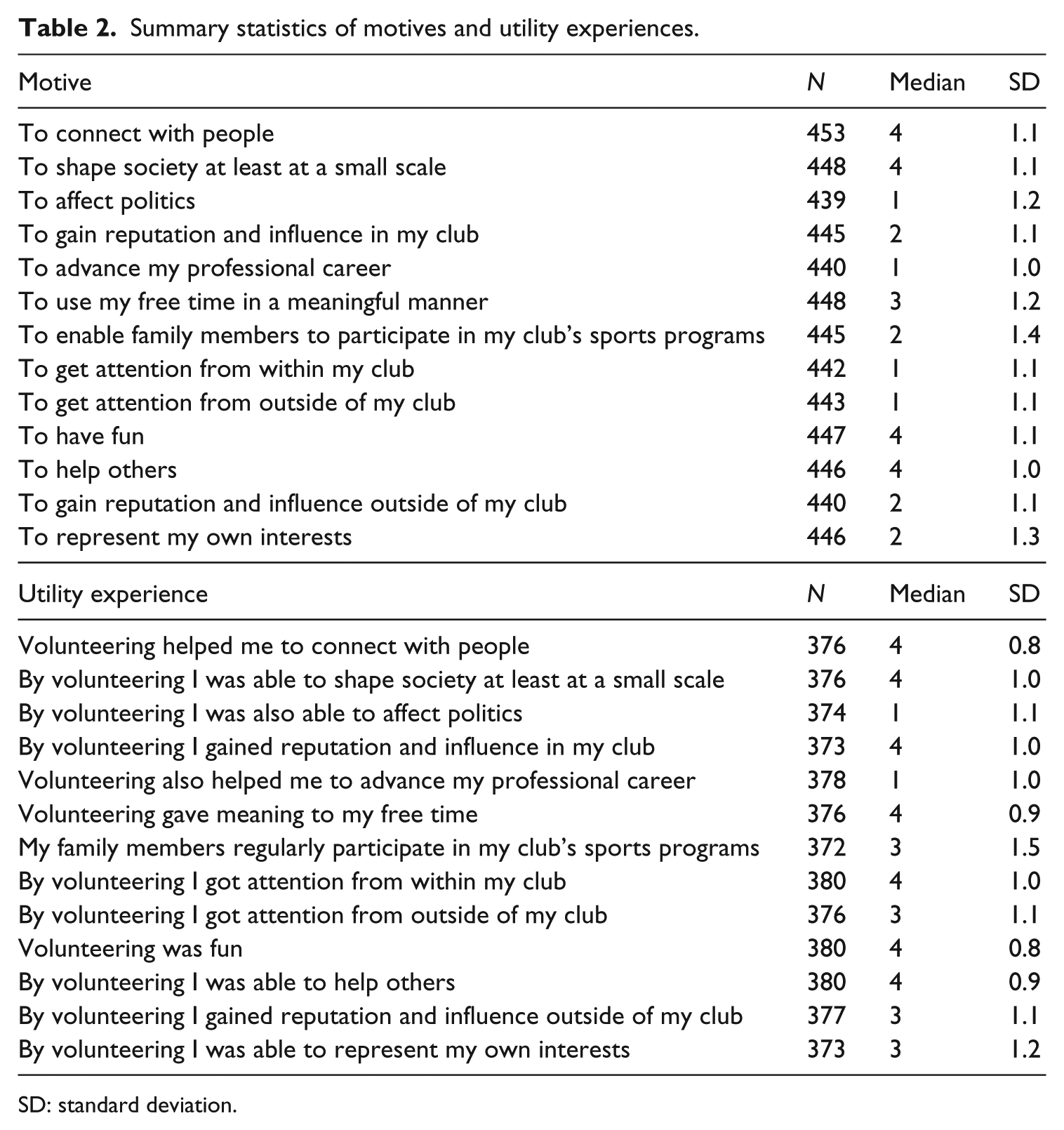
SD: standard deviation.
Following Stukas et al. (2009), we then constructed the MQI by combining the motive and utility dimensions in a multiplicative way. For every volunteer, we have

where
Figure 1 shows a histogram of the resulting MQI (N = 303). The mean (median) of the index is 125.06 (123), and its standard deviation (SD) is 38.83. The MQI ranges from a minimum of 35 to a maximum of 325, with an interquartile range of 47.
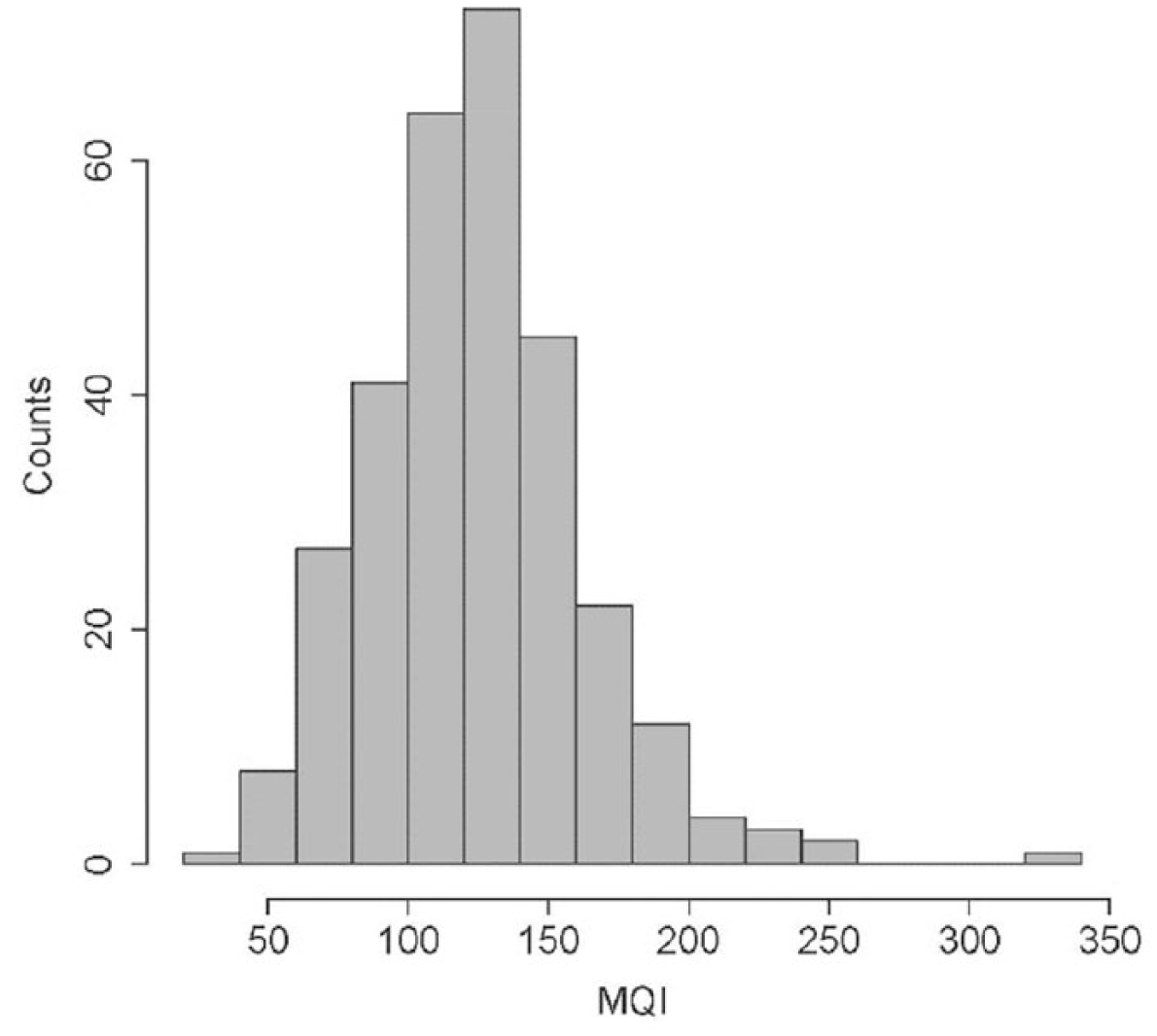
Match-quality index (N = 303).
An alternative way to measure match quality would be to examine matches of utility experiences and corresponding motives separately along every single utility-motive dimension or along specific subsets of utility-motive dimensions (e.g. a subset formed by aggregating altruistic utility-motive dimensions in some way). Stukas et al. (2005) implement such a multidimensional approach based on the Voluntary Functions Inventory (VIF; see also Clary et al., 1998) to study volunteer satisfaction, future intentions, generalized trust, and sense of community. Tschirhart et al. (2001) use a different multidimensional approach to study how goals and outcomes affect volunteer satisfaction and the likelihood of future volunteering, and Davis et al. (2003) consider how altruistic-motive fulfillment and self-oriented-motive fulfillment affect volunteer satisfaction, involvement, and persistence. The management of charitable and non-profit organizations in general and amateur football clubs in particular, however, may find it difficult to implement a multidimensional approach in practice, not least because such an approach would complicate tracing out how a high match quality measured along some utility-motive dimensions together with a low match quality measured along some other utility-motive dimension jointly contribute to overall volunteer satisfaction (Stukas et al., 2009: 8). Tschirhart et al. (2001: 437), for example, also present results for an empirical model ‘… using the overall match variable (which added how well the goal matched the outcome for each of the five functions)’ because studying their various categories did not allow them ‘… to look at the match of goal importance and achievement for all five functions together’.
Control variables
In addition to match quality, donations may depend on several other control variables. Our choice of control variables builds on the research by Brown and Ferris (2007) and the empirical literature on giving equations (see, e.g., Andreoni et al., 2003; Brown, 2005). Table 3 depicts the summary statistics of our control variables. Because not all volunteers answered all questions of our questionnaire, and because we used the control variables to estimate our multivariate regression models, we report for all control variables summary statistics for those N = 212 observations that we could use to estimate our regression models (see Table 4).
Summary statistics of control variables.
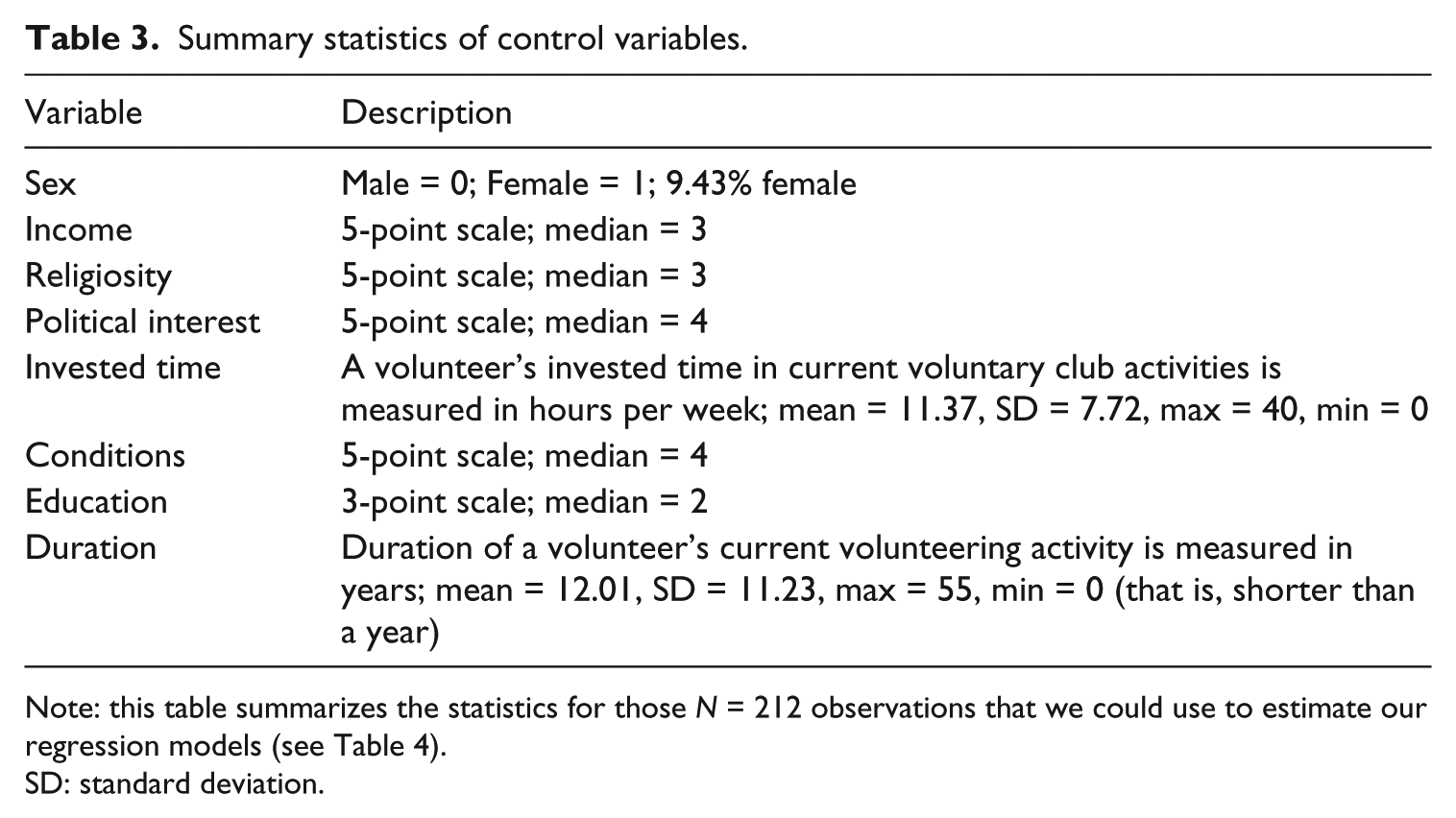
Note: this table summarizes the statistics for those N = 212 observations that we could use to estimate our regression models (see Table 4).
SD: standard deviation.
Results.

Note: estimates of Probit models. Internal donations denote donations to a volunteer’s own football club. External donations denote donations to other charitable and non-profit organizations.
SD: standard deviation; MQI: match-quality index. AIC: Akaike Information Criterion.
10% significance levels.
5% significance levels.
Before turning to the description of the control variables, we briefly mention that volunteers are, on average, 46 years old (min = 16 years, max = 73 years; data are available only for 204 volunteers of those volunteers that we studied in our regression model). Almost all volunteers are German citizens and were born in the former Federal Republic of Germany. They do their volunteer work in football clubs that have, on average, approximately 357 members (median = 220, SD = 206.19). The top five tasks on which volunteers work are organizing events, coaching teams, working on projects, representing the interests of the club, and administrative work, followed by taking care of media relations, doing everyday practical work (cultivating the sports field, cleaning shirts, etc.), and fundraising.
Donating money may depend on income (e.g. Auten et al., 2002). Given the sensitivity of questions regarding income, we measured (net) income by means of six broad categories (smaller than 1.000 euros, 5.66%; larger than 1000 euros but smaller than 2250 euros, 22.17%; larger than 2250 euros but smaller than 3500 euros, 46.23%; larger than 3500 euros but smaller than 4500 euros, 15.57%; larger than 4500 euros but smaller than 5500 euros, 8.96%; larger than 5500 euros, 1.42%; median = 3).
Because earlier research has shown that donating behavior may depend on gender (Andreoni and Vesterlund, 2001; Emrich and Pierdzioch, 2015, among others), we controlled for a gender effect. In the sample of data we used in our regression model, we have 90.57% male volunteers and 9.43% female volunteers.
Donating behavior may depend on general humanitarian values of a volunteer (see, e.g., Emrich and Pierdzioch, 2015). We, therefore, controlled for a volunteer’s religiosity (median = 3) and interest in politics (median = 4), measured on a 5-point scale from ‘none’ to ‘exceptional’. While donations to other charitable and non-profit organizations may increase in a volunteer’s general humanitarian values, the effect of humanitarian values on donations to a volunteer’s own football club depend on whether donations to different organization are substitutes or complements.
Hoye et al. (2015) argue that conditions at place of residence affect involvement in community sports. People who are more content with their place of residence are supposedly more involved than others. Because involvement may affect donating behavior, we controlled for conditions at place of residence, measured on a 5-point scale from ‘very poor’ to ‘very good’ (median = 4).
Donations may depend on a volunteer’s human capital. Several studies find that donation behavior increases in the level of education, a proxy for human capital (see, e.g., Andreoni et al., 2003; Bradley et al., 2005; Rosen and Sims, 2011). We controlled for a volunteer’s level of education, divided into three categories (student/still in training or no secondary education, 3.77%; vocational education, 78.77%; and academic degree, 17.45%, median = 2).
We followed the literature on social capital in sports clubs and other voluntary organizations (Harvey et al., 2007; Stolle, 1998) and controlled for how long a volunteer had worked in his or her current volunteer position (mean = 12.01 years, median = 8, SD = 11.23). Long-term members may accumulate a higher level of social capital compared to short-term members and are, therefore, expected to have a higher probability of donation. In this regard, the intensity of a voluntary engagement may be yet another determinant of donating behavior. We measured the intensity of a voluntary engagement in terms of the hours spent per week on voluntary work. On average, volunteers work 11.37 hours per week (median = 10, SD = 7.72).
Empirical results
Bivariate analysis
The bar charts summarized in Figure 2 show that the mean value of the MQI is higher for those volunteers who donated to their own football club (mean = 128.09, N = 173) than for those volunteers who gave to other charitable and non-profit organizations (mean = 119.24, N = 135). This difference is statistically significant (t-test = 2.14, p-value = 0.03). The bar charts further reveal that the mean value of the MQI assumes the largest value for those volunteers who only donated to their own football club (mean = 133.01, N = 95), followed by the mean value of the MQI for those volunteers who donated to their own football club or other charitable and non-profit organizations or both types of organizations (mean = 124.93, N = 230). The mean value of the MQI is lowest for those volunteers who gave only to other charitable and non-profit organizations (mean = 115.33, N = 57; difference to volunteers who only gave to their own football club: t-test = 3.06, p-value < 0.01), and is in between the mean values of the other groups of volunteers and those volunteers who did not donate (mean = 126.01, N = 71).

Match-quality index and donations.
In sum, the bar charts show that match quality is, on average, higher for those volunteers who donate to their own football club than for those volunteers who also give to other charitable and non-profit organizations. The bar charts do not lend support to a positive association between match quality and donations to other charitable and non-profit organizations. In fact, donations to other charitable and non-profit organizations than the volunteer’s own football club appear to be negatively associated with match quality.
Regression models
The bar charts do not answer what the associations between donation behavior and match quality look like once we control for the influence of our control variables. Given the binary nature of the answers to whether volunteers donate to their football club or other charitable and non-profit organizations, we estimated Probit models to study how the propensity to donate depends on match quality and the other control variables. Estimating Logit models instead gives similar results (not reported, but available from the authors upon request).
The left panel of Table 4 (‘Internal donations’) summarizes the estimation results for the donations to a volunteer’s own football club. In terms of significant effects, the probability of a donation increases relative to the lowest income group, except, however, for the highest income group for which we have only a few observations. The propensity to donate also increases significantly in the intensity of a voluntary engagement. Regarding human capital, we find that having had vocational education significantly increases the probability of making a donation; however, only at a significance level of 10%. The effect of having an academic degree is insignificant with respect to donations. Match quality has a positive, albeit insignificant, effect on the propensity to donate. The McFadden R2 of the model is 0.12.
The right panel of Table 4 (‘External donations’) summarizes the estimation results for the donations to other charitable and non-profit organizations. For donations to other charitable and non-profit organizations, we observe a strongly significant gender effect. The propensity to donate to other charitable or non-profit organizations is significantly higher for female than for male volunteers, which is in line with results of earlier research (that is, women are more likely to spread their donations to more organizations than men; see, e.g., Emrich and Pierdzioch, 2015). While the coefficients of all income categories are insignificant, the duration of a person’s current voluntary activity significantly increases the propensity to donate to other charitable and non-profit organizations. Finally, match quality has a significantly negative effect on the propensity to donate to other charitable and non-profit organizations. The McFadden R2 of the model is 0.16.
Discussion
One might be tempted to argue that our results are not too surprising. Based on a simple budget-constraint argument, one could argue that donating a certain amount of money to one’s own football club leaves no money on the table that a volunteer could give to other charitable and non-profit organizations. In other words, if a high match quality triggers a donation to a volunteer’s own football club it should also trigger, given a budget that is available for charitable giving, less donations to other charitable and non-profit organizations. This budget-constraint argument, however, does not explain why donations are linked to match quality in the first place and why volunteers who enjoy a high match quality tend to give to their own football club rather than to other clubs and charitable organizations. The argument also does not apply when a high match quality (as in our Probit models) not only leaves donations to a volunteer’s own football club unaffected but, given a budget for charitable giving, rather reduces donations to other clubs and charitable organizations.
In order to set up a more elaborate theory of match quality, social capital, and donations, it is useful to draw on research in social psychology on social identity theory and recent research on the economics of identity. Resorting to identity theory to develop a theory of match quality, social identity, the bonding and bridging element of social capital, and donations is promising because results reported by Vermeulen and Verweel (2009) indicate that membership of a sports club ‘is related to identity’, that it is a demonstration of ‘belonging to a group’, and that it combines elements of inclusion and exclusion. The theory should explain at the microscopic level how exactly match quality affects the creation of social capital and, eventually, the donations of volunteers. Moreover, the theory should not only explain why match quality has a moderate positive effect on donations to volunteers’ own football clubs but also why match quality has a significantly negative effect on the donations to other charitable and non-profit organizations.
In recent research on the economics of identity, Akerlof and Kranton (2000) argue that identity, which they define as a person’s sense of self (p.715), can explain why people choose to give to one organization over another rather than simply spreading donations across organizations so as to equilibrate the marginal returns on their donations (p.722). In their model, utility depends on one’s own and others’ actions and identity. Identity is a function of one’s own and others’ actions, social categories, assignment of individuals to those categories, prescribed behavior, and the extent to which an individual behaves according to prescribed behavior. In the context of our analysis, the decisions to volunteer and to donate money constitute a volunteer’s own and others’ actions. Football clubs and other organizations are the social categories. The membership in a football club constitutes an assignment of a volunteer to a social category. Prescriptions may require that a member of a football club volunteers, donates money, or helps his or her football club in some other way.
A direct influence of donations on utility could arise due to, for example, ‘warm glow’ considerations (Andreoni, 1989) or the possibility to consume the good (sports, football) that the club produces. An indirect effect of donating money on utility that operates through identity, in turn, arises if donating money strengthens a volunteer’s subjectively perceived belonging to his or her football club. Such an indirect effect also arises if donating money brings a volunteer’s behavior closer in line with prescribed behavior. Prescribed behavior reflects the shared values and norms of the members of a football club. Prescribed behavior may reflect, for example, reciprocity norms that require that an elder club member does volunteer work because he or she benefitted from the volunteer work of other club members when he or she was an active football player. In this regard, Emrich et al. (2014) argue that a sports club can be interpreted as a closed social structure that increases the cooperation of its members because it ‘…constitutes an institutional framework that makes it relatively easy to invoke emotionally supported sanctions, which Coleman (1990: 278–282) termed “incremental sanctions”, and which make it difficult to refuse the provision of services in the long run’ (p.233). The incentive to invoke incremental sanctions is strong because non-cooperation of a single club member gives rise to an externality insofar as non-cooperation undermines the shared values and norms and, thereby, threatens the identity of all club members (see Akerlof and Kranton, 2000: 717).
One way to integrate match quality into this model is to assume that match quality directly leverages the utility effect of doing volunteer work and donating money because a volunteer’s satisfaction increases when the congruence of utility experiences with motives for volunteering becomes stronger. Another way through which match quality may enter the model, however, is through its effect on identity. First, match quality, by making volunteer work more satisfactory and giving money more rewarding, may directly reinforce the effect of donations on a volunteer’s subjectively perceived belonging to his or her football club. Second, match quality makes it easier for a volunteer to live up to the values and norms of his or her football club. It becomes easier for a volunteer to reconcile individual with prescribed behavior, triggering a process during which organizational bonds strengthen and the identification with a football club intensifies. This process, in turn, may result in a stronger bonding component of social capital as the extent of emotional and social inclusion in the social category ‘my own football club’ becomes more extensive. Moreover, our empirical results suggest that the self-image as a member of ‘my football club’ (the ingroup in the terminology used by Tajfel and Turner, 1979) not only strengthens the bonding component of social capital but that it, at the same time, weakens the bridging component and, thereby, reduces donations to other charitable and non-profit organizations (the outgroups) than a volunteer’s own football club.
In order to explore the potential root of the latter result in more details, it is useful to recognize that the research by Akerlof and Kranton (2000) builds on a large and significant body of research in social psychology on social identity theory. Tajfel and Turner (1979: 40; see also Tajfel and Turner, 1986) define social identity ‘… as those aspects of an individual’s self-image that derive from the social categories to which he perceives himself as belonging’. For the volunteers that we studied in our research, a relevant social category is ‘their’ football club, that is, a social construct that consists of a group of club members ‘… who perceive themselves to be members of the same social category, share some emotional involvement in this common definition of themselves, and achieve some degree of social consensus about the evaluation of their group and of their membership of it’ (Tajfel and Turner, 1979: 40). According to social identity theory, membership in a football club, thus, not only structures a volunteer’s social environment but, together with other social categories (the outgroups), it rather constitutes ‘…a system of orientation for self-reference…’ by defining an individual’s place in society (Tajfel and Turner, 1979: 40). Once individuals have defined ingroups and outgroups, an ingroup bias ‘… is a remarkably omnipresent feature of intergroup relations …’ and ‘… the mere perception of belonging to two distinct groups – that is, social categorization per se – is sufficient to trigger intergroup discrimination favoring the in-group’ (Tajfel and Turner, 1979: 38). Several experimental studies have shown that an ingroup bias arises even when an experimenter forms ‘groups’ based on a minimal and arbitrary random categorization criterion. Tajfel et al. (1971), for example, set up such experiments and find that otherwise anonymous (there is no social interaction) subjects tend to favor members of ‘their’ ingroup and discriminate the outgroup. They also find evidence that subjects follow a strategy of maximum difference between the ingroup and the outgroup rather than a simple strategy of maximizing ingroup reward, and that subjects reduce rewards to the outgroup even when giving to the outgroup does not lower the rewards for the ingroup (for a summary of their experimental evidence and a compact review of the experimental literature, see Tajfel and Turner, 1986: 14). In a sport-specific context, Levine et al. (2005) report results of experiments that show that an ingroup bias can help to explain the behavior of supporters of different football clubs in emergency-intervention experiments.
In sum, if match quality helps volunteers to maintain a positive social identity (by associating positive values with ‘their’ football club as compared to other charitable and non-profit organizations), the resulting ingroup bias is likely to reinforce the bonding element of social capital. At the same time, an ingroup bias, in line with experimental evidence, helps to explain that donations to other charitable and non-profit organizations are negatively associated with match quality even when donations of volunteers to their own football clubs tend to be only weakly (and in the Probit models insignificantly) positively linked to match quality (but as far as the latter link is concerned, it should also be kept in mind that volunteers already donate time to their football clubs).
Summary and limitations
In sum, our empirical results suggest that match quality has a positive (but in the Probit model insignificant) effect on donations to a volunteer’s own football club (the bonding component of social capital). In contrast, donations to other charitable and non-profit organizations (the bridging component of social capital) are significantly negatively linked to match quality. Taken together, our results indicate that match quality strengthens the bonds of volunteers to their football clubs, but weakens ties with the outside world, at least when the latter are measured in terms of donations to other charitable and non-profit organizations. We have argued that social identity theory and the economics of identity help to explain both the positive effect of match quality on the bonding component of social capital and, in particular, its negative effect on the bridging component.
If match quality fosters the production of the bonding component of social capital and, at the same time, weakens the bridging component of social capital, the result could be an introspective view on the world that focuses a volunteer’s attention on his or her football club. Such a negative effect of match quality on ties with the outside world can be further tested in future empirical research by studying whether football volunteers’ civic engagement in other sectors of society is systematically linked to match quality. When undertaking such an analysis, however, it is important to take into account a potential reversed causality. A reversed causality can easily arise because, if volunteering is a process of search, match quality may depend on search intensity and search experience and, thus, on a football volunteers’ civic engagement in other sectors.
Finally, we point to some limitations of our research. In this regard, it is important to note that we derived our empirical results based on a relatively small sample of football-club volunteers in south-west Germany. It remains to be seen in future research whether empirical research using data for other German regions corroborates our results. Another interesting avenue for future research is to explore whether the football-specific results we have laid out in this research can be replicated using data for other sports disciplines. Last but not least, it should be noted that our results neither shed light on how donations and social capital vary across volunteering and non-volunteering members of football clubs, nor on how donations and social capital vary across members and non-members of football clubs.
Footnotes
Acknowledgements
We thank Lawrence Wenner (the Editor-in-Chief) and two anonymous reviewers for their very helpful and constructive comments. The usual disclaimer applies.
Funding
The authors received no financial support for the research, authorship, and/or publication of this article.