



Abstract
The intergenerational transfer of a sports-related lifestyle within the family is a potential way to explain the social differences in sports participation that are displayed by young people. In this article, the importance of a sports-related lifestyle within the family, as well as parents’ educational background and sports participation in childhood, in the sports participation of adolescents and young adults is examined from the perspective of socialisation theory. Structural equation modelling was used to demonstrate that all of the examined predictors have significant positive effects on the current sports participation of individuals between the ages of 15 and 30 years (N = 4028; M = 21.48; SD = 4.64). The most pronounced effect on sports participation was observed for a sports-related lifestyle in the family.
Keywords
Introduction
The question of whether adolescents are able to relate to sports and integrate physical and sports activities in their everyday lives, as well as the way in which they do it, is determined to a large extent by their families, particularly by their parents. In this context, social differences are often manifested in socially disadvantaged children and young people who are less active in sports (Berger et al., 2008; Scheerder et al., 2005; Vandermeerschen et al., 2016; White and McTeer, 2012).
This raises the question of how the positive linkage between the educational status of the parents and the sports involvement of children and adolescents can be explained. Sports and physical activity are forms of behaviour and habits that can vary in importance from one family to the next, depending on the parents’ attitudes, preferences and lifestyle. Depending on these factors, children and adolescents are offered different opportunities for physical activity and sports experiences. According to Welk et al. (2009), parents affect the formation and shaping of sports-related attitudes and behaviour in adolescents, which are understood as a sports-related lifestyle. This sports-related lifestyle includes sports-related orientations, interests and preferences, as well as sports activities, which are learned through socialisation processes (e.g. Brettschneider, 1992). It becomes clear that a sports-related lifestyle is transferred intergenerationally within the family by means of regular joint sports activities, social and material support or sports-related communication during the course of a family’s daily life (Burrmann, 2005; Downward et al., 2014; Welk et al., 2009).
In the studies that have been conducted thus far, the effects of parents’ sports activities and their social support of the sports participation of their children have been investigated comparatively often; however, overall, the findings are inconsistent (Gustafson and Rhodes, 2006). Furthermore, numerous studies consider the direct effects of social inequality and parental sports behaviour, as well as social support of sports activity, to explain the differences in sports participation among youths (Biddle et al., 2011; Pugliese and Tinsley, 2007). However, it is surprising that the relationship between social inequalities (e.g. parental educational level) and the sports-related lifestyle within the family, as well as sports participation in childhood, and its effect on the sports participation of adolescents and young adults has rarely been investigated.
The present study aims to consider the connection between the sports participation of adolescents and young adults and a range of different factors, specifically the sports-related lifestyle within the family, parental educational status and past sports participation in childhood. Although many studies confirm positive influences, the question arises of the extent to which a sports-related lifestyle is conveyed through socialisation processes within the family, particularly in childhood, and whether it is carried over into adolescence and young adulthood, thereby influencing the sports activities in these phases of life. The aim of this study is to examine in more detail: (a) whether a sports-related lifestyle within the family depends on the social background of the parents; and (b) the extent to which these aspects are relevant for adolescents’ participation in sports. 1
First, theoretical considerations and recent studies on social inequality in sports and family socialisation in sports will be presented. Then, a structural equation model will be designed based on the latest research and theoretical considerations, which will be empirically analysed. Finally, the results will be presented and discussed.
Theoretical considerations
In previous studies, it has been shown that the socioeconomic status of the family influences children’s (Chen et al., 2002; White and McTeer, 2012) and adolescents’ (Reichert et al., 2012; Toftegaard-Stockel et al., 2011) access to sports. Education status is crucial to the financial situation of the family, which may determine the availability of a sports-stimulating environment to children and adolescents (e.g. sports equipment, club memberships). In the present study, the direct effect of parents’ educational status on the sports participation of children and adolescents, as well as young adults, is analysed. It can be assumed that the higher the parents’ educational status is, the more pronounced the sports participation in childhood (H1), as well as in adolescence and adulthood (H2), will be. Because the importance of the family decreases and that of a child’s peers increases with age (Hurrelmann, 2010; Zinnecker, 2000), it is possible that the effect of the parents’ educational status on sports participation changes with age (Chen, 2004; Chen et al., 2002). Therefore, the question arises of how the sports-related socialisation practices within the family depend on the parents’ level of education. It is possible that the parents’ level of education is positively linked with the awareness of the effect of sports on the holistic development of the individual. The higher the educational levels of the parents, the greater the probability is that they will invest time, money and social relationships to provide a sports-stimulating environment for their child. It has been shown that an educationally advantaged home is more able to offer children the necessary temporal, financial and socio-emotional support than an educationally disadvantaged home (Evans and Davies, 2010). Based on these considerations, it may be assumed that the parental level of education has an effect on the accessibility of the relevant contexts for sports activities and the extent to which they are actively used. Therefore, it is to be assumed that parental educational status has positive effects on the sports-related lifestyle within the family (H3).
The organisation of the contexts that are relevant to sports and physical activity of youth is conveyed to a substantial degree through socialisation mechanisms within the family (e.g. attitude towards sports and physical activities, social support, educational style of the parents) (Burrmann, 2005; Duncan et al., 2005; Wheeler, 2011). Differences in sports participation of adolescents and young adults are thus determined by sports-related socialisation strategies and practices within the family and their effectiveness (Baur and Burrmann, 2008).
According to Hurrelmann (2006), socialisation is a lifelong process whereby an individual learns the (sports-related) attitudes, values and behaviours that are appropriate to his or her own society. In childhood and youth, individuals are mainly influenced by their family and peers, who are the primary agents of socialisation. For socialisation concerning sports, the previous research has shown that adolescents and young adults are strongly shaped by their parents, whereby the parents’ sports-related attitudes and activities are likely to be relevant to their children’s participation in sports (Downward et al., 2014). Depending on parents’ sports-related orientation and their own sports history and sports-related educational views, children will be offered more or fewer opportunities for sports-related experiences. These findings on the intergenerational transfer of behaviour indicate the importance of parents in their function as positive role models (Bois et al., 2005; Downward et al., 2014). In this scenario, parents can exert an influence on the sports-related lifestyle of their children by serving as passive and unintentional models (Fredricks and Eccles, 2004; Kay, 2004). Aside from this, however, the – active and intentional – support that is given by parents to their children’s sports activities is also important (Beets et al., 2006; Duncan et al., 2005).
Children who grow up in a home with an affinity for sports are, therefore, more likely to become involved in sports than children who are from families that are detached from sports (Downward et al., 2014). It seems that parents’ sports behaviour and attitudes lead to an intergenerational transfer through socialisation processes to the children and youth. Depending on the way in which children are involved in the sports activities of their parents or siblings, sports are assigned high, indifferent or low relevance, which represents the sports-related lifestyle within the family, and this affects the sports involvement of adolescents and young adults accordingly. Therefore, it can be assumed that a sports-related lifestyle within the family leads to a higher sports participation in adolescence and young adulthood (H4).
Sports-related orientation and competencies are communicated to children through family socialisation by involving children in everyday activities such as joint bicycle tours (Baur, 1989). In addition, communicating about sports-specific topics and attending sporting events with the family may shape the sports-related orientation of children. Such health-, physical- or sports-related everyday routines within the family can have a lifelong effect on children while they are growing up. Sports activities in childhood exert a positive influence on sports involvement in adolescence and (young) adulthood (Beunen et al., 2004; Telama et al., 2005) (H5).
However, because social learning experiences within the family are bi-directional, it is also conceivable that an influence may occur in the opposite direction: if a child makes contact with sports-related activities outside of the family home, for example, during physical education (PE) lessons at school, this could also affect the sports-related lifestyle within the family. Children’s involvement in sports increases the relevance of sporting habits in the family’s everyday life, which may lead to parents and/or siblings becoming involved in sports (once again) or, at least, it may lead them to revise their own sports-related lifestyle and their sports-related views on childrearing; this may, in turn, influence the sports participation of the child (Hurrelmann, 2009). A reciprocal relationship may thus be assumed to exist between the sports-related lifestyle within the family and the sports participation of children (H6).
Furthermore, considering the importance of social inequality in sports participation of adolescents and young adults, analyses of the socialisation mechanism should be conducted for different social groups (e.g. gender, age group, nationality). For example, it is possible that the effect of socialisation processes in the family may be less for young women than it is for men. In particular, gender, age group and nationality are of interest because differences in sports participation are often correlated with these sociodemographic factors (European Commission, 2014; Lamprecht et al., 2014). The previous research on the socialisation mechanism in the family neglected the effect of such sociodemographic variables (Dukes and Coakley, 2002). Taking this into consideration, the effect of gender, age group and nationality on the postulated model will be investigated. In particular, the question of whether these three sociodemographic properties moderate the effect of the postulated influencing factors will be studied.
Method
Sample
With the aim of obtaining a sample of approximately 3000 to 4000 adolescents and young adults between the ages of 15 and 30, municipalities were first selected in two Swiss cantons, Bern and Freiburg, which were as heterogeneous as possible in terms of language (German and French), size (number of inhabitants) and extent and quality of municipal sports promotion (e.g. participation in appropriate sport promotion programmes on a national and cantonal level). Of the 100 municipalities that we approached in writing, 36 agreed to take part in the study and gave us access to their population’s postal addresses. Depending on the size of the municipality, either the entire population was used or a random sample was drawn from the entire population of 15- to 30-year-olds. Overall, 24,715 letters were sent to the postal addresses of adolescents and young adults whose names were provided by the municipalities. They were invited to participate in an online survey by following a link or using a QR-code with their smartphone. In the end, the present study included data from 4039 individuals (rate of return: 16.3 %).
Slightly more women (54 %) took part in the study than men (46 %), and the mean age was 21.48 years (SD = 4.64). The youngest age group (15- to 20-year-olds) accounted for 47 %, i.e. almost half, of the respondents (Table 1); the age group of 21- to 25-year-olds accounted for 29 %, and 24 % were in the age group of 26- to 30-year-olds. With respect to the level of education, it is notable that the majority (64%) have either completed compulsory school or secondary school (including lower professional education). Approximately 10% hold a university degree. For 72%, the main language is German, and for 28% the main language is French. Regarding nationality, 82% of the participants are Swiss nationals, 9% are foreign nationals, and 9% have a second nationality in addition to their Swiss citizenship. Furthermore, 83 % of respondents stated that they actively took part in sports, i.e. engaged in gymnastics, fitness or sports at least one to three times a month, whereas 17 % did not participate in sports.
Description of the sample (N = 4028).
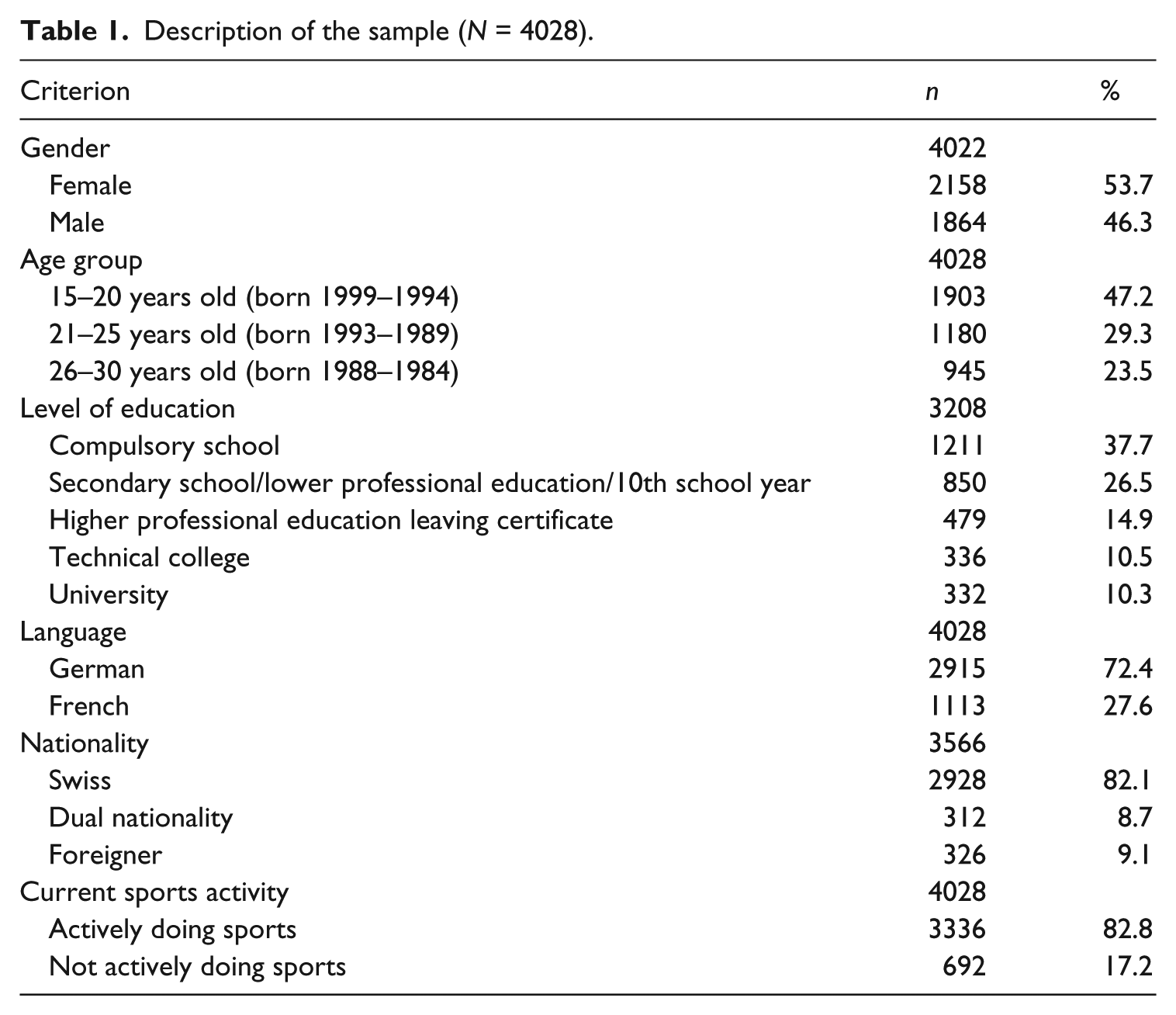
Compared with the available data for the Swiss population (Federal Statistical Office, 2016a, 2016b), the population is satisfactorily represented by the sample with respect to gender (female: 51%) and language (German: 63%, French: 23%). Regarding sports activity, the sample appears to be slightly more active than the Swiss population, in which 80% of 15- to 24-year-old adolescents and young adults and 76% of 25- to 34-year-old adolescents and young adults take part in sports (Lamprecht et al., 2014). In the Swiss population, almost a quarter of the participants are from a foreign country (24%), whereas 18% are identified as foreign citizens in the sample. With regard to education level, it is difficult to compare the sample with the overall data for the Swiss population because the adolescents and young adults in that age range are still completing their studies. In conclusion, the sample is not only adequately large, but it also reflects the Swiss population to an acceptable, although certainly not ideal, extent. Some bias may be introduced by the fact that the questionnaire was available only in German and French, so that adolescents and young adults with a different main language are underrepresented in this survey.
Operationalisation of the constructs
The main focus of the standardised questionnaire was on the past and present sports participation of adolescents and young adults, as well as their sports-related lifestyle. The present study draws on the group that the adolescents and young adults designate as their family.
Sports participation of adolescents and young adults
The questions about the sports participation of adolescents and young adults were developed based on the questionnaire for the national survey of sports behaviour of the Swiss population (Lamprecht et al., 2014). In the interest of a broad interpretation of sports, the central dependent variable ‘sports participation of adolescents and young adults’ comprises all of the sports that can be pursued in a sports club, at a private or commercial sports service provider or informally with one’s family, friends or alone. However, it does not include obligatory PE lessons at school or mobility activities (e.g. going shopping on a bicycle). In concrete terms, the sports participation of adolescents and young adults was operationalised by the time that is spent engaging in sports activities (number of hours per week, not including obligatory PE lessons) and the frequency with which the two preferred sports were performed, distinguishing between summer and winter (1 = never, 2 = less than once a month, 3 = approximately one to three times a month, 4 = approximately once a week, 5 = several times a week, 6 = (almost) every day).
Sports participation in childhood
Sports participation in childhood was determined retrospectively by asking ‘How would you describe your sports involvement as a child (up to the age of 14)?’ and offering two response options for continuity of the sports activity (1 = sporadic sports activity or 2 = constant sports activity without interruption) and four possible answers for the degree of the sports activity (1 = no sports activity, 2 = leisure time spent with physical activity, 3 = doing sports, 4 = competitive sports).
Sports-related lifestyle within the family
The items for a sports-related lifestyle within the family were based on a questionnaire to measure the health-related family climate that was developed by Niermann et al. (2014). Six items were used, for which the adolescents and young adults had to state on a five-point Likert scale (1 = does not apply to 5 = applies) to what extent the statement applied to them. In my family: (a) ‘sports are/were very important’; (b) ‘it is/was taken for granted that one does sports regularly’; (c) ‘we support/supported each other in our respective sports activities’; (d) ‘we enjoy/enjoyed actively doing sports together’; (e) ‘it is/was taken for granted that you behave in ways that are beneficial to your health in everyday life’; and (f) ‘we regularly speak/spoke about sports topics’.
Educational status of the parents
The educational status of the parents was determined by the highest level of education that was completed by the father and the mother (‘What level of education has your father/mother completed?’). The possible answers were 1 = no education, 2 = obligatory school, 3 = 10th grade, 4 = secondary school, 5 = lower professional education, 6 = higher professional education leaving certificate, 7 = technical college, 8 = university.
Sociodemographic details of the adolescents and young adults
The adolescents and young adults were also asked to indicate their gender (1 = female, 2 = male), age group (1 = 15- to 20-year-olds, 2 = 21- to 25-year-olds, 3 = 26- to 30-year-olds) and their nationality. It was possible to indicate multiple nationalities. A foreign nationality or dual Swiss and foreign nationality was counted as a foreign nationality, and a (sole) Swiss citizenship was not (1 = Swiss nationality, 2 = foreign nationality).
Data analysis
The data were processed and analysed using the statistical program packages IBM SPSS 23 and R (Version 3.2.2). The key analyses were performed using structural equation models (R package lavaan, Rosseel, 2012), which have the advantage over path models that the postulated effects can not only be estimated simultaneously but also more precisely and with greater validity (correction of measuring errors) (Brown, 2015).
Considering the number of missing values, large differences were found between the individual variables (age: 0.0%, gender: 0.2%, sports participation in adolescence: max. 6.1%, parental education: 12.3%, sports-related lifestyle within the family: max. 12.9%). To detect a possible bias, patterns of missing data were analysed. In particular, correlations were calculated between indicator variables for missingness (0 = no valid answer, 1 = valid answer) and all 21 variables that were used in this study, i.e. all of the model variables and all of the variables describing the sample. By and large, the effects were small (rmax = .18). The most consistent pattern could be observed with respect to sports activity, in the sense that, for example, willingness to answer item i21 (‘In my family (a) sports are/were very important’) was higher among individuals who actively participated in sports (│r│ =.15) in comparison to inactive individuals. However, a slight bias in this direction is probably ubiquitous in the sports science research. As a result, it was assumed that the missing values were random (Enders, 2013). Following Enders (2013), they were estimated using the full information maximum likelihood (FIML) option in the R package lavaan.
In the face of some skewed and ordered categorical variables, two robust methods of estimation were used for the structural equation modelling process (MLR, DWLS). These revealed no differences that are worth mentioning in the results, so only those results obtained using the robust MLR estimate will be presented.
To determine the effect of the three sociodemographic variables of gender, age and nationality on the postulated model, multiple group comparisons were performed. Following a step-up approach (Brown, 2015), different aspects of measurement invariance were checked for the three variables: configurational (equivalence of factor structure), metric (equivalence of factor loadings), scalar (equivalence of the means of manifest variables) and strict factorial invariance (equivalence of error covariances). These analyses are a necessary prerequisite to make valid statements about the structural effects in the various different subsamples, more specifically about the moderator effects and the differences between the latent constructs (equivalence of covariances or the means of latent variables). The models that were examined in this context were compared with one another using χ2 difference tests. Based on Chen (2007), who considers this procedure to be too restrictive, we primarily focused on the differences in the comparative fit index (CFI) of the models, and we rejected the null hypothesis (measurement invariance) for differences > .01.
Results of structural equation modelling
Analysis of the overall group
The means, standard deviations and intercorrelations of all the variables used for all of the model estimates are displayed in Table 2. The key results of the structural equation analyses are presented in Figure 1.
Zero-order correlations (r), means and standard deviations for study variables.
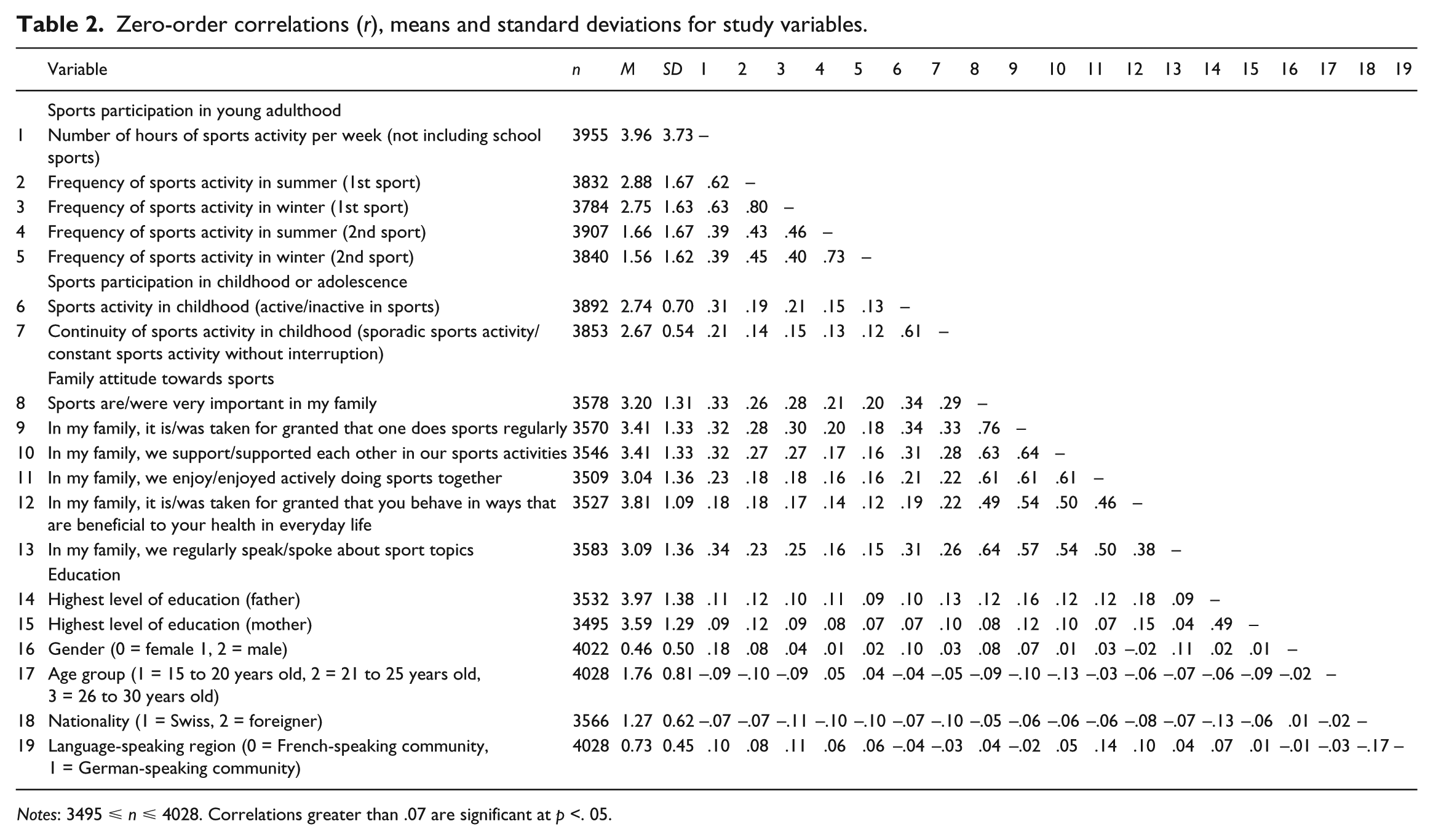
Notes: 3495 ⩽ n ⩽ 4028. Correlations greater than .07 are significant at p <. 05.
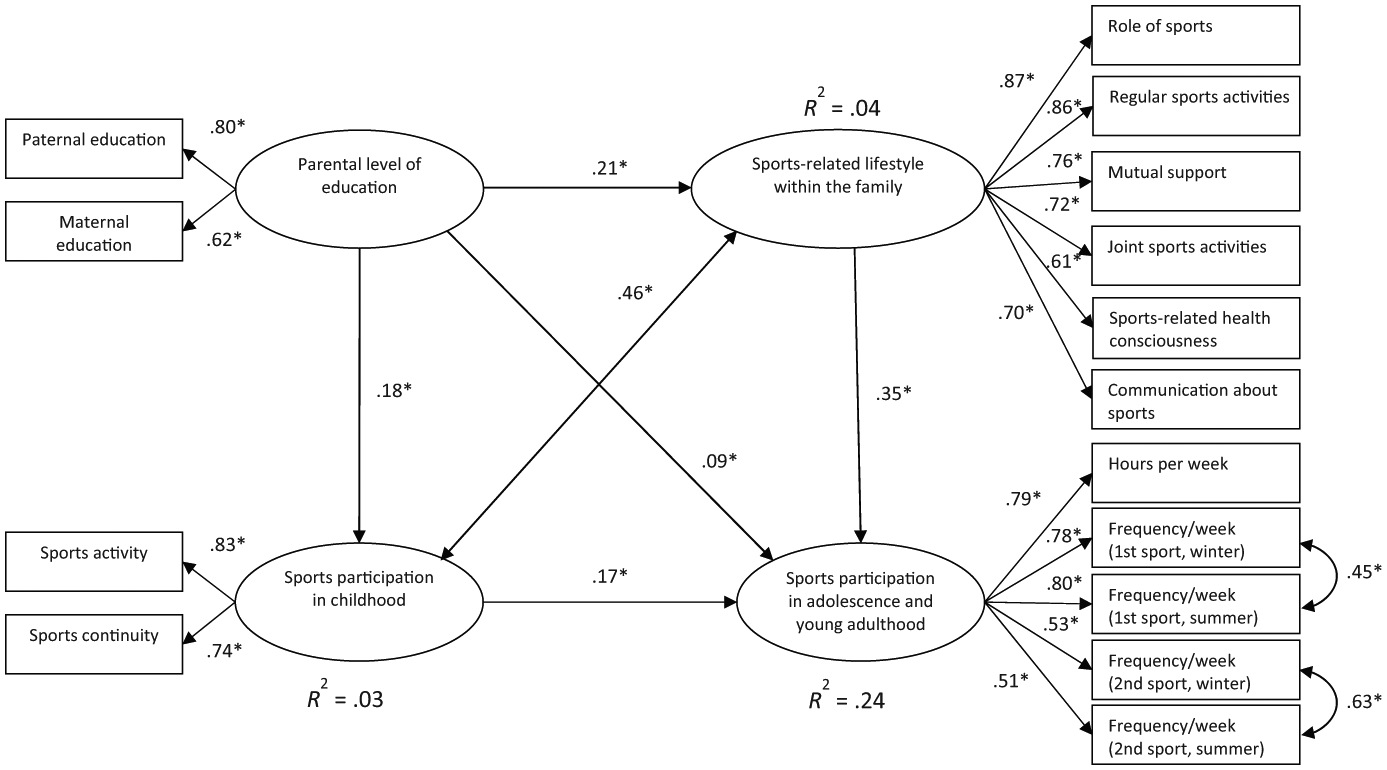
Standardised coefficients of the proposed model for intergenerational transfer of a sports-related lifestyle within the family. Latent constructs are enclosed in ellipses and observed variables are enclosed in boxes. * p < .001.
Based on Brown (2015), several parameters were used to assess the goodness of the structural equation model: the CFI, the Tucker Lewis index (TLI), the root mean square error of approximation (RMSEA) and the standardized root mean residual (SRMR). Values of TLI ⩾ .95, CFI ⩾ .95, SRMR ⩽ .08 and RMSEA ⩽ .06 were considered to indicate an acceptable model fit.
The measures of goodness of fit show that the postulated model fits the data well (MLR-χ2(82, N = 4028) = 752.747, p < .001; CFI = .970; TLI = .961; SRMR = .026; RMSEA = .045 [.042–.048]). With regard to the estimated model parameters of the base model B, Figure 1 shows that the current sports participation in adolescence and young adulthood was predicted by the sports-related lifestyle within the family (γ = .35, p < .001), whereas the sports participation in childhood (γ = .17, p < .001), as well as the level of education of the parents (γ = .09, p < .001), had a smaller, albeit significant, direct effect on the current sports participation. Furthermore, sports-related lifestyle is also relevant to the current sports participation since it appears as a mediator for parental educational status (β = .21, p < .001). In addition, the parental educational status had an effect on the current sports participation of the adolescents and young adults, which was mediated by sports participation in childhood (β = .18, p < .001). A pronounced correlation (r = .46, p < .001) was found between the sports-related lifestyle within the family and the past sports participation in childhood. The explained variance for the latent variable of the current sports participation of adolescents and young adults is R2 = 23.6%. Thus, on the whole, the data provide evidence for the six postulated hypotheses.
Moderator analyses
The results that have been presented thus far are based on the overall group. To determine whether the three sociodemographic features of gender, age group and nationality have an effect on the postulated model, a series of multi-group comparisons was conducted (Table 3). The results of the moderator analyses indicate that there are no moderating effects for gender, age group and nationality. Thus, the central result of these supplementary multi-group comparisons suggests that we must indeed confine ourselves to discussing the parameters of the model that was estimated on the basis of the overall group. This is because it can be assumed that the corresponding model parameters, which were estimated in the gender and age groups, as well as the group with a Swiss or foreign nationality, are identical apart from chance differences.
Tests for invariance across gender, age and nationality: Summary of model fit and χ2 difference test statistics.

Notes: MLR = maximum likelihood estimation with robust (Huber-White) standard errors and a scaled test statistic that is (asymptotically) equal to the Yuan-Bentler test statistic; CFI = comparative fit index; TLI = Tucker-Lewis index; SRMR = standardized root-mean-square residual; RMSEA = root-mean-square error of approximation; CFit = p-value of close fit (p RMSEA < .05); ΔMLR-χ2 = chi-square difference testing using the Satorra-Bentler scaled chi-square difference.
p < .001
To control for a possible method effect, the above calculations were repeated using complete case analysis for the missing data instead of FIML, and all of the relevant estimates (loadings, covariances and regressions) were correlated. The correlation of r = .99 indicated that the results were almost identical.
Discussion
Considering the social inequalities that are often mentioned in the literature in connection with the sports participation of adolescents and young adults (e.g. gender, age group and nationality) and the further explanations for sports participation that are typically drawn upon (including parental educational status and sports participation in childhood) (Nagel, 2003), the central goal of the present study was to focus on the family as an agent of socialisation. We were interested in determining whether the sports-related lifestyle within the family contributes towards explaining individual differences in the sports participation of adolescents and young adults over and beyond the known factors that are mentioned above. In addition, our aim was to examine whether this effect, along with the others, differed depending on gender, age group or nationality.
Overall, the results underscore the fact that the family and its sports-related lifestyle are noteworthy agents of socialisation for the sports participation of adolescents and young adults and that they serve both as a direct and indirect agent of socialisation, as a mediator between the parental educational status and the sports activities in childhood and the sports participation in adolescence and young adulthood. The results that have been obtained thus support the hypothesis that the sports-related lifestyle within the family influences the sports participation of children when they are growing up (Baur, 1989). However, it is possible that the psychosocial support between family members can compensate for a lack of parental education (see Stecher, 2001; Zinnecker and Stecher, 1996). It thus seems appropriate to pay more attention to the construct of a sports-related lifestyle within the family in developing future studies.
To determine the extent to which sociodemographic properties (gender, age group and nationality) moderate the relationships that are postulated in the model, particularly the effect of sports-related lifestyle within the family on the sports participation in youth and adulthood, multi-group comparisons were conducted. These revealed no signs of any moderator effects. It follows that the effect of a sports-related lifestyle within the family on the sports participation of adolescents and young adults (as well as all other effects) can be assumed to be the same – irrespective of which factors of gender, age group or nationality are considered. This finding is remarkable in that the previous studies have shown typical gender transmissions of so called ‘sports capital’ in the family context (e.g. Fredricks and Eccles, 2004; Heinze et al., 2014) and that these three sociodemographic features are associated with substantial social inequalities in sports (Nagel, 2003).
Regarding public sports and health promotion, the results of the present study show that efforts based on family-specific sports promotional concepts may be promising in terms of sports participation and that this is true irrespective of gender, age group or nationality.
Limitations and future research
From a methodological perspective, it is critical to note that we conducted a cross-sectional study. Hence, the information about sports participation in childhood had to be ascertained retrospectively. The operationalisation of a sports-related lifestyle must also be viewed critically, since the chosen timeframe included both the present and the past. This is because it was only possible to use one questionnaire with a single question format. In the case of adolescents and young adults who no longer live with their parents, we were interested in the sports-related lifestyle in their past, so a unidirectional effect has been assumed between the sports-related lifestyle within the family and the sports participation in adolescence and young adulthood. However, in the case of children who are still living with their parents, we wanted to know about the sports-related lifestyle in the present. Due to the way in which the question was asked, including both the present and the past, a certain temporal fuzziness occurred; this led to our specifying a reciprocal influence rather than a unidirectional effect of the sports participation in childhood on the sports-related lifestyle within the family and a unidirectional effect of the sports-related lifestyle within the family on the sports participation of adolescents and young adults. It is left to future studies to analyse more in depth the relationship between sports participation at different stages of life and a sports-related lifestyle within the family.
In the future, longitudinal studies should be conducted to mitigate these methodological difficulties. Beyond this, it would be advisable to draw on the manifold options of structural equation modelling in the analysis. Although complex, this method of analysis is excellently suited to account for error variance in the data and to detect differential item functioning which occurs when a questionnaire has different measurement properties for members of different subgroups (e.g., Brown, 2015). Considering this, future studies should pay more attention to the measurement equivalence of the instruments that are used. However, a prerequisite for this is the use of relatively large samples.
Of course, the structural equation model that is presented does not capture all of the factors that affect sports participation in adolescents and young adults. Because peers have an increasing importance with age (Hurrelmann, 2010; Zinnecker, 2000), it would be advisable to involve the influence of peers on adolescents’ and young adults’ sports participation in future studies to improve the model fit and to reduce the unexplained variance. Furthermore, structural circumstances such as local sports infrastructure and the number and variety of sports that are offered at the place of residence, education or work are presumably important for the sports participation of young people when they are growing up (Davison and Lawson, 2006; Wicker et al., 2012), which is why it is recommended that future analyses should take into account not only the social but also the structural factors that influence the sports participation of adolescents and young adults.
From the perspective of sports and health promotion, further research questions on the intergenerational transfer of a sports-related lifestyle within the family also need to be answered, specifically, the extent to which the parents’ knowledge of the effects of sports activities on the development of their children affects sports behaviour in the everyday lives of the family, and how one might influence this (e.g. intervention studies), with the aim of maintaining the long-term sports participation of young people as they are growing up and reducing the social inequality that (still) exists.
Footnotes
Declaration of Conflicting Interests
The author(s) declared no potential conflicts of interest with respect to the research, authorship, and/or publication of this article.
Funding
The author(s) received no financial support for the research, authorship, and/or publication of this article.