



Abstract
The current article provides a critical examination of the racialised and gendered processes that reinforce disparities in sport coaching by exploring the experiences of Black men and women coaches in the United Kingdom. The findings are based on in-depth qualitative interviews with coaches from two national governing bodies of sport. Using a Critical Race Theory approach and Black feminist lens, the coaches’ narratives illuminate the complex, multifaceted and dynamic ways in which ‘race’, ethnicity and gender are experienced and negotiated by sport coaches. The coaches’ reflections are discussed under three themes: negotiating identities; privilege and blind spots; and systemic discrimination. The narratives from the coaches’ experiences emphasise the need for key stakeholders in sport to recognise the intersectional, structural and relational experiences that facilitate, as well as constrain, the progression of Black coaches in order to challenge racialised and gendered inequalities.
Introduction
Contrary to the popular belief that sport represents a meritocratic and egalitarian space, we have previously noted that sport coaching remains an arena in which interconnecting disparities of ‘race’, ethnicity, and gender (as well as other social categories) create structured power relations that serve to reinforce patterns of inclusion/exclusion (Rankin-Wright et al., 2016). In particular, Black 1 coaches are underrepresented in sport leadership and sport coaching in the United Kingdom (UK), and we know little about their lived experiences (Bradbury et al., 2014, 2018; North, 2009; Norman et al., 2014; Sporting Equals, 2011). Research on racial equality in sport organisations lacks insight on the institutional discourses and power relations that embed racialised and gendered disparities. The purpose of the current paper is to explore the experiences of Black men and women sport coaches in two national governing bodies of sport (NGBs) in the UK. Specifically, we consider the complex, multifaceted and dynamic ways in which intersecting racialised and gendered processes are experienced and negotiated by coaches on entry to, and progression through, their sport. In doing so, the paper augments the sociology of coaching literature that focuses on the social dynamics of the sport coaching context, while also centralising the experiences of Black coaches.
It is important to note that whilst acknowledging critiques of the term ‘Black’, and recognising the multiplicity of experiences within and across different groups of people, we adopt Black as an inclusive theoretical and political term to refer to groups that experience processes of racialisation and suffer discrimination due to their colour, culture or phenotype. Within UK policy circles, terms such as BAME (Black, Asian and Minority Ethnic) and BME (Black and Minority Ethnic) are common ethnic labels though not necessarily accepted by those they supposedly represent. While acknowledging theoretical and policy discourses on ethnicity, we have employed the coaches’ self-identified terminology so as not to obscure the individual identifiers and heterogeneous lived realities of ‘race’ and racism. As we examine Whiteness we recognise it as a dynamic, contested process that invariably privileges White people, though is different from White people who themselves are socially constructed (Frankenberg, 1993; Singer, 2005a). Much of the earlier research into ‘race’ and sport coaching has rendered Blackness visible while White people and the Whiteness processes that privilege them and institutional hegemony remain invisible (Long and Spracklen, 2011).
Critical research in sport coaching is necessary to better understand processes of inclusion and exclusion. In the following sections, we review the limited albeit significant literature that explores Black coaches’ experiences before outlining a Critical Race Theory (CRT) approach and Black feminist lens. We then introduce a qualitative methodology used to explore and centre the experiences of Black coaches in the UK. The coaches’ reflections are (re)presented under three themes: negotiating identities; privileges and blind spots; and systemic discrimination. The insights from the coaches’ narratives emphasise the need for key stakeholders in sport to recognise the intersectional structural and relational experiences that facilitate, as well as constrain, progression in order to challenge racialised and gendered inequalities.
Sport coaching in the UK: locating the experiences of Black coaches
Critical scholarship that examines intersecting racialised and gendered experiences related to organisational practices in sport is sparse (Birrell, 1989; Borland and Bruening, 2010; Bruening, 2005; Carter-Francique and Olushola, 2016; Carter-Francique, 2017; McDonald and Birrell, 1999; Ratna, 2011, 2013). Studies focusing on the UK sporting context examining the interconnections of ‘race’, ethnicity and gender in sport have tended to focus on the experiences of participants, rather than coaches (Burdsey, 2007, 2009; Ratna, 2011, 2013). Though there is still a dearth of work on the Black experience of coaching in the UK, what has been completed has generally focused on men (Bradbury et al., 2018; King, 2004). Consequently, knowledge gaps remain, including a more in-depth understanding of the experiences of Black women in sport leadership and coaching and their negotiations of and challenges within the racialised and gendered structural practices and power relations embedded within sport organisations (c.f. Borland and Bruening, 2010; Carter-Francique and Olushola, 2016; Norman et al., 2014, Rankin-Wright and Norman, 2017; Sporting Equals, 2011).
Research that has foregrounded the lived experiences of Black women coaches has demonstrated that they confront multiple, complex and intersecting oppressions. These oppressions include: limited institutional support for professional development; prejudiced assumptions that position them solely as players, rather than coaches or leaders; and situations that make them feel isolated, intimidated, and under-appreciated (Borland and Bruening, 2010; Carter-Francique and Olushola, 2016; Norman et al., 2014; Rankin-Wright and Norman, 2017). In the US, Borland and Bruening (2010) found that Black women coaches downplayed and masked their collective identities and curbed their normal preferred behaviours to avoid drawing attention to their diversity to better assimilate into hegemonic norms and culture. King (2007) extended Fanon’s (1967) analogy of the ‘white mask’ to include a gendered dimension by arguing that Black women coaches in the UK adopt a ‘gendered white mask’ to negotiate the layers of oppressions to progress as football coaches and managers.
The emerging interest in the marginalisation of Black experiences within sport coaching research and practice highlights the imminent need for further critical studies that explain the intersecting dynamics of ‘race’ from the perspective of Black men and women coaches. Coaching research has yet to fully address these unique and diverse aspects of racialised and ethnic identities that become more or less pertinent for coaches at different times and in different situations, as well as the Whiteness of sport coaching as an institutional field (Rankin-Wright and Norman, 2017). Specifically, research is necessary to examine the interconnections across systems of power and oppression and how they are organised (Collins, 2000: 12). This paper contributes toward the development of these theoretical insights by advancing understanding of the multiple racialised dynamics that reproduce the inequitable racial and gendered order in sport coaching.
CRT and Black feminist thought
The research was foremost informed and framed by a CRT approach that centralised, privileged and theorised the experiences of those Black coaches that have traditionally been inadequately represented in sport research, policy and practice (Burdsey, 2009; Hylton, 2009). Despite the scientific refutation of ‘race’ and its marginalisation in sport coaching research and discourse, CRT begins from the premise that ‘race’ continues to be a powerful social construct, a signifier of broader structural problems in society and reflective of real lived experiences (Crenshaw et al., 1995; Delgado and Stefancic 2001; Hylton, 2012). The underpinning principles for this research were based on broad precepts of CRT, outlined by Hylton (2015) that included: (1) the centrality of ‘race’ and racism(s) in society whilst recognising interconnections with other forms of subordination and oppression, in this case gender; (2) challenging dominant ideologies of meritocracy, equal opportunity, ‘race-neutrality’ and colour-blindness to facilitate a reimagining of the everyday realities of sport coaching; (3) a commitment to social justice and transformation in regard to racial and gender inequalities in sport to engage a politics of resistance to tardy approaches to change; and (4) centring the lived experiences of marginalised groups as a counter narrative to representations and terms of oppression in sport.
Whilst CRT was used as a guiding framework for the research to centre ‘race’, gender and its intersections, the research was sharpened further by the insights and concepts of Black feminist thought that enabled a specific focus on the everyday sport coaching experiences of the Black women coaches. Black feminist thought was initially conceptualised by Collins (1986, 2000) and hooks (1984, 1989) to address the intersecting identities experienced by African American women in the USA that had been ignored or marginalised by mainstream feminism. Dominant theories in the social sciences and in sport have been critiqued due to their silencing of the voices and experiences of Black women through a lack of, or misrepresentation (Bruening, 2005). The critical paradigm adopted by Black feminists moves beyond merely describing gender and ‘race’ as distinctive systems of oppression, to naming and critiquing interconnecting systems of institutional and cultural oppression as being part of one overarching structure of domination (Collins, 2000; Crenshaw, 1989; hooks, 1984, 1989; Mowatt et al., 2013). This agenda recognises and privileges the Black coaches’ position of “perspective advantage” (Rollock, 2012: 65), or ‘outsider within’ status, argued by Black feminists to provide a distinctive standpoint on existing social paradigms and ‘sociological spaces’ such as the context of sport coaching (Collins, 1986, 2000; hooks, 2000). This is particularly relevant for Black women coaches whose experiences, in many cases, are not synonymous with either the experiences of Black men or White women (Bruening, 2005).
In the study, CRT was used as a framework that engaged insights from Black feminist thought to explore the experiences of Black men and women coaches. The complementary principles of CRT and Black feminism with regards to providing a platform to privilege the experiences, positions, and perspectives of coaches who have previously been marginalised and to drive social justice agendas to challenge and transform discriminatory practices ensured that ‘race’ and gender remained central to the study. In this respect, the study provides a counter-narrative that disrupts the dominant thinking of the sport coaching system and the popular perspectives shared across sport organisations and sport coaching research.
Methodology
The purpose of the current research was to explore how Black men and Black women coaches experience coaching within their sport and NGB in the UK. The findings presented are drawn from a wider study examining racial and gender equality and diversity in sport coaching in the UK. The current paper analyses the qualitative accounts of eight coaches who self-identified as: (i) being Black or from a ‘Black and minority ethnic’ background; and (ii) with coaching experience and a UK Coaching Certificate (UKCC 2 ) qualification between levels one to four. Four coaches (two women and two men) were interviewed from each of two anonymised NGBs (eight coaches in total). These two NGBs, NGB1: ‘Team Sport’ (TS), and NGB2: ‘Grouped Individual Events’ (GIE), had been purposively selected based on a larger study that included six NGBs and the coaches were only selected from these two NGBs (Rankin-Wright et al., 2016). The two NGBs were selected because they represented contrasting approaches to racial and gender equality, and were willing to participate in the research.
Both NGBs were actively working toward The Equality Standard. 3 Team Sport was a small governing body that administered support to a non-Olympic team sport for both men and women. At the time of the interviews, TS had achieved the intermediate (third) level of The Equality Standard and had a dedicated full-time Equality Lead. Although in the larger study, TS demonstrated the greatest engagement with an equalities agenda, including a number of programmes in place to diversify participation, they were unable to accurately state the ethnicity of their coaching workforce. GIE was a large governing body that oversaw the development and management of a number of Olympic and Paralympic individual events for men and women. At the time of the interviews, GIE had achieved the preliminary (second) level of The Equality Standard and had employed an Equality Lead on a six-month contract with the sole remit to deliver the intermediate level of The Equality Standard. GIE were represented by a diverse national team of athletes, but could not provide the ethnicity of their coaching workforce. The typical profile of a GIE coach was noted to be White, male, middle-class, and forty years old and above. In the larger study, GIE demonstrated the least engagement with an equalities agenda. Levels of engagement were gauged by assessing each NGB’s equality and diversity strategies, senior level commitment to equality and diversity agendas, coach monitoring and action planning.
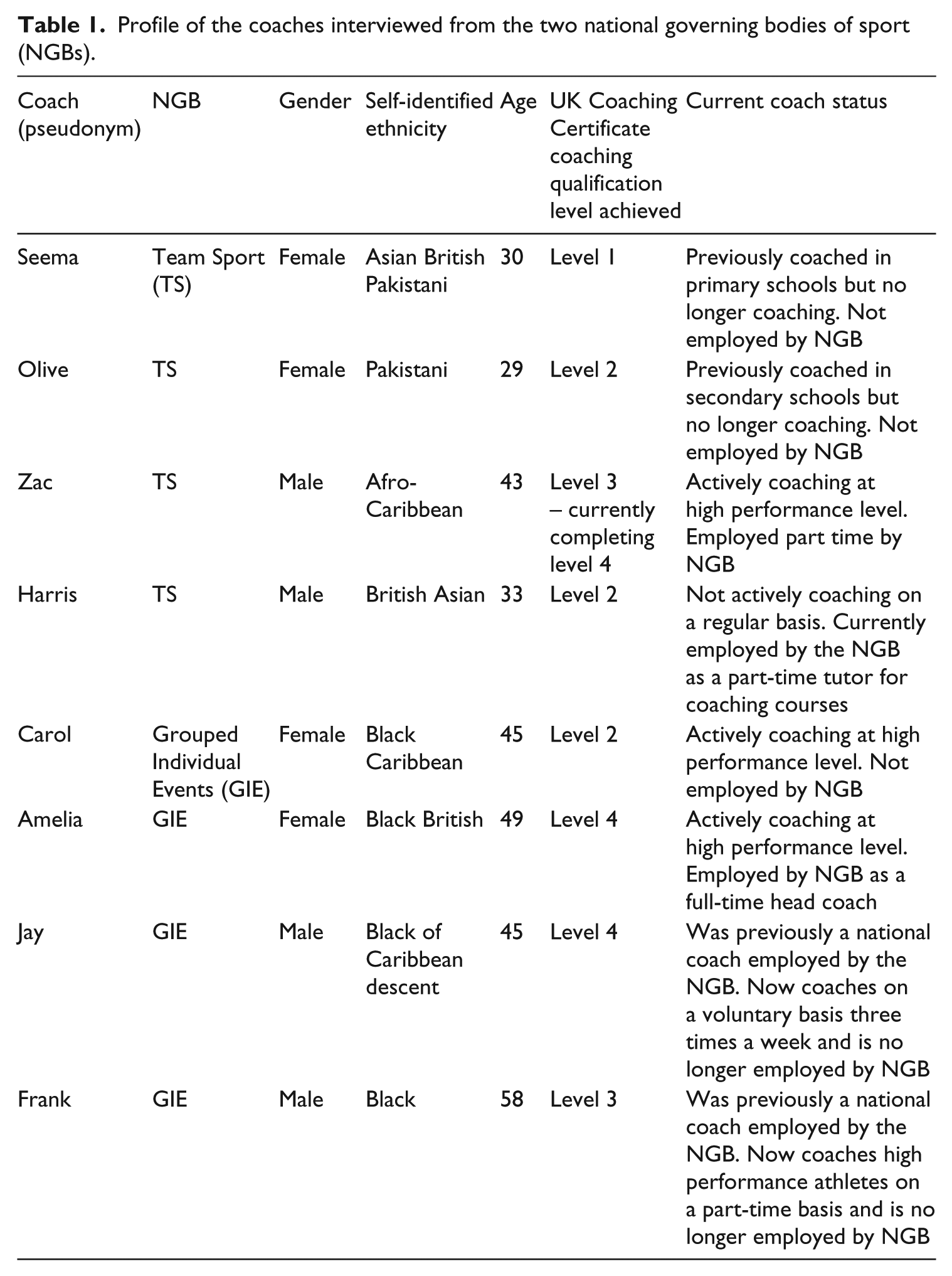
The coaches from TS and GIE were purposively selected based on the criteria above. Some coaches were recruited through the first Author’s contact with key ‘gatekeepers’ in the two NGBs or through processes of snowball sampling where existing coaches recommended and helped the first Author to contact other coaches. The coaches’ profiles are shown in Table 1, along with their self-selected pseudonyms and self-reported ethnicities. Given the high profile of some of the coaches and the low representation of Black coaches in the UK, confidentiality in relation to the coaches’ names, the sports they coached, and their NGB was necessary in order to create freedom for the coaches to feel safe and open in discussing their experiences as a coach. All eight coaches gave informed consent for the recording of their interview and were assured that their identity and responses would remain confidential.
Profile of the coaches interviewed from the two national governing bodies of sport (NGBs).
Semi-structured interviews were carried out face-to-face at the coaches’ preferred locations and lasted between 36 and 80 minutes. The interviews were digitally recorded and transcribed verbatim (with pseudonyms used for any names, sports, organisations, clubs, and places). Prior to each interview, the coaches were briefed about the research and discussion themes. The research question was: What are the experiences of Black men and women sport coaches (in two NGBs in the UK)?
The interview questions focused on: personal background; getting into coaching; progression; ambitions; insights; and reflections. Qualitative interviews were selected to encourage rich, discursive responses regarding each coach’s experiences. Following Braun and Clarke’s (2006) step-by-step guide, thematic analysis was used to aid the identification of themes from the interview transcripts in a predominantly inductive way. This involved selecting text from the transcripts and filing it under themes and sub-themes, referred to as nodes and sub-nodes in the computer software program, NVivo 10. The themes were refined and cross-checked against each interview transcript. This coding process was initially completed by the first Author and significant themes across the data set were then shared and triangulated with the authorship team to ensure reliability of the conclusions reached.
As part of the CRT and Black feminism framework for this study and through the processes of privileging those voices that have been traditionally marginalised, the first Author, who carried out the interviews, was mindful of her multiple identity positions and the need to recognise her subject position. As a White, middle class, British female coach and researcher, the first Author was aware, not only of her own privileged position(s), but also the responsibility to disrupt rather than perpetuate power structures within the research production process and within coaching literature. We remain acutely aware that the experiences and perspectives shared during the interview interactions and the understanding and re-telling of these will have been influenced by our subjectivities as researchers and power relations including but not limited to gender, ‘race’, ethnicity, class, religion and age (Bhopal, 2010; Frankenberg, 1993; Ladson-Billings and Donnor, 2008; Rollock, 2012, 2013). For example, the re-telling of Black women coaches’ experiences will be interpreted differently by a White woman, who occupies a privileged, rather than liminal status within sport and society (Carter-Francique, 2017; Rollock, 2012, 2013). As an authorship team, which included a Black British male of African-Caribbean descent, the second Author, and another White British woman, the third Author, we were challenged to comprehend the insight of lived experiences of racialised gendered processes within sport coaching. At times, we drew out divergent readings of the data based upon our own lived experiences and our critical insights on the literature. Although the experiences of all the coaches were individualised and multidimensional, and therefore cannot be reduced or essentialised, relevant and related threads of the coaches’ experiences and stories have been interlinked in order to form an overarching narrative informed by a CRT framework and the insights of Black feminism.
Findings
The findings are discussed here under three themes: negotiating identities; privileges and blind spots; and systemic discrimination. These theme titles encapsulated the interview quotes that reflected significant patterns within the data analysis.
Negotiating identities
The coaches shared their personal strategies towards negotiating and accommodating inclusion and exclusion, in order to become accepted as a coach in both NGBs. Seema, an Asian British Pakistani level one coach, and Olive, a Pakistani level two coach, highlighted difficulties of ‘fitting in’ during coach education courses for NGB1:TS in a traditionally White male-dominated team sport where they felt detached from the ‘ideal image’ of a traditional coach. Seema explained:
I think if I was, say, someone that was White, male, it would have been a different experience than what it was for myself. … I just think in terms of just fitting in would be the massive one for me, feeling like I could just slot in, and that it would be the same as everybody else (Seema).
Here, Seema’s Pakistani female body was immediately marked as ‘different’ to the unmarked normative positions of Whiteness and masculinity dominant in this sport (Puwar, 2004; Singer, 2005b). Seema, Olive and Carol all discussed feeling singled out, belittled, and patronised by (White) male coach educators on courses and within their respective NGBs. For Seema, she felt like an intruder into a space that has traditionally recruited and promoted White men, and to a lesser degree, Black men and White women: a feeling that is not likely to be experienced by her White counterparts on coach education courses. The coaches employed a number of strategies to negate rejection of their ‘different’ bodies in their sport coaching cultures. Harris, a British Asian male coach, who was both a coach and coach educator (tutor) for TS, had not felt challenged by athletes or other coaches, who he originally felt would not be accepting of the traditional appearance of a South Asian man:
It’s because I think they didn’t see me as that different, … I don’t think they look at me as an Asian person, … because I’ve got tattoos and I do play [the sport], they don’t look at me that way … If you’ve got a person with a big beard, wearing a skull cap type thing and he was the tutor I don’t think it would look right, I mean me personally, when I say that I just don’t think he’d be…you know [respected] (Harris).
Harris hints at his own proximity to the dominant norm of coach/player in his sport, and his embodiment of symbolic markers of an insider. This was at odds to others from a similar South Asian background who were excluded based on more identifiable signifiers of cultural and religious difference. For inclusion to become a reality, Harris had consciously deprioritised certain “ethno-cultural differences” to align his identity to conform to the expectations of the institutional Whiteness, and traditions of sport coaching (Burdsey, 2007: 69; Ratna, 2011, 2013). The pressure to conform to the values and norms of the hegemonic culture, an “unspoken requirement of entry” (Puwar, 2004: 150), illustrates the subtlety of processes that lead to racial formations within sport. These can then empower and promote the interests of dominant groups, whilst marginalising those on the periphery. Whether this pressure was perceived or real, for Harris it was a lived reality.
Olive who had completed her level 2 coach qualification with TS, also discussed the challenges of negotiating her cultural and religious values, which she felt had been marginalised within the prevailing TS coaching culture. Olive found it necessary to use a different strategy to feel included by other coaches on the courses. Her experience illustrated a concerted effort to prove her competency on coaching courses, constituted mainly of men, to justify her visibility as a woman and Pakistani coach. Unlike Harris, perceptions of Olive complicated her relationships due to suspicions from other coaches of her abilities as a coach underpinned by racialised gender stereotypes.
I think I was probably the “swot” [someone who studies assiduously] in the class, I was making notes on everything … If I get this qualification I want it to be on my own merit and not based on the fact that I might be one of only two females on this course, … So, I think for that reason I’m more conscious of myself to I suppose work that extra bit harder, sort of get by on my own merit and not my identity (Olive).
Olive’s strategy illustrates the interrelatedness of multiple oppressions that shape Black women’s experiences who are subject to processes of racialisation and gendered discrimination. Olive’s experiences within sport coaching are unique from those of Black men and to the women within this group (Bruening, 2005; Rankin-Wright and Norman, 2017). Harris, and Frank (a Black British level three coach for NGB2: GIE), discussed similar strategies to combat the doubt felt from their White counterparts, but for them, their racialised identity was foregrounded. Harris made a conscious effort to project an image of himself that he felt would be accepted when delivering coach education courses:
I’m fully aware of it [how participants act towards South Asian tutors] when I deliver the courses … They wouldn’t take [an Asian man] seriously, “What does he know? What level has he played at?” They’d always question his credibility. … So, what I do is I’m quite thorough in terms of when I go to deliver I talk about the experiences I’ve had and I talk about… I’m quite articulate in terms of processes and I’ve read up quite a lot on it and I don’t want to fall foul because I need to know about the subject that I’m delivering (Harris).
Frank also foregrounded his racialised identity:
It’s an old boys’ network out there, and how you overcome that is just keep coaching and keep improving yourself. … Yeah, if I was accepted and given the same perhaps support as some of my White colleagues then life would be a lot easier but you have to jump over hoops continuously but, you know, it’s part of life, part and parcel of life. (Frank).
Here, we see that the coaches’ attempts to fit in are complex and paradoxical as they recognise the need to perpetuate the Whiteness that excludes them and also the dominant hegemonic norms of masculinity. While these strategies to progress may not disrupt hegemonic notions of masculinity entirely (which is characterised in Frank’s account for example, by operating in select networks and in Harris’ account, by questioning those who are different and trivialising their contribution), they have consciously refused to self-select themselves out of the coaching profession and have, in part, refused to just fit in and assimilate themselves in the culture. The coaches experience a contradictory state of (in)visibility; whilst the coaches are highly visible as Pakistani, South Asian and African-Caribbean coaches, they are simultaneously invisible as competent coaches within a culture that marks them as less capable, less competent and powerless to progress based on their raced–gendered identities (Puwar, 2004). The coaches’ performances within the existing structure and requirements of coach education are assessed, judged and valued as a result of historical patterns of inclusion/exclusion and popular attitudes and ideologies that have become the unquestioned norms and standards (Hylton, 2009; King, 2004; Long and Hylton, 2002; Singer, 2005b).
Privileges and blind spots
Two contrasting insider/outsider narratives were particularly illuminating in the findings. The experiences of Zac, an Afro-Caribbean [sic] coach, who was completing his level four coaching certificate for NGB1: TS, revealed an ‘insider’ position. His testimony spoke of coaching as a meritocratic system whilst denying any gendered privilege in a sport dominated by men and traditionally only played and coached by them. This denial and his ‘insider status’ was exemplified when Zac shared his views on why female colleagues had not reached the higher levels of coaching:
I think [it’s] because they are too conscious about being a female … I often say to [my colleague] “until you can
Zac unconsciously demonstrates here that ethnic similarities do not necessarily locate individuals into the same social position or privilege them with similar experiences where gender and other intersecting identities are factored in (Mowatt et al., 2013). For instance, Zac’s gender and social position as a male ex-professional athlete within the sport coaching field means he does not have to simultaneously contend with both gendered and racialised oppressions. Zac’s narrative further speaks to the broader issues of patriarchal discourses across sport, in which deeply embedded ideas and practices reflective of hegemonic masculinities that can marginalise women are enacted regardless of racialised and cultural identities. Carrington’s (1998) work has illustrated that sites of cultural resistance to the ideologies and practices of racism within Black communities, (Carrington uses the example of Black men’s cricket clubs) can still silence the voices and needs of Black women within these communities. Drawing on the work of Black feminists, he highlights the complex positioning of Black women and cautions against equating Black resistance “with the need for Black male emancipation” (Carrington, 1998: 291).
Zac’s (insider) status was challenged by the contrasting ‘outsider’ narratives of Harris, Olive, Seema, Frank, Jay and Carol that told the story of coaches who felt disempowered within a culture that disadvantaged them due to their ‘othered’ identities. For example, Carol, a Black Caribbean female level 2 coach, who had coached within the high-performance environment for a number of years for NGB2: GIE, described how she was constantly belittled in front of other coaches and athletes by some male coaches:
You know you have to be that much better than all the coaches in the building because you are a female and because you know you are going to get the barriers. … It’s like they talk to you and say “Oh this is my assistant coach”, … I’m not assisting you in anything, I’m coaching [this athlete] on my own … I try not to rant because people think “it’s because she’s a woman, you are going on about you’re a woman again”, and one of the coaches employed by [GIE] said “Oh, is she bleating on about sexism in sport again, why doesn’t she just get over herself and shut up” and this is the thing, because you have not experienced it, I’ve had it first hand (Carol).
Harris had also witnessed similar incidents with female colleagues with whom he delivered coach education courses:
I remember somebody saying, it was these kind of remarks “It’s a woman, how does she know?” and “She’s not delivered that skill properly”, … there’s just backchat type thing and I think it’s just inherent in the sport … and that’s the same mentality that you would get if you’ve got an Asian person delivering it, and I can imagine people saying it. (Harris)
Harris identifies with the discriminatory behaviour that undermines his female colleague because he too experiences prejudice and discrimination as a British Asian coach educator. The normalisation of these insidious practices that remain unchallenged illustrate the power of racialised and gendered discourses to shape relations in sport (Massao and Fasting, 2010).
As Ratna (2013) found with a selection of British Asian female football players, Zac had aligned his beliefs and behavioural practices to share hegemonic gender assumptions. Sharing such assumptions reproduces the culture of those in the dominant group of sport coaches. This dynamic was observed by King (2004, 2007) in his recognition of the propensity and pressures for successful Black football coaches to consciously or otherwise assimilate into the dominant culture, to the detriment of their own identities. Collins (1986: 26) has argued that for Black women, assimilating “a standpoint that is [often] quite different from their own” and accepting both gendered and racialised norms that have subordinated them can be extremely stressful. Carol discussed these interconnecting oppressions in relation to feeling stereotyped:
I think some of it’s to do with race but I think some of it’s to do with being a woman … they tarnish every Black person with the same brush. I say to people just because that person is like that, don’t tarnish me! So, I’m not sure if it’s racism, sexism… do you know what I mean? I think it’s all of it. (Carol).
For Carol, a gendered racism is in operation where ‘race’ and gender are inextricably linked. Carol cannot ‘forget that she is female’, as Zac suggested above. Amelia’s recognition of gendered differences in treatment did not preclude her from acknowledging that amongst women, being a Black woman in her sport meant that she had, and would continue to have a more challenging journey to navigate compared to even her White female counterparts. When talking about her progression to higher coaching levels, Amelia said: “I don’t think they’re ready for a female, never mind a Black female, to do the job”. These contrasting insider/outsider narratives illustrate that there are many interlocking systems at work, which advantage some as prototype coaches within sport whilst marginalising those that do not possess these characteristics. Although the first Author shared a gendered identity with Carol and Amelia, she recognised that she could not fully empathise with their everyday experiences of gendered racism living as Black women. McIntosh (1997: 3) argues that these systems “take both active forms which we can see, and embedded forms which as a member of the dominant group one is taught not to see.”
Systemic discrimination
The coaches’ narratives in NGB2: GIE, illustrated a constant struggle with more subtle forms of discrimination that were extremely difficult to evidence due to their “different disguises” (Frank). Frank explained his frustration with a system that favoured some coaches through a process of financial inducement of athletes to train with different coaches:
I’ve coached some White athletes where they’ve arranged to take them off me and pass them on to others. … Athletes are free to leave but if they are being backed heavily by the governing body, i.e. we will pay for your expenses to go and train with this coach… And, you know, it’s kept quiet but behind the scenes that’s what’s done. … If you’ve got a really decent athlete and they know that the athlete will not part with the coach then they do their best to support you, but if it’s one that they can take away, then they do their best to take the person away. (Frank).
Although at face value a racialised dimension was not overtly apparent in this inducement of athletes to train with specific coaches, Frank was clear in his telling that, from his knowledge of racialised patterns of behaviour in decision making in the sport, these experiences were a consequence of him being a Black coach, and therefore his exclusion from what he saw as a “White old-boys’ network”. This was also Carol’s experience, who was clear that her identity as a Black Caribbean female coach had affected how her athletes were treated:
So, this is why I know that it’s the system now, [this athlete] was with me and she got nothing, now all of a sudden [the athlete is training with [White male coach] she gets the top physios, top massage, top S and C [strength and conditioning], nutritionists, everything, she gets everything. … So…don’t tell me there’s not a differentiation. (Carol).
The allocation of athletes to coaches demonstrated the lack of transparency regarding coach development in NGB2: GIE. The reading of a gendered and racialised decision-making bias was further illustrated by Frank’s story. Frank explained that a Black male coach who was shortlisted for a high-performance role had not been offered the job, even when the other candidate, a White man, dropped out of the process. He believed that this was an act of racial discrimination based on biases held by those in decision-making positions:
He made it to the last two, why didn’t they offer him the job then? … Well [they said] “he wasn’t the right person”. So, you know they get round things. … I’ve always said they prefer their own kind and that’s the way it is. … But when it’s so blatant, when perhaps you’ve got the same qualifications as someone and you are possibly better than that person and it’s given to that person then you question it (Frank).
Another example of a recruitment decision in which racial and gender bias arguably played a factor was recalled by Jay, a Black high-performance coach in GIE:
I’ve seen people bully female coaches … I’ve seen [the] head of coaching almost discriminate and not wanting to have selection of a female coach, … I personally think [it was] because they were female and also because they were a Black female. (Jay).
These testimonies, and Frank’s earlier reference to the “White old-boys’ network” indicates broader practices of homologous reproduction within GIE, that operates when those in power maintain their influence by only allowing individuals with similar characteristics to gain access to positions of power within the organisation (Kanter, 1977). Jay’s example in particular illustrates the multiple and interconnecting structures of oppression, including practices of homologous reproduction underpinned by gendered and racialised motivations held by those in influential positions in sport coaching, that faced Black women coaches. Due to these practices generally remaining unchallenged, the coaches were unsure as to whether to name the discriminations they had experienced as deliberate acts of racism and/or sexism or as ad hoc events. Jay explained:
I think quite a few people were invited to sit on the Board and make sure that the policies that are in place are correct, so they’ve moved on in some guises … but in another sense, you’ve still got the old guard who are still there who do things and make decisions and I don’t think they are really, either it’s a deliberate decision they’ve made, … [or] I just don’t think they are aware of their behaviour and how they do things because they get caught up into what they are doing (Jay).
This question of conscious or unconscious bias was raised a number of times throughout the interviews. Amelia raised her concern at the lack of diversity in the coaching workforce in her sport and governing body (GIE), which had a widely representative athletic and participant base:
It’s probably one of the sports where there definitely could be more Black people [coaching] because if you look at the ratio of athletes training and the ratio of coaches it doesn’t make sense (Amelia).
Whereas Carol voiced that her experiences of discrimination were based on deliberate conscious acts of institutional racism and sexism, Frank asked the question “is it jealousy?” Followed by “is it favouritism, is it racism?” These examples of unconscious (or conscious) bias, the social networking systems and assumptions of the ‘other’ held by those individuals and groups in authoritative positions, reinforced racialised gendered hierarchies by limiting the recruitment and progression opportunities for Black coaches (Bradbury et al., 2014; Collins, 2007). By unpacking these processes, we engaged with Gillborn’s (2008a, 2008b) argument as to whether or not such disparities and consequences were a coincidence or conspiracy. Gillborn (2008b) acknowledges that forms of institutional racism that (re)produce racialised disparities and consequences can operate regardless of individual or institutional intentions. Yet he also writes (Gilborn, 2010: 91):
[The] invisibility [of ‘race’] suggests a hidden dimension, sometimes unknowing or inadvertent but more than likely planned, or at least ordered, structurally arranged, deeply embedded.
The structural and cultural patterns of inequality are argued by Gillborn (2008b: 162) to reflect a racialised hierarchy, a White “supremacy” in which racialised disparities and consequences (that arguably privilege White coaches and disadvantage Black coaches) have not only become accepted as routine and normal, but are also forcefully reinstated. These stories are evidence of this occurring in a sport coaching context. Jay believed that the discrimination and prejudice that he and other coaches felt were deeply embedded within the coaching culture and was something they had come to accept:
We just laugh now because it’s just jobs for the boys … they don’t want to be challenged, they don’t want to be told anything and the system is quite clever in the sense that if you, even as a coach, if you are part of a group and you don’t like that group it’s really simple, you either go and find a new group or you form your own group. … For me anyway I thought to myself I don’t want to be part of the system now in the sense that because I know the system, it’s thirty years now that I’ve known it, it’s not going to change (Jay).
In institutions such as sport, these individual, institutional and structural forms of racial processes and discriminations are so embedded and entrenched, Hylton (2009: 10) argues, that they have “seemingly become benign practices”. When discriminatory actions are legitimised in organisations, they are no longer marked by overt expressions of harmful behaviour by individuals. Rather, discrimination has become systemic, subtle and covert, unwittingly reproduced and perpetuated.
Conclusion
The purpose of the current paper was to explore the experiences of Black men and women sport coaches in two NGBs in the UK. This paper has privileged these voices on the basis that sport is a gendered and racialised institution that often marginalises Black men and women. Critical race theorising in this respect facilitated a focus on sport’s meritocracy ideals and the need for principles of social justice and transformation to underpin a critique of an under-researched area of sport studies theory and practice. In addition, by ensuring the conscious inclusion of Black feminist methodologies, the theoretical framework strengthened our capacity to critically conceive of racialised gendered practices to avoid a reductionist approach to intersectionality and more sensitively incorporate the experiences of Black women coaches. The findings from the coaches’ narratives provide a critique of sport coaching within two different NGBs that help forefront and deconstruct the cultural norms and taken-for-granted assumptions within sport coaching. Hylton (2009) contends that such a perspective lends researchers and practitioners a clearer understanding of the major structures, power processes, White supremacy, racism and (in)equality within sport organisations that have consistently been ignored by both practitioners and mainstream theorists. The coaches’ counter-stories to sporting myths of meritocracy and inclusion make an intriguing and challenging contribution to coaching research and the broader sport coaching landscape.
The findings, across both NGBs, demonstrate that although the diversity of coaches within the UK may be slowly improving, the institutional systems within sport coaching organisations continue to disadvantage and subordinate Black coaches in generic and specific ways. Although NGB1: TS displayed the greatest engagement with an equalities agenda, the coaches’ narratives still shed light on the resistant nature of sport coaching culture that equality policies and programmes were unable to regulate. Their experiences reflect the gendered and racialised discourses underpinning sport coaching in both NGBs that played out during everyday interactions and that positioned them as ‘othered’. In particular, the Black women coaches had to negate racialised gendered practices in the form of prejudices and discriminations that led to compensatory behaviours in recognition of the biases and disparities in their sport. These experiences will always be unique to their particular lived reality and embodied identity. Their mutual but different experiences of racism with the Black men coaches were differentiated by the location and privileging of men in each sport even though there was consensus across the coaches that they did not feel they met the somatic norm of the ‘ideal’ leader/coach and felt vulnerable in how their competence was perceived.
The stories shared during the interviews and analysis evidenced that gender was often expressed as more salient by the women coaches than their racialised identity and ‘race’ was expressed as more salient than gender by the men. For the women, this hints at the masculine discourses underpinning sport coaching and women’s position as coaches within this space. Ratna (2013) has suggested that forefronting sexist discrimination, rather than racism, is a coping mechanism in an attempt to facilitate a sense of belonging in organisations that in/advertently deny the significance of ‘race’ and presence of racism. However, as stated in the methodology section, the racial and gender positioning of the first Author and in particular, her racial and cultural privilege and own outsiderness in this context, likely impacted on the accounts shared by coaches, the shaping of interview interactions, and understanding of the coaches’ narratives. Gunaratnam’s (2003) argument that ‘race’ and ethnicity should not be essentialised nor privileged as a relation of difference over others, at times, played out during the interviews. For example, Seema explained that having the same gendered identity as the first Author meant she openly shared certain experiences of sexism that she would not have openly discussed with a male researcher. Another male coach acknowledged that he ‘censored’ his stories and views because the first Author was a woman. Different identity characteristics became more or less relevant at different times throughout the interviews and within each interview process. To assume that insider/outsider status is based solely, or even primarily on ‘race’ is to ignore the inherent and fluid heterogeneity of social identities that are actively produced and reproduced across and within different social contexts (Carrington, 2008; Flintoff and Webb, 2012). In this respect, the findings indicate that further research is needed to examine the interlocking oppressive systems for coaches as part of the complex processes of inclusion and exclusion.
The findings highlight the importance of considering interconnected identities and the multiplicity of coaching experiences when recruiting and developing coaches in the UK. Crucially, the coaches’ journeys and experiences cannot be essentialised nor generalised, though do reveal intersecting racialised and gendered patterns of behaviour reflected in other studies (Bradbury et al., 2014; Norman et al., 2014). The different stories within these narratives illustrate that the coaches were contending with different racialised and/or gendered discourses and these discourses became salient at the same and different times (Collins and Bilge, 2016). The centring of ‘race’ and the interrelationship between ‘race’, ethnicity and gender was critical in order to reveal and understand these dominant power relations within sport coaching. Hence, performing ‘race’ and gender at one and the same time emphasises the complexities of intersectional learning in everyday life and for those researching it. Essed’s (1991) concept of “gendered racism” illustrates that the personal, lived experiences of Black coaches are structured by converging systems of ‘race’ and gender, and by racist and ethnicist notions of gender. Although Harris, Frank and Jay reflected on their ethnic and cultural identities, a discussion of gendered identity was rarely volunteered in the reflections on their experiences, despite being probed during the interviews. Harris and Jay did, however, recognise their gendered privileges through their telling of stories of prejudice and discrimination towards female colleagues. This hints at the requirement for strategies to manage the pressures of accommodating the hegemony of coaching environments in attempts to fit in and progress as ‘outsider’ Black men. The silences and denials around these systems of dominance and unearned privileges within coaching circles and NGB organisations keeps the thinking about equality incomplete and maintains the myth of a ‘level playing field’ within sport coaching (McIntosh, 1997). These institutional inequities can also be highly ambiguous and seemingly invisible to those most implicated, and as a result can often be denied or difficult to identify (Rankin-Wright et al., 2016).
Making visible the coaches’ perceptions and experiences in this research has been instrumental to understanding the connection between everyday experiences, routine practices and the structural forces within the equalities landscape of the these two NGBs. Experienced realities can be used as “a valid source of knowledge” for informing institutional custom and practice that lead to discriminatory outcomes (Collins, 1986: 30). It can also assist sport stakeholders to recognise and challenge racialised and gendered routines in everyday coach education and development that have become normalised (Essed, 1991). Therefore, understanding the coaching journey for Black men and women coaches, who are often on the margins of decisions regarding policy and practice, should be mandatory practice for NGBs. This may involve specific consultations with them, and improved ethnic monitoring and diversity in organisational leadership and governance, which might involve specific positive action interventions.
It can be concluded that NGBs need to improve their approaches to and implementation of equality agendas and coach education. For example, diversifying the coaching workforce with transparent recruitment and development systems should be of paramount concern for NGBs. Organisational workshops on creating inclusive cultures should be mandatory for all staff including coaches, coach educators and leaders. Bradbury et al. (2018) have previously advocated a package of positive action measures that included: educational programmes for key stakeholders in NGBs on institutional racism and its impacts, and the benefits of a culturally diverse coaching workforce; clear policy goals in relation to equity targets; and measures to increase recruitment opportunities for Black coaches. Such positive action measures are advocated by the commitment to social change endorsed by CRT and Black feminism in order to positively transform mainstream coaching agendas where ‘race’ and gender issues have been marginalised or ignored.
The key intended outcomes of these recommendations should not be merely to increase the number of Black coaches within NGBs, although this would indeed be a favourable outcome (Burdsey, 2007). Rather, NGBs need to acknowledge and challenge the dominant discriminatory discourses and practices within their organisations and sport coaching to ensure equality of opportunity for all coaches aspiring to enter and progress.
Footnotes
Declaration of Conflicting Interests
The author(s) declared no potential conflicts of interest with respect to the research, authorship, and/or publication of this article.
Funding
The author(s) received no financial support for the research, authorship, and/or publication of this article.