




Abstract
The theory of the cultural omnivore has been applied to many cultural domains. However, given the pervasiveness of professional sport in contemporary societies, less is known about omnivorous behaviour when it comes to consuming this cultural form. This study sets out to find if indeed there is an omnivorous consumption profile for professional sport. Using a latent class and regression analysis of survey data on five major professional sports leagues from Canada, this paper seeks to determine if this professional sport omnivore exists, how prevalent it might be, and if it maps onto wider socio-economic differentiations. The latent class analysis does show that there is an omnivorous consumption profile. However, it is the second smallest professional sport profile and does not map onto wider socio-economic differentiations, even as other patterns of professional sports’ consumption do display such distinctions.
Introduction: positioning the research
The rise of the cultural omnivore in recent decades has many proponents (Holt, 1998; Peterson, 1997; Peterson and Kern, 1996; Warde et al., 1999). However, few studies have assessed any kind of omnivore concept with respect to sport as a form of cultural consumption (Widdop and Cutts, 2013; Widdop et al., 2014; Wilson, 2002). This is especially true with regards to consumption of sport that is not directly participatory, such as following professional sports. Indeed, the existence and nature of the omnivore within the realm of sporting preferences generally remains under-researched (Widdop et al., 2014). Much more work has been undertaken in other cultural domains, such as music (Chan and Goldthorpe, 2007; Peterson, 1992; Peterson and Simkus, 1992; Savage and Gayo, 2011; Veenstra, 2015). Fewer scholars have looked at sport, and especially professional sport, as a cultural good that can be engaged in the same way. This paper is thus concerned with how professional sport operates as another domain of culture. This study proceeds with the assertion that sport is an important aspect of culture more generally. The importance of sport in Canadian culture is exemplified by the fact that the most watched television broadcast in Canadian history was an ice hockey contest that saw 80% of the population tune in at some point in the game (NHL, 2010). There exists a lack of work on cultural consumption and sport that is especially true within the social context of Canada. The sports industry around the globe and in North America grows larger each year. In the current decade, the overall sports industry in North America is projected to increase to 73.5 billion US dollars in 2019, up from approximately 50 billion in 2010 (PricewaterhouseCoopers (PwC), 2015). The sports betting market in Canada exceeds 15 billion Canadian dollars (Westhead, 2014). Overall, the sports industry generated $8.3 billion in 2010 for the Canadian economy and accounted for more than 105,000 Canadian jobs (Statistics Canada, 2015).
With specific regard to professional sports in Canada, four of the five largest professional sports leagues (by revenue) are located on the North American continent, namely in the United States and Canada (Kutz, 2016). These four leagues are the National Football League (NFL), Major League Baseball (MLB), the National Basketball Association (NBA), and the National Hockey League (NHL). Canada has teams in three of these leagues; seven NHL teams, one NBA team, and one MLB team. The market valuations of these nine teams is approximately 7 billion US dollars and their yearly revenues approach USD 1.5 billion (Forbes, 2017a, 2017b, 2017c). The Canadian Football League (CFL) operates nine franchises that hosted more than 2 million attendees to watch a game in 2016 (CFLdb, 2016). While not having any franchises in Canada proper, as the largest sports league in the world, and their location on the Canadian doorstep, the NFL’s penetration into the Canadian market is significant. Despite the prominent role that sport plays in Canadian society, research is lacking into the social consumption patterns of culture and sport. Indeed, research into comparative sports consumption, generally, is lacking in the literature on sports fandom (Pope, 2015). Rather, the vast majority of the existing literature focuses on the experience and modes of consumption for only one particular sport or another.
This paper works towards an analysis of this domain of culture to determine if these patterns exhibit socio-economic difference, how they do so, and to what degree they do so. The academic importance of this work hinges on its status in providing the most up-to-date empirically based re-examining of Peterson’s theoretical frameworks that is possible with existing data, its breadth of data, and its methodology in exploring and analysing professional sports engagement as a specific domain within the wider cultural landscape of Canada. It also fills key gaps in the literature regarding sports consumption and cultural consumption more broadly. Sport as a site of culture that can be consumed in a similar fashion to other cultural forms is under-studied generally (Warde, 2006; Washington and Karen, 2001; Widdop and Cutts, 2013). In Canada, there is almost a complete absence of such research, save from Veenstra’s (2010) study of class and culture in Canada that only cursorily addressed non-professional sport in the social space of Canada. Veenstra (2010) found that the four sporting variables that he included in his wider analysis of culture, downhill/alpine skiing, golf, local sports participation, and attending amateur sports events, all were found to be associated with high economic and cultural capital possession (as operationalised by income and education). However, consumption of professional sports is often viewed as a ‘lowbrow’ cultural activity (Bourdieu, 1978). Therefore, will the professional sports included in this analysis show a similar relationship to capital possession? Importantly, there is currently no work that analyses professional sports consumption from the kind of cultural consumption theoretical perspective that this paper seeks to employ, either in Canada or elsewhere. By using two under-studied substantive focal areas when it comes to cultural consumption – the cultural domain of professional sport and the national context of Canada – this work seeks to deepen understanding of cultural omnivorousness and potentially stratifying effects of cultural consumption. While this contributes to the wider academic knowledge about cultural consumption, the focus on sport and on Canada provides theoretical and methodological applications for the area of sports studies and provides a further national context by which cross-national perspectives can continue to be informed and cultivated.
A number of studies deal with cultural consumption, especially in Europe, and more recently in the United States. However, sports are of particular interest because of their conspicuous absence from this corpus. There are indeed some studies regarding direct sport participation. Much of this work finds that direct sporting participation is stratified along socio-economic and demographic lines (Bourdieu, 1991; Collins, 2003, 2014; Gruneau, 1975, 1981; Lamprecht and Stamm, 1996; Loy, 1969; Scheerder et al., 2002, 2005; Sugden and Tomlinson, 2000; Taks et al., 1995). Some deem personal exercise to act as a social marker of cultural capital possession (Shilling, 1993; Stempel, 2005; Wilson, 2002). Others suggest that those of higher social classes both participate more in sport and more often attend sporting events (Coakley, 1994; Eitzen and Sage, 1991; Erickson, 1996; Gruneau, 1999; Hartmann-Tews, 2006; Moens and Scheerder, 2004; Thrane, 2001; White and Wilson, 1999; Wilson, 2002). On the other side, Mehus (2005) finds a negative relationship between cultural capital and sports spectatorship. Direct sports participation, however, has received substantially more scholarly attention than any other kind of sports consumption (Thrane, 2001). This is important as arguably, sporting viewership, as an activity that is more widely engaged in, may be a better representation of an individual’s cultural consumption and cultural lifestyle (Kahma, 2010; Warde, 2006).
Thrane (2001: 149) argues that there are three primary modes of sports consumption: direct physical involvement in sport and physical activity; ‘active’ forms of sports spectatorship (going to sporting events at their respective venues); and ‘passive’ forms of sports spectatorship, such as watching sports on television. However, the spectrum of what is considered ‘active’ is fluid because for instance, does going to a bar or friend’s house and watching sport on television constitute active or passive consumption? Within Thrane’s framework, one would actively go to a place for the purpose of passively consuming. Is this action even able to fit into this framework at all? This taxonomy is problematic for these reasons. It ultimately reifies the spectrum of sports consumption. How best, then, should we capture this complexity within the domain of professional sport?
The professional sports ‘follower’
Previous taxonomies being as they are, and in accordance with the survey data used in this analysis, this paper posits the concept of the ‘follower’. This is not the follower as conceptualised in the taxonomy of Giulianotti (2002) regarding football fans in the United Kingdom. This is the case for many reasons, not least because of the limitations of the survey questions by which such a detailed taxonomy is not reasonable to try and parse. Also, this sports ‘follower’ is slightly different from a ‘fan’, at least in terms of the methodology for capturing sports consumption. Asking about following a sport, as a specific activity, is a more precise method of capturing sports consumption than relying on the self-description of said ‘fan’. This kind of measure predominates in the literature of cultural consumption. Fanship is also immensely more complicated, as many have pointed out in great detail (e.g. Billings, 2011; Pope, 2017), and there is no universally accepted definition (Gantz, 2014). However, following professional sport can certainly go towards speaking to fandom, even as quantitatively it does so lacking complete context and nuance.
The follower in this paper at once speaks to an activity, the positive step of following, and taste, as following a particular sport does not articulate a specific activity, or range of acceptable activities by which one can follow a sport. Therefore, conceptualising the ‘follower’ has the benefit of encompassing all manner of following professional sport. ‘Following’ is also not static. That is, regardless of the methods available to follow sport, either in the past or future, this term still applies. This conceptualisation also more directly speaks to taste than most survey questions surrounding cultural engagement, as watching television or reading a magazine is the traditional cultural activity while sport is the taste within these activities. Thus, ‘following’ is at once an action of following sport and a taste within other cultural domains and activities. However, this classification cannot distinguish between the methods of following and therefore cannot distinguish between schemes of appreciation. This study can only speak to which sports are consumed. It therefore cannot capture any social class bases of different modes of consuming. However, the concept of the follower ultimately opens up modes of consumption that are precluded by Thrane’s (2001) framework.
The omnivore
Any discussion of the cultural omnivore, or indeed cultural consumption in contemporary society more generally, must at some point run through Pierre Bourdieu. Bourdieu found differences in the type of cultural activities that were engaged in by the different classes of France. Those of higher-class status and higher educational qualification engaged themselves in ‘highbrow’ art forms (Bourdieu, 1984). These are forms that are consecrated by society as being of high taste, such as going to the opera. This is contrasted to the cultural engagement of the lower, less educated classes who engaged in less consecrated markers of legitimate taste, or ‘lowbrow’ cultural forms. This created stark social distinctions based upon the type of culture that one engaged in and the sophistication with which one could innately discuss these highbrow art forms (Bourdieu, 1984). Cultural choices are thus structured by these socialised constitutions. They are structurally patterned by one’s ‘habitus’. Bourdieu’s habitus is the class-based dispositions of the individual that subsequently structure taste and social action (Bourdieu, 1984). One’s habitus then leads to a homology of taste for Bourdieu that is consistent across the various domains of culture, including sport.
The concept of the cultural ‘omnivore’ was primarily theorised by the American Sociologist Richard Peterson. It introduces the concept of a cultural consumption profile that spans traditionally highbrow and lowbrow cultural lines, consuming forms on either side of this line (Peterson, 1992, 1997; Peterson and Kern, 1996; Peterson and Simkus, 1992). In describing the rise of the omnivore, and defending and defining it as a concept, Peterson and Simkus (1992: 169) write that: elite taste is no longer defined as an expressed appreciation of the high art forms (and amoral disdain or bemused tolerance for all other aesthetic expressions). Now it is being redefined as an appreciation of the aesthetics of every distinctive form along with an appreciation of the high arts. Because status is gained by knowing about and participating in (that is to say, by consuming) all forms, the term omnivore seems appropriate. (emphasis in original)
Likewise, in terms of music, Peterson and Simkus (1992) theorise the ‘univore’ as only liking one type of lowbrow musical form. They contrast the omnivore and univore by describing that ‘the omnivore…commands status by displaying any of a range of tastes as the situation may require, while the univore uses a particular taste to assert differences from others at approximately the same level holding a different group affiliation’ (Peterson and Simkus, 1992: 170).
These univores were thus staunchly fans of one specific popular musical genre or another at the expense of all other musical genres. They found univorousness to be associated with the lowest occupational groups while those who engaged in omnivorous patterns of musical consumption were from higher occupational classifications (Peterson and Simkus, 1992). Might this also apply to followers of professional sports? Many academic studies since Peterson have sought to test his omnivore–univore taxonomy and his omnivore theory of cultural consumption (Bryson, 1996; Chan and Goldthorpe, 2005; Sintas and Alvarez, 2002; Van Eijck, 2000, 2001; Van Rees et al., 1999).
Some studies also contend that Peterson’s omnivore thesis is not as incompatible with Bourdieu’s homology as it might first appear. These argue that omnivorousness may actually be a manifestation of cultural homologies (Bennett et al., 2009; Coulangeon and Lemel, 2009; Leguina, 2015; Lizardo and Skiles, 2012; Savage and Gayo, 2011; Tampubolon, 2008). This follows Peterson and Kerns’ (1996) argument that the culturally omnivorous do not consume indiscriminately, even as they do not argue that this omnivorousness is itself a manifestation of Bourdieu’s more structural theories, as some other studies have argued. That is to say, Peterson does not explicitly associate omnivorousness as fitting seamlessly into Bourdieu’s habitus or homology theses, even as others suggest that omnivorousness does indeed fit into Bourdieu’s framework. Lizardo and Skiles (2012) argue that it is Bourdieu’s disinterested aesthetic disposition that is transposable to all existing cultural domains and also to new cultural domains. Therefore, it is this disinterested aesthetic that is the common thread between Bourdieu and Peterson. Bourdieu’s disinterested aesthetic is a way of consuming culture by which intellectual distance is applied in the appreciation of that culture rather than a more visceral enjoyment.
Rather than homologies of taste per se, it is thus more of a homology of application of the disinterested aesthetic that distinguishes omnivorousness and ties it to Bourdieu’s theories. Likewise, Lizardo and Skiles (2012: 277) adhere to Bourdieu’s habitus thesis and conception of embodied cultural capital, as they argue ‘that omnivorousness can be most profitably thought of as a form of skillful cultural competence, accumulated via early experiences in the family environment and enhanced by formal and extracurricular education and occupational experiences’. Regarding the cultural ‘snob’ and its relationship with the cultural omnivore, other scholars echo these kinds of dynamics and find that omnivorousness itself does not eliminate snobbery, but rather reconfigures it to draw boundaries fully within relatively lowbrow cultural domains so that it is more about which kind of lowbrow culture one consumes (certain kinds of television (TV) programmes) and how one consumes it (intellectually vs. passively for entertainment only) (Bennett et al., 2009; Friedman, 2011; Jarness, 2015; Savage et al., 2015). Indeed, Mehus (2005) suggests that the ‘how’ of consumption may be the greatest driver of distinction in sports spectatorship. These kinds of dynamics continue to perpetuate Bourdieusian conceptions of ‘distinction’, while at the same time appearing to omnivorously consume cultural objects of differing social status.
Towards these more structural arguments around omnivorousness, omnivorous cultural consumption is frequently asserted as being associated with higher status groups and individuals (Chan and Goldthorpe, 2005, 2007; Peterson and Kern, 1996). Likewise, studies find that it is associated with higher class position and educational attainment (Bryson, 1996; Chan and Goldthorpe, 2007; Erickson, 1996; Peterson and Kern, 1996; Peterson and Simkus, 1992; Sintas and Alvarez, 2002, 2004; Tampubolon, 2008; Van Eijck, 1999). Other studies suggest that the upwardly mobile represent the primary example of a site in which we can find the culturally omnivorous (Coulangeon, 2015; Daenekindt and Roose, 2013; Emmison, 2003; Friedman, 2012, 2014; Van Eijck and Knulst, 2005). There is some disagreement, however, about the make-up of the omnivore, whether omnivorousness is a consistent style of consumption across cultural domains, if there are different kinds of omnivores, and whether there are co-existing elite styles of consumption depending on the cultural domain (Cutts and Widdop, 2016).
Widdop and Cutts (2013) is one of the only examples of a study that focuses on class, sport and omnivorism. Using a latent class analysis (LCA) of 2005 data, this study found a five-latent class solution for sports participation in England. They find a first group who are the ‘classic omnivores’ that participate in a wide variety of sport, a second ‘fitness class’ that engages in fitness activities and little else, a ‘lowbrow omnivore’ group, a ‘highbrow’ group, and an inactive group (Widdop and Cutts, 2013). As far as the social class composition of these groups is concerned, they found that classic omnivores and highbrow groups came from high social strata, the lowbrow omnivores and inactive cluster came from lower social strata, while the fitness class was less distinguishable by class but was rather distinguished by gender, with a wide range of classes participating but a large proportion of women also participating in these sporting forms (Widdop and Cutts, 2013).
The most recent example of an existing study of sport and omnivorousness is the study of sport participation in the United Kingdom by Widdop et al. (2014). With a theoretical focus on the omnivore, they set out to analyse the social capital resources of those who are omnivorous in sport. In this study, highbrow omnivores possessed the highest levels of education and both omnivorous clusters had the most social capital, according to the operationalisation of social capital by Widdop et al. (2014). They thus were able to ‘further validate the existence of omnivoral patterns – the existence of two omnivore groups – in the sporting field’ (Widdop et al., 2014: 612). These two studies, however, again investigated direct sports participation and not all recent work affirms the primacy of omnivorousness across cultural domains. For instance, Veenstra (2015) does not confirm the omnivore thesis in the domain of music amongst urban populations of English-speaking Canada. These disagreements highlight the necessity of understanding the styles of consumption from each cultural domain and from as many different contexts as possible.
The aim of this paper is to discuss the existence of omnivorous patterns of professional sports consumption. However, to find out how patterns of sports consumption adhere to a strict understanding of omnivorousness (consumption of both high and low forms), we must first understand if any professional sports manifest themselves as ‘highbrow’ or ‘lowbrow’. While there are often some inherent assumptions of where these sports fall, this study first analyses each sport to see the socio-economic and demographic make-up of these sports individually. This study is not, however, able to discuss class differences in ‘how’ these sports are followed. That is to say, attending a professional sporting event requires much more economic capital than watching on TV and certain other ways of following may require other competencies, such as technological literacies. Therefore, this study is only able to broach an analysis of class difference as it relates to which professional sports Canadians consume and not class differences in how they consume these sports.
Research questions
The first research question that this paper seeks to answer has to do with the existence of omnivorousness in professional sports following in Canada. This is to ask, do those who follow professional sports tend to follow all of the professional sports leagues or do they only follow certain sports? Sub-questions to this first research question pertain to the size of this group, if it exists. Is omnivorism the primary method of professional sports consumption or is it only one of many styles of professional sports consumption in Canada?
The second research question pertains to the social position of the omnivore. Given previous theorisations and findings surrounding omnivorousness in other cultural domains, if omnivorousness exists in the consuming of professional sport in Canada, either as the primary style of consumption, or as a smaller group, does it map onto social class divisions and capital possession? To start answering this question we must first turn to the limited data that exist regarding professional sport in Canada.
Data
The data set for this analysis comes from the Project Canada Survey of 2005. This is the most up to date data set that is available at the moment. Project Canada is a survey programme that monitors social trends in attitudes and activities in Canada. The director of the programme is Dr. Reginald Bibby. The sampling procedures consist of both a type of longitudinal panel and randomly selected persons. For the 2005 survey this included 2,000 Canadians who had taken the survey in previous years and 3,000 who were randomly selected (Bibby, 2005). The 2005 survey saw a response rate of 48% for a completed sample size of 2,400. This sample is weighted (by Dr. Bibby) in order to achieve national representativeness. Additionally, because educational attainment is of principal importance to this analysis, only those aged 25 and above are included in the regression analyses of this paper. This is to account for those who may still be in the process of obtaining their qualifications before this age.
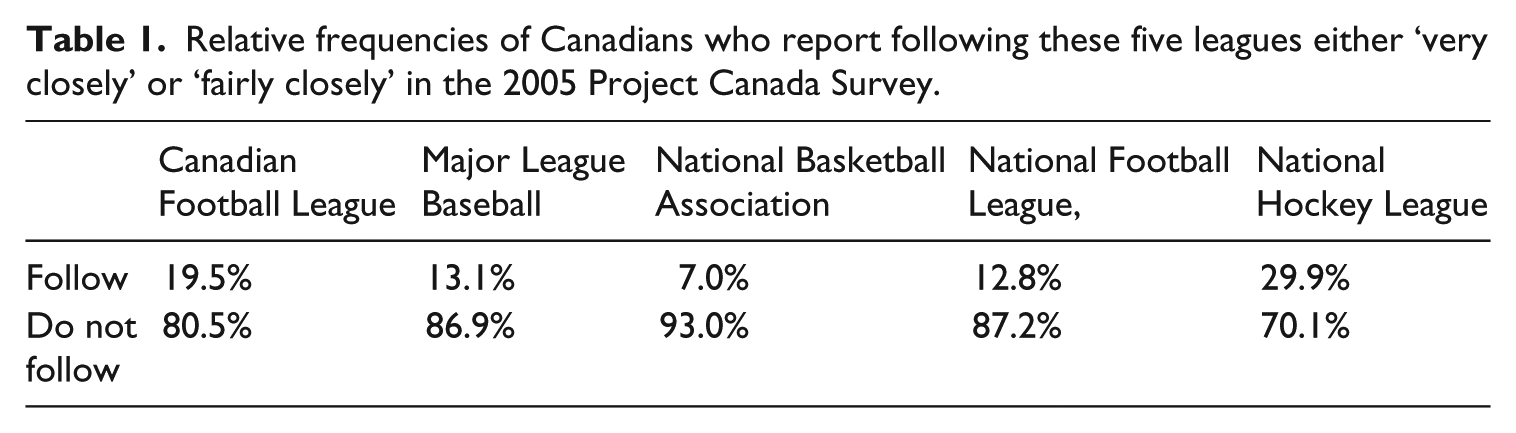
The specific question from this survey that this analysis relies upon is ‘How closely do you follow: the NHL the CFL, MLB, the NFL, and the NBA’. The response options were ‘very closely’, ‘fairly closely’, ‘not very closely’, and ‘not at all closely’. For the purposes of this paper, these first two responses are coded as ‘following’, meaning that they follow that professional sports league and the second two responses are coded as ‘not following’, meaning that the respondent does not follow that league. Only the two more frequent response categories are used, as using the third option here likely ‘results in overestimations of the nation’s fan base and includes those who are more casual with their fanship, those who jump on band-wagons for short periods of time and are no more interested in following some sports activity than they are for a TV program they occasionally enjoy watching or talking about’ (Gantz, 2014). The relative frequencies resulting from this re-coding can be seen in Table 1.
Relative frequencies of Canadians who report following these five leagues either ‘very closely’ or ‘fairly closely’ in the 2005 Project Canada Survey.
Methods
This study performs a Latent Class Analysis (LCA) for its efficacy in creating classes of consumption behaviour. LCA forms groups of behaviour and finds specific styles of consumption. In this case, it is following professional sports leagues. It does this by taking the data and estimating the probability that an individual is in one latent class or another (latent class probabilities) and also conditional probabilities of the data, a type of reverse of this process (Widdop and Cutts, 2013). These latent classes illustrate typologies by which we can say something definitive about these styles of cultural behaviour. The LCA will use the sports inputs to find the correct number of latent classes that explain the various styles of consumption. Omnivorousness is operationalised in this paper with the previous conceptualisation of ‘following’ professional sports, which spans the taste/action divide that is a prevalent debate in the literature on omnivorousness (Bennett et al., 2009; Chan, 2010; Sintas and Alvarez, 2002; Van Rees et al., 1999; Widdop and Cutts, 2016).
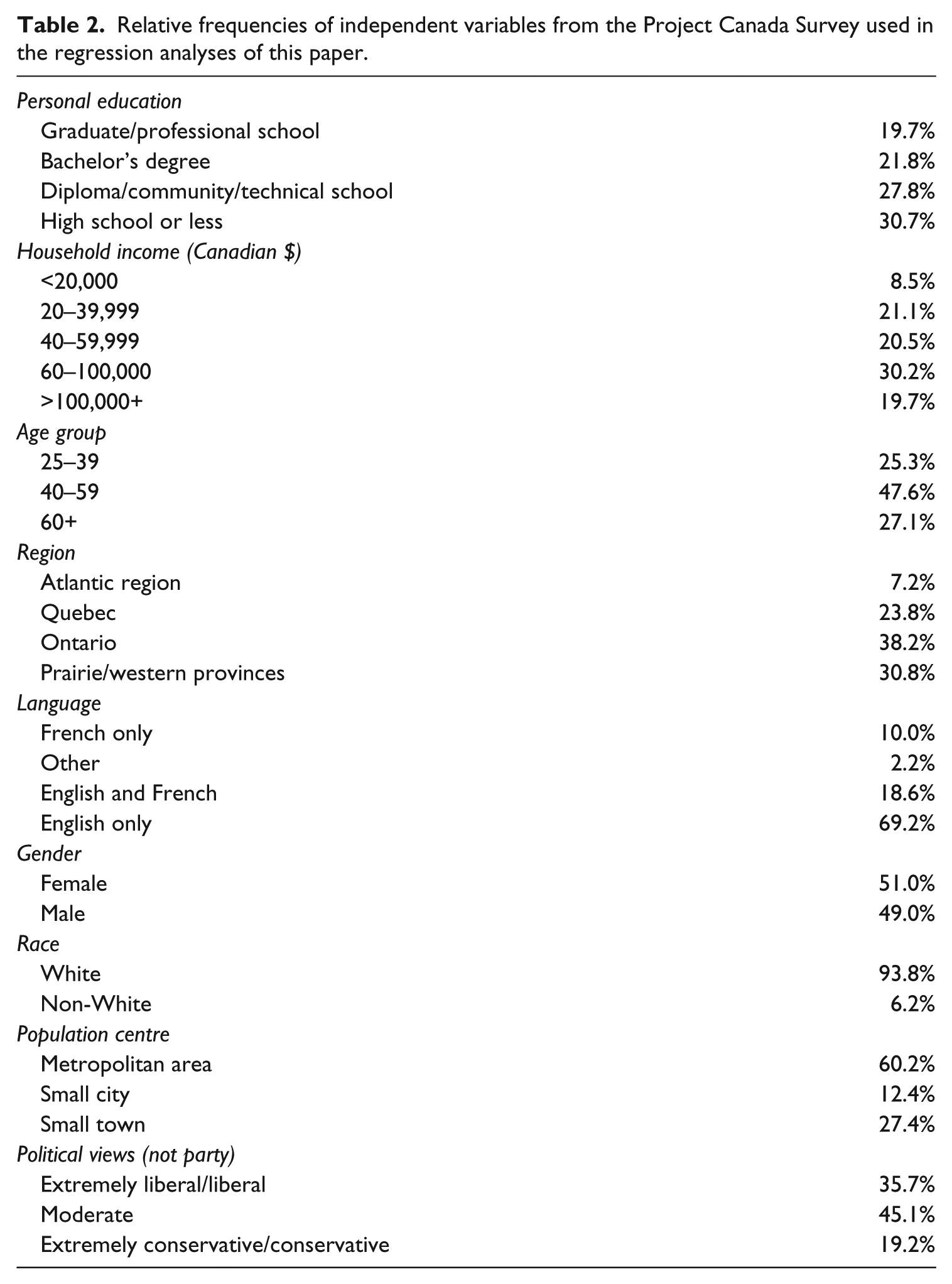
Multinomial logistic regressions are then used because of their ability to isolate and control for variables and generate predictive measures. This study uses this regression technique to assess the socio-economic and demographic make-up of the various clusters. In these regressions of the latent class clusters, economic capital is operationalised using total household income. From Bourdieu onwards, household income has been a consensus measure of economic capital in the consumption literature. In this survey, the question regarding income asked ‘Which of the figures below comes closest to your TOTAL FAMILY INCOME, before taxes…?’ The response options were: less than $10,000, $10,000–19,999, $20,000–29,999, $30,000–39,999, $40,000–49,999, $50,000–59,999, $60,000–69,999, $70,000–100,000, over $100,000. These response categories have been collapsed in a way that is reflected in Table 2. Cultural capital is operationalised using personal educational attainment. The survey question for education was, ‘In terms of formal education, what is the HIGHEST LEVEL you have COMPLETED?’ The response options for this question were: Grade school; High School; Technical/business/community college; Undergraduate university; Graduate degree/professional school; and Doctorate. These education levels have been collapsed in a way reflected in Table 2. These measures for the operationalisation of economic and cultural capital are ultimately constrained by the questions asked in the survey.
Relative frequencies of independent variables from the Project Canada Survey used in the regression analyses of this paper.
Bourdieu asserted that cultural capital was accumulated through the primary socialisation of children. Those from more well-off families were instilled from an early age with an appreciation of, and competence in, more ‘legitimate’ forms of culture. This was then often misinterpreted by the education system as natural intelligence because they showed knowledge about institutionally consecrated cultural objects (Bourdieu, 1984; Bourdieu and Wacquant, 1992). These processes are why the attainment of formal educational qualification is an appropriate operational measure of cultural capital possession. Indeed, educational attainment has been a primary method of operationalising cultural capital in the cultural and sports consumption literature (e.g. Bourdieu, 1984; Holt, 1998; Stempel, 2005; Veenstra, 2010).
Results
In order to understand the nature of any omnivore categories that might result from our LCA, we must first engage in a brief regression analysis to see if any of these sports map onto a capital possession profile by which they could either be characterised as ‘highbrow’ or ‘lowbrow’. These results can be viewed in Table 3 (see also Notes). Regarding cultural capital, the NBA, NHL, and MLB followers show gross regression effects that suggest that those who have either a high school diploma or less as their highest level of formal education are more likely to follow these sports leagues than those who have tertiary degrees. The NHL and MLB, in particular, show significant results between those who have a high school diploma or less and those with an undergraduate degree. Indeed, this difference also holds once the full model is applied, with those holding undergraduate degrees less likely to follow these leagues.
Project Canada Survey; odds ratios from multinomial logistic regression (not following as reference).
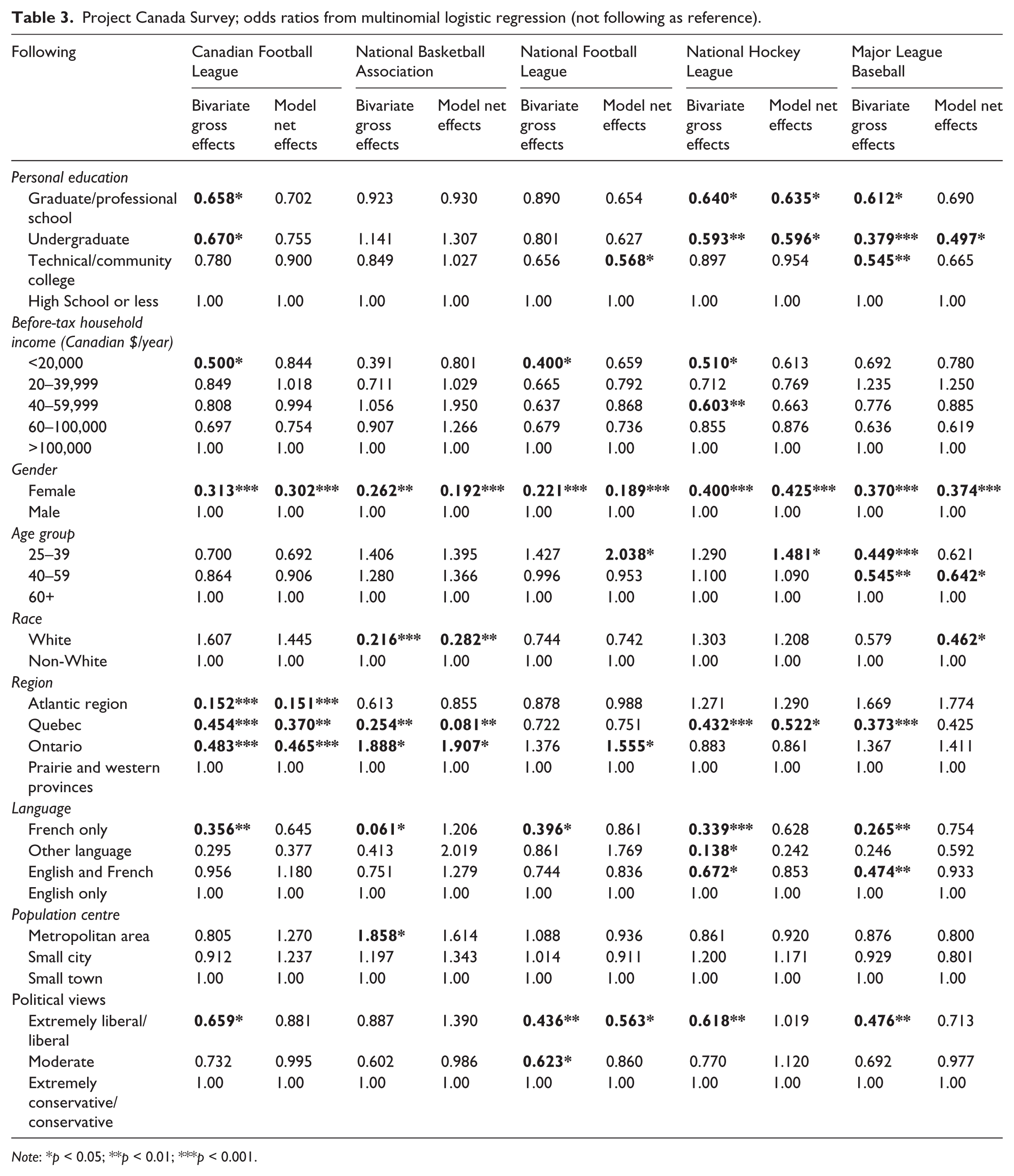
Note: *p < 0.05; **p < 0.01; ***p < 0.001.
Unlike the results for cultural capital, which appear to demonstrate an inverse relationship between education and following these professional sports leagues, the relationship with economic capital presents a disparate relationship. The regression analysis for these five leagues shows that all of the leagues, save the NBA and MLB, are most likely to be followed by those in the highest income category. Those in the highest income category are more than twice as likely than those in the lowest income category to follow the other three leagues. Because of these results, even as those who follow this league are likely to possess more economic capital, the relative lack of cultural capital for followers of these leagues suggests that designations of highbrow and lowbrow are perhaps inappropriate to describe the individual sports. Rather, other factors, particularly demographic, show more predictive capacity in judging class membership when the full regression model is applied. This could either suggest that ‘the influence of class structure on lifestyle is waning’ (Gerhards et al., 2013: 167), or that, as other studies have shown, sports fandom is an especially important element of identity construction (Pope, 2017). The next question becomes then, are there combinational patterns of following these leagues that do present themselves as indicative of the capital possessed? These relationships will be explored with the LCA.
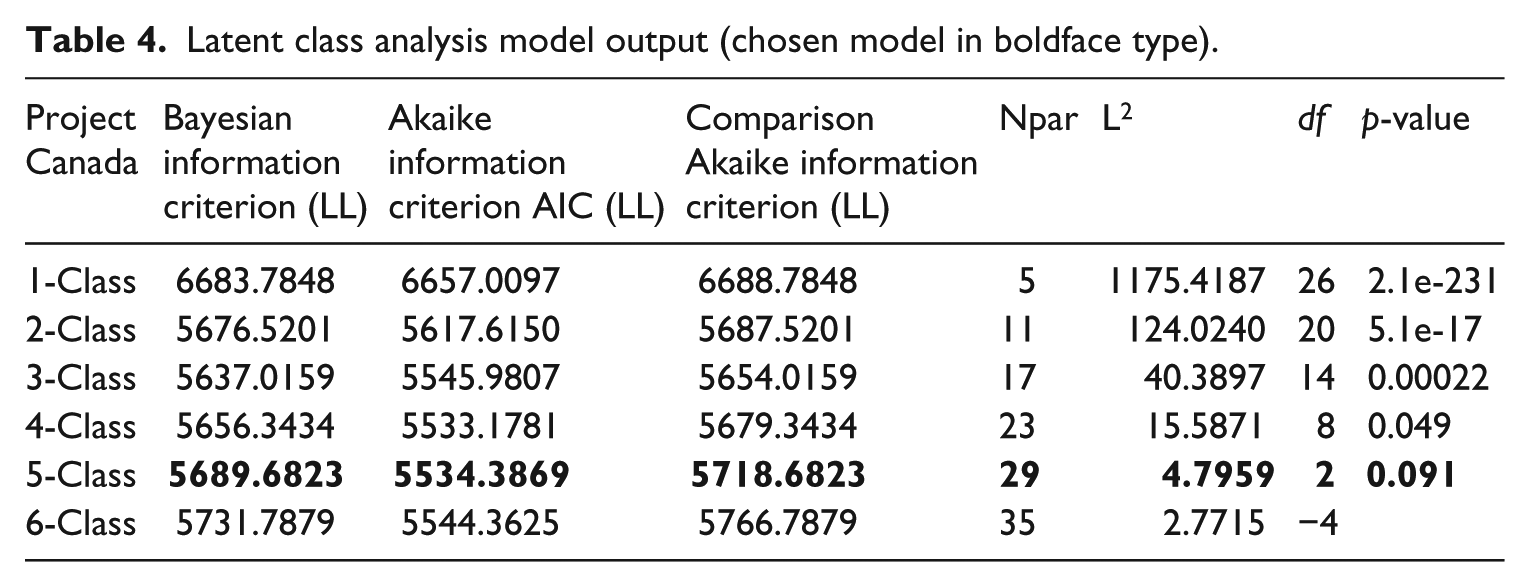
The results of the LCA are listed in Table 4. As this table illustrates, the only model that fits the data is the five-latent class model. This model highly fits the data and there are no residual associations of aberrant size found in this five-class solution. Therefore, there appear to be five distinct styles of professional sports following in Canada. The latent class profile of these five groups can be seen in Table 5. Variables that have higher probabilities of inclusion in any particular latent class that exceeds their overall relative frequency (see Table 1) are set in boldface type and used to determine cluster characterisation (Widdop et al., 2014).
Latent class analysis model output (chosen model in boldface type).
Latent class analysis profile.
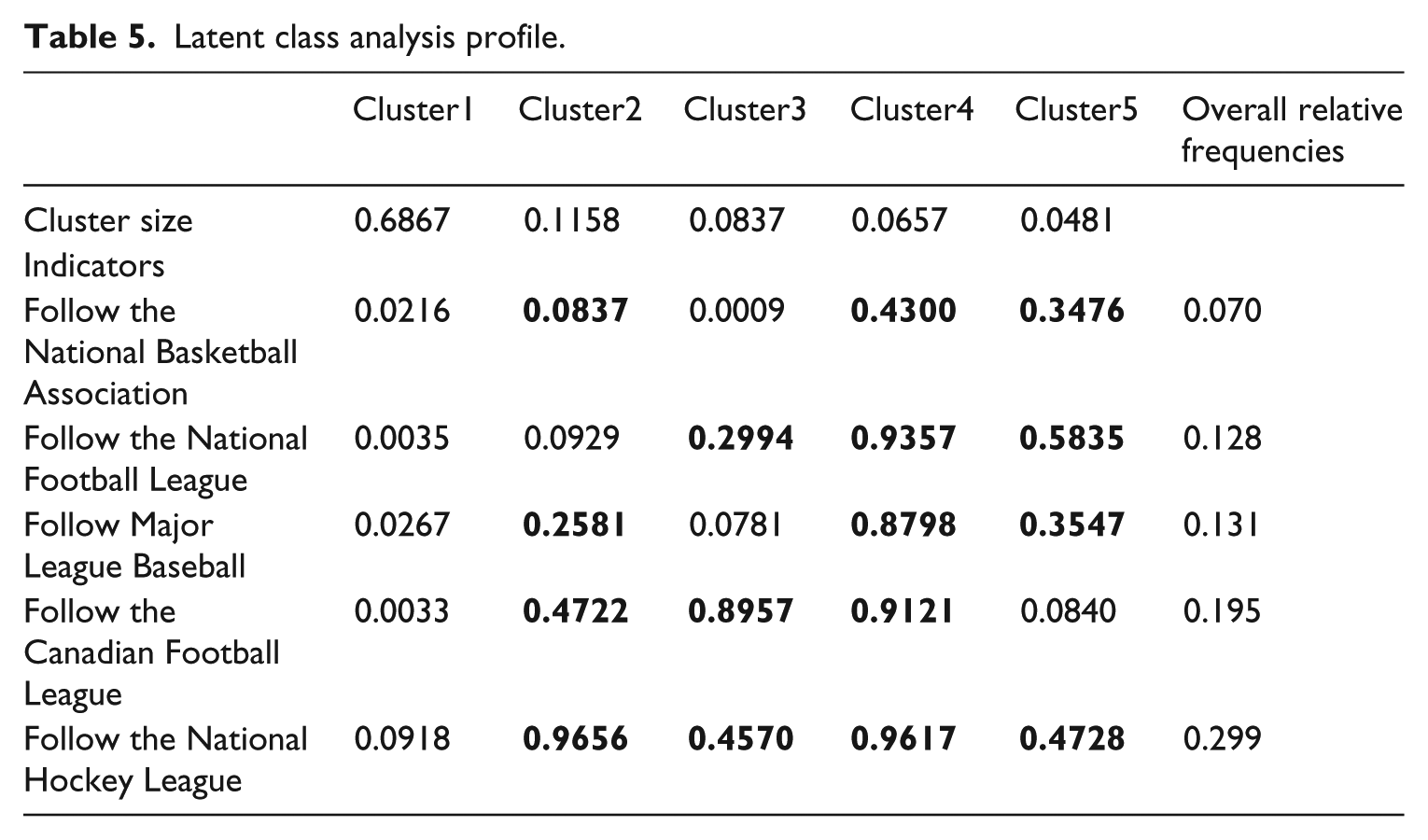
As seen in Table 5, the five-latent class model divides the respondents from the Project Canada Survey into five latent class groups, which constitute 69%, 12%, 8%, 7%, and 5% of the sample, respectively. The first latent class here is by far the largest group. It is defined by people who have comparatively low probabilities of following any of these five professional sports leagues. We will label this group the ‘non-sports fan’ cluster, because people in this group do not follow any of the professional sports leagues.
Latent class two is defined first by the highest probability that people in this group follow the NHL. After this high probability of following the NHL, probabilities drop almost by half for CFL, by half of that for MLB, and again by a third for the NBA. This group then, is thus labelled the ‘NHL primary paucivore’ group. The taxonomy of the ‘paucivore’ is borrowed from Chan and Goldthorpe (2010) and the description of this latent class being the ‘NHL primary paucivore’ group is because, outside of the prominence of the NHL follower in this analysis, the other probabilities for persons in this group following other professional sports leagues is comparatively much less than other latent classes for those sports leagues. However, outside of the NHL, they are ‘paucivorous’ across three of the other four leagues. The only league in this group that has a lower probability to be in latent class two than its overall relative frequency is the NFL.
The make-up of latent class three is similar to the second, except with different leagues. This group is primarily defined by the high probability that people in this group follow the CFL. The other two sports with probabilities in this group higher than their overall relative frequencies are the NHL and NFL. However, these probabilities are orders of magnitude smaller than those for the CFL. This group then, constitutes a kind of ‘CFL primary paucivore’. While only consisting of three of the five sports leagues, because this group still follows more than half of the leagues, outside of the CFL, they can still be considered paucivorous. MLB, and especially the NBA, do not have probabilities for inclusion in this third group that approach their overall relative frequencies. It is interesting to note that all three of the sports followed by those in this latent class are collision sports, with violence as a core component. These first two groups are also characterised by primarily following the two most distinctively Canadian sports leagues.
Latent class four represents the ‘omnivore’. As the reader can see from the probabilities in boldface type, this group has the highest probability of inclusion for four of the five leagues, with the NHL just ever so slightly below latent class two. Unlike the previous two sports following groups, this latent class has very high probabilities of inclusion for the three most American sports of the five, MLB, NFL, and NBA. This group constitutes 6.57% of the overall sample. Therefore, it is not the primary style of professional sports following in Canada. However, the fact that there is a distinct omnivorous group is important to note, as we can now see if the make-up of this group is distinct from the other latent classes, how it is so, and if it is the primary style of professional sports consumption for the capital possessed.
Latent class five is first defined by probabilities of inclusion that are higher than the general relative probabilities for four of the five sports leagues. However, these probabilities are much lower than for the two leagues of the two sport primary groups of latent classes two and three, as well as the omnivorous group of latent class four. This is the case with the exception of the NBA, which has a probability comparatively near to the probability of latent class four. The last league, the CFL, is distinctive in its low probability of inclusion in this group. Because of these characteristics, this group is dubbed the ‘non-CFL omnivore’. Because these results show NFL followers with the highest probability of inclusion in this group, and also quite high probabilities for MLB and the NBA while showing relatively lower probabilities for the NHL, and especially the CFL, this group may also represent a bit more of an ‘Americanised’ sports consumer.
What, then, is the make-up of these various sports following clusters? To analyse this make-up, multinomial logistic regressions are performed on the modal latent class values associated with each respondent. Analysing these latent classes for socio-economic and demographic variables can further the analysis of which prevailing theories of cultural consumption are most indicative of professional sports consumption in Canada. One of the primary findings of this paper is that an omnivorous consumer of professional sports exists in Canada. But what are the characteristics of this, and indeed the other latent classes from our LCA? The results are listed in Table 6 (see also Notes). They report odds ratios from the regressions. The bivariate gross effects are regression results solely from each individual independent variable while the model effects report the net effects of the entire regression model. Latent class one, the non-sports fan group is used as the reference category, as using a larger reference category better facilitates a regression analysis.
Project Canada Survey; odds ratios from multinomial logistic regression.
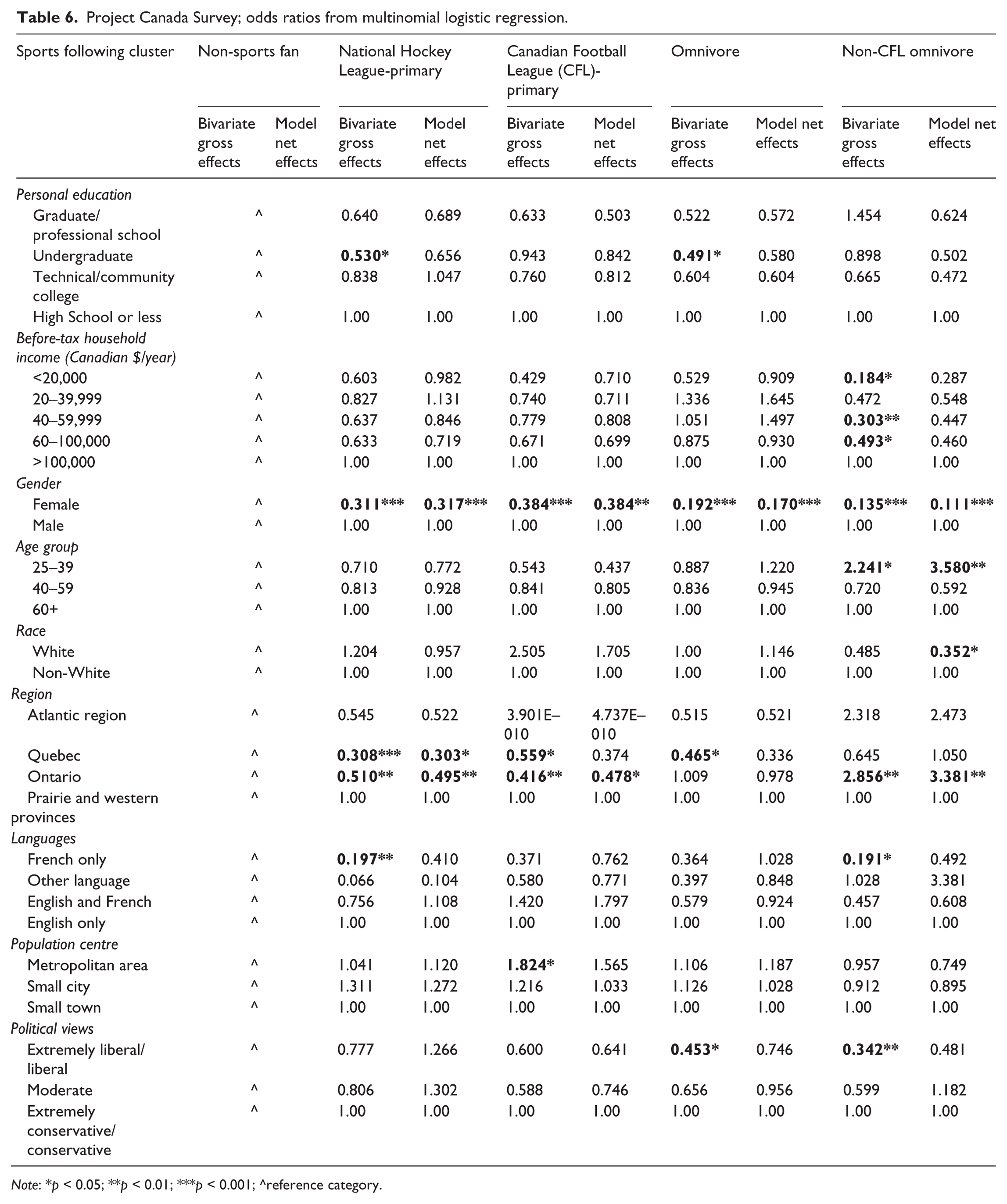
Note: *p < 0.05; **p < 0.01; ***p < 0.001; ^reference category.
The regression shows a significant bivariate gross effect for education whereby those in latent class two and latent class four, the NHL-primary paucivore and omnivore groups, are about half as likely to have an undergraduate degree than to have a high school diploma or less of formal education, relative to latent class one. However, there are no other significant gross effects for education parameters. There are also few significant parameters that show gross effects for income. Relative to latent class one, latent class five, the non-CFL omnivore group presents evidence that suggests that this group has high levels of economic capital possession. This group shows that those in the highest income category are more than five times more likely to be in this group than those in the lowest income category, relative to latent class one.
However, when the full regression model is applied, there are no significant results for economic capital among these groups. The most important model predictor of latent class membership is instead, gender. Gender is the strongest predictor of membership in all four of the sports following groups relative to the non-sports following cluster. While males are more than twice as likely as women to be in group three, they are more than three times as likely to be in group two, more than five times more likely to be in group four, and more than seven times for latent class five. Therefore, the two omnivorous sports groups are the most likely to be male. Other model effects suggest that relative to latent class one, latent classes two and three are also highly sensitive to region, and cluster five to age, race, and region. In stark contrast to these results, cluster four shows no other significant model effects besides gender.
Discussion and conclusions
What do these results tell us about the existence and nature of the omnivore within the domain of professional sports consumption? First and foremost, the omnivore exists. Or at least, there are indeed those in Canada that follow all five of these professional sports leagues. However, the compatibility of this finding with prevailing theories of the omnivore is complicated in some important ways. First, none of these five sports present themselves in the individual regressions as overtly ‘highbrow’ or ‘lowbrow’. While some show a negative relationship to cultural capital possession, some also show a positive relationship to economic capital. The first of these findings mirrors the findings of Mehus (2005) regarding sports spectatorship. Sport being a traditional ‘male preserve’ (Dunning, 1994), these findings also fit Bourdieu’s (1978) assertions that sports may be to the masculine what arts are to the feminine, and likewise, what economic capital is in relation to cultural capital as male is to female. Regarding this difference in capital emphasis, Veenstra (2010: 100) finds a distinction between ‘popular highbrow cultural practices such as sports’ that fall in the social space of Canada most distinguished by economic capital and ‘traditionally highbrow practices’ that fall in the social space that is most distinguished by cultural capital possession. While both Bourdieu and Veenstra assess participatory sport, where, as Bourdieu (1978) argues, the upper classes often eschew violence, leaving these types of ‘prole’ sports (Wilson, 2002) to the lower classes, the results of this paper suggest that this may not be the case with professional sports following. The LCA results directly refute Peterson’s univore concept in this professional sports domain, as there are indeed clusters that follow more than one of these sports and even the NHL and CFL primary paucivores are not distinguished by low levels of economic capital possession. Understanding our arguments from earlier that do not place Bourdieu’s ‘snob’ in direct opposition to omnivorous consumption (e.g. Lizardo and Skiles, 2012), what about Bourdieu’s theoretical framework in relation to Peterson’s omnivore?
The omnivorous group is the second smallest of the five different latent class groups. We can safely conclude that it is not the primary style of consuming professional sport in Canada. Rather, those who follow sports tend to either have a distinct favourite, such is the case with the two largest of these groups, the NHL and CFL paucivores. Conversely then, three of the four sports following groups also have sports that they definitely do not follow. This kind of pattern of sports consumption more closely mirrors Bourdieu’s theorisations of consumption, particularly regarding the differentiation in socio-economic and demographic composition between these groups. Because they are not fully defined by following just one sport, these groups also do not fit nicely into Peterson’s ‘univore’ concept, even as groups two and three show some levels of univorousness. Because the greatest distinctions along socio-economic and demographic lines within the domain of following professional sports occur between the three non-fully omnivorous sports following latent classes, and not at all found in the full omnivore group, it suggests that intra-domain differentiation does not particularly follow the omnivore thesis, which would hold that this group should possess more economic and/or cultural capital than their counterparts in other groups of consumption. While increased economic capital among sports following groups is found and is important, the strongest predictors of latent class membership are indeed demographic ones.
Therefore, these results may also hint at forms of more symbolic exclusion. The most interesting comparative case from these data comes between the CFL-primary paucivores and the non-CFL omnivores. Although not a significant value, Whites are two and a half times more likely than non-Whites to be in the CFL-primary paucivore group, while the non-CFL omnivore is strongly and significantly predicted by race, with non-Whites more than seven times more likely to be in this group than Whites, both in reference to the non-sports fan latent class. Bryson (1996: 895) finds ‘that negative attitudes towards social groups result in negative attitudes toward the types of music associated with that group’. These results hint at a similar dynamic regarding following of professional sports in Canada, with the non-CFL omnivores demographically opposed to the CFL-primary paucivores. But this demographic opposition is not solely racial. While the non-CFL omnivores are located primarily in Ontario, the CFL-primary paucivores are located in the prairie and western provinces of Canada and in metropolitan areas in these regions. These dynamics, coupled with the fact that of these five professional sports leagues, the CFL is the most exclusively Canadian and also the least ‘excellent’, may also suggest a type of parochialism of this group and perhaps a type of ‘cosmopolitanism’ of the non-CFL omnivores. The CFL may thus be serving a similar function that National Collegiate Athletic Association football serves in the United States, particularly in the geographic south of the US where NFL franchises are more diffuse. In the west of Canada, where professional sports franchises from the other four leagues are more diffuse, or indeed do not exist in certain markets, the CFL serves as the parochial sporting substitute, even as the CFL does not represent the highest level of competition in gridiron football, while the other four sports represent the highest levels of competition in those sports.
Because the non-CFL omnivore latent class is also the most capitally possessed of the sports following groups, this group is an example of omnivores that do not indiscriminately consume. Rather, members of this group have omnivorous tastes that are still exclusive of certain forms that they have symbolically devalued for whatever reason. The full omnivore group found in this paper, one that indiscriminately follows all major professional sports leagues in Canada, that is also mostly distinguished by being male and having relatively low levels of education, represents a fully omnivorous profile that does not support Peterson’s theory of this group having higher levels of social status. Rather, this paper finds that the full omnivore in these findings is the least socially distinguished, showing that the most socially distinguished and dominant groups have specific sports that they follow and more importantly, sports that they conspicuously do not follow. This is especially true of the second most omnivorous group, whose profile as economically dominant omnivores, but not indiscriminately so, mirrors Bryson’s (1996) findings of education and musical omnivorousness in the United States.
While no other studies of professional sports consumption have, as yet, identified a fully omnivorous consumption profile across a spectrum of professional sport offerings, studies from other countries do support the findings of class difference in professional sports consumption. For example, class difference was found in Australia (Ward, 2009) between high status persons who followed tennis and cricket and lower status persons who consumed rugby league and motor sports. Likewise, in the United Kingdom, a number of scholars have observed class differences between higher status persons who consume rugby and working class persons who consume soccer (Collins, 2009; Holt, 1992; Pope, 2015). While Wilson’s (2002) study is not explicitly about professional sports in the United States, the findings in that paper are similar to a finding of this paper regarding the elevated capital possession of latent class five, a group that consumes a variety of sports but specifically eschews certain sports. This may hint at similar consumption patterns of professional sports in the US, particularly as most of the leagues are shared between the two countries.
The primary limitations of this work include the relative age of the data, being now over a decade old. I hope to remedy this when Dr. Bibby makes the 2015 survey available. The 2015 survey will also remedy another weakness in the data, also related to its age. Since 2005, Major League Soccer has expanded into Canada, growing in popularity each year. This is particularly important for cross-national comparison to other national contexts, where soccer may occupy a different (or similar) social space and its consumption may be disparately structured. Additionally, the proliferation of new sports media platforms (e.g. online streaming and fantasy sports) during the years since this survey may have changed the size of the population that now would characterise themselves as sports followers. However, the beauty of the conceptualisation of the ‘follower’ is precisely that it is not a period-specific activity. Therefore, while new media platforms may perhaps skew new sports followers younger, the general aging of the population (with their own forms of following) likely mitigates any acute differences. This is especially true as we must recognise that the various successes of Canadian teams in any given year will likely also skew these numbers. For instance, interest in the NBA or MLB may be up with the recent success of the Toronto Raptors and Blue Jays. However, these dynamics may ultimately be cyclical. For example, NBA television audiences have been found to be 4.5 times more sensitive to team success than those persons who attend games, ultimately affecting a broad audience in a cyclical manner (Mongeon and Winfree, 2012). That said, more research into the changing landscape of professional sports consumption is needed to build off the findings of this paper. A final suggestion for further study involves qualitatively studying how people in these various professional sports following groups come of their dispositions and acquire their tastes. Likewise, what structures their dislikes and does this manifest itself in the production of distinction? These are the further paths of investigation into a domain of culture that is too large to be further neglected relative to other forms of culture.
Footnotes
Acknowledgements
Special thanks to Dr. Reginald Bibby for providing SPSS spreadsheets of the Project Canada Survey results. Thanks also to four anonymous reviewers of this journal for their invaluable input on this paper.
Declaration of conflicting interests
The author(s) declared no potential conflicts of interest with respect to the research, authorship, and/or publication of this article.
Funding
The author(s) received no financial support for the research, authorship, and/or publication of this article.