



Abstract
It has been widely recognized that women in Western countries are marginalized in the sports field, and sports media is one of the institutions that strengthens such trivialization. However, there are very few studies investigating women in sports in countries outside of Europe and the USA. The aim of this study is to review how sportswomen are portrayed in sports media in China, Japan, South Korea and North Korea. East Asian media is congruous in its disparities regarding quantity of coverage between domestic athletes and abroad athletes, between sportsmen and sportswomen, and between international events and local events. Narratives and commentary focus on nationalism, appropriate femininity, non-sports related aspects of sportswomen’s lives, and the dual identities of sportswomen. Some slight differences regarding quantity, narratives and commentary exist between the four countries. In its current state, scholarly research on media images of sportswomen is contradictory and too limited. Overall, more studies regarding how sportswomen are represented in East Asian media are needed, with further considerations of social media and media autonomy while making essential connections to social and cultural contexts.
Introduction
It has been widely recognized that women in Western countries are marginalized in the sports field, and the sports media is one of the institutions that strengthens such marginalization (Toffoletti, 2016). Specifically, sports media strengthens men’s and women’s positionality in sport by limiting the quantity of their media coverage, deprioritizing page placement in print media, and gendering narrative focus, language, and imagery of women in sports (Sherry et al., 2016). Despite the seemingly broad focus of this research, there are very few studies investigating women in sports in countries outside of Europe and the USA (Bruce, 2016). Studies show that women in developing countries face significantly greater inequalities, discrimination, and exclusion than in Europe and the USA (Hargreaves, 2005). This is true for the diverse developing and developed countries of East Asia – China, Japan, and North and South Korea. Within the East Asian context, there are very few studies investigating the media portrayal of sportswomen in East Asia (Wu, 2010). To understand women’s participation in sports in East Asia, but particularly the portrayal of sportswomen in sports media, we must consider the cultural, social, political, and economic factors that influence gender equity. Overall, there are more similarities than differences rooted in shared cultural values that maintain gender inequity despite the expanded rights and roles of women in modern East Asian societies.
The prevalence and endurance of Confucianism in East Asia is central to these shared cultural values. Confucian culture is characterized by a gendered hierarchy within the family; a woman should obey her husband and her parents-in-law and provide care for the whole family. The prevalence of Confucian culture in East Asia over thousands of years has greatly stabilized the way patriarchal structures are rooted in people’s minds in the region (Pascall and Sung, 2007). Thus, despite significant social and economic changes that have benefitted women in East Asia, they continue to face the challenges of gender inequity in private and public life (Das Gupta et al., 2003; Pascall and Sung, 2007).
For one, the economic crisis of the 1990s had a significant impact on East Asia and gender ideology. For example, the collapse of the bubble economy in Japan ushered in an era of neoliberalism leading to dramatic changes to traditional family structures, wherein women challenged marriage and pursued the feminization of masculinity (Edwards, 2014). On the other hand, economic crisis in North Korea led to the “Arduous March,” a four-year famine in the region, lasting from 1994 to 1998. As a result, the woman’s familial role transformed from one of support to one of leadership; and women in North Korea became more socially independent (Lim, 2005).
In addition to such economic crises, the different political structures in East Asian countries have supported gender equity despite their disparate ideological structures. The communist regimes in North Korea and China have played an important role in the increased status of women in these societies; communism as a system advocates gender equity. Regardless of the progress of women through this systemic push for equity, the complete liberation of Chinese and North Korean women is still a long way off and now depends on modernization and democratization (Ryang, 2000; Zhou, 2003). On the other hand, the capitalist regimes in Japan and South Korea have also contributed to improvements in gender equity (Peng, 2004). In all, these differing political and economic regimes support greater gender equity, such that the employment status of women across communist and capitalist countries in East Asia is similar (Cooke, 2010).
The vast economic and political changes that have occurred in East Asia have had positive effects on gender equity overall but have initiated demographic crises across the region that present a push back toward traditionally gendered social structures. The dramatic demographic transition over the course of the twentieth century has included a low birth rate, and an aging population, both of which have had negative economic impacts (Kim and Lee, 2007). This is especially true in Japan, where the political parties within the Japanese government are strategizing to protect the country’s future, in part, by returning to its traditional, patriarchal past, emphasizing the role of women as mothers and wives (Mandujano-Salazar, 2016).
This exploration of East Asia, however brief, cannot ignore the impacts of historical rivalries and Western interventions in the region. While some of these tensions have a long history, the more immediate relationships amongst East Asian nations derive from World War II and the Korean War, as well as the ideological battles and other military entanglements of the Cold War. In modern East Asia, Japan and South Korea have been influenced by long-term US presence and reflect some Western political and economic positions, sitting at odds with their ideological rivals in China and North Korea. At the same time, resentment of the imperialist actions of Japan remained strong in some regions of China and the Koreas. With the opening of the Chinese economy but while remaining a communist country, there has been an easing of ideological tension between China, Japan, and South Korea; however, China continues to be seen by some as a begrudging ally of North Korea, which is a source of serious unease regionally and globally. North Korea’s continuing work on its nuclear program and its militaristic diplomacy strengthens this tension (Lee and Bairner, 2009). These rivalries stoke long held feelings of nationalism in East Asia. Importantly for this study, however, this nationalism contributes to an exalted image of woman as a representative of her respective nation (Nagel, 1998).
Overall, the Confucian culture and the demographic crisis shed light on the gender equity in East Asia, whereas economic, political and historical factors have contributed to the improvement of women’s social status to some extent. This contextualization creates an important point of differentiation between Western and Eastern societies. Despite the uniqueness of these cultural, economic, social, historical, and political characteristics and the complexity of their interactions with gender ideology in East Asia, to the best of our knowledge, there has been no previous review of the portrayal of sportswomen in East Asian media. Therefore, the aim of this study is to review how sportswomen are portrayed in sports media in China, Japan, South Korea, and North Korea and present a call for more research in this area.
Methods
Inclusion/exclusion criteria for study selection
The languages were limited to English, Chinese, Japanese and Korean. The researchers are fluent in English and Chinese. They used Google Translate and the support of multilingual colleagues on titles and abstracts for the Japanese and Korean. All studies were peer-reviewed articles with full-text; conference abstracts were excluded. The publication years were restricted from January 2000 to November 2017.
There were three inclusion criteria: (a) study media included narrative, commentary, image, video, and social media; (b) study samples included sportswomen or sportswomen with disability; and (c) study areas included China, Japan, South Korea and North Korea.
Electronic search
The electronic databases Academic Search Premier, Bibliography of Asian Studies, SPORTDiscus with Full Text, Women’s Studies International database, China National Knowledge Infrastructure, e-Korean Studies and CiNii were searched for relevant studies. Search terms to locate studies included: (a) sport, athlete; (b) woman, women, female; (c) media; and (d) China, Chinese, Japan, Japanese, Korea, Korean and other equivalent words. References of included studies were further examined for complementary sources.
This search retrieved 237 peer-reviewed articles. After removing duplications and reviewing the titles, 114 articles were eligible for screening. Through careful reading of the abstracts, 29 articles were eligible for thorough examination. Finally, six of these 29 articles were excluded because they focused on women’s participation, narrative translation, Chinese–Korean relations, North and South Korean relations and audience responses to rather than media portrayal of sports women. Of the remaining 23 articles, there were 14 in English, four in Chinese, four in Korean, and one in Japanese. These 23 articles were included in this literature review (see Figure 1).

Study selection.
Data analysis
We first segmented media portrayal by creating two domains of measurement: (a) quantity of media portrayals; and (b) quality of media portrayals (Bryman, 2003). We created three subdomains under the quality domain according to media forms. These subdomains included: (a) narrative and commentary; (b) image and video; and (c) social media. Then we classified articles into these different domains and subdomains according to the topics they covered – one article could be classified into multiple domains and subdomains.
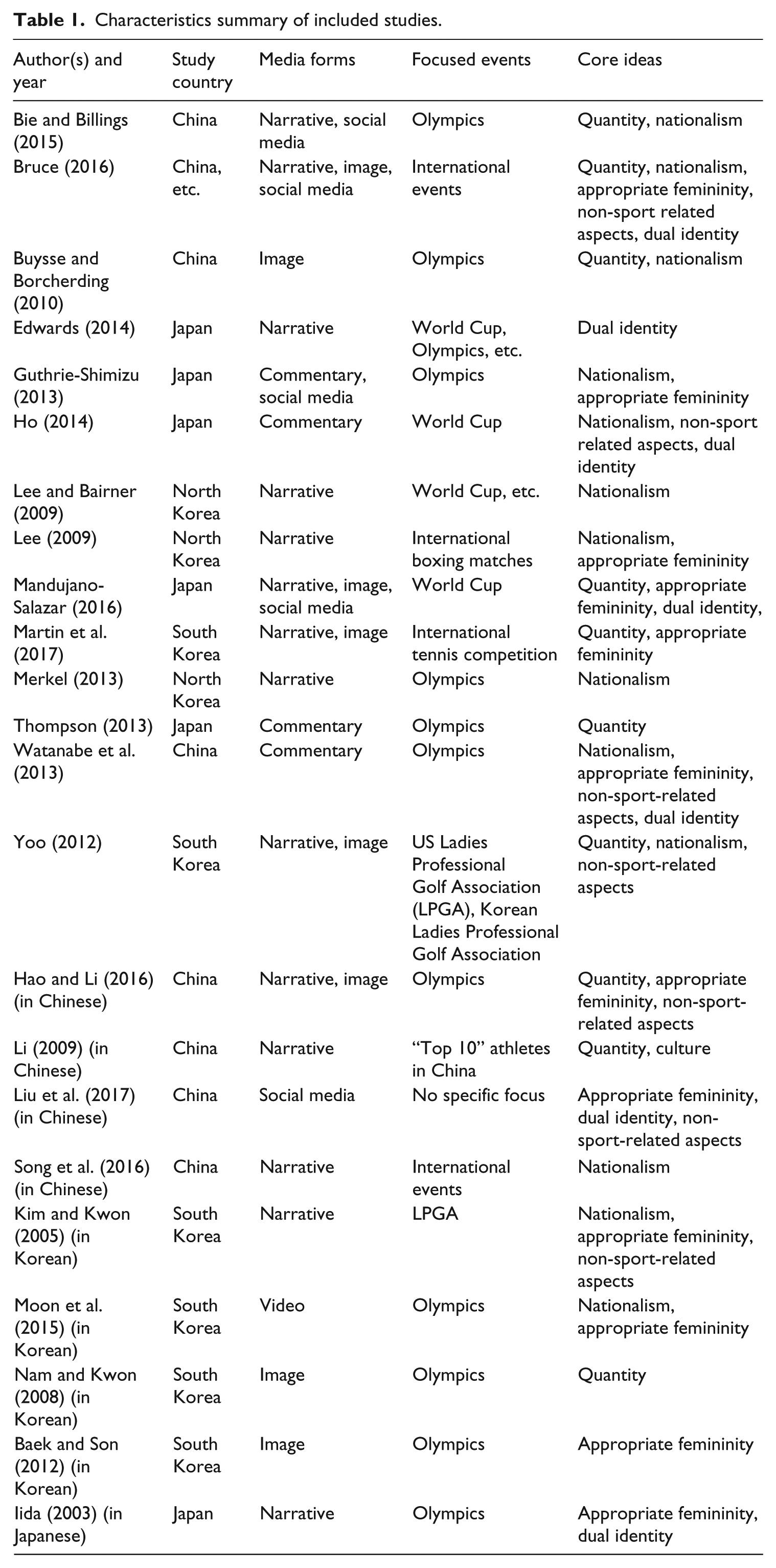
After classification, we read each article and developed core ideas. The core ideas depended upon content of the article and ultimately included nationalism, appropriate femininity, non-sport-related aspects of sportswomen’s lives, and dual identity. Finally, we used those core ideas to distill themes for our results section. Information on eligible studies, including article publication year, study countries, study institutions, media forms, focused events, and core ideas, are summarized in Table 1(Patten and Newhart, 2017).
Characteristics summary of included studies.
Study characteristics
Dominance of US institutions
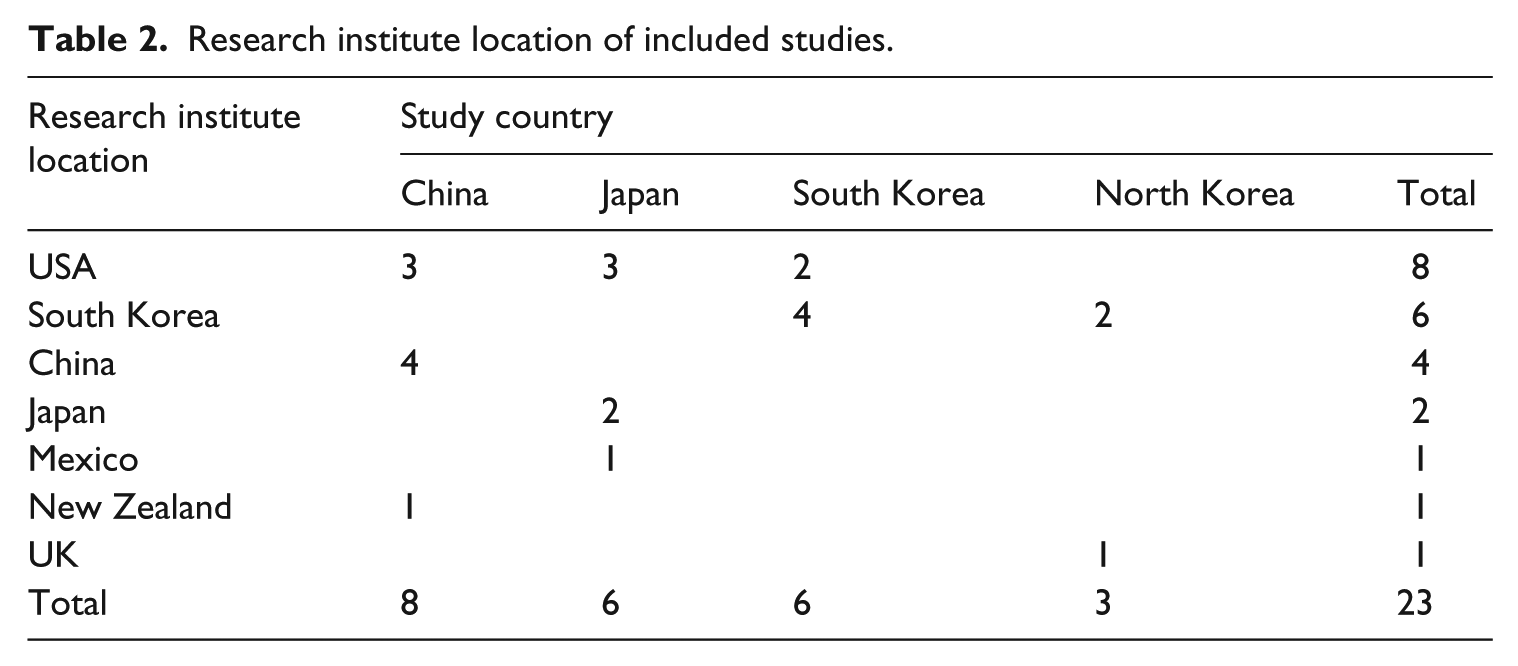
Overall, the number of peer-reviewed journal articles that relate to media portrayal of sportswomen in East Asia is very limited. There were 23, with eight of these on China, six on Japan, six on South Korea, and three on North Korea. Among all the research institutes represented by those journal articles, US colleges or universities constituted eight out of 23 affiliated institutions (see Table 2). Further, it is important to consider the impact factor of articles published in English over the native languages of East Asian countries and the affiliated institutions of researchers. English was the language for 14 articles, but of those 14, eight were from US institutions while six studies were published outside of the USA. These ratios (8/23 and 8/14) reveal the dominant status of the USA in this research area; more than a third of the total articles and more than half of the English language articles were published in the USA.
Research institute location of included studies.
Focus on the Olympics
With the exclusion of one Chinese article that is focused on the top 10 national athletes and another article that has no specific focus, over half of the studies (12 out of 23) are about the Olympic Games, whereas the remaining nine studies cover the FIFA World Cup and other international, single-sport competitions. These points of focus may result from the practicality of obtaining data from international events; it is hard to obtain local media data for authors outside of these East Asian countries due to the language barriers and network block, especially in North Korea (Talmadge, 2016) and China (Pham, 2017). Finally, the Olympics, with their potential to generate international recognition, prestige, dignity, and pride, encourage strong nationalist movements in East Asian countries (Bie and Billings, 2015; Merkel, 2013).
Results
Amount of coverage
Domestic athletes vs. international athletes
It was found that sportswomen representing China and North Korea received significantly more domestic media coverage than sportswomen representing other countries (Bie and Billings, 2015; Merkel, 2013). Particularly, North Korea is so self-focused that it only reports accomplishments of its own athletes while totally ignoring other sportswomen, especially sportswomen from South Korea and Japan playing in the same games (Lee, 2009; Merkel, 2013). No research was found on the comparative coverage of sportswomen internationally or domestically for Japan or South Korea. There is some discussion of representations of sportswomen in South Korea, but this will be discussed in the Narratives section.
Women vs. men
Considering all of the research together, sportswomen receive less coverage than their male counterparts in China (Bruce, 2016; Hao and Li, 2016), Japan (Mandujano-Salazar, 2016), and South Korea (Martin et al., 2017; Nam and Kwon, 2008). Further, sportswomen with a disability get much less coverage when one considers the interaction of two variables; gender and disability (Buysse and Borcherding, 2010). Notably, in Japan, when sportswomen lose, they almost totally disappear from media coverage. When their male counterparts lose, however, they receive a similar amount of coverage as compared to when they win (Mandujano-Salazar, 2016). Another Japan article found sportswomen have comparatively equal coverage with their male counterparts during the Olympics, but this may result from considerations of the Olympics as an international event – as discussed in the next subsection (Thompson, 2013).
While the research tends to show that sportswomen receive less coverage than sportsmen in East Asia, there is some disagreement about the coverage gap in China based on what media sources are analyzed. In one study, the coverage gap is especially obvious when comparing unofficial media to official media. Unofficial media is privately owned, and includes, for example, Sina Corp. Official media is totally owned by the government and includes People’s Daily and China Central Television. Official media gives equal amounts of coverage to men and women whereas the unofficial media outlets give a much greater coverage to sportsmen (Hao and Li, 2016). Another Chinese article claims that sportswomen receive more coverage than sportsmen in China, but because it is an official media selection, it can be explained by the results of Hao (Li, 2009). As will be discussed later, the Chinese government seeks to promote gender equality through media because of its communist and nationalist ideology.
International events vs. local events
It is a global trend that sportswomen receive more coverage during international sports events, such as the Olympic Games, than they do in local events (Bruce, 2016). In South Korea, the increase in coverage of global events is very sharp (Martin et al., 2017; Nam and Kwon, 2008; Yoo, 2012); while in China, such an increase is comparatively slight (Bruce, 2016). Regardless of the increase, the amount of coverage that sportswomen receive is still disproportionately low.
Narrative (magazine, newspaper, etc.) and commentary (television (TV) show, broadcast, etc.)
Nationalism
Sportswomen are consistently depicted as heroines or role models to propagate nationalism in four countries: China; Japan; South Korea; and North Korea. This reveals that nationalism has a higher social priority than sexualization. In these articles, nationalism has four main goals: to win international recognition; build international rapport; gain national confidence; and promote national rejuvenation (Bruce, 2016; Buysse and Borcherding, 2010; Guthrie-Shimizu, 2013; Ho, 2014; Kim and Kwon, 2005; Lee and Bairner, 2009; Song et al., 2016; Watanabe et al., 2013). The historical rivalries among these countries and Western interventions have also had a strong impact on the portrayal of sportswomen in relation to nationalism (Lee, 2009; Merkel, 2013; Yoo, 2012). In China and North Korea, nationalism serves their need to allege the superiority of their communist and/or socialist regime. Because communism as a system promotes gender equity, China and North Korea promote positive narratives of sportswomen to affirm both internal feelings about the superiority of their systems of government as well as nationalist feelings (Bie and Billings, 2015; Lee, 2009; Li, 2009; Merkel, 2013). In Japan, the economic crisis, social segmentation, and natural disasters (such as the 2011 earthquake and tsunami) the country has experienced over the last few decades have also prompted the government to create patriotic depictions of sportswomen to improve national confidence (Mandujano-Salazar, 2016). Interestingly, while facing similar economic and demographic problems to Japan, South Korea and its media have portrayed domestic athletes as model citizens, while sexualizing and feminizing US athletes (Bruce, 2016). Such differential depictions indicate, however superficially, the continued rivalry with the USA.
Appropriate femininity
In addition to nationalism, appropriate femininity is also prevalent in East Asia – North Korea is somewhat exceptional in this regard, as will be discussed below. The prevalence of appropriate femininity means that femininity and athleticism are incompatible (Bruce, 2016). Media tend to praise and highlight physical attributes of sportswomen in gender appropriate sports, such as tennis, table tennis, archery, badminton, volleyball, gymnastics, and synchronized swimming (Guthrie-Shimizu, 2013; Hao and Li, 2016; Martin et al., 2017; Watanabe et al., 2013). The Image section discusses representations of sportswomen in gender inappropriate sports, such as soccer. North Korea, as an exception to appropriate femininity, deems sports such as boxing, football, judo, and weight lifting as gender appropriate for women (Lee, 2009). This stems from North Korea’s priority to maintain its communist regime in a social environment of turmoil, which may explain such active, skillful, and aggressive representations of sportswomen.
Emphasis on the feminine traits of sportswomen also highlights the prevalence of traditional gender roles discussed in relation to China, Japan and South Korea – North Korea was not mentioned. Sportswomen are always depicted as delicate, graceful, modest, obedient, and psychologically weak (Hao and Li, 2016; Kim and Kwon, 2005; Mandujano-Salazar, 2016; Watanabe et al., 2013), while their successes are attributed to their male coaches, leaders, fathers, or husbands (Bruce, 2016; Iida, 2003). However, Iida (2003) revealed that only male journalists trivialized sportswomen’s athletic achievement, whereas female journalists depicted sportswomen as self-reliant and independent. As female sports journalists change the narrative of women in sports, so do the sportswomen themselves. Due to the popularity of counter-hegemonic culture in Japan recently, Japanese sportswomen have begun to reject underrepresentation and voice their own opinion on television shows (Ho, 2014; Mandujano-Salazar, 2016).
Non-sports related aspects
Sports media prefer to depict non-sports related aspects of sportswomen in China, Japan, and South Korea – again, there is no discussion of North Korea in this regard. These aspects include: family status; appearance; personal life; and personality (Bie and Billings, 2015; Bruce, 2016; Hao and Li, 2016; Ho, 2014; Kim and Kwon, 2005; Watanabe et al., 2013; Yoo, 2012). For example, Watanabe et al. (2013) found that a Japanese TV show was keen to discuss whether or not certain sportswomen had boyfriends or the preferences of women soccer athletes for popular boy bands.
Dual identity
Sportswomen face contradictory dual identities in East Asia (Bruce, 2016). Sportswomen must balance their roles as athlete, mother, wife, and daughter (Hao and Li, 2016; Ho, 2014; Iida, 2003; Mandujano-Salazar, 2016). They must also balance their roles as sports star and imperfect, real-life person (Edwards, 2014; Ho, 2014; Watanabe et al., 2013). Interestingly, North Korea recognizes sportswomen as model workers to balance the conflict between the individual as a star and the value of the collective under the communist regime (Merkel, 2013).
Image (newspaper, magazine, etc.) and video (TV advertisement)
In exploring the image of sportswomen in East Asia, the findings are inconsistent and there are fewer studies compared to those of narrative and commentary. Though Bruce (2016) claimed that sportswomen are pictured in active poses, especially at international events in East Asia, this was challenged by other findings. In China, the unofficial (non-government) media presents female volleyball athletes, in a gender appropriate sport, off court and in sexualized poses during the Olympics (Hao and Li, 2016). In South Korea, sportswomen in images or advertisements are either sexualized to emphasize feminine traits and the non-sport-related aspects of their lives (Baek and Son, 2012; Martin et al., 2017), or masculinized to emphasize nationalism. How images of sportswomen are used depends on sport type, appearance, and body shape (Moon et al., 2015). In Japan, one study showed the challenges of being a sportswoman in a gender inappropriate sport. Female soccer players were pictured in crisp pantsuits, wearing makeup, and holding their World Cup medals. Despite winning the World Cup, the commentary underneath the image described the team as losers both as women and professionals because of the way their profession and appearance contradicted traditional gender ideals (Mandujano-Salazar, 2016). Overall, the findings of image and video representation of sportswomen are consistent with those in narrative and commentary regarding nationalism, appropriate femininity, and non-sport-related aspects of their lives, but more studies are needed to draw convincing conclusions about representation.
Only one study discussed sportswomen with disability in the media. This article, which focused on images of women with disability in the Chinese media, found that they are more trivialized and underrepresented; they are less often in uniform, less often on court, and less active in their poses (Buysse and Borcherding, 2010).
Social media
As compared to traditional media, social media provided sportswomen with a big opportunity to interact with their fans and lend their voice to issues of women’s sport in China and Japan (Bie and Billings, 2015; Bruce, 2016; Guthrie-Shimizu, 2013; Liu et al., 2017). For example, on the Chinese social media platform Weibo (namely microblog), Chinese woman swimmer Yuanhui Fu has almost 8 million followers and one of her most popular blogposts received almost 200,000 comments during the 2016 Rio Olympic Games (Fu, 2016). However, commentary on social media posts often displays the same characteristics as traditional media, such as appropriate femininity, dual identity, and non-sport-related aspects of life (Liu et al., 2017).
Discussion
Dominance of US institutions
It should be noted, regardless of the dominance of US institutions, that most of the researchers in this review appear to have a cultural connection to China, Korea, and Japan – their names appear to be of East Asian origin. They might be citizens of East Asian countries or first- or second-generation immigrants to the USA. The popularity of gender studies in US academic institutions may explain why Western models heavily influence international studies regardless of national and cultural differences (Bruce, 2016). On the other hand, the lack of gender studies as a field in East Asia means there are not many journal articles focused on this topic originating in East Asian institutions, which limits any exchange of ideas and perhaps influences the prevalence of gender studies as a scholarly topic in these countries. Such scarcity may also result from stereotypes of subservient East Asian women, lack of legal statutes like Title IX, the limited impact of first, second, and third wave feminism in these countries, and decreasing academic interest in sport as a result of the attenuation in political rivalries between communist and capitalist countries, such as the Soviet Union and the USA, with the end of the Cold War (Hanson, 2005).
Cultural context and race
Differences in media portrayals of US and East Asian sportswomen, and even within East Asian countries, demonstrate the significance of cultural context (Bie and Billings, 2015; Bruce, 2016; Hanson, 2005). The lack of studies on media portrayals of sportswomen in East Asia also confirms the need to give attention to regions outside of the West (Hargreaves, 2005).
Notably, US studies often consider variables such as race and institutional division (Musto and McGann, 2016), but these factors totally disappear in East Asian studies. In terms of race as a variable, many East Asian countries lack such diversity. Further, the absence of studies on the second variable, institutional division, may result from the differences inherent to the US and East Asian sports systems. For example, the national system in China gives much less attention to collegiate sports, whereas collegiate sports constitute a significant part of the US sports media.
Nationalism
Almost all studies of East Asian sportswomen refer to nationalism, while studies in the USA seldom involve this topic. One study referenced Caster Semenya, a female runner from South Africa who some claimed was a man. The South African media responded by depicting this sportswoman as a national heroine and made use of her as a political tool to criticize racist practices (Cooky et al., 2013). Interestingly, beyond comparisons to East Asia and South Africa, all countries use sportswomen to support nationalism. The lack of nationalism as a topic of study may reveal the scholarly bias caused by overconfidence in US political, economic, and military power on the international stage. This context of national confidence might also influence how academics analyze gender and consider (or ignore) nationalism within the USA. Alternatively, a lack of discussion of nationalism within gender and sports might be due to US cultural individualism as opposed to the collectivism that is prominent in East Asian countries (Watanabe et al., 2013).
Media manipulation
Two theories regarding media are widely discussed in these studies and inform this review: framing theory; and social learning theory. Framing theory suggests that the information sender can manipulate media to meet their goals by “framing” public conversations and audience perceptions through selection, emphasis, and exclusion of media content (Bie and Billings, 2015; Buysse and Borcherding, 2010; Kane et al., 2013; MacArthur et al., 2017; Martin et al., 2017; Watanabe et al., 2013). The second theory, social learning theory posits that media provide models and moral guidance for audiences to emulate (Li, 2009; Watanabe et al., 2013). Therefore, it is naive to assume that the audience can freely or independently interpret the facts of a story or that the audience can avoid the media’s social and cultural impact.
In comparing the USA to East Asian countries, the framing and social learning theories suggest that the media in these countries manipulate the portrayal of sportswomen for political and financial gain. To be sure, Chinese and North Korean sports media are under government control, whereas Japanese, South Korea and US sports media operate under freedom of the press (Bie and Billings, 2015). The distinction is made in the forms and purposes of this media manipulation. For example, North Korea uses the positive narrative to educate its female population to: be effective workers; lay a foundation for its army-centered militarization, which maintains the power of the ruler; and propagate the so-called “equal status of women” as part of the communist regime (Lee, 2009; Merkel, 2013). In Japan, on the other hand, the negative narrative advocates traditional qualities of womanhood, especially for the younger generation, due to that generation’s low birth rate and economic depression in the country (Mandujano-Salazar, 2016). In the USA and South Korea, the sexualized portrayals of sportswomen become commodities to cater to predominantly heterosexual male audience preferences (Baek and Son, 2012; Edwards, 2014; Ho, 2014). Therefore, these manipulated portrayals of sportswomen are used as tools that support nationalism and build gender ideologies in order to gain power and money and to maintain hegemonic masculinity.
Hegemonic masculinity
Sportswomen in Western countries such as the USA only receive 2–4% of media coverage (Tucker Center, 2017), which is significantly lower than East Asian countries – for example, in China, sportswomen receive 16–21% of media coverage (Bruce, 2016). Further, highly developed countries such as the USA depict sportswomen as highly sexualized while developing countries such as North Korea portray sportswomen as laborers and national heroes rather than sexual objects. This contradicts findings that gender inequality, exclusion and discrimination are more severe in developing countries (Hargreaves, 2005). North Korea seems to surpass the USA in gender equality because of its equitable portrayal of sportsmen and sportswomen. However, the two countries represent two different kinds of hegemonic masculinity: the former capitalizes on their target of a middle-aged, white male audience, while the latter maintains its male-dominated political structure (Lee and Bairner, 2009). One similarity exists across cultural barriers: men control women’s sport and subsequently sportswomen for financial and political gain (Suggs, 2007).
Gender construction
The emphasis on appropriate femininity, non-sports related aspects of sportswomen’s lives, and dual identity dominates gender construction in media portrayals of sportswomen in both the USA and East Asia, with North Korea as an exception (Toffoletti, 2016; Tucker Center, 2017). Unlike these other countries, in North Korea, the ideology of the strong and active woman reflects the wartime femininity that the country established in the 1950s as opposed to women’s liberation as equals to men. In all countries, gender construction is established and strengthened through interactions, structures, and cultural symbols in everyday life (Messner, 2000). However, we should not maintain a pessimistic attitude toward trends in gender construction because some changes are happening in social and political contexts. For example, in the USA, women who grew up with Title IX are becoming mothers, which may transform gender stereotypes in their children’s experiences of sports (Messner, 2000). In Japan, younger generations have progressive gender views counter to the hegemonic culture (Mandujano-Salazar, 2016). Also, the impact of social media cannot be ignored because it facilitates global exchange through popular platforms such as YouTube, Twitter, and Facebook.
Transgender athletes and disability athletes
This review found only one article that mentioned disabled athletes and no discussion of transgender athletes among the total 13 studies. Gender construction in East Asian countries not only prohibits open lesbianism for sportswomen but eliminates the possibility of the East Asian transgender athlete. It is widely recognized that transgender athletes are trivialized and marginalized in the USA, and even Title IX has failed to extend protections to transgender athletes (Pirics, 2016). However, resources, policies and allies in some US colleges support these athletes (Kauer and Krane, 2013; Krane et al., 2017). Unfortunately, transgender athletes totally disappear in East Asia, generally. This disappearance is due to a variety of factors, including conservative views, trans-negative culture, a lack of education, laws and policies against lesbian, gay, bisexual, and transgender individuals, and strict social norms. It is no wonder that there are no studies regarding such groups in East Asia.
The current situation for sportswomen with disabilities in the USA is just a little bit better than transgender athletes. In the articles about East Asia, a brief mention of disability in sports representation in China states that the Chinese media has only covered disabled athletes in wheelchairs (Buysse and Borcherding, 2010).
Conclusion, strengths and limitations
To the best of our knowledge, this is the first review to synthesize studies on the media portrayal of sportswomen in East Asia. It provides some insights into aspects of media portrayal in East Asia, which differ from portrayals in Western countries. Further, we used the cultural contexts of East Asia countries to understand the current literature on East Asia and consider the value of comparisons to studies of the USA. The main limitation of this study is the shortage of articles on the topic. The relatively small number of articles included interferes with drawing clear conclusions about image and social media, but this weakness indicates what an underexplored topic this is. Rather than a weakness of this review, the relatively small number of articles indicates a weakness of the field of scholarship. This review provides a foundation for understanding the media portrayals of sportswomen in East Asia and reveals the urgent need for future studies that focus on this topic.
Footnotes
Acknowledgements
The authors would like to thank Lauren Klaffke for her help and support with this review.
Declaration of conflicting interests
The author(s) declared no potential conflicts of interest with respect to the research, authorship, and/or publication of this article.
Funding
The author(s) received no financial support for the research, authorship, and/or publication of this article.
