



Abstract
Since the 1990s there has been a growing number of female supporters following football clubs and there is little doubt that they have recently become an important part of the audience for both football authorities and clubs. The process of football’s feminisation is neither simple nor is it taking place in a social vacuum, and female fans are encountering well-institutionalised football fandom culture, which is deeply entrenched in stadium rituals. This paper offers an empirical study of roles assigned to women in football fandom culture and the way in which this has been done in order reproduce a “traditional” social order on the Polish football stands. In doing so, it examines the grass-roots ultras’ magazine To My Kibice (We are the fans) that belongs to an increasingly popular type of fan magazine, which was developed from popular homemade football fanzines in the 1980s. The analyses provide evidence that female supporters are either marginalised (not being counted as regular fans), patronised or instrumentalised by their male peers. These strategies are visible both in language and in the social contexts in which women on the stands are described.
Introduction
Since the 1990s there has been a growing number of female supporters following football clubs. Women have not only entered the football community as consumers of a spectacular mode of entertainment, but have also joined the body of staunch supporters. In addition, the share of women among the sports media (both TV and internet) audience, including football, is significantly increasing (IBRIS, 2014; Repucom, 2015). Despite the fact that there are no official statistics to verify this statement in Poland, the long-term ethnography allows us to assume that this phenomenon is the case. There is little doubt that women have recently become an important part of the audience for both football authorities and clubs, but the process of football’s feminisation (Pope, 2017) is neither simple nor straight-forward, nor is it taking place in a social vacuum. Female fans are now encountering well-institutionalised football fandom culture, which is deeply entrenched in stadium rituals.
Female fandom is a relatively new phenomenon in the social sciences, but it has already earned considerable research attention worldwide (Ben-Porat, 2009; Dixon, 2015; Toffoletti, 2017, Meier et al., 2017). The main focus of female fandom studies is on the situation of women and their strategies for confronting the gender stereotypes embedded in traditional masculine football culture. Most research fieldwork on ultras and hooligans tends to downplay the gender factor, but our study locates women in the centre, albeit resting upon de facto collective diaries written by male ultras.
The aim of this paper is to identify roles assigned to women in football fandom culture, as female fans entering football stadiums have to challenge them head-on. The significance of this question is not only confined to sport-related studies, but also refers to a much broader and more significant phenomenon, especially as football games have never solely been a sports competition. The departure point of this study is that, in many European countries, stadiums turn into a political agora that provides radical groups – known as ultras – with the opportunity to demonstrate their social and political views in front of the thousands gathered in the stadiums, as well as the millions watching at home.
Polish ultras represent a much wider population, dominated by males from working class backgrounds, whose role is diminishing in the post-industrial economy and society. The fall of the industrial world destroyed the collective ideology of the working class, which was also linked to a sharply dichotomous and asymmetric division between male and female roles (e.g. Goldin, 1984). In this context, football stadiums remain one of few bastions of male domination, functioning as a territory in which men can still claim their hegemonic position.
In fact, there has been no other public space adopted by the lower classes with such a strong set of institutionalised values and norms. This is particularly the case in transitional countries, in which young working class males may feel left out and stigmatised by mainstream society. So, this is why the Polish terraces have a bad reputation as hosting an angry voice against the social, cultural and political world of the west (Antonowicz et al., 2016).
This study explores the football fandom culture of Polish ultras in order to examine the social roles that are being assigned to women and the way in which this has been done in order reproduce a “traditional” social order. This system rests upon three assumptions.First, that football stadiums represent a special “permission zone” (Ben-Porat, 2009) that allows norms of behaviour largely unacceptable outside of football grounds, such as body gestures, offensive banners, rough language, etc. Of course, the scope of this “freedom” is the subject of continuous negotiations between ultras and club authorities, which sometimes leads to conflicts. The second assumption refers to the enormous impact on fandom culture exercised by radical groups – commonly known as ultras. Their radicalism refers to both their kind of dichotomist views on clubs, players and other fans and also the way they express them without any care of political correctness. Such groups have cultural power due to their self-proclaimed loyalty and commitment to their team, providing vocal and visual support during games. They have a strong say on the informal social rules on the stands. The third assumption alludes to the fact that women entering fandom culture are confronted with a well-structured social order in which gender divisions play an important role (Ben-Porat, 2009; Pfister et al., 2013).
Football culture as men’s world
Current research shows that football fandom culture remains an emanation of masculinity. Performing fandom and watching sport in a crowd of boys and men can be used as male bonding, and it can be assumed that the football stadium is attractive for men because this is one of the places where bonding has an aim, makes sense and can be bodily performed. In addition, the stadium is one of the few spaces where men can still be “real” men and demonstrate their virility to other men. Thus, in many ways, football consumption draws on men’s habitus and taste and constructs women as outsiders (Pfister et al., 2013: 862).
The perception of football and football stadiums as a place for the reproduction of masculinity has been confirmed by various studies conducted in different European countries, for example, Spain (Llopis-Goig, 2007), Denmark (Lenneis, 2013; Pfister et al., 2013) and England (Dunn, 2014; Pope, 2011, 2013, 2017), as well as outside of Europe, for example, Zimbabwe (Chiweshe, 2014). Describing this process, the authors usually refer to the concept of hegemonic masculinity (Connell, 1987; Connell and Messerschmidt, 2005). In the sports context, one can speak of two kinds of hegemony, as distinguished by Demetriou (2001), that is, internal and external hegemony. The first refers to the relations between different groups of men, between which there is a defined hierarchy. For example, in stadiums, so-called ultra fans have exercised the greatest influence on fandom culture due to fact that they are well-organised, strongly committed and traditionally play the most active role (in orchestrating support during football matches) on the stands. Meanwhile, external hegemony is the domination of men over women on the stands, which is sustained by excluding both persons and behaviours “considered the opposite of masculine, such as women, homosexuals and children” (Del Campo, 2003: 67). Moreover, one can observe a culture of misogyny (Chiweshe, 2014; Gosling, 2007) in which women are perceived as sexual objects and have to face various forms of sexism (Jones 2008, Lenneis, 2013). Feminisation is also used to insult both the fans and players of an opposing team (Erhart, 2013; Pope, 2011).
As men play an hegemonic role on the terraces, they also define the conditions (relative autonomy) under which female supporters can be present in a stadium. In some way, these conditions create a particular “bio-power”, especially when the status of women (their identity, as well as their body) is evaluated through the prism of men’s power (Alpan, 2015). This power sets both the limitations and definition by which women can be present on the terraces (“ornaments”, volunteers, entitled members). Women tend to be stigmatised as subordinate “spectators” (onlookers), rather than being recognised as supporters (Pope and Williams, 2011). This is also one of the main reasons that the presence of female football fans tends to be overlooked. Of course, women can comfortably sit back as “onlookers” and distance themselves from fandom culture but, paradoxically, the more they want to become “true/real fans”, the more they have to perform specific gender roles.
Male fans are denying women the “cultural ticket” to football fandom (Pfister et al., 2013). They discredit women’s knowledge of the sport and its rules and perceive women as interested only in men, both players and fans. They are also often reduced to the role of the girlfriends, wives, friends, daughters, sisters, etc., of male fans (Cecemore et al., 2011). One can also observe male supporters’ chivalry towards women. As Lenneis’ (2013) study revealed, men often feel responsible for female fans’ safety in a stadium.
The process of dominant masculine reproduction is manifested and reproduced in various ways, such as presenting spectacular choreographies of flags, banners and flares, as well as joint chanting and singing. The role of verbal discourse is very important, and the discourse itself is crucial to the creation of football culture (Erhart, 2013). So far, most analyses regarding the role of gender in football fandom have made almost no reference to the reproduction of male power via popular textual forms. Some focused on female fans’ statements (Pope, 2017) or observations during fieldwork (Cere, 2012; Pitti, 2019). This study aims to fill this knowledge gap by providing empirical analyses of texts published in a grass-roots but still widely available and popular fan magazine. Such texts play a significant role in constructing beliefs of “what things are” or “what things should be” (e.g. Sellnow, 2010). They are politically powerful in a micro-scale, offering to minority groups a window opportunity to promote their own views (Fiske, 2010). They are therefore a strong tool in defining situation and contrasting fans’ identity.
Notwithstanding this, the process does not take place in a socio-political vacuum, but is well entrenched in various local contexts that cannot be ignored when investigating such issues. Rather, such contexts need to be seriously taken into account, as they often hold the key to obtaining a full understanding of the gender dynamics of football stands.
The context of Polish fandom culture in the light of dynamic socio-economic transformation
The history of Polish football fandom clearly shows that it is impossible to analyse this social phenomenon without a broader context considered. The development of fandom structure, as well as the ideological background, is strongly related to the transformation of Polish society. For example, it is generally acknowledged (see Antonowicz and Grodecki, 2018; Kossakowski, 2017b) that during the post-transformation period, due to a lack of legal tools, weak policing and such issues as a collapsing economy and high levels of unemployment, the Polish government failed to address the growth of violence and anarchy in stadiums. In many respects, the football terraces became an enclave for precarious masculinity. In the context of collapsing state factories, which constituted the natural environment of young men from working class backgrounds, groups of extremist fans were perceived as a source of companionship, providing a sense of belonging, strength and the feeling of mightiness. Women and girls were practically separated from these enclaves. This period of “anarchy”, characterised by the cult of physical power and “tribal” rituals of violence, shaped the structure of fandom and only strengthened its hierarchy, creating a set of required behaviours and attitudes (Antonowicz and Grodecki, 2018). In addition, due to the constant possibility of violent confrontation, features traditionally connected with manhood – physical strength, willingness to fight for others, violence – constitute the most important requirements for the members of this group.
As a result, the structure of fandom is based on a “militant” mode of conduct – hierarchical order, fusion of personal identity with the group, physical and mental strength, physical punishment for breaking rules, discipline and homophobic attitudes towards sexual minorities (Kossakowski, 2017a). These factors constitute the particular “ultras’ culture”, expressing itself through behaviours, attitudes and stadium performances. Such a structure allowed fans to create very strict borders, both physical and mental, that “filter” all redundant and adverse factors – “un-masculine” men, women and gays.
Many Polish football fans (certainly the ultras), in the search for the components of social identity, mobilised ideas dominated by conservative-right aspects and a strong influence of the Roman-Catholic Church. One of the most recent foundations (since 2015) for reinforcing their social identity is the history (legend, myth) of the “Cursed Soldiers” – guerrilla troops who fought against the communist regime shortly after World War II. 1 Their myth has been incorporated by football fans as that of a role model because – in their eyes – they represent an uncompromised scarification in the fight for their country, anti-system attitudes, great courage and a sense of brotherhood. Among the members of these groups, there were also several women. Fans – in their choreographies – have glorified these women, but the emphasis has been placed on their scarification, devotion and fulfilling the traditional duties of women (Kossakowski, 2017b).
This contemporary socio-cultural context seems to heighten the traditional, conservative and dominantly patriarchal nature of fandom. The prevailingly militant nature of Polish fandom makes it difficult to believe that female fans could take a leading role on football terraces. In many aspects of the Polish society and economy, while women successfully perform social roles that used to traditionally belong to men, fandom culture seems to resist this trend and football terraces remain one of the last bastions of the so-called “old” era, in which gender roles were fixed and embedded in the traditional framework.
Ultras constitute the most influential community in Polish stadiums – they have the power to impose their ideas and major performative forms. Also, no other group has such a strong influence on the type of chants heard or displays choreographed in such a direct and largely uncontested way. Fans who do not share the principal values of ultras can (without consequences) occupy other sectors. However, it is difficult to imagine that they could initiate their own “identity politics”, as this is largely one way ideological traffic. Ultra groups operate in most football clubs in Poland, but some lower league clubs do not have such separate ultra groups. Last but not least important, is the low quality of football, making it unattractive to potential new fans whose considerable number could possibly create a serious ideological alternative to the ultra-dominant discourse. There is almost no chance that they will come in a large enough number to challenge the existing power balance on the stands.
Methodology
It must be acknowledged that female fans in Poland have failed to attract almost any research attention. This is a surprise, taking into account the visible presence of female fans during numerous sport events. However, it also perfectly reflects their – accorded by male fans – peripheral position in fandom culture. Notwithstanding this, it is beyond any doubt that there is knowledge gap that needs to be addressed by empirical study.
The analysis is based on written materials published in the grass-roots ultras’ magazine To My Kibice (TMK), the title of which can be translated as “We are the fans”. TMK belongs to an increasingly popular type of fan magazine, which was developed from popular homemade football fanzines in the 1980s (Haynes, 1995). The latter, however, were linked to particular clubs or firms, documenting their activities alone, while modern ultras’ magazines (e.g. TMK) cover the entire “ultras’ scene”. Nevertheless, they still rely on contributions from fans, namely the representatives of ultras’ groups, which make them genuine, reliable first-hand sources of knowledge about the views and performance of ultra fans. In spite of their grass-roots character, in several countries, such as Spain (Super Hincha), the Netherlands (Panenka Magazine), Germany (Blickfang ultra), Italy (Supertifo), Turkey (SopaliPankrat Fanzine) and of course Poland (TMK), such magazines enjoy considerable popularity among football fans. TMK is a magazine publishing monthly, so 12 volumes are available per year. It is published in full colour on art paper (as it contains many photos from stadiums; the average number of pages is 84) and is available from most important retail groups, as well as magazine and books stores.
In general, TMK does not employ regular journalists, but provides space for contributions from numerous ultras’ groups, from the top league games (Ekstraklasa) to selected games in the lower leagues. TMK is made also by fans for fans and, therefore, it offers first-hand narratives for which the authors (usually hidden behind nicknames) have a particularly good sense of the audience to which they also belong. Judging by the nicknames, all the authors in the studied period were male. 2 In short, fans’ stories are a form of narrative and “the most typical form of social life (…). People tell stories to entertain, to teach and to learn, to ask for an interpretation and to give one” (Czarniawska, 2004: 650). We also state that “narrative knowledge tells the story of human intentions and deeds, and situates them in time and space. It mixes the objective and the subjective aspects, relating the world as people see it, often substituting chronology for causality” (Czarniawska, 2004: 651). In our investigation, it helps to put particular glosses on such accounts, as they inform us about intentions and deeds. Therefore, for the sake of this study, TMK is considered to be a collection of match-day diaries of Polish ultras, from which this study addresses the social roles that women performed in the ultras’ culture. Technically speaking, although such material only constitutes a number of individual stories, from a practical perspective they provide us with advice for analysing their views on women. By their nature, match-day reports include many details (both objective information and subjective opinions), considering both the behaviour of a club’s own fans and an evaluation of the performance of rival fans.
The sensitive nature of our research problem and, more significantly, the specific features of our researched community (ultra fans), which is extremely hermetic, distrustful and, most importantly, strongly stigmatised by mainstream society, requires the undertaking of specific methodological measures in order not only to gather the required data but also to develop a contextual understanding. Therefore, the methodological dimension of this analysis is inspired by the seminal work of William Thomas and Florian Znaniecki, “The Polish Peasant in Europe and America” (1996), which sheds light on the great importance of autobiographical narratives as expressed in private correspondence, such as letters or diaries. Since then, the analysis of personal documents has developed into a fully fledged research method and is widely used when investigating sensitive topics, hidden assumptions and unspoken views, of which members of this community might not be fully aware. “They can furnish information (albeit partial and personal) on groups and settings that are not available for first-hand observation” (Hammersley and Atkinson, 2007: 124). These include not only various forms of texts, such as diaries, autobiographies, letters and blogs, but also images and numerous media productions. They are produced by individuals for different proposes (private or public), being distributed through both official and unofficial channels. Martyn Hammersley and Paul Atkinson acknowledge that “documents may be of value in stimulating analytic ideas” (2007: 122). Indeed, they navigate us through the rocky path of the social world of ultra fans. Although personal narratives do not necessarily offer universal truths, documentary materials may provide valuable insight, often helping to create an account of internal group hierarchies, informal norms and values.
Methodologically, the paper stands firmly on the ground that fans’ narratives are the most accurate sources for understanding largely inaccessible communities. TMK offers genuine fans’ diaries, from which we can draw the knowledge needed for the purpose of analysis and avoid the interviewer effect, which can mislead an entire investigation. The latter is likely to emerge when exploring extremely hermetic and stigmatised communities. Furthermore, through its largely grass-roots and first-hand nature, TMK has become a forum for numerous authors (male only), all of which are ultras with well-established positions in their groups. It supplied the investigation with a wide spectrum of narratives, proving an opportunity to better understand the ultra’s world and explore the social roles performed by women.
The period of our investigation stretches between 2006 and 2016 and covers a total number of 131 issues of TMK number of match-day diaries taken into consideration, with the total being 1696. The sample was purposely designed to provide a solid collection of empirical data to investigate regularities in fans’ views on women. The analysed period was chosen arbitrarily but it is long enough to make sure that certain phenomena are not ephemeral. On the other hand, 11 years is a long period in which to identify a possible change in attitudes and behaviours.
Overall, the study consists of three major phases. In the first phase, (a) the quantitative analysis was conducted to identify a number of narratives in which three independent researchers found any reference to femininity. This is based on the assumption that the frequency of female reference is a proxy of their position in the social world of the ultras (Cere, 2012). In the second phase, (b) each of the identified cases was investigated separately (also by three independent researchers) in order to explore the social contexts in which women appeared. In the last phase, the researchers established (cooperatively) major analytical categories (roles) that women perform in narratives published by TMK. By using them, all the identified cases were classified in order to produce a taxonomy of the social roles of women in ultra fans’ narratives and the social contexts associated with them.
Women in the fans’ stories
The study analysed a total of 131 issues of TMK. Only 10 issues of TMK did not include any fans’ “match stories”, due the fact that TMK is published also during the summer and winter season breaks. Overall, women as fans were mentioned in only 4.5% (76 items, n = 1696) of articles. The number of “match stories” in which “females” or “femininity” were mentioned demonstrates the rather popular assumption of the masculine nature of the ultras’ world. However, it provides solid empirical evidence of its homosocial character (Kanter, 1977; Lipman-Blumen, 1976), in which the presence of women is nothing more but “incidental”. Therefore, not only is the number of female supporters low, but they also seem to occupy peripheral positions in traditional football fandom culture.
Metaphors and categories of female fans
The marginal appearance of women in ultras’ narratives is hardly a surprise; however, it is interesting to explore the rich vocabularies that have been used to address women. A significant amount of research has revealed that language is an important tool for gender differentiation in sport (Fuller, 2006; Messner et al., 1993). At the same time, researchers have drawn attention to the use of homophobic language in sport (Adams et al., 2010; McCormack, 2014). In the context of these studies, the language used to describe female fans should be considered through its role in the process of women’s inclusion and exclusion.
This linguistic analysis is critically difficult to conduct because of unavoidable inaccuracies in translation. For this reason, the authors have decided not to focus on particular terms, but to distinguish the major categories that shed light on the social context in which women appear in fans’ narratives. They are presented in Table 1, along with examples of the terms and the frequency of appearances in TMK.
Major categories used when refering to female persons. 3
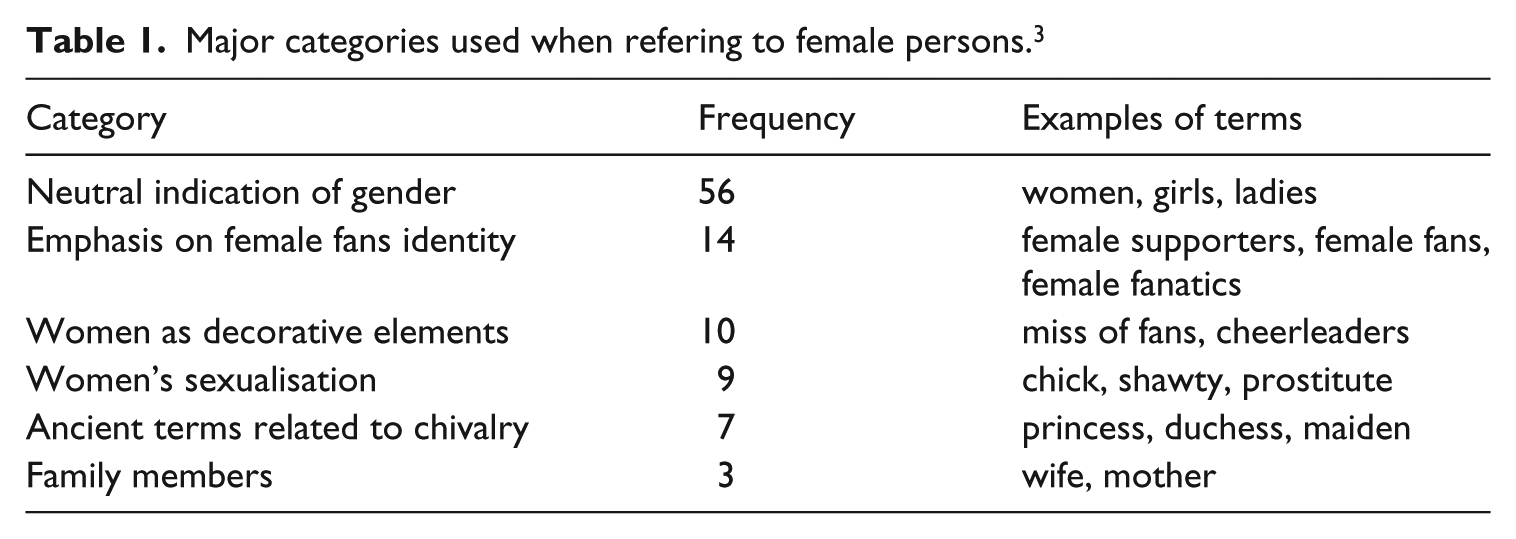
The analysis of vocabulary terms used by male fans to write about women allowed us to distinguished six main categories. Most commonly, match reports used neutral terms that aimed simply to indicate women’s presence among the fans (see the first context below). Fourteen times the male narrators stressed the fans’ identity as women, usually when they were active participants of fan behaviours. The next categories emphasised that female fans and other women are perceived either in terms of their beauty and (sexual) attractiveness, or as a “weak gender” that needs male protection. Finally, women appeared in narratives as family members of male fans, that is, their presence in the stadium resulted (only) from the presence of a male fan.
Gender-neutral terms, as mentioned above, are used exclusively to notice the fact of women’s presence. When an activity conducted by women is described in the narratives, the majority of the terms suggest that women are not perceived as “real” fans, but primarily by their gender, being understood in a traditional, stereotypical way (i.e. beauty and frailty as female traits).
Role and status of female fans in narrations
To learn something more about women’s status, further analysis was conducted to identify the social role and contexts in which women appear in ultras’ narratives in TMK. The selection process was conducted independently by three researches who highlighted five major contexts in which women were mentioned, listed in accordance with the frequency of appearance.
The first – the reporting context – is by far the most frequent to occur in TMK stories. Authors reported the number of female fans among the whole group of fans, using only numbers. From the outset, this looks neutral and distanced, as in the following quotations: There were 80 of us, including 4 women. (66/2007, p. 47)
4
On our ultras’ stand there were 50 people and 19 visitors and one girl arrived. (169/2015, p. 29)
Each TMK article contained detailed information about the number of fans present. So, although the reporting context might look neutral, this is a rather misleading assumption. Interestingly enough, a sharp distinction is made in the narratives between the number of fans and what we recognise as separate categories, such as women or kids. This distinction suggests that they do not count as regular fans in the ultras’ world. Ultras groups compete in away-match attendance (in lower leagues, also at home games), but this applies exclusively to male supporters, as they are the only ones who count. Pulling women out of the parenthesis of fans underlines not only their lower status on the stands, but the refusal to recognise them as regular fans. The reasons for such odd behaviour stem from the military account of fandom, which excludes those who are not strong enough to participate in fights. In other words, real ultra fans see themselves as a homosocial community that, at most, can be accompanied by other categories (e.g. children, female, elderly). The latter cannot be excluded, but, at the same time, they do not count as “real” supporters.
The second and most common circumstance in which women were pictured in fans’ narratives was as the victims of police and/or security staff’s abuse of power: Anti-riot police made brutal and thoughtless attacks on anyone around them, no matter if their victims were young or old people, even the girls got hit. (79/2008, p 37).
Similar to the previous category, a neutral indication of gender was employed, but the context in these stories tells us more about the role they play. This rather unexpected role was not only the most common, but also illustrative in terms of an instrumental account of female presence on the stands. In the fans’ narratives, published in TMK, women are used to de-mask brutality and the misuse of power by law enforcement services. These incidents vary in terms of scale: the explicit indicator of mindless brutality is the use of power against women and youngsters who are perceived as physical vulnerable and, as a consequence, not considered as part of the ultras’ community. Discourse on women as physically vulnerable normalises and legitimates the associations between masculinity and violence. It seems that being a proper ultra fan requires the physical capacity to confront opponents (security). Those who do not demonstrate this (e.g. old, youngsters and women) have a different (much lower) status and are used to illustrate the scale of police violence, which is perfectly demonstrated in the following quotations: Sadist cops hit blindly whoever stood their way whether they were girls or very young teenagers. (134/2012, p. 26) Security staff spread tear gas also against innocent kids, women and elderly people. (167/2015, p. 31)
The third social context in which women were brought into light in TMK is explicitly linked to their appearance and sexualisation. In these narratives, girls are depicted as sexual objects to be admired and conquered by “real” ultra fans – men. So, when it comes to girls, the only thing that mattered was their physical attractiveness: The girls looked like participants in the world gathering of top models, so many of us wanted to get know them better. (107/2010, p. 6)
Unsurprisingly, such attitudes were frequently followed by verbal harassment aimed at girls, such as “show your tits to the lads” and other primitive attempts at sexual conquest. In all these relations, women are presented as sexual objects who will satisfy the sexual demands of fans: [about the party] …..finishing with girls who had many “jobs” to do☺. (93/2009, p. 41) We had a great laugh at the trespassing hostess, undoubtedly beautiful, who resisted our numerous compliments and was also unwilling to dance with us, despite promises to double their royalties. (128/2012, p. 10)
The fourth identified context will be called “normative” and it refers to the social norms, terms and the conditions under which female fans can or cannot participate in certain parts of fandom culture. This covers a wide range of aspects and leaves little doubt that it is men who define the “dos and don’ts” for female fans on the stands.
As mentioned above, groups of ultra fans accept physical violence, both in and outside football stands, as a part of regular rivalry. Also, occasionally they tend to clash with stadium security or even the police; however, as a principle, they (male supporters) do not accept physical violence against women. As a consequence, they explicitly exclude women from their fights and also try to keep them (if possible) away from any incidents that might involve physical confrontations. This cultural norm seems well embedded in the ultras’ culture and is illustrated by the following quotations: We have rules not to involve girls and spectators. (142/2013, p. 42) On the street near the railway station we sparked the brawl. All Raków fans but the girls joined the fight. (72/2007, p. 38)
Interestingly enough, this limitation is lacking in terms of practical justification, especially taking into account the growing presence of women in combat sports, for example, mixed martial arts (MMA; Jakubowska et al., 2016) and the supposition that many of them would perhaps be fitter for brawls than their male colleagues. However, such an approach significantly forges the glorification of the role of men in fandom culture. It presents their violent activities in the frame of chivalry, which fits into the patterns of traditional masculinity. This perspective is also expressed by the terms used in fans’ narratives, common to the time of chivalry, such as lady or maiden.
Women in this narrative context appear to be restricted more generally, and not just in terms of participating in fights. Rather, the investigation also found numerous references to their exclusion from travelling to away games. Having said this, we need to clarify that ultras’ associations share with their clubs the responsibility for all travel arrangements to away games. They also enjoy the informal power to establish and execute the rule about who (and under what conditions) can and cannot travel to (specific) away games: For this particular away game, all female supporters will be excluded from travelling. (111/2010, p. 14) Travelling ban was given to all female supporters and also several others [male supporters] who are not actively involved in the ultras’ life. (172/2016, p. 5) For this particular game, Warsaw fans (Legia) decided to make selection for travelling fans and, for example, exclude female supporters. (179/2016, p. 30)
Last, but not least, the appearance of women in the normative context refers to the general presence of women on the stands. The research finds that women are not only generally excluded from fights and away travelling, but also that they can be explicitly forbidden from entering an ultras’ supporters’ stand: The most unpopular decision concerned throwing away all the girls from the lower tier of our stand [Kocioł] whose number in the last couple of years has been growing. Of course, there are real female fans among us who demonstrate even stronger engagement and passion than male fans, however during the last round there was too many dating couples and “stars” from night clubs. There is neither democracy nor gender parity/balance on the stands, so girls had to leave the lower tier of our stand. (162/2015, p. 10) (…) the core ultras group consisted of 300 supporters which had undergone selection before entering the ultras sector. Thanks to it, neither girls nor youngster were present in the core ultras group. (182/2016, p. 50)
There will be no doubt that the world of ultras is a manifestation of masculine power in which only men count as fans. It is male ultra supporters who set both the rules and conditions, and also execute them. This is partly due to security reasons, as ultras occasionally get involved in brawls with other fans, security services or the police, but is also partly due to the male hegemony of the stands. That might be the reason why violence is still so strongly embedded in fandom culture in Poland. Perhaps this is simply the only way to keep masculine domination of the stands. In other words, being an ultra fan requires the ability to defend (flag, scarves, banners and oneself) against enemies, demands that neither women nor youngsters seem to meet. The visible presence of female supporters might be thought to undermine the “militant style” of fandom and soften the “tough image” that is spectacularly demonstrated by the banners and flags. The latter tend to focus much more on physical strength, muscularity and combat skills than loyalty.
The “normative” aspect also refers to the dedicated roles female fans are accepted as playing. They are mostly connected to traditional duties concerning the preparation of food and taking care of children. Two quotations depict this context: The day before the tournament, Polonia’s female fans sat in the hall and prepared 800 sandwiches for the fans invited to the tournament. (137/2013, p. 11) Thanks to the Female Elite’64, the kids with their parents covered the sector with the colours of the club. (182/2016, p. 27)
Female Elite’94 is one of two active female-only Polish ultras’ groups (the second one is CzaROWnice, “Witches’, a female group from ROW Rybnik football club, residing in the third tier of the competition). It is a group composed of female fans from GKS Katowice (second tier of the league competition). Female Elite’94 are well-recognised for their social activities with children and families, supporting the club from the family sector. They also conduct regular workshops in local kindergartens and schools to socialise with a new generation of fans. Male fans respect their duties; however, simultaneously GKS Katowice is one of the clubs for which travelling to away matches is strictly prohibited for women. The members of Female Elite’64 accept this regulation.
In respect to frequency, the last, but not the least important context in which women are mentioned in TMK, refers to denying women the status of real fans. In general, women are usually denied the status of “real” fans, being perceived more in terms of their femininity than their affection for a club. However, the study of TMK found descriptions of several situations in which attention is drawn to individual female supporters who have crossed “gender roles” on the stands and act as “male supporters”/men: Shortly before the game one of the female lost her scarf to… female one from Korona Kielce. (69/2007, p. 26) During the last 20 minutes, vocal support was conducting by a girl. (92/2009, p. 40) ….without our knowledge, one of female fans of Mazańcowice [football club from Lower league – ed. authors] approached the sector of visitors and attempted to steal their flag. (133/2012, p. 38)
Of course, it should be noted that women’s presence in this context, as illustrated by the first and second quotations, is treated as something against the dominant norms of fans’ behaviours, being regarded as exceptional or even a little funny. Nonetheless, the author of the narrative clearly appreciates and respects these female fans for what they did, but these are undoubtedly rare exceptions that deserve special attention in the narratives. On the other hand, this also means that female fans can earn considerable respect if they perform “masculine” roles. This was also demonstrated by the tribute that ultras paid to a female fan who had passed away, holding a minute’s silence in her memory and presenting a special banner: During the match, we also recalled the late Agata, a (female) fanatic who has bravely struggled for four years with serious illness. The banner “You have never surrendered” was just for her. (181/2016, p. 13)
The above-mentioned cases clearly show that female fans should not expect to gain equal status in terms of ultras’ activities. They are sometimes appreciated and respected, but mostly in terms of fulfilling the traditional roles dedicated to caring services or an “aesthetic” meaning.
Addressing women’s conquest of the football stands
The analysis of fans’ narratives published in TMK makes an empirical contribution to our understanding of the dynamics of football stands, particularly in response to the growing number of female fans. The study is focused on the ultras because – following Ben-Porat’s (2009) work – we also see the football stadium as a sort of “permission zone” in which social norms, informal rules and patterns of behaviours are negotiated between club authorities and ultras. Whoever wants to enter a stadium has to confront this deeply institutionalised fandom culture. This appears to be particularly challenging for women since, in doing so, they are “conquering men’s territory” or interfering with a homosocial community (Kanter, 1977; Lipman-Blumen, 1976) of football fans.
The study of TMK provides empirical evidence that the ultras’ world is depicted as a separate social reality with its own distinctive sets of values and norms, which are largely at odds with mainstream culture. One such critical difference is the status and role of women. While economic, political and cultural transformation has significantly improved the situation of women in Poland (Dobosz, 2009; Sekuła, 2014), football fans seem intent on defending the traditional social order, which not only envisages a sharp distinction between gender roles but also aims to maintain a masculine hegemony. In that respect, fans’ narratives make numerous references to the 1980s and 1990s, which are seen not only as the “heydays” of football hooliganism in Poland, but also symbolise the industrial society with its patriarchal hegemony. Overall, football is one of the last realms in which working class men can exercise their collective power, which has been largely lost due to the de-nationalisation and de-unionisation of industry.
Previous studies have suggested that football fans are under pressure from the growing number of female supporters on the stands. The TMK narratives seem to confirm that female fans are gradually entering football culture in Poland, perhaps not in large numbers, but in sufficient numbers to be spotted. This can be observed in the ultras’ reports, especially when they note the number of women who attended a match. Beyond any doubt, the growing number of women on the stands poses a serious threat to the homosocial community of football fans. In general, TMK narratives softly but consequently pull women from the parenthesis of fans, which sheds light on their downplaying (if not ignoring) of femininity and fanship attitudes. This results in a bold distinction between fans and female fans (only 14% of terms describing females was related to fans’ identity), the latter slowly being recognised as regular ultra fans. In short, if women are allowed to be part of the ultras (which is not always the case), they require the permission of male supporters (the leaders) and can only operate according to the conditions set by them.
Carrie Dunn (2014) analyses how female fans manage their identities as “female” and present themselves in the stadium, while Kevin Dixon (2015) explores different strategies that women apply to overcome gender discrimination. Our study, on the other hand, identifies various measures that ultras deploy to defend gender discrimination on the stands whilst trying to address the visibly growing presence of female supporters. Female supporters are either marginalised (not being counted as regular fans), patronised or instrumentalised by their male peers. These strategies are visible both in the terms and in the contexts in which women on the stands are described. Gender-neutral terms are used to distinguish them from “real”, that is, male, fans, which, as a consequence, marginalises female fans. Other terms relate to sexualisation (e.g. chick), reveal their instrumentalisation or use patronising vocabulary (e.g. princess) that reinforces the male hegemony of the stands. It could be interpreted – although this statement requires deeper empirical investigation – that these three strategies are not only developed to address the rising number of female fans but that they also reflect the deep nostalgia of a working class whose position has significantly diminished with the post-industrial transformation.
The language used to depict women and the social contexts in which they appear confirms that fandom culture is still a man’s territory. It is largely inspired by the old fandom culture that rests upon symbolic and physical violence. Interestingly enough, despite decreasing amounts of physical violence on Polish stands (see data presented by Antonowicz and Grodecki, 2018; Kossakowski, 2017a), TMK demonstrates that it remains an integral part of ultras’ mythology. Our findings on this matter are rather provocative, and we see that the exposure and glorification of violence is a powerful device for maintaining the legitimacy of the masculine character of the ultras’ world. TMK made endless references to “firm”, “brawls” “set-up fights” and, most frequently, the ability to confront opponents, presenting ultras’ culture as a form of paramilitary activity. In many reports, the editors present some kind of “nostalgia” for the “good old times” when, due to lack of security procedures, fights and brawls regularly occurred in stadiums. It aims to put off female fans from participating in the centre of fandom, which is viewed as a both a man’s territory and source of power. However, the well-developed militant mythology in the fans’ narratives seems considerably larger than its actual presence in the football stands. By doing so, it contains numerous references to the chivalry, which helps to mythologise ultras’ activities and justify their supreme position. Probably, this “mythology” serves as a kind of “escapism” – in the real world, many women, even partners and wives of ultras, are not marginalised. It seems that the lowering of female fans’ status works only in the framework of ultras’ terraces. Out of them, the most “hegemonic” ultras have to reconcile themselves to the more emancipated and equal status of women.
Conclusion
What stems from our research is an image of the strongly marginalised, patronised and instrumentalised role of female fans in narratives published in a leading ultras’ magazine in Poland. It embraces a wide range of aspects of female fandom. The situation of Polish female fans is fundamentally different than, for example, that of female fans from Leicester (UK) analysed by Pope (2017) due to various political contexts. One might expect that Polish ultras develop a hostile approach to female fans, but this is clearly not the case. Instead – in the male fans’ narratives – they are treated instrumentally either as an “exotic” ornament or as means to fit the ultras’ purposes. In principle, they do not oppose female presence on the stands as long as they accept their (gender) role. Ironically speaking, the most important status (“real fan”) was only accorded to female fans who had passed away. Our analysis has added value to the existing state of the art by examining male responses to the growing number of female fans. Football is still a man’s game and it is a key issue to evaluate the voice of men, as they play the role of “guards” of the principles and behaviours of the stands. Their statements show the “natural” state of discrimination. However, we are aware that this is a one side of a coin – it is essential to compare their dominant “ingrained” discourse with women’s statements presenting the dominated, marginalised side. In our opinion, only such an image – based on a two-fold interpretation – could present the depth and complexity of women’s status.
Footnotes
Declaration of conflicting interests
The author(s) declared no potential conflicts of interest with respect to the research, authorship, and/or publication of this article.
Funding
The author(s) disclosed receipt of the following financial support for the research, authorship, and/or publication of this article: This work was supported by the National Science Centre [Grant Number 2016/21/B/HS6/00846] “Women entering the male-dominated world of football fans: causes, course and consequences.”