




Abstract
The culture of horseracing is rather under researched by social scientists. It may seem a highly progressive site for gender equality in sport because, unusually, men and women compete directly against each other as owners, trainers and jockeys. But gender inequalities are deeply rooted and persistent in British racing. Our interview-based study suggests that ingrained patterns of sexism, chauvinism and paternalism reproduce patriarchal assumptions among both males and females in racing which act as key barriers, especially for ambitious female jockeys. Conventional ideas about women’s embodiment and their intuitively caring and ‘loving’ nature towards horses may open up prospects for females as junior stable staff, but they also dialectically reduce opportunities elsewhere. Obstacles to advancement on merit mean that family connections and influential networks shape female prospects in racing rather more than is the case for men. New equality strategies pursued from within British racing are welcome, but they are unlikely to challenge existing structures and ideologies or challenge core gender inequalities.
Introduction
The focus of this paper is female jockeys and the gendering of work in the British horseracing industry today. We begin by offering some background material on British racing before looking, briefly, at the international history of female jockeys and trainers. We then offer some observations on theory and on recent empirical work in this field, before turning to our own interview-based research. Finally, we review our findings and recent policy interventions aimed at promoting greater gender diversity in British racing. We begin by providing some brief socio-historical context about British horseracing within which we can locate some of the arguments that follow. In the inter-war years horseracing in Britain could legitimately claim to be the nation’s leading sport. Major racetracks then could attract up to 300,000 spectators for a single event, with racing being managed by men drawn from wealthy backgrounds, the English aristocracy and landed gentry (Huggins, 2003; Williams, 1999). By the 1960s the legalisation of off-course betting in Britain and increased television coverage of the sport meant that live attendance at British racecourses was in sharp decline and, like many sports, racing soon faced a major structural upheaval induced by globalisation. This meant that by the early 1990s elite British racing had effectively moved from a mainly domestic sporting activity, involving ‘a small circle of people who knew each other’, to an international business with new Middle East funders, especially for top-level flat racing. While smaller British racetracks struggled to stay afloat, standout races now became national (and international) televised public spectacles. For example, the Epsom Derby (representing, since 1787, southern-based, thoroughbred flat racing for speed in the summer months) and the Grand National (from 1839, long-distance, stamina-based, northern national hunt (NH) jumps racing, mainly in the winter) have today become iconic global mega-events, as well as a key part of the annual British calendar for sport (Whannel, 1992). The epic four-mile-plus Grand National race in Liverpool has become especially ritualised and canonical in the British sporting calendar (Haynes, 2016: 195), attracting a global TV audience of some 600 million in 2017 and popular support for female riders as the so-called ‘housewife’s choice’ for a casual wager (Lawton, 2017). NH racing has, historically, been more rural, less commercialised and less professionalised than flat racing and it is widely perceived today as the most demanding and ‘masculinised’ form of race riding, combining physical toughness, high levels of excitement and uncertainty, and the ever-present risk of serious, sometimes life-threatening, injury (Vamplew and Kay, 2006; Velija and Hughes, 2019). These different racing formats often play out in complex and contradictory ways with regard to the system of British class relations and its established gender order, while racing’s enduring popularity is rooted in ‘an extraordinary mix of greed, good fellowship, love of horses, snobbery and a hundred other qualities’ (Hill, 1988: 263).
According to the British Horesracing Authority (BHA) Britain’s 60 racecourses attracted just under six million customers to race meetings in 2016, some 39% of them women. In May 2017 Women in Racing (WIR), a group supported by the British racing establishment, published a report on racing and the results of the first ever on-line survey on diversity in the sport (Clayton-Hathway and Manfredi, 2017). It revealed that for lower ranking stable yard staff there is a ratio of at least 60:40, females to males, which is moving towards 70:30. There are 600 licensed racehorse trainers in Great Britain, making up around 36% of those employed in the core industry. Some 450 licensed professional jockeys and 300 amateurs constitute much of the rest of the sport’s core workforce. Female trainers remain a small minority, and female jockeys fare even worse. In 2017, women accounted for 12% of all licensed jockeys, but just 6% of all rides and only 1% of rides in the top races (BHA, 2017). The WIR survey produced a predictably divergent set of views about gender inequality in British racing, but, broadly speaking, it backed findings from more qualitative recent academic studies. Women from across the industry complained about ‘an old boys’ network’, not being taken seriously, and being denied opportunities because of their gender (Clayton-Hathway and Manfredi, 2017: 5).
Some history: women in – but mainly out of – the saddle
Of the 2.4 million people who ride horses recreationally in Britain, more than three-quarters are female and most come from affluent backgrounds, a pattern widely repeated elsewhere (Pukas, 2010; Von Hippel et al., 2017). Female equestrianism is often claimed to challenge women’s oppression and their status as incomplete ‘others’ in a masculine world (Birke and Brandt, 2009; Savvides, 2011). But women have only openly featured as key figures in British horseracing since the late 1960s, again mirroring wider developments. However, American rider Anna Lee Aldred was given a jockey’s licence at age 18 in 1939 at the Agua Caliente Racetrack in Mexico, when local officials were unable to find a rule barring women jockeys (Simon, 2007). Aldred later competed in rodeos in the USA, where, having failed to obtain one in 1960, Olympic show jumper Kathy Kusner finally sued the Maryland Racing Commission under the 1964 Civil Rights Act for a jockey’s licence in 1968. Her stand paved the way for the USA’s first tranche of licensed female race riders (Hedenborg, 2007). In the 1950s, the Australian female rider Wilhemena Smith was forced to compete at north Queensland racecourses posing as a man – Bill Smith. It was only when Smith died in 1975 that it was clear ‘Bill’ had indeed been a woman and women were then officially licensed to ride (Jacks, 2014). In New Zealand, in the late 1960s and early 1970s, women could ride only in charitable, non-betting races, the derided ‘Powder Puff Derbies’, which recalled the so-called ‘Amazon’ races for women in inter-war Sweden. By the 1970s, lighter female jockeys began to dominate jockey lists in Sweden – the only place in the world where this remains the case today (Hedenborg, 2007). In September 1976, Linda Jones became the first woman to apply for an apprentice jockey’s licence in New Zealand, but she was rejected for being, variously, too old, married and not strong enough. Nevertheless, by 2014 four out of six of the top flat winning race riders in New Zealand were women (Robertson, 2014).
Female racehorse trainers were licensed in some US states back in the 1930s but in Britain until 1966 women from racing backgrounds were forced to train horses unofficially, using their male head lad or a male family member as the official licence holder (Barrett, 1999). Women were banned from race riding in Britain under Jockey Club rules until 1972, when a series of flat races was approved for female riders only. The passing of the Sex Discrimination Act in Britain in 1975 paved the way in 1977 for Charlotte Brew to become the first female jockey to ride in the 30-obstacle Grand National steeplechase in Liverpool. British flat racing eventually followed suit when, in 1996, Alex Greaves became the first woman to ride (on a 500–1 chance) in the Epsom Derby – some 216 years after the race was first run. To date, only three women have ever ridden in the Derby. In 2008 Hayley Turner became the first woman to ride 100 winners in a British season.
In a deluge of international publicity, in 2015 the British Olympic cyclist Victoria Pendleton announced plans to race ride over NH fences in Britain as part of a novelty celebrity sponsorship deal with a betting company. She was ridiculed by established male riders for her alleged publicity-hungry ‘recklessness’, and criticised by some female jockeys for giving a ‘slap in the face’ to female stable staff who, lacking her privileged access and connections, would never have the same opportunities to race ride (Price, 2015: 7). In Australia, in the same year, Michelle Payne, riding a 100–1 outsider, became the first female jockey to win the famous Melbourne Cup flat race. ‘It’s such a chauvinistic sport’, a visibly frustrated Payne said in the press conference that followed: ‘A lot of owners wanted to kick me off. Everyone can get stuffed who thinks that women aren’t good enough’ (Jabour, 2015: 4). Local male journalists soon returned to normative-heterosexual type, however, describing Payne as ‘a pretty eligible bachelorette’ who male jockeys might now be queuing up to woo (Davey, 2015: 8). Her owners also responded badly to Payne’s post-race comment: she was summarily taken off the ride on the same horse for the 2016 race.
Working sportswomen in a man’s world: some theoretical and empirical issues
Despite some impressive work on the history of horseracing and its role as an increasingly global business (Cassidy, 2002; Hill, 1988; Huggins, 2003; McManus et al., 2013), scholarly contributors have only recently begun to explore the gendered subculture of racing and the role of women in the professional racing yard (Adelman and Azeredo Moraes, 2008; Butler, 2013, 2014; Butler and Charles, 2012; Hedenborg, 2007, 2015; Roberts and MacLean, 2012; Velija and Hughes, 2019). Broadly speaking, accounts of the position of women employed in the horseracing industry largely resemble those of women in the general manual workplace. For women to feel they ‘belong’ in masculine occupational cultures (including sporting ones), they are faced with some difficult choices: to resist and demand reform, with all the hostility and damage of job prospects that is likely to bring; or else join in, become ‘one of the lads’, thus effectively re-forming their own identity and reinforcing cultures of dominant masculinities in the (sporting) workplace (Agapiou, 2002; Sangster, 2014). Arguably, heterosexual women toe a particularly difficult line: what Grogan et al. (2004) have called the ‘balancing act’ between the competing demands of muscularity and femininity. These corporeal tensions usefully reveal how girls and women both challenge and collude with the conventional discourses that shape sport’s established masculinised imaging, forms of talk and access. This relative identity fluidity today thus offers opportunities, as Judith Butler (1993) and others have pointed out, for a range of gender performances and it can also allow for expressions of different forms of embodiment in different sporting contexts (Wedgewood, 2004). This ties in, we would argue, with claims that dominant forms of masculinity may be challenged today by more horizontally structured, more inclusive, masculinities which can serve to ‘open up space’ for accepting a wider variety of gendered behaviours (Anderson and McGuire, 2010; Dashper, 2012). We might expect this to be the case in sports such as horseracing, in which males and females are direct competitors.
We agree with Rowe (1998), Connell and Messerschmidt (2005), Messner (2007), Wedgewood (2004) and many others that, as social scientists, we must be increasingly aware of the complex, plural masculinities and femininities that operate both inside and outside sport; that, while sport remains a ‘gender construction site’ policed by hegemonic masculinity (Messner, 2007: 3), gender identities are, nevertheless, ‘configurations of practice that are accomplished in social action’ which can differ according to relations in a specific sports setting (Connell and Messerschmidt, 2005: 836). In accepting this view we can be ready to accommodate the very real ambiguities and contradictions – and potential for change – of lived sporting experiences today (Pringle, 2005). They include, for example, the new challenges posed to conventional body types and norms about femininity – by female body builders, Mixed Martial Arts (MMA) fighters and boxers – as well as the appropriation by some female athletes of highly sexualised modes of gender address which do not simply pander to the objectifying gaze of modes of gendered dress.
All this is not to disavow, of course, how popular media can casually cultivate and capitalise on arguments about ‘choice feminism’ by using the language of agency and empowerment to claim for a specious equality while routinely promulgating sexualised images of women (Hatton and Trautner, 2013: 74). Nor does it ignore the ways in which new representations of ‘positive’ feminine physicality are often cyphers for market-driven consumer preferences (Azzarito, 2010). But it is to try to avoid what Rowe (1998: 248) calls ‘the writing of the narrative in advance and following the script of inevitable defeat’. However, it is also clear that such possibilities for new agendas and transformations in sport are still played out today within a deeply constraining heterosexual matrix, one in which surveillance of female sporting bodies and dominant notions of conventional femininity remain the prescribed norm for most women (Godoy-Pressland, 2016; Jeanes, 2011: 405).
We think Hills’ (2006) phrase ‘regulated liberties’ captures quite well how most contemporary elite sporting females are made to manage the performance of gender, even in an era of ‘choice feminism’ and one in which extreme gender transgressions in sport are actually becoming much more commonplace. Perceptions remain that liminal and excessive embodied transgressions for women in sport threaten the legitimate boundaries of everyday sociality because of widely shared assumptions that ‘any woman interested in building muscle must be psychologically deviant or deliberately trying to offend others’ (Shilling and Bunsell, 2009: 145–146). Horseracing is unusually located in this debate, of course, because males and females compete directly against each other and it is primarily the horse, not the rider, which provides much of the body capital and competitive speed and power involved (Martin et al., 2017: 573). Indeed, horseracing provides just the sort of integrated sporting arena that might limit the oppositional and misogynistic masculinities typically produced in sex-segregated sports (Anderson, 2008). Moreover, although all race jockeys must be physically fit, weight issues also mean that, ideally, they tend towards physical androgyny: to be small, wiry and slight rather than particularly muscular. Patience, rhythm and race judgement are all key parts of a successful jockey’s skill set, though female riders are still criticised for lacking the necessary strength required to force a horse home in a driving finish, a view which Michelle Payne recently colourfully dismissed as ‘complete bullshit’ (McRae, 2017: 8). Nevertheless, in 2017, 48 of the top 50 winning jockeys in the British flat racing championship were male. In the 35 elite Group 1 flat races run in Britain in 2015, female jockeys were booked for a total of just two rides, both on rank outsiders. The issue here was not about attracting women into racing – they made up a rising 42% of all work riders in British racing. It was that female riders in stables were simply not making the transition into becoming jockeys (Walker, 2016).
Butler and Charles (2012) locate this issue in terms of core patriarchal assumptions about women’s primary motivations for being in racing at all – their ‘natural’ love of horses, rather than any real ambitions to race ride – and the requirement that women be shielded from the obvious dangers of racing, especially over jumps (Turner et al., 2008). Research by Butler (2013) and Butler and Charles (2012) suggests that the habitus of the racing field promotes the protected, subordinate position of women, while female stable staff are routinely subjected to symbolic violence in the workplace. Roberts and MacLean’s (2012) work corroborates this view, pointing out that male trainers routinely farm out ‘difficult’ horses at home to head lads who can demonstrate their superior manly discipline and strength. Women are deemed to have a ‘natural’ caution, a love for horses but a lack of physical power and an ‘inappropriate’ body shape for race riding.
Finally, the ultimate capacity to elevate female riders lies with owners and trainers, who tend, instead, to favour what they believe is the tried and tested formula – winning male jockeys. As a result, women jockeys rely largely on patronage and chance for their success (Butler, 2014). This is despite evidence that female riders are probably slightly better performers than males (Grimes and May, 1995). Brown and Yang (2015) also argue that female riders outperform their male equivalents when considering their finishing position and the starting price of the horses they ride. Early results from an MBA study in Britain (Cashmore, 2018) reveal that women accounted for just 5.2% of all 1.25 million rides between 2003 and 2016, but performed at least as well as male riders. A US study of flat racing reached similar conclusions (Von Hippel et al., 2017). Roberts and MacLean (2012) also argue that changing fashion can have a positive impact on the prospects of women in horseracing today – a more optimistic note, perhaps, on which to begin discussing our own research.
Out in the field: the runners and riders
We used a qualitative approach for this project – semi-structured interviews – with a sample of 14 male and female racing professionals at different levels and in different sectors of the current British horseracing business. Along with the thorny issue of the representativeness of our sample, we accept that qualitative methods can generate data that give us a much richer understanding of social phenomena but they can also unearth more questions than answers (Morse, 2011). The author who conducted the interviews was a young sociology graduate already employed in a racing stable in the English Midlands area. He has a background working with horses in racing and, thus, had both the sociological imagination and the access and practical occupational experience needed to explore ‘from the inside’ how this sporting culture works. Having a young male stable employee operating as an overt researcher for this study we would argue worked well with both female and male interviewees, who appreciated exchanges with someone who had an intimate knowledge and understanding of British horseracing culture. But we would also contend it was especially important, perhaps, in relation to some older (male) subjects, who may have been less guarded on gender matters than perhaps they might have been with a female ‘outsider’ or a less knowledgeable investigator.
This co-author is, in short, what Adler and Adler (1987) would call a ‘complete member’ within the horseracing world, someone who was able to observe normative relations between owners, jockeys and trainers at racecourses, where he acted as a stable lad on race days. Through this channel we were also able to see the British horseracing world in action elsewhere: at bloodstock sales, race meetings and at various other racing events. We wanted both male and female perspectives on how ideologies and practices around gender shape the racing business and we are well aware that, as an ‘intimate insider’, the researcher-self is a part of the ‘other’s’ narrative, so the roles of the researched and the researcher inevitably become entwined, with tendencies towards auto-ethnography. The researcher, then, must look both outward and inward, to be reflexive and self-conscious, and acknowledge the intertextuality that is a part of data gathering and the writing processes (Taylor, 2011: 9). Finally, for background we also interviewed Sally Rowley-Williams, founder of the WIR initiative in Britain, a network created for women who have a ‘vested interest’ in British horseracing. The aim here was to evaluate what might be proactive developments designed to promote women in racing and at all levels of the industry. Table 1 provides brief biographical details of our interviewees. All names have been changed in this table except WIR’s Sally Rowley-Williams, who we interviewed specifically for her representative role in that body.
Brief biographical details of interviewees.
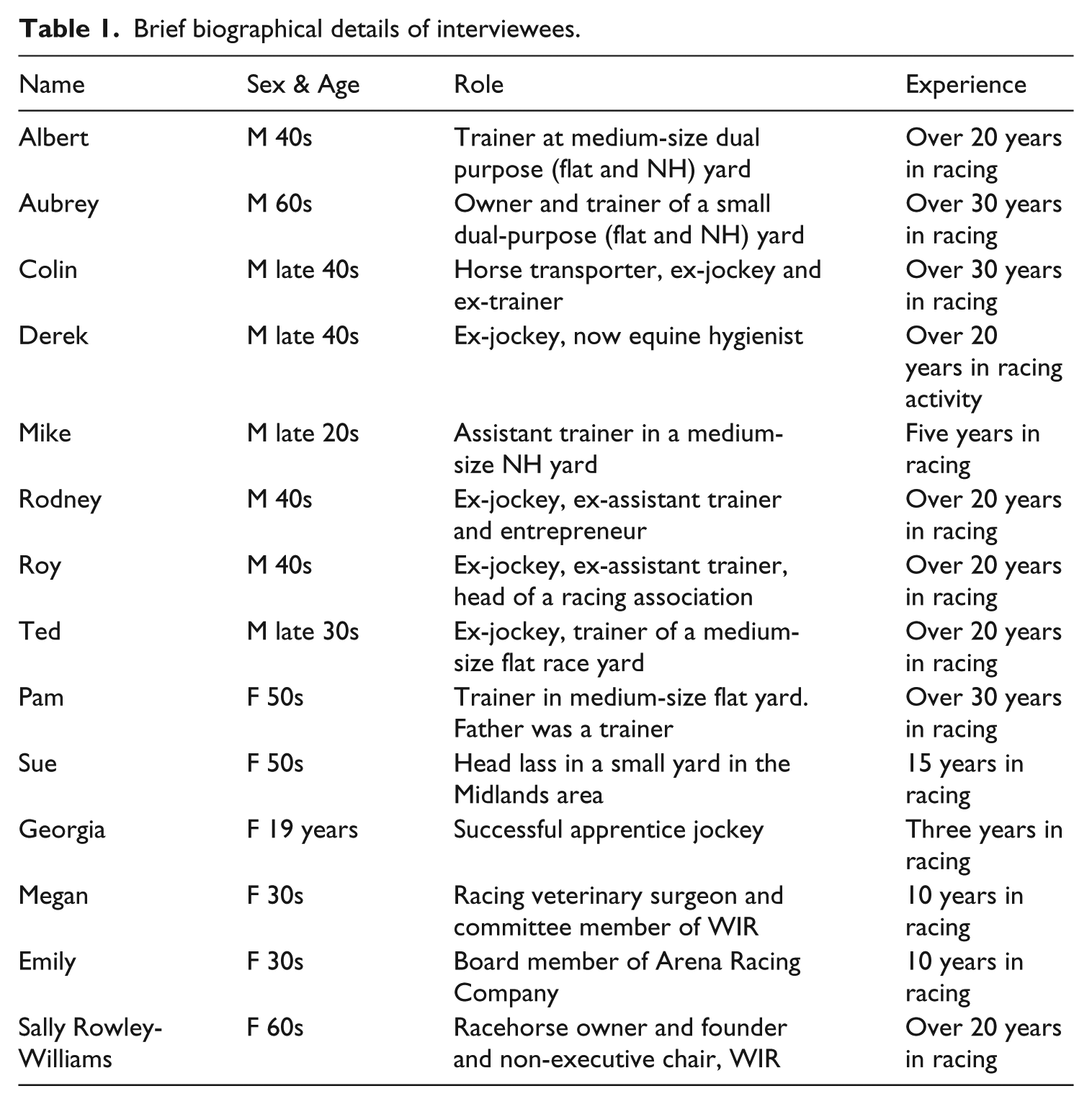
We settled on eight male interviewees and six females. We tried to cover different dimensions and levels of the racing business, but we cannot claim our sample is scientifically representative of the British racing community. All interviewees were white: people with a different British ethnic heritage are almost completely absent from the ranks of trainers and jockeys in the UK, though it has been argued that in Britain, ‘stable staff [are] increasingly Asian or East European because of the problem of finding British youngsters either devoted or light enough’ for such work (Engel, 2011: 13). We used the thematic analysis method of data analysis to interrogate and organise our findings into subthemes and then the core themes which are outlined below (Braun and Clarke, 2006).
Findings
Getting started – ‘it is difficult to get into it’
Despite its recent greater professionalisation, British horseracing – especially NH racing – is still a rather opaque world of largely informal entry via individual initiative, family ties, existing links and influential networks. As Megan put it: ‘If you want to work in racing, contacts are useful.’ The men in our sample had either, themselves, come from a racing background, or else they had very early informal contacts with the culture, connections that exemplified their early ‘passion’ for racing. For our female respondents with ambitions to rise beyond the junior ranks of stable lass, some family or network sponsorship was pretty much indispensable. ‘My father was a trainer; first of all, he was a jockey and then a trainer’, revealed trainer Pam. ‘So I grew up with it really. I worked in the yard from a young child. I rode out when I was ten; it was just expected.’ The men in our sample also broadly recognised that family connections were probably much more important for aspiring women than they were for men (Butler, 2013). Having a trainer in the family, for example, could guarantee a useful ‘leg-up’ and some apprentice rides for female jockeys in an otherwise hostile climate. ‘The family tries to support the children’, argued assistant trainer Mike, of one rising young female rider. ‘One of those children is female and she’s a jockey … I do know she finds it difficult to get rides elsewhere.’ Or: ‘I think it’s hard for them [women] unless they are related to the daughter of, or the wife of, a trainer or something like that’ (Aubrey). For Pam, opportunities for female jockeys who lack ‘connections’ in racing remain deeply problematic: ‘I was lucky that my family have done it [got into racing] and that’s how I came to it. I would say it is difficult to get into it. Female jockeys, for instance, don’t get the opportunity and then they get disillusioned and leave the industry.’
The response of some racehorse owners, even to successful female jockeys, remains quite fixed: ‘I had a ride a few weeks ago’, top apprentice female jockey Georgia told us, ‘and the owners said: “You’re a girl!” and I said “Yeah!” And they kind of went: “Oh, God!” you know [laughing]. But I think, yeah, it does, it does make a difference to them.’ The perception among the women was that it was perfectly possible to access the racing business at the bottom end, but that routes are much less well defined than they are for men for moving up and changing roles in racing. Younger women are well represented among lower stable staff, but their belief, self-confidence and ambition are likely to be ground down by the masculinist culture of the yards in which they work. For Megan, a racing veterinary surgeon: Getting into the industry at the grass root level in the racing yards is fine. What is more difficult is pushing on to do other things at a higher level within the industry. There are a lot of girls who are work riders, who would never consider themselves good enough to be jockeys, even though they can probably ride a horse as well as any bloke their age.
Getting rides as a female jockey can also be problematic because of common-sense assumptions about female numbers, their career commitment and their assumed priorities around family and parenting.
Women moving ‘out of the equation’
These views about female domesticity were widely shared by both men and women in the sample. ‘You can’t be a jockey and pregnant’, pointed out ex-jockey Derek. ‘Females end up getting married, having children and they finish’, according to experienced head lass, Sue. For Mike, the prospects of having children flagged up new risks for women: ‘If you have a baby at 25 or whatever, I think your whole ideas change. And you probably think: “I’ve got to look after a baby now; I’m not sure I want to be riding a racehorse up the gallops at 30mph.”’ This presumed maternal and emotional screen for women as riders could then be rationalised, converted to a numbers game, pure and simple: If a female jockey wants to start a family or something like that, you get people dropping out. Have a family, yes! So, that could, actually, give you a different understanding to the numbers of female to male jockeys. That’s basically what we already have now. That’s common sense. All of a sudden, they [female jockeys] start a family, so they are out of the equation. (Colin, ex-jockey and trainer)
Here, the gendered body is shaped by social processes related to biology which assume that female bodies need special protection so that women can be mothers (Velija and Hughes, 2019: 10). The risk aversion at the heart of horseracing accentuates this predicted shortfall. Our respondents describe it as a ‘natural’ self-perpetuating cycle: the top owners buy the top horses and send them to the top trainers who, in turn, use the top male agents and jockeys. ‘There’s not a great turnaround of these people, I think, if you look at the last 30 years of champion jockey and champion trainer’, says Mike. ‘I imagine there’s only a handful of trainers and a handful of jockeys.’ If they can avoid serious injury, jobbing male jockeys can have extended careers, even into their fifties. The majority obtain a first licence in their late teens or early twenties – some time before most British women are even contemplating starting a family today.
However, the perceived nurturing role of women – a disadvantage for the more competitive higher-end, risky jobs in racing – can also signal their perceived greater devotion, reliability, conscientiousness and job satisfaction, all positives at entry levels into racing stable work (Birke and Brandt, 2009). Trainers are quick to identify gender distinctions among their stable staff: ‘Most young lads want to go into it [racing] to be a jockey. Most young girls want to go into it to look after the horses and go racing’ (Rodney, assistant trainer). Moreover, it was easy for some respondents (including women) to account for the relative absence of females as race riders by pointing to the challenges faced by the many more failing male jockeys: ‘It is hard for female jockeys, but it is hard for the less known male jockeys. There are a lot of jockeys out there and unfortunately some are being pushed more than others’ (Sue). Why younger male jockeys are ‘pushed’ more than talented females is, of course, a moot point. Stable staff in Britain work very long hours for poor pay in an unforgiving and arduous regime, producing a recent crisis in recruitment (Mottershead, 2016). For Sue, female stable staff are valued more because they typically go into ‘more detail’ in a demanding environment: ‘You’ve got to be dedicated, because it could be up to seven days a week. This isn’t a nine-to-five job. If the horse is poorly you’ve got to put your time in with them, sort them out.’ As racehorse trainer Albert put it, at racing’s lower end it is the selfless and self-disciplined qualities of female staff that are crucial to the efficient running of the business: I do believe a good girl is worth their weight in gold. Because they have a delicate touch, they have a cleaner touch. They have a kinder touch. A lot of lads can be … they can ride with aggression […]. They [lads] probably peek around the corner to see if the boss is about. I would find girls would be a little bit more trustworthy. Which as a trainer is important, especially when you aren’t there.
There is some patronising chauvinism in play here, of course. Valuing this kind of dedication and so-called ‘feminine way’ with horses – especially in coupling reliability with care – is fundamental in shaping the gendered character of junior stable staff. For those inside racing, low wages and lack of opportunity for women as riders seems a relatively marginal issue because defining ‘success’ simply by enumerating female jockeys may be ‘missing a trick’. But for women with ambitions to be jockeys the road remains incrementally tough. Successful female apprentice Georgia told a very familiar story: women who want to race ride must work much harder than men for less reward: Obviously, you wanna be, like, as good as one of the lads. And it can be disheartening, because I found I had to work twice as hard and do everything twice as much to get where I want to. Whereas men and lads – probably because I’m a girl, you know – I have to work twice as hard. And I have to be twice as strict to be as good as them. But it is tougher [for females], I think, definitely.
Successful jockeys like Georgia are necessarily obsessives. They may take on hundreds of often doubtful rides a season, and travel tens of thousands of miles for little return, enduring hours of tortured weight loss duty – though perhaps less than men (Butler and Charles, 2012). They also need to match their horse-riding skills with calculated but excessive risk-taking, bravery and a highly developed, and ruthless, competitive edge.
No pain, no gain: gender and danger in horseracing
In this latter context, Derek distinguished between ‘horsemen’ – skilled riders with an intuitive ‘feel’ for horses – and race jockeys – people who can hustle, ‘pick your pocket’ in a race, and take competitive advantage by draining their mount. Real jockeys ‘wouldn’t know how to produce one [horse] to get to the races, but they’d be good on the course’. The elite riders on the flat and in NH combine both traits; they communicate well with horses and push them to the very brink. The implication here is that women can master the former, but typically fail on the latter. Horseracing is also a very dangerous sport: tons of horseflesh moving at 30-plus miles an hour in a frantic, competitive contest, vying for position, is a treacherous conveyance. Even in flat racing the risk of life-changing injury is ever present: 12 jockeys died in racing in Britain and Ireland between 1980 and 2014. British jockeys are lauded in racing for their broken-boned courage and NH riders are especially noted for being careless about their looks: cheeks and teeth are particularly vulnerable to flying hooves. People in racing accept such injuries as an occupational hazard – for male jockeys. Prominent press stories highlighting dental work for young injured female jockeys seldom figure for males (Armytage, 2018). As Colin put it: ‘It’s a hard game, you know, to be a jockey and people know that. I think people are just more adjusted to men falling off, rather than women falling.’ Physical damage from falls is generally perceived to have potentially catastrophic consequences for a woman’s performance of femininity: I think because of the physical nature of the industry, more likely to drop out are females…. That’s just the nature of the industry: it’s physical. A bloke falls off and busts his nose and gets a couple of black eyes, you know, it’s almost a badge of honour…. I think it’s more important to females to maintain their looks in some respect. (Roy)
These ideas and conventions may seem dated in the era of female Ultimate Fighting Championship (UFC) competitors or boxers faced with managing both ‘hard’ and ‘soft’ models of femininity (Mennesson, 2000). But even for those females who reject fragile or passive versions of womanhood, avoiding danger and being sheltered from physical injury because of their ‘feminised’ identities is still considered the norm in racing. A dominant, patrician, sexist trope pertains that women require protection from racing ‘hits’ because they lack body capital, or a macho disregard about personal appearance away from the track (Roberts and MacLean, 2012; Velija and Hughes, 2019). Nor are women riders typically seen as matching men for the necessary physical strength to race hard. ‘I just think men are stronger’ (Pam) and ‘Men, as a whole, are stronger than women’ (Sue). As even top young apprentice jockey Georgia pointed out: I think it’s more natural for the boys, the strength side of things. But I’m not saying that girls are weaker, but I think it comes more naturally to lads. And I think in racing it’s still old fashioned and it’s not very open-minded yet, as it is in other sports. In every other sport it’s segregated, males and females. In racing it’s, you know, we are still together: it’s still that sort of thing. Yeah, I think that’s tricky.
Georgia has managed, to an extent, to come through racing’s gender barriers and so is much more nuanced and careful to avoid sweeping assertions here. When dealing with 500-kg animals of varying temperaments and dispositions it is axiomatic that one must rise to the physical demands this challenge brings. But as Butler (2014) rightly points out, male jockeys might have to starve themselves to the point of ‘feminised’ litheness and physical weakness simply to make the weight for a big race. Insistently recruiting men to make low weights for flat racing, rather than capable females who can make weight limits more comfortably, encourages weakness, unhealthy diets and eating disorders among male jockeys (Von Hippel et al., 2017). Nevertheless, women as a group were deemed simply incapable of stepping up as jockeys in the same way as men: ‘They can’t, it’s not physically [possible]. In any sphere of life women are not physically as strong as a man. It’s a fact: they can’t possibly be as strong as a man riding a horse in a finish’ (Rodney).
Female trainers have more leeway. Being successful as a trainer – in the office as well as out in the field – does less to challenge established gendered ideologies in the sport. Training horses demands more obviously ‘feminine’ attributes, including organisational nous, horse and human empathy, good social skills and astute staff management. However, in 2017 there were only four female trainers among the top 60 British trainers. Strength and resilience are less valued in trainers than patience and skill in wooing prospective owners. ‘Entertaining’ owners – looking after them in racecourse bars and at social events – can mask the pain of a losing streak and cement long-term loyalty with key sponsors. Sociality and discipline are also core facets: ‘Hard work, dedication, meet the right people, have the right horses’, was Ted’s recipe for training success. Men and women could each show the ‘right stuff’ here.
‘The best she can get’: or, ‘it’s a results business, stupid’
The dominant rhetoric inside the British horseracing industry – more than its social aspects or its human–animal bond – is that, ultimately, it is a cut-throat, results-based business. The core requirement for owners, trainers, jockeys and stewards that all horses run ‘on merit’ means there are few opportunities to offer schooling rides in competitive racing. This also means that agency – exercising choice in selecting jockeys – is routinely argued to be subordinate to ‘hard evidence’ and neo-liberal market forces. In a risk-averse business such as this one, so the argument goes, owners and trainers will ‘naturally’ favour riders with established records who are proven to get the best out of a horse in a highly competitive environment. Female stable staff may ride and nurture horses at home, but the track is a different milieu entirely. The claim here is that gender is irrelevant – it is simply that male jockeys dominate the elite lists: I would be looking for the best jockey there is available. Well, again, the sex of them isn’t an issue. I would start with Ruby Walsh and Richard Johnson [top male jockeys]. Now, where do the girls fit in? I wouldn’t say Venetia [Williams] [top trainer] is against female jockeys, because she was one … But she never has a female jockey. It’s not: “Let’s help people along.” She runs a business and she wants the best she can get. (Derek)
Pointing to established female trainers as similarly unsentimental, cold-eyed professional operators who think calmly about outcomes above promoting female riders is also a means, of course, of evading potential accusations of gender closure or overt discrimination by men. Owners may (if given the chance) discover that female jockeys offer better rides for their animals, but it is much more likely that the established gender order will ultimately reconstitute itself in the paddock on race day, even if only by default: Some trainers think they have horses that go better for a woman and will therefore want a female to ride it. But owners and trainers may still – even if it’s a subconscious perception – have an assumption that they will have a male jockey or a male rider, over an overt ‘I don’t want a woman.’ It’s, possibly, just an assumption that their jockey will be a man. (Megan)
The idea that race riders will ‘naturally’ be men is often fused here with neo-evolutionary assumptions that males are intrinsically more competitive and simply more driven to win than females. Male riders are more able to rely, to an extent, on the rigidity of gender conventions, their past performances, and established relationships with owners and trainers to see them through the inevitable lean times (Ray and Grimes, 1993). Even successful female riders experience a much greater sense of heightened precariousness: the game seems inherently stacked against them: Yeah, I’d say so, yeah. I just think it’s a very biased sport. I think, well, if you are in fashion, I think people use you. But if you aren’t riding winners, they don’t really want to know. Because they think she’s not riding winners and [that’s] the reason why we aren’t getting rides. People just need the chances, if you know what I mean […]. If you are a girl and you want to be a jockey, you’ve got to expect it to be tough: it’s not going to be easy, and it’s not going to happen quickly. Lads just think they can walk into it and get their licence and take off straight away. (Georgia)
Georgia knows that even to be considered by British owners and trainers, to have a chance of breaking into the ‘self-perpetuating cycle of inclusion and exclusion’ (Roberts and MacLean, 2012: 331) at UK racetracks, female riders must constantly be ‘in fashion’. They must be seen to be extra-regularly delivering winners to justify the agency shown by owners in opposing conventional gender narratives and defying the status quo. After all, why risk picking a female rider just to be ‘politically correct’ – and then to finish down the field?
Discussion and conclusions: leading around the final bend?
Because we have started from the position that, despite the inequalities involved, both men and women have socially transformative potential as active agents who can either challenge or reproduce gendered domination, our research has involved interviewing both males and females in different roles and at different levels of the British racing configuration. We adopted the phrase ‘regulated liberties’ (Hills, 2006) as the best way, perhaps, of capturing how contemporary elite sporting females produce gender performances in the era of ‘choice feminism’ marked by increasing gender transgression in sport. We found relatively little evidence, however, even in this new general setting for women in sport, that ingrained assumptions and established networks were being effectively challenged in British racing by more fluid and more inclusive approaches, ones that were successfully ‘opening up’ spaces for more progressive gender practices. This is despite the fact that in 2009 the WIR group was set up from inside British horseracing by American ex-banker and racehorse owner Sally Rowley-Williams, precisely to try to shift perceptions and to promote more opportunities for women.
We also found little evidence that men or women in the industry felt able, or were willing, to challenge existing barriers and cultural norms. Assumptions remain widely shared by both genders about the ‘natural’ role of women as mothers and parents and about their socially programmed avoidance of danger and physical injury, especially if it risks impacting appearance. Instead, the established view that younger female pliability and discipline and their ‘innate’ love of horses make them ideal stable staff is conveniently coupled in British racing circles with highly gendered tropes that elite race riders will naturally be men. Such beliefs are clearly extremely resilient, and they were often combined, crucially, with assertions that males are intrinsically more competitive and simply more trusted to win races than women, despite much existing evidence to the contrary. These positions were left largely undisturbed by the fact that, in the full glare of global media on 18 March 2016, ex-Olympic track cycling gold medallist Victoria Pendleton finally won her £250,000 sponsorship wager from the betting company Betfair by completing a gruelling NH race at the elite Cheltenham festival.
Pendleton, in her exaggerated femininity for TV and modelling work, combined with a highly intensive, ‘masculinised’ elite athlete training regime, is widely promoted as a symbol of the new sporting era of celebrity ‘choice feminism’ (Smith, 2012). Of course, the sheer repetition and intensity of objectified and sexualised images of women and their relative absence in other guises points us towards the structural basis for embedded gender bias in sport rather than, simply, to matters of individual choice (Hatton and Trautner, 2013: 74). Our research on the general perceptions and the treatment of young women inside British racing certainly points in this direction. Indeed, Pendleton’s performance and media coverage, ironically, served to highlight just how far working women inside British racing still have to travel. Her race that day was won by a female jockey, Nina Carberry, a fact rendered largely ‘invisible’ (Butler, 2014: 413) by the ex-cyclist’s media profile and celebrity status.
Nevertheless, Pendleton was broadly supported by the women in racing we spoke to, especially for successfully maintaining the binary of a feminised, media-friendly persona, without compromising her tough, ‘masculinised’ sporting identity: ‘Enormously positive for racing and for women in racing’, argued Emily. ‘Because what Victoria does so brilliantly is she does everything with a smile. But she is as hard as nails, we all know that.’ Most of our interviewees argued, too, that Pendleton had at least heightened the profile of women around British racing, if not necessarily changed wider attitudes and the employment prospects of aspirant female jockeys. Indeed, our research shows that the need for positive action here seems especially pressing for ambitious female stable staff and potential race riders.
It was clear from our discussions with Sally Rowley-Williams that she hoped that the call for reform in the WIR report of 2017 might offer a springboard for change in British racing, though this seems improbable. Sponsored by the Jockey Club, the Racing Foundation and various commercial interests, and typically using the smooth, conciliatory language of ‘partnerships’, ‘brands’ and ‘best practice’, the report offers a heavily corporatised and rather incorporated female voice. This was no challenging call to arms. As Rowley-Williams bluntly put it: ‘I’m not here to burn bras or knock down the doors. I’m here to say racing could improve with more gender diversity at the decision-making levels.’ The report’s call for more diversity monitoring and for industry-wide – but voluntary and unspecified – diversity targets is welcome, but it is unlikely, in our view, to challenge or subvert anytime soon the existing gender order in British racing.
The report’s highlighting of: bullying and sexist banter in stable yards; a lack of effective female role models in senior positions; claims of sex and age discrimination in relation to jobs and promotions; and the existence of a cabal of ageing, senior men adept at resisting change is convincing but it rather confirms the view that the sort of consensual gradualism favoured by WIR may not be the most effective route to take here. Instead, for women to be able to ‘take off’ in British horseracing a much more radical and transformative agenda is required inside the sporting arena itself – in the stables, out on the racetrack and in the paddock – as much as it is needed in the stewards’ areas, the boardrooms and corporate boxes. In short, talented young horsewomen working in British racing urgently need a more even racetrack.
Footnotes
Acknowledgements
We would like to thank our diligent reviewers for their very constructive and helpful comments, which have much improved this paper.
Declaration of Conflicting Interests
The author(s) declared no potential conflicts of interest with respect to the research, authorship and/or publication of this article.
Funding
The author(s) received no financial support for the research, authorship and/or publication of this article.