




Abstract
Despite the recent rise of female Australian rules football in the public eye, little research has explored the nuances of players’ experiences of gendered embodiment, performance, identity, desire and engagement in the sport. The aim of this article is to explore how spaces have the capacity to create, normalise and regulate gender, bodies, identity and desire through an analysis of a women’s Australian rules football team, a space that is neither dominated by heteronormativity and neither queer nor lesbian subcultures. Through analysis of photographs and photo-elicitation interviews, this paper seeks to explore how bodies, gender, desire and embodiment are experienced, perceived and contested by and through the lens of players, within this sportscape. The implications of this research are an insight into the fluid and complex dynamics of a particular sportscape and the capacity of such spaces to redefine belonging and normativity outside of dominant hetero-gendered discourses.
Keywords
Introduction
Australian rules football is one of the most popular forms of sports entertainment (Australian Bureau of Statistics, 2012) in Australia and has become a cultural icon. Kelly and Hickey (2006) describe the Australian Football League (AFL), the national professional (male) football competition, as ‘the premier sports entertainment industry in Australia’ (Kelly and Hickey, 2006: n.p.). Indeed, it is difficult to avoid the sport in the southern states of Australia, with professional (male) Australian rules football games televised free-to-air; print, radio and television news regularly featuring Australian rules related headlines; a multitude of television shows about the professional version of the game and past players becoming media icons on television and popular radio stations. The experience for female players is quite different, with Australian rules football 1 typically enshrined in Australian lingo as male Australian rules football. As a full contact sport, described as ‘one of the most physically demanding codes of football that is played anywhere in the world’ (Kelly and Hickey, 2006: n.p.), it has been slower to gain social and cultural acceptability for female participation, although women have been playing at local levels in structured competitions since 1981 in the state of Victoria, and the earliest recorded female game was in 1917 (Lenkić and Hess, 2016). In 2016, the AFL decided to launch an inaugural national-level women’s Australian rules football competition – the Australian Football League Women’s (AFLW) – with season one taking place in 2017. As such the profile of women’s Australian rules football and the idea of female football players has risen, albeit on the peripheries of the men’s game and with a range of structural challenges, including semi-professional status, poor remuneration (Ryan and Navaratnam, 2016) and the imposition of top-down rule changes based on ‘watchability’. With publicity around the rise of the national professional women’s game and with some media coverage of the games themselves, female players are increasingly becoming legitimised as athletes and as footballers in the Australian imagination. Such visibility and representations of female footballers at the professional level has increasingly legitimised female participation at a community level, and the effect of this has been a ballooning of growth. Participation by women and girls in Australian rules has doubled and female participation from Auskick to professional levels now constitutes 25% of all Australians playing Australian rules (AFL, 2016). Such growth has been characterised by AFL CEO Gillon McLachlan as ‘a revolution’ (AFL, 2016).
At the professional level, female players display a diverse range of gendered performances and embodiments. Whilst the game demands an intense physicality typically associated with masculinity, players perform and embody gender in diverse ways. For example, some players wear long ponytails, bows in their hair and makeup, while others have short hair more typically associated with traditional men’s cuts and sleeves of tattoos down arms and on legs. This paper seeks to explore the intersections of gender, embodiment, performativity and desire within this sport, engaging with the ways in which the microcosm of one team – the sportscape – might redefine and shape what constitutes dominant gendered discourses within this space, demonstrating the capacity for sex, gender and desire to be more fluid than the heteronormative discourse gives rise to.
Gender and sexuality in codes of female football
Traditionally, the footballing body has been produced and reproduced as a male body and, increasingly, with the rise of AFLW, a female footballing body continues to be represented first and foremost as a legitimately feminine footballing body by, for example, the shaping of uniforms ‘for women’s bodies’ and the representation of leadership players as consistently displaying a significant degree of traditional heteronormative embodied femininity, at least off the field (see e.g. Huntsdale, 2017). As Butler’s work on performativity suggests, such repetition of acts produces norms. Since the Victoria Women’s Football League was established in 1981, women and girls have continued to play in limited numbers and at only a fraction of the participation rate of men and boys and, as such, football has remained a domain of men and boys, differentiated by gender only when women are playing (Woodward, 2009). The reiteration of men playing football in the current media and through history means that men playing football has produced the norm of a football body as a male football body. Bodies in sport are conceptualised in varied ways in sociology of sport research, with some bodies’ physical presence and abilities in sport underrepresented in this literature, including the diversity of footballing bodies. Footballing bodies tend to be represented as muscular, ultra-toned, well-oiled machines, at times with a propensity for injury, but for the most part professional athletic male Caucasian bodies. It is not these footballing bodies that I suggest are underrepresented in the literature, popular media and football iconography, but bodies that are positioned as at odds with such representations, including ethnically diverse bodies and female footballing bodies. In academic studies exploring women’s football participation, the bodies of participants as footballing bodies tend to be represented as female bodies rather than footballing bodies. The significance then of exploring women’s athletic bodies, engaged in full contact sports such as football, is important for engaging with bodies and gender as fluid and diverse rather than fixed, and this has been discussed by Caudwell (2007: 184): ‘women and/in football is emerging as a fertile popular cultural practice for feminist analysis of gender and its intersectionality with sexuality and ethnicity’.
For women, sport has traditionally been ‘a vexed sphere…It has historically been the site of public anxiety about women’s gender and sexuality, and their development of unfeminine muscular bodies’ (Baird, 2004: 79). West and Zimmerman (1987: 134) note that ‘Women can be seen as unfeminine, but that does not make them “unfemale”’, while Wittig (1992: 12) asserts that ‘To refuse to be a woman, however, does not mean that one has to become a man’. These avowals ask that we dissociate with the exclusivity of heteronormativity 2 and, as Kaelin Alexander (The Good Men Project, 2011: n.p., emphasis in original) notes in work on masculinities, asks us to ‘tell more stories, about more kinds of people, who give us more ways to think about masculinity’. Women’s football is a prime example of engaging in what has been traditionally defined as an exclusively male and masculine pursuit, described as ‘one of the last bastions of men’s traditional power and privilege’ (Messner et al., 2006: 38). Women have thus been dissuaded from playing, not through a biological inability to play the game, but through the perceived normalising of the game as masculine and therefore male, with codes of women’s football across the globe reflecting this challenge. For example, soccer in the UK (Caudwell, 1999, 2003, 2006, 2007, 2011a, 2011b; Harris, 2005, 2007), New Zealand (Cox and Thompson, 2000) and Austria (Marschik, 2003); rugby in the UK (Gill, 2007), USA (Broad, 2001; Chase, 2006) and New Zealand (Chu et al., 2003); Australian rules football in Australia (Hillier, 2005; Wedgwood, 2004, 2005); and gridiron football in the USA (Migliaccio and Berg, 2007).
Queer theoretical analyses have gone some way to engaging with the tensions of women’s participation in sport and the intersections of sex, gender and desire (Broad, 2001; Caudwell, 2006, 2007, 2011a, 2011b; Eng, 2006), with a raft of research on women’s participation in codes of football globally (Chase, 2006; Chu et al., 2003; Harris, 2005, 2007; Skille, 2008) and gender, embodiment and performativity (Azzarito, 2010; Carlson, 2011; Ezzell, 2009; Finley, 2010; Gard, 2008; Gill, 2007; Hauge and Haavind, 2011; Mean and Kassing, 2008; Schippers, 2007). Women’s growing participation in codes of football is symbolic of shifting and fluctuating gender dynamics in contemporary Australian culture, with Carlson (2011) suggesting that women athletes transfer across varied terrains without essentially committing to any one in particular. That is, a woman playing football does not need to subscribe only to the gender embodiment of herself as ‘footballer’, but while women may ‘gladly engage in masculine-marked practices in the contexts of sport[…]they may also engage in feminine practices outside of sports’ (Carlson, 2011: 83). Women may also engage in masculine practices within sports, as well as outside of sports, while also engaging in feminine practices within leisure space. This article draws attention to the ways in which bodies, gender and desire are experienced, normalised and othered, shaping the boundaries and regulations of what constitutes, in this sportscape, ‘acceptable’ gendered embodiment, performance and desires.
Methods
Visual images are ubiquitous which, inevitably, is part of their appeal and their difficulty. (Bloustien, 2003: 1)
Visual images are embedded in our everyday lives. Indeed, Weber (2008: 41) suggests that ‘We are born into a world of visual images projected onto our retinas, clamouring for the attention of our perceptual processes’. I draw on the significance of visuality in this research to explore women’s Australian rules football. While a number of studies have been conducted that explore various codes of women’s football, none draw on visual methods and I suggest that, given the ubiquitous nature of visuality, visual methods offer insight into women’s football that non-visual methods alone cannot. Consequently, this research project drew on multiple methods – participant-generated photographs, researcher-generated photographs, a group interview and individual interviews. By combining visual methodology with other qualitative research methods my aim was to develop a nuanced insight into the cultural space of women’s Australian rules football that research engaging qualitative methods alone seems to overlook. Gerry Bloustien (2003: 6), exploring qualitative methods that encompass visual methods in ethnographic research, suggests that ‘to understand and analyse differences within the cultures we investigate requires new methodologies, new ways of expressing the insights to be discovered there’. Complementing language with visual imagery as methods of data collection was potentially a means of accessing a broader insight into the particular field of study. Knowles and Sweetman (2004, cited in Rose, 2007: 238) suggest that visual methods are valuable not for what they are but for the analytical and conceptual possibilities that they can achieve. While images in isolation may offer information and insight, that knowledge can be developed through exploring what those images mean and represent for the person who created the image. Following the photo-interview process, the images and interview text form data for analysis and interpretation (Kolb, 2008). Bettina Kolb (2008: para. 18) draws on visual methodologies to conduct cross-cultural studies and suggests that ‘the photo interview is an important moment of interpretation and understanding, when the respondent explains and makes explicit his or her intention in capturing the image and recounts a first interpretation of it’. Indeed, Clark-Ibanez (2004: 1512) notes that ‘there is nothing inherently interesting about photographs; instead, photographs act as a medium of communication between researcher and participant’. It is this communication that forms the photo-interview process and it is the combination of the interview and visual data that provides the richness for this study.
The five phases of data collection
The first phase of the research asked each participant to take their own photographs as part of what I describe as ‘photo projects’, guided by the following four broad themes, with participants asked to take or create 5 to 10 images for each photo project.
What does women’s football mean to you?
What does a female football player look like?
Take self-portraits in your football uniform, in a typical training outfit, everyday ‘civilian’ clothing, and in a typical work outfit.
Take 5 to 10 photographs of what you believe women’s football looks like.
The second phase of the research project involved the researcher taking photos of ‘the empty football space’. These were the only photos that the researcher took for the project and the images were significant in encouraging participants to reflect during the group interview on the physical space within which football is situated. The photos were taken in the empty football space on a Monday morning with the clubrooms still carrying the marks of the previous day’s game. The women’s team had been the last to use this space and thus the aftermath, the mud and grass in the change rooms (the Australian equivalent of a locker room), the alcohol bottles littering the social rooms and the dishevelled waste left around the club were the women’s by-products of the previous day’s game.
The third phase of creating images for the research involved participants undertaking a ‘staged’ training session. This was an opportunity for them to create images ‘in action’ and interaction. Because only a selection of players from the team volunteered to take part in the research, there were limitations around taking images during actual training sessions or games. Instead, a staged training session was organised, and participants got together and had the opportunity to pose for and create images of the way that they wished to portray women’s Australian rules football. This was participant driven and significant in creating images of participants in action and interaction with the scope to create images that might be useful in exploring issues of embodiment, physicality and homosociality. These images were then reflected on through the group interview.
Phase four of the research was a group interview during which participants discussed the images taken during phases two and three – the empty football space images and the staged training session images. This was an opportunity to draw meaning from and through the photographs and encourage participants to engage with one another on the various meanings and significance of images. The final phase of visual methods involved photo-elicitation interviews with each participant, discussing the photos players had created through their photo projects. For each interview the researcher collated each photo project into separate documents and noted what the participant had written on the photo project sheet provided to them.
Driven by creating opportunities for player voice and perspectives both orally and visually, these methods produced a wide range of data. Shaped by the original research questions seeking to explore the significance, experiences and perspectives of women playing football, alongside the tensions and complexities of bodies, gender, desire and sociality, the data analysis process was avowedly subjective. Deliberate attention was paid to themes of gendered embodiment, physicality, sociality, space and sexual identity categories as they emerged in the images and throughout the interview data.
The team and the data
The data drawn on in this paper come from a broader research project conducted with the Australian rules football team in which I was playing and had been a member of for several years, though I held no leadership roles or positions of power. As player researcher, I had a unique opportunity to undertake this research with team mates, having insight into the values of the team, social dynamics, the broader club context and the community within which the club resided. Although there were ethical concerns in undertaking research with the team that I played for, including power imbalances or the risk of coercion, in this instance the benefits of conducting research with the team I was connected to were greater than the potential risks.
All players within the team were invited to take part and eight players volunteered for the study, aged from 20 to 35 years old, with a playing history of 2 to 17 years. Seven players were Anglo-Celtic Australians, and one was an Indigenous Australian player. In the remainder of this paper, I focus on the data that emerged from these images and conversations, as they relate to (a) gender, bodies and tensions and (b) desire and gender identity within this sportscape.
The sportscape: A microcosm of gender dynamics
For Pronger (2004), the social and cultural landscape offers the context and possibilities for sporting experiences. Drawing on John Bale’s work, Pronger (2004) suggests that a sportscape may encompass all spaces in which sporting pursuits take place, for example parks, fields, courts, gyms, locker rooms or swimming pools (Pronger, 2004). Derived from the term landscape, ‘sportscape’ denotes a background, the spatial context for the sporting activity taking place (Pronger, 2004). The sportscape that the women in this study describe is largely centred on the team’s home ground, a space that includes the football oval, the clubrooms and the change rooms. These physical places generate powerful affective experiences for some participants. For example, of the following image (Figure 1), Crack says, ‘As soon as I walk through those doors at the start of a game or, you know, I walk through here at ten o’clock in the morning it’s go time. Nothing else matters but football at that time’ (Crack).
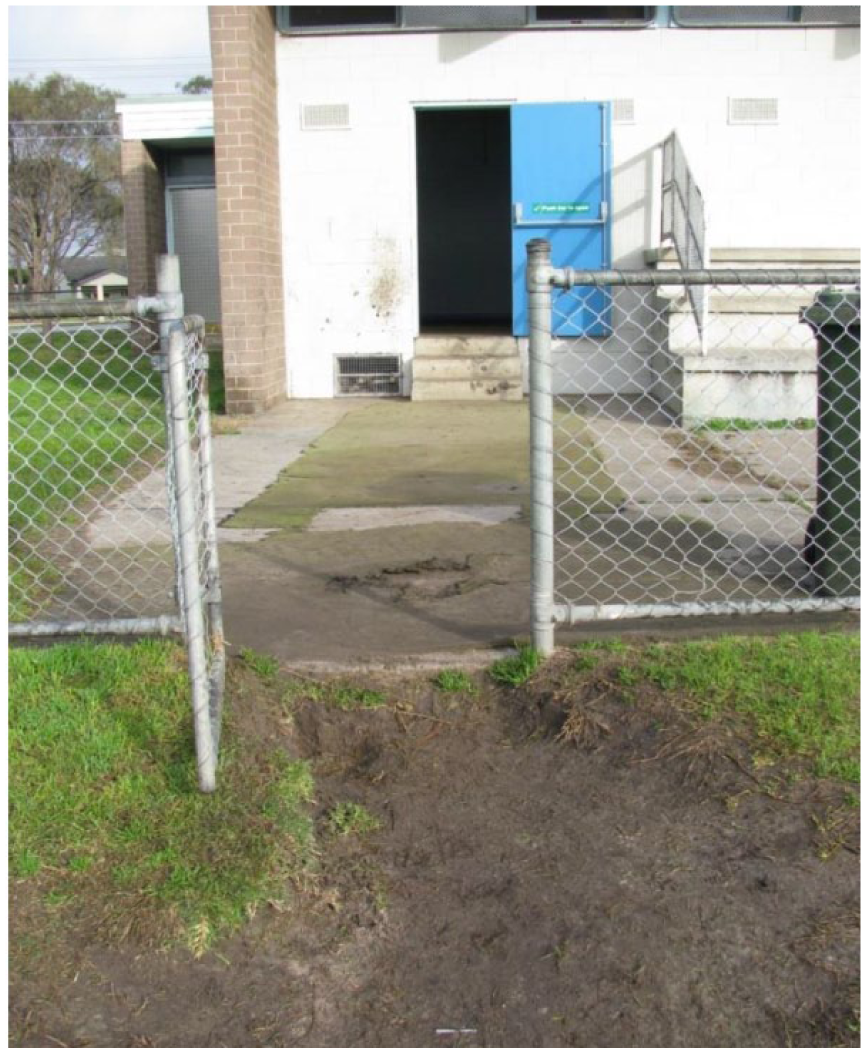
Untitled, empty football space sequence. (Copyright Sanders).
These doors reflect not only the physical football space but the entrance to a social and cultural space. Pronger (2004: 148) notes that the use of ‘place’ translates a physical locale into ‘space’, ‘a productive opening for actual living, becoming, desiring’. The notion of the sportscape encompasses more than just visuality and stretches to encompass all of the senses, for example the sounds and smells of the sportscapes (Pronger, 2004), and this was evidenced in this research, with one player noting of an image, ‘If I had of seen those images unrelated to football I would have thought about football…it comes with a smell, a feeling…even the night air has a smell…it’s a bit wet and there’s a noise’ (Bumpy). Our senses are not passive recipients of the sportscape but, rather, active in appreciation of what is sensed (Pronger, 2004). What takes place in the social and cultural landscape of this football club brings the space to life and creates meaning and affective experiences; it is the ways in which people utilise and conceptualise the space that give it life, and it is through this life-giving that the sportscape emerges.
Jones and McCarthy (2010) explore the sportscape that gay men’s football teams create for participants. Situated in the UK, the study highlights notable differences between players in a gay male team and a heterosexual-dominated male team. Jones and McCarthy describe the gay men’s football team in their research as eschewing the aggression that is often associated with competition. Instead participation is focused on a different set of values: inclusion, community, safety and enjoyment (Jones and McCarthy, 2010). The values that Jones and McCarthy describe for one particular team means that the conceptual space that the team has created has peculiarities other teams may or may not share. For example, one player describes the team as akin to an extended family, going out and just spending time together. This may or may not be experienced within all gay men’s football teams but for this particular team is an effect that has been carved out. For the gay men in their study, Jones and McCarthy assert that the football team is a safe space away from the risk of rejection and homophobia. Hillier (2005) similarly suggests that for the women in her study their football team offered a safe space away from heteronormativity, where same-sex desires were accepted as a norm rather than dismissed or derided as inferior to opposite-sex desire. While I do not mean to affiliate the football team in this research as an exclusively lesbian space, nor necessarily a ‘safe space’ for same-sex desire, I do suggest that the space diverges from the dominance of heteronormativity. For example, one of the research participants, Stella, draws attention to the implications and extension of thinking beyond the physical space of the sportscape and to the ways that it extends to the experiences of social spaces: once you walk off [the field] and you’re in the clubrooms and you’re, you’re talking to everyone, you’re still in that moment and you’re still in with your mates and you’re still part of that group that has just been out there playing football, I think that it’s sort of goes back to normality once you drive out of there and go home. (Stella)
Such an experience within the sportscape draws on what Fusco (2005: 285) refers to as ‘a return to spatial theorizing’, signalling that space matters, and asserting that sports spaces have a tendency to be replete with discourses of gender, race, class, sexuality and nationhood. For Stella, this sportscape generates an affective experience that transfers from the playing field through to the clubrooms and shared physical spaces and social interactions of the football team. Such conceptions draw on ideas of Lefebvre who, Fusco (2004) asserts, critiques the neglect of what space is by introducing the concept of ‘social space’. The social space, as described by Stella in this excerpt, reflects the experiences of engagement and interaction within space and is extended on in Lefebrve’s oeuvre, whose work positions space not as ‘simply “there”, a neutral container waiting to be filled’ (Lefebvre, 1991: 24, cited in Marfell, 2017: 4), but rather as ‘a social product[…]a dynamic, humanly constructed means of control, and hence of domination, of power’ (Lefebvre, 1991: 24, cited in Marfell, 2017: 4). In the modern era, suggests Lefebvre (cited in Fusco, 2004), the complexities of space have been condensed to abstraction, manipulated and homogenised for the imposition of power. Indeed, theorists of human geography and space, since Lefebvre, reflect on the ways in which space is socially produced and innately connected to sustain and reproduce power and the production of certain subjectivities (Fusco, 2004). Marfell (2017: 3), for example, also drawing on the spatial theorising of Lefebvre, asks ‘in what ways are dominant relations of femininity and heteronormativity (re)produced within and across the social space of netball in New Zealand?’ Fusco (2004: n.p.). discusses the subjectivities that are (re)produced in locker rooms, ‘in, and through, a/the process of abjection which in turn ushers in the (re)production of respectable, normative and proper citizen-subjects’. Such a lens of the re/production of power, applied to either the particularities of this netball sportscape or this locker room, emphasises the knowledge that social, cultural, historical and political legacies play a role in the construction of sportscapes, with implications for what is normalised and rendered acceptable, and that which is perceived as abject. The remaining sections of this paper explore the ways in which players in this team experience and regulate gender performativity and embodiment within this sportscape.
Gender in the sportscape
it is not a question of blinding oneself to how a person appears, but a question instead of how the way in which a person appears blinds one to the worth and capability of the person. (Butler, 2000: 63, emphasis in original)
Judith Butler’s statement succinctly comments on society’s tendency to take the appearance of a subject at face value while dismissing the potential competence of that subject to act in physical, intellectual and creative ways. It is through this disregard of potential competence that the footballing bodies in this research are seen first as women’s bodies and then as ‘women who play football’. Gender manoeuvring, a concept that Finley (2010) draws from Schippers (2007), is described as ‘a collective effort to negotiate actively the meaning and rules of gender to redefine the hegemonic relationship between masculinity and femininity in the normative structure of a specific context’ (Finley, 2010: 362). The significance of gender manoeuvring is that participants in Finley’s research shift familiar meanings of gender, challenge traditional rules of interaction and alter positions so that links between gender relations might be transformed within that context (Finley, 2010). Essentially, gender manoeuvring ‘challenge[s] localized gender relations and produce[s] “alternative” gender relations’ (Finley, 2010: 362). For example, Mac in figure 2 demonstrates an emphatic display of strength, force and immense size that a heteronormative discourse would associate with masculinity and male embodiment. Femininity is associated with ‘female embodiedness’ – being small, delicate, fragile and passive (Gill, 2007) – and Mac’s display of strength and size contrasts with this. Although these characteristics may not be celebrated in other spheres, they are valued in women’s football because when appropriated onto the football field Mac draws on her strength and size to hold her ground and get the ball out to a team mate rather than be tackled and lose the ball. Thus, Mac’s gender manoeuvring as appropriated to the space of football means that her strength, size and aggression become valuable commodities. Women on the football field however require resolute strength and aggression in order to play football at a high level. In this social and cultural milieu, physical size and stature are translated into valuable attributes for bodies that play football, regardless of the sex of the footballing body.
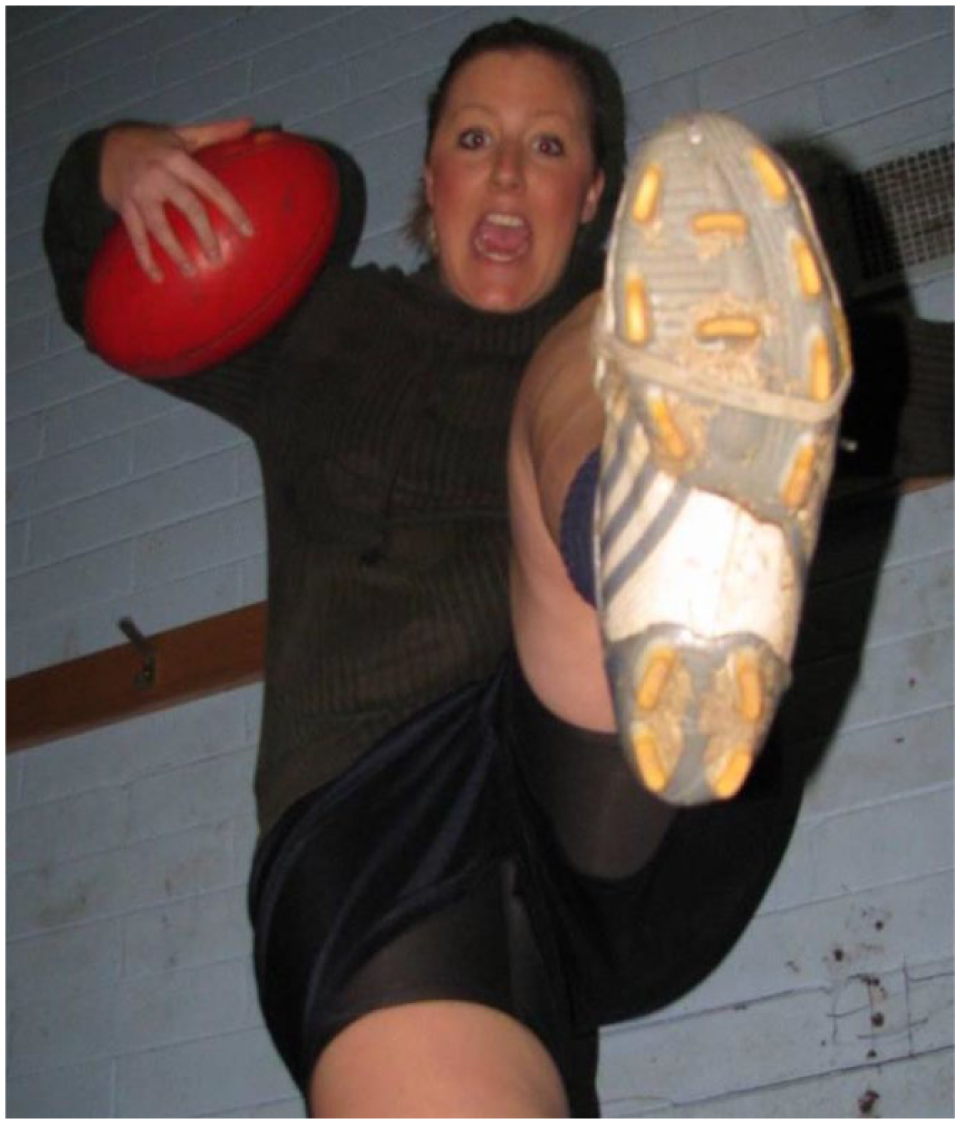
Untitled, staged training session. (Copyright Sanders).
The different ways that players embodied masculinities and femininities in this sportscape were demonstrated through the images participants created and players’ reflections on these images. For example, the following image (Figure 3) depicts Stella stretching with a player sitting on a bench in the background showing a gender-neutral, yet practical style of clothing that players typically wear to train in. The way that the player in the background is sitting is, as described in the group interview, ‘like boys sit typically with their legs open ’cause their balls are going to get squashed’ (Bumpy). This points to players’ recognition of their own performances of masculinity in the sportscape, and the creation of images enabled these reflections: ‘I’ve never thought about what we do looking like boys’ (Bumpy). It was only when presented with this photograph that such a conversation around gender and performance emerged amongst these players.
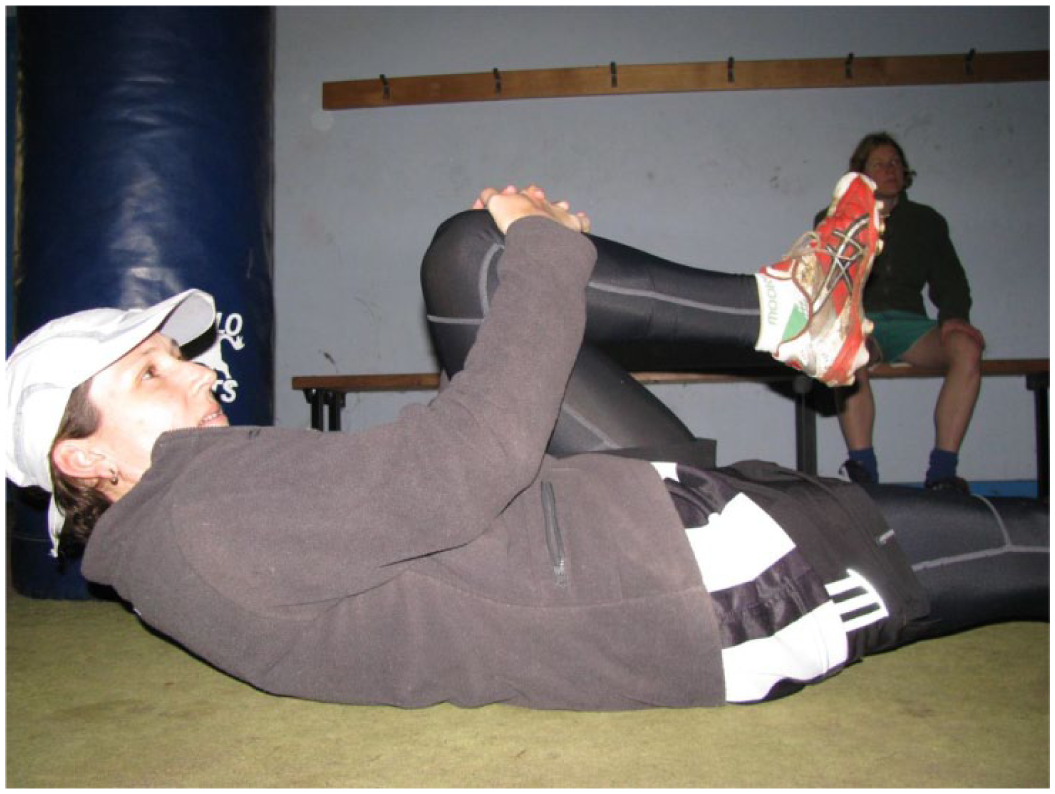
Untitled, staged training session. (Copyright Sanders).
Desire, gender identity and tensions in the sportscape
For the participants in this study the sportscape of this women’s football team was a site in which contestations of gender, sexuality, embodiment and power were played out. Participants who engaged in this research were aware of the lesbian stereotype surrounding women’s Australian rules football and that, in the wider culture, this stereotype was sometimes constructed negatively. Such stereotypes and tensions around gender, where women who perform, embody or identify with masculinity are presumed lesbian, are echoed colloquially through such sports as rugby, soccer, boxing and gridiron, and in some instances this is reflected in academic research (see e.g. Caudwell, 1999, 2003, 2012; Harris, 2005, 2007; Roy and Caudwell, 2014). Yet what emerged as empowering for these players was that, within the sportscape, while subjects’ sexual desires may not have been overtly conspicuous, they were neither silenced nor rendered invisible. For example, one of the players reflects that: [W]hen you say you play women’s football and they don’t know anything about it, they will immediately make an assumption um, that [it] is majority lesbians…I think our team is about 50–50. (Bumpy)
Amongst the team, there were players who identified as lesbian, players who were couples and players who identified as bisexual and heterosexual, including heterosexually married players. Acknowledging that the team is composed of women who do not exclusively identify with lesbian nor heterosexual subjectivities highlights the necessity of undertaking a more nuanced exploration of the intersections of genders, sexualities, embodiments, spaces and power within this social space. For instance, Bumpy reflects: ‘[I] don’t fit into the gay world, don’t fit into the straight world…but when you’re playing footy, I feel like I belong a million percent’. The sportscape of this football team enables Bumpy to feel at ease, providing a sense of belonging that she does not experience elsewhere. For other players such as Stella, playing football has meant that you have this community of friends and you can be completely who you want to be. You can sit on the couch with your partner and hold their hand, or you know you can, whereas I certainly wouldn’t be doing that at work or with my straight friends. (Stella)
The power of the sportscape here is significant for Stella, who says that although she finds a sense of belonging within this sportscape, she remains beholden to the legacy of the heteronormative fear of female masculinity and the negative connotations of the butch lesbian dyke association with women’s football participation: it’s probably affected me in not telling everyone that I play it because the job that I’m in is a male-dominated career as well so there’s a lot of old dinosaurs there that have opinions and things about women even being in the police force and then if you’re in the police force if you don’t show up for the boys too you’re a dirty dyke sort of thing…I choose who I tell that I play football with because I just can’t be bothered with the shit. (Stella)
Stella’s counter experiences within and outside this sportscape are testament to its significance for those directly engaged within it, what is normalised within it and how it is distinct from the homophobic and heteronormative space of her employment. The bounding of this sportscape acknowledges what takes place within it; the ways in which players embody and perform gender and desire and experience their bodies do not necessarily reflect the ways in which players experience their gendered, sexual and embodied selves in social and cultural spaces beyond this sportscape. Roy and Caudwell (2014), exploring the context and experiences of the women surfers predominantly identifying as lesbian in the UK, provide a useful elaboration on the ways in which space is sexualised. In this study, the authors note that, whilst the town in their research space is not predetermined by sexuality, heteronormativity is ‘widely used as shorthand for the numerous ways in which heterosexual privilege is woven into the fabric of social life, pervasively and insidiously ordering everyday existence’ (Jackson, 2006: 108, cited in Roy and Caudwell, 2014: 236) and tends to dominate the context within which their study was undertaken. In contrast, spaces that are specifically demarcated as gay, lesbian or queer and act as specifically safe spaces for queer and same-sex attracted people, such as bars, clubs, special events, sporting teams or the Gay Games, are deliberate attempts to counter the perversity of heteronormativity. For Roy and Caudwell’s research, the female, lesbian surfers did not have exclusively lesbian or queer spaces in which to meet. However, as the authors note, ‘For this group of women, rather than places being available for lesbians, spaces are created by lesbians and at times through lesbian bodies (kissing, holding hands)’ (Roy and Caudwell, 2014: 241). For these lesbian women who surf, the space they have created is ‘mobile, transient and nomadic…instances where heteronormative surfing spaces might momentarily, transiently become re-configured as different spaces, potentially queer spaces. These moments of rhizomatic rupture might only be subtle ones, but they are visible’ (Roy and Caudwell, 2014: 241). Drawing on this idea of the ways in which sportscapes are mobile, transient, generative and participant driven, this sportscape is significant for Stella, for example, for the way in which it does not force her to silence her (same-sex) relationship, whilst, for Bumpy, it is significant for the way it does not exclusively represent a queer subculture. Such a sportscape, then, might be valued for its generative capacity, for the ways in which it ruptures ‘the dominant’ (Roy and Caudwell, 2014: 242) and offers a challenge to the dominance of heteronormativity.
Although traditional gendered power dynamics such as heteronormativity were not manifest amongst this team, power dynamics remained significant within this sportscape. For example, despite the acknowledgment of women taking up and embracing physicality and masculinity, boundaries of gender performance within this football subculture remain. For example, one of the players on the team embodies masculinity to the extent that others have mistaken her for a male and, due to her height (she is quite short), more specifically a boy. This degree of masculine embodiment was stringently denigrated by some team mates, who referred to her as ‘Uncle’. This term was evidently used disparagingly, because players would only refer to ‘Uncle’ when the player was absent. The subjugation of this player can be seen as a way of disapproving of the ways in which she embodied and performed her gender and is an example of the ways in which gender was regulated within this sportscape. This clearly represents a fine line in what constituted an acceptable embodiment of and for footballing bodies in this sportscape, where both overt masculinity and femininity were called into question. The contestation, negotiation and regulation of gender was also evident in Mac’s assertion that I think cricket’s a little bit more [um] that real dykey, lesbian looking than what football is. Football, yeah, we go and hit people, not like punch on with them, we hit them hard and we, we tackle them and people see that as being butch but I find cricketers are more, more sort of dykey – I don’t want to sound wrong but, I just, I find them to be more of the male-looking females. (Mac)
Mac’s identification of ‘lesbian’ is interspersed with the synonyms ‘dyke’ and ‘butch’, drawing on the terms interchangeably. Mac’s strong disassociation with what she describes as certain ‘kinds’ of lesbian provides perhaps the most telling insight into the ways in which gender, sexualities, embodiment and power are interwoven. The passionate repudiation of the ‘real dykey, lesbian’ proffers a powerful sense of othering, where her own bisexual desires are positioned as distinct from other lesbian subjectivities, in particular those ‘more male-looking females’ (Mac). Mac’s repudiation of masculine, ‘butch’, ‘dykey’-looking ‘lesbians’, I suggest, is not related to subjects’ same-sex desire, but to their embodiment of ‘woman’. The disavowal of female masculinity (Halberstam, 1998) that Mac refers to is not concerned with sporting bodies, as seen by the distinction she makes between football players and cricket players. Rather, this renunciation of ‘dykey’ and ‘butch’ is preserved for women whose appearances do not subscribe to her perception of acceptable feminine embodiment and presentation. Such a repudiation was not reflective, however, of the way in which same-sex desire was experienced within this sportscape, positioned as distinct from gendered embodiment.
Such an example was further experienced by Crack who, as a heterosexual-identifying woman, experiences the lesbian stigma as problematic and has become conscious that how she dresses embodies her gender impact whether she is read as ‘a lesbian’ or ‘straight’ subject. The following image (Figure 4) shows Crack in what she describes as a casual outfit that she might wear at home. Of the image Crack says, ‘When I was wearing this shirt I was told I looked like a dyke. I’ve never worn it since’ (Crack). It is unclear whether Crack is defensive of the term dyke because of its association with same-sex desire or because for Crack the term ‘dyke’ is what she describes as a ‘dirty word’. Regardless, as a result of this incident Crack carefully polices her choice of clothing to ensure that she is not read as ‘dykey’. Subscribing to heterosexuality, Crack experiences the subculture of this women’s football team in a way that is not only about participating in sport but is tied up with sociality, sexuality and self-identity, negotiating her heterosexual desires amongst a milieu in which her football participation catapults her into a stereotype of homosexual subjectivity. As a result, Crack finds herself negotiating her heterosexual identity in a way that is not typically required of heterosexual-desiring subjects. For Crack, gender is contextual, and she finds that she must balance her performance and embodiment of gender through her clothing and the ways in which she styles herself. In a broader culture in which heteronormativity is the hegemonic, idealised model of sexuality, Crack finds herself in a social space in which she must justify her desires, her embodiment of gender and her engagement with and in a women’s football team.
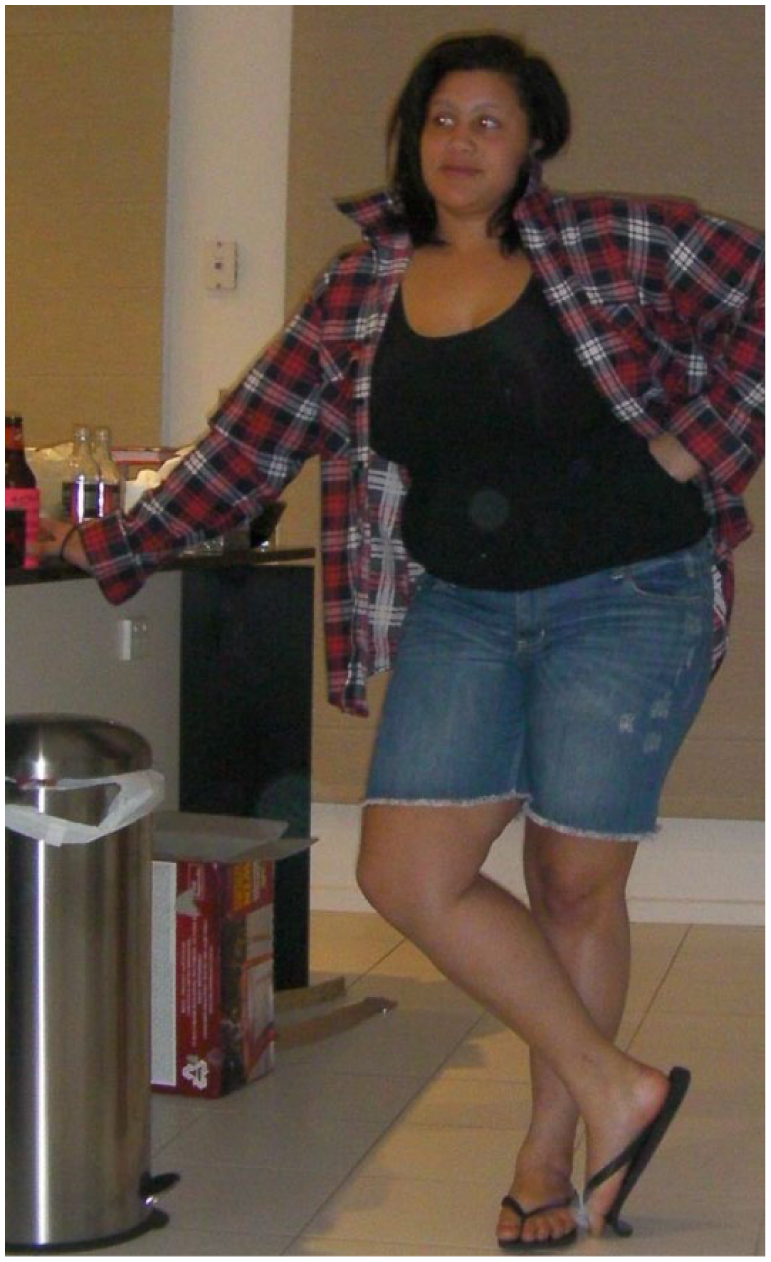
‘Casual’ by Crack. (Copyright Sanders).
Representations of footballing bodies, of gendered footballing bodies, ‘the lesbian’ and ‘the real dykey-looking’ body discussed here begin to offer insight into the complex intersections of the ways in which genders, sexualities, embodiment and power are manifest in this sportscape. Within this sportscape, although there are broader perceptions of the sex, gender, sexuality triad than a heteronormative lens might give rise to, performances and identity of gender, bodies and desire were renegotiated, contested and regulated along a different axis of normativity, belonging and inclusion. Socially constructed ideologies of what constitutes ‘acceptable’ gendered embodiment and performances in this sportscape highlight the ways in which belonging and inclusion are dependent on the nuances of the space – in this instance the sportscape – to shape and regulate belonging. Whilst all players in this sportscape were encouraged to perform masculinity through the valorisation of ‘hitting them hard’, tackling other players and engaging in the full contact demands of the sport, at least while actively playing the sport, when players’ gender was embodied to an extent that it might be read as ‘a bloke’, a line of transgression was drawn, echoing the work of Carter and Baliko (2017: 704), who found repeatedly that the queer communities that research participants were engaged in allowed people to ‘find a space where norms can be transgressed, but also where there is conflict and friction’ (Carter and Baliko, 2017: 704). Such analysis reflects the drive of queer theory to continue exploring beyond identity, to ‘seek ways to understand what and how power flows and who (dis)continues to be valued’ (lisahunter, 2017: 8).
Conclusion
As a site of ongoing contestation for women’s active participation and belonging for generations in Australia (Lenkić and Hess, 2016), women’s football offers a useful site through which to critically engage with issues of genders, sexualities, embodiment, space and power, alongside legitimation of women taking up and claiming space within footballing contexts that overflow into wider social, economic and political environments. Within this sportscape, gender was experienced in ways that are more expansive than a traditional heteronormative lens gives rise to. For example, women identified variously as same- or opposite-sex attracted, using terms such as lesbian or straight to self-identify, and women variously embodied, performed and identified with masculinity to varying degrees and in different ways from femininity. Such reflections are powerful for the ways in which women’s bodies might be seen, legitimately, for their capacity to act, perform and embody culturally sanctioned masculinities and femininities. And yet the cultural legitimacy of the butch body in this sportscape is abjectified, rendered unintelligible to Mac, despite her own embodiment of masculinities. Such a reaction reflects the way in which this sportscape, as ‘a social product…a dynamic, humanly constructed means of control, and hence of domination, of power’ (Lefebvre, 1991: 24, cited in Marfell, 2017: 4) enacts powerful hierarchies of domination that serve to powerfully legitimate those who are included and those who are excluded. The othering of the butch body suggests the enduring legacy of the binaries of the sexed body, and the limitations of this sportscape to support diversity and inclusion, despite its strength in advocating for and supporting gendered performances and desires outside of heteronormative ideologies. Rendering visible and exploring the experiences of the excluded in this and other sportscapes enables us to ‘re-imagine community as a site of tension and ongoing change’ (Carter and Baliko, 2017: 696). Such a ‘re-conceptualisation of community as spaces in flux and tension would shift expectations of sports spaces as only or predominantly for fun and refuge to one of shared work and struggle’ (Carter and Baliko, 2017: 696–697), to put into action the work of queer theory to interrogate and make visible ‘the politics of difference, resistance and challenge’ (lisahunter, 2017: 9). While this paper has not had the scope to engage with intersections of race, class or dis/ability and reifies an absence of feminine lesbian visibility, all important work for queer intersectional analyses, such limitations reflect the need for ongoing critical explorations of female experiences in culturally defined ‘male spaces’. With the advent of the AFLW, such work is more important than ever. As women playing football increasingly moves into popular culture, the ways in which women’s football sportscapes may generate more expansive or reductive representations of bodies, genders, sexualities, class, race and dis/abilities alongside neoliberal commercial imperatives of women’s participation remain to be seen, and interrogation of who and what is in/visible, included or excluded and has voice will be necessary areas for queer intersectional analysis.
Footnotes
Declaration of Conflicting Interests
The author(s) declared no potential conflicts of interest with respect to the research, authorship, and/or publication of this article.
Funding
The author(s) received no financial support for the research, authorship, and/or publication of this article.