




Abstract
Despite the benefits of diversity amongst sport leaders increasingly being argued by both researchers and practitioners, English sport governance remains gender-imbalanced at all levels of leadership. Within this article, we aim to explore how informal organisational practices within two established English national governing bodies impact upon gender equity and gender balance within their governance. This is important to raise awareness of the power of informal organisational practices to favour one gender over another. We present findings generated through a multi-method qualitative approach of semi-structured interviews and participant observation. Official documents from the two organisations were also drawn upon to add specific detail or fill information gaps during the collection, analysis and write-up of data. Throughout the article, we draw upon Bourdieu’s theory of practice to focus on the ways in which cultural resources, processes and institutions hold sport leaders within gendered hierarchies of dominance. We found that informal organisational practices contribute to the reinforcement of gendered structures of dominance which privilege (dominant) men and masculinity, and normalise and naturalise the positions of men as leaders. Some examples of resistance against inequitable informal practices were also evident. Drawing upon Bourdieu’s theorising, we highlight that alternative practices must be valued more highly by the organisation than current problematic practices in order for them to become legitimised, habitual and sustainable. We suggest that one way of achieving this is by linking gender-equitable governance to organisational values and performance to provide motivation for organisations to make genuine, sustainable change.
This article focuses on informal organisational practices and how they shape the opportunities and experiences of female leaders in sport organisations. Feminist scholars and activists have formally identified the need to address gender inequity within sport governance since the 1980s. For example, the International Working Group for Women and Sport (IWG) has, since its inception at the first World Conference for Women and Sport in 1994, called for increasing the numbers of women leaders in sport with a particular focus on their recruitment, development and retention (Fasting et al., 2014). Powerful international bodies such as the International Olympic Committee (IOC) and the Commonwealth Games Federation (CGF) have taken steps in addressing gender-imbalanced sport governance, including the implementation of gender governance targets (IOC, 2018) and taskforces/working groups to oversee the development of gender equitable governance (CGF, 2018; IOC, 2016). The benefits of gender-balanced sport governance are well-documented and include: the development of more creative, democratic and forward-thinking leadership teams (Women in Sport, 2015a); women bringing new and different perspectives/ideas to the boardroom and improving the atmosphere of meetings (Pfister, 2010); and more female role models leading to a trickle-down effect of more women working in sport (Acosta and Carpenter, 2014; Whisenant et al., 2002).
This article is set within the context of English sport governance and specifically English national governing bodies of sport (NGBs). The roles and responsibilities of NGBs have developed significantly over the past 100 years and broadly include the management of major facilities, the development of their sport from grassroots to international level, and the performance of national teams (Walters et al., 2011). The highest decision-making level within an English NGB is the board of directors, or ‘board’, which is typically concerned with the development of strategy to improve or maintain the organisation’s performance. The executive leadership team (ELT) oversees the various departments of an NGB, led by a chief executive officer (CEO). The role of the ELT is to make operational decisions on the delivery of organisational strategy as agreed by the board.
In 2016, Sport England and UK Sport set a 30% minimum gender representation target for all English NGBs applying for public funding (Sport England and UK Sport, 2016). Table 1 shows that, in 2015 and 2016, there was an average of 30% women on the boards of NGBs.
The percentage of female board members and executive directors across NGBs funded by Sport England and UK Sport from 2012 to 2016 (Women in Sport, 2015b, 2017).
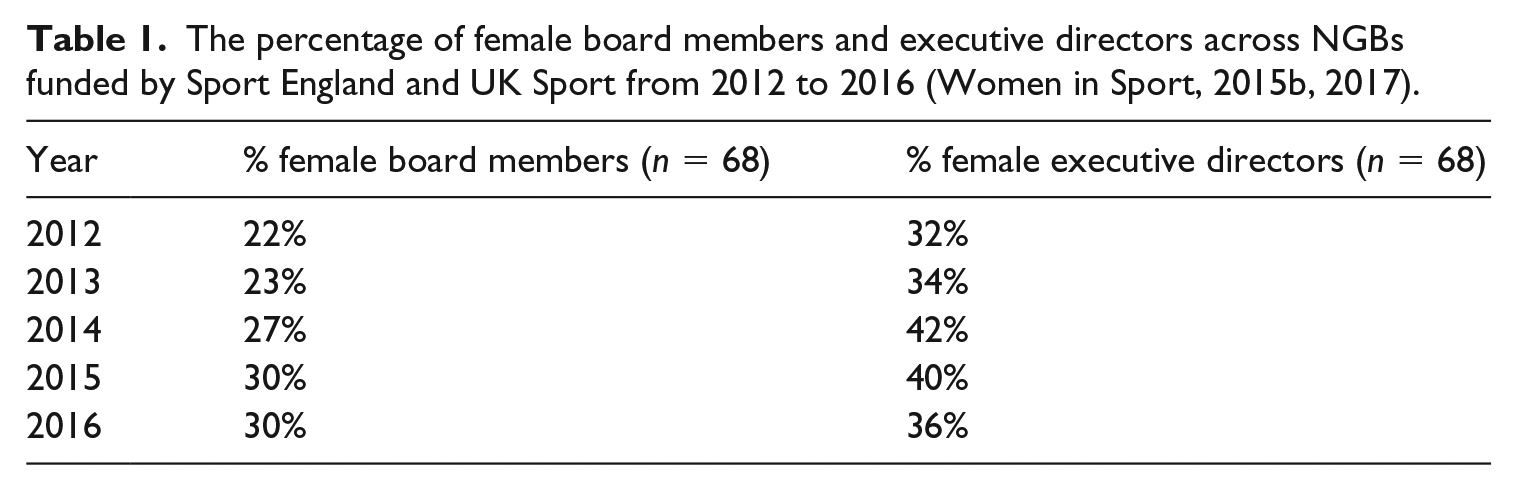
Despite the statistics shown in Table 1 aligning with Sport England and UK Sport’s (2016) gender represenation target, in 2016 there were still more than double the amount of men than women on the boards of NGBs as well as significantly more men in executive positions.
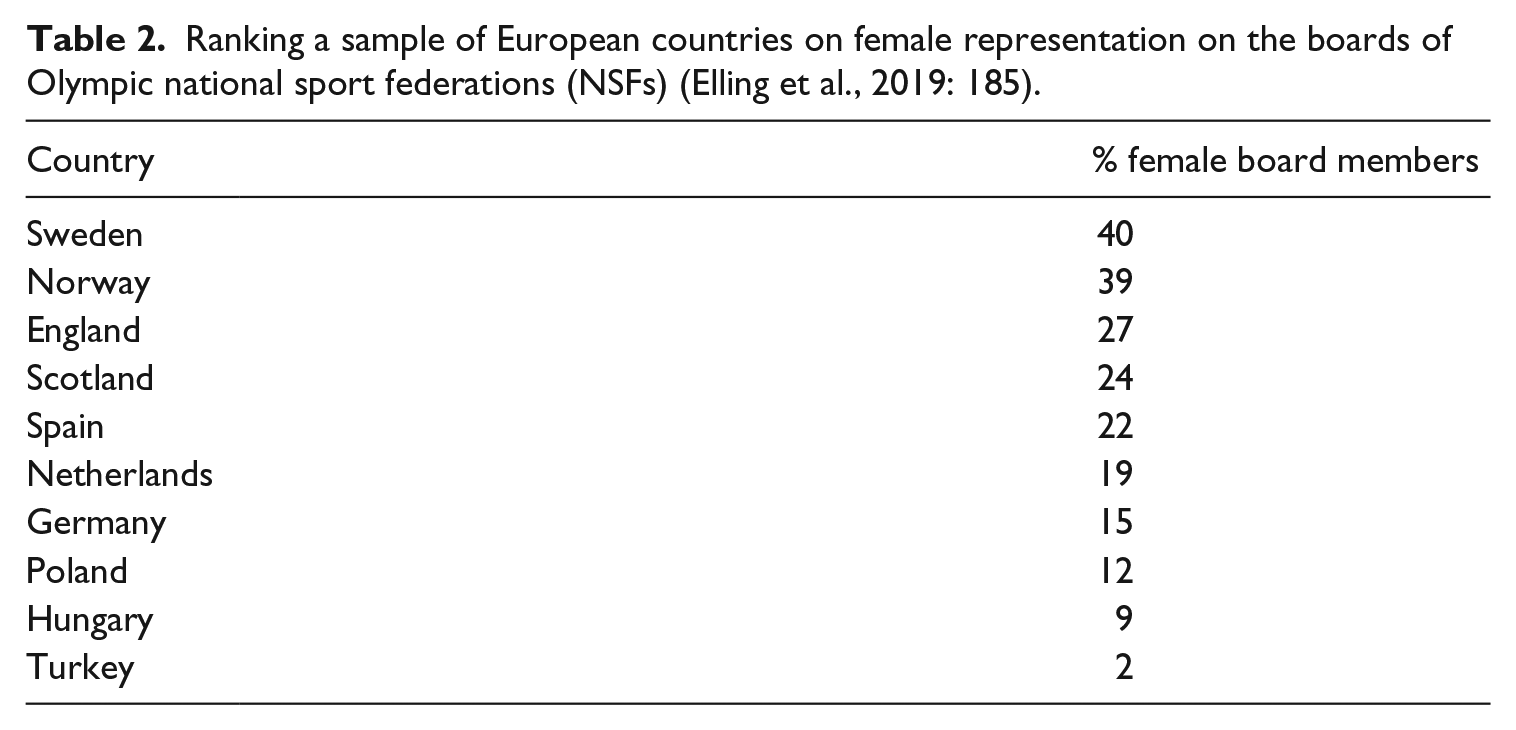
Table 2 outlines a recent cross-country comparison by Elling et al. (2019) of female representation in sport governance at the European level, demonstrating that, of this sample, England has the third highest female representation in European Olympic sport governance.
Ranking a sample of European countries on female representation on the boards of Olympic national sport federations (NSFs) (Elling et al., 2019: 185).
The purpose of this paper is to draw upon Pierre Bourdieu’s theory of practice to explore how informal organisational practices influence dominant gender power relations which shape the positionality and experiences of senior leaders along gendered lines within two established English NGBs: England Golf and the Lawn Tennis Association (LTA). We explicitly focus on gendered informal practices rather than formal practices. This is because of their ‘doxic’ nature as ‘seemingly “natural” practices and attitudes which, rather than being “natural”, are in fact taken for granted assumptions and beliefs that become “givens” in society’ (McCreadie, 2016: 81). The subconscious nature of informal practices makes them difficult to resist (Bourdieu, 1977). This study is important in raising awareness of the power of informal organisational practices to reproduce a gendered structure of dominance which favours one gender over another.
The gendering of sport governance
Previous research has identified multi-faceted reasons for an under-representation of women in sport leadership positions. These include: organisational structure, policy, and formal practice at the macro/structural level (Pfister and Radtke, 2009; Piggott, 2019; Velija et al., 2014); discrimination, gender stereotyping and labelling, and gendered organisational culture at the meso/cultural level (Shaw, 2001, 2006; Shaw and Hoeber, 2003; Shaw and Slack, 2002); and gendered expectations, styles and behaviours of leaders at the micro/individual level (Claringbould and Knoppers, 2008, 2012). This article draws from the findings of a wider study that explores all levels of organisational analysis. Within this paper, we focus specifically on the meso/cultural level of analysis because we are interested in discussing the impact of doxic informal organisational practices on gender balance and gender equity within English sport governance.
The most powerful sport leadership roles continue to be associated with masculine traits such as those that are ‘technically rational, performance-oriented, highly instrumental, devoid of intimacy yet preoccupied with identity, and driven by rarely reflected upon corporate or bureaucratic goals’ (Knights and Kerfoot, 2004: 436). Gender stereotypes develop when assumed natural differences between the genders become consensual and groups of individuals make judgements about the assumed behaviours and qualities of individuals based primarily on their gender (Eagly and Karau, 2002). Women leaders who embody traditional femininity are often gender-stereotyped as unsuitable for leadership positions (Hovden, 2010). Simultaneously, women who adopt more masculine leadership qualities experience marginalisation because ‘women who exude confidence, competence, and fortitude risk comprising their femininity and (hetero)sexual desirability’ (Sartore and Cunningham, 2010: 482). It is difficult for women leaders to embody dispositions that are congruent with traditional (masculine) notions of leadership because they engage with the social field through a female body that holds deep-rooted social meanings, expectations and identities (Krais, 2006).
Researchers have also found that informal gendered practices normalise the position of men within sport leadership positions. This includes the use of discriminatory and patronising language and humour to marginalise women leaders (Shaw, 2006; Shaw and Slack, 2002). Gendered dress codes such as official blazers and ties for male board members have also been reported. These create a sense of normalcy around men being appointed for board positions and allow men greater opportunity for visual recognition of their position of authority within the field (Claringbould and Knoppers, 2007; Shaw, 2006). One of the biggest barriers reported in women obtaining sport leadership positions is the expectation for leaders to work long and unsociable hours (Claringbould and Knoppers, 2007; Knoppers and Anthonissen, 2008; Pfister and Radtke, 2006). This predominantly impacts women leaders because of continued trends in social expectations for women to look after the family and home (Scott and Clery, 2013). Within this article, we will contribute to this work by presenting examples of informal gendered organisational practices within England Golf and the LTA.
Theoretical framework: Bourdieu’s theory of practice
Our analyses of the gendered organisational cultures of England Golf and the LTA are informed by Pierre Bourdieu’s theory of practice. The focus of the theory of practice is the ways in which cultural resources, processes and institutions continually hold individuals within hierarchies of domination. Bourdieu identifies gender as a power relationship which is shaped by male domination because ‘the definition of excellence is in any case charged with masculine implications’ (2001: 62). Male dominance is maintained within society because ‘the particularity of the dominant is that they are in a position to ensure that their particular way of being is recognised as universal’ (Bourdieu, 2001: 62). Gender order is maintained through symbolic violence: the legitimation and normalisation of symbolic systems to profit dominant groups (Bourdieu and Wacquant, 1992).
The theory of practice is composed of three key concepts: field, capital and habitus. Bourdieu’s macro-concept of the field refers to a semi-autonomous, objective hierarchy that is constituted by individuals and institutions who follow the same sets of rules, rituals and conventions (Webb et al., 2002). The rules of the field are legitimated by the very act of individuals following them (Bourdieu and Wacquant, 1992). English NGBs are examples of organisational fields comprised of both voluntary (led by the board) and paid (led by the ELT) governance hierarchies in which individual sport leaders compete for professional advantage (Everett, 2002). Ozbilgin and Tatli highlight the usefulness of conceptualising the organisation as a field because it ‘provides an analytical perspective to investigate the structure without ignoring the agency of the individuals’ (2005: 867).
An individual’s position within an organisational field is influenced by the types and volumes of capital they accumulate. Capital is viewed by Bourdieu as a resource that generates power (Calhoun, 1993). Bourdieu (1986) outlines four principal kinds of capital: economic (income and wealth); cultural (artistic taste and consumption patterns); social (social networks and relationships); and symbolic (authority, legitimation and prestige). Bourdieu’s work on social capital has been adopted and adapted by a number of sociologists. These include Putnam (1993, 2000), whose concepts of bonding and bridging social capital have been drawn upon throughout this article to conceptualise gendered social networks amongst and between male and female leaders. Bonding social capital is the development of trust and strong social ties between individuals who share similar social identities (including gender). Bridging social capital is the transcendence of ‘social and political and professional identities to connect with people unlike ourselves’ (Putnam, 2000: 411).
Individual sport leaders’ ability to successfully accumulate various forms of capital are influenced by their individual habitus and the extent to which it is harmonious with collective organisational habitus and the formal requirements of the organisational field. For Bourdieu (2000), individual habitus is a system where social actors develop ‘repertoires’ and durable dispositions that enable them to function within the social world on an everyday basis. An individual’s habitus is simultaneously impacted by the behaviours and interactions of individuals, and impacts upon the future actions and behaviours of individuals (Bourdieu, 1990). Organisational habitus refers to ‘informal, unconscious [gendered] practices which interact to guide the dispositions of the organisation as a whole’ (Kitchin and Howe, 2013: 129). Bourdieu (1990) uses the term ‘dispositions’ instead of ‘rules’ because habitus regulates behaviour outside of any explicit rules or laws, and outside of the consciousness of social agents.
Gendered habitus develops when ‘collective [gender] expectations . . . tend to inscribe themselves in bodies in the forms of permanent dispositions’ (Bourdieu, 2001: 61). Krais further developed this concept as the ‘social construction of masculinity and femininity that shapes the body, defines how the body is perceived, forms the body’s habitus . . . and . . . determines the individual’s identity – via the body – as masculine or feminine’ (2006: 121). Within this article, we extend the concept of gendered habitus to gendered organisational habitus to conceptualise the ways in which informal organisational practices are regulated by, and regulate, gender norms, expectations, identities and dispositions within individual sport organisations. We will use the key concepts of Bourdieu’s theory of practice to conceptualise the ways in which informal gendered practices within England Golf and the LTA regulate the perceptions, dispositions and interactions of sport leaders along gendered lines to develop dominant gender power relations which conserve and/or resist male-dominated sport governance.
Methodology
The findings presented in this article form part of a wider study that adopted an ethnographic approach to explore the complexity of gender equity within the governance of sport organisations. This article focuses specifically on findings that have been thematically grouped as informal organisational practices which, as part of the wider study, were generated through semi-structured interviews and participant observation. Official documents from the two organisations were also drawn upon to add specific detail or fill information gaps during the collection, analysis and write-up of data. An ethnographic approach was adopted to reveal ‘unconscious actions that can inadvertently marginalise groups, or reveal how dominant agents wield strategies to maintain inequality’ (Kitchin and Howe, 2013: 132). However, this research cannot be classed as a full organisational ethnography because it was not possible to have ‘direct and sustained contact with human beings, in the context of their daily lives, over a prolonged period of time’ (O’Reilly, 2012: 3).
The research sites were the National Golf Centre in Woodhall Spa, Lincolnshire (headquarters of England Golf), and the National Tennis Centre in Roehampton, London (headquarters of the LTA). England Golf and the LTA are both established NGBs, and so they provide ideal sites for multi-layered organisational analyses because of their different hierarchical levels of leadership. Additionally, both England Golf and the LTA have achieved Sport England and UK Sport’s (2016) 30% gender balance requirement for boards. Therefore, this research analyses the organisational cultures of two NGBs that satisfy national governance requirements and provides some insight into the extent to which these national requirements are effective and sustainable in making sport governance more gender-equitable.
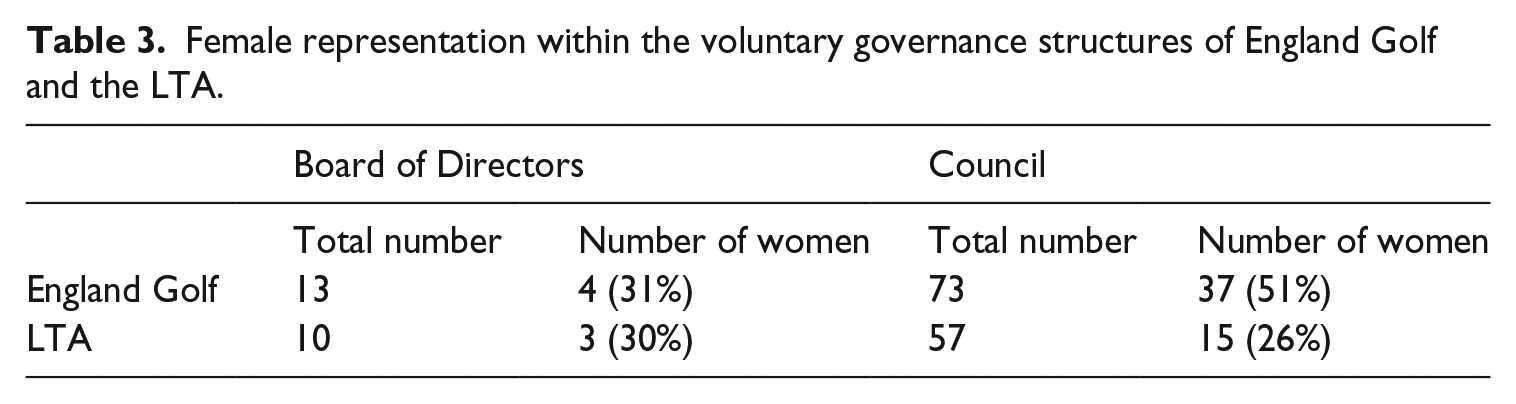
England Golf was established as the single NGB for women’s and men’s golf in 2012 after the merging of the English Golf Union and the English Women’s Golf Association (England Golf, 2012). The LTA was established in 1888 and has always been the governing body for both women’s and men’s tennis (Walker, 1989). Tables 3 and 4 display female representation across the voluntary governance structures and paid workforces of the two organisations at the time of research.
Female representation within the voluntary governance structures of England Golf and the LTA.
Female representation within the paid workforces of England Golf and the LTA.
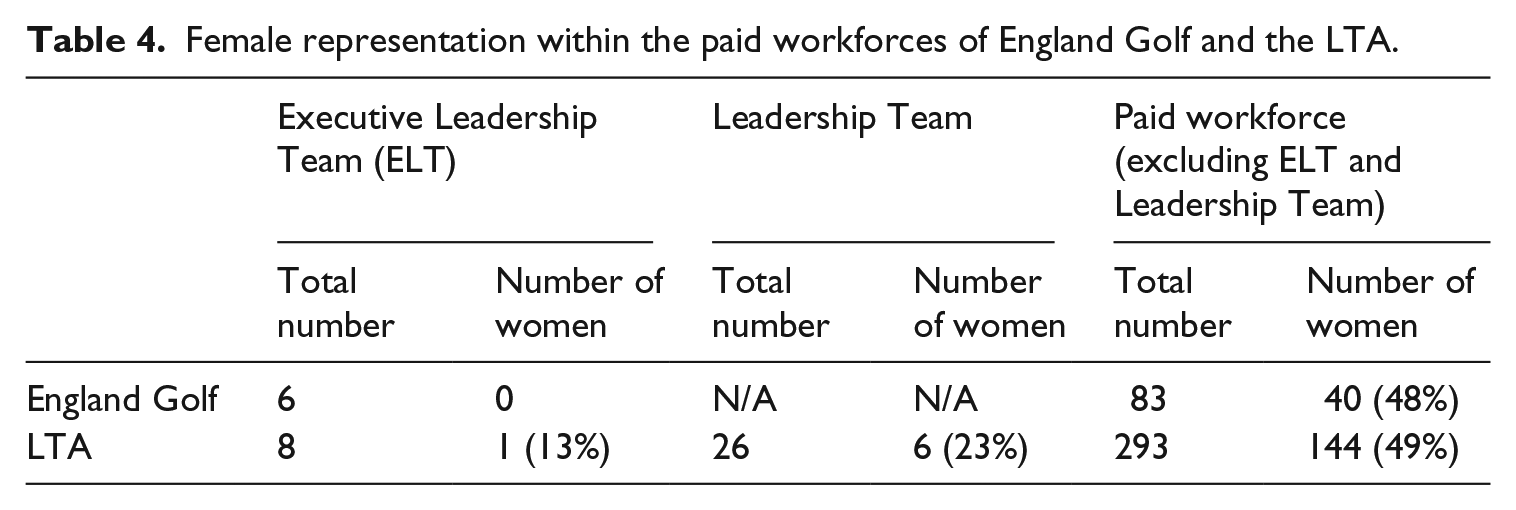
Table 3 demonstrates that both boards align with the national statistics presented in Table 1 and meet Sport England and UK Sport’s (2016) 30% gender target. Table 4 highlights the stark vertical gender segregation found in both organisations across their paid workforces. England Golf had 48% female representation across its paid workforce excluding the ELT, but no women on its ELT. The LTA had 49% female representation across its paid workforce excluding the ELT and leadership team, with just six women on its leadership team (23%) and one woman on its ELT (13%).
There were 33 formal participants who engaged in semi-structured interviews for this research, in addition to those informally observed. These consisted of female and male board members, executive leaders, individuals in middle-management positions, and further employees of interest to the project. Fourteen of the participants were female and 19 were male. All interviewees were white, middle class and all bar one were non-disabled. Female and male leaders were interviewed and observed to investigate dominant gender power relations from both a privileged and a subordinate perspective. This is often absent in feminist research but is important because ‘without males as allies in struggle [the] feminist movement will not progress’ (hooks, 2000: 12). The interviews lasted between 35 and 100 minutes and the central overarching themes of the interview questions included: backgrounds/motivations for becoming a leader, recruitment processes, leadership experiences, organisational culture, barriers for women leaders in sport, and strategies to increase the number of women in sport leadership. The CEOs of both organisations agreed that they were happy for their organisations to be named if individual participants remained anonymous. One comment used within this article reveals the identity of the participant, and the participant gave consent for their identity to be revealed in relation to this point only, with their pseudonym protecting their identity throughout the rest of the article. The positions of LTA female leaders are anonymised as there is only one female executive leader. All female board members and the executive leader are described as ‘LTA Leaders’.
Participant observation was used as a supportive research method and importantly offered insight into doxic elements of organisational habitus which go beyond the routines of knowledge of individuals who engage in the daily social practices of the organisational field (Bourdieu, 1999). Participant observation enabled the development of rapport with participants, as well as increased general organisational knowledge such as the jargon, the people, current organisational priorities and current organisational challenges. This was instrumental in contextualising the interviews and documentary evidence. In total, 11 specific events were observed across the two organisations in addition to time spent across 15 days conducting participant observation within the two headquarters. Specific events at England Golf included a board meeting, strategy meeting, project meeting, and partners and sponsors event. At the LTA, specific events included a council meeting, departmental meeting, induction day and women’s leadership event. A range of documents were drawn upon, including annual reports, financial reports, strategic plans, policies, governance documents, merger documents, and handbooks.
A simultaneous qualitative research design was adopted, using the same participants to contribute to answering the same research questions with the same epistemological and theoretical underpinning (Morse, 2010). The data sets were analysed separately. Interview and observation data was manually thematically analysed and split across four spreadsheets (England Golf interviews, England Golf observations, LTA interviews and LTA observations) to systematically identify, organise and pattern meaning across the data sets (Braun et al., 2012). Braun et al.’s (2012) six-phase approach to thematic analysis was used because of its strong focus on familiarity with the data, its thoroughness, and its methodical and easy-to-follow structure. Documents were not formally analysed, but informed understanding of formal governance structures, processes and practices. Next, we thematically present four informal gendered organisational practices found to be significant in the development of gendered power structures within England Golf and the LTA.
Informal gendered organisational practices
Gendered dress codes
Gendered dress codes were observed within both England Golf and the LTA as a form of gendered symbolic capital which visually legitimates male board members, and not female board members, as distinguished leaders. Whilst not an official requirement, male board members and councillors from both organisations wore organisation-branded blazers and ties to board or council meetings (observations, 18 October 2016 and 19 May 2017). This created a visual distinction between male and female leaders, and a sense of unity and uniformity amongst male leaders but not female leaders. Mary (England Golf Board Member) described how male board members having ‘their blazers [and] their ties’ was ‘the thing that struck the women on the first meeting’ after the merger between the (men’s) English Golf Union and the (women’s) English Golf Association. Additionally, Sue (England Golf Board Member) argued that dress codes are ‘a bit stuffy’ and that ‘if we’re trying to attract young females to come into [England Golf] it’s very off-putting’. Daniel (England Golf Executive Leader) explained that he wears official England Golf clothing to board meetings to show ‘that I’m really committed to the organisation and that’s not about aligning myself to the male side’. However, he also acknowledged that there are challenges in providing female board members with the same opportunities to symbolise their affiliation to the organisation through their clothing: What do women wear? . . . They don’t wear blazers, they haven’t got ties, they haven’t got cufflinks, so what do we give to the female members of the Board to feel a part of the Board? I feel that identity is very important.
Scholars have discussed how women leaders can experience both empowerment and hindrance through their attire within organisational fields dominated by men (Entwistle, 2000a, 2000b; Ross-Smith and Huppatz, 2010). This is because a ‘groomed appearance is a social signifier’ that can be used as a form of feminine capital, yet femininity can still be equated to traditional female roles which are devalued (Ross-Smith and Huppatz, 2010: 12). Sue (England Golf Board Member) discussed how she felt she had to have ‘presence when I walked in the room to get attention’ by ‘power dressing to the nth degree’ at the beginning of her career. This even involved getting expert advice on ‘what colours should I wear for what eventuality’. Entwistle (2000b) explains how power dressing emerged in the 1980s as a form of female empowerment in the workplace and became a strategy for women to increase their symbolic capital through gaining attention and acceptance. However, power dressing in masculinised clothing can have only limited success for a woman leader because ‘her identity will always be as a “female professional”, her body and her gender being outside the norm “masculine” ’ (Entwistle, 2000a: 343).
Female leaders within the LTA expressed their beliefs that displaying female sexuality through clothing is also problematic: ‘what I wouldn’t try and do is . . . think oh I want to look attractive’ (Charlotte, LTA Leader). Similarly, Natalie (LTA Leader) explained that she ‘would be more careful about making sure that I didn’t wear something that overtly made it look like I was trying to use [her female sexuality]’. Both female leaders felt that overtly feminine dress would negatively impact upon their symbolic capital as a leader if they were deemed to be attempting to gain advantage in the field. Gendered dress codes reinforce dominant gender power relations which marginalise women as outsiders to the prestigious ‘blazer brigade’ and position masculinity as synonymous with leadership. Bourdieu identifies such challenges for women in accumulating symbolic capital because ‘if they behave like men, they risk losing the obligatory attributes of “femininity” and call into question the natural right of men to the positions of power; if they behave like women, they appear incapable and unfit for the job’ (2001: 67).
Gradual resistance to gendered dress codes was reported within the LTA, which demonstrates that organisational habitus is in a constant state of tension, negation and negotiation (Ozbilgin and Tatli, 2005). Joyce (former LTA leader) explained that when she first joined the council ‘it was frowned on when we first wore trousers’. However, through women continuing to wear trousers it became normalised and is now perfectly acceptable within the organisation. Joyce’s experience was nearly 20 years ago, which demonstrates that organisational habitus can change over time, but requires persistent resistance by a collective of individuals in combination with wider social change.
Gendered language
It has long been argued by feminists that the use of sexist language has real-world consequences for gender relations, and gendered language can shape people’s interpretations of the world along gender lines (Prewitt-Freilino et al., 2011). Which words are said and how they are said can perpetuate gender stereotypes and widen status differences between women and men (Chew and Kelley-Chew, 2008). This research uncovered the use of androcentric language as a collective gendered disposition that normalises the position of men within leadership roles. Discussions on the use of gendered language are culturally specific to the organisations’ location within England because of the meanings and associations behind the language in English culture. Within England Golf, there were isolated reports of the use of overtly sexist language to demean women. James (England Golf Executive Leader) presented an example of the use of sexist humour: We used to have a President . . . [who] used to say ‘women in golf, I think it’s really good, every golf club should have at least one’ . . . Although he was smiling all the time, you have to say behind that smile there was a ‘what are women doing in golf?’
There was a greater prevalence of more subtle forms of sexist and gendered language within both organisations. For example, Fiona (LTA Middle-Manager) reported that male pronouns were used when discussing the appointment of a new CEO at the LTA: We’re recruiting a new CEO. I have been in many meetings when people mention it and they’ll go ‘when the new CEO arrives, he will . . .’ . . . [I]t’s deep-set cultural, unconscious bias about what a CEO looks like. . . . CEO equals man.
The doxic use of male pronouns in Fiona’s example not only reinforces the naturalisation of male leadership, but is difficult to resist because it is entrenched in organisational habitus and becomes a ‘given’ (Bourdieu, 1977).
Men are also normalised and naturalised as leaders through the use of ‘false generics’: masculine or feminine terms that are used to represent both men and women (Prewitt-Freilino et al., 2011). For example, the word ‘Chairman’ is used to describe the highest officer of the board within the official documents of both organisations, regardless of whether the individual within that role is male or female. Additionally, England Golf use the terms ‘he’ and ‘his’ within the Rules of England Golf to describe those in leadership positions (England Golf, 2012). It has been reported by social scientists that when one reads, hears or uses male-gendered generics such as ‘chairman’ or ‘he/his’, that person is more likely to think of ‘maleness’ (e.g. Gastil, 1990; Hamilton, 1991; McConnell and Fazio, 1996). Cathie Sabin, the sole female Past-President of the LTA, spoke of one example where gendered language led to assumptions that she was not the President of the LTA based solely on her gender: Our first grand slam visit after my appointment was to Australia and when they gave us our accreditation, John’s card said President and mine said Deputy. They were mortified when they realised their error. . . . One would hope that people would do their homework and find out who their guests are but when we appear as Mr and Mrs John Sabin then the presumption is that John is the President. All it needs is a simple clerical amendment to say Mrs Cathie Sabin, President, and her husband John.
In addition to Cathie’s husband wrongly being naturalised as the President of the LTA because of his gender, Cathie also highlights how traditional marital naming within the UK contributed to her husband being assumed to be the President instead of her. Kim discussed how marital naming is a measure of gender hierarchy that embodies ‘the absence of autonomy and individual identity of women both within the family and in public life’ (2010: 919). In Cathie’s case, her symbolic capital as a leader was threatened and her position as the President was doxically questioned. Examples presented in this section demonstrate how deep-rooted linguistic traditions, embodied collectively through organisational habitus, result in both dominant (male) and subordinate (female) agents using gendered language. This reproduces gendered structures of domination that formally (e.g. official documents) and informally (e.g. everyday conversation) afford men more symbolic capital as legitimate leaders.
Informal gender segregation
Informal gender segregation was observed within both England Golf and the LTA, which accentuates perceived gender differences between female and male leaders. For example, men and women were spatially segregated within an England Golf board meeting when all five of the women present were sitting in a line at one end of the board table (observation, 18 October 2016). During interviews, several female England Golf board members commented on this. Michael (England Golf Executive Leader) was the only male to mention the ‘sharp gender divide’, and claimed that ‘I’ve never been in any aspect of society where it’s as pronounced as it is in golf’. When discussing the reasons for such a ‘sharp’ gender divide, Michael suggested that ‘perhaps the men feel more comfortable with the men and the women feel more comfortable with women’. Physical gender segregation within the boardroom creates a visual divide between the two genders that does little to resist problematic gendered organisational habitus shaping gender stereotypes and expectations.
A problematic outcome of informal gender segregation is the social exclusion of an individual based on their gender. Mary (England Golf Board Member) suggested that bonding social capital develops strongly between male board members because of their shared contacts and experiences: ‘they know the same people and . . . chat about the same things and they’ve been to the same things’. She further explained that ‘the women do feel a little bit excluded from that . . . and we probably as a fall-back congregate together’. This means that forms of bonding social capital develop amongst male and female board members which are ‘inward looking and tend to reinforce exclusive identities and homogenous groups’ (Putnam, 2000: 22). Bonding social capital amongst men at the exclusion of women was also found to be evident within the world of tennis. Graham (LTA Board Member) explained how he was not invited to an informal networking meeting for male tennis leaders at the All-England Tennis Club because it was still assumed that a woman was in his position: Somebody said ‘oh why didn’t you come to the men’s evening?’ I went ‘oh never got the invite’. Then it turns out the reason I never got the invite was because they thought [former female leader] was still [in position] and they hadn’t updated their list. . . . [A]nd I think that’s terrible, I didn’t even know they did that.
Whilst it is important to state that the LTA had no input in the staging of this meeting, it demonstrates how bonding social capital amongst male leaders is valued more highly than bridging social capital across genders within the wider field of tennis. This reinforces a gendered structure of dominance that affords male leaders greater access to information, influence, contacts and social inclusion, which in turns influences their positionality within the field.
Some women leaders at England Golf discussed their attempts to resist informal gender segregation within the boardroom. For example, Sally (England Golf Board Member) explained that within one board meeting she ‘went and plonked myself in the middle of [the men] because I don’t like that. We should be sat together, we should be working together.’ Furthermore, in contrast to Shaw’s (2006) findings, female leaders in both organisations expressed their disinterest in developing ‘old girls’ clubs’ that profit women over men. For example, Sally (England Golf Board Member) explained that ‘I don’t think there should be men and women . . . we should be in there all together.’ Additionally, Charlotte (LTA Leader) discussed her negative experience of women’s networks: ‘it’s probably not so bad now but 15 years ago actually having women’s networks made it even worse for the men accepting you because they sort of felt like you were ganging up’.
Attempts to resist informal gender segregation in the boardroom and through women’s networks align with Putnam’s (2000) argument that the development of homogenous bonding social capital is most likely to result in illiberalism, intolerance and exclusion. This is in contrast to the premise of increasingly popular women’s leadership development programmes and networks which tailor to the specific needs and experiences of women leaders to increase their field-specific capital. Research has found single-sex, separatist development approaches to be received both positively and negatively by different female leaders depending on their individual preferences which are shaped by their past experiences (Pike et al., 2018). This supports Bourdieu’s notion of epistemic reflexivity, which conceptualises how subjective ‘knowledge’ (e.g. how best to develop as a woman sport leader) is shaped by the social conditions of the field (e.g. organisational culture) and the unique past experiences of agents (e.g. the extent to which women leaders have previously faced discrimination in mixed-sex settings) (Maton, 2003).
Expectations for leaders to work long and unsociable hours
Within the LTA in particular, there was a deep-rooted expectation for leaders to work long and unsociable hours to be successful in the organisational field. Natalie (LTA Leader) explained how two male executives were promoted from more junior positions because of ‘hard work and doing long hours and showing that they were a cut above somebody else’. Additionally, Colin (LTA Executive Leader) spoke of how he was a ‘workaholic’ and had put his family second throughout his career (observation, 8 March 2017). Although he remarked that ‘I’m not proud to say that’, he did infer that his successful career was heavily influenced by his work ethic (observation, 8 March 2017). Working long and unsociable hours was reported to be challenging for both men and women. For example, Matthew (LTA Executive Leader) suggested that ‘the amount of travel, the unsociable hours, [the] evenings and weekends . . . it makes it difficult for the blokes as well, it’s not unique to females’. However, Natalie (LTA Leader) suggested that a woman of the same age as the two internally promoted executives may not have been able to commit to the same hours if they were mothers and had domestic responsibilities, and so ‘might not have been identified as good old solid hard workers’. This is because ‘there’s still an expectation that senior people work hours that don’t fit in with childcare arrangements’ (interview with Natalie, LTA Leader).
The majority of interviewees discussed the reproduction of traditional gender roles as a barrier for women in attaining leadership positions because of the continued social norm for women to be primary caregivers for children. Factors identified included: a lack of time to balance both motherhood and a full-time leadership role, logistical challenges of working full-time and organising childcare arrangements, the negative impact of a career break, the psychological and emotional challenges of working full-time as a mother of young children, and the cultural pressure to choose between children and a career. Most female leaders interviewed did manage to navigate these barriers and have both a family and a successful career, and those women who did not have a family explained that this was out of choice. However, as is often a limitation of research of this nature, it was only successful women who were interviewed (Pfister and Radtke, 2006). Therefore, the views of women who may have been unable to access a leadership career due to domestic responsibilities were not heard.
Flexible working is an example of a transformative strategy that changes the social order of organisations through resisting doxic norms around working practice to make the habitus of working mothers more aligned to the requirements for leadership positions. Flexible working aims to suit the needs of the employee and can include flexible start and finish times or working from home. At the LTA, flexible working was implemented as an option for women returning to work after taking maternity leave. Natalie (LTA Leader) discussed how she thinks the effectiveness of this could be improved by the LTA ‘being a bit more transparent’ in the offering of flexible working, particularly when advertising for new jobs. At England Golf, flexible working was also implemented when hiring one female middle-manager who was ‘the best candidate’ but could work only three days a week because of her commitments as a mother (interview with Michael, England Golf Executive Leader). Although on this occasion flexible working was offered on request, Sophie (England Golf Middle-Manager) discussed how it is ‘not actively promoted’ within the organisation which ‘makes you wonder then actually would that be possible, would you be able to do that?’ Greater transparency and promotion around flexible working options would provide women (and men) the option to better navigate the challenges of choosing to balance a career and parenthood.
Discussion and conclusion
Drawing on Bourdieu’s theory of practice, we have highlighted how informal organisational practices impact, and are impacted by, gender power structures that continue to place higher value on the capital of men and align sport leadership to the dominant male habitus. These findings are important in demonstrating the limitations of one-dimensional strategies for change that focus either at the macro/structural level, such as gender targets/quotas, or at the micro/individual level, such as women’s leadership development programmes. These strategies will not be sustainably effective unless gendered informal practices that shape and are shaped by organisational habitus are transformed. Bourdieu argues that increased consciousness of the problematic nature of habitual practices ‘help to orient individual and collective practices’, which can then lead to the potential appreciation of alternative practices (1992: 141).
One problematic informal practice identified within this article is androcentric language. Bourdieu suggests that to resist dominant language, alternative language must be valued more highly (i.e. afforded more symbolic capital) by the dominant group to be considered ‘legitimate language’ and change collective dispositions (1991: 53). We suggest that one potential way of increasing the symbolic value of gender-equitable practices, such as gender-neutral language, is by linking them to espoused organisational values and performance (Schein, 1984). For example, both England Golf and the LTA state inclusivity as one of their organisational values, which should include language used across the organisation being symbolically inclusive to the roles of both women and men (England Golf, 2019; Lawn Tennis Association, 2017). This should also include safe and inclusive organisational environments where both women and men feel able to challenge doxic gendered language within the workplace and increase collective consciousness of the impact of androcentric language on the perpetuation of gender stereotypes and naturalisation of men as leaders.
Strategies for change that are already in place within the two organisations, such as flexible working, need to be embedded across the whole organisation to demonstrate genuine commitment to change, which in turn can change individual perceptions on valued professional behaviours. Flexible working has not yet been implemented at senior leadership level in either organisation, suggesting a perceived value of senior leaders working long hours. To change doxic working practices, work–life balance must be afforded more symbolic capital than long working hours (Bourdieu, 1991). Academic research has found work–life balance to positively impact upon organisational performance due to factors such as improved productivity and reduced turnover (Lazar et al., 2010). Therefore, increased reflexivity on the benefits of work–life balance is required before flexible working can become viable for all sport leaders. Whilst a linkage between organisational values and gender equity is easily achieved, there is a need for further research evidencing the benefits of gender equity to organisational performance for organisations to understand the value of gender-equitable organisational cultures.
Footnotes
Declaration of Conflicting Interests
The author(s) declared no potential conflicts of interest with respect to the research, authorship, and/or publication of this article.
Funding
The author(s) received no financial support for the research, authorship and/or publication of this article.
