



Abstract
Iceland attracted international attention when its national football team qualified for the 2018 Men’s World Cup. This surprise qualification made Iceland the smallest nation to qualify in the 88-year history of the prestigious competition. During the World Cup, life in Iceland seemed to center on the Icelandic team and attract interest and attention from almost every Icelander. But how widespread was the national interest in Iceland’s participation and did the inclusion of Iceland in the competition have any positive social/psychological impact on individuals and/or Icelandic society? Questionnaire data from a sample of the Icelandic population show that there was extensive interest among Icelanders in the participation of the Icelandic team in the World Cup. The findings further show that Iceland’s participation positively affected the mood of Icelanders and created a positive atmosphere among the Icelandic nation, as well as some critical attitudes, at least for the short term.
Keywords
Introduction
The imagined community of millions seem more real as a team of eleven.
Sports play an important role in most modern societies. Figures for sport participation are historically higher than ever before, sports are a popular entertainment and in many societies sports have been associated with a substantial economic impact and with public health benefits (Coakley, 2006; Guttmann, 2007; Þórlindsson et al., 2015). Sports also have an important role in the integration of individuals into society where, through sport team identification, individuals develop a heightened sense of belonging, as being part of something larger than themselves. It can be argued that the importance of this integrative function of sports is particularly important nowadays due to increased individualism in modern society, the decay of traditional institutions (such as religion and the nuclear family), and the emergence of non-linear media, which is in most cases based on solitary experiences (Giddens and Sutton, 2013; Livingstone, 2007). Sport can, in this respect, be seen to help communities to counteract the increased alienation of contemporary society by its ability to strengthen citizens’ perception of ‘imagined communities’ (see Anderson, 1983). Sporting contests can, in this sense, provide citizens with a mutual focus, establish shared pasts and identities, and increase opportunities for communication (see Farberman, 2019: 9–14; Giulianotti, 2005: 1–5; Halldorsson, 2017; Katovich and Couch, 1992; Kuper, 2006).
In the summer of 2018, the Icelandic men’s national football team wrote its name in the sports annals by becoming the smallest nation to qualify for the football World Cup. Two years earlier, the team had emerged at the highest international level in sports by qualifying for the European Championship finals by reaching the quarter-finals of the competition. This achievement stunned the football world. The Icelandic supporters further caught the world’s attention when they performed the synchronized and powerful Viking Thunder Clap (or the Húh!) at games – the Viking Clap has since become a popular fad all over the world, from the US to Iran. Thus, the on-the-field success of the Icelandic football team and the captivating atmosphere of the Icelandic supporters suddenly put tiny Iceland – with a population of 340,000 – in the news headlines all over the world (Júlíusson, 2015; mbl.is, 2016c).
The appearance of Iceland at the major football competitions not only attracted attention abroad, but consumed Icelandic society. Some figures estimate that over 70% of the Icelandic population watched the Icelandic games at the World Cup live on television, with 99.6% of Icelanders, who had their televisions turned on when the games were aired, watching the games (ruv.is, 2018a); the main traffic routes in Reykjavik (the capital) were almost empty while Iceland played at the World Cup (Hilmarsdóttir, 2018); shops and institutions closed early on game days so staff could go home and watch the games (ruv.is, 2018b); numerous Icelanders followed the team to France and/or Russia to support them during games (mbl.is, 2016a); sales of the Icelandic team jersey and other team merchandise multiplied (mbl.is, 2016b); and more than the 20 first minutes of the state news broadcast were devoted to Iceland’s first game against Argentina on the eve of the game (ruv.is, 2018c). Thus, it can be argued that Iceland’s participation in major football competitions in recent years has captivated Icelandic sports enthusiasts.
But does a national sport achievement influence the mood of its citizens and the social atmosphere? And have such achievements affected the integration of its citizens into society? This paper focuses on the short-term psycho-social effects of the qualification and participation of the men’s national football team of Iceland at the 2018 World Cup Finals. On behalf of the author, the Social Science Institute at the University of Iceland conducted a questionnaire survey among the Icelandic population in order to answer the following research questions:
1. How strong was the interest among Icelanders in the men’s national football team’s participation in the 2018 World Cup?
2. Did Iceland’s participation in the 2018 World Cup affect the individual mood of the Icelanders?
3. Did Iceland’s participation in the 2018 World Cup affect the collective atmosphere in Iceland?
The findings from this study can shed important light on the potential role and function of sports in modern societies, as well as on the effects of a particular sport success on a tiny island nation.
Sport and community
Sport, individual well-being and social integration
As humans we have evolved an addiction to culture as we are dependent on belonging to something larger than we are as individuals and therefore we seek to identify ourselves with the collective community (Henrich, 2016: 3). In his classic account of the role of religion in society Emilé Durkheim (1965) argued that religion was ideal for creating a shared base of the traditional society. Religion helps individuals to gain a sense of common identity and thus build social and moral bonds between citizens, which in turn strengthen the conscience collective of a given society (Durkheim, 1965). It was through religion that strangers could build and share a similar vision, purpose, understanding and identity. In this respect, religion has historically served an important function of holding societies together (Pescosolido, 1990).
However, in a more secular modern society – characterized by impersonal relationships and the decay of religion and other traditional institutions of society – sports can be seen to serve this integrative function to a greater extent (see Farberman, 2019: 9–14). Durkheim even stated that ‘(i)t is a well known fact that games . . . seem to have been born of religion’ (1965: 425). Sports both serve a pedagogical role for children and adolescents as a gateway into society (Þórlindsson et al., 1994) and are sometimes seen as taking on a ‘semi-religious’ function, serving a wider integration role in modern societies where they form shared identities within certain groups, especially through sport fandom (see Farberman, 2019: 9–14; Giulianotti, 2005: 1–5; Kuper, 2006). Thus, sports provide citizens with the opportunity to identify themselves with certain teams and belong to something more than they do on a day-to-day basis. Sports, in this context, help people connect with others and temporarily escape from their mundane everyday lives (see Farberman, 2019).
These strong collective sentiments of the masses towards their shared sport teams build on feelings of a shared identity and establish a common vision of what is important in the eyes of the group (Goffman, 1974). Such sentiments kindle a positive and energetic social atmosphere which spreads through social networks by behavioral contagion (see Brekhus, 2015; Christakis and Fowler, 2009; Granovetter, 1973; McLean, 2017). This emergent and energetic atmosphere provides a common platform for citizens, through ranks and classes, and builds social capital around sporting events (Halldorsson, 2017; see also Coleman, 1988; Putnam, 2000) which serves both individuals and groups. Research has shown how such identification with sport teams can increase individual and collective well-being (Berument and Yucel, 2005; Maennig and Porsche, 2008; Wann and Weaver, 2009; Wann et al., 2011), enhance collective sentiments and feelings of togetherness (Halldorsson, 2017; Sullivan, 2018; Wann, 2006; Wann and Weaver, 2009) and exercise a positive effect on self-identity and pride (Elling et al., 2014; Halldorsson, 2017; Hirt et al., 1992; Sullivan, 2018; Wann, 2006).
The largest global sport events, such as the football World Cup, are in this sense ideal means to enhance individual well-being and boost community togetherness and pride. Such events build on competition against opponents (us versus them) and take place at a particular time, in a particular historical and cultural context which encourages the bonding of citizens to what Durkheim would identify as common totems (Durkheim, 1965; see also Giulianotti, 2005: 5). Totemism in this sense collectively energizes a group (the clan), fostering identity, community and feelings of belonging. National sport teams thus come to represent the sacred, where the team jersey, the logo, the flag and the national anthem unite the masses (as a clan) around a specific team (see Birrell, 1981). Such sport teams support further builds on the application of common rituals and symbols which provide collective framing and boost shared sentiments among citizens (Cottingham, 2012; Goffman, 1974). Individuals are, therefore, transported through a collective energy, from their profane and mundane realities to a more sacred existence in social gatherings. As Durkheim argued: ‘Since neither men nor nature have of themselves a sacred character, they must get it from another source’ (1965: 107). Under such circumstances, citizens can easily unite behind ‘their team’. Sport contests can in this respect come to resemble an emotional rollercoaster where people engage in the on-the-field game action, hold their breath, curse the referee and hug a complete stranger supporting the same team (Sullivan, 2018). The clan, in such cases, is composed of individuals who feel united by bonds of kinship, almost as if they belonged to a single family (Durkheim, 1965: 122). In other words, a positive and constructive collective atmosphere can develop through sports fandom which transports enthusiasm, increases individual well-being, unites citizens and enhances their level of communication and collective sentiments – as is common in religion (Birrell, 1981; Durkheim, 1965). The team thus becomes a symbol of the collective representation of a particular community, where such collective team identification forms a kind of social electricity which ignites sparks in everyone associated within that particular community (Durkheim, 1965: 247).
Sport and national identity
National sport team success can affect national identity in various ways. At the macro level, national sport successes can provide nations with a positive and favorable image, resulting in strengthened belief and trust in the nation, increased tourism, business opportunities, and various other financial, cultural and ideological gains (Maguire, 1999). Many nations thus devote huge resources and effort to helping establish national sport success, often with a favorable outcome (De Bosscher et al., 2008). International sport success can thus create and/or strengthen shared ideas which suggest that a particular society is healthy and effective (Coakley, 2006: 474–481; Guttmann, 2007). For instance, China recently started to build the infrastructure of football with the intention of staging successful national teams in the near future (Sullivan et al., 2019). According to this ideology a global superpower like China has to have a good national football team, rising to its expectations (Delgado and Villar, 2020).
The potential benefit of sport success on the international sports scene does not only apply to the world’s superpowers who compete for the gold medals; this also applies to the small nations – the underdogs. For a tiny nation like Iceland, qualifying for a major international sport competition can enhance the nation’s prestige and self-worth. Small nations can show the bigger nations that they can also do well in sports, despite limited human resources. They can, in this context, show that they are nations among nations, which can be trusted and should be taken seriously. Such successes of small nations can increase respect for them and draw attention to those small communities which generally are not prominent on the international scene. Such attention can, in turn, foster and strengthen the conscience collective (Durkheim, 1965; Shih et al., 1990; Walton and Cohen, 2003).
It can, furthermore, have different meanings for different nations to participate in big sporting events (see Goffman, 1967: 237–270; 1974). While large nations aim to win medals at the top international games, what matters most to small nations is to belong and to give a good performance (Halldorsson, 2017: 65–77). The smallness of Icelandic society, its close kinship relations and the tight social networks of Icelanders make the performance of the national sport teams players particularly important for the Icelandic national spirit and national identity (see Halldorsson, 2017; Thorlindsson and Halldorsson, 2019b). In globalized live games, where much is at stake – in what Goffman identified as fateful situations (1967: 260) – the culture and values of the Icelanders are symbolically reflected in the behavior and character of Icelandic players and teams on the field (Birrell, 1981; see also Archetti, 1999; Halldorsson, 2017, 2018b; Lever, 1983). The national team players are, in this respect, the representatives of the worth of their nations and under such circumstances it is not the result of the sporting contest – whether they win or lose – that matters most (Fink et al., 2002) but whether the nation’s representatives (the players) behave appropriately and make the folks back home proud by demonstrating bravery and good character (Birrell, 1981; Goffman, 1967: 237–270; Halldorsson, 2017: 65–77; 2018b). If the teams succeed in bolstering patriotic pride, they – and, by proxy, Icelanders in general – can identify themselves as winners, despite a negative result on the scoreboard. Such representations of collective ideas and values can, in such cases, fuel national sentiment, regardless of whether the team wins or loses (Halldorsson, 2017: 65–77; see also Goffman, 1967: 237–270). In this context, the players are the products of their communities and representatives of their nations. This particularly applies to tiny nations like Iceland (Thorlindsson and Halldorsson, 2019a, 2019b).
The aforementioned research on the positive effects of sport team support, however, provides mixed findings on the long-term effects of positive feelings associated with sport team success (see Elling et al., 2014; Hallmann et al., 2013; Pawlowski et al., 2014). Most researchers argue that sport success leads to the reproduction of positive feelings and collective/national sentiments while the contest lasts, but that those effects dwindle shortly after it comes to a close (Elling et al., 2014; Maguire and Poulton, 1999). Furthermore, research has shown that the participation of nations in major international sporting contests can have detrimental effects on individuals and groups. Kirby et al. (2014), for instance, showed how domestic violence increases in England when men’s football teams participate in top global competitions, whether or not the team is doing well. Thus, sport mega-events can have various effects on nations, both positive and negative.
This paper focuses on the international success of Icelandic men’s football. It is of particular interest to analyze the impact of a major sport achievement such as the Icelandic men’s national team participation in the 2018 football World Cup: first, because of the historical significance of Iceland’s achievement, becoming the smallest nation to qualify for the World Cup Finals – and the massive global attention that followed this achievement; second, because sports are cultural products which need to be accounted for in a specific socio-historical context. Therefore, the case of a tiny population such as that of Iceland, consisting of only 340,000 people, could result in different reactions and sentiments than we might expect among other/larger nations (Benedict, 1967; Halldorsson, 2017); third, because of the strong general interest in sports among Icelanders (Halldorsson, 2017, 2018a; Kuper and Szymanski, 2014: 256–259); fourth, because Icelanders are rather homogenous in terms of race and class and are generally religiously inactive, which should arguably create stronger collective sentiments in relation to sport achievement than found in some other nations (Halldorsson, 2017; Pétursson, 1990); and fifth, because such analysis of the achievement of a tiny nation is somewhat lacking in the literature. Thus, the following analysis of the impact on Icelanders of their country’s participation in the 2018 football World Cup has the potential to expand our knowledge of the effects of a national team’s sport success, given the level of achievement and attention this particular case evoked.
Methods
The Social Science Institute at the University of Iceland conducted a probability-based netpanel questionnaire survey based on the author’s questionnaire, representing the Icelandic population (the netpanel was adjusted to reflect the population of Iceland in terms of gender, age, residence, education and family income). 1 The survey focused on whether the respondents had followed the Icelandic games at the 2018 World Cup and whether there were some individual and/or collective psycho-sociological effects associated with the competition. The data was collected from 2 July to 16 August 2018. The survey pool was 1900 members of a netpanel of the Social Science Institute who represent the Icelandic population; 934 responded to the survey, or a participation rate of 49.2%.
Variables and analysis
First, the interest of Icelanders in the 2018 World Cup was measured with two variables: (a) the question How much or little did you follow the Icelandic national football team at the 2018 World Cup in Russia? The variable was measured on a 5-point Likert scale from very much to very little or nothing; (b) the question Did you make the trip to any of the following international football competitions?; (b(1)) Did you make the trip to Russia to watch the Icelandic men’s national team play in the 2018 World Cup finals?; (b(2)) Did you make the trip to Holland to watch the Icelandic women’s national team play at the 2017 European Championship?; (b(3)) Did you make the trip to France to watch the Icelandic men’s national team play at the 2016 European Championship? Binary answer options for each question consisted of no or yes. The computed variable from the three questions was coded =0 for those who did not attend any of the competitions, and =1 for those who attended some of the aforementioned competitions.
A further question concerning the main reasons why respondents attended games with the national teams in the competitions was a multiple response question with the following answer options: I have a strong interest in football; Because of national pride; I wanted to experience the social atmosphere; Friends or family members were going; A relative or friend was playing; I received an invitation; Other reasons, which? The respondents could select up to three answer options.
In addition, the survey further attempted to test for the respondent’s associations with the Icelandic football scene with two questions: (a) How many players do you know personally in the men’s football national team? The question was measured on a 5-point ordinal scale with answer options from none to 6 players or more; (b) How many games have you attended in either of the top two divisions in the Icelandic men’s or women’s league this summer (2018)? The question was measured on a 5-point ordinal scale with answer options from none to 10 games or more.
Second, with regard to measuring the psycho-social effects associated with the 2018 World Cup, the respondents were asked both about the individual effect of the competition and the perceived effect the competition had on others. How the 2018 World Cup affected the respondents at individual level, was measured on a 5-point statement scale from I strongly agree to I strongly disagree. Eight statements accompanied the introduction: When the Icelandic men’s football team plays at major international competitions: (a) I have a better social relationship with others; (b) it increases my well-being; (c) I experience more stress; (d) I forget daily worries; (e) I feel more self-confident; (f) life is better; (g) I feel I belong to the same team as the people around me; (h) I am filled with national pride. The questions appeared in random order. The eight questions were computed into a scale termed Positive Mood (α=.83) (the answer option for (c) was inverted). The scale was recoded as a 3-item variable as 1=high, 2=medium, 3=low.
How the 2018 World Cup was perceived to affect people around the respondents, at a collective level, was measured on a 5-point statement scale from I strongly agree to I strongly disagree. Eight statements accompanied the introduction: When the Icelandic men’s football team plays at major international competitions: (a) Icelanders show more compassion; (b) Icelanders act in a friendlier manner; (c) Icelanders are happier; (d) Icelanders are more helpful; (e) Icelanders become filled with nationalistic sentiments; (f) Icelandic society becomes too focused on football. The questions appeared in random order. Questions (a)–(d) were computed into a scale termed Positive atmosphere (α=.87). The scale was recoded as a 3-item variable as 1=high, 2=medium, 3=low. Questions (e) and (f) represent Critical atmosphere and were used individually to measure the downside of the social atmosphere around the competition.
The background questions used in the analysis were: gender (1=men, 2=women); age (1=18–29 years, 2=30–44 years, 3=45–59 years, 4=60 years old or older); residence (1=capital area, 2=other); children in the household (0=no children, 1=children); education (1=primary level; 2=secondary level, 3=university degree); and monthly family income (1=400,000 ISK or less, 2=401,000–600,000 ISK, 3=601,000–900,000 ISK, 4=901,000–1,100,000 ISK, 5=1,101,000–1,500,000 ISK, 6=1.5m ISK or more). See descriptives of key variables in Table 1.
Descriptions of key variables.
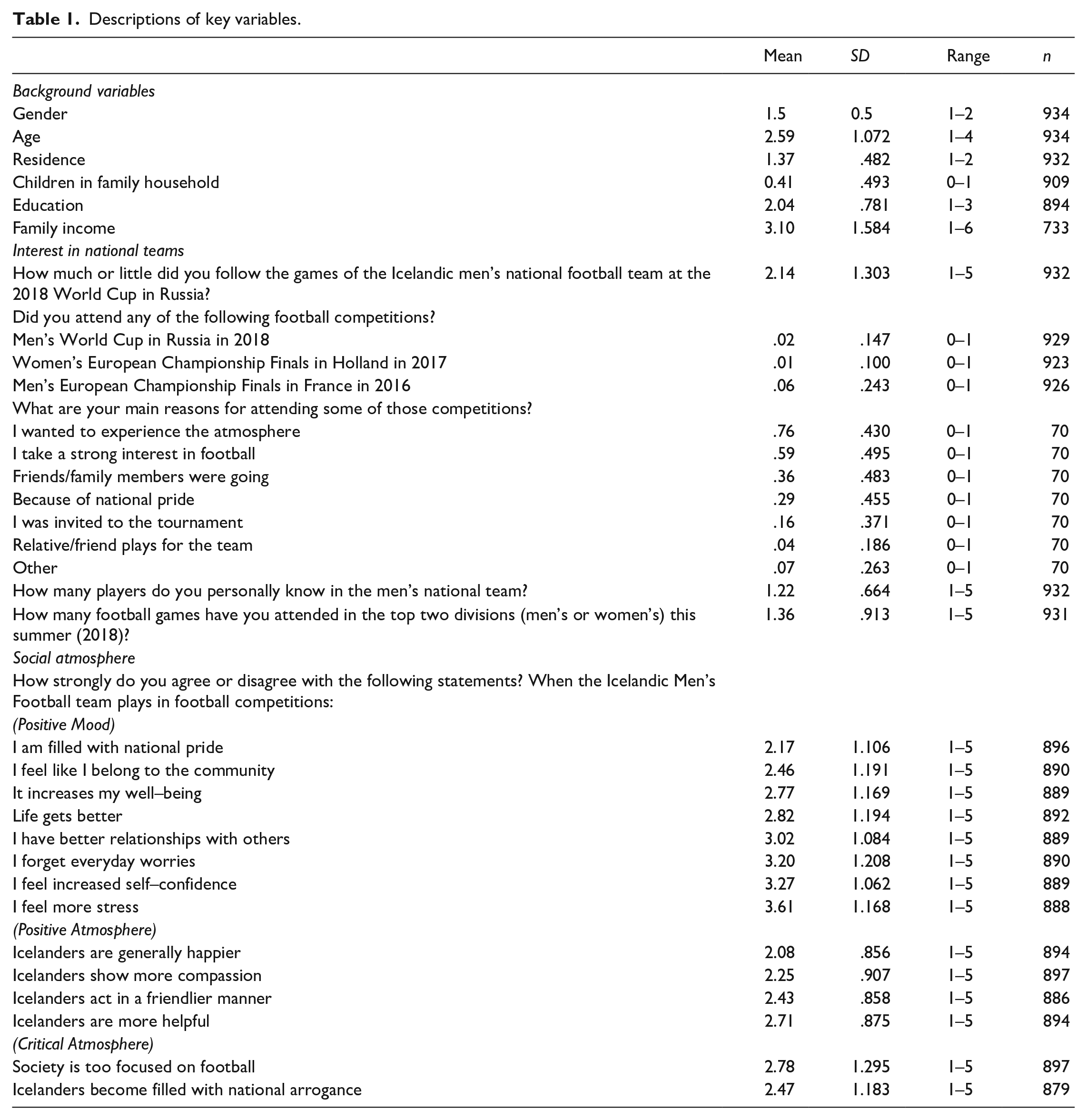
The statistical analysis is, on the one hand, based on descriptive statistics and, on the other hand, on statistical correlations and regression analysis.
Results
How interested were the Icelanders in the team’s participation in the 2018 World Cup?
The findings confirm strong interest in the Icelandic team’s participation, as indicated in the introduction. Over 91% of the Icelandic population followed Iceland’s games on television, where around 71% followed the team’s games extensively, 20% somewhat, and around 9% did not follow the team’s games at the competition.
A regression analysis of Icelanders’ interest in the team’s games at the 2018 World Cup suggests that the interest was general. In other words, it can be argued that the Icelandic population as a whole was interested in Iceland’s participation. There was no statistical difference according to tradition or background variables, such as gender, age, residence or levels of education (Table 2). It must be noted, however, that the regression model only explains 10% of the variance in the dependent variable, but it is of particular interest that no significant difference was noted on key variables. In other words, interest in the games was widespread among women and men, younger and older, among people in urban and rural areas and among people with different levels of education. It was, however – unsurprisingly – those who took most interest in the sport of football, those who had attended football games in Iceland (b=-.227) and those who personally knew a player on the team (b=-.112) (13.3% of the respondents knew a player) who were most likely to watch TV broadcasts featuring the Icelandic team. Also, a weak correlation was found between interest in the competition and family income; those with lower incomes were somewhat more likely to watch than those with higher family incomes (b=-.093).
Regression analysis of interest in Iceland’s participation at the 2018 World Cup.
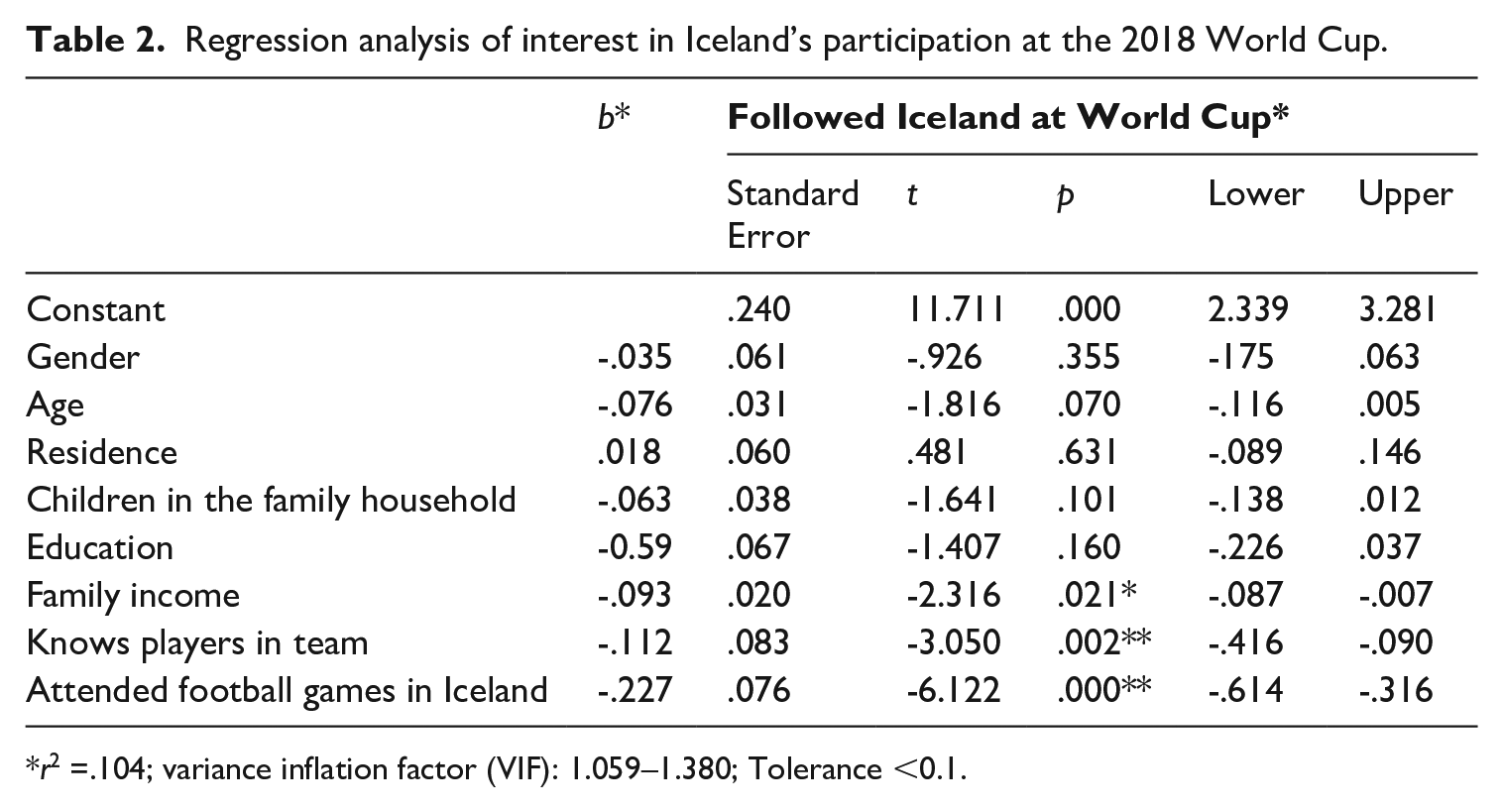
r2 =.104; variance inflation factor (VIF): 1.059–1.380; Tolerance <0.1.
In terms of interest in Iceland’s participation at the 2018 World Cup, the data further shows that around 2.6% of the adult population of Iceland followed their team to Russia where they attended games with the Icelandic team (Figure 1). This figure is, however, much lower than at the European Championship in 2016 where over 6% of the Icelanders followed the team to France. By comparison, around 1% of the adult population followed the women’s team when it played in the European Championship in Holland in 2017.
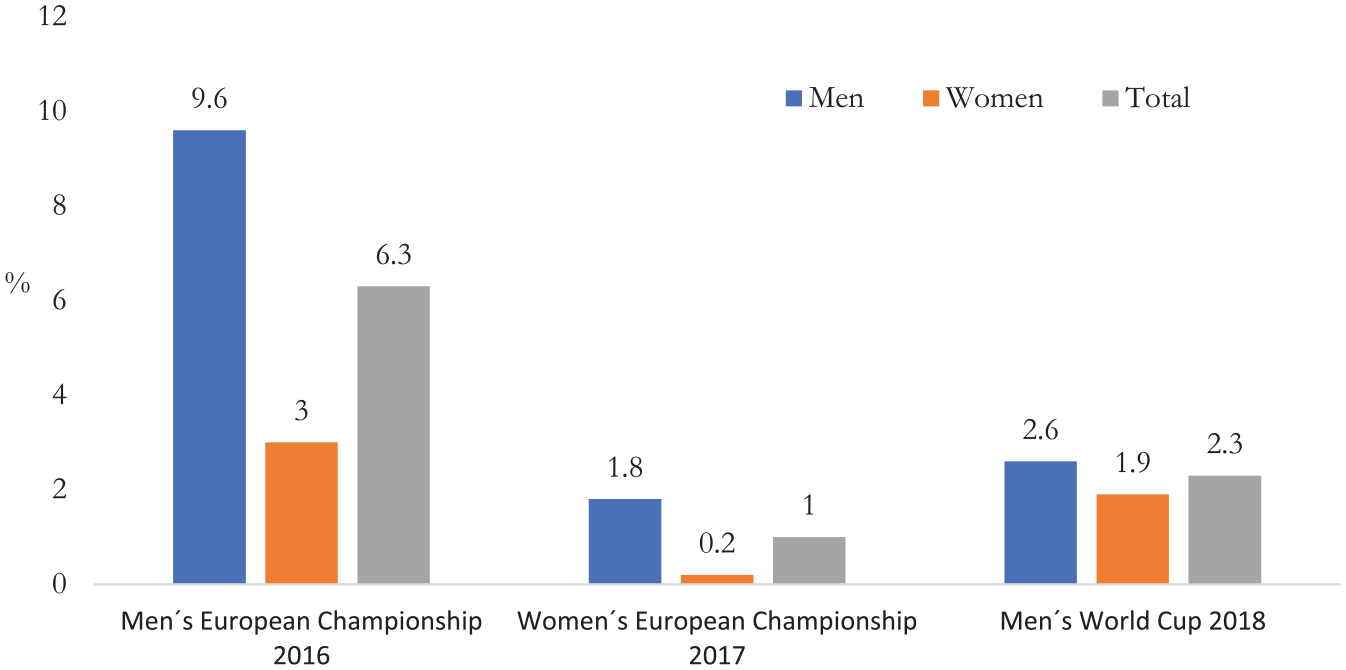
The percentage of respondents who attended games with the Icelandic teams at any of the following competitions: 2018 Men’s World Cup; 2017 Women’s European Championship; 2016 Men’s European Championship – by gender.
A further analysis (not in Figure 1) showed that those who had attended a football match in Iceland were more likely to attend a national team game abroad than those who had not attended a football match in Iceland (r=0.35**). Likewise, those who knew players on the teams were more likely to attend games than those who did not (r=0.14**). Those who had a higher family income were also more likely to follow the team abroad than those with a lower family income (r=0.19**), as were those with higher education (r=0.15**). Finally, men were more likely to follow the teams abroad than women were (r=0.13**). 2 In comparison, the results further show that Icelandic men were somewhat more likely to have attended a football match in Iceland in the summer of 2018 than women were (r=-.11**).
In addition, the survey participants were asked – via multiple response questions where they could select up to three options – which were the main reasons why they had attended Iceland’s games at international competitions. Three out of every four participants (76%) indicated that they wanted to experience the atmosphere of the competition. Around 60% took a strong interest in football, over one-third because their friends or families were going, around 29% because of national pride, around 16% because they were invited to the competitions and around 3.5% because they had friends or family members who were playing for Iceland. Approximately 7% stated some other reason.
The effect of Iceland’s participation in the 2018 World Cup on individual moods and the social atmosphere in Iceland
As stated above, most of the Icelanders who attended games with the Icelandic teams at major international competitions did so to experience the atmosphere. But how did the Icelanders in general perceive the atmosphere around the 2018 World Cup? Participants in the survey were asked whether they agreed or disagreed with various statements regarding their personal experience of the competition and how they experienced the behavior of others.
First, at the individual level, around 70% of the respondents confirmed that they were filled with national pride when watching the Icelandic team play at the World Cup (Table 3). Just over 61% further confirmed that they perceived a feeling of belonging to the community. Around 44% felt increased well-being and around 40% regarded life as better during the championship than normally. Around 30% sensed that they were better connected to the people around them, 28% forgot their daily worries and 18% felt more self-confident during the competition than they normally do. However, around 17% felt more stress during the competition than normal. The respondents who indicated that they disagreed the most with the aforementioned statements were those who did not suffer more stress (50.6%), forget daily worries (35.3%) or experience more self-confidence (35.3%).
The perceived individual mood and collective atmosphere in Iceland around the 2018 World Cup.

Second, the results further suggest that Iceland’s participation in the World Cup was experienced positively at the collective level, as the respondents felt a more positive attitude from others during the competition than they would normally experience. Three out of every four respondents (76%) felt that Icelanders were more joyful during the World Cup and 65% felt that Icelanders showed more compassion during the competition than normally (Table 3). Over half of the respondents, furthermore, experienced a more positive attitude from others who were friendlier (55%) and more helpful (35.8%) during the competition than normally. However, the results also suggest that a majority of the respondents were critical of the collective atmosphere around the competition. Thus, around two-thirds of the respondents (66%) felt that Icelandic society was too focused on football during the competition and well over half of the respondents (56%) felt that Icelanders had become filled with national arrogance. The respondents who indicated the strongest disagreement with the aforementioned statements of the social atmosphere were those who did not think the Icelandic society was too focused on football (32%) and that Icelanders were filled with nationalistic arrogance (around 21%). Furthermore, only 5–12% of the respondents disagreed with statements that Icelanders were more joyful, compassionate and helpful when attending important sports events.
A regression analysis (see Table 4) showed that the perceived positive individual experience of the World Cup was mainly confined to those who took an interest in Iceland’s participation and followed the competition rather than those who did not (b=.526). On the other hand, those who stated that society was too focused on football were less likely to experience the positive mood of the competition (b=-.196), as were people who live outside the capital area (b=-.070). Table 4 further shows that those who followed the competition were more likely to experience a positive atmosphere from this than those who did not follow it (b=.413). Women were also more likely to experience a positive atmosphere than men were (b=-.168).
Regression analysis on the Positive Mood and Positive Atmosphere of Iceland’s participation at the 2018 World Cup.

r2 =.392; variance inflation factor (VIF): 1.060–1.399; Tolerance <0.1.
r2 =.204; VIF: 1.055–1.369; Tol. <0.1
Finally, an analysis of the critical attitudes around the competition in Iceland, that Icelandic society was too focused on football and that Icelanders were filled with national arrogance, showed that there was a strong positive relationship between the two variables (r=0.34**). A regression analysis (see Table 5) further shows that it was mainly those who personally knew a national team player (b=-.280), those who did not follow the games at the World Cup (b=-.200), those who do not have children in the household (b=.198) and those who had not attended a football match in Iceland (b=.115) who felt that Icelandic society was too focused on football, as well as those who did experience positive mood (b=-0.59), and those who did not experience a positive atmosphere during the competition (b=.041). It was further those who did not attend games at international competitions (b=.381), men (b=.244), those who live in the capital area (b=-.194) and those who had not attended a football match in Iceland (b=.102), who felt that Icelanders showed national arrogance, as well as those who did not experience a positive atmosphere (b=.072), and those who did experience positive mood during the competition (b=-0.44).
Regression analysis on the Critical Atmosphere of Iceland’s participation at the 2018 World Cup.
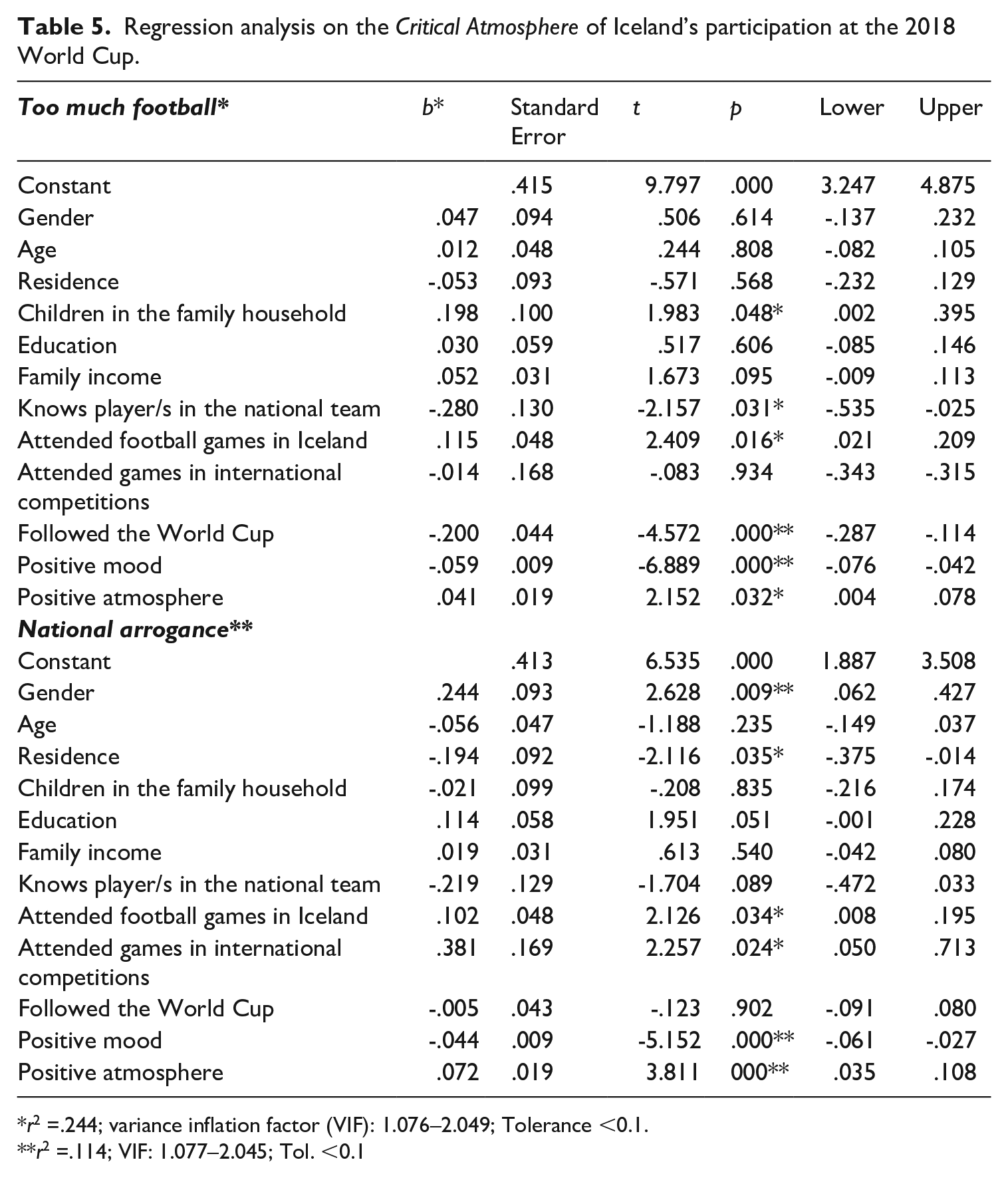
r2 =.244; variance inflation factor (VIF): 1.076–2.049; Tolerance <0.1.
r2 =.114; VIF: 1.077–2.045; Tol. <0.1
Discussion
The results show that Icelanders took a strong interest in the participation of their men’s national team in the 2018 World Cup as around 90% of the respondents followed Iceland’s games to some extent (research question 1). The results further show that – even though the Icelandic team did not do particularly well at the World Cup, with one draw and two defeats – considerable positive individual and collective psycho-social effects were associated with Iceland’s participation in the competition (research questions 2 and 3 respectively), as well as indicating some critical attitudes to the atmosphere around the World Cup. These findings correspond with earlier research which has showed that sport achievement can be associated with a general positive social atmosphere, benefitting both individuals and society (see Elling et al., 2014; Farberman, 2019; Hirt et al., 1992; Ma et al., 2014; Maennig and Porsche, 2008; Sullivan, 2018; Wann, 2006; Wann and Weaver, 2009; Wann et al., 2011; ).
Interestingly, the results from this study show, firstly, that the strong interest in Iceland’s participation at the FIFA World Cup was not confined to football fans, but was common among the general population of Icelanders, across genders, age, residence and levels of education. Women were, for instance, as interested in following the competition as men were. The interest of women in the competition is particularly noteworthy since football fandom is predominantly considered as a male domain (Pfister et al., 2013). However, as Meier and Leinwather (2012) have noted, for instance, when the German national team play live football on television, German women tend to follow men as far as watching is concerned. This also seems to be the case in Iceland. According to the results, Icelandic men show a somewhat more general interest in football as a sport than women, and men were also more likely to follow the national teams playing abroad. However, Icelandic women were as interested as men in following the games of the Icelandic team at the World Cup and women were even more likely to experience a positive attitude from others and less likely to experience national arrogance than men were during the World Cup. These findings are somewhat in line with former research, which showed that women are more socially motivated to watch sports, which includes being around friends and family, rather than for the sport itself, than men are (Meier and Leinwather, 2012; Wann and Waddill, 2003; Wann et al., 2008). It is further important to bear in mind that Iceland has regularly topped the World Economic Forum Global Gender Gap Index in recent years, which also reveals gender equality in Icelandic sports (World Economic Forum, 2018). Thus, sports are not only a male domain in Iceland, and women’s participation in sport, such as in football, has been steadily increasing in recent years, closing the gap on men, which could further explain the interest of women in the competition (Halldorsson, 2018a).
Secondly, the results indicate a strong and general association of Iceland’s participation in the World Cup with a positive mood and social atmosphere in Iceland around the competition. However, the majority of respondents, on the one hand, felt life in Iceland was too focused on football during the competition and, on the other hand, that Icelanders had been filled with too much nationalistic arrogance during the competition, which can accompany such sporting successes (see Reich, 2019; Thórisdóttir and Karólínudóttir, 2014). These findings may appear contradictory to one of the main conclusions of the paper; that is, that Icelanders seem to have shown general interest and pride in Iceland’s participation. As the results suggest, it was typically those who do not take a strong interest in football who were critical of the atmosphere around the competition – this could arguably include the group that is sometimes labeled ‘the anti-sportist’ in the Icelandic discourse – but, more interestingly, it was also those who experienced a positive mood around the competition. It can be argued that those who experienced a positive mood around the World Cup, but were also critical of the extent of football coverage in Iceland and the national arrogance of the Icelanders associated with the competition, invested more emotionally in the competition than others, and thus experienced both the positive and negative sentiments of Iceland’s participation. An important aspect of national identity is how societies remember past events (Halbwachs, 1992), and such collective memories can be especially strong among small and relatively homogenous social groups, such as Icelanders (Wieting, 2001). It is further relevant, in this respect, to place Iceland’s participation in the 2018 World Cup in a socio-historical context where it can be argued that the skepticism of Icelanders regarding nationalistic sentiments, which arose during the competition, was linked to the national embarrassment the nation faced in its infamous 2008 economic meltdown. The international economic expansion of Iceland in the mid-2000s was considered a great success, led by the adventurous Icelandic Business Vikings. This ‘success’ was interpreted in highly nationalistic terms in Iceland, which became established in the social discourse as a result of a special characteristic of Icelanders as a nation (Loftsdottir, 2015: 9; see also Durrenberger and Palsson, 2015; Pálsson and Guðbjörnsson, 2011: 138; Thórisdóttir and Karólínudóttir, 2014). Incidentally, the term ‘Vikings’ was no coincidence since Icelanders take pride in their Viking origins (cf. the Viking Thunder Clap referred to earlier; see also Thorlindsson and Halldorsson, 2019b). However, as was eventually revealed in the aftermath of the 2008 economic meltdown in Iceland, the meltdown was predominantly caused by the nationalistic arrogance and recklessness of the nation’s representatives (and former heroes), the Business Vikings. The recent collective memory of the nation’s embarrassment at having attributed the economic ‘success’ to Icelandic superiority leading to the economic meltdown may have restrained many Icelanders from producing a similar narrative in regard to its football success. It has indeed been argued that Iceland’s football success is not the result of some genetic superiority of the Icelandic race, but rather that, due to increased opportunities at international level and the social organization of sport in Iceland, their teams have been able to pull through to the top levels (Halldorsson, 2017). Although Icelanders can rightly be proud of the nation’s sport success in recent years, this success does not make Icelanders a superior breed. The past failures of the Icelandic team – in which Iceland was ranked number 131 in the FIFA ranking in 2012 – and the sudden decline of other ‘small’ nations from the international sports scene, should prove the point (see Telseth and Halldorsson, 2019).
Moreover, as stated above, experienced individual and collective feelings and sentiments associated with football success, such as those of Icelanders, are usually short-lived. Most research shows that those sentiments weaken progressively as time goes by (Berument and Yucel, 2005; Hallmann et al., 2013; Van Hilvoorde et al., 2010; Pawlowski et al., 2014). If, however, such positive and collective feelings are reinforced on a regular basis, they can manifest themselves in the social consciousness. In the case of Iceland, we can bear in mind that the Icelandic sport teams – in football, team handball and basketball – have been regular contestants at major international sporting competitions in recent decades and thus have regularly boosted the pride of Icelanders (Halldorsson, 2017). The men’s handball team has been most successful through the years, winning an Olympic silver medal in 2008 and a European Championship medal in 2010 (Thorlindsson and Halldorsson, 2019a). The major handball competitions are held at the beginning of January each year and probably have had a lasting impact through the years on the national psyche of Icelanders in the dark and cold winter months. It can, therefore, be argued that these positive and collective sentiments are regularly reinforced through the Icelandic national sport teams, thus earning sports a particular place of honor in the social atmosphere and the Icelandic national consciousness. This function of sport could be especially relevant in a somewhat secular and small society like Iceland, as the findings suggest, where such sport success can bring people closer together, strengthening their experiences of kinship (Halldorsson, 2017; Pétursson, 1990).
Finally, this research has some limitations in terms of its data and interpretation of the results. First, although the survey was administered to represent the population of Iceland (over the age of 17) it fell just short of 1000 participants. Thus, the results from the survey should be interpreted cautiously since they do not necessarily represent the whole population of Iceland. Second, the survey did not reach those Icelanders aged 17 or younger, who are the most active sport participants in Iceland (Halldorsson, 2018a) and thus leaves an important gap between generations. Third, the survey was conducted at a single point in time, so it cannot be argued that the positive mood and atmosphere associated with the World Cup is a norm when Icelandic teams play, because no other measures of this kind are available for Icelandic sport. Consequently, the long-term psycho-social impact of Iceland’s participation in the World Cup cannot be determined on the basis of this analysis, only that Iceland’s participation in the 2018 World Cup was associated with a short-term positive individual mood and a social atmosphere of particular importance to individuals and Icelandic society.
Conclusion
It can be argued from the findings of this paper that sports are much more than a game. When national sport teams play in major competitions, they can in this sense spark what Durkheim (1965) called a social electricity, which affects almost everyone in a given community. The conclusions, which confirm the general interest among Icelanders in the football World Cup, therefore seem to highlight the social and integrative function of such a sporting contest for Icelandic society, at least for the short term. It can, in this context, be argued that sports can now perform some of the social functions religion had in the past; that is, to foster connections across social groups and to strengthen a nation’s collective consciousness through national team sports (Durkheim, 1965; Giulianotti, 2005: 1–14). The results show, in this sense, how a national sport success is associated with its citizens’ sentiments of national identity, patriotic pride and a sense of belonging to something more meaningful than they usually experience – its clan – in their mundane everyday lives (Durkheim, 1965; Moffet, 2019). It can be argued, furthermore, that many of the customary and potential integration moments of collective happenings and experiences of people in any given society, which they share together and from which they build the perception of imagined communities (see Anderson, 1983), are dwindling (Livingstone, 2007). This makes sporting events such as national team competitions even more important for collective social integration and national identity than ever before, with all of their promises for social integration – as well as their potential dangers associated with promoting national arrogance.
Footnotes
Declaration of conflicting interests
The author declared no potential conflicts of interest with respect to the research, authorship, and/or publication of this article.
Funding
The author disclosed receipt of the following financial support for the research, authorship, and/or publication of this article: This research was funded by the University of Iceland Research Fund.
