



Abstract
This article looks at how high-profile individual and collective actors within the worlds of sport and politics seek to advance their views on significant social issues. It focuses on the public debate around the anti-racist actions taken by the England men's football team at Euro 2020 and uses a form of critical discourse analysis to look at how the England manager and players, on one side, and members of the UK Government, on the other, sought to gain and maintain legitimacy for their opposing positions. It also seeks to understand legitimacy as a relational process, by looking at how members of the public and national newspapers responded. Drawing on Strittmatter et al.'s framework of legitimacy, the article examines the subjects, sources, strategies, bases and scenarios of each side's efforts. The article seeks to contribute to a more detailed understanding of political discourse and legitimacy in the context of sport, as well as offering some critical reflections on the nexus of sport and politics.
Euro 2020 – the international men's football championship of Europe – took place in summer 2021, a year later than scheduled, due to the coronavirus pandemic. Before every match, the England men's team, who ended up losing in the final to Italy, ‘took the knee’. According to an official statement by the English Football Association, this was ‘a mechanism of peacefully protesting against discrimination, injustice, and inequality’ (The FA, 2021). There was a wider background to this. In 2016, US football players Colin Kaepernick and Eric Reid began to kneel during the national anthem, with Kaepernick explaining that this was a protest against police brutality and oppression against people of colour (Niven, 2021). Other people, both within sport and outside, then began to take the knee to protest publicly against discrimination. This gained much greater prominence following the killing, in the United States in 2020, of George Floyd, a black man, by a white police officer. The killing sparked multiple protests across the world and the action of ‘taking the knee’ became seen, in the United Kingdom and elsewhere, as an expression of solidarity with the anti-racist protests.
This action by the England men's football team sparked major debates in the United Kingdom. When the team took the knee during their warm-up matches for the tournament, a proportion of England fans inside the stadiums audibly booed. This gained wider public consciousness and attracted attention from politicians, sports figures, journalists, and cultural commentators. The England team defended their right to protest and consistently reiterated that their aim was to highlight racial injustice and to fight for equality (The FA, 2021). Meanwhile, a number of prominent commentators – many associated with right-wing politics – criticised the England team's position. As just one example, Nigel Farage, former leader of the United Kingdom Independence Party (UKIP), argued that taking the knee was ‘divisive’ and linked to Marxism (Farage, 2021).
In essence, this can be seen as a battle for legitimacy, in which each side sought to gain and maintain legitimacy for their stance through particular public actions and statements (Johnson et al., 2006). It can also be seen as one more manifestation of the nexus of sport and politics (Gift and Miner, 2017). The intertwinement of sport and politics is well recognised and has been well explored (Bairner et al., 2016; Grix, 2017). Indeed, more than two decades ago, Washington and Karen (2001) observed that the uneasiness with which these two phenomena co-exist is reflective of the characteristics they both display: conflict and competition; near-ubiquity in public life; and the ability to inspire wildly contrasting thoughts and emotions among the public at large. Researchers have examined a number of aspects of the sport-politics nexus, including sport and international relations (Levermore and Budd, 2004), sport and diplomacy (Murray, 2012) and the role of sport in state politics (Lin et al., 2008). Researchers have also studied political discourse within sport, examining, among other things, the Black Lives Matter movement in football (Rudwick and Schmiedl, 2023) and military-related remembrance rhetoric (Kelly, 2023).
To date, however, little research has focused directly on the role of legitimacy in these various discursive contexts. That is what this article seeks to do. Specifically, it asks: how do sports stars and politicians seek to gain and maintain legitimacy for their views? It seeks to answer this question through a critical discourse analysis of the ‘take the knee debate’, where critical discourse analysis is accepted as an appropriate way to examine the ‘social practices, individuals and institutions that make it possible or legitimate to understand phenomena in a particular way’ (Hodges et al., 2008: 570). An understanding of legitimacy, in particular the dynamics through which legitimacy claims are made and responded to, is increasingly relevant when analysing sport and politics, both separately and together. Several recent studies have highlighted this in sport policy (e.g. Broch and Skille, 2019; Ronglan, 2015), including by noting how elected politicians are deliberately targeting the legitimacy of sport bodies and their spending decisions. In politics, the last few years have seen an increasing focus on issues of legitimacy and authenticity, linked in part to the rising significance of the so-called ‘culture wars’ (Cammaerts, 2022). The legitimacy of institutions and the importance of understanding communication around them are now more central to political analysis, as, for example, Dellmuth and Tallberg (2021) show in their study of international organisations.
Beyond this, the article makes a further contribution to our understanding of social identity. While social identity has traditionally been examined in sport in relation to fandom (Hirshon, 2020), this article highlights the ways in which social identity shapes legitimacy claims and responses within sport-politics discourse. In so doing, the article identifies the even closer intertwinement of sport and politics over time and how this is influenced by the long-standing tribal nature of sport fandom. Of course, the issues we are looking at here – racism, the action of taking the knee – are complex, contentious, societal issues. In this sense, the analysis of a specific episode can only provide limited insight. Nevertheless, it is worth exploring particular cases for their intrinsic interest and for the more general trends they can signify.
The article is structured as follows. The next section offers a critical review of academic literature on the sport-politics nexus, athlete activism, discourse and legitimacy. The following section explains and justifies the methodology used in the study. Then, the subsequent sections present the analysis: first, we conduct a critical discourse analysis on three key texts from the ‘take the knee’ debate; second, we analyse the legitimacy strategy each side deployed; and third, we discuss how successful each side was in securing legitimacy among their intended audiences over time. Finally, we discuss the implications of our analysis and draw conclusions.
Theoretical background
The sport-politics nexus
More than 15 years ago, Lin et al. (2008: 23) argued that it was ‘no longer possible for any serious social commentator to posit a separation between the worlds of sport and politics’. Since then, these worlds have only become more entangled. Much has been written about the extent to which politics directly affects sport, with Houlihan and Lindsey (2012), among others, referring to sport as a ‘policy taker’, rather than a ‘policy maker’. Throughout history, governments and individual politicians have used sport as a vehicle to achieve their own, nonsport-related aims. However, the relationship between sport and politics is not unidirectional.
In a review of Beyond a Boundary by C.L.R. James, Carrington (2013) discusses how sport is interconnected with society at large. In particular, he focuses on how sport plays a fundamental role in framing issues of race and he rejects the notion that sport is simply a domain where ‘race happens’ (2013: 389). Indeed, Gift and Miner (2017: 17), among others, highlight how Colin Kaepernick's activism ‘inspired virulent debate’ throughout American society and beyond, when he began to take the knee in protest against racism and police brutality. In Australia, Allsop (2008) had already argued that sport had been turned into a battleground within the so-called ‘culture wars’ between proponents of right-leaning and left-leaning socio-political value systems. Together, these and other accounts demonstrate how sport, as a socio-cultural phenomenon, actively shapes and influences public opinion and debate.
The dynamics of this process are further analysed in Seippel et al.'s (2018) study of how sport is politicised. Their primary finding is that sport can enter the political sphere when issues are articulated, when interest is mobilised, when claims have ideological resonance in the public sphere and when someone responds to the mobilisation. At points in their analysis, they discuss legitimacy. For example, drawing on Stenling and Sam (2017), they argue that within the process of mobilisation, those approached with political claims ‘should also feel a certain responsibility for the issue – a need to legitimize their behaviour with respect to the issue – and have a capacity to do something about it’ (p. 670). Elsewhere, they make the point that certain key actors (e.g. commercial, or international actors) often do not depend, or do not depend greatly, on political legitimacy. Yet, their analysis does not go into specific detail on processes of legitimacy, that is, how actors seek to gain and maintain legitimacy for particular views. To be clear, the authors do not set out to do this, but, as we argue below, a closer focus on the concept of legitimacy can offer valuable insight into political discourse in sport, revealing the micro-processes through which actors seek to advance their views. One arena where these legitimacy contests increasingly play out is athlete activism and it is to this we now turn.
Athlete activism
The act of ‘taking the knee’ is a prominent example of athlete activism. Much of the existing academic research on athlete activism has focused on the United States and its collegiate and professional sports competitions, in particular looking at issues around ‘race’ (e.g. Agyemang, 2012; Edwards, 2016; Frederick et al., 2019; Sanderson et al., 2016). One of the principal themes is the way in which black (usually male) athletes are categorised as role models. Considering athletes in this way emphasises their exceptional ability to influence the attitudes of others (Melnick and Jackson, 2002), which is relevant when seeking to understand how they can frame a point of view as legitimate. Another related theme, particularly relevant here, is the potential for sport fans to either support or oppose athlete activism, with Sanderson et al. (2016) and Frederick et al. (2019) examining numerous examples of ‘fan backlash’. The ‘role model’ tag has also placed a very high level of expectation on black athletes to agitate for social change. To illustrate this, both Agyemang (2012) and Frederick et al. (2019) refer to criticism of Michael Jordan for allegedly failing to use his platform to promote social justice and raise awareness of the black American experience.
Given the majority of research on athlete activism has focused on the experiences of black athletes in the United States, it is unsurprising that many studies are grounded in critical race theory (CRT). Among the key tenets of CRT are that racism is structural and pervasive in society and that ‘race’ is socially constructed (Delgado and Stefancic, 2017). CRT has illuminated key aspects of athlete activism: for example, Frederick et al. (2019) have drawn on CRT to show how protests within sport should be perceived as a challenge to the societal system at large and, further, how this illustrates the intertwinement of sport and politics. Less common, but still regularly used in research on athlete activism, is social identity theory, pioneered by Tajfel (1981) and emphasising how human identity is ‘fluid, contingent, and socially constructed’ (Huddy, 2001: 127). For example, Pelak (2005) explored the phenomenon of athletes as agents of change in South Africa, arguing that social identity theory could explain the collective actions of athletes who cultivated a shared experience and understanding alongside one another.
Social identity theory (SIT) is particularly appropriate for our study, emphasising as it does the ways in which socially identifiable groupings form and are sustained through shared (and competing) sets of values. For example, Sanderson et al. (2016) drew on SIT to examine the public reaction following anti-racism protests from some St. Louis Rams players They argued that the fan backlash was not necessarily caused by the content of the players’ protests, but rather offended fans’ sense of unity and togetherness with the team, that is, as a socially identifiable group with a broadly prototypical set of values. Indeed, as Huddy (2001: 128) argues, social identity is often a ‘powerful ingredient’ determining biases and conflicts within and between groups. We draw here on SIT to frame the ways in which actors sought to gain and maintain legitimacy for their views. Next, we turn to legitimacy itself, specifically as it plays out in particular discursive contexts.
Legitimacy in discourse
The ‘take the knee debate’ played out through symbols, rhetoric, arguments and gestures – in short: discourse. We therefore attempt to make sense of the debate through discourse analysis, which in the broadest sense can be defined as the ‘study of texts’ (Gill, 2000: 172). Discourse analysis has two prominent principles: first, a meticulous critique of the methods by which meaning is conveyed (Gill, 2000) and second, the notion that discourse does not simply describe the world, but constitutes it (Hardy and Thomas, 2015). We discuss the detail of our methodology in the next section, but it is useful to discuss our general orientation towards discourse here, especially as it relates to the concept of legitimacy.
As Potter et al. (1990) note, there were several strands of early work on discourse analysis, ranging from cognitive-based research on discourse processes, through more sociolinguistic approaches, influenced by speech act theory, to those approaches influenced by post-structuralism and semiology and Foucault in particular. Potter and Wetherell (1987), with some nuance to the discussion, situate their seminal work, Discourse and Social Psychology, in the latter strand – and this is the broad tradition we follow. This approach to discourse analysis is still concerned with linguistic minutiae, but it is particularly concerned with the wider social context that constitutes and is constituted by discourse. In this sense, our approach is also influenced by Van Dijk's (2009) close attention to context, that is, the ‘social and situational aspects of communicative events’ (p. 2). As befits an approach influenced by Foucault, we are also interested in power. As Hardy and Thomas (2015) argue, discourse is knowingly deployed by actors pursuing their plans and projects. In this sense, it is directly connected with the pursuit and consolidation of power and authority (Hardy and Thomas, 2015; Stolowy et al., 2019). This is also the broad approach of Fairclough (1992: 4), who argues for a ‘combination of this more social-theoretical sense of “discourse” with the “text-and-interaction” sense in linguistically oriented discourse analysis’. As we discuss below, we draw explicitly on Fairclough and Fairclough's (2012) political discourse analysis to examine our texts.
Existing literature emphasises that discourse is intrinsically linked to legitimacy (Stolowy et al., 2019; Suchman, 1995; Wry et al., 2011). Van Dijk (2009: 44) makes this explicit, when he discusses how an actor's ‘context model’ typically ‘represent[s] at least some (major) reasons or motives why they engage in the current discourse or the social or political act(s) being accomplished by them (such as to “defend a policy” or “to seek legitimation” by a speech in parliament)’. Legitimacy itself is generally considered to be actions or phenomena that are societally recognised as ‘appropriate’ (Suchman, 1995: 574), ‘acceptable’ (van Dijk, 1998: 124) and ‘right and proper’ (Zelditch, 2006: 352). However, there are differing arguments about the nature of legitimacy and how it is manifested. The principal one is whether we ought to consider it a property, or a relational process. For example, while some consider legitimacy as an ‘asset’ that is owned by an actor, or group of actors, Suchman (1995: 594) argues that legitimacy ‘represents a relationship’ between the originators of discourse and their audience. There is a parallel here with other concepts, such as social capital. For example, Putnam (1993) was criticised for treating social capital as ‘an individual attribute that constitutes a fully portable resource’ (Foley and Edwards, 1999: 149), when instead it is much more conceptually coherent when understood as embedded in webs of social relations. We subscribe to the latter interpretation of legitimacy as a relational process and argue, along with a number of other authors, that audiences constitute important evaluators of discourse and conferrers of legitimacy (Stolowy et al., 2019; Suchman, 1995; Wry et al., 2011). As we discuss below, we try to get at this, at least in part, through our examination of text, context and responses.
Various theoretical frameworks have been employed to analyse legitimacy. For example, Suchman (1995) proposed a typology based on three categories of legitimacy, namely pragmatic, moral, and cognitive, while Zelditch (2006) focused on the process of legitimation, considering redistributive politics, the consequences of legitimacy for the stability of authority, and justifications. While both of these offer valuable insights, we draw instead on Strittmatter et al. (2018), who developed a framework for analysing legitimacy in the policy-setting lifecycle. This framework is presented as a tool by which the concept can be examined in full recognition that legitimacy is ‘a continually unfolding process in which different scenarios can be identified at different points in time’ (Deephouse et al., 2016: 4). It is particularly relevant here, as it was not only developed in the context of sport, but also pays explicit attention to shifts in legitimacy, which characterised the ‘take the knee debate’. We discuss this framework, along with the other aspects of our methodology, in the next section.
Methodology
The framework for this study is critical discourse analysis – more specifically, political discourse analysis (PDA). We argue that PDA is the most appropriate version of discourse analysis for examining the ‘take the knee debate’, as it focuses on argumentation as a core element of the approach (Fairclough and Fairclough, 2012). Conducting a PDA requires focusing on values, goals, circumstances, means-goals and claims for action, as visualised in Figure 1.

Political discourse analysis: Structure for political arguments (figure adapted from Fairclough and Fairclough, 2012).
When undertaking a PDA, researchers must take care to truly engage with the context and purpose of the speech. Within political speech, this is commonly the aim to ‘convince an audience that a certain course of action is right or a certain point of view is true’ (Fairclough and Fairclough, 2012: 18). The success or otherwise of this aim can be analysed through an exploration of the legitimacy afforded to the set of views, values or norms being espoused.
To analyse legitimacy, we draw on Strittmatter et al.'s (2018) framework, which is grounded in Deephouse et al.'s (2016) work on the ‘six key questions’ of legitimacy, namely:
What actor is seeking legitimacy?
What is the subject of the legitimating act?
Which legitimating source(s) may confer/be perceived to confer legitimacy to this subject?
Which legitimating strategy is used?
Which base(s) of legitimacy is/are invoked?
In which scenario does the legitimating act take place?
We selected three key texts to represent the two sides of the ‘take the knee debate’. The first is the open letter written by Gareth Southgate, the manager of the England men's football team, entitled Dear England and published in The Players’ Tribune on 8 June 2021 (Southgate, 2021). This can be seen, broadly, as a plea for unity among England fans in support of the team and their ‘take the knee’ protest. On the opposite side of the debate, we analyse two texts from Conservative politicians: the then UK Home Secretary Priti Patel's interview with television channel GBNews (Patel, 2021a) and the then Leader of the House of Commons Jacob Rees-Mogg's interview in a podcast produced by ConservativeHome, a blog closely associated with the Conservative Party (Rees-Mogg, 2021).
In choosing the texts for analysis, we deliberately selected those produced by figureheads for both sides. Southgate was the national team manager and, within the text of the letter, he explained that while his was a personal explanation, he also wrote on behalf of the players, making this the key text for publicly articulating the reasons behind the protest. On the other side, Patel and Rees-Mogg were, at the time, key political figureheads, who articulated critical views of the protest and, as Home Secretary and Leader of the House of Commons, had a broadly comparable standing to Southgate within politics. The choice was also a pragmatic one, in that the latter two texts were similar in length to Southgate's open letter, meaning the analysis was at least comparable in terms of length and so not obviously distorted by the depth of argument, justification or context on one or other side.
We also sought to evaluate the success of each side in securing legitimacy. First, we examined publicly available opinion polls from YouGov and Opinium: two organisations that possess a strong record of polling accuracy (Barnes, 2019) and who are both members of the British Polling Council. Second, we reviewed media coverage throughout Euro 2020. We focused on coverage in two newspapers: the Guardian and the Daily Mail. These were selected because they can be argued to represent the two sides of the ‘culture wars’: the Guardian is broadly liberal and left-wing, whereas the Daily Mail is broadly supportive of conservative, right-wing values (Smith, 2017). Specifically, we searched the Database of International Publications for editions of these two papers dated between 1 June 2021 (the day before England's first warm-up game) and 13 July 2021 (two days after England's final match). Other than the final, we reviewed editions of these newspapers on the day before, the day of and the day after an England match. As an exception, we extended the search to two days after England's final match, as the previous day's editions were published before incidents of racism towards England's black players were widely known about. We included in our analysis all articles that referenced England players ‘taking the knee’. Our analysis of the newspaper articles was more general than our analysis of the main texts. We conducted a basic content analysis of the articles that categorised them broadly as supportive of, critical of, or neutral towards the ‘take the knee’ protest.
Analysis
Dear England: Political discourse analysis
As an open letter, Dear England offers things the recipient of a letter would expect: personal stories, questions, suggestions and emotive language (Figure 2). But it is also a broad claim for legitimacy. Southgate starts the letter by setting out the wider circumstances around Euro 2020, referring to, but not naming, the coronavirus pandemic, as well as the protests following the murder of George Floyd: ‘It has been an extremely difficult year. Everyone in this country has been directly affected by isolation and loss’. He discusses the immediate circumstances of the tournament, but states explicitly that ‘what I want to speak about today is much bigger than football’.
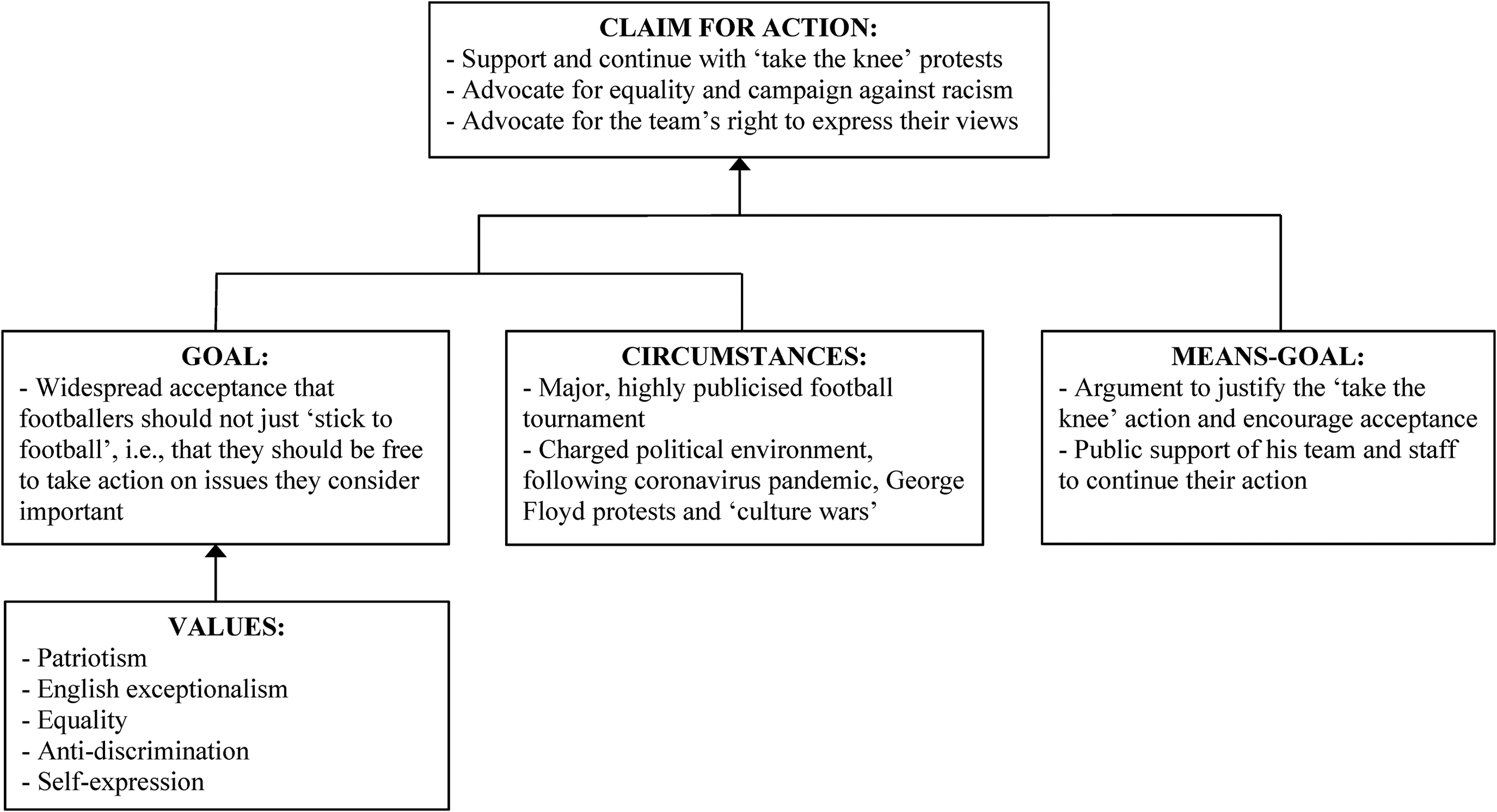
Political discourse analysis of ‘Dear England’ letter (figure adapted from Fairclough and Fairclough, 2012).
Throughout the letter, Southgate makes repeated references to values, in particular patriotism. Specifically, he refers to experiences and institutions that are widely considered to be bastions of patriotism within England. First and foremost, this is the England men's football team itself, considered the most popular sports team representing the country (YouGov, 2022). But beyond this, Southgate refers to Queen Elizabeth II, the British military, and pageantry: ‘For me, personally, my sense of identity and values is closely tied to my family and particularly my granddad. He was a fierce patriot and a proud military man, who served during World War II. The idea of representing “Queen and country” has always been important to me. We do pageantry so well in Britain’.
These institutions are closely intertwined with the prototypical image of an English football fan (Penn and Berridge, 2018). By invoking them, Southgate not only extends his attempts to establish common ground between him, the team and England fans, but also seeks to dismiss suggestions that England's players are not patriotic. He then reinforces the notion of patriotism with language that invokes the concept of English exceptionalism: ‘Regardless of your upbringing and politics, what is clear is that we are an incredible nation […] that has contributed so much to the arts, science and sport. We do have a special identity’. Here and elsewhere, Southgate's language is near-hyperbolic, as if he is attempting to transcend the typical values and political opinions that can be divisive in modern society.
His key objective in the letter – the ‘goal’, in PDA terminology – is to encourage England fans from all backgrounds to not only unite behind the team, but also accept the ‘take the knee’ action and what, in the players’ view, it represents: ‘It's [the players’] duty to continue to interact with the public on matters such as equality, inclusivity and racial injustice, while using the power of their voices to help put debates on the table, raise awareness and educate’. Importantly, he also stresses: ‘I have never believed that we should just stick to football’. The phrase ‘stick to football’ is recognised as a generic dismissal of athletes’ rights to speak out for what they believe in and this latter point directly challenges the assertion of Southgate's opponents that sport and politics should not mix.
Throughout the letter, he uses both storytelling and personalisation techniques (Wry et al., 2011) to bolster the legitimacy of the claim for action. Early on, for example, he evokes humility and self-deprecation: ‘At home, I’m below the kids and the dogs in the pecking order but publicly I am the England men's football team manager’. This is likely intended to humanise and create relatability towards him and the players, whom Southgate acknowledges ‘aren’t as accessible to fans’ as they once were. He also implores fans to buy into his personal trustworthiness when he emphasises ‘believe me’, referring to how desperate England are to win the tournament. In a continuation of this theme, Southgate refers to shared experiences from his own recollection of history, attempting to further expand the common ground between him and the reader. For example, he writes: ‘The first England match I really remember watching was in the 1982 World Cup […] I was obsessed. I had the wall chart, ready to fill in with every result, every goal scorer, every detail’.
In doing this, Southgate reminds detractors that, as England fans, they are all part of the same group, seeking to emphasise this particular social identity. Indeed, he is clearly committed to creating a sense of shared identity: ‘It's about how […] we create memories that last beyond the 90 minutes. That last beyond the summer. That last forever’. Again, Southgate's use of rhetorical repetition here constructs a story. He encourages the reader to believe that the ‘take the knee’ protests are part of a wider narrative arc – one in which there is an ostensibly happy ending, namely the eradication of racism. This storytelling technique also enables the evocation of heroes and villains, and he addresses those who boo as follows: ‘Unfortunately for those people that engage in that kind of behaviour, I have some bad news. You’re on the losing side. It's clear to me that we are heading for a much more tolerant and understanding society’.
Alongside this, Southgate deploys explicit questioning: ‘Why would you tag someone in on a conversation that is abusive? Why would you choose to insult somebody for something as ridiculous as the colour of their skin?’ This technique encourages the reader to examine their own response to the ‘take the knee’ protest and it criticises, albeit subtly, the values of those who oppose the action. Posing this criticism as questions, however, allows him to limit his confrontational language. True to his managerial style, he advances his views in the style of a friend putting his arm around a companion's shoulder and having a firm but fair word in their ear.
‘Gesture politics’ and ‘patriotism’: Political discourse analysis
Priti Patel, the then UK Home Secretary, was asked about her reaction to the England team's ‘take the knee’ protest during an interview with GBNews (Patel, 2021a; Figure 3). Her first response was: ‘Look, I just don’t support, you know, people participating in…that type of…gesture politics’. The Cambridge Dictionary defines gesture politics as ‘any action by a person or organization done for political reasons and intended to attract public attention but having little real effect’. This was, therefore, a direct challenge to the argument of Southgate and the England team that the protest was intended to raise awareness, educate people and ultimately shape the opinions of the public at large when it came to racism. Her response attempted to nullify the England team's protest – not through direct contradiction, but through dismissing its validity as a credible argument promoted by credible individuals who have a right to put forward their views.
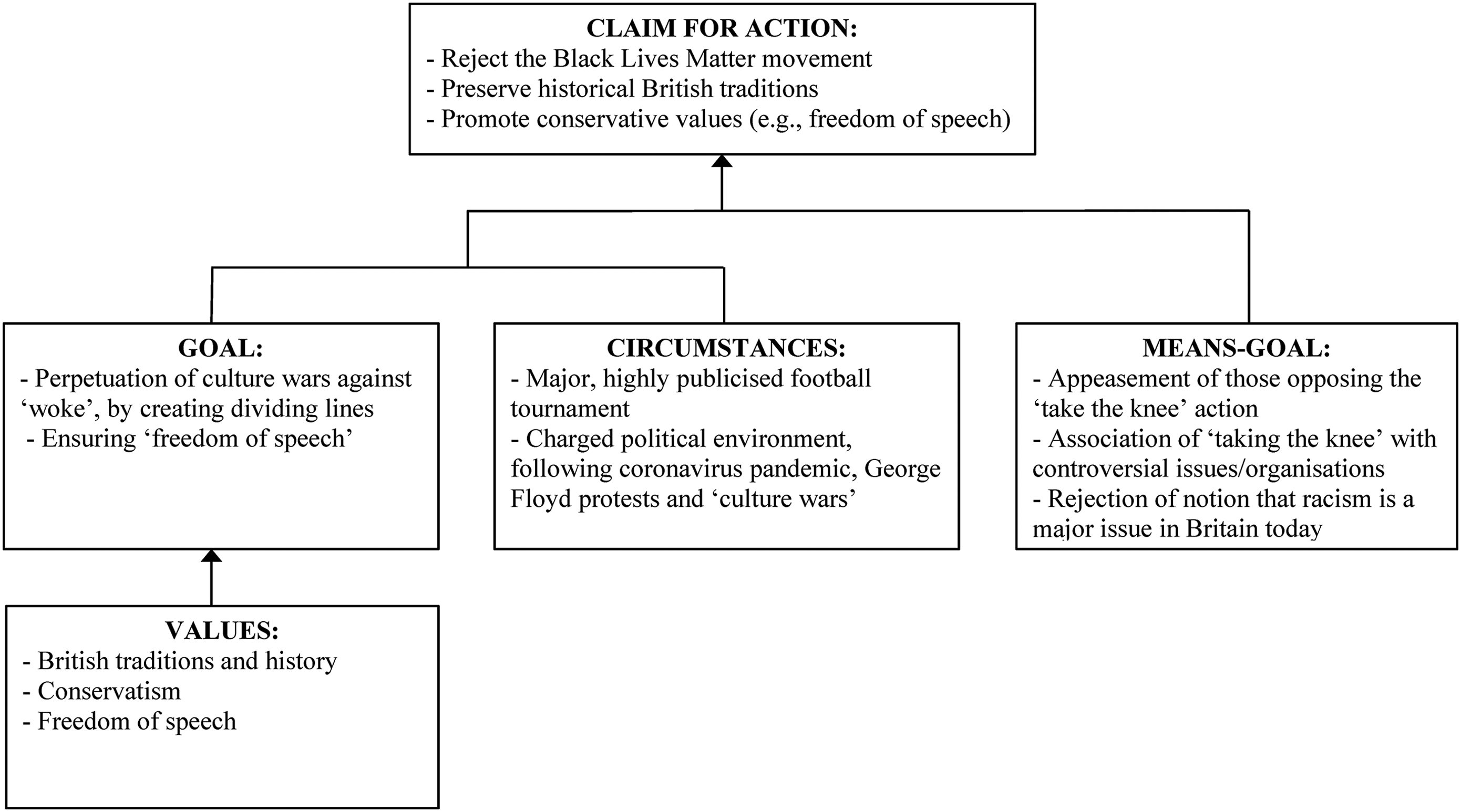
Political discourse analysis of ‘gesture politics’ argument (figure adapted from Fairclough and Fairclough, 2012).
In his interview, Jacob Rees-Mogg (2021), then Leader of the House of Commons, argued that the ‘take the knee’ action was ‘problematic, because…the symbol of taking the knee has become associated with the BLM [Black Lives Matter] movement’. He continued: ‘So, I think the difficulty is over the symbolism that has become attached to taking the knee – which is, in fact, an American issue that relates to people kneeling down during the national anthem, which is sung before all sorts of games in the US, in the way that it just isn’t in the United Kingdom’. Rees-Mogg's repeated emphasis on the action as ‘symbolic’ links with Patel's characterisation of it as ‘gesture politics’. Further, he explicitly associates the action with the Black Lives Matter movement, which at the time was linked with a broad range of objectives, including de-funding the police. This was despite the England team explicitly stating on multiple occasions that they were not supporting Black Lives Matter – or any other political organisation (The FA, 2021). Rees Mogg's argument works, therefore, to deliberately conflate the players’ anti-racism message with other (political) aims that would be considered far more controversial.
Moreover, Rees-Mogg argues that the protest is somehow un-English – a direct challenge to the patriotic values that Southgate espoused on behalf of the team. He further emphasises this argument when he says of the fans who have been booing the ‘take the knee’ gesture: ‘I think they are booing the BLM movement. I think that's quite clearly a reaction to…what is now known about BLM and the…underlying political message, which is one that is not sympathetic to the United Kingdom as a nation’. The argument here is intended to create clear, but perhaps unfounded, ‘us and them’ boundaries – characteristic of tactics deployed by political opponents in the so-called ‘culture wars’ (Gates, 1993). Rees-Mogg's rhetoric can be contrasted with Southgate's approach, which also highlights a dividing line between those who support and oppose the players taking the knee, but urges self-examination on the part of those who oppose it. This represents a subtle but meaningful difference in style: Southgate is attempting to win the moral argument; for Rees-Mogg, the moral argument has already been finalised – people now just see themselves on one side or another.
Patel also commented on themes that are closely linked to conservative social values and similarly referenced the supposedly unpatriotic morality of ‘taking the knee’: ‘I just don’t subscribe to this view that we should be re-writing our history…you know, pulling down statues’. This echoes Rees-Mogg's approach: conflating the England players ‘taking the knee’ with other issues and protests that the England team have not laid claim to, for example, the action in 2020 of trying to take down statues of historical British figures who had links to the slave trade (Moody, 2021). Similarly to Rees-Mogg, Patel positions the ‘take the knee’ protest as a fundamental debate about Englishness, but unlike Rees-Mogg she does not engage directly in the debate about racism. In response to the accusation that those who boo the players’ protests are racist, Rees-Mogg offers a sense of surprise: ‘No! I don’t think there's any evidence that they’re racists. I think calling them racists is unfairly attributing views to people who have been part of a movement, in football, that has taken huge strides to reduce racism…’ Whether deliberately or not, the effect of this argument is to minimise the scale of the racism that the players and their supporters state they are trying to overcome. In turn, this creates the impression that the protest itself is an unnecessary overreaction to an issue that does not exist, or exists in only a limited way.
Overall, Patel and Rees-Mogg tended to focus their arguments on the style of the protest, rather than the substance. There is no evidence in the arguments put forward that Patel or Rees-Mogg personally condone racism. However, given their influential position as high-level Government ministers, there was also no obvious recognition of the social ramifications of endorsing people actively rejecting an anti-racism protest. Patel subsequently found herself accused of hypocrisy when, less than a month after her interview, and after several black players on the England team were subjected to racist abuse after the final of Euro 2020, she tweeted, ‘I am disgusted that @England players who have given so much for our country this summer have been subject to vile racist abuse on social media’ (Patel, 2021b). As we discuss below, it is likely that this shift in tone and content was influenced by the increasing public perception that racism was present and problematic in UK society.
Analysing legitimacy
Table 1 sets out the various elements of legitimacy identified in Strittmatter et al.'s (2018) framework.
Elements of legitimacy.

In both the act of protesting, and their public statements about their protest, the England team were attempting to highlight the racism experienced by (in particular) black people, in modern, Western societies. As per Southgate's letter, the over-arching subject of such a protest was to facilitate a continued advancement towards a society where racism is eradicated. This reflects the theory that values, morals and norms gradually evolve over time to create a new status quo. The sources from which the England team were seeking legitimation were – unavoidably, due to their public position – society at large, but perhaps more specifically, supporters of the team. Southgate's letter made a concerted attempt to connect with England supporters through his invocation of recognisable experiences that many England fans will have shared. The rationale for the team to focus in particular on legitimation among England fans can be seen through Wry et al.'s (2011) theory of story-telling, whereby the protest can be viewed as a ‘growth story’ (2011: 452), designed to expand the morals and values that constitute the collective identity of the group.
The legitimation strategy of the team was to continue the public display of protest through the ‘taking of the knee’, notably engaged in by all members of the team and its staff, regardless of ethnicity. This act of solidarity further supported the intent to promote the values of the protest as a unifying cause that should ideally be shared by all members of the social identity group: the team and its fans. By explaining the protest as a way of highlighting and challenging racism, the team was attempting to build awareness and support for this aim. Due to the values-driven nature of the legitimation subject, the bases of legitimacy were moral and cultural-cognitive. The cultural context of George Floyd's death and subsequent protests were clearly fundamental to the actions of the team.
Finally, the scenario in which the legitimating act took place was ‘institutionally innovating’, namely a ‘radical attempt to shift and challenge…norms’ (Deephouse et al., 2016: 22). While opposition to racism is not radical in the context of the United Kingdom in the 21st century, there were elements of the players’ protest and attempts to seek legitimacy that could be considered ground-breaking. First, while there is a strong tradition of athlete activism in the United States, this is not the case in the United Kingdom, so the action of taking the knee was unprecedented in popular British sport. Second, participation in the protest by players and staff of all ethnic backgrounds marked a departure from the typical situation in which anti-racism protest by athletes is the domain of non-whites. Finally, based upon opinion polling indicating that almost 40% of England fans opposed the ‘take the knee’ gesture (Ibbetson, 2021a), the team persisted with a strategy that knowingly tested the shared social identity between team and fans.
The first objective when considering the legitimacy analysis of Patel and Rees-Mogg is to accurately describe the organisation they constitute. We consider them here as figureheads of those opposed to taking the knee. The reason for this is twofold. First, their comments relating to the England team's protests were broadly reflective of known rhetoric among other opponents of the action. Second, their position as leading politicians within the governing Conservative party was not coincidental: polling conducted in the United Kingdom in 2020 showed that while 37% of respondents thought it was ‘appropriate’ for footballers to take the knee before kick-off in league games, this number was 18% among those who voted Conservative in the 2019 General Election (YouGov, 2020). In this way, the source of legitimation that Patel and Rees-Mogg were appealing to was likely to be Conservative voters, as well as society at large. From a social identity perspective, it can be argued that conferring legitimacy on one or other of these ‘organisations’ was dependent on which social identity was most salient for individuals: being an England fan, or being a voter for a certain political party.
Just as with the England team, Patel and Rees-Mogg's bases of legitimacy were moral and cultural-cognitive, emphasising supposedly patriotic values and opposition to Black Lives Matter protests. By either skirting or minimising the topic of racism, Patel and Rees-Mogg's organisation did not actually have racism as the subject of their legitimation strategy. Instead, the subject was a broad attempt to uphold ‘conservative’ values and criticise so-called ‘woke’ issues (Richardson and Ragland, 2018). This is reinforced in the strategy deployed by Patel and Rees-Mogg, in which they repeatedly sought to conflate the anti-racism message of ‘taking the knee’ with other issues and actions, such as taking down historical monuments, or the aims of the Black Lives Matter movement, including de-funding the police. Within the process of legitimation, this phenomenon is known as ‘hybridisation’ (Deephouse et al., 2016: 23) and is a key indicator that they were attempting to legitimate in a ‘responding’ scenario. While Patel and Rees-Mogg likely recognised that being viewed as not anti-racist was unlikely to secure legitimacy, their attempts to link the ‘take the knee’ action to more controversial issues associated with the Black Lives Matter movement were designed to be more successful within their target audience.
Responses to legitimacy seeking strategies
Polling data shows that 39% of self-identified England fans opposed the ‘take the knee’ gesture at the beginning of the tournament (Ibbetson, 2021a). Unfortunately, no repeat survey was carried out at the end of the tournament, so there is no direct way to track any changes. However, a representative poll of England fans found that the belief that ‘racism in football is a serious issue’ increased by 17 percentage points in the month from mid-June to mid-July 2021 (Ibbetson, 2021b). This provides some evidence that the England team's protest was successful in securing increased legitimacy within this particular target audience. Meanwhile, representative polling in the United Kingdom by Opinium (2021) found that support for the England team ‘taking the knee’ increased by six percentage points (to 56%) across the period of Euro 2020, with opposition to taking the knee decreasing by five percentage points (to 32%). These shifts in opinion, and the widening gap between the ‘support’ and ‘oppose’ factions, suggest that the England team's argument gained greater legitimacy than that of Patel and Rees-Mogg in society at large. Finally, considering Patel and Rees-Mogg's target audience of Conservative voters, YouGov's representative polling found that, between September 2020 and September 2021, the proportion of Conservative voters agreeing with the statement ‘racism is present in the UK today’ increased by six percentage points (YouGov, n.d.). This was a greater increase than observed in the general population (one percentage point). Again, while this shift in perception cannot be solely attributed to the ‘take the knee’ debate in Euro 2020, it offers some support for the conclusion that the England team achieved greater legitimacy over time than did Patel and Rees-Mogg.
In terms of newspaper coverage during the period concerned, the Guardian and Daily Mail each published 17 articles with a strong focus on the ‘take the knee’ debate. As noted earlier, we conducted a basic context analysis of these articles, categorising them broadly as supportive of, critical of, or neutral towards the protest. In the Guardian, 13 of 17 were broadly supportive of the protest, with the other four neutral. As an example of supportive coverage, the 7 June comment piece claimed ‘The England football team…ought to be congratulated for pre-match kneeling to show their opposition to racism’ (The Guardian, 2021). In the Daily Mail, 11 of 17 articles were broadly supportive of the protest, with four neutral and two explicitly critical. The language in these two resonated strongly with the themes raised by Patel and Rees-Mogg, for example regarding attacks on statues and a rejection of the notion that England fans who boo the ‘take the knee’ gesture are racist. An example of this was John Humphrys’ column on 12 June, titled ‘I won’t be a foot soldier in the WOKE WAR: Tomorrow England players will take the knee – and millions quietly weary of statues toppled and buildings renamed will be labelled racist for daring not to support it’ (Humphrys, 2021).
In terms of shifts over time, much of the coverage of ‘taking the knee’ in both newspapers was focused on the warm-up matches and the first tournament match, which took place on 13 June. Between 1 and 14 June, the Guardian published 11 articles on this topic and the Daily Mail published 13, including both of the articles explicitly supporting the Patel and Rees-Mogg argument. Coverage became sparser as the tournament proceeded. This was likely due to two main factors. First, the ongoing success of the England team as they reached the final of the tournament became a dominant, feel-good news story that garnered widespread coverage. Second, as the ‘take the knee’ gesture became part of the tournament's rhythm, it ceased to be ‘new’. Still, news coverage was reignited immediately after the tournament, when three of England's players – Bukayo Saka, Jadon Sancho and Marcus Rashford, all of whom are black – were subjected to racist abuse on social media. The Guardian published four articles about this between 12 and 13 July, all displaying pro-England team, anti-Patel and Rees-Mogg sentiment (e.g. Olusoga, 2021). The Daily Mail published one article in the same timeframe, which was supportive of the England team and critical of the racist abuse. It could be argued that the relative lack of attention to this story in the Daily Mail reflected a recognition that public opinion had shifted across the duration of the tournament, as demonstrated in the opinion polling examined above. This fits with the discussion above of Priti Patel's (2021b) tweet condemning the racist abuse of England's players following the final.
Discussion and conclusion
This article set out to analyse how actors involved in the ‘take the knee’ debate during Euro 2020 sought to gain and maintain legitimacy. Of course, as noted at the start, we should be cautious in drawing lessons about highly complex, societal-level issues from a single episode. Nevertheless, the analysis did offer several insights. First, it indicated a much more nuanced struggle than simply a statement of anti-racism and direct opposition. Instead, both sides drew on discourses around patriotism and made wider appeals to values and morals. Social identity theory, which has been used in recent studies of athlete activism (e.g. Sanderson et al., 2016), illuminates this process. Both sides sought, through the articulation of their positions, to construct an ‘us’ and ‘them’, with the ‘us’ constituting the ‘proper’ form of English patriotism. That both sides could make such appeals reinforces what Huddy (2001) refers to as the fluidity, contingency and socially constructed nature of social identities.
The article also sought to dig further into the micro-processes of legitimation used in this particular example of the sport-politics debate. Here, Strittmatter et al.'s (2018) framework offered a systematic way of considering the various interlinked elements of legitimacy and allowed us to move beyond general considerations of political discourse and argumentation. One of the key points to emerge was the differing strategies and scenarios employed by the opposing sides, and this has wider implications for the intertwinement of sport and politics and more recent developments around athlete activism. While Southgate and the England team pursued a strategy of peaceful protest, with an institutionally innovating base (i.e. their whole-team, prominent public protest), the opposing, politician-led side pursued what Strittmatter et al. (2018) termed a hybridisation strategy, with a ‘responding’ base. Specifically, the politicians’ aim was not to directly oppose the stated aims of the protest, as much as it was to deliberately conflate it with other movements and organisations, which were considered more controversial, and where they could tap into existing ‘ready-made’ opposition. The shifts in how the politician-led side sought to gain and maintain legitimacy point to how politics and the perceived attitudes of particular audiences shape the positions actors take on issues. As the polling data shifted over time, indicating more sympathetic attitudes among particular audiences towards the ‘take the knee’ action, so too did the politicians’ public expressions on the issue.
Furthermore, the politician-led side in our analysis sought to gain and maintain legitimacy for their position in part not by refuting the arguments of the other side, but by questioning the legitimacy of them making such arguments. In sport-metaphorical terms, this is a case of playing the man, not the ball. Several other studies have highlighted this aspect of sport-politics debates, particularly around athlete activism. For example, Niven (2021) finds, in the US context, that ideology and party-political support shape people's attitudes to whether athletes should ‘shut up and dribble’. However, he also finds evidence of racial views shaping these ideas and notes how media organisations often downplay the race-related aspects of such debates. This has wider implications for discussions of sport and society. As Niven (2021: 8) argues, ‘Failing to treat issues of race as issues of race denies activist athletes a full hearing on their views, but broadly, it perpetuates society's self-serving depiction of sports as a color-blind utopia’. Still, the evidence from our analysis, specifically from polling data and media reporting, is that the actions of the England team were increasingly seen as legitimate. If this trend continues – and this certainly cannot be taken for granted considering the volatile political environments in many countries – this suggests that politicians responding to forms of athlete activism may increasingly be forced to engage with the substance of the issues, rather than questioning the legitimacy of athlete activism itself.
In several ways, then, social identity emerged as arguably the most salient element of these sport-politics discourses; and this is likely linked to the wider socio-cultural context of sport in which team allegiance features so powerfully. While social identity has long been incorporated into the analysis of sport fandom (Hirshon, 2020), the analysis here suggests an increasing connection between social identity as related to team allegiance and political affiliation, at least in terms of the underlying processes involved. This reinforces recent findings in the academic literature. While some studies have identified specific connections between sport team affiliation and political party affiliation, most have focused on the nature of the social identity processes involved. For example, a recent survey-based study in the United States exploring the links between hyper-identification in sport, politics and religion found significant correlations among them, but found that whether one identified appeared more pertinent than which group one identified with (Billings et al., 2023). In our analysis, in a broad sense, the right-wing political actors sought to cultivate a social identity category in which people displayed their patriotism and respect for ‘tradition’ through opposition to forms of athlete activism. Yet, the fluctuations in identity salience can, to some degree, confound these kinds of efforts. Indeed, the evidence here is that, across the duration of the tournament, the success of the team on the field may well have increased the salience of the England fan identity, which in turn may well have increased identification with the players’ protest, or at least diminished opposition to it (c.f., Levine et al., 2005).
There is, as always, plenty that future researchers in this area can focus on. Our analysis was, to our knowledge, the first to use Strittmatter et al.'s (2018) framework to probe legitimacy in discourse. Previously, it had been used to examine policy frameworks. Although it allowed us to break down legitimacy into specific elements, which provided useful insight into a complex concept, it was arguably limited in its ability to illuminate the wider socio-political trends that can shape legitimacy at any given time. Future research might seek to develop this framework for more sensitive use in political debates. In addition, we analysed secondary data here. While this included transcripts of public interviews, it would be interesting to explore legitimacy through primary research, perhaps using Strittmatter et al.'s (2018) framework to probe, in interviews, how and why people see certain actions and arguments as legitimate and how these views are constructed. Furthermore, given that we see legitimacy as a relationship between the originators of discourse and their audiences (Suchman, 1995), future survey research could track in more fine-grained detail and, importantly, over time, people's attitudes towards the legitimacy of specific forms of athlete activism. For it seems that, whatever certain politicians might argue, many athletes do not agree that they should just ‘stick to football’.
Footnotes
Declaration of conflicting interests
The authors declared no potential conflicts of interest with respect to the research, authorship, and/or publication of this article.
Funding
The authors received no financial support for the research, authorship, and/or publication of this article.
