




Abstract
In sport, transgressing binary gender boundaries is especially challenging for women as physicality, muscularity and athleticism remain closely tied to male masculinity. In this feminist poststructural and posthumanist study, 14 South African women CrossFitters engaged in individual autophotographical activities and photo-elicitation interviews, with five then participating in a focus group discussion. Visual and textual data from these data production activities were analysed using Foucauldian Discourse Analysis. The findings interrogate how CrossFit women, as a discursive object, are primarily constructed through their bodies. In this article, we theorise two novel discourses shaping CrossFit women's bodies (i.e., a sexual (dis)pleasure and (un)desirability discourse, and a muscular dilemma discourse). Relatedly, we theorise how these two discourses allow two subject positions for CrossFit women: submissive/deviant and oppressed/rebel. Importantly, (CrossFit) women's bodies are shaped through interactions with human and non-human forces (e.g. gym equipment) that impose precarious but precious opportunities for non-gendered embodiment and transformation. Our findings contribute to wider debates of how women's sporting bodies are both positioned within and against gendered cultural power. Specifically, the CrossFit women's bodies in our study reinforce how sport both celebrates and constrains femininity, and how these celebrations and constraints extend into women's psychological and sociopolitical subjectivities.
Women's participation in sport is frequently impeded by systemic gender inequality and discrimination, which are rooted in socially constructed norms associated with masculinity, femininity, muscularity and athleticism (Miossi and Prewitt-White, 2021). Sport has historically been positioned as a masculinised pursuit in which women are often marginalised, monitored and required to negotiate the acceptability of their bodies and performances (Cahn, 2015; Dworkin, 2001). These norms contribute to persistent tensions between women's athletic embodiment and cultural expectations of feminine appearance and behaviour in and beyond the sporting environment. CrossFit is a high-intensity strength and conditioning sport developed in the early 2000s that presents a useful case for examining gender dynamics, as it is saturated with gendered discourses that simultaneously celebrate and constrain women's athleticism, appearance and sexuality (Schrijnder et al., 2021). CrossFit involves athletes lifting heavy weights, climbing ropes and building visible strength in mixed-gender environments (Podmore and Ogle, 2018). Workouts are organised around performance measurement, with scores displayed on whiteboards, apps and leaderboards, producing a culture in which capability, discipline and continual improvement are valorised (Malcom et al., 2021). This structure creates opportunities for women to challenge norms that traditionally position slenderness, softness and passivity as central to femininity (Knapp, 2015). In addition, some gruelling CrossFit workouts are named after ‘girls’, which has had the effect of simultaneously idealising women's power while embedding their athleticism within heteronormative, masculinised logics (Knapp, 2015). Although CrossFit, as a ‘sport of fitness’ (Dawson and Jackson, 2025) with ‘girls’ workouts, remains foundational to CrossFit's identity, CrossFit today constitutes a more complex and contested terrain for gender performativity. Women's visible muscularity is both celebrated and constrained. CrossFit branding and media representations frequently promote the ideal woman athlete as lean, muscular but not excessively so, conventionally attractive and heteronormatively feminine (Schrijnder et al., 2021). Internal performance structures such as Rx/scaled divisions and cross-gender comparison on leaderboards similarly reinforce gendered logics of strength and hierarchy (Schlegel and Křehký, 2022). While CrossFit allows women to embody strength, force, endurance and capability, these shifts remain entangled with dominant cultural scripts that regulate femininity and appearance. CrossFit is therefore neither a gender-neutral nor wholly emancipatory space. Rather, it constitutes a contradictory terrain in which empowerment through performance coexists with subtle yet persistent surveillance and regulation.
Although CrossFit is a global phenomenon, its emergence in South Africa is shaped by the country's ongoing racialised and gendered inequalities in access to and representation in sport (Burnett, 2021). Athletic spaces remain unevenly distributed, and women are subject to heightened scrutiny concerning their bodies in both competitive and recreational contexts. CrossFit boxes in South Africa are therefore likely to provide a unique site where women negotiate visibility, strength and belonging within a broader cultural landscape that continues to privilege white heteronormative femininity. Situating this research in South Africa emphasises how femininity is not only globally regulated, but locally reworked through social, historical and material conditions.
Literature review
We understand gendered subjectivities as being informed by Butler's (1990, 1993, 2004) work on gender as performative and the opportunities for non-gendered subjectivities that gender performativity then (dis)allows. In addition to performativity, our focus on femininity draws on Connell's theorisation of gender hierarchies, and specifically that of emphasised femininity, which is characterised by compliance with heterosexual desirability and patriarchal accommodation (Connell, 1987; 1995). However, rather than referring to emphasised femininity in our work, we rely on Schippers’ (2007) conceptualisation of hegemonic femininity, as a femininity that operates parallel to emphasised femininity, exemplifies the idealised femininity in a specific context (i.e. CrossFit), reinforces a hierarchy among women in that context, but still supports hegemonic masculinity and the gender order. We draw on hegemonic femininity rather than emphasised femininity because our analytic focus extends beyond women's accommodation to patriarchal relations, toward examining how specific configurations of femininity actively operate alongside and in support of hegemonic masculinity within a particular sporting context. Schippers’ (2007) formulation enables us to theorise how certain feminine ideals in CrossFit are hierarchically organised among women and remain complicit in sustaining the gender order, even as they appear to celebrate women's strength and empowerment. Therefore, hegemonic femininity in the context of this article emphasises how aesthetic expectations such as slenderness, delicacy and heteronormative attractiveness function as regulatory forces that discipline women's bodies in sport, and thus still reinforce hegemonic masculinity. Building on this theoretical framing, we also attend to how gender norms may be disrupted through moments in which women relate to their bodies in ways that exceed binary expectations.
Non-gendered subjectivities describe moments when women construct or enact their bodies outside conventional gender norms; when muscularity, capability and self-presentation are not filtered through expectations of femininity or masculinity (Caudwell, 2003). Importantly, we do not use non-gendered to suggest neutrality, erasure, or the absence of gender. Rather, we use it to describe practices and moments that exceed binary gender categories where women's performances of muscularity, capability, or competitiveness are not tethered to either femininity or masculinity. In CrossFit, such moments may arise when women's capacities are measured and valued similarly to men's, potentially disrupting entrenched binaries.
While Caudwell (2003) does not explicitly use the term non-gendered subjectivities, her work on rearticulations, resistances and disruptions of gendered embodiment in sport informs our conceptualisation. We use the term non-gendered subjectivities to extend this work by naming moments in which women's embodied practices are not organised in relation to femininity or masculinity, but instead through capacity, function and bodily sensation. This is not intended to suggest the absence or erasure of gender, but rather to describe moments that exceed binary gender classifications while remaining situated within gendered power relations.
Contextualising CrossFit culture and gendered subjectivities
There are several non-affiliate offshoots of CrossFit; however, all participants in our study were members of CrossFit-affiliated boxes, and so the term CrossFit in this article specifically refers to the affiliate-based practice and community. Because all athletes train and compete together in CrossFit, the setting can foster a culture of cross-gender comparison and competition that can simultaneously challenge and reproduce dominant gender norms (Podmore and Ogle, 2018). Women participating in CrossFit can perform and compare their strength, endurance and physical achievements against men's, often defying the normative, socially constructed belief and experience that men are inherently stronger than women (Podmore and Ogle, 2018). However, the performance of ‘masculine’ traits within the context of CrossFit is not without tension. Women in this space navigate the intersection of gender performativity, power and identity, often balancing the desire for empowerment through strength with the lingering cultural pressure to embody certain aspects of femininity (Leith and Munro, 2024). Although women in CrossFit may feel empowered as they break away from traditional gender expectations and discourses by embracing physical strength and competitiveness, this empowerment can be complicated by pervasive societal discourses to maintain traditional feminine traits such as slenderness, softness and heteronormative attractiveness (Cahn, 2015; Connell, 1987). Also, this empowerment can create new hierarchies, where particular kinds of bodies (lean, muscular, disciplined) are more valorised than others. Thus, women in CrossFit not only negotiate mainstream cultural gender norms but also the gendered subcultural logics of CrossFit (Schrijnder et al., 2021). Therefore, CrossFit is not a non-gendered neutral space; it is deeply infused with masculinised norms and a new hybrid form of gender identity (i.e. masculinised and hegemonic femininities that enable women to embrace strength and competitiveness while remaining tethered to cultural imperatives of slenderness and heteronormativity (Desjardins, 2026; Dworkin, 2001; Podmore and Ogle, 2018)). Although CrossFit women may engage in non-gendered subjectivities by performing strength and competitiveness in ways that disrupt binary logics of masculinity and femininity, they may also experience tension and pressure to maintain gendered subjectivities (Knapp, 2015; Malcom et al., 2021). This tension and pressure highlight the slippage between bodies and femininity, as muscularity both unsettles and reproduces cultural ideas of what counts as female, requiring clearer articulation in how embodiment is read, regulated and reimagined.
Sporting subjectivities can be understood as the ways women take up and perform gendered identities through their participation in sport, shaped both by biological discourses of sex difference and by socially constructed expectations of gender. CrossFit provides opportunities for women to engage in a form of gender performativity that challenges traditional norms because, like with many other sports, CrossFit encourages women to perform specific physical actions with their bodies (e.g. powerlifting) and embrace certain traits (e.g. assertiveness, competitiveness) that are often associated with masculinity (Kerry, 2017). As a result, the sporting subjectivities of women in CrossFit can become driven by a desire to be strong and competitive beyond the boundaries of normative femininity (Bennett et al., 2016; Lunde and Gattario, 2017). In this sense, CrossFit becomes a site where gender can be both resisted and reproduced. Discourses of biology further complicate this paradox with men often being positioned as inherently stronger, and these logics being reproduced in CrossFit through performance comparisons (Podmore and Ogle, 2018; Schlegel and Křehký, 2022). While such claims draw on statistical differences in strength outcomes, they remain contested considering transgender and intersex experiences, as well as feminist critiques of biological essentialism (Fausto-Sterling, 2000).
Methodology
This article draws on elements of a feminist poststructural and posthumanist study conducted in South Africa, which explored how women CrossFitters construct and deconstruct CrossFit as non-gendered. Feminist poststructuralism enables a focus on how language and discourse shape reality (Burr, 2015) and on how power is embedded in social processes and institutions (Weedon, 1997). Posthumanism decentres the individual and moves beyond fixed categories of identity (e.g. male/female) to embrace a fluid, relational view of subjectivity (Braidotti, 2018). Coupled with feminist poststructuralism, posthumanism allows us to think about CrossFit women not just as subjects defined by gender, but as dynamic, complex, relational and embodied assemblages shaped by interconnected elements in their environment (e.g. gym equipment, clothing) and constantly evolving in relation to human and non-human forces. Grounded in the aforementioned context, literature review and theoretical framing, the research questions that guided the study are:
Research Question 1 (RQ1). What discourses inform the ways women CrossFitters negotiate and make meaning of femininity (and its limits) in and through CrossFit? Research Question 2 (RQ2). How do these discourses enable, constrain, or disrupt the subjectivities that women CrossFitters inhabit in and through their participation in CrossFit?
Although these questions extend from existing research in the field of gender and subjectivity in CrossFit (Bennett et al., 2022; Podmore and Ogle, 2018; Washington and Economides, 2016), our aim was to interrogate these from a unique methodological and analytic vantage point (i.e. feminist poststructuralism and posthumanism, and Foucauldian discourse analysis (FDA)).
Researcher positionality and reflexivity
The data for this study were generated for the first author's doctoral study, while the second author served as the supervisor of the study. The first author identifies as a cisgender woman and the second author as a cisgender man. While the first author participates in CrossFit, the second author does not, but participates in DanceSport (i.e. ballroom dance). The first author has experimented with reconstructing her femininity when engaging in ‘masculine’ performances of competition and physical strength through CrossFit. However, she acknowledges how feminine ideals pertaining to physical appearance, both within and outside CrossFit, persist and are socially reinforced for her. The second author acknowledges how traditional ballroom dance is premised on pre-feminist gender roles, which reinforce conventional relationships between men and women (Leib and Bulman, 2007). Like in CrossFit, men and women train and compete together in ballroom dance, but, in the latter, dancers are explicitly judged on their hyper-emphasised gender performativity. However, for male dancers, even when demonstrating hyper-masculine performativity, because gender performativity through dance is explicit, it can never escape the social coding of dance as feminine (Richardson, 2016). Inherent power dynamics of student/supervisor, man/woman, leader/follower exist in the identity and relational domains of the authors. We attempted to problematise and resist these dynamics through reflexive dialogue and through collaboratively producing scholarly work. Overall, we acknowledge the role that our shared and cultural-historical identity domains, as well as gender performances, have played in our personal and sporting endeavours in this study. Also, because our study only included white, South African, heterosexual women's experiences of CrossFit, we recognise the limitations of this. CrossFit is not only gendered but also steeped in raced, classed and neoliberal logics of fitness (Edmonds et al., 2023). CrossFit's valorisation of disciplined, high-performing, lean bodies is entangled with broader cultural discourses of whiteness and exclusion. Although our analysis does not explicitly engage with race, we position our findings within this wider terrain and acknowledge how our own positionalities as white, cisgender researchers influence what is visible and what remains unspoken.
Ethics, participants and sampling
A purposeful and snowball sampling method was used to recruit participants into the study. After obtaining ethical clearance for the study from the Human and Social Sciences Research Ethics Committee based at the University of KwaZulu-Natal, the first author secured gatekeepers’ permissions from six South African CrossFit gym managers to recruit prospective participants from their gyms. Eligibility requirements for participation were established as: between 20 and 50 years of age, identify as a woman, be active in CrossFit for at least 6 months and attend CrossFit classes 3 to 4 times a week. Identifying as a woman in this study was conceptualised in self-identificatory terms, and our recruitment materials did not exclude trans women or non-binary participants. However, all participants who participated in the study identified as cisgender, heterosexual women. Active participation in CrossFit for at least 6 months was reasoned to reflect participants’ commitment to CrossFit, which we believed would facilitate richer data production. Prospective participants were first provided with a study information sheet and were invited to ask questions about the study. The recruitment process generated informed consent for participation from 14 White, heterosexual South African women CrossFitters. Each participant was assigned a pseudonym derived from the names of the ‘Girls’ CrossFit workouts. We use these ‘Girls’ names in this article as an act of assimilation and resistance against heteronormative discourses, which simultaneously sexualise and conquer women, and as a way of engaging with CrossFit's cultural lexicon. From a feminist poststructuralist perspective, this naming practice highlights how subjectivities are already discursively constituted within the sport. By adopting the ‘Girls’ pseudonyms, we both reproduce and interrogate the gendered connotations embedded in CrossFit culture. This reflexive move allows the analysis to foreground and remind us how discursive practices simultaneously empower and constrain women's identities and experiences.
Data production
Data was produced in three phases. First, the participants were invited to complete an individual autophotographical activity, and second, to participate in a photo-elicitation interview (PEI). Third, the participants were invited to participate in a focus group discussion (FGD). Autophotographical research activities involve participants using photographs they take or select to produce representational constructions about aspects of their life (Noland, 2006). From a poststructuralist perspective, text includes linguistic forms of communication as well as visual and symbolic forms (Burr, 2015), and so photographic material was regarded as an opportunity to explore how participants construct and perform aspects of their identity, particularly gender, through visual-symbolic representational means. For the autophotographical activity, the participants were prompted to ‘take 10 photographs that represent how gender is expressed to/by me as a South African woman CrossFitter’. For the PEIs, the authors developed a semi-structured PEI schedule that invited the participants to explain how their photographs constituted their non-gendered subjectivities through CrossFit. To guide the PEIs, a semi-structured PEI schedule was developed and used to encourage the participants to discuss their selected photographs and the gendered meanings attached to them. Examples of questions from the semi-structured PEI schedule included: ‘What does this photograph represent to you?’ and ‘How is gender expressed or challenged here?’ Only five participants participated in the FGD which provided a collective space for participants to co-construct and produce knowledge (Lehoux et al., 2006). During the FGD, the participants were asked to select one photograph from their autophotographical collection for discussion with the group.
Analytic approach
We used Willig's (2013) approach to FDA to generate discursive constructions of women CrossFitters. The analysis began by identifying recurring themes across all data sources. These themes were starting points for generating constructions of CrossFit women, which we then examined in relation to wider cultural discourses (i.e. RQ1). We then generated descriptions of how these discourses construct women CrossFitters’ subjectivities (i.e. RQ2). FDA is often used in feminist psychological research (Gavey, 2011), given its capacity to offer insights into the gendered constructions of subjectivity, power relations and social practice (Ussher and Perz, 2014). Unlike other approaches to discourse analysis, which focus on micro-details of talk and interaction, FDA is explicitly concerned with how discourse operates as a practice of power. For Foucault (1972), discourse is not simply language but a system of statements that produces knowledge and regulates what can be said, thought, or done. In this sense, FDA enables researchers to interrogate how broader cultural discourses normalise certain identities, marginalise others and sustain power imbalances as part of everyday life. This makes FDA particularly appropriate for interrogating how gendered and athletic subjectivities are discursively constituted within CrossFit, a sporting space where empowerment and regulation are deeply entangled. Willig's (2013) approach to FDA takes place within six stages, the first stage involving the identification of how the discursive object (i.e. CrossFit women in this study) is constructed in the text (i.e. the photographs produced by the participants, the transcripts from the PEIs and the transcript from the FGD). The second stage recommends that the researcher locate the discursive constructions from the first stage within wider discourses, while the third stage involves the researcher exploring contexts within which various discursive constructions function. Willig's (2013) fourth stage involves identifying subject positions (dis)allowed, while the fifth stage involves identifying what the subject can do and not do when positioned in particular ways. The sixth stage of Willig's (2013) FDA involves identifying what subjects can think, feel and experience, given the subject positions made available to them through the discourses.
Findings and discussion
Based on our research questions and participant prompt, the primary discursive object identified was CrossFit women. Although our analysis generated three constructions of this object (i.e. CrossFit women's bodies, minds and mind–body connections), this article prioritises the first and explores two related and novel discourses developed during the second stage of FDA: ‘a sexual (dis)pleasure and (un)desirability discourse’ and ‘a muscular dilemma discourse’. We also examine the subject positions that are (dis)allowed by these discourses, as generated during the fourth stage of FDA, and linked to our second research question. Grounded in feminist poststructuralism and posthumanism, our analysis shifts from a body-centric lens to explore how agency, power and identity emerge through intra-actions among people, objects, affects and space. Femininity and strength are understood not only in the body but also as relational assemblages shaped by training practices, equipment, technologies, aesthetics and spatial configurations.
A sexual (dis)pleasure and (un)desirability discourse
A sexual (dis)pleasure and (un)desirability discourse frames CrossFit women's bodies as sites of sexual objectification, where subjectivity is regulated through dominant heterosexual standards of pleasure and displeasure, and desirability and undesirability (Forbes et al., 2004). The discourse constructs the female body through a binary of sexual appeal, where the woman is deemed either desirable or undesirable, or capable of pleasure or displeasure, according to hegemonic femininity (Schippers, 2007) and the male sexual gaze (Mulvey, 1975). Cultural expectations render femininity as soft, smooth and pleasing (Krane, 2001; Motseki and Oyedemi, 2017; Rondel, 2025), while the visible, rough, or muscular features of an athletic woman's body may be interpreted as signs of deviance or unattractiveness (Caudwell, 2003; Coakley, 2020; Engh, 2011). These meanings are not produced in isolation, but through CrossFit women's entanglements with non-human objects (e.g. barbells, rigs, boxes and dumbbells) that shape, mark, and inscribe their bodies. These non-human objects are not passive; they actively participate in the co-construction of CrossFit subjectivity, producing physical traces such as calluses, blisters and bruises that sit uneasily within dominant ideals of femininity. In doing so, they make visible the embodied tensions between strength and softness, utility and aesthetics, and sexual autonomy and regulation. To illustrate, Grace presented the photograph in Figure 1 during her PEI. The photograph portrays calluses on the palms of her hands, and she says: For a woman, it's not nice. I know this is a bit too much and could be inappropriate. But I am a woman who loves to do [demonstrates manual stimulation of a man]. I feel insecure and self-conscious about it that they [men] can feel it [the calluses] …. and it's uncomfortable for them. I was really worried to get these things because I was like, ‘My sex game is going to flunk here’. … I am going to get complaints. So, I was very worried, and they [the calluses] got harder and more visible. But something changed; I was just like, ‘See, look at this [the calluses] —it gives more pleasure [trying to sound convincing]?’
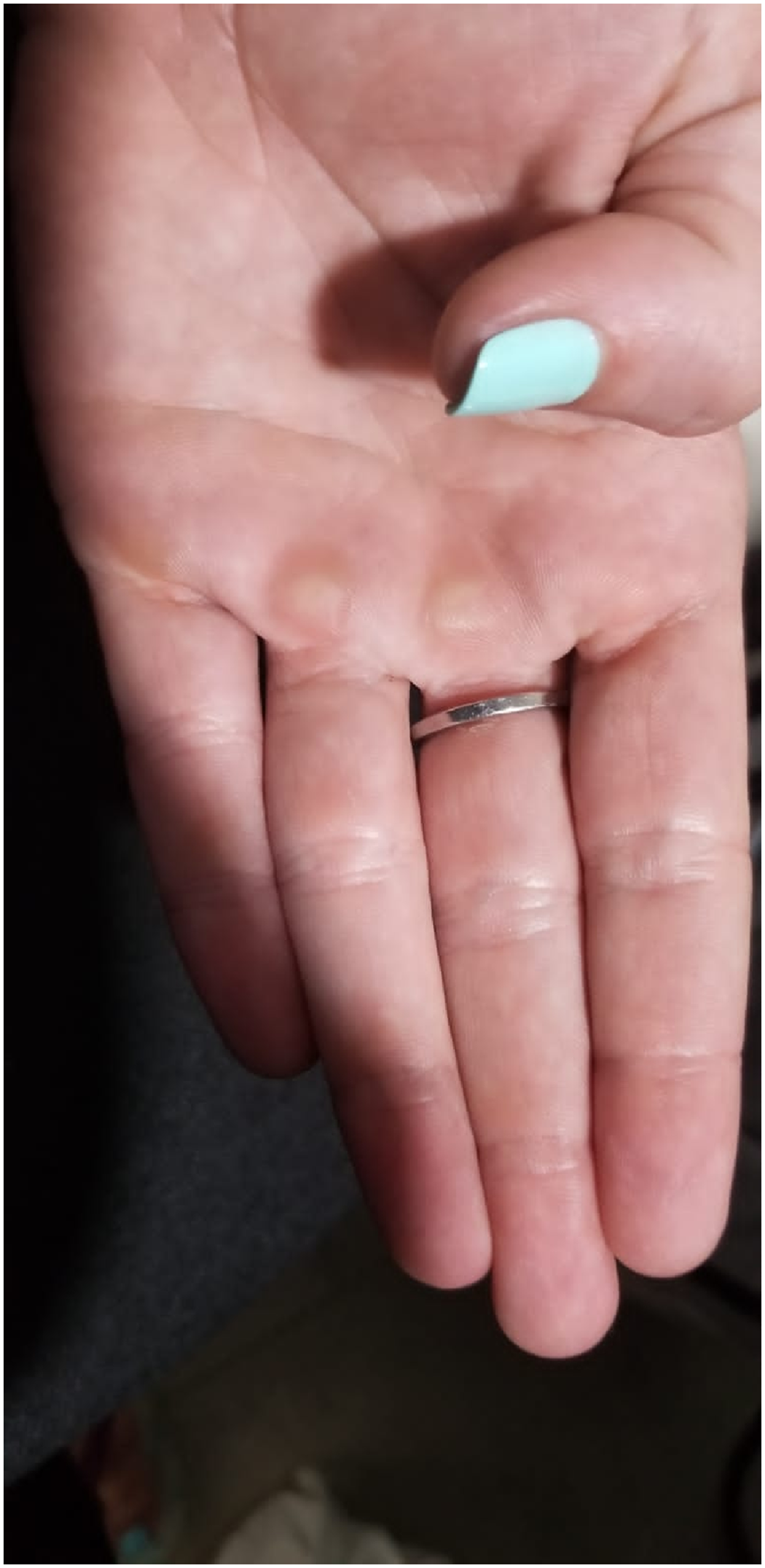
The appeal of calluses on the hand.
Grace's account reflects the tension between performance-oriented embodiment and heteronormative sexual expectations. In describing her sexual preferences as ‘a bit too much’ or ‘inappropriate’, Grace positions the disclosure itself, rather than her calluses, as potentially transgressive within dominant norms of feminine sexual respectability. The calluses produced through repetitive intra-action with non-human objects unsettle norms that women's hands should be soft and unmarked. However, her attempt to justify these calluses by aligning them with male pleasure signals the persistent regulatory force of heteronormative desirability. Rather than fully reconfiguring femininity, this moment illustrates the affective labour involved in keeping the athletic body intelligible and acceptable within sexualised norms. Grace's response exemplifies how resistance and accommodation operate simultaneously, as empowerment through capability remains tethered to the imperative of pleasing a male partner. Similarly, during her PEI, Kelly presented the photograph in Figure 2, noting that: You think you need to cover the bruises up because they do not look nice for a woman. They are not feminine. But now I do not even care. The bruises show the hard work I put in. The day I do not get bruises is the day I am not working hard enough. I do not feel bad if someone asks me about them, they are nothing to be embarrassed about. My husband loves them because he can see I have become more confident. Before I started CrossFit, I was very insecure about my body which affected our relationship, sexual and everything.
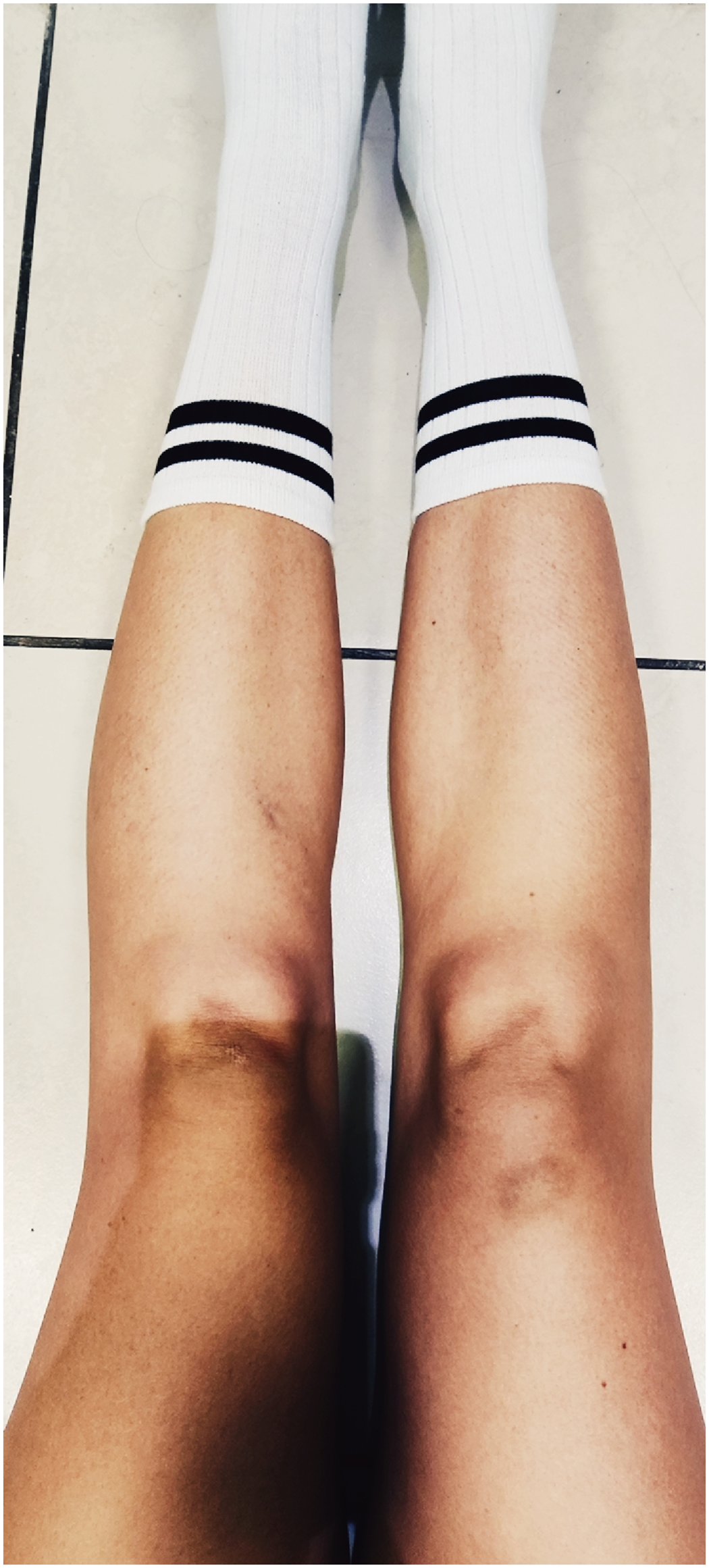
I love my bruises.
This illustrates that bodily empowerment shifts sexual subjectivity and desirability logics in everyday life. Kelly's bruises, like Grace's calluses, are not incidental. They are material inscriptions left by non-human objects during training, and they operate as discursive signifiers of physicality and effort. Kelly's shift from embarrassment to pride signals a move towards bodily ownership and confidence, wherein CrossFit objects are implicated not only in shaping the physical body, but also in producing the conditions for resisting normative femininity. Kelly's discursive construction of bruises as a sign of confidence suggests that these shifts are not transient, with increased capability becoming a durable, embodied resource that reconfigures how she relates to her partner, herself and her body beyond the gym. These accounts suggest that the discourse of sexual (dis)pleasure and (un)desirability functions not only as a site of sexual regulation but also as a terrain where non-human and non-gendered encounters disrupt bodily sexualisation, enabling CrossFit women to re-experience themselves as capable, agentic and powerful on their own terms. CrossFit women's bodies can thus trouble dominant heteronormative aesthetics, however, highlighting the paradox that bodily empowerment often remains tethered to the ideals of feminine attractiveness and sexual availability (Cahn, 2015; Krane, 2001).
The sexual (dis)pleasure and (un)desirability discourse constructs the subjectivities of CrossFit women in two ways: first, as the submissive woman subject, and second, as the deviant woman subject. The former complies with traditional gender roles and sexual scripts, where women are expected to be pleasing, passive, soft and accommodating to male desire (Morier and Seroy, 1994). Grace exemplifies this position when she expresses fear that her calluses might cause discomfort to male partners and anticipates ‘complaints’. Her worry that her ‘sex game is going to flunk’ indicates that her sense of self is still being organised around male sexual experience, positioning her as a woman whose body must not disrupt male pleasure (Butler, 1990; Sturken and Cartwright, 2001). Similarly, Kelly aligns with this submissive position when she states, ‘you need to cover the bruises up because they do not look nice for a woman. They are not feminine’, thereby locating her body within the regulatory gaze of idealised femininity. Yet, both Grace and Kelly also occupy a deviant woman subject position, a space where dominant norms are subverted and where sexual and embodied subjectivities are reasserted (Kamen, 2000). Grace's explicit discussion of her sexual preferences, though described as ‘a bit too much’ functions as a form of resistance, where she momentarily claims her desires and reframes her bodily difference as sexually pleasurable. Kelly's reframing of her bruises as a symbol of confidence and strength, admired by her husband, allows her to disrupt the script of passive, aesthetic femininity (Weedon, 1997). What is critical in both cases is that the physical objects involved in the women's training are not external to their shifts in subjectivity, but are vital (Barad, 2007). Barbells and rigs leave marks that complicate and destabilise gendered readings of the body, providing a material-discursive space where women can experience themselves not solely as gendered, sexualised beings but as functional, capable bodies engaged in labour, discipline and self-transformation. These fragile, fleeting moments offer glimpses of non-gendered subjectivity, or modes of being beyond the femininity/masculinity binary, allowing women to relate to their bodies through strength, function and sensation rather than sexual availability or visual appeal (Heywood and Dworkin, 2003). Thus, subject positions are not simply constructed through discourse alone, but emerge through the intra-action of discourse, materiality and affect, enabling CrossFit women to move fluidly between submission, deviance and resistance and to momentarily reconfigure sexual subjectivity towards new possibilities of embodied agency and self-definition.
A muscular dilemma discourse
A muscular dilemma discourse constructs the CrossFit woman's body as a female body that disrupts normative constructions of femininity by occupying a paradoxical space between strength and cultural expectations of slenderness. It emphasises the tension between muscularity, particularly as developed in CrossFit, and societal ideals that frame visible muscular development as inherently masculine and, therefore, problematic for women (Engh, 2011). The CrossFit women from this study constructed the muscular female body as both a source of empowerment and a site of contradiction. For example, Amanda presented the photograph in Figure 3 during her PEI, noting: It [finding clothes] is very frustrating…, a lot of the times my husband must help me take my top off because it is very difficult [laughs]. I cannot find feminine clothing, because they don’t make clothes for women with big backs.
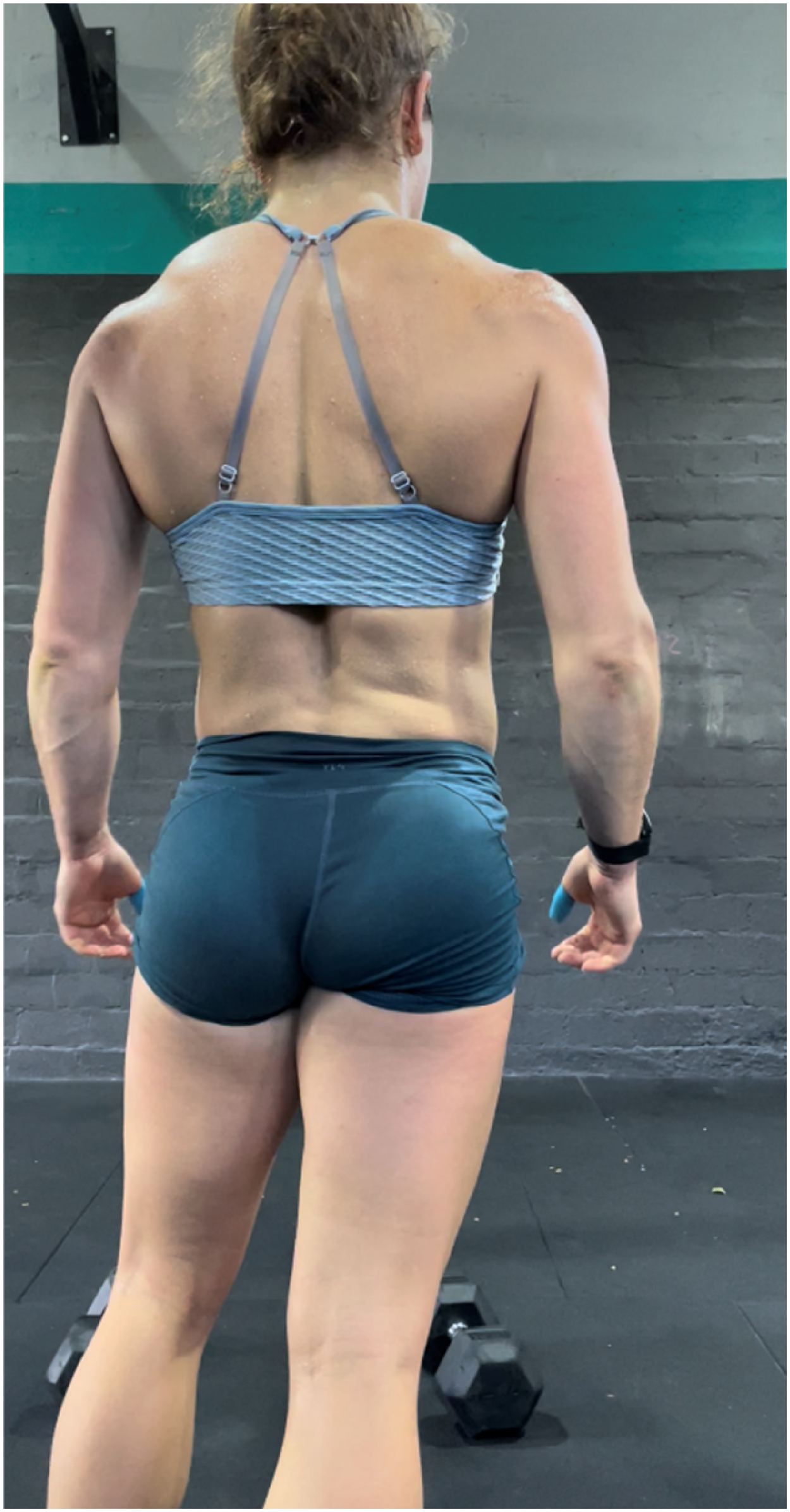
Dressing the muscular back.
Amanda makes use of a muscular dilemma discourse to demonstrate the dilemma she experiences when trying to dress her muscular body and back in feminine clothes. Her photograph and related talk position her as oppressed and frustrated by mainstream clothing that does not accommodate women with large muscular backs. She presents the dilemma by laughing, which masks an embodied frustration, namely that her body is not only muscular but incompatible with ‘feminine’ clothing. The muscular dilemma becomes materialised in clothing, not merely as fabric, but as gendering devices that reinforce normative femininity through design and fit (Cahn, 2015). Isabel, by contrast, engages more ambiguously with the muscular dilemma discourse, indicating that: I'm in a jumpsuit, and I put it on, and a guy said to me something about my arm muscles, … as being jacked [well-developed]. At first, I would have seen that as being a negative thing. But I just thought ‘ah, screw it; I'm just going to wear it anyway’. Yeah, it's comfortable and it's who I am. And, you know, I’m not going to change. You work hard to find strength and build an upper body.
Here, Isabel reclaims the term ‘jacked’, a term typically situated in masculinised discourses, and signifies it as a marker of identity, comfort and self-definition. Her talk reflects an internal negotiation, a debate around what her body communicates and whether she should conceal or display it. Her choice to wear the jumpsuit and not apologise for her muscularity reflects a reframing of femininity that embraces strength as part of her embodied subjectivity (Weedon, 1997). Rather than masking her strength, Isabel integrates it into her presentation of self, asserting her identity as a strong, capable woman (Podmore and Ogle, 2018). In addition, Fran further illustrates how muscularity reshapes femininity in everyday contexts by noting that, ‘I had to adapt my clothing style because normal shop clothes do not always fit my shoulders and legs anymore’. Fran's account reveals how the muscular dilemma extends beyond workout spaces and into daily routines. Muscularity does not simply exist on the female body; it requires practical negotiation with material culture. Adapting her wardrobe demonstrates that her body has shifted what counts as ‘feminine clothing’, enabling a version of femininity that accommodates strength. CrossFit therefore shapes how Fran performs femininity not only in the gym, but in public, social spaces where muscularity becomes visible, enduring and central to her self-presentation. Ingrid offers a different yet related account: I am doing shit now that I never thought I would do. You know, like pull-ups and getting on my hands [handstand walks] … it becomes more about what you can do in the gym, rather than what you look like. Your gains [muscles] in the mirror after a big session, hell yes, I like my arms.
Ingrid's experience demonstrates a shift away from external validation and aesthetic expectations toward embodied capacity and performance. Her pride is located not in conforming to feminine ideals but in her ability to move and achieve physically (Podmore and Ogle, 2018). Like Isabel, she rejects the imperative to conceal strength and instead embraces muscularity as integral to her identity. Crucially, this subjectivity is not produced in isolation, but through intra-action with non-human objects (i.e. pull-up bars, the gym floor, the mirror) (Barad, 2007). The mirror does not merely reflect Ingrid's body; it acts as a material-discursive apparatus that mediates her relationship with herself, enabling her to see and affirm her muscularity (Sturken and Cartwright, 2001). These non-human objects participate in shaping bodily meaning, contributing to a construction of subjectivity grounded in function, intensity and capability rather than visual appeal or passive femininity. Collectively, these accounts demonstrate that muscularity is negotiated not only inside the box but in everyday settings where femininity is displayed, read and regulated.
In relation to RQ2, the muscular dilemma discourse constructs the subjectivities of the CrossFit woman in two ways: as both the rebel and the oppressed woman subject. The oppressed woman's subject position aligns with internalised feminine ideals, which prioritise slenderness, softness and aesthetic appeal. Women occupying this position may conceal their muscles, reduce training intensity, or downplay strength to remain within the bounds of acceptable femininity (Cosh et al., 2019). In contrast, the rebel subject position embraces muscularity, actively challenging these gendered body norms. The rebel woman values performance, strength and bodily capacity, reframing femininity to include powerful physical expression (Knapp, 2015).
Isabel's talk about her arms being ‘jacked’ positions her as navigating both subject positions. Her experience challenges the normative feminine body ideal, one that emphasises aesthetics over functionality (Dworkin, 2001; Robinson et al., 2017). The dilemma surrounding the jumpsuit exemplifies this tension. Although a man's comment about her ‘jacked’ muscles could have prompted concealment, Isabel chooses to wear the outfit regardless. In doing so, she asserts her autonomy and defies external expectations of how her body should appear. This decision not only illustrates her resistance to dominant beauty standards but also her awareness of the social pressures that continue to shape them.
Ingrid, too, can be positioned within the rebel subject position. Her muscular body is not a site of conflict, but one of pride and capability. By focusing on what her body can do, such as handstands and pull-ups, rather than what it looks like, Ingrid reorients value from aesthetics to performance (Podmore and Ogle, 2018). Her embodied confidence reflects a departure from the aesthetic regulation typical of feminine norms. Importantly, Ingrid's sense of confidence is not solely internally driven but is co-constituted through material intra-actions with non-human elements such as bars, gym flooring and mirrors. These tools participate in the production of meaning by making bodily strength visible and tangible (Barad, 2007), facilitating moments in which Ingrid sees and experiences herself as powerful, not in relation to femininity or masculinity, but to what her body can achieve.
By contrast, Amanda exemplifies the oppressed subject position. Her reliance on her husband to help remove clothing that does not accommodate her muscular back highlights both the material and emotional constraints of hegemonic femininity. Her frustration is palpable, yet masked through laughter. This dilemma, however, was not navigated in isolation. When Amanda shared a photograph of her wedding dress during the FGD, her peers collaboratively re-evaluated the relationship between femininity and muscularity. They remarked that elite CrossFit women ‘looked beautiful… and they looked strong’, and one participant noted, ‘You do not have to only wear gym clothes, but you can also dress femininely and have a beautiful wedding dress’. Amanda responded with pride in her ‘amazing squat legs and strong arms’, affirming that she could ‘feel beautiful like a female but strong and feel confident like a bad ass’. This co-constructed reframing transforms muscularity from a source of aesthetic tension into a shared site of empowerment, demonstrating how collective affirmation facilitates movement away from constrained femininity toward legitimised strength.
While these examples illustrate how the muscular dilemma discourse positions women as either rebels or oppressed subjects, this binary does not fully capture the complexity of their embodied negotiations. Moments of non-gendered subjectivity also surfaced, particularly during experiences of intense training or bodily focus, when gender was no longer the primary frame of reference. In these moments, participants related to their bodies not as female or feminine, nor in contrast to male or masculine, but through performance, exertion and capability rather than visual appearance or gendered aesthetics. For example, Ingrid's reflection on her ‘gains in the mirror’ after a demanding session is not rooted in conforming to a feminine appearance, but in recognising the strength and endurance her body had produced. Here, the body is not read through a gendered lens, but as a powerful, performing body which is valued for its capacity to act. These fleeting non-gendered openings decentre the feminine/masculine binary and foreground the body's function over form.
Non-gendered subjectivities and the paradox of CrossFit women
Our discursive analysis foregrounds a paradox: while CrossFit offers a space for physical empowerment, its practices remain entangled within dominant gender norms and hegemonic femininity (Schippers, 2007). The above two discourses demonstrate how CrossFit women's bodies are constructed within shifting and conflicting cultural meanings. The discourses co-construct subjectivities that oscillate between compliance and resistance, submission and rebellion, discipline and agency. What is evident across both discourses, however, is the possibility of non-gendered subjectivity: fleeting moments where CrossFit women experience their bodies not as feminine or masculinised objects, but as functional, capable and agentic assemblages. These moments are grounded in affective intensity, material intra-actions and the performative nature of training practices. They represent subject positions not neatly captured by traditional gender binaries, but rather, forged through movement, capacity and sensation. This reframing challenges the dominant emphasis on appearance and gendered aesthetics that typically regulate women's bodies. Whether through the reframing of bruises and calluses as signs of effort and pleasure, or the embracing of muscularity as a source of identity and pride, these CrossFit women reveal how identity can be co-constituted through posthuman intra-actions between bodies, objects, spaces and affects. As such, the gym and its equipment, and the mirror and clothing are not inert or secondary; they actively participate in the making and unmaking of subjectivity.
Importantly, this analysis does not romanticise resistance or suggest linear progression toward liberation. Instead, it illuminates the fragile and negotiated nature of becoming – a continuous oscillation between being hailed by dominant norms and pushing against them. CrossFit women are not simply free or bound, but always becoming through paradox: strong yet surveilled, muscular yet marginalised, visible yet resistant. By prioritising a feminist poststructuralist and posthumanist lens, we move beyond individualised or body-centric explanations of agency and position CrossFit women as dynamic figures produced within and through assemblages of discourse, materiality and affect. The findings contribute to broader conversations around gender, embodiment and athleticism and invite further exploration of how non-gendered subjectivities might offer alternative ways of inhabiting and experiencing the body.
Conclusion
This article explored how CrossFit women's bodies are discursively and materially constructed through two intersecting discourses, which expose gendered yet unstable terrains upon which athletic femininities are negotiated. Using feminist poststructuralism and posthumanism, we illustrated subjectivity as formed within discourses and through intra-actions between bodies, objects, affects and spaces. CrossFit women do not have fixed subject positions; rather, their embodied identities remain in flux as they negotiate competing norms, desires, technologies and bodily capacities. Women tend to resist when their physical capability is recognised and valued through performance-based measures that decentre femininity as appearance, yet they accommodate when external surveillance, heteronormative ideals, or the desire for social legitimacy reassert femininity as a disciplinary frame
Importantly, these fleeting moments of non-gendered embodiment also have wider implications for understanding hegemonic masculinity and the gender order. Connell's theorisation of gender hierarchy positions hegemonic masculinity as sustained through the symbolic alignment of men with strength, force, autonomy and bodily authority, while women's bodies are positioned as objects of regulation, desirability and containment. The fleeting cracks identified in this study momentarily disrupt this alignment. When CrossFit women relate to their bodies not through aesthetic scrutiny or sexualised visibility, but through effort, sensation and capacity, they inhabit bodily logics historically reserved for hegemonic masculinity without becoming masculine subjects or seeking masculine legitimacy. In doing so, they unsettle the taken for granted association between bodily capability and masculinity that underpins the gender order.
From a performative perspective, these moments matter not because they abolish gender, but because they interrupt the repetition through which gendered hierarchies are sustained. While hegemonic femininity continues to discipline women's bodies toward slenderness, desirability and compliance, the non-gendered openings identified here temporarily suspend femininity's regulatory function and weaken its role in supporting hegemonic masculinity. Following Schippers (2007), these moments do not constitute a new hegemonic femininity. Rather, they expose the instability of femininity's alignment with masculine dominance. Through posthuman intra-action with equipment, space and affective intensity, women's bodies become instruments of action rather than objects of evaluation, producing embodied experiences that exceed binary gender logics.
Although these openings are fragile and fleeting, they are not insignificant. Repeated material discursive encounters with strength, exertion and bodily competence deposit embodied dispositions that extend beyond the gym, subtly reshaping how women inhabit intimacy, visibility and authority in everyday life. In this sense, resistance to gendered oppression does not emerge as a singular act of refusal, but as an accumulative process of becoming, enacted through moments that loosen the grip of hegemonic masculinity over bodily meaning. CrossFit, therefore, does not stand outside the gender order. Instead, it becomes a contested site in which that order is both reproduced and momentarily reconfigured.
Rather than offering resolution, this article foregrounds paradox as the ground on which CrossFit women can stand and lift. Their bodies are never only strong, sexual, disciplined, or their own. They are always becoming through a web of relations that exceed them. This study therefore demonstrates alternative femininities not as isolated moments of challenge‚ but as ongoing, cumulative processes of becoming that materialise through continual intra-action between bodies, technologies and cultural norms. Future research could examine how fleeting non-gendered openings might be sustained, expanded, or foreclosed over time, including whether these shifts extend into women's intimate, social and professional lives. Additional work could investigate how alternative femininities may be relationally transmitted to others, such as children or peers. Given that non-human objects and spaces played a central role in shaping these subjectivities, further studies could explore how different training environments and material conditions co-produce embodied agency in strength-based sport cultures. Such inquiries would extend this article's demonstration of how performance-based embodiment both unsettles and remains entangled with normative gender relations.
Footnotes
Consent to participate
Study participants provided written informed consent to participate in the study.
Consent for publication
Study participants provided written informed consent to publish any data they co-produced during the study. In addition, the study participants signed acknowledgement and release forms for pixelated or anonymised photographic data they produced to be published.
Data availability statement
Data not available due to ethical restrictions (i.e. participants did not consent to secondary analysis of data).
Declaration of conflicting interests
The authors declared no potential conflicts of interest with respect to the research, authorship, and/or publication of this article.
Ethical considerations
This study was approved by the University of KwaZulu-Natal's Human and Social Sciences Research Ethics Committee (Approval Number: 00003881/2022) on 01 March 2022.
Funding
The authors received no financial support for the research, authorship, and/or publication of this article.
