




Abstract
Participation in organized sport contributes to children's physiological, psychological and social development. The aim of this study was to examine how Ukrainian refugees reflect upon their children's inclusion into sport activities in Norway. The study used an exploratory sequential mixed methods design with interviews followed by a questionnaire survey, where the findings were discussed using Bourdieu's theory of field and habitus. The qualitative analysis, supported by patterns observed in the quantitative data, revealed three main findings: Parents experience a lack of information about local sport activities; parents have a desire for their children to participate in organized sport; parents view sport participation as a tool for integration into the local community and Norwegian society. The findings demonstrate that although parents strongly value sport and view it as an important arena for integration, they struggle to navigate the Norwegian sport system due to limited information, language barriers and unfamiliarity with the voluntary structure that characterizes youth sport. This mismatch between parental habitus and the doxic expectations of the Norwegian sport field creates barriers to participation. The results suggest that municipalities, sport clubs and integration services should collaborate to develop accessible and multilingual information about local sport opportunities. Providing clearer guidance on how voluntary sport is organized, who to contact and what is expected from parents may facilitate participation. Improving communication across sectors and offering structured entry pathways could support refugee families in helping their children engage in organized sport.
Introduction
Due to the geopolitical context created by the Russian invasion of Ukraine in 2022, many countries received Ukrainian refugees (Buzev, 2023; Mickelsson, 2023a). In Norway, most refugees arriving are Ukrainian (Lagestad et al., 2025; SSB, 2024). Given that sport is the most popular organized leisure activity among children in Norway (Seippel and Skille, 2019), one may ask how children from Ukraine are integrated into Norwegian sport and how Ukrainian families experience it. Therefore, this study is about Ukrainian refugees’ parents’ reflections upon their children's inclusion into sport in Norway.
Participation in organized sport is unevenly distributed across gender, class and minority–majority groups. Studies show that boys and girls express different ambitions with their participation (Eriksen, 2022) and that class-based parenting contributes to closing off certain sports. For example, in Norway, cross-country skiing is increasingly shaped by upper-class parents who reinforce informal processes that strengthen illusio and limit access (Stefansen and Strandbu, 2025).
Youth from lower socio-economic backgrounds, those with immigrant backgrounds and especially minority girls participate less in organized sport (Bakken, 2019; Bakken and Strandbu, 2023; Walseth, 2013). Working-class parents often view sport as a way for children to fit in, providing belonging and structure, including limiting screen time (Eriksen and Stefansen, 2022). Differences in participation between minority and majority youth are complex and shaped by different sociological dimensions and their interactions, including those between gender, culture and religion (Strandbu et al., 2020).
Scrutinizing refugees and sport participation in Norway, Nesse et al. (2024) studied unaccompanied children and argue that these children experience participation in sports clubs as challenging because it involves conflictual views on how to do sports. The children's experiences are prevalent barriers to mainstream sport participation. Hence, refugee children may prefer informal sports because mainstream sport is ‘based upon pre-existing hierarchies, boundaries, and assumptions that reinforce ethnocracies stratification and othering’ (p. 655). Swedish research into Ukrainian refugees and sport, which is close to and relevant for a Norwegian context (Mickelsson, 2023a, 2023b, 2024a, 2024b), found that Ukrainian refugees were considered as more culturally suitable than many other immigrants; they are considered as sport competent and sharing values with Swedes, such as discipline and community building (as compared to other immigrants who are often considered as passive receivers of welfare) However, there were also challenges related to their East European heritage. Mickelson (2023b, 2024a) argues that Ukrainian refugees enter other countries’ sports spheres with an amount of sporting capital along with a post-socialist tradition of practicing sports.
Adults generally view supporting children's sports participation as ‘good parenting’ (Dorsch et al., 2021; Sutcliffe et al., 2024). Sporting cultures are often passed down in families as ‘habituses’, or historically shaped beliefs and behaviours related to sport (Wheeler, 2012). Parents today invest more – and at earlier ages – in their children's sport than previous generations, reflecting an intensification of middle-class social reproduction (Wheeler and Green, 2014). Parenting expertise in sport also depends on parents demonstrating certain competencies, such as choosing appropriate sport opportunities, providing emotional and practical support, managing organizational demands and building positive relationships with coaches and clubs (Harwood and Knight, 2015).
Parents’ desires for children's sport participation are multiple: for example, risks associated with inactivity and a sedentary lifestyle, failing to meet the recommended levels of physical activity (Kolle et al., 2012; Reitlo, 2012; WHO, 2018), highlighted by national and international health authorities (The Norwegian Directorate of Health, 2022; Who, 2018); and the physical activity’s positive impact on growth and development of both physiological, psychological and social factors (Bakken, 2019; Bergin and Lagestad, 2023; Lagestad and Mehus, 2018; Lopez-Diaz et al., 2021; Møllerløkken et al., 2015). Strandbu et al. (2020) found that family sport culture positively influences adolescents’ participation in organized sport, though the effect weakens for girls as they age. In theoretical terms, these findings reflect an extended socialization process tied to Bourdieu's concept of habitus. In a similar vein, Stefansen et al. (2018) show that parents across social classes are more involved in their children's sport than previous generations and view it to connect, though excessive ‘deep involvement’ may become counterproductive.
For minority parents, sports clubs can support integration, but many reports need clearer information about voluntary work and the structure of children's sport, finding the system complex (Espedalen and Strandbu, 2023). Differences in cultural backgrounds may also limit participation; for example, some Ukrainian activity preferences are less common in Norway (Lagestad et al., 2025).
Overall, adults consider it ‘good parenting’ to encourage their children to participate in sports (Dorsch et al., 2021; Sutcliffe et al., 2024). Wheeler (2012) found that sporting cultures are passed down within families as ‘habituses’, or historically shaped beliefs and behaviours related to sport. Parents’ goals, strategies and practices in their children's sport were influenced by their own developmental histories and relationships with other parents. Wheeler and Green (2014) further showed that today's parents invest earlier and more heavily in their children's sport than previous generations, signalling an intensification of middle-class social reproduction. Parents also felt increasingly capable of supporting their children's overall development and sport participation. According to Harwood and Knight (2015), parenting expertise in sport depends on competencies such as choosing appropriate sport opportunities, offering needed support, using suitable parenting styles, managing emotional demands, building healthy relationships, handling organizational challenges and adapting involvement.
However, a belief in and desire for sport does not create sport participation – the interface between the individual and the sport context must be analyzed.
Research questions
Given the above, the research question is: How do Ukraine refugees reflect upon their children's inclusion into sport activities in Norway? As the question indicates the interface between individuals and a sport context, Bourdieu's (Bourdieu 1977, 1978, 1986, 1990) field and habitus theory is applied (Bourdieu, 1978; Skille, 2007). The current study supplements Mickelson (2024a, 2024b), who investigated the societal and organizational levels, concluding that ‘there is … a need to engage with the Ukrainian refugees’ themselves’ (2024a: 676) and to understand how Ukrainian refugees experience Scandinavian sport (2024b: 277). The study supplements Nesse et al. (2024) by interviewing parents about their reflections related to the research question.
Context and theory
Espedalen and Strandbu (2023) found that sports clubs can be difficult for some minority parents to navigate, especially when their cultural backgrounds differ from Norwegian norms. Another study showed that refugees’ activity preferences from Ukraine can make it harder to understand or join local sports, since activities like art gymnastics and acrobatics are more common there (Lagestad et al., 2025). Research indicates that children's sport in pre-war Ukraine was largely organized through a combination of school-based physical education, municipal sport schools and specialized training centres that stem from Soviet-era structures. Physical education was compulsory at all school levels, and thousands of children regularly trained in local sport clubs connected to schools or municipal sport institutions. This reflects a highly institutionalized, state-linked model of children's sport (Rauch and Kropyvnytska, 2025). Tikhonova (2014) notes that youth sport historically served three core functions: preparing future elite athletes through structured training pathways, supporting children's health and rehabilitation, and providing an educational and character-building arena. Ukrainian children often had access to state-supported sport schools, where participation involved systematic training and early specialization in specific sports.
Cross-cultural comparisons further show that Ukrainian adults view participation in sport as important for developing discipline, teamwork and personal growth, and they value sport as a means for community building (Turchyk et al., 2021). Mickelsson (2023b, 2024a) highlights that Ukrainian refugees often arrive with substantial ‘sporting capital’ and a post socialist tradition of structured sport participation, which may align more closely with Scandinavian sport cultures than those of many other refugee groups. At the same time, this tradition differs from the Norwegian voluntary model: in Ukraine, sport participation is more institutionalized, less dependent on parental organization, and often guided by coaches and public sport institutions rather than by a volunteer-driven club structure (Espedalen and Strandbu, 2023). This background helps explain why the families in our study expressed confidence in their children's previous sport experiences while simultaneously lacking familiarity with the doxic expectations of Norwegian children's sport – particularly the need for parents to identify opportunities, navigate decentralized club structures and handle communication and logistics.
Following Bourdieu (1977, 1990), a field is a relatively autonomous area of society. The term ‘relative autonomous’ indicates an ambiguity, indicating that sport has its own logics, rules and values: formalized and unwritten rules for action and interaction. The latter is Doxa. Thus, two doxic features of Norwegian sport are its arm’s length from the state, and its voluntary workforce. A field is always interrelated to other fields and the overarching society, and demographics from social space can be found in, for example, participation patterns in sport (Bourdieu, 1978; Engström, 2010; Gemar, 2020). To define a field, Bourdieu suggests: (i) identify its (dominant) actors, (ii) the relative positions between the actors, and (iii) the field's history (Bourdieu and Wacquant, 1992).
The easily observable dominant actor in the Norwegian sport field is the Norwegian Confederation of Sports (Norwegian abbreviation: NIF). NIF is the umbrella organization for 55 national federations (NFs; the football association, the ski association, etc.) and sport clubs located throughout every village and suburb across the elongated country. With approximately five and a half million citizens, 1.9 million memberships in 9454 sport clubs (NIF, 2024), sport is omnipresent. Furthermore, NIF has 12 regional units that serve as sports’ collective bodies on the county level that are responsible for implementing NIF's policies. This dual organization (with NFs and regional units) stems from a merger between workers’ sport and bourgeois sport in 1946; it symbolizes the vision of ‘sport for all’, manifested through statements regarding participation regardless of factors as ethnicity (NIF, 2019).
Another dominant actor is the generalization of ‘the volunteer’. Given that most sports club activities throughout the country are conducted by voluntary parents (Seippel and Skille, 2019) and that most children take part in organized sport (Bakken, 2019), both become taken-for-granted (for both Norwegian sport and Norwegian parenting). Hence, when ‘some parents recognize the value of the game and have practical knowledge of how to play it from the outset’ (Stefansen and Strandbu, 2025: 4), they are more suited for it compared to others. Sport comprises an omnipresent doxa on societal, community and individual levels. Imagine replacing the word class in the next quotation with refugee or native: ‘Class habitus define the meaning conferred on sporting activity, the profits expected from it; and not the least of these profits being the social value accruing from the pursuit of certain sports by virtue of the distinctive rarity they derive from their class distribution’ (Bourdieu, 1978: 835; see also Bourdieu, 1986).
The individual possesses a habitus, which positions them in social space and indicates their suitability for specific fields. Habitus is defined as structured and structuring structures of an individual (Bourdieu, 1977, 1990). Structure indicates relative stability, although you evolve throughout the life course. Structured refers to processes of socialization (or internalization according to Bourdieu), while structuring points to habitus as facilitating externalization. It influences both an individual's interpretation of the world and the actions made. People socialized under similar material and social conditions develop a group habitus that can be identified, for example, in the form of sport participation patterns (Bourdieu, 1978; Engström, 2010; Gemar, 2020).
Regarding the objectification of the Norwegian sport field, and the relationship with the subjective individual, Mickelsson (2024a) highlighted that Ukrainian refugees enter other countries’ sports spheres with considerable amount of sporting capital along with a post-socialist tradition of practicing sports, and this could be a value for the Norwegian sport community (cf. Mickelson, 2023a, 2023b, 2024b). This ambivalence – sport competence but cultural difference – will be scrutinized in the discussion section; hence it will be analyzed how Ukrainians ‘understand’ Norwegian sport, if they a ‘feel for the game’, which ‘is what gives the game a subjective sense’ and shows who ‘acknowledge what is at stake’ (Bourdieu, 1990: 66). The latter is referred to as llusio, a deeper sense of the need to not only invest, but to do it ‘correctly’ or appropriately within the focal context. Thus, the feel for the game refers to more than sport per se, but also to the sport system of the focal context.
Material and methods
Given the nature of the research question, qualitative interviews were conducted. The qualitative findings guided the development of a subsequent quantitative phase. While the qualitative interviews formed the core of our study and generated the most substantial insights, a small descriptive quantitative phase was added to examine whether key themes identified qualitatively were present among a somewhat larger group of parents, confirming the findings.
Participants
Research participants were recruited through an obligatory inclusion program provided by the refugee service in a municipality in Mid-Norway. Attendees were informed about the research before they were invited to participate. The Introduction Program (IMDI, 2024) is a statutory, time-limited program for newly settled refugees, primarily aged 18 to 55 years, designed to prepare participants for work or further education in Norway. Participants receive Norwegian language training and social studies. In addition, adult participants who are parents of children under 18 are offered – and in many municipalities required to attend – parental guidance courses that provide information about parenting in Norway and available services for children and families. The interviews were introduced to the participants as a study about Ukrainian views on their children's sport participation in Norway.
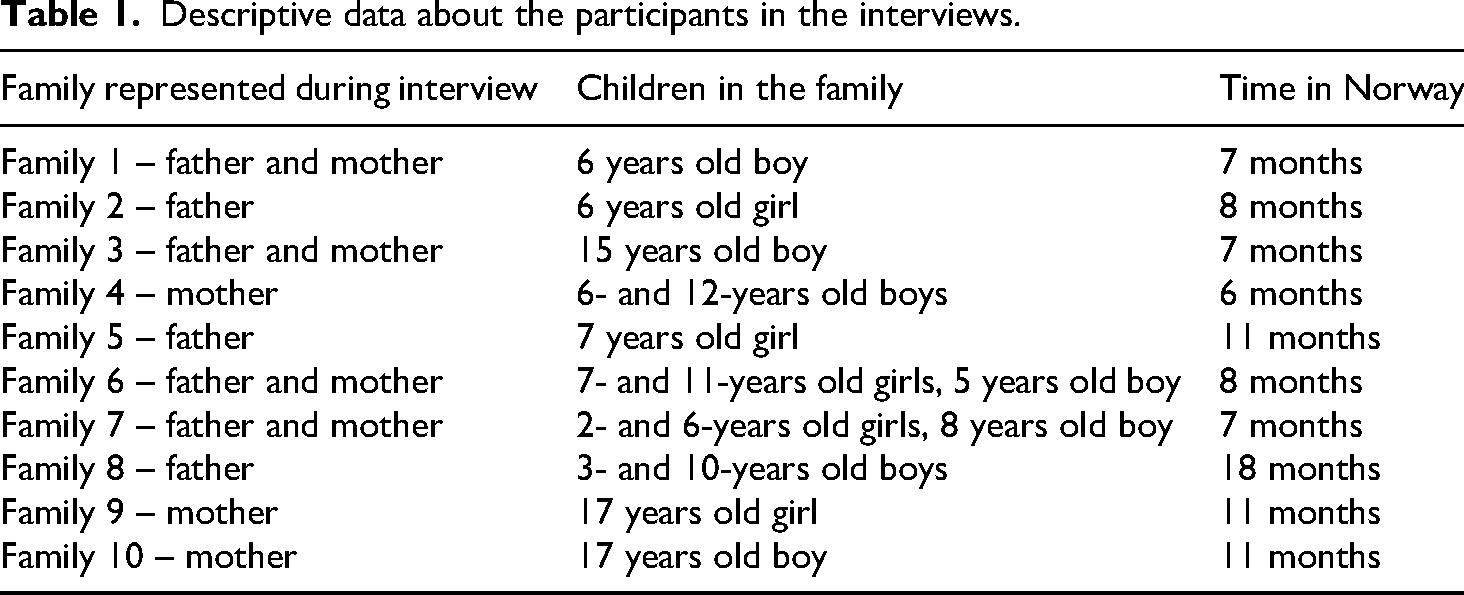
To be included in the study, participants had to originate from Ukraine and have at least one child between 6 and 18 years old. A total of 10 families (each represented by one or two adult caregivers, see Table 1) volunteered to participate and were interviewed. The interviewees lived in two communities in the municipality: a small rural community and in a city. Most Ukrainian families that participated in the study had lived in Norway for 7–8 months (mean = 9.4, SD = 3.6). See Table 1 for information about the families included in the interviews.
Descriptive data about the participants in the interviews.
Instruments
A semi-structured interview guide composed of 15 questions with open prompts was designed by the first author to elicit narrative accounts (e.g. ‘Can you tell me about your children and their participation in sports and physical activity?’, ‘What do you know about the possibilities for sports activities at [the area]?’, ‘Can you tell me about the differences related to your child’s participation in sport in Norway and Ukraine?’, ‘Which challenges you think occur according to your child’s participation in sport in Norway?’. The interviewer routinely used follow-up probes (e.g. ‘Can you give an example?’, ‘What happened next?’, ‘Why was that?’, ‘How did that affect you/your child?’, ‘Who helped/hindered?’) to develop depth, clarify meanings and capture contextual detail. Probes were important, as many of the questions required follow-up questions.
To examine whether the themes identified in the interviews were also present among a broader group of Ukrainian refugee parents, a questionnaire was administered to a sample of 29 parents. The questionnaire items emerged from the findings of the interview data analyses in the form of statements to which the respondents should indicate their agreement on a seven-point Likert scale (totally disagree, disagree, disagree a little, neither agree nor disagree, agree a little, agree, totally agree). Examples of statements were: ‘I think participation in sport are important for my child to get friends’, and ‘I think participation in sport are important for my child's physical health’. Five questions about the information sheet (regarding local sport activities) that they received at the same meeting were also included in the questionnaire. Examples of statements were: ‘I think this information about sport activities (the scheme) are important for me and my family’, and ‘I think this information about sport activities (the scheme) will be useful for me and my children’.
Data collection and analysis
The interviews were conducted by the first author in January 2024, at places chosen by the participants – to make them feel as comfortable as possible. Most interviews took place in an office at the Inclusion Program, while two interviews took place in their private homes. An interpreter born and raised in Ukraine was present and translated the questions and answers (to/from Ukrainian/Norwegian). The interviews were introduced to the participants as a study about Ukrainian views on their children's sport participation in Norway. The interviews were audio recorded and lasted between 30 and 45 min. The questionnaire survey was conducted in April 2024 at a meeting of the Inclusion Program. Based on preliminary findings from interviews, pointing towards a lack of information about sport, the first author developed an information sheet in parallel with the creation of a questionnaire. Twenty-nine questionnaires from Ukrainian research participants representing different families were analyzed, 12 males and 17 females. Among 33 volunteers, one participant did not have any children, and three were from other countries; these were consequently excluded from the study. Fifteen participants had only boy(s), 10 participants had only girls, and 2 participants had both girl(s) and boy(s). The mean number of children was 1.6 (SD = 0.6). They had been living in Norway between 2 and 18 months (mean = 8.7, SD = 3.9).
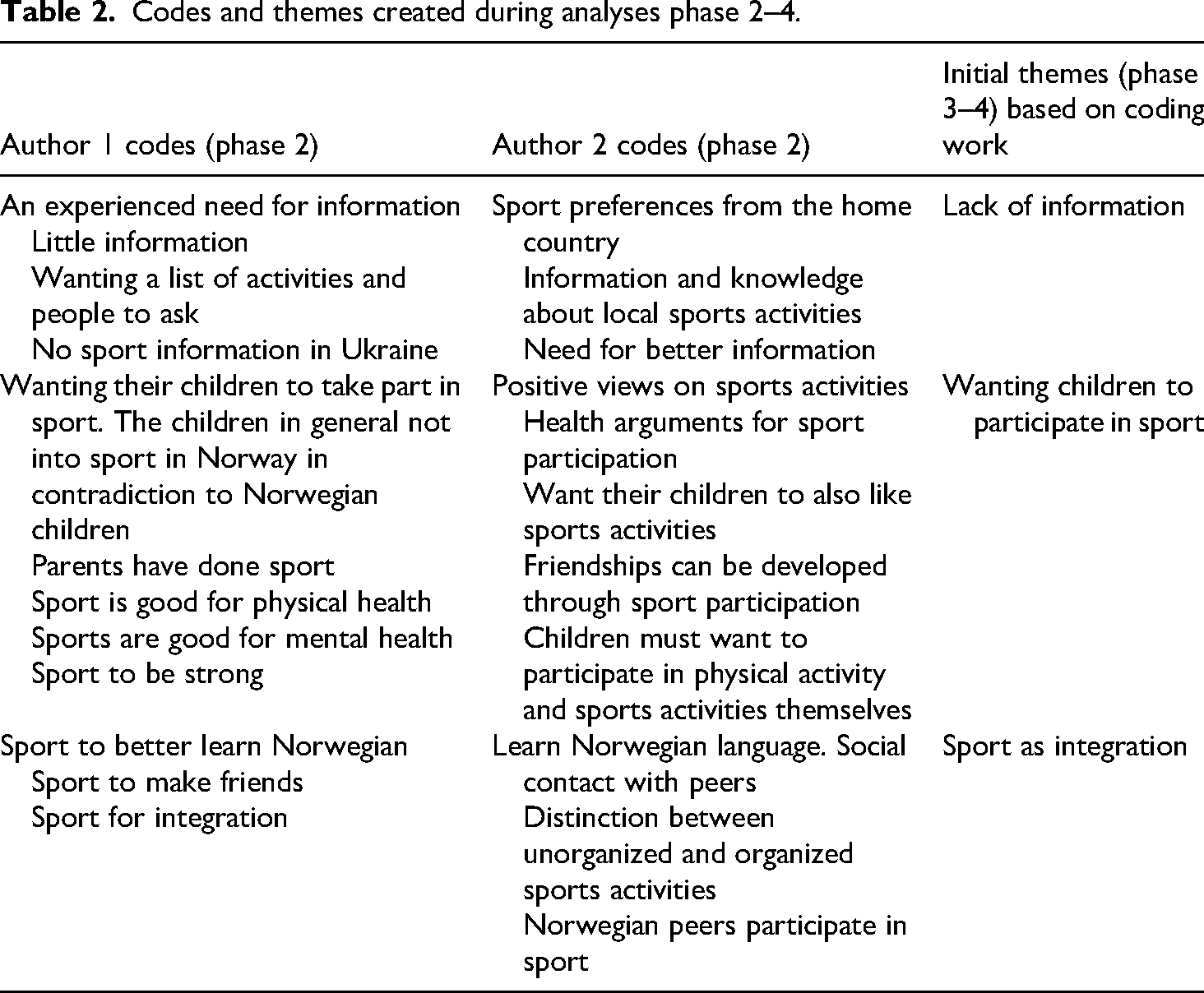
Braun and Clarke's (2019, 2022) reflexive thematic analysis was employed. The analysis was conducted throughout six phases. First, all three authors read through the transcripts to familiarize themselves with the data (phase 1). Already here, the authors agreed that the lack of information was a candidate theme. In phase two, the first and the second authors coded the interview material individually, using the qualitative analysis program NVivo 14 Plus. In phase three, the three authors gathered and discussed the codes before creating initial themes (see Table 2). The themes that were related to lack of information and reasons for sport participation were decided to be the empirical basis for this article.
Codes and themes created during analyses phase 2–4.
In phase four, the themes were reviewed and explored further with questionnaire data. At this point, we aimed at presenting the two data sets together. However, when moving on to phase five (refining and labelling the themes) and phase six (drafting text), the results were split into two subsections.
Overall, Braun and Clarke's evolution from thematic analysis (2006) into RTA (2019, 2022) is significant, because the analysis was an iterative process and due to the emphasis on flexibility regarding the use of theory (Braun and Clarke, 2019, 2022). Especially during phases five and six, the circulation of drafts between the authors was guided by the chosen theoretical perspective. The use of the six-phased RTA identified meaningful patterns in the interview text supplemented by statistics, resulting in three themes: (i) Lack of information, (ii) Desire for children's sport participation, and (iii) Sport as a tool for integration.
Ethics
The research project was approved by the Norwegian Centre for Research Data (SIKT, project number 454250) and fulfils ethical standards for empirical research conducted in accordance with the Declaration of Helsinki. The research participants were fully informed in Ukraine language about the project before participating voluntarily according to the regulations from SIKT. Written consent was obtained from all research participants.
Results
Lack of information
The first theme concerned the lack of information and parents’ perceived need for information in Ukrainian. This theme represents a cross-cutting structural condition that shapes the possibilities for sport participation and integration described in the subsequent themes. One interviewee says they miss ‘more information made for us, the parents, because then we can perhaps inspire our children’. A consequence of no or limited information is a lack of knowledge about the activity opportunities in the local communities in which they live. Several interviewees say they have searched for information on the internet themselves, but that the results are limited. The analyses also revealed that sometimes it is rather random or by accident that they become aware of and gain knowledge about sport supplies that can be relevant for their children. One parent stated that she wanted her daughter to join ballet or dance, but did not know where to go, and found that very problematic. She had randomly seen a place where it looked like they were doing ballet, but she was not sure. In addition to this story of random information, the interviews include stories that reveal little or no knowledge about sport activities, sport facilities or sport providers in the refugees’ new local communities. This dialogue illustrates this:
What do you think is different about sports in Norway compared to Ukraine?
I don’t really know what to say, because I don’t know what you can offer here. I haven’t been in Norway for very long, so I don’t know much.
No, so you don’t know much about what kinds of sports activities are available where you live?
Yes, exactly.
Would you like to introduce your children to different sports they could participate in? Is that something you would want for your daughter, that she is introduced to different sports?
What kinds of sports are there?
Here in [town], we have many, and we can offer most of them.
I would like to see a list of different sports activities to choose from.
Would that be important to you? In that case, why?
Yes, it is very important. The main thing is that my child must be able to choose for herself. I need to talk to my child, but I don’t know what sports we can choose from. I want to know exactly what options exist for children at her age.
Another interview showed similar points of little or no knowledge, but also highlighted a different pattern. In this case, the parents actively sought information about dance opportunities for their daughter. When asked whether they had received information, one of the parents explained: ‘No. I asked the school about dancing, but they knew nothing. I get information at the library or at the culture house’. This contrasts with earlier interviews, where parents primarily waited for information from public agencies. Even when parents took initiative, they often encountered the same barriers – limited knowledge within schools and little communication between municipal services and local sport clubs. Several interviewees said that they had requested meetings with municipal offices (such as the school) to support their children’s entry into sport, but had not received responses for months. This variation illustrates that while some refugee parents are proactive, both proactive and less proactive parents face similar structural challenges: fragmented information systems, unclear responsibilities, and a lack of accessible guidance on how sport is organized in Norway.
Moreover, the analysis shows that there is a language challenge in connection with the lack of information. One parent stated that first and foremost information is needed, but then a limitation is our Norwegian language skills […]. Language must not be a barrier for inclusion in sport’, the interviewee stated. The interviewer followed up with a probe regarding language as a problem for integration, and what possible solutions there might be. The interviewee's immediate response is ‘of course’ and pinpoints the challenges of finding sport offer for their children when all that is available is in Norwegian. When it comes to solutions to overcoming the language challenge, the interviewee proposes making a list in Ukrainian covering the sport activity offers in their local community would be helpful. This was subsequently created by the first author and distributed in the same meeting as the questionnaires (see methods). The language challenge as a problem for integration is exemplified through statements from one parent. This parent stated that in Ukraine, it is easier: ‘You come, you sign up, and you are included’. In Norway, it is more difficult to sign up for a group, ‘to become part of a sports club’. ‘We don’t get information about how it is done or how to make contact’, she comments, and added that the lack of Norwegian language skills is a problem. She explained that she has been here (in Norway) for half a year and has attended Norwegian classes for only one month and then said: ‘I don’t speak much yet’. Furthermore, she reflected: ‘I wished the process of including my children in sports would go faster. It takes time, and time just passes. Time flies’. When asked if that feels difficult for her, she answered: ‘Yes, it feels difficult’.
Other parents also pointed out that it would be helpful if it was provided information about contact persons and public offices relevant for specific issues – such as sport – and just to be available for all kinds of questions related to children's activities. For example, a parent whose son trained three times a week in Ukraine in a sport called sambo, would like to do that in Norway, too. But we have little information about different organizations and types of sport like sambo, the parent said. We only know about a sport that is called bodybuilding. We know that because we saw a pile of different equipment. We saw a football pitch too, but have no more information. Moreover, when some refugees finally have information about sports offers, an additional challenge is how to get there. Thus, interviewees also requested better transportation arrangements, so their children could avoid taking the bus to training sessions.
Desire for children's sport participation. The second theme was that parents indeed wanted their children to take part in sport. This overarching wish or desire is made up of several factors. One of the factors was the health benefits from physical activity. When a parent was asked why it was important that his child participates in sport, he replied: ‘First and foremost because it gives good health’. The following dialogue with a father exemplifies the point:
What do you, as a father, think about the importance of your sons participating in sports?
I believe it is very good for keeping the body in good condition. And especially now, when there is so much technology, and the children are sitting with computers or with their mobile phones. So, it is a very good way to develop their physical fitness.
Finally, is there anything you would like to say about sports and participation in sports that I haven’t asked about?
Sport is very important in people's lives because it develops people, and it develops the body. Sport also helps with becoming included in society. And it helps everyone develop. People experience how they can reach different goals—without war, for example, and things like that. So, sport and physical activity are a very important part of people's lives.
Also, another father pointed towards the importance of sport to promote health, saying: ‘In my opinion, it is very important to keep the body in good shape … It is a really good instrument to develop physical fitness’. Despite these strong motivations, parents consistently described an inability to translate desire into participation, echoing the informational barriers described above.
From the data, it seems as if the Ukrainian children in general were less active in Norway compared to when they lived in Ukraine. Several parents reported that their children had participated in sport when they lived in Ukraine, but not here in Norway. One interviewee says her daughter participated in dance and acrobatics three times per week in Ukraine, and that she wanted to do the same in Norway. They had investigated various websites with information about dance in the municipality where they were in Norway, but had heard that there were waiting lists. At the time of the interview, the daughter was not very active. She took a walk and joined activities organized by the Red Cross.
Also, the interview data showed that the parents had an interest in and were familiar with sport in Ukraine. Many of the parents reported that they liked sport and had been practicing sport when they lived in Ukraine. The mother and father from one family expressed:
Have you participated in sport yourselves?
Yes, my husband used to box.
I trained in boxing, and my wife [trained] fitness
Fitness, aerobics - wife exercise (laughing)
One of the interviewed parents reported that he had been a professional athlete when he lived in Ukraine. When another father was asked how important it is for him that his son participates in sport, he replied with much reference to himself: ‘Very important. I have trained for maybe twenty years. I want my son to enjoy sport, too. I will say it is very important in life. He is a boy; he must become strong’. As we see, this father also connects sport to ‘becoming’ – in his view the boy should become strong.
Sport as a tool for integration
Following the last part of the former point, the third theme was that the parents pointed towards sport as a valuable tool for integration. Particularly, they viewed sport a tool for integration, to make friends and to better learn Norwegian. Across interviews, sport is not framed merely as a leisure activity, but as a multifunctional arena through which parents understand their children's physical, social and cultural integration into Norwegian society. Sport was perceived as a key mechanism linking individual wellbeing with broader processes of social inclusion, health and language acquisition. Parents were concerned with integration, and that it should start early. ‘I wish it went faster, this integration to sporting life’, one parent stated. A mother said that her daughter had told her that all Norwegian children participated in some sort of sport activities, and that the daughter also wanted to take part in sport as all the Norwegian children did. As one interviewee stated, being asked about why he wanted his children to take part in sport: ‘Because he is interested in it, and it generates more development for him, in many ways. […]. It makes more friends, gives better physical shape, and better language skills’.
When another mother was asked about why sport for her children is important, she shared: ‘First, it is to improve health, but it gives also more friends and social contact, as well as discipline’. Two interviewees, respectively with a son and a daughter, said that their children were participating and were integrated into sport. Their stories stand out as a good example of sport integration. The children participated in volleyball. One of the two parents stated: ‘Volleyball has been important for contact, for communication with others her age, and for her development. She spends less time on her phone now’. The other parent was asked about her opinion regarding any potential changes in her son from before to after he started playing volleyball. She stated that her son uses his energy in the right direction. He spends less time on the computer and on his phone. His physical development is better, and he sets goals for himself. He has started to develop, and he has moved into the older group to a higher level. The parent also stated that her son has got more friends, many Norwegian friends who play volleyball and speak both ordinary Norwegian language and local dialects: I think about half of his friends are from volleyball, maybe one-third. He has got the Norwegian friends through volleyball. So, the Norwegian friends come from volleyball.
Moreover, she reflected that her son has improved his Norwegian speaking and is beginning to understand more about Norwegian society through participation in volleyball. He has also gained more self-confidence and become calmer, she stated.
Overall, the interviews represent the parents’ view on sport as to get their children away from inactivity. Parents often mentioned – what they as parents conceived of as – challenges related to computer games and mobile phones, such as this father:
What do you as a father think about the importance of your sons joining sport?
I think it is very important to keep the body in good shape. And especially these days, with all the technology that makes them sit still with the computer or the phone.
Another mother and father held that their boy should participate in organized sport ‘because he goes to a Norwegian school, and he continues to learn Ukrainian language online. Therefore, he stays at home. He must have some physical activity because he only stays home, that doesn’t work’. Notably, the strong belief in sport as an integration tool stands in contrast to the structural barriers described in the first theme, suggesting a gap between parents’ aspirations and their actual possibilities for action.
As a supplement to the qualitative findings – which constituted the core of the study and generated the most substantial insights – the questionnaire survey served to strengthen, support and extend these findings. The strong consensus in the interview data regarding sport's integrative value is mirrored in the questionnaire results, reinforcing the centrality of sport as a perceived pathway to health, social inclusion and wellbeing. The results showed strong agreement regarding the importance of sport for children's health and inclusion. In total, 93% of respondents agreed or totally agreed that sport was important for making friends and for their children's mental health, while 97% agreed or totally agreed that sport was important for their children's physical health. Furthermore, 76% agreed or totally agreed that sport was important for their children's inclusion in society, and 83% reported that it was important to them that their children were included in sport. There was also strong agreement regarding the usefulness of the information letter. Specifically, 90% agreed or totally agreed that the information letter was important and useful for their family, and 83% reported that it made it easier to involve their children in sport. A similar proportion indicated that they would have appreciated receiving the information letter upon arrival in Norway.
Overall, parents position sport as a critical arena for integration, not because of competition or performance, but because it offers children everyday opportunities to belong, communicate and develop within their new social context.
Discussion
Drawing on the empirical findings – parents’ limited knowledge of Norwegian sport structures, their strong wish for their children to participate in sport and their perception of sport as a pathway to integration – and on Bourdieu's theoretical framework (1977, 1978, 1986, 1990), this discussion examines how Ukrainian refugee parents understand, interpret and relate to the Norwegian sport field, using Bourdieu's concepts of field and habitus as analytical tools rather than as the basis for a full habitus analysis. Bourdieu's (1994) conceptualization of habitus as a system of perceptions and appreciations helps clarify why parents may strongly value sport participation yet struggle to access organized sport in Norway. Rather than pointing to differences in habitus formation (Bourdieu, 1992), the findings highlight a discrepancy between parents’ strong valuation of sport and their limited familiarity with the specific Norwegian way of organising children's sport. Parents value sport highly, but lack knowledge of the decentralized, volunteer-based structures and expectations that characterize the Norwegian sport system.
Across interviews, parents emphasized sport's importance for health, development and social belonging, a finding consistent with studies showing that Ukrainian adults generally associate sport with enjoyment, discipline and community (Turchyk et al., 2021). Parents also viewed sport as a means for integration, language development and managing screen-based inactivity – paralleling Norwegian working-class parents’ emphasis on belonging and structure (Eriksen and Stefansen, 2022). Gendered expectations further appeared in their reflections, reflecting culturally embedded notions of masculinity and femininity (Connell, 1995, 2002). Boys were often associated with strength-oriented sports, while girls were linked to aesthetic activities such as dance or ballet. These findings resonate with Wheeler's (2012) argument that sporting cultures are transmitted intergenerationally through family habitus.
However, Harwood and Knight's (2015) concept of parenting expertise helps explain why Ukrainian parents still face barriers in Norway. Effective support for children's sport participation requires familiarity with the voluntary structure of Norwegian sport, awareness of where activities are offered and understanding the expectations placed on parents. Unlike the more institutionalized, state-linked Ukrainian sport model, the Norwegian model requires parents to navigate decentralized club structures, volunteer roles and implicit norms. Refugee parents in this study clearly lacked this doxic competence. The perceived lack of information reinforces this gap.
Harwood and Knight (2015) emphasize the importance of educating parents in youth sport settings, and this aligns with Espedalen and Strandbu's (2023) finding that minority parents often need clearer guidance on how voluntary sport is organized in Norway. Their study suggests that sport clubs can foster integration, but only when parents understand the expectations embedded in the system. For refugee parents unfamiliar with Norwegian cultural norms, navigating sport clubs can therefore be particularly challenging.
Although Ukrainian parents possess strong sporting values and often substantial sporting experience, these assets alone are insufficient for entering the Norwegian sport field. The boundaries of this field are opaque to newcomers, and as Bourdieu and Wacquant (1992) note, the limits of a field only become visible through practice. What is intuitive to insiders becomes a barrier for outsiders, especially in a field that has undergone long-term autonomization (Bourdieu, 1990). Norwegian parents, who typically have grown up within this voluntary system and remain highly involved in their children's sport (Stefansen et al., 2018), hold a ‘feel for the game’ (Bourdieu, 1990) – a practical sense of how to navigate club cultures, communication and organizational expectations. Refugee parents lack this tacit knowledge, even when they possess motivation and sporting capital. This underscores an important analytical distinction: sport as a rules-based physical activity versus sport as a culturally contingent organizational field. Ukrainian families may understand the former exceptionally well, but remain unfamiliar with the latter as it operates in Norway. In this regard, Norwegian insiders may unintentionally close the field to immigrants (Stefansen and Strandbu, 2025). Their taken-for-granted doxic illusio – the assumption that everyone knows how sport ‘works’ – means they may not recognize newcomers’ need for explicit guidance.
Prior research (Mickelsson, 2023a; Turchyk et al., 2021) suggests that Ukrainian refugees often arrive with sporting capital aligned with Scandinavian traditions, but the present findings show that such similarities do not guarantee successful integration. Rather than lacking motivation or sporting values, parents were unfamiliar with what is at stake in the Norwegian sport field – the forms of engagement, responsibilities and expectations that structure participation and that Bourdieu (1977, 1990) conceptualize as the field's illusio. As Mickelsson (2024a) emphasizes, Ukrainian refugees may represent valuable sporting resources for host countries; however, their integration still depends on political and institutional conditions shaping expectations for adaptation. If assimilationist expectations dominate, refugee parents are implicitly required to conform quickly to norms they cannot yet perceive.
In summary, while Ukrainian parents display strong motivation and well-developed sporting values, their ability to support their children's sport participation hinges on acquiring tacit cultural competence within Norway's voluntary sport model. The central mechanism constraining participation, therefore, appears to be the mismatch between habitus and field – not a lack of interest, effort or sporting capital. An important contribution of this study lies in its focus on Ukrainian refugees, a group that might be considered culturally and institutionally closer to Norwegian society than many other refugee populations. The findings challenge assumptions that familiarity with organised sport necessarily translates into easy access in a new national context. Despite strong sport traditions and high motivation, parents still struggled to understand how the Norwegian sports system operates. This indicates that inclusion in sport depends not only on cultural alignment or individual motivation, but on access to information and institutional guidance – suggesting that the Norwegian sports model must be actively explained rather than assumed to be transparent.
Conclusion
The analyses of interviews with Ukrainian refugees, who reflected on their children's inclusion into sport in Norway, resulted in three main findings: lack of information about sport activities in the place they live, a desire for getting their children integrated into sport and the importance of sport as a tool for integration for their children. These findings were both corroborated and further illuminated by the quantitative data, which showed that there is strong agreement on statements related to the importance of sport for making friends, physical and mental health and inclusion in society. Also, these findings showed that parents really appreciated receiving a note with information written in their own language about sport activities and contact details in their region.
We conclude with two important contributions of the study. First, the study adds to the research field and particularly to Mickelsson's (2023a, 2023b, 2024a, 2024b) research as the immigrants themselves are sources of data. Moreover, given the theoretical perspectives applied, a piece is added to the understanding of the relationship between the sport field on one side, and individuals on the other. Thus, we also challenge the value of understanding sport as outsourced social work (Mickelsson, 2024b: 278). Overall, this study adds to an increased understanding of how sport participation among refugees as one case of immigrants more generally, must be considered, in all it's a complex phenomenon, which includes elements and interdependencies between age, gender, parenting and other (Strandbu et al., 2020). This can be transferred to how an analysis of refugees – based on a specific geo-political situation – adds to a more general field of research and application of the theoretical apparatus of Bourdieu, hereunder the habitus-field mismatch in organized sport.
Second, and more closely related to politics and practice, the study shows that refugees arriving in Norway express a strong need for information about local sport activities in their own language. However, this empirical point is nuanced by the theoretical analysis, which highlights an important distinction between having a sporting habitus and understanding the Norwegian sport model. A key contribution of the study is that this challenge is identified among Ukrainian refugees – a group that might be expected to encounter fewer barriers due to strong sport traditions and cultural proximity to Norwegian society. Despite this, the findings show that the Norwegian sport model cannot be taken for granted, but must instead be explained, mediated and translated, even to refugee groups often perceived as ‘closer’ to the majority population. In this respect, two further implications should be considered by politicians, bureaucrats and practitioners. First, information about sport participation must go beyond listing activities and include explanations of how the Norwegian sport model operates, including its voluntary basis and the significant expectations placed on parents. Second, improved communication across sectors is needed – particularly between voluntary sport organizations and public authorities responsible for inclusion and integration initiatives. One possible approach is for public authorities, in collaboration with county sports districts, to develop an overview of local sport offers, relevant contact persons and procedures for participation, and provide this information in Ukrainian and other relevant languages. More broadly, the findings suggest that barriers to sport participation among refugees are not primarily cultural or motivational, but structural and organizational. Future research should therefore follow refugee families over time to examine whether, and how, they gradually develop an understanding and habitus aligned with the expectations embedded in the Norwegian sport model.
Footnotes

Ethics statement
Ethical approval was not required for the study involving humans in accordance with the local legislation and institutional requirements. The studies involving humans were approved by the Norwegian data protection agency (SIKT). Written informed consent for participation in this study was provided by the participants.
Funding
The authors received no financial support for the research, authorship, and/or publication of this article.
Declaration of conflicting interests
The authors declared no potential conflicts of interest with respect to the research, authorship, and/or publication of this article.
Data availability statement
The raw data supporting the conclusions of this article will be made available by the authors, without undue reservation.