




Abstract
Contemporary sport is increasingly organised around a prosumer logic in which audiences simultaneously consume, produce, and circulate sporting content through digital and networked media. This shift has intensified the commodification, mediatisation, and rationalisation of sport consumption, positioning fan participation as a central organising principle. In contrast, the Masters Tournament represents a striking institutional anomaly within this landscape. Through the prohibition of most electronic devices, the maintenance of analogue scoreboards, and the regulation of patron behaviour, the first major tournament in the men's professional golf calendar curates a form of consumption rooted in presence, scarcity, and tradition, whilst permitting limited personal image capture through digital cameras. Drawing on sociological theory, particularly Weber's analysis of rationalisation, Bauman's critique of consumer society, and scholarship on the collapse of production–consumption boundaries, this article examines The Masters as a critical case of the selective management of participation within prosumer sport culture. The analysis demonstrates how institutional control, exclusion, and symbolic power preserve a distinctive, presence-based mode of consumption within a digitally saturated sporting landscape. The article contributes to the sociology of sport by interrogating the limits of prosumption and demonstrating how elite sporting institutions regulate participation to maintain cultural authority, prestige, and social distinction.
Introduction
Sport occupies a central position within contemporary global consumer capitalism, where it operates not only as a site of athletic competition but also as a platform for consumption, branding, and cultural production (Giulianotti and Numerato, 2017; Smart, 2007). The expansion of broadcast media, sponsorship, and digital platforms has intensified the commodification and mediatisation of sport, producing a highly rationalised cultural form in which economic and symbolic value is generated through visibility, engagement, and circulation (Hutchins and Rowe, 2021; Rowe, 2020). A defining feature of this transformation is the emergence of prosumption, whereby audiences simultaneously consume and produce sporting content through networked media environments (Andrews and Ritzer, 2018; Ritzer and Jurgenson, 2010). Smartphones and social media platforms encourage spectators to document, share, and comment on live events in real time (Davis, 2026; Van Winkle, 2016), normalising participatory engagement as a central feature of contemporary sport spectatorship (Hutchins et al., 2022).
Despite the apparent ubiquity of prosumer sport culture, it is not universally embraced. Certain elite sporting institutions actively limit digitally mediated participation, challenging assumptions that connectivity, visibility, and co-creation are inevitable features of modern sport. The Masters Tournament, 1 held annually at Augusta National Golf Club, represents one of the most prominent examples of such institutional constraint. Unlike most contemporary sporting events, the tournament prohibits mobile phones and most electronic devices, restricts real-time digital mediation, maintains analogue infrastructures such as manual scoreboards, and tightly regulates spectator behaviour (Edmonds, 2025; Riddell, 2024). These practices deliberately constrain prosumer participation and prioritise an embodied, presence-based mode of spectatorship that contrasts sharply with dominant trends in digitally mediated sport.
This article argues that the Masters Tournament represents a strategically managed form of participation control within contemporary sport culture. Drawing on theories of rationalisation and consumer society, it examines how institutional control, scarcity, and behavioural regulation preserve a distinctive mode of consumption within a digitally saturated sporting landscape. In doing so, the article positions The Masters as a critical case for understanding the limits of prosumption and demonstrates how elite sport institutions can selectively manage participation to maintain cultural authority, prestige, and social distinction.
Literature review
Consumer culture and the commodification of sport
The relationship between sport and consumer culture is a foundational concern within the sociology of sport. Contemporary sport is widely understood as embedded in global consumer capitalism, shaped by commodification, mediatisation, and transnational circulation (Giulianotti and Numerato, 2017). In this framing, sport is not simply an arena of play but a cultural and economic form through which brands, identities, and attachments are produced and exchanged (Beissel et al., 2023; Brownell and Besnier, 2019). Smart's (2007) political-economic account situates these developments within the broader logics of capitalist modernity. From this perspective, modern sport has been transformed by commercialisation, corporate sponsorship, and media integration, producing a market-oriented cultural form increasingly organised around consumption. Sport, therefore, does not merely reflect consumer culture but actively contributes to it, providing symbolic resources through which social identities and hierarchies are articulated, displayed, and contested (Smart, 2007). This emphasis on sport as a site of cultural power remains central to the contemporary sociology of sport, particularly when analysing how institutions manage audiences, control narratives, and consolidate legitimacy (Giulianotti and Numerato, 2017; Rowe, 2020).
Consumer culture theory also challenges simplistic assumptions that consumption is passive. Cultural and postmodern approaches argue that consumption is a productive practice through which meanings are made, and identities are performed (Featherstone, 2007; Firat and Venkatesh, 1995). Applied to sport, this perspective suggests that spectatorship involves ritual, affect, and embodied participation rather than simply the purchase or observation of an event (Crawford, 2004). This shift is important because it establishes a pathway from ‘consumption’ to ‘co-creation’ without assuming that participation necessarily produces equality, empowerment, or democratic control. These practices contribute to the creation of atmosphere, identity, and belonging, highlighting how sport consumption is socially organised and culturally significant. These dynamics become particularly visible in debates surrounding prosumption and digitally mediated spectatorship.
Prosumption and the transformation of sport spectatorship
The concept of prosumption has become central to understanding contemporary transformations in sport consumption. Initially popularised to describe the collapse of the producer–consumer distinction (Toffler, 1980), prosumption highlights how individuals increasingly occupy both roles simultaneously. Ritzer and Jurgenson (2010) argue that late capitalism increasingly relies on prosumer labour, as consumers generate value through participation, interaction, and content creation rather than through traditional forms of paid production. In this view, prosumption is not a marginal cultural trend but a structural feature of contemporary capitalism, enabling value extraction from everyday communicative and cultural practices.
Within sport, prosumption has developed as both an embodied and digital phenomenon. Andrews and Ritzer (2018) conceptualise the ‘prosumer sport spectacle’, in which spectators contribute directly to the production of the event through atmosphere, participation, and narrative energy. Empirical research illustrates how such participation can be institutionally cultivated as a defining feature of live sport consumption. For example, Davis and Gibbons (2023) demonstrate how fans attending Professional Darts Corporation events engage in highly visible, performative practices that produce atmosphere and media-ready spectacle, becoming integral to the event itself.
The growth of platformised sport environments further intensifies these dynamics. Hutchins et al. (2022) argue that platformisation reorganises sport within data-driven digital economies, reshaping how sport is distributed, experienced, and valued. From this perspective, prosumption becomes structured through platform logics of visibility, metrics, and engagement, and fan labour becomes legible as data, attention, and reach. Across the 21st century, sport organisations have increasingly designed events and environments that assume continuous interaction, documentation, and circulation, reinforcing prosumption as a normative mode of spectatorship.
However, critical scholarship warns against treating prosumption as inherently empowering. Participatory cultures often involve the extraction of unpaid labour, as fans generate value that is captured by organisations and media systems (Zwick et al., 2021). In sport contexts, fan participation frequently serves institutional needs for visibility, branding, and engagement rather than democratic participation. Prosumption, therefore, requires sociological analysis not only as participation, but as a site where value and power are actively organised. The Masters therefore provides a useful case through which to examine the limits of prosumption, as the tournament deliberately constrains many of the participatory practices that have become normalised across contemporary sport spectatorship.
Digital mediation, fandom and the normalisation of participation
Digital mediation has become a defining feature of contemporary sport fandom. Networked media environments enable constant connectivity and transform spectatorship into an ongoing communicative practice that extends beyond the temporal and spatial boundaries of the live event (Giulianotti, 2002; Hutchins and Rowe, 2021). Hutchins and Rowe (2021) describe how digital media have expanded sport beyond television, producing networked forms of consumption in which spectators move between live viewing, second-screen practices, highlights, commentary, and platform-based interaction. These processes are not merely additive but reorganise the conditions under which sport is consumed, discussed, and valued.
In this environment, smartphones and social platforms normalise expectations that fans document and circulate their experiences. Sharing, commenting, and producing content become central practicesthrough which authenticity and belonging are performed (Lawrence and Crawford, 2018). As a result, the experience of sport increasingly becomes inseparable from the communication of sport itself. Digital mediation therefore shapes both the meanings of fandom and the political economy of contemporary sport, as attention and visibility are monetised through platforms and sponsorship structures (Hutchins et al., 2022).
This normalisation of participation also reshapes cultural expectations about what live sport ‘should’ look like. The ‘default’ event increasingly assumes connectivity, visibility, and self-documentation, making the digitally mediated spectator a normative figure within late modern sport culture (Lawrence and Crawford, 2018). Events that restrict digital mediation therefore challenge more than technological practices; they contest cultural norms surrounding participation, authenticity, and the performative dimensions of fandom. This makes such events sociologically significant, particularly when restrictions are institutionalised and framed as essential to the meaning, prestige, and legitimacy of the spectacle.
These shifts are also evident within professional golf, where transformations in governance, media, and audience engagement are reshaping the sport's cultural landscape. The emergence of LIV Golf disrupted established institutional hierarchies and introduced more entertainment-oriented spectator formats (Jephson, 2024; Nite et al., 2024), with LIV events frequently emphasising entertainment-oriented spectator environments that encourage noise, music, and visible fan participation. These formats include the use of ‘drinking holes’, which, whilst also present at certain PGA Tour events (Davis and Gibbons, 2023), represent a deliberate departure from traditional norms of golf spectatorship.
Beyond institutional disruption, broader changes are being driven by the rise of social media and influencer-led golf cultures. Content creators and collectives such as Grant Horvat, Good Good, Rick Shiels, the Bryan Bros, and Paige Spiranac have built substantial audiences by promoting alternative, highly mediated forms of golf consumption centred on accessibility, personality, and entertainment (Weston, 2025). These developments are often characterised by informality, humour, and visible audience engagement, standing in contrast to the restrained traditions of elite tournament golf. Hybrid figures such as two-time U.S. Open champion Bryson DeChambeau further blur these boundaries, combining elite competition with active participation in digital content production and platform-based self-branding via platforms such as YouTube. Together, these developments signal a broader shift towards participatory, performative, and highly visible forms of golf spectatorship and fandom. Against this backdrop, the Masters Tournament stands out as a site where such trends are not only resisted but institutionally constrained, reinforcing its distinctive position within contemporary sport culture (Grainger et al., 2025; Millington and Wilson, 2017).
The Masters Tournament as a site of institutional control and cultural power
First contested in 1934 and formally established as a major championship from 1935, the Masters Tournament occupies a distinctive position within men's professional golf as one of the sport's four major championships and the only major played at the same venue each year (Murray, 2015). Organised by Augusta National Golf Club, the tournament exercises an unusually high degree of institutional autonomy over broadcasting arrangements, sponsorship relationships, and spectator conduct. This autonomy is central to its capacity to regulate the conditions under which the event is experienced, consumed, and represented.
Augusta National is widely regarded as one of the most visually distinctive and carefully curated sporting venues in the world, with aesthetic control and environmental management forming key elements of its institutional identity. Whilst The Masters has long been defined by its role within elite men's professional golf, Augusta National has expanded its competitive portfolio in the 21st century through the creation of the Augusta National Women's Amateur 2 in 2019 and the Drive, Chip and Putt National Finals for junior golfers (Adkins, 2025; Alvarez, 2018). These developments reflect a degree of institutional adaptation, but they remain consistent with a broader governance model centred on control, exclusivity, and the careful management of participation.
In contrast to the increasingly participatory and digitally mediated spectator environments emerging elsewhere in professional golf, the Masters Tournament represents a distinctive institutional model characterised by strong organisational control and carefully managed tradition. Whilst the event has received less sustained academic attention than other global sporting mega-events, existing research consistently frames Augusta National as a distinctive institution defined by exclusivity, symbolic power, and tightly regulated cultural practices. Much of this scholarship treats The Masters not simply as a golf tournament but as a cultural site through which broader dynamics of class, race, gender, and institutional authority are reproduced.
Early-21st-century sociological and historical analyses emphasise Augusta National's exclusionary foundations and governance practices. Scholars examining the club's traditions of membership, access and conduct argue that these are central to the construction of an elite institutional identity, reinforcing patterns of social stratification within golf and American sport (Delaney and Eckstein, 2007; Markovits and Hellerman, 2001). Across this work, prestige is not an accidental outcome of tradition but a product of restrictive practices that generate distinction by controlling entry, behaviour and cultural legitimacy.
A related strand of scholarship examines the cultural politics of exclusion through gender and race. Tofilon (2005) analyses Augusta National's resistance to gender equality through debates about freedom of association, showing how institutional power is defended through legal and ideological frames. Work on race has similarly examined how The Masters becomes a site where inequality is managed discursively as well as materially. In contemporary scholarly literature, Misra and Roessner (2025) analyse The Masters as a context in which ‘not talking about race’ becomes a tradition in itself, describing journalistic ‘repair’ practices that protect the tournament's legitimacy by rendering racial politics unspeakable. Ruggiero (2022) also documents the tournament's racist practices, reinforcing the claim that tradition is frequently mobilised as a legitimising frame that obscures exclusion.
Research has also examined Augusta National's control over space, representation and aesthetics. Millington and Wilson (2017) conceptualise The Masters as a media mega-event, with environmental practices bound up in the production of spectacle. Their concept of ‘Augusta National Syndrome’ highlights how aesthetic perfection and environmental control become institutional imperatives, revealing a broader governance logic in which the tournament's image is protected through intensive regulation of place and presentation. Millington and Wilson's conceptualisation of ‘Augusta National Syndrome’ provides a useful bridge to sociological debates about institutional control, since it highlights that Augusta National's authority extends across both cultural representation and material environment.
Additional institutional accounts provide context for how this authority is produced and defended. Owen's (1999) historical account situates The Masters as a consciously engineered project, shaped by leadership, exclusivity and narrative management. Sampson (2010) and Shipnuck (2008) document how money, elite networks and strategic resistance to external pressure have shaped Augusta National's governance and public image. Whilst these texts are journalistic rather than sociological, they provide a detailed empirical background that supports sociological interpretations of institutional power and controlled tradition.
More recent scholarship has moved towards consumption, media and modernisation. These developments occur alongside wider shifts in professional golf towards more participatory and entertainment-driven spectator environments, further highlighting the distinctive regulatory model maintained at Augusta National. Grainger et al. (2025) analyse The Masters as a paradoxical institution that embraces technological innovation whilst preserving a deeply traditional consumer experience. They show how Augusta National selectively adopts data analytics, broadcasting technologies and global media strategies whilst tightly managing on-site spectator practices. In parallel, research on sport media and representation highlights how The Masters is produced as a carefully curated media object, relying on narrative framing and aesthetics that cultivate timelessness and purity (Boyle and Haynes, 2009; Rowe, 2020). Across this literature, the tournament's cultural power lies not only in what is shown but also in what is withheld, including overt commercialisation and unregulated spectator participation.
Popular media accounts of The Masters experience also highlight the distinctive sensory and cultural qualities of the event. For example, the No Laying Up podcast episode ‘Sounds of the Masters’ documents the auditory landscape of Augusta National, capturing the atmosphere of the tournament from practice rounds through competition. Whilst informal in tone, the episode reflects broader narratives surrounding The Masters as a carefully curated sporting experience defined by tradition, nostalgia, and distinctive spectator rituals. Such accounts reinforce the idea that the tournament's cultural meaning lies not only in the competition itself, but also in the managed environment through which spectators encounter it.
Overall, existing Masters Tournament research emphasises exclusion, governance, representation and institutional control, but it has rarely been theorised explicitly through prosumption and digitally mediated fandom. This matters because the contemporary sporting landscape increasingly assumes smartphone-enabled documentation and circulation as core components of spectatorship (Hutchins et al., 2022; Hutchins and Rowe, 2021). The Masters therefore provides a timely case through which to examine how an elite institution extends long-standing forms of control into the digital era, not by rejecting modernity wholesale but by selectively managing participation in ways that preserve distinction. This article builds on prior work on Augusta National's power and tradition whilst advancing a focused sociological argument about how restrictions on mobile phones, smartphones, and digital participation operate as the managed regulation of participation within prosumer sport culture.
Broadcast discourse has also played a central role in naturalising The Masters’ institutional exceptionalism. Renowned American sportscaster Jim Nantz's oft-repeated description of the tournament as ‘a tradition unlike any other’ has become one of the most recognisable narrative devices in sports media, framing The Masters as culturally singular rather than historically contingent. The phrase condenses ideas of heritage, etiquette, exclusivity, and continuity into a simple broadcast refrain that reinforces the tournament's mystique and symbolic authority. Importantly, reporting on Augusta National's decision to trademark the phrase highlights how even seemingly organic traditions are subject to institutional ownership and control, underscoring the extent to which The Masters actively manages not only behaviour and access, but also the language through which its identity is produced and circulated (Porter, 2015).
Theoretical framework: Rationalisation, consumer society, and controlled consumption
This article draws on classical and contemporary sociological theory to analyse the Masters Tournament as a case of institutional control over participation within prosumer sport culture. In particular, it mobilises Max Weber's theory of rationalisation and Zygmunt Bauman's analysis of consumer society to conceptualise how control, scarcity, and regulated participation operate within late modern sport. Together, these perspectives provide a framework for understanding how The Masters preserves a distinctive consumer experience not by rejecting modernity, but by selectively managing its conditions. Whilst Weber's and Bauman's contributions predate contemporary digital sport cultures, their analyses of rationalisation, consumption, and institutional control remain central to understanding how participation and value are organised within late modern sport.
Weber, rationalisation, and institutional control
Weber's theory of rationalisation provides a critical framework for interrogating how power operates within contemporary sport institutions. Rather than equating rationalisation solely with technological expansion or bureaucratic efficiency, Weber conceptualises it as a process through which social action becomes organised around calculability, predictability, and control (Weber, 1978 [1922]). This emphasis is particularly useful for analysing sport (Guttmann, 1978), where rationalisation is often assumed to take the form of increased digital mediation, accelerated consumption, and expanded participation.
Crucially, Weber does not treat rationalisation as the eradication of tradition. Instead, he shows how modern institutions frequently preserve selected traditions by formalising and regulating them. Tradition, in this sense, is not opposed to rationalisation but becomes one of its mechanisms. As Kalberg (1980) argues, rationalisation operates through institutional discipline, stabilising meaning and behaviour by embedding tradition within rule-bound systems of governance. This understanding of managed tradition remains central to contemporary sociological analyses of sport institutions, where continuity and heritage are actively produced through formalised governance rather than inherited organically (Giulianotti and Numerato, 2017). This insight challenges celebratory narratives of sport modernisation by highlighting how control and continuity may be actively produced rather than passively inherited.
Within sport contexts, rationalisation also shapes how spectatorship itself is organised. Institutions regulate movement, communication, and behaviour in ways that structure how audiences experience and interpret events. From this perspective, the Masters Tournament should be understood not as an anachronistic exception to modern sport, but as a highly rationalised institution that exercises power through deliberate limitation. The prohibition of electronic devices, the use of analogue scoreboards, and the regulation of patron behaviour function as formalised rules that produce predictability and discipline. These practices restrict unauthorised communication, unregulated representation, and spontaneous digital circulation, thereby preserving institutional authority over how the tournament is experienced, mediated, and remembered, but also bringing it into tension with media organisations and sponsorship rights holders, as commercial and representational interests complicate this control.
This form of rationalisation differs from efficiency-driven models common elsewhere in sport. Rather than accelerating consumption or maximising interaction, Augusta National rationalises spectatorship by constraining it. The result is an environment in which attention, movement, and behaviour are directed towards the event itself rather than towards individual acts of digital production. In this sense, The Masters exemplifies what may be described as rationalised restraint, a mode of institutional power in which authority is maintained not through technological expansion, but through the disciplined limitation of participation, communication, and representation.
Whilst Weber and Bauman provide important insights into institutional control and consumer desire, Pierre Bourdieu's concept of distinction offers an additional perspective on the social meaning of controlled consumption. In Distinction, Bourdieu (1984) argues that consumption practices function as markers of social status, enabling individuals and groups to differentiate themselves through culturally valued forms of participation. Within the field of sport, certain events acquire prestige not simply through athletic performance but through their association with exclusivity, etiquette, and restricted access. From this perspective, consumption at The Masters can be understood as a form of symbolic capital. The tournament's strict behavioural codes, limited ticket access, and restrictions on digital mediation contribute to an environment in which spectatorship itself becomes a marker of distinction. These practices reinforce The Masters’ status within the field of elite sport by transforming attendance into a culturally valued and socially differentiated experience.
Bauman, consumer society, and the management of desire
Whilst Weber provides a framework for analysing institutional control, Bauman's work on consumer society offers insight into how consumption shapes identity and social meaning in late modernity. Bauman (2005, 2007) argues that contemporary societies have moved from a producer ethic, organised around discipline and delayed gratification, to a consumer ethic, organised around desire, choice, and continual replacement. In consumer society, individuals are increasingly defined by what they consume and display, rather than by what they produce.
For Bauman, consumption functions as a moral and cultural ordering principle, shaping identities through choice, visibility, and the continual renewal of desire rather than through stable social roles (Bauman, 2005). Consumer culture encourages constant novelty, flexibility, and self-reinvention, producing what he describes as ‘liquid’ social relations in which commitments are temporary, and attachments easily discarded. Leisure and spectacle become key arenas for identity construction, as experiences are consumed, documented, and replaced in rapid succession. This logic aligns closely with digitally mediated sport culture, where fandom is expressed through visibility, circulation, and constant engagement.
Within this framework, contemporary sport spectatorship exemplifies liquid consumption (Bauman, 2005, 2007). Sporting experiences are increasingly fragmented across platforms, documented in real time, and rapidly displaced by new content. The value of sport consumption lies not only in being present but in sharing, circulating, and displaying that presence. Prosumption intensifies this process by transforming spectators into producers of content, embedding consumption within cycles of visibility and replacement.
The Masters Tournament disrupts this logic by deliberately slowing consumption, restricting choice, and substituting scarcity and privilege for flexibility and immediacy as the basis of consumer value (Bauman, 2007). By prohibiting phones and smartphones and limiting digital mediation, the tournament curtails the capacity of spectators to document, share, and personalise their live experience through social media-based platforms. This enforced limitation interrupts the fluidity of contemporary consumer culture, privileging duration, memory, and embodied presence over immediacy and circulation.
From a Baumanian perspective, The Masters does not reject consumer society altogether. Rather, it manages desire through scarcity and privilege. Access to the tournament is limited, tightly controlled, and symbolically loaded. Consumption at The Masters is framed as exceptional rather than routine, reinforcing distinction rather than flexibility. In this sense, the tournament functions as a counterpoint to liquid consumption, reasserting solidity, hierarchy, and controlled access as mechanisms of distinction within late modern consumer culture (Bauman, 2007; Reith, 2005).
Production, consumption, and the limits of prosumption
Postmodern critiques of the production–consumption divide further illuminate the sociological significance of The Masters. Scholars such as Humphreys and Grayson (2008) and also Cova and Cova (2012) have argued that the distinction between production and consumption is increasingly unstable or blurred, particularly in cultural industries where meaning and value are co-created. Prosumption theory extends this critique by showing how consumers increasingly generate value through participation and cultural labour. In sport, prosumption has become a dominant framework for understanding spectatorship. Fans produce atmosphere, narratives, and digital content that extend the spectacle and generate economic value. Recent empirical work demonstrates how this operates as an explicitly performative practice in live settings, where in-person audiences are encouraged to actively co-produce atmosphere, visibility, and meaning as part of the event itself (Davis and Gibbons, 2023; Davis and Dixon, 2026). This model assumes participation, visibility, and circulation as normative components of authentic fandom. However, such assumptions obscure the fact that prosumption is not inevitable but institutionally enabled.
The Masters Tournament provides a case in which prosumption is not merely absent but actively constrained through institutional design, regulation, and surveillance of spectator behaviour (Andrews and Ritzer, 2018). By restricting spectators’ ability to produce and circulate content, the tournament reasserts a distinction between institutional production and spectator consumption. Whilst spectators remain active participants in embodied terms, their capacity to engage in digital prosumption is structurally limited. This does not eliminate consumption but reshapes its form and meaning. Theoretically, this positions The Masters as a site where the collapse of production and consumption is partially reversed or at least suspended. The institution retains authority over how the spectacle is represented and circulated, limiting the extent to which spectators can appropriate or transform it through digital means. This selective regulation demonstrates that prosumption is not an inevitable condition of contemporary sport, but a contingent institutional outcome shaped by governance, authority, and control (Zwick et al., 2021).
Bringing Weber and Bauman together allows this article to conceptualise the Masters Tournament as a distinctive form of controlled consumption within late modern sport. Weber highlights how rationalisation enables institutions to discipline behaviour and manage uncertainty, whilst Bauman explains how consumption operates as a site of desire, identity, and social meaning. Bourdieu's concept of distinction further illuminates how scarcity and exclusivity generate symbolic value within elite cultural fields. Together, these perspectives demonstrate that limitations on prosumer participation do not require rejection of modernity or capitalism. Instead, elite sport institutions may strategically manage participation and access in ways that preserve prestige, scarcity, and institutional authority.
This theoretical framework informs the subsequent analysis by positioning The Masters as a sociologically significant case through which to examine the limits of prosumption. Rather than treating digital participation as an inevitable feature of contemporary sport, this article demonstrates how elite institutions may rationalise consumption in ways that privilege control, presence, and distinction over participation and circulation.
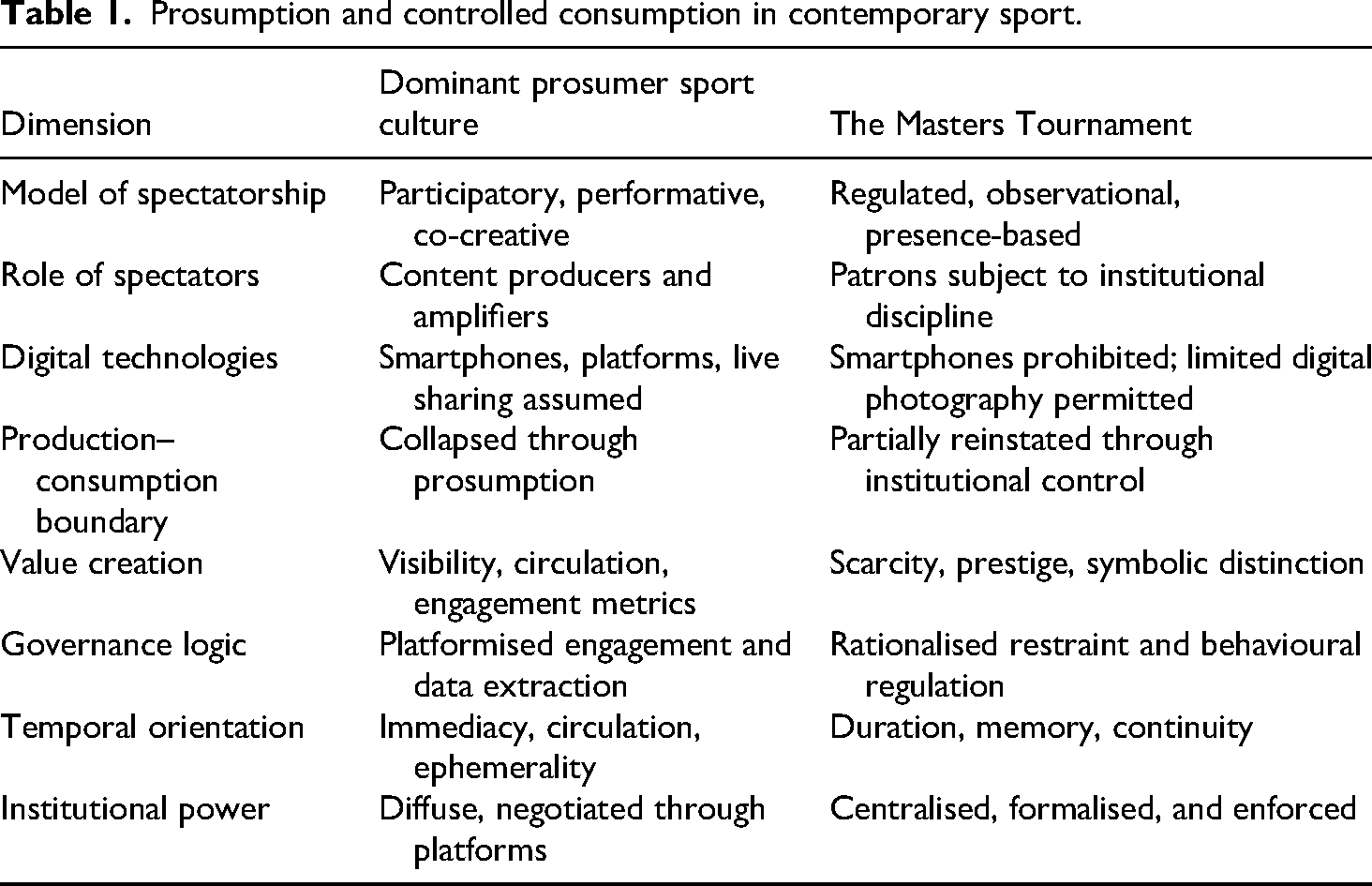
Table 1 summarises the key distinctions between dominant prosumer sport culture and the model of controlled consumption exemplified by the Masters Tournament, providing an analytical framework for the case analysis that follows.
Prosumption and controlled consumption in contemporary sport.
Methods and case selection
This study adopts a qualitative, theory-driven case analysis to examine how the Masters Tournament organises consumption, participation, and institutional control. The analysis prioritises institutional governance over patron experience, treating Augusta National as a governing institution whose rules, policies, media representations, and material arrangements structure the conditions under which consumption occurs. The analysis therefore draws on publicly available institutional materials, historical accounts, media coverage, and policy documentation relating to spectator conduct and event organisation. A case analysis approach is particularly appropriate given The Masters’ high degree of formalisation, visibility, and documentation, as well as its status as an elite sporting institution with practices that are widely codified and publicly articulated (Flyvbjerg, 2011; Yin, 2018).
The Masters is analysed as a critical case through which broader sociological questions about prosumption, rationalisation, and consumer culture can be examined. Critical cases are valuable not for their representativeness, but for their capacity to illuminate the limits of dominant theories and assumptions (Flyvbjerg, 2011). In this context, interviews with patrons were not prioritised, as the analytical focus is not subjective experience but institutional power and governance. By examining formal restrictions on electronic devices, behavioural regulation, and practices of scarcity and access, the analysis foregrounds how consumption is structured and constrained through institutional design, offering insight into how elite sport organisations selectively resist digitally mediated prosumer culture. Whilst this approach prioritises institutional governance over spectator perspectives, future research could extend this analysis by examining how patrons interpret, negotiate, or occasionally resist these restrictions in practice.
Case analysis: The Masters Tournament
This case analysis examines how the Masters Tournament organises consumption through institutional control rather than participatory engagement. The analysis focuses on four interrelated mechanisms: restrictions on smartphones and other electronic devices, the continued use of analogue scoreboards, the regulation of patron behaviour, and the strategic management of scarcity and access. Together, these practices demonstrate how Augusta National limits prosumer participation whilst preserving prestige, symbolic power, and institutional authority. Rather than encouraging spectators to co-produce the spectacle through digital circulation and visible participation, the tournament structures spectatorship as a disciplined and regulated form of consumption.
Phone/smartphone bans and limited digital production
The prohibition of phones and smartphones is the most visible mechanism through which The Masters limits digitally mediated prosumption. Patrons are explicitly forbidden from bringing such devices onto the course during tournament play, thereby restricting real-time documentation, circulation, and platform-based interaction. From a Weberian perspective, this ban constitutes a rationalised form of control that limits unregulated communication and reduces uncertainty over representation (Kalberg, 1980; Weber, 1978 [1922]).
Importantly, this prohibition does not constitute a wholesale rejection of digital technology. Patrons are permitted to use digital cameras, allowing still images to be captured and retained for personal use. This distinction is analytically significant: whilst digital photography enables memory-making, it does not facilitate instantaneous circulation, commentary, or algorithmic amplification. The institutional restriction is therefore not directed at digital imagery per se, but at the communicative and prosumer capacities embedded within smartphones (Hutchins et al., 2022).
By allowing limited image capture whilst restricting real-time sharing, Augusta National preserves control over the public mediation of the event. Popular accounts of the tournament experience reinforce this emphasis on embodied presence. The Sounds of the Masters documents spectators’ attention to the distinctive auditory and atmospheric qualities of Augusta National, from crowd murmurs to the eruption of roars across the course, highlighting how the absence of smartphones contributes to a heightened sensory engagement with the event itself. This selective restriction disrupts the logic of prosumption, in which fans are expected to produce and circulate content as part of authentic participation (Andrews and Ritzer, 2018; Ritzer and Jurgenson, 2010). The ban thus functions as a form of rationalised restraint, enabling controlled consumption whilst limiting the extraction of unpaid prosumer labour.
Despite these institutional restrictions, it would be misleading to assume that patrons passively accept all constraints. As with many highly regulated cultural environments, spectators occasionally test or negotiate the boundaries imposed by Augusta National. Media reports periodically document attempts to bring prohibited devices onto the course (Leighfield, 2026; Nash, 2026), whilst others describe informal strategies through which patrons capture memories or relay information to external audiences. Such practices illustrate that institutional control is never absolute. However, the strict enforcement of tournament rules, combined with the prestige associated with attendance, appears to limit widespread resistance. Rather than openly contesting restrictions, most patrons appear to accept them as part of the distinctive cultural experience of The Masters.
Analogue scoreboards and attention management
The continued use of analogue scoreboards further reinforces The Masters’ commitment to controlled consumption. In contrast to digitally networked score displays common in contemporary sport, the tournament's manual scoreboards require patrons to engage with the physical environment of the course. Information is present but deliberately mediated through institutional channels rather than personalised digital feeds.
Analytically, analogue scoreboards exemplify predictability and calculability achieved through formal organisation rather than technological acceleration (Weber, 1978 [1922]). The flow of information is slowed, standardised, and collectively oriented. This resists the fragmented, individualised consumption characteristic of platformised sport culture, where spectators curate personalised streams of data and content (Hutchins et al., 2022). From a Baumanian perspective, this practice interrupts the immediacy and ephemerality of liquid consumption, anchoring attention in duration and shared presence rather than constant updating and replacement (Bauman, 2007).
Behavioural regulation and atmosphere governance
Patron behaviour at The Masters is subject to regulation in line with traditional golf etiquette. Movement, speech, and conduct are governed by formal and informal rules, with enforcement mechanisms that include removal from the grounds. These expectations reflect a rationalised governance of conduct in which discipline and predictability are central to institutional authority (Weber, 1978 [1922]).
This regulation shapes the atmosphere of the tournament. Unlike prosumer sport spectacles, where atmosphere is co-produced through visible participation, chanting, and performative fandom, atmosphere at The Masters is curated through restraint. Noise levels, mobility, and interaction are carefully managed to preserve order, exclusivity, and aesthetic control (Edensor, 2015; Millington and Wilson, 2017). Roars and cheering can be heard around the course during the tournament, but quiet order is maintained during a golfer's shot routine or swing. Descriptions of the tournament atmosphere in Sounds of the Masters similarly emphasise how spectators become attuned to these rhythms of quiet anticipation and sudden collective noise, reinforcing the sense that The Masters experience is structured through carefully managed sensory and behavioural norms. The use of the term ‘patron’ is itself indicative of this governance model. Unlike ‘fan’ or ‘spectator’, the term implies conditional access, behavioural obligation, and deference to institutional norms. Patrons are invited to observe rather than perform, reinforcing a consumption model grounded in discipline rather than co-creation.
Scarcity, access, and symbolic distinction
Linked to this, scarcity is central to The Masters consumer experience. Access to tickets is limited and framed as a privilege rather than a right. This scarcity enhances the symbolic value of attendance and reinforces social distinction, positioning the tournament as exceptional rather than reproducible (Grainger et al., 2025). From a Baumanian perspective, The Masters limits mass, repeatable consumption by managing desire through exclusion. Consumption is not democratised through participation but stratified through controlled access (Bauman, 2005, 2007). Attendance becomes a marker of status rather than a routine leisure activity. Scarcity also functions as an exercise of institutional power. By regulating how many patrons may attend and limiting the number of golfers invited to compete, as The Masters operates as an invitational event, Augusta National preserves cultural authority whilst insulating the event from pressures to expand participation or embrace prosumer engagement. Controlled consumption thus becomes a mechanism through which legitimacy and prestige are sustained.
Discussion
This article positions the Masters Tournament as a critical case for debates surrounding digitally mediated sport consumption. Whilst much scholarship treats participatory, prosumer fandom as an expanding and largely taken-for-granted condition of contemporary sport, The Masters demonstrates that such forms of engagement remain contingent upon institutional design. Rather than extending opportunities for co-creation, Augusta National organises spectatorship through restriction, producing a model of consumption structured by discipline, scarcity, and selective access.
Power, governance, and the regulation of participation in contemporary sport
The Masters illustrates that limitations on prosumer sport culture should not be understood as a rejection of modernity or capitalism. Rather, it represents an alternative mode of governance in which institutional authority is preserved through selective control over participation, representation, and access. These practices exemplify rationalised restraint, where regulation operates not through expansion, but through the strategic limitation of action and representation. This enables Augusta National to retain control over how the event is communicated and interpreted, insulating it from the decentralised production of meaning characteristic of platformised sport (Hutchins et al., 2022).
In this sense, The Masters reveals that rationalisation in contemporary sport may operate as much through restraint as through efficiency and acceleration. This challenges dominant narratives within sport sociology that equate modernisation with openness, participation, and technological expansion. The Masters demonstrates that elite institutions can remain culturally powerful precisely by limiting these trends. This analysis further suggests how elite sport organisations retain the capacity to shape the conditions of spectatorship, determining not only access but also the forms of engagement that are considered legitimate. Although spectators occasionally test or negotiate these restrictions in informal ways, the strength of Augusta National's regulatory framework ensures that such acts remain limited and rarely challenge institutional authority.
Any analysis of the Masters Tournament's contemporary authority must also acknowledge the historical exclusions through which Augusta National accumulated its symbolic power. The tournament's mystique and prestige were forged within an institutional context marked by racial, gender and social exclusion, practices that long shaped access to membership, visibility, and legitimacy. Whilst Augusta National has sought to reframe itself as a universal ‘Mecca of Golf’, recent scholarship demonstrates how racial issues have often been rendered unspeakable through narratives of tradition and repair rather than critically addressed (Misra and Roessner, 2025).
This history is sociologically significant not because it represents a deviation from The Masters’ contemporary identity, but because it helps explain the institution's enduring capacity to control access, behaviour, and consumption. The ability to present scarcity, restraint, and discipline as markers of prestige rests on an accumulated authority produced through long-standing practices of exclusion. In this sense, The Masters’ regulation of participation within prosumer sport culture is not detached from its past, but continuous with an institutional logic that privileges control, distinction, and selective inclusion.
The limits of prosumer sport culture and the emergence of controlled consumption
A central contribution of this article lies in its interrogation of prosumption as a dominant but not universal logic of sport consumption. Existing literature frequently frames prosumption as an inevitable outcome of digital mediation, positioning fans as co-creators whose participation enhances authenticity, engagement, and value (Andrews and Ritzer, 2018). Whilst this model accurately describes many sporting contexts, The Masters reveals important limits to this assumption. Prosumer participation remains contingent upon institutional permission, and where such permission is limited, as at Augusta National, prosumption is curtailed without undermining the event's legitimacy, visibility, or commercial success. The case also highlights how prosumption often serves institutional rather than fan interests. In many sports, fans generate content that extends the spectacle and produces value through unpaid labour (Zwick et al., 2021). By restricting phones and smartphones, The Masters limits this form of extraction, consolidating value within institutional and broadcast channels and exposing the uneven power relations embedded within prosumer sport culture.
From this perspective, The Masters operates through scarcity and durability rather than immediacy and circulation. Consumption is framed as exceptional and temporally anchored, contrasting with the fluid and rapidly replaceable experiences characteristic of digitally mediated sport culture. Value is not generated through visibility, but through restricted access and the symbolic weight attached to presence, reinforcing its status as a culturally distinctive sporting event. The case therefore suggests that participatory sport culture should not be understood as universal, but as uneven and institutionally contingent. The capacity to limit engagement, rather than maximise it, emerges as a key dimension of power within contemporary sport. In this sense, The Masters demonstrates how restriction itself can operate as a resource, sustaining prestige and reinforcing hierarchical distinctions in a highly mediated sporting landscape.
Implications for the sociology of sport
These findings contribute to the sociology of sport by demonstrating that prosumer culture is neither universal nor uncontested. This suggests the need for greater analytical attention to institutional strategies that limit, manage, or refuse participation, rather than assuming expansion and engagement as default conditions of contemporary sport. The Masters Tournament reveals how elite institutions can organise controlled consumption in ways that preserve authority, privilege, and distinction within a hyper-mediated sporting landscape. This case study invites scholars to reconsider assumptions about participation, technology, and progress in sport. Rather than treating digital engagement as an inevitable good, sociological analysis must attend to who controls participation, who benefits from it, and under what conditions it is permitted or denied. In doing so, this article positions The Masters not as an anomaly to be dismissed, but as a critical case that exposes the limits of prosumption and demonstrates how elite sport institutions can strategically organise consumption in ways that preserve authority, scarcity, and symbolic distinction in late modern sport.
Conclusion
This article has examined the Masters Tournament as a critical case through which to interrogate dominant assumptions about prosumption, digital participation, and consumer culture in contemporary sport. Although a range of sociological scholarship positions participatory, digitally mediated fandom as an inevitable feature of late modern sport, The Masters demonstrates that elite sporting institutions retain the capacity to limit this trajectory through rationalised control, scarcity, and disciplined consumption. Drawing on Weber's theory of rationalisation and Bauman's analysis of consumer society, the analysis shows that regulating participation within prosumer sport culture represents not a rejection of modernity or commercialisation, but an alternative institutional strategy through which authority is maintained.
Through the prohibition of smartphones, the maintenance of analogue infrastructures, and the governance of patron conduct, Augusta National curates a spectator environment grounded in presence, privilege, and distinction. These practices demonstrate how consumer culture in sport can be organised around controlled consumption, where restriction and scarcity function as sources of symbolic value rather than barriers to engagement. Participation and co-creation remain contingent upon institutional permission, and although spectators may occasionally negotiate these constraints, the strength of the regulatory framework ensures that such practices rarely challenge institutional authority.
More broadly, the case demonstrates how elite sporting institutions can remain globally visible and commercially successful whilst limiting audience co-production. The Masters, therefore, reveals how consumer culture operates not only through participation, but also through exclusivity, scarcity, and carefully managed access, reinforcing symbolic distinction and social hierarchy within contemporary sport.
Whilst The Masters represents a distinctive case, it also reflects broader cultural norms within golf, where etiquette, restraint, and tradition shape the spectator experience. Future research could examine how patrons interpret and negotiate these constraints, offering further insight into how elite sport institutions organise participation, authority, and value in digitally connected contexts. In doing so, it highlights how participation in contemporary sport is not simply enabled by digital technologies, but actively structured, limited, and ultimately determined by institutional power.
Footnotes

Funding
The author received no financial support for the research, authorship, and/or publication of this article.
Declaration of conflicting interests
The author declared no potential conflicts of interest with respect to the research, authorship, and/or publication of this article.