




Abstract
This article examines the types of racism experienced in community sport in Australia. Drawing on interviews with 51 community sport stakeholders, including 26 individuals with lived experiences of racism in sport, the article shows how Australian community sport maintains white dominance through everyday racisms including: the use of racial norms and stereotypes that shape how Indigenous peoples and racialised settlers are treated; favouritism and racial exclusion; and a consistent lack of action against racism. The types of racism work together in a self-sustaining system that makes them challenging to tackle, supporting the maintenance of white dominance in Australian community sport. This article addresses a significant gap in the literature by detailing the types, extent and nuances of everyday racisms in Australian community sport, particularly those that operate beyond the more visible and overt forms of interpersonal racism.
Introduction
Community sport is a cornerstone of social life in Australia. Club-based community sport can provide environments where participants can have fun and broaden their social networks (Hoye et al., 2015). This can result in associated benefits such as a sense of belonging, security and access to resources (Ziersch et al., 2005), and improved mental health and resilience (Luthar and Cicchetti, 2000). However, the benefits of sport are not evenly spread. The Australian Sports Commission estimates that while overall 41% of Australians aged over 15 participate in sport at least weekly, only 32% of First Nations Australians and 38% of Australians who speak a language other than English at home participate, indicating an underrepresentation (Australian Sports Commission, n.d.). This may be due in part to racism, which is a known problem in Australian community sport (Farquharson et al., 2019; Jeanes et al., 2025), and can lead to social exclusion and marginalisation, while also having a direct negative impact on the health and wellbeing of Indigenous peoples and racialised settlers (Paradies et al., 2015). When racism acts as a barrier to participation in community sport, Indigenous peoples and racialised settlers are denied the physical, mental and social health benefits that sport can offer.
The Australian Human Rights Commission National Anti-Racism Framework (Australian Human Rights Commission, 2024) and the Victorian Government's anti-racism strategy 2024–2029 (Department of Premier and Cabinet, 2024) both mention sport as a site for antiracist intervention. Despite this, racism in Australian sport is generally under-explored (Ben et al., 2024), with most studies focusing on elite sport (e.g., Coram and Hallinan, 2017; Farquharson and Marjoribanks, 2006; Hallinan and Judd, 2009). This leaves a significant gap in our understanding of how racism occurs in Australian community sport, which not only serves as an entryway to elite pathways but also shapes everyday experiences of belonging and inclusion, especially for young people from racialised settler groups (Young and Block, 2023). Little is known about the types of racism experienced in community sport settings and their extent and nuances, especially beyond the most visible, overt forms of interpersonal racism. There is also a perception within Australia's community sport sector, confirmed by this study, that racism is not a serious issue.
This article addresses this gap. We ask: how is racism experienced in community sport in Australia? We argue that Australian community sport is structured to maintain white dominance through everyday racism (Essed, 1991), which relegates people who are not white to peripheral positions on and off the field. This is compounded by a lack of awareness about the many structural and systemic ways in which racism operates in sport, as well as a lack of political will to prevent racism and support victims when racism occurs. Drawing on interviews with community sport stakeholders, including individuals with lived experiences of racism, we explore the types of racism experienced in Australian community sport.
Racism in Australia
In this article, we use the term ‘racialised settlers’ to refer to non-European settlers, whether they were born overseas or have racialised settler heritage, and including racialised cultural and/or religious minorities. We use the term ‘Indigenous’ to refer to the original inhabitants of the land known as Australia, which is made up of numerous First Nations. We use the term ‘white’ to refer to settlers of European descent. We also use the term ‘settler’ to refer to anyone who is not Indigenous.
Australia is a settler colonial nation that was founded on racism. Racism shaped European settlement by situating Indigenous peoples as not people through a doctrine of terra nullius, which asserted that the land had no occupants (Opare-Addo and Farquharson, 2025). It also prevented the settlement of non-white migrants through the Immigration Restriction Act 1901, colloquially known as the White Australia policy (Opare-Addo and Farquharson, 2025). The structural separation between Indigenous peoples and settlers remains today, and while the White Australia Policy ceased in 1973, racism against racialised settlers remains a feature of Australian society (Elias et al., 2021; Hage, 2023) and of Australian sport (Cleland et al., 2024; Coram and Hallinan, 2017; Farquharson et al., 2019).
One of the consequences of this historic separation is that when the White Australia policy ended, the Australian government essentially stopped collecting racial data about racialised settlers, leaving Australia with a racial classification system consisting of just two categories: Aboriginal and Torres Strait Islander peoples (Indigenous peoples) and everyone else. There is no agreed upon racial classification system that could structure the collection of racial data for racialised settlers or religious groups. This makes it challenging to assess the extent of racism against racialised settlers. This was apparent in a recent study about the collection of data about racism in Australia (Ben et al., 2024), which identified major gaps in the collection of such data, highlighting that most data focused on racism against Aboriginal and Torres Strait Islander peoples (Ben et al., 2024). Racial and cultural data are not systematically collected for non-Indigenous groups. The research found that few studies included perpetrator demographics, how racism affects life outcomes, or context-specific studies of racism (Ben et al., 2024). Sport was specifically called out as a context where research is needed.
As noted above, two recent government reports, the Australian Human Rights Commission National Anti-Racism Framework (Australian Human Rights Commission, 2024) and the Victorian Government's anti-racism strategy 2024–2029 (Department of Premier and Cabinet, 2024) have also identified the need to address racism in general, and in sport specifically. While governments at all levels could provide leadership on the collection of data on racism, the lack of a shared understanding of ‘race’ in the context of racialised settlers makes it challenging, leaving us in a Catch-22 situation where it is agreed that racism in a problem, but it is very difficult to assess the extent of the problem or the efficacy of approaches to challenge it.
Theorising race and racism
Race is a social construction based on ancestry, identity, and ascription, among other factors (Roth, 2016). In white-dominated societies such as Australia, race can be theorised as a technology of white supremacy that serves to create and maintain social differences (Lentin, 2020). Race, in this view, divides people hierarchically to benefit white dominance through a process of signifying some people as not white and treating them as lesser (Lentin, 2020). Thus, while socially constructed, race has material consequences through racism. In the Australian context, white settlers are the main beneficiaries of racism, though all settlers benefit from Indigenous dispossession (Stewart and Vaughan, 2025). Following Elias et al. (2021), we define racism as discrimination based on belief in racial ideologies/categories. It has three interconnected levels: institutional, interpersonal and internalised. At the institutional level, racism includes norms and practices; policies, laws and regulations; privileges; and the racialised structuring of institutions themselves (Elias et al., 2021). Interpersonal racism plays out in relationships, attitudes, behaviours and actions (Elias et al., 2021). Internalised racism is where a person believes they or their group is inferior or superior to other groups (Elias et al., 2021). It can lead to self-sabotage, but possibly also self-promotion in the case of sport, where racial stereotypes situate white athletes as tactical decision-makers and Black athletes as naturally talented rather than hardworking and intelligent (Spaaij et al., 2015). Importantly, the three levels are mutually constitutive; through feedback loops, each reinforces the others, making racism a self-sustaining hegemonic system (Elias et al., 2021).
Elias et al.'s (2021) theory of racism was created for Australia and works well as a framework for understanding racism in this context. It has features in common with critical race theory (Delgado and Stefancic, 2017) in that both argue that racism is everyday business, structuring interactions at all levels of society. In white-dominated societies such as Australia, social institutions, such as sport, are organised to maintain white dominance (Christian, 2025; Lentin, 2020). The valorisation of whiteness is hegemonic, supported by internalised racism as well as interpersonal and institutional racism. In sport this means that the ways that policies and practices are developed and implemented, the racialised ways that individuals interact with each other, and the racialised beliefs about who is good at what in sport, support the elevation and centring of white people and the subordination of Indigenous peoples and racialised settlers. Racism is embedded in society such that everyone, regardless of whether they hold racist beliefs, is implicated in it (Elias et al., 2021). It is present in how seemingly non-racist policies are implemented, in understandings of who is capable of what.
An alternate approach to understanding racism is everyday racism theory (Essed, 1991), which argues that racism is carried out through repeated ‘normal’ everyday practices and routines. Here, racism, as with Elias et al.'s (2021) theory, is seen as part of the social fabric. However, rather than asking whether racism is interpersonal or structural, everyday racism theory asserts that the ideological and attitudinal aspects of racism are brought to life through repertoires of repetitive, individual racist acts (Essed, 1991). These repertoires are part of the social structuring of racism; in other words, they link micro-interactions and macro-structures. In the theory of everyday racism, racialised others are marginalised by dominant norms and values. This marginalisation is supported by the systematic problematising of racialised others’ experiences, qualifications, and social observations. They are viewed as less competent and not able to ‘function at the same level as Whites’ (Essed, 1991: 289). Their attempts to challenge racism are frustrated by the ‘containment strategies of the dominant group’ (Essed, 1991: 289). These include systematic denial of racism, patronisation, intimidation, pressure to assimilate and isolation. While not all racism is everyday racism, everyday racism theory provides insights into the ways that racist behaviours occur in patterns of individual interactions. Essed's theory of everyday racism remains influential, inspiring a large body of work within the social sciences (Bourabain and Verhaeghe, 2021).
While providing a compelling explanation of how racism operates, everyday racism theory does not offer a theory of change (Essed, 1991), yet discussions of racism in contexts such as sport are often accompanied by questions of how it can be reduced or prevented. According to critical race theory (Delgado and Stefancic, 2017; Ray, 2022), anti-racist change is possible when there is interest convergence. This suggests that unless it is in the interests of the racial elites (white settlers), racism will continue to structure Australian sport. Thus, we argue that critical race theory can explain why, even though our research demonstrates that racism is an acknowledged problem in Australian sport, there has been a lack of effective solutions to preventing or reducing it (Spaaij et al., 2020). Elias et al. (2021) further argue that various anti-racism approaches require necessary conditions to be effective and have varying degrees of effectiveness. In addition, they find that backlash is a common response to anti-racism, for example, a denial of racism.
Racism in sport
In this article, we conceptually situate and empirically examine everyday racism within the context of community sport in Australia. We recognise that everyday racism is structural, permeating and structuring micro, meso and macro levels. Building on recent advances in everyday racism theory (Bourabain and Verhaeghe, 2021), we acknowledge the importance of meso-level spaces in which everyday racism occurs. In this article, we do so by linking experiences of everyday racism in community sport in Australia to the characteristics of those community sport settings, which influence the types and intensity of racism.
While there is a dearth of research into racism in Australian sport (Ben et al., 2024), there is a substantial body of research from other contexts, particularly the USA and UK. In white-dominated societies, including Australia, whiteness is normative in sport, structuring all its aspects (Fletcher and Hylton, 2016; Lee et al., 2023; Peel et al., 2023), including playing (Baker-Lewton et al., 2017), coaching (Bradbury and Conricode, 2025; McDonald, 2016) and fans and fandom (Cleland, 2024), with the white male athlete being the reference group against which other groups are constituted (Wrench and Garrett, 2018). Indeed, Phillips and Osmond argue that whiteness explains on whose terms Australian sport is played and how the marginalisation of Indigenous athletes is structured (Phillips and Osmond, 2018).
Institutional racism also shapes access to sport, with, for example, white students having access to more sport than Black students in the USA (Pericak and Martinez, 2022) and entire sports being divided by race in the UK (Harrison, 2013; Hylton, 2020). Harrison (2013) calls this ‘racial spatiality’: how racialised bodies are situated to (not) belong in entire sports, and where those that do not belong are considered disruptive and are policed. Racism can also lead to positional segregation (or stacking), where non-white athletes are relegated to performance positions on the field aligned with racial stereotypes (Nobis and Lazaridou, 2023). Whites dominate sport leadership and tactical decision-making positions both on and off the field, while racialised minority coaches and leaders are underrepresented (Bradbury, 2013; Bradbury et al., 2018; Bradbury and Conricode, 2025). There are decades of research on positional segregation, however in Australia, research has explored positional segregation for Indigenous players (Hallinan and Judd, 2007, 2009) but not, as far as we are aware, racialised setters.
There is also extensive research on racial stereotypes in sport, including the myth of natural talent that situates Black athletes as physically superior but mentally inferior, and its negative effects on Black athletes (Harrison, 2001; Hoberman, 1997; McDonald and Spaaij, 2020). These stereotypes are reinforced and reproduced through everyday talk (van Sterkenburg et al., 2019). The myth of natural talent is also reinforced through internalised racism, where individuals believe their race is better/worse at sport than others.
There has been less research on racial stereotypes about non-Black, non-white athletes, though the dynamics are arguably different. For example, Asian athletes may be stereotyped as physically inferior (Chin, 2015). Media representations support racial stereotypes and have been shown to affect attitudes towards minorities (Ash et al., 2023; Kobach and Potter, 2014). Such stereotypes, while having no basis in biology, can contribute to differential treatment, for example, in decision-making around the hiring of coaches (Sartore and Cunningham, 2006).
Relatedly, favouritism towards white athletes disadvantages non-white athletes, who have been found to be treated more harshly by officials (Magistro and Wack, 2023). Favouritism is the use of racial stereotypes to discriminate and can be viewed as a form of everyday racism (Essed, 1991). While seemingly individual, favouritism is part of a repertoire that leads Indigenous and racialised settler athletes to be treated in ways that exclude and marginalise them. So, while it occurs from individuals to individuals, it is occurring constantly, in similar ways and systematically.
Similarly, research into everyday racism in sport has found that Australian community sport can be a site for ‘slow violence’ (Baker-Lewton et al., 2017), a form of everyday racism that creates an environment where migrants are racialised and excluded, leading to the creation of safer informal sport spaces that sit outside of the mainstream. These spaces, while providing safety from racism, also limit access to talent development pathways, contributing to segregation. Nevertheless, they enable participation for people who are marginalised by mainstream community sport.
Somewhat paradoxically, racism in sport is seen by many as a relic of the past, even while, at regular intervals, professional athletes, leaders, spectators and clubs are called out for racism (Burdsey, 2011). Those who commit racist acts are seen as individual aberrations (‘bad apples’) rather than as part of an overall pattern in sport (Cleland et al., 2024; Mashigo et al., 2025).
Methods
To examine the types of racism experienced in Australian community sport, we conducted 51 in-depth interviews with stakeholders across the community sport ecosystem.
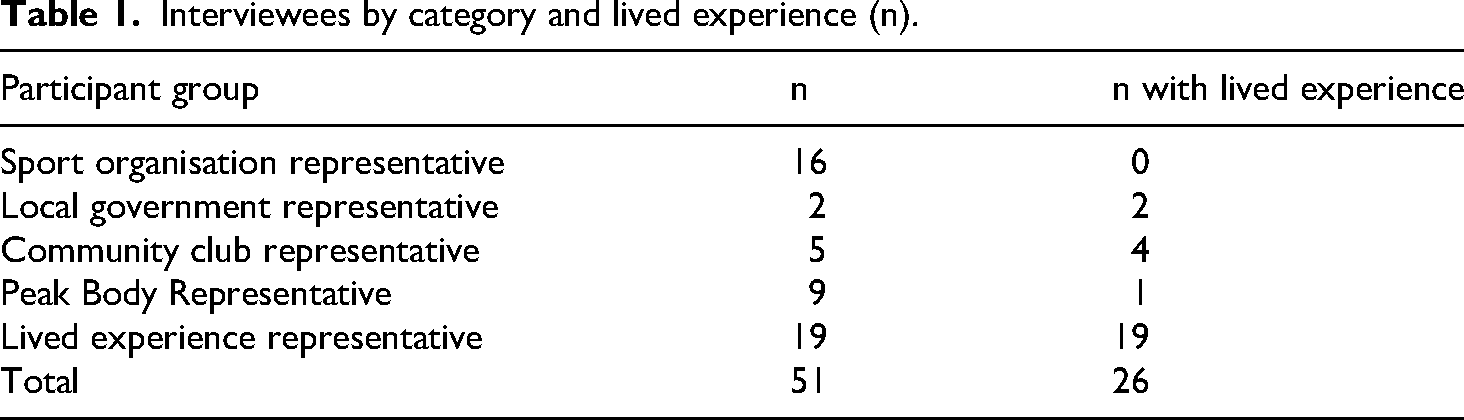
As Table 1 shows, 25 leaders of sport organisations and peak bodies were interviewed. Twenty-six of the 51 interviews were with people with lived experiences of racism, consisting of those who identify as either Indigenous or being from a racialised settler background. The other 25 people identified as white. Six of the participants with lived experience of racism were leaders. Participants worked in sport organisations, local government, not-for-profit organisations, or as coaches, volunteers, and leaders in community sport. The Victorian community sport community is small, with few women, Indigenous people and racialised settlers in leadership positions. To protect participant confidentiality, including their internal confidentiality (Tolich, 2004), we have chosen not to use pseudonyms. While we could have assigned gender-neutral pseudonyms, they come with the risk of erasing cultural identities and/or enacting a paternalistic approach. Instead, while recognising that there is a cost to not using pseudonyms, each participant is identified as ‘Lived experience participant n’ or by their role. We have not indicated whether those in leadership positions had a lived experience of racism as this could make them identifiable. We have also not distinguished between Indigenous and racialised settler background participants when attributing quotes due to the small size of the community.
Interviewees by category and lived experience (n).
The interviews averaged 60 min, were audio-recorded with permission, transcribed using Otter AI and manually checked for accuracy, and imported into NVivo for thematic analysis. We adopted a reflexive thematic analysis approach following Braun and Clarke's (2022) six recursive phases: (1) familiarisation with the dataset, (2) coding, (3) generating initial themes, (4) developing and reviewing themes, (5) refining and naming themes and (6) writing up. Early theme development began by summarising recurrent ideas across participant groups. We then developed a codebook through a collaborative process. Each member of the four-person research team independently coded three to four transcripts, drawing on the interview questions, research aims and recurring participant topics. Coding decisions were then compared and refined in team discussions. The project lead consolidated inputs into a draft coding framework, which was reviewed and finalised collectively. Consistent with Braun and Clarke's (2022: 39) reminder that ‘themes cannot exist separately from the researcher’, we recognise that our interpretations were shaped by the diverse perspectives, values and experiences of the project team, which included three migrants, two from the global south and with lived experience of racism. The consisted of three women and one man.
Findings
As Essed (1991) has argued, people with lived experience of racism have detailed understandings of how racism operates in everyday settings such as sport. We found that participants with lived experience were able to express sophisticated understandings of how race structures community sport and its effects on all aspects of participation. Participants without lived experience had a different understanding of how racism operates, and in some cases, were not aware of the ways certain policies, practices and behaviours were racist. Nevertheless, research participants, both with and without lived experience, frequently referred to racism, from general assertions that racism was a key structure in sport through to specific examples that they had witnessed or experienced first-hand. The examples documented in this article are a small proportion of what we were told. The forms of racism experienced in community sport included racialised practices, privileges, norms, stereotypes, favouritism and exclusion, along with a consistent lack of action to prevent or attend to racism. Together, these racisms structure Australian community sport around an ideology of white supremacy.
The findings suggest that racism is common in Australian sport and is enacted through three interrelated types of everyday racisms: racial stereotypes and positional segregation, favouritism and racial exclusion; and a systematic lack of action on racism. These forms of racism are not isolated incidents but are brought to life through repertoires of repetitive racist acts that normalise racialised hierarchies and embed them into the routine practices of community sport. Together, these types of everyday racism centre white people in Australian community sport and marginalise Indigenous peoples and racialised settlers.
Racial stereotypes and positional segregation
The centring of whiteness was evident in the many ways that participants described racial stereotypes, particularly myths around the natural talent of certain groups and how they lead to racism. For example: ‘People assume that if you're Aboriginal, you're Black, that you're good at sport. In athletics, it's a particular problem’ (Peak body representative 2). Racial stereotypes could encourage and discourage sport participation, and their effects varied across different racialised groups. For example, one participant recounted being discouraged from playing sports as an Asian person: I think Asians … [are] not really supposed to play sports, and especially in my age group … when I was a kid, it was not encouraged by anyone … teachers didn't seek you out to do athletics…they might pigeonhole you to be more academic whether you were or were not. (Club representative 3)
Another participant told us that it was expected that they would be talented at cricket, but not other sports: My background is Indian, and when I stepped onto the cricket field or into a cricket club… it was assumed I could play. I was very much more welcomed because of my appearance … In soccer, I really had to work to gain some credibility and respect …. And then in footy [it] was a bit more work. (Lived experience participant 6)
The myth that talent and race were seen to be linked is clear in these quotes. For the first person, being Asian was automatically associated with a lack of sporting talent but also with academic ability (cf. Chin, 2015), while for the second, Indian people were expected to be good at cricket, but not other sports. There were also broader racialised issues that affected the participation of non-Indigenous racially minoritised peoples in talent pathways. One participant noted the disconnect between lots of South Asians playing community-level cricket and their absence on the national team, indicating structural racism: You have majority of, let's say Sri Lankan or Indian cricket players, right? A huge community playing across multiple areas. Do you see that in the national team? I'm just saying there's a classic example. (Peak body representative 4)
Racial stereotypes also shaped perceptions of African
1
and Indigenous players, but they played out in different ways. For Black African Australians, it was that they were talented, but also trouble (see also Hall, 1981). Indigenous players were thought to be ‘quick’ but lacking in work ethic (see also Hallinan and Judd, 2009). While neither of these myths has any evidence to support it, they were commonly assumed to be real, and both led to players being treated as lesser and feeling like they didn’t belong. This was discussed by the following participants in relation to Indigenous and Black African Australian children: There's an assumption that because they're Aboriginal, they're going to be good at football, [not] anything or something else. (Peak Body representative 2) [At] sports clubs, they feel it once they come through the door, they feel it when they miss a training session and everyone's like, ‘Can't trust these African boys.’ They feel it in every aspect in the sports club, they feel it in the same way Aboriginal kids might in the club, like ‘he's a quick little player’. That type of stereotyping. Constantly being seen as something else is something that they've grown up with. … them not belonging in that space or not feeling like they belong in that space. (Lived experience participant 12)
Multiple participants also mentioned a lack of racial diversity in leadership positions, particularly in coaching or on boards, as a form of structural racism. The following quotes are typical examples of those comments: [There is an] over-representation of Aboriginal people in elite sport, … I think the space that we haven't really tackled yet to create change and cultural shift within the sports industry is sports administration, boards, and coaching. … (Lived experience participant 1) [I] think that [sport is] very white centric and very male centric, and in that … way, [I] don't think that it's that inclusive. And I guess the evidence for that is the fact that there are people of colour or racialized communities who are very well represented in sports, but particularly in positions of power, decision making tables and the like, they just were non-existent. (Lived experience participant 2)
In this form of positional segregation, racialised people are systemically excluded from leadership, thus reinforcing stereotypes of white superiority (Spaaij et al., 2015).
The whiteness of decision-makers and leadership was not limited to one or two sports. It was consistent across the sector. Embedded in all of these experiences was the unspoken assumption that non-white athletes are considered inherently less competent than whites (Essed, 1991), and therefore not deserving of a place at the leaders’ table.
Favouritism and racial exclusion
Racial favouritism occurred when white players were preferred over racialised others. The following shows how one participant described favouritism: Let's say, I make a mistake, and the coach, the way he addressed it with me, while some other guy makes the same exact mistake, and how he addressed it with them, right? You can see [them] treating you like you’re inferior, and then just talking to the other kid that if I really teach you, you will get it. (Lived experience participant 7)
For this person, they were not afforded grace when they made a mistake, but white players were. They felt they were treated as though they were ‘inferior’.
Another participant discussed feeling that he always had to try harder and ‘be better’ than the white players to justify his place on the team. He reflected on how he experienced this as racism, but it was difficult to raise as it was a subtle undermining by his coach without anything overt being said. A parent in the study also commented on subtle forms of racism that, for her children, manifested in the coach giving them less game time and being harsher towards them when they made mistakes. Relatedly, a different participant told us that when a ‘dominant group child’ is dysregulated on court, the behaviour is treated as normal, but when a ‘multicultural child’ does the same thing, they are treated as problematic.
As noted elsewhere (e.g., Baker-Lewton et al., 2017), sometimes Indigenous peoples and racialised settlers create their own teams, and these teams experience racism when playing in mainstream leagues. Our data show similar experiences, as discussed by the following two participants: Our multicultural children are treated differently, especially if … they're like 95% represented in their team. So, if a team is … mainly … South Sudanese or … Burmese [or] … South Asian…. They as a team will be treated differently… I see this all the time; every week I see this. (Lived experience participant 5) A predominantly white club plays our Sudanese clubs. There is no question in my mind, there's an undercurrent of unconscious racism or worse intended racism … I'm dealing with an issue now where a 12-year-old boy's used the F word and the N word towards a player of colour and has refused to shake their hands off the game. There's no question in my mind that this person has been taught this hate and it's very demoralising, and it's very disappointing. (Local government representative 1)
In these examples, minority dominated teams are shown to experience systemic racial exclusion. The latter quote is an example of the racial disdain experienced by minority players, the name-calling and unwillingness to shake hands after the game. This participant acknowledged that they had to deal with it, and that it was disappointing, but also normal. It was also seen as individual: one 12-year-old boy, needing to be dealt with individually. Implicit was that the ‘dealing with it’ would be unsuccessful and it would happen again.
Favouritism and racial exclusion were elements of a systematic bias favouring white people in the community sport system. They occurred across the sector, situating and treating Indigenous peoples and racialised settlers as less than whites, both on the field and off, and when facing them in teams, treating those teams with disdain and exclusion.
A systematic lack of action on racism
The final type of everyday racism that was prevalent in the data was a refusal to act on racism even when it was an acknowledged problem. This everyday racism had three elements. First, it was a challenge to get racism acknowledged as a problem. Second, when it was acknowledged as a problem, action was resisted. Finally, when anti-racist action occurred it was performative rather than substantive. These three elements combined into an everyday systematic lack of action to address racism.
Acknowledging racism
Participants discussed the challenge of getting racism acknowledged as an important problem that needs to be addressed. For example, one person said, ‘It's not just there's no resources available. It's like, how do you then tell people who feel like it's not a problem, that it is a problem?’ (Club representative 3). The community sport sector is run by volunteers and resources are tight across all sports. For this person, it was not just that resources are scarce, it was that leaders did not believe that racism was a problem.
Several participants described clubs that knew they were not attracting racially diverse participants but did not care. This lack of care situated racism as not a problem to be acknowledged or addressed. Lived experience participant 4 described the situation in their sport: … first of all, [white] men have been there forever. And then giving up their power in their space has been hard, seeing women come into the game. And then you have those … racist beliefs. So the way they build and they run their club, whether they be on the board, or coach or the chairman, or whatever, it's just not like it's not a safe place for [Indigenous people] to be. …And what we see in fully is those older [white] people … like, they've been there forever, who won't give it up. But I guess you've got to understand, too, that that that's been their connection, and their wellbeing and their sense of belonging. So the idea of a white fella who's been in that role for 40 years, played for the club, the dad played for the club, and now I'm the chairman of the club or whatever it is. Yeah, I can see how the idea of giving it up or sharing power can be really scary. (Lived experience participant 4)
Here, to Lived experience participant 4, sport is organised around white dominance and the need to share power with Indigenous people might be ‘scary’, indicating an unwillingness to make changes that might disrupt existing racialised power structures. Club representative 1 described a similar dynamic: All your [ethnic] communities were playing their own competitions. But they weren't playing in the club environment. Why is that? Probably because they don't feel very welcomed in there, right? Probably because all the work done by a [sport governing body], whoever, to work on how clubs are structured and all that, it all is great. But at the end of the day, the President of the [local club] is still John, who's 70 years old, who drinks pints, who wants [his club] to be a place for his mates, and wants to win premierships but doesn't really care that in his time that he's been President, the whole area demographic has changed, right. So really, the club should reflect that a bit more. But that won't change because he won't change. (Club representative 1)
Like Lived experience participant 4 and Club representative 1, participants across several sports described similar dynamics. In this case, it was not necessarily a denial of racism, but more a lack of interest in fostering diversity. The ‘old, white men’ in charge were seen as not wanting to welcome Aboriginal peoples or racialised settlers into their clubs and not caring that their clubs did not reflect their local communities. The expectation of some of our participants was that things would change when the ‘Johns’ retired, though there is no evidence that they would not be replaced by new ‘Johns’.
Resisting action
Most participants agreed that racism was an acknowledged problem, but that acting on it was resisted. One national sport association commissioned a report on systemic racism, which: came back saying that yes, structural racism is very evident throughout all state [sport] organisations. And within [sport national association] itself. And [national sport association] said, ‘we need to do something about this. We are making this the onus and the responsibility of our state organisations to turn this around’. They have done nothing. (Lived experience participant 14)
This was not an uncommon approach. For example, a participant with lived experience noted that their organisation just was not interested in tackling racism: ‘it's quite disappointing to see that's not a priority they want to solve’ (Lived experience participant 11). Another said that their sport wanted to be seen to be diverse and inclusive, ‘But then at the same time, their efforts and their beliefs don't really resonate with those ambitions’ (Lived experience participant 6).
Lived experience participant 10 recounted how resistance to action was justified, sharing a conversation they had with the CEO of their sporting association: And so, for me, it was at a point I was like, the association, is racist. The CEO at the time said and I quote: ‘Well, when I was growing up, “Wogs” [migrants from Southern Europe] had to deal with it back then. I guess it's the same thing happening now.’ And I was like, okay, what are we going to do about it? And he said, ‘What can we do about it? It is what it is, and it's going to happen from time to time’. (Lived experience participant 10)
For this CEO, racism was inevitable; it was normal and did not need to be addressed. And even if they wanted to address it, they did not know how to.
A different take on resisting action comes from Sport organisation representative 9, a white senior leader. Sport organisation representative 9 acknowledged that their sport was white dominated, noting that the only athletes that are visible in their sport are white, and this perception makes it unwelcoming for Indigenous peoples and racialised settlers: I think there's just an inherent whiteness about our sport, and I think there's this invisible barrier for a lot of [Indigenous people and racialised settlers] to access something when there is this, you know, inherent whiteness about a sport when we're promoting our sport on social media, and you're constantly seeing our white athletes, our white administrators are, you know, I do think there is a, an unconscious bias towards white people, which can bring about systemic racism and systemic issues down the line. Like, I don't think there is a, an overt racism issue, like what some other sports may face with athletes on the field, you know that that's a different story. But I think with we're, as I said, more immature in our journey, [compared with] those traditional sports, I mean, that we might not get that kind of explicit racism. But it's implied when you see that whiteness, and you see those sorts of areas, and that's something I'm really conscious of, and that we really do need to change. (Sport organisation representative 9)
Sport organisation representative 9 indicates that their sport has almost exclusively white players and, as a result, promotional imagery exclusively features white athletes. This visibility signals to white people that the sport is a space for them, while Indigenous peoples and racialised settlers are signalled, through this imagery, that it is not for them (cf. Harrison, 2013). Sport organisation representative 9 says ‘I don’t think there is a, an overt racism issue’, which suggests it is a problem in other sports, but also that the seeming whiteness of the sport is something ‘… that we really do need to change’. However, this need to change, to act to reduce the perception that the sport was only for white people, was not a priority. It is sort of on the agenda for some time in the future, something that would be nice to remedy, not something that needed to be addressed urgently.
When asked about policies or procedures to respond to racism, Sport organisation representative 9 said about their sport: ‘Yeah, well, we adopt the national integrity framework, which is sort of the standard practice amongst all national sports organisations’ (Sport organisation representative 9). There were no specific anti-racism policies or practices that were adopted or used, and they were satisfied that their approach was sufficient and ‘standard practice’.
Performative anti-racism
The final perspective was that when there was action, it was performative rather than substantive. Symbolic anti-racism is anti-racism that makes it look like action is being taken, but is ineffective (Farquharson et al., 2019; Hylton, 2010). Symbolic anti-racism can be seen as a containment strategy to prevent genuine change (Essed, 1991). Flying the Aboriginal flag and holding multicultural or Indigenous rounds were examples of performative anti-racism shared by participants. As one lived experience participant (14) said: ‘We are inclusive, because, you know, we've got the Aboriginal flag up, and we allow girls to play in our boys’ teams. Very performative’. The lack of action on racism indicated to participants a tacit acceptance of racism as normal practice. Of the types of racism conveyed, it was perceived as one of the most challenging and frustrating.
Discussion
Like previous international studies that show how whiteness structures sport (e.g., Fletcher and Hylton, 2016; Lee et al., 2023), our analysis shows that racism shapes community sport in Australia as a space where white participation and leadership are the norm and Indigenous peoples and racialised settlers are often constructed as problematic others. We identified three types of everyday racism – racial stereotypes and positional segregation; favouritism and racial exclusion; and a systematic lack of action on racism – each enacted through distinct but interconnected repertoires of racist acts that give everyday racism its cumulative force (Essed, 1991). We argue that the three types are interconnected and mutually support a self-sustaining system of racism (Elias et al., 2021) that shapes all aspects of Australian community sport.
The use of racial stereotypes to determine how Indigenous and racialised settler athletes were treated was experienced as unfair and frustrating for participants with experience of racism. This practice occurred through repeated individual interactions; it was systematic and constant. White athletes were not subject to stereotypes – they were seen as normal, highlighting a centring of whiteness. Like previous research on racial stereotyping in sport, which has mainly focused on Black athletes (e.g., Hallinan and Judd, 2009; Harrison, 2001; Hoberman, 1997), we found that racial stereotypes were largely negative for the two ‘Black’ Australian groups, Indigenous and African Australian players, shaping their experiences and opportunities both on and off the field. However, the stereotypes for Indigenous players were different from those for Black African Australian players. While both were seen as naturally talented, Indigenous athletes were also considered lazy, while Black African Australian players were considered aggressive and possibly dangerous. This affected their playing experiences in different ways respectively. Like Harrison (2013), we found that when racialised bodies are deemed not to belong, they were treated as disruptive. This was particularly apparent for Black African Australian players, who were valued only for their playing ability, not as peers or potential leaders (cf. Baker-Lewton et al., 2017).
Our findings also indicate that racial stereotypes affected non-Black racialised settlers in Australian community sport, but in different ways. Asian players were expected to not be talented at sport (see also Cheng et al., 2025; Chin, 2015; Thangaraj, 2015), with some being discouraged from playing, and some, particularly South Asians being discouraged from playing particular sports, pigeonholing them into particular types of participation. These repertoires were present across the sector, not just in one or two sports, indicating a shared understanding of race as a source of difference, even in a context like Australia that lacks a formal racial classification system for racialised settlers.
Racial stereotypes also influenced favouritism and racial exclusion, the second type of everyday racism we found. This form of everyday racism seems individual, but our research suggests that it is systemic, targeting Indigenous peoples and racialised settlers whenever they participate as something they are on the lookout for, leading to an extra burden of participation.
Essed (1991) has problematised the separation between institutional and individual racism, arguing that everyday racism is structural. This study found that individual acts of racism are part of a broader pattern that structures community sport as both centred around white people and racist. It is the patterning that makes these forms of racism structural. We found that whites employed containment strategies (Essed, 1991) when racism was called out. These generally denied that racism was really a problem and, when obvious racism occurred, individualised it (see also Farquharson et al., 2019). These strategies minimised the problem and prevented substantive action. We also found that efforts to improve racial inclusion were resisted, even when racism was known to be a problem. Inaction, the third type of everyday racism, was itself a containment strategy that neutralised challenges to racism. It was a strategy of delay. Even when it was acknowledged that racism was a problem, the solution was to deal with it elsewhere, or later, or to do further investigations into whether it really was a problem.
Racial spatiality (Harrison, 2013), where some sports are effectively whites-only spaces, was also mentioned by our participants. Pressures to not participate for some racial groups maintained this racial spatiality. A participant, for example, noted that the imagery around their sports reinforced the sports’ white-centredness, but also that they were not sure how to counter that dynamic. This study's finding that repetitive interactions of everyday racism occur within particular sports spaces, such as playing fields, board rooms and policies, is consistent with the recent call for research on everyday racism to consider space as the situational context in which micro-interactions of everyday racism take place (Bourabain and Verhaeghe, 2021).
Like Lee et al. (2023), we found that whiteness in sport was normative. Participants described unspoken assumptions around who could do what types of roles that were gendered and raced, locking out Indigenous peoples and racialised settlers. This centring of white people was supported by racism that relegated Indigenous peoples and racialised settlers to the periphery. The normativity of whiteness was present in all sports, but for some, the entire sport was seen as white, and therefore participation was almost entirely white, a vicious circle of whiteness leading to further whiteness (Hylton, 2020; Lee et al., 2023).
Conclusion
In this article, we situated community sport in Australia within the macro-level context of Australia as a settler colonial nation that was founded on racism. We found that community sport centred white people in its norms and practices from the macro to micro levels. This was enacted through everyday racism, including the use of racial norms and stereotypes to shape how Indigenous peoples and racialised settlers are treated, favouritism and racial exclusion, and a consistent lack of action against racism. Indigenous peoples and racially minoritised migrants were systematically treated as lesser than whites, though the ways this manifested varied depending on the racial background of the marginalised person or group.
By documenting the types of racism experienced by stakeholders, we have sought to explain how they work together in a self-sustaining system (Elias et al., 2021) that makes them challenging to tackle and, hence, supports the maintenance of white dominance. We have argued that Australian community sport's racism maintains white dominance. This helps explain why, even though racism is a persistent problem in Australian sport, there have been no effective solutions to preventing or reducing it. Herein lies an important direction for future research. This article and previous research offer a comprehensive diagnosis and an explanation of the problem of racism in community sport. It does less to explain how to address racism effectively. Future research is needed to bridge the gap between problem diagnosis and evidence-informed anti-racism solutions. We would encourage authors to consider how critical race theory and the aforementioned interest convergence theory can provide theoretical foundations for bridging this gap.
Footnotes
Acknowledgements
This work was supported by a VicHealth Impact Research Grant, in partnership with the Centre for Multicultural Youth (CMY) and Rob Hyatt (Koorie Heritage Trust). We are grateful for that support and for the collaborative spirit of VicHealth, CMY and Rob Hyatt in this research. We are also grateful for the generous time and expertise shared by the participants in this research. We acknowledge that this research was carried out on unceded Aboriginal land. We are grateful for the care and custodianship provided by traditional owners. We also acknowledge and are grateful for the contributions of the Indigenous participants in this project.

Ethical considerations
This research was approved by the Monash University Human Research Ethics Committee. All participants provided informed consent for their participation.
Funding
The authors disclosed receipt of the following financial support for the research: This work was supported by a VicHealth Impact Research Grant.
Declaration of conflicting interests
The authors declared no potential conflicts of interest with respect to the research, authorship and/or publication of this article.