




Abstract
In their roles as purchasers, users and dischargers of used products, consumers play an important role in the circular economy. In this article, we put forward a ‘hierarchy of consumption behaviour’ to support European Union policymaking. Among the priorities are avoiding the purchase of single-use and unnecessary products, prolonging the lifetime of products through maintenance and engaging in repair activities. Moreover, the hierarchy intends to privilege sharing and leasing to buying and second-hand products to new ones. Finally, consumption in the circular economy also requires allowing products to re-circulate. Changing consumption patterns is difficult insofar as they are largely determined by the paradigm upon which our economy is built and are enabled by the existing legal framework, most notably European Union consumer law. The article contains concrete recommendations to develop European Union law and promote the proposed hierarchy.
Keywords
1. Introduction
A circular economic model is characterized by resource reduction and re-utilization. It is a system in which rates of production and consumption are decreasing, maintenance, repair and re-use prevail and the value of products, components and materials is retained across tight and closed cycles. The circular economy (CE) is meant to achieve a gradual decoupling of economic growth from the consumption of finite resources and lead to designing waste out of the system. 1 The CE concept has elements of old and well-established thinking related to resource efficiency and toxic free-material streams, but it also stresses the economic aspects of saving resources and the potential gains it allows for. 2 Although the European Union (EU) has not yet adopted a formal definition of CE, there are certain generally shared notions of what it means, notably the four buildings blocks that are deemed vital for the transition to a CE: (i) materials and product design; (ii) new business models; (iii) global reverse networks; and (iv) enabling conditions (namely policies and infrastructure). 3
Without policy interventions, the chance of realizing the CE vision is small. Businesses that have, or plan to adopt, a circular business model face a systemic ‘web of constraints’ such as people’s preferences and life circumstances, weakly developed infrastructures and conflicting policies. 4 The EU Action Plan on the CE outlines existing and new policies in support of this transition with proposals on product design, production processes, consumption, waste management and markets for secondary raw materials. 5 The breadth and variety of these policies give a sense of the fundamental changes that are required at every level and by every actor in the value chain to realise the CE. The CE agenda also opens up a wide array of legal research avenues of great interest. 6
The role of consumers in the CE is particularly compelling. Consumers can be seen to be at the centre of the value chain. Indeed, they are the main target of the product supply chain and the starting point of the reverse supply chain. Achieving the goals of the CE will not be possible without their involvement. Consumers contribute to the CE notably by purchasing more durable products, with their readiness to repair items and by properly disposing of waste products. However, the specific role of consumers in the CE is somewhat under-researched. For instance, although there are abundant studies of public procurement for CE, private procurement research is largely absent from the literature. 7 There are also disparities in the focus areas. The role of consumers in certain sectors or related to certain problems – such as food waste, textiles and electronics and more generally collection and recycling of waste – is quite well researched. Few studies, however, investigate the specific role(s) of consumers as enablers of the CE in spite of engaging prospects. A study on the attitudes of Finnish consumers towards the CE states that ‘consumers used [CE] services only marginally, but expressed a high likelihood for using such services in the future’. 8 Another study examined consumer attitudes, motivations and barriers to alternative models of consumption (second-hand, access-based and collaborative consumption) and exposed the crucial role of consumers in the success of new business models: ‘The results demonstrate that consumer attitudes vary greatly to the consumption models and depending on the product group. Attitudes towards buying second-hand furniture and short-term renting are largely positive, while attitudes to long-term renting are negative. Collaborative consumption has higher acceptance for seldom-used products. 9
This research gap might be due to that fact that consumers are not seen as powerful market actors. In the eyes of lawmakers, consumers are traditionally the weaker part in a contractual relationship, requiring special protection against the seller. Moreover, consumer protection as an EU policy objective has not developed under the aegis of sustainable development (including environmental, social and economic elements), but as part of the establishment of an internal market that aims at economic development. Because today’s consumer law continues to reflect this paradigm, its objectives may contradict those of the CE. Questioning the current throwaway model of the ‘linear economy’, with a view to triggering consumption changes, encouraging the purchase of durable products and use of repair services, also requires us to investigate the basic postulates of the existing legal framework for consumer protection.
In this contribution, we discuss the role of consumers in the CE and more specifically the many roles that individuals need to embrace in shaping sustainable production and consumption models. We begin by framing the topic. We introduce the CE objectives and main policy developments before outlining the various roles of consumers and users in the CE and review current orientations for sustainable consumption policies (Section 2). We then propose a hierarchy of consumption behaviour in line with the CE objectives, explain the rationale behind this prioritization and provide some directions for its application. The section ends with a presentation of some of the main barriers to the hierarchy, especially consumption behaviours, market and legal barriers (Section 3). The ensuing section addresses the current paradigm underlying consumer protection policy and law and discusses how it conflicts with environmental protection requirements as put forward notably by the Treaty on the Functioning of the European Union (TFEU). 10 A change of paradigm is not unreasonable, we argue, but requires legal intervention (Section 4). We therefore propose various legal measures to promote the hierarchy of behaviour at EU level. They show how complementary policies can form a powerful and valuable mix in efforts to realize the highest priorities of the hierarchy, namely to avoid, maintain and repair (Section 5). The article ends with a summary of the main findings and a short discussion about current and possible new policies (Section 6).
2. The CE and the role of consumers
A. CE goals and lifecycle thinking
The reason for establishing a circular economic model as opposed to a linear one is to achieve overall long-term preservation of the environment. The current model of production and management of resources that seeks to promote short-term overconsumption of new products is unsustainable. Its impacts in terms of resource depletion, environmental degradation and waste generation are threatening the planet’s limits and, indeed, human survival. 11
Sustainable production and consumption require the introduction of several interrelated strategies and policies. The regulation of products is a central part of this process. A holistic approach is required in relation to products, aiming to minimise environmental effects throughout their life cycle. In many ways, product regulations are key to reaching sustainability objectives. Perez has identified the regulation of products to incentivize durability and maintenance and making producers responsible for the entire lifespan of their products as key measures to promote the CE and manufacturing durability, as well as stimulating the growth of a rental and maintenance economy. 12
In the last few decades, ‘life-cycle thinking’ has grown in importance in EU environmental law. 13 The EU and its Member States are increasingly adopting product regulations looking at products in their entirety rather than specific processes. Policies promoting product design and content, handling of waste products, product taxes and taxes on repair activities all affect the life-cycle performance of products and can affect consumption patterns in different ways.
Early product policies and laws mainly addressed: (i) chemicals in products; (ii) collection and recycling of used products; and (iii) energy efficiency of products. We now see new policies emerging that address conflict minerals, product durability and reparability. 14 There is a lot of ‘experimentation’ regarding CE-related policies at the national, regional and local levels, where new practices include the set-up of re-use centres at recycling stations, the criminalization of planned obsolescence and public procurement of manufactured goods. These types of policies are very different in nature and include mandatory requirements, as well as market-based approaches. Interestingly, some of the recent policies clearly signal that markets cannot be trusted to deliver durable products even if consumers want them and that public intervention is needed. We can also see that governments are starting to take serious action and to pose specific questions to corporations suspected of undertaking measures that may shorten the lifespan of products. 15 A case that has received a lot of media attention is the probe of French and US prosecutors into whether Apple’s iPhones show evidence of planned obsolescence. 16 The signals governments are sending to the market are important and will probably trigger changes in industrial practices such as standardization, where product durability may become more important.
Lately, policymakers have also shown growing interest in addressing consumption behaviours more directly, by means of longer mandated consumer warranties (EU and national rules), 17 promoting the availability of spare parts (France) 18 and supporting repair services through tax reductions (Sweden). 19
B. Outlining the various roles of consumers in the CE
In the official documents and research related to the CE and the sharing economy (SE), 20 we can discern different roles for the individuals who engage in consumption activities. Depending on the context, they can be labelled inter alia as ‘consumers’, ‘users’ or ‘peers’. 21 In relation to the CE objectives, expectations on users are often expressed in normative terms: they are expected to be well informed and make purchasing decisions either through motives of self-interest or to support other preferences. In the documents, we see the expectations of users in their various ‘roles’. Examples of such ‘roles’ and activities that can support the CE and the SE are outlined in Table 1 below.
Attempted mapping of the ‘roles’ of consumers in the CE.
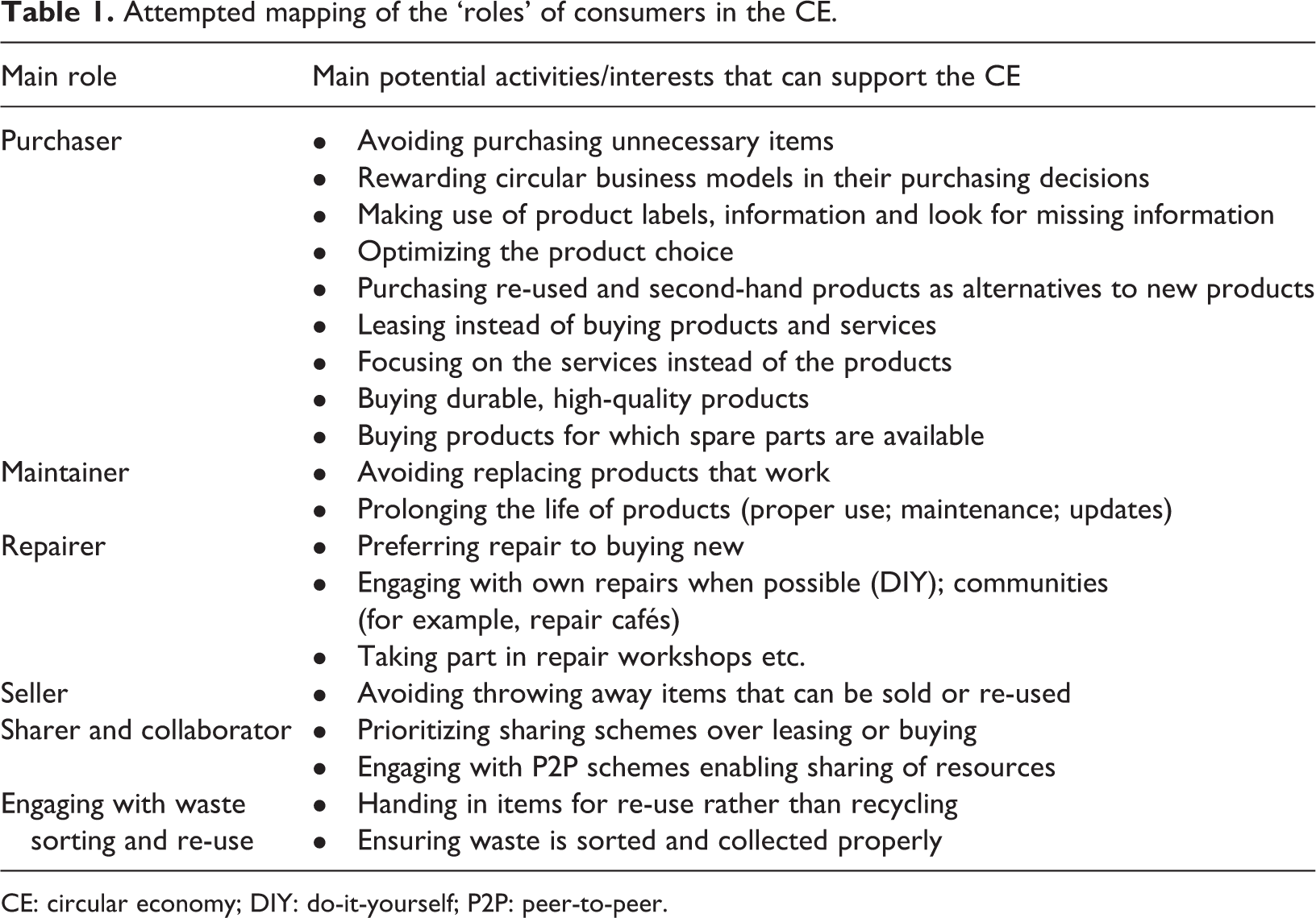
CE: circular economy; DIY: do-it-yourself; P2P: peer-to-peer.
Although the table is merely a preliminary attempt to categorize the different roles that consumers may come to play in the CE, it offers nonetheless a useful account of the wide range and importance of their potential contribution. It is important to remember that markets and society are in a state of flux, not least given the surge in sharing and digitalization. Those roles are therefore likely to further evolve and develop and the exercise of mapping will need updating.
The law needs to recognize new circumstances and consumption patterns and adapt accordingly. Consumer law, in particular, originated from the traditional role of individuals purchasing new goods, 22 but new forms of use and consumption (such as peer-to-peer (P2P) transactions) require new rules. Moreover, consumers cannot keep being considered merely as the vulnerable party that needs protecting, but as an agent of change, whose behaviour will make a difference in the struggle for sustainability. 23
C. Overview of consumer-oriented policies in the CE
When it comes to CE policies directly aimed at consumers, we can identify four main trends: (i) informing consumers through labelling and signage in stores; (ii) giving economic incentives to promote certain behaviour through taxation and price adjustments; (iii) empowering consumers through reinforced rights to complain and possibilities to undertake repair; and (iv) enabling new forms of consumption notably not ownership based. Here, we briefly introduce these trends before discussing the necessary policy mix and investigating specific policies in Section 5 below.
1. Information
The issue of information is a challenging one. The EU CE Action Plan states that consumer choice is ‘shaped by the information to which consumers have access, the range and prices of existing products, and the regulatory framework’. 24 Targeting consumption patterns through information disclosure has become a classical approach to environmental protection regulation. 25 Indeed, environmental labels have flourished in recent decades at European, regional and national levels with varied aims, content and levels of trustworthiness. 26 Generally, it is important consumers easily understand and trust the labels, which requires monitoring of the adequacy of the standards set under the labelling schemes. 27
There is a lot of discussion at the EU level on the need for a consumer label on expected lifetime, allowing consumers to benchmark products on the market for durability. 28 This type of label could be mandatory or voluntary; a mandatory label would of course have a greater effect in the market and could trigger innovation among manufacturers to compete for durability. In any case, designing such a label is complex for several reasons, including: 29 (i) consumers may have different ideas on what ‘durability’ entails and it may differ between consumer segments and product groups; (ii) for some product groups, such as lighting, durability has many dimensions (for example, switching cycles, colour and luminous flux); (iii) for very durable products it is hard for market surveillance authorities to establish whether the manufacturers’ claims are true; unless there is an access to ‘stress tests’, the only way to see how long a product lasts is to test it continuously for years; (iv) the durability of the product is not only linked to the design as such; access to spare parts at a reasonable cost is equally important; (v) durability may vary depending on the product usage (frequency; conditions of use and storage; maintenance).
2. Economic incentives
Products made from low-quality materials requiring frequent replacement are typically cheaper upfront compared to high-quality, longer-lasting items. For consumers who only see the sales price, the first category of products would clearly appear more attractive. 30 Yet the long-term economic cost of repetitive purchases could rapidly exceed that of a one-time, expensive acquisition. The same holds true of the long-term cost of purchasing cheap energy-intensive equipment against something more expensive and efficient. Consumers may find it difficult to make such calculations upon purchase. Moreover, prices of new products are often so low that the comparative advantage of repairing existing products or purchasing re-used or remanufactured is not an attractive option. The environmental cost of manufacturing a product from scratch is nevertheless in most cases higher than any recovery treatment. 31 Beyond awareness-raising campaigns and labelling, economic incentives could help prevent unsustainable products from appearing more economically advantageous, and new products from being a worthwhile choice.
Internalizing the environmental costs of products and reflecting them in the price is one way to influence purchasing decisions. From the perspective of the CE, high taxes on materials and low taxes on labour are key to the solution, as they would support product durability and repair (as repair is labour intensive). However, there is no common tax policy in the EU. Current national tax systems and the international trading system provide incentives that are quite different: whereas new products are made in countries with low taxes and raw materials are cheap, taxes on labour are high in advanced economies, inhibiting willingness to repair in these jurisdictions. Some countries are exploring other tax policies, such as exemptions for certain economic activities (such as repair), or deductions for consumers who engage in repair, sharing or second-hand trading. 32 One could also examine the practicability and potential benefits of introducing consumption taxes. This, however, is beyond the scope of this article.
3. Consumer protection
Traditionally, consumer protection legislation seeks to protect consumers against abuse. For instance, legal guarantees protect consumers against faulty products. From an environmental perspective, these guarantees can incentivise producers to prolong product lifetime and consumers to go for repair instead of discarding broken items. This is not the case today because of insufficient legal provisions and high market constraints.
Nowadays, when a product breaks during the guarantee period, consumers can choose between repair and replacement. While consumer organizations appear unwilling to compromise on the consumer’s freedom of choice, 33 the result of this freedom adversely affects efforts to realise the CE. Replacing a faulty product with a new one usually has a much greater environmental impact than repairing it. The product may end up as waste even before it has started its useful life. Moreover, current business models still tend to favour the production of new products at the least cost. Because producers do not have an obligation (or even many incentives) to facilitate product repair, that option may not be available at all, for instance if the product cannot be disassembled without damaging it or if spare parts are not available. In Section 4, we discuss in more detail the tension and conflict between environmental protection and EU law on consumer protection.
4. New forms of consumption
The discussion of the role of consumers in the CE is inevitably entangled with the activities of consumers in the SE, where they are more frequently referred to as ‘users’ or ‘peers’. The two concepts – CE and SE – have slightly different origins. Where the first is anchored in sustainability, the second does not necessarily pursue any environmental objective per se. The main SE focus has been on the organization of economic activity. The SE is a ‘market-oriented’ policy field, whereas CE is ‘sustainability oriented’. The SE has, however, significant – but difficult to calculate – potential to achieve resource savings. Exchanges and leases between individuals have clear direct environmental benefits: secondary markets reduce demand for new goods. 34 So when consumers opt for repairing, sharing, swapping and leasing items within the SE, their activities can promote the CE and ‘sustainable consumption’ more broadly. 35
Similarly, purchasing a service instead of a product is also considered an effective way of encouraging sustainable consumption patterns. 36 It is argued that service-oriented consumption 37 could bring about sustainability benefits by breaking the link between profit and production volume. 38 Among the potential benefits are the increased incentives to prolong the useful life of products, since this is what firms make their money from when leasing out products, as opposed to the sale price of that product. 39 Other possible sustainability gains are the reduction in resource consumption, enhanced efficiency in use, increase in repair activities and increased amount of materials re-used. 40
The relationship between the new consumption patterns and sustainability is not, however, that straightforward. With regards to real-life service provision, Corvellec and Stål argue that it is anything but immaterial because it involves a product or activity that necessarily requires the consumption of natural resources and the production of waste. 41 Both sharing and service-based activities can negatively affect the environment albeit providing economic benefits, notably as a result of consumption behaviour (see Section 3.C.1 below). 42 Ensuring the sustainability of new models requires consideration of the environmental benefits not only upon their creation but also during their implementation. 43
The European Commission is generally positive towards new models of consumption. The communication on the ‘collaborative economy’ (terminology used for referring to the SE) focuses solely on the social and economic components of sustainability. It discusses the consequences on consumer protection and labour law of having atypical actors participating on the market. It also stresses the need to carefully consider tax rules. 44 Thus, the policies advocated for the SE are quite different from those usually stressed in CE policy documents, though they sometimes overlap. Consumer guarantees are, for instance, relevant in both policy areas, but the objectives are clearly distinct: whereas the first seeks to protect consumers against sales abuse, the second aims at using the legal rules to promote product durability and reparability.
3. A hierarchy of consumption behaviour
A. Establishing the priorities
The Waste Framework Directive establishes a waste management hierarchy (WMH) that prioritizes waste prevention over preparation for re-use, followed by recycling, energy recovery and finally landfilling. 45 We contend that the first priority – waste prevention – needs to be expanded and clarified. Therefore, we propose developing that priority into an own ‘hierarchy of consumption behaviour’ (see Figure 1) 46 that shall complement the WMH. Similar to the WMH, which is binding and applies ‘as a priority order in waste prevention and management legislation and policy’, 47 the consumption hierarchy is meant to guide and constrain future product-related policymaking and contribute to realizing the CE.
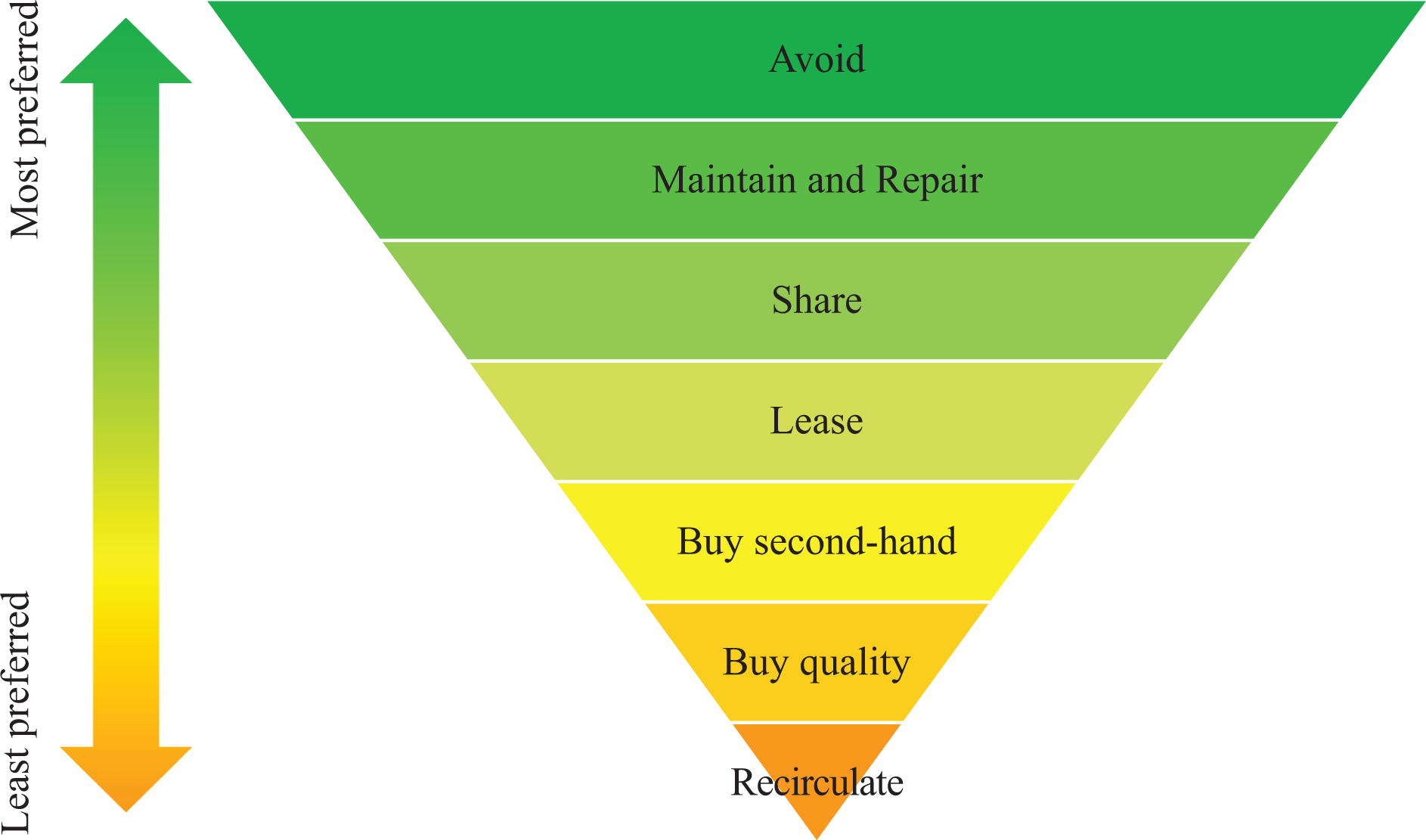
Hierarchy of consumption behaviour in the circular economy (CE).
At the top of the hierarchy, avoiding the purchase of single-use and unnecessary products may seem provocative. It is not. If the CE is to optimize resource utilization and prevent waste production, then low-quality, short-lived products must eventually disappear from the shelves. Their environmental impact throughout their life cycle is too great (in particular at the production stage and through waste pollution) and the potential to minimise that impact – mainly through cascading – is too limited. These products are inherently unsustainable and have no place in a CE. The harmful potential of some of those products is so great that the EU had proposed banning them. 48 Single-used plastics, such as cutlery and straws, constitute 70% of marine litter and are responsible for killing millions of sea birds and marine animals each year. 49 A policy related to avoidance cannot be based upon voluntary measures only, but should include legislation. For instance, banning single-use plastics and certain kinds of packaging, imposing durability and reparability requirements, or introducing an environmental tax on products.
Repair and maintenance are also key to the success of the CE. Their second place in the hierarchy stems from the rationale that consumers today already own many items and should first and foremost aim to prolong their lifetimes rather than replace them with new products. Products naturally wear down with use, they become outdated (especially technologically), they sometimes have inbuilt faults, or certain components have a shorter lifetime than the entire device. By repair and maintenance, consumers seek to retain or restore products to a desired level of performance to continue using them. For example, upgrading existing appliances when necessary instead of buying a newer model, or changing the depleted battery of otherwise well-functioning electronic equipment. Policies supportive of repair and maintenance are typologically quite different and include consumer guarantees, eco-design requirements and lower taxes for repair services. It should be noted that the repair potential – both technical and economic – is usually greater for a high-quality product, thus linking the strategy to purchase high quality to repair.
As of 2018, there were about 300 million vehicles on European roads, or one for every two people. 50 Every household owns an increasing number of appliances. A UK study from 2010 showed that households owned on average 41 electrical products (not including lighting). 51 Each of them consume energy. In 2016, European households used on average 5% of their total consumption expenditure on clothing and footwear, representing a total expenditure of €395.4 billion. 52 The wide variety of products on the market and their affordability, coupled with steady population growth, are negatively impacting the environment. Individual ownership of an increasing number of items is unsustainable. Sharing products appears a possible alternative to individual purchasing. This is not true in every case, because some items simply cannot be shared, such as mobile phones, or because of geographical distances. In Europe, however, around 75% of the population lives in urban areas, so opportunities to share are high. Cars are a definite example of shareable goods, as are garden tools.
Going one step further in challenging individual ownership, we put a call for the leasing of high-quality products as the fourth priority. Moving away from ownership, this form of consumption consists of purchasing the service of a product rather than the product itself. As discussed in Section 2.C.4, leasing’s sustainability cannot be taken for granted. Yet good leasing arrangements – through P2P platforms or as part of a business model – appear to offer greater opportunities to reach sustainable consumption levels. The main benefit of leasing compared to sales is that manufacturers have incentives to design durable, upgradeable products, as they do not make money from each sale but from keeping a product functional for a long time.
In our view, the purchase of products needs to be divided into two separate priorities. Consumers should aim primarily to buy second-hand or remanufactured products rather than new ones. 53 Upon purchase of new products, priority should then be given to quality, durability and energy efficiency over products of poorer quality. This will also strengthen the repair potential.
Finally, and this last priority is where the consumption hierarchy joins and overlaps the WMH, products must recirculate. This requires consumers to refrain from discarding items they no longer want, but instead sell or pass them on for re-use, or explore the possibilities of returning them for remanufacturing or recycling. We need to stop seeing recycling as a positive activity per se: although it is better than landfilling and incineration, it should still be a last resort. Recycling too often implies ‘downcycling’, namely producing products of lower quality than the original. Consumers should avoid whenever possible discarding products as residual, unsorted waste. There are a lot of initiatives around Europe to divert products and materials from recycling to re-use, including municipal re-use parks and public procurement of remanufactured furniture and ICT products. 54
B. Aim and implication of the hierarchy
Introducing this hierarchy shall mandate policymakers to prioritise action areas and the adoption of measures that support these stated priorities. At the same time, it informs consumers about how they can best support sustainable consumption. With regards to policymakers, applying the hierarchy requires laws and policies that enable and encourage behaviour reflecting the priorities. Consequently, measures promoting the purchase of long-lasting, expensive and reparable high-quality products should be adopted, as well as widening access to and expanding repair activities. Examples of such policies are discussed in Section 5. Other policies should also aim at ensuring the sustainability of product sharing and leasing and encouraging second-hand purchasing.
The hierarchy of consumption behaviour shall be binding on policymakers as in the case of the WMH, but not absolute. 55 Various circumstances could affect the order of priorities. For instance, if a second-hand product pollutes much more or is more energy intensive than a new one, the benefit of keeping it is cancelled out by the environmental impacts. Another example of the limitations of the hierarchy relates to sharing and lending activities. Although they are labelled high priorities, one cannot assume they are necessarily better than purchasing in all cases. Earlier, we warned of the potentially negative environmental impacts of the sharing and service economies. The behaviour of consumers as ‘sharers’ and ‘lenders’ may also bring these activities into conflict with the CE (see Section 3.C.1). Like the WMH, the hierarchy should privilege the best overall environmental outcome over a strict application of the priorities. It may also be very difficult in practice to design policies applicable to all products and every market. Different strategies may be needed for specific product and service categories to accommodate the reality of the market and people’s willingness to take part in it. We do not, however, advocate polices that ‘force’ consumers to share if they do not want to, or in other ways compel them to move up the hierarchy. Rather, we recommend policies that make it more attractive – economically and in other ways – to move up the hierarchy.
One weighty objection to the hierarchy will doubtless come from consumer protection advocates as unduly affecting the basic policy principle of consumer choice. This opposition goes to the core of the consumer protection paradigm and its development in line with the linear and throwaway economic model. In Section 4, we discuss and challenge this philosophy, and argue that new ways of thinking are required if we are to move towards a sustainable CE.
C. Barriers to promoting the hierarchy
1. Consumers and consumption behaviours
Consumers are very volatile and complex market actors. Motivations behind consumer choices are manifold and may vary with time and circumstances. A recent study by Deloitte concluded that the lack of interest and awareness of consumers constitutes the main barrier to the CE. 56 Environmental considerations may prompt some consumers to favour products that are (or appear) more sustainable, but even consumers who care for the environment may take harmful decisions given their circumstances and need to balance other social needs, notably health, housing and education. 57 Moreover, consumers are traditionalists and tend to purchase the same bulk of items every time. 58 Changing these preferences in favour of less harmful products and more sustainable purchasing habits is deemed a particularly challenging task. Consumers who may be willing to consume more sustainably are often, according to Sanne, ‘locked in by circumstances’ and unable to engage in more sustainable consumption practices even if they want to. 59
In spite of them being seen quite favourably in the CE context, the new consumption models spurred by digitalization may actually lead to unsustainable behaviour. The indirect environmental impacts of participating in the SE should not be underestimated and must be accounted for. An important challenge facing the SE is the risk of indulging consumption, in particular of ‘concerned’ consumers. The negative environmental impacts of P2P exchanges are increasingly documented. 60 These practices prompt overconsumption not least because environmentally conscious consumers are more likely to indulge when using second-hand P2P platforms. For the mainstream consumer, it is more tempting to buy unnecessary items because of the lower price on secondary markets or because of the capacity to resell them easily. 61 Moreover, rebound effects occur through purchasing additional items because of the ‘savings’ from buying second hand. 62 Similarly, private sellers and leasers are likely to spend the money earned to buy other items. 63
Besides, studies show that consumers tend to be less careful when using rented, leased or shared products than products they own. 64 Intlekofer et al. note that consumers prefer ‘to buy new products after only a few years of use’. 65 Because of rapid technological improvements, some products, such as computers and mobile phones, have a user-preferred lifetime that is much shorter than their actual functioning lifetime. 66 The increase in leasing contracts does not appear to have altered this trend. On the contrary, it may lead to even more rapid return of products to the service provider than would be the case with purchased products because it may be both easier and cheaper. Yet, re-use can prove difficult, if not impossible, for those very products for which innovation is taking place at such high speeds, hence undermining the very foundation of the product-service economic model. 67 Interestingly, however, mandatory requirements about product durability could encourage industries to change business models towards leasing. 68 Thus, the sustainability of product-service contracts might depend not on the model itself, but on legal requirements about product characteristics.
Analysing consumer behaviour through the lens of behavioural economics would be very interesting and indeed useful when developing accompanying measures and changing the consumption paradigm. These issues are, however, beyond the scope of this article.
2. Market barriers
There are other important barriers to promoting the hierarchy that are independent of consumption behaviours but come from the market itself. The lack of clear and useful information about products is a particularly important problem. It prevents consumers from making enlightened choices and being able to communicate their preference, for example for more durable products. More and more, consumers are overloaded with unnecessary or unreliable information and even false claims (greenwashing). 69
The throwaway society that developed following the industrial revolution is driven by the idea that what is new is good and what is used or broken must be thrown away. Linear business models are producing short-lived and cheap products, effectively hindering the aims of the CE. The premature obsolescence of products, whether intentional or not, may result from design measures, use of low-quality materials, technical and psychological outage to name a few. 70 Mainstream industries continue to view the sale of new products and accessories as their main business and have little interest in providing cheap and easy updates or enabling repairs on which they might not make money. Typical CE activities related to maintenance and repair, re-use and recycling prove often impossible or simply too costly and troublesome for consumers in comparison to tossing aside older products to buy new ones. Moreover, there is increasing evidence that some companies deliberately discourage and hinder such operations, for instance by preventing disassembly (using glue or proprietary screws) and not making spare parts (in particular batteries, which are known as having a shorter lifespan than other electronic devices), special tools or manuals available. 71
Consumer interest in repair is growing, 72 and initiatives to enable own and independent repair – such as iFixit – are flourishing. However, consumers still face various obstacles to undertaking repair, not least the availability and cost of spare parts. 73 At present, manufacturers do not have an obligation to produce or supply spare parts. The General Court of the EU recently found that refusal to provide spare parts to independent repairers was not a breach of competition law. 74 But even when spare parts are available, the price of a new product in comparison to that of the replacement part often discourages consumers to pursue repair. Alternatively, spare parts may be useless if the product cannot be disassembled. The use of proprietary screws, non-removable batteries and similar procedures can impede repair. Fashions such as ‘slim and sleek’ result in the use of encased batteries and non-visible screws, making products more difficult to disassemble and repair while increasing the likelihood of damaging them. 75
3. Legal barriers
Various barriers to the hierarchy can also be found in the law. There are various barriers to accessing repair. For example, several IP regulations, such as copyright and patent laws, contain repair-related restrictions that may compromise their access. 76 Similarly, sales contracts between producers and end-users may contain clauses specifically forbidding unauthorized repair or modification, the disassembly of software-enabled products, or the use of unlicensed spare parts. Whether these clauses are valid will depend on contract law, which remains largely a national issue with a great variety of national approaches. 77 Although very important, we will not discuss these legal barriers in more detail in this article as they are not directly relevant to our analysis and legal recommendations. We refer to the work of Svensson et al. for further discussions on the matter.
Of more relevance are the legal barriers found in consumer law. Provisions contained in consumer legislation may indeed clash with the hierarchy either because the protection granted to consumers is not sufficient to promote sustainable choice (for example, too short legal guarantees compared to expected product lifetime) or because they fail to prioritize options for redress based on their environmental friendliness (repair and replacement are put forward as equivalent alternatives). We discuss these issues in the following section.
4. Consumer law in need of a new paradigm
A. Conflicting goals and the integration principle
The initial ‘productivist’ logic of the founding EU Treaties, which focused on the producer of economic value and the realization of the ‘internal market’ remains strongly anchored in EU consumer policy. Consumer welfare and the ‘raising of the standard of living and quality of life’ has long been seen as an adjunct to the four market freedoms. 78 The transformation of relatively small-scale national markets into a large European and globalized economy has sharpened competition between producers, multiplied available goods and lowered product prices. 79 This intensification of competition was – and still largely is – seen as favourable to consumers who benefit from a wider choice of products at lower cost. Economic law has become a tool to ensure proper competition on the market and consumer choice as primary interests. The Court of Justice of the EU (CJEU) has repeatedly held that competition law should take a stand against practices that harm consumers directly and that harm them indirectly through their impact on competition. 80
Similarly, the liberalization of the market for products and services is said to have expanded consumer choice. For example, in Walter Rau v. de Smedt, the CJEU commented that Belgian consumers were paying more for their margarine than consumers in neighbouring states because of restrictive national measures. 81 The question of how to prioritise the different aspects of consumers’ interests, and consequently restrict trade or promote deregulation, has faced the Court with some difficult choices. 82 Extending consumer choice through unrestricted trade in the internal market has often prevailed over the protection of other consumer interests although, for instance, national rules prohibit deceptive marketing practices. 83 In some cases, the CJEU upheld national rules that restricted trade to protect consumers. 84 It is undeniable, however, that the Court tends to see the ‘average consumer’ as robust and self-reliant and therefore without the need for protection against harmful commercial conduct. Instead, they rather benefit from the freedom to make informed choices. 85 The problem is that this assumes the market only provides consumers with appropriate choices and they just have to choose what they consider best for them. This is far from the case in practice. Today, a lot of products that are placed on the market are not only harmful to the environment, 86 some are even dangerous to human health. 87
In classical economics, the consumer is seen as the homo oeconomicus passivus, the passive market participant. Because their rights need to be protected against active and powerful market participants, the companies, consumer law seeks to protect the autonomy of consumers, guarantee their power of choice and allow them to seek redress. Article 169(1) TFEU states the Union ‘shall contribute to protecting the health, safety and economic interests of consumers, as well as to promoting their right to information, education and to organise themselves in order to safeguard their interests.’
The alleged correlation between the interests of the market and those of the consumers has strongly influenced consumer law. Consumer policy appears essentially built on the premise of the right of consumers to ‘make a good deal’. For some, that good deal may indeed mean buying durable high-quality products, but for most people today, a good deal means being able to purchase as many products as possible at the cheapest price. Moreover, current protection does not prompt consumers to buy durable products. Access and opportunity (notably financial) to repair services is far from guaranteed. Consumer law neither secures, nor even promotes, sustainable consumption. Should it? The TFEU says it should: ‘[e]nvironmental protection requirements must be integrated into the definition and implementation of the Union’s policies and activities, in particular with a view to promoting sustainable development.’ 88
This provision in the Treaty, also known as the integration principle, imposes a legally binding duty on the EU institutions to recognize and uphold the overarching sustainability principle in all policies and legislative decisions. It applies to consumer protection as well. The preeminence of environmental over consumer protection objectives is evident in the language used in the TFEU: Article 11 TFEU requires environmental integration, whereas Article 12 merely recommends lawmakers to ‘take into account’ consumer protection requirements. A correct application of the TFEU would require EU consumer legislation to properly integrate and reflect environmental protection requirements. This is not (yet) the case.
B. The EU legal framework in light of environmental protection requirements
The core EU horizontal consumer law is composed of seven directives, but we will discuss only two in this article, the Consumer Sales and Guarantees Directive 1999/44/EC (CSGD) 89 and the Consumer Rights Directive 2011/83/EU (CRD). 90,91
The CSGD harmonized after-sales rights for consumers. First, consumers have the right to receive goods that are in conformity with the contract of sales notably in terms of quality and performance ‘which are normal in goods of the same type’. 92 Second, any lack of conformity gives rise to remedies. Consumers are entitled to have goods brought into conformity free of charge by repair or replacement, to benefit from an appropriate price reduction, or to have the contract rescinded. 93 Third, consumers may benefit from their right to remedy within 2 years of delivery of the goods, with a 6-month presumption that the fault pre-existed the delivery. 94 After 6 months, the burden of proof shifts from the seller to the consumer. These are minimum standards. Member States may lay down more stringent provisions to secure a higher level of consumer protection. 95
The rights laid down in the CSGD form an essential part of consumer protection and benefit to some extent our proposed hierarchy. Indeed, allowing consumers to remedy product faults free of charge is a very effective way of avoiding unnecessary discard. Without such a guarantee, repair would not be as attractive an option to consumers. However, it is clear that the legal provisions were not written with environmental protection in mind. The fact that repair and replacement are set out as equivalent alternatives is particularly revealing. If these remedies prove equally satisfactory to consumers, they are quite distinct when it comes to their environmental impacts. Although repair is a priority of the CE, replacement clashes with its main purpose, namely minimising waste and reducing manufacturing activities. Moreover, the current guarantee of 2 years may be in line with the consumption behaviours of the throwaway society, but in a sustainable economy most products can and should be kept in use – and be guaranteed – for a much longer period.
The CRD is the result of intense debates that resulted in significantly lowering original ambitions to achieve full harmonization of EU consumer law. Ultimately, it merely established certain basic consumer rights across the Union. Information duties are the central element of the Directive, which applies to both on- and off-premises contracts. It is required in particular that, prior to the conclusion of a sales contract, traders provide information to consumers ‘in a clear and comprehensible manner’. This information must include the main product characteristics, the total price (including tax) and trader’s identity, as well as information about rights in case of lack of conformity or regarding contract termination. 96 The Directive also establishes a right of withdrawal for distance or off-premises contracts for a period of 14 days free of charge. 97
In spite of having been adopted after the Lisbon Treaty, which established the environmental integration principle in its current mandatory form, the CRD does not seem to include more considerations about environmental protection than the CSGD. The Directive seeks rather to remove the legal disparities between the Member States that created significant internal market barriers and affected the cross-border sale of goods. 98 The legal provisions were intended to increase consumer confidence and, with that, sales volumes. The quality of the purchase, particularly in terms of durability or reparability, is not enhanced as such by the CRD, which indeed comes across as a missed opportunity given the information requirements that the Directive contains.
A fitness check conducted by the European Commission in 2017 pointed at a lack of knowledge and enforcement capacity as the main deficiencies of current consumer protection policy. 99 The proposed Directive, currently under legislative review, aims at strengthening the enforcement of existing law, 100 but contains no measures to promote sustainability in consumption or encouraging consumers to side with the purpose of the CE.
More interesting is the proposed Online Sales Directive that aims to reinforce consumer rights in case of lack of conformity with the contract. 101 A key improvement with regards more sustainable consumption is certainly the absence of a reversal of burden of proof from the seller to the consumer, as contained in the CSGD. 102 This means that, for the entire period of the guarantee, the product is presumed to be faulty and it is for the seller to prove it is not. This should make it much easier and more attractive for consumers to seek repair. The main concern is that the proposal still considers replacement a remedy equal to repair. 103
In a 2018 Communication entitled ‘A New Deal for Consumers’, the Commission stated that it is crucial to produce sustainable products and to encourage more sustainable consumption. [Consumers] need to be empowered to make informed purchasing choices and have easy access to products that are environmentally friendly (…). The ‘New Deal for Consumers’ will benefit the environment, given that stronger enforcement and better opportunities for individual redress against unfair practices can deter false environmental claims or planned obsolescence practices, complementing the actions of the EU Circular Economy Action Plan.
104
C. Reflections on the need for a change of paradigm
Behaviour is not immutable. It is important to place today’s overconsumption patterns in a historical perspective. The current patterns are indeed quite recent if we look back in human history. Consumption habits have changed radically in just half a century. Disposable and single-use items are very modern inventions, but their impact on the environment is already devastating. 105 Cheap, low-quality garments have allowed every person to accumulate clothes and renew their wardrobe whereas, only a few decades ago, people owned a small number of outfits that would be passed down through the generations. Generally, quantity appears to have outweighed quality in many purchasing decisions. Globalization and liberalization of markets seem to have been accompanied with a producers’ right to design short-lived products and a right for consumers to make discretionary choices.
Environmental protection does not need to undermine consumer protection. The idea that sustainable consumption is at the expense of consumer wellbeing is just another outcome of the current paradigm under which material accumulation is considered consonant with personal happiness. A recent study published in the official scientific journal of the National Academy of Sciences concluded that buying goods had no effect on people’s happiness whereas spending money on experiences (such as vacations) or meaningful gifts clearly produced happiness. 106 Could it be, then, that allowing consumers to make the best possible deal is not as important to the consumers themselves as allowing them to engage in sustainable consumption? Could consumers be happier if they were not overconsuming?
The purpose of the hierarchy of behaviour is not to create new morals and blame individuals for behaving improperly. The aim is to shift the balance from the current – and relatively recent – paradigm according to which human flourishing depends on economic growth to one that places environmental preservation as the one non-negotiable condition.
Current consumption behaviour is not, we suggest, anchored in people. It is the result of a change in society, a change in paradigm that was driven by industry and mainstream economics following the Industrial Revolution. There are no reasons why that paradigm could not be changed again to promote more qualitative and sustainable consumption habits. Just about 50 years ago, it was widely accepted that people could smoke in public spaces and around children. Today, all European countries have banned smoking in public spaces and almost nobody would argue that passive smoking is not a health hazard. The change of paradigm took place through changes in hard law and awareness campaigns. The same could be true of overconsumption and throwaway habits. This requires, among other actions, challenging existing consumer policies that maintain consumers’ right to unrestricted choice and to make a good deal. The paradigm shift, we argue, could begin with introducing the hierarchy of consumption behaviour as a governing principle of the EU’s coming legal consumer framework.
5. Possible legal pathways to advance the hierarchy at EU level
It appears clearly that the market – and market actors – is not able to promote product durability and repair as it does not fit with current market logic, policies or consumption patterns. Markets, policies and consumption patterns have evolved together such that the various elements strengthen each other, but this indicates how hard it will be to change things without political action. For instance, if a mobile phone manufacturer makes money primarily by selling more phones, they have little reason to make them durable and upgradeable. Consumers get used to new models with new functions and are geared to changing models often. Further, providers of broadband and mobile phone services also want a steady stream of new phone models because they attract customers to the store and widen their opportunity to sell new services. 107 Political intervention is therefore necessary.
The regulation of guns, drugs, cigarettes and, more recently, micro plastics may point to one way forward: we need to regulate more products and materials. We need to question the very existence of some products and materials. Cheap, low-quality products are not only unsustainable because of their short lifetime, but also because they are not easy to recover. For example, the potential for remanufacturing furniture 108 and IT products 109 is significant, but only for high-quality products. There is no (or only limited) incentive to remanufacture an inferior sofa and re-sell it, whereas the economic case for remanufacturing top-class furniture is much larger. Thus, we need to buy high-quality products as a starting point. Although this may prove more expensive upfront, it will reap the returns in terms of longer-lasting reparable and/or upgradeable products and socioeconomic benefits from products getting a second life. The latter benefits may be realized by persons other than the original purchaser. Because we cannot realistically expect all consumers to purchase more expensive products based on remote benefits and durability claims, policies and laws must be put in place to address two main aspects, that is to ensure that (i) as many quality products and as few low-grade products as possible are placed on the market; and (ii) consumers are encouraged to and feel confident about making the more sustainable choice. Here, we focus on the second.
One of the recent legal experimentations towards more sustainable consumption took place in France in 2015. An amendment to the French consumer code required professional sellers to disclose any information they received from manufacturers or importers of products about the availability of essential spare parts. 110 Upon request from the seller or any repairer, those spare parts are to be made available, within 2 months, during the period that was advertised. 111 The law, which aimed to help consumers make enlightened choices and incentivise producers to provide for the reparability of their products, does not seem to have lived up to its promise. The law’s lack of clarity resulted in confusing information. For example, producers used different dates to establish the start of the availability period of the spare parts, confusing consumers and making comparative analysis impractical. 112 A French consumer association reports that a large majority of retailers are not abiding by the law and that even when the information is available, it is lost in an array of other product specifications. 113 Yet, where the information was available, it showed significant differences from one brand to another. 114 Besides, we identify two important limitations of the French law: first, it relies on the goodwill of producers broadly to provide information that could alter their business models. An illusory hope. Second, it depends on one country enforcing a rule that affects the entire EU market. The gloomy results of the French policy should not lead to the conclusion that it was impractical or inopportune, but rather that it was not daring enough and that we must aim at adopting EU-wide measures.
In practice, changing consumption patterns will usually require a policy mix that addresses the product itself and the behaviour of the consumer at the same time. For example, prolonging the lifetime of consumer electronics is a very effective way of reducing life-cycle impacts, as most environmental damage is associated with the extraction of the raw material and production phases. 115 However, consumers are ever-more likely to discard goods early and purchase new ones, negating any potential benefits from making goods more resistant and repairable. 116 In such a situation, an effective policy mix would need to address the main barriers noted in the previous sections and focus on all relevant stakeholders, notably producers, consumers and repairers. A good policy mix could include the following: (i) Ecodesign requirements for manufacturers to make durable quality products that are easy to repair and disassemble; 117 (ii) requirements to inform consumers about the expected lifetime and reparability of products at the time of purchase; (iii) introduction of a right for any repairer to access to spare parts and repair tools at a reasonable cost; (iv) extension of legal guarantees and shifting the burden of proof onto producers to help consumers to have their goods repaired; (v) conditioning of consumer choice of legal remedy in favour of repair. (vi) removal of barriers to repair in competition and IP legislation (for example, copyright and patent restrictions); (vii) VAT reductions for the repair sector; (viii) tax deductions for consumers who choose to repair their products; (ix) support for do-it-yourself activities and other relevant initiatives to encourage consumers to repair their own goods (for example, repair cafés); (x) consumer awareness campaigns about environmental impacts and the environmental gains from repair.
In this section, we discuss four of those policies (in bold in the list above) more closely and suggest how they can be translated into legislation. They are, in our view, a perfect example of complementary policies that, if properly drafted, can form a powerful and valuable mix fostering the realization of the highest hierarchy priorities, namely avoid, maintain and repair.
A. Information requirements about durability and reparability
The first policy goal to be translated into law is to encourage consumers to choose longer-lasting quality products over short-lived inferior products by informing them about the products’ lifetime and reparability. It is hoped that by receiving this information upon purchase, consumers will opt for the more sustainable option. If they are to be properly empowered, consumers must be given clear, reliable and comparable information and the tools to understand it. 118
The direct impact of information availability on consumer decision making may not be tremendous in light of the above-mentioned barriers such as ‘irrational’ behaviour or influence of mainstream markets, but information requirements are nonetheless meaningful. This is because providing information requires acquiring and paying attention to it, and because once information is out there, it is accessible to all, not only consumers. It is not given that producers know their products’ lifetime or even their reparability. This is, in any case, what certain businesses claim: they care mainly about production costs, visual appearances, performances, not necessarily durability or disassembly. 119 Disclosing such information involves actively considering these particular features and hopefully working to enhance them. This is especially so if they can gain comparative advantage against lesser-performing competitors.
Information requirements are not new to EU law. The most accomplished example of mandatory obligations is the Energy Labelling Regulation 2017/1369 (ELR), which recently repealed Directive 2010/30. 120 The Regulation lays down a framework for the labelling of energy-related products. The information provided may relate to energy efficiency, noise levels, the consumption of energy and other resources during use, and supplementary information that would enable customers to choose more efficient products. 121 Durability and reparability requirements could possibly be developed under this existing scheme. This option would have the advantage of benefiting from a well-established and well-running scheme that is backed by political institutions, businesses and civil society. Moreover, current discussions about developing ecodesign requirements on durability would directly benefit the labelling scheme. The Ecodesign Directive and ELR are indeed working as two sides of the same coin. The disadvantages of the ELR are that it is a slow process and its scope is limited to energy-related products.
Alternatively, specific legal requirements could be introduced in consumer legislation. The two proposed directives currently debated by the European legislators 122 offer such an opportunity. The main advantage here is clearly that discussions are underway and there is political willingness to review the existing legal scheme. It is a small window of opportunity, however, and reaching consensus on the current proposals is already proving complicated. 123 Also, it is uncertain whether provisions adopted in this context would have the necessary impact. So far, information requirements imposed through consumer directives have not translated into clear and useful information, unlike, for example, energy labels.
Another possibility could be to develop entirely new regulations on durability and reparability, including setting up a specific labelling scheme. The new instrument could be based on Article 114 TFEU, which gives the EU competence to act to approximate legislation for the achievement of the internal market. This provision is the legal basis of a number of environmental regulations, such as the Ecodesign Directive. Clearly, the main disadvantage of this solution is its political feasibility. An advantage, which is not to be underestimated, is to start from a clean slate that allows establishing a scheme adapted to the objective, possibly with a wider scope than the ELR.
Concretely, the legal provisions should require, at least, that: (i) access to the EU market is conditional upon the full availability of the requested information; and (ii) the information is passed on to consumers in a clear and intelligible manner prior to the sale.
With regards to the specific information requirements, they should include: (i) the expected lifetime of products (from sale); (ii) the availability of spare parts in time (from sale); and, (iii) the possibility to disassemble the product, and if so, whether it requires the use of special tools.
Durability and reparability labelling should address the product as a whole as well as key parts, such as the battery, cables and connectors. It could use colour codes similar to energy labels to facilitate consumer understanding. Developing labelling rules for durability is a complex task as discussed above (Section 2.C.1), but a necessary complementary measure to enable and promote enlightened consumer choice.
Providing information is not the end of the road, however, but a first step to the introduction of other legal requirements. To ensure consumers purchase the more durable products, they must also be confident they will be able to keep and use those products over the longer term. This requires two things; first, that the product can be repaired and, second, that the cost of repair will not effectively restrain the option.
B. Availability and access to spare parts
The second policy is meant to strengthen the first by guaranteeing the longer-lasting product can effectively be repaired should a defect occur. With the French experience in mind, we argue for the adoption of mandatory requirements about the availability and provision of spare parts at EU level to ensure the effectiveness of the measures and avoid trade distortions. Article 114 TFEU could therefore be an appropriate legal basis for the adoption of a new legal instrument. Alternatively, Article 194 TFEU (the energy legal basis) could be used if the legislation was – as the ecodesign rules – limited to energy-related products. Following this path could allow for the adoption of a framework directive that could draw the contours of the law and mandate the Commission to develop specific requirements for particular products in delegated acts. 124 Those acts could specify for each product group which parts are essential and should be made available for a certain period. In other words, producers would have to produce requisite spare parts. As part of the delegation, other aspects could be established, such as the minimum time of availability of the parts, their maximum sales price (in any case lower than the price of the whole product – potentially a percentage of that price) and the minimum durability of those parts.
Other options, already mentioned in the previous section, could be either to modify existing consumer legislation or develop new regulations based on Articles 114 or 194 TFEU.
Concretely, the legal measures should contain at least the following: (i) essential spare parts must be made available to the consumer or any repairer (also independent) upon request within a maximum 2-month period during the time advertised by producers following information requirements recommended above; (ii) the availability of these parts in time cannot be less than the expected lifetime of the original product; and, (iii) infringements are punished by appropriate sanctions.
In connection with the above, we note that new ecodesign requirements for dishwashers and refrigerators shall include notably: (i) design for easier dismantling for recycling, material recovery and depollution purposes; (ii) declaration on spare part availability; (iii) information requirements about maximum delivery time for spare parts; and (iv) access to repair and maintenance information for independent repairers with reasonable and proportionate fees. 125 This is a positive development although we regret in particular the absence of information requirements about durability and the limitation of spare parts availability to professional repairers.
C. Guarantee for the lifetime of products
The third policy aims to bring the consumer one step closer to making the more sustainable choice by guaranteeing the performance of the products for the entire period of their expected lifetime. According to the fitness check performed by the Commission, consumer protection rules such as guarantees are fit for purpose and merely require better information and enforcement. 126 The proposed Online Sales Directive does not provide for an extension of the minimum 2-year guarantee put forward in the CSGD. It does, however, propose setting aside the 6-month reversal of the burden of proof. In practice, this 6-month period often means the product is presumed to be faulty only if the fault arises during those first months after purchase; after this, the consumer must prove that the defect was pre-existing, which is often complicated and requires expert advice. A legal guarantee without the reversal of the burden of proof would considerably strengthen consumer rights and confidence in pursuing remedies. 127
Some Member States have gone beyond the 2-year guarantee period established by the CSGD. Four of them, plus Norway, have established longer periods from 3 to 6 years, 128 and two are taking into account the expected lifetime of the product. 129 The Finnish consumer law stipulates that with regards to durability and otherwise, the goods shall ‘correspond to what a consumer ordinarily may expect in the purchase of such goods’. 130 If this is not the case, the goods are considered defective. The expected lifespan of the product is, in practice, very much dependent on the product category. The generosity in terms of duration of the guarantee is somewhat counterbalanced by the fact that the burden of proof passes to the consumer after 6 months. 131
In a case brought before the Finnish Consumer Dispute Board, the lifespan of a boiler was deemed to exceed 3 years (the period claimed by the buyer) and to fall under the legal guarantee. 132 In a recent case of a dishwasher, the Board was more stringent and reminded the consumer that she bore the burden of proving the error pre-existed the sale. 133 In addition, and this is where the consumer lost her case, the Board stressed that consumers should be prepared for the fact that household appliances may need to be fixed after a few years of use, without this being considered as a defect (for which a seller would be responsible). 134
With this last consideration, the Board raised an important issue: the inevitable wear and tear of a product with use and the need to perform repairs or upgrades regardless of the good’s condition upon sale. This problem is particularly crucial for durable products that are meant to be used time and again over several years. If consumers are made responsible, also economically, for normal maintenance and repair, the attractiveness of products with a longer lifetime might decrease accordingly. Should, then, producers bear these costs? This is, in effect, the solution adopted by product-service business models whereby producers remain the owners of the product that is rented to consumers. Any maintenance or repairs are born by the producers, not the consumers. Why, then, could producers not bear the costs that naturally arise from using a product over a long period of time?
Guaranteeing products for their entire expected lifetime requires amending consumer law. Such new provisions should, in our view, provide that: (i) legal guarantees shall cover the entire expected lifetime of the product and not less than 2 years; (ii) the burden of proof is born by the producers/sellers for the entire guarantee period; and, (iii) the guarantee covers defective products as well as wear and tear that naturally occurs from normal use.
D. Condition consumer choice of remedy
Finally, the fourth policy aims to constrain the choice of the consumer – and of the producer/seller – if that choice should affect the environment negatively and contradict the objectives of the CE. This is currently the case with regards to remedies offered by EU consumer law. As discussed in Section 4 above, the existing paradigm that places consumer choice as the irrefutable basis of consumer law needs, in our opinion, to be challenged whenever it conflicts with the hierarchy. This is the case when consumers are free to choose between repair and replacement of a defective product, except where the costs are excessive to the seller. 135 In terms of environmental impact, those two options are not equivalent as replacement is much more resource intensive and wasteful, particularly if it involves replacement with a new product.
This proposition to alter the remedies offered to consumers will directly affect consumer choice and certainly be met with strong opposition from consumer protection associations. We argue that the consumer’s right to redress does not amount to a right to obtain a newly manufactured product. Consumers have the right to obtain a product whose characteristics and performance are equal to what they aimed to buy. Repaired or remanufactured goods are not of lower quality or performance than new ones per se. There are, however, undoubtedly more sustainable alternatives.
It may happen, however, that repair is not a valid option, either because the product cannot be repaired, because the consumer cannot wait for their product to be repaired (for example, if their livelihood depends on using that product), or because the repair cost would be unreasonable for the seller/producer. Although they are valid arguments, they should not be used to circumvent the purpose of the rule. In particular, many today could genuinely claim that they cannot perform their work without their smartphone or laptop. This should not, however, mean that repair is not feasible or unreasonable. Sellers should make a similar product available to consumers during the period of repair. Should that not be sufficient, consumers could get their defective products replaced with repaired or remanufactured products of equal quality. With regards to sellers, the concept of ‘disproportionate costs’, which is already known in EU consumer legislation, should be interpreted strictly and properly justified. This last issue would be worth discussing in more detail, in particular how to avoid abuse in practice, but falls outside the scope of this article.
In sum, we recommend amending consumer legislation, that is, the current CSGD and the proposed Online Sales Directive, with regards the choice of redress as follows: (i) consumers shall be entitled to have their goods brought into conformity free of charge by repair, and borrow equipment while repairs are ongoing; (ii) if repair is not feasible or would entail unreasonable costs, consumers are entitled to replacement with another repaired or remanufactured good of equal quality; and, (iii) if replacement with remanufactured goods is not available, consumers are entitled to replacement with a new product.
6. Summary and discussion
In this article, we have described the need for a hierarchy of consumption behaviour in line with the CE whose first priority is to encourage consumers to avoid purchasing single-use, low-quality products, followed by maintenance and repair of existing products, sharing, lending, purchase of second-hand goods, purchase of high quality, durable and energy-efficient products and finally recirculation (namely, hand-in for re-use, remanufacturing, recycling). This hierarchy is based on the ‘average’ environmental impacts associated with each practice and thus aims at promoting the best choice from an ecological perspective. The global acceleration of ecological degradation we are currently witnessing 136 – which is very much associated with resource consumption – requires us to reconsider old concepts like ‘markets’ and ‘consumer choice’, and to question ideas underpinning various legal fields. Although we cannot in practice coerce consumers to adhere to the hierarchy in all situations, and this would of course be very controversial, we can implement a number of legal changes that make new consumption practices more economically attractive, or as discussed in the case of consumer redress: we can change the ‘default’ option from replacement with new product to repair. In some cases, we should also dare to be more radical and ban certain products or materials altogether, as exemplified by the recent ban in several jurisdictions on micro plastics in some applications.
This will involve, of course, a larger process that spans several legal fields. We have recommended four legislative innovations that could serve as a starting point, which by their complementarity would usefully contribute to promote the top priorities of the hierarchy. Further research is needed to see how we can advance work on existing and new laws with a view to reinforcing the policy mix. Examples of other policies include economic incentives (such as tax reductions for undertaking repairs, as have already been implemented in Sweden), development of producer responsibility schemes to promote repair and remanufacturing, controlling and restricting advertising access and exposure (notably to children) and developing commercial-free zones (in particular within urban limits).
Footnotes
Funding
This research was funded by the Norwegian Research Council (Norges forskningsråd) through the project ‘Preventing environmental effects of products through producer responsibility’ and by the Swedish Foundation for Strategic Environmental Research (MISTRA) through the research program ‘Resource-Efficient and Effective Solutions based on circular economy thinking’ (MISTRA-REES).