



Abstract
The scope of derogation possibilities for Services of General Interests in the EU internal market has been widened by legislators for more than fifteen years. The process is also supported by the case law of the Court of Justice of the European Union. State aid and other influential instruments are allowed to derogate from internal market and competition rules while their roles are heavily discussed in the circumstances of free market economy. Are these solutions leading to new regimes in European integration? This study aims at reconstructing the sense of this process in its details. This analytical study is based on comparative legal investigations applying qualitative and quantitative methods.
Keywords
1. Introduction
The market of public services has already been influenced by direct derogative considerations for more than fifteen years in the European Union. So-called ‘general interest’ is cited as a reason to allow exceptions from general rules governing the EU’s internal market and competition. Most explanations of this issue are based on the logic of government failures 1 or any type of influential interest 2 against integrative motives. Our view differs based on the findings of this analysis, which indicate that an inherent acceptance for legitimate influence of derogative considerations on EU market rules can be derived consciously from the legal framework itself.
The theoretical background of the paper is based on the policy approach of EU law towards Member States’ leeway to pursue their particular regulatory interests. The ongoing process of spreading this policy approach is scrutinized from the perspective of Member States’ derogations under EU law, as public services 3 are subject to EU internal market rules and EU competition rules. 4
Although EU law also utilises terms that originally sprung from national law (for example, public utilities and/or public services), it has a distinct conceptual framework. 5 The EU terminology recognizes the categories of Services of General Economic Interest (SGEI), Services of General Interest (SGI), and, recently, Services of Social General Interest (SSGI), together with the emergence of the ‘European Social Model’. 6 The former (SGEI) is used in primary law texts, without being defined in the Treaty or in secondary legislation. However, the case law of the Court of Justice of the European Union (hereinafter ‘CJEU’) and the Commission’s practice reflect the existence of a broad agreement that SGEI refers to services of an economic nature subject to specific public service obligations (PSO), where a general interest criterion differentiates them from other economic activities. 7 The term SGI, which is the closest EU law equivalent to the traditional notion of public services, 8 is also derived from practice rather than from systematic theorization. It is broader than SGEI and covers both market and non-market services classified by public authorities as being of general interest and subject to specific public service obligations. 9
Although evaluation studies of public sector 10 and institutional reforms 11 at intergovernmental levels are based on different reform terminologies, in this case the question is to what extent the ongoing development process may be derived from inherent explanations of regulatory motivation in the EU. Our hypothesis, which concerns particularly SGI in internal market rules, is that derogation is not simply exceptional or reasonable, but in a sense systemic both in the relevant normative framework and the operational legal context.
This article examines how the abovementioned derogatory considerations are reflected in the EU regulatory framework for SGIs and, especially, in the case law of the CJEU. Without questioning the role and importance of derogatory rules in the European integration process, the potential negative consequences of their extensive interpretation will be also highlighted. First, the paper provides an overview on the empirical research and the underlying regulatory framework, followed by a more detailed discussion (including the examination of the legal context evolution) and an elaborated analysis of the empirical research findings. The study concludes with the examination of its key results, which also looks at the main questions and challenges brought up by the analysis.
2. Methodology of the empirical study used
The study entailed analytical research based on legal empirical (statistical) evidence. We leveraged an original data basis containing selected cases initiated before the Court of Justice of the European Union – that is, the Court of Justice (hereinafter ‘the Court’) and the General Court – from 2000 to 2018. According to particular subject matter tables of the whole judicial activity, 12 there were 8,773 Court of Justice cases and 2,313 General Court cases in total during this period. 13 Overall, from a stratification of this focused data collection, eight subject-areas have been selected that linking directly to economic services where the sector involved or public management instruments applied are relevant from the point of view of our research focus. These subject-areas are as follows: competition, energy, freedom of establishment, freedom to provide services, public health, public procurement, state aid, transport. As a result, our data basis consists of 1,853 Court of Justice cases (21% of the total cases connected to the treaties) and 428 General Court cases (19% of the total cases connected to the treaties), for a total of 2,281 cases in the period examined. The sample selection is focused on mixed cases in which the issue of competition as a representative of free movement is supplemented by any type of correction (restrictions, state aid, etc.).
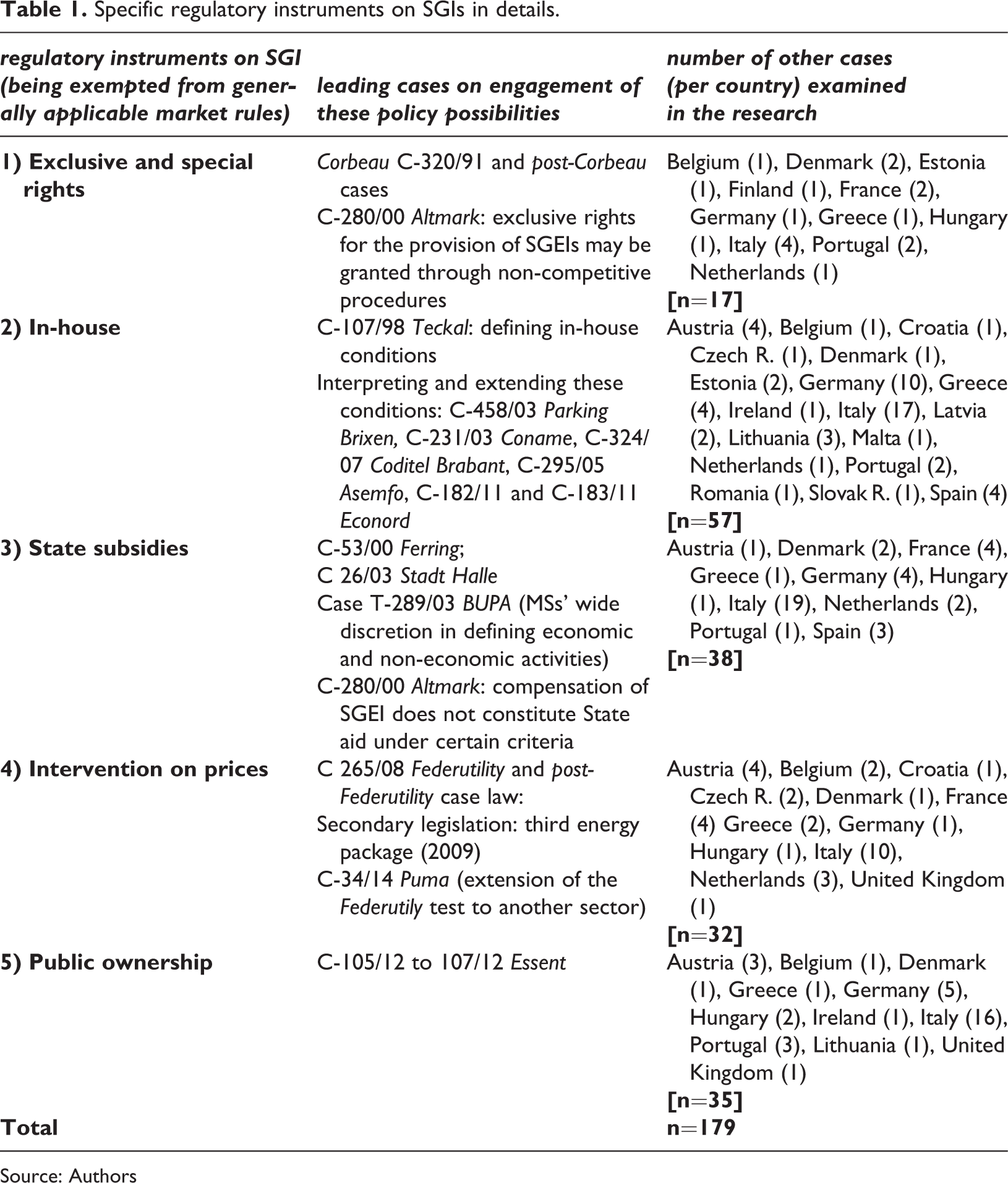
As a first step in finding the relevant cases, we examined all decisions of the above 2,281 cases where the judgment’s text mentions at least one of the following options: (1) one of our previously defined keywords (like ‘services of general interest’, ‘services of general economic interest’, ‘public services’, ‘public infrastructure’, and so on); (2) one of the relevant EU Treaty provisions or secondary legislative acts (Article 14 TFEU, 106 TFEU, procurement directives, regulations in specific SGI sectors like energy, waste, water). In doing so, we collected a total of 506 decisions. According to their frequencies, the contested issues in the case law – based on the specific categories of Member States’ regulatory instruments – have been classified into the following groups: exclusive or special rights (to undertakings), in-house (exceptions from public procurement), state subsidies, intervention on prices of service provision and public ownership (state-owned shares of companies in public service provision). Then, we clustered 179 SGI-related individual problems, the sense of which is directly linked to any derogatory instrument from formal internal market and competition rules. This way, the complete database has been categorized according to the most frequently applied tools of public service provision (see Table 1 below).
Specific regulatory instruments on SGIs in details.
Source: Authors
3. Changes in approach to public services in the EU integration
Neither the CJEU nor the Commission sheds further light on the concept elements of ‘general interest’ and ‘special characteristics’ of SGEI. 14 Within the framework established by fundamental rules of EU law, the case law acknowledges that Member States have a wide margin of discretion when defining what they consider to be an SGEI or SGI. 15 Definitions given by Member States may be subject to control of the European Commission only for manifest error, 16 however in most cases these definitions were validated by the CJEU case law 17 and the European Commission’s practice. 18
The delimitation between SGEI and non-economic SGI (NESGI) is especially important as only the latter category is exempted from EU internal market and competition law rules, 19 though NESGIs are also subject to the most fundamental principles of EU law such as transparency, non-discrimination, proportionality or citizenship provisions of the Treaties. 20 However, the concept of ‘non-economic’ services is not clearly defined in EU law, 21 as political choice or economic developments may cause the classification of a given service to change over time. As pointed out by the Commission, ‘what is not a market activity today may turn into one in the future, and vice versa’: 22 therefore, it is not possible to draw up an exhaustive list of activities that a priori would never be considered ‘economic’. Thus, a large ‘grey area’ exists between these two categories (SGEI-NESGI), in particular in the fields of health, education, social services and housing. 23 The evolution of users’ needs and technical change are the other reasons why the view of whether a certain public service is an SGEI may change over time. 24
Another key concept of EU law terminology is the ‘universal service obligation’ (USO), which is ‘a type of PSO which sets the requirements designed to ensure that certain services are made available to all consumers and users in a Member State, regardless of their geographical location, at a specified quality and, taking account of specific national circumstances, at an affordable price.’ 25 In that broader sense, USO is sometimes used interchangeably with the term PSO. 26 In the narrow sense, the concept of USO is used to identify services in specific sectors where the minimum elements of USO have been determined at EU level 27 but Member States can add stricter national requirements to the basic EU-definition. 28 Electricity is one example of such specific set of services.
As a general rule, EU internal market and competition rules apply to Member States’ regulations on services of general interest as well (see Table 1), save where they fall under specific regulations or exceptional clauses of the EU Treaties. In this section, we will briefly outline the legal fundamentals relevant to SGEIs, including those provisions escaping them from the generally applicable market rules.
Before the adoption of the Single European Act (SEA) of 1986, the matter of public service provision was not at the heart of the European integration process. In line with the principle of subsidiarity under Article 5 of the Treaty of European Union (hereinafter TEU), a consensus had been reached between the Member States that each country had the competence to organize and finance its basic public services. 29 This was based on the general idea of balancing the EU’s interest in the free market with national public interests, which means that public enterprises, state monopolies, special and exclusive rights and other specific SGI regulations are compatible with EU law to the extent that they involve proportionate restraints with regard to the internal market and competition rules. 30 This early economic compromise was expressed in certain provisions dating back to the original Rome Treaty of 1957 (some still existing, for example Articles 37, 93, 106 and 345 TFEU as guarantees for protecting the Member States’ interests linked to the provision of public services. At the same time, the above provisions also leave room for the lawful maintenance or introduction of national measures which, under the pretext of safeguarding these general interests, may negatively influence competition on the internal market.
Tools like these, where Member States’ influence is more determinant than it would be derived directly from the basic principles of the single market, we are calling non-conventional regulatory solutions.
As mentioned above, based on the analysis of our dataset, we narrowed the selection and defined leading cases according to main groups of applied tools in cases where the above mentioned Treaty provisions and relevant secondary law were applied. As a result, we selected 179 sentences out of the original 506 cases. 31 Main groups of instruments, leading cases and spread of these cases in particular groups per countries are shown in Table 1.
Concerning the relevant EU law provisions applied in the above cases, Article 106(1) TFEU generally states that public undertakings and those entrusted with special or exclusive rights are not exempted from EU competition rules. Article 106(2) TFEU, however, sets out a regime of derogation for services of general economic interest, 32 providing that relevant undertakings are subject to EU competition law provisions (that is, Articles 101, 102 and 107 TFEU) only in so far as the application of such provisions does not obstruct the performance of their particular public service obligation.
Most cases on the application of EU competition rules to public services have been examined in the context of dominance abuse, state aid rules and specific secondary legislation (like ‘energy packages’, public procurement directives, and so on). 33 Granting exclusive or special rights to an undertaking often sufficed to generate a dominant position, 34 which is the precondition for unlawful conduct under Article 102 TFEU; nevertheless, as Article 106(2) TFEU suggests, dominant undertakings may be spared by referring to the ‘particular tasks assigned to them’. The legality of public monopolies and other entities (often operating as state-owned companies) enjoying exclusive or special rights is supported by the freedom of Member States to choose their system of property ownership, guaranteed by Article 345 TFEU. 35
Most forms of state aid are in principle prohibited under Article 107(1) TFEU, unless they are found to be compatible with the internal market because of their specific policy objectives under paragraphs (2) or (3) of the same provision, or because they fall under the scope of a block exemption regulation. 36 In the case of SGEI, however, public service obligation compensation (that is where the State pays aid to undertakings as a compensation for the fulfilment of PSOs) under certain conditions does not qualify as state aid. 37 In addition, non-economic SGI a priori fall outside the scope of Article 107 TFEU, since state aid rules only extend to services that qualify as economic activities. 38 Finally, Article 93 TFEU is a sector-specific provision with regard to state aid for transport, which expressly excludes ‘reimbursement for the discharge of certain obligations inherent in the concept of public service’ from the category of illegal aid under Article 107(1) TFEU.
Article 37 TFEU forms a lex specialis in relation to Article 106(1) TFEU, 39 forcing Member States to adjust their law in a non-discriminatory manner with regard to a particular kind of undertaking (commercial monopolies) being entrusted with exclusive rights. 40 However, such discriminatory rules can also be saved by Article 106 TFEU as it is necessary to ensure that the monopolies concerned can perform their particular obligation of public interest. 41
4. Turns in general development of EU law
A. Europeanization of public services
Although the above provisions had been incorporated into the founding Treaties in the very beginning of the European integration process, their role and their significance have changed over time. The present contribution analyses and reconstructs this rather challenging process.
The ‘Europeanization of public services’ 42 only started in the mid-eighties with the entry into force of the Single European Act (hereinafter ‘SEA’). As the national transport and energy markets were becoming integrated with the objective creating an internal market by 31 December 1992, 43 public service obligations constituted obstacles to this aim. 44 Thus, the SEA initiated a process that led to progressive sector by sector liberalization. 45 The case law of the Commission and the CJEU also reflected this market-friendly attitude, as provisions permitting special treatment for such services were interpreted restrictively. 46 This free market orientation has been ‘constitutionalized’ in the Treaty of Maastricht, which, by enacting a new clause (Article 3a), set ‘the adoption of an economic policy which is based (…) on the internal market (…) and conducted in accordance with the principle of an open market economy with free competition’ as a common goal for the EU and its Member States.
Critical movements against these reforms led to the first Commission Communication on services of general interest of 1996, which laid a particular emphasis on the social elements of public services as well as the limits of market forces.
47
Then, the Treaty of Amsterdam was amended by a new Article 16 of the Treaty of European Community (TEC), which, among the fundamental principles of the EU, reinforces the constitutional importance of the role and protection of SGEI obligations.
Although the real legal relevance of the provision is questionable, 49 it has caused SGEIs to be treated less as an obstacle to the completion of the internal market and more as an expression of citizenship rights and, therefore, of value in themselves. 50 The actions of the Commission and the case law of the Court tended to readjust the balance between the principles of competition and the freedoms of the internal market on the one hand and the traditional prerogatives of the Member States for defining and financing SGEI on the other. 51 This approach was also confirmed by the practice of the Commission and the CJEU, that is, the EU law compatibility of the Member States’ derogatory tools was given more consideration rather than being outright rejected.
B. Emergence of social considerations in the regulation of public services
In the meantime, the adoption of The Charter of Fundamental Rights (in 2001) including a separate provision (Article 36 of the Charter) on the right to access to SGEI forced the described progress along. The whole process assumed particular importance in the liberalization of specific sectors, especially in the field of utilities. 52 Although market opening and access remained a central policy objective, other priorities were also being promoted. This ‘paradigm shift’ 53 is an important factor in explaining why the degree of liberalization varied from sector to sector. The liberalization was extensive (though not complete), for instance, in telecommunications, or electronic communications. The energy market, however, remained dominated by the presence of natural monopolies (dominant undertakings by the Member States), where the specific public service grounds (universal service obligation, security of supply, environmental concerns) gave the Member States more opportunities to derogate from market liberalization. 54
The ‘safeguarding provision’ introduced by the Amsterdam Treaty (ex-Article 16 TEC, now Article 14 TFEU) has been slightly (but importantly) modified by the Lisbon Treaty, with an express reference to the protection of national autonomy under Article 4 TEU. The new provision expressly pointed out the Member States’ competence to provide, commission and fund such services. A Protocol on Services of General Interest (No. 26) was also added to the Treaties. Reading Article 14 and the Protocol together, there is an even higher emphasis on national and local interests and a more state-centred approach seems to be applied to the protection of public service values. Moreover, the Charter of Fundamental Rights including the right to access to SGEI became binding with equal effect to the Treaties by entering into force of the Lisbon Treaty in 2009.
These particular reforms are well-embedded in the changes, also brought on by the Lisbon Treaty, concerning the broader constitutional framework of EU market integration. Instead of promoting (only) the values of free market economy and liberalization, the new Article 3 TEU rather pointed out the ‘social market economy’, ‘full employment and social progress’ and environmental protection as key elements of the internal market. Moreover, ‘competition’ is no longer mentioned as an independent objective in the EU Treaties (as had been proposed in the draft European Constitution), which might lead to the conclusion that competition must be considered as a tool to achieve the (other) objectives of the EU, and not a goal in itself. 55
The above provisions reflect a political signal from the authors of the Lisbon Treaty that there is a need for the protection of SGEI and of particular local interests attached to them against the efforts of liberalization. 56 In other words, the Lisbon Treaty consolidated the ‘welfare autonomy’ of Member States. 57 The Lisbon amendments also support the view that national governments regard their EU law obligations as being in conflict with the freedom available to them to pursue local interests. 58 However, as pointed out in the legal literature, 59 this attitude stands in contrast with the original basis of their membership commitments whereby obligations in the Union are imposed voluntarily by Member States on themselves in order to realize their common interests.
The above-mentioned process is mirrored in the case law. Scrutinizing our data basis we have found out that it is possible to cluster sentences according to their substantive result on the basis of their relationship to acceptance of derogation. In specified subjects of cases, substantive content is classified according to Table 2 (groups of cases (A) to (D)).
CJEU decisions on derogatory instruments by detailed subject and substantive results.

Source: Authors
Table 2 classifies the above CJEU decisions according to their results. Four groups of cases have been identified as regards their consequence on Member States’ instruments derogating from EU internal market and competition rules (see Columns A–D in Table 2). This type of classification cannot simply correspond to the question of whether a Member State’s action is lawful or unlawful in light of the judicial decision, due to the following factors. First, quite often the decision taken by the Court in a preliminary ruling procedure under Article 267 TFEU does not go beyond its interpretative function and leaves the final decision on EU law compatibility of the Member State’s action to the national court. Second, in the framework of Article 263 TFEU procedures where the actions of EU institutions (such as Commission decisions qualifying national subsidies as state aids) are challenged, the final judgment of the CJEU has only an indirect consequence on the contested national instruments. Finally, even if the judgment itself is obvious as regards the incompatibility of the national action under review (typically in infringement procedures) with EU law, the solution to comply suggested by the Court’s reasoning may not always be ‘the worst’ scenario from the Member State’s perspective. 60
The process of Europeanization of SGEI and the ‘paradigm shift’ outlined above in the context of the Treaty provisions was also manifested in the European Commission’s legislative activity (and practice). 61 The first SGEI Communication of 1996 was followed by several others in the first half of the last decade. 62 These pieces of soft law reflect a shift in emphasis, giving support to the more radical reading of (current) Article 14 TFEU. The Commission’s communications highlighted the link between SGI and European citizenship as an important contribution to the values of European life, rather than seeing the former as obstacles to the completion of a competitive single market. 63
The Commission’s activity from the mid-2000s was largely influenced by the case law of the CJEU. The leading decision is the 2003 Altmark judgment, in which the Court held that the discharge of PSO is not covered by Article 107(1) TFEU where it merely compensates the provider of a public service mission for the costs that arise due to the performance of the PSO and determined four cumulative criteria which have to be met for not qualifying public service compensation as state aid. By declaring this kind of financial compensation out of the realm of the concept of state aid, the Court in essence largely reduced the monitoring and decision-making competence of the Commission over national measures granting compensation for public services, 64 as the judgment allowed Member States to conduct an autonomous assessment on that issue. This means, in fact, that Member States were left relatively free under the criteria defined by the Altmark judgment. Such outcome clearly flows from the above-mentioned paradigm shift in the constitutional framework whereby the EU leaves Member States free to organize the SGEI markets themselves. 65
Two years after delivering the Altmark judgment, the Commission adopted the ‘Monti-Kroes package’ 66 and then, a few years later, the ‘Almunia package’ 67 (in force since 2013). 68 With the Monti-Kroes package, the Commission aimed at providing increased legal certainty and retaking the monitoring and decision-making competence in this field, which could have been potentially taken over or largely reduced by the Altmark judgment. 69 However, the practical result of the application of the package was different, since, in fact, it extended the scope of those PSO compensations which did not have to be notified by the Member States to the Commission. 70 Along with the adoption of the Monti-Kroes Package, the Commission issued its Communication on welfare services, 71 introducing this concept for the first time into the European context, arguing that social policy objectives may justify the application of measures intended to regulate the market. 72
By adopting the new 2011–2012 package (the ‘Almunia package’), the Commission had the ambition to provide Member States ‘(…) with a simpler, clearer and more flexible framework for supporting the delivery of high-quality public services to citizens which have become even more necessary in these crisis times.’ In that spirit, all social services became exempted from the obligation of notification to the Commission, regardless of the amount of the compensation received (previously only hospitals and social housing were exempted). Beyond modification of the former set of rules, two new instruments were added to the previous package; a new de minimis regulation, providing that compensation below a certain threshold (€500,000 over three years) does not fall under state aid scrutiny (thus creating a new category of notification-free state subsidies that is not considered as state aid under Article 107 TFEU), and a new communication clarifying basic concepts of state aid (‘aid’, ‘economic activity’, etc.) relevant for SGEI. Nevertheless, the latter instrument does not concern the freedom of Member States to define which services are of general interest.
The latest State Aid Notice of the Commission of 2016 73 also extended the scope of the measures not covered by the prohibition of Article 107(1) TFEU. Namely, Member States won more room for ‘purely local interventions’ to be treated as exemptions from the general state aid rules on the basis that such local services do not affect trade between the Member States. 74 With the declared aim of helping Member States to design public support measures which do not need prior notification, the Notice confirms that public investments in roads, inland waterways, rail and water distribution networks can typically be carried out without prior scrutiny by the Commission.
On the basis of Article 106 TFEU 75 and related case law, these packages (together with the latest Notice) created the evolving regulatory framework of the ‘EU SGEI policy’. 76 However, these acquis do not reach the level of ‘real’ harmonization. In the absence of harmonized EU rules in this area, the Commission does not have the authority to decide the scope of the mission of the SGEI undertaking, namely the level of costs linked to this service, the opportunity of political choices taken in this respect by national authorities or the economic efficiency of the undertaking. 77 Such a lack of EU power also supports Member States’ leeway (which is confirmed by the above mentioned Article 14 TFEU and Protocol No. 26 of the Lisbon Treaty) in taking ‘EU law-conforming’ decision when organizing their public services.
These changes in the Commission’s attitude should not be seen as isolated from the financial and economic environment of that time. In the wake of the global financial and economic crisis of 2008, the Commission assessed, within one year, over 100 national schemes or measures to support financial institutions under EU state aid rules. 78 The Commission also adopted communications 79 and regulations in order to allow Member States to grant certain types of aid to the financial sector with the aim of reducing the negative effects of the crisis, providing guidance on the criteria for the compatibility of state aid with the internal market pursuant to Article 107(3)(b) TFEU. 80 These measures, basically aiming at ensuring fair competition between banks and return to normal market functioning, leave more room for Member States to grant state aid in the financial sector. The crises thus served as an opportunity for influencing EU state aid and competition policy, giving national governments an impetus for experimenting with ‘patriotic’ national policies 81 not only in the financial sector but in other regulatory fields as well. 82
5. Derogation in action
The abovementioned process is also mirrored in judicial cases, as Figure 1 shows. In the second decade of our examined period, the Court’s case law proved to be more supportive towards the widening of derogation from generally applicable market rules than it formerly was.

CJEU decisions on non-market-compatible Member State actions of SGEI regulation.
Though the EU legal and policy framework for provision of SGEIs outlined above can be understood as a complementarity between EU obligations and Member State interest, 83 it may also leave room for nation-based reorganization of the public service delivery system in certain sectors. 84 As we have explained above (see Tables 1 and 2 and related analysis) there are five main instruments of public sector reorganization: (1) exclusive and special rights, (2) in-house, (3) state subsidies, (4) intervention on prices, and (5) public ownership.
On the basis of our data pool and country studies investigated in projects in which the authors were formerly involved, 85 these instruments are specified in Table 3.
Specification of instruments for the particular solutions of derogation.

Source: Authors
A brief overview of the research results on the particular derogative issues is the following. As already explained, EU law accords wide discretion to Member States in defining the scope of SGIs and in choosing the instruments for their operation, granting exclusive rights among them.
86
Case law of the CJEU, as examples from Austria,
87
Bulgaria,
88
Czech Republic,
89
Denmark,
90
France
91
and Italy
92
show, also confirms that exclusive rights that restrict or even exclude competition in the internal market are not necessarily incompatible with EU law if they are inevitable to ensure the performance of PSO assigned to the company concerned. Our analysis evidences a tendency of the Court to interpret Member States’ freedom to define ‘inevitable’ in this context in an increasingly extensive way. The concept of ‘in-house’ refers to the implementation of so-called re-municipalization, which involves the direct provision of services by public means (which can be operated under market rules), as opposed to contracting with private economic operators. However, the provisions of the EU public procurement directives did not apply to ‘in-house’ operation.
93
In addition, as cases in Italy,
94
Belgium
95
and Spain
96
demonstrate, the CJEU gradually relaxed the conditions to be met for the qualification as an in-house award of the public service in question.
97
In doing so, the CJEU’s case law also made clear that Member States were not precluded from adopting rules which enable public undertakings to provide public services without being subject to the public procurement regime laid down by these directives. The Altmark decision (and subsequent Commission communications) also assisted this progressive inclination to leniency in EU public procurement law. Furthermore, a new clause was added to the last generation public procurement directives (as compared to the text of the previous ones)
98
recognizing Member States’ competences in public service provision with the same wording as in Article 14 TFEU and with reference to Protocol No. 26 of the Treaties.
99
The percentage of CJEU decisions supporting or partly supporting Member States’ derogatory actions is the largest (74%) in this second group (out of the five groups identified in the tables). Beyond the category of PSO compensation not qualifying as state aid under Article 107(1) TFEU as discussed above, there are other lawful ways of avoiding the generally applicable state aid prohibition.
100
Especially after the outbreak of the global financial and economic crisis of 2008, measures the declared aim of which was to reduce the negative effects of the crisis often took the form of special taxes.
101
Special taxes were also levied in the public sector, often placing service providers at a competitive disadvantage.
102
The Commission showed more understanding towards such initiatives and more flexibility in assessing the compatibility of these national measures with EU competition rules.
103
The EU Courts, as the example of Greece’s aid in the agricultural sector shows,
104
went even further.
105
Competence to regulate public utility sectors is expressly granted by EU directives to Member States authorities. Though some of these intervening instruments (especially those relating to prices, such as like cutting utility fees, etc.) might be among the most serious interventions into market trends, the protection of household consumers seemed to be a good argument against EU rules, especially under the authorization given by the revised consumer protection clauses of the latest electricity and gas directives,
106
and in light of the CJEU’s Federutility judgment concerning Italy’s reference prices for the sale of gas.
107
There is a possibility for central and larger local governments to acquire the majority of shares in companies in charge of public utility service provision. While public ownership itself is not a problematic issue, it may, as our case analysis shows, often lead to undesirable state influence on the market or privileges that have distortive effect on competition. In particular, these companies were often entrusted with exclusive rights by local governments to fulfil certain municipal public service obligations, as was the case in Italy
108
or Portugal,
109
for example. Here, Article 345 TFEU, which states that EU law does not concern the rules in Member States governing the system of property ownership, also supports the Member States thwarting of their general obligations under EU internal market and competition rules. In a case concerning Dutch law prohibiting privatization of electricity and gas distribution system operators
110
the Court also confirmed that the reasons underlying national property ownership rules may be taken into consideration as potentially justifying restrictions on the free movement of capital under Art 63 TFEU.
111
6. Conclusions
Market conditions of the provision of public services are completely changing in any of the Member States. This article examined the nature of derogations from EU internal market and competition rules in relation to national measures in the provision, organization and financing of public services. Derogations aiming at safeguarding the general interest to ensure public service delivery in the Member States originate in the core principles of EU law laid down at the very beginning of the integration process. However, their role and significance have changed over time. This process has been analysed and reconstructed in our study. Five main groups of national regulatory solutions of derogatory nature have been distinguished. These instruments are identified as non-conventional regulatory solutions in our analysis.
The research shows that there is a dynamic trend in extension of derogations both in legislation (Treaty provisions and secondary law) and jurisprudence at the EU level. As regards the former, the tendency to grant Member States increasing freedom to regulate the provision and financing of public services is clearly visible since the entry into force of the Amsterdam Treaty (1999). Our case law analysis also indicates that, in the last decade, the CJEU is more supportive towards exceptions to market rules than it formerly was. Our initial hypothesis on the widening importance of derogation in the acquis communautaire has been proved by the findings of the above normative analysis and empirical research.
However, this broadening of the scope of the permitted derogations generates a shift in the development of the integration process and allows different understandings and misunderstandings of the influence of internal market rules on the role of the Member States. There is an even higher emphasis on national and local interests and a more state-centred approach seems to be applied to the protection of public service values. Without underestimating the importance of such values, the negative ‘side-effects’ of this process should also be highlighted. It means that there is a growing threat that derogatory instruments may cause serious distortions of competition on the internal market, as Member States’ will is more determinant in their application than it would follow directly from the logic and fundamental single market principles. The overall development of derogation rules, which is in a way gradually giving (or expressly recognizing) more relevant competences to Member States, is leading to systemic consequences, as was explained by scrutinizing legislation (including soft law) and case law.
There is also the risk that a forced ‘unorthodox’ process of change giving rise to a national ‘public service regime’ may make EU rules effective only as regards individual guarantees. Therefore, Member States’ governments might become more influential under the umbrella of the effective derogation.
