



Abstract
The principle of mutual trust has become a structural principle of EU law that underpins many rules of primary law as well as secondary legislation both in the field of internal market and in that of the area, of freedom, security and justice. Several questions in relation to this principle have had to be settled by the Court of Justice, particularly, with regard to the risks that it can pose for the protection of, fundamental rights in the area of freedom, security and justice. In this regard, the Court of Justice adopted a ‘stone-by-stone approach’, by progressively specifying the limits framing the principle of mutual trust on the basis of the specific cases it had to handle. Building on recent the case law, this paper offers a critical, examination of the balance struck by the Court of Justice between the, principle of mutual trust and the protection of fundamental rights.
Keywords
Introduction
The importance of the principle of mutual trust in European Union (hereafter, EU) law is no longer questionable. It is indeed a structural principle of EU law that underpins many rules of primary law as well as secondary law instruments, 1 both in the internal market and in the area of freedom, security and justice. It is therefore not surprising that numerous writings dedicate their content to the analysis of this principle. 2 Many questions in relation to its application have also had to be settled by the Court of Justice, particularly with regard to the risks that it can pose for the protection of fundamental rights in the area of freedom, security and justice (hereafter AFSJ). In this regard, the Court of Justice adopted a ‘stone-by-stone approach’, 3 by progressively specifying the limits framing the principle of mutual trust, on the basis of the specific cases it had to handle. In order to fully comprehend the scope of the principle of mutual trust in the AFSJ, it is thus imperative to conduct an intersectoral review of the most significant Court's judgments shaping this principle. Indeed, although this principle is applicable in very different areas (among others in criminal matters, in asylum matters, in the internal market), it constitutes a cross-cutting principle of EU law that deserves a cross-sectoral analysis. 4 As underlined by Maiani and Migliori, ‘the Court speaks of one principle, so there has to be some “core”, generalizable content to it’. 5
Given that the proposed analysis pertains to different domains, it does not, however, aim to provide a comprehensive analysis of every particularity in all the relevant areas. Instead, it seeks to highlight the general trends associated with the balance established by the Court of Justice between the imperatives of protecting fundamental rights and the principle of mutual trust. In this way, this article hopes to contribute to the overall understanding of this important principle of EU law.
A recent judgment delivered by the Court of Justice presents us with an opportunity to engage in such reflection, as it adds another building block to the edifice of mutual trust. The judgment delivered in the E.D.L. case 6 indeed conclusively addresses the issue of how to proceed with the implementation of a European arrest warrant in circumstances where the individual's health is being threatened. Further details are provided on the difficult issue of balancing mutual trust on the one hand, and protection of fundamental rights on the other. Building on this recent development, and through an analysis of the case law that preceded this ruling, this paper aims at offering a critical examination of the balance struck by the Court of Justice between the principle of mutual trust and the protection of fundamental rights, and suggests new avenues with regard to the limitation scheme. In particular, we propose the abandonment of the two-step test in favour of a reasoned risk-based test, on the basis of two main proposals. In the view of this, paper will first propose a definition of the principle of mutual trust, appraise its functioning and nature and briefly recall its foundations (section 2). The paper will then present the risks it poses for fundamental rights protection and the legislative framework establishing the admissible exceptions in that regard (section 3). It will then analyse the case law of the Court of Justice, framing these limits surrounding the principle of mutual trust (section 4). Finally, in a more critical perspective, the paper will conclude with some recommendations regarding the method of application of the principle of mutual trust, in particular with regard to the adoption of a reasoned risk-based test (section 5).
The principle of mutual trust, a structural principle imposing a presumption of equivalence of national legal solutions based on the sharing of common values
Although widely present in various areas of EU law, the principle of mutual trust has not been the subject of a comprehensive definition by either political institutions or the Court of Justice. On the basis of an in-depth study of all manifestations of the principle of mutual trust elsewhere, 7 I proposed a comprehensive definition of this principle. I argue that the principle of mutual trust is defined by the obligation it imposes on Member States to presume – in their horizontal relations and to a certain extent – the compatibility of different national ‘legal solutions’. Indeed, the principle of mutual trust creates an imposition, when applicable, on a Member State to ‘trust’ legal acts issued by other Member States, or practices or legal situations that are conducted or tolerated therein. This obligation of trust is reflected in the existence of a presumption. In fact, it implies the inference (presumption) of an unknown fact (the admissibility of national ‘legal solutions’) from a supposedly known fact (the basis of mutual trust). This presumption is, however, not irrebuttable and can be set aside under certain conditions (the limits).
According to the case law of the Court of Justice, it is on the ‘fundamental premise that each Member State shares with all other Member States and acknowledges that they share with it a series of common values on which the Union is founded as specified in Article 2 TEU’ that the principle of mutual trust is based.
8
Thus, because Member States share the same values (foundation), they are required to presume the equivalence of their national legal systems, without mutually controlling each other (presumption).

The presumption induced by the principle of mutual trust covers in particular respect for fundamental rights. To quote the Court, the principle of mutual trust indeed imposes on Member States ‘to consider, except in exceptional circumstances, that all other Member States respect Union law and, in particular, the fundamental rights recognized by that law’. 9 The principle of mutual trust thus imposes on Member States, in the context of their direct horizontal relations, to presume the compatibility of various rules, practices or legal situations issued or tolerated by the legal orders of their peers – including with regard to the respect for fundamental rights. However, it does not bind the EU institutions, which are not required to presume that Member States respect EU law. Moreover, a Member State may initiate infringement proceedings against one of its peers for an alleged breach of EU law. 10 The presumption of compatibility may therefore be indirectly challenged by a Member State.
The duty of mutual trust appeared in the internal market, in the field of mutual recognition of diplomas 11 and in the field of civil judicial cooperation. 12 This principle was put forward to justify recognition of national diplomas across the common market. In the civil judicial field, it opposes, in principle, the revision of a judgment issued by another Member State whose recognition is sought. It underpins, in this context, several instruments imposing mutual recognition of judgments in civil and commercial matters, 13 matrimonial and parental responsibility 14 and insolvency. 15 Judgments issued by Member States must indeed be presumed to be ‘equivalent’ and compliant with the requirements arising from EU law, particularly in terms of fundamental rights protection. It was also used to construe the freedoms of movement, in order to justify, save exceptions, the removal of obstacles arising from the existence of divergent national normative systems. 16 The principle of mutual trust was then exported to the criminal cooperation sphere and the common European asylum system. In the field of criminal cooperation, the European arrest warrant (hereafter EAW) 17 is very illustrative of the duty of mutual trust. This mechanism indeed facilitates the surrender of individuals who are either accused or convicted of a criminal offence between different Member States, and it heavily relies on automated procedures to carry out these transfers. The Framework Decision contains an exhaustive list of optional 18 and mandatory 19 grounds for refusal of execution. Despite significant procedural and substantive disparities in the legal systems of the Member States, the high level of cooperation between national authorities is imposed on the basis of the principle of mutual trust. Indeed, Member States must presume that their legal systems have similar qualities that allow them to provide equivalent ‘justice’ compliant with fundamental rights requirements. Similarly, the ‘Dublin’ system, 20 in the field of asylum, is based on mutual trust. 21 This system organizes the distribution of responsibilities among Member States for the handling of asylum applications made on European territory. It is based on mutual trust in that Member States where asylum seekers would move to can rely on it to transfer them to the responsible state, trusting the latter and therefore not checking whether the fundamental rights of these applicants will be respected after the transfer.
Due to its significant role in organizing legal relationships within the EU, mutual trust has now become, in our view, a structural principle of EU law. This category of principles is not primarily intended to protect Community citizens or litigants, but ‘underlie the constitutional structure of the [EU] and define the [EU's] legal edifice’. 22 Yet, the principle of mutual trust must today be regarded as one of the founding principles structuring the EU legal order. Like the principle of primacy, which defines the vertical relations between the Member States and the EU, the principle of mutual trust indeed shapes the relations between the Member States in the areas covered by EU law. This principle thereby allows the reconciliation of two conflicting objectives pursued by the EU: achieving unity while preserving diversity. The principle of mutual trust makes it possible to dim the legal barriers between national legal orders, which coexist on an equal footing despite their diversity. The only way to achieve unity while preserving national structures is to recognize a certain degree of interchangeability of domestic legal solutions, so that they can be exported throughout the European space. Despite the preservation of substantial and procedural national diversities, the borders separating Member States must be fictitiously blurred so that, in broad terms, the legal solution of state A does not encounter any obstacles when penetrating that of state B. For example, a Member State A may be required to recognize and enforce a judgment delivered in a Member State B, even though the applied law and the procedure leading to the decision are different than its own domestic rules. The ‘national legal solution’ – the judgment – is thus considered as being capable of being exported beyond the borders of the state that adopted it. Such interchangeability of national legal solutions is also recognized in favour of individuals when they themselves make use of the freedoms of movement. For instance, an individual will be able to benefit from the rules applicable in Member State A where they produce a good, and continue to be subject to those rules even when exporting this good to Member State B.
Despite its structural role, the principle of mutual trust requires implementation through primary or secondary law in order to become applicable. In other words, mutual trust has not an ‘independent’ existence, it will only be applicable when implemented by more precise rules.
The risks for fundamental rights implied by the principle of mutual trust and the exceptions provided by the law
Although mutual trust constitutes a cornerstone of the current EU architecture, it can lead to significant risks, particularly in relation to safeguarding fundamental rights. This is because the principle prevents mutual oversight of national legal solutions, which in turn can result in violations of fundamental rights. Indeed, due to the principle of mutual trust, Member States are regularly called upon to recognize legal acts adopted by other Member States, such as judgments, for example, without controlling their compliance with fundamental rights. Furthermore, they may also be required to presume, for the future, respect for fundamental rights, for example when they hand over to another Member State a person pursued on the basis of a EAW.
This analysis reveals the circular relationship between, on the one hand, fundamental rights, and, on the other, the principle of mutual trust. As a matter of fact, it is because of the premise that all Member States share – in abstracto – the values enshrined of Article 2 TEU that they are required to presume the respect – in concreto – of fundamental rights by their peers. This presumption, in turn, threatens the foundation of the principle of mutual trust: by enabling the spread of legal solutions potentially contradicting fundamental rights and, more generally, the values of Article 2 of the TEU.
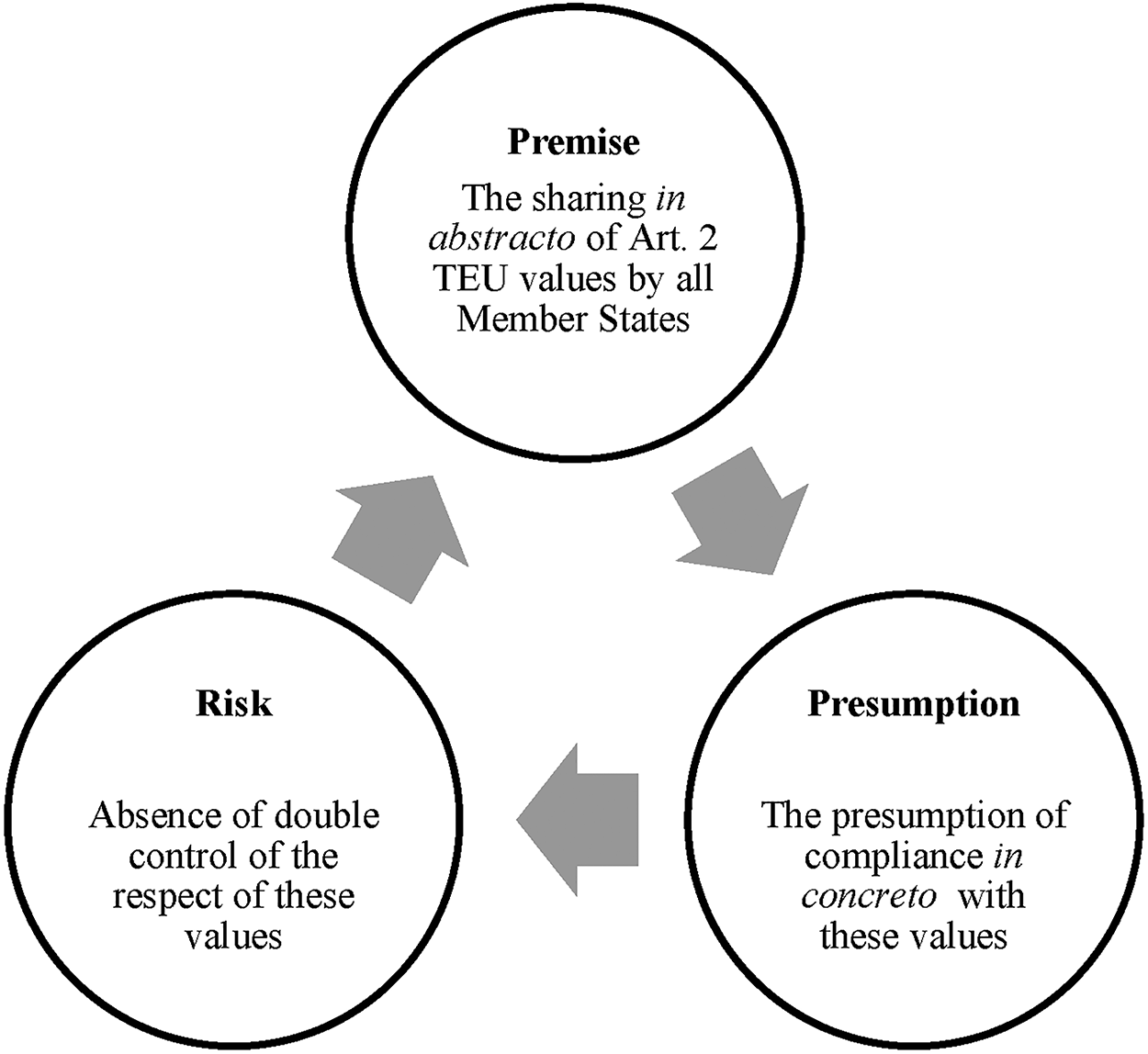
This circularity can lead to a conflict between, on the one hand, the obligations deriving from the principle of mutual trust and, on the other, the respect of fundamental rights which is founding this principle.
As highlighted above, the principle of mutual trust is implemented through a series of norms of both primary and secondary law. These norms also establish a framework for this principle and enshrine the exceptions that can be recognized, particularly to safeguard the fundamental rights of the individuals involved. Two types of limitation schemes can be distinguished: ‘closed’ systems, which precisely and exhaustively enumerate the circumstances in which exceptions to the principle of mutual trust can be made, and ‘open’ limitation systems where these exceptions are defined in a more vague manner, often through public policy clauses. 23
For instance, the Framework Decision on the EAW 24 constitutes a closed system, as it very precisely defines the reasons that can justify refusing the execution of an EAW. On the other hand, most instruments of mutual recognition within the framework of civil judicial cooperation establish ‘open’ systems of limitation, allowing for the refusal of mutual recognition of judgments that would contradict public order in the requested state. 25
However, the importance of this distinction is somewhat lightened up by the case law of the Court of Justice, developing the doctrine of the ‘exceptional circumstances’. This doctrine allows for exceptions to mutual trust outside the strictly set parameters of legislative instruments, when very serious risk threaten fundamental rights. The Court of Justice has indeed at several occasion relaxed rigid limitation systems because the presence of such risks. On the other hand, the Court of Justice also construed ‘open’ systems of limitation narrowly because of the principle of mutual trust. Thus, the difference between open and closed limitation schemes appears to lose some importance because of this case law.
The next section delves into this case law to better grasp the delicate balance struck by the Court of Justice between, on the one hand, the imperatives linked to mutual trust, and on the other hand, the protection of fundamental rights.
The ‘exceptional circumstances’ justifying setting aside mutual trust: the Court of Justice’s stone-by-stone approach
The Court of Justice had promptly addressed the conflict between mutual trust and the protection of fundamental rights. In doing so, it had to determine the balance that needs to be struck between protecting fundamental rights and upholding the imperatives of mutual trust. 26 In the view of this, the Court developed ‘stone-by-stone’ a line of case law on ‘exceptional circumstances’ allowing setting aside the principle of mutual trust, thereby construing the textual exceptions provided by legal texts implementing this principle. As underlined by Koen Lenaerts in a seminal article on the working methods of the Court, the latter has no other choice than developing a ‘stone-by-stone’ approach with regard to important constitutional questions, as it can only address the questions that cases at hand requires. 27 In the following paragraphs, we will strive to provide a concise overview of this case law and distill broader conclusions from it.
The first important point to note is that, to date, the Court of Justice has never endorsed the full suspension of mutual trust towards a Member State. Although there may be systemic issues related to certain founding values, in particular the rule of law, in several Member States, 28 the Court has not considered them to justify a suspension of the principle of mutual trust. Instead, the principle can only be departed from through specific and limited exceptions. 29 The importance of the principle of mutual trust makes it quite easy to understand the position of the Court. A general suspension of this principle towards a Member State could have extremely detrimental consequences for the functioning of the EU. It would halt the implementation of a significant number of instruments based on this principle. For instance, EAWs issued by the State excluded from mutual trust could no longer be executed by other Member States. Individuals who have committed an offence in that state may be incentivized to escape to another Member State, confident that they would find refuge there. It is probably due to these risks that the Court of Justice has chosen to strictly define the exceptions to the principle of mutual trust, in addition to those explicitly dedicated in legal texts.
To offer a thorough insight into these exceptions within the AFSJ, we shall provide a concise overview of the case law of the Court of Justice pertaining to each domain. Given the vast number of judgments delivered in relation to the principle of mutual trust, we do not purport to offer an all-encompassing analysis. Instead, we are thoughtfully selecting the rulings that we judge to convey the most crucial insights for the definition of ‘exceptional circumstances’ allowing to set aside mutual trust, in addition to the specific exceptions provided for by the legal texts. We will conduct this analysis first in the field of civil judicial cooperation, then in connection with asylum, and finally in relation to the EAW in the area of judicial criminal cooperation.
In the area of judicial cooperation in civil matters, the Court precluded as a matter of principle, with regards to the Brussels II bis regulation 30 which deals, inter alia, with cases of child abduction, the review, by the executing authority, of the compliance with fundamental rights of the judgment whose recognition is sought. In its judgment in Zarraga, 31 it held that the authorities of the executing Member State were not entitled to verify whether the court which issued the judgment requiring the return of the child had respected the child's right to be heard, as provided for by the Regulation, since the principle of mutual trust requires the national authorities to consider ‘that their respective national legal systems are capable of providing an equivalent and effective protection of fundamental rights, recognized at European Union level, in particular, in the Charter of Fundamental Rights’. 32 The Court of Justice also justified this approach on the grounds that the right to hear the child is not an absolute right and that the national authorities are granted a margin of discretion in this matter. 33 Exceptions to the principle of mutual trust have nevertheless been established, when more serious risks of infringement of fundamental rights were at stake, in the context of the application of the Brussels I bis Regulation, which concern the recognition and enforcement of judgments in civil and commercial matters. 34 In the judgment on Krombach, the Court of Justice indeed held that mutual recognition may be refused when the defendant has suffered ‘a manifest breach of his right to defend himself before the court of origin’. 35 In the judgment in Trade Agency the Court stressed, in the same vein, that a Member State could rely upon the public policy clause – enabling a Member State to refuse the recognition of a judgment which is manifestly contrary to its ordre public – when the defendant's right to a fair trial is ‘manifestly’ breached, leading to the ‘impossibility of bringing an appropriate and effective appeal’ against the judgment in the issuing state. 36
In the field of asylum, the first exception to the principle of mutual trust related to the protection of fundamental rights was enshrined in the N.S case. 37 This case concerned the transfer of asylum seekers to Greece, while it was confronted with significant challenges due to the high volume of people arriving at its borders, which posed significant risks to the fundamental rights of migrants under its responsibility. In this context, the Court held that such a transfer could not take place if there were ‘substantial grounds for believing that there are systemic flaws in the asylum procedure and reception conditions for asylum applicants in the Member State responsible, resulting in inhuman or degrading treatment, within the meaning of Article 4 of the Charter, of asylum seekers transferred to the territory of that Member State’. 38 A few years later, the Court of Justice further clarified this case law, this time in connection with risks to the fundamental rights of the asylum seeker in the absence of systemic deficiencies in the responsible state. In the C.K. case presented to the Court, the risks involved the mental health of the individual who was to be transferred. On this occasion, the Court went on to clarify that ‘even where there are no substantial grounds for believing that there are systemic flaws in the Member State responsible for examining the application for asylum, the transfer of an asylum seeker […] can take place only in conditions which exclude the possibility that that transfer might result in a real and proven risk of the person concerned suffering inhuman or degrading treatment’. 39 As a result of this second case, the Court of Justice was able to specify that, regarding the Dublin Regulation, any transfer must be excluded if there are serious risks of inhumane or degrading treatment, whether or not they result from systemic deficiencies in the responsible state. In a subsequent judgment delivered in the Jawo case, the Court explained moreover that ‘the transfer of an applicant to [a] Member State is ruled out in any situation in which there are substantial grounds for believing that the applicant runs such a risk during his transfer or thereafter’. 40 This prohibition applies regardless of whether the risk of inhuman or degrading treatment exists ‘at the very moment of the transfer, during the asylum procedure or following it’. 41
Similar questions were subsequently raised in the field of criminal cooperation, particularly in connection with the EAW. While both the EAW and the Dublin system are based on the principle of mutual trust, the possible analogy between these instruments remains limited. In particular, the consequences that will result from the non-execution of a Dublin transfer or an EAW are not comparable: in the first situation, the asylum seeker's application will be examined by another Member State, whereas in the second situation, it could lead to a situation of impunity, as Member States do not share the same jurisdiction in criminal matters. It is likely for this reason that the Court's attitude had to be more cautious when it came to recognizing exceptions to the principle of mutual trust. 42
The first landmark ruling in this matter has been delivered in the Aranyosi and Căldăraru case 43 – later confirmed by the judgments in ML 44 and Dorobantu 45 – where the Court of Justice accepted that an exception to the execution of a EAW could be made due to the existence of a risk of inhuman and degrading treatment arising from poor detention conditions in the issuing state. However, in order to preserve the effectiveness of the EAW, a strict two-step test was developed by the CJEU. The executing authority must first (i) establish the existence of ‘systemic or generalised deficiencies, or deficiencies affecting certain groups of people, or certain detention centres’, with regard to the conditions of detention in the issuing Member State. 46 It must then (ii) establish that, in the event of surrender, the person concerned will face a real and individualized risk of inhuman or degrading treatment. 47 In order to verify the existence of such a risk, the executing authority must contact the issuing authority to obtain precise information on the conditions under which the person concerned is to be held. Only under these strict conditions can a refusal to execute be made on the basis of risks related to detention conditions.
This case law was subsequently extended to protect the right to a fair trial. How should one proceed with an EAW issued by a judicial system plagued by systemic deficiencies threatening its independence? This question was first addressed in the LM case, in which the Court applied this two-step test, considering that the execution of a EAW could only be refused if there exist in the issuing state (i) systemic or generalized deficiencies concerning the judiciary likely to impair the ‘essence’ of the right to a fair trial, which includes the right to judicial independence, 48 and (ii) serious and substantiated reasons that demonstrate the existence of a concrete and individualized risk for the person concerned to be exposed to that risk. 49 In the X and Y judgment, 50 the Court specified that this exception could also cover, in the presence of ‘systemic or generalised deficiencies concerning the independence of the judiciary in the issuing Member State’, the risk threatening the ‘fundamental right to a fair trial before an independent and impartial tribunal previously established by law’. 51 The need to go through both steps of this test was recently confirmed in the Puig Gordi judgment in relation to the lack of jurisdiction of the trying Court. The Court reiterated the strict and restrictive nature of the grounds justifying a refusal to execute an EAW. 52 The ruling also clarified that the ‘exceptional circumstances’ doctrine is based on Article 1(3) of the Framework Decision, which states that it ‘shall not have the effect of modifying the obligation to respect fundamental rights and fundamental legal principles as enshrined in Article 6 of the Treaty on European Union’. 53
The two-step examination approach, whether in relation to deficiencies in detention conditions or the judicial system, is justified by a logic of shared responsibilities based on the principle of mutual trust. The executing State should not be concerned solely with the presence of an individualized risk of a fundamental right violation, as this could be resolved by the functional legal system of the issuing State. Similarly, systemic deficiencies that do not result in an individualized risk in the issuing state should not be the responsibility of the executing state, which can only be concerned with the concrete consequences arising from the execution of the EAW that it is entrusted with.
The recent case E.D.L., 54 which we mentioned in the introduction, emerged in this context. The question concerned a EAW, issued for the purpose of carrying out criminal proceedings whose execution could pose a serious danger to the health of the person concerned due to his inability to be incarcerated. As we have seen, the Court of Justice had already addressed a similar issue in connection with the Dublin system in its CK judgment. 55 However, as we have pointed out, the consequences of non-execution of an EAW in relation to a Dublin transfer are not the same. In order to strike a balance between the imperatives of safeguarding the interests of the requesting Member State and the protection of the health of the person concerned, the Court of Justice developed two approaches that could be considered by the executing authority. The first approach is explicitly provided for in Article 23(4) of the Framework Decision. This provision allows for a temporary suspension of the surrender ‘on serious humanitarian grounds, for example if there are substantial grounds for believing that it would manifestly endanger the requested person's life or health’. According to the Court, this provision can be relied upon at the time of the decision on execution. 56 However, this solution is inherently temporary. Yet, as the Court itself emphasized, it cannot be excluded that ‘in exceptional circumstances, [the risk of inhuman and degrading treatments] cannot be ruled out within a reasonable period of time’. 57 According to the Court, in such circumstances, the executing judicial authority should refuse the execution of the EAW, in accordance with Article 1(3) of the Framework Decision, read in the light of Article 4 of the Charter. 58 Therefore, taking seriously the prohibition of inhuman and degrading treatment, the CJEU established the obligation to refuse the execution of an EAW when it appears that the risk of inhuman treatment cannot be avoided within a reasonable time. However, in order to fall under Article 4 of the Charter, the risk must reach a minimum threshold of severity, which in this case implies a ‘real risk of a significant reduction in his or her life expectancy or of a rapid, significant and irreversible deterioration in his or her state of health’. 59 The most significant change introduced by this judgment is the abandonment of the two-step test in the context of the execution of a EAW, in the case it could entail serious risks due to the health condition of the individual concerned. Indeed, only the individual risk to the person in question of undergoing treatment contrary to Article 4 of the Charter should be taken into account here, which exists ‘either as a result of or, in certain circumstances, regardless of the level of quality of the care available in the issuing Member State’. 60 The overall state of the healthcare system within or outside the prison environment in the issuing State is therefore not a factor to be considered, except when assessing the assurances that the latter could provide to the executing authority. However, it would have been possible for the Court to request these two steps, by imposing an obligation of trust towards the Member States whose healthcare system for incarcerated individuals does not suffer systemic failures.
The judgment also offers further clarification regarding how long the execution of a EAW can be suspended. According to the Court, such a suspension could under no circumstances exceed ‘a reasonable period’, and a refusal of execution should be pronounced if the risk of a violation of Article 4 of the Charter cannot be ruled out within such a period. 61
Overall, the analysis of the Court of Justice's case law area by area reveals that the limitation test varies significantly depending on the specific domain or threatened right. However, what seems to be common is that there must be a particularly severe violation or risk of violation of fundamental rights for exceptions to the principle of mutual trust to be justified. Thus, it appears that exceptions have mainly been recognized in cases involving a risk of infringement either of an ‘absolute’ fundamental right or of the essential content of a non-absolute fundamental right. As their name suggests, the rights falling within the first category cannot, under human rights law, suffer any limitation. According to the EU Charter of Fundamental Rights, human dignity belongs to this category. 62 The Explanations attached to the Charter add that ‘no limitation may legitimately affect’ the prohibition of slavery. The Court of Justice, for its part, recognized the absolute value of the prohibition of torture and inhuman or degrading treatment or punishment. 63 The application of the principle of mutual trust should thus be discarded when an absolute fundamental right could possibly be jeopardized. The same seem to apply when the ‘essential content’ of a fundamental right is at stake. 64 Enshrined at Article 52(1) of the Charter of Fundamental Rights, this notion echoes related concepts of ‘substance’, ‘essence’ and ‘hard core’ of rights originating from national constitutional laws and from the European Convention of Human Rights. 65 Although its precise meaning is disputed in the literature, the concept of ‘essential content’ generally refers 66 and, also, in the sense of Article 52(1) of the Charter, to the inalienable part of fundamental rights that could never suffer any restriction. There are accordingly unjustifiable limitations per se, even in relation to the rights that are not absolute categorical imperatives. In the framework of the application of the different tests – be it one-step or two-step –, it would also seem that the principle of mutual trust should also give way when there is an impairment of the essential content of a fundamental right. It was stressed by the Court in relation to the right to judicial independence, which is, according to the Court, part of the essence of the fundamental rights a fair trial. 67 It should, however, be noted that the definition of the scope of the essence of rights is far from being clear-cut. 68 Furthermore, the question of how to address mutual trust when there are risks to other fundamental rights that are not absolute will soon be examined in another criminal case by the Court of Justice. The pending GN case indeed concerns the existence of risks to the right to privacy and the best interests of the child during the execution of a EAW. 69 This case concerns a EAW that requests the execution of a mother's sentence, which would involve handing her over to another Member State, resulting in a long-term separation from her young child. The opinion of the Advocate General has already been issued, and it suggests that the Court should keep the two-step test with regard to the mother's right to family life. 70 Conversely, with regard to the best interest of the child, it considers that ‘if the executing authority does not receive sufficient information that would allow it to be absolutely certain that the execution of the EAW would not go against the best interests of the child, it should refuse surrender’, 71 considering that the two-step test is irrelevant when it comes to protect the rights of a third-person (the child in this case). 72 However, from our point of view, we find it difficult to understand how a two-tiered protection of fundamental rights could be justified. Upon what grounds could we possibly justify unequal protection of fundamental rights, which are deemed ‘universal’, for the individual targeted by the EAW in comparison to others? While limitations may be admissible concerning fundamental rights, it remains the case that such limitations are not admissible with regard to absolute fundamental rights, and this regardless of whether they pertain to individuals accused or convicted of criminal offences or not.
Although there seems to be a general trend on the kind of the risk that justifies setting aside the principle of mutual trust, the methodology for evaluating such risk varies depending on the area concerned. Indeed, we can observe that the application of the test varies (sometimes in 1 or 2 steps), depending on the area (e.g., CK case vs. Aranyosi case); or based on the threat posed by mutual trust (e.g., Aranyosi vs. E.D.L.). Furthermore, the current case law isn’t very precise regarding the question of the burden of proof. In the next section, we advocate for the adoption of a more consistent approach to appraising the risks to mutual trust in the AFSJ. In addition, we propose refining the standards of evidence required to support claims made in this domain.
From the two-step test to a reasoned risk-based test? Two proposals to improve the method of applying the principle of mutual trust
As underlined here above, the Court of Justice's ‘stone-by-stone approach’ did not lead to a uniform methodology to delimit the scope of the principle of mutual trust within the AFSJ. It appears that the approach which the authorities responsible for implementing the principle of mutual trust should adopt varies depending on the specific domain, the fundamental right being threatened and the reasons behind the threat. In certain cases, exceptions to the principle will require a two-step test, taking into account the condition of the entire legal system of the concerned state. If there are no systemic deficiencies, trust should be placed in the functional system to address individual risks of violation. In other cases, the Court of Justice considers that it may be sufficient to examine the individual risk faced by the person concerned, without regard to the existence or absence of systemic deficiencies. Furthermore, the way in which the burden of proof to determine the existence of the risk is allocated is not clearly specified by the Court of Justice. In order to enhance the coherence of the principle of mutual trust and facilitate its implementation by national authorities, we propose two avenues of improvement. Firstly, we suggest abandoning the two-step test in favour of a risk-based approach that nevertheless takes into account the condition and qualities of the other Member State's system (A). Secondly, we propose adapting the burden of proof within the framework of this risk analysis, to better protect fundamental rights in the implementation of the principle of mutual trust (B).
From two steps to one: Taking systemic deficiencies into account in an individual risk-based analysis
As noted earlier, the Court of Justice sometimes focuses on an individual risk assessment for the person concerned, while in other cases it first requires an examination of the quality of the state's judicial or detention system before proceeding to the individual risk assessment. We suggest standardizing the method into a one-step test that focuses on the risk faced by the individual concerned.
The two steps could indeed, in our view, be merged to bring more coherence and simplicity to the implementation of the principle of mutual trust. Indeed, the appraisal of the state's ‘system’ 73 to which trust should be placed could be directly included in the assessment of the individual risk faced by the person concerned. Consequently, this paper proposes abandoning the step of examining the existence of systemic deficiencies and instead focusing on an analysis of the risk suffered by the person affected by the measure.
The new application method that we advocate should thus be based on an individualized risk analysis. This requires characterizing the fundamental right which is exposed to risk, the severity of exposure and the potential vulnerability of the person concerned. In this context, elements such as minority status, health status or migratory status of the person whose fundamental rights are at stake should, for example, be taken into account. Furthermore, the environment in which a risk unfolds is crucial for its assessment. A risk will indeed be less severe if it arises in an environment that effectively protects fundamental rights, compared to a legal system that presents systemic deficiencies in this regard. This is where the factors considered in the first part of the former test should come into play.
Indeed, despite the abandonment of the two-step approach, the quality of the system of the State to which trust is to be bestowed should still be a crucial factor in evaluating individual risk. A system presenting systemic problems should be considered as less trustworthy than ‘healthy’ legal systems. Discarding the two-step test does therefore not mean not taking into account the possible existence of systemic failures in the risk assessment. Nevertheless, by including this appraisal into the one-step risk-based test, greater coherence and simplicity in implementing the principle of mutual trust could be achieved. Moreover, in the context of applying the principle of mutual trust, national authorities are required to communicate with their counterparts in other Member States and to request possible assurances aimed at guaranteeing respect for fundamental rights. 74 It seems to us that, in this context, the functionality of a system will also have a role to play. The assurances provided could possibly consist of demonstrating that the system in question does not present systemic failures.
Furthermore, such an approach would be methodologically more akin to that of the European Court of Human Rights, which Member States must also comply with, even in the implementation of EU law. Indeed, the European Court of Human Rights focuses on individual risk while taking into account the legal context in which such risk arises. 75 Therefore, a malfunctioning system will logically be considered more risky than a functional one.
The system of limitations currently in place raises many practical challenges arise due to the complexity of implementing these exceptions. 76 National authorities might indeed find it difficult to determine whether a breach or risk of breach of fundamental rights justifies the waiver of the principle of mutual trust given the differing conditions established by the jurisprudence of the Court of Justice.
We therefore advocate for a harmonized approach with that of the European Court of Human Rights, which itself supports the principle of mutual trust to an admissible extent with regard to the protection of fundamental rights. 77 This approach is based more on the consideration of individualized risk, while taking into account any assurances that may be given by the Member State in whom trust must be placed.
Refining the burden of proof to better protect fundamental rights
Whether conducted in a single or dual-step process, implementing this risk assessment may present significant difficulties for both authorities responsible for its enforcement and individuals striving to safeguard their fundamental rights. As a result, we support the adoption of a clear-cut definition of the burden of proof, contingent upon the presence or absence of systemic deficiencies within the state that requires trust.
In EU law and in the Member States’ legal orders, the principle of actori incumbit probatio, according to which the burden of proof weighs on the plaintiff, is generally applicable. 78 Thus, any individual or state seeking to challenge the applicability of the mutual trust principle would need to furnish evidence of the associated risk. However, enforcing this requirement can present a considerable hindrance, especially in scenarios where demonstrating such risk poses significant obstacles, or when the affected individual is in a precarious position that restricts their capacity to provide proof.
The analysis of the Court of Justice's case law on the principle of mutual trust reveals that the resolution of the burden of proof issue is not clearly and consistently settled. For example, in the LM judgment, the Court of Justice stated that if the information provided by the issuing judicial authority ‘does not lead the latter to discount the existence of a real risk that the individual concerned will suffer in the issuing Member State a breach of his fundamental right to an independent tribunal and, therefore, of the essence of his fundamental right to a fair trial, the executing judicial authority must refrain from giving effect to the European arrest warrant relating to him’. 79 However, in a later judgment, the Court of Justice determined that ‘it is for the person in respect of whom a European arrest warrant has been issued to adduce specific evidence to suggest, […] that systemic or generalized deficiencies in the judicial system of the issuing Member State had a tangible influence on the handling of his or her criminal case and, in the case of a surrender procedure for the purposes of conducting a criminal prosecution, that such deficiencies are liable to have such an influence’. 80
This is why we advocate for greater coherence in this area and, within this framework, relaxing the requirements of the ‘actori incumbit probatio’ principle.
In this respect, the evidentiary rules established by European non-discrimination law appear to be a useful source of inspiration for the proposed method. Many directives implementing the principle of non-discrimination indeed establish specific rules for adjusting the burden of proof with a view to combatting discrimination more effectively. 81 Without going so far as to reverse the burden of proof, these directives place the burden of proof on the person claiming discrimination only to the extent of establishing the existence of facts which could lead to the assumption that discrimination has taken place. 82 If they present evidence of possible discrimination, it is then up to the defendant to show that there has been no breach of the principle of non-discrimination. The burden of proof resting on the potential victim of discrimination is thus lightened: the provision of elements that prima facie suggest the possible existence of discrimination is sufficient to establish a presumption of discrimination, which it is up to the party who is defending himself or herself to deny. 83
In our view, this technique could be used in the context of implementing the principle of mutual trust. The provision, in a specific case, by the person concerned of prima facie evidence demonstrating the potential existence of a risk threatening fundamental rights should have the consequence of reversing the burden of proof so that it would be up to the national authority wishing to rely on the principle of mutual trust to demonstrate that the risk does not exist. This prima facie evidence could notably rely upon the existence or not of systemic deficiencies in the Member States requiring the application of the principle of mutual trust. Furthermore, the authorities whose trust is required should be granted a right of investigation, which could be exercised through information exchange mechanisms, inter alia.
If the authority benefitting from the application of the trust manages to demonstrate sufficiently convincingly that there is no real individualized risk exposing the person, then the principle of mutual trust should be applied. However, if the actor fails to demonstrate this, the risk should be deemed real and proven by the judge or authority called upon to rule on the case.
Conclusion
The principle of mutual trust is a fundamental structural principle in the European Union law. However, we have long known that it poses a threat to the protection of fundamental rights. In response to this threat, the Court of Justice has developed, adopting its ‘stone-by-stone approach’, a framework of limitations that carefully delimit the application of this principle. In light of the recent E.D.L case, we took stock of this case law. While this framework aims to safeguard fundamental rights in all areas where mutual trust applies, certain inconsistencies and challenges have been identified. Consequently, we proposed avenues to improve the implementation of the principle of the mutual trust. Specifically, we recommend replacing the two-step test with a one-step test that focuses on the risk faced by the person affected by the measure that implements mutual trust. Moreover, we suggest adjusting the burden of proof to facilitate the demonstration of risks that jeopardize fundamental rights. Although we propose abandoning the first step of the test concerning the possible existence of systemic deficiencies, we believe that this criterion remains relevant, both when examining individual risks and when adjusting the burden of proof.
Footnotes
Acknowledgments
The author wishes to thank the reviewers for their valuable comments on a previous version of this article.
Declaration of conflicting interests
The author declared no potential conflicts of interest with respect to the research, authorship, and/or publication of this article.
Funding
The author disclosed receipt of the following financial support for the research, authorship, and/or publication of this article: This work was supported by the H2020 European Research Council, (grant number the European Union’s Horizon 2020 research and No 851621).
