




Abstract
This article interrogates how Member States’ constitutional courts make use of the case-law of the European Court of Justice. Instead of focusing on the extreme instances of open backlash, we put forward a data-driven methodological approach to the study of Europeanization of national constitutional courts. Drawing on the use of automatic text analysis, we suggest that searching for the formal citations of the rulings of the European Court of Justice in the constitutional courts’ case-law contributes to nuanced understanding of their role within the EU. By means of a case study of the Czech Constitutional Court's case-law (more than 71 000 decisions issued between the years 2004 and 2022), we demonstrate a way to explore the so far under-researched area of EU law adjudication where the majority of strategic behaviour might be taking place.
Introduction
While having to deal with numerous crises over the past years – those of climate, pandemic, late capitalism and many others – the European Union's project of integration through law has been moving forward in quantitative terms. 1 Given the steady increase in the number of EU's regulatory instruments, the process of Europeanization 2 of Member States’ legal orders becomes more and more evident. 3 This expanded reach of EU law dynamically affects the position of all national institutions, and national constitutional courts (CCs) 4 are no exception in that regard.
From the perspective of the centralized constitutional courts of the Member States, the heat of the Europeanization process has been spreading bottom-up. Multiple doctrines of the European Court of Justice (ECJ) – primacy principle, doctrine of direct effect and principle of consistent interpretation, to name just a few 5 – together with Article 267 TFEU preliminary reference procedure – have empowered all ordinary national judges to effectively circumvent any piece of domestic legislation they deemed incompatible with EU law. 6 In other words, all domestic ordinary courts were materially enabled to perform a form of diffuse judicial review of national legislation even though this was not a traditional role assigned to them by their respective national constitutions. 7 As a result, these ordinary domestic courts have swiftly assumed their new role of the ‘European union courts’. 8 Understandably, this radical bottom-up development has put national constitutional courts under significant amount of pressure.
The effects of the new system of diffused judicial review were further strengthened in 2009 when the Charter of Fundamental Rights of the European Union (EU Charter) entered into force. Since then, constitutional courts must share their central agenda of human rights protection not only with the European Court of Human Rights (ECtHR) in Strasbourg but also with the Court in Luxembourg. 9 As Michal Bobek aptly puts it: constitutional courts have always been rather special creatures, and by the process of accession to the EU, such creatures were caged as some parts of their former habitat were declared out of bounds. 10
Against these dynamics, some argue that constitutional courts should not only fulfil a unique institutional role in the domestic matrix of deliberative constitutional democracy, but also find a special place in the European Constitutional Democracy. They ought to represent an appropriate part of the EU's communicative arrangements, which generate legitimacy of collective decisions. 11 Accordingly, and in line with the ideal of constitutional pluralism, national constitutional courts are called to find their distinct sphere of authority within the institutional space of the European Union. 12
Yet the reality of constitutional courts’ engagement in the EU judicial system seems somewhat blurry when considering the last developments of the EU constitutional landscape. Indeed, everyone who takes an interest in the EU context has read about cases in which national constitutional courts invoked the ultra vires and constitutional identity cards – Czech Landtova saga, 13 German PSPP, 14 and Polish K 3/21 15 need no elaborate introduction here. Although all the cases mentioned are set in a very different context, they all represent specific forms of involvement with the authority of the EU. As a result, the place of constitutional courts within the European Constitutional Democracy seems far from settled.
To investigate the degree of Europeanization and the role that the CCs play, we conduct a case study on the Czech Constitutional Court. The primary goal of our case study on the Czech Constitutional Court (CCC; Constitutional Court) is to illustrate how the study of constitutional courts’ citation practices contributes to our knowledge regarding their role within the EU by building an intuition regarding the day-to-day constitutional adjudication and reconstruct a more comprehensive picture of the link between the national constitutional courts and the ECJ.
The article proceeds as follows: We argue that the existing literature does not provide us with a realistic picture of how constitutional courts make use of EU law. Not only is it unclear whether those courts fulfil the deliberative role within the European Union discourse, but it is also uncertain how much they contribute to or push back against the authority of EU law and EU institutions in general. Therefore, we propose to shift the focus from rather extreme cases and carefully examine everyday adjudication of those courts (section 2). In what follows, we employ a data-driven methodological approach to study the phenomenon of Europeanization of national constitutional courts. Drawing on the use of automatic text analysis, we suggest searching for the formal ECJ rulings citations in the constitutional courts’ case-law (section 3). Finally, by means of the case study of the Czech Constitutional Court, we show that there is plenty to be revealed about the CC’s day-to-day EU-law adjudication. In particular, our findings suggest that Czech constitutional judges refer to the ECJ's precedents disproportionately more frequently in cases where they declare the legislative act under review unconstitutional (section 4). In the concluding part, we summarize our claims, highlight that our citation analysis can be replicated with relation to other Member States’ constitutional courts and speculate about the potential avenues for future research (section 5).
Moving beyond the frontiers of the scholarship on the constitutional courts’ EU mandate
Many scholars have addressed the phenomenon of constitutional courts’ Europeanization from various and undoubtedly fruitful perspectives. The debate surrounding the role of constitutional courts within the EU has been primarily dominated by the narratives of ‘constitutional pluralism’ 16 and ‘judicial dialogue’. 17 Against these broader conceptual accounts, three aspects of the link between the constitutional courts and the European Union stand out in particular – instances of constitutional conflicts, the use of preliminary reference mechanism by constitutional courts and the inclusion of EU law into the standard for constitutional review. In what follows, we argue that the existing literature focusing on these three aspects remains limited both methodologically and substantively and thus we suggest a fresh direction to complement the existing writings.
The first strand of the scholarship focuses on the constitutional conflicts between the national constitutional courts and the ECJ and other EU institutions. 18 In particular, many authors have analysed several defensive strategies developed by individual constitutional courts with the aim of posing limits on the primacy principle of EU law within national legal orders. These concepts include the ‘higher level of fundamental rights’ review (Solange), ultra vires review, the controlimiti doctrine and the national/constitutional identity review. 19 Even though they differ in some important aspects, they all share the same theoretical premise: the transfer of powers to the EU is limited, because domestic constitutions do not allow the Member States to surrender their sovereignty to the EU altogether. 20
Accordingly, some have argued that national constitutional courts should cautiously use these concepts as substantive tools to counterweigh the EU's democracy diminishing mechanisms. 21 Others have alerted against them by highlighting that their flawed potential may lead to dangerous outcomes. 22 In any case, the conflict-and-power accounts have been particularly attractive in the context of the current ‘EU's rule of law crises’ and ‘backlash politics’. 23
Against this backdrop, we contend that although the analysis of open constitutional conflicts is crucial to our understanding of the ECJ's (and the EU's) authority, these instances of judicial wars still represent an extreme minority of cases in which constitutional courts make use of EU law. Consequently, one needs to wonder how important such strategies are in the majority of the day-to-day constitutional adjudication. Since we do not really know how constitutional courts work with EU law on a more frequent basis, there is a large rather uncovered area in which less visible forms of pushback against the authority of the ECJ and the EU might occur. Or to the contrary, constitutional courts may also contribute to the development of EU law in a hidden but more significant way than previously depicted. In Alec Stone Sweet's words – ‘the field desperately needs more systematic data collection and empirical research on what national judges do when EU law is pleaded in cases before them.’ 24
Let us now turn to the second strand of existing literature which has analysed the preliminary references submitted by individual constitutional courts according to Article 267 TFEU. 25 These references have been recognized as ‘one of the more powerful procedural connectors among courts serving the cause of constitutional pluralism’ 26 The preliminary reference mechanism ought to represent ‘the only appropriate forum’ for constitutional dialogue because it provides the national CCs with an opportunity to challenge EU law, alert the ECJ and inform it of arguments why an EU measure may be problematic. 27 Under the right conditions, the argument goes, such dialogue could serve a productive auto-correct function. 28
Although the analysis of preliminary references submitted by constitutional courts is undoubtedly valuable due to their political salience, one has to conclude that the issue of exceptionality similarly affects those instances as well. Relying on the preliminary references as proxies for the assessment of the Europeanization of constitutional courts might be deceptive because an overwhelming majority of cases relating to EU law do not reach the ECJ at all. 29 This is caused not only by the ‘judicial ego’ of national constitutional judges, 30 but also by the vaguely-defined CILFIT criteria, according to which the constitutional courts enjoy wide discretion in deciding whether to refer the question or not. 31 As Stacy Nyikos aptly noted – ‘[w]hat we most desperately need to know is how capable domestic courts are of shouldering the burden of resolving an increasing number of European legal issues within their own chambers’. 32
Now, what about the third strand of the existing literature? Some authors have in fact moved beyond the rather extreme cases of open constitutional conflicts and preliminary references. In particular, when inquiring how constitutional courts use EU law as a yardstick for constitutional review, be it directly or indirectly, David Paris has shown that most constitutional courts have by now started to interact with EU law on a more frequent basis. 33 Similarly, in their book, Bobek and Adams-Prassl present valuable insights into how individual constitutional courts work with the EU Charter when reviewing national legislation or dealing with constitutional complaints of individual EU citizens. 34
Even though these doctrinal studies are more productive as they shift the focus on the core part of constitutional courts’ activity within the EU law adjudication, the conclusions drawn from them cannot be easily generalized and replicated due to their predominant qualitative and substantively narrow focus. Indeed, since they mostly depend on more traditional qualitative and doctrinal methods of legal analysis, a more complex picture of the behaviour of national constitutional judges with regard to the majority of EU law is still missing. As a result, we contend that we also need to move beyond methodological frontiers and make use of novel forms of analysis, which would allow us to study the phenomenon of Europeanization quantitatively as well.
The three strands of existing scholarship on constitutional courts’ role within the EU and their described drawbacks illustrate well the point we are trying to make here: in order to understand the process of constitutional courts’ Europeanization on a larger scale, we need to gather and analyse more data on how constitutional courts use EU law in their day-to-day constitutional adjudication. Only by shedding some light on the large—and so far un-researched—area of constitutional decision-making, will we be able to assess better what national constitutional courts do and do not contribute to the development of EU law. Furthermore, only by shifting the focus onto the run-of-the-mill practice of constitutional judges might softer forms of strategic pushback against the ECJ's authority be identified. In other words, to understand the strategic behaviour of constitutional courts, one must look beyond the high-profile EU law cases. In what follows, we propose a technique which could contribute to such aims.
Measuring constitutional courts’ Europeanization
There are diverse groups of indicators which can be used to operate the process of Europeanization of national courts. Among other approaches, researching the level of domestic judges’ engagement with, or application of, EU law has been suggested to be a productive way to operationalize such a phenomenon. 35 In particular, looking into the way national courts treat the ECJ's jurisprudence in their decisions might be highly informative of how domestic judges fulfil their EU mandate. 36 Accordingly, we suggest examining whether and how national constitutional courts use the ECJ's case-law in their day-to-day constitutional adjudication.
This focus seems reasonable from both from doctrinal and theoretical perspectives. The ECJ itself formally instructs national judges to follow its previous case-law. According to Da Costa 37 and CILFIT 38 criteria, domestic judges are expected to either follow the previous interpretation already given by the ECJ in a similar case (irrespective of the nature of the proceedings), or to submit preliminary reference. 39 If national judges do not follow the ECJ's previous case-law or refer the case to the ECJ, they face a quite real risk of subsequent individual state liability claims according to Köbler 40 as well as the liability based on the infringement proceedings pursuant to Article 258 TFEU (as recently confirmed in Commission v France 41 and Commission v United Kingdom 42 ). It is especially due to the existence of the two liability procedures, as formed and enforced by the ECJ, that it is safe to claim that for domestic judges, the ECJ's case-law at least formally enjoys binding force and, as a result, national judges are expected to strictly apply the ECJ's interpretations of EU norms as ‘faithful agents’ do. 43
Although there are some theoretical disagreements about whether previous ECJ's rulings enjoy mere persuasive authority, or whether they represent formally binding sources of law, 44 essentially no one disputes that the ECJ's previous decisions play a major justificatory role in EU law adjudication in general. 45 From this perspective, even if the prior ECJ's judgements were not formally binding in the strict sense, they still enjoy a great degree of de facto strong authority. 46 Thus it is safe to claim that ECJ's rulings formally enjoy a ‘wider precedential value’, which, in certain cases, reaches ‘a quasi-normative effect’. 47
As a result, it seems that using citations of ECJ's precedents as indicators of how national constitutional courts interact with EU law in their run-of-the-mill constitutional adjudication might rectify our still limited knowledge regarding the level of their Europeanization. What is then a good methodological approach to obtain and analyse useful information about citation practices of individual constitutional courts?
Drawing on the research developed for the study of the national judiciary's treatment of the rulings of the European Court of Human Rights, 48 we develop the framework for the macro-level analysis which encompasses the quantitative search for the formal ECJ rulings citations (references) in the constitutional courts’ case-law.
First and foremost, this kind of analysis should allow us to map not only how frequently national constitutional judges refer to the ECJ's case-law and how the total number of citations changes over time. Moreover, it ought to enable us to explore the areas of law as well as the type of proceedings in which constitutional judges make use of the ECJ's case-law the most. Crucially enough, the citation data should help us interrogate how the use of EU law influences the outcomes of constitutional reviews. In addition, further characteristics of the cited precedents can be studied in order to examine which case-law of the Luxembourg Court enjoys the highest precedential value.
Even though the citation analysis cannot provide us with detailed insights about the way in which constitutional courts work with these ECJ's doctrines – whether they follow, challenge or develop them, it helps us to build a much more complex picture of the overall impact of the ECJ's case-law in national constitutional adjudication.
In the course of the analysis, automatic text analysis is employed. 49 Computational tools are used to detect the citations/formal references to the ECJ's case-law in the constitutional courts’ decisions. Extracting references based on the use of regular expressions 50 allows us to address three general shortcomings of qualitative analysis.
First, there are simply too many constitutional courts’ decisions where the past ECJ rulings are cited which makes the in-depth reading and hand-coding unmanageable even for large teams of researchers. The use of computational tools makes the processing of a super-large number of judgements possible (‘data amount problem’). Secondly, the focus on the mere occurrence of the ECJ's case-law citation in the national judgements minimizes the biased selection of prominent precedents the implementation of which is examined as well as reduces the risk of a tendency to ‘read a story into our analysis’ (‘cherry-picking problem’). Finally, qualitative reading of the domestic case-law necessarily suffers from a decreased level of transparency in presenting the research outputs. Discovering domestic courts’ reactions to the ECJ's precedents in detail and categorizing those reactions into treatment patterns is central to the qualitative analysis. However, the ability to describe in detail all the processes by which such classifications were developed is necessarily limited. The inclusion of automated processes which are more technical, clear-cut and universal, might, on the other hand, increase the overall transparency and replicability of the research (‘transparency problem’). 51
In the following part of the article, we demonstrate the approach of studying constitutional courts’ Europeanization in detail on the case study of the Czech Constitutional Court.
Case study: Insights from Czechia
The primary goal of our case study on the Czech Constitutional Court (CCC; Constitutional Court) is to illustrate how the study of constitutional courts’ citation practices contributes to our knowledge regarding their role within the EU. Thus we want to build intuition regarding the day-to-day constitutional adjudication and reconstruct a more comprehensive picture of the link between the national constitutional courts and the ECJ.
The automatic text analysis is typically divided into four stages: obtaining data; converting text to quantitative data; analysing the data; and validating the results. 52 Here, we roughly follow this outline.
Defining the datasets
As to the collection and characterization of the data, in our case study we automatically analysed 71 527 decisions of the Czech Constitutional Court issued between 1 January 2004 and 1 November 2022. We searched for the citations of all the ECJ's judgments issued between the years 1958 and 2022.
The data are the result of a connection between two datasets: the IUROPA dataset 53 for the ECJ and our own Czech Apex Courts dataset. 54 For the national part of the analysis, both the text corpora and the metadata of the Czech Constitutional Court's decisions were utilized, whereas for the EU part of the analysis, only the metadata regarding the ECJ's judgements were utilized.
Automatic search for the references
Once all the data was obtained and structured, the tracing of the ECJ references in the collection of the CCC's decisions followed. In general, there are several techniques that are used in automated text analysis, ranging from simple keyword searches to supervised or unsupervised machine learning. 55 For the purposes of our citation analysis, we opted for the so-called ‘rule-based method’ in which ‘the researcher explicitly instructs the computer to look for certain words or patterns and interprets the resulting outcome as a measurement.’ 56 In other words, we developed several instructions for the computer to detect the ECJ citations in the plain text of CCC's decisions.
Before we describe these instructions in detail for the future replicability purposes, let us first examine an example of an ideal ECJ's judgement citation which can be found in some of the CCC's decisions. In the Decision No. I. ÚS 387/20, para 59, the CCC stated: Jurisdiction in matters of parental responsibility is thus primarily conferred on the courts of the Member State in which the child is habitually resident at the time the court is seized; because of their geographical proximity, those courts are generally the best placed to assess the measures to be taken in the interests of the child (see para 36 of the Judgement of the Court of Justice of the European Union of 23. 12. 2009 in case C-403/09 PPU Detiček).
Following this example, one can identify typical components of the EJC's case-law citation: (1) identification of the ECJ; (2) date of the ECJ's ruling; (3) name of the case; (4) case number; (5) number of the cited paragraph(s). A truly ideal citation would also include another component – the ECLI identifier which is a specific citation identifier of the case-law. However, these are almost never used in the practice of Czech courts.
Now, even though the ideal citation might seem quite straightforward at first glance, it is a well-known fact that domestic courts cite the case-law in a very inconsistent way. 57 Lacking any formal guidelines which would be effectively followed, the Czech Constitutional Court is no exemption. For instance, constitutional judges may identify the ECJ not only as ‘the Court of Justice of the European Union’, but also as the ‘CJEU’, ‘ECJ’, ‘European Court of EU’, ‘Community Court’, ‘European Court’, ‘Luxembourg Court’ or simply as the ‘Court’. Similarly, as regards the name of the case, they may omit the name altogether, cite only the ‘popular name’ as appearing in CURIA, cite merely part of the full name, cite full name with ‘v’, ‘v.’ or ‘proti’ (which stands for versus in Czech) and so on. As a result, automatically searching for citations in a reliable way is quite a challenging task.
In order to detect as many citations as possible, we started with the most specific component of the ECJ case-law citation – the ECLI identifier (Rule No. 1). As mentioned above, the practice of citing ECLI is not common, but it might still occur in a few instances.
Since the first rule allows us to identify only a very small portion of the citation, we had to develop subsequent rules. First, we focused on the full case number of the ECJ's precedents (Rule No. 2). Fortunately, the pre-signs ‘C-’, 58 ‘T-’, 59 and ‘F-’ 60 are quite specific in the European and Czech context, which means that the ECJ's case-numbers in that format do not overlap with docket numbers of other institutions. 61 Knowing that the ECJ has never decided more than 999 cases in a year, we could search for all the sequences of signs in the format ‘C|T|F-XXX/XX’ where X stands for any number from 0–9. The regular expression had to be readjusted several times in order to also detect references in which the Czech Constitutional Court cited the ECJ case number imprecisely [e.g., used a dash instead of a hyphen (‘C|T|F–XXX/XX’), added extra spaces (‘C|T|F – XXX/XX’) etc.]. 62
The issue with Rule No. 2 is that even if adjusted to cover various typographical errors of the national judges, it would still not cover three groups of references. First, it does not detect the references which national courts omit to include the ‘C|T|F-’ (be it either intentionally or unintentionally). Secondly, until the end of 1988, the ECJ's format of the ECJ's case-law did not include the prefixes ‘C|T|F-’ and took the form of ‘XXX/XX’. Consequently, we had to develop an additional rule which would detect these instances.
The third rule detects references in which the case is cited without the prefix ‘C|T|F-’ (Rule No. 3). One cannot solve the issue only by searching for the ECJ case-law number in the format ‘XXX/XX’ as such format overlaps with the docket numbers of other institutions, i.e., the search would identify for instance the ECtHR's rulings instead of the ECJ ones. Thus another specific element needed to be added. In this regard, we used the occurrence of another typical citation element – the identification of the ECJ. The premise is simple – every time a constitutional court refers to the ECJ's ruling, it also mentions the name of the ECJ nearby that reference. 63 Therefore, the third regular expression searched for the occurrence of the number in the format ‘XXX/XX’ under the condition that the name of the ECJ was mentioned in the vicinity of 300 signs surrounding that number. Here, we used the specificity of the Czech version of the ECJ's identification. In Czech, a court, in general, translates as ‘soud’ while the Luxembourg Court translates as ‘dvůr’. Thus the probability that the search would identify docket numbers of other courts was very low as these other courts would be identified as ‘soud’ and not ‘dvůr’. On the other hand, due to the linguistic peculiarity of Czech declension, various forms of the world ‘dvůr’ needed to be included. Also, we searched for potential abbreviations such as ‘ESD’ (‘ECJ’) and ‘SDEU’ (‘CJEU’). Finally, we added some further conditions in order to avoid false results. 64
Now the substantive description of the developed rules shows that none of these rules could detect all the ECJ references in constitutional courts’ decisions on its own terms. The three rules are complementary and are designed to cover as many varieties in citation style as possible. We strongly believe that these instructions taken together are complex enough to detect the majority of the cases in which the Czech Constitutional Court referred to the ECJ's case-law. 65 For an overview of the substantive rules used in the search for the references, see Table 1. For the actual code of the used regular expressions, see our digital depository. 66
Overview of the rules.

Overview of the rules.
In what follows, we present the results of the macro-level citation analysis of the Czech Constitutional Court's case-law. First, we focus on the scope of the Europeanization of the case-law. Here, we inspect how often the CCC refers to the ECJ's precedents and how that practice evolves over time. Importantly enough, we look not only at the citations of the constitutional court as such, but we analyse the behaviour of individual justices as well (4.C.1). Secondly, we focus on the areas of Europeanization. Here, we inquire in which substantive areas constitutional judges refer to the ECJ's authority most often. This should allow us to gain some important insights about the ECJ's authority within various subject matters (4.C.2). In the third part of this section, we zoom in on the effects of Europeanization. Here, we inspect which type of cases and proceedings the CCC refers to the ECJ's case-law. This part of the analysis should provide us with a preliminary picture of how and for which purpose constitutional courts use the ECJ's case-law most often (4.C.3). Finally, we inquire about the origins of Europeanization. Here, we analyse some of the characteristics of the cited ECJ's case-law in order to gain a better understanding of the most influential aspects of its authority (4.C.4).
Before we delve into the analysis of our results, it is important to clarify two elements of our method. We distinguish between a referring decision and a reference. A referring decision represents any constitutional court's decision that contains at least one reference to an ECJ's judgement. A reference, on the other hand, means a citation of a particular ECJ's judgement which occurs in a referring case. To be sure, this primarily means that one referring case can contain multiple unique references. Moreover, this also means that we do not count multiple references of the same ECJ's precedent in one CCC’ referring decisions. 67 As for the second clarification, we employ the term caseload to represent the number of cases that the CCC decided (not lodged) in any given year.
The scope: Europeanization increases
Let us start with rather descriptive findings about the frequency of CCC's references to the ECJ's case-law. Overall, the CCC referred to at least one ECJ precedent in 433 out of 71 527 decisions. As can be seen from Figure 1, there is a clear increasing tendency in the proportion of referring cases against the yearly caseload of the CCC.
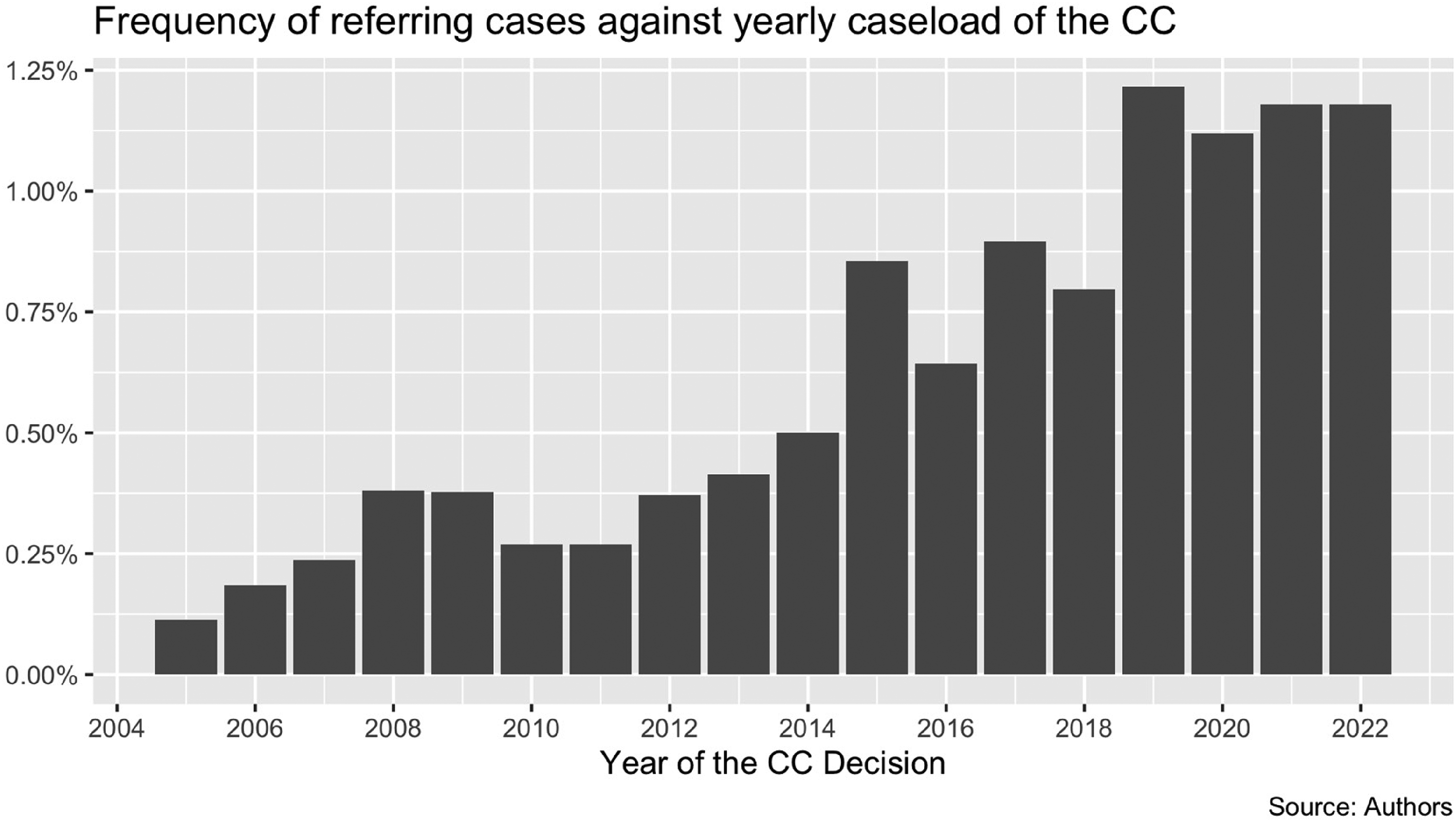
Frequency of referring cases against yearly caseload of the CC.
It is perhaps not surprising that in the early years after the accession to the EU, the Constitutional Court did not refer to the Luxembourg case-law very often. After all, it takes some time before the EU law cases even reach the docket of the constitutional court and before litigants begin to invoke the ECJ's doctrines in their submissions. Nevertheless, it is more interesting to see the proportion of referring cases in the more recent jurisprudence. Indeed, in the last years, the ECJ's case-law has occurred in more than 1% of all cases decided by the Constitutional Court each year.
Even though the portion of cases in which the CCC reasons with at least one ECJ's precedent seems very low at first sight, this should not be bluntly accepted as evidence that the process of Europeanization is in reality not taking place in the CCC's adjudication. Firstly, as we will argue below, the absolute numbers need to be put into closer context because the vast majority of cases (more than 90%) are represented by quasi-procedural decisions which are rather short and simple and thus less likely to contain substantive citations to ‘foreign’ case-law. Moreover, since even older and modest studies show that the proportion of national legal rules affected by the EU law oscillates at least around 10 per cent of all national norms, 68 the overall low number of referring cases shows – more than anything else – that the CCC might often come across EU law issues without evoking the ECJ's precedents or the whole EU-law dimension as such . This seems to confirm Lisa Conant's claim that ‘[n]ational judges who do invoke European provisions in their decisions are likely to interpret [them] without any explicit reliance on ECJ case-law.’ 69 Similarly, the low percentage of referring cases might also indicate that the CCC ignores the EU aspect of the reviewed national legal acts altogether in a lot of cases. In any case, the key finding regarding the scope of Europeanization is clear – the Czech Constitutional Court refers to the ECJ's case-law on a more frequent basis than it used to.
As much as the overall statistics provide us with a rough picture of how the Czech Constitutional Court approaches the ECJ's precedents in general, let us now zoom in and inspect how the citation practices of individual justices change over time. This is crucial for several reasons. First, the overall statistics do not reveal anything about the distribution of the citations among individual judges. Thus it could be the case that some judges would refer to the ECJ's case-law disproportionately more than others. To put it plainly – individual personalities matter in decision-making. 70 This is especially relevant in the case of the Czech CC, where a judge rapporteur enjoys a crucial role of drafting the decision, which includes referencing the ECJ's case-law. Secondly, Czech constitutional judges’ mandate lasts ten years. This is a reasonably long period of time which allows us to identify any signs of the development of individual approaches in time.
What is then the story of Czech constitutional judges? As we can see in Figures 2 and 3, there are noticeable differences between the various approaches of individual members of the bench. Some judges remain rather passive and have not cited more than 10 unique ECJ judgements per year during the course of their whole tenure (Lichovník, Uhlíř, Tomková). Others, on the other hand, steadily refer to the ECJ's authority on a more frequent basis (Šimáčková, Filip). Such findings are not surprising, especially in the latter case, as, for instance, Kateřina Šimáčková has the reputation of being a proactive and internationally focused judge. 71
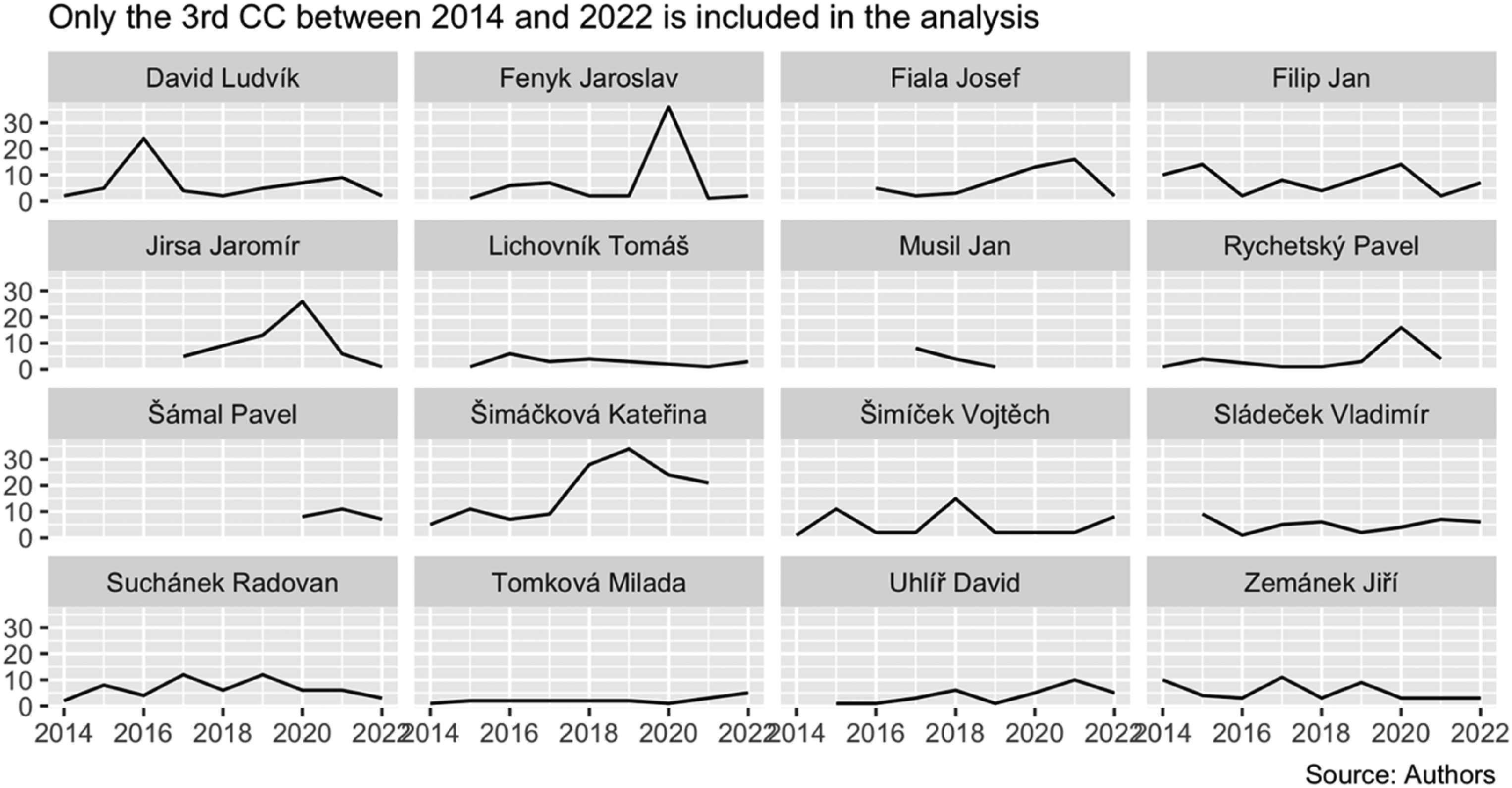
Number of ECJ citations by judge rapporteur.
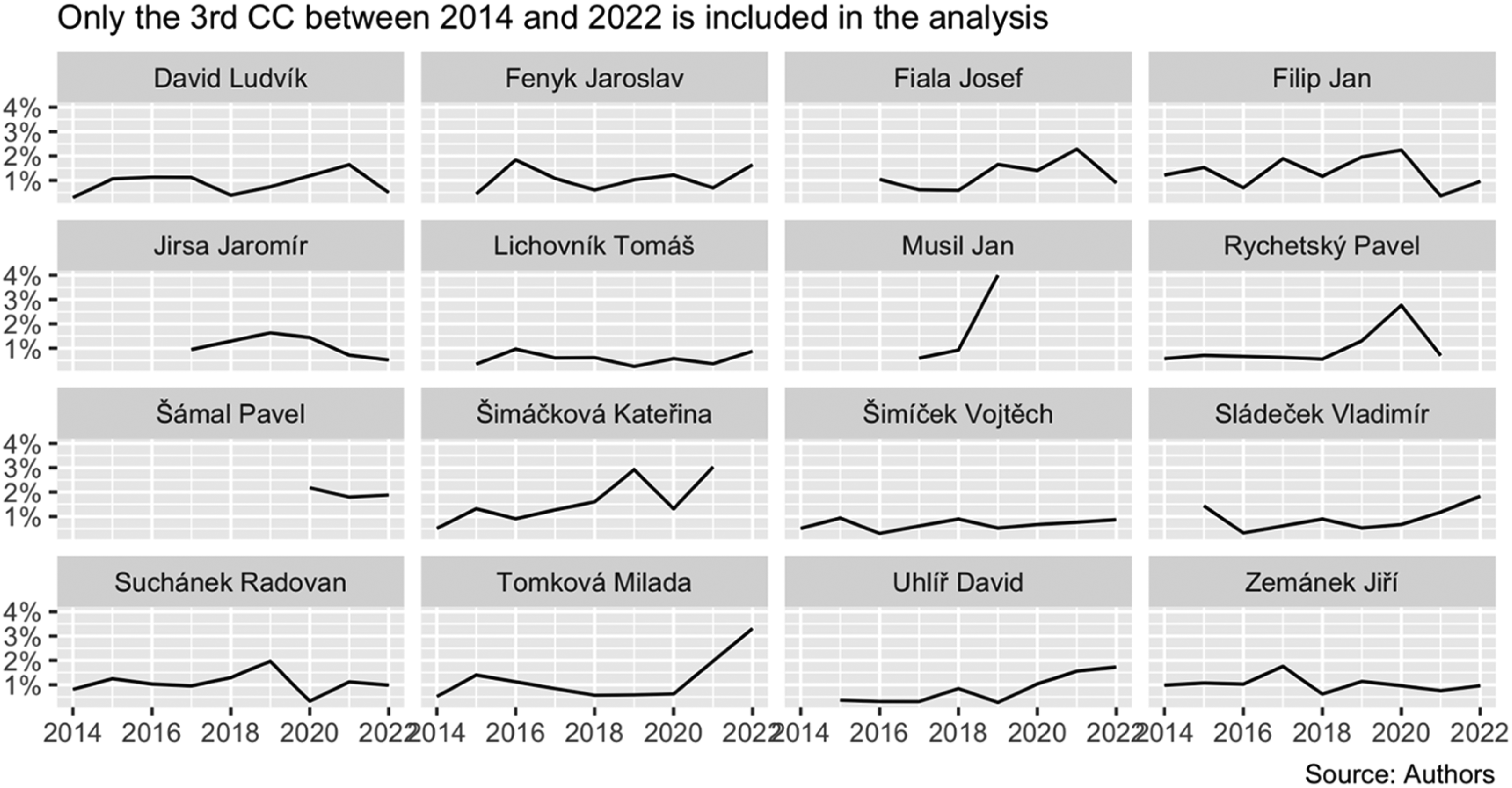
Frequency of referring cases by judge rapporteur relative to their yearly caseload.
What is intriguing, however, is that during the tenure of many of the judges (Fenyk, Jirsa, David, Rychetský), an ‘outlier’ year occurred where they referenced the ECJ noticeably more than in other years. This might be caused by various factors ranging from the need to solve hard EU law questions, to more subtle influences such as hiring a new law clerk who specializes in EU law. 72 In any case, these instances represent apt candidates for further contextual research.
To conclude this section about the scope of the Europeanization of the Czech Constitutional Court, so far we have seen that the number of referring cases has increased by every year. Importantly enough, the approaches of individual judges differ significantly and thus one may wonder whether the level of Europeanization depends mostly on the individual characteristics of those judges. Be it as it may, the first set of descriptive statistics provides us with valuable insights into the relationship between national constitutional adjudication and EU law.
Now it is useful not only to deepen our understanding of the scope of the Czech Constitutional Court's Europeanization, but also to gain some information about the areas in which the ECJ's jurisprudence enjoys the widest effects.
As Figure 4 reveals, the most cited subject matters are threefold: taxation, area of freedom, security and justice, and provisions governing the institutions. At first glance, this seems surprising as the taxation cases do not represent any major part of the Czech Constitutional Court's docket, perhaps on the contrary. The second category, on the other hand, can be better explained as it might include criminal cases in which the Constitutional Court reviews the constitutionality of the European Arrest Warrants, 73 or decisions regarding asylum and EU residency permits. 74
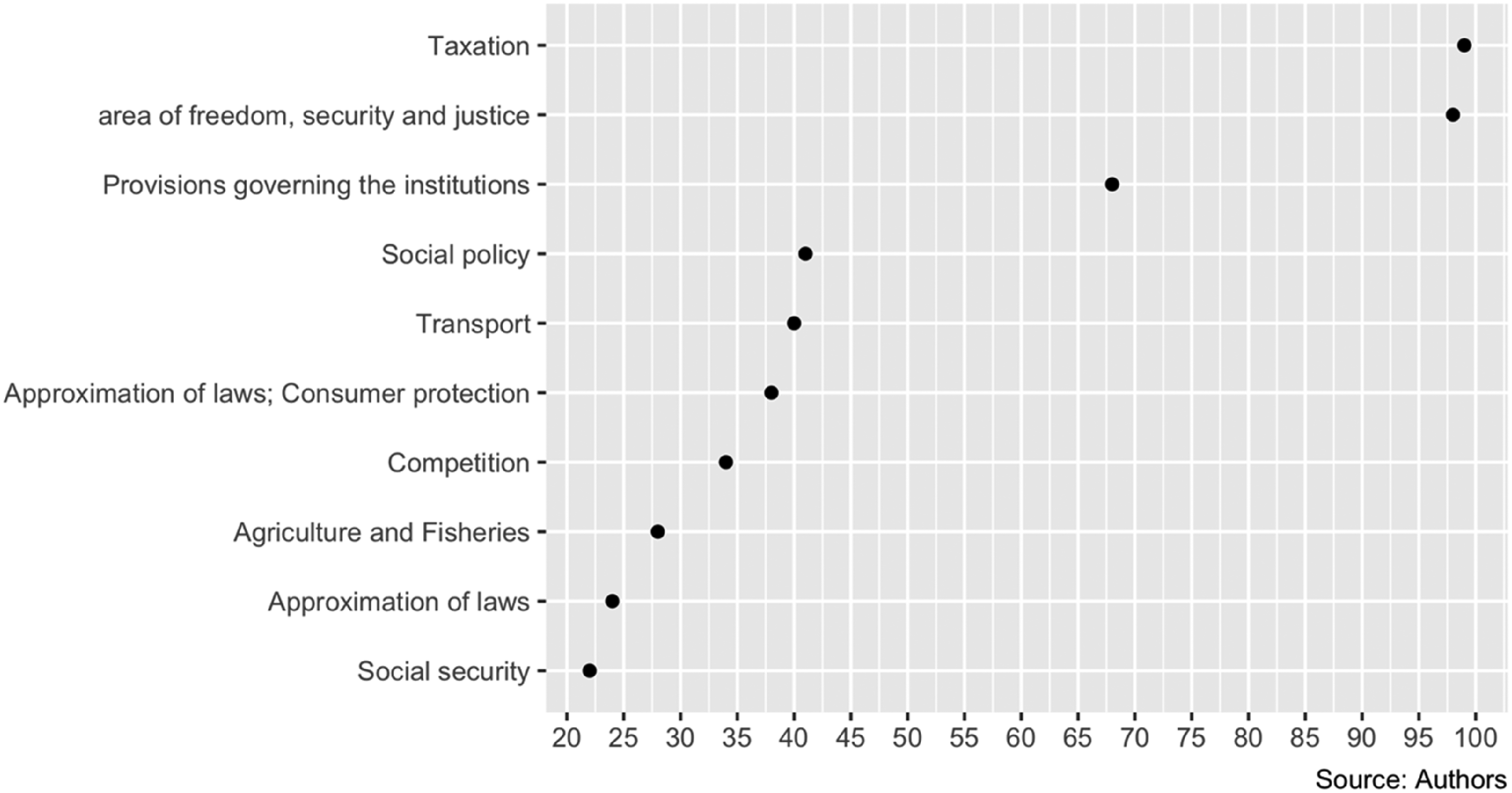
Top 10 cited ECJ subject matters.
As to other categories worth pointing out, it is intriguing that the topic of consumer protection made it to the list. This is due to the fact that the Czech Charter on Fundamental Human Rights does not recognize the principle of consumer protection explicitly, which has long caused a number of doctrinal difficulties. 75 The high number of references might support the intuition that the ECJ's case-law influenced the development of constitutional protection in that area significantly.
The somewhat rough picture of the most Europeanized areas of the Czech Constitutional Court's practice may be well complemented by the inspection of the most cited ECJ precedents. As can be seen in Figure 5, taxation cases – and the VAT fraud cases in particular – occupy the leading places (Kittel, 76 Mahagében 77 and Optigen 78 ).
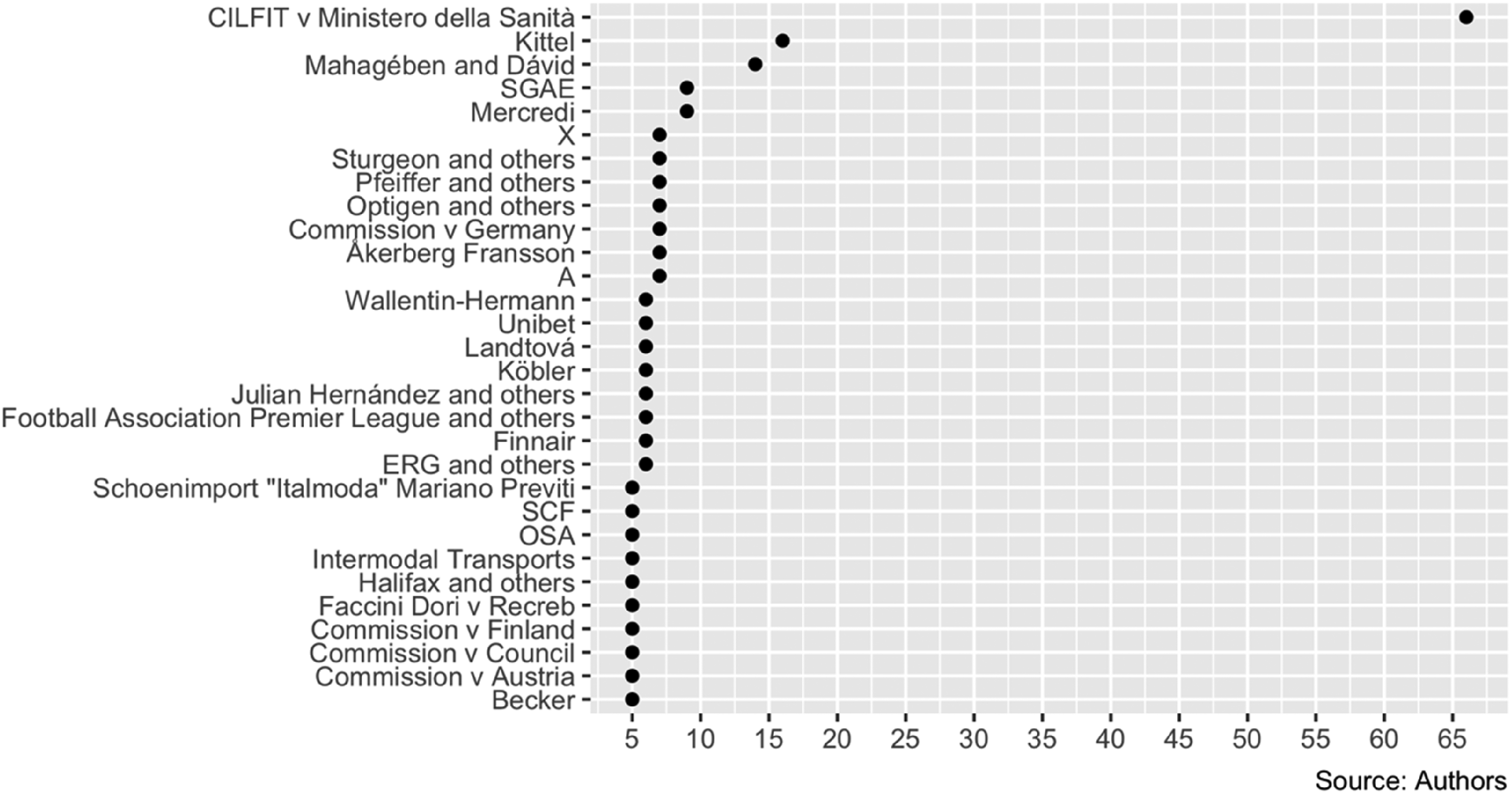
Top 20 cited ECJ decisions.
Furthermore, what is striking is the extremely high number of references to CILFIT. 79 Considering the fact that the Czech Constitutional Court has never submitted a preliminary reference according to Article 267 TFEU and does not consider the CILFIT criteria binding on itself, it is safe to claim that in those approximately 65 references, the Constitutional Court reviewed whether ordinary courts of last instance dealt with their obligation to submit the question to the ECJ in accordance with the applicant's right to fair processes. 80 This brings valuable empirical evidence regarding the still theoretical claims about the growing tendency of constitutional review of this kind taking place. 81 Consequently, although formally avoiding direct interaction with the ECJ, the Czech Constitutional Court may play a significant role as a ‘watchdog’ which guarantees that ordinary courts fulfil their obligation to supply preliminary references to the ECJ. This undoubtedly sheds some light on the role of the Czech Constitutional Court in the European Union.
To conclude this section, the descriptive statistics about the subject-matter of the cited ECJ's precedents provided us with promising preliminary insights about the areas in which the Luxembourg jurisprudence might influence the Czech Constitutional Court's adjudication the most. Even though taxation cases stand out in the overall picture, the analysis uncovered more subtle influences in as-yet hidden areas such as consumer protection or constitutional review of the fulfilment of the ordinary courts’ obligation to submit preliminary references to the ECJ.
So far, we have examined the results of our citation analysis regarding the scope and the area of Europeanization. Those do not tell us much about the nature of the cases in which the CCC make use of the ECJ's precedents. To put it plainly, we also aim to get a closer context of the way ECJ's precedents influence the run-of-the-mill jurisprudence of constitutional courts.
For such purposes, Figure 6 depicts the frequency of the CCC's referring decisions relative to the overall caseload while also categorizing the referring decisions per their outcome. The data reveals quite intriguing and yet untold findings. Czech constitutional judges refer to the ECJ's precedents disproportionately more frequently in cases where they declare the act under review unconstitutional. The disproportion is heavy. For instance, in 2015, out of all decisions that year, the CCC referred to the ECJ's precedents in 8% of the granted applications whereas the precedents were used only in 0.4% out of the rejected ones. 82
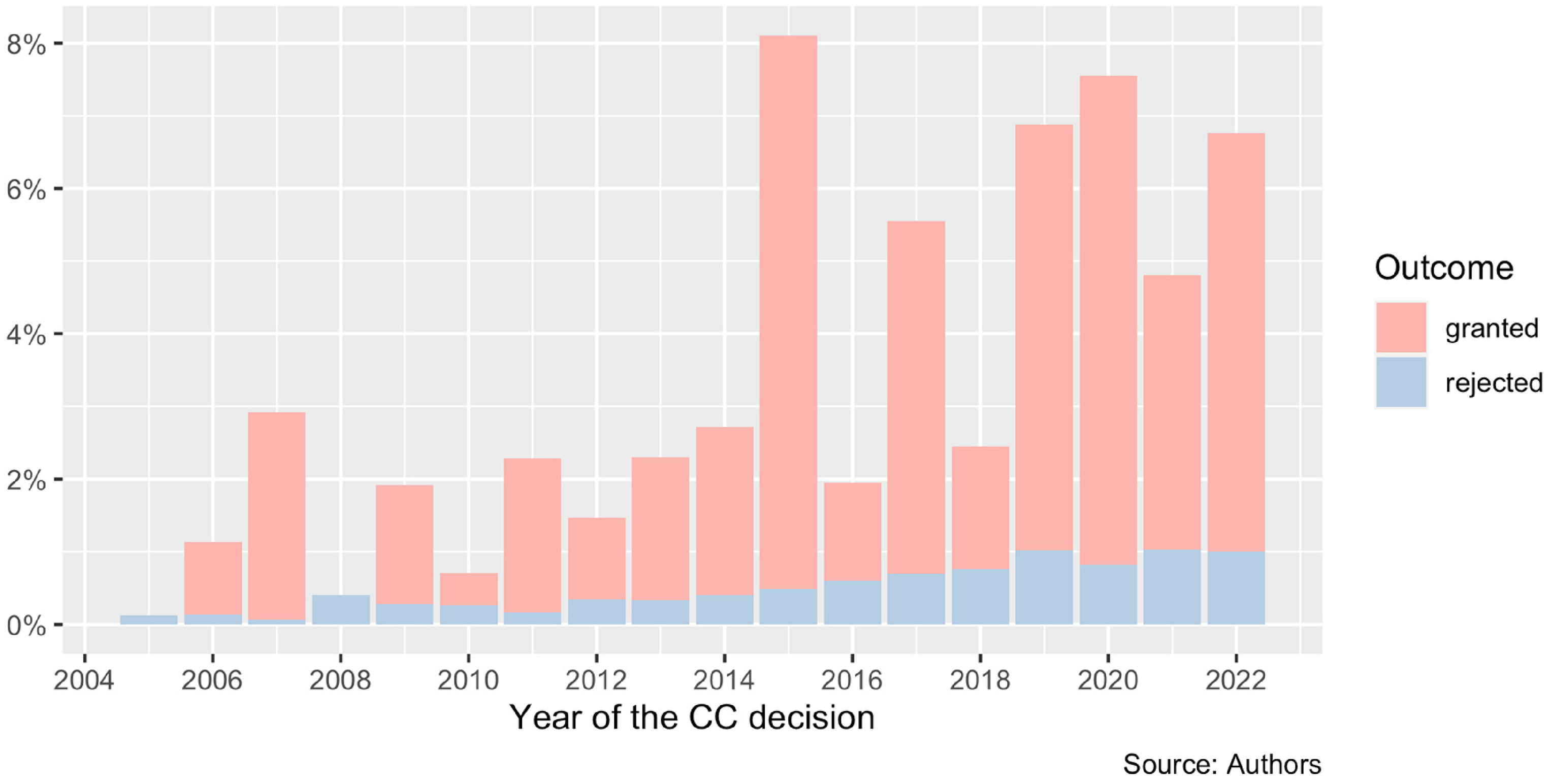
Frequency of referring cases relative to the yearly caseload of the CC per outcome.
Undoubtedly, one cannot infer too broad conclusions from these statistics, as the macro-level analysis does not tell us anything about the specific way in which the ECJ's precedents were used in the reasoning of CCC's decisions. Although cited, the precedent might have played only an ornamental role, or might have even been distinguished from the case at hand and thus not applied substantively. 83 Nonetheless, the skew is so significant that even our broad-stroke quantitative analysis reveals a substantial trend.
Considering the fact that in all types of proceedings, the Constitutional Court essentially decides about the constitutionality of acts of other political actors, the numbers presented support the narrative according to which the CCC often makes use of the ECJ's precedents against other political actors. In short, it seems probable that Czech constitutional judges use the ECJ's legitimacy as a ‘shield’ against the potential pushback against their authority. Following this line of logic, it does not seem that probable that the CCC would ‘cover’ the non-compliance regarding the ECJ's case-law on the side of other state actors by means of rejecting the applications.
Once again, such broad assumptions need to be cautiously inspected further in a qualitative way in order to reveal the substantive influence of Luxembourg's opinions. It is also important to highlight that the majority of non-compliance might be taking in decisions where the ECJ's precedent is not invoked at all. Nonetheless, we are confident to claim that the descriptive statistics show that the CCC does not hesitate to employ ECJ case law to protect constitutionality, not via entering into conflict with the ECJ, but via utilizing its authority to strike down legal acts of other domestic political actors.
Turning to Figure 7, we subsequently explore in which type of proceedings the ECJ's precedents get invoked the most. Assessing the type of proceedings conducted in the referring cases in relation to the overall caseload of such proceedings allows us to conclude that the ECJ's jurisprudence is mostly used in the abstract constitutional review.
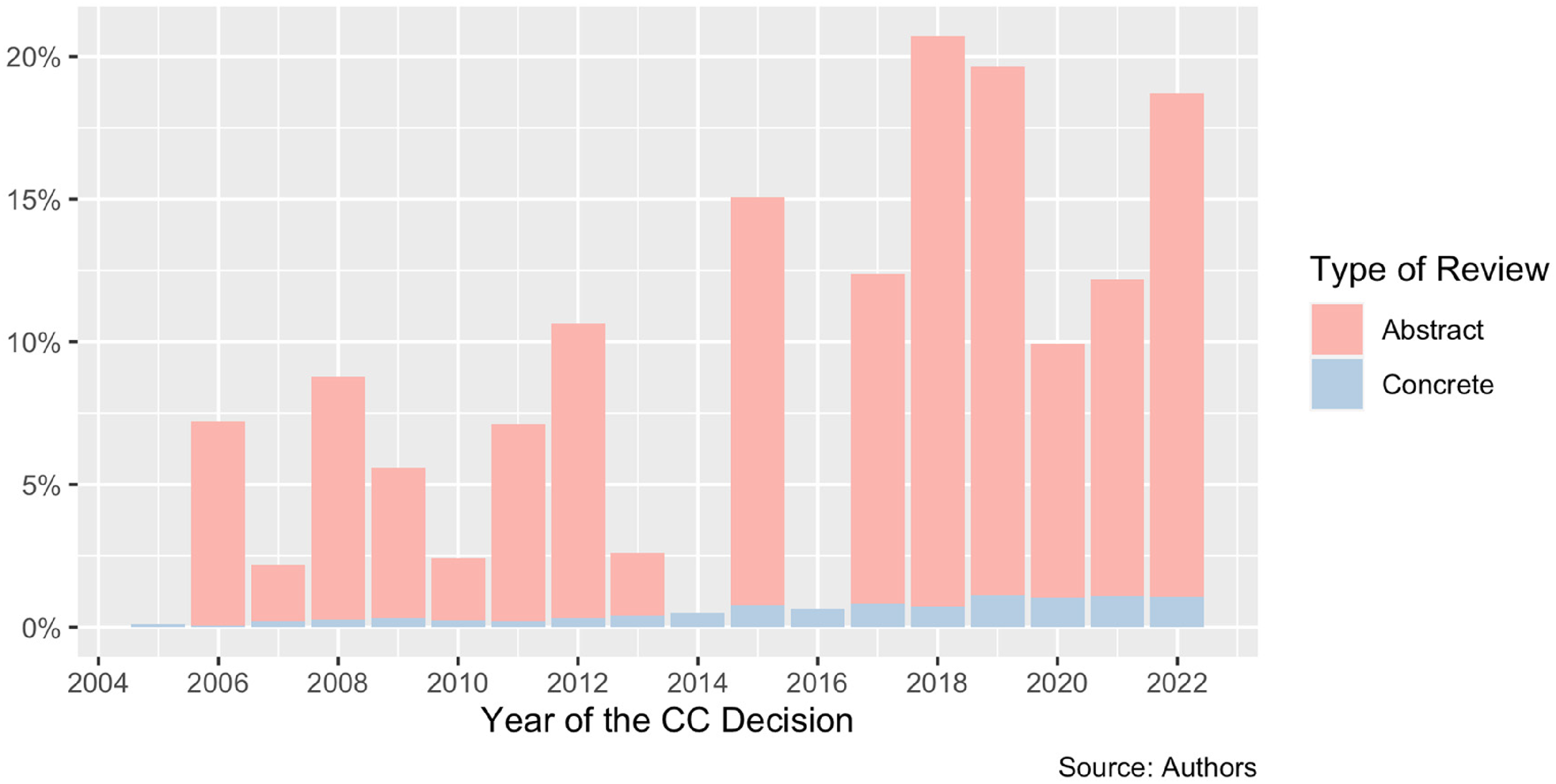
Frequency of referring cases relative to the yearly caseload of the CC per type of review.
The data shows that the disproportion is once more significant. For instance, in 2018, the CCC referred to the ECJ in more than 20% of all abstract review cases, whereas in about 0.7% of the concrete review cases of that year. Accordingly, we may conclude that constitutional judges make more use of ECJ's case-law in cases where they review the constitutionality of legislative outputs. When matched with the previous results, this might suggest that ECJ's authority might affect national legislative policies more substantively than usually imagined.
Our assumption that the CCC is more likely to use ECJ references in ‘granting’ cases is further supported by the fact that there is a statistically significant difference between the average number of citations in the cases where the CCC grants and rejects the applications, with the average number of ECJ citations being higher in the granting decisions (Table 2). 84 Such findings strengthen our intuition that the CCC turns to the ECJ more often where it rules against the domestic government, not otherwise.
Wilcoxon rank sum test with continuity correction: count by outcome.
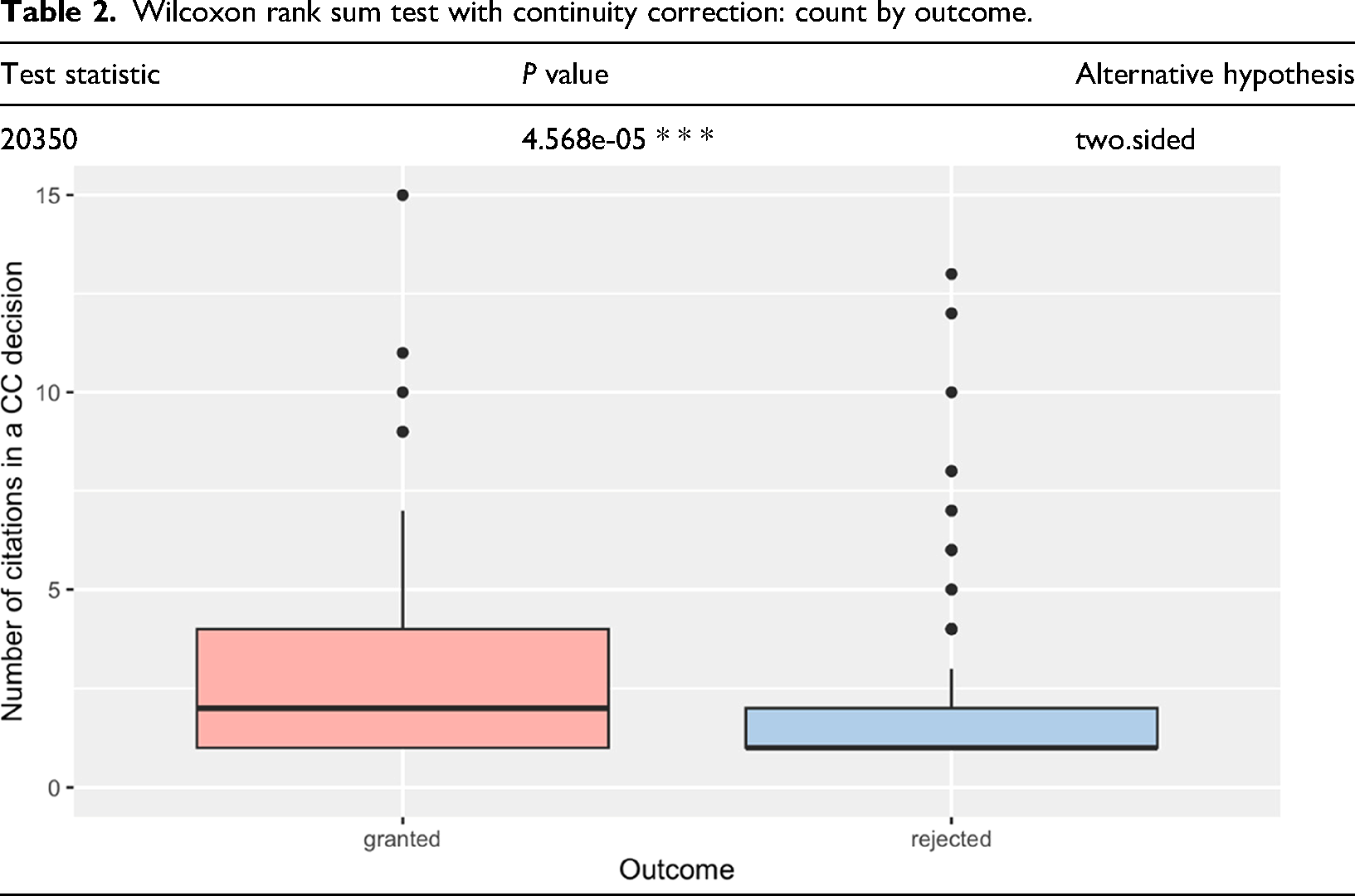
In this section, based on our analysis, we speculated about the effects of Europeanization of the Czech Constitutional Court. Our findings show that the CCC has referred to the ECJ's case-law disproportionately in cases where it granted the applications and in abstract proceedings. In other words, we found the CCC refers to the ECJ disproportionately more when it strikes down national law rather than in concrete proceedings or in cases that it rejects the applications. This allowed us to advance some theoretical assumptions about the purpose for which domestic courts use the ECJ's jurisprudence in their day-to-day adjudication.
Let us finally offer some of the descriptive statistics regarding the characteristics of the ECJ's precedents that Czech constitutional judges refer to. Exploring such features allows us to speculate about the factors which may influence the citation of particular kinds of cases by the CCC. We reiterate that we are not offering any conclusive evidence of such influence. We are only revealing some broad-brushstroke trends that may direct us towards inferential quantitative or qualitative research.
First, it seems useful to explore the type of proceedings from which the ECJ's precedents originate. As Figure 8 shows, the majority of the cited ECJ's precedents originate from the preliminary reference procedure. This is by no means surprising, as this type of proceeding also represents an overwhelming majority of ECJ's docket. Nevertheless, the data also reveal that the CCC does make use of judgements issued in other types of proceedings as well. This trend seems to confirm the ECJ's doctrine according to which domestic courts are bound by previous decisions irrespective of the nature of the proceedings as mentioned in the theoretical part. 85
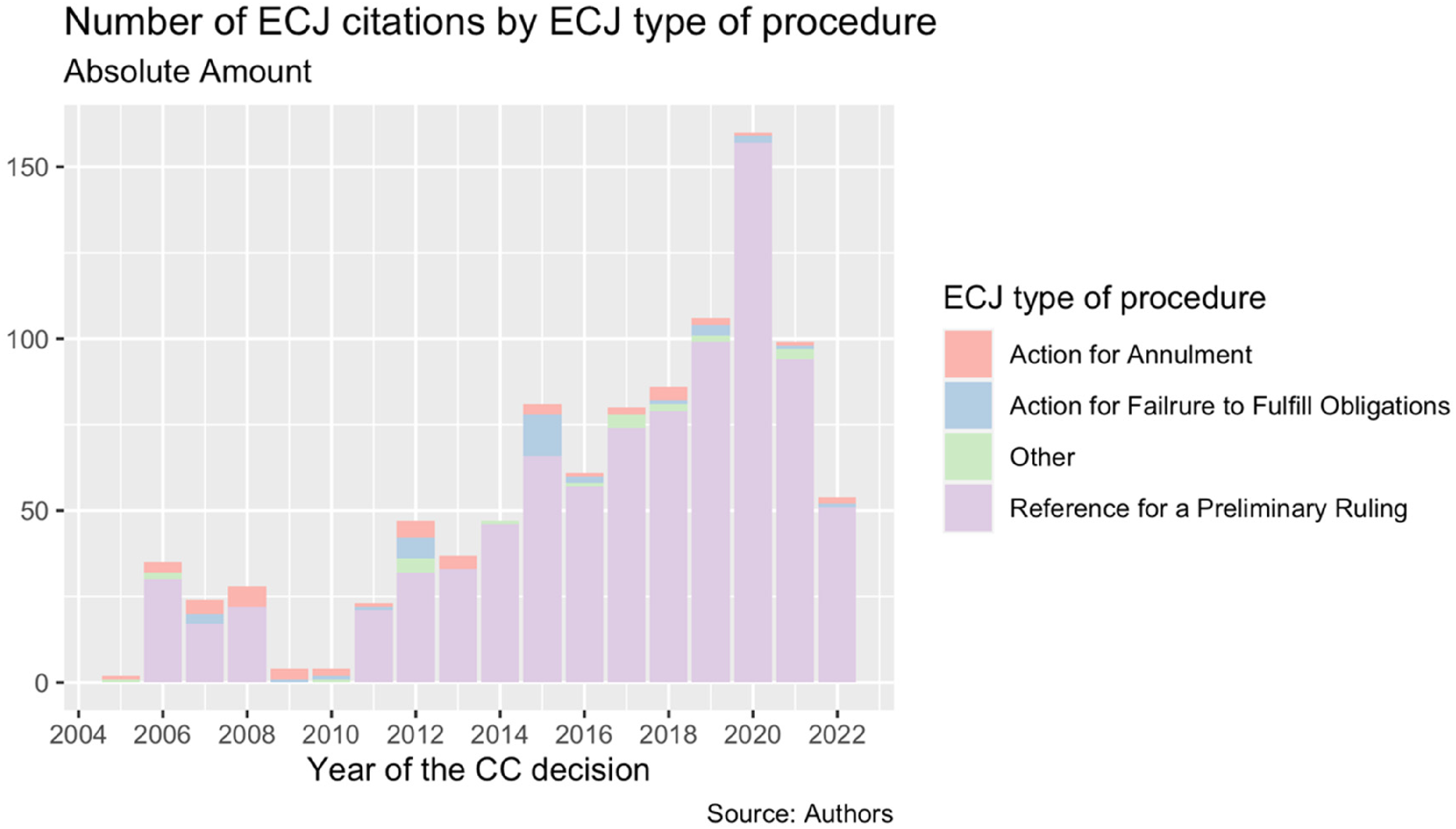
Number of ECJ citations by ECJ type of procedure.
At this point, we may also have a look at the prevailing composition in which the ECJ decided the cited cases. How could this information be relevant? Since 2004, the Grand Chamber of the ECJ has been expected to decide where the difficulty or importance of the cases or particular circumstances require so. 86 Some authors have further speculated that the Grand Chamber's existence might be legitimized not only by the need to decide cases of great importance, but also by the need to ensure unity and coherence of the case-law. It is particularly the later function which might, in turn, be of great concern for national judges who need to identify clear and coherent guidance in the ‘avalanches of technical cases’. 87 In other words, one might expect that constitutional judges interact with decisions of the Grand Chamber more often as they should represent clear and coherent signals of high legitimacy. A similar role might be played by the Plenary Assembly.
Data which can be seen in Figure 9 seem to suggest these theoretical assumptions. Indeed, citations of cases decided by the Grand Chamber and Plenary Assembly represent a fairly high portion of overall citations considering that the Grand Chamber decides merely around 11% of all cases. 88 Nevertheless, the exact influence of the Court's composition on the domestic court's citation practice is to be explored more thoroughly in future research.
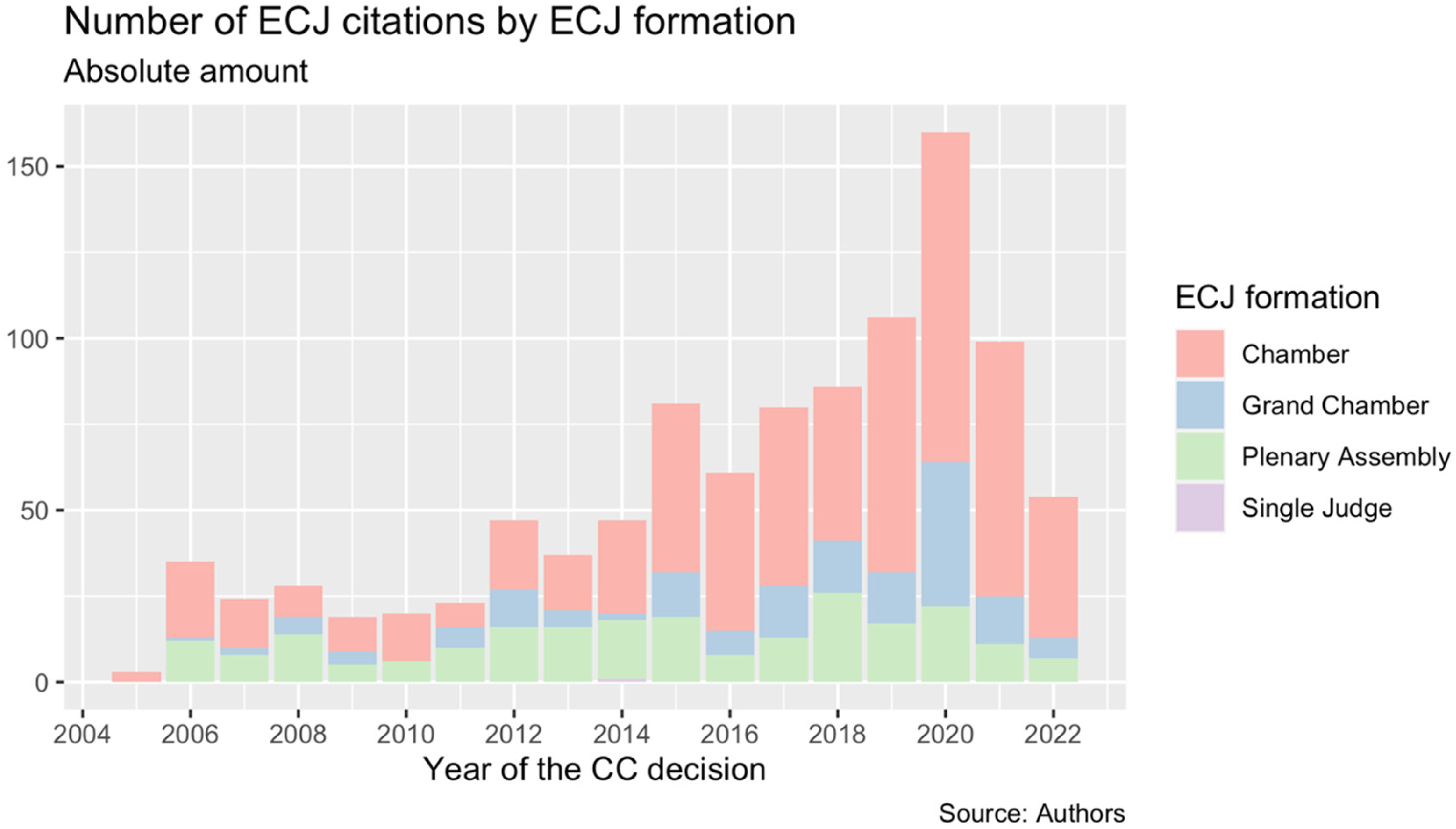
Number of ECJ citations by ECJ formation.
Now, additional data regarding judge rapporteurs and referring Member States reveal another potentially fruitful insight regarding the origin of the cited cases. Figure 10 shows that the ECJ's precedents originating from the preliminary procedure initiated by Czech courts are the sixth most cited precedents overall. Considering that Czech courts have so far submitted only around 100 preliminary references, 89 it seems that Czech constitutional judges might pay more attention to and subsequently use the doctrines which the ECJ stipulated vis-à-vis the Czech context.

Top 15 cited ECJ referring member states.
On the same note, it is striking – as Figure 11 shows – that Jiří Malenovský, who served as a Czech judge in Luxembourg, is the second most cited judge rapporteur overall. Taking into account that Judge Malenovský used to sit on the bench of the Czech Constitutional Court before he moved up to Luxembourg, one might wonder whether the precedents of the former colleague of constitutional judges enjoy special treatment for a particular reason. 90

Top 15 cited ECJ judge rapporteurs.
To conclude this section, the examination of some of the characteristics of the ECJ's precedents allowed us to explore the origins of the process of the Czech Constitutional Court's Europeanization. This provided us with some preliminary evidence about the most influential factors which might affect the probability of citations in day-to-day constitutional adjudication.
Constitutional courts of the Member States have always occupied rather specific role within the complex dynamics of European integration. Especially the instances of the famous Czech, German and Polish constitutional wars revealed the importance of national constitutional courts’ role in various forms of pushback and backlash against the authority of the European Court of Justice and the EU in general.
In this article, we argued rather that researching high-profile cases can hardly reveal a realistic picture of the constitutional courts’ role in the European Union. As a result, we suggested that using formal citations of ECJ's precedents in the constitutional courts’ decisions as indicators of how national constitutional courts make use of EU law in their run-of-the-mill constitutional adjudication might rectify our still-limited knowledge regarding the level of their Europeanization. Accordingly, we introduced a contemporary technique to search for the formal references to the Luxembourg's jurisprudence in the constitutional courts’ case-law by means of automatic text analysis.
In our case study, which aimed to illustrate the usefulness of the introduced approach, we presented several insights in the day-to-day ‘European adjudication’ of the Czech Constitutional Court. Drawing on the analysis of more that 70 000 decisions issued between the years 2004 and 2022, we revealed some parts of the as-yet untold story about that Constitutional Court's contribution to the development of the EU law.
First, as to the scope of Europeanization, we showed that although the Czech Constitutional Court as a whole refers to the ECJ's case-law on a more frequent basis than it used to, the approaches of individual constitutional judges differ significantly. With regard to the areas of Europeanization, we presented a perhaps surprising finding that in the context of Czech constitutional review, the ECJ's doctrines are mostly used in cases dealing with tax law, VAT frauds in particular. Nevertheless, we also revealed the hidden but strong influence of the ECJ's jurisprudence in the area of consumer protection as well as the previously unobserved potential role of the Czech Constitutional Court as a ‘watchdog’ which guarantees that ordinary courts fulfil their obligation to supply preliminary references to the ECJ. Thirdly, as to the effects of Europeanization, the data suggest that the CCC uses the ECJ's precedents as a means to strike down acts of other domestic political actors in abstract types of proceedings rather than to cover up their non-compliance. These findings bring preliminary evidence of the fact that the ECJ's authority may have a more substantive impact on national legislative policies than previously depicted. Finally, with regard to the origins of the Europeanization, the analysis offered some intuitions about the most influential factors that may affect the probability of ECJ precedents citations in day-to-day constitutional adjudication (these include the composition of the ECJ).
In conclusion, this article aimed to shed light on the complex and often misconstrued role of national constitutional courts in the European integration process. We hope to have illustrated the potential for a more nuanced understanding of the process of Europeanization of national constitutional law. However, our case study focused solely on the Czech Constitutional Court, leaving many questions regarding the use and influence of ECJ jurisprudence in other Member States’ constitutional courts unanswered.
Future research should expand the scope of analysis to other national constitutional courts, with a view to identifying common patterns or divergences in their approaches to European law. Although our methodological approach will certainly need to be adjusted in order to reflect specific features of individual constitutional courts (citation practices, role of judges rapporteurs, type of constitutional review), we believe that this can be done without any major difficulties. As a result, we hope to have provided a productive and replicable path to research the level of CCs’ Europeanization quantitatively by use of computational means.
Further investigation is also needed to explore the underlying factors that influence the citation of ECJ precedents in national constitutional courts’ decisions, such as the delicate political context and the individual judges’ legal and political philosophies. To understand the strategic behaviour of CCs in EU law adjudication in more detail, a comprehensive research would finally require exploring the cases where EU law and the ECJ case-law should have been cited, but no reference to the ECJ precedent occurred nevertheless.
By continuing to deepen our understanding of the interaction between national constitutional courts and the EU legal system, we can better assess the functioning of the complex web of heterarchical relations within the judicial system of the European Union.
Footnotes
Declaration of conflicting interests
The authors declared the following potential conflicts of interest with respect to the research, authorship and/or publication of this article: Marek Pivoda works as a law clerk at the Czech Constitutional Court; Standard disclaimer applies.
Funding
The authors disclosed receipt of the following financial support for the research, authorship, and/or publication of this article: This work was supported by the ERDF project ‘Internal Grant Agency of Masaryk University’ (grant number No. CZ.02.2.69/0.0/0.0/19_073/0016943).

Notes
Correction (September 2024):
Table 2 in the article has been updated since its original publication.