




Abstract
The organic-inorganic hybrid salt Ethanolammonium oxalate, (C2H8NO)2[C2O4], was synthesized and characterized by complementary structural and spectroscopic techniques. Singal crystal X-ray diffraction (XRD) analysis confirmed the crystalline structure of the obtained compound. Infrared spectroscopy revealed the characteristic vibrational modes associated with the ethanolammonium cations and oxalate anions, highlighting the presence of strong hydrogen-bonding interactions within the crystal network. UV–visible spectroscopy was employed to investigate the optical behavior of the material and provided information on its electronic transitions. In addition, Hirshfeld surface analysis was carried out to gain deeper insight into the intermolecular interactions governing the crystal packing. The results revealed that O···H—O/N—H···O hydrogen bonds constitute the dominant intermolecular contacts stabilizing the structure (62.8%), while weaker H···H and C···H interactions also contribute to the supramolecular organization at 28.8%. The combined experimental and theoretical analyses demonstrate the structural stability and rich hydrogen-bonding architecture of this oxalate-based hybrid material, making it a promising candidate for further investigations in crystal engineering and functional molecular materials.
Introduction
Supramolecular chemistry is devoted to the study of non-covalent interactions governing the organization of molecules into ordered architectures and functional crystalline materials.1,2 Among these interactions, hydrogen bonding plays a central rôle in crystal engineering owing to its strength, directionality, and predictability, allowing the rational design of supramolecular assemblies and molecular solids. 3
In this context, ammonium–carboxylate systems derived from the association of organic amines with dicarboxylic acids have attracted considerable attention. These compounds generally form robust hydrogen-bonded networks through electrostatic interactions between protonated ammonium groups and carboxylate anions, leading to stable crystalline frameworks without the involvement of metal ions.4–6
Such metal-free organic salts constitute an important class of supramolecular materials because of their structural diversity and their potential applications in crystal engineering and materials science.
Among the various dicarboxylic acids, oxalic acid is particularly interesting due to its strong acidity and its remarkable ability to generate directional hydrogen-bonding motifs. The oxalate anion C2O42− readily participates in proton-transfer processes and supramolecular recognition phenomena, favoring the formation of extended crystalline networks with different topologies and dimensionalities.7,8
Consequently, oxalate-based organic salts have been extensively investigated as model systems for understanding intermolecular interactions in hydrogen-bonded frameworks.
Organic amines, especially aliphatic amines such as ethanolamine, are excellent proton acceptors and easily undergo protonation in acidic media to yield ammonium cations. Owing to the simultaneous presence of ammonium and hydroxyl functional groups, protonated ethanolamine can act as an efficient hydrogen-bond donor and acceptor, thus promoting the formation of complex supramolecular assemblies. Several oxalate salts involving aliphatic ammonium cations, such as ethylammonium oxalate 9 and dimethylammonium oxalate salts, 10
have been reported in the literature, revealing a rich diversity of hydrogen-bonded architectures stabilized mainly by N–H···O and O–H···O interactions.11,12
Despite the growing interest in organic oxalate salts, structural investigations involving ethanolammonium-based oxalate systems remain relatively limited. In this work, we report the synthesis and characterization of the organic salt (C2H8NO)2[C2O4] obtained from the reaction between oxalic acid and ethanolamine in aqueous medium. The compound was investigated using powder X-ray diffraction (PXRD), infrared spectroscopy (FTIR), UV–visible spectroscopy, and Hirshfeld surface analysis in order to elucidate its structural features and intermolecular interactions. Particular attention was devoted to the role of hydrogen bonding in the stabilization of the supramolecular framework.
Experimental section
Materials
Oxalic acid (99%) and ethanolamine (99%) were purchased from Sigma-Aldrich and used without further purification. Distilled water was used as solvent.
Synthesis of (C2H8NO)2[C2O4]
The compound was prepared by mixing oxalic acid (0.378 g, 3 mmol) and ethanolamine (0.366 g, 6 mmol) in 40 mL of distilled water. After several days, colorless single crystals were obtained.
X-raycristallography
A single-crystal X-ray diffraction data, for booth compounds, were measured on a Rigaku Oxford Diffraction Supernova diffractometer at the MoKα radiation. Data collection reduction and multi-scan ABSPACK correction were performed with CrysAlisPro (Rigaku Oxford Diffraction). For the compound, the crystal structures including the anisotropic displacement parameters were refined with SHELXL-2013. PLATON was used to check additional symmetry elements and Crystallographic Information Files were compiled with Olex2.12.
Spectroscopy
The UV-Visible absorption measurements of the compound were carried out using a ThermoScientific GENESYS 10S UV-Vis spectrophotometer at room temperature in an acidic aqueous solution (H2SO4). Fifteen milligrams of the compound were dissolved in 10 mL of 2 M sulfuric acid. A scan was performed over the 200–1100 nm range, using sulfuric acid as the blank.
Infrared (IR) spectroscopy measurements were also conducted for the compound. The IR spectrum was recorded using the ATR (Attenuated Total Reflectance) technique in the 4000–400 cm−1 range
Results and discussion
UV-vis and IR spectroscopy
The infrared spectrum of (C2H8NO)2[C2O4] exhibits several characteristic absorption bands (Figure 1). The asymmetric and symmetric stretching vibrations ν(O–C–O) of the oxalate anion are observed at 1594 and 1410 cm−1, respectively, while the bending vibrations δ(O–C–O) appear at 857, 785, and 746 cm−1. The bands located at 1067 and 1018 cm⁻1 correspond to the ν(C–C) stretching vibrations. The ν(O–H) and ν(N–H) stretching vibrations are observed at 3394 and 3146 cm−1, respectively. Furthermore, the bands at 1594 and 1410 cm−1 may also be associated with the δ(N–H) bending vibrations. Finally, the bands at 2960 and 2867 cm−1 are attributed to the asymmetric and symmetric ν(C–H) stretching vibrations.4,8

IR spectra of compound.
The UV-visible spectrum of the compound, shown in Figure 2, was recorded in solution after dissolving 0.015 g of the sample in 0.1 N sulfuric acid (H2SO4). The spectrum exhibits a single absorption band centered at approximately 294 nm. This band is assigned to an

UV-visible spectra of the compound.
These observations suggest the formation of oxalate and organic groups.
Structures description
The crystallographic data were obtained by single-crystal X-ray diffraction. The compound crystallizes in the monoclinic system with the space group I2/a. The asymmetric unit of the compound is shown in Figure 3. It consists of one [C2O4]2− anion and two ethanolammonium groups (C2H8NO)+, which ensure charge neutrality. These data confirm the formation of an oxalate species, as suggested by the spectroscopic analyses. The crystallographic data are summarized in Table 1.

Asymmetric unit of (C2H8NO)2[C2O4].
Crystallographic data of the compound.

The compound (C2H8NO)2[C2O4] is distinguished by the presence of the oxalate anion C2O42−, which exhibits an inversion center. This confers upon the compound two crystallographically identical carbon atoms, linked to each other by a covalent bond with a length of C5–C5i = 1.5612(12) Å. Each carbon atom is bonded to two oxygen atoms, with bond lengths of C5–O1 = 1.2516(7) Å and C5–O2 = 1.2520(7) Å, forming an angle O1–C5–O2 = 126.38(6)°. These values are comparable to those reported in the literature.
In the literature, several oxalate-based compounds have been obtained in various forms, including:
Among the oxalated compounds described in the literature, organic salts based on protonated cations are of particular interest due to the structuring role of hydrogen interactions in crystalline organization. In this context, the compound (C2H8NO)2[C2O4] stands out due to the presence of the ethanolammonium cation, which imparts an original supramolecular architecture to the structure. The particularity of this compound is the presence of the ethanolammonium cation C2H8NO +. The latter exhibits dual chemical functionality: an ammonium group and a hydroxyl function. This configuration promotes the formation of an extended network of hydrogen bonds with the oxalate anions, thereby contributing to the cohesion and stability of the crystalline edifice. The ethanolammonium cation adopts a gauche (synclinal) conformation, as indicated by the torsion angle N4–C6–C7–O3 = 65.54(8)°. This conformation favors an appropriate orientation of the ammonium and hydroxyl groups, enabling strong hydrogen bonds with the oxygen atoms of the oxalate anion (Figure 4).

Hirshfeld surface of compound.
The analysis of Hirshfeld surfaces (HSs) is an effective approach for exploring and visualizing intermolecular interactions within a crystal structure. 20 The supramolecular interactions surrounding the oxalate anion were investigated using Hirshfeld surfaces and two-dimensional fingerprint plots (FPs), generated from the CIF file using CrystalExplorer. 21
Three-dimensional Hirshfeld surfaces provide valuable information on both short- and long-range interactions within the crystal. The corresponding two-dimensional fingerprint plots derived from these surfaces allow the identification of the nature of intermolecular contacts as well as their relative contribution to the crystal packing. For each point on the isosurface, two geometric parameters are defined: de and di, corresponding respectively to the distances from the surface point to the nearest external and internal nuclei. From these distances, the dnorm parameter is calculated, representing the normalized contact distance. 22
In Figure 5, the dnorm surface highlights the various intermolecular interactions present in the crystal structure. Deep red regions correspond to close contacts, whereas blue areas indicate the absence of significant interactions. 23 The numerous red spots observed on the surface of the compound reflect the presence of a dense network of non-covalent interactions involving the oxalate anion.
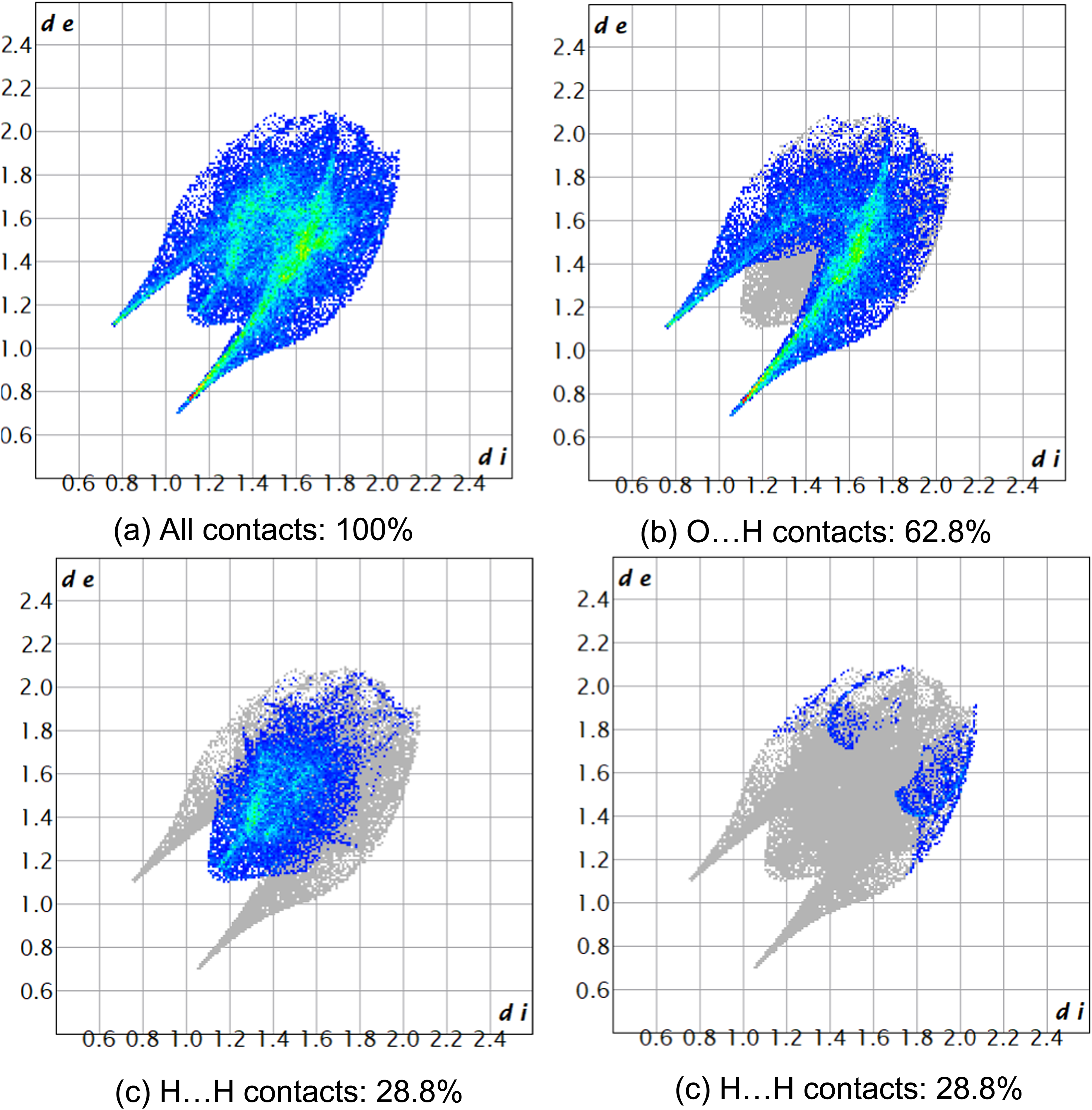
2D fingerprint plots of compound.
The quantitative analysis shown in Figure 5 reveals that O···H contacts constitute the major contribution to the Hirshfeld surface, accounting for 62.8%, confirming their dominant role in stabilizing and organizing the crystal packing. In contrast, H···H and C···H interactions, representing 28.8% and 3.7% of the total surface respectively, appear as secondary contributions with a less significant role in the supramolecular architecture of the crystal (Table 2).
Hydrogen-bond geometry (å, °).
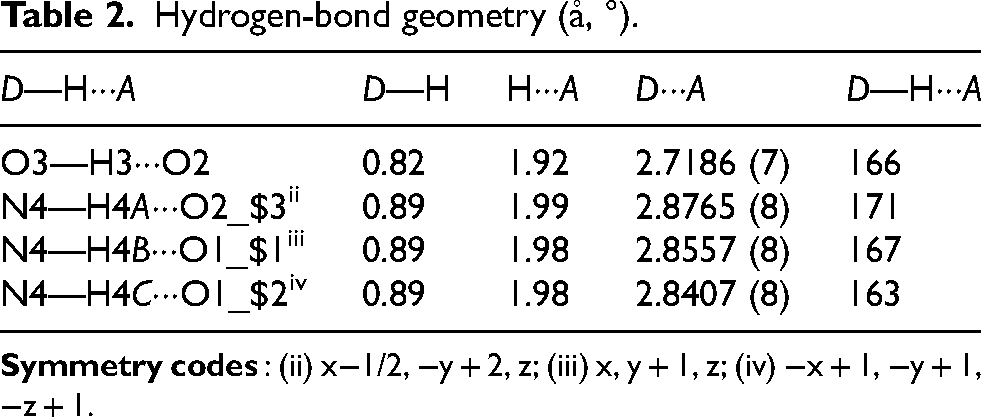
The [C2O4]2− anion is stabilized by two ethanolammonium groups. These ions ensure the connection between the oxalate units, leading to the formation of infinite one-dimensional chains extending along the

Two-dimensional representation of (C2H8NO)2[C2O4].
Conclusion
In summary, a new oxalate salt material (C2H8NO)2[C2O4] with ethanolammonium cation, was successfully synthesized and characterized through single-crystal X-ray diffraction and complementary analytical techniques. X-ray diffraction confirmed the crystalline nature and structural of the synthesized material, while FTIR spectroscopy identified the characteristic vibrational bands associated with the ethanolammonium cations and oxalate anions. UV–visible analysis provided information on the optical behavior and electronic transitions of the compound.
The Hirshfeld surface investigation revealed that the crystal packing is predominantly stabilized by strong O···H—O/N—H···O hydrogen-bond interactions, which play a crucial role in the formation of the supramolecular network. Additional weak intermolecular contacts also contribute to the overall structural cohesion of the crystal.
The combined structural, spectroscopic, and intermolecular interaction analyses demonstrate the importance of hydrogen bonding in directing the organization of this oxalate-based hybrid system. These findings contribute to a better understanding of the structural chemistry of organic oxalate salts and may encourage further studies on related hybrid materials for potential applications in supramolecular chemistry and functional materials science.
Footnotes
Acknowledgements
The authors gratefully acknowledge Cheikh Anta Diop University, Iba Der Thiam University and Institute of Inorganic Chemistry I Ulm University and Helmholtz Institute Ulm (HIU), Electrochemical Energy Storage Albert-Einstein-Allee 11 89081 Ulm, Germany for the support analysis.

Funding
The authors received no financial support for the research, authorship, and/or publication of this article.
Declaration of conflicting interests
The authors declared no potential conflicts of interest with respect to the research, authorship, and/or publication of this article.