



Abstract
Introduction
The abstract nature of chemical bonding, however, makes it difficult for students to visualize the motion and interactions of minuscule particles like atoms and electrons at the subatomic level. Therefore, this study explored how Grade 9 students in government secondary schools (SS) in Yeka Sub-City, Addis Ababa, understood chemical bonding concepts in relation to video-based learning (VBL).
Methods
The study used a pretest-post-test non-equivalent quasi-experimental design. A total of 140 students took part; 71 students from Tesfa Birhan SS made up the comparison group (CG), and 69 students from Karalo SS were allocated to the intervention group (IG). A pilot-tested chemical bonding comprehension test. SPSS version 23 was used to analyze quantitative data. Independent samples t-tests were used to compare mean scores between groups and genders at a significance level of 0.05 and a 95% confidence interval.
Result
The finding shows that after intervention, the independent samples t-test found that there is statistically significant difference in overall mean scores of chemical bonding between the IG and the CG among SS students (NIG = 69, MIG = 15.77, SDIG = 2.30; NCG = 71 MCG = 9.50, SDCG = 2.54; t (138) = 15.31, p < 0.001). The results revealed statistically significant differences in overall chemical bonding understanding between IG (M = 15.77, SD = 2.30) and CG (M = 9.50, SD = 2.54), t (138) = 15.31, p < 0.001). These evidences indicated notable improvements in students’ comprehension of covalent, ionic bonds, and metallic bonds, favouring IG.
Conclusion
The study concludes that by visualizing notions of chemical bonding through videos, especially those with animations and simulations-students can develop a stronger understanding of these concepts. The schools should host VBL training sessions that cover the concepts, methods, and classroom management approaches necessary for secondary students to successfully implement them.
Keywords
Introduction
Chemistry is a key branch of science that offers fundamental ideas for comprehending intricate chemical reactions that are employed in industries to create a wide range of goods for both technical advancement and human gain. 1 Making associations to other subjects like thermodynamics and drawing conclusions about the linkages between structure and function depend on an understanding of chemical bonding. Chemical bonding and electrostatic interactions have been recognized as “disciplinary core ideas” or “anchoring concepts” in the area of chemistry by a number of separate curriculum reform projects.2–4
Notwithstanding of fact that the abstract nature of chemical bonding, however, makes it difficult for students to visualize the motion and interactions of minuscule particles like atoms and electrons at the subatomic level. 5 Identifying which type of bond—ionic, covalent, or metallic—between atoms in a molecule is the main goal of chemical bonding principles that are frequently taught in secondary school chemistry classes. 6 To explain the ensuing features of compounds, students frequently use tools like Lewis's dot structures and concepts like polarity and molecular geometry. 7 Secondary students find it challenging to comprehend chemical bonding due to its abstract character, the difficulty of drawing links between macroscopic, symbolic, and sub-microscopic levels, and the prevalence of misconceptions of ionic bonds are a form of electron sharing. 5
One of the main ideas covered in Ethiopian high school students’ Chemistry curriculum for Grade 9 is chemical bonding. 6 Chemical bonding is closely related to other chemical concepts, including molecular structures and bond-forming or bond-breaking chemical reactions. However, because chemical bonding focuses on the invisible sharing and transfer of electrons, it is an abstract concept that gives rise to widespread fallacies, such as the idea that covalent bonds include electron transfer or ionic bonds are produced by electron sharing. 8 Such misunderstandings in understanding can hinder the learning of other related concepts. Therefore, it is crucial to identify these misconceptions and address them effectively to find appropriate solutions. 9
In the twenty-first century, education is essential to preparing students for responsible engagement in a society that is becoming more and more digital. 10 This means that digital technologies must be seamlessly incorporated into classrooms. Globally, the COVID-19 epidemic severely disrupted educational systems, forcing teachers to reconsider conventional teaching strategies and adopt digital platforms in order to maintain learning. These modifications hastened the digital transition of numerous classrooms worldwide. 11 One of the finest answers during emergency situations like the COVID-19 pandemic was to use digital platforms and resources, such as VBL, to improve learning outcomes. These tools and platforms should still be used today. 6 In chemistry, learning videos help students visualize abstract phenomena such as molecular interactions, reaction mechanisms, and laboratory procedures, enhancing understanding. 12 Though video-based instructional approaches have been widely implemented in various educational contexts, 13 their integration into secondary school chemistry—particularly within the Ethiopian context and in Addis Ababa—remains insufficiently explored. The study conducted in a developing country shows that secondary school chemistry is difficult and confusing for students since it requires them to visualize the interplay of atoms, molecules, ions, and indistinct and intangible particles. 14
Chemical bonding in chemistry involves abstract concepts that are not always directly observable. Secondary school students often struggle with the concept of chemical bonding due to difficulties in visualizing the electron transfer and sharing process, particularly when distinguishing between ionic, covalent, and metallic bonds. 11 Students often confuse the electronegativity differences and incorrectly apply Lewis dot structures, leading to misconceptions about molecular shapes and the stability of compounds. 5 Students must therefore explain the properties of matter, understand scientific ideas at the level of the particle of matter, and describe the many chemical changes that occur in a wide range of chemical occurrences. 15 For students to succeed in chemistry classes, they must comprehend microscopic descriptions of how compounds are made and what purposes they serve. These tiny worlds are difficult for students to comprehend since they are usually unrelated to their everyday experiences. 16 Much research conducted over the past few decades has highlighted ongoing challenges in understanding sub-microscopic and symbolic forms to assist students in gaining a conceptual knowledge of chemical representations. 17
These challenges stem from the nonconcrete nature of such representations, which cannot be directly experienced, while students’ thinking is predominantly shaped by sensory information and tangible experiences. 18 In addition, students sometimes cannot translate one representation given to another because of their limited conceptual knowledge and poor visual-spatial skills. 19 Many high school teachers tend to shift between the three levels of chemical representation without explicitly emphasizing their interconnections. This fragmented approach, frequently observed in developing countries, 20 often exacerbates students’ difficulties in constructing a coherent understanding of chemical concepts. Hwang and Chang 21 Emphasize that students’ academic performance is greatly improved when technology is incorporated into natural science education, especially chemistry training. The tiny ideas that are essential to chemistry can be better understood and visualized by students thanks to resources like video demonstrations.
Similarly, Ghavifekr 22 Underline that enhancing educational quality, particularly in science education, requires both the use of instructional technology and the careful planning and execution of technology-based teaching, such as video-based training. To the best of the researchers’ knowledge, however, there aren't many studies in Ethiopia that look at how technology affects students’ conceptual comprehension. This study seeks to examine the effectiveness of video-based learning (VBL) in enhancing Grade 9 students’ conceptual understanding of chemical bonding in secondary schools located in Yeka Sub-city, Addis Ababa, thereby addressing a critical gap in localized research on this pedagogical strategy.
Methods
Study procedures
Research methods encompass the specific techniques or procedures utilized to collect and analyze data, providing the framework for gathering evidence to address research questions (Creswell, 2014). This study was employed using quantitative approach to collect data and analysis to achieve a comprehensive understanding of chemical bonding (Creswell & Plano Clark, 2011). When a single approach is insufficient to answer complicated research topics or when it is intended to triangulate findings from many perspectives, mixed methods research is especially beneficial (Creswell & Plano Clark, 2011).
Research design
The general approach or framework used to logically and cogently combine the many elements of a study, guaranteeing that the research questions are successfully addressed, is referred to as research design. According to Creswell (2014), it includes the techniques and protocols for gathering, evaluating, and interpreting data. It ensures that the study was methodical and rigorous by offering a defined plan for the research process. A pretest–pretest-post-test non-equivalent Groups Quasi-Experimental Design was used in this investigation, which is presented in Figure 1.
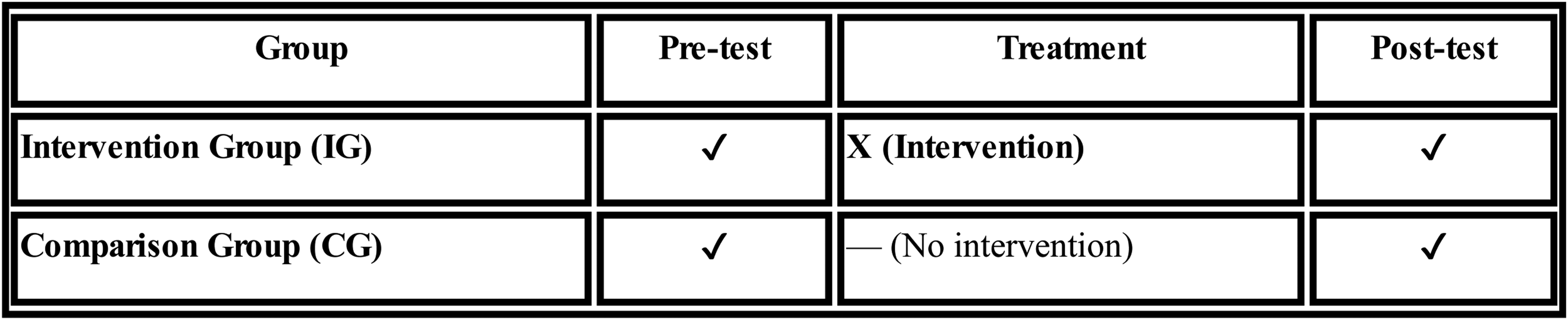
Pretest–Post-test Non-Equivalent Groups Quasi-Experimental Design.
This design is commonly used to assess the impact of an intervention or treatment when random assignment of participants to groups is impractical or ethically constrained. 23 Its relative simplicity in comparison to actual experimental designs is one of its main advantages, which makes it a sensible option in educational contexts without randomization. 24 Because it eliminates the need to randomly gather kids for any intervention during school hours in order to maintain the smooth operation of school programs, it permits the use of intact groups in actual classroom settings (the complete class was assigned to the specified intervention). Two or more groups are used in this design: the intervention group, which receives the intervention, and the comparison group, which does not. Two groups are used in this study: the Intervention group, which uses video-based learning, and the Comparison group, which does not. Pre-tests and post-tests given to students both before and after the use of video-based learning resources were used in this study to collect data. Students’ prior knowledge of chemical bonding was examined in the pre-test, and their comprehension following the intervention was measured in the post-test. According to Campbell and Stanley. 23 The design is referred to as “non-equivalent” because the groups are not randomly assigned, which may lead to baseline differences between groups.
Study population, sample, and sampling method
The research population comprised all 9th-grade students enrolled in Yeka sub-city secondary schools within Addis Ababa. The target population for this study consists of 9th-grade students from two purposively selected schools: Karalo Secondary School and Tesfa Birhan Secondary School, with a combined enrollment of 1273 students across all sections. 25 Purposive sampling was employed to select these schools based on specific criteria, such as their representativeness of the sub-city's educational context or logistical feasibility. 26 From these schools, two intact 9th-grade sections were randomly selected to form the study sample. One section from Karalo Secondary school was designated as the intervention group (69 students) from one section and the other from Tesfa Birhan Secondary school was the comparison group (71 students) from one section. Random selection of sections ensures a degree of impartiality in group assignment, despite the non-random selection of school. 27
Variables of the study
Independent variables
This study examines two independent variables: the mode of instruction and gender. The primary independent variable, mode of instruction, refers to the teaching approach used to deliver content (chemical bonding concepts). Specifically, video-based learning was employed, utilizing digital videos as the main instructional tool. These videos incorporate animations, teacher explanations, visual demonstrations, and interactive elements aligned with the chemistry curriculum. One group (intervention group) received video-based instruction, while the other group (comparison group) received conventional instruction (i.e., traditional teaching methods). The other independent variable was gender, categorized as male and female. The intervention and comparison groups’ data were analyzed to assess differences in outcomes (conceptual understanding) in terms of gender.
Dependent variables
The dependent variable in this study is students’ understanding of chemical bonding concepts. This variable was assessed using quantitative measures. Pre-tests and post-tests, comprising objective questions (multiple-choice), were employed to evaluate students’ conceptual understanding of chemical bonding.
Treatment
Instruction in intervention group
The intervention group has received instruction through video-based learning methods, which incorporate multimedia elements such as animations, narrated explanations, real-life analogies, and visual simulations of chemical bonding concepts, such as ionic, covalent, and metallic bonding, electron sharing, and molecular structures. Each lesson started with a short introductory video to activate prior knowledge and spark interest. This was followed by concept-specific videos that use visual and audio cues to explain bonding theories and models. The videos included pause-and-discuss moments, allowing students to reflect and answer guided questions. At the end of each session, based on the video content, students were engaged in interactive tasks such as group discussions. These activities are aimed at reinforcing learning, clarifying misconceptions, and promoting deeper understanding through visualization. The teacher's role in the intervention group included facilitating, guiding discussions, addressing questions, and ensuring that students remain engaged with the material.
Conventional instruction in comparison group
The comparison group received teaching using a traditional method that included note-taking, textbook reading, and chalk-and-talk. The teacher was explaining chemical bonding concepts verbally with the aid of diagrams on the blackboard. The explanation followed a linear format, where the teacher introduced definitions, theories, and examples sequentially. Students were engaged in typical classroom activities such as listening to lectures, copying notes, answering oral questions, and completing practice problems from textbooks. The emphasis was on theoretical explanation without the use of multimedia tools or visual animations. Discussion was primarily teacher-led, with occasional question-and-answer sessions to assess understanding. This conventional approach reflected the usual teaching method currently used in many classrooms. The teacher was ensuring content coverage instead of student understanding.
Data collection tools
The primary instrument for data collection was the chemical bonding understanding test, designed to measure students’ comprehension of chemical bonding concepts. This test was administered as both a pre-test and a post-test to evaluate changes in understanding before and after the intervention. The test consists of multiple-choice questions structured in two tiers: a concept tier and a subsequent reasoning tier. This design aims to assess both surface-level conceptual understanding and deeper analytical reasoning. The combination of question types ensures a comprehensive assessment of students’ mastery of chemical bonding concepts, aligned with the study's objectives.
Reliability and validity
A methodical strategy was used to guarantee the authenticity and dependability of data collection tools. To improve the instruments’ quality, the procedure includes statistical analysis, pilot testing, and expert assessment. Thesis advisors and two secondary school chemistry instructors evaluated the Chemical Bonding Understanding Test (CBUT) and interview procedures to make sure the material was pertinent, understandable, and in line with the goals of the study. The CBUT was evaluated for face validity (making sure the exam seems appropriate to the target audience) and content validity (making sure the test fully covers the construct of chemical bonding comprehension) by two seasoned chemistry professors and thesis advisers. 28 These experts’ feedback guided revisions to improve item clarity and relevance. A pilot study was conducted with a small group of students (excluded from the main study) to evaluate the instruments’ consistency, comprehensibility, and usability. 26 Feedback from participants informed revisions to address ambiguities or difficulties in the CBUT items and interview protocols. The pilot test allowed for an initial assessment of the instruments’ psychometric properties. The reliability of the CBUT was assessed using the Kuder-Richardson Formula 20 (KR-20), adapted from previous study. 28 A reliability coefficient greater than 0.7 was targeted, as this is widely accepted as indicating acceptable internal consistency for educational assessments. 29 The KR-20 was calculated based on pilot test data to ensure the CBUT's reliability before its use in pre- and post-tests. The calculated reliability coefficient is 073. This exceeds the threshold commonly recommended in the literature, indicating a satisfactory level of internal consistency for the instrument.
Following accepted practices in educational measuring, a pilot test result was examined to assess the difficulty level (P) and discrimination power (D) of each multiple-choice item in the CBUT. 30 Based on feedback, pilot test results, and items remodified and recorrected, the quantitative protocol was refined to ensure they are valid, reliable, and appropriate for the target population (IG & CG as well for IG and CG). This iterative process aligns with best practices for instrument development in educational research. 31
Pilot study
Pilot studies were essential components of robust study design, serving multiple important functions and offering valuable insights for researchers. In this study, grade 9 students participated in the pilot phase, which was conducted at Dejazmach Wondirad Secondary School—a site purposefully selected outside the cohort of schools included in the main study. Twenty (20) students were involved in quantitative tool piloting. The pilot study fulfilled important objectives, notably evaluating the reliability of the instruments and facilitating the refinement of key research tools—specifically the Chemical Bonding Understanding Test (CBUT) and the accompanying interview protocol.
Procedures of data collection
In order to maintain openness, improve reliability, and guarantee the quality of the results, the data collection process adhered to a strictly defined methodology. During the planning stage, verified tools including comprehension tests and interview guides were created and put through a pilot study to verify their efficacy and dependability. During this stage, individuals’ informed permission and ethics approvals were also obtained. Students in Grade 9 participated in the study; schools were chosen using purposive sampling, and individual Grade 9 sections were then picked using a random selection process. Pre-tests to determine baseline knowledge, semi-structured interviews with chosen participants, and post-tests to gauge learning outcomes following the intervention were all part of the data gathering process. Triangulation techniques were used to guarantee consistency between the two data gathering tools, and a response was carefully cross-checked for accuracy and completeness. Standardized grading methods and careful documentation served to further bolster reliability.
Data analysis and interpretation
The quantitative data analysis methods were used to thoroughly assess the Video-Based Learning (VBL) approach's efficacy. SPSS version 23 was used to analyze the data. After a normalcy check, descriptive statistics like mean and standard deviation were used to summarize students’ comprehension in quantitative analysis. The data was subsequently examined using parametric tests and inferential statistics. The two mean scores of IG and CG, as well as male and female, were analyzed using the independent-t test. At the significance level of.05, the 95% confidence interval was considered.
Ethical considerations
Throughout its conception and execution, the study closely followed established institutional protocols and stringent ethical standards to maintain ethical integrity. Before the study started, ethical approval was received by Kotebe University of Education's Ethical Review Committee. In order to ensure conformity with institutional and international ethical norms, the application for ethical review contained a thorough explanation of the study's goals, methodology, participant recruitment, data collection techniques, and safeguards for participants’ rights and welfare. The Department of Chemistry at Kotebe University of Education sent formal letters to the participating secondary school or schools asking for cooperation. These letters outlined the study's purpose, scope, and expected involvement of the school, fostering transparency and securing administrative support. In alignment with ethical standards, oral assent was obtained from Grade 9 student participants prior to data collection.
An in-depth orientation session was conducted with the students, during which the study's objectives, methodological procedures, and anticipated benefits were thoroughly explained and discussed. The information was presented in clear, age-appropriate language to ensure comprehension. Students were informed of their right to voluntarily participate and withdraw at any time without consequences. The confidentiality of participants’ data was strictly maintained at all stages of the study. To safeguard participant anonymity, all personal identifiers (like names) were substituted with unique codes throughout data collection and analysis. All data, including test responses, interview recordings, and transcripts, were stored securely. Audio recordings were deleted following transcription, and anonymized data were retained solely for the duration required to complete analysis and reporting. Participants were explicitly informed that their responses would bear no consequences on their academic evaluations or professional rapport with teachers.
Results
Background characteristics
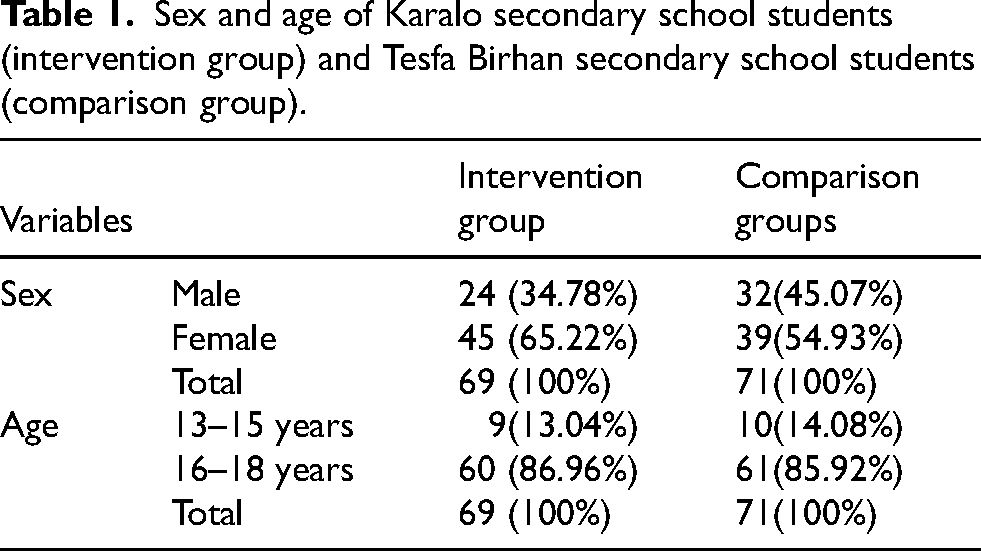
Table 1 shows that a total of 61 Grade 9 students from Karalo Secondary School participated as the Intervention Group (IG). Among them, 24 students (34.78%) were male and 45 students (65.22%) were female. In terms of age distribution, 9 students (13.04%) were between 13 and 15 years old, while the remaining 60 students (86.96%) were aged between 16 and 18 years. In parallel, 71 Grade 9 students from Tesfa Birhan Secondary School were assigned to the Comparison Group (CG). Of these, 32 students (45.07%) were male and 39 students (54.93%) were female. Regarding age, 10 students (14.08%) fell within the 13–15 age range, whereas 61 students (85.92%) were between 16 and 18 years old.
Sex and age of Karalo secondary school students (intervention group) and Tesfa Birhan secondary school students (comparison group).
Descriptive analysis
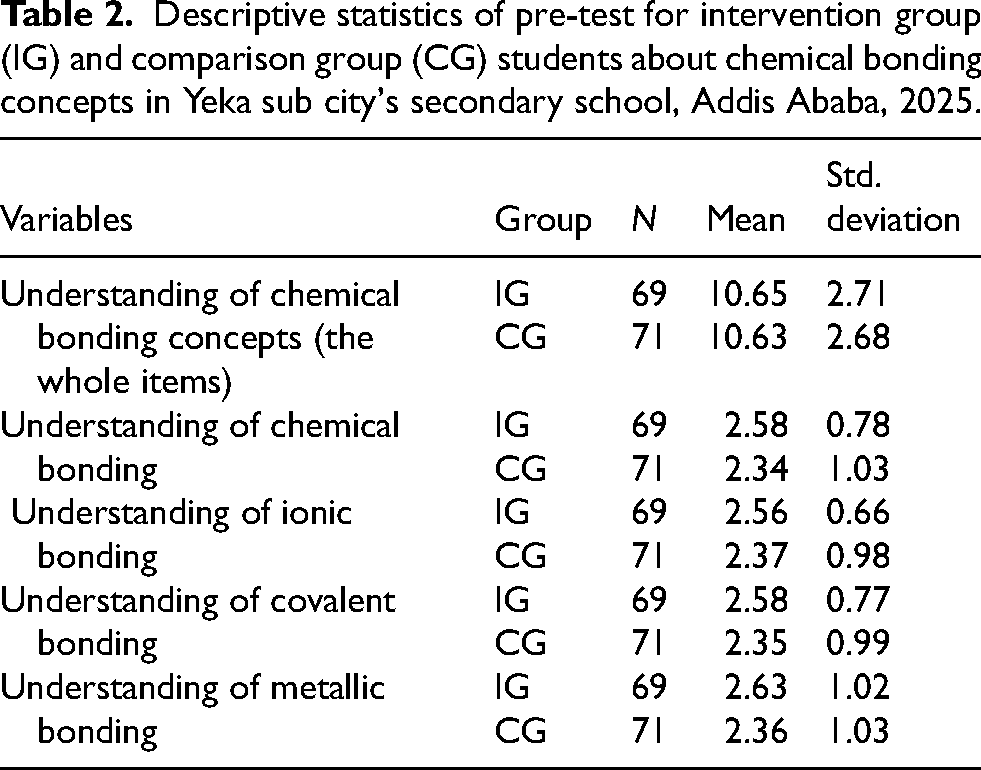
As presented in Table 2, the comparative analysis of pretest scores on understanding of chemical bonding concepts indicates a modest advantage for the Intervention Group (IG), which achieved a mean score of 9.62 (SD = 2.69) across 69 participants, compared to the Comparison Group (CG), which recorded a mean of 9.50 (SD = 2.54) among 71 participants.
Descriptive statistics of pre-test for intervention group (IG) and comparison group (CG) students about chemical bonding concepts in Yeka sub city's secondary school, Addis Ababa, 2025.
Pre-intervention understanding of overall concepts of bonding
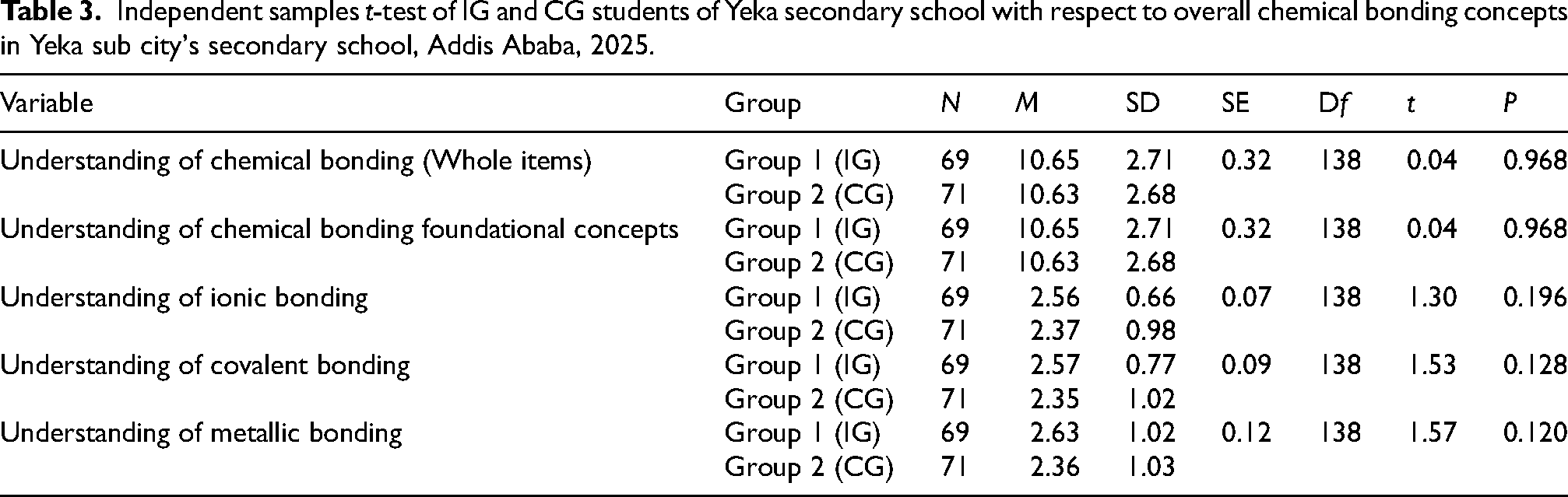
Table 3 indicates that here is no statistically significant difference in the mean scores of students’ comprehension of chemical bonding concepts between the IG and the CG among students in Yeka government SS, according to the independent samples t-test result with (NIG = 69, MIG = 10.65, SDIG = 2.71; NCG = 71, MCG = 10.63, SDCG = 2.68; t (138) = 0.04, p > 0.05). The number of items of chemical bonding concepts was twenty (20). This result suggests that both groups were not different in terms of their understanding of the overall chemical bonding concept before the intervention. In other words, the understanding with respect to the overall chemical bonding concept was similar across IG and CG students at baseline.
Independent samples t-test of IG and CG students of Yeka secondary school with respect to overall chemical bonding concepts in Yeka sub city's secondary school, Addis Ababa, 2025.
Post-intervention understanding of overall concepts of bonding
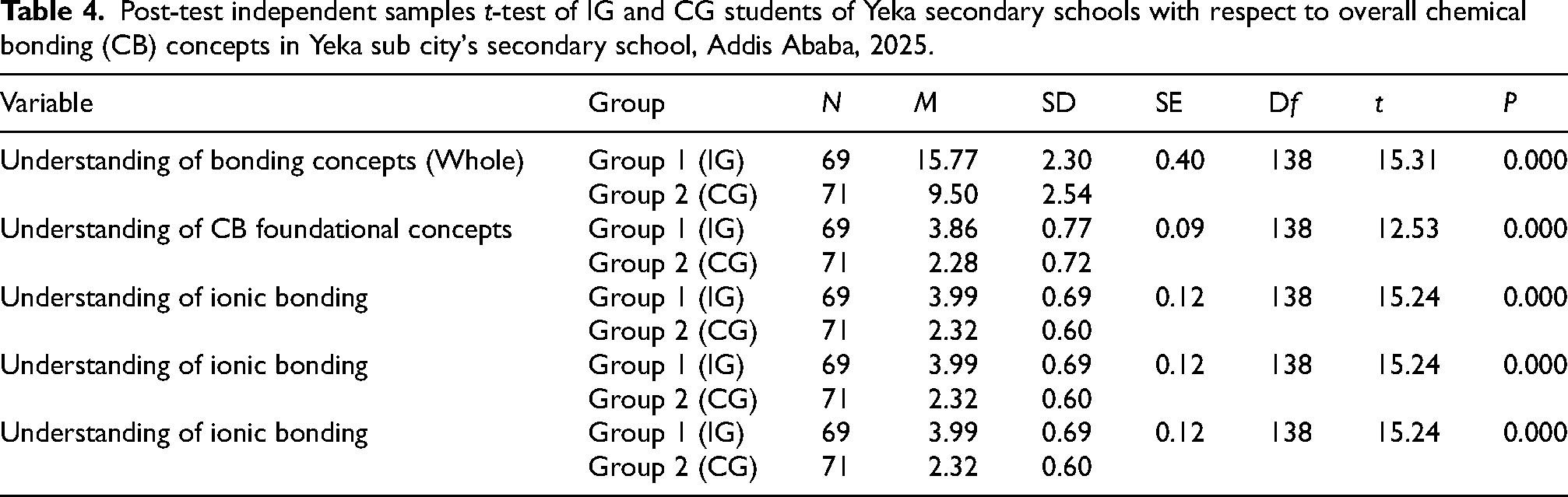
After intervention, the independent samples t-test result presented in Table 4, there is statistically significant difference in mean scores of students’ understanding of overall concepts of bonding between the IG and the CG among students in Yeka government secondary schools (NIG = 69, MIG = 15.77, SDIG = 2.30; NCG = 71 MCG = 9.50, SDCG = 2.54; t (138) = 15.31, p < 0.001).
Post-test independent samples t-test of IG and CG students of Yeka secondary schools with respect to overall chemical bonding (CB) concepts in Yeka sub city's secondary school, Addis Ababa, 2025.
Understanding of chemical bonds by gender
The Table 5 indicated that the independent samples t-test was used to determine whether there was a statistically significant difference in the comprehension of total chemical bond concept scores between male and female students in both the IG and the comparison group (CG) students in Yeka government secondary schools. Regarding gender difference, the independent samples t-test result presented in Table 5, there is no statistically significant difference in mean scores of students’ understanding of bonding concepts between males and females among CG students in Yeka government secondary schools (NM = 32, MM = 919., SDM = 2.50; NF = 39, MF = 9.76, SDF = 2.58; t (69) = −0.94, p > 0.05).
Independent samples t-test of males and females in both IG and CG students of Yeka secondary school with respect to overall chemical bonding concepts, 2025.

Discussions
Descriptively before intervention, the standard deviations indicate that both groups’ performance varied similarly. Additional study, such as doing an independent samples t-test, would be necessary to ascertain the statistical significance of this mean score. Table 2 above shows a slight but significant performance difference between the Intervention Group (IG) and Comparison Group (CG) in terms of their comprehension of chemical bond concepts with the IG (N = 69) achieving a higher mean score of 2.58 (SD = 0.78) compared to the CG (N = 71), which scored a mean of 2.27 (SD = 0.72). The slightly higher standard deviation in the IG indicates more variability in responses. A statistical test, such as an independent samples t-test, would be appropriate to determine whether this observed difference is statistically significant or not. This trend persists across other specific domains: understanding of ionic bonding concepts (IG: N = 69, M = 2.56, SD = 0.66; CG: N = 71, M = 2.31, SD = 0.60), covalence bonding concepts (IG: N = 69, M = 2.86, SD = 0.94; CG: N = 71, M = 2.56, SD = 0.83), metallic bonding concepts (IG: N = 69, M = 2.63, SD = 1.02; CG: N = 71, M = 2.36, SD = 1.03). The relatively close standard deviations across all categories indicate comparable variability in both groups. While the differences are not large, further statistical testing—such as independent samples t-tests—to determine the significance of these observed differences is necessary.
Table 3 indicates, there is no statistically significant difference between the mean scores of students’ comprehension of covalent bonding concepts between the IG and the CG among secondary schools’ students, according to the independent samples t-test result (NIG = 69, MIG = 2.57, SDIG = 0.77; NCG = 71 MCG = 2.35, SDCG = 1.03; t (138) = 1.53, p > 0.05). The number of items of covalent bonding concepts was five (5). This result suggests that both groups were slightly not comparable in terms of covalent bonding before the intervention. In other words, the knowledge and skill levels of the covalent bond were almost similar across IG and CG of secondary students at baseline. In addition, there is no statistically significant difference in mean scores of students’ understanding of metallic bonding concepts between the IG and the CG among secondary schools’ students (NIG = 69, MIG = 2.63, SDIG = 1.02; NCG = 71, MCG = 2.36, SDCG = 1.03; t (138) = 1.57, p > 0.05). The number of items of metallic bonding concepts was five (5). This result suggests that both groups were not different in terms of their self-awareness levels on metallic bonding before the intervention. In other words, the self-awareness with respect to the metallic bond was similar across IG and CG students at baseline.
Moreover, as presented in Table 4, the mean and standard deviation of the intervention group (IG) increased from 10.62 ± 2.69 to 15.78 ± 2.30 after delivering VBL for the overall score of chemical bonding items. That means the mean score for the overall score of chemical bonds’ concepts was increased by 32.46% after the delivery of VBL. Regardless of the percentage, it is consistent with the previous study, which found that active learning leads to an increase of 55% the score of students as compared to those who learnt with a traditional teaching method. 35
According to the independent samples t-test result presented in Table 4, there is statistically significant difference in mean scores of students’ understanding of chemical bonding foundational concepts between the IG and the CG among secondary school students in Yeka government schools (NIG = 69, MIG = 3.86, SDIG = 0.77; NCG = 71, MCG = 2.28, SDCG = 0.72; t (138) = 12.53, p < 0.001). This result indicates that the two groups differed remarkably in their understanding of foundational concepts of chemical bonding following the intervention, with the experimental group—taught using the video-based approach—demonstrating significantly higher scores. The findings indicate that VBL significantly improved Grade 9 students’ conceptual understanding of chemical bonding foundational concepts. These results are consistent with those reported by others (Lodge et al., 2018), whose review highlighted improvements in students’ comprehension of chemical bonding within intervention groups following the implementation of VBL strategies, as compared to peers taught through conventional instructional approaches. The findings of this study also align with those of other similar investigations,33,36 which likewise reported enhanced conceptual understanding.
Also, there is statistically significant difference in mean scores of students’ understanding of ionic bonding concepts between the IG and the CG among secondary students (NIG = 69, MIG = 3.99, SDIG = 0.69; NCG = 71 MCG = 2.32, SDCG = 0.60; t (138) = 15.24, p < 0.001). This finding demonstrates that after the intervention, the two groups’ comprehension of the ionic bond idea varied dramatically, with the intervention group—which was taught using the VBL—showing noticeably higher scores. The results show that Grade 9 students’ conceptual grasp of ionic bonding concepts was much enhanced by VBL. Additionally, the results of this study are consistent with those of previous comparable studies (Chong et al., 2019; Shadreck & Enunuwe, 2017), which likewise reported enhanced conceptual understanding among secondary school students.
Moreover, the independent samples t-test found that there is statistically significant difference in mean scores of students’ understanding of covalent bonding concepts between the IG and the CG among secondary school students in Yeka government schools (NIG = 69, MIG = 4.00, SDIG = 0.73; NCG = 71 MCG = 2.56, SDCG = 0.83; t (138) = 10.93, p < 0.001). This result indicates that the two groups differed remarkably in their understanding of covalent bonding following the intervention, with the intervention group—taught using the VBL—demonstrating significantly higher scores. The finding suggests that video learning had a positive impact on improving students’ understanding of covalent bonding. Also, there is statistically significant difference in mean scores of students’ understanding of metallic bonding concepts between the IG and the CG among secondary schools’ students (NIG = 69, MIG = 3.53, SDIG = 0.75; NCG = 71 MCG = 2.36, SDCG = 1.03; t (138) = 10.41, p < 0.001). This result indicates that the two groups differed remarkably in their understanding of metallic bonding following the intervention, with the intervention group—taught using the VBL—demonstrating significantly higher scores. The finding suggests that VBL had a positive impact on improving students’ understanding of metallic bonding.
This analysis's main conclusion was that the difference between male and female students’ average scores on a chemical bonding score post-test (after a particular intervention or teaching) was insufficient to be deemed statistically significant. Put more simply, the intervention did not have a statistically significant effect on one gender over the other, and the observed difference in scores between males and girls could have occurred by chance. A prior study also reported the same outcome. 37 In this study, the video-based instructional approach appeared to be gender-inclusive, benefiting both male and female students equitably.
Conclusions
This section summarizes the study's main conclusions. The study, which was based on three research objectives and related questions, looked at how VBL affected ninth-grade students’ conceptual grasp of chemical bonding at secondary schools located in Yeka Sub-City, Addis Ababa. The mean scores for foundational bonding ideas, ionic bonding, covalent bonding, and metallic bonding concepts did not differ statistically significantly between the Intervention Group (IG) and the Comparison Group (CG) according to pre-intervention data. Therefore, the study advised that VBL is more effective than conventional techniques at improving students’ comprehension of chemical bonding. In order to improve students’ conceptual skills, schools are urged to explicitly include video-based teaching techniques into secondary chemistry curricula, especially in collaborative, team-based learning environments.
The study advised that since chemical bonding movies must be used in accordance with national educational standards, instructional durations, and technological accessibility, integration to be successful. The study's conclusions emphasize the necessity of organized execution and additional investigation. As a result, stakeholders (teachers and schools) are urged to expand the application of VBL beyond chemical bonding, especially in disciplines where learning outcomes can be greatly improved by visual and conceptual reinforcement. Given the limited duration of the current quasi-experimental study, the long-term effects of VBLon student outcomes remain unexplored. Future research should adopt longitudinal designs to evaluate the sustained impact of Video-Based learning (VBL) on students’ conceptual understanding, skill, and behavioral development in chemical bonding and other concepts over extended period.
Footnotes
Acknowledgments
We acknowledge the secondary schools and students who participated on this study

Authors’ contributions
AHA, WB and ET developed the idea, conceptualized, theorized the evidences. AHA, WTT, and WB gathered the data from the selected hospitals, analyzed data, validated, visualized the data. AHA, WTT, ET, WB and STT compiled data, wrote and edited the manuscript. All authors contributed for this final paper.
Funding
The authors received no financial support for the research, authorship, and/or publication of this article.
Conflict of interest
The authors declared that the study was carried out without any financial or commercial ties that might be interpreted as a conflict of interest
Data availability statement
The datasets presented in this article
Publisher's note
This article's assertions are entirely the authors’ own and do not necessarily reflect those of the publisher, editors, reviewers, or their related organizations. The publication does not guarantee or promote any product that may be reviewed in this article or any claim made by the publisher.