




Abstract
The EU framework agreements on telework and work-related stress are non-legally binding European social partner framework agreements that were to be implemented in Member States in accordance with national ‘procedures and practices’ for social dialogue. In a study of the implementation of the agreements in Denmark and the UK, this article finds that the national ‘procedures and practices’ implementation clause was fragile and subject to misinterpretation by national actors, and that the implementation of the agreements added little in terms of substantive effect to policy contexts in Denmark and the UK.
Introduction
The EU framework agreements on telework and work-related stress concluded in July 2002 and October 2004 represent a new form of European governance. They were the first two autonomous European-level agreements to be implemented by the social partners’ national and European affiliates within three years of the date of signature via the non-legally binding ‘procedures and practices specific to management and labour and the Member States’ implementation route. This is the first implementation route that was set out in the Social Protocol annexed to the Maastricht Treaty in 1992 and is now part of the social policy provisions of the Treaties at Articles 151 to 156 TFEU, that gave the European-level social partners the right to conclude European-level collective agreements. The second implementation route, whereby the agreements concluded are implemented as European directives via Council Decision, was the form in which the three inter-sectoral level framework agreements of the 1990s, on parental leave (1995), part-time work (1997) and fixed-term work (1999), were implemented. The key distinction between the two implementation routes is that the second is legally binding, whilst the first is non-legally binding.
The aim of this article is to highlight the problems associated with the non-legally binding implementation route chosen for the framework agreements on telework and work-related stress. This article pursues a twofold approach to the non-legally binding framework agreements and their implementation. The merits of this dual approach are that both the procedural and substantial dynamics (and the interplay between the two trends) of the agreements and their implementation will be focused upon, thus allowing greater scope to appraise the extent of the influence that the agreements exerted in the Member States.
The first part of this approach lies in an investigation of the ‘procedures and practices specific to management and labour in the Member States’ implementation clause. This focus has been chosen because it is the sole criterion by which European-level actors may insist on the national implementation of their agreements. Without the existence of the national ‘procedures and practices’ clause, the agreements on telework and work-related stress would have assumed the status of entirely voluntary agreements, in turn subject to whatever form of implementation national affiliates saw fit. It is thus crucial that the ‘procedures and practices’ implementation clause is both viable and respected at the national level, and this article will discuss the extent to which this is the case.
The second part of the approach consists of an examination of the substance of the framework agreements on telework and work-related stress and their relevance to national-level policy agendas. The issue of the quality of the content of the framework agreements is crucial. Should it be concluded that the agreements on telework and work-related stress offered a dubious level of added value to national actors, then not only would this indicate a weak EU-level instrument, but it would also severely impair the extent to which national systems had been ‘Europeanized’ via the EU-level framework agreement, thus undermining part of the rationale for EU-level collective agreements.
In line with these two concerns, this article seeks to answer the two following questions:
1. Is implementation via national ‘procedures and practices specific to management and labour and the Member States’ a viable alternative to the legally binding implementation route?
2. Did the content of the telework and work-related stress agreements add regulatory value to national systems of industrial relations?
The article seeks to answer these questions through a study of the implementation of the agreements in two Member States with substantially different systems of industrial relations: Denmark and UK. Denmark was selected as an exemplar of a Nordic system where the importance of the state is low, the role of the social partners in regulating industrial relations autonomously is pivotal, and trade union density rates are high. The UK was selected to exemplify a system with decentralized collective bargaining, lower trade union density and little tradition of inter-sectoral collective bargaining.
The study is based on 29 semi-structured research interviews with representatives from social partner organizations and public authorities in Denmark and the UK and at the European level, conducted between September 2006 and March 2007. Six interviews were conducted in the UK, 12 in Denmark, and 11 at the European level. Officials were identified on the basis of their proximity to the process of the implementation of the agreements. Substantial documentary data were also collected from relevant organizations in the course of the fieldwork. Interviews were transcribed, coded and analyzed using qualitative data analysis software.
This article has four sections. After the introduction (I), a review of the literature regarding the European social dialogue is set out (II). The implementation of the two agreements in the UK and Denmark is then examined (III). Finally, a conclusion is offered (IV).
The European social dialogue: perspectives in the literature
High levels of scholarly attention were bestowed on both the new procedural rights granted to the European social partners to conclude EU-level collective agreements under the terms of the Social Protocol, and the three directive backed social partner framework agreements that followed. The debates focused upon the robustness of the new procedural machinery (Falkner, 1998; Jensen et al., 1999) and the quality of the agreements themselves (Keller and Bansbach, 2001; Falkner, 1998). Keller (2003) identified two schools of thought within the literature: the Euro-pessimist school and the Euro-optimist school. The latter were broadly positive about the European social partners’ new procedural rights and the output of this process. Arguing for the deep political significance (Falkner, 1998; Welz, 2008) of the development of such rights and the substantial quality of the three framework agreements themselves (Falkner, 1998), the ‘Euro-optimist’ school contended that the policy processes associated with the European-level social dialogue signified the Europeanization of national systems. The ‘Euro-pessimist’ school was rather less optimistic about the process. This group of scholars highlighted the limited quantitative output (Keller and Bansbach, 2001; Keller, 2003) of the procedure, the likelihood that the agreements would not add significantly to national-level rights and the formidable structural and political barriers (Streeck, 1994; Keller and Bansbach, 2001) to the conclusion of framework agreements at the European level. For writers like Streeck and Keller, the European-level social dialogue was symptomatic of a fragmenting or Americanizing set of national systems in which the social aspect of European integration was severely lagging behind the economic aspects.
Some research exists on the implementation of the telework and work-related stress agreements. Many of the studies that do exist are broadly pessimistic. Larsen and Andersen (2007), in a study of the implementation of the telework agreement across Member States, contended that the national implementation that had occurred had reflected the logic of ongoing ‘power games’ between national social partners rather than those of actual national ‘procedures and practices’. Deakin and Koukiadaki (2008), in their study of the implementation of the telework agreement in five Member States, found that the ambivalent nature of the national ‘procedures and practices’ implementation clause inspired ad hoc implementation outcomes and that the weak nature of the agreement meant that little in terms of new regulation was offered to national contexts. Ertel et al. (2010) concluded that the use of the non-legally binding implementation method was problematic in the light of the diversity of national industrial relations practices and the weakness of social dialogue structures in several Member States.
Parallel to the work that has been conducted on the efficacy of European ‘soft’ law, a body of research has also been carried out that studies the effects of legally binding EU directives in Member States. Many of these studies (Hix, 2005) have demonstrated that ‘hard’ European law has a major effect upon regulatory frameworks in Member States. The most relevant work with respect to the social dialogue is Falkner et al.’s study (2005) of the implementation of six EU social policy directives in the EU-15 Member States. Falkner et al. found that the directives in question had actually imparted comprehensive new rights to national systems of social and employment regulation. In a mere four cases out of the 91 studied were all of the terms of the relevant directive already present within a national system. In the vast majority of cases then, the directives imparted at least some new rights to national contexts. This would seem to refute the suggestion of Euro-pessimists such as Streeck (1998) that the potential of the European level to impart major new employment rights to national contexts is limited.
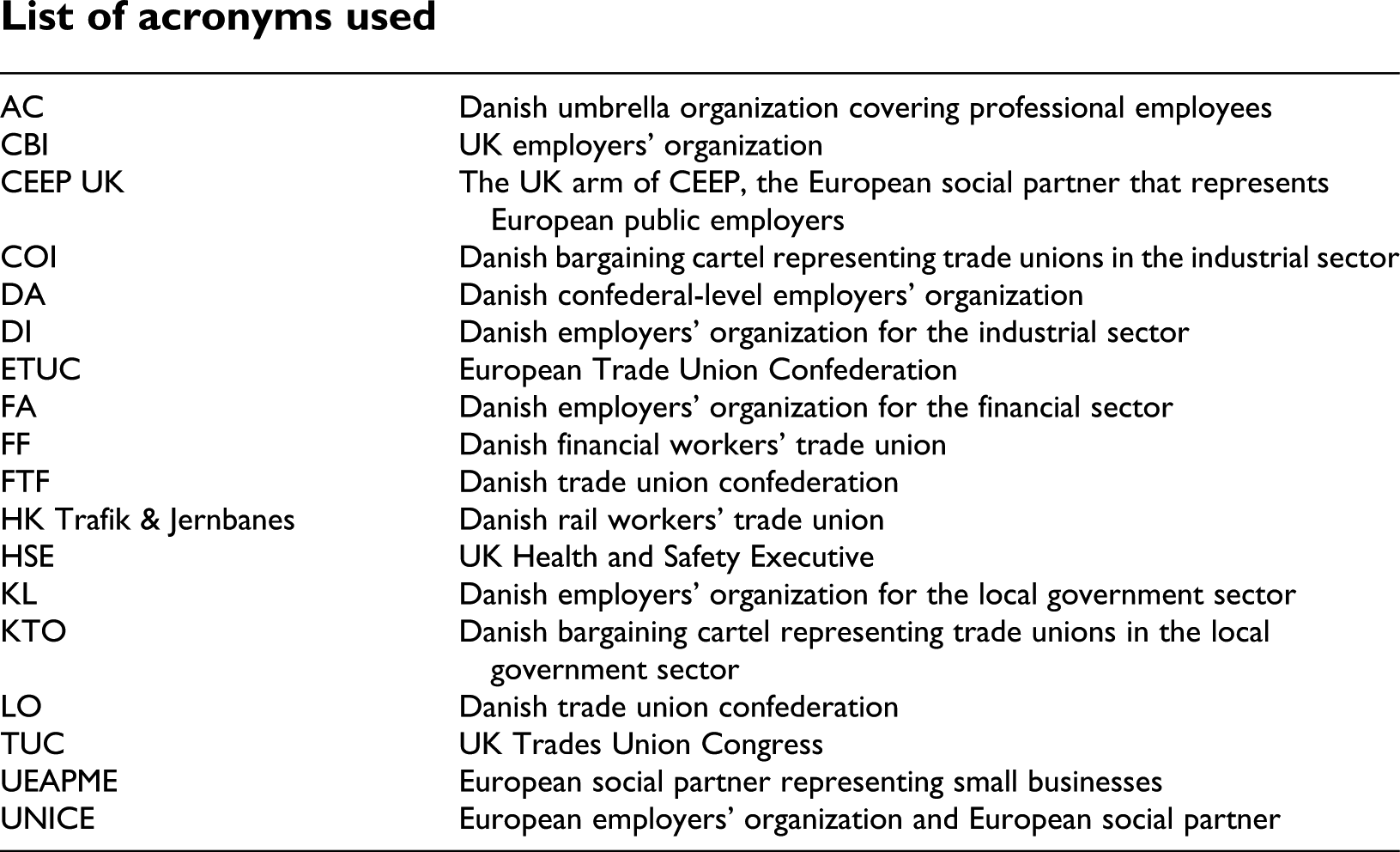
List of acronyms used
The implementation of the framework agreements on telework and work-related stress in the UK and Denmark
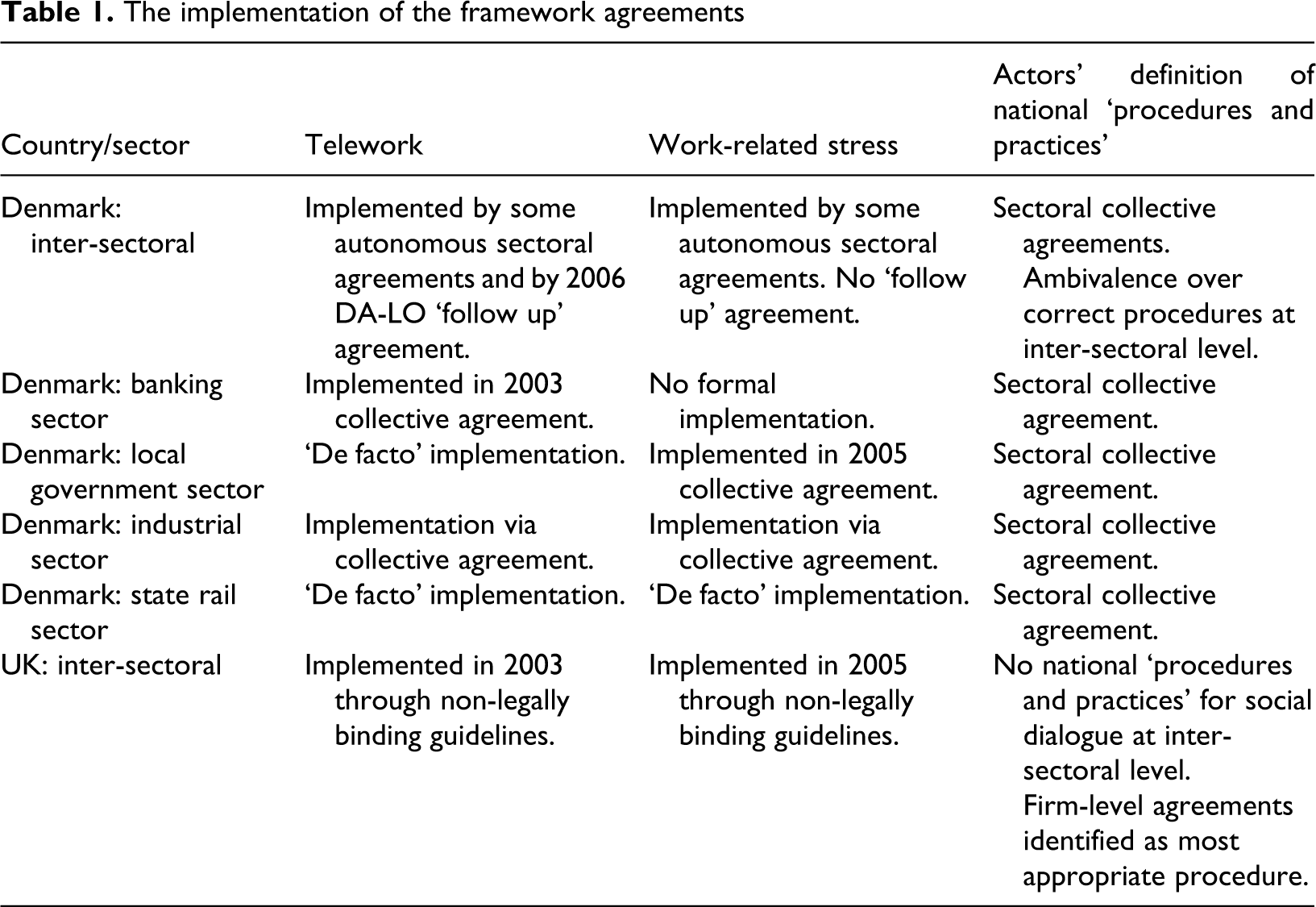
In this section, the implementation of the framework agreements on telework and work-related stress in the UK and Denmark will be discussed. Table 1 gives a summary of how the agreements were implemented in these national contexts. In line with the article’s twofold approach, the section will be divided into (1) debates about national ‘procedures and practices’ and (2) the relevance of the content of the framework agreements to national contexts.
The implementation of the framework agreements
National ‘procedures and practices’
At the European level, the European Trade Union Confederation (ETUC) were the most rigorous proponents of the view that the framework agreements on telework and work-related stress be implemented in accordance with national ‘procedures and practices’. An ETUC official argued that ‘effective’ implementation consisted of two strands: (1) the use of the normal national procedures to implement the agreements, and (2) the use of the normal national legal means to implement the results of those procedures. European-level employers espoused a different line. Their view was that implementation is solely a matter for national social partners, and that satisfactory implementation of European agreements consists of the joint presentation to the European level of the results of national implementation by both sides of industry. A UEAPME (European Association of Craft, Small and Medium-sized Enterprises) representative contended that this was in keeping with the subsidiarity principle of European governance, and that this approach also allowed national social partners the flexibility to adopt solutions that were appropriate for their national contexts. All EU-level interviewees recognized the problems inherent in extending the national ‘procedures and practices’ implementation benchmark to the new Member States. As was acknowledged, social dialogue procedures are at a very youthful stage of development in these states, and it is thus exceptionally difficult to identify national ‘procedures and practices’ by which to gauge implementation.
United Kingdom
There are no, or at the most very few, traditions of inter-sectoral level social dialogue in the UK that cover the whole of the private labour market. An abortive incomes policy involving the UK employers’ association, the Confederation of British Industry (CBI), and the TUC was attempted in the 1970s, yet was derided by contemporaries and subsequent commentators as ‘beer and sandwiches at number ten’ (No. 10 Downing Street being the official residence of the UK prime minister). Bargaining takes place between employers and unions at the national sectoral level in areas of the public sector, yet industrial relations in the UK is largely characterized by decentralized relations between management and unions where there is a trade union presence. There are thus no discernible national ‘procedures and practices’ involving all of the UK parties that were signatory to the European agreements on telework and work-related stress. In the absence of procedures for the conclusion of national inter-sectoral agreements, the UK social partners implemented the framework agreements on telework and work-related stress as non-legally binding guidelines. The UK social partner Telework Guidance and Work-Related Stress: A Guide thus impart no new obligations on employers and should be considered as very ‘soft’ forms of implementation when compared to the activity carried out in other Member States (ETUC et al., 2006). A variety of creative interpretations were offered however with regard to what, in the absence of robust national social dialogue structures, could be taken to constitute national ‘procedures and practices’ in the UK. A TUC official cited the example of the 2003 UK social partner framework agreement on information and consultation, yet added that this was a largely isolated example, and did not, along with the implementation of the framework agreements on telework and work-related stress, herald the onset of a new era of UK national-level social dialogue. A CBI official identified the informal dialogue that the CBI conducted with the TUC as an example of regular association that the organizations had prior to the implementation of the telework agreement in the UK, and mentioned a report issued by the parties on skills and productivity years earlier. The CBI and TUC have also aided the British government in the implementation of the EU Information and Consultation Directive (Larsen and Andersen, 2007); this being another example of the very limited degree to which national-level social dialogue exists in the UK.
None of the parties regarded these instances as comprehensive or exemplary however, and the UK implementation of the framework agreements on telework and work-related stress thus took place in the shadow of the country’s liberal employment relations machinery. The positions of the parties to implementation, although also heavily bound up, as will be argued below, in the issues addressed by the agreements and their non-legally binding nature, may be seen as attempts to accommodate themselves to this. Various different implementation strategies were suggested by the parties to implementation, all apparently based on what, in the absence of discernible national ‘procedures and practices’, the parties to implementation regarded as the most consistent with the issues addressed by the framework agreements. The TUC advocated implementing the Telework Agreement via an inter-sectoral collective agreement. The CBI firmly opposed such an implementation route, and advocated the production of a set of guidelines for the implementation of both the telework and work-related stress agreement. This position sprang from the view that creating new institutional machinery to implement the European agreements would have been disproportionate to the issues addressed, and would also not be consistent with the non-binding nature of the two agreements. The position of the CBI was also, according to a TUC official, trenchant with regard to the implementation of the telework agreement. The organization was ‘quite difficult’ during the implementation process, bluntly refused anything that was called an ‘agreement’, and also disliked the use of the term ‘social partners’. These findings accord with Larsen and Andersen’s (2007) account of this process, although these authors also found that the CBI had threatened to walk out during negotiations rather than sign a UK national agreement on telework.
CEEP UK, the UK affiliate of the European public sector employers’ association European Centre of Employers and Enterprises providing Public services (CEEP), also advocated the production of a set of guidelines for both the telework and work-related stress agreements. As was the case with the CBI, CEEP UK based their implementation strategy on the recognition that there were no discernible national social dialogue structures in the UK and subsequently advocated a practical route that they regarded as most appropriate for the issue at hand. A representative of the organization contended that the group formed to implement both of the European agreements represented ‘ad hoc’ machinery and was very unlikely to become part of the permanent institutional scenery in the UK. As with their employer counterparts, the TUC’s preferred implementation strategy for the implementation of the telework agreement in the UK was not based on a precedent for such an arrangement, and sprung from what the organization regarded as the most appropriate means to manage the issue at hand. A TUC official asserted that the organization would have preferred the conclusion of an ‘agreement’ on telework rather than ‘guidelines’. According to the representative, an ‘agreement’ would have had a harder edge to it, would have had greater potential to inspire negotiations at lower levels and would have also involved the UK social partner organizations consulting with their members over implementation. The organization did not pursue this implementation strategy with great vigour however, and was quite willing to cede to the CBI’s demands on many of the points at issue. A TUC interviewee contended that this was because the organization did not see telework as a greatly pressing issue.
Denmark
Denmark has a century-long history of national-level dialogue between employers and organized labour (Due and Madsen, 2008). The primary level of collective negotiations between the parties moved from the national inter-sectoral level to the national sectoral level in the late 1980s, but the inter-sectoral social partners, primarily DA and LO but also AC and FTF, the confederation of trade unions for professional employees, still play a key role in concluding cooperative agreements covering workplace representation and coordinating wage demands across sectors (Due and Madsen, 2008). The Danish system is therefore a prime example of the type of system that Keller (2003) had in mind when he asserted that the framework agreements would only be implemented ‘effectively’ in states with integrated bargaining tiers.
The inter-sectoral trade union federations LO and FTF were explicit as to what constituted national ‘procedures and practices’ in Denmark. Interviewees from both organizations contended that collective agreements between the social partners in Denmark at the relevant levels was the only interpretation possible of such an implementation clause, and it was also argued by LO that the interpretation did not differ from issue to issue, but was applicable to whatever the topic of the framework agreement was. The interpretation of national ‘procedures and practices’ as constituting collective agreements was also prevalent amongst trade unions at the Danish sectoral level. Representatives from several sectoral trade unions all contended that collective agreements between the social partners at the sectoral level was the normal procedure for the management of industrial relations in their sector, and there was no distinction made on the basis of the issue at hand. AC advocated a slightly less orthodox view of Danish national ‘procedures and practices’ and contended that, given that their organization had signed the framework agreement on telework at the European level along with DA, then a collective agreement should be concluded between AC and DA in Denmark. This was despite the fact that there was no precedent for this in Denmark. Interpretations of national ‘procedures and practices’ differed on the employer side. Regarding the issue of a collective agreement with AC to implement the telework agreement in Denmark, DA contended that since there was no precedent for this in Denmark, it was not incumbent upon them to enter into such negotiations. Arguing that the tradition for members of AC was the conclusion of individual contracts with employers, DA asserted that to sign a collective agreement would not be in keeping with Danish traditions. The positions of both parties are probably best ascribed to the ‘power games’ that Larsen and Andersen (2007) described as occurring between national social partners when implementing European agreements. The key concern that Danish employer associations had with the national ‘procedures and practices’ implementation clause however lay in the varying nature of the issues dealt with by the agreement. Interviewees advanced several arguments to bolster this position. The sectoral employers’ association Dansk Industri (DI) asserted that implementation methods should be decided on the basis of the issue tackled by the European agreement, rather than by a rigid definition of what constituted ‘procedures and practices’ in Denmark. It was further noted that the topic of work-related stress was not ‘normally’ handled by the industrial sector social partner organizations DI and COI, and that, as a topic, work-related stress belonged more naturally in a cooperative agreement. A similar point was made by the local government employers’ association KL. A representative from this organization stated that, in the case of their sector, the implementation of the work-related stress agreement had been via the sectoral cooperative agreement rather than a traditional collective agreement given that the issue lay in ‘the grey area between work environment and traditional collective agreements’.
Implementation on the basis of issue rather than on the basis of national ‘procedures and practices’ was also the position of the employers’ confederation DA. A representative summarized,
‘We will deal with [European agreements] from issue to issue. We are not automatically in favour of social dialogue … We do not need to implement the Work-related Stress agreement as we did the telework agreement because what is in the agreement is already covered by Danish legislation.’
Whilst the implementation of the telework and work-related stress agreements in Denmark was based on a consensual reading of national ‘procedures and practices’ by the social partners in many cases, several disputes stemmed from these diverse interpretations of national ‘procedures and practices’. Of particular note was a long-running dispute between AC and DA over the implementation of the telework agreement. According to an AC representative, a letter was sent by AC to DA soon after the conclusion of the telework agreement requesting that the parties enter into collective negotiations to implement the agreement in Denmark. A subsequent reply was received by AC stating that DA were ‘considering what to do’, but nothing was announced by DA after that. Nor was there ever any agreement between DA and AC. Also remarkable is the long tussle between LO and DA over the implementation of the telework agreement. Here, the issue was the form that the LO-DA ‘follow up’ agreement to cover those sectors of the labour market that had not implemented the agreement would take. LO advocated a ‘harder’ route that would be incorporated into the parties’ cooperative agreement, whilst DA pushed for the production of a set of guidelines. An eventual compromise was only reached in the autumn of 2006, and with regard to this article’s argument about the shifting nature of national ‘procedures and practices’ it is of note because it was implemented in the DA-LO cooperative agreement in a manner that had not been done before.
In summary, the constitution of national ‘procedures and practices’ for social dialogue was a contested one both in the UK and Denmark. In the UK, there was no common definition of national ‘procedures and practices’ for social dialogue. UK employers’ associations thus argued for implementation via non-legally binding guidelines whilst the TUC advocated implementation via a national collective agreement. In Denmark, although the Danish trade union movement interpreted national ‘procedures and practices’ as collective agreements, Danish employers’ associations advocated an interpretation based on the issue at hand. This led to debates over suitable implementation routes between the employers’ association DA and the trade union confederations AC and LO.
The relevance of the content of the framework agreements on telework and work-related stress to national contexts
The UK
There were varying levels of interest in the European agreements on telework and work-related stress in the UK, and this ambivalent level of interest reinforced the drift towards ‘ad hocery’ that had been initiated by the absence of national social dialogue ‘procedures and practices’ in the country. A TUC official stated that teleworking had not been a big issue for the TUC, and contrasted the modest level of concern that the organization had over the teleworking issue with the high levels of concern regarding the part-time work and fixed-term work issues. This lack of interest was justified by the fact that teleworkers generally had a strong position on the labour market as a group of workers, that the topic was largely covered by existing legislation on health and safety and discrimination, and that the organization received little information from their members over problems regarding teleworking and its practice. The TUC’s ‘reasonably easy’ approach to the implementation of the agreement in the UK and their willingness to accept the CBI’s demand for guidelines rather than an agreement was also attributed to the fact that the topic of teleworking was not a priority for the TUC. British employers’ associations firmly espoused the view that the topic of telework was not fitting for legal regulation. A CBI official noted that the issue was on the employers’ agenda when the agreement was implemented in the UK, yet nevertheless argued that the issue called for the use of a non-legally binding implementation route. Part of the justification given for this approach was that the right to telework was often an employee, rather than an employer, demand. It was also argued that teleworking was an unsuitable topic for legal regulation due to the fact that teleworkers were already covered by existing health and safety legislation and other legislation covering other aspects of the employment relationship. Judging by the extent to which the social partners’ Telework Guidance referred to existing legislation, this appears to have been the general consensus. A CBI interviewee also stated that an area such as part-time work was more suitable for legal regulation given the number of female part-time workers and the increasing proliferation of sex discrimination laws, but that an issue such as teleworking was not suitable for such an implementation. A similarly low level of interest appears to have been exhibited towards the European agreement on work-related stress in the UK. Whilst an audience did exist for the agreement in the country, the degree and form of this interest proved inadequate to stimulate lively debates over the constitution of national ‘procedures and practices’ in the UK, prejudiced as it were by the belief that the issue of work-related stress was most suitably managed via ‘soft’ means. As with the telework agreement, British employers argued that work-related stress was largely covered by existing legislation and was also unsuitable for ‘harder’ forms of regulation given the subjective nature of the phenomenon of stress. The UK social partner text Work-Related Stress: A Guide was apparently well received by firms and unions. Larsen and Andersen found that a re-print had been required to meet the demand for the text (2007). This popularity, however, appears to have been compromised by the non-binding nature of the UK text, the strength of the European agreement (Larsen and Andersen, 2007), the existence of prior legislation on the topic, and by the publication of more high-profile voluntary guidelines on work-related stress by the HSE.
Denmark
The topics of telework and work-related stress had been substantially addressed in Denmark prior to the conclusion of the European agreements. There are various exceptions however. One such example lies in the local government sector. Here, despite an awareness of the problems caused by work-related stress, the issue of work-related stress had not been managed before the implementation of the European agreement in the sector. The implementation of the European agreement subsequently became a reasonably high priority for the social partners in the sector, and the implemented agreement was subject to a series of promotions by the sectoral trade union organization KTO. Elsewhere at the Danish sectoral level the topics of telework and work-related stress were the focus of substantial previous regulation. In the industrial sector, a representative from the sectoral employers’ association DI stated that the topic of teleworking had been largely addressed by a 1998 collective agreement on distance working. The contents of this agreement had not been dissimilar to the European agreement, therefore making the implementation of the agreement in the sector an uncontroversial affair. A similar picture prevailed in the finance sector. Here, a 1997 agreement on distance working had also been concluded prior to the European agreement. Officials from the sectoral trade union FF and the employers’ association FA therefore questioned the degree of impact that the implementation of the European agreement, via an annex in the sectoral collective agreement, had achieved. The pattern reoccurred in both the railway sector and the local government sector. In the latter case, a union representative from the sector argued that the 1998 teleworking agreement concluded in the sector had been superior to the European agreement in the quality of rights granted to teleworkers, and that the sectoral employers’ association KL had attempted to lower the standards of rights in the Danish agreement during the implementation of the European agreement. In the railway sector, a HK Trafik & Jernbanes official reported that the degree of added value implied by the implementation of the European agreement was very low given the work previously done.
The trend for existing work to cover the contents of the European agreement, clear in the case of the implementation of the telework agreement, was also manifest at the sectoral level in the implementation of the work-related stress agreement. In the finance sector, a degree of work on work-related stress had occurred that, according to interviewees from both sides of industry, exceeded the contents of the European agreement. This led to a scenario where both parties saw no need to implement the European agreement. In the railway sector, an interviewee from the sectoral trade union HK Trafik & Jernbanes reported that the contents of the European agreement on work-related stress had been more than fulfilled through previous work in the sector. The sectoral-level social partners offered the same prognosis. A DA official reported that telework was largely covered by existing agreements in Denmark, with which an AC interviewee concurred. On the work-related stress issue, inter-sectoral level interviewees offered the view that the issue was largely covered by existing health and safety legislation. As a result of this degree of previous work, the social partners in Denmark were sometimes critical of the level of content of the European agreements on telework and work-related stress. The case of the implementation of the telework agreement in the local government sector illustrates this point. In this instance, KTO, the union cartel for the sector, accused KL, the employers’ association, of trying to downgrade sectoral standards on teleworking via the implementation of the European agreement. This scenario thus stemmed from the perceived inferior content of the European agreement on telework in relation to existing regulation in Denmark. With regard to the issue of work-related stress, what is particularly remarkable is that the topic enjoys no small degree of importance in both the UK and Denmark. In the Danish context, various studies (European Foundation, 2005) have been conducted highlighting the large scale of the issue and a substantial volume of work has been done at the sectoral level to attempt to manage the issue. A 2005 Eurofound survey revealed that work-related stress was both widely prevalent and on the rise in Denmark, whilst sectors such as rail and finance have in recent years pioneered new approaches to the phenomenon in a bid to tackle what is regarded as a growing and serious problem in the sectors. This recognition that work-related stress was an issue of great concern fed into a critique of the content of the European agreement which was generally regarded by Danish interviewees as inadequate. The trade union confederations were particularly vocal. An LO official reported that his organization had held low expectations for the content of the agreement at the European level, and regarded the eventual agreement as ‘very softly drafted’ and with little to offer in terms of added value to the Danish trade union movement. It was also added that the weak drafting of the agreement would impair efforts by unions in Denmark to implement the agreement, given that there was little in the agreement that unions could specify as direct obligations on employers that stemmed from the European-level agreement. On the employers’ side, a DA official also asserted that the European agreement on work-related stress implied no new obligations for employers in Denmark, and would be best used in the future as an awareness-raising tool. Trade unions in the railway and finance sector shared this set of concerns.
In summary, both agreements generally failed to impact upon the quality of national regulation in the countries studied. In the UK this was because there were modest levels of interest in teleworking and work-related stress and the topics were also the subject of pre-existing regulation. In Denmark, although the agreements had an impact in some sectors, the content of the agreements was typically present in existing regulation and social partners generally considered the strength of the agreements weak.
Conclusions
In conclusion, the answers to the questions this study has addressed are rather pessimistic. With respect to the viability of the national ‘procedures and practices’ implementation clause, there are good reasons for regarding this implementation method as a fragile one. The first reason is that many states have very under-developed national ‘procedures and practices’ that relate to national sectoral-level social dialogue. One such example is the UK, where precedents for national-level social dialogue are exceptionally limited. In this article’s research, it emerged that ambivalence over UK national ‘procedures and practices’, along with modest interest in the issues addressed by the EU agreements, led to implementation of the European agreements that was largely improvised. Another example of countries with under-developed national ‘procedures and practices’ for social dialogue can be found in many of the new Member States that acceded to the European Union in 2004. The youthful nature of their social dialogue structures is a familiar point in the literature (Vaughan-Whitehead, 2003), and it is thus arduous to specify implementation via national ‘procedures and practices’ where these ‘procedures and practices’ are far from prominent. Even in those states where there are traditions of inter-sectoral social dialogue, the identification of correct national ‘procedures and practices’ may often be far from the subject of consensus. In Denmark, for example, it emerged that there were competing interpretations as to the constitution of national ‘procedures and practices’ at the inter-sectoral level.
A second problem with the national ‘procedures and practices’ implementation clause is that interpretations of national ‘procedures and practices’ are likely to vary in relation to the topic and content of the European agreement. It emerged that national actors were often inclined to decide on an implementation route consistent with the content of the European agreement, rather than one based on a reading of national ‘procedures and practices’. This was the case in Denmark and the UK.
With respect to the article’s second question, it must be concluded that the agreements only added very modest regulatory value to national systems of industrial relations. In Denmark and the UK, the agreements only inspired a limited amount of interest from national actors, in many cases were viewed as addressing somewhat peripheral issues that are already effectively regulated at the national level, and were sometimes regarded as overtly weak to offer comprehensive solutions to the problems that they set out to address.
Although the two agreements are innovative and help to build structures for autonomous European social partner social dialogue, it is consistent with the article’s findings to argue that the framework agreements on telework and work-related stress represent quite dubious modes of European social partner governance. Whilst it would be a gross overstatement to contend that these findings are symptomatic of an unravelling or ‘Americanizing’ of Social Europe in the post-enlargement era, the data collected seem to suggest that European-level developments have taken a turn towards both (1) greater procedural fragmentation via the national ‘procedures and practices’ implementation clause and its difficulties, and (2) weaker substantive content through the tendency of the agreements on telework and work-related stress to offer national actors little in the way of virgin content. This will be of concern to those seeking to create a robust Social Europe. Recent strains have been placed on Social Europe through enlargement of the European Union (Meardi, 2002), recent European Court of Justice case-law, and the European Commission’s increasingly neoliberal attitude towards social policy (Schömann, 2011). Although there has perhaps never been a greater need for strong EU-level governance in the industrial relations sphere given these trends, the European social dialogue’s efficacy appears to be retreating at precisely such a moment.
This broadly pessimistic verdict requires a few qualifications however. First, whatever their efficacy in the UK and Denmark, the telework and work-related stress agreements play an important role in developing social dialogue structures both at the level of the EU and in new Member States. Research conducted by the European social partners and the European Commission demonstrates that the agreements play an important function in this respect (ETUC et al., 2006; Visser and Martin, 2008). Research also demonstrates that the effects of the framework agreements were greater in other European countries. Although other studies that look at the implementation of the agreements in other countries and sectors (Deakin and Koukiadaki, 2008; Prosser, 2011) report pessimistic results that are broadly similar to this article’s, certain instances of successful implementation have been found in other national and sectoral contexts. This is particularly the case in new Member States. In these countries, as with the implementation of the work-related stress agreement in the Danish local government sector, the fact that the topics of telework and work-related stress were rarely subject to prior regulation meant that the European agreements often had significant effects (Prosser, 2011).
A further qualification is that the conclusion of a non-legally binding framework agreement on a weighty issue that added substantial value to national contexts could significantly enhance the prospects of the non-legally binding implementation route. This article’s critique of the agreements on telework and work-related stress and their implementation centred on both the limited added value of the agreements and the fact that this limited added value reinforced ambivalence over national ‘procedures and practices’. Although the other problems identified with the national ‘procedures and practices’ implementation clause would remain should an agreement be reached on an area of key concern to national actors, such an agreement would be far more likely to add value to national regulation and would also be likely to trigger more vigorous debate about the constitution of national ‘procedures and practices’. Furthermore, the ETUC’s continued commitment to the EU-level dialogue means that the organization has some level of political clout at the European level, and that the social dialogue ball is kept rolling. The latter point is vital, for if a key issue were to turn up on the European agenda then the organization would still have the use of the social dialogue procedures to manage effectively such a topic. European agreements such as those on telework and work-related stress also play an indispensable role in inculcating national actors with an EU-level outlook. Should the EU level cease to conclude such agreements, then trends towards the primacy of national-level regulation of employment relations would gain even greater impetus.
Footnotes
Acknowledgements
I would like to thank the interviewees who participated in the project and my PhD supervisors Paul Marginson and Guglielmo Meardi. I would also like to thank everyone at the FAOS Research Institute at Copenhagen University, where I was based whilst writing a draft of this article. Particular thanks should go to Søren Kaj Andersen and Trine Pernille Larsen, whose comments and advice were invaluable.
Funding
This work was supported by the Economic and Social Research Council of the United Kingdom [grant number: PTA-031-2004-00323].